An Unlikely House of Ill-Repute
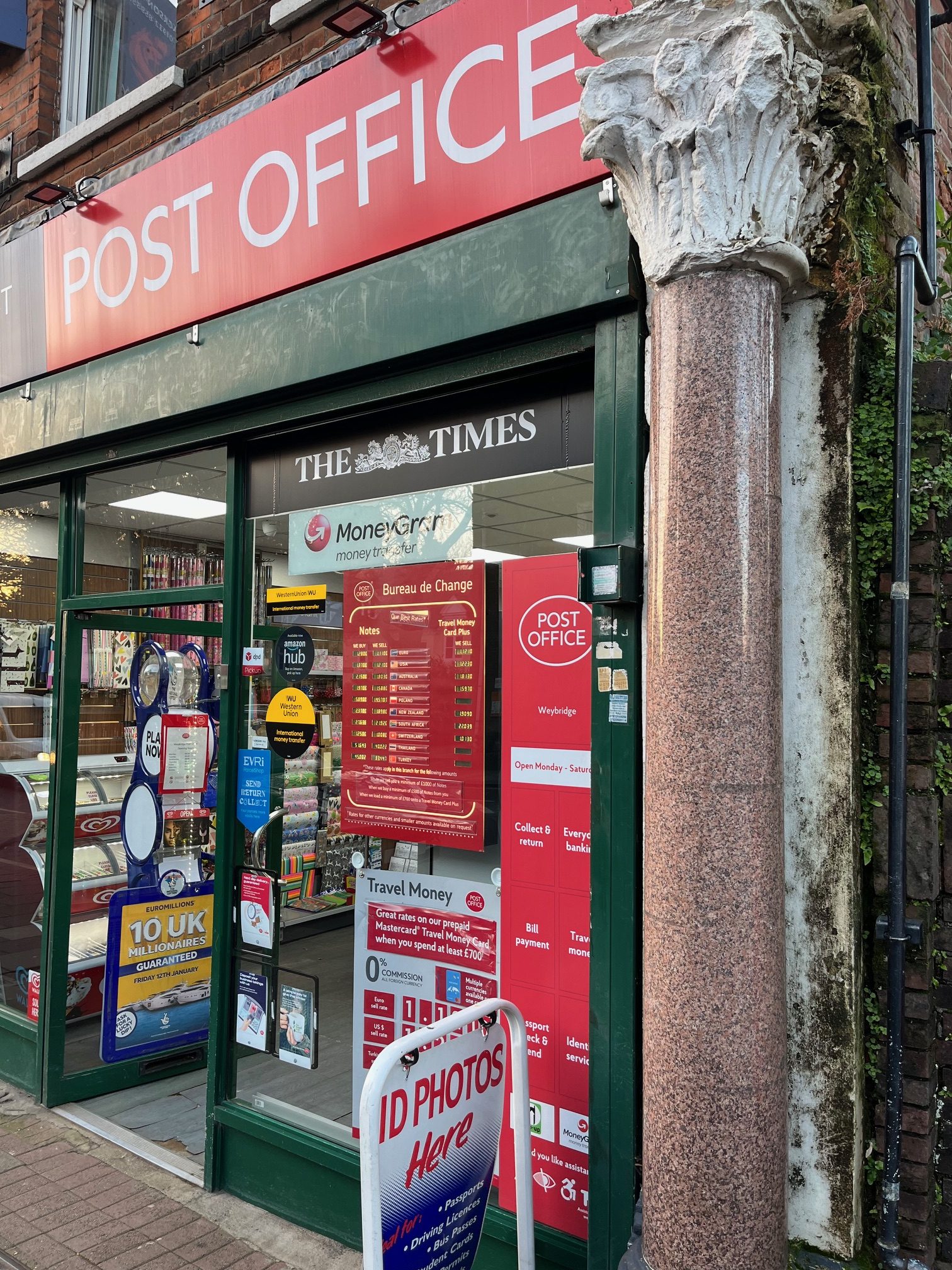
Why did a recent TV drama documentary featuring a scandal at what was once a humdrum British institution reduce me to blood-boiling fury, when so many other events, big and small, week in and week out, should have evoked a similar response but didn’t?
The answer presumably is that there’s only so much white-hot outrage you can experience in a given day before the adrenaline runs out or you collapse with exhaustion. Which perhaps explains why I’m not chewing the carpet about Gaza, or about a young fellow murdered in a park on New Year’s Eve, or about the iniquitous bilge spewed out on a daily basis by Donald Trump.
And why did this story about the British Post Office scandal, which was not new to me, have me shouting “bastards!” or worse at the TV every few minutes over the four episodes.
In answer to the first question, perhaps its a matter of desensitisation. We’ve become used to the inhumanity of protagonists in the Israel/Palestine saga. Knife crime has become so common in the UK that we’re no longer shocked by it. And Trump? What else is there to say about a country that could even contemplate such a monster from becoming its president again?
Perhaps what’s different about the Post Office story is that for me and I suspect many others in Britain who watched the series, it’s so close to home. Just about everybody has been to a Post Office for one reason or another. Over the past couple of centuries it’s become an embedded, indispensable feature of every town and village in the country. And until recently, when the suits took over, a trusted, and for many, a beloved, institution. Even after the corporate types encouraged us to think of it as a business rather than a public service, none of its customers doubted its integrity.
And what’s shocking is to see this pillar of British society turning on its employees with arrogance, malice and boneheaded refusal to question the validity of its actions. And even more shocking to see, both in dramatised form and from the actual mouths of those portrayed, even a small sample of the suffering inflicted on the victims.
So the idea that hundreds, or perhaps thousands, of sub-postmasters should suddenly turn into thieving shysters is almost as absurd as Santa Claus descending down your chimney with a cudgel, ready to rob you of your life savings. I won’t go into the details of the scandal here, except to say that the lives of hundreds of innocent employees and their families have been ruined. Their reputations destroyed, their livelihoods and savings wiped out.
Perhaps the root of my outrage is that these people could have been my neighbours. They could have been friends. They, their kids and grandkids could be seen walking the dog in the park. They were not a bunch of sinister chancers who lived in alleys and back streets and came out at night to rob us.
No. The chancers were the ones who gave bonuses to investigators based on the amount of money they recovered. The ones who told those who complained about the accounting system that they were the “only ones” who were experiencing such problems. The ones who lied about the reliability of the system, telling all and sundry that it was nigh on perfect. Who denied that the operators were able to manipulate the accounts of the sub-postmasters. And the ones who used legal tactics that the most ruthless sleazeball would be proud of in order to shut up the accused, with whom they did worthless plea bargains. And those who used legal delaying tactics Donald Trump would have loved to avoid the reckoning that their misdeeds would eventually incur, in the hope that the matter would just go away.
When I sat watching Mr Bates Versus the Post Office, they – the corporate persecutors – were the bastards I was shouting at. To my knowledge, none of them have been to prison or suffered financially, though those outcomes may be yet to come.
Two thoughts occur on the wider implications of the scandal.
Firstly. conspiracy theories are the jewel in the misinformation crown. Believe one and you will be more inclined to believe another. Before long you’re through the golden gate into cult membership. It’s easy to laugh at the crap people believe in, even when such beliefs lead to toxic behaviour. Unless they become full-blown religions, most of the really bizarre theories eventually die a death. The trouble is that we’re so infested with falsehood that whenever a real conspiracy is proven, especially with an impact as profound as the Post Office scandal, it tends to make all the dumb ones more believable.
Secondly, the idiots who were allowed to take over the Post Office in the 1980s gave it the appearance of a private business, even though it was always owned by the government. The intention was that it be prepared for privatisation, even if the final step was never taken. Its performance since then, crowned by the Horizon scandal, would seem to have banged yet another nail into the coffin of privatisation.
All of a sudden, the idea that a business whose raison d’etre is to make a profit for its shareholders can be restrained from using every available tactic – moral or immoral – to achieve that objective seems a little fanciful these days. As does the idea that a bunch of seemingly tame regulatory bodies backed up by tepid legislation prevent these companies from enriching their executives as a reward for short-term thinking that funnels money to shareholders rather than into improving the enterprise and preparing it for the future.
The Post Office joins the hall of infamy already populated by some of Britiain’s favourite privatised utilities.
Take our railways, for example. Looking back with nostalgia at the time when we had a single organisation called British Rail might be comparable to modern Russians looking back fondly at the era of Josef Stalin. But as we struggle to navigate a byzantine booking system and make it onto a train that isn’t delayed or canceled only to find that the prohibitive price we’ve paid for our tickets entitles us to standing room only, I suspect that more than a few of us look back fondly to the jobsworths and stale sandwiches of the publicly-owned British Rail.
And what of our water companies, whose main contribution to the life of the country is the turds and other detritus that slide past the banks of our once-beautiful rivers and decorate our favourite beaches? And our energy companies are hardly bywords for efficiency and diligence. Those that don’t go bust after a year or two scare the bejasus out of us by sending us bills that are inaccurate by a factor of a hundred or more.
About the only privatised utility I can think of that has escaped a large dose of public disapproval in recent years is British Telecom. I suspect that this is largely because it’s unrecognisable from the organisation that spawned it, but also because its original technology – copper wire, analogue landlines – is becoming a thing of the past. So it’s not really possible to look back with nostalgia at the broadband speeds provided back in the day by the General Post Office, which once upon a time looked after the nation’s post and telecommunications systems, because broadband didn’t exist. And nor, for that matter, did Fujitsu and Horizon.
The sad thing about the story is that it needed a TV dramatisation to ram home the depths to which the Post Office sunk. I’ve been following the story for years as new aspects kept coming up, and then, presumably though the efforts of its PR people, quietly disappeared from view.
I suspect that now, thanks to Alan Bates, Toby Jones, ITV and all those who had the courage to speak up against the suits, there will be no hiding place, even for those who thought that their connections with the great and the good would allow them to slink away unnoticed.
This is not going away, thank goodness.
 59steps
Trackbacks & Pingbacks