2016 may turn out to have been the Dawn of the Apocalypse, but it wasn’t all bad. It would be a sad thing if even in the worst of years we couldn’t look back on some moments of delight, and if we were unable to find people and things to admire.
Here are my highlights:
Young Germans welcoming refugees. Germans may be less happy about the influx of refugees now, but the welcome the huddled masses received from the young was moving and encouraging. Would we in Britain have been so charitable? Some, but not many.
Nick Kristof. I was not impressed by the New York Times journalist’s habit of putting himself at the centre of every story he covered during the 2011 Bahrain unrest, which I also experienced. But his coverage of the US elections made me realise what a superb writer he is. I would say that because I share his views on Trump. But so did many others, and he was the first person I would read on any development in the campaign. He may have a big ego, but goodness, he cares.
John Oliver. Maybe I’m biased because his Wolverhampton twang reminds me of where I grew up, but Oliver’s losing battle on Last Week Tonight to convince America not to elect a conman as president was one of the highlights of the campaign. What a shame he didn’t succeed.
The British Museum and all its exhibitions. The British Museum may be home to many treasures, but the institution itself is the greatest treasure. It opens minds, informs and educates. Its exhibitions are imaginative and inspiring, especially the Egyptian Sunken Cities. And it’s mostly free, as all museums should be.
East West Street. Stories of the Holocaust are legion. But Philippe Sands, by weaving the lives of two international lawyers – one who created the concept of genocide, the other who introduced crimes against humanity into the legal canon – into those of his grandfather and Hitler’s eastern viceroy, has written a book that is both an unravelling of family history and a primer on the legal basis for war crimes prosecutions. It sounds pretty dry by that description. But it isn’t. It’s moving, illuminating and always compelling.
Strangeness of my Mind. The story of a street vendor from Anatolia who scratches a tenuous living over four decades in Istanbul is not obvious best-seller material. But Orhan Pamuk sets his central character against a backdrop of recent Turkish social and political history. It’s a story of common humanity, but its insights into Turkey’s past add some context to the country’s present troubles. If you’re a lover of Istanbul, it’s well worth a read, as are so many of Pamuk’s other novels set in that city.
Ben Stokes. Ben Stokes is a cricketer who sets matches alight. He is fire made flesh. In January, he played an innings I will never forget. He forgot the difference between five-day cricket and and the rapid-fire T-20, and hit the fastest 250 in history. It was brilliant and brutal. It was why I watch cricket.
The Young Pope. Jude Law pays the role of his life as the new Pope seen by the church’s insiders as biddable, who turns out to be the very opposite. If only there were more series like Paolo Sorrentino’s masterpiece in nine parts.
Moeen Ali. An English cricketer whose beard would not be out of place in the tunnels of Mosul, Moeen is a symbol of Britain’s religious and ethnic diversity at its best. He’s probably the finest cricketer of Asian origin to have played for England. He’s a role model for British Muslims and a living demonstration that beards don’t necessarily mean bombs.
Sadiq Khan. In the era of the galumphing Boris Johnson, who would have thought that his successor as London mayor would be a Muslim? He’s competent, dignified and an excellent communicator. Well done London for electing him to lead one of the greatest cities on the planet. In the era of Brexit and Trump, it’s comforting to know that we’re still capable of judging a person on criteria other than religion and ethnicity.
Mary Beard. Britain’s best-loved and most-trolled academic would make my list every year. I love her unstuffy erudition. She writes a great blog. This year I especially enjoyed SPQR, her latest history of Rome. I wish she had been my professor at university – who knows, I might have ended up doing something useful with my life.
Tom Holland. If I include the aforementioned Professor Beard, I have to sing Tom Holland’s praises too. Lover of dinosaurs and hedgehogs, cricketer of substance (according to him), incessant tweeter and author of history books that never fail to hit my sweet spot. His latest, Dynasty, about the first Roman emperors, shows us that there’s nothing new in politics, and in his portrayal of Nero gives us a narcissistic equal of Donald Trump.
Planet Earth II. Britain’s stock of national treasures keeps dwindling, but David Attenborough is still standing at 90. His latest natural history series contains probably the best wildlife photography ever produced. His narration is pithy and wise. Long may he continue. Our heroes don’t always die in their sixties.
The Sanctuary. New York has many museums, but few match The Sanctuary. A piece of medieval Europe transplanted to Upper Manhattan. A place of calm and beauty, so close to Trump Tower and yet so far. Visit it in the summer, as I did, to be reminded that there’s more to America than belligerence and bigotry.
I’m currently trudging towards the end of a dose of man-flu. It seems to be developing into a seasonal visitation, rather like the cantankerous relative you have to invite for Christmas.
The rituals are the same every year. Voice turning into a gritty basso profundo, frightening the dog. Wife imploring me to take all manner of liver-destroying drugs. Normal intimacies suspended – don’t you dare come close to me! Unleashing rib-bruising coughs into the pillow at night so as not to wake her. Tissues carelessly left all over the place, discharging my virus on every available surface.
And me feeling profoundly sorry for myself. Not only that, but turning into a late-onset hypochondriac. Hardly surprising really, given that people my age seems to have been dropping like flies this year: David Bowie, Alan Rickman, Greg Lake and now poor AA Gill.
I hold my arm out to check for Mr Parkinson’s shake. I have my own daily Alzheimer’s test. Can I make it up the stairs in the morning with coffee for me and tea for my wife without falling over the dog on the way and spilling the contents on the journey? And can I tell which drink is which when I get there?
I keep a wary eye on my prostate (well perhaps not an eye, though I do have friends who tell me that my head spends much of its time lodged in that area). I get daily updates on the latest cancer treatments. And every crackle in my spine is a sign of imminent lumbar collapse.
And what of my mental health? Pretty good actually, despite the kind of year that would put Santa Claus on Prozac. Though those who witness me howling with the wolves at my ineptitude on the golf course might think otherwise.
Then there are the drugs. Statins for cholesterol. Aspirin, because depending on who you believe it protects you from every known ailment. And various other bits and bobs for chronic conditions. It’s a sad testament to ageing that decades ago I might have had some entertaining conversations with friends about various recreational pharmaceuticals (though I didn’t venture too far on the wild side in that respect), these days I meet friends at parties and get chapter and verse on their daily pill routines.
When I travel, I pack my bag with a wonderful selection of pain killers, ready to anaesthetise myself against any eventuality. I draw the line at saline drips, portable defibrillators and adrenaline pens. But I do have my own qualified personal nurse, who was foolish enough to marry me a long time ago. She’s a bit of a hypochondriac as well, so whenever something doesn’t feel right, we spend many happy hours in a diagnostic frenzy. And if we absolutely can’t figure out what we’re about to die of, there’s always my sister, a retired GP, and my brother, a medical research statistician, to fall back on – as in “it’s this, so prepare for the end”, or “there’s a 10% chance it’s that”.
I’m not quite as health obsessed as Spike Milligan, who insisted that “I told you I was ill” be inscribed on his gravestone, or Alan Clark, political diarist and professional cad, who spent much of his later life convinced he had a brain tumour, and eventually died of one. But as each year brings a new medical surprise, it’s hard not to contemplate eternity from time to time.
But never mind. I’m cheered by the news that we men are not spineless whingers who roll over at every approaching bug. Apparently we really do have less robust immune systems than women, which might explain why most of them live longer than us. If we start pumping ourselves full of oestrogen, then we might become more like our sisters – resolute, uncomplaining and robust.
Which doesn’t explain why I had hardly a day off sick when I was running a business, but a good few more when I wasn’t. Something to do with the extent to which you control of your destiny perhaps. After all, when you’re omnipotent, throwing a sickie can have direct consequences – you have to rely on all the less talented people who work for you. Whereas if you’re a mere employee, there’s always someone else who can do your job while you luxuriate in self-pity.
I’m being ironic, of course. But motivation does seem to be a stronger boost to the male immune system than developing a fine pair of man boobs and getting together to eat cake with your friends.
There are upsides to man-flu, especially during the festive season. You don’t have to pretend to be jolly against your usual cantankerous nature. People feel sorry for you and make allowances. You get to wake up very early in the morning to watch England being destroyed by India in the cricket. And best of all, when you finally emerge from the tunnel of despair, you realise you’ve dodged the bullet once more. That it wasn’t ebola, zika or some malevolent tumour. It was just a bloody cold.
The downside is that Christmas is coming and my affliction is going. No excuse for grumpiness then. No reason not to go out into the clammy gloom for walks in the woods. No exemption from chopping firewood. And no chance to justify my gluttony on the grounds that I’m feeding a cold.
But there’s still hope. Only five days to go, and I’m still a little unwell….
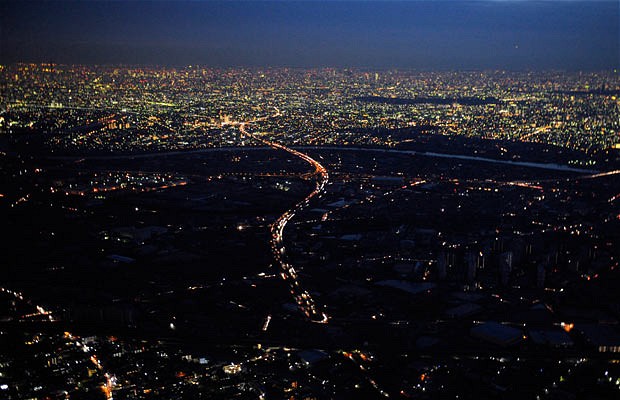
Those of you who read this blog regularly will perhaps have become used to me musing on matters global, or at least national. This post is about something a little closer to home. Outside my front door, actually. As I write, I’m looking out of a window onto my street. It’s early in the evening – it got dark a couple of hours ago. A few yards from where I sit, there’s a street light blazing away.
If we live in a country that considers itself to be part of the developed world, we take it for granted that the lights stay on at night, don’t we? Just as we expect the garbage collector to appear every Tuesday, the postman to bring our letters every day and an ambulance to be only a few minutes away if we get a heart attack.
Some of us in Britain are old enough to remember the Three-Day Week, when as a consequence of a miner’s strike we began to run out of coal. To save fuel, the government switched our street lights off and banned electric shop signs.
There are also plenty of people still around who remember the blackout during the Second World War.
But for everyone else, dark streets are part of our history, not of our present. Not for much longer, it seems.
You could easily understand the reason for blacking out the streets during the Blitz. The last thing we needed was to provide an easily-recognisable target for the swarms of German bombers looking to level our cities. And as the miner’s strike dragged on, whether or not we sympathised with the miners themselves, it was clear that we needed to conserve fuel to keep essential services running.
Now, in my neighbourhood, some Smart Alecs have decided that whole areas don’t need street lights to be on between midnight and 5am. Again, if the motive had been to save the planet by burning less fossil fuels, and if this had been a national initiative, perhaps there would be little resistance to the plan. We’d summon up the spirit of the Blitz, keep calm and carry on.
But that’s not the motive. The council estimates that by switching off up to two thirds of its 89,000 street lights, it will save princely sum of £210,000. The cost of a council dust cart, perhaps. Or the salary of one of its senior employees.
To those who object on the basis that dark streets give licence to rapists, muggers and burglars to roam undetected through the darkened but well-heeled streets of Surrey, the Smart Alecs would no doubt have plenty of arguments up their sleeves. They might point out that we have far more to fear from Russian cyber-criminals trying to steal our money than from nasty people waiting up dark alleys to prey on our children walking home from the last train.
They might also say that in this age of austerity, dark streets are preferable to grannies being abused in care homes because the council can’t afford to pay a rate for beds that enables the owners to make a profit – unless they use staff who aren’t paid enough to give a damn about those in their care.
They might also say that potholes need to be filled, library books need to be bought, the homeless need to be housed, and so forth.
If I thought that £210k would materially fix all these stresses on the council budget, I’d probably be sympathetic to their arguments. But quite obviously it won’t, though every little helps, I suppose. Then I think back to an incident in my business career when an overzealous chief financial officer decided to save a few bucks by abolishing the longstanding custom that the company paid for the staff’s tea and coffee. The consequences of the hit on morale massively outweighed the savings. Every little didn’t help on that occasion.
I’d also cite the cost to parents and spouses of having to collect their loved ones from stations, workplaces and parties, when otherwise they’d let them walk down illuminated streets. It’s important that people feel safe, right?
All the while, as we taxpayers whinge and moan, the Smart Alecs might be thinking to themselves “how dare you object to this small economy, you prosperous, spoilt residents of Surrey, whose houses are increasing in value every year by the equivalent of the wages of ten thousand brick-makers in Pakistan? Get over it!”
Putting it this way, they might have a point, even if the new measure isn’t selective enough to apply only to home owners.
But there’s something symbolic about a return to darkness, isn’t there? In early days of urban electrification, street lighting was seen by city fathers not only as a way of reducing crimes against people and property, but also as a sign of progress, of civic pride.
When the streets go dark, a message goes out to nervous residents that progress is being reversed. That we’re going backwards.
And in many ways we are, usually for the same reasons: pursuit of profit dressed up as modernisation. Pursuit of savings in the name of necessity.
Commuters in towns like mine are been driven to distraction by a dispute between Southern Rail, one of the train franchises, and the train drivers’ union. The company wants its trains to be able to run with one person responsible for hundreds of passengers: the driver. It calls the elimination of the need for a second person, who wanders up and down the train, inspects tickets and opens doors at stations, “modernisation”. It blames the union for resisting the change in order to preserve the jobs of its members.
Now I’m no great fan of trade unions per se. Some do indeed go too far in preserving practices that no longer make sense. But in this case, I’m with them all the way. If I was driving that train, I would want to share the responsibility for my passengers with someone else who watches my back – literally.
It’s pretty obvious that a single train guard can’t deal with every emergency that might come up in ten fast moving carriages – a bomb, a fight, someone having a stroke. But what can a CCTV operator do other than call for help? Can someone in a control centre miles away tell the difference between a drunk and someone having a seizure? Is the train company expecting the passengers to deal with every problem? And what can the driver do, apart from stop the train at the nearest – possibly deserted – station?
No doubt the train company would say it’s investing in its franchise, and needs to get a return through efficiency savings. But if you’ve had a little experience in running businesses, it’s easy to cast a jaundiced eye over Southern Rail’s claim. Cynics, me among them, might take the view that it’s not about safety, it’s not about modernisation and it’s not about customers. It’s about maximising profit.
Elsewhere, companies not encumbered by awkward trade unions are able to ride roughshod over their employees. The minimum wage is no longer a safety net. It’s a cost objective for the likes of Sports Direct and Amazon. Did we think about the price their employees pay so that these companies can drive down their prices to customers, thereby putting high street book sellers and clothing retailers out of business? Do we think of the farmers who have to accept razor-thin margins if they are to supply Tesco, so that we can pay £1.20 for a litre of milk?
George Osborne, our former Chancellor of the Exchequer, made an interesting admission the other day when reflecting on the failed Remain campaign that cost him his job. He said that he was so obsessed with the economic arguments for staying in the EU that he forgot about people – their experience, hopes and fears.
He could have spoken for a hundred government departments and local councils who are to a greater or lesser extent at arm’s length from the people they are supposed to be serving. He could also have spoken for employers – from coffee shops to online retailers – whose overriding concern is not the people they depend upon to function but extra bucks they can make by cutting salaries and benefits to the bone – because they can. He could simply have said “we’ve forgotten about people”. Not “The People” of Brexit mythology. But people.
When our resident’s association sent us an email alerting us to the Smart Alecs’ bright new wheeze, they referred us to a Facebook page. I immediately thought oh-oh, fake story. But a comprehensive list of streets affected is unlikely to be clickbait originating from a Macedonian teenager, so it must be true.
Perhaps I’m being over-dramatic. The people of East Aleppo have no hospitals left. That’s a crisis. But the slow erosion of services we think of as being benchmarks of an orderly and developed society feels like a new normal. And if it happens in prosperous Surrey, whose residents are far too polite to do more than sign an online petition, how long before similar measures in other less well-off areas evoke a more extreme response?
My concern about this issue is not born of any political ideology. I don’t hold a candle for any of our current crop of political parties. I do however believe that such stupid measures are rooted in a terror of asking people to pay more for stuff, when the reason for asking them is not the enhancement of shareholder value or a responsibility to taxpayers, but the common good. To ensure, for example, that less people have to walk through dark streets, sit in unguarded trains and struggle on the minimum wage.
The Alecs aren’t that smart. I suspect that a fair number of people whose street lights go off at midnight on January 1st would be quite capable of spending a day in the council offices and working out a better way of saving £210k.
Perhaps I’m being unkind. But as the year draws to a close, and a darker 2017 beckons, I can’t resist quoting Sir Edward Grey’s words. On the eve of the First World War, our Foreign Secretary remarked that “The lamps are going out all over Europe, and we shall not see them lit again in our life-time.”
For Europe, read Surrey. Or maybe not – perhaps Europe again.
Since this is the time of the year when curmudgeonly householders around the UK spend their evenings repelling gangs of itinerant carol singers, it’s time for a few words about something I love. Something enduring. Something far away from the bloodstained streets of Aleppo, beyond the reach of Donald Trump, Vladimir Putin, Nigel Farage and all the others who have contributed to such a rotten 2016.
The BBC has come in for its share of brickbats of late. Yet whatever its follies and weaknesses, there are still some things it does supremely well. Planet Earth 2 is the ultimate in wildlife documentaries. Another niche it dominates – though not without competition from Classic FM with its blathering hosts and sampling of works that deserve to be heard in their entirety – is classical music.
Classic FM has its uses. It’s probably done more than the BBC in recent years to convert a mass audience to the classical genre. But the BBC’s musical coverage is a four-course meal compared with Classic’s fast food. Or, to use an analogy from the greatest game in the world, Test cricket versus T-20. The BBC broadcasts the Proms. It produces documentaries on music history – David Starkey’s glorious series on English royal music is a recent example. It funds, sponsors and promotes classical music like no other broadcaster.
More than any other classical form, I love choral music. The voice is the only musical instrument that that can choke me up. I sat through Princess Diana’s funeral in tears. Not out of grief for her. It could have been anyone in that coffin. It was the setting, the ceremony and above all the music that transformed what might have been just a sad event into something truly heart-wrenching.
It all started for me when I joined the Bryanston school choir. It wasn’t just the music. Sometimes, to love something you need to be inspired to do so by others. In this case I have to thank the choirmaster, Rodney Dingle. Half a century on, I still remember and listen to the music he had us sing: motets by Tallis and Byrd, Britten’s Ceremony of Carols and much more.
Rodney Dingle will be quite old by now, but hopefully he’s still around. Either way, through this post I hope to immortalise him as a magnificent choir master who imbued this one-time chorister with a lifetime passion for the music he loved.
Last week the BBC gave us something to treasure, for reasons beyond the music itself. It was the finals of the annual Choir of the Year competition. I had no idea there was such an event – I just stumbled across it by accident. The only big singing competition in the UK I previously knew about was at the Eisteddfod, a festival that celebrates all things Welsh. It used to coincide with family holidays in Wales when I was a child, but I remember little about it apart from druids declaiming in a language I didn’t understand.
Quite apart from the quality of singing, which was carried off with panache and shining eyes, the six choirs represent an activity both binds and transcends generations, and is to be found in all corners of the country. The winners were Voices of Hope, an acapella group from Newcastle. Four of the other competitors came Wales and Yorkshire – a reminder perhaps that a musical tradition rooted in mining communities has lived on beyond the demise of coal.
Choral singing, like orchestral music, is not about me, me, me. Though there are often parts for soloists, it’s a team activity. It’s is about us, us, us. It demands discipline and precision equal to anything you would find elsewhere in the performing arts. And most of the people who sing in choirs don’t do it for the money. They are amateurs in the true sense of the word – they do it for love.
For me, the human voice is quite unlike any other instrument. In the hands of a skilled musical director, it is as multi-textured as any orchestra. Watching the choir director from Voices of Hope coaxing dynamic range and power from his singers took me back to a chilly chapel in Dorset where I spent some of the happiest hours of my life.
Sadly, my singing days are long gone. If Donald Trump wants an effective instrument of torture, he should hire me to sing to his prisoners. Fortunately, I have a sister who can do what I can’t. She performs in a large choir at many of the major British venues – The Albert Hall and the Barbican, as well as churches and concert halls throughout the UK and the continent.
Unlike her, I never experienced the fellow-feeling that comes from being in a choir drawn from different age groups and backgrounds. Mine was a boy’s choir, occasionally augmented by teachers. I once made a living from other forms of music, each with their own emotional power. But choral music was my first love, and the legacy of those few short years has been decades of listening.
For that, I thank Rodney Dingle, wherever he is.
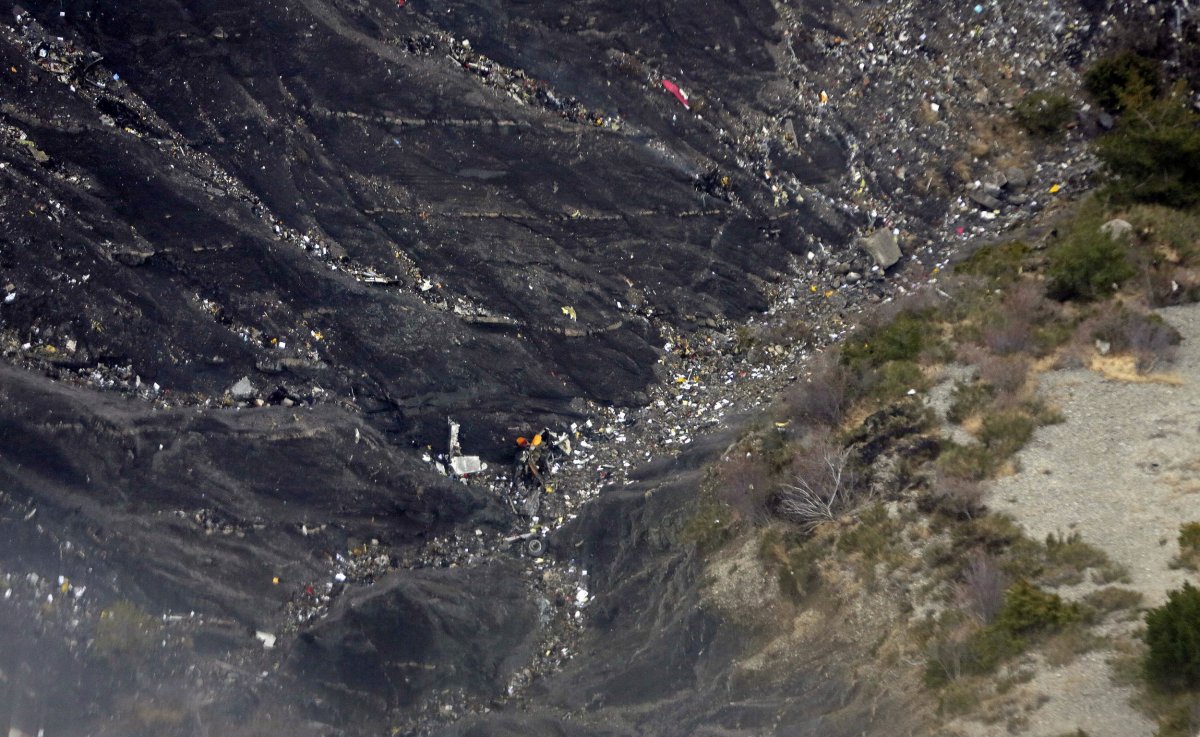
Debris from Germanwings Flight 9525
There are fake news stories and there are true ones. You will be more likely to pick up a fake one from Facebook than by reading the online version of an established national newspaper, right?
But what about stories designed to grab your attention by scaring the life out of you? Research data, out of context and selected for maximum impact, comes our way almost every day via news aggregators like MSN. It’s not just creepy websites in Macedonia that use clickbait.
I came across a good one today. Microsoft Edge gives me all manner of tempting stuff when I open a new tab. Splits emerge in EU over Brexit; Minister refuses to wear headscarf; Cheryl’s ex on her baby; Dad’s cute call to girl as Santa Claus. Mouth-watering stuff.
But the headline that really grabbed my attention was this one from the Daily Telegraph: “Thousands of airline pilots flying with suicidal thoughts – Harvard”.
Holy Moses! One depressive German pilot flying an A320 full of passengers into a mountain is bad enough. But thousands of those ubermenschen in their glamorous uniforms just waiting for the opportunity to bring our holidays to a fiery end? And Harvard says so? Something we really want to know at time of year when half of my fellow Brits seem to be heading for a ski resort, to visit cousins in Australia or granny in Ireland.
The Telegraph tells us that:
More than 4,000 commercial flights on any given day are being flown by pilots who have experienced suicidal thoughts, a landmark study on the airline industry suggests.
An international survey of pilots by Harvard University found 4.1 per cent had contemplated killing themselves at least once in the previous fortnight, and 12.6 per cent met the criteria for depression.
Pilots diagnosed with acute depression are automatically deemed unfit to fly, but experts have warned many cover up their symptoms for fear of losing their careers.
Let’s look at this story a bit more closely. I’m deliberately not going to the source because most Telegraph readers are unlikely to do so. My conclusions might therefore be wrong, and the same goes for my fellow readers.
First, note the weasel word in the first sentence: “suggests”. Not states. Did we pick that up? I didn’t on the first reading. It’s a survey, dummy. It uses a sample. No researcher in the world can climb into the mental cockpit of all those pilots and work out what’s going on at the controls.
The sample in the Harvard survey is quite large, as you would expect from such an august institution. They did an anonymous survey of 3,000 pilots. Using the percentage quoted we can conclude that they came across 123 pilots who had contemplated killing themselves in the past two weeks. No mention of whether they had thought of taking their passengers with them.
And then comes the “suggestion” that every day there are 4,000 flights with suicidal pilots at the controls. Without thinking about it, you might believe that this means there are 4,000 suicidal pilots out there. But what we don’t know how many of those flights are piloted by the same people. Take a pilot doing the London-Dublin run. Let’s say the person does six flights a day. Apply that assumption to the 4,000 flights and we’re down to 660 suicidal pilots – presumably across the world. Scary enough, to be sure. So, given that across the globe, according to one estimate, there are 98,000 flights a day, there is just over a half of one percent chance that your pilot is a suicidal maniac.
Now let’s think for a minute about that unhappy pilot. Suicide by airplane is extremely rare. Aside from the 9/11 “pilots”, I’m only aware of six incidents involving commercial airliners over the past forty years that may have been the result of pilot suicide. The most recent occurrence was through the action of the GermanWings pilot, Andreas Lubitz.
Lubitz was able to bring down the plain because he persuaded his co-pilot to take a toilet break, then locked the door and flew the plain into the Alps. Without the procedural weakness that allowed him to be alone in the cockpit with the co-pilot unable to get back in and stop him, he wouldn’t have been able carry out his plan.
After each such incident lessons are learned and fail-safe measures introduced to prevent a recurrence. It’s probably fair to say that the only way a pilot can be certain they can bring down their aircraft is if both pilots agree on the same plan.
What, then, are the chances of your being unfortunate enough to find yourself on a flight piloted by not one but two of those 660 suicidal depressives? The Telegraph doesn’t tell us, but my guess would be vanishingly small if previous incidents involving lone suicides are anything to go by.
Is the Telegraph piece a fake story? No. But is it seriously out of context – and likely to send us flocking to the website, scaring the hell out of us? I would have thought so.
I personally would worry more about depressive US presidents with their fingers on the nuclear button (as in Nixon). I would also be far more concerned about the person in the car driving towards me on the other side of the road. I worry about train drivers asked to take responsibility for hundreds of people without a single colleague to watch over the train itself and those who are riding in it (would you fly in an aircraft without cabin crew?).
For me, the real issue raised in the Telegraph piece and in thousands of studies is depression. Depressives are not necessarily suicidal, but depression can blunt performance. An aircraft maintenance engineer who suffers from depression, by ignoring a vital safety check, or an air traffic controller standing in for a sick colleague on a night shift, can be just as lethal as a suicidal pilot. Depression can cause tiredness, and vice versa. You are far more likely to be flown by a knackered pilot, to ride in a train driven by a knackered driver, and to share a road with a knackered motorist.
As for suicide, I nearly lost the will to live the other day when for some reason all our computing devices simultaneously stopped sending email, even though they run on three different platforms. The headbanging stress of dealing with multiple call centres and waiting hours to fix each problem sent me close to the edge.
Hardly an existential crisis, I know. But when you then learn that a billion customer records – including your own, have been stolen from Yahoo, not yesterday, but since 2014, and that the Russians might well be responsible for foisting Donald Trump on all of us, a sense that things are slipping out of control might be enough to tip many people into a state of gloom and depression.
We have much more to be scared of than a few depressed pilots. Which leads me to look forward to my upcoming flights safe in the knowledge that a bunch of very scared newspaper readers will not be joining me. More elbow room for me then.
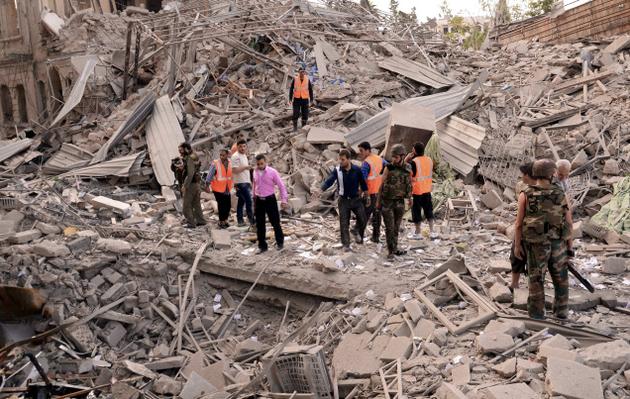
On the day when East Aleppo falls into the hands of Bashar Al-Assad’s forces, are thousands dying while we eat our breakfasts, greet our families and workmates and go about our daily business? The question is irrelevant on one level, because the slaughter has been going on for months. Today is perhaps just the finale.
But I can’t let this day past without saying something. I can’t stop the fighting, save the children or help the White Helmets dig the bodies out of the rubble. Just as I couldn’t save the people of Hama, Grozny, Fallujah, Srebrenica and Rwanda. Nor could my parents save the people of Auschwitz, Belsen, Hiroshima and Dresden.
But what I can do is mark the moment. I can also encourage those who have not witnessed a similar catastrophe to be aware, remember and learn.
Being aware is not about reading the newspapers and scouring the web. It’s about taking a little time to imagine ourselves and our loved ones caught up in the inferno, reduced to the very basics of existence, watching others die and expecting death at any minute.
Remembering is not about coming up with grand theories about why the disaster happened. Only that it did happen, that we were alive at the time and that it happened to people just like us who do not deserve to be forgotten.
And learning – for those of us with the power to influence only those around us – is not about making sure that we know how to prevent something similar from happening again. Because it will happen again. The circumstances may not be identical, but it will happen maybe tomorrow, maybe next year, maybe in ten years’ time. All the wise people in the world will not be able to prevent it.
Learning is about reflecting on our own behaviour. Do we have it in us to stand by and let those close to us suffer their own catastrophes without stepping in to help? Would we come to the assistance of the woman in the hijab kicked down the subway stairs in Berlin? Or do we just watch as our neighbours spit abuse at other neighbours because of their lifestyles, beliefs or the way they dress?
As we watch acts of inhumanity beyond our personal experience carried out in faraway places, can we learn to become just a little bit more humane ourselves, to encourage humanity in those around us, and to do everything else in our power to ensure that our own societies do not descend into the degradation that is Aleppo?
Blaming is the easiest thing. Blame whoever you like – Bush, Blair, Assad, Putin, Iran, Saudi Arabia and every bomber pilot in the air and gunman on the ground. But pointing the finger will not bring back the people who die today. Nor will accusations of genocide and crimes against humanity, and the bringing to justice of a small number of perpetrators, cause all the instigators of future massacres from thinking twice. It will happen again.
We, sitting in our comfortable homes, looking out over unscarred, unbloodied streets, can send money to the stricken and send messages to our leaders. But first we should be aware, remember and learn. If we want to make the world a better place, we should think of Aleppo, and start with ourselves.
If these words come over as overly pious, I make no apology. Today feels like a day when a little piety could come in handy.
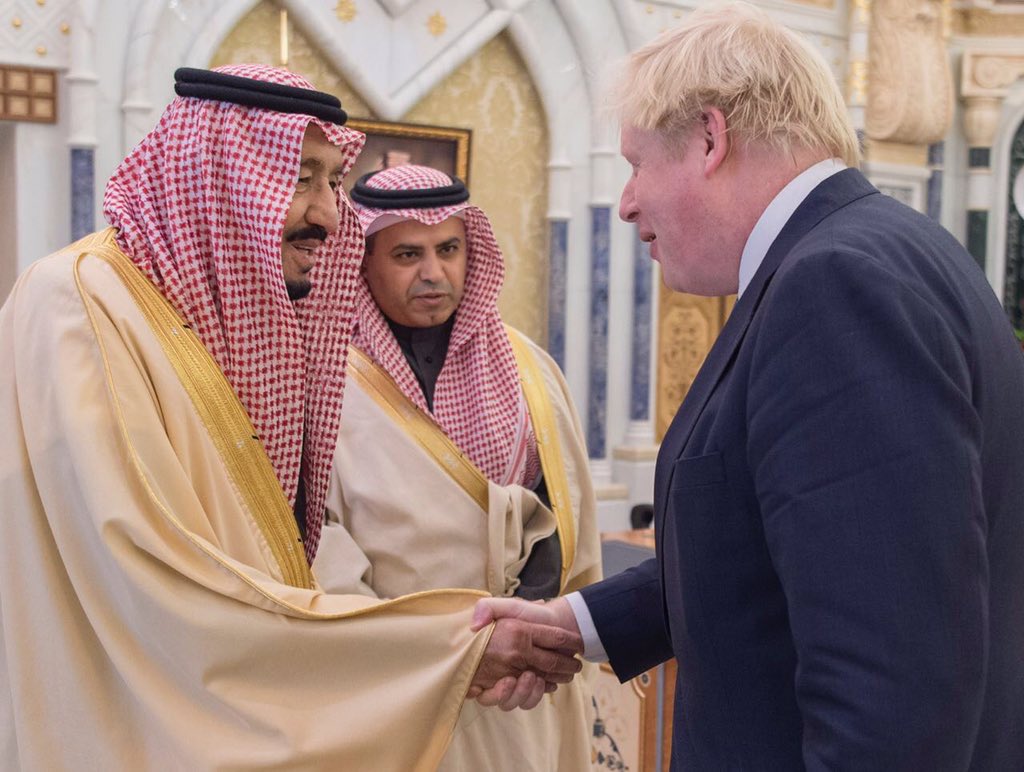
He’s right, of course. Boris Johnson’s comments about Iran and Saudi Arabia “puppeteering and playing proxy wars” in the Middle East, and his observation about a lack of “visionary leadership” in the region are, if taken in isolation, fair comments. Up to a point.
But words are cheap, and Boris sprays headlines like a six-year-old with a hosepipe.
Pundits on the BBC’s Newsnight show pointed out the other night that his words nothing more than what has been said in private to the Saudis for fifteen years. They are asking whether they are a deliberate counterpoint to the government’s official position. Or is Boris merely riding the wave of plain speaking that passes for authenticity in this year of the demagogues?
Whatever. If this is the season of plain speaking, let me indulge in a little of my own.
The main reason why Theresa May is not pleased with her Foreign Secretary’s words is the threat to commerce, not the rare intrusion of ethics into diplomacy. They represent a country with declining influence in the Middle East. Yes, we make a nifty missile and some awesome cluster bombs. We’re pretty good on education, health tourism, technology and engineering. But gone are the days when Perfidious Albion was the puppet master of puppeteers. We have reverted to our former incarnation as a nation of shopkeepers, as Napoleon once contemptuously called us. We no longer move and shake. We sell stuff.
And as shopkeepers, we are facing – thanks to Brexit – the erosion of one of pillars of our economic prosperity: our membership of the EU Single Market. For that reason we are desperate to shore up our trading relationship with the Gulf states, hence May’s visit to the region. Over the past three decades we have made a fortune selling our Gulf allies military equipment worth many billions of dollars. Thousands of jobs back in the UK have depended on our exports of warplanes and all manner of other bits of kit.
While we might occasionally put on our ethical hat and baulk at training prison guards who watch over the incarcerated opponents of the Saudi regime, we’re happy to supply guns and tear gas to the police in Bahrain. And we have no problem with selling the Saudis ordnance that rains down on Yemen, and sometimes finds its way into the hands of warlords in Syria and Iraq.
I’m not getting into a debate on the rights and wrongs of our military exports. I only want to make the point that Mrs May doesn’t either. She considers our economic interests to be of paramount importance, and she is not about to let an overgrown college debater with a Trumpian delight in his own verbosity upset our customers with a few inconvenient truths.
Let’s now consider the expressions he used in his notorious speech.
What, to start with, does he mean by visionary leadership?
Putting on my cynical hat, I have my own ideas. Simply put, politicians and potentates create visions for others to believe in. They do so either to achieve power or to retain it. Once they’re in power, they usually fail to achieve the dreams they sell because they lack at least one of four things: the power to impose their will, unanimity among the believers, ruthlessness, and finally resources.
Those who are widely recognised as genuine visionary leaders are rare indeed. They actually believe what they say and have the qualities to realise their visions. Their political vision is built on a bedrock of personal values. They inspire and unite. Some are benign, just as many are less so. For every Mandela and Gandhi I’ll show you a Khomeini or a Castro. Oh, and I suppose you could describe Adolf as a visionary under my definition.
By that yardstick, I would be interested to hear Boris, who decries the lack of visionary leadership in the Middle East, tell us where else in the world such leaders are to be found. Donald Trump perhaps – at least he unites half of his country. Boris himself, the high priest of Brexit? I don’t think so. He is a man whose convictions are tailored to his ambition. Hardly a person who inspires or unites.
So, given the dearth of visionary leadership elsewhere in the world, it’s a little unfair of him to single out the oil sheikhs and warlords of the Middle East. If I was one of them, I would probably say “to hell with visions – I do what’s necessary to ensure I don’t end up cornered in a culvert like Gaddafi”.
And speaking of visionary leadership as a means of overcoming sectarian strife, Boris, as a historian, should remember that Gandhi couldn’t prevent the post-partition massacres in India, and that for 30 years, our would-be visionaries, Margaret Thatcher included, could do nothing to overcome the sectarian strife in Northern Ireland. Until, that is, the much-reviled Tony Blair came along.
You are far more likely to find something that looks like visionary leadership outside politics and government. The true visionaries, often enough, have no political power. They act as examples, catalysts and instigators. They plant the seeds, even though they often leave it to others to turn their dreams into reality. John the Baptist, Karl Marx and Desmond Tutu come to mind.
But in politics, visions are more often than not artificial constructs. Every leader needs one. If they lack a vision, it’s necessary for them to invent one that will inspire the people. The same goes for businesses. I’ve lost count of the number of consultants who approached businesses I ran offering to help us create the holy trinity: vision, mission and values. And if you fall for their snake oil, the chances are that you will end up with a bunch of fine-sounding but hollow words. The kind of stuff that end up on glass plaques in restaurants and golf clubs.
So my advice to Boris, as a pragmatic politician, is leave the visions to prophets, saints and internet billionaires. The real business of politics is goals and the pragmatism needed to achieve them, hopefully underpinned by a constructive philosophy. If you feel that you need to create a vision, never forget that it’s an illusion you are peddling to achieve those goals.
Now, turning to puppeteering and proxies, our esteemed Foreign Secretary berates Iran and Saudi Arabia for behaviour that is the story of the past century, and applicable as much to the major powers as to the regional players. America seeking to shore up an Asian domino in Vietnam. America gleefully inciting the downfall of the Soviet Union in Afghanistan. The Soviets using Cuba to foment revolution in central Africa. Iran and Saudi Arabia learned the art of proxy warfare by following the example of the superpowers.
Perhaps what Boris should have said is that proxy wars rarely fulfil their objectives – to shift power in favour of the sponsor without the sponsor suffering adverse consequences. As the US discovered in Vietnam, and Russia in Afghanistan, Iran and Saudi Arabia have found out that what starts as a proxy war usually sucks in the puppeteer. The defender of the status quo becomes the aggressor in the eyes of the world. Saudi Arabia is directly involved in a costly and inconclusive war in Yemen. Iran’s body count from the conflict in Syria is rising steadily.
So although he’s perfectly entitled to talk about the questionable adventures of the Middle East’s two leading powers, he would have delivered the same message to the Saudis if he had reminded them of the superpowers’ painful experiences of proxy warfare. Not a plain enough message, I suppose, but one that the Saudis, who are masters of reading between the lines, would immediately understand. After all, they’ve heard it all before. Been there, done that, got the quagmire.
As it happens, when Boris visited Riyadh, his hosts received him with their usual immaculate politeness. Adel Jubeir, his Saudi counterpart, brushed off his guest’s plain words by using the classic excuse on his behalf: that he had been taken out of context. Jubeir’s private thoughts might well have been something along the lines of “who is this pompous windbag? He doesn’t make the decisions, so why worry about him?”
Boris is not an idiot, of course, and apart from his sense of humour, one of his redeeming features is that he tweets mainly in platitudes, which perhaps explains why he has a mere quarter of a million followers, 16.6 million less than Donald Trump.
If he really wants to establish a reputation for plain speaking, perhaps he should try adopting The Donald’s style. How about:
Theresa May way down Donald Trump’s call list after the Election. Then he told her she should come up and see him some time. Most insulting!
Or perhaps:
Downing Street objecting to my calling out the Saudis for what they are. Pusillanimous peons!
Maybe not. I sense that he had his fifteen minutes of fame on Brexit Day. Perhaps, before it all ends in tears, he would be better off slipping away to join Cameron and Osborne on the lecture circuit. Or writing more history instead of trying to create it.

Is there a single one of the Ten Commandments more symbolic of the age we live in than the Ninth – that “thou shalt not bear false witness against thy neighbour”?
Truth, lies, disinformation and confusion are more potent currencies than dollars and pounds. Whether by accident or design, most of us have a variable relationship with the truth. We have our version, and others have theirs. In my case, here are four little stories from my misspent youth:
At university, my mate Nick and I, outraged at the decision of Margaret Thatcher (then Education Minister under Edward Heath) to discontinue free milk for schoolkids, screen-printed a load of posters bearing Thatcher’s head above the legend “Thatcher the Milk Snatcher”. We then went out in the dead of night and fly-posted them all over walls and windows in the neighbourhood.
On another occasion, in the early hours of the morning, I was wandering somewhat worse for wear through a Nottingham suburb with another friend, Andy. I flagged down a police car and persuaded the constable to give us a lift back to where we were staying.
On the third occasion, a bunch of us went to a party in Norfolk hosted by Nick. His home was a mile from the sea. We decided on a spot of late-night swimming. To get there, we had to cross some fields. On the way back, wearing a white suit, I fell into a ditch full of cow effluent and emerged brown from head to toe. After showering down the worst of the slimy stuff, I spent the rest of the party wearing a light-brown suit.
Finally, during my short career in the music business, I nearly lost my shirt staging a concert featuring a band that were not as popular as I thought. In fact, they were a box-office disaster. After the gig, I took twenty or so friends and assorted hangers-on to the nearest curry house, took the last few pound notes out of my wallet, gave them to the waiter, and said “feed my friends”, despite knowing that I would be living on cabbage for the rest of the month.
Of these four rather mundane episodes, two I know to be true, because I remember them. The other two might be true, but I have absolutely no recollection of them – I heard them years later from others who claimed to be there at the time. Which of them is true or otherwise is for you to guess.
Now zip forward forty years. I love golf, but I have acquired a reputation for being a slow player. The age of compulsive speed has not passed golf by, so being labelled as slow has a certain stigma attached. If it were true, I would try and do something about it to accommodate my partners who always have something else to do afterwards. Except, in my perception, it’s nonsense. Yes, I have the occasional slow round, especially at this time of year when one spends an inordinate amount of time looking for balls under leaves. But nine times out of ten, I’m no faster or slower than anyone else. But I’ve acquired a reputation that seems to have stuck. Nothing I can do about it. To protest would be to protest too much.
So how do these stories, true or not, define me in the minds of others? In my youth, politically to the left, a bit of a clown, with a measure of chutzpah and a penchant for the grand gesture. Today, in the eyes of some, I’m a human tortoise, someone who holds up other golfers and thereby creates impatience and frustration across the golf course.
In those characterisations I can see some but not all of myself. The mythical tales might not have been true, but they probably describe the person I was as accurately as the ones I know to be true. As for what I am today, I’m Slow Steve, up there with Crooked Hillary, Little Marco and Lyin’ Ted Cruz. Except that unlike the targets of Donald Trump’s incessant tweets, I don’t care a jot, and nor does anybody else, with the possible exception of the occasional golfer with attention deficit disorder.
The main difference is that for politicians truth and lies are weapons, whereas in the lives of the rest of us they are part of the air we breathe, sometimes without even noticing.
Which brings me to the point that there’s no such thing as “post-truth”. Or at least, nothing new about the idea that lies create their own reality, and thereby become truth. It’s happening all around us. And always has.
What, after all, is history, if not the selective ordering of verifiable facts and unverifiable myths? Whether the historian is led to the narrative by facts and myths, or starts with the narrative and assembles the evidence to support it, is perhaps less important than that the feed-stock is readily available.
What’s different now is that in the social media we have the perfect conduit for that feed-stock. There are no true or untrue buttons on a Facebook post or a tweet. Only emotions such as like, love, wow, sad and angry. Perfect fodder for demagogues who trade in adoration.
Donald Trump didn’t invent post-truth. He exploited it so successfully that the phrase became the centrepiece of attempts to explain his appeal. It’s worth remembering that way before the internet, back in 1960, the Democrats campaigning for Kennedy produced the famous Nixon poster above. Unlike Trump, Kennedy’s team didn’t flat out accuse his opponent of dishonesty, but the insinuation is clear enough.
But thanks to Trump’s (and possibly Vladimir Putin’s) efforts, we’re now at the stage when we either choose to believe what we’re told because of who tells it (Trump, the New York Times, the imam, the pastor, our parents or the family doctor) or we believe nothing without going to great lengths to convince ourselves of the bona fides of the teller and the information they convey. To do the former is easy. To do the latter can be an impossible burden on our time.
So we happily delve into the social media – a swamp full of malcontents, manipulators, exploiters, conspiracy theorists and trolls peddling information of dubious provenance. Not the swamp that Trump wants to drain, but one that is entirely co-existent with the lobbyists and political insiders whose influence America’s next president has said he wants to curtail – even as he busily goes about signing up creatures from both swamps to become part of his government.
Things are getting a little out of hand, though. The outcomes of the Brexit referendum in the UK and the US election were almost certainly influenced because people believed stuff that wasn’t true. And it seems that those pushing the lies did so without a trace of embarrassment.
So will factual, as opposed to emotional, truth ever make a comeback? Or are the futures of the so-called liberal democracies henceforth at the mercy of politicians (not to mention businesses, celebrities, media and public institutions) who play fast and loose with reality?
In the United States, Donald Trump’s success at using the social media as his primary communications platform, rather than the more sceptical conventional media with their fact-checking, editorial teams and journalistic standards, suggests that any renewed respect for factual accuracy will not take place during his presidency.
And besides, whatever sop Facebook, Twitter and the others offer to quell the fury over false news, demagogues in the past did quite nicely in tapping into the emotions of their audiences with the tools they had at their disposal. Hitler through theatrical rallies, newsreel, newspapers and grass-roots organisation. Joe McCarthy, the anti-communist witchfinder-general of the post-war years, through the medium of Senate hearings on TV.
I believe that unless some catastrophic situation or event takes place that is directly attributable to a lie successfully propagated, we are going to have to live with the currency of untruths for the foreseeable future. Trump has forged a path along which other will follow – and indeed are following, in France, Germany, Italy and elsewhere.
What sort of event might cause us to re-think our attitude to truth in politics?
In the United Kingdom, one event stares us in the face: Brexit. Yes, I’m biased, because I oppose our leaving the EU with every bone in my body. But whatever I believe, if Brexit is a disaster for the United Kingdom, and leads to a decade of penury and social discord, we might at some stage look back to the factors that swung the referendum vote, and recognise the role played by the obvious untruths – perhaps on both sides. We might then declare that we will never again allow our politicians to get away with bare-faced lies.
In the US, several of Trump’s proposed policies could end in disaster. An economic melt-down caused by protective trade barriers. The emasculation of NATO, leading to a European conflict with Russia. A nuclear conflict with North Korea. An environmental catastrophe resulting from looser regulation. Or even a scandal resulting in Trump being impeached and removed from office.
How would we ensure a future political system in which lies are exposed for what they are in a manner that has consequences for the perpetrators?
In America, no measure would succeed if it was deemed to infringe on rights to free speech embedded in the constitution. However, a code of conduct agreed upon by all parties contesting presidential and congressional elections, policed by an independent monitoring body, could be one answer. The code could be voluntary, or required by law.
An independent watchdog could refer transgressors to a special court with the authority to sanction those proven to have lied. It would take over the traditional fact-checking role of the independent media. Politicians who breached the code could be forced to clarify their statements and, if necessary, face disqualification from the contest. No doubt the Trumps of this world would find ways to insinuate rather than tell outright lies. But the presence of a non-partisan monitor to call out obvious falsehoods would surely go some way towards curbing the worst excesses of the candidates.
In the UK, there would be no constitutional barrier preventing Parliament from enacting similar legislation. Again, a code of conduct and an independent fact-checking body could curb the kind of nonsense we heard during the Brexit campaign.
The devil would be in the detail. How, for example would you catch a lie such as the claim that thanks to Brexit £350 million would be freed up to invest in the National Health Service? You would have to be able to distinguish between intent, and the facts that underlie the intent. Not easy.
But a code of conduct could certainly prohibit extreme denigration of opponents. Calling Hillary Clinton “crooked” was an accusation of dishonesty not validated by any civil or criminal judgement. Under such a code, the accuser could be called out and held liable for the consequences – either under the law or through a voluntary agreement between all parties contesting elections. Feasible? Why not? After all in the UK we have the Independent Press Standards Organisation, which is the independent regulator for the newspaper and magazine industry. Why not apply a similar standard to the utterances of politicians?
What the politicians say is one thing. But in the jungle of the social media, other less accountable players are equally influential in influencing the outcomes of electoral contests. Ensuring that the social media adopt policies that prevent false and misleading news from influencing opinion could be problematic, especially if the entity was beyond the jurisdiction of the country holding the elections. But even small measures such as the insertion of true, misleading and false buttons would help – a little. Without some form of regulation – something that the high priests of the internet abhor – the owners of the major social media sites are only likely to take serious action if they perceive a threat to their commercial interests.
The crucial underlying issue is that the demagogues are speaking to audiences who often lack an inbuilt bullshit detector. Or, if they have one, they choose to disable it.
For generations, school curricula have focused on knowledge and skills. The ability to think critically is not taught on a formal basis to everyone. In the UK, only a small minority of students in the state system who are not on track towards tertiary education receive any formal training in reasoning and critical analysis. Critical thinking should start at primary level, and continue through the curriculum as one of the cornerstones of education, alongside language, maths, science and technology.
The ability to think critically would not stop people voting with their emotions and believing lies, but it would give voters the tools to identify untruths if they chose to do so. This is not to say that whole sections of the population lack the ability to think for themselves. Those skills also come with life experience and emotional intelligence. Even so, exposure to formal techniques during school years would surely benefit our students without turning them into Mr Spocks.
But even if critical thinking because a core component of school curricula today, it would take up to seventy years to produce an entire electorate versed in those techniques, so it would hardly be a quick fix.
Ultimately, the answer must lie in values. What is the motivation of the liar? Revenge, malice, self-interest, national interest, altruism, the greater good? Decode the intentions and values of the liar, and you have a better chance of dealing with the lie.
The debate over truth is perhaps less important than the underlying intention. After all, truth and lies are often meaningless without context. Lies are sometimes spoken with the most benign of intentions, and truth can be an essential tool in the armoury of the deceiver.
As for the internet, what began as a new dawn of communications, openness and opportunity has turned into a swamp that will not be easily drained. Even if the demagogues can be stopped from uttering outright lies, their poison will still be spread by proxies. Only when their techniques start to be used against them as effectively as they deploy them might things change, but not necessarily for the right reason.
One only needs to think of China’s Great Firewall and of Weibo, with its government-mandated no-go areas, to imagine the social media that Donald Trump would like to see. Should he succeed in taking down those who provide platforms for his opponents, it would be too late. There would be only one version of the truth – Donald’s truth.
And if the internet is now the key to electoral success in the United States – and possibly the UK – who would bet against those who wish to remain in power seeking to control it?
We’re not there yet, but not so far away either.
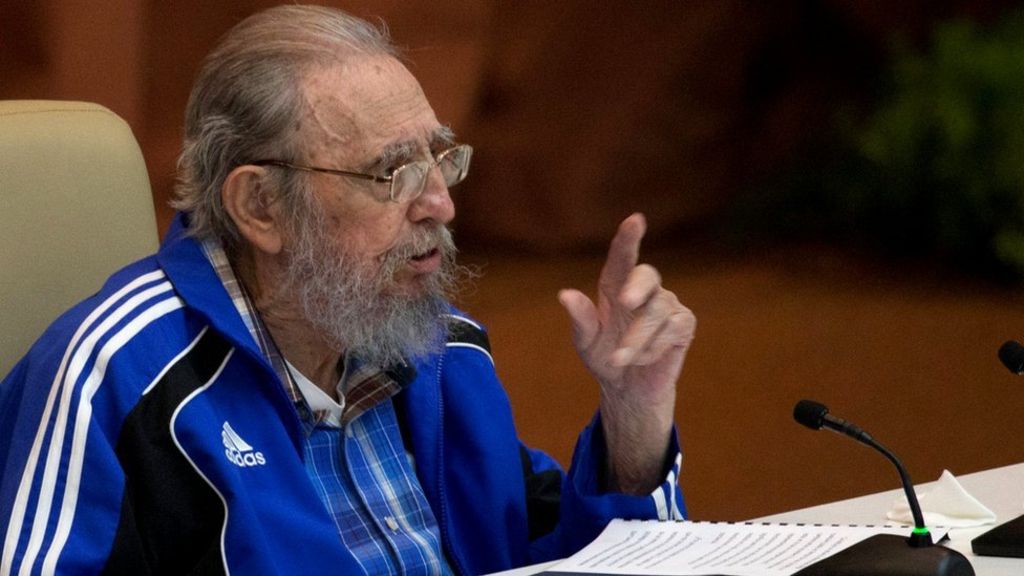
In October 1962, Fidel Castro nearly killed me, along with most of the population of his country and a good proportion of the rest of us. Not because he particularly wanted to create a near-extinction event of a magnitude last seen when an asteroid crashed into the earth a few hundred miles from his back yard. But his pact with Khrushchev was the price he chose to pay for preserving his revolution from the vengeful superpower next door.
Had he not chosen the Soviet Union as the role model for the new Cuba, there is little doubt that the Yanquis sooner or later would have launched another attempt to return Cuba to its sleazy old ways of oligarchs, money-laundering and mafiosi. The reward for being a client state of the world’s other superpower was three decades of hand-outs from the Soviet Union. And when the USSR went into liquidation, Venezuela happily stepped into the breach and shipped huge quantities of oil to Cuba at cost.
There are plenty of obituaries to choose from, and plenty of comments from politicians. To Donald Trump he was the devil incarnate. To Jeremy Corbyn he was an inspiration. So far we have heard nothing from Nigel Farage, our newly-minted world statesman, not that I care much for his bar-room opinions. But it’s hard not to think of Fidel as anything other than a mirror who reflects our prejudices back to us. An enemy of freedom who tolerated no dissent and ruthlessly suppressed his opponents. The benign leader who gave his people world-class healthcare and education, yet denied them the one thing that would best capitalise on that investment: freedom of speech and thought. An indefatigable supporter of African independence struggles.
What I take from his life is that he exemplifies what seems to me to be an abiding political principle.
Most armed revolutions start with good intentions. If they fail to evolve beyond the control of the original instigators, they end in sour ossification. Thus it was with Fidel’s sponsor, the Soviet Union. New dawns turn rancid, especially if the elites they create entrench themselves. And why wouldn’t they? If you have launched a violent revolution, you of all people would know to make it impossible for a revolution to dispose of you. If a revolution isn’t rapidly followed by evolution, it eventually becomes the plaything of those who brought it about. As in Robert Mugabe, Kim Il Sung and his family, Nicolae Ceaucescu, Enver Hoxha and assorted Baathists in Iraq and Syria.
The only reason that Fidel ended up as an iconic figure of the 20th century was the accident of geography that placed Cuba 90 miles from Florida. Otherwise by now he would be a half-forgotten former tinpot dictator, ranked in importance with Stroessner of Paraguay, Pinochet of Chile, Noriega of Panama and Peron of Argentina, along with all the other generalissimos who over the past century contrived to make South America second only to Africa as the worst-governed continent on the planet.
Castro was neither hero nor devil. He was an intelligent guy with a keenly-developed survival instinct whose ideals transformed themselves into a sense that what was good for Fidel Castro was good for Cuba. Rather like the new leader across the straits, I suspect. The people of Cuba will no doubt thank him for ensuring that his country didn’t become another Haiti, even if generations of exiles will lament the lost opportunity to turn their homeland into something like the neighbour to which they fled.
My abiding memory of him is of Khrushchev’s dupe. The man who nearly killed me. Once the madness passed, he was just another dictator.
Happy Thanksgiving y’all! And I mean all.
Now that Black Friday has spread its slimy tentacles across the internet to encompass the globe, perhaps it’s time for every country to embrace another American tradition, and give thanks for national deliverance.
In the case of the United Kingdom, I suspect that the most appropriate symbol of our fortune would be a scrawny old pigeon pumped up with water injected by a poultry producer in Norfolk whose workers come from some faraway country of which we know little. I’m joking of course. We have much to be thankful for, do we not?
Let’s see now….
First up, Nigel Farage is fed up with everybody in the UK being nasty to him (Very Unfair, as the president-elect might tweet). So he’s planning to emigrate to the United States. “How will he get a Green Card?” my wife asked when I broke the joyous news. “Well…”, I replied, “The Walrus’s best friend? Think about it.”
Sadly, Nigel is unlikely to be our next ambassador to the court of St Donald. Perhaps he can be persuaded to change his mind about going to America, and we can offer him a cushy number as Our Man in Asunción. Think how much a trade deal with Paraguay would transform our national prospects.
Second, let us give thanks for my local Member of Parliament, the ultimate Mr Boring, who has dared to do what hundreds of po-faced automata in Parliament have shrunk from. Philip Hammond, our Chancellor of the Exchequer, has through his Autumn Statement, effectively admitted that Brexit will make us worse off. Very much worse off.
In the words of Robert Peston, one of the UK’s most respected financial journalists:
“….the rise in the national debt compared with expectations at the time of the March budget is much more than most expected: by the end of the parliament the Office for Budget Responsibility forecasts government debt at £1.945 trillion, up from £1.725bn.
That is an increase in the cash level of debt of an eye watering £220bn (to use an adjective favoured by the Chancellor, Philip Hammond).
Now £78bn of that is due to the expected post-referendum slowdown in the economy, £16bn is from government spending and tax decisions, and most of the rest is the result of measures taken by the Bank of England in August to avert recession (its initiatives to help banks lend and to purchase bonds).
So it’s reasonable to characterise that £220bn increase in the national debt as the financial cost of Brexit.”
£220 billion over four years? Stuff and nonsense. And anyway, I’m sure all right-thinking Britons will agree that a minor increase in the national debt will be a price worth paying for freedom from EU bureaucracy, the ability to negotiate our own trade agreements and the power to impose our own rules on immigration. Thank you for your honesty, Mr Hammond. You’re fired.
Thirdly, let us give thanks for Deloitte, the consultancy, who suggested in their now infamous memo that in order to disentangle ourselves from the EU, we would need 30,000 more civil servants. Either that, or other programmes that are on the government agenda would have to take second place to what in effect is an act of institutional destruction. Which won’t happen, of course. Excellent, all those new jobs thanks to Brexit. Even if you halve that number, that’s still one ginormous recruitment drive.
And from where will these potential mandarins be sourced? It’s not quite the same as hiring a few turkey pluckers in Norfolk. Will we drag retired civil servants out of their comfortable retirement? Or raid the private sector? Surely we can persuade a few bankers to jump ship for a tenth of the salaries they’re currently earning and no annual bonuses.
No? Not to worry. We’ll muddle through, as we always do. All this stuff about being unable to cope with the Brexit workload is propaganda cooked up by lazy civil servants anxious to make sure that they can still have Friday off to play golf. And if not, there’s no obstacle that a few thousand more bureaucrats can’t clear. As for Deloitte, their disloyalty has been exposed for all to see. They will soon find out what happens to peddlers of inconvenient truths.
Next, let us give thanks for Ed Balls, the former Labour minister whose artistry on Strictly Come Dancing gives hope and encouragement to all those politicians who realise that Brexit is a slow slide to disaster, but don’t have the courage to say so for fear of their jobs. There is a life beyond politics! Think of Nadine Dorries, who outshone all the D-listers on I’m a Celebrity, Get me Out of Here. And Gorgeous George Galloway, resplendent in his pussy suit in Celebrity Big Brother. Who would not embrace a deselected MP in some future blockbuster – Celebrity Rehab perhaps? Thanks to the dancing buffalo, we now have the opportunity to purge Parliament of all but the true believers. Ship out the doubters!
Let us also rejoice in the fact that we in Britain are entirely free from the malign influence of false news and lying politicians, unlike our cousins across the pond. When we are told about the massive influx of funds that will flow post-Brexit into the National Health Service, we know it to be true. When we are told that Boris Johnson is an agent of the Russian FSB, with a mission to spread confusion, division and indigestion across the EU member states with his after-dinner speeches delivered in Latin and his incomprehensible Etonian humour, we know it to be true. How lucky we are that in the nation that gave the world John Stuart Mill, Charles Darwin and Alf Garnett, the notion of “the truth, the whole truth and nothing but the truth” is still so eagerly embraced by our upstanding politicians and newspaper editors. Post-truth? Not in our backyard.
We should also glory in our ethnic and cultural purity. The fact that ever since our ancestors dragged the bluestones from Wales to Stonehenge, we have resisted the malign attempts to change our culture by the Romans, the Saxons, the Normans and all the other interlopers who have tried and failed to dilute our essential Britishness. What did the foreigners do for us? King Alfred, Henry V, William of Orange, Georg Freidrich Handel, Prince Albert, Isambard Kingdom Brunel, Benjamin Disraeli, Gustav Holst, Isiah Berlin, Philip of Greece, Peter Ustinov, Salman Rushdie, Freddy Mercury, Helen Mirren, Chiwetel Ejiofor, Lewis Hamilton, Moeen Ali, Anthony Sher? Foreigners all, of little account.
Yes, we Brits have so much to be thankful for. And I haven’t even mentioned Andy Murray, our glorious Queen, fish and chips, our rapidly improving climate and the flourishing industrial heartlands of the North.
So Happy Thanksgiving, my wonderful homeland. Enjoy the pigeon, and count your blessings that those mangy pilgrims sailed off to America all those years ago, leaving us free from dissent and division. The harvest is good. It’s morning in Britain.
Isn’t it?
Well, we might have a few shortcomings, but fear not. In the immortal prose of The Donald: “Hang in there, Britain. When I’m done draining our swamp, Nigel and I will come over and fix yours. Great country!”

The Young Pope is magnificent. Laden with symbols and portents. In other words, ominous.
HBO’s series about Lenny Belardo, who becomes the first American pope, passes my dream test with flying colours. I know that I’ve seen something special when I dream about it, not only at night but in my waking hours.
The sets, the acting, the script, Jude Law’s portrayal of a tortured soul and the unpredictability of the plot have embedded themselves in my conscious like few other dramas in recent times.
I’m wondering why I’m so enthralled. Perhaps because the timing is exquisite. Here is a man who appears from out of the blue and threatens to change everything. Sounds familiar? Then again, I suppose if you try hard enough, you can make connections between most things that dominate your thoughts. At least Carl Jung thought so when he talked about synchronicity.
And we certainly seem to be living in fearful times, when superstitions normally confined to the subconscious come to the fore. We see meaning in the accidental, intention in the coincidental.
Anyone who is familiar with Shakespeare’s Julius Caesar will know that the ancient Romans were deeply superstitious. Here’s his wife Calpurnia, urging the great man not to venture out on the Ides of March:
Caesar, I never stood on ceremonies,
Yet now they fright me. There is one within,
Besides the things that we have heard and seen,
Recounts most horrid sights seen by the watch.
A lioness hath whelped in the streets;
And graves have yawn’d, and yielded up their dead;
Fierce fiery warriors fought upon the clouds,
In ranks and squadrons and right form of war,
Which drizzled blood upon the Capitol;
The noise of battle hurtled in the air,
Horses did neigh, and dying men did groan,
And ghosts did shriek and squeal about the streets.
O Caesar! these things are beyond all use,
And I do fear them.
Now I’m not generally one to don my toga and stare out over Capitoline Hill (or in my case, the garden of my suburban home) looking for gloomy omens, even though much of what I’ve written since the coming of Brexit and Trump has been pretty doom-laden.
But the other day, for no particular reason, I happened to glance out of the window. There, on our back lawn, was a flurry of feathers. A predator – a kestrel perhaps, or maybe a hawk – was devouring a pigeon. The victim was still alive, twitching. I went outside to identify the aggressor. Before I could make out more than the familiar hooked beak and fantail, it carried the pigeon aloft and flew away. What’s more, the pigeon was scarcely smaller than the bird that carried it.
To say that it was an unusual sight was an understatement. In thirty years of living in the house and looking out on our very tame garden, I had never seen a bird of prey, let alone one feeding on another bird.
If I were Calpurnia, I would have immediately recognised the event as an omen. A forewarning of a greater power feeding on a weaker one, perhaps. But my world is far more mundane, and I thought little more about it other than that it was rather an odd thing to see. Only later, when I went into magus mode, did I make a connection with Donald Trump – The Walrus, as I called him in a previous post. A predator if ever there was one, whose seizure of the US presidency was as unprecedented as the appearance of the avian raptor in my garden.
Then another strange thing.
In the opening sequence of The Young Pope, to the accompaniment of Jimi Hendrix’s magical rendition of Bob Dylan’s All Along the Watchtower, Belardo is seen striding past a gallery of old masters. An animated fireball sets buildings in the pictures alight, and finally topples what looks like a waxwork of a former pope. The Pontiff’s face is set in a permanent smirk. He turns and winks at us.
As I was watching the TV last night, I was thinking of writing about the series. I was curious as to why the director choose that song. So I went to the web for a closer look at Dylan’s lyrics:
There must be some way out of here
Said the joker to the thief
There’s too much confusion, I can’t get no relief
Businessmen, they drink my wine
Plowmen dig my earth
None of them along the line know what any of it is worthNo reason to get excited, the thief, he kindly spoke
There are many here among us who feel that life is but a joke
But you and I, we’ve been through that, and this is not our fate
So let us not talk falsely now, the hour is getting lateAll along the watchtower, princes kept the view
While all the women came and went, barefoot servants, tooOutside in the distance a wildcat did growl
Two riders were approaching, the wind began to howl
Did Paolo Sorrentino, who created the show, see Dylan’s verse as being about the end of days, or perhaps the corruption of power? Or was he hinting at Belardo’s internal struggle – his Greater Jihad? Is Belardo the joker or the thief?
And then, bang! As if through an act of God, at the very moment that the lyrics appeared on my IPad, Hendrix’s opening riff to All Along the Watchtower came ripping through as the soundtrack of an advert.
I thought back to the pigeon and the predator. I thought of omens and synchronicity. And I started thinking of Trump and the fictional Belardo as two sides of the same coin.
Trump the demagogue, ever present, in your face and in your mind, yet unknowable. What lies within? What drives his narcissism, his ten-year-old petulance? And Belardo, an orphan whose emotional wounds are all too clear, who shrinks from human familiarity and will not allow himself to be seen by the laity. Whose past is blameless. Whose message is uncompromising: no love is more important than our love of God.
Belardo is unknowable too. Like Trump, he’s unpredictable. Not afraid to use the symbols of power to enforce his will. A believer of mystique and mystery. Cruel yet compassionate. Calculating yet impulsive. But all in the service of God, rather than for the greater glory of Donald Trump.
In my fevered imagination, Belardo is the Anti-Trump. A chain-smoking ascetic stands opposite Trump’s teetotal self-indulgence. A pope who is loyal to nobody (not even to God, it seems) and a president-elect who prizes loyalty above all things.
Just occasionally two parallel events seem to act as a counterpoint. The one illuminates the other. Thus, to me at least, the coming of a real-life president and a fictional pope, both seemingly intent on bringing down the watchtowers constructed by their recent predecessors, is a perfect example of what Jung would have called a synchronicity event.
Well, maybe. I’m only up to Episode 4 of The Young Pope, and The Walrus hasn’t even taken the oath of office.
Silly nonsense, I know. It’s only a TV show, whereas The Walrus and his band of oyster-guzzling Carpenters are frighteningly real. But still, contemplating the divine, I find myself wondering how many of America’s religious right embraced Trump’s flagrant immorality and voted for him out of a sincere conviction that he’s the Antichrist – the catalyst who will bring about the final confrontation between good and evil, culminating in the Second Coming of Christ. Enough to swing Pennsylvania and North Carolina perhaps.
Time, no doubt, to don the toga, examine the entrails and scour the sky for signs. Or else to fish out the old bible I haven’t read for many a year, join the Adventists and eagerly await the Four Horsemen of the Apocalypse.
On second thoughts, I reckon I’ll just get a prescription for Prozac, sit through the final episodes of The Young Pope in a beatific haze, and wait for a real-life Anti-Trump to deliver us from Armageddon.
PS: The remaining episodes did not disappoint. Sorrentino has delivered a masterpiece in nine parts. As for Trump, Episode 1 is pretty gripping, in a bewildering kind of way.
For the second time this year I happened to be away from home when a great political event took place. On Brexit day I was in France. This time, when Trump triumphed, I was ten days into a holiday in Thailand. It was an appropriate place to witness from afar a political death. The country has just lost its king. Memorials to the longest-reigning monarch in the world were to be seen on street corners, in public buildings, in restaurants and hotels.
King Bhumibol was an emotional anchor for a country wracked for most of his reign by political instability culminating in regular military interventions. He was their talisman. Whatever pain the generals, the demagogues and the corrupt elite might have inflicted on his people, he was there for them – a model of wisdom, benevolence and rectitude, willing to intervene on their behalf not through constitutional right but through authority that comes from respect.
The sense of loss, of an era coming to an end, of uncertainty about the future, was not just reflected in the official period of mourning declared by the military leadership. It was personal. Thais speak about the monarch not as “the King” or “our King”, but as “my King”. Pictures of him at work and play adorn homes as well as public places, as if he was a member of his subjects’ families as well as the national icon.
Now the rest of us join the Thais in wondering what comes next. Whether or not I was unconsciously influenced by deep foreboding on account of Brexit, which I deplore, the books I chose to bring with me reflected previous times when the world has turned upside down, and the effect of turmoil on individuals, families and groups within societies.
I didn’t deliberately choose those themes, but I guess they reflected a state of mind that should be evident from most of what I’ve written in this blog over the past six months. At the risk of sounding pompous, the certainty that I have less time left than I have already lived causes me to spend more time trying to make sense of what has led to now, of why now is what it is, and what future nows might unfold.
So for those of you who might share similar preoccupations, here’s a brief summary of the six books I’ve read over the past couple of weeks. Not a dud among them, but not a barrel of laughs either.

East West Street. A deeply moving account by Phillipe Sands, an eminent barrister and professor of law, who pieces together the history of his Jewish family from their origins in Lemburg (also known as Lviv and latterly Lvov). He intertwines the lives of four men and their families. Three of them lived few streets away from each other: his maternal grandfather, Leon Bucholtz, along with Hersch Lauterpacht and Raphael Lemkin. The latter two were lawyers who subsequently had a profound influence on the development of international law. The fourth person was Hans Frank, Hitler’s viceroy in charge of Poland and the other occupied territories in the East.
As a member of the team of lawyers preparing for the Nuremberg trials of the Nazi leadership, Lauterpacht created the concept of crimes against humanity. Lemkin first coined the term genocide. Although Lemkin’s concept was not universally accepted by the four powers represented at Nuremberg (for fear that the term being used to describe earlier historical events of which the victors were not proud) the two lawyers were authors of two enduring planks of international law, even though they didn’t see eye to eye on the details. Lauterpacht was focused on crimes in terms of their effects on individuals. Lemkin believed that prosecutions for war crimes should be conducted on the basis of crimes against groups.
In Sands’ narrative, all roads led to Nuremburg. For Frank, the trial ended with the death sentence. At the time of the trials neither lawyer was aware of the fate of their extended families and Frank’s part in it. Only subsequently did they and Leon Bucholtz discover that their loved ones were among more than two thousand residents of nearby Zolkiev who rounded up, shot and buried in a forest outside the town. Other family members ended up at the Treblinka death camp.
When we talk blithely about a world turned upside down in the wake of Trump’s election, we should read this book and consider the fate of Lemburg/Lviv/Lvov, a city that over thirty years ended up by treaty or through invasion within the borders of three separate states, and whose population suffered endless turmoil.
You don’t have to be Jewish and to have been robbed of a normal family history to appreciate the legacy of Lemkin and Lauterpacht. Thanks in large part to the work of two outstanding lawyers, tyrants, warlords and their foot-soldiers know that today there is an International Criminal Court waiting for the opportunity to reward them for their efforts.
Although East West Street is an invaluable primer of the origins of international criminal law, in essence it’s a book about individuals and their stories, eloquently told by an author who has through his work encountered more than his fair share of inhumanity. To that extent, you sense that Lauterpacht, with his emphasis on the individual, is the greater influence on Sands as he weaves together the strands of human tragedy and survival in this impressive and compassionate book.
SAS: Rogue Heroes – The Authorised Wartime History. A rattling yarn about Britain’s Special Air Services (SAS) in the Second World War. Ben MacIntyre, who specialises in “untold stories” from that war, was given access to the SAS diaries that document every operation the organisation undertook from its foundation in the North African campaign through to the end of the war. Full of eccentrics, psychotics and feats of incredible bravery. At the heart of the SAS founding ethos was training and planning – conventional military virtues – overlaid with improvisation, versatility, team spirit and determination up to the limits of human capability. It’s a template that has survived in special forces to this day.
The saddest part of the book was the long list at the end of those who didn’t survive – victims of battles against the odds, cock-ups and Hitler’s policy that all captured commandos should be shot. There are also poignant stories of those who did survive and couldn’t adjust, including Paddy Mayne, one of Britain’s most decorated soldiers. A hard-drinking international rugby player and solicitor, he died within ten years of the end of the war, after running his car into the back of a farmer’s truck at the end of a late-night drinking session.
Purity. Jonathan Franzen’s latest novel – dense, intense, intricately plotted and with a rich array of three-dimensional characters. It’s a story about relationships between mothers, fathers, sons and daughters, set in California, Bolivia, East Germany and Colorado. The themes are enduring, and the main characters revel themselves in increasing depth as the story progresses. What more could you ask for? This is my first Franzen novel, and it’s as good as anything I’ve read for years.
Conclave. Robert Harris’s latest tale, in which he describes a papal conclave – the process to elect a new pope. Full of arcane details, skulduggery and unholy ambition punctuated with unexpected external interventions – acts of God, you might say if you were one of the cardinals locked into the Sistine Chapel for interminable rounds of inconclusive voting.
Harris is one of those novelists I can count on not to disappoint. I’ve read most of his previous stuff. Conclave isn’t his very best – I rate his Cicero novels higher – but the story races along, and has an interesting if slightly unbelievable final twist.
The Plot Against America. Philip Roth’s 2004 novel is about what might have happened if the Nazi-sympathising aviator Charles Lindbergh, running on an isolationist platform, had taken on and defeated Roosevelt in the 1940 presidential election. It was frequently cited during the US election campaign, which is why I decided to read it. With exquisite timing, I started it the day before the election, and finished it the day after.
It’s a tale of insidious anti-semitism. Roth’s own family is ripped apart as one side takes the view that things won’t really be that bad, and the other foresees an apocalypse. As Britain takes on Germany alone, we readers know what is about to happen in occupied Europe, but the Jews of America oscillate between denial and resistance.
The parallels are obvious. Did Hitler have a hold on Lindbergh? For Hitler and Lindbergh, read Putin and Trump. Even if Roth’s novel was written from the perspective of a Jewish family in New Jersey, and today there are many other targets of Trump’s wrath, we are seeing the same sentiment of cautious optimism. Trump will draw back from his campaign rhetoric, won’t he?. Things will turn out OK, won’t they? Until they don’t.
In Roth’s tale they do eventually work out. With Trump we will have to wait and see.
The Maisky Diaries: The Wartime Revelations of Stalin’s Ambassador in London. Ivan Maisky was the Soviet ambassador to the UK between 1932 and 1943. The very fact that he survived in his post for that length of time shows that he was an extraordinary individual. Stalin’s purges carried off many of his high-ranking colleagues, and he too came close to disaster. He was extraordinary not just because of his survival skills. He cultivated relationships across Britain’s political and literary spectrum. As evidence by the diaries, he was a highly accomplished writer. He was a man of letters and a lover of the arts.
His diaries are fascinating because they offer the perspective on English society of an outsider who was capable of donning the mask of an insider. He was aware that everything he wrote would at some stage be read by the leadership in Moscow, and would be used in evidence if he ended up as the accused in a show trial. He was therefore careful to bend the knee to ideology. Often, if he wished to make a point in his dispatches to Moscow that Stalin might not appreciate, he was careful to attribute those views to one of his British contacts. But you still get the sense that if you had sat down with him beyond the earshot of informers, he might have revealed the soul of a man who was a bolshevik only by convenience.
The politicians he describes in the run-up to the war are, with a few exceptions, a complacent and deluded lot. Chamberlain, Halifax and Hoare come in for the worst of Maisky’s scorn. Subsequent events proved him right. His favourites were Lloyd George and Churchill. Lloyd George, as the elder statesman, was never afraid to share his views with anyone prepared to listen, and he undoubtedly helped Maisky to better understand the subtleties of British politics. The relationship the envoy formed with Churchill long before the war was based more on respect than affection. It was clear to him that here was a man with more backbone than most of his peers put together.
For those of us not privy to the often tortuous complexity of international diplomacy, Maisky gives a fascinating blow-by-blow account of the shifting sands of negotiations between the German, British, Soviet and French governments in the run-up to the Second World War. In those days communications were mainly by notes, telegrams and letters and often conducted through the subtle intermediation of the ambassador. Summits were rarities, and even high-ranking envoys like Maisky would make interminable rail trips to attend international conferences, such as meetings of the League of Nations in Geneva. A far cry from shuttle diplomacy, which seems to have reduced all but the most influential modern ambassadors to the status of bag carriers.
Maisky fell foul of his masters in the end, during a late flowering of Stalin’s reign of terror. He was accused of being a British spy. He came within an inch of the firing squad, but was saved by the death of the leader. He still ended up in jail for five years, and remained in disgrace until the Sixties. But he died at the ripe old age of ninety-one, despite predicting in his diary that he wouldn’t make it past his seventh decade.
It’s a fascinating read, excellently edited by Gabriel Gorodetsky, who rediscovered the diaries in 1993. He provides illuminating commentary throughout.
A pretty heavy selection for a holiday, you might think, and you’d be right. But if ever a time could be said to be ordinary, this sin’t it.
A final note: the links to Amazon are not sponsored. I include them for convenience, not as a recommendation to buy from the site. There are still a few independent booksellers out there, though sadly the last one in my town closed recently. Don’t let them all die.
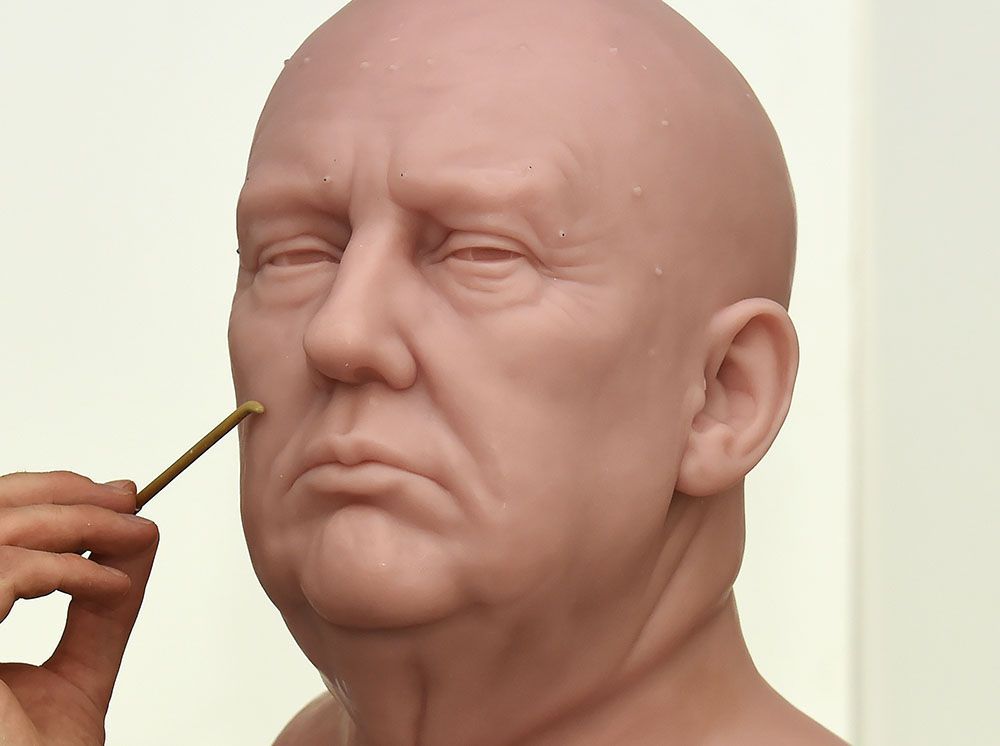
The grim visage staring at you in this picture would be enough to scare the living daylights out of 007, Luca Brasi, ISIS, Kim Jong Un or a pack of rabid attack dogs. Uncle Fester on steroids. The face of a serial killer, a torturer, a Christian-persecuting Roman emperor, a paranoid eunuch at the court of a fratricidal Ottoman Sultan?
I’m not a fan of Madame Tussauds. Waxworks look, well, waxy, and often nothing like the intended subject. But this one, before they stuck the yak hair on top of his head and plastered him with orange, captures The Walrus rather well, I think.
Would the American people have elected him if he’d appeared before the people without the cirrus cloud hovering those grim features? I don’t think so. A few months ago I wrote a post about the difficulty bald politicians face in achieving supreme power, especially in the US and the UK. Think back to every elected prime minister since Churchill, and every president since Eisenhower (apart from the accidental one thrown up by Watergate). A quirk of follicular genetics determines your perceived fitness to lead. More on that subject in Politics – why do the baldies always lose (unless they’re up against other baldies)?
Anyway, just when you think America has elected Ernst Stavro Blofeld as president, he comes up with this rather plaintive tweet:

Ah OK, that must have been the version with the hair. Makes you want to pass the poor guy a hankie.
The wonderful thing about America is that you can say all kinds of things about elected officials – provided they are not threatening or libellous – without some G-man or lawyer with a writ knocking on your door. Not so in some other parts of the world – Turkey for example.
Should that cease to be the case in the near future, then the rest of us have real cause to worry. Until then, happy days for cartoonists, political sketch writers and John Oliver. If only Theresa May was such an easy target!
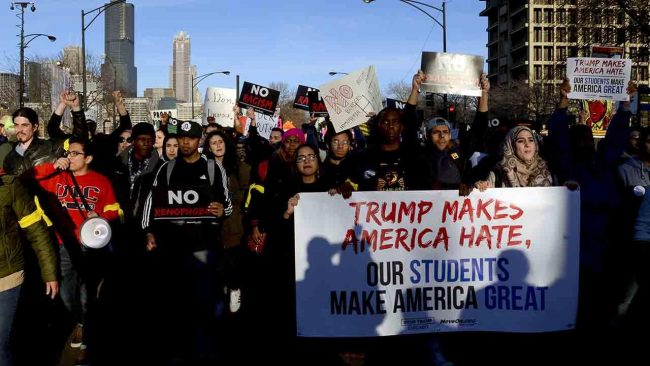
OK, so Trump won.
Enough of the wailing and gnashing of teeth. I had those moments yesterday, but I’m over them, because neither I nor anybody else can do anything about it.
Brexit, on the other hand, I’m not over, because so long as there is an opportunity to influence the outcome, either towards a reconsideration of the whole deal or a mitigation of the effects of a hard Brexit, I’ll continue to make my voice heard.
But Trump is a done deal, so now it’s time to take a hard look at the new reality with which we must now come to terms.
As an immediate reaction, a few thoughts have been going through my mind since yesterday. Here they are, in no particular order:
It will not be the first time that America has elected a President with a few screws loose, but with Trump at least we know where the screws are. This was not the case last time a potentially unhinged president was in office. Richard Nixon’s paranoia was pretty well known, but it was only after his resignation that the full extent of his obsessive, depressive and drink-fuelled behaviour while in office became known.
In Trump’s case most of the stories have come out already, though don’t be surprised if more seep out in the next couple of months. Barring more gruesome revelations we know what to expect. Hopefully there will be a shrink close to the White House to raise the red flag when things get out of hand.
Ace negotiator? That remains to be seen. Many successful negotiators I’ve come across don a mask of inscrutability. In Trump’s case there will be enough information from his media career, from the election campaign and from the numerous stories from people who know him (and don’t like what they saw) for a negotiating opponent to be armed with perhaps the most accurate and comprehensive psychological profile of any president in history.
Contrast Trump with Vladimir Putin, a cold-eyed poker player whose opponents are still trying to figure out even after sixteen years in power. The only thing Trump has going for him is his reputation for unpredictability, something he shares with Putin. But at the heart of Putin’s unpredictability lies a talent for lateral thinking. Trump’s, it seems, is rooted in low emotional intelligence and impulse control. Should be interesting watching them together.
Trump may do nasty things, but nasty things happen anyway. 9/11 didn’t happen on the watch of a narcissistic demagogue. Nor did the financial crisis of 2008. And nor did the Arab Spring and the rise of ISIS. The known unknowns under Trump may be different from those Hillary Clinton might have had to deal with. The consequences of a weakened NATO, of trade wars, of climate change denial, of the destruction of Obamacare and the dismantling of the Iranian nuclear deal are as yet hard to predict. But stuff happens that is beyond the control and influence of the United States. Trump’s administration is going to have to deal with the unknown unknowns just as any other would.
There will be no quick fixes, so be prepared for an impatient President. Walls take time to build, factories even longer. All the fixes required to “put Americans back to work” will take time. So in the early part of his presidency, bar one or two landmark pieces of legislation, expect Trump to gorge himself on gesture politics. Then, as the next election draws nigh, expect him to blame others for his failures and beg the electorate for more time “to finish the job”.
The tools he used to climb so high might ultimately lay him low. Or, to put it another way, the genie of extremism he has released will not meekly return to its bottle upon his inauguration in January. His opponents will use the same weapons to attack and undermine him as he used against Hillary and everyone else who spoke against him. As president, he will not be able to lash back as he has done during the campaign. For a candidate to accuse his opponent of criminality is one thing. For a president to abuse and slander his fellow-citizens is quite another. The American people will not take kindly to being described as losers. Expect an endless anti-Trump campaign on the social media.
In terms of his behaviour and his utterances he will be under scrutiny as never more. He will be called out on every act of hypocrisy and every failure to keep his campaign promises. The well of popular discontent on which he drew will be available to his enemies, especially when he fails to deliver the miracles he has promised. The activism last seen when America was in Vietnam has returned. The young are no longer quiescent and compliant, as they were through much of the 80’s and 90’s. Donald Trump will be under the media gun from Day One.
His dominance in domestic politics is unlikely to last beyond two years. Even though both houses of Congress are under Republican control, that can change in 2018. The Democrats will re-group. They will exploit every failure on Trump’s part with a vengeance. And there will be failures. His opponents will fight tooth and nail against reactionary legislation – on Obamacare and abortion, for example. The Democrat-leaning media, both print and online, will be relentless.
So if Trump isn’t very careful – or very lucky – he will find himself in the same situation as Obama did for the final six years of his presidency: fighting against a Congress dominated by his opponents. That could be the point at which he will start to contemplate unconstitutional means to enforce his will. With success? I suspect that America’s institutions are stronger than Donald Trump, and that he would meet opposition from his own side, many of whom will continue to find him profoundly distasteful, not to mention a threat to their continuance in office.
What of the outlook for the United Kingdom during the Trump presidency? Well, I suppose one thing that stands out is that if America’s shield no longer provides us with protection against the territorial ambitions of Vladimir Putin, we should be grateful that we still have Trident. Our nuclear deterrent would not be enough to protect the Baltic states and Ukraine. But should NATO dissolve or weaken, our military strength should provide us with fresh leverage in our Brexit negotiations with the European Union. It’s also conceivable that Theresa May will yield to the warnings of the generals and increase our defence spending.
In political terms, we already have the most right-wing government in living memory. The left is divided and weak. The centre is painfully ineffective. That should be to Trump’s liking. Will he place us up the queue for trade negotiations? Quite possibly, provided we adopt the appropriate begging posture. But be assured that the devil will be in the detail, and it may not be pretty. There will be no favours just because the President’s mother was Scottish and he loves our golf courses.
Will Trump’s protectionist policies force us to rethink Brexit? Unlikely, but you never know. Should there be some form of Trump-induced economic or geopolitical shock, the pressure on the UK to seek safety in numbers may become irresistible.
How about our European soon-to-be-former partners? Will they succumb to the far-right wave that is sweeping through western democracies? Le Pen in France? Wilders in the Netherlands? Conventional wisdom says that Trump’s victory makes it more likely that Le Pen will prevail, because America has already done the unthinkable.
I’m not so sure. It may be that events in America will serve as a warning not to underestimate the demagogues. Perhaps France and other countries will form temporary centre-left coalitions to defeat the extreme right. There will certainly be a reaction against Trumpery, whether it comes from the grass roots or through a realignment of traditional political forces.
But one thing is pretty certain. The discontent that found its lightning rod in Trump will not go away. One way or another, the European Union – and the United Kingdom – will need to address the causes in their own back yards. That could mean a bumpy ride in Europe and quite possibly the rest of the world over the next four years.
Fasten your seat belts. It should be interesting.
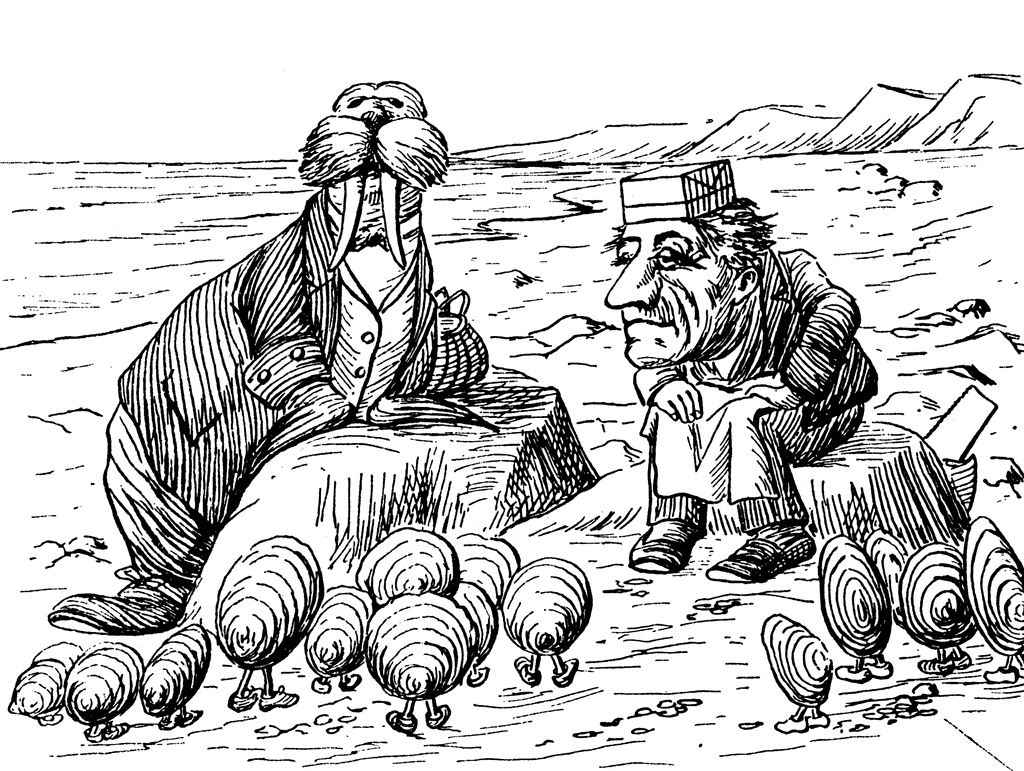
I don’t even live in the US, yet all my vital signs are telling me that one more intervention, one more lie or one more scandal that isn’t a scandal will send me off the deep end. Two days to go until the moment of “truth”, and I eagerly await the news that The Walrus is a paedophile, a drug runner or an infiltrator from an endangered planet far beyond the solar system. Or that Hillary isn’t actually alive – the person we see on our TV screens is an animatronic reconstruction, endlessly emoting the same stuff from rally to rally.
I’ve had enough. And yet this election thing is addictive, isn’t it? If I do survive until Thursday, I shall probably collapse with grief at the thought that the whole 18-month reality show is over. I’ll go into a long depression that will only be relieved when Theresa May does us all a favour and calls a general election in the UK.
In the event that our UKIP-lite government decides not to give us another chance to vote down Brexit, all is not lost for election addicts. After all there’s still the fascinating prospect of watching the French and the Germans tearing themselves apart next year.
By that time I fervently hope that Nigel Farage, our very own Mr Toad, will have departed from Britain to take a job with Trump TV, because that will mean that The Walrus will have failed to get elected. Even better would be if Boris decided to re-apply for his US passport, and took some of his shifty mates off to America with him.
As you will have noticed if you’re a regular reader of this blog, I’m finding it harder to think of politicians without thinking of animals. Ferrets, cockatoos, giant sloths, rats, snakes and chipmunks keep coming to mind when I look beyond The Walrus and Mr Toad. I’ll leave it to you to work out who I’m thinking of. How I would love to be a cartoonist!
Moving on from such trivia, we really aren’t living through democracy’s finest hour, are we?
Four years ago, you would have thought that the number of countries that don’t practice some form of democracy or other was decreasing by the month. Even in the Middle East, you could see absolute monarchies creaking under the pressure of the Arab Spring. Today Egypt is a dictatorship and Turkey is moving in that direction. Let’s not speak of Iraq, Syria, Yemen and Libya, except to question to whom they will turn should they wish to adopt some form of democracy when the dust has settle and the bodies have been buried.
The shining beacon on the hill that is American democracy? I don’t think so. A system in which personality outshines policies. In which partisan divides prevent any coherent form of government. In which the equivalent of the GDP of a medium-sized country is spent on a perpetual round of election campaigns. In which the exposure of lies and borderline criminality no longer disqualifies candidates. In which unscrupulous partisan officials connive to suppress voting. Hardly an inspiring example for the huddled masses.
And what of the United Kingdom? A country in thrall to a few unscrupulous media owners and editors who hurl abuse at reputable judges trying to defend the sovereignty of parliament. Politicians whose principles are subject to their career prospects. Just as in the US, lies, empty promises and meaningless visions abound. The Mother of Parliaments is looking a bit raddled these days.
So to whom will those searching for a model of self-government turn in 2017?
To Russia perhaps, whose population seems to value most highly the preservation of order and the restoration of national prestige even if the price to be paid is that the rulers fleece the ruled. Or China, where you can criticise anything except the one thing that should always be subject to criticism – the political order.
If you were an American, disgusted with the moral pollution of the current election campaign, where would you turn to for a new home? Canada perhaps – viewed by many as the last remaining exemplar of liberal democracy. Curiously enough, I read in one of the main UK newspapers (not the one that rails against “Enemies of the People”) that there has recently been a surge of enquiries from Americans about emigrating to my country. Good luck with that, folks.
Me, I’m staying put. It would take a lot to persuade me to leave Britain. Our values may be seriously corroded, but we’re not broken yet, whatever Mr Toad might say. I would far rather live with Eeyore, Tigger, Badger and Piglet than the Walrus and the Carpenter.
A final word of encouragement to my cousins across the Atlantic: it’s not too late. Surprise and delight the rest of us – go kick that sand in the bully’s face. Make sure he never gets near government again, and slinks off to run his TV station – which, of course, goes bankrupt in a couple of years.
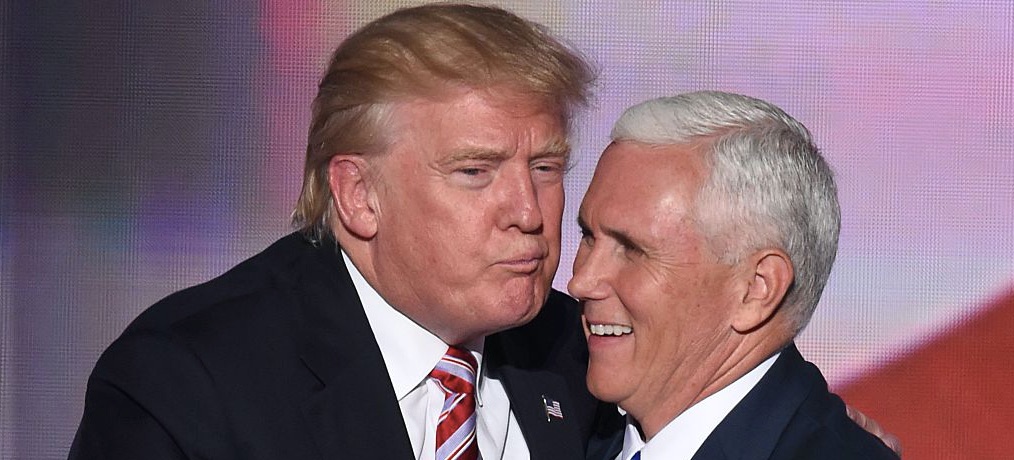
The sun was shining on the sea,
Shining with all his might:
He did his very best to make
The billows smooth and bright–
And this was odd, because it was
The middle of the night.
The moon was shining sulkily,
Because she thought the sun
Had got no business to be there
After the day was done–
“It’s very rude of him,” she said,
“To come and spoil the fun!”
The sea was wet as wet could be,
The sands were dry as dry.
You could not see a cloud, because
No cloud was in the sky:
No birds were flying overhead–
There were no birds to fly.
The Walrus and the Carpenter
Were walking close at hand;
They wept like anything to see
Such quantities of sand:
“If this were only cleared away,”
They said, “it would be grand!”
“If seven maids with seven mops
Swept it for half a year.
Do you suppose,” the Walrus said,
“That they could get it clear?”
“I doubt it,” said the Carpenter,
And shed a bitter tear.
“O Oysters, come and walk with us!”
The Walrus did beseech.
“A pleasant walk, a pleasant talk,
Along the briny beach:
We cannot do with more than four,
To give a hand to each.”
The eldest Oyster looked at him,
But never a word he said:
The eldest Oyster winked his eye,
And shook his heavy head–
Meaning to say he did not choose
To leave the oyster-bed.
But four young Oysters hurried up,
All eager for the treat:
Their coats were brushed, their faces washed,
Their shoes were clean and neat–
And this was odd, because, you know,
They hadn’t any feet.
Four other Oysters followed them,
And yet another four;
And thick and fast they came at last,
And more, and more, and more–
All hopping through the frothy waves,
And scrambling to the shore.
The Walrus and the Carpenter
Walked on a mile or so,
And then they rested on a rock
Conveniently low:
And all the little Oysters stood
And waited in a row.
“The time has come,” the Walrus said,
“To talk of many things:
Of shoes–and ships–and sealing-wax–
Of cabbages–and kings–
And why the sea is boiling hot–
And whether pigs have wings.”
“But wait a bit,” the Oysters cried,
“Before we have our chat;
For some of us are out of breath,
And all of us are fat!”
“No hurry!” said the Carpenter.
They thanked him much for that.
“A loaf of bread,” the Walrus said,
“Is what we chiefly need:
Pepper and vinegar besides
Are very good indeed–
Now if you’re ready, Oysters dear,
We can begin to feed.”
“But not on us!” the Oysters cried,
Turning a little blue.
“After such kindness, that would be
A dismal thing to do!”
“The night is fine,” the Walrus said.
“Do you admire the view?
“It was so kind of you to come!
And you are very nice!”
The Carpenter said nothing but
“Cut us another slice:
I wish you were not quite so deaf–
I’ve had to ask you twice!”
“It seems a shame,” the Walrus said,
“To play them such a trick,
After we’ve brought them out so far,
And made them trot so quick!”
The Carpenter said nothing but
“The butter’s spread too thick!”
“I weep for you,” the Walrus said:
“I deeply sympathize.”
With sobs and tears he sorted out
Those of the largest size,
Holding his pocket-handkerchief
Before his streaming eyes.
“O Oysters,” said the Carpenter,
“You’ve had a pleasant run!
Shall we be trotting home again?’
But answer came there none–
And this was scarcely odd, because
They’d eaten every one.
Lewis Carroll (from Through the Looking-Glass and What Alice Found There, 1872)
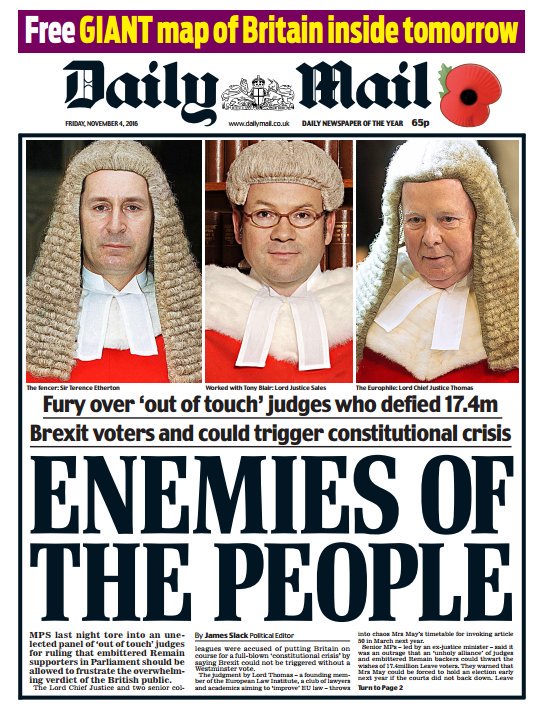
Brexit continues to orbit like a moon around Donald Trump’s earth.
Yesterday the moon shone a little brighter. The High Court decision that the government must consult Parliament before invoking Clause 50 of the European Union Treaty produced a stream of vituperation from Leave supporters and right-wing newspapers that The Walrus (aka Trump) would find it harder to better.
Leading the field as always, the Daily Mail published pictures of the three judges who made the decision – including the Lord Chief Justice – under the headline “Enemies of the People”. A surprisingly Stalinist phrase for a newspaper that has served over the past year as the Brexit rabble-rouser-in-chief.
But hardly surprising given its unerring ability to find itself on the right side of history. This is the newspaper whose owner in the 30s was the best mate of Hitler and Mussolini. The same owner, the first Viscount Rothermere, who published a charming leader entitled “Hurrah for the Blackshirts” in praise of Oswald Mosley’s fascist thugs.
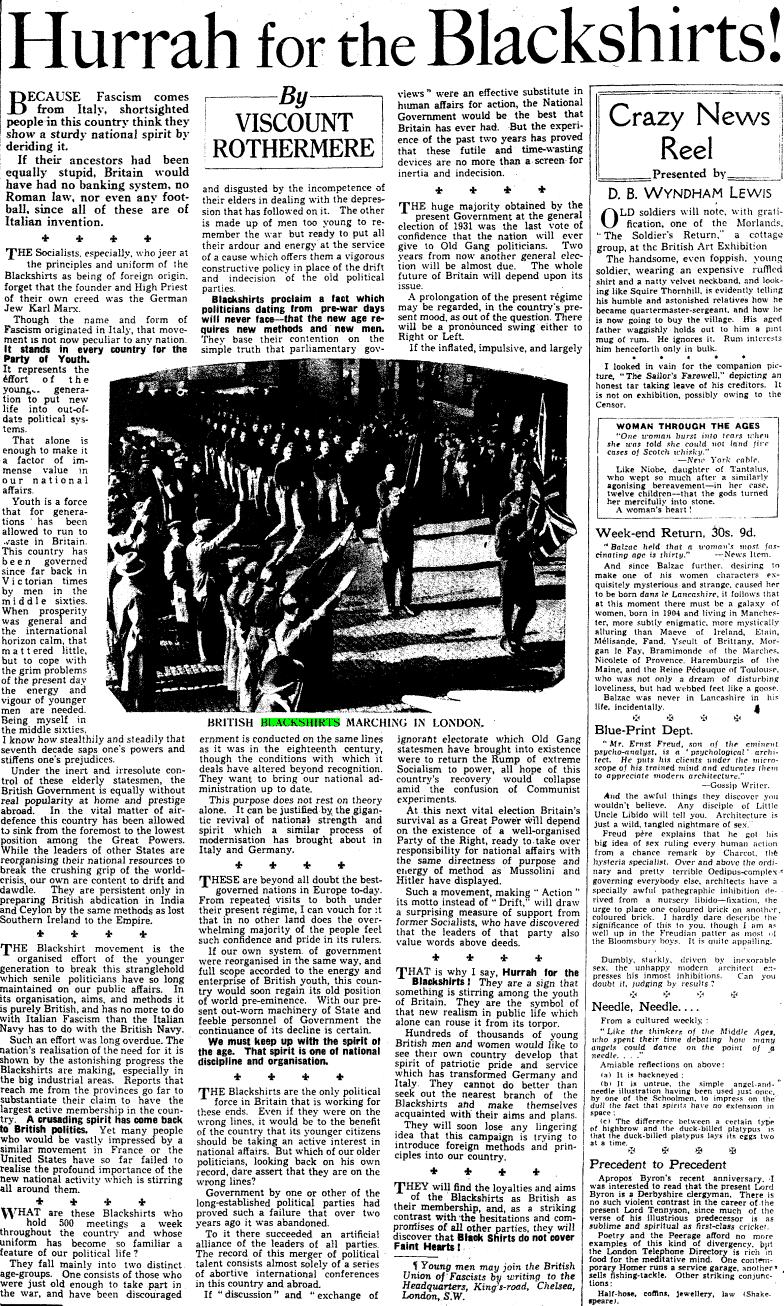
The Mail was also the paper that in 1924 published the Zinoviev Letter, purportedly written by a Soviet official urging increased communist agitation in Britain, as in this section:
A settlement of relations between the two countries will assist in the revolutionising of the international and British proletariat not less than a successful rising in any of the working districts of England, as the establishment of close contact between the British and Russian proletariat, the exchange of delegations and workers, etc. will make it possible for us to extend and develop the propaganda of ideas of Leninism in England and the Colonies.
It just happened that the Mail published the letter four days before a general election, at a time when Ramsey MacDonald was struggling to stay in power as the leader of a minority Labour Government. The letter was later revealed as a fake. MacDonald lost. Sounds familiar? Hence the analogy of the sun and the moon.
Once the High Court decision put the spoke in the Brexit wheels, I was not surprised at the reaction on the Leave front. Nigel Farage, for example, saying that our political class “have no idea of the level of public anger they will provoke” if they try to hamper Brexit. Riots in the streets, Nigel? Very Trumpian.
The Daily Mail went further, however. By branding the judges as “enemies of the people”, it impugned the independence of the judiciary, and it intimidated, at least by implication, the judges of the Supreme Court who will have to hear the Government’s appeal against the ruling.
It’s not hard to imagine that there might be some Leave supporters who will be influenced by that headline to take some action against these judges. After all, we lost an MP this summer to a seemingly deranged right-wing fanatic. Hopefully the judges will be protected from physical abuse, but the verbals have already started, cheer-led by the Daily Mail.
All of which leads me to wonder whether the newspaper has gone too far. Under the Criminal Justice and Public Order Act, Chapter 33, Part XII, Section 4A of Section 154 (Intentional Harassment, Alarm or Distress):
-
A person is guilty of an offence if, with intent to cause a person harassment, alarm or distress, he—
(a) uses threatening, abusive or insulting words or behaviour, or disorderly behaviour, or
(b) displays any writing, sign or other visible representation which is threatening, abusive or insulting,
thereby causing that or another person harassment, alarm or distress.
- An offence under this section may be committed in a public or a private place, except that no offence is committed where the words or behaviour are used, or the writing, sign or other visible representation is displayed, by a person inside a dwelling and the person who is harassed, alarmed or distressed is also inside that or another dwelling.
- It is a defence for the accused to prove—
(a) that he was inside a dwelling and had no reason to believe that the words or behaviour used, or the writing, sign or other visible representation displayed, would be heard or seen by a person outside that or any other dwelling, or
(b) that his conduct was reasonable.
Let’s think about this, then. Was the act of describing three senior judges as “enemies of the people” threatening, abusive or insulting? I for one would say yes.
Were those words “used by a person inside a dwelling and the person who is harassed alarmed or distressed is also inside that or another building”? Clearly not, unless the justices happen to have offices inside the Daily Mail’s offices.
And finally, was the conduct of the Daily Mail “reasonable”? Well, dear reader, that’s for you to judge. But to malign three eminently-qualified judges by accusing them of political bias, and to incite hatred towards them by describing them as enemies of the people would appear to be profoundly unreasonable.
No doubt the Mail would argue that it was merely reflecting public opinion about the judgement. If so, why did it not ascribe the words to an individual as a quotation? It seems pretty clear to me at least that the headline reflects the view of the newspaper.
I await with interest to see whether the Director of Public Prosecutions will issue a summons against Paul Dacre, the paper’s editor, and the current owners, on the criminal charge of causing intentional harassment, alarm and distress to Lord Chief Justice Thomas, Master of the Rolls Sir Terence Etherton and Lord Justice Sales.
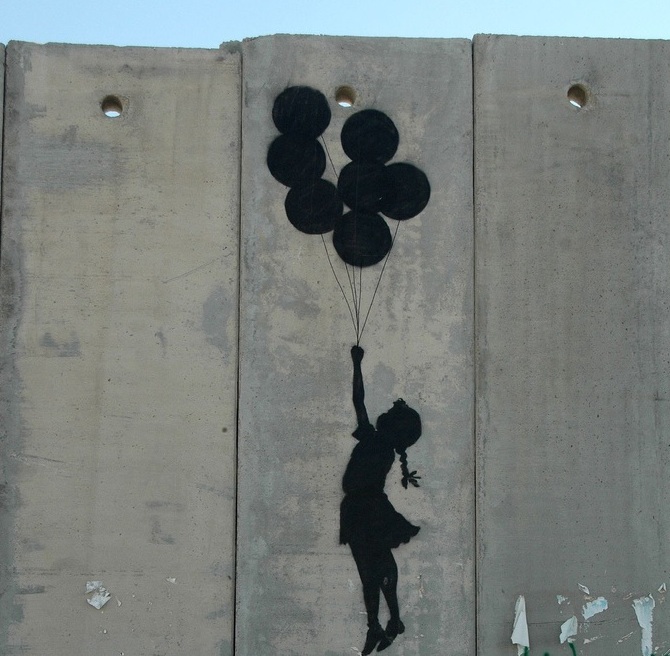
Imagine a world in which national borders suddenly slam shut. International trade grinds to a halt. Perhaps because of war. Or because of a lethal epidemic that has caused your country to prohibit anyone from entering for fear that they might introduce the infection. Ports closed. Airports shut down. No imports and no exports.
Let’s suppose that this was not a temporary aberration – it was clear that for an indefinite period your country was going to have to rely on its own resources.
How would you cope? In Britain, a good proportion of our cars, trucks and trains would break down within five years for lack of spare parts. We would start growing large quantities of sugar beet to make up for the lack of cane products. We would have to go back to mining coal to keep our homes warm. Fracking would become a national necessity to keep the gas power stations running. The internet would shut down because some countries would be unable to maintain the nodes for the lack of chips and printed circuit boards. Doctors would have to revert to traditional diagnosis techniques because the scanners and all the other medical equipment on which we’ve come to rely would slowly degrade.
In the end, we would probably cope, provided civil order didn’t break down. And to prevent that, we would probably need a police state the likes of which we have never seen before. Everything we would need we would have to make, mine or grow.
It’s almost unthinkable, but let’s think about it anyway Would all the small countries of the world become mini Cubas and North Koreas, making do and mending, enduring periodic famines, and, deprived of the fruits of international cooperation, unable to deal with health crises and resource shortages? You’d reckon that the United States would cope, with so many resources to be found within their borders. But what about China and Japan, with their high reliance of imported oil? What about France, so reliant on nuclear power? Where would it find the uranium to keep the power stations running? Where would just about every country reliant on computer technology find the lithium and the rare earths?
Of course, short of World War 3 or some horrendous epidemic, it isn’t going to happen. After all, trade across regions has been going on since the bronze age. But thinking about the consequences of a collapse in international trade makes you realise what a delicate ecosystem the world economy has become. And how, since the beginning of the 20th century, it has been getting ever more delicate.
Why this apocalyptic snapshot of a world without trade? Have I been reading too many Margaret Atwood novels, or gorging on Mad Max movies? Not lately, but there are plenty of other cues for dystopian musing if we care to look for them. Ebola and Zika. Donald Trump vomiting hyperbole about Hillary’s bloody emails. Russian warships passing by the cliffs of Dover on their way to pulverise Aleppo. Videos of tunnels full of ISIS flags and people choking on sulphur fumes.
For the benefit of us foreigners who are following the US elections, just about every newspaper and TV station from London to Taiwan has sent a reporter to interview jobless white voters against the backdrop of dead factories, mines and steel mills. This report is an example. All the fault of the Chinese, the Mexicans and whoever else the “deplorables” can find to blame. Oh, and Hillary of course.
Actually, my train of thinking didn’t start with the blatherous walrus about to become President of the United States. It started in Denmark. My wife and I were on a visit to Copenhagen. As we wandered through the city centre, we happened on a procession snaking down the street on its way to the parliament building. A very Danish demonstration – young and old, people wheeling bicycles, singing songs, waving placards. Hardly a policeman in sight. If this was London, cops in full riot gear would have been formed up somewhere ahead in a Macedonian phalanx ready to repel the unruly mob. But not here. Being sensible Danes, they waited until the gap between the end of the working day and dinner time to make their protest. And the object of their very civilised ire? Two treaties. One signed the other day, and the other still grinding through the works after ten years of negotiation.
The first was the Comprehensive Economic and Trade Agreement – also known as CETA – between the EU and Canada. The other was the Transatlantic Trade and Investment Partnership – TTIP for short – between the United States and the European Union. Compared with TTIP, CETA, which was finally signed on Sunday after the objections of the Belgian Walloons were overcome, is like a pimple on the backside of an elephant.
TTIP is huge. So far there have been fifteen rounds of negotiations. There are twenty-seven separate subjects for negotiation, ranging from agricultural market access, e-commerce, energy and raw materials to dispute settlement, procurement and financial services. Each of the concluded set of sub-agreements must be ratified by each of the 28 (shortly to be 27) member states of the EU.
There are many reasons why the Danes and many others across the Union are getting aerated about it. The possible reduction of technical standards to lowest common denominator, the threat to national and local democracy, the unreciprocated ability of corporations to sue states. The anti-TTIP forces are also angry because at the insistence of the US, the negotiations are being held in secret (haven’t I heard a few rumblings about secret negotiations somewhere else recently? Oh yes, Brexit).
The whole deal was supposed to be agreed in principle by the end of this year. There’s not a chance of that. Maybe in ten years, some experts say. According to others, the whole thing is a dead duck.
And should Trump be elected US president in seven days’ time, that duck will plunge flapping and squeaking out of the sky in short order thereafter.
Should TTIP survive the slings and arrows heading in the direction of both parties in the next few years, it would involve 60% of the world economy. That’s one big duck.
What’s more, the US, not content with deploying a vast team of negotiators to eat hotdogs and drink schnapps with the Europeans, is pursuing a Trans-Pacific Partnership (TPP) with eleven other countries on the Pacific Rim, including Canada, Japan, Malaysia, Australia and New Zealand. That one’s a bit further down the track than TIPP, but since both Trump and Clinton propose to dump it, we can safely assume a further reduction in the duck population.
What of Russia and China? You would think that all the cozying up being contemplated would leave them seriously isolated. But they belong to the biggest and fattest duck of all – the World Trade Organisation. Just about every country in the world is either a member or applying to join (a notable exception being – guess who – North Korea). In other words, virtually everyone does their business according to a vast system of rules and conventions that prohibit independent actions that might be to the detriment of member states.
So it was those bleak images of rusting factories, along with Trump’s bombastications about American jobs for American workers that led me to speculate about how we got to here, and what would be the consequences if the whole global trade edifice came crashing down. And pretty dire those consequences might be. One could even suggest that a tradeless world – or at least a world with vastly restricted international trade – would be like a slow version of World War 3. The immediate extinction of half the world’s population in a single conflagration would be replaced by local and regional wars of competition for resources, starvation on a massive scale. Very Margaret Atwood, in fact.
I say that because nobody has everything, and nobody makes everything.
Go back to 1900, and that was far less the case. More or less everything that the United States needed in order to run its economy and its infrastructure could be found – and manufactured – within its borders. The factories were humming, the oil wells gushing and the forests crashing down. Other countries were not so lucky. But some, including the industrialised nations of western Europe, came close.
Fast forward to today. Not a single country in the world – not even Cuba or North Korea – doesn’t depend on imports of one kind or another, be it technology, raw materials or intellectual property. Whether we like it or not, we are locked into interdependence. And all Trump’s blustering will not change that. It would take the US several decades to rebuild the manufacturing capability needed to be self-sufficient in all the goods, services and amenities that Americans have come to expect. And very likely the process of adjusting to self-sufficiency would be so traumatic that the institutions and values the country recognises today would be blown away before it gets there.
Not only would America and other large nations have to start rebuilding their manufacturing capabilities, but the whole edifice and ethos of business would have to be recast. Banks would have to deal with the restricted flow of funds from one country and another. Large enterprises that long ago ceased to think of themselves as having any responsibility to one country or another would probably be carved up and nationalised. E-commerce beyond national borders would probably grind to a halt because because there would be few transactions to carry out.
Am I stating the obvious? Probably, yes. But stop for one moment and think. How many people go through their lives without the slightest consideration about where their phones come from, how the internet works, who makes their cars and where their food was produced. We take this stuff for granted.
You can argue until the cows come home about the benefits and drawbacks of globalisation, about threats to jobs, to democracy and to ways of life. You can put brakes on trade to protect national interests. You can stop China from dumping cheap steel. You can protect wages by banning immigration from low-wage countries. You can stop outsourcing to India, Taiwan and China. But each of these actions have consequences, and not necessarily those you might want. For example, the price of a living wage could be reduced exports, because your home-grown industries can’t compete with low-cost producers.
So the message to Americans who keenly await a new dawn under Donald Trump is that those wire factories and steel mills will never return unless he raises import tariffs so high that the end product becomes cheaper to buy from his own country rather than from abroad. And if he raises the tariffs, how much will it cost his manufacturers to buy the materials they need to create the next generation of computer chips, over which China has a near-stranglehold? Or the next generation of nukes, or just about anything else that it imports?
The bald reality is that every country in the world is addicted to foreign trade, because not a single one can survive as currently configured without it. Those demonstrators in Copenhagen were not arguing about the principle, only the detail. They have no more desire to stop exporting butter, cheese and bacon than to stop importing mobile phones and Japanese cars.
And just as it is more or less impossible to plan for life after World War 3, there is no Plan B to cope with the after-effects of a collapse in international trade. So it makes sense for all governments trying to get the edge in trade negotiations to stop posturing, get practical and start thinking beyond national noses. And that means you, Mr Trump. And you, Mrs May, along with your negotiating partners in the EU.
And we voters who think that we can solve all our problems by building walls along our borders should remind ourselves that interdependence is our best chance of living in peace. Because, as I said, nobody has everything, and nobody makes everything. Mutually assured destruction isn’t just about nukes – it’s about economics too.
If irresponsible politicians bring the whole edifice crashing down, the only Plan B is to start stockpiling – everything.
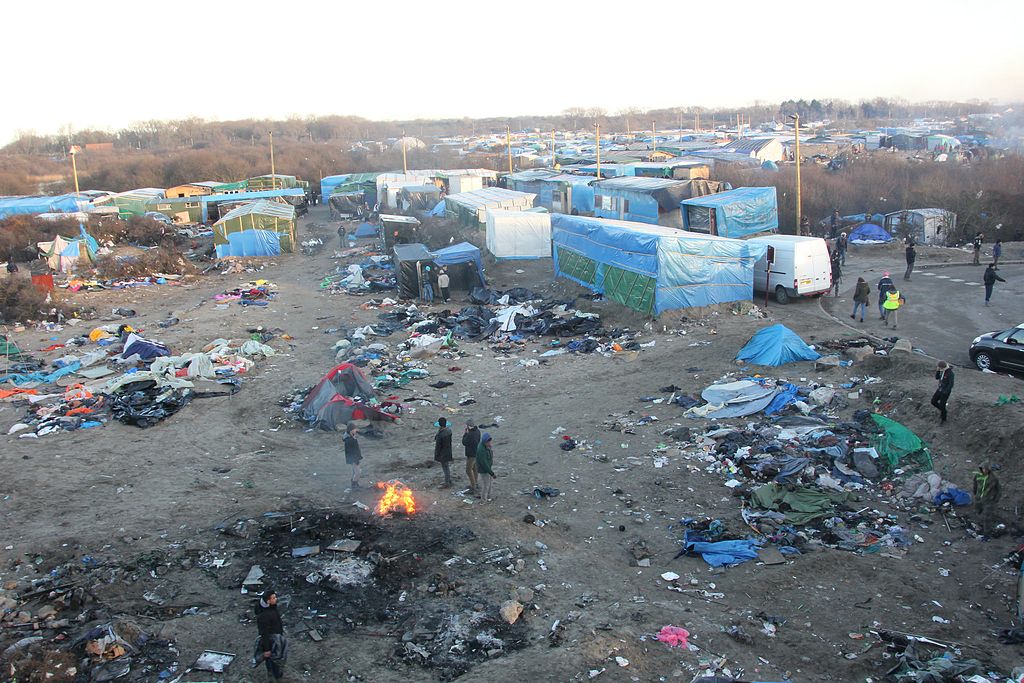
Calais Jungle
The other day I nearly fell off my chair when I read about the kids we in Britain have rescued from the Calais Jungle camp. According to the London Times, some of them are being settled in a small town in South-West England. Those lucky enough to end up in the beautiful county of Devon, well known for its pleasant climate and cream teas, will apparently be given lectures on “British culture and traditions”.
Quite right too. After all, they certainly need to learn about our tradition of tolerance, of welcoming the oppressed over many centuries, our respect for difference, our democratic values and our belief in the freedom of speech. Not to mention how to brew builders’ tea, and whether to put the clotted cream directly onto the scone or on top of the strawberry jam.
But what made me choke on my cornflakes with a mixture of mirth and horror was the revelation of who was being entrusted with the delicate task of putting our new guests right on all these matters. A retired teacher, you might think, or a social worker. A volunteer from the Citizen’s Advice Bureau, or perhaps someone who has a bit of experience in communicating with people from different cultures as the result of having worked in the Middle East or Africa, where many of the migrants were born.
But no. The chosen agency is none other than the Devon and Cornwall Police.
So no doubt our guests will be warned about laws that prohibit the slaughtering of goats on the streets during religious festivals. They will learn that while it’s OK for a US presidential candidate to grope a passing woman in tight clothes and a generous superstructure, these things don’t go down well in Devon. They will learn about Asbo’s (Anti-Social Behaviour Orders, in case you’re not familiar with the term), dangerous driving, fly-tipping, late-night drinking and a host of other things that we British are not supposed to do. They will be encouraged to tip the wink to the local constabulary if they notice any of their friends shopping for rucksacks, batteries and chemicals.
Will the message to these young people be that they’re here on sufferance, and if they step out of line they’ll be toast? Perhaps I’m doing an injustice to our police, but it’s hard to imagine that there won’t be a strong dose of law and order on the agenda.
For me, the choice of the police for this job epitomises Theresa May’s Britain. Or, to put it another way, post Brexit-Britain, in which our ruling politicians are persuaded that the most vocal 37% of the electorate favour an orderly society above all other considerations, including material prosperity.
That’s certainly a popular view. After the EU referendum, academics and media commentators made much play of the death penalty correlation: that you could have predicted who was going to vote for Brexit based on their support of the death penalty.
This theory had its roots in a survey of voting intentions before the event. 24,000 white people took part. Hardly a rock-solid sample of the countrywide electorate, I would have thought. Nonetheless, it became received wisdom in some quarters that if you believed in putting people to death, you were 70% likely to go for Brexit.
And so, it seems, the divide was never about class or wealth. It was about values. Authoritarianism versus laissez-faire.
The other night, I was discussing Brexit with a psychologist friend. He buys into the death penalty theory. But he goes further. The reason, he thinks, why we are going through a period when authoritarianism seems attractive is that we are the only member of the EU not to have experienced an extreme version of it in living memory. The others, barring Sweden, suffered war, invasion and the imposition of one form of totalitarianism or the other – in other words, communism or fascism.
They are therefore left with a horror of extreme ideology. So much so that in his opinion the right-wing parties in countries like France and Germany are unlikely to gain political power. He associates authoritarian values with male values, and laissez-faire with female. Try telling that to the ghost of Margaret Thatcher, I wanted to say, but didn’t.
I thought further about what he said.
Even though during the Second World War and in the couple of decades thereafter we in Britain went through a draconian phase, our authoritarianism was relatively mild compared with that suffered under Hitler and Stalin. And yes, we retained the death penalty until 1965. But thereafter the floodgates of laissez-faire opened. We legalised abortion and homosexual acts. We abolished exchange controls. We introduced no-fault divorce. And we joined the European Union, thus opening our borders to our neighbours and diluting our sovereignty.
So was the referendum result a foregone conclusion? Are we in the grip of politicians who believe that we are yearning for paternal values – respect for authority, law and order, tradition? As opposed to maternal values – diversity, respect for difference, tolerance, the embracing of change? Does this explain the 52:48 divide? And can we characterise the remaining EU member states – driven by a spirit of “never again” – as staunch adherents of those maternal values?
With all due respect to those far better qualified than me, I don’t buy into the death penalty theory, or the maternal/paternal argument. The sample for the death penalty conclusion is too narrow and too thin. As for gender traits being the dominant cause of the decision, the argument breaks down when you consider whether those traits are real. Yes, the “caring professions” – teaching, medicine, social work, HR – are over-populated by women. Yet are female practitioners in those fields any more or less resistant to change, tolerant of diversity or supportive of law and order than males? Not in my experience.
And think of our two women prime ministers. Neither Thatcher or May can be described as soft on issues that characterise an authoritarian mindset. As for the idea that our EU colleagues are immune to a return to ultra-authoritarian government, I’m not sure Marine Le Pen, Geert Wilders and Victor Orban would agree.
There were many other reasons put forward as to why we voted for Brexit – sovereignty, immigration, the age divide, economic deprivation, the power of emotion (fashionably referred to in the US as post-truth politics). No doubt they all played a part.
What interests me is that attention seems to be almost entirely focused on the motives of the Brexit voters. I can find little analysis of the reasons why 48% of the voters opted to remain in the EU. If, as one survey claims, 64% of eligible people between the ages of 18 to 24 cast their votes, as opposed to 90% of those over 65, and younger voters overwhelmingly supported remaining in the EU, we should ask the question why the young see their future differently from the old. And so should any government that wishes to create an enduring core of support.
This certainly appears to be Jeremy Corbyn’s strategy. He is frequently described as building a movement as opposed to a party electable in the short term. Has he and his Momentum shock-troops successfully tapped into the zeitgeist of the young generation of voters? And will their idealism survive the ageing process, or will their political arteries harden, just as those of Tony Blair’s youthful supporters did?
All that remains to be seen, but the thoughts and dreams of those younger voters who opted to Remain, as well as those who didn’t, have received very little exposure in the mainstream media.
There is another aspect of the Brexit divide that doesn’t seem to have been much discussed. It’s also relevant to the polarisation in the US in this fractious presidential election year.
The idea that there are two types of freedom – “freedom from” and “freedom to” is nothing new. Without getting into a deep discussion on the nature of freedom, it does seem to me that the Leave voters bought into the message that Brexit is about Freedom From. From interference by Brussels, from immigrants, from EU bureaucracy and so on. And on a wider level, freedom from crime.
The Remain voters, on the other hand – especially the younger ones – seem to have bought into Freedom To. Most especially to work and travel where they please. Again, on the wider level, freedom to marry who they want, to say what they want, to get blasted on whatever they want.
Freedom From is about leave me alone, don’t bother me. Freedom To is about the world being my oyster. And it’s in our attitude towards freedom that we are most deeply polarised – between the fearful, the defensive and the resentful, and the confident, the optimistic and the outward-looking.
This is to an extent at odds with the Brexit evangelists who rattled on during the referendum about the nirvana of a Britain free to trade with the world and determine its own future. But I sense that their message was swamped by the anti-immigrant rhetoric coming from the likes of Nigel Farage.
It’s in attitudes towards freedom that Britain today most closely resembles the US. I like to think that a Donald Trump would never flourish on the British political landscape (though Farage in his role as a Donald mini-me together with his pugilistic colleagues cause one to wonder). But Trump is all about Freedom From: immigration again, interference by federal government, terrorism and the corrosive effects of globalisation.
So is this where we in the UK are heading? Towards a country with closed borders and an ever-expanding role for our police? At some stage will the lion and the unicorn on our national crest give way to effigies of a CCTV camera inside a castle? I doubt it. These tendencies come and go, though I don’t see another Summer of Love arriving any time soon.
But I do wonder at a society in which PC Plod is being taken off the beat and sent to lecture children. Have they run out of burglaries to solve?
On a wet Sunday night, what could be better than to escape the psychopaths, murderers and torturers running around the small screen, and go off to the local Odeon to see Inferno, Dan Brown’s latest silliness?
With Ron Howard directing, music by Hans Zimmer and Tom Hanks playing the lead role again, at least it promised to be stylish silliness. And any movie set in Florence, Venice and Istanbul was bound to feature its fair share of gorgeous buildings, old masters and miscellaneous antiquities.
What’s more, with the British government planning to end the teaching of archaeology, history of art and classical civilisation in our schools, the chances are that before long our kids will have to rely on the likes of The Da Vinci Code, Angels and Demons and Brown’s latest effort for their knowledge of such subjects.
So what would they learn from Inferno? Not a lot actually. Except that there was a chap called Dante who wrote a horrible book that gave the movie its name, and another chap called Botticelli who painted a nightmarish picture of Dante’s dream. For the first ten minutes their vision of hell swirled around the head of Hanks’s character and spilled onto the screen, filling it with all kinds of CGI nasties doing their hellish thing.
As Hanks’s deranged Professor Langdon tries to figure out what on earth is going on, we do too. The most likely outcome seems to be that the puzzle-solving academic ends up in a loony bin. His senses finally return when a gorgeous ER doctor rescues him from the attention of a hit-woman (probably the daughter of James Bond’s Rosa Kleb) dressed in Carabinieri uniform.
The plot seems to hinge on the fact that poor Langdon is being chased through Florence by not one but two sets of nutters. There’s the sinister lot who work for a security company so secret that nobody knows they exist. And then there’s another bunch of headbangers who turn out to be a SWAT team from the World Health Organisation.
The WHO? Whaat??? At this point I’m wondering if a third group might join the fun – perhaps the paramilitary wing of the Church of England, running around in big black vans, pouncing on Satanists and necromancers. I imagine Archbishop Welby, or possibly the Reverend Blofeld, white cat on lap, barking orders at fanatical novices. But no, maybe that’ll be in the next book. Or maybe I’m the one heading for the asylum.
I won’t spoil the plot by giving away too much, except to say that there’s a mad genius who plans to cull the world’s population by means of a plague. Better to take out half the human race now, he reckons, than see a total extinction event in a hundred years’ time thanks to overpopulation, war and climatic meltdown. And our hero has to stop him. Except that said genius sails off a Florentine bell-tower without a parachute two minutes into the movie. But for reasons unclear to anyone apart from the author of a best-seller, he’s left clues, and it falls upon Langdon to save the world. Again.
You get the picture by now, I imagine.
Have you ever watched a movie in which you suspend your critical faculties for a couple of hours, and then, a few hours later, you reflect on how cynically the makers have insulted your intelligence? Well, this was a case in point.
I mean, if you really wanted to unleash another Black Death, why would you give a history professor a set of bizarre clues that might enable him to cut Armageddon off at the pass? As the Irish like to say in response to requests for directions: “if I was going there I wouldn’t start from here”. Unless, of course, you believed that you were Moriarty, watching from the afterlife with whimsical curiosity to see if Langdon’s Sherlock manages to think his way out of the latest conundrum.
On the other hand, you might do it because, like the those in charge of education in Britain, you don’t consider art, archaeology and the study of the Greeks and the Roman to be essential features of our Trumpian, post-Brexit cultural wasteland, and you want to make a fool out of the good Professor and all those other effete, wannabe Kenneth Clarks before plunging the world back into the dark ages.
Howard, Hanks and Zimmer must have been pretty desperate for the money to get involved in this crock of crud. Having said that, the music was up to Zimmer’s usual standard, the plot rattled along like Disney’s Thunder Mountain, and the cinematography was pretty fine. Hanks was – how to put this kindly? – showing his age a bit during the chase sequences. Not surprising given that the poor chap has just hit sixty.
So I woke up the following morning wondering for what purpose I had wasted a precious evening of my life on a piece of Hollywood junk. After all, I could have spent the time studying the thoughts of Donald Trump, a real-life psycho, or watching horrific video clips from Aleppo, a real-life inferno.
Those of us whose patience with Dan Brown’s fantasies has finally run out can always catch up with a real professor, the wonderful Mary Beard, deepening our understanding of the fiery hell that struck Pompeii and Herculaneum.
As for the fascinating A-Level subjects that are about to slip away from the British liberal arts curriculum, why worry? There are more than enough conspiracy theories to chew over on the History Channel, and no doubt plenty of evidence about to be revealed on National Geographic that we’re the descendants of alien reptile colonisers. Well, maybe not me, but Trump for sure – a lizard in disguise if ever I saw one. Much more fun than Socrates, Michelangelo and holes in the ground.
I, however, should really stop being such a churlish culture snob, get back into my generational box and spend my evenings watching Hercule Poirot box sets. And trying to remember my name.
OK guys, it’s time to be honest. How many of us haven’t had the occasional Trump moment in our dealings with the opposite sex? Not at a party? Not even when intoxicated with the exuberance of several pints of Newcastle Brown, or shots of Jack Daniels?
Speaking for myself, I think I can safely say that I have never thrust my tongue down anyone’s throat as the opening gambit of a courtship ritual. Or grabbed their crotch for that matter. Perhaps that’s because I never had the chutzpah – or whatever else you want to call it – to do so. Or perhaps because I’m not the kind of alpha male who considers that all women (or men) are there for the taking.
No, I can relate more easily to men like Jimmy Carter, who once famously declared – during his election campaign – that “I’ve looked on a lot of women with lust. I’ve committed adultery in my heart many times.” Which doesn’t get me off the hook, but definitely puts me in the category of a thinker rather than a doer.
All of this is strictly theoretical, of course, because, like Jimmy, I’m a happily married man.
But should I be so inclined, would I discuss my deeds and desires in a locker room, as Trump claims he does from time to time? Unlikely. I can’t think of any less congenial location for a discussion about heterosexual love and lust than a place where sweaty, half-naked men gather together, no doubt casting envious glances at their team-mates’ personal dimensions. Something faintly homoerotic about that, don’t you think?
Maybe that’s an American thing. In England, you would be more likely to have that kind of conversation about an hour into a session in the pub.
If locker rooms are the American way, I shouldn’t think that Donald has been in one for a while, unless he’s talking about a golf club full of geriatric walruses like him. He doesn’t look like a gym bunny, does he?
Anyway, back to the original question. Among the many men ready to bury Mr Trump under a heap of stones, how many are without sin? In public life, I suspect, most guys are a bit like me. Prone to the occasional sinful thought but disinclined for any number of reasons – not least the fear of being found out – to do anything about it. Those who do act on their desires tend to seduce rather than assault. Recent history is full of successful seducers among our leaders – Francois Mitterand, John Major and good ole Bill Clinton among them. But unsolicited crotch-grabbers? Not so many. The sons of Saddam Hussein perhaps, Muammar Gaddafi, Lavrenti Beria and probably a number of other powerful people who have had the means to prevent their activities from becoming publicly known at the time.
But not in America surely? Or Britain for that matter. In the case of my country, that’s one of the things the ill-fated public inquiry into the activities of Jimmy Savile and his friends is designed to find out (more on that some other time).
But I do find it interesting that back in the day, when I was growing up, sex scandals involving politicians tended to not to be the actual cause of people losing their jobs. Covering them up was the real sin. Also, at the time, we were all so paranoid about reds under (or in) the bed that we viewed ministerial indiscretions as threats to national security. Which was what the Profumo scandal was all about – the Minister of War sharing a girl with a Soviet defence attaché. Honey traps, blackmail and espionage.
These days – certainly over the past couple of decades – it seems that politicians can get away with just about anything sexual without penalty. Trump, the groping walrus, may well be seen to have crossed the line of acceptability. Yet his supporters, upright citizens, many from areas espousing strict moral standards, seem to be giving him a free pass. Is it because they share Nigel Farage’s view that they’re not electing a pope? Or that boys will be boys? And does the idea that the red menace is no longer with us – and therefore questions of national security don’t come into the equation – have anything to do with their new-found broad-mindedness? If so, perhaps they know nothing about Vladimir Putin’s time-honoured methods.
Whatever the reason, if former New York Congressman Anthony Wiener can be exposed (if that’s the right term in his case) as a serial sexter, and yet continue to stand for public office, it would seem that in America at least there is the expectation that you can do just about anything in the sexual arena and get away with it. Hence, perhaps, Donald Trump’s attitude.
There is, however, one card that sexual miscreants in the United States have up their sleeves. It’s called redemption. Americans believe in redemption, up to a point. If you confess your sins and ask for forgiveness, you touch an emotion that chimes not only with the religious right but with the multitude of Catholics in that country who go to confession on a regular basis.
However, many American voters believe in three strikes and you’re out, so if you are forgiven, you really need to make sure you don’t re-offend. And when I say they believe in redemption up to a point, I mean that their beliefs don’t stop them from happily applying the death penalty on those they see as irredeemable. But in the case of sexual transgressions, I suspect that among many of those willing to forgive – men anyway – there’s a sense of “there but for the grace of God go I”.
In Britain, we tend not to go for redemption. With the exception of some members of our Muslim population who hold fairly draconian views about what they see as sexual deviance, we do manage to keep church and state pretty well separate. But we are pretty strong in condemning the far side of sexual behaviour. We don’t like paedophiles, and we don’t like rape or any other form of sexual assault. It’s worth speculating as to whether Donald Trump, based on the allegations swirling around at the moment, would if, he was British, be prosecuted on grounds of historic sex abuse.
Perhaps not, but you can be pretty sure that over here, on the evidence presented in the media, he would be hounded out of politics in very short order by which ever political party under whose umbrella he was standing for office. Even UKIP. At least I like to think so.
One final word on Trump – at least for now. In the last debate he promised to appoint a prosecutor who would send Hillary Clinton to jail for her “crimes”. That caused a bit of a stir, given that she’s never been convicted of any, and that it’s not within the power of an American President to jail anybody.
You would think that Hillary herself has grounds to sue Trump for defamation on the basis of the numerous occasions when he has referred to her as “Crooked Hillary”. Yes, I know why she hasn’t, and probably won’t. But what about all the other public figures he has insulted and lied about with merry abandon over the past few months?
It seems that politics – both in the US and to a lesser extent in the UK – is the only arena in which people can wilfully seek to destroy the reputation of others with impunity. Perhaps a lawsuit or two be sufficient to civilise the debate next time around. Do I hear someone say that Donald is planning to sue the New York Times for their hurtful revelations?
I wouldn’t bet on it. All mouth and no trousers is a particularly apt description for the would-be leader of the free world.
I’ve tried and I’ve tried. But I cannot and will not get over it. Any more than I will drive over a cliff despite the warning signs because Satnav told me to.
Four months on from the EU referendum, if it’s not now clear to a majority of people in Britain that Brexit is a bad idea, it will not be so until it’s too late for the government to do anything about it. This is not to say that the concerns of those who voted to leave are invalid. But it should be pretty obvious by now that the anger of the electorate is directed at the wrong place. The European Union is not responsible for our under-investment in South Wales and the North East. It’s not responsible for our failure to provide adequate housing, education and health services to a growing population.
These problems can be laid partly on the doorstep of successive British governments, and partly on factors beyond the control of any single government or political bloc. The European Union, flawed though it is, is a convenient scapegoat for British politicians who want divert attention from the consequences of the policies they have implemented over the past thirty years.
The EU did not force us to rely on the City of London for economic growth at the expense of engineering, manufacturing and technology. It didn’t create seventy-odd new universities without sufficient thought as to how those institutions were to be funded, and without reference to the skills that the country actually needed.
It didn’t build a massive set of parallel bureaucracies in the National Health Service at the expense of patient care on the principle of market-driven reform. It didn’t demand that we tinker with our primary and secondary education systems with a frequency that has left our teachers bewildered and demotivated.
And it didn’t insist that we allow hundreds of thousands of non-EU workers to enter the country – either to study (thereby propping up our cash-strapped universities) or to make good urgent skill shortages in organisations such as the NHS.
Now we learn from no less a source than the Treasury, an arm of the British government, that the version of Brexit that the same government has in mind will cost us as much as £66 billion a year in lost gross domestic product, more than eight times the amount of money saved by our leaving the EU. The Treasury made this prediction before the referendum, but, significantly, still stands by it today.
And what of the sovereignty we urgently wish to restore? The main bit of control we want to restore is not over the size of bananas, or even human rights law. It’s over immigration. This appears to be the objective of our new Prime Minister, who seems to have forgotten that her brief is now much wider than the Home Office. It appears to be more important than membership of the Single European Market that accounts for 45% of our exports.
Despite the hot air rising from the Conservative Party conference a couple of weeks ago, I have a message for the doctors, nurses, care-home workers, scientists, bankers, software designers, baristas and fruit pickers who hold foreign passports and currently work in the United Kingdom. Don’t worry. You will still be needed here in ten years’ time.
Here are some reasons why.
Let’s start with the medics. Regardless of what sort of Brexit emerges at the other end of the coming negotiations – open, closed, hard, soft or plain suicidal – people will still get sick and die in increasing numbers. Demographics sees to that. More people are getting older every year.
What about the government’s plan to train more British doctors and claw back their training costs if they fail to complete a specified period working within the NHS, you might ask? It won’t work. People looking at a career in medicine will be put off by the prospect of what appears to be indentured labour. Already a large proportion of doctors are leaving medicine within a few years of qualifying. Junior doctors are no longer prepared to put up with the ordeal of endurance that has been part of the culture of British medicine since the foundation of the NHS. Measures that made their ridiculous working hours more meaningful – mentoring, for example – have disappeared in the welter of reorganisations that have taken place over the past two decades.
As for the scientists and engineers, even the hard Brexit supporters accept that we will need to import foreign expertise long after Brexit becomes a reality. Likewise the IT specialists. All assuming, of course, that the employers – many of which are foreign-owned – of these skilled individuals don’t decide that it’s simply too much hassle to maintain workforces in such numbers in the UK because the government puts up too many barriers against their employment. An irony, considering that we’re leaving the EU because we’re fed up with its bureaucracy and red tape.
Even in the fields of Norfolk, is it really likely that our indigenous workforce, loaded up to the gunwales with degrees, diplomas and matching ambitions, will pick up the slack to replace the foreign fruit pickers? I don’t think so. At least not unless they’re paid considerably more than the living wage. Which will mean that the supermarkets will have the choice of paying our farmers more for the produce, or importing tariff-laden produce from the EU. In either case, we the consumers pay more, which we won’t be happy about, and in the latter case the farmers will simply go out of business, with the knock-on effect of depressing yet more areas of the country.
And finally consider the tens of thousands of foreign workers who look after our elderly up and down the country. The same scenario applies. Would we be able to replace them all with British workers? Not without a wage hike. How would our politicians react to old people’s homes going out of business up and down the country because either they can’t fill their vacancies or local councils refuse to pay the fee increases they would need to demand in order to remain sustainable?
So no, I won’t get over it, and neither should the 48% of the voters who elected to stay in the EU, not to mention a significant proportion of the Leave voters who were misled by opportunistic claims and who probably have now realised it. The people of Sunderland, for example, who voted to leave the EU and are now discovering that Nissan is reconsidering further investment in their local manufacturing plant.
At the very least, the government should test the will of Parliament by putting the decision to invoke Clause 50 to the test. There are enough MPs of all political stripes who oppose Brexit to bring the whole project crashing down. Whether they have the courage to do so is another matter. At whatever stage, the most important measure since our entry to the market must be subject to Parliamentary endorsement. If our MPs have the right to debate and vote down the annual budget, why should they not have the right to scrutinise the consequences of an advisory referendum, and ultimately the terms of Brexit?
I’m not saying that leaving the EU might not work out in the long run. No doubt we can and will muddle through. But it’s no less a colossal risk now than it was at the time of the referendum. And if we ignore the very obvious pitfalls and unknowns, and jump blindly into the void, those who allowed it to happen will pay for it with the destruction of their careers, and we, the voters, will live with the consequences for decades ahead.
It is not petulant or grumpy – or whatever other epithet the “get over it” merchants use to describe people like me who profoundly oppose Brexit – to continue to speak up against what we believe is a horrendous mistake. Nor, as the UK Daily Mail suggests in one of its more virulent editorials (Whinging. Contemptuous. Unpatriotic. Damn the Bremoaners and their plot to subvert the will of the British People), are those who urge a re-think “sore losers”. The referendum was not a contest intended to produce winners and losers. It was a debate involving many shades of opinion and political allegiance on a matter of fundamental national importance. The debate was deeply flawed, and was subject to shameless manipulation by politicians and other public figures who should have known better.
My voice is not loud. I have no axe to grind. I have little to lose materially whether or not we leave the EU – or at least little that I value. I won’t be around to see the long-term consequences. But my kids will, and so will my friends’ kids. I care about them, and about their future.
It’s not too late to call a halt to this madness. But the clock is ticking towards March 2017, when the government proposes to press the exit button. Time for the politicians to show some guts for a change, methinks.
For what it’s worth, this is a short meditation on Syria. Why now? Get to the end and all will be revealed.
I haven’t written about the Syrian conflict for a while, because at the micro level I can’t pretend to be an expert on the shifting allegiances of the global, regional and local players, none of which seem to be to the benefit of the stricken population.
But this much I do understand.
We should not be surprised that governments are capable of bombing cities, attacking aid convoys and wiping out the only places the victims of the bombs can turn to for medical help. And when we’re talking about governments, let’s not forget that those who lead them are human beings, no matter how dehumanised their actions make them appear to be.
They’re not dehumanised. If human beings were constitutionally averse to shedding the blood of other humans, then our history would be very different. In fact, we probably wouldn’t have a history at all, because the chances are that we would remain a pastoral species among many, rather than one that has evolved through organisation, competition and subjugation.
What makes events in Syria, Iraq, Yemen and Libya harder to ignore than any previous conflicts is that they take place in front of a global audience, often in real time. As communications technology develops, we, the non-combatants, are able, if we wish, to look inside, above and around every conflict.
Trace a line from the reports received in London weeks after the fact about battles in the Crimean War, through the two world wars of the 20th century, Vietnam and the Gulf wars to Syria today. The intensity and diversity of reportage grows in direct proportion to the bandwidth and accessibility of communications. Along, of course, with the potency and sophistication of the weapons brought to bear.
What also makes the Syrian conflict – unparalleled is its multiple dimensions. It’s a platform not only for local sectarian and political rivalries but for proxy wars between distrustful state actors: Iran and Saudi Arabia. The US and Russia are involved because neither wishes to see the eventual outcomes diminish their influence and physical foothold in the region. Those countries that have chosen to support the US in attacking ISIS are of relatively little account – without American involvement they would most likely fade out of the conflict. And now Turkey, ever fearful of its Kurdish minority and the success of the Kurdish fighters in the conflict zone, has joined in.
So it’s wrong to say that this conflict is, as some argue, like any other with local origins. That it will eventually burn out when the combatants on the ground run out of weapons, the desire to fight and an expectation that things will turn out to their advantage. For as long as the regional and global rivalries persist, Syria will have plenty of injections of arms, manpower and motivation for years to come. And so, for that matter, will Iraq, Yemen and Libya.
Even if ISIS are finally expelled from Syria, their destruction will not be a game-changer. Who will move into the vacuum? Assad with his mercenaries? The Syrian Kurds? One or more of the other rival factions aligned either side of the US/Russian/Saudi/Iranian divide? Or all of them?
The only way one can see an end to the Syrian conflict would be for Iran and Saudi Arabia to agree on limits to their ambitions for regional hegemony, and for the US and Russia to re-establish a stable détente. But none of these players seem to have recognised that they have reached the limit of the advantage they can extract from the current situation.
In each of those countries, there are naturally many people who are appalled at the human destruction taking place on a daily basis. But not so outraged as to persuade their leaders that the political consequences of backing off are not even more unacceptable than the price Syria is paying in lives. In other words, national self-interest – and political ambition – is more important than lives. So the killing continues.
What can we, the bystanders who have little influence over events and yet are assailed daily by reminders of the suffering, do beyond wringing our hands and saying “stop – all of you”?
The populations of each of the leading players see the conflict through their own perspectives. The United States has a presidential candidate who, until recently, was unaware of who or what Aleppo is – and most likely he’s far from alone in his ignorance. Russians by and large back their president in his ambition to do what it takes to restore his country’s power and prestige – for now. Iranians are cowed by the mullahs and their praetorian guard, for whom the maintenance of political control and influence trumps all other considerations. Saudi Arabians are unable to express their views through the exercise of conventional democracy, and their ability to protest via other means is limited. And the rest of us lack the individual or collective power even to shame the participants except by the use of well-meaning but ultimately impotent grass-roots campaigns.
What we can do is help to clear up the mess, and come to the aid of those who are wounded – physically or mentally – by the conflict. We can support neighbouring countries that are hosting millions of refugees. We can open our hearts and our borders to those who have fled, but only if our leaders have the strength to look beyond the fears of their electorates – a strength that appears to be diminishing every day.
And as individuals, we can make clear to our leaders – elected or otherwise – by any means necessary that we expect them to exert such influence as they have to bring the leading actors to the table. Not Russia and America, or Iran, Turkey and Saudi Arabia. But all of them.
And we can be kind and respectful to the minorities in our own countries, whether they are citizens, economic migrants or refugees. Because even if our leaders in their bubbles of power worry about economics, demographics and geopolitics, we are the people who encounter our neighbours every day.
Call me a pious metropolitan liberal if you like. But during the many years I spent living and working in the Arab world, there were three words that I heard and appreciated more often than any others: you are welcome.
When we neglect to say those words, and retreat within the confines of culture, ethnicity and nationality, we set ourselves up for future division and conflict.
Theresa May, Britain’s new Prime Minister, said yesterday in an address to her party’s annual conference:
If you believe that you are a citizen of the world, you’re a citizen of nowhere. You don’t understand what the very word “citizenship” means.
She’s wrong. I for one do understand what citizenship means: responsibility and accountability. And in my world, it is possible to be a good citizen of a nation without abandoning those who are suffering beyond our borders.
We are citizens of the world, whether we like it or not. And Syria should matter to each and every one of us.
Golf is only a game? Stuff and nonsense!
As the this year’s Ryder Cup goes into the third day, the most important question arising out of the competition is how the outcome will influence the US presidential elections.
If the US lose against the odds, will Trump add the defeat to his narrative of a broken America that needs to be raised up and redeemed? If they win, will he send subliminal messages about the triumph of white America, since not a black, latino or Asian are to be found amongst the victors?
Note that I’m not dwelling on how Hillary will react. You wouldn’t think that golf was her thing. She’s probably delighted to pack Bill off to the golf course, where he can happily send his balls into bushes without damaging her campaign.
As I predicted in yesterday’s post about Danny Willett’s loquacious younger brother, the fans are rowdier than ever. Boozed up, according to the American commentators. The European Sky TV pundits, mindful of their status as guests in the country, dare not make such observations. They also remember the disastrous fallout from The Sun’s coverage of the Hillsborough disaster – allegations of drunken Liverpool fans and all. Rupert Murdoch, who owns Sky and The Sun, has a long memory.
Judging by the amount of times the European golfers had to step back from their shots after being cat-called mid-swing, there certainly seem to be a respectable complement of Hillary’s Deplorables, masquerading as P J Willett’s “pudgy, basement-dwelling, irritants, stuffed on cookie dough and pissy beer”. The cameras, however, preferred to dwell on America’s equivalent of the Barmy Army, the extravagantly-clad travelling fans who support the England cricket team. Except that these guys – for they were mostly men – incessantly chant “Yoo Ess Ay”, as opposed to “Barmee Armee”, and dress up as Vikings, rather than Henry the Fifth and Daffy Duck.
In both cases, these fans are not economic pond life. It costs serious money to spend two weeks in Australia watching English batsmen get peppered by Mitchell Johnson. And I’m guessing that admittance to the Ryder Cup for a weekend is way beyond the pocket of an unemployed steel worker in Pittsburgh.
And if you think that moronic encouragement to the European golfers to deposit their balls in a nearby lake is typically American behaviour, then you haven’t listened to the neo-Nazis whispering sweet nothings to the opposition at a Saturday afternoon football match in any one of a dozen European countries.
As for yesterday’s golfing proceedings, I confess that having spent the morning at my local golf course, drenched by rain and failing dismally to learn from Rory McIlroy’s bunker technique, and then spending the rest of the day watching Patrick Reed bellowing like a moose after a series of miraculous death blows, I ended up golfed out, and went to bed rather than witness the three American victories that put the ultimate result firmly in the hands of the home team.
Returning briefly to Trumpery, there was one interesting episode on the first day worth thinking about. When Phil Mickelson and Ricky Fowler were interviewed after their win on the first morning, Mickelson spent the whole time talking about what he did. It was “I this”, “I that” and “I the other”. Whereas Fowler spoke throughout about “we”. Moreover, Phil looked bored, Ricky engaged.
Mickelson is an old-timer. He’s the guy who likes to blame his captains for his own misfortunes in previous Ryder Cups. Fowler, on the other hand, is a relative newcomer. Might the fact that there are fewer Mickelsons and more Fowlers this time around be the reason why the US is prospering in the 2016 Ryder Cup?
And I wonder if a sense of self being less important than team is a penny that might drop when America decides whether or not to award its biggest prize to the most incorrigible narcissist ever to contest a presidential election?
I for one would happily concede a dozen Ryder Cups for that to be so.
For those of you who know nothing about golf and care less, a chap called P J Willett is all over the social media – and the national newspapers – today because of his disparaging remarks about American golf fans in National Club Golfer, a magazine aimed at obsessive-compulsive hackers like me.
P J, or Pete, as he’s probably known to his brother Danny, the current US Masters champion, has pulled off a masterstroke. He’s made the owners of National Club Golfer very happy by increasing its readership by a factor of a hundred. He’s pissed off his brother, who is busy preparing to help European team to retain the Ryder Cup by beating those nasty Americans on their home soil. And he’s guaranteed himself everlasting fame – well, at least five-minutes-worth – for an eloquent put-down of our delightful, enthusiastic cousins who follow golf in the United States.
Here’s some of what he said:
“Team USA have only won five of the last 16 Ryder Cups. Four of those five victories have come on home soil. For the Americans to stand a chance of winning, they need their baying mob of imbeciles to caress their egos every step of the way. Like one of those brainless bastards from your childhood, the one that pulled down your shorts during the school’s Christmas assembly (f**k you, Paul Jennings), they only have the courage to keg you if they’re backed up by a giggling group of reprobates. Team Europe needs to shut those groupies up.
They need to silence the pudgy, basement-dwelling, irritants, stuffed on cookie dough and pissy beer, pausing between mouthfuls of hotdog so they can scream ‘Baba booey’ until their jelly faces turn red.
They need to stun the angry, unwashed, Make America Great Again swarm, desperately gripping their concealed-carry compensators and belting out a mini-erection inducing ‘mashed potato,’ hoping to impress their cousin.
They need to smash the obnoxious dads, with their shiny teeth, Lego man hair, medicated ex-wives, and resentful children. Squeezed into their cargo shorts and boating shoes, they’ll bellow ‘get in the hole’ whilst high-fiving all the other members of the Dentists’ Big Game Hunt Society.”
A rant of the first order, don’t you think? Actually, in the article he also says some interesting stuff about parallels between golfers and the students he teaches. But the remarks that caught the eye were not guaranteed to give brother Danny an easy ride as he tries to concentrate on his putting in front of thousands of these baying barbarians. The champ issued apologies all round. Team captain Darren Clarke huffed and puffed with outrage, and rival skipper Davis Love III affected lofty disdain.
Since then, P J has maintained a judicious silence, on Twitter at least.
Others, in an attempt to defend him, said that Americans don’t get irony. This could be true in the case of many Americans, but not Trump supporters, who cheer gleefully when their leader insults whole swathes of his fellow citizens, and even more when he says he’s only kidding. There’s irony, and then there’s rearranging someone’s face and then saying I didn’t mean it, and can’t you take a joke?
Anyway, I’m deeply jealous of P J, first because he’s a talented writer who clearly has an alternative career when he gets fed up with teaching. And second, because he has a famous brother he can take down, ironically of course. How many siblings have longed to do that after decades in the shadow of a high-achieving brother or sister? Americans will appreciate that sentiment. In the seventies, Billy Carter, Jimmy’s beer-swilling redneck brother, did a fair job of embarrassing the President. Since then, just about every celeb has had to put up with an inconvenient relative emerging from obscurity to dish the familial dirt. As for me, I’m sad to say that my siblings are all worthy people who have never known fame, and I have no old scores to settle with my poison pen.
Turning to the subject of his brickbats, P J manages to skewer several popular stereotypes – the obese, NRA members, the sartorially inelegant, divorcees, spoilt kids, Prozac poppers and people who travel to Africa to shoot animals on the endangered species list. And he manages to do all this without one reference to Donald Trump, something that I regularly fail to achieve.
Very unkind, especially as we European supporters don’t exactly set high standards of decorum. An American counterpart to P J might easily refer to the Camembert-eating surrender monkeys, the Scots with their deep-fried Mars bars, boozed-up Irish and neanderthal Englishmen who regularly patronise our great sporting events.
And I think P J knows in his heart that without the rowdies, the Ryder Cup would be as boring as a golfing seniors event, where retired colonels sip tea from their thermos flasks and occasionally pierce the silence by muttering “good shot” when a hero from yesteryear manages to remind us what once made him great.
So I say bring it on. Let the fans throw as many insults as they like. Let them crunch on potato chips and pork scratchings while the lads wind up their back-swings. As long as they don’t actually take out one of the competitors with an assault rifle, let anything go.
The Ryder Cup is a glorious competition in the most ancient traditions of “sport”, from gladiators to bear-baiting and bare-knuckle boxing. And believe me, this contest, set in the heartland of Middle America, will be the most raucous and emotionally incontinent yet. Why? Because “President” Donald has taught his fellow citizens that it’s OK to give voice to their darkest thoughts, when previously they would have kept them to themselves. So hatred, contempt and xenophobia might well be the order of the day.
Better to spew insults for a weekend at the Brits, Spaniards, Germans and Belgians in their immaculate golf shoes than spend the time cursing Mexicans, and heaping ridicule over stupid tax-payers, fat beauty contest entrants and Crooked Hillary. We need a break from that stuff.
But who knows? This year’s competition might be the last. In two years’ time the European team will no longer be able to gather beneath the European Union flag – at least not with its British contingent. And maybe, if they lose yet again, the Americans will invite the Canadians, Mexicans and South Americans to help them out next time, only to be countermanded by The Great Wall Builder.
So we should enjoy the Ryder Cup while we can. And my dear American friends, pay no attention to that beastly P J Willett. Rest assured: we’re just as ugly as you are.
The other night my wife and I took ourselves off to the National Theatre in London to watch The Plough and the Stars, Seán O’Casey’s epic play about the 1916 Easter Rising.
Every Irish schoolkid learns about the insurrection in Dublin that took place against the backdrop of World War One. Of how Patrick Pearse, James Connolly and others led a few hundred armed volunteers on an ill-fated attempt to throw off the British yoke. They had chosen a time of perceived weakness on the part of what they saw as the occupying state. But the response was not as weak as they hoped. The rebellion was crushed, the leaders were executed, and much of the centre of Dublin ended up a charred ruin. The Rising took its place in the hallowed narrative of Irish independence.
Ten years later, O’Casey’s play caused riots on its debut in Dublin, largely because it humanised the hallowed. The good folk of the capital were also not pleased at the appearance of a prostitute in Act Two, and some less than complimentary references to religion.
Ninety years on, the Catholic church in Ireland has lost its grip on the morals of the nation, partly because of its resistance to divorce, abortion and contraception, and partly because of the paedophilia scandals that have shaken Catholicism across the world. Buy an Irish tabloid and you will enter a world full of page three girls, and stories of adultery, broken marriages and unconventional sex that would make Eamonn De Valera turn in his grave.
But the heroes of the Rising are still heroes, and the dead are still martyrs – except of course for the soldiers and policemen, many of whom were also Irish, who died trying to suppress the revolt.
For reasons only partly connected to the Easter Rising, I found the play hard to sit through.
I have a passing familiarity with Ireland. My children are half-Irish, from which you can deduce that my wife is from the Republic. I love the country. I’ve always found its people to be welcoming and full of humour. It has landscape and seascape that matches anything to be found on the bigger island next door.
You’re waiting for the but, so here it is. We’re only a decade on from the latest episode of the Troubles, in which organisations such as the IRA, Sinn Fein, the Ulster Volunteers, the Ulster Freedom Fighters dominated the headlines of British newspapers almost on a daily basis. Po-faced protagonists would justify the bombings, the casual murders, the divisions of families and communities in the name of their causes. It was nasty, vicious and often motivated by factors far removed from political idealism: religious bigotry, drug-smuggling, illicit trading across the border with the south and, of course, personal vendettas and power struggles.
Were the motives of the players in 1916 pure and unalloyed? Not according to O’Casey. And it was power struggles between the leading factions that contributed to the relatively quick end to the conflict. Ireland was by no means united behind the republican uprising, and the characters in The Plough and the Stars reflect the differences. The cynical communist who sees everything in terms of the class struggle, the fighter’s wife who desperately tries to detach her husband from the cause as she sees the imminent destruction of her family life. The unionist neighbour who pours scorn on the preening volunteers.
Many British people who lived through the period of bombings on the mainland felt – rightly or wrongly – that the cause of the bombers was not their concern. They would have been happy to have seen the North peacefully united with the South. But references in the play to the organisations of 1916 – the Irish Volunteers, the Irish Citizen Army and the ever-present Sinn Fein were a disturbing reminder that the most recent Troubles have deep roots. Even if the South has evolved into a mature state, the political undercurrents are still flowing, and may surface again in the North.
None of which fully explains why I found O’Casey’s work so hard to bear. I suppose the main reason was that everyone was so bloody angry with everyone else. From start to finish the play was one long caterwaul. The whole thing was enacted at such high volume that I’m amazed the actors’ voices have lasted for the run. The volume was not confined to human output. At one stage there was a bang so loud that I would have expected a couple of fatal heart attacks – or at the very least mass incontinence – among the well-heeled audience. Of course, in the best traditions of English politeness, no doubt those sitting next to the suddenly expired would have had the courtesy to wait until the interval to remove the corpses.
If you’ve ever witnessed a frank discussion between my wife and one of our daughters you might ask why I’m surprised at the emotional intensity on stage. And no doubt the tenement dwellers O’Casey portrays had much to be angry about. But two hours of unrelenting bawling was an ordeal. At least in my family the disagreements subside, just as do the stormy interludes in a Beethoven symphony.
By the time we got to Act Four – in which Nora, the wife of the volunteer fighter who loses her baby and fails to drag her husband back from the brink, becomes demented with the pain of it all – I’m ashamed to say that I just wanted her to put us out of our misery and jump out of a window. In the manner of Father Ted’s housekeeper, I longed to stand up and shout “ah goo on – yer know yer want ter”.
I daresay the Dublin worthies of 1926 were also not enthralled by the portrayal of drunkenness and looting during the Rising. Fecklessness, opportunism and love of the bottle are aspects of the cartoon Oirishness that have powered a thousand jokes on the mainland and found full expression in TV comedy series that became hits in the UK – such as Ballykissangel, Father Ted and latterly Mrs Brown’s Boys. Weave them in with the pathos of so many episodes in Irish history – the Famine, the emigration, the independence struggle, the Troubles and the recent banking crisis – and you have the basis for a large slice of Irish literature and drama over the past couple of centuries.
For the Irish, so good at laughing at themselves, being Irish is not a joke. For many, it’s a passion. I guess The Plough and the Stars reminds the rest of us of the dark side of rapture.
But boy, was it hard to watch. So hard that we took ourselves off the next night to watch Bridget Jones’s Baby, where a similar audience hooted and howled with laughter through two hours of English eccentricity. Are we English so different from the Irish? Only, perhaps, in our innate and thoroughly unwarranted sense of superiority.
A bit of a smorgasbord, this post. Four different topics, vaguely connected, based on a day’s browsing.
A couple of weeks ago I started following Donald Trump and Hillary Clinton on Twitter. I did so largely because I was fed up with reading second-hand commentaries on the utterances of the two presidential candidates. Best, I thought, to receive the wisdom from the horses’ mouths, so to speak.
After two weeks of following Trump I’m left wanting a steam clean to rid myself of the poisonous stench that this hateful character spreads with every mean and bombastic utterance.
With Hillary, I want to go see a priest to confess my sins, even though I have no religious affiliations. Her tweets range from censorious school-mistress mode (usually when referring to Trump) to inspirational vacuities of the kind you see fifty times a day on Facebook.
It’s not surprising that Trump’s social media campaign attracts more attention than Hillary’s. Muck, dirt, hate and anger is far more compelling than high-minded. Why otherwise is every second movie and TV series made in America about crime, murder and mayhem?
After all, The Joker was always more interesting than Batman. In this era of endless super-hero movies, Hillary will always be one-down to the chest-thumping Donald.
On to other matters.
It might seem strange to say this, but each of the attacks in the United States over the past couple of days is a symptom of success, not failure, of the security measures in place around the country. The fact that those who want to terrorise America can do no more than to detonate a pressure cooker or a pipe bomb in a dustbin is a measure of the difficulty lone wolves and organised groups face when trying to pull off atrocities.
The trouble is that these attacks pay off a thousand times by intensifying the fear of terrorism. So in that respect they are highly effective. They provoke reaction. They incentivise politicians, governments and citizens to marginalise communities from which the offenders spring. And they give people like Trump the excuse to campaign on simplistic solutions such as heavier vetting of immigrants.
The awful truth is that most of the perpetrators, both in the US and Europe, are home-grown. They either arrived in the country and were subsequently radicalised, or were born in the country they turned against. That’s not to say that ISIS didn’t manage to plant some of their sympathisers in among the flood of refugees entering Europe. But they are a tiny minority of the people who subsequently went on to carry out atrocities.
So “intensified screening” might catch a few, but it won’t make much difference if the poison brews up from within. The result? The cost of catching an occasional infiltrator will be the curdling of the melting pot as whole communities end up mistrusted and discriminated against.
The other and even more important awful truth is that attacks, whether lone wolf or group actions, will not end until the conflict in Iraq, Syria, Libya and Afghanistan ends. And that’s not likely during the lifetimes of many of us. So get used to the new normal, people of America and Europe.
Back in my country, Theresa May’s government seems to be focused almost exclusively on the issue that sunk David Cameron and the Remain campaign: immigration. Maybe that’s why Jeremy Corbyn is reported to be putting Labour on a general election footing. Immigration is undoubtedly an election issue, and May is determined not to be on the wrong side. Her persistent banging away at the subject, to the exclusion of other pressing items, certainly sounds like campaign rhetoric.
The government also seems to be in kite-flying mode. An inquiry into police behaviour during the Orgreave riots during the 1984 miner’s strike? Mooted then stamped on. Questions about the Hinkley Point nuclear power project? Delayed for a micro-second and then waved through with a few eye-catching conditions.
I wonder how much attention May and her advisers are paying to events within the EU – the rise of the right-wing fringe parties, financial instability and a disaffection with governance – especially among member nations that are not among the core group of power-wielders. There may well be armies of civil servants now beavering away on working out the British position on Brexit. But are we also gaming contingency plans that take into account the fissures within the club we are leaving?
The other question is whether we truly understand that we see the EU as an economic project, whereas for those nations still recovering from the fundamental disasters of the recent past, the social dimension is equally important. If you’re interested in a discussion on that theme, the thoughts of the German philosopher Jürgen Habermas, published in Social Europe, are well worth considering. How many British philosophers match his knowledge of voting trends in the EU referendum with their understanding of the demographics of the Rhineland? For a pretty self-obsessed nation, we would benefit from the occasional glimpse of how others see us, I suggest.
Finally a reminder that not every famous person spends their life jumping up and down like a demented gorilla spewing insults at all and sundry. Today’s BBC website ran a video feature on the work of Prince William. Not the part of his life where he opens art galleries and says the right thing to people with ostrich feathers on their heads, but his job as an air ambulance pilot in East Anglia.
It’s a portrait of a bunch of down-to-earth people who are dedicated to saving lives. William, as he goes to some length to point out, is just one of a team. He’s not the first member of the royal family to do a “real job”. His brother risked life and limb in the army for several years. But William will be our king, and I suspect that when he is elevated to that exalted plane, he will bring with him memories of his life as a pilot – of the people he helped to save, of his interaction with ordinary people doing extraordinary jobs – that will leave him more connected with common humanity than many of the cabinet ministers who will one day line up to kiss his hand.
He comes over as unshowy, intelligent, humble and humane. Not a bad set of qualities for a monarch. His Mum, were she still alive, would be proud of him.
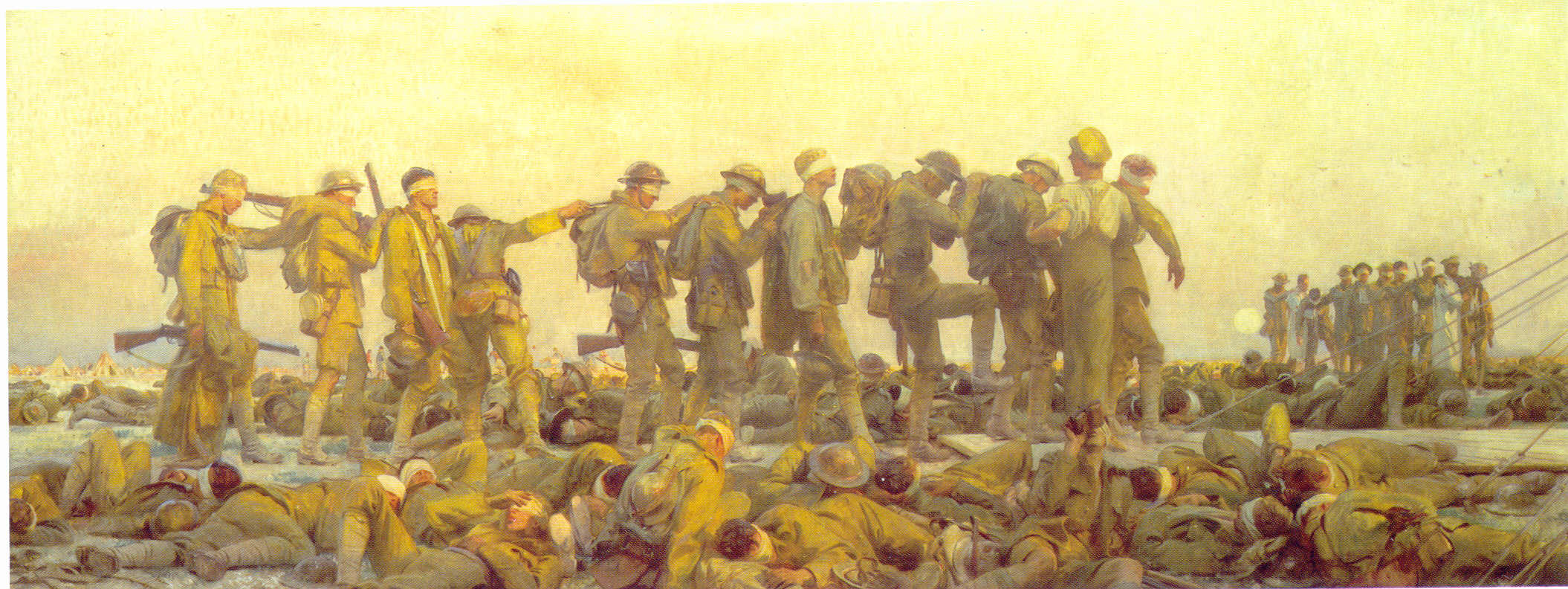
Gassed, by John Singer Sergeant, 1919.
Political policy-making, except in countries with overwhelming power and ruthless leaders, is largely a matter of informed guesswork. Can we be certain that a policy or a decision will produce the desired effects? Of course not, because we can’t anticipate all the factors and events that might derail the outcome.
We can only work on the basis of probability and risk. Our political masters make their decisions by taking account of the known unknowns. Or at least we’d like to think so. And as far as the unknown unknowns are concerned, well, as Donald Rumsfeld said, stuff happens. Nobody got fired for failing to anticipate Krakatoa.
In Britain we are now three months into the post-Brexit era. Except that we aren’t, because we haven’t left yet. And nobody seems to have a clue what the Brexit deal will look like. Every piece of good economic news is hailed as proof that the Remain camp were spreading fear for no reason. It seems that confidence is holding up, but that critical long-term decisions that will depend on the outcome of the Brexit negotiations are not being made. In other words, business as usual, but with a large dollop of hedging.
The government, meanwhile, is getting on with business that it can control, such as its new proposal for grammar schools, thereby distracting us from thinking too much about the stuff it can’t.
But I’m sure I’m not alone in thinking that we are currently dealing with more unknowns – partly thanks to the Brexit decision – than at any time since World War 2. Here are a few of them.
The European Union will not preserve itself in amber during two years of negotiation specified after we invoke Clause 50 of the European Union Treaty. It’s quite conceivable that both France and Germany will have new political leaders in place before the negotiations conclude. If so, will they seek to tinker with what is in the process of being agreed? Movements in other member countries to change the nature of the union might also gain in strength. Juncker might be junked. In short, the EU that we leave in 2019 might be radically different from the one we voted to leave three months ago. It might even be an entity that we feel able to be a part of.
Then there’s the financial system. The frailties of the Eurozone have not gone away. It would not take a crisis of the magnitude of the 2008 event to upset the financial applecart. Italian banks appear vulnerable, and it’s quite conceivable that the lid will again blow off the Greek economy. It’s not impossible that Greece might leave the EU before Britain. And what political and financial dominos might fall thereafter?
The conflicts in Syria, Iraq and Libya show no sign of abating. The knock-on effect of further migration might blow the EU’s treasured freedom of movement principle into smithereens. Turkey is more unstable than it has been for decades. China might face economic meltdown. Putin might try a new adventure in Eastern Europe. Donald Trump might, if elected, fatally destabilise NATO. South Korea might attempt a pre-emptive strike on North Korea before Kim Jong Un develops the means to deliver his nukes. Saudi Arabia and Iran might move from proxy war to direct conflict. And we haven’t even factored in Israel and Palestine.
With all these factors in the mix, Theresa May, if she ever read Isaac Asimov’s Foundation Trilogy, must be yearning for Hari Seldon’s psychohistory, the magic algorithm that produced a Plan to limit the damage to humanity as the galactic empire crumbled.
Meanwhile, back in our soon-to-be independent homeland, we face uncertainties of our own making.
The Government is having to cannibalise the civil service to create two new ministries – one to deal with trade, and the other the Brexit negotiations. One wonders where these new people are coming from. After all, we apparently have no civil servants capable of negotiating trade deals.
The two ministers appointed to run the new departments are ideologues, not pragmatists. The next few months will see fissures in government as the “Hard Brexiteers” battle it out with the Remainers, who want to compromise with the EU in order to preserve Britain’s status in the single market.
Liam Fox, the trade minister, blunders around the country sounding off about fat and lazy business leaders who prefer to play golf on Fridays instead of working to boost exports. Very supportive. No doubt his department will come up with measures intended to bolster the UK’s export capabilities. But the question we should be asking is why they weren’t taken a long time ago. Brexit makes it harder for new businesses in areas that the government wishes to encourage to grow, since they will face import tariffs virtually everywhere.
He will also be looking to incubate new business sectors in economically deprived areas. It’s unfair to say that his predecessors have ignored this issue – the Northern Powerhouse and the National Graphene Institute in Manchester are example of previous initiatives. But they are long on aspiration and short on results.
And what of the skills we need to create blockbuster industries that will out-perform those in the five national economies larger than ours? We are cutting back on visas issued to foreigners who wish to study in our country, thus starving the universities of funds and depriving ourselves of the skills we have helped to develop. If we are unable to import or develop the skills we need to grow these businesses, they will grow more slowly. Restrictions on those wishing to study in the UK will mean that talent goes elsewhere.
We still do not know what Brexit means. Our representatives in parliament will have no say in the timing of our exit, and, as far as we know, no opportunity to vote on any deal that the government comes up with. Another referendum might not be the answer, but scrutiny and approval by parliament of the terms is a must. Since the European Parliament will need to approve the deal, why shouldn’t our parliament have the same opportunity?
The voters must be given an unbiased view of the implications of each aspect of Brexit. This view should not be delivered by the politicians, who have proved themselves incapable of presenting credible, objective arguments. Perhaps it should be formulated either by the civil service or by an independent commission of experts who are capable of evaluating arguments free from political and emotional interference.
Therein lies an even bigger concern. Throughout Whitehall, government departments are planning, debating, fighting turf wars and hopefully coming up with solutions – but in secret. We voters are not privy to the deliberations. By and large, we are presented with decisions and arguments to support them. Occasionally we might be thrown a consultational sop in the form of a white or green paper, or a public inquiry. Those of us who follow the business of parliament can study the proceedings of parliamentary committees, but these often degenerate into bouts of political mud-throwing and inquisitions of public figures.
Unfortunately, only a tiny minority of voters pay attention to policy debates, and even if they do, they are rarely presented with arguments unencumbered by interest groups, political spin and media owners with axes to grind.
All too often we are presented with solutions without serious discussion of the alternatives or reasons why the preferred option is superior to the others. These discussions are taking place within government departments, but we, the electorate, are not privy to them. Or, if we are, the documents of public record are so complex that they are indigestible to those of us who don’t have the time, the inclination or the knowledge to figure them what they mean. We end up forming opinions based on mediated content we get from TV, the web and newspapers.
Opinion-shapers frequently brush over perfectly viable alternatives. Party policy and Rupert Murdoch’s prejudices don’t necessarily allow a full exploration of the issues.
The EU referendum, so full of lies, distortions and false certainty on both sides, is a classic example of what now constitutes political debate.
There are two reasons for this. Genuinely independent thinking is hard to come by. And emotion has become the dominant currency of debate.
Take the Hinkley Point nuclear power project. When was the last time a government commissioned a national review of energy policy, and presented it to the public in terms easy to understand? Have we fully explored the cost of the project, the security implications, the alternative measures we could consider in order to make up our imminent energy shortfall? Is there a publicly available review that takes into account emotional (meaning political) impact – fear of nukes, fear of China’s involvement, destruction of our environmental back yards by renewable energy technologies – as well as the economic and geopolitical risks of each approach?
The same question might equally apply to policies on education, defence, social inclusion, infrastructure and a host of other areas. We boast about our impartial judiciary. Is it impossible to find impartial expertise? Not people wheeled in to support your argument, to be deployed against experts engaged by “the other side”.
More often than not, we rely on our elected representatives to carry out due diligence on our behalf. But delegating power to Parliament is one thing. Expecting our representatives to display independence of thought in the face of the coercive power of party whips is quite another. Barring the occasional referendum, our view only really counts once every five years. Yet the British electorate is probably better educated now than at any time in our history. Isn’t it time that we were treated as more than just gullible bystanders?
As for emotion, we are not quite at the point where politicians are elected purely on grounds of how we the voters feel about things, as seems to be happening in the US at the moment, but we’re getting there. The Brexit campaign proved that.
Emotions have their place in politics. Of course they do. They should be used to inspire, unite, galvanise and celebrate, not to elicit fear, contempt, envy and hatred. Dark emotions are the tools of demagogues like Donald Trump and Nigel Farage. Those who use them to create rather than destroy – and for all their flaws, politicians like Ronald Reagan and Barack Obama come to mind – are somewhat thin on the ground these days.
It would be wrong to blame politicians for all our ills. They are after all fallible creatures of the systems in which they operate. Other contributing factors include our increasingly short attention spans, shortfalls in critical thinking skills, failures in communications across cultures and geographical space, and the deep reservoir of fear and uncertainty in most parts of the world that sits ready to be tapped by unscrupulous persuaders.
But I do believe that while we are going through the Brexit process, British politicians have the opportunity to reverse the tide somewhat. They can do this by admitting the risks of the solutions they propose, by explaining the probabilities and by stating the alternatives. They should let us in on some of the debates going on behind closed doors. They should be less squeamish about admitting to awful truths, such as things they can change and those that they can’t. They should stop treating us like children who crave the security of knowing that our parents know best and have everything under control. And they should stop manipulating us with fantasy, factoids and outright falsehood.
Above all, in two years’ time or however long it takes, whether it be through another referendum or some other form of national consultation, they should ask our opinion about the deal they’ve negotiated – warts and all.
Perhaps then we will cease to be the kingdom of the blind, in which the one-eyed man is king.
Alan Rickman and Juliet Stevenson in Truly Madly Deeply, 1991
I have seen the future of death. Well, if not the future, certainly a future.
No, I’m not a prophet, but the other day I did have a bit of a revelation about what death will come to mean to the millennials and their children.
Let me explain. I’ve long been aware that there’s a huge number of dead Facebook users. Anyone with the password of the deceased can continue to post in the person’s name, until Facebook finds out. Likewise on Twitter.
A few months ago, an old friend passed away. His family launched an appreciation page on Facebook. Several months later, the page is still being populated with pictures and stories about him.
Then I saw a story about a woman who inserted into her wedding photo the image of her brother, who had died shortly before the wedding. His smiling face – slightly ghostly – shines out from the family group.
A few days ago, I read a piece in the London Times about teenage girls who spend most of their waking live outside school on their smartphones. Instagram and Snapchat mainly, Facebook only occasionally (yuk, that’s for parents, it seems).
And then I thought about Big Data, sucking all this chatter into all those huge digital islands. The islands are getting bigger and bigger. Even moderate users of the internet have launched gigabytes of stuff into cyberspace.
Take me for example. Over six hundred blog pieces, tens of thousands of emails, website visits, online searches and e-purchases. If you digest all this stuff, you will know pretty well what I think about life, what I like doing with my time, what I like buying, the kind of books I read, movies I watch. You’d probably even discover that I buy my underwear from Marks and Spencer.
So when I shuffle off, it’s not too much of a stretch to imagine that some smart data aggregator will be able to raid each of the islands and assemble a near-as-dammit a comprehensive digital picture of me, run it through a few algorithms, and turn Steve back into a living, commenting, reacting and feeling digital entity. Assuming anyone would want to approach me for wisdom and guidance, which is highly unlikely.
Be that as it may, future entities with which you will be able to communicate might not be alive, but permanently pickled in cyberspace.
In the real world this is nothing new. In some parts of the world shamans communicate with the dead on behalf of the living. In those cultures, the dead are as much a part of everyday life as the living. Even in my little country, you can go to a medium and talk to your granny, deceased cat or whatever.
In other cultures, mummified grannies hang out in people’s front rooms, and are wheeled out to take part in family occasions. In the movie Gladiator, Maximus talked to the little figurines of his dead family on a regular basis. But when the dead talk back, do they say much beyond sage pronouncements, and reminders to loved one to repair the broken ballcock in the downstairs loo? Computers, quite conceivably, will be able to go many steps further.
So will we have social media sites populated by the dead and the living, where the living maintain the personae of the dead, consult them, photo-shop them into family occasions, such that it will be impossible to distinguish between the living and the dead? And will this come naturally to those millennials who spend more time with friends online than they ever do in person?
As computers get to know more and more about us, will they be able to predict how we might react, emulate our humour, and at some stage become the person, who thereby gets to be immortal? So that one day, cyberspace becomes one vast forum populated by departed personalities busy talking to each other and the living.
The implications are many and varied.
Will the living be able to consult a cloudy oracle to get advice from their departed parents, sisters and best friends? The desire is definitely there, as we have seen with the shamans, the mummies and the mediums. And a couple of days ago came the sad story of the best friend of a woman who killed herself accidentally doing the same thing because she though that by dying temporarily she would be able to see her friend. Only she didn’t make it back.
Will the living be able to befriend the dead in order to tap their wisdom? What if we could talk to Einstein, Shakespeare, Abraham Lincoln and Steve Jobs? Perhaps. Plenty of source material for our animating algorithm to work out what the Bard might have to say on a number of subjects. The others? I guess it would have to dive into biographies to supplement the animation. But what of the philosophers, artists and leaders of tomorrow, whose every waking hour plays out on the social media. What of Donald Trump, for that matter?
Will machines get to know so much about us that they will be able to create a digital DNA built from our experience, likes, dislikes and opinions? And ultimately, as close a replication of our personalities as makes no difference? Will our descendants be able to get the answer to “what would Jesus do?”
Take out the digital bit, and this is nothing new. After all, a sizeable proportion of the world’s population order their lives according to the supposed acts and thoughts of no more than a handful of profoundly influential men. The hard work of interpreting and rationalising those deeds and utterances was undertaken over centuries by thousands of scholars.
What if the work of those scholars could be undertaken by computers? Could we be about to witness the birth of the first digital religion?
Think also of the arts. Computers are already creating movie trailers automatically. Some bright sparks recently came up with the anatomy of a fiction best-seller by analysing the themes and language embedded in five thousand successful novels. So it can’t be long before a computer can produce an endless series of James Bond novels without the publishers having to pay excessive royalties to high-profile authors such as Sebastian Faulks and William Boyd.
And what if there are algorithms that work out what moves us in the works of the great composers? Wouldn’t we welcome Beethoven’s Twenty Ninth Symphony and Mozart’s Seventieth Piano Concerto?
And then, if machines can replicate the thoughts, the creative process and the beliefs of the dead, why not do so for the living? So that we can set our avatars to work running countries, businesses and families, while we sit around watching box sets of Game of Thrones? Avatars that remember our “better nature”, and don’t get side-tracked by illness, depression and hangovers. At which point, as Stephen Hawking suggests, our avatars question the point of having us around wasting money and resources, and decide to dispose of us. They simply carry on doing their thing after we die, slowly degrading though lack of updates.
At which point there will be no more living, only the living dead.
Even if the computers leave us be, there are downsides, of course. Imagine the dead fighting the dead, and bringing the living down with them. Imagine still having to deal with cantankerous relatives poking their noses into our business long after their physical deaths. At what point do we replace a digital leader with another one? And how about giving the living a chance?
If you think this is all crazy stuff, you’re probably right. But do you suppose that the Taliban wouldn’t have digitally re-animated Mullah Omar after his death three years ago? After all, it was only recently that his followers admitted that their reclusive leader had expired. What’s more, you can’t snuff digital leaders out with drone strikes.
And what of the clique around Uzbek leader Islam Karimov? It took his courtiers three days to admit to his death. What if they could have kept him “alive” for a couple of years while they worked out the succession? And what would Venezuelans not give for the return of Hugo Chavez, even in a digital form?
Are we moving to an age when there are no more living, only the living dead?
Yes, I know none of this is startlingly original, but hey, it sure is fun thinking about it.
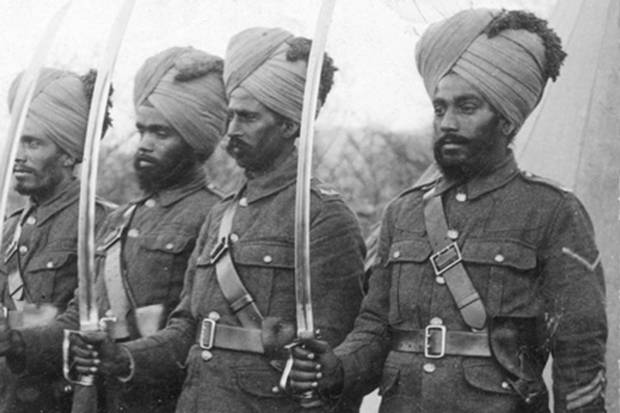
Sikh Soldiers in France, World War 1
I’m writing this from a farmhouse in rural France – a place we’ve visited many times and will continue to visit in the future, all being well. We arrived the other day at the small regional airport outside Bergerac that serves the area. The Ryanair flight disgorged its usual complement of late season visitors. Cashmere-clad, middle-aged, middle-class Brits who have come to enjoy a couple of weeks of late summer warmth, wine and good eating. In amongst them, a smattering of people who looked like celebrities but probably aren’t – not that I could tell the difference. A ravaged rock star here, a best-selling novelist there.
There were few signs that times have changed since the attacks on Paris and Nice. The flight was full. The car rental companies were doing a roaring trade. The main difference was the presence of a lone soldier, heavily armed, patrolling the car park. Oh, and in the window of the local Mairie, there’s an A4 leaflet telling you what to do in the event of a terrorist attack. In French, of course.
But otherwise, situation normal. And since we were here last year, some enterprising chap has even opened a Lebanese restaurant in our local town. When we tried to get a table, he told us with a hint of arrogance that he was full. One import from the Arab world that the French are unlikely ever to reject is the cuisine.
No burkinis here – we’re a hundred miles from the sea, and there’s only one lake within a ten mile radius. In the local producers’ evening at the town square there wasn’t a hijab in sight. Only French and British families, mostly white, happily mingling as they tucked into their frites, escargots and brochettes.
I suppose this would be just the sort of place where the lone wolf might strike. A beautiful bastide where traditional France cheerfully blends with its British visitors as if the Hundred Years War had never taken place. There are plenty of small towns in France for the wolf to choose from, which lowers to minimal the likelihood of AK-47s ringing out on this town square. Minimal enough for us, anyway.
I suspect that the fear factor is somewhat less than minimal in France’s major cities. But no amount of fear justifies empty gestures such as the ban on burkinis. Some years ago I wrote in this blog a piece about face veils: The Veil of Fears. It was written before the coming of ISIS and its attacks in various corners of the globe, but I still believe that the central theme – that drawing attention to a style of dress turns that style into a gesture of defiance on the part of a minority against what the wearer considers an oppressive majority – still holds true.
The French ban – now overturned – made such an impact that the real winners will be the makers of burkinis, whose sales most likely will have rocketed.
As someone who used to wander through his student union in the early seventies dressed in an eighteenth century frock coat obtained from a source I have long since forgotten, I can testify that clothes differentiate. I certainly wouldn’t have been mistaken for a civil servant. Even though I didn’t really feel like a member of an oppressed minority, it still gave me a kick to watch the horn-rimmed specs twitch in indignation in my local high street.
Eventually my rather silly sartorial defiance melted away when I had to get a job. Nobody told me not to dress like a Georgian clerk. I just got bored of it.
So here’s the thing. If the far right politicos in Britain want their country back, they should remember that apart from a brief period in the Middle Ages, when a law was passed dictating permissible clothing for various social classes, for most of our history, governments have not sought to regulate styles of dress, however bizarre they might seem. Such regulation as has existed has been on practical grounds – those pertaining to uniforms, for example. Even in the choice of uniforms, we have always recognised diversity, as the picture of Sikh soldiers in World War 1 demonstrates. And when regulations are manifestly stupid – such as the ban in the Sixties on Sikh bus drivers wearing turbans – they have usually been repealed.
Changes to dress conventions have usually come about through social pressure and gradual changes in the law, not because some local mayor has determined that being covered up when going for a dip in the sea is offensive to his constituents.
Our laws do not condone arbitrary bans on apparel covering the head, or even the face. That should be a matter for the wearer. We should be worried less about appearance and more about mindset. Those who seek to change our society through threats, intimidation and violence are not the ones who cover their faces. More often or not they are men who dress and look like any other men.
We have more than enough laws that criminalise acts and expressions of hate, sufficient to lock up the likes of Anjem Choudary and his followers. And tempting as it might be to criminalise symbols of culture and religion, be they face veils, burkinis or even long beards on men, by doing so we go against the very traditions that those who “want our country back” seek to reinstate.
By banning burkinis and face veils, how do we differ in this respect from groups like ISIS, whose ideology we seek to eradicate, and who order women to cover up and men to wear long beards?
I’m not “in favour” of face veils. But nor do I like tattoos, Y-fronts and bling. And I’m not too keen on moustaches, for that matter. What really matters is the stuff that goes on inside peoples’ heads, not what they wear on their bodies.
Unfortunately, whether we like it, the seed of a distinctive kind of violence has been planted that is yielding its first crop. Snipping away at everything surrounding it above the ground will not eradicate the roots. We are not a country that is in the habit of applying sweeping measures to destroy an enemy within. We don’t do purges, ethnic cleansing or deportations, no matter how much the authoritarians among us would like us to.
We can’t force people to think differently. So the sooner we recognise that each generation faces different threats – real or perceived – to its well-being and security, and that this particular nightmare might take a decade or more to dissolve, the better we will come to terms with those threats and deal with them in a realistic and sustainable manner.
This is our world, and obsessing over what people wear over their hair and their faces isn’t going to change it.
 59steps