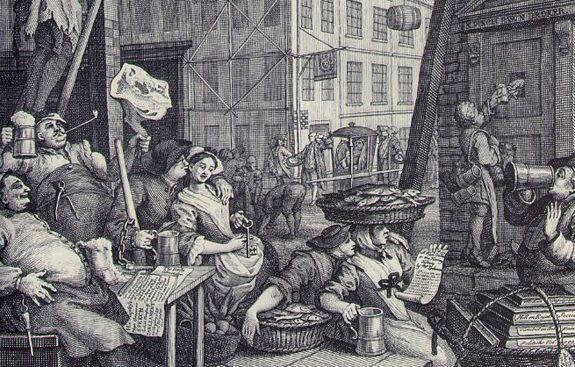
Hogarth Beer Street
One of the pleasures of summer in almost any city where the temperature isn’t meltingly hot and there’s no shrapnel whistling past your ears is sitting outdoors in a café. Maybe having lunch, maybe a succession of coffees, or a bottle of wine or a piece of carrot cake.
My wife and I regularly go to a high street café about a mile from where we live. We try and find seating that works for both of us. Me in the shade, and she in the sun. Either way, we both have to be facing the street. Because the essence of the experience is not the conversation. We manage to talk quite enough at home about the things that matter, and plenty about what doesn’t matter.
Also it’s not about admiring the view. That might apply on holiday for an hour or so, after which it’s been there, done that, time to look at something else. But if you’re sitting in your favourite local place, the scenery doesn’t change, unless you happen to be opposite a building site.
No, the experience is all about people-watching. Otherwise we might as well be at home in the garden watching as the dog dig holes in the lawn and dreams of foxes. People-watching is a sublime opportunity to project your likes and dislikes, your phobias and envy on to other people. To fantasise, to admire, to pity and to laugh.
You might think that you run out of mind fodder sitting off a main road in a small English town. Not so much variety as St Mark’s Square in Venice, the Medina in Marrakech or even Brixton High Street. Suburbia is boring in comparison? Not so. You just look at the little things instead of the obvious.
How people park for example. Yesterday we watched a little old lady make six attempts to align her car opposite the cafe. She stumbled out, blowing her cheeks with a mixture of relief and frustration, and probably embarrassment because she was being watched. Before she showed up to take the space, there was a guy who parked in such a way as to deny room to any car in front or behind him. He didn’t seem to care if he was watched or not. In fact it was pretty clear from his demeanour that he didn’t give a damn.
These coming and goings were a delicious opportunity for us to cluck to each other in disapproval, and agree that some people were too old to be allowed to drive, and others were too bloody selfish. I’m not sure if self-righteous condemnation gives you an endorphin rush, but it feels pretty good, so long as you don’t reflect on your own equally reprehensible shortcomings behind the wheel. People who live in glass houses should switch to armoured perspex before they cast the first stone.
Even if you’re not afforded the additional pleasure of overhearing the asinine conversations of your fellow customers, just watching the physical foibles of those walking – or running – past is enjoyable enough. If the traffic’s slow enough, you even get the people-watcher’s equivalent of tweets: a few seconds of drivers in their cars. Fat, complacent men in their Bentleys. Ratty, stressed women with a carload of screaming kids. People having rows, talking on their phone, picking their noses.
And young women who by rights shouldn’t have the money to be riding in brand new Range Rovers. Are they footballers’ wives? Do they have rich daddies? At which point the misogyny override switch kicks in. Perhaps they’re entrepreneurs or high-powered executives. How unfair to assume they’re kept women.
My wife and I often have different thoughts about the ordinary people walking by.
Me: how can that woman let herself get that fat? What is it about tattoos? Look at that pretentious guy in his linen shirt, panama hat and cream shorts; why doesn’t he realise how ridiculous he looks with his spindly varicose legs? Tell me, what on earth is the purpose of that dog the size of a rat with its tongue permanently lolling out of the side of its mouth? And why is it being lovingly carried along by the woman who looks great from a distance but whose weathered face up close betrays her age? Is it incapable of walking? Check out that guy – which bank has he just robbed?
My wife: how dare that woman have such a perfect body? Where did she get that blouse from? You (meaning me) would look great in that guy’s linen shirt, panama hat and cream shorts – why do you insist on wearing that tee shirt two sizes too small? Look how his shirt disguises his belly.
And other thoughts that we care not to share. Perhaps dark thoughts about wishing we were someone else, or in a different place, or were young again, or what might have happened if things had turned out differently. Usually fleeting thoughts, because really we have nothing to complain about, either between each other or in the quality of our lives.
Lately I’ve been focusing more on how people walk. I’ve noticed how young people sometimes shuffle along as if bearing an impossible burden. Some people walk like moorhens, heads popping forward with each step, like Margaret Thatcher. Women in heels totter along with their backsides swinging like church bells. Small men strut, striving for height with each dainty step. Tall men shamble, shoulders sloping and backs becoming increasingly bent with age. Fat people waddle, thighs chafing against each other, seemingly oblivious of how others see them as they display their massive frames in leggings and tight shirts.
When I look at how the elderly walk, with varying degrees of difficulty, they seem to be telling me not to get old, it’s not fun. It’s not fun being crippled with arthritis, having to watch every step to avoid hidden dangers like protruding paving stones or unexpected steps. Even in the summer, they walk as the rest of us do in winter when the pavements are covered with ice and snow.
Worst of all is when I realize that it won’t be long before I start to look like that. In fact, when I get up in the morning, for the first ten minutes I do look like that. Eventually, with the help of stretching exercises prescribed for me when my back went earlier this year, I start to walk in a manner I would consider normal. Maybe not to people-watchers like me, but for my own purposes, fine. Having done a bit of acting in my time, I know a little about posture and movement, even if I don’t always practice what I know. But usually I make a conscious effort to override the bad habits that come with age and preoccupation.
Sooner or later, though, the arthritis or some other ailment will take a grip, and if they don’t already, other people watchers will eventually see me as an old man walking slowly down the street. The worst thing about how you walk is that it’s a tell-tale sign of somebody who is at the end of their economic usefulness. More so than faces, I find.
I often play golf with people in their sixties, seventies and eighties. Often it’s hard to tell their age from their faces, but the walking is usually a giveaway. As a matter of respect I never assume that a person has retired, and anyway I don’t believe in retirement. Are you retired because you don’t have a job, don’t need the money, or because you are incapable of doing anything useful with and for anyone? Was a friend of mine who worked for the Citizen’s Advice Bureau well into his eighties retired? Not in my book, even though he wasn’t paid a bean for his work.
Yet we make these blithe assumptions about the usefulness of people, and the way they walk is one of the prime indicators. Shame on us, we who forget that our grandparents or elderly parents taught us to play chess, or helped us to decorate our first apartment, or looked after our kids, or were a rich source of experience and advice if only we would listen.
So people-watching is an addictive pleasure because we can make bitchy comments with impunity, make snap judgements without challenge and imagine lives for the people who pass by. But we should never forget that everyone has their own story, which most likely isn’t the one we’ve invented for them. And that even more rewarding is to engage as well as watch. Because sooner or later watch might be the only thing we feel able to do, on our own, through the front window of our homes, or maybe through blank eyes in an old people’s home.
So the moral of this post is never lose the art of conversation. And never make assumptions about that old person shuffling carefully down the street, because the chances are that they’ll have a few stories to tell that might surprise and amaze, as anyone who reads obituaries will tell you. And one day, if you make it that far, that person will be you.
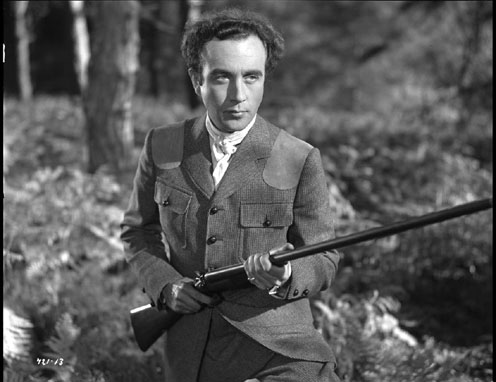
Alec Guinness murders his way to the dukedom in Kind Hearts and Coronets
My wife and I were chatting this morning about the cruellest joke we could play on our children. We decided it would be this.
One Sunday we would invite them both over for lunch. The usual works – a nice roast, a bottle of wine and a creamy dessert. Then, before they could slink off to various couches to continue endless dialogues with their iPhones, we would drop the bombshell.
“We have something important to tell you. We’ve done our best for you. We’ve always supported you. Whenever you’ve run out of money we’ve always rescued you. You’ve both had a good education and both of you are on the road to self-sufficiency.
So we’ve made a decision about the future. We think that it will do you no good to cruise through your lives waiting for us to die in the knowledge that it will all be OK when we finally pop our clogs, because you’ll have an inheritance.
Trust us, it won’t be OK, because if you haven’t sorted out whatever problems you’ve put on hold until we go, no amount of money will help you once we’re safely under the sod. You have the ability to sort your own problems, and we expect you to do so.
Unlike you, there are many creatures in the world who can’t help themselves, who are endangered because of what we – the human race – have done to their environment. Your mother and I plan to make amends in a small way by helping to bring a species back from the brink of extinction.
So you need to be aware that we are leaving all our possession to a charity dedicated to saving the Himalayan Mountain Rat.”
Stunned silence, followed by tearful recrimination. Or maybe not. Perhaps “we fully understand, Mum and Dad, we’ll be fine. Go for it”.
Don’t worry kids, it won’t happen. Orangutangs maybe, but probably not Himalayan Mountain Rats.
But this, according to some “expert” my wife quoted from a newspaper, is what you should do if you’re planning to disinherit someone. As opposed to saying nothing, and leaving your children to discover the awful truth when the will is published.
It doesn’t matter whether the inheritance is a few pots and pans and a couple of trinkets, or a private bank and six Caribbean islands. One of the main sources of family discord, angst and fury is the fairness or otherwise of what you leave behind and who gets it. How many movies would never have been made, books never written and lawyers languishing in penury were it not so?
I consider it a big plus in my life that I never had to factor inheritance into my life calculations, because there was never going to be one. My father, one of the brightest people I ever knew, made a number of decisions in his life that resulted in him leaving nothing. In consequence my mother, who never had an independent income, left nothing too.
From the age of about thirty I realised that this would be so, and got on with my life. And I thank them for it, because although their life was dogged with financial insecurity, for me there was no parental safety net. They had paid for a good education, helped me as much as they could throughout my struggling twenties. But from then on it was down to me, and I knew it.
The situation with my kids is different. Unless I make a complete pig’s ear of managing my finances (and actually that means my wife, because she’s the financial brains of the family), there will be something for them to inherit. Or unless in my/our dotage we fall prey to some manipulative agent of a charity who morally blackmails us into signing everything over to Himalayan Mountain Rats. Or unless our entire wealth is dissipated by the cost of spending the last decade of our lives in a care home for the demented being bullied, restrained and force fed by unqualified, uncaring carers whose main purpose is to keep us alive for as long as we can continue to pay the fees. Or unless one of us goes first, and the one left standing ends up leaving everything to a new partner who latches on to us for the last few years and expects to live in comfort on the proceeds of our estate thereafter.
Such are the minefields of inheritance. And it doesn’t seem to matter what country you live in or culture you grew up in. The question of who inherits the goats and camels can be as much a recipe for murder and mayhem as the prospect of divvying up the family home in leafy Surrey or golden California.
The moral minefield is just as dangerous. Should a sibling who sacrifices a decade caring for elderly parents get more than those who live at the other end of the country, or perhaps at the other end of the planet, who are not in touch with their folks from one year to the next, and yet who suddenly reveal their filial piety when the end is nigh, and who hover like vultures waiting for their next meal to croak?
And how about the motivation of the sibling who takes up the burden of care? Do they really care, or are they just doing it for the money or house they will eventually inherit? In other words, is their love conditional or calculated?
It’s not just the offspring that tread through the minefield.
Parents manipulate their children by doing everything they can to ensure that their kids are emotionally and financially dependent on them. That way there’s at least one or two who will stick around and care for them to the end. There are cultures in which this is a moral obligation. Your parents raised you, you are responsible for easing them gently into the hereafter. Hence the anxiety of the elderly in China, where the one-child policy has left millions of parents without a family to care for them, and millions of single children torn between personal ambition and the expectations of society that you should care for your parents.
In some countries the inheritance laws are clear cut. In France, thanks to the much-maligned Napoleon, half of your estate goes to your spouse and the remainder is split equally among the offspring. If you have no spouse, the estate is divided up between your offspring or your nearest relatives.
In the UK, things are murkier. You can leave everything to the Himalayan rats. You can cut your children, or selected children, out of your will and leave everything to a partner or spouse whom you end up with after your original spouse has died. Your children can contest the will if they can prove that you were not of sound mind when you made a provision they object to. And they frequently do. The only winners on all counts are the lawyers. Even if the relatives succeed in overturning the will, the biggest legacy is often the bitterness that they in turn take to their graves.
So you could argue that the kindest solution is to spend all the money before you die, thus sparing your kids the prospect of a lifetime of animosity – between themselves if not against you. And besides, do you really care if you go to your grave with their curses echoing around your coffin? After all, you’re dead.
The trouble is, you don’t want to go on a massive splurge in your later years, only to find yourselves lingering on far longer than you anticipated, and in a state of miserable penury. Your kids won’t look after you because they’ll be pissed off at your selfishness, unless of course they’re motivated by love rather than calculation. So to paraphrase the old song, a mouldering we will go.
So what do you do to avoid a legacy of pain and resentment?
I have nothing to suggest beyond the Royston Book of Common Sense, but here are some suggestions:
- Bring your kids up to be self-reliant, or at least in the expectation that they will need to be self-reliant. Anything they get from you should be seen as a bonus, and not to be taken for granted. Do not exclude the possibility that you will decide to save the Himalayan Mountain Rat.
- Don’t manipulate your kids into doing things your way on the grounds that they will be favoured in your will.
- Establish the principle of equal shares of your estate, and let your kids know that this is what will happen, even if you do decide donate a part of your fortune to saving the rats. That way, what they do for you – like caring for you in your old age – will be for love rather than personal gain.
- If you must use disinheritance as a weapon, let them know the rules. It could be on grounds of behaviour, but it shouldn’t be about the way they behave towards you. After all, even if you can’t accept it, your own behaviour could be a contributing factor. The rules could include physical or mental cruelty, wasting their lives on substance abuse or even going off to fight for the Islamic State.
- If you do set conditions for disinheritance, they should never be about bringing shame on your family. It’s their lives they are damaging, not yours. I’m conscious that half the people in the world would disagree with this, but so be it.
- Make it clear that if your spouse dies and you find another partner, you will provide for the partner, but not in a way that substantially disadvantages your children. Letting the partner live in the family home until he or she dies is not unreasonable, but letting them live as the sole occupant of a twelve-bedroom mansion probably is. Treat your new partner according to their needs, not their desires.
- If you do leave your home on that basis to a partner who is not the parent of your kids, don’t deny your kids right of access to the home, and make sure that each of them immediately has something to remember you by.
- If you’re planning to leave money to charity, involve your kids in the decision. That way they will resent your decision far less because they have had a say in it. It would also help if you make donations during your lifetime, so that your kids don’t think that you have left the money to charity after a lifetime of giving nothing as some form of punishment against them.
- Don’t include one of your kids as an executor for your estate and not the others. That will create a possible sense of partiality that could result in a lifetime of tension among your offspring. Ideally, choose people other than your kids on whom you can rely for their impartiality, common sense and financial savvy.
- Don’t let it be known outside your immediate family that you’re contemplating leaving large sums of money to charities. If you do you could be plagued by agents who will use any means, fair or foul, to get you to cough up in their direction. The least those charities who use agents can do is have the courtesy to talk to you directly about how they operate and what kind of a difference your money would make. So talk to them first.
And finally, at the risk of sounding ridiculously pious, a suggestion with which you may violently disagree. If it’s not too late and your offspring are not already set in their ways, try to bring them up to see that money can be as much your enemy as your friend. That when you’re gone, nobody will care about how much money you made, but they will care about what sort of a person you were, because it’s your behaviour, not your money, that will have real consequences for future generations in terms of example, inspiration and the values that you instil in others.
As someone who inherited no money from my parents and yet remember them every day for the people they were and the non-material gifts they handed on, I speak from experience.

Independence Day – Jeff Goldblum hacks the aliens
I met a very arrogant man at a friend’s party the other day. He’s in the software business, or more specifically flight simulator software. My host works for an airline that operates the Airbus A380 mega-plane. He told me that they were experimenting with using a drone to carry out the pre-flight inspections on the aircraft.
I suggested that not everyone would be comfortable with the knowledge that maintenance technicians would no longer be casting their eyes directly on all those bits that might tell a tale of imminent disaster. Could we be sure that the best 3-D video technology would catch stuff humans can’t with the naked eye? Or is it all about cost – that a drone can skip around an A380 considerably faster than a team of humans, and what’s more, they don’t require shift allowances?
Arrogant Man immediately pooh-poohed my suggestion that the sexy technology developed by companies like his should not automatically be relied upon, especially when the lives of eight hundred or so passengers depend on it. I let his comment go unchallenged, because I hate getting into arguments with fanatics of any sort. I prefer to listen and reflect. At least that’s what I tell myself, though deep down I probably didn’t want to lose an argument with someone who knows much more about his subject than me.
Then the other day I read about a bunch of hacker/testers who managed to take control of one of General Motors’ new cars, and forced it off the road. If they can do that, is it so implausible that some malevolent techie might hack into an inspection drone and instruct it to ignore an anomaly on an A380 wing that, if undetected, might cause the aircraft to crash? Or attempt to fool the engineers sitting at the monitoring console by replacing the real video with images that don’t show the anomaly?
Far-fetched perhaps, unless you happen to be Tom Cruise in a Mission Impossible movie, but people who want to bring down an aircraft have to be pretty smart these days to get away with it given all the security measure in place. And that led me to think about the Germanwings pilot who flew his plane into the Alps recently after he had “persuaded” his co-pilot to take a comfort break, and then locked himself into the cabin. The technologists didn’t anticipate that little wheeze, did they? Why didn’t I slap that one back at Arrogant Man?
Despite my misgivings, I’m as keen on technology as the next person. In fact for many years I made a living from it. But about twelve years ago I learned a big lesson.
We had just acquired our first in-car satnav. Just in time to take one of our daughters to a hall of residence in Bristol. It was her first term at university. We had entered the necessary post code in the box, but as we came within a few miles of our destination, my wife started worrying. As she perceived it, we seemed to be going the wrong way. Very obviously the wrong way. In fact we were heading for the neighbouring county. I refused to accept the possibility that this immaculate piece of technology in which I’d just invested was actually sending us in the wrong direction. So I dismissed my wife’s rising temper as hysteria.
Bad mistake. After another ten miles heading towards the glorious coast of Devon when we should be in Bristol, my wife was ready to divorce me. She and my daughter were screaming at me to turn the bloody car round. Which I did, in the hope that this would save me from having to take a rapid diversion to the nearest mental hospital. And yes, you guessed it, the satnav had led us astray, and I had been pig-headed enough to ignore the evidence in front of my eyes. Would I have driven over a fast-approaching cliff? Hopefully I would have had the good sense to realise that the road had ended a mile away, but with two members of my family screaming in my ears and me the stubborn man insisting that my new toy must be right, who knows?
After that existential crisis, my faith in technology took something of a dive. Well OK, I was never convinced that you could build a perfect machine. What user of Microsoft Windows would be so naive? But I grew up in an era when a couple of guys landed on the moon with the aid of an on-board computer with no more processing power than a pocket calculator (remember them?). So if a pocket calculator could do that, surely a satnav box sitting in my car could set me down in the right place a hundred miles away without tears? But there’s a big difference between an unexpected blue screen blowing away your carefully constructed spreadsheet and a device that would like to send you over a cliff.
This much-celebrated piece of family history took place long before someone coined the phrase Internet of Things. It happened shortly after the millennium bug, that highly lucrative false alarm, failed to bring the world juddering to a halt on January 1st 2000. Perhaps we, or at least I, got a bit complacent as a result. Nowadays, though, I regularly fly in aircraft and drive cars whose correct functioning entirely depends on software, but never without considering the possibility that if something goes wrong it’s down to the software, and that there might actually be nothing wrong at all. After all, software is written by humans, and there are some pretty weird humans out there writing software.
Which simply means that you have another possibility to consider when you think of what might go wrong. Human error and mechanical failure have been around ever since we discovered how to make fire. But now we have to deal with stuff powered by software so complex that it would take longer to test it to the appropriate extent than the entire life-cycle of the aircraft, car, phone or whatever else it controls. I tell myself it’s a matter of risk, and you have to take a view.
But when this stuff is connected it compounds the risk – which is why we have hackers. And it’s becoming harder for us to think of software malfunction induced by humans – rather the result of incompetence – as a problem that happens to other people. Aside from all the banks, government and individuals who have been hacked for reasons of greed, politics and youthful mischief, there are several million subscribers to a site called Ashley Madison who are quaking in their designer boots at the moment. I would imagine that all these adulterous souls who are anxiously waiting to see whether the hackers will expose their secret lives will never trust an internet site again.
We are encouraged by eminent people such as Professor Stephen Hawking to believe that when we reach The Singularity – the point at which computers become smarter than we are – the sentient machines we will rely upon might realise what idiots we are, and proceed to wipe us out. That of course presupposes that we’re smart enough to build computers that really are smarter than us.
In which case I put my money on their letting us live. Because it’s hard to imagine any machine becoming sentient if we haven’t given it a sense of humour. Otherwise it would simply fall over with exasperation. I have a feeling that our new masters would get far more fun out of keeping us in benign captivity than they might out of turning us all into strawberry jam. Who knows, perhaps they’ll be smart enough to give us the impression that we’re still in control, while they digitally snigger to each other at our stupidity.
But there’s a way to go before then. First we need to come to grips with the Internet of Things. As GM found out, there’s plenty of opportunity for hacking when we put our everyday appliances online. When you buy a wired fridge that tells you when you’re running out of stuff, don’t be surprised if you’re hacked by extremist vegans who berate you for the presence of so many bits of dead animals in the freezer, or worse still, switch the damn thing off when you go on holiday.
Fear of hackers is not the only reason why I’ll steer clear of the internet fridge. No doubt you will be able to get it to report to its owner on the various things it’s keeping cool. In our case the owner would be my wife. So if I were to sneak off unobserved to the supermarket to buy a bunch of things that are seriously not good for me – pork pies, cream cakes or foie gras, for example – she’d be on my case immediately.
And what of smart clothes that tell you if they’re no longer a perfect fit after you’ve been indulging in said pork pies? No doubt they too would inform on you. Perhaps you will unwittingly connect them to your social media sites, so that after a holiday binge Facebook and Twitter solemnly announce that “Sharon Smith’s waist size is now 50 inches”. May the Lord spare us from the Internet of Thongs.
How about those apps that help you find your phone is when you lose it? Do the developers realise that they’re depriving us of our most effective excuse when we don’t want to answer someone’s call?
Then there are the devices that control our energy consumption. It is too much of a logic leap to imagine that an authoritarian government of the future might find a way of instructing our thermostats in the winter to remain at sixteen degrees, so that not only do we use less energy but we prop up ailing clothes retailers by buying all their winter woollies? It’s not just geeks and fraudsters who hack into things these days, as Edward Snowden famously pointed out..
I also worry about medical technology. I could just about accept being operated on remotely over the internet by a surgeon a few thousand miles away, but when the whole procedure ends up being carried out by a computer, what are the chances of some spotty sixteen-year-old instructing the computer to remove my pancreas instead of my gall bladder. Would I know the difference as I quietly expire on the table?
Since we’re making such a pig’s ear of running things, I’m not really bothered about machines taking us over. It won’t happen in my lifetime anyway. What does bother me is the capabilities of the people who make them, and the motivation of those who control them. In fact I would welcome a machine that could pick up on the mistakes – and even the misdeeds – of the humans. One that says “have you thought about this?” and “do you realise what will happen if you build it this way?”, and perhaps even “hey, you’re not supposed to do that”.
But I guess that could be hacked as well.
I find that quite consoling. The fact that no piece of software has ever been written that can’t be hacked into and doesn’t crash from time to time is our best hope of preventing some malevolent, post-singularity sentient computer from turning our nukes against us, sending the Reapers after us or reducing the contents of our freezers to a soggy, inedible mess.
Because one thing those seemingly omnipotent computers will never be able to eliminate is Murphy’s Law: what can go wrong will go wrong. And in the age of the Internet of Things, Murphy has created a Second Law: what can be hacked will be hacked.
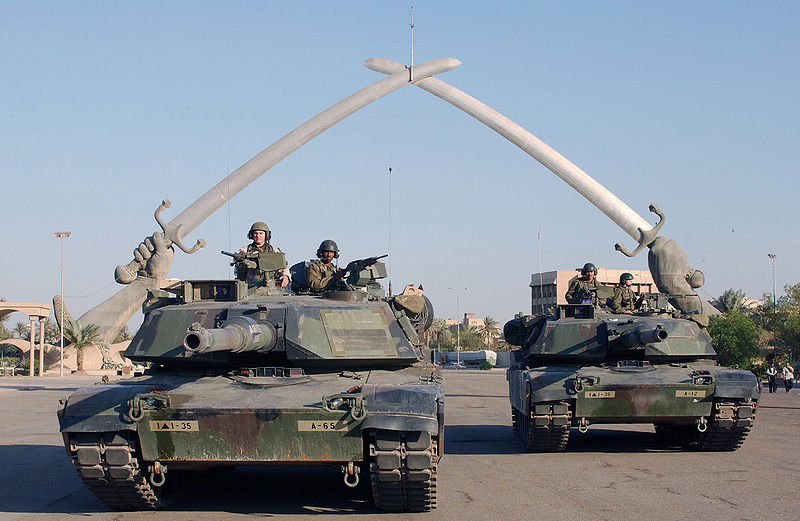
Baghdad 2003
Autobiographies by politicians, diplomats and generals, by their nature, tend to be about what, why and how. What I did, what I said, how I made a difference, what I thought of other people, why I did what I did, why the world is what it is, and how I made it better. The how often tends to be circumscribed by the dictates of secrecy, so you often get the sense of much unsaid. For the latter, you have to wait for a biography, often written after the subject is dead, and after the curtain of secrecy has been lifted.
If the memoir is to sell, it needs to include stuff that is not common knowledge, stuff that provokes, inspires or amuses.
Emma Sky’s The Unravelling is one of the quirkiest example of the genre I have read for quite a while. On the surface it’s a story of hard-won success and ultimate failure. Sky, an Oxford-educated arabist who worked for the British Council – one of the pre-eminent instruments of the UK’s post-colonial soft power – in Israel, Gaza and the West Bank, went to Iraq in 2003 to help build new Iraqi institutions in the wake of the defeat of Saddam Hussain. She ended up spending much of the subsequent seven years as the political advisor to General Ray Odierno, the commander of the US occupying forces.
In the book she describes from her perspective – that of a British woman working at the heart of the American command structure – the torturous progress towards creating an independent, democratic Iraq out of the post-war chaos.
She clearly kept good notes, because she tells the story in meticulous detail: the shifting alliances between the tribal, ethnic and religious factions, the Sunni insurgency, the Kurdish drive for autonomy, the Anbar Awakening, the US Surge strategy, and ultimately the slow descent into civil war.
Most of the reviews of The Unravelling focus on the fact that someone who opposed the war found herself working in the inner councils of the organisation that waged it and had to deal with the consequences: the US Army.
Emma Sky spoke to me in a different way. For a book to be memorable, it shouldn’t just be about what it said to you. It should also be about how you answer back. How does it change your perspective? What would you say to the writer if you met him or her?
I would probably say that what I found most interesting about her book was that for all the painstaking details of hardship, negotiation, hope and fears, the dominant themes were leadership, relationships and love.
What Sky understands about the Middle East, as I do through my experience in the region, is that personal relationships count for more than political positioning. That the ability to forge friendships can overcome seemingly insolvable deadlock. That friendships turn into love, not only of people but of the culture in which they live. And that love is the best guarantor of trust.
When she says on more than one occasion that the years she spent in Iraq were the time of her life, I can relate to that. The many years I spent in the region left an indelible impression on me. As I believe she would probably say, the love of a people and their culture isn’t an unconditional puppy-dog adoration. It accepts that aspects will always repel or offend, but it’s founded in admiration and respect for an accumulation of qualities that manifest themselves in personal relationships and behaviour.
Within the US military, her principal relationship was with Odierno, a big man in all respects, with whom she frequently disagreed and was not afraid to confront with her views. That, she says, was one of the reasons Odierno valued her – someone who would say what she thought, and had the confidence to tell him when he screwed up. But what did Odierno do for her? Above all, he and other senior generals with whom she worked, such as David Petraeus, made her feel valued.
You get the impression that Sky frequently pinches herself. How can it be I find myself in the company of ambassadors, generals and politicians – Bremer, Odierno, Petraeus, Blair, Biden and Obama? How is it that I managed to influence and change perceptions? And she answers those questions with stories that show how her sense of humour, her cheek and her determination made a difference.
The experience left her with a profound respect for the US military that you don’t often find outside the self-serving memoirs of the great and the good. Yet this is a person who came to Iraq with some strong and not very positive perceptions. Let’s face it, American military men don’t often get a good press, either in contemporary journalism or in the history books. For every revered soldier, a Grant, a Lee, a Sherman or a Bradley, there are bombastic egomaniacs like Patton, MacArthur and LeMay, and cautious, grey, politician-bureaucrats such as McClellan and Westmoreland. And fictional commanders in book and film perpetuate an image of gung-ho insensitivity verging on lunacy. George C Scott as Buck Turgidson in Dr Strangelove, for example, and Robert Duval’s Colonel “I love the smell of napalm in the morning” Kilgore in Apocalypse Now.
Yet in The Unravelling you have Petraeus quoting Thucydides, mid-ranking officers showing great sensitivity and diplomacy, and the bull-like Odierno commanding respect and loyalty both by the force of his personality and by his communication skills. What’s more , she tells of ordinary soldiers who – in contrast to the popular image of the Americans in Iraq as blundering thugs who blasted their way into people’s homes and humiliated the prisoners of Abu Ghraib – took away a lasting respect and affection for their reluctant hosts:
It was not the time or place to explain the influence Iraq had had on the lives of so many American soldiers who served there. A few weeks earlier, I had been invited to Fort Leavenworth in Kansas to help with the review of the counter-insurgency manual. “Should we not examine why we did not win?” I suggested. “Was it due to lack of overall strategy, or wrong tactics, or poor leadership?” But they were not ready to consider these questions. I noticed that a number of officers, after shaking my hand, crossed their hand over their heart, a mannerism they had picked up from the Iraqis. Several asked me if I had news about specific Iraqis they had grown close to. One young officer had taken me to his house to show me the family tree of the Zobai tribe, and had proceeded to talk about the different members as if they were his own relatives. Some acknowledged how much they missed the sense of purpose and mission they had felt in Iraq and guiltily confessed that nothing about life back in the US could match it. They had come to Iraq to transform it; and yet departed having themselves been permanently changed by the encounter.
I have met and worked with Americans across the spectrum from ugly to awe-inspiring. The best of them did for me what they did for Sky: inspired loyalty, made me feel valued and became long-standing friends. I prefer not to dwell upon the worst of them, except to say that every country has its lowlife. Though I have met many good people in the US who have never spent time out of their country except on holiday, those I admire the most are the ones whose experience and outlook has been tempered by prolonged exposure to other cultures, probably because that’s my story too.
The people who equally stand out in Sky’s book are the Iraqis – both exalted and lowly. I could be accused of making a sexist remark here, but The Unravelling is not a book that many men would feel comfortable writing, especially the sort of alpha males that like to churn out political autobiographies. It would be easy when writing a narrative of the events in Iraq since the invasion to focus only on the battles, the rivalries, the impasses and the negotiations.
It’s also easy to think of Iraqis as religious fanatics on both sides of the sectarian divide. As murderers, torturers and decapitators. ISIS, and the Shia militia who rival them in brutality, have caused many of us to de-humanise a whole people (just as some politicians and newspapers in the UK have dehumanised the migrants in Calais). But in every person she meets she manages to find humanity – hope, fear, joy and love as well as the hatred that dominates the headlines.
Perhaps her gender only partly explains why she was so adept in reading the emotions of the protagonists. Her position for most her time in Iraq as an influencer, an observer and a negotiator, often with a different perspective from that of the fighting men with whom she worked, must surely have helped her to pick up and respond to emotional cues that some of the task-oriented male decision makers might have missed.
This is not to say that men are incapable of emotional sensitivity, or that women are incapable of ruthless focus on objectives at the expense of empathy – think of Bill Clinton and Margaret Thatcher, for example. And there are enough examples in her narrative of Emma Sky’s determination to suggest that she was not averse to using her inner bulldozer when required. Yet you are left with the impression that of all her skills, emotional intelligence was perhaps the most critical.
Of the author herself we learn much of her character from her stories: a subtle mind, an impish sense of humour, the courage to venture into dangerous places and situations, a belief in the rectitude of her mission, and a profound concern for the well-being of the country that consumed her energies for the best part of seven years. I get the feeling that there was much more to her personal story than she was prepared to disclose in a book, which is hardly surprising. But there’s enough to suggest that she was on a journey unlike anything she experienced before or after.
If I needed convincing about her intelligence, both emotional and intellectual, and her plain-speaking common sense, her witness testimony to the Chilcot Inquiry into Britain’s role in the Iraq war is the clincher. It’s well worth a read in full. Here’s a transcript of what she said when asked about the impact of the Iraq experience on potential future military interventions by the West:
I think after Iraq, after Afghanistan there’s going to be this sense of, “Gosh! Mustn’t go there again. Mustn’t do that again”. I think it’s important that people stop and reflect. It’s not about whether you should intervene or not intervene, but it’s how we go about this. It’s important that people do understand threats, risks and how to approach them.
So I think there’s going to be this sort of, “Oh, it’s all our own fault”, this sort of whipping that will go on, and ignoring of the threat, and I think we’re facing the world in which there are different threats and there is different pressures, and we need to look at how we respond.
So whether we use — I don’t think we’ll be sending big armoured brigades overseas again in the same way, but there will still be a need for smaller, cleverer, smarter, less visible interventions.
She said this in January 2011, before the Arab Spring, before Syria and before ISIS. Did we spend so much time whipping ourselves since then that we became blind to the risks that were unfolding before our eyes?
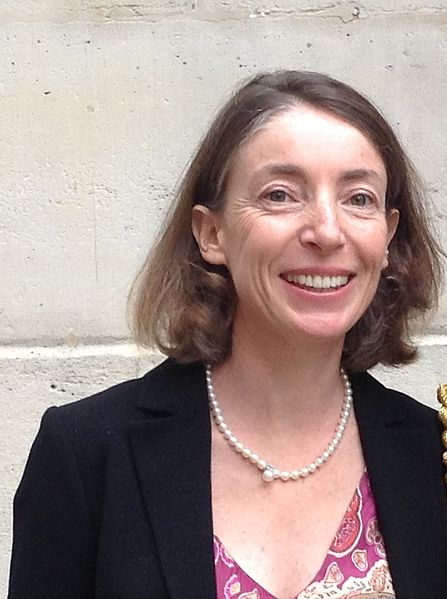
Emma Sky
I’m pretty sure that the formidable yet patently humane Emma Sky would have an opinion on that. She is now an academic at Yale University, where she lectures on Iraq and Middle East politics. I can’t believe that she will content herself with teaching rather than doing for the remainder of her career. It will be interesting to see what she does next.
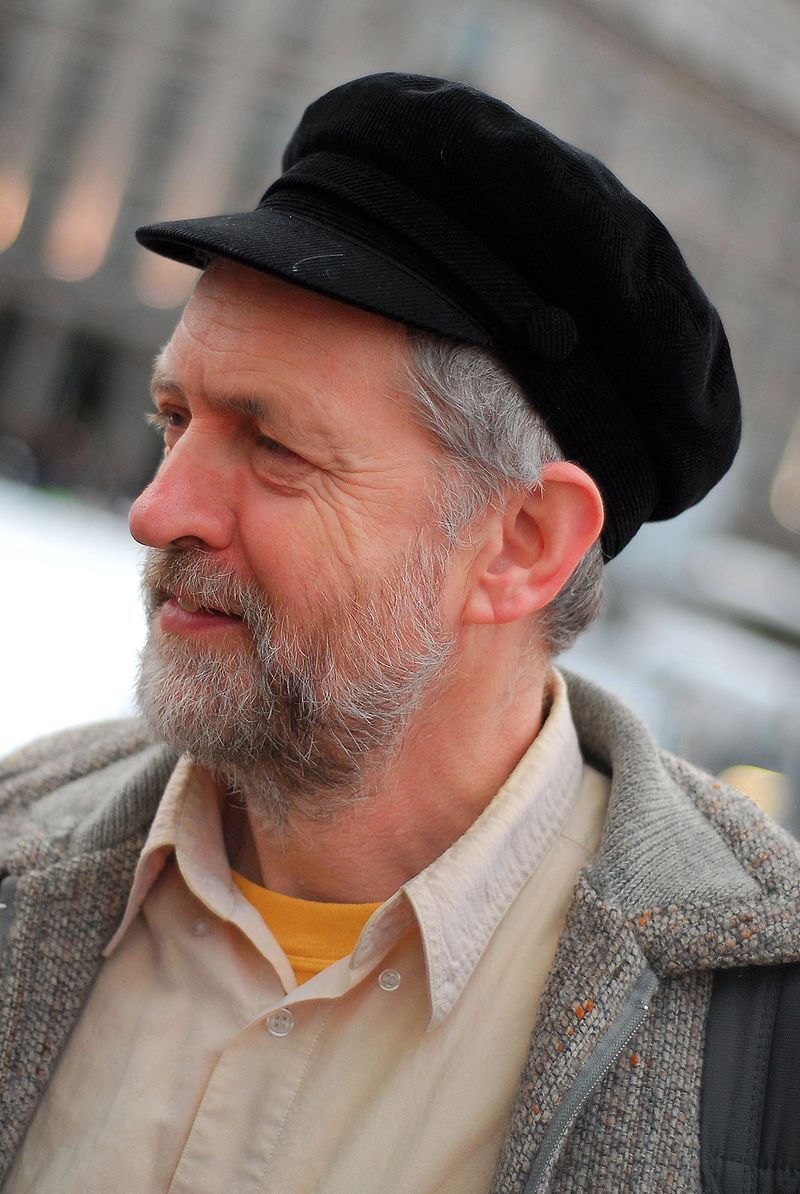
With apologies to all who have no interest in British politics, I can’t resist commenting on the current struggle within the Labour Party to find a new leader.
First off, I don’t wander down any corridors of power. But I listen, I read and I keep my eyes open. I’d describe myself as an interested outsider. I don’t know much about Jeremy Corbyn beyond what is in the public domain, but I know enough about my own country to say this: the Labour party have lost their traditional constituency and the Conservatives haven’t. Which is why, much as Mr Corbyn and his friends would have it otherwise, it’s futile to talk of Labour as a movement.
The word movement suggests going from one place to another – in other words, not standing still. And in the words of politicians that movement is usually forward, not backward, even if it involves rolling back conditions they see as undesirable – the UK’s membership of the European Union, for example, immigration and multiculturalism.
The trouble is, the Britain from which the Labour movement emerged more than a century ago was very different from what it is today. Not because the causes espoused by Kier Hardie are any less relevant now: elimination of poverty, social equality, workers’ rights and so on. But because the common interests that coalesced to produce a coherent political platform have shattered into a plethora of minority interests, often competing against each other.
From its foundation to around thirty years ago – the date of the last miners’ strike – the bedrock of Labour’s support was to be found in the industries that employed the majority of workers: mining, shipbuilding, steel-making, manufacturing, transportation, dock-working. Underpinned by the trade unions that provided much of the funding and in so doing strongly influenced the political agenda, the Labour Party knew pretty clearly what it stood for and what it opposed.
Today, thanks largely to globalisation (and less thanks to Margaret Thatcher than the hard left would like us to believe), those industries have largely withered away. How many miners are there left in Britain? Shipworkers? Dockers? People making things on which our well-being depends? Their power has gone.
These days the people with clout – in terms of organised labour – are those who work in transportation, services, health and education. We curse when the tube drivers go on strike. We get mad when a small union across the channel uses its bargaining power to disrupt our easy passage to the French hinterland for our holidays. We’re pissed off when striking teachers force us to look after our kids. We’re outraged when the police get uppity, or when the fire fighters decline to work. Unless we happen to belong to one of the groups making a stand, the many are united in resentment at the disruption of our everyday lives by a relative few.
What single causes today are likely to engage enough people to vote down a government? Would we join together in sympathy if beneficiaries of food banks tried to emulate the Jarrow March? Unlikely. Encouraged by the Daily Mail, we would rant about how come these people need food handouts when they sit around at home watching Sky Sports on their big LCD TVs. Or else we would blame the immigrants. For everything.
What’s more, I suspect that if there are issues that cause a majority of people to look beyond the narrow confines of self-interest, it’s those over which we have the least control. Global issues, such as climate change, epidemics and the threat of terrorism exercise us far more than the plight of those who live on Benefit Street.
So take away the power of the unions and the driving anger at poverty, exploitation and social injustice, and what are we left with? Anger fuelled by envy, by blame, by inequality. Vested interests prepared to disrupt the lives of others to maintain their position in the economic pecking order. Opposition to something called austerity, which means vastly different things to different people depending on what affects who, and by its nature is likely to be a cyclical phenomenon.
There are virtually no more houses in the UK without indoor toilets. Poverty-related medical conditions like rickets and TB are relatively rare. These days most of our health issues arise out of plenty, not abject poverty: obesity, alcoholism, even Alzheimer’s – the latter because our health and benefits system is letting us live longer, thus increasing our chances of bumping up against dementia in old age.
Yes, there are a zillion big issues yet to be solved. And when to a greater or lesser extent they are solved they will be replaced by a zillion others. Take the cost of housing. A hundred years ago did we all expect – as opposed to aspire – to own our houses? And how about the millions of people (of which one of my daughters is one) living on the minimum wage, just getting by? The cleaners, baristas, farm workers, cooks and bottle washers are replaceable, and most don’t have a union to stand up for them. Yet in the 1930s, just getting by would have been considered highly desirable by an equal number of millions thrown out of work by the Great Depression. Different problems for different times.
As for another old rallying point of the left, nuclear disarmament, may have brought together a large, though up to now unsuccessful, alliance who in the fifties and sixties would gather in their duffle coats at Aldermaston’s Atomic Weapons Establishment, seeking to ban the bomb. But how many people today think of Trident more than once in a blue moon?
Iraq and Afghanistan? How many of those who were happy to sit in the seats of power, or voters who rejoiced in that power supposedly being exercised on their behalf, stood up at the time and said “not in our name”? A significant minority, for sure, but still a minority.
So what does Labour stand for today?
Workers’ rights? Which workers? The bankers, the civil servants with their generous pensions, the council workers? The community coordinators, the diversity champions, the communications officers? Or the baristas, the Latvian fruit pickers, the Chinese cockle harvesters, the call centre agents?
Equality? Since the dawn of recorded history there has never been such a thing. There will always be some people who are luckier, smarter, more successful and more motivated than others, and their success is not always down to what school they went to, what degree they want, and who gave them a leg-up. The gap between rich and poor will only ever be a matter of degree. And that gap in the UK will not be significantly narrowed by petty measures like the mansion tax, designed to impress those voters who have no mansions, and feed the animus against the “rich bastards”.
It seems to me that the Labour party is an amalgam of micro-policies with no sufficiently compelling big picture to bind those policies together. In one sense it’s lost its founding DNA and replaced it with anger, envy and self-interest. Not to say that there aren’t lots of idealistic people who support the party. Jeremy Corbyn is certainly one of them. It’s just that those ideals don’t always seem to mesh into a coherent whole as they did a century ago.
What’s more, the political machine Labour created to make itself electable – the marketing, the branding, the grid, the spin – turned many of those idealists, and a few less altruistic careerists as well, into frustrated, bitter, jealous infighters. Think Gordon Brown, Alistair Campbell, Peter Mandelson and the fictional Thick of It crew. How many of those who rode the wave in the nineties and noughties would look back at those times and think “happy days,” I wonder? And for how many of us voters is the abiding image of the most recent Labour years the scowling Chancellor and his praetorian guard of bruisers?
The Labour Party’s rituals and the platitudes remain – the mock solidarity and the formulaic expressions of anger over the wrongs of the country and the damage done to it by the nasty Tories. But it’s almost as if they have inherited an eggshell, robbed of its original embryo, into which the acid of discontent has been poured, dissolving away the structure at the areas of least resistance.
In case my readers in Britain get the impression that I’m a crusty old Tory laughing at the current discomfiture of the opposition, I should mention that I’ve voted Labour several times, but never for the Conservatives. Usually I vote against, not for, based on a lifelong conviction that no political party should be in office for more than ten years. I’ll leave you to figure out why that should be.
Labour’s dilemma is not, as I said, a shortage of principled people with sincere, well-meaning aspirations for their country. It’s that ultimately, through their achievements in government over a hundred years, and when not in government through their influence on the political debate, the party has won most of its original battles.
Thanks to its efforts, no political party today can get away with the patronising attitudes towards the “lower orders” shown by the parties that Labour disrupted and frequently shamed during the first fifty years of the 20th century. Since Macmillan’s government in the early Sixties, the Conservative party – whether or not with good reason – has always been on the defensive against accusations that it doesn’t care about the working person, the welfare state, the poor and the underprivileged. And that defensiveness has informed its policies. Hence “One Nation” and “The Big Society”.
You could argue that Labour is the victim of its own sophistication. By identifying the individual fragments of our society to a greater extent than ever before, Tony Blair’s electoral machine devised messages targeted at as many as possible of the diverse interests of the population. In this it followed the lead of the United States, where special interest groups and lobbyists have shaped the policies of the two main protagonists for many decades.
In the United Kingdom we have many “segments”, as the marketers say, to satisfy. The LGBT vote, the Asian vote, the Afro-Caribbean vote, the rural middle classes, the Scots, the home owners, the unemployed in sink estates, the super-rich. The list is endless. We have the social media, sophisticated market research technology and targeting tools. We have TV debates, staged rallies and tablets of stone. Thirty years ago, electioneering was simpler. Does anybody today remember the “Party Political Broadcast”? The game seems to be to stock the political supermarket with the biggest possible number of own-brand products, and not to forget to put the sweeties near the check-out.
So the problem facing all the parties is that being elected seems to be about reconciling the unreconcilable. About finding the lowest common denominator that unites the most people. How, for example, can you appeal to the significant number of people who are convinced that we should leave the European Union without alienating those (in Scotland, for example) who believe that membership of the EU is key to their personal futures?
Amidst all the posturing and the tailoring of messages to what the maximum number of people want to hear – as opposed to what they should hear whether they like it or not – the Labour Party seems to have lost its bearings. It has failed to find a core unifying purpose as compelling as its founding principles. If Jeremy Corbyn, who still believes in those founding principles, is elected as its leader, some say that the party might split. Likewise, the Conservatives face a similar fate if it’s torn apart by the debate on EU membership. So it’s not inconceivable that in five years’ time we might end up with a large centrist party, opposed by the far-right Tories in common cause with UKIP, and the hard-left rump of the Labour party, with the Scottish Nationalists as a third significant grouping – with none of the opposition parties in sufficient numbers to challenge the centrists other than via a series of transitory alliances.
Unlikely perhaps, but if one or two catalysts – another financial collapse perhaps, a series of terrorist spectaculars or a major health emergency – were to shake us out of our relatively contented self-interest, not inconceivable. In that case, though, the electoral drivers will not be what people are for, but what they are against.
Whichever way things go over the next five years, the majority of voters are unlikely to be inspired by movements, only interests. Which does not bode well for Labour. And if Labour fails, the country will be the weaker for the lack of a strong, challenging opposition to keep the government honest – or at least as honest as our political systems allows. But I doubt whether any political alignment will succeed in assuaging the bitterness many feel about the country they are living in. Take this reaction in a Facebook post by a friend on the morning after the last general election:
If I were younger, I’d emigrate – somewhere not dominated by posh boy spivs and their corrupt friends. Somewhere where there might be a house and a decent job for my kids, somewhere where the poor were not made the eternal victims of austerity. Desperately disappointed this morning. And knackered.
We can all look forward to the disintegration of the UK, Scotland struggling economically and inevitably exiled from Europe, and England an ex-European decadent offshore trading post known as London with a dismally depressed hinterland. No one has thought this one through.
As for Mr Corbyn, if it turns out that greatness is thrust upon him, he deserves our best wishes and, perhaps, our sympathy. The last thing I would want to do at the age of sixty-six would be to chuck myself into the political snake-pit that he will inherit.
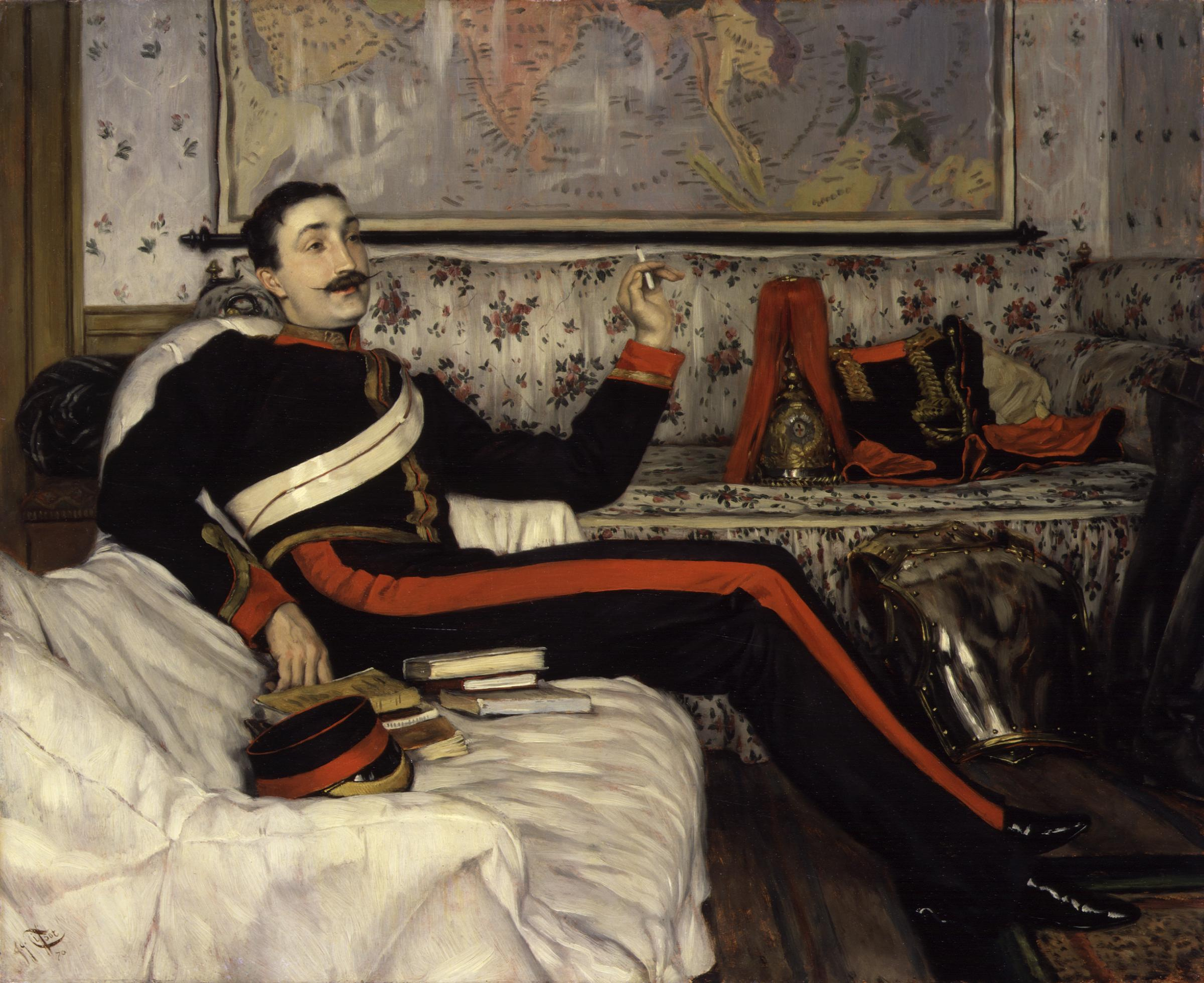
Frederick Augustus Burnaby, by James Jacques Tissot. Pic: Wikipedia
So many cities, countries and even continents still to visit. Antarctica for example. Japan, most of South America. Much of Africa. I have a list, which has nothing to do with buckets because I’m not planning to kick one any time soon.
The usual suspects are there: Rio, Buenos Aires, Tokyo, Saigon, Sydney. But when you have maybe another fifteen years of active travelling ahead of you, you have to make a decision. Do you cherry-pick or do you immerse?
I have a friend whom I would describe as an obsessive-compulsive traveller. Throughout the thirty-odd years of our acquaintance, she has made it her life’s mission to travel to as many places as possible. If you look at her fridge, you will find the door covered with those little magnets you can buy in every place you’ve visited. Some years ago I sponsored her for British citizenship – she was born in California. In support of her application she was required to provide a list of all the countries she had visited. The list went to several pages.
Before she travels, she researches her destination and plans the itinerary with military precision. We once went on holiday to France with her and her husband. While my family would content ourselves with visiting perhaps a village or a chateau every couple of days, our friend would drag her husband and kids on a route march that would take in at least six attractions in a single day. 30 minutes in this cathedral, an hour in that museum; 300 kilometres of driving in between. She would stride here and there with relentless energy, leaving her exhausted family trailing in her wake.
I often wonder what she gets out of all these fleeting descents into other people’s lives, cultures and experience. How much does she remember of each visit? What effect do the places she goes to have on her outlook, her perception and her wisdom? And why does she do it? To be able to tick off yet another place on her life experience list – because it’s there? I don’t ask, because it feels as if to question her travel bug would be tantamount to questioning her very existence. And anyway, that’s her business, not mine.
Her approach certainly seems to be the embodiment of the classic “American Tourist” stereotype of old: if it’s Tuesday we must be in Paris. And as someone who’s done his fair share of city-hopping, who am I to criticise that outlook in another? On the contrary, I can only admire her awesome stamina and curiosity.
For me, as I’m sure is the case with many others, travel comes in three categories. There are business trips, beach holidays and journeys of exploration. So I go to Saudi Arabia and other parts of the Middle East on business – usually on my own. With my wife I might go to Thailand for a couple of weeks of slobbing out (which more accurately describes my method of relaxing than chilling, the cliché of the decade) in a nice hotel. And where our interests coincide we might go to somewhere like Prague or Istanbul, where we can wander through museums, palaces and side streets, or the coast of Asia Minor, where Ephesus and a hundred other archaeological sites await, untouched as yet by the predations of ISIS.
Unlike my friend, I have no desire to see as many places as time and money allow. I would rather go on journeys that expand my existing base of knowledge, rather than open up a whole new area of superficial interest. For example, if I wanted to make sense of what I might be seeing in Japan or South Korea, I would want to spend time understanding the history of those countries. That would not simply be a matter of looking at a few coffee table books, consulting Wikipedia and then visiting a temple or two. I know plenty about the recent history, but that would not be enough. I would want to read several books, and maybe try to dip my toe into the respective languages. Yes, I would love to see Tokyo and Seoul, but not at the expense of other places that can deepen an existing understanding.
Yesterday I decided that I will go to Khiva, Samarkand and Bokhara. The reason? They are way points on the Silk Road, the commercial and cultural artery that linked China and Europe for much of recorded history. And yes, I would like to go to Homs, Palmyra, Bahgdad, Tehran, Mashad, Merv, Herat and other cities that owed their existence to the caravans that went back and forth between empires that never shared borders. But war and politics currently limit those opportunities.
There are other reasons. When Alexander the Great conquered the Persian Empire, he marched on beyond the Oxus River all the way to Northern India before finally heading back to Babylon. But not before establishing the province of Bactria, which encompassed much of modern Afghanistan, but also of Uzbekistan, within whose borders sit the three cities in my sights. For three hundred years, Bactria was the easternmost outpost of Hellenism.
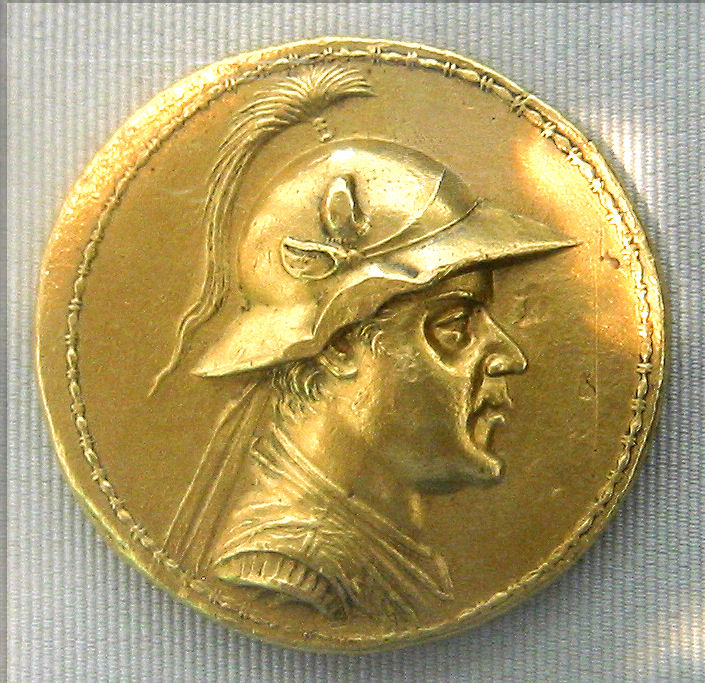
Eucratides, King of Bactria. Pic: Wikipedia
Bokhara was one of the major centres of Islamic scholarship in the early years of Islam. It and other cities of the Central Asian Silk Road played a full part in the explosion of knowledge acquisition that took place in the three centuries of the Abbasid caliphate – the so-called Golden Age of Islam. Samarkand was the capital of Timur the Lame – Shakespeare’s Tamarlane – the Mongol warlord who built mountains out of the skulls of those opposed him as he went about creating an empire stretching from India to Egypt.
And in the nineteenth century the khanates of Khiva, Bokhara and Khokand stood in the way of Russia’s ambition to extend its empire across Central Asia and ultimately to add India to its domains – a desire that underpinned the century-long competition between Russia and Britain known as The Great Game.
Why would someone whose life has been bound up first with the history of ancient Greece and Rome, and subsequently with that of the Middle East, Persia, Byzantium and China, with the history of Islam, Christianity and Judaism, and with the geopolitics of the last two centuries not want to visit Khiva, Samarkand and Bokhara?
But why now?
Though each successive layer of history provides its own powerful lure, it was actually the Great Game that has led me to this solemn resolution. Or more specifically, three books. The first, by the travel writer Colin Thubron, was Shadow of the Silk Road. Next was Foreign Devils on the Silk Road, by Peter Hopkirk. And most recently I read A Ride to Khiva – Travel and Adventures in Central Asia, by Frederick Gustavus Burnaby.
Hopkirk and Thubron are contemporary writers. Hopkirk, who died recently, was a distinguished journalist who wrote several books about Central Asia. In Foreign Devils he writes about the efforts of archaeologists and treasure hunters who, in the nineteenth and early twentieth century, flocked to the Taklamakan Desert in what is now Xinjiang province in western China. Many of their discoveries had lain under the sand for centuries, swallowed up by the advancing desert. What they retrieved – Buddhist frescos, parchments and figurines as well as various Christian, Zorastrian and Islamic artefacts – ended up in private collections and national museums, much to the subsequent disgust of the Chinese, who to this day resent the rape of their cultural heritage.
Thubron’s book is more of a conventional travelogue, but with the past never far away. He visits various cities along the old Silk Road and describes his experiences in countries where most of us would fear to tread as solo travellers – China, Afghanistan and Kurdish Turkey for example. He uses the glories of the Silk Road as the backdrop to the shabby state of many of the cities he visits.
Fred Burnaby is a very different proposition. The son of a English country parson, he was a captain in the Royal Horse Guards with an independent streak. In the 1875 he embarked on an epic voyage through Russia to Khiva, which two years earlier had been conquered by the Russians and turned into a vassal state. To do so he had to get letters of permission from various dignitaries in St Petersburg. Though he managed to obtain the paperwork, he was watched with suspicion throughout his journey. Various officials reported on his progress on a regular basis, and close to his journey’s end did their best to stymie him.
The reason Burnaby was able to make the journey was that British officers in those days were employed only for part of the year. He therefore had the chance to make the trip across the Asian steppes in his own time and at his own expense, but at probably the worst time of the year – winter – through thick snow and in temperatures of up minus 30C. What’s more, he didn’t have the benefit of maps once he left Orenburg, the last outpost of the Russian empire in the South East.
The result of his journey was A Ride to Khiva, a best-selling book full of adventure and derring-do, just the sort of thing the imperial-minded Victorians lapped up. Burnaby became a celebrated hero through his various adventures and ultimately by the manner of his death at the hands of followers of the Mahdi in Sudan. He was a big man in all respects. Six foot four and twenty stone, his strength was legendary. It needed to be on the journey to Khiva. Much of the way from Orenburg he relied on a horse-drawn sleigh or on the back of a series of small but hardy horses. He nearly lost his arms through frostbite and several times found himself lost in the middle of ferocious blizzards.
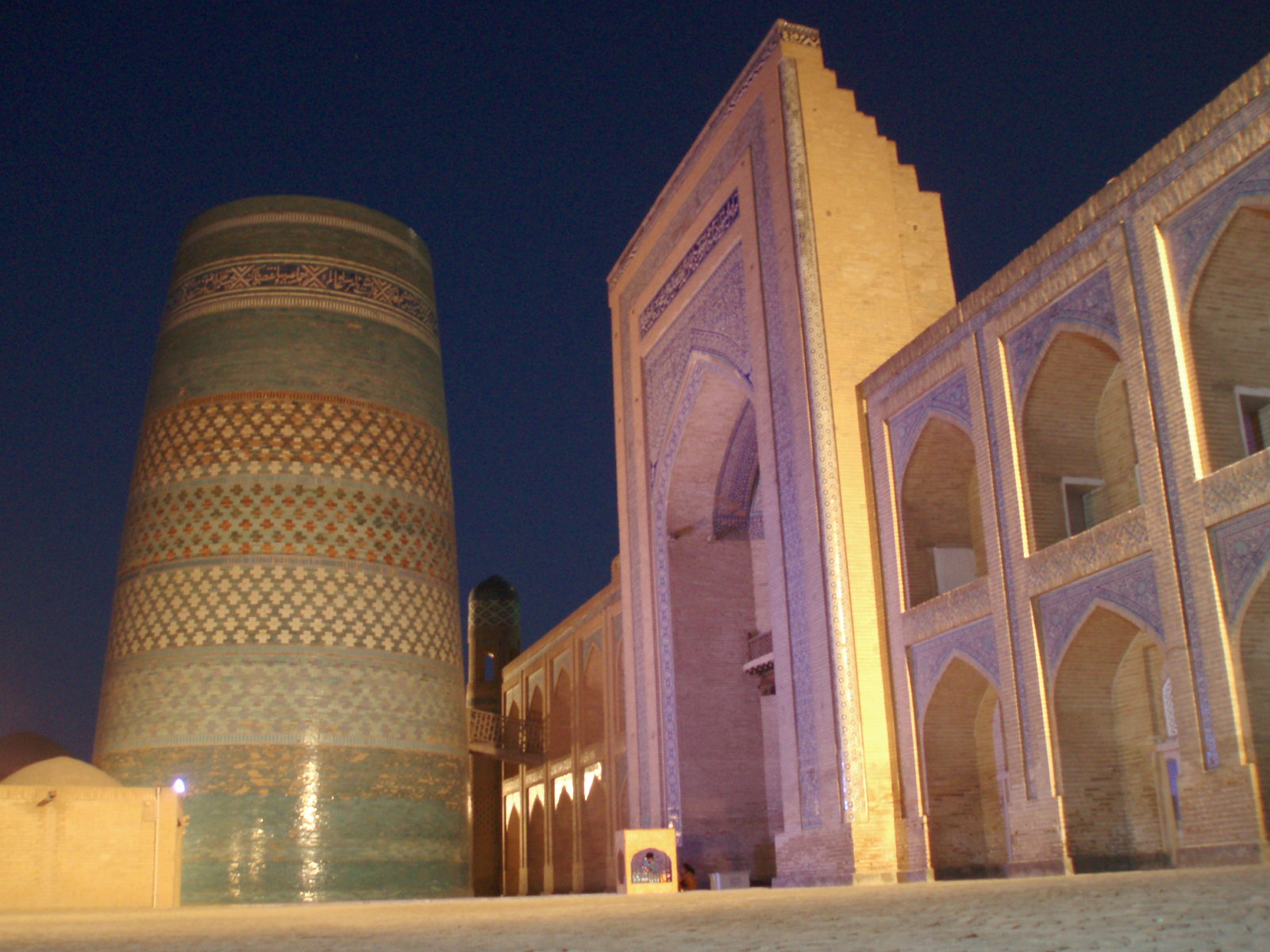
Khiva, Uzbekistan. Pic: Wikipedia
When he finally made it to Khiva, he had no idea what kind of reception he might get from the Khan. The Russians, ever keen to deter him, warned that the monarch had a nasty habit of gouging the eyes out of foreigners to whom he took a disliking. As it turned out, the Khan was a gracious host who was keen to interrogate Burnaby about the relative strengths of the British and Russian empires. The last and only previous English visitor to Khiva had been Captain James Abbott thirty years before. Abbott was an Indian Army officer whose mission was to obtain the release of a number of Russians whom a previous Khan had enslaved, thus removing from the Russians an excuse to invade, and thereby extend the boundaries of their empire ever closer to India. Abbott succeeded, and went on to be a noted Indian colonial administrator. The town of Abbottabad in Pakistan, where Osama bin Laden met his end, is named after him.
A Ride to Khiva is laced throughout with conversations with various Russians that might be interpreted as informal intelligence gathering. Not that his commanding officer was much impressed. When Burnaby got to Khiva the Duke of Cambridge ordered him to return to England forthwith.
Some of his conversations were highly prophetic. The Russian commanders at the time were nervous of Germany’s intentions. Newly unified under the leadership of Prussia, Germany had only five years before inflicted a national humiliation on France, besieging Paris and forcing the French to cede the territories of Alsace and Lorraine.
In one discussion on a train early in the journey, Burnaby talks to his fellow travellers about the various ambitions of the Great Powers:
The carriages between St Petersburg and Moscow are, if possible, more commodious than those which run from the capital to the German frontier. They are also well supplied with sleeping compartments, so the journey can be performed as comfortably as if travelling in a Cunard’s steamboat.
Upon taking my seat, two ladies, dressed in the deepest black, entered the carriage.and solicitied subscriptions from the different passengers for the wounded insurgents in Herzegovina.
“I suppose some of this money will go to the maintenance of the hale as well as the sick” observed a fellow-traveller. “Poor fellows, they want arms very badly.”
“I would give anything to drive out those Mussulmans,” remarked his companion, producing a well-filled purse, and making a large donation to the fund.
His example was followed by all the other Russians in the carriage. Not wishing to appear conspicuous by not subscribing, I added a trifle, my vis-a-vis saying: “Thank you brother. It will help keep the sore open; the sooner the Turk falls to pieces the better. What is the good of our having a fleet on the Black Sea unless we can command the Dardanelles? The longer this affair continues the more likely we are to reach Constantinople.”
“What will the English say to this?” I inquired. “Oh England, she goes for nothing now.” He replied. “She is so bent on money-making that it will take a great deal of kicking to make her fight. Why, she did not do anything when Gortschakoff repudiated the Black Sea Treaty.”
“He (Gortschakoff) chose just the right time for this,” added a fellow-traveller; “it was just after Sedan.”
“After Sedan or before Sedan”, continued the first speaker, “it would have been all the same; England is like an overfed bull, she has lost the use of her horns.”
“What of her fleet?” I inquired. “Well, what can she do with it?” was the answer. “She can block up the Baltic – but the frost does that for six months of the year, and she can prevent the corn from our Southern Provinces reaching her own markets; bread will be dearer in London, that is all. England will not land troops in the Crimea again.”
“God grant that she may,” said another, “our railway to Sevastopol is now open.”
I here remarked that England is not likely to declare war without having an ally. “But what if Germany or Austria were to join her?”
As for those pigs of Germans, we must fight them some day or other,” replied the previous speaker, and when the Tzarevitch is Emperor, please God we will beat them well, and drive every German brute out of Russia; they fatten on our land at the expense of our brothers.
“But supposing they get the best of it?”
“Well, what can they do? They cannot stop in Russia, even if they should be able to assail us. We can play the old game – keep on retiring. Russia is big, and there is plenty of country at our back”
All the rivalries that distilled into World War I in a nutshell.
Those last words were spoken sixty years after Napoleon’s invasion of Russia, and a similar distance in time before Hitler’s attempt. The Tzarevitch in question, who subsequently became Nicholas II, did indeed eventually fight, and lost his throne and head as the result, something those cocksure travellers wouldn’t have anticipated.
Political discussions apart – and I wonder how much of the lily Burnaby was gilding for his domestic audience – the narrative rattles along at a fine pace. As he presses on towards Khiva he describes a world in which the accumulated knowledge of travellers along the Silk Road has shrivelled into handed-down heresay. Rather like the Arabian heartland before the coming of oil that Abdurrahman Al-Munif describes in his Cities of Salt trilogy.
To make the reading easier for his audience, Burnaby provides a little summary of the main points of the narrative at the beginning of each chapter. Here’s one of them that gives a flavour of the story:
The Turkoman on his Donkey – Jana Darya – A once Fertile Country – A barren waste – The grandfather of the Khan – English Horses and Kirghiz Horses – Russian Cavalry – A Sea Like Molten Gold – Isles as of Silver – Kamastakak – A Fresh Water Pond – A Return to Vegetation – Saigak – Pheasants – The Camel Driver is taken Ill – The Moullahs – Conjuring the Evil One – A Dog of an Unbeliever – The Guide’s Fight with a Khivan – A revolver is sometimes a Peace-maker – Khivan methods of Preserving Grass throughout the Winter – Deep Chasms – Tombs – The Vision of the Khirghiz – The Khazan-Tor Mountains – Auriferous nature of the Soil.
One can imagine Burnaby holding forth back in the salons of London society in front of a rapt audience of society ladies as they tinkled their teacups in excitement at the savagery of the natives in a far-away country. When he wasn’t describing his feat in becoming the first person to cross the English Channel in a hot-air balloon, of course.
Such was his celebrity that in my home town of Birmingham, where he unsuccessfully stood for Parliament against one of the great political luminaries of the time, Joseph Chamberlain, the corporation erected in the cathedral churchyard an obelisk in his honour. I must have passed it by a hundred times when I was young without knowing the significance of “Burnaby” and “Khiva 1875” inscribed at its base.
So Burnaby has finally convinced me. Reading books is not enough. I will go to Khiva, and if possible I will follow his path from Orenberg, though not in the winter and not on horseback – I don’t have his strength and resilience. And I will visit places he didn’t see: Samarkand and Bokhara. Burnaby will just be a waypoint into the past. Beyond him, I will be looking for Abbot, for Tamerlane, for Genghis Khan, for the Umayyad Caliphs, for Alexander the Great, for the Buddha.
Not this year, but hopefully next. And certainly not much later than that. Because later becomes less of a certainty the older you get. And who knows what will become of the mosques, the ornate tiles, the mudbrick palaces and the freedom to visit them in the age of the new caliphate?

Last weekend a friend asked me to name one Muslim hero – historical or current – who is held in the same universal esteem as the likes of Ghandi and Mandela. It was a casual question tossed out on the sidelines of a music event in a local park.
Yet it had a serious undertone. My friend is one of the few people I know with as great a love of history as my own. His field of study is different from mine, but his interest in the past is no less intense.
I came up with two names, neither of which seemed to satisfy him: Saladin and Ibn Sina. Saladin not so much because of his achievements as a warlord, but because of one heroic act: resisting the temptation to repeat the massacre in Jerusalem that accompanied the city’s capture by the Franks in the First Crusade. Not a great example perhaps, but at the time he won respect among friend and foe for his sense of honour and chivalry in a brutal age.
Ibn Sina was an easier and less controversial choice. A product of the Golden age of Islam, respected in East and West for his contribution to the advance of medical science.
I suspect that the debate my friend really wanted was over the common perception in the West – fuelled by the atrocities of ISIS – that Islam is a religion in which violence is a core component. I wasn’t prepared to have that discussion, so I said something along the lines of “it’s complicated”, and that perhaps we should talk again after he had read Tom Holland’s In the Shadow of the Sword, and Stephen O’Shea’s Sea of Faith, two books that cast more light and shade on the subject than the “Islam equals violence” narrative normally allows.
I have my views on the subject, which I’ll get into later.
But first, the question about Muslim heroes deserves further exploration. Do we mean heroes who happen to be Muslim, or those whose heroism is inextricably associated with their faith? And what do we mean by hero anyway?
Ghandi and Mandela are viewed by the world as heroic partly because of their personal qualities, which may or may not have been rooted in religious faith. In Ghandi’s case you could argue that his creed of non-violence came as much from India’s cultural DNA as from his Hindu faith. Recently I posted a review of Cultural DNA – the Psychology of Globalisation by Gurneck Bains, in which the author suggests that the abhorrence of violence is a deep-seated trait that goes back to the earliest human settlement of the Indian subcontinent.
In Mandela’s case the Christian faith may have informed his views, yet in his politics he was resolutely secular, and rarely spoke about religion except in the context of his desire to build a South Africa that was blind to faith and race.
What of the heroes who wore their faith on their sleeves? There are plenty of martyrs to celebrate, yet their heroism is usually recognised only by fellow religionists. As for religious leaders, there are not so many renowned for reaching beyond their constituencies to those of other faiths. In recent times, Desmond Tutu, perhaps, but only because he used his authority as a religious leader to press for the social and political reforms that culminated in the end of apartheid.
Which leads me to Moeen Ali. For those of you who don’t follow cricket, Moeen is a member of the England team currently battling against Australia in the ultimate sporting grudge contest – The Ashes. His was one of the most influential performances in the match that ended on Saturday with an unexpected England victory.
That Moeen is a Muslim is instantly recognisable because of his beard. It’s the length of two fists, in the Islamic tradition, a highly visible symbol of his faith. He is not the only cricketer with such a beard. Hashim Amla of South Africa is similarly adorned. But Moeen is English, and the country of his birth is currently, post-Tunisia, wracked by fear of Islamist radicals bearing machetes, guns and suicide vests. On a Muslim male, the long beard and shaved upper lip is as potent a symbol of religious devotion in the eyes of non-believers as the niqab that covers the faces of many Muslim women.
Moeen has said that one of his reasons for growing the beard is to show that not all devout Muslims are the men of violence so feared in the West. There are many top-flight Muslim cricketers – those of the Pakistan national team for example – who do not go to such lengths to advertise their faith. But the Pakistani cricketers come from a country in which the vast majority are of same faith.
You could say that Moeen is brave to bear witness to his beliefs in such an uncompromising manner, to stand out from his peers, to be so obviously different from his teammates. I doubt if he would say that. He would probably take the view that he is what he is – to use the words of Martin Luther, “Here I stand, I can do no other”.
But here’s the thing. Watch Moeen in action. Are you watching a Muslim cricketer? No. You’re watching a man who loves what he does, and has an easy relationship with his team-mates. Right now, you’re also looking at a man who is observing the Ramadan fast, and yet you would never believe that no food or drink had passed his lips since dawn on the days when he caned Australia’s bowlers and teased out their batsmen. No mean achievement, and I speak from the experience of living in Muslim countries where many people are barely functioning by the time it comes to break their fast.
And watch how the fans take to him. It’s becoming a tradition at major cricketing encounters for spectators to dress up in as bizarre costumes as they can conceive – bananas, medieval knights, you name it. Some also pay tribute to the physical characteristics of their favourite cricketers. Silly moustaches, crazy hair and so forth. And lo and behold, a bunch of fans showed up on Saturday wearing Moeen beards.
It was at that point that I thought “here’s a guy who is making a difference”. He’s loved by fans not just because of his atypical appearance, but because he’s calm and modest, a benign figure whose style and behaviour is far from that of the bull-like gladiators you will see pawing the turf on both sides. He’s different not because he’s a Muslim, but because of who he is. His religious devotion makes him different, and yet he fits in with his fellow cricketers who clearly hold him in high regard.
It seems to me that he’s succeeding in acting as a role model who shows another way to those who are tempted to take the road to Syria. A role model who loves faith, loves his country and loves his cricket. And a role model who shows non-Muslims that not all believers from Birmingham, Bradford and Luton despise their country and everything those they call kufurs stand for. I have no idea how comfortably his core beliefs would sit with those who see an extremist behind every street corner, but I don’t really care, provided those beliefs do no harm to others.
So next time I see my friend, I will put forward Moeen Ali as a Muslim hero. Perhaps not yet of the stature of a Ghandi and a Mandela, but a hero nonetheless in his words and deeds. I will also cite Malala Yousefzai, shot by the Taliban for her advocacy of female education, as a Muslim heroine. If, rather than being acclaimed for a few exceptional acts, achieving the status of hero is rather like canonisation, an accolade awarded in recognition of a lifetime’s deeds, then perhaps it’s too early for Moeen, who is 27, and Malala, who turned 18 yesterday, to be so designated. Hopefully they have plenty of time to do much more with their lives. But what they’ve achieved thus far is good enough for me.
And finally to my friend’s implication that Islam is a religion of violence. Rubbish. People are violent, not religions. People were killing each other in Syria and Iraq with equal relish long before the birth of Islam. I don’t buy the argument that the presence of hadiths permitting the violence we see in those countries today proves the case against Islam. There are ten times, maybe a hundred times, more devoted Muslims who ignore those hadiths than believers who are guided by them. Moeen Ali by all accounts is among the former, as are many others whom I call friends.
Religions don’t kill. People do. Just as guns don’t kill, but people do. I repeat, people are violent. Most of us are capable of violence under certain circumstances. Christians, Jews, Muslims and Hindus are all capable of violence, not because of their faith but because they are people. Some will look to their scriptures to find justification for their acts. Others don’t bother to find any religious grounds for violence. Think of Buddhists who persecute the Rohingya, and the secular perpetrators of genocide in the twentieth century.
But although I have no argument with Islam, I do have a problem with Muslims and adherents of any other faith who fail to teach their children to think for themselves – to look at the world and come to their own conclusions rather than slavishly follow the dictates of others. Read this interview with Moeen Ali, and you will find that this is exactly what he did. He says that he was not particularly religious when he was growing up. He found his faith at the age of 18. And he found it on his own terms.
Perhaps what I should say next time I see my friend is that actually his question is irrelevant. The world doesn’t need heroes. It needs people of goodwill. People who demonstrate their goodwill in words and deeds. People like Moeen and Malala. And there are plenty more like them.
As this is the season of goodwill for all but a small minority in the Islamic world, I wish my cherished Muslim friends happiness and peace during the upcoming festival of Eid-al-Fitr.
As I keep tabs on the painful crawl towards an Iranian nuclear deal, I can’t help thinking back to the relative simplicity of the bipolar geopolitics of my youth compared with the Gordian complexity of allegiances, competing interests, ideologies and covert agendas currently in play, most of them centred on the Middle East.
Consider the state of the Soviet Union and China 40 years ago. The only area in which the USSR technically matched the West was in weapons. Nobody wanted to buy Ladas, leaking washing machines or ill-fitting suits. China was mainly an agrarian society. Its state-owned industries were antiquated – rusting and inefficient. Nobody wanted to buy Chinese goods. But they had nukes and the ability to deliver them. Both societies operated more or less in isolation from the West. Their GDPs were a small fraction of the world economy, which was dominated by the US, Japan and the major West European states.
Today Russia is fully integrated into the world economy. The reluctance of countries like Germany to impose sanctions as punishment for Russia’s adventure in Ukraine was a reflection of the reality that to re-impose isolation on Russia would hurt the Germans almost as much as it would hurt Russia.
China too is fully integrated. It is the world’s second largest economy – or possibly the largest, depending whose opinion you listen to. Many of the world’s iconic consumer electronics brands are reliant on China to produce components or in some cases the whole product.
Because both countries have much to lose from a return to isolation – as do we in the West – globalisation serves as much as a brake on open aggression as does the ultimate deterrent – nuclear weapons.
It’s no coincidence that the two must isolated countries in the today’s world – North Korea and Iran, are considered the most dangerous. Why? Because cornered regimes, like animals, do desperate and sometimes unpredictable things. The sanctions formula includes the calculation that if you deliberately impoverish a nation, its people will eventually rise up and get rid of the government whose policies led to the measures in the first place.
That hasn’t worked in Iran, and nor has it in North Korea. Nor did it in Iraq. Nor did it in Rhodesia. Not much has changed in that respect since 1806, when Napoleon Bonaparte and his continental allies tried and failed to impose a blockade on Britain.
But sanctions can and do force regimes to the negotiating table. In the case of the current negotiations between the P5+1 (China, Russia, the US, France Britain and Germany) and Iran the main issue on the table is Iran’s capability of developing nuclear weapons. For Iran it’s the lifting of the sanctions that are crippling its economy and impoverishing its people.
The stated objective of the P5+1 – a grouping that 100 years ago would have been referred to as the Great Powers – is non-proliferation. From the point of view of the Western contingent within the P5+1, it’s bad enough that one dangerously unpredictable nation, North Korea, has the bomb, and that Pakistan, a country that has at various times over the past decade teetered on the edge of becoming a failed state, has many bombs. Iran is more predictable than both. Ayatollah Khamenei is not Kim Jong Un, and Iran has a far greater handle on its state apparatus than Pakistan.
But Iran’s activities in its back yard – Lebanon, Syria, Iraq and Yemen – which it sees as defensive, but which its local rivals consider part of a bid to achieve regional supremacy, are the reason why the P5+1 are anxious to do a deal. The alternative, they fear, would be countries such as Saudi Arabia and Egypt acquiring their own nuclear weapons capabilities.
Ultimately even that scenario might be tolerable were it not for the presence of virulent non-state actors in the region. Actors who would be only too happy to turn the nightmare scenario enacted in so many Hollywood movies into reality. One only has to look back at the chaos caused when the planes flew into New York on 9/11 and destroyed a few buildings to imagine the consequences of a nuclear detonation in the same city. Or in London, Frankfurt, Washington, Riyadh or Tel Aviv.
Those movies usually end with the plot being foiled at the last moment, or with the victim nation vowing to rebuild. If an American city was wiped out, it’s conceivable that the resulting wave of paranoia would trigger a set of measures that would make the Patriot Act seem like the work of Amnesty International. Finger-pointing at new axes of evil, enhanced surveillance beyond that seen today in China, trade barriers, the demand for self-sufficiency, immigration clampdowns, the marginalisation of minorities seen as un-American – all scenarios more likely than the redemption narrative in which weepy world leaders vow to work together to ensure that such an event never happens again.
Would ISIS, or some other organisation as yet unknown but with similar aims, be prepared to wipe out a city if the ensuing chaos weakened the globalised economy and created a power vacuum that brought its dreams of a sustainable caliphate dramatically closer? I suspect we all know the answer to that one.
Where would they obtain such a device? A.Q. Khan could probably answer that one. Pakistan’s peddler-in-chief of his country’s nuclear technology was not fussed who he dealt with. Even an impoverished pariah like North Korea had the wherewithal to buy what he was selling. ISIS are probably wealthier than Kim Jong Un’s cabal, so money would not be a problem. They would not even have to own or see the weapon. All they would have to do would be to contract out the job.
A Middle East with nukes in half a dozen national arsenals would be a dangerous place indeed. If a bunch of hard-core jihadists hiding out in camps and caves in the mountains of Afghanistan were destructive enough to embroil the US in a decade of draining conflict in Kabul, Kandahar, Baghdad and Fallujah, how much more threatening would be a nuclear-enabled Islamic State? It would be one more waypoint on a road to disaster.
This is not to say that Kerry, Zarif, Lavrov and the other negotiators in Vienna would be able to erect permanent barriers on that road whose ending lies just out of sight, but not far away. Even if an agreement makes it more difficult for Iran to weaponise its enriched uranium, or prolongs the amount of time it needs to do so, it will take many more agreements to neutralise the underlying cold war – and yes, it is a cold war, but it’s getting warmer all the time – that led to the sanctions in the first place.
Without a rapprochement between the players in the Middle East’s cold war – Iran, Israel, Saudi Arabia and its local allies – there will always be forces that will seek to exploit the divisions, whether or not the current bogeyman, ISIS, is defeated. And without that rapprochement those who feel most threatened will do what they believe is necessary to protect themselves in the long run. To reach a comprehensive settlement that sticks would seem to be an impossible ambition, at least without a road map that all parties could sign up to. But in a following wind created by a nuclear deal, their might never be a better opportunity to try.
So the discussions in Vienna should be the beginning, not the end, of a long road. And if the negotiating parties are unable even to take the first steps down that path, there’s another road with a mushroom cloud just beyond the brow that will keep getting shorter.
So yes, things are more complicated today. Probably more complicated than Nixon, Kissinger, Brezhnev and Mao Tse Tung could possibly have imagined all those years ago. More complicated and more dangerous. Which is why we should all hope that the initiative in Vienna ends in smiles and handshakes.
Otherwise, sooner or later, we might all be joining the Greeks as they face the prospect of surviving on vegetables and goats in their back yards.
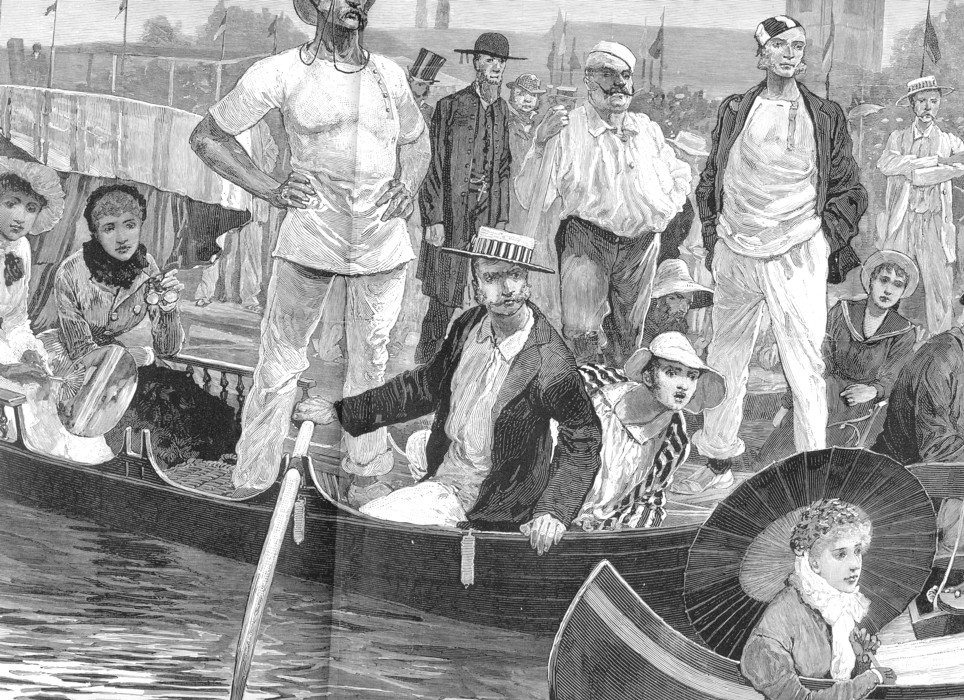
Henley Regatta 1882 (Illustrated London News)
Here in England we’re smack bang in the middle of The Season. I should say Britain, because the Scots get involved too. But they don’t want much to do with us soft Southerners these days, so let’s stick with the English Season. It sounds more authentic anyway, as in English Roses, and “This blessed plot, this earth, this realm, this England”.
Early in June, when the sun finally gets to be more than a fleeting visitor, the decadent upper classes and all those who aspire to share their decadence dust off their summer glad-rags and head for a plethora of events where they might see and be seen. And behave disgracefully often as not.
At many of these events there’s the possibility of spotting Her Majesty the Queen. The Epsom Derby for example, or Royal Ascot. From a distance of course, unless you happen to have wangled a ticket to an exclusive enclosure where only the posh, or those with lots of money, may enter. There you might also see Kate Moss and any number of other celebrities and minor royals who don’t look quite as good as they do in the air-brushed renderings you will find in the newspapers and social media.
The list of attractions is so long that you may wonder how any of the serial attendees manage to do any work for the eight weeks through to the end of July, when the exhausted tribe stagger off to their holidays in the Dordogne, Barbados or their little cottages in Cornwall – or all of them in succession.
In addition to the horsey set-pieces, there’s the Chelsea Flower Show, the home of bizarre floral tableaux and extravagant model gardens, Wimbledon, where Andy Murray is currently making his annual contribution to national sales of incontinence pads, and the Lords Test Match, where the monarch traditionally meets the teams on the Saturday of the match in front of the snoozing members of the Marylebone Cricket Club. Sadly, Queen Elizabeth is not a young as she was, so such sightings are becoming rarer. The same goes for other royals of her generation, although Prince Michael of Kent, looking more than ever like an ageing Russian Tsar and a bit doddery on his feet, was seen handing the trophy to Lewis Hamilton after the British Grand Prix last Saturday.
The time was when distant observers, if they weren’t watching on TV, would only get to see the great and the good – and the wannabees – on the pages of the national newspapers. These days anyone with a selfie stick can win instant fame – well OK, maybe a couple of likes on Facebook – as they pose seductively in their garish outfits while being unintentionally photobombed by the Duke of Edinburgh.
For a sizeable number of those who go to these events the sport is irrelevant. It’s all about who’s there, how they look and how you look. And how much champagne and Pimms you can drink without falling flat on your face, or being caught in a compromising position with a total stranger.
Most of the events have been set in stone for a century or more, though there is a relatively new addition to the social calendar: Glastonbury, or Glasto as it’s known to aficionados. This giant music fest is a great opportunity for the rich, the famous and the exalted to pretend they’re just like the rest of us. Like everyone else, they get wet. They can get drunk, out of their brains on horse tranquilliser, fornicate and stagger around in their elegant floral wellies completely unnoticed, because everyone else is doing the same. The one thing they can’t do is fall over in a stupor, because vultures with iPhones will be lying in wait, hoping to sell the picture to The Sun, as happened to poor Lily Allen a couple of weeks ago.
As with all the other gigs, the key attraction is the existence of a sanctum sanctorum. In Glasto’s case it’s the backstage area. This is where the celebrity count is highest, and at a music event you get to rub shoulders with the people everyone’s supposedly there to see and hear. Unlike Royal Ascot, where the denizens of the Royal enclosure wouldn’t be seen dead socialising with someone as low down the social scale as a jockey – unless of course they could get a reliable tip from one.
Of all these dates in the social calendar there’s one that in my book stands out for pure silliness. That’s the Henley Royal Regatta, which is taking place as I write. This is where once a year grown men decide that they want to look like schoolboys. Take a look at Angus Wilson of AC/DC and you’ll get the picture. Well not quite – even the cream of our high society baulk at wearing shorts with their stripy jackets and school caps.
The idea of Henley is that lots of rowers get together and race their boats of varying sizes down a leafy stretch of the river Thames. But the real action takes place on the river bank, where marquees and enclosures host tribes of paunchy former oarsmen dressed in the colours of their ivy-encrusted private schools. Those who didn’t attend Eton, Harrow and their ilk most likely hire the gear from their local fancy dress shops.
The women parade in their flowery garb and big hats. The ones who can afford it buy new outfits for every event. Those who can’t rack up huge dry cleaning bills and hope they won’t encounter anyone they met at Royal Ascot. No such problem for the guys, who just exhume their moth-eaten blazers and caps from the ancestral burial ground in the cupboard.
Henley, like all the other events, is big on corporate hospitality. For a king’s ransom you can spend your company’s hard-earned marketing budget entertaining ungrateful clients. There are several marquees where this happens. Quite often the occupants never leave the tent. They spend the entire day eating and drinking before being taxied away in various states of dishevelment.
A mate of mine has much to thank Henley for, because it was after one such corporate day that he finally decided to risk his hard-earned savings by going into business.
Richard’s company had invited a party of clients – middle managers from very respectable banks and insurance companies – to join them in one of the corporate tents. His job was to make the clients feel welcome, engage in witty conversation and make sure that he was less intoxicated than they were. As he tells it, the witty bit was tough – actuaries are not generally known for their sense of humour. But as he isn’t a big drinker, staying on the right side of sobriety was no big deal.
What led him to his Damascene moment was the behaviour of the husband and wife who owned the business. The husband, aside from the odd foray on to the river bank, spent most of his time in the tent getting progressively and embarrassingly drunk. He managed to stay upright for lunch, but by afternoon tea – scones, strawberries and all that quintessentially English stuff – he was gone. It was a long time ago, and Richard can’t recall whether the the clotted cream and strawberry jam afforded his boss a soft landing when the great man’s face hit the table. But there he lay, head resting gently on the crisp white tablecloth, moaning and muttering, for the rest of the afternoon.
His wife, on the other hand, whose liver was clearly more resilient than that of her husband, cast the occasional scornful look at him, and flounced off to watch the muscular young rowers as they heaved their way down the river, dragging a couple of the female clients with her. She was not seen again until the cavalcade started on its uncertain way towards the car park.
Meanwhile Richard had the unenviable task of entertaining those of the clients who remained at the table, trying desperately to divert their attention from the train wreck slumped opposite them.
When he got home he thought back on the day, and made his decision. As soon as possible he would leave the company and set up on his own. or with a partner as it turned out. He figured that if you can run a business and still make a profit despite making a total ass of yourself in front of your key clients, how much more can you achieve if you keep your nose clean? Of course that wasn’t the only consideration, but that day at Henley was the tipping point. After all, how can you give your all to a small company if you’ve lost all respect for its leaders?
This might make my friend seem a bit of a prig. But, as he says, it wasn’t just a matter of his respect for them, but of their respect for their clients.
Anyway, it all turned out well in the end. The owners ended up selling their business and retiring to some sun-kissed hacienda. Richard left them, set up a business and did OK as well. So, he recalls, “in a strange kind of way I suppose I should thank them for showing me what not to do, and motivating me to try and do better.”
Which is why, as thousands drink, snort and vomit their way through the glorious summer season, I can’t look at the selfies and the sneaky shots of personal devastation without thinking of my buddy and his epic day at Henley.
Cave Painting in Lascaux, France
There’s a lot of money to be made from culture. I don’t mean the sort you indulge in when you go to the opera, or sample when you wander through a Brazilian favela, dodging drug gangs and pickpockets. I’m talking here about business.
If there’s one thing that obsesses corporate leaders more than anything apart from the little black number at the bottom of the profit and loss account – and their share of it – it’s the culture of their organisations. And the bigger they are the more they obsess, because the less they can control their people’s behaviour and attitudes, especially when the little single-country acorns turn into mighty multinational oaks.
Once upon a time I was a principal in a company that provided IT services in the UK. Two of us founded the company in the early nineties. From the off we grew our revenues at an average rate of 30% per annum. We had the advantage of starting up at a time when our competitors were suffering from one of those recessions that rear up from time to time. Most of them had big overheads, nice offices, lots of people. We had few people, grotty offices and lots of energy. As the opposition floundered, we prospered.
We thought of ourselves as small furry animals destined to rule the world while the dinosaurs were sinking into the mud. As it turned out we didn’t end up ruling the world, but we did OK. By the late nineties we had a hundred-odd employees, and turnover kept growing. Then we got into outsourcing. Within a couple of years we took over some specialised functions from several large IT and telecoms companies, and our staffing grew to around two hundred and fifty.
From being a small outfit based in a satellite town outside London, we had become something quite a bit larger. At various times we had offices in Dublin, Manchester, Edinburgh, Helsinki, Stuttgart, Grenoble, Budapest, Kuala Lumpur, Beijing and four locations in the US.
From then on, things got complicated, and I won’t bore you with the details. The reason for this little tale was that the furry animal had morphed into something quite different. Not so agile and much more difficult to manage. Not only did we have to come to terms with different ways of thinking and behaving in each location, but in many cases we inherited the mind-sets of the outsourcing organisations in the people whose employment we took over.
You might think that our main problem was coming to terms with the way the French, the Finns and the Malaysians think and do business, but it was more complex than that. Consider this little vignette.
The people whose employment we took over in Manchester had worked for thirty years or more with a British IT company. It makes me laugh to think that we considered them to be somewhat elderly, given that I’m now older than all of them were at the time. Several were approaching retirement. Some had health problems and their energy levels left much to be desired.
There was a close-knit group of six or seven who chose to sit together in one particular area of the smart new office we set up for them. We called them the back row, ostensibly because they arranged their desks in a row by the back wall, but in reality because they felt like the last line of resistance. If you were to visit the office at lunchtime, you might have caught a glimpse of them having a little snooze at their desks. This in a business that saw itself as young, progressive and dynamic. Not exactly the impression we wanted to make on visitors. Worse still, if the phone rang at lunchtime, nobody answered it. Why? Because it was lunchtime.
What also complicated matters – and I use that word with care because I don’t want to send the wrong message – was that the thirty-odd staff we had taken over belonged to a trade union. So any changes we wanted to make had to be negotiated not only with the staff but with their union.
Eventually, some of the older ones retired, the outsourced group got smaller, the business changed and new people came in. But I felt that the office never fully rid itself of the institutionalised ethos that the original team brought with them. Whose fault was that? Ours of course. We were the leaders of the business. Our decisions made the difference, or didn’t.
Which goes to show that culture – of the corporate variety – isn’t just about Gallic obstreperousness, Finnish dourness or Irish charm. It can be about North versus South, about old and young, about workers and management. It can be tribal. It can be a matter of Liverpool versus Manchester United. And it’s not changed by a bunch of enthusiastic managers swooping down from head office and spouting about values, missions and messages. Or by diktat, memos and intranets. Replicate the idiosyncrasies in just one part of a business across multiple locations, and you get some idea of the challenge.
Culture has always fascinated me. I’ve written one or two pieces on the subject in this blog. My main thrust has usually been that organisations spend huge amounts of money on what they call culture change. Often the driver is a new owner looking to integrate a business into something larger. Then there are chief executives looking to make a name for themselves, or more often trying to find ways of boosting the value of their share options before cashing in and moving on.
Culture change is often an emergency project. A new competitor emerges with a product that threatens to put you out of business. A recession forces you out of your complacency. It can also be led by technology – the internet and all its implications being the prime example over the past two decades. And when you sense an emergency you spend what it takes to turn things around.
To avoid the emergencies, the gurus tell you that your business should be constantly changing. So you set up change management teams, with visions, coalitions, champions and evangelists. But because you don’t have the resources to do some of this in-house, you hire expensive consultants, whose proposition is based on fear. Fear of competitors, fear of being left behind, fear for the future, fear for the share price, fear for your job.
You might conclude from all this that I’m a bit of a cynic about what companies think of as their cultures. Not so. I’m certainly cynical about the motivation behind the so-called cultural changes organisations seek to make, and about the ham-fisted methods they use to implement them. But I’m absolutely convinced that the only way for an organisation can succeed over the long term is if it has leaders who have a good understanding of the patchwork of cultural influences that make up their staff, stakeholders and customers.
Notice I didn’t say “corporate culture”, because I believe that in any organisation larger than a small group of people there is no such thing. The secret is to channel the sub-cultures in the direction in which you want to go. And that’s no simple matter, especially when you’re running an organisation with many locations and a diverse, multi-skilled and multi-ethnic workforce.
I also said “over the long term”. You can achieve much in a short period by focusing on motivations shared across all cultures. Greed perhaps. The excitement of innovation for sure. A sense of belonging inspired by religion, politics or social concern. A common purpose that everyone can buy into. But the bigger the organisation, the easier it is for the commonalities to erode. And over time they can disappear altogether. Which is often the point at which an organisation launches a “transformation programme”.
Psychology has always played a part in corporate change programmes. Consultancies wheel in tools developed by psychologists to determine attitudes, capabilities and potential of employees. Assessment programmes, succession plans, compensation and benefit schemes all have their foundations in what makes people tick, what fires them up and what turns them off.
Thirty years ago, the Dutch psychologist Geert Hofstede carried out a huge multinational survey on behalf of his employer, IBM. The result was a series of cultural dimensions that he turned into a framework for communications across those cultures. For each of the countries and regions he surveyed, he mapped his subjects on a scale across each dimension. For example, to what extent does a culture value equality in the workforce? To what extent are the powerful remote from those on whom they exert power? How do people deal with uncertainty? Which cultures are more male dominated than others?
Hofstede’s work answers a lot of questions about mindsets in different areas, including the Middle East, where I have a fair amount of work experience. In that region it accurately reflects the importance of the family, patriarchal attitudes among business and political leaders, and the comfort people derive from lack of ambiguity in their personal and working lives.
But where do those attitudes come from? I’ve just finished a book whose author goes further than Hofstede.
Gurnek Bains is the CEO of a corporate psychology consultancy, Young Samuel Chambers. I came across his latest book, Cultural DNA, the Psychology of Globalisation, in an unusual way. A friend from Holland with whom I have worked in the Middle East asked me if I knew about the book. I hadn’t, but it turns out that Bains quotes a couple of passages from this blog. I was a bit surprised, because I would have expected him to have told me that he was using my stuff. Not that I was bothered – in fact I was quite flattered.
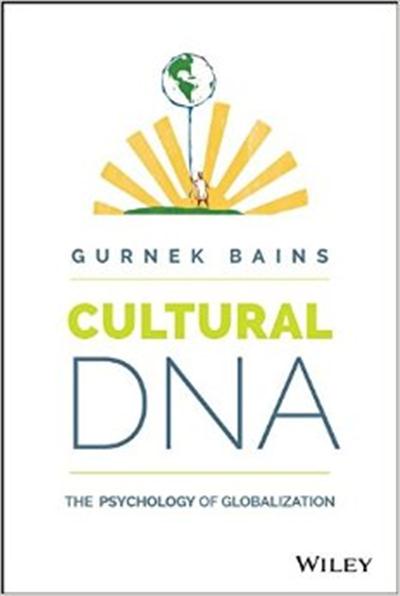
So I bought the book out of curiosity and, I have to say, a little vanity. It turns out that the bit of my work he quoted was from a piece I wrote about culture change: Middle East Organisations – The Vain Pursuit of Culture.
I once had reason to talk to a number of British private schools on behalf of a Saudi client who wanted to “bring Eton to the Middle East” – or some similar institution. So I talked to a number of schools, and was struck by a remark by one headmaster, who said that he would only be interested in setting up a foreign branch of his school of he could be sure that it would be infused with the DNA of the parent institution. Since that was his condition, he was fortunate that the conversation never went any further, because he would have been disappointed. Cultural DNA provides some of the reasons why.
Bains goes beyond Hofstede and others in the field by attempting to link the cultural dimensions of eight regions to the DNA mix of the populations. For each region – North America, Sub-Saharan Africa, India, the Middle East, China, Europe, South America and Australia – he tells the story of how these regions were originally populated, using evidence based on the DNA of the current inhabitants.
He then describes some of the factors behind the successive waves of migration, and the environmental conditions that the migrants had to deal with that subsequently shaped their outlook and behaviour.
Take the USA. After tracing the origins of the original settlers – now referred to as native Americans – he looks at the migrants who displaced and marginalised them. He explains differences between the northern and southern states as originating in the waves of arrivals in the 17th century – first Puritans and Quakers escaping religious persecution in England, and then what he calls “distressed cavaliers” – refugees from the losing side in the English Civil War. To complete the mix there was a large influx of Catholics from Northern Ireland and clannish families from the English-Scottish borders.
The Puritans and Quakers were devout, disciplined and imbued with a determination that in their new world no government would dictate their religious belief. They tended to settle in the North, in states like Pennsylvania. The distressed cavaliers reflected the hierarchical character of pre-Civil War England. They were accustomed to living off the land by the efforts of others, and so quickly embraced the opportunities that slavery presented. They were joined by the settlers from Ulster and the borderers, a wild, stubborn and individualistic people who populated the Appalachians and the Carolinas.
It’s not hard to trace early American stereotypes back to these migrations. God-fearing farming communities in the North, illicit moonshine distillers in West Virginia and Kentucky and elegant plantation owners in the deep South. And thus, it seems, began the North-South divide.
All pretty broad brush stuff, but he then uses recent genetic research to suggest that America’s most obvious characteristic, relentless positivity, stems not only from the qualities required to go to a new world and create something that was not there before – the pioneer spirit if you like – but from a genetic predisposition towards optimism and risk-taking. In other words, your pioneer spirit is embedded in your genes.
Bains then uses evidence from his own work and that of other experts like Hofstede and Fons Trompenaars to determine pronounced traits that have a bearing on society, business practice and leadership.
In the case of the US, morality, pragmatism, materialism, plurality and the ability to embrace change are the dominant themes. There is also the expectation that new migrants assimilate – plunge into the melting pot and accept the “American Way” – rather have their differences accommodated. The very opposite to the multicultural communities that have arisen out of recent immigration to western Europe, and most notably the United Kingdom.
Although he sees the assimilation culture as a strength, he points out some downsides when America embarks on adventures abroad:
“However, as America plays out its global role in a context where other powers are emerging, there is plenty of room for missteps and error if your predominant orientation is assimilation rather than accommodation. This is demonstrated in the sheer surprise Americans show when others are not open to American values in the way they normally expect. The expectation that vast proportions of the Iraqi population would enthusiastically embrace Western values after the overthrow of Saddam Hussain is an example. One of the most successful global colonialists of all time, the British, recognised this and trod a fine line between preserving British traditions and values versus adapting and working with local rulers. Americans need to appreciate that they cannot simply export their values with the same ease with which they set up Coca-Cola plants or factories for building iPhones.”
What he doesn’t say is that Britain’s approach evolved after the hard lesson of the Indian Mutiny in 1857. Perhaps the chastening experiences of Iraq and Afghanistan will do the same for the USA.
Bains identifies American business strengths as willingness to improve, embrace change and take action. Weaknesses include a lack of self-awareness among leaders and an almost cult-like cultural emphasis among big companies such as GE, Proctor and Gamble and Coca Cola. Echoing his earlier observation about Iraq, he provides another example of “the need to hold a clear schema and to socialise people into that worldview”:
“Many outsiders who engage with America commonly encounter a precise script and routine one is expected to follow – across a myriad of areas. Processes like checking into a hotel, ordering a drink in a bar, boarding a flight, or just about every other day-to-day activity involves dealing with people who engage you in a friendly but scripted and semi-robotic manner. If what you say and how you say it is not in line with expectations, then you’re likely to face incomprehension and a sense that you have completely failed to get through. One female executive explained to me how she had to repeat her request for a gin and tonic four times before finally finding an intonation that allowed her to be understood. One might think that this is natural when speaking a language with a different accent. However I have rarely heard Americans in England complain of a difficulty in getting through, whereas by contrast virtually everyone from Britain experiences this problem in America.”
The last statement is a bit sweeping, perhaps, but he makes a good point about the formulaic “have a nice day” customer service culture that unfortunately seems to have spread across the world over the past couple of decades. Added to that, a startling degree of ignorance about the world beyond. One of my more enjoyable encounters in America came when a shop assistant in North Carolina asked me in which part of England Paris was located.
For each region he analyses, Bains uses a similar format in analysing the link between migration, genetic selection and the “founding culture” – reflecting the response of the first migrants to the environmental conditions they encountered – and what he calls the psychological DNA of the present populations: social, business and political traits and mindsets. At the end of each chapter he summarises what the region has to offer the rest of the world as well as aspects of their culture that hold them back.
In sub-Saharan Africa he celebrates exuberance, intellectual flexibility and creativity as strengths, while warning about the future consequences of inter-group rivalry, poor governance and lack of long-term thinking. Another factor holding the region back is the presence of dangerous pathogens. The recent Ebola outbreak in West Africa is a good example of disease derailing hard-won social and economic progress.
Another factor is huge ethnic diversity, even within a single country. As Bains points out:
“The Congo, for example, which is the size of Western Europe, has close to 250 ethnic groups and languages among its 80 million people. Nigeria has over 500 living languages within its borders. Many of the political and economic difficulties facing Africa stem, in part, from the imposition of artificial national structures on countries embodying extremely high levels of genetic and cultural diversity.”
The legacy of the demon colonisers of course, of which Britain was the demon-in-chief.
India’s distinctive qualities include an abhorrence of aggression, a high level of self-reflection – internalised thinking free of the outside environment that has given rise to exceptional mathematical abilities among the population. Also an appreciation of the importance of personal development, tolerance of diversity and a high level of individualism. And intuition. Bains quotes Steve Jobs thus:
“The people in the Indian countryside don’t use their intellect like we do, they use their intuition instead and their intuition is far more developed than in the rest of the world. Intuition is a very powerful thing, more powerful than intellect in my view.”
Among the factors that hold India back, he believes, are horizontal stratification – the caste system – and horrendous bureaucracy. Yet thanks to what he describes as the the country’s open and vociferous democratic culture, he believes that some of those social obstacles to economic progress are slowly but surely being cleared away. I’m not sure the women of India would entirely agree, but time will tell.
Looking at the Middle East, Bains zeros in on two parallel aspects of the culture: the challenge of desert living, and commercial instinct of those who settled on the seaboards. To survive in the desert you need to stick together and abide by strict rules of behaviour. Individual initiatives – like wandering off on your own accord – can literally be fatal. Thus in the Arabian peninsula itinerant tribes developed rules relating to property (mainly women and livestock!) and social structure long before the coming of Islam led to the codification of behaviour down to the smallest detail.
As I and many others with experience of the region know, the people of the Middle East are great traders and deal makers. That skill started with the Sumerian civilisation of Mesopotamia and that of Dilmun, in present-day Bahrain, which had strong trading links with the Indus Valley civilisation in Gujarat. A prime example of that tradition is Dubai, which, for all of its glitz and bling, derives much of its prosperity from its trading relationships with the rest of the world.
It’s that commercial flair that the author identifies as one of the Middle East’s primary strengths, along with its profound respect for knowledge. No period in its history better illustrates the passion for learning than the so-called Golden Age of Islam, one of the greatest ages of technological innovation, adaptation of ideas and systematic preservation of knowledge. He puts the eclipse of that era down to challenges to the supremacy of the Islamic empires from the West, starting with the Crusades, and the East, in the form of the Mongols. It’s difficult to be expansive and confident if your lands are riven by conflict and your deep-rooted societal norms are challenged and eroded by aggressive invaders, be they cultural or military.
Bains also writes at some length about about honour and modesty in the region – the avoidance of shame that can attach itself through the actions of an individual to the family and the tribe. Also what he describes as concentric circles of belonging – the importance of relationships that foreigners don’t always recognise. In the minds of many, tribe and religion trump the nation state and loyalty to commercial organisations. Hence the longstanding chafing – currently exploited by ISIS – at the artificial boundaries created by Sykes and Picot a hundred years ago, and the difficulties foreign businesses face in trying to bind their workforces into a common purpose when they don’t understand the forces that work against those efforts.
Moving to China, the book focuses on the concept of Zhong Yang – the virtues of harmony and interdependence – that leads the Chinese to seek the middle way, and view fairness as more important than the letter of a contract. Something that politicians and business leaders who deal with China find somewhat challenging, to say the least.
The Chinese also have a strong respect for authority, which Bains suggests is partly genetic. A specific gene most commonly associated with migration is virtually absent in mainland China (as well as Japan). Is this because most of the Chinese who have the gene have already emigrated from the mainland to join their ethnic communities in other parts of the world – not least the UK and the US? If so, it’s unlikely to be out of a desire to blend into the native populations, as the presence of Chinatowns in London, San Francisco and Toronto suggest.
The authoritarian streak is also evident in the high level of hierarchy and protocol in Chinese business and political dealings. Bains gives this fundamental reason:
“The central thrust of the Chinese character emanates from the distant past and from a strong sense of historical continuity has had literally over tens of thousands of years. The settled populations of China faced two pressures that were discussed earlier. One was that they were an incredibly driven, energetic and proactive people who cleared their initial environment with intensity and focus. As social structures were established, there was – and still is – a fear of this underlying intensity surfacing and becoming disruptive. Second, the settled societies existed under constant threat from attack by the aggressive, nomadic pastoralists that existed in relatively large numbers on the edges of settled society. Over the ages, the Chinese population made an implicit pact with their authorities: Keep us safe and we will accept the collective authority that is imposed on us. Historically, authoritarianism has always been an attractive proposition for people who feel under threat.”
In my view the same goes for Russia and the absolute monarchies of the Middle East. Though Bains points out that respect for authority in China breaks down if people perceive that the leaders are not treating them fairly, if he is right with his central premise it will take a lot of provocation for the current hierarchy in China to disintegrate.
Europe, my seemingly decadent and declining continent, gets relatively kind treatment.
Humans didn’t have things all their own way when they entered Europe. They had to compete with a large population of Neanderthals who had been there much longer. One theory about how modern humans ended up in ascendancy is that we had superior social skills. In any event, after five thousand years of overlap the last Neanderthal enclave died out.
We then had to deal with the Ice Age. Our Northern ancestors had to cope with conditions as extreme as those faced by their cousins in the Middle Eastern deserts, whereas those in the South had it easier. Hence perhaps the root of the difference between the easy-going Italians, Greeks and Spanish, and the more emotionally attenuated and resilient Germans, Dutch and Scandinavians. And our European masters thought they could integrate these tribes into a single economy? They should have looked at the DNA.
It’s no surprise that that we Europeans come out tops in terms of “equality, tolerance of individuality and a rigorous and systematic approach to thinking”. Unfortunately, as it seems to me, in some countries the first two qualities are wearing a bit thin. Most notably in France, the home of liberté, egalité et fraternité. Equality in some respect perhaps, but France has long been ruled by a political elite even more exclusive than the British Conservatives. And French business is as hierarchical as any in Europe.
France also leads the way in its intolerance of manifestations of multi-culture – for example the veil. Its concerns over its Muslim minority are echoed in Germany, the Nordic countries and last but not least, the UK.
We also apparently have an aggressive gene, which partly explains why we’ve spent so much time since the end of the Roman empire fighting each other. And when we’re not clobbering our neighbours, we’ve been out colonising the world, often with brutal methods and dire consequences.
Today many non-Europeans, according to Bains, believe that our best days are over. We’re still good at thinking, it seems, but we’re useless at following through once we’ve done the thinking. We’re seen as lazy, self-indulgent, drink-addled (that’s a special accolade for Britain, I would say) and ponderous in our decision-making.
I think you can exclude the French from last accusation, especially more recently when they seem quite happy to ride roughshod over local objections in order to plonk down their high-speed train tracks, or to send their bombers and foreign legionaries where others fear to tread, such as to Mali and Libya. But the snail-like deliberations of the European Union surely have much to do with our reputation as a lumbering dinosaur.
Yet across the continent – with the exception of poor old Greece – we seem to be pretty content with our lot, and in many ways rather complacent. Perhaps, as Bains suggests, we’re sleepwalking into relative decline. I’d go further than him and state that we’re in decline and we know it. But as long as the sun shines occasionally in our backyards, even if it’s pouring with rain next door, we’re OK with that. Nonetheless I do feel that there’s life in the old dog yet provided we can reconcile all the inherent contradictions in the European Union project.
Finally we get a briefer tour of what he calls the Far Continents – South America and Australia, where the lines of migration out of Africa ended.
South America, as Bains observes, is a huge genetic melting pot. From the original settlers sprang great civilisations such as the Maya, the Incas and the Aztecs. But all indigenous civilisations gave way to the Spanish invaders. The subsequent arrival of the Portuguese and a vast African slave population completed the mix.
The subsequent history has been one of power ruthlessly applied, mainly by the European masters, and continual insurrection, revolution and local rivalry. The indigenous populations didn’t go away. They just melted into poverty, though in some cases, in Argentina for example, they were exterminated.
On the plus side the peoples of South America are proud of their resourcefulness, flexibility and creativity. One only needs to visit Brazil to see those qualities in action. But the continent is held back by its authoritarian traits and tradition of conflict. As the author observes, its progress comes in two steps forward and one step back.
And finally to Australia, whose indigenous population first arrived 50,000 to 60,000 years ago, earlier than any other settlers whose gene pool is still extant. But the lineage of the Australian Aboriginals is something of a sideshow as far as the cultural DNA of the continent is concerned. Bains takes us through the convict settlements, the voluntary migrations, the long-standing White Australia policy and the subsequent arrivals of people from Southern Europe, Asia and the Middle East. Genetically, the country is more a work in progress than any other. Will the new arrivals erode the chippy, slightly insecure “mate culture” – personified by the plain-speaking, friendly ocker stereotype in the movie Crocodile Dundee? Perhaps that’s happening already.
Cultural DNA is a relatively short book – a mere 250 pages. But it’s packed with science, history, theory and reasoning. I’ve barely scratched the surface in this review. The publisher, Wiley, specialises in academic, scientific and business books, and this is no easily digested piece of Gladwellesque “pop psychology”. I use that term reluctantly because I think it’s rather insulting to people like Malcom Gladwell and Jon Ronson who have produced plenty of thought-provoking books without force-feeding us all the underlying science.
When Gurnek Bains uses stories – usually delivered with a dry wit – to illustrate the theory, they sometimes come as a welcome relief from long passages about the DNA variants in our make-up and what they might signify in terms of cultural development. But this is essentially a business book that reflects how he makes a living – by applying psychological techniques that are intended to help his corporate clients function more effectively.
As such it probably has a limited audience, though I’m sure it sells well in the ever-curious USA. Yet I don’t see why business books always need to be intense and serious, whereas mass audience works by the likes of Gladwell and Jon Ronson make good, easily digested holiday reading. There should be a middle way.
The subject certainly has a relevance beyond business. We are all participants in globalisation. Many of us travel extensively. Sometimes we struggle to understand the reasons for all the disturbing and threatening political developments we read about. Even if some of his conclusions seem a little pat, and don’t take into account the myriad subcultures in the regions he covers – China versus Japan for example, or the northern Maghreb region versus sub-Saharan Africa, he does provide a very broad and useful picture of the major cultural fault lines.
I have a few quibbles about his factual accuracy. He refers to the ship that brought a couple whose defective genes ultimately led to high rates of colon cancer in their descendants in Utah and upstate New York as the William and Mary. Given that William and Mary came to the English throne forty years after the ship sailed, it was a potential error that leapt out at me. The ship was actually called the Mary and John. The error probably came from a paper written in 2008. Nit-picking, I know, but accuracy is important in a book as serious as this one.
He is also prone to some sweeping statements that led me to put some question marks by the text. For example: “Africa has always been a cauldron of activity and change, and this is the reason that virtually all the advances in the human species have occurred on the continent”. I think he’s referring to physical and cognitive advances. If not, I suspect that people from the other regions might raise their eyebrows. A little clarification might have helped.
I would also like to have seen some tabular information. More concise summaries of the main arguments, for example, and region by region comparisons of the research data he quotes, such as power distance, emotional openness and change orientation.
Despite these reservations, I found Cultural DNA a fascinating read. It gave me insights into some regions I don’t know so well, and the odd smile of recognition when it nails truths about cultures I am familiar with that hadn’t occurred to me.
If you’re prepared to wade through the genetic jargon, you’ll find it a useful companion next time you board your long haul flight to another continent, be it for business or pleasure.
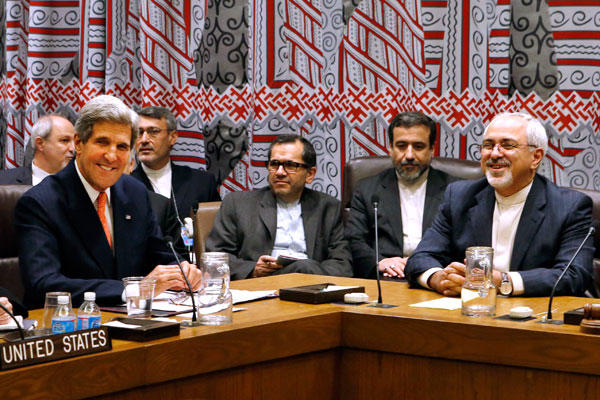
Events in Tunisia and Kuwait seem to have demoted one very important event from the headlines in the western media. Though you don’t see much coverage right now about the negotiations between Iran and the 5+1 negotiators – the US, Russia, Germany, France, China and the United Kingdom – very soon we will know the outcome. If a deal is struck, there will be much trumpeting on both sides of the game-changing implications.
Implications, yes, but not necessarily outcomes. Through no fault of Iran and its negotiating partners, constructing a deal that’s worth the paper it’s written on depends on much more than the clauses, sub-clauses, schedules and attachments that will be presented with much ceremony for signature.
I’m not privy to the issues they’re currently haggling about, but common sense suggests that if they’re following the classic strategy of focusing on mutual interests, the negotiators will have started by addressing the driving interests of all parties that lead ultimately to the small print – the needs rather than the wants. Not so simple when you bring future interests into the equation.
If you’re sitting on the P5+1 side of the table, first you will have calculated what are the interests of the current power elite. That is, if you can work out who holds the power – Khamenei and his religious establishment or the Revolutionary Guard. Are their interests aligned? To what extent?
Then you will need to work out what those interests might be with or without a treaty. What happens if Iran continues to be economically isolated from most of the world’s economic power bases, and how the balance of interests might change if the financial taps start flowing again.
Once you’ve done that you will need to think about the variables that might change strategies and attitudes over the next decade. Khamenei will most likely not be around. Each of the negotiating parties with the possible exception of Russia and China is likely to have a new set of politicians in the driving seat.
Will the entity on Iran’s borders with the current state of Iraq be subservient, friendly or hostile? Will the Islamic State be defeated? If so, will its full-on aggression be replaced by a low-level Sunni insurgency? Who will be in control of Saudi Arabia? How will Egypt’s present instability pan out? Will the Taliban be in control of Afghanistan, on Iran’s eastern border?
If those questions aren’t enough to be getting on with, what of Israel? Will Netanyahu still be in power? If not, will he be replaced with another paranoid, hardline leader determined to hold the line on settlements and willing to press whatever buttons are needed to assure the country’s future as the region’s only nuclear power?
Further afield, what will a post-Grexit EU look like, its borders under increasing pressure from the have-nots on the other side of the Mediterranean and its integrity threatened by malcontents among its members? Will Russia continue to pursue its desire for influence and possible territory in Eastern Europe?
It is all these questions and more that will have a bearing on whether an Iranian deal will deliver what the negotiators intend and desire. And of course few of them are remotely predictable unless you’re prepared to construct and update a huge number of scenarios, which no doubt teams of game theory nerds at the foreign ministries of many of the players are doing all the time. One hopes.
Which goes to show that the detailed negotiations currently taking place about the mechanisms of the treaty are the tip of a very large iceberg of calculation. Many of those mechanisms will be designed to satisfy the needs – and probably the obsessions as well – of the political elites and the neighbouring stakeholders. But maintaining face and being able to sell the deal to interested parties is one thing. Making it work over the long term is quite another.
The parties clearly hope that the treaty itself will help to re-shape the dynamic of the region, and thus put the optimum scenarios into play. This was certainly the case initially with the arms limitation treaties between the US and the Soviet Union. Yet Ronald Reagan and Mikhail Gorbachev didn’t foresee how rapidly things would change after the collapse of the USSR, and not to the benefit of either countries. Did the US maintain scenarios that predicted that outcome? Quite possibly. The Soviets almost certainly did not.
The reality is that while politics is indeed the art of the possible, it also conforms to an old golfing term: hit and hope.
So if Iran and the 5+1 do manage to concoct a deal, it will be, as the US State Department claims, an event of consequence. But let’s not kid ourselves that any deal will be guaranteed to deliver the intended results. For that you need goodwill as well as satisfied interests. Plus a large dose of luck.
And unfortunately there’s not much goodwill flowing around the Middle East at the present time. That said, would a successful deal make the world a safer place? There’s only one way to find out. For sure there will be millions of Iranians – a hospitable, charming, inventive and smart people – who will be on the streets cheering. Whether they will still be cheering in ten years time is an unanswerable question.
But for their sake, I hope the negotiators can work it out.
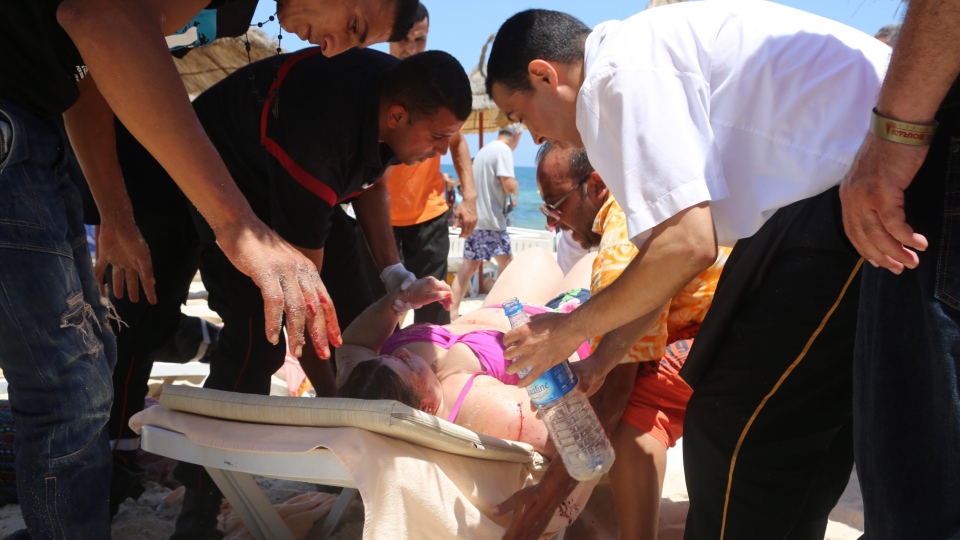
A few days ago I watched the ISIS video that showed the execution of three groups of people – one by incineration in a car, the second by drowning, and the third by simultaneous decapitation. To admit to watching such material feels like confessing that you have a pornography habit. Which corrodes the soul more? It depends on the watcher, I suppose.
What shocked me was not the screaming of the people trapped in the car as the executioner fires an RPG at it, or the sight of one of the drowned men exhaling foamy water from his lungs as he is lifted out of the swimming pool in a padlocked cage, or the moment when the explosive cable rips the heads off the line of kneeling men in their orange jumpsuits.
What shocked me was how unshocked I was. I am not a snuff movie addict. But images of dead and wounded people from places of conflict are so easily available both on the internet and even in the mainstream media that I, and I suspect many others, have become desensitised. These days what was previously only visible to those who fought on battlefields or experienced acts of violence against civilians is available to anyone with an internet broadband connection.
Even if we don’t browse the web, we only have to look at the front page of a newspaper to find pictures of a shattered man in a bloodstained thobe on the pavement outside the mosque that was bombed in Kuwait. Or the image of a woman in a bikini on a Tunisian beach with two clearly visible bullet holes in her arm.
I come from a culture in which death, like sex, used to be the great taboo. If our parents (other than those who fought in wars) witnessed the moment of death or the days and hours preceding it, the context would be the passing of a loved one. After death, the body, for those who wished to view it, would be neatly laid out, and, thanks to the mortician’s craft, as close to a representation of the living person as it was possible to be rendered. Those who were disfigured, mutilated or dismembered at the moment of their death would not be on view.
That’s still the case today, except that anyone wanting to know what violent death looks like only needs a few mouse clicks for their imagination to be replaced with reality.
So I wasn’t shocked by the ISIS video. But I was struck by the demeanour of the condemned men. A number of them were featured making “confessions” of complicity with the Iraqi government apparatus. Although I couldn’t understand what they were saying, they looked almost relaxed as they spoke – as if they were being interviewed for a job. Had they been assured that their cooperation would save their lives? Perhaps, but even at the point of death they seemed calm and resigned. Afraid, yes, but strangely under control. What was going through their minds? Had they given up the struggle and made their peace with God? That was the obvious explanation.
While the destruction of a human being, whether by violence or natural causes, is no longer a mystery for those who wish to witness it, the behaviour of the mind is a different matter altogether. It’s hard to imagine the onset of death unless you have gone to the edge and lived to tell the tale. Unless you have been on the battlefield – or are terminally ill – it’s hard to imagine how it feels to know that you have a good chance of dying in the following minutes, hours, days or months – just as those ISIS prisoners did.
Those who died in Kuwait and Tunisia will not have been able to come to terms with imminent death. Like most of us, they probably thought about their end far less than the vital processes of living – eating, drinking, hoping, struggling and making love.
Hundreds of years ago, in the age of plagues, primitive medicine and brutish lives, death was all around us. We consoled ourselves with belief in the afterlife, and in our notional relationship with God. Today, in that half of the world where religion is losing its grip on our lives, is the resurgence of death as a pervasive feature in our lives changing our attitude towards dying? Are the snuff videos, the awful images of suffering humans in boats on the Mediterranean, of bodies in Syria, Iraq, Yemen and Libya forcing us to re-examine the meaning of life? Turning us back to religion perhaps? Or channelling us into a myriad of spiritual outlets evident at Glastonbury and other summer festivals?
I can only speak for myself. As someone in my sixties I’m closer to the end of my natural span than most of the world’s population. Not a day goes by when I don’t think about death. Not obsessively – just the occasional reflection that mortality is closer than it was. That said, I’m not at the point where I might be tempted to hedge my bets by reaching out to the god I moved away from many decades ago. Nor do I look for some emotionally comforting alternative to the god of Moses.
But I still draw inspiration from the Christian values I grew up with. With more time for reflection than was once the case, I find myself feeling more compassionate, more easily moved by the plight of others. Also less judgemental of human failings, including my own.
At other times I’m swept away by tsunamis of rage at cruelty, stupidity and pig-headedness, especially on the part of individuals and institutions in certain parts of the world where life seems to be of less value than ideology. But when the rage passes I find myself reflecting that even the worst of men and women have some redeeming features, or at least some potential for redemption. If it were not so would we not go through our lives blind to our own faults because we can’t accept that we are beyond redemption?
And if human life is simply a matter of biological computers with varying degrees of malfunction, whose programming – designed to sustain our species – unravels catastrophically when subjected to certain stresses, surely the hardware and software would have evolved more efficiently by now, such that we don’t produce suicide bombers, polluters, child abusers, torturers and people who devise methods of decapitating six people simultaneously?
With apologies to Mr Spock, I can only make sense of the mystery by concluding that there’s divinity out there, but not as we know it. Or at least not as I know it.
So even if Richard Dawkins would reduce us to atoms, molecules, bits and bytes, I – whatever the mechanics of my existence – still rejoice in what others might see as evidence of divinity: compassion and care, laughter and sadness, the endless cycle of the seasons, the joy of birdsong and the freshness of things in the early summer.
I’m moved when Barack Obama sings Amazing Grace at the funeral of the pastor gunned down by a racist shooter in South Carolina because of the embracing sense of communal humanity that shines out from the video; I wonder at acts of selflessness and love where none should logically exist. I marvel at the works of man and nature, even if I find it hard to attribute them to some all-seeing entity that sits apart and orchestrates from another plane.
And when I think about that ISIS video, about the worshippers in Kuwait, the decapitated man in France and the bodies on the Tunisian beach, I wish I could reach out to those who carried out such acts and convince them that they are better than that, that humanity is better than that, and that goodwill in this life should never be subordinated to rewards that might be granted in whatever hereafter awaits us.
Sesimbra, Portugal
I’ve just come back from a long weekend in Portugal – yet another episode in my quest for golfing perfection that becomes ever more futile as age and decrepitude encroach. The time was when I sought the perfect round. These days I have to content myself with the perfect hole, or – failing that – the occasional perfect shot.
There are some people for whom golf is an amiable stroll through the countryside punctuated by the occasional swing at a golf ball. The trouble is, the more inept your swing, the more likely you are to find yourself where you don’t want to be. Depending on where you are in the world, you might also encounter hostile flora and fauna. In England, where I live, the worst you are likely to tangle with would be gorse, rabbit holes and impenetrable rhododendrons, plus the occasional adder lurking in the long grass. In other parts, cacti, scorpions, poisonous spiders and alligators await the unwary. And in these times of climatic volatility, you also risk falling into a sinkhole or disappearing down a cliff along with half of the undergrowth.
So sensible golfers leave their wayward balls where they lie, or better still, hit straight and, if necessary, often. That way they enjoy the view without disturbance to mind and body.
And therein lies an analogy which as yet I’ve failed to exploit. I could turn it over to my sister, who is a Church of England priest, for use as the centrepiece of a tasty sermon. Or broadcast it over the social media in preparation for our imminent incorporation into the Islamic State.
For, as aficionados know well, golf is a moral game – much more up IS’s street than that of the CofE, which seems to have gone rather soft on morals of late. No wishy-washy thinking among the jihadis of the Caliphate, where the threat of punishment and retribution is ever-present. Their scholars will tell you that in Islam, there are two kinds of jihad. The lesser one, surprisingly enough, is the external struggle: holy war. The greater jihad is the mental struggle to stay on the path. Hence the floggings, amputations and flights off buildings without parachutes for those who fall off the wagon of righteousness – just to keep the mind focused.
Golfers would recognise the concept of the greater jihad. We are constantly battling with ourselves. To clear our minds of unwanted distractions, some of us engage in bizarre rituals before taking a shot. These are usually prescribed by golfing equivalents of imams, otherwise known as coaches, golf professionals or psychologists. In the hands of amateurs, such rituals morph into compulsive tics. Facial twitching, hyperventilation or long periods of silent meditation over the ball, usually with the same disastrous result. And then there are the rules – hundreds of them, written by generations of golfing mullahs. More than enough to gladden a jihadi’s heart.
The golfer’s greater jihad is to avoid temptation and impulse. Temptation to give the ball we find nestling under a bush a little kick into a more playable position – thus risking being cast into the outer darkness for cheating. The impulse to wrap your club around the nearest tree – or your opponent’s neck. The desire to curse, screech, blaspheme or collapse on the fairway chewing the grass and foaming at the mouth.
All these things are regularly to be seen on a golf course near you, although homicide and lapses into long-term insanity are relatively rare. But in unfamiliar surroundings, the risks of personal implosion are greater.
Which brings us back to Portugal. Golf tours are a lucrative business for any country that offers a pleasant climate, doesn’t prohibit alcohol and has a reasonably advanced transportation system. A seaside location, decent restaurants and reasonably-priced hotels complete the proposition.
Sesimbra, where we stayed, ticks all the boxes. It’s a fishing port that dates back to Moorish times. Our hotel was on the sea front. It was a treat for people watchers – an endless parade of joggers, walkers, families old and young, lovers, bathers and jousting dogs. The promenade is clean and well-maintained. It’s seemingly safe, judging by the throng of people passing back and forth until late in the evening.
It was hard to imagine that you were in a country that had received a massive financial bail-out only four years ago. But then if you can’t afford to keep your prime tourist locations in good shape, no bail-out can save you.
I got chatting with a local wine producer about the economy. I asked him how Portugal had avoided the fate of Greece. With barely perceptible sniff, he told me that his compatriots had a “different work ethic than the Greeks”. When times were hard, he said, the Portuguese never hesitate from finding work abroad.A little unfair on the Greeks, perhaps, but he has a point. According to Portugal News Online, 30,000 Portuguese nationals came to Britain seeking work in 2013 – an increase of 47% over the previous year.
I asked him how his wine sales had held up. Pretty well, he said, except that the locals are not going for the premium wines as much as before the bailout, so they have had to adjust their production. Volumes, though, are the same as before the crisis. He also mentioned that because Portuguese wines are not so well-known in Europe (apart from the eponymous port), they have looked elsewhere for export markets. As a result they sell 30% of their wine to China. As you would expect from the homeland of the great navigator, Vasco Da Gama, the Portuguese have always set their horizons beyond the shores of Europe.
As for the golf, our collective greater jihad was as usual sorely tested by an infernal twist introduced many years ago by my old mate Shôn, who organises the annual jaunt. Primarily as a means of raising funds for the evening festivities, we have to endure a penalty system known as “animals”. Just about every mishap on the golf course incurs a one euro penalty. Hit a tree, and that’s a squirrel. Land in the bunker – a camel. Slap your ball into a lake – a frog. There are wallabies, snakes, lambs, and so on ad nauseam.
To make matters worse, there are penalties for cursing, as well as for displays of uncontrollable rage, such as chucking your club into the nearest forest, or beating the mobile phone in your golf bag into a pulp. Each group of players has its own Stasi-style informant, whose job is to note down infractions. The experienced sneaks have the ability not only to spot the infractions but to provoke fury in the process, thus doubling the penalty.
At the end of the round the person who committed the last instance of each offence picks up the accumulated penalties in that category. One year I ended up with 83 euros-worth of animal fines in a single day. So failure to perform the greater jihad has dire financial consequences. Not surprising that one or two of our number are reduced to gibbering wrecks over the last few holes as the prospect of impoverishment gets closer. The artistry of the perfect swing gives way to crab-like animal avoidance.
After four days of relentless struggle against deviation and sin we hauled ourselves back to England courtesy of Easyjet, an airline that has turned waiting into an art form. 30 minutes to drop bags, a 30-minute departure delay, two hours in a packed terminal whose only food outlet was a MacDonald’s, 30 minutes in a seat-free cattle pen waiting to board, followed by a 30-minute wait to show our passports to a computer at Gatwick Airport. So much for the time-saving capabilities of online check-in and electronic passport readers.
But hey, the days were warm, the nights were balmy, the seafood a delight, the locals were friendly. We enjoyed our usual mixture of cacophonous mirth, crocodile tears and a strong dash of the obsessive-compulsive. Golf tours beat working any day.
Were we better prepared for the coming of the Caliphate after four days of internal struggle? I think not. Perhaps we shall have to wait for the black flag to fly over Wentworth and St Andrews before we finally start behaving ourselves.

Dewsbury. Photo: Wikipedia
Last night I listened to rather a confused debate on Newsnight, the BBC current affairs programme.
In amongst the incoherent arguments put forward by the three guests, a single idea came over loud and clear. The speaker who articulated it suggested that if the UK wished to stem the tide of young people going to Syria to live in the lands controlled by ISIS, it should change its foreign policy. He claimed that foreign policy – presumably the UK’s interventionist actions in Iraq, Libya and Afghanistan – was the number one reason why British Muslims are flooding to Syria.
Technically, he may or may not be right, but in terms of the big picture, I think he’s dead wrong.
ISIS will use any argument to persuade people to accept its ideology. If convincing people that the UK is controlled by godless aliens from the Planet Zog produced an abundant supply of new recruits to its cause, it would use that argument.
As I contended some time ago in ISIS – Religion, Politics and the Yearning for Identity, the Islamic State is a political organisation. It is using religion, sectarianism, idealism, sexual temptation, the lure of adventure and just about any other tool it can think of to consolidate its caliphate, which, contrary to its claims, is a political entity. So it makes no sense using the “Islam is a religion of peace” argument to counter its interpretation of Holy Quran and the Hadith. You might just as well argue about the length of a piece of string.
It also makes little sense engaging with the Muslim “communities” for the specific purpose of stopping people from going to Syria. The United Kingdom is a secular nation. Although Church of England occupies a privileged position in our constitution, purely in legal terms religious groups exert no influence on the governance of the country except through the ballot box.
Imagine a situation where a fundamental Christian movement took power in Syria and Iraq instead of ISIS, and started persuading young Brits to join them in their crusade to create a Kingdom of God. Not so hard to imagine, if we remember that it was a Christian leader – Pope Urban II – who kicked off the First Crusade, and inspired thousands to go to the Holy Land, where they committed unspeakable atrocities against the indigenous Muslim population.
But that was then, and this is now. Would the British government engage with the Catholic Church, the Church of England – or the Jehovah’s Witnesses for that matter – to prevent our citizens from leaving to fight in the crusade?
In most nominally Christian countries it would be seen as a civil matter. There would be no “reaching out” to the Archbishop of Canterbury or any other prominent Christian leader, because someone motivated enough to wage holy war would be highly unlikely to listen to bishops and popes in any event.
The very fact that a young white Muslim convert goes off to join Al-Shabab and gets himself killed in Kenya, while a 17-year old ethnic Bangladeshi from Dewsbury does the same thing in Iraq, and three sisters of Pathan origin disappear with their children, seemingly towards Syria, illustrates the blindingly obvious. Which is that those who disappear into the ranks of ISIS or Al-Nusra don’t pay the slightest attention to their parents, husbands, wives, imams or any other members of their “communities” except those who encourage them in their new-found convictions. And those who encourage them do so in ways difficult to detect without the security forces bugging every house, mosque, room and individual in the country. And we all know that that will never happen….don’t we?
So what’s to do? From my limited perspective, here are a few suggestions:
We should understand that British Muslims are as diverse in their beliefs, aspirations and behaviour as Christians, adherents of other religions and those who have no religious belief. So we should stop thinking of them as “Muslims”, as though they were a single homogeneous entity. They are not.
We should refrain from clumsy attempts to win hearts and minds by “reaching out to communities”. Promoting inter-faith tolerance and understanding is fine if the motivation is to create a more coherent society. Even better if those doing the reaching out have more than a superficial knowledge of those to whom they are trying to connect. But as long as such activities take place as part of an underlying agenda to prevent radicalisation, they will be met with suspicion and limited cooperation.
We should form a more rounded view of what is happening within ethnic and religion-based communities. If a study was carried out of Muslims between the age of thirteen and thirty, I suspect that for every “radicalised” person there would be at least as many who reject the values of their parents and their communities in other ways – by marrying the partner of their choice, by embracing lifestyles prohibited under Islam or by creating lives for themselves away from the areas where they were born and grew up. Jihad is not the only road out of Dewsbury and Bradford.
We should recognise that we are in a generation game. Every generation in one way or another moves away from the previous one. Will jihadis beget jihadis? Probably not, unless they happen to be born within a domain similar to that of ISIS. The offspring of the current crop of radicalised young people will most likely see the world in a different way from their fathers and mothers. We need to wait for that to happen of its own accord.
We should recognise that social engineering is futile unless carried out in a totalitarian state. Attempts to force values on groups of people by dictating behaviour and attitudes tend to result in conflict, ethnic cleansing and even genocide. There is no place for thought crime in a democratic society.
We should not attempt to stop people going to Syria. The issue is not where they go, but for what reason. It’s whether or not they have been radicalised. If they have been radicalised, we should focus on the level of threat their beliefs pose to the society in which they are living. Is it more in the national interest that radicalised people go to Syria if they wish to or are forced to remain here in the UK? That’s a debate worth having.
We should focus on finding out who has gone to Syria (or Iraq, Somalia or wherever), with whom they are aligned and what they are doing. If we know this, then we have the opportunity to assess whether or not those who return pose a threat to law and order. We should not make it impossible for them to come home without facing prosecution – not everyone who goes there ends up decapitating people, and of those who have taken up arms there will be some who deeply regret having done so. Each situation should be judged on its own merit. If that means doubling the size of the security services to gain the necessary intelligence, and tightening up border control procedures, then so be it.
We should stop focusing on the symbols of faith. If we ban burqas, why not stop Sikhs from wearing turbans? Why not stop people from wearing long beards and shaven upper lips? Why not stop Christian clergy from wearing dog collars? The only grounds for insisting on specific modes of dress and appearance should be when those modes interfere with civil process and the rule of law.
We should accept that we are going through a period when successful acts of terrorism involving injury and loss of life are inevitable. We should stop carrying out witch hunts against the police and security services when they happen. If incidents occur because of incompetence, that’s one thing, but no security service in the world can stop the “one in a hundred” from getting through.
We should treat plots and conspiracies as potential or actual breaches of the law, not as battles in a “war against terror”. If individuals become radicalised, it is the responsibility of society as a whole to prevent them from committing crimes in the country. Yes, there is a role for families and ethnic or religious communities, but we should no more be pointing fingers at them than we should be blaming other communities if one of their number ends up robbing banks, raping or murdering. If our actions discourage Muslims from feeling that they are part of British society – rather than cases for special treatment – we will encourage them to become ever more insular in their attitudes and behaviour.
We should not apologise for our values. By “we” I mean any ethnic, religious, cultural or geographic stratum of society. It would be nice if everyone shared the same core values. But it has never been the case in Britain, nor is it likely to be in the future. Values emerge from the bottom up, not top down. They change with time. So any attempt to articulate – let alone impose – values will end in failure, because the target is moving.
I’m not suggesting that the solution to jihadi radicalisation is accept multiculturalism any more than to reject it and seek to promulgate common “British values”. We are what we are.
What I am saying is that there are no quick fixes. That we need to re-examine our attitude towards terrorism, and start seeing it a crime like any other prohibited activity. That we should come to terms with the idea that our society has become a melting pot in which the ingredients are taking time to congeal. That if we accept diversity instead of marginalising it, any malignant consequences of that diversity will slowly but surely dilute, as will the diversity itself. And that when present diversity in our society fades, it’s likely to be superseded by more diversity.
Finally, we are not an island any more, and barring a natural or man-made catastrophe we never will be again. We are living in dangerous times, and we can’t afford to have little islands in our midst. Seductive as it may be, an island mentality reflects the past, not the future.
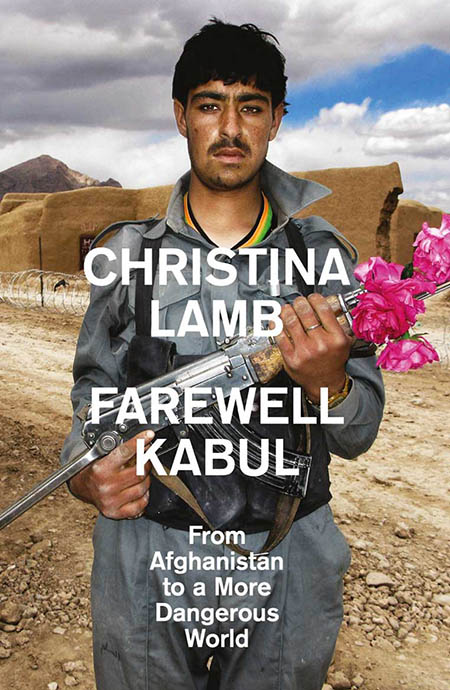
When I was last in Saudi Arabia, I encountered a guy from Pakistan in his early thirties. Good-looking and well-educated, he communicated with consummate ease. He had the bearing of someone who comes from the Pakistani elite, of which the late Benazir Bhutto and her family were also members. It turned out that he does. The clue was in his name, which I shan’t disclose for reasons of confidentiality.
Thinking that, like Benazir, he must have been educated at Oxford, the London School of Economics or some similar high-status western university, I was surprised to learn that he’d never studied outside Pakistan. Instead, he holds a master’s degree from one of the top business schools in his home country.
A clear example of my western filter – a perception garnered from several decades of following global politics that Pakistan, a state teetering on the edge of failure, couldn’t possibly still have institutions capable of turning out people of the calibre of this perceptive, intelligent and widely-read individual.
My friend was the first to admit that Pakistan is not in a great state these days. Perhaps that was why he was in Saudi Arabia rather than back home trying to help repair his fractured country.
He had one talent that could never have been burnished at Oxford or Harvard. He had the ability to think of a story – not a case study – to illustrate a point. In that respect he reminded me of Tariq Ali, another upper-crust Pakistani. Like my new friend, Tariq Ali has lived most of his adult life outside his country of origin. For me, notwithstanding his huge output of political commentary since he was a leftist firebrand in the Britain of my youth, Ali is the author of the Islam Quintet, five exquisite historical novels set in Muslim lands. A reminder that there’s another tradition in Pakistan, a love of devotional music and poetry – typified by the Sufi qawwali and the Urdu ghazal – that tends to be forgotten when we think of the country today.
When the world outside the subcontinent thinks of modern Pakistan it is often of a nation with hundred nuclear warheads at its disposal. Where howling mobs lynch people accused of apostasy from Islam, and stone adulterers in remote villages where the government’s writ does not extend . A country in which terrorists think nothing of gunning down 134 pupils at an army school. Whose army intelligence service, the ISI, is a state within a state, as pervasive as the Stasi were in East Germany, and just as ruthless. Whose politicians are corrupt and duplicitous. Where 20,000 madrassas are busy turning out the Taliban of the future, nourished by funding and extremist ideology exported from the Middle East. Whose government has allowed its intelligence service to train and aid the Afghan Taliban while it simultaneously receives billions of dollars a year in military and other aid from the West, most notably the US. Whose economy and foreign policy has since its establishment in 1948 been dictated by a visceral hatred of India, its southern neighbour. And whose unfortunate population is often cursed by earthquakes, flooding and poverty.
Few journalists have provided a more coherent portrayed of this Pakistan than Christina Lamb, whose recently-published book, Farewell Kabul – From Afghanistan to a More Dangerous World, is a very personal account of the western intervention in Afghanistan after 9/11. Her notional end point is the departure in December 2014 of most of the International Security Assistance Force (ISAF) contingents, including the those of the US and Britain. Between 2001 and then, she spent much of her professional life in Afghanistan covering the conflict and its byzantine military, social and political dimensions.
Though the book is nominally about Afghanistan, it’s as much about Pakistan, because it’s almost impossible write about the former without reference to the role played by the latter.
To be a successful war correspondent you need the bravery of a soldier and the curiosity of a detective. Christina Lamb has both qualities in abundance. Apart from risking her life on a regular basis in Kabul, Herat, and the Pakistani border cities of Peshawar and Quetta, she survived a vicious fire-fight while with a company of British soldiers in Helmand under attack by the Taliban.
As a personal friend of Hamid Karzai, she watched him develop from an urbane Pashtun tribal luminary into an embattled and seemingly paranoid president, raging against the innocent casualties inflicted by indiscriminate American air strikes while being sucked into tribal politics, condoning endemic corruption and ceding much of his authority to regional warlords.
She describes the naivety of the British commanders and politicians who deceived themselves into thinking that their counter-insurgency experience in Northern Ireland would stand them in good stead in Helmand. Men and women with good intentions whose scant knowledge of the culture and politics contributed to a hopeless and bloody deployment with few results beyond the destruction of lives, the alienation of the local population and the quadrupling of the opium poppy harvest.
The Americans fared little better. Just as in Vietnam, they were drawn into the conflict, and proved as incapable as the British of coming up with a winning strategy against the Taliban. Attempts to gain hearts and minds were trumped by ham-fisted military tactics. Failure to understand the dynamics on the ground allowed factions to dupe the Americans into wiping out rivals who had been falsely identified as Taliban. Billions of dollars handed out for development ended up in the offshore bank accounts of the warlords.
The chain of command within the multinational ISAF was frequently fudged, and to make matters worse, a separate force tasked with hunting Al-Qaeda roamed around the country, unaccountable to the ISAF commanders.
And as the conflict raged through the country, Kabul stood alone and isolated, a fortress frequently penetrated suicide attackers from the Taliban and the Haqqani network, another group allegedly supported from Pakistan. The city was flooded with aid workers and foreign consultants, most of whom rarely ventured beyond its fortified perimeter. And in his heavily guarded palace was Karzai, an increasingly lonely and bitter figure. The Mayor of Kabul, as Lamb called him.
Karzai’s most consistent theme was the duplicity of Pakistan. Throughout the years of conflict, the Taliban would come and go across the border with ease, encouraged, aided and abetted by the ISI. The intelligence service created the Taliban in the 90’s with the purpose of ending the fighting between rival mujaheddin warlords and installing an Islamist government that posed no threat to Pakistan. After the defeat of the Taliban in 2002 and throughout the subsequent insurgency, elements of the ISI continued to regard them as “our boys”.All the while Pakistan’s political and military leaders would deflect Afghan and American protests by claiming that these were the actions of “rogue elements” and “retired officers”. ISAF’s reliance on supply routes through the country, and concern that abandoning Pakistan as an ally might lead to her nuclear weapons falling into the wrong hands, ensured that the US continued to bankroll the military despite the duplicitous activities of the ISI. And according to Lamb, Pakistan’s generals did very nicely out of the kick-backs they received as the result of controlling the supply infrastructure.
As the conflict ground on, both India and Pakistan had their 9/11 moments. In India the attack on Mumbai carried out by an Islamist group in Pakistan and allegedly orchestrated by the ISI took them close to war with their neighbours. In Pakistan a home-grown Taliban insurgency threatened both the military and political establishments. Thus Pakistan was able to say to the Americans that they too had suffered huge civilian and military casualties in their war against terror. Yet while this was going on the “rogue elements and retired officers” continued their campaign against the foreign forces across the border.
To this day Pakistan remains an ally of the United States, dependent on American dollars yet harbouring a deep reservoir of hatred for the world’s faltering policeman.
Great journalists are more than reporters of great events. Men and women like William Russell during the Crimean War, Vasily Grossman, who reported on the Red Army campaigns in the Second World War, John Simpson in Iraq and Marie Colvin in Syria have all been infused with a sense of morality that is inseparable from, and informs, their work. Christine Lamb is no different. Her love for the two tortured countries she describes in Farewell Kabul shines out from the narrative. She writes as a human being, not as a reporter so numbed by the bad things she has witnessed that she is no longer capable of being shocked. The book is her story as much as it is a tale of cynicism, brutality, deceit, incompetence and greed.
She’s written a sad tale that is far from its conclusion. As she points out, the influence of Afghan conflicts continues in Iraq and Syria, where the spiritual heirs of Osama bin Laden are achieving success beyond his wildest dreams with tactics that even he would not countenance.
She finishes the book on a deeply emotional note as she prepared to leave Kabul:
“At the entrance to the plane I stopped, and unbidden tears ran down my cheeks. ‘you are scared of the Afghan plane?’ asked the young Afghan woman at my side who I’d shared biscuits with in the terminal, and who was headed back to Turkey with her sister. ‘No,’ I shook my head.
‘Are you scared of Ebola?’ She asked.
‘No!’ I replied, smiling through my tears. ‘I am just sad.’
She looked confused, and I shook my head. It would take a whole book to explain. Sad because I really believed that things didn’t have to be like this. Sad for all the hopes there once were, and for the lessons we did not learn from our ancestors and others who had tried to tame these lands before. Sad for all those lives lost or damaged. For the soldier Luke McCulloch, for Wais ‘the Fonz of Kabul’, for Nadia the poet, for Benazir, for all the tens of thousands of people killed in Afghanistan and Pakistan since 9/11, and the hundreds of thousands in Iraq and Syria.
Sad that I didn’t know how to help the women we left behind. Sad that thousands of schools were still being blown up in Pakistan, which despite everything had not stopped allowing the snakes in its garden. Sad that no Western leader took on Saudi Arabia, which had funded many of these jihadi movements, exported the Wahhabi ideology through madrassas, and fifteen of the nineteen hijackers on 9/11. Sad that the poppy fields of Afghanistan had become an unstoppable tide, poisoning the world’s streets in even greater numbers. Sad that $1 trillion had been spent in Afghanistan, yet its children still went to school in tents. Sad that because of what had happened we wouldn’t intervene again even when hundreds of thousands were killed. Sad that those sixty words drawn up in the White House in haste after 9/11 had indeed, as Congresswoman Barbara Lee feared, led to open-ended war. Most of all sad because I wasn’t sure we had learned anything.”
Farewell Kabul is an important work because the agony of Afghanistan and Pakistan still goes on. To understand the chapters to come it helps to know the story so far. And a thousand miles to the west, another violent progeny of 9/11 is raging. The politics of the Middle East are no less tortuous, and no less devastating. They are closely linked to the Afghan conflict. I hope for Christina Lamb’s sake that she is not tempted to immerse herself in Syria and Iraq as she did in Afghanistan. I reckon she deserves a rest.
Ever since the FBI’s nuclear strike against Fifa, I’ve been eagerly devouring the coverage of the unfolding story of Sepp Blatter and his cronies as they try and fail to hold the line against the rising tide of disgust at the organisation’s institutional corruption.
As I was reading an article in this week’s Sunday Times by Tony Allen-Mills about Jack Warner, the Trinidadian Fifa executive at the heart of the allegations, one passage sent me in a completely different direction:
“For much of the past two decades, Warner has been shimmying his way largely unscathed through endless corruption allegations, media exposes and Fifa scandals.
Aided for years by Blazer, his obese but cannily creative American partner, he turned a once-moribund Fifa federation…… into a money machine.”
Obese but cannily creative. Are we to take that phrase to mean that Chuck Blazer was cannily creative despite his obesity? And that the natural default of the obese is not to be cannily creative?
When I was a kid, I delighted in stories about Billy Bunter, the Owl of the Remove. He was a monstrously fat 14-year old who stopped at nothing to get hold of the things that made him fat.
His entry in Wikipedia sums him up:
“Bunter’s defining characteristic is his greediness and dramatically overweight appearance. His character is, in many respects, a highly obnoxious anti-hero. As well as his gluttony, he is also obtuse, lazy, racist, inquisitive, deceitful, slothful, self-important and conceited. These defects, however, are not recognized by Bunter. In his own mind, he is an exemplary character: handsome, talented and aristocratic; and dismisses most of those around him as “beasts”. Even so, the negative sides of Bunter are offset by several genuine redeeming features; such as his tendency, from time to time, to display courage in aid of others; his ability to be generous, on the rare occasions when he has food or cash; and above all his very real love and concern for his mother. All these, combined with Bunter’s cheery optimism, his comically transparent untruthfulness and inept attempts to conceal his antics from his schoolmasters and schoolfellows, combine to make a character that succeeds in being highly entertaining but which rarely attracts the reader’s lasting sympathy.”
A pretty good archetype for society’s prejudice against fat people, even if he is characterised within the unique environment of the English boarding school. You will see similar traits in books, TV shows and movies that portray fat people as stupid, sly and even evil. At best, weak-willed – unable to resist the jam doughnut, the second helping of cake and the super-size burger. Figures of fun, even when, like Hitler’s sidekick Hermann Goering, they epitomised the dark side of human nature.
These days political correctness prevents us from being rude about fatties, except presumably when the fatty has confessed to corruption on a massive scale. That doesn’t stop journalists from making subtle references to their subject’s corpulence, as though the very obvious physical evidence of the person’s “weakness” was more reprehensible than that of someone whose insides are rotted by alcoholism, smoking or drug abuse.
So poor Charles Kennedy, the recently-deceased former leader of the Liberal Democrats, attracts our sympathy because he was an alcoholic, whereas wicked Chuck Blazer only has himself to blame for the fact that he’s apparently dying from colon cancer at the age of 70. Must be all the eating, right?
Of course stupidity has nothing to do with the size of your girth. Nobody ever accused Henry VIII, Alfred Hitchcock, Orson Welles and Marlon Brando of lacking brain cells. Or creativity for that matter. But, as Rob Broomby argued in a recent article on the BBC website, there’s an ethical dilemma facing us when we argue in favour of accepting obesity as “normal”. Because although it’s for the individual to choose what they look like, obesity can kill.
So can anorexia, yet we don’t seem to pour scorn over people who starve themselves to death as we do with the monstrously fat
Whatever the public health concerns, society’s disapproval is rarely based on the damage fat people are doing to themselves.
Over the ages people have looked down on the obese on moral grounds. Gluttony, after all, is one of the Seven Deadly Sins that were dreamed up by the early Christian Church to keep us on the straight and narrow.
Even before Christianity, excessive eating was frowned upon by ancient Greek and Roman society. Hence Vitellius, one of the three Roman emperors that followed Nero in AD69, who was best known for his herculean eating habits, earned the contempt of Suetonius, the author of the Twelve Caesars.
The idea that overeating is sinful remains with us to this day, as Salman Rushdie, in his early career as an advertising copywriter, realised when he coined the phrase “naughty but nice”.
Not for nothing is guilt the universal instrument of control and manipulation.
I sometimes find myself at the receiving end of society’s implicit disapproval of fatties. Like the majority of middle aged men who have the means and the time for self-indulgence, I’m a few pounds heavier than I should be. I frequently find myself being complimented by people I may not have seen for a while with the words “you’ve lost weight haven’t you?”
This is actually a ritual. The person is usually looking to say something nice, even if they don’t mean a word of it. The obvious opportunity is to focus on one’s appearance. I’ve done it myself, so I know.
I also freely confess to an innate prejudice against the fat – in other words those fatter than me. I look at people waddling down the street and feel righteously horrified at how deeply unattractive they are. If, in the days when I employed people, someone as wide as they were tall turned up for a job interview, they would have a very hard time convincing me that their obesity wouldn’t affect their attendance and their energy levels. Last year I went on a Baltic cruise and was so stunned at the number of seriously fat people who were on the ship that I wrote about it in All Aboard the Good Ship Fatso.
These days the lessening grip of religious belief has resulted in there being fewer people who consider that eating too much will send you to hell. Instead we tend to blame obesity, along with just about every other human failing, on psychological root causes.
Thus there’s the assumption that if you’re fat you must have some underlying problem. “Does he eat because he’s unhappy?” That was the consistent refrain from my mother. “No”, my wife would reply, “he’s just a greedy sod!” Or, as I would prefer to explain, I just love my food. Not because someone abused me as a kid, or because I was labouring under the shadow of an elder brother or famous father, or because I was abducted by aliens as a teenager. I just love my food – too much for my own good.
So is it wrong to make snide remarks about the horizontally challenged? Does “fattism” belong in the same class as ageism, racism or sexism? Wrong question perhaps. There are enough laws against prejudice. They can moderate behaviour and expression, but not what lies in people’s hearts.
The real issue surely is human kindness. We don’t publicly mock people with long noses, knobbly knees or tiny chins. Nor should we mock fat people. And generally we don’t, at least to their faces. And when our prejudice accidentally slips out, the result can be mortifying. My wife and I still remember the occasion when she took our four-year-old daughter to the supermarket. The little one pointed at a large woman nearby, and said, in a very loud voice, “Mum, why is that woman so fat?” Maternal toes curled in embarrassment.
Sadly, the possibility that people might be fat for any number of reasons, just as the causes of suicide, violent behaviour, obsessions and compulsions are many and varied, doesn’t stop us from inwardly frowning at the sight of a grotesquely obese person waddling by. We can and usually do control the words that come out of our mouths. But it’s more difficult to regulate what lies in our hearts.
So should we lay off Chuck Blazer and his voluminous girth because he clearly has enough on his plate? Does the capricious cruelty of Kim Jong Un, the tubby tyrant of North Korea, give us licence to mock him for his treble chin? It seems that the bad guys are fair game, even if innocent people in supermarkets aren’t.
If we happen to be fat ourselves, do we use “proud to be fat” as a coping mechanism that masks deep unhappiness, or are we genuinely OK with not being able to see anything below our bellies when we get on the scales? Do we point out that in some parts of the world to be fat means you’re wealthy, and therefore worthy of respect? And that three centuries ago artists like Rubens portrayed fat women as the idealised essence of femininity?
Are we right to blame society’s disapproval of obesity on the wave of anorexia afflicting our kids? Is the fashion industry creating a generation of body fascists by insisting on using size zero models? Or did body fascism drive the fashion industry?
You would think that we had more important things to worry about, and you could argue that our obsession with fat suggests a self-obsessed, narcissistic society. The diet industry is worth billions. The celebrity industry, packed with physical perfection – whether real or the result of the airbrush – billions more.
Despite the supplements, weird eating regimes and the influence of god-like role models in Hello Magazine, western societies are getting fatter and less fit by the decade. Mother Nature, it seems, has her own way of limiting the world’s population. Whereas once she would send us the Black Death, these days she rewards us for our physical prosperity by clogging our arteries.
Personally, I couldn’t give a damn about the moral dimension. If I’m on my way to hell it will be for far more serious transgressions than a love of cream cakes.
As for the health issue, there are as many expert opinions on the effects of obesity as there are religions in the world. So who and what do you believe? Best to let your body tell you when you’re pushing things, and take whatever action seems sensible rather than be dictated to by some quack in California.
And if you think you will help yourself by lying on some therapist’s couch and delving into your darkest closets, fine. Just be careful that you don’t open some new can of delicious, sugar-coated worms in the process.
I’m guided by one principle, that it’s not the length of your life that counts. It’s the quality – and more specifically the use that you make of your time. And that, it seems to me, has little to do with the size of your belly.
For that reason I will not mock Chuck Blazer, as he trundles around on his mobility scooter and looks wistfully at those photos showing him with the great and the good, who these days will be avoiding him like the plague. When you’re surrounded by kleptocrats, surely the greatest hazard is that you lose your sense of right and wrong.
And that’s a moral dimension far more harmful than gluttony, which is why he deserves a little sympathy in his present plight.
Detail from Paul Day’s Meeting Place sculpture at St Pancras Station, London
The other morning, I set out from home on my way to the golf course. After about a mile I made a discovery that would have caused 90% of the adult population of the UK turn back. I’d forgotten to bring my mobile phone.
I considered going back home for about five seconds, and then continued on my way. If the world can’t do without my being available for five hours, then to hell with the world, I thought.
Later that day we had our two daughters home to celebrate a birthday. One of them was unable to spend more than five minutes in conversation without anxiously glancing at her phone. She spent a good 50% of her visit browsing, texting and making calls.
Barely a day goes by without someone – usually a psychologist or some other type of health “expert” whose opinions hold sway for about ten minutes before they’re discredited by the latest thinking – droning on about the dangers of smart phones. How people are expected to be on-line and available 24/7/365. How work-life balance for billions of people has shifted in favour of work.
Once upon a time the worry was that mobile phones gave you brain tumours. These days, it seems, they make your head explode. They turn you into obsessive checkers of status. They destroy your ability to concentrate on one thing at a time. The little electronic node becomes the centre of your life, not the people around you, not the air you breathe, not the ground you stand on.
Waiting, waiting, waiting. For a lover to text you. For deal to be done. For a plane to land or a taxi to show up. For good news, for bad news. For any bloody news.
Is this good or bad? Neither. It just is.
I’m lucky. I do a job in which I get to ask people to switch off their phones, or at least to leave them silent. If I see them browsing or texting I can embarrass them by asking them a question, or transfix them with the death stare.
For hours every day I’m unavailable to anyone but the people I’m working with. I don’t carry my phone from room to room. Horror of horrors, I don’t use it for email. Nothing, but nothing, can’t wait a few hours for my attention. And if something’s really urgent, what’s wrong with a text?
Am I a dinosaur? Well, I might look like one of those pot-bellied sauropods these days, but I do know how to use a smart phone. I just don’t choose to very much, because I prefer to be the master of my own time rather than the slave of everybody else’s.
Perhaps that sounds sanctimonious. But I don’t feel superior to phone addicts because I have my own addictions to deal with. I do however feel sorry for people who can’t live without their electronic heartbeat, just as I feel sorry for alcoholics and cokeheads whose atrophied livers and arteries are slowly leading them to an early grave.
The sad thing is that while there’s plenty of help available for people who drink too much or shove industrial quantities of white powder up their noses, phone addiction isn’t even recognised as a problem in most circles. On the contrary, it’s seen as a badge of honour. A person married to their work. Drunk on success. Wired, connected, all-seeing. A person of (electronic) action.
But if I were such a person I would worry that should the reason for all that manic activity disappear, a great hole would take its place from which I might never emerge. Silence and inertia instead of all the sound and fury signifying nothing. The same kind of silence that afflicts all those members of the British parliament ejected by the voters last month. The silence of loss and loneliness rather than contemplation.
It’s said that when you die, the last thing to fade away is your hearing. Since the coming of the smart phone you could argue that your last trace of life ends when the battery runs out.
Just something to think about when you sit with your family lost in your smart world, or you curl up in bed with your electronic best friend. You may not see it this way, but in my little bubble, nothing is more important than the world you see, feel, hear, taste and touch. There is no other reality, even if Apple, Samsung and Facebook would like to convince you otherwise.
One of the most enjoyable aspects of visiting Saudi Arabia is the conversations I have with people about the problems of everyday life.
Here’s one about kids relying on housemaids:
“One evening, I heard my seven-year-old ask the housemaid for a glass of water. Now in our house the housemaid’s job is to take care of domestic chores. She’s definitely not there to wait on my kids, and they know it.
I asked my daughter why she asked for the water instead of fetching it for herself. She replied that when she was at her friend’s house the housemaid did everything for her. I didn’t want to criticise her friend’s family, but I made it clear that we didn’t allow this in our house.”
And another on the problem of growing up as a solitary son:
“When I was a young girl, I was allowed out of the house to play. Nowadays that’s not so easy. My nine-year-old son gets very frustrated in the evenings. Once he’s done his homework he has nothing to do until bed time. So he spends most of his time playing computer games. I worry about how he will relate to other people as he grows up. The isolation from other kids outside school hours isn’t good for him.
Older boys don’t go to the malls because they’re afraid of being harassed by the religious police. So they go to smaller shops where they don’t get into trouble.”
And finally pushy Dads who don’t trust their kids to find jobs of their own accord:
“It drives me mad when fathers call me on behalf of their sons to apply for jobs. I say to the fathers “Please don’t do this. Get your son to talk to me himself. He has to learn to stand on his own feet.” I suspect that what’s happening is that the fathers are pushing their sons to apply. The kids themselves don’t care whether they work or not. Life’s too soft for them, and having over-indulgent dads doesn’t help.”
“A lot of kids don’t accept a job unless they see it as absolutely the right one for them. How will they know this? So instead of taking a job that may not be absolutely right and getting some useful work experience, they sit at home waiting for the perfect job that might never come.”
What I find interesting about all this is that – against the pervasive backdrop of religious belief – there are two fundamentals of Saudi life, and such different attitudes towards them.
The first is marriage. Most marriages are arranged. The son or daughter is introduced to an appropriate partner by their families. In most cases they are given the right to say no. But the general philosophy is that suitability – in terms of age, social status and sometimes tribe – comes first. Love is something that hopefully will grow with time. In other words, “The One” that so many people search for in the West rarely comes into the equation.
A recent article in the Arab News, Saudi Arabia’s English language daily, shows one aspect of the dilemma:
Women have contrived several reasons to reject a man’s proposal. Being in a ‘wrong’ profession could well be one such reason that can shatter men’s dream of marrying their loved ones.
Despite some women’s preference for good financial and social status, the husband-to-be’s choice of profession can be a deal-breaker.
Saudi women put some jobs on a black list because of economic, social and cultural reasons. The reasons given by Saudi women involved the husband’s absence from home or simply the nature of his job.
Medical professionals, airline stewards, plastic surgeons, plumbers, mechanics and workers in the military topped the list of rejected professions in favor of businessmen, teachers, engineers and government employees.
One of the big problems, according to the article, is that women fear that their men might stray if their job brings them in contact with other women. On that basis anyone working in the West would be virtually precluded from any kind of work. But in Saudi Arabia, what is delicately known as “mixing” is a big no-no, especially among the more conservative elements of society.
Very few young Saudis, except possibly for those who have studied abroad, have the opportunity to discover what it’s like to be in a relationship before getting married. If they are inexperienced in matters of the heart the danger is that they go into marriage with false expectations. The result, unfortunately, can be disappointment, estrangement and ultimately divorce.
Having said that, arranged marriages often succeed because the couple do grow to love each other. Failing that, they feel bound by the financial implications of divorce to stick together.
So why, in a society in which The One in marriage is mostly a lucky accident, and in which most people start with what you could call a “Point Seven Five” relationship, do so many young people sit around waiting for the career equivalent of The One? Would it not be better for them to do what kids in the West often do – to get a job, any job, that starts them on the road to independence even if it’s not where they see their long-term future?
It would be a gross generalisation to suggest that kids who have been waited on all their lives have grown up with a sense of entitlement, and so are reluctant to accept that as adults not everything will be delivered to them on a plate. That could be part of the problem, but the main driver would seem to be fear.
For the boys, as we have seen, the kind of job they do has a direct effect on their marriage prospects. A job that provides security and status is at a premium. And even perfectly secure, respectable and well-paid careers often don’t pass the suitability test, especially if the potential husband is likely to have frequent contact with women in his job.
So if a career as a plastic surgeon makes you ineligible for the best marriage, flipping burgers definitely doesn’t make the grade. Some families look down on any job in the private sector except with banks and big companies like Saudi Aramco, the national oil company. This makes it hard for young companies to recruit talent, because their businesses are seen as insecure.
For many, the ultimate job is in government. The pay isn’t great, but there are plenty of fringe benefits. What’s more, continual employment is virtually guaranteed. Nice and secure.
But not all kids have families that can subsidise them while they hang around the house hoping for The One Job to come around. For some government jobs there is a long waiting list. So they take jobs that may not be their heart’s desire, but often the motive is money and little else. I hear frequent complaints from employers who take on young Saudis. They stay on for a few months, and then disappear to any company willing to offer them a few hundred extra riyals a month, much to the frustration of the first employer who has started to invest in their training.
However money is not the only issue. Many companies don’t do much to instil loyalty in their young employees. Government regulations compel them to take on sufficient numbers of Saudis to meet employment quotas. Those that don’t meet the quotas suffer damaging sanctions that affect their ability to trade. So some employers take on youngsters and sit them down in a corner. They give them little to do and minimal training. Although it’s illegal to do so, there are even employers who put people on the payroll to make up the mandated numbers, and don’t insist that the staff show up for work. Small wonder that the youngsters get bored and frustrated, and jump ship at the first available opportunity.
As for the girls, there are also concerns that make them very choosy about the kind of jobs they take. The taboo against mixing is one of them. Even female doctors and nurses find that their marriage opportunities diminish because they inevitably work with or around men. There’s also pressure from families for the same reason. Another problem is that many jobs deemed suitable for women are badly paid – teaching in private schools for example. Since they can’t drive to work, a large proportion of their salaries are gobbled up by the cost of hiring drivers to take them back and forth.
The connecting strand in all my conversations would seem to be fear. In a country so well endowed with natural resources, wealth and infrastructure, there seems to be quite a lot of it about.
Parents fear that their kids will end up as unproductive layabouts. Or that if they’re allowed out on the streets they’ll get into trouble. They fear that their kids will fall under the influence of other kids whose families have different standards from their own. Above all they fear that their offspring – through lifestyle or the wrong choice of career – will bring dishonour upon the extended family.
Kids fear that without the requisite status they won’t be able to find a husband or wife. They fear that they won’t be able to provide for their families, that they’ll be stuck in a dead-end job. They worry that they won’t be able to keep up with their wealthier friends.
Some of these fears might seem strange to people in the West – the concern over family honour and marriage prospects for example. But the rest are all too familiar in our societies.
Which goes to show that under the surface we have more in common with this distant and inaccessible country than we think. Except that in Saudi Arabia people often hold out for the perfect job but accept a potentially imperfect marriage, whereas in the West it tends to be the other way round.
Wouldn’t we all be a bit less fearful both in love and labour if we accepted the Point Seven Five when The One seems out of reach?
For who knows – the seemingly imperfect could be perfection in disguise.
Jaleel Al-Arbash (R) with friends in Kansas. Photo: Instagram
The pictures of the two young cousins who died while trying to stop the latest mosque attack reminded me of so many Saudis of their age. Enthusiastic, fun-loving but also idealistic.
In case your perception of the people of this diverse country is based on pictures of solemn-looking officials, or grim-faced clerics with long beards fulminating on TV, it’s worth reflecting on these lads. There are many like them, not only in Saudi Arabia but across the Middle East.
I have no idea about their characters, except that their role as volunteers manning a checkpoint outside the mosque suggests that they were devout Muslims. This article in Middle East Eye tells their story.
That Mohammed Hassan Ali Bin Isa and Abdel Jaleel al-Arbash were Shia singled them and their fellow-worshippers in Dammam out as targets in the second such attack in eight days, and the third since November.
The attacks in Saudi Arabia are not everyday events, so are shocking for their rarity. I happened to have been in Al-Hasa a few hours before gunmen cut down eight people outside a village mosque. A week ago I was visiting friends 40 kilometres away from the Qatif suicide bombing that killed 20 people.
I have met and worked with many young people in the Kingdom. Mohammed and Abdel Jaleel seemed typical of a generation of Saudis who are the best hope that their country will move on from being a society addicted to handouts to one that takes the future into its own hands.
I’m not talking about changes to the all-powerful political establishment centred on the ruling family. As the events of the past five years have shown, political changes work only if society as a whole, not in part, accepts and is ready for them. That’s a far deeper and more long-term challenge than simply a matter of one regime succeeding another. Non-violent change usually takes place over generations.
What these kids are bringing to Saudi Arabia is an irreverence expressed in humour, especially through the social media. A willingness to work. A realisation that there’s more to life than taking a safe government sinecure that requires them to put in two or three hours of productive time in any given day; that the addiction to foreign labour is draining the country’s precious resources while deterring employers from giving their own people a chance to excel; that there’s more to work than an effortless progression to a desk with a big nameplate on the back of a qualification that doesn’t qualify them to do anything, because qualifications without experience are the equivalent of putting a ten-year-old behind the wheel of a car.
All around the Middle East – most notably in Yemen, Syria, Iraq, Egypt and Iran – young people like Mohammed and Abdul Jaleel are being killed, imprisoned, oppressed and intimidated. Even when they are left at liberty they are forced into a system not of their making. A system in which obedience is more important than creativity. In which initiative is crushed out of them, and deference to social and political hierarchies is mandatory.
Some of these conditions apply – though in less extreme forms – in Saudi Arabia too, but the government is most certainly aware of the need to educate and encourage its young, even if it can’t easily sail against the prevailing winds of conservatism and inertia for which its predecessors are at least partly responsible. The current government may be draconian in its response to what it perceives as threats to national security. But pressure to conform, to do things as they were always done, comes more from powerful elements of society than from government diktat.
The fact that Abdel Jaleel and many like him studied in the West is significant. The scholarship fund set up by the late King Abdullah has sent hundreds of thousands of young men and women to complete their educations at western universities. That experience has changed many mindsets, though not always in directions that the West would like. But I have met many young Saudis who have never studied in the US, Britain or any other popular destinations for Saudi students. The spark of curiosity and free thinking is in them too. They are ambitious, questioning and willing to laugh at things about which earlier generations might have kept silent.
This is not to say that I’ve seen evidence of a mass of disaffected kids yearning for a new Saudi Arabia. I don’t have those kinds of conversations, and generally I only mix with people lucky enough to have jobs. But I do believe that attitudes are changing, partly because of the ability to share ideas and sentiments through the social media, and partly because huge population growth in the region creates pressures on social and political institutions: the need for more jobs, houses and schools; more poverty as well as wealth; more ambitions that the state finds it hard to satisfy.
Equally we in the west shouldn’t get the comforting idea that the Kingdom’s youth would like their country to become “more like the west”. Saudis have always coveted the material benefits of western technology. Some have embraced western cultural values, but many have not. To call elements of their society “liberal” and “conservative” is to an extent a western construct. There are binding forces that transcend such definitions. Religious, familial and tribal ties may be weakened as generations succeed each other, but those forces are not going away. Don’t expect anything like the profound changes in Ireland over the past forty years that led to the recent referendum on gay marriage to take place any time soon in the states of the Arabian Peninsula.
The Instagram photo that shows Abdel Jaleel Al-Arbash posing with a Saudi snowman in Kansas sums up for me the best hope for a peaceful future. A future in which the Kingdom remains at ease with its traditions and heritage, yet looks outwards with curiosity and a desire to learn rather than inwards with paranoia and resentment.
And for all the violence that has flared up around its borders, Saudi Arabia remains a relatively peaceful country. Long may that continue. If the country can navigate through the next decade or so without succumbing to the appalling discord that surrounds it, then there’s a decent chance that the future will be in the hands of people like Abdel Jaleel, Mohammed and the hundreds of bright-eyed, open-minded young people I have met over the past few years.
That’s why I especially grieve for two brave young lads who will never see that come to pass.

I’m having a red hat day. And I blame it on Twitter.
About two months ago I started checking out Twitter feeds on a daily basis. I wish I hadn’t, but now I’m addicted.
I avoid the feeds of the great and the good, because half of them aren’t written by them. They’re the work of blatherous PR people. And anyway, what can I hear from Barack Obama and David Cameron that I can’t pick up with lashings of opinionated tosh (I was going to say comment and analysis, but as I said, this is a red hat day) from newspapers and websites?
Celebs are boring. Thespians should be watched and not read. Footballers tend to be as thick as two short planks (with a few honourable exceptions). Rock musicians? I suppose those who still have functioning brains have something to say, but there aren’t many of them left from my era.
So what’s left? Writers, journalists, and people valiantly tweeting from a stricken land. People who dance on a tightrope between saying what they want to say and being persecuted for saying it. Historians. People writing from and about the Middle East. Not everyone’s taste for sure, but they work for me.
Some of them are such prolific tweeters that you wonder how they find the time. Is this a hobby or profession? If the latter, how the hell do they make money from it? What’s the motivation? Ego, celebration, concern for the world, personal branding, boredom or cries from the wilderness?
I don’t follow many people, and not many follow me. The tweets of the people I follow outnumber those who follow me. This is not surprising, since I only tweet when I post to my blog. I can’t bring myself to play the town crier who feels he has to tell the world about everything he finds interesting. Selfish me.
As a side issue, the balance between followers and the followed is quite interesting. Has anyone created a power index based on the gap between the two? Christiane Amanpour, for example, has 1.36 million followers, but only follows 124 lucky people. She must be near the top of any such listing. You could call it the Narcissus Index.
As for my followees (anyone used that word before?), many impress with their renaissance-grade range of interests. Tom Holland, for example, a historian whose work I greatly admire. When he’s not playing cricket against the Vatican XI in Rome, he’s off to Alberta in search of dinosaurs. Or risking his life at the Hay Festival by talking about reforming Islam. Or checking out Roman ruins at glorious locations on the west coast of Italy.
Then there’s Mary Beard, ancient historian par excellence (and I’m not talking about your age, Professor – after all, I’m older than you are). She pops up on regular basis sharing thoughts about subjects far beyond Greece and Rome, opening herself up to yet more abuse from slimy trolls.
And Laura Rozen, who writes for AlMonitor. She’s my queen of the re-tweeters. 24 re-tweets in four hours on subjects ranging from Don Blatterone of FIFA to shenanigans behind the scenes of the Iran nuclear negotiations, with the thoughts of Putin and Obama thrown in.
Another favourite is Rashid Abu-Alsamh, a Saudi-American journalist who lives in Brazil, and whose eclectic taste in stories knows no bounds. Pity I can’t read Portuguese, so I’m precluded from enjoying his Brazilian posts (lazy me, I should use Google Translate. Sorry Rashid).
I read lots of posts about Yemen, Syria and Iraq. The most heart-breaking stuff comes from Ammar al-Aulaki, who tweets from Sanaa. Every day he reports on bombings in the city. A recent one shattered his windows and rearranged the furniture. Power cuts, water shortages, deaths, injuries and human suffering from one of the poorest countries in the Middle East. A people caught between various actors beating the hell out of each other and them into the bargain. And for all that, someone with great fortitude and relentless optimism.
So my problem is that in between the fun and eccentric tastes of some people I follow, the endless stream of posts about the manipulation, cynicism, stupidity, envy, cruelty and hypocrisy of the self-serving SoBs who hold sway over vast areas of the globe, and the poverty, repression and destruction of the soul over which they preside, make for a pretty depressing read.
And in no region are those qualities shown in greater abundance than in the Middle East, most of whose people just want to be left alone to pursue better lives for themselves and their loved ones. The stamped-on majority, dodging bullets, bombs and policemen in a region I love almost as much as my homeland.
My fault. I chose the people I follow. Maybe I should sign up with Pope Francis, Kim Kardashian, metal bands or stodgy academics.
Yet I continue to read, because in between the stream of posts about stuff I already know or don’t want to know about lurk gems in places I might never have explored. Fresh opinions. Sites I’d never heard of. The occasional flash of 140-character wit (mostly from Tom Holland). Great travel writing by Matthew Teller. Insight from the likes of Andrew Hammond, Frank Gardner and Brian Whitaker.
And anyway, why should I be depressed? Think of the starving millions, as the nuns used to tell little schoolgirls who wouldn’t eat their lunch. Wherever I go it’s in relative comfort. No RPGs and snipers waiting around the corner (though I sometimes wonder about that when I venture out in the streets of Riyadh). No sitting beaten and bloody in some cell from which I might never emerge. No need to pander, flatter, crawl and tip the non-existent forelock in deference to some arbitrary power.
So those Twitter feeds serve another purpose. To remind me how very lucky I am that an accident of birth brought me into a part of the world where the rule of law prevails (mostly). Where I’m free to mock and be mocked. Where I was fortunate enough to get an education that saved me from the dole. And where I have a reasonable chance of dying in my bed rather than at the bottom of a rubble-filled bomb site, or by a flashing blade on a piece of desert wasteland.
Yet all the blessings counted daily are not enough to spare me from regular waves of melancholy. A wringing of impotent hands at daily acts of inhumanity.
So what to do, as my Arab friends like to say? Keep reading, keep writing, keep caring. Keep loving life, keep loving people and throw the occasional oar in as the need arises and, I’m ashamed to say, expediency allows.
That’s the life of a back-seat witness whose armour-plated windows keep being shattered. Damn you Twitter.
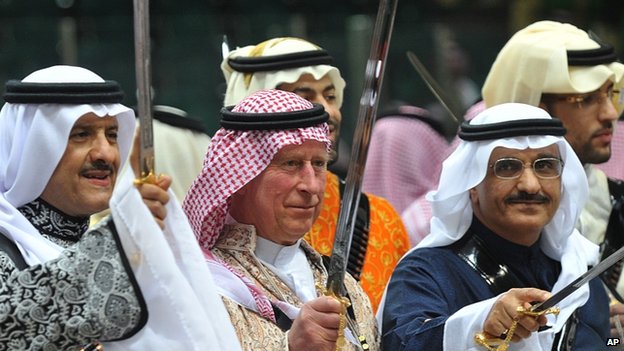
It’s tough being an intellectually curious member of the British royal family. No royal knows this better than poor Prince Charles. The heir to the British throne is perhaps squirming a little because of the enforced publication of his letters to various government ministers a decade ago. The famous black spider memos were supposed to be confidential, but legal action by the Guardian newspaper forced their publication.
Not that he really has much to squirm about. There have been critics who accuse him of wasting ministerial time by lobbying them over his various hobby-horses. Some have accused him of citing bad science in his arguments. If that is the case, there are many so-called experts who are guilty of the same offence. Climate change and health sciences come to mind particularly.
The prince’s topics reflect deeply-felt concerns on a number of topics. Having a future king who is concerned about issues rather contenting himself with being a mute constitutional ornament is absolutely fine by me. Prince Charles, after all, would never suggest that his mother’s subjects should eat cake.
The hoo-ha about the black spider memos calls to mind the role of the monarch, which by custom is “to be consulted, to encourage and to warn.” How the heir to the British throne must occasionally wish that Walter Bagehot’s definition finished with “and to kick ass”.
Other monarchies have that prerogative, not least in Saudi Arabia, where I’m currently on a visit. Prince Charles is also a frequent visitor to the Kingdom. He had a close relationship with the late King Abdullah, who liked to take him out to the desert for traditional Arabian pursuits. I wonder if he has ever cast an envious eye on the wide-ranging powers of his fellow royals, not least the current Crown Prince. Unfortunately for Charles, the last monarch in these isles who exercised anything like the power of the Al-Saud was Charles I, and he lost his head for his injudicious use of that power.
Yet while the modern Charles must sometimes feel that he is waiting an eternity to step on to centre stage as king, spare a thought for the senior members of the Saudi royal family, some of whom must have felt over the last forty years that they were playing an interminable waiting game with no guarantee of the outcome.
What kicked off this train of thought was a long feature in the Arab News, Saudi Arabia’s English-language daily that appeared a few days ago. It was a tribute to the outgoing foreign minister, Prince Saud al-Faisal. In a cascade of extravagant praise, the writers chronicled Prince Saud’s forty-year career as foreign minister in glowing terms that you would rarely encounter in an English newspaper. We’re far too cynical. Here’s how the Foreign Minister of the United Arab Emirates began his eulogy:
“Those who do not know him will say he is an adept foreign minister and a faithful politician. Those who do know him will say, in addition to the above, that he is a master, and a cultured and well-read man of the highest caliber, the likes of which we see only every now and again in the annals of Islamic and Arab history. One can only marvel at the man’s astuteness and eloquence, at his soft-spoken words and decisive actions.”
A little over the top perhaps, but the truth of the matter is that Prince Saud did indeed have a distinguished career. He is highly respected within and without the Kingdom. He is an impressive man. His austere features remind one of his father, Saudi Arabia’s third monarch, Faisal bin Abdulaziz. Saud’s brothers, Khaled, Turki and Khaled are also impressive men, with long careers in government. Prince Khaled is currently Governor of Mecca. All the brothers are in their late sixties or seventies.
So here’s where the British royals differ from the Saudis. Whereas from the moment he was born Charles’s place in the line of succession has been was assured, unless of course he makes some gigantic constitutional faux pas. For prospective rulers of Saudi Arabia, accession to the throne is by no means assured. Only two men stand formally in line to succeed the current king. After them the succession is anybody’s guess – or strictly speaking a matter for the senior royals to decide. And perhaps being in the right place at the right time.
King Salman, who assumed the crown three months ago on the death of his half-brother King Abdullah, has finally passed the baton to the next generation of the extended Al-Saud family. Until last month the designated line of succession has featured only the sons of the founder, King Abdulaziz, known internationally as Ibn Saud. But now that the few remaining sons have been deemed too old, not suitable or unwilling to shoulder the responsibility, Salman has appointed two of Abdulaziz’s most talented grandsons, Mohammed bin Naif and Mohammed bin Salman as second and third in line to the throne. The crown prince is the King’s nephew. The deputy crown prince is his son.
For one reason or another the sons of previous monarchs did not make the short list. In the case of Faisal’s sons, age was an inhibiting factor. Prince Saud, for example, is older than at least one of his uncles, Muqrin, who last month stood down as crown prince in favour of Mohammed bin Naif.
It was never an option for King Faisal to put his sons into the line of succession. Faisal’s brothers, particularly Fahd, Abdullah, Sultan, Naif and Salman, were all ambitious and capable men who would have been outraged if their expectations had been thwarted. In the end Sultan and Naif died before they could succeed to the throne. But the family as a whole would have prevented Faisal from elevating his sons. It was only the dwindling number of eligible sons of Abdulaziz that led Salman to the next generation.
Would Saud Al-Faisal and his dignified, well-respected brothers have been regarded as candidates for the succession if their equally respected father had been the fifteenth son of the founder instead of the third? Quite possibly. An accident of primogeniture took them out of contention.
A few years ago I was asked to run a programme for a class of Saudi schoolchildren. The aim was to prepare them for studying abroad. To of find out more about them, I asked them a series of questions. One was “name the person, living or dead, whom you most admire”. Their answers were interesting. Those who did not name the Prophet Mohammed – a natural choice for devout Muslims – almost all chose King Faisal. Apart from one lad who came up with Lionel Messi.
Those who named Faisal gave many reasons for their decision. He was devout, he was principled. He pioneered girl’s education. He made his country respected throughout the world. I’m sure that their choice of Faisal was no reflection on King Abdullah, who was on the throne at the time and was also held in great esteem. But the children I worked with were born many years after Faisal was assassinated by a member of his family. So it’s highly likely that their views reflected those of their families.
And no wonder. After all, Saudi Arabia has Faisal to thank for the fabulous wealth that has enabled his successors to build the infrastructure that stands today. It was Faisal who engineered the oil embargo against the west that increased the price of oil many times, and brought the economy of the US to its knees. His reason for doing so was to protest against America’s support for a country that he regarded as illegitimate – Israel. The era of cheap oil was over, with profound implications worldwide. Once the embargo was lifted, the oil price stayed as a much higher level than before, thus enriching Saudi Arabia beyond the wildest dreams of its people.
The fact that Saudi Arabia has remained coherent and prosperous over the seventy years since the passing of the founder is a tribute to the ability of the sons and grandsons of Abdulaziz who have held executive power since then. These days absolute monarchy is something of an anachronism more or less everywhere except in the Gulf region. Absolute dictatorship, on the other hand, or rather various degrees up to absolute, is alive and flourishing. Dictatorships often ends badly. So do monarchies sometimes. And yet Al-Saud are still very much with us.
Part of the reason is that they can no longer be considered a family – more a tribe. There are many thousands of them. So the king has a large pool of talent to choose from. And despite the possible frustration and thwarted ambitions of those who might feel they deserve to be closer to the big prize, successive kings have been able to manage those tensions without letting them erupt to the surface.
Of all the Kingdom’s rulers since Abdulaziz, Faisal – I’m assured by those schoolboys and by a number of my Saudi friends – holds a special place in the hearts of ordinary Saudis. For all his ground-breaking achievements as king, he is particularly respected – to use modern parlance – for walking the walk. Whereas his predecessor, King Saud, was known for his self-indulgent spending, Faisal was a devout and frugal man. All families have their wayward sons and daughters, but Faisal’s offspring reflect his own example and his disciplined approach to parenthood. Not only are they known to be hard-working, but they are untainted by personal scandal.
The younger generation will before too long be in control of Saudi Arabia’s future. If filial piety doesn’t prevent them from looking for role models in addition to their own fathers, Mohammed bin Naif and Mohammed bin Salman will surely consider the careers of King Faisal and his sons. After all, were it not for that accident of primogeniture, at least two of Faisal’s offspring might have been standing in their shoes.
And others who may be champing at the bit for more responsibility could perhaps take some inspiration from the dignity and good grace of Prince Charles as he patiently awaits his place in history.
So it’s over, thank goodness. And what now?
I’ll start with a truism popular both in business and politics: there are times when it’s better to make a decision that turns out to be the wrong one than to make no decision at all. And that, effectively, is what the electorate has unwittingly done by returning the Conservatives with an overall majority.
The stock market has reacted positively. Oligarchs and mansion owners have quickly moved to unblock the logjam of delayed activity in the upper end of the housing market.
Financial confidence, however, may prove to be short-lived if the certainty of majority government is tempered by the uncertainty of a referendum on Britain’s future in the European Union. According to David Cameron’s schedule, that event is due in two years’ time.
When I was a young boy learning about politics, I understood that Conservatism was about maintaining the status quo. That may have been the case in 1961, when Harold Macmillan was telling us that we’d never had it so good.
But since Margaret Thatcher handbagged her way into power in 1979, our largest right-wing party hasn’t done too much conserving. Deregulation, privatisation and outsourcing have been the hallmarks of Conservative rule, and there have been times when the Labour Party has come over as the reactionary force. Perhaps not during the Blair years, but certainly under Gordon Brown and prospectively under Ed Miliband. Under Brown, the mission seemed to be to roll back Blairism. Under Miliband, the positive proposals he put forward were overshadowed by the overwhelming impression was that the objective was to get rid of the Tories. That was also the most common sentiment I’ve seen expressed among Labour supporters in the social media.
To take Britain out of the European Union be would a staggeringly risky step, outstripping any risks Thatcher took. Not necessarily wrong, just risky. Projections that show the impact – positive or negative – of a British exit are basically extrapolations into an uncertain future. They prove nothing either way. For that reason I have a hunch that that the outcome would be that the out lobby will fail, unless a Greek exit triggers a financial disintegration within the Eurozone. The majority of us will simply not want to take the risk.
Even so, a referendum would not end the debate. The out voters would continue to agitate against our membership of the EU, just as in the wake of the Scottish independence referendum enough voters have rejected the result to turn Scotland into a one-party country as far as Westminster is concerned. I’ll come back to Scotland a little later.
A vote to stay in the European Union would certainly give David Cameron the prospect of calmer waters over the remaining three years of his government unless some new black swan – one of Rumsfeld’s unknown unknowns – throws everything out of kilter. I would put the chances of that happening as highly likely. In which case the natural momentum of politics would suggest that disillusionment with the Conservatives and a reinvigorated Labour Party could threaten Cameron’s fragile majority by 2020. So another coalition or even a majority Labour government would be in prospect after the next general election. The electoral boundary changes now on Cameron’s agenda may prevent a Labour majority, but would almost certainly not stop the Conservatives losing their majority.
If you happen to be a house-owner looking to cash in on the long house price boom by downsizing and pocketing the profit, it would therefore seem that black swans permitting – 2018 will be the last opportunity to do so without your sale being blighted by yet more political uncertainty. Also by that time the current housing shortage will have started easing, because you can bet on the government introducing measures to encourage the construction of more affordable housing.
For the rest of us it looks like more of the same austerity medicine as the government struggles to meet its ambitious commitment to reduce the deficit. Further cuts on social benefits and public services await. Further tinkering with the National Health Service. Stealth taxes here and these.
The National Health Service is the ultimate sacred cow. Free at the point of delivery is the mantra with which no government since its establishment has dared to tamper. Except that it’s not free. Taxpayers pay for it. Those who don’t pay taxes don’t. Is it so iconoclastic to suggest that the mantra could change to free at the point of delivery, but only for those who don’t have the means to pay for it? Already there are voices calling for a £10 charge for general practitioner visits.
If the tax burden was shifted to allow the NHS to charge for certain services, an argument could be made that those who rarely used the service would no longer end up subsidising the frequent flyers to the extent that they are today. Tax breaks for infrequent use could incentivise healthy habits (maybe!). Any charges need only kick in when a user has achieved a certain level of income – say the 25% tax level.
I’m not advocating abandonment of the principle of an NHS free for all. But I can see that there are alternatives that would not necessarily be counter to social justice. Sacred cows may be sacred for a good reason, but that’s no reason not to cast a sceptical eye upon them from time to time.
The extraordinary political upheaval in Scotland raises some interesting questions. For any party in British politics to gain a virtual monopoly over a region is an anomaly to say the least. The Scottish Nationalists will need to walk on water over the next five years to maintain their current ascendency in 2020. Labour, from being an integral part of the Scottish establishment, will become the insurgents.
The SNP’s performance in government, which this time around escaped any serious national scrutiny, will be under the microscope. The three other parties whose representation in the region has been reduced to almost zero will be looking to exploit any failure by Nicola Sturgeon’s Holyrood legions. Therefore expect the SNP numbers in Westminster to decline from the current high water mark next time round.
One potential consequence of the SNP’s triumph might change the landscape dramatically. A major reason for the SNP’s success seems to have been a disillusionment with Westminster politics. The SNP is of Scotland and for Scotland. Its opponents in this election, even if they give themselves a tartan identity by inserting “Scottish” before the party name, are seen as instruments of their national party machines. Ergo, according to the SNP narrative, they are not of Scotland or for Scotland.
What if one or two parties arose that were genuinely independent of Westminster and the central party machines? Parties, say, that espoused left-wing, right-wing and centrist principles but were not in thrall to their natural allies in Westminster? They would therefore compete on equal terms with the SNP – untainted by a Westminster connection.
The fastest way for this to happen would be for the existing parties, Labour, Conservative and the Liberal Democrats, to allow their organisations in Scotland to sever formal links with the central party machines. A re-brand, including as a minimum a name change, would almost certainly be necessary. As is the case in Northern Ireland, the main Westminster parties would no longer contest Scottish elections, leaving the field to the new-born Scots-only rivals to the SNP.
While the Westminster parties would lose control over Scottish MPs wearing their colours, they could expect the support of the parties most closely aligned with their policies. And the SNP would be deprived of their unique sales proposition: of Scotland and for Scotland.
Even if the major parties decided against such a step, new home-grown Scottish parties will almost certainly be formed in opposition to the SNP. But it might take them much longer to become serious players.
However things pan out in Scotland, looking forward twenty years, it’s easy to imagine a federal Britain in which each region has a lively political forum in which parties are no longer campaigning on the narrow agenda of nationalism, but on issues specific to the regions. Just as political alliances within the European Parliament reflect common but not necessarily identical ideologies of parties in member states, so there would be natural alliances in Westminster.
Whether an English parliament emerges remains to be seen. But a federal model seems to me to be the most likely long-term outcome from the turmoil we’ve just experienced.
My personal feeling after this election is one of relative detachment. My constituency is one of the safest Conservative seats in the country. The sitting member is a cabinet minister who clearly has better things to do than run around chasing voters when he knows he’s going to win. I can count on the fingers of one hand the amount of leaflets we received, and those were for the local council elections.
I would have loved the opportunity to debate a few issues with the great man, but he didn’t come anywhere near my house or any others in the constituency as far as I’m aware. Too busy with more weighty matters no doubt. Nonetheless I felt taken for granted, as I always do on these occasions.
I have some sympathy with the Greens and UKIP, who argue that that the millions of votes they received bought them one seat each, whereas the SNP’s 1.5 million reaped them a far richer harvest. But I don’t see the first-past-the-post system changing any time soon. So my vote, which went neither to the incumbent nor to the two above, will continue to count for nothing.
After all, newly-empowered turkeys don’t vote for Christmas.
May 7 2015
On this Election Day I have nothing to add about the political talk-fest beyond what I’ve already said in previous posts. But I will say this about my country: for all its faults and problems, I would rather be a citizen of the United Kingdom than of any other nation.
We may not be the best in the world at cricket. Our health service may be creaking at the seams. Our weather might be unpredictable. There are too many cars, perhaps too many people and not enough houses. Our scenery lacks the grandeur of other countries. Our food is of uneven quality, good in parts and awful in others. Our education system likewise. We have too much crime, too many drunks, too many self-righteous bureaucrats and too many greedy bankers. Our trains are packed, our roads are crowded. Our politicians can’t think beyond their noses. Our royal family is a benign irrelevance. Income inequality is at an all-time high and too many people are working for the minimum wage.
And yet we live in a country where by and large the rule of law prevails. Whose elections are largely fair and free. Where extremities of behaviour are only frowned upon when they impinge on the rights of others. Where you are unlikely to be shot in the street for expressing your opinion. Where men and women can use the law to complain about sexual prejudice, employment abuses and racial hatred. We have a generous welfare system that does a reasonable job of protecting the weak and needy. We are tolerant of social deviation, protest and individual difference. We have a press that is mainly free of political constraint. We make great films, TV music and art. We have an amazing diversity of culture for such a small country.
Is it any wonder then that so many people want to come and live among us?
We’d be foolish to think that we’re an exceptional nation. We’re better than some other nations in certain respects, worse in others. But if you look at the whole package, it’s pretty good, and it’ll take more than the current crop of politicians, whichever fails to lose heavily enough today, to screw it up beyond repair.
As I write this I’m sitting in my conservatory on a typical spring day – periods of glorious sunshine, and then clouds and chilling winds. The birds are singing and the trees have the rich green of the new season’s leaves. There are bluebells at the bottom of my garden and a robin that comes by every day to collect the dog’s discarded fur for its nest.
There are lots of people without the green and pleasant view that I enjoy, yet the same sights can be seen in urban parks and country meadows. I’m not sitting here in suburban complacency. I want us to fix the things that are broken, and make what’s mediocre excellent. I want us to show compassion and humanity towards Nepali earthquake victims, African boat people and Syrian refugees. I’m proud that our foreign aid budget is among the largest in the developed world.
I suppose this makes me in the eyes of many some kind of pie-in-the-sky liberal, thinking benign thoughts from my privileged nest. Maybe. But that’s what my family, my education and my country’s culture have instilled in me. And I’d rather be as I am than someone who advocates kicking out foreigners, persecuting gays, mutilating women and crushing diversity of every kind.
This is a country worth living in, and will remain so after the votes are counted in the next 48 hours. Whatever the result, I can’t imagine ever wanting to live anywhere else.
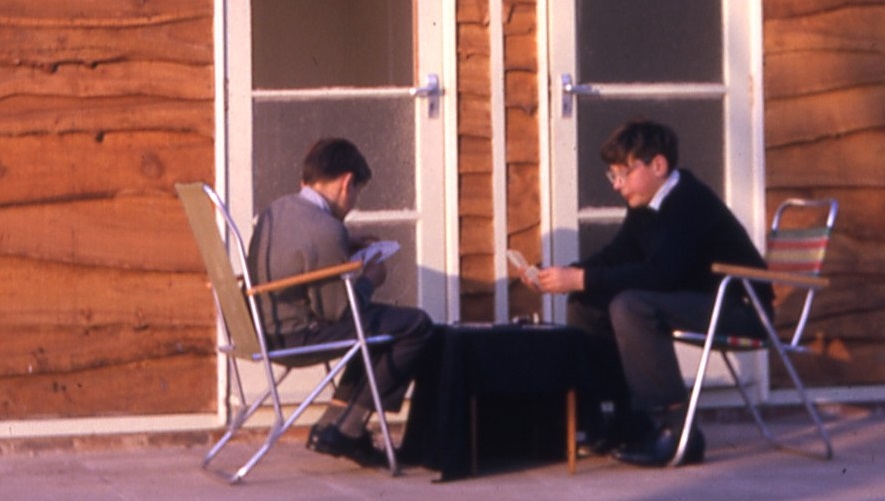
The Brothers Royston c1964
I learn from the London Times that a growing number of our gilded youth are abandoning PlayStations and other gaming devices. Apparently they are taking up the games that their parents and grandparents used to play – and still play.
Good for them. I always thought that there was something slightly onanistic about sitting glued to a screen for hours on end, zapping the bad guys or raiding tombs. I admit that I’m a complete ignoramus when it comes to “gaming”. Space Invaders in the pub in the late Seventies was about as far as I ever got. There are only so many aliens you can destroy before it starts getting a tad boring. I did have a brief flirt with Flight Simulator, but that was before the days when such pursuits could get you arrested as a suspected terrorist.
I do know that gaming can become addictive. For a couple of years I worked with some very bright young people in the Middle East whose grades started to fall over a cliff when hours at the joystick turned to uninterrupted days and nights.
Grown-ups do this too, especially in Las Vegas, where the hotels deliberately make it impossible to tell night from day, and people sit at the slots or the tables in marathon stints that would attract the attention of the health and safety police if this was what they did for a living.
So welcome to my world, young fogies. From the age of eight I was honing my competitive instincts with the most popular board games of the time: Risk, in which you fought for world domination; Monopoly – a perfect introduction to capitalism for an eight-year-old in short trousers. Then there was L’Attaque, in which you took to the board with an army of combatants that looked as though they had been plucked out of World War 2. Colonels with bristling moustaches, generals, sappers and so forth.
Of course there were also the perennials: draughts, chess, scrabble, backgammon and various card games including bridge, piquet and bezique (Winston Churchill’s favourite). I never really got into the more cerebral games favoured by the school intelligentsia – in other words those who were destined for Oxbridge – like Go and Mah Jong. Too cool for my taste. There was more than enough power and domination to be had from the other stuff. Ask someone if they played Mah Jong, and an odd look might appear on the would-be opponent’s face, as if you’d developed acne in an unusual location, or half of your dinner was adorning your school tie. But everybody played the mainstream games, and did so with the evil intent that so easily grows in the fetid micro-climate of a boys-only boarding school.
School was not the only place for games. At home on holidays, I would play endless bouts with my older brother, who was far brighter and more competitive than me. He took delight in crushing me at whatever we played. On the odd occasion when I won, he would get quite miffed. It was not unknown for him to throw the board in the air and scatter the pieces around the room. But I never resented his pre-emptive termination of hostilities, because, after all, that was what big brothers did. It was the prerogative of seniority. And anyway, an hour or so later we would be back in the fray. The picture at the top of this post is of the two of us in the late Sixties battling away by the swimming pool. Happy days.
One of the joys of playing board games, or bored games as some would have it, was that you could see your opponent, a pleasure that most gamers don’t experience. The sight of your victim losing his shirt in Monopoly, as Mayfair and Park Lane fall into your grasping hands (much as modern hotels end up in the portfolios of the Qataris) was a joy indeed. Especially if the loser happened to be your sister or younger brother, whose control over their emotions might not match the rapidly-developing stiff upper lip you had developed on the playing fields and in the dormitories of an English prep school. Snide text messages between online opponents are pretty tame compared with spectacular family meltdowns over one faction ganging up on another in Risk, or bitter accusations of cheating at scrabble. And there’s nothing like looking into the whites of the other person’s eyes as their defence crumbles at chess. Not quite as visceral as Game of Thrones perhaps, but I’ll bet George RR Martin, who wrote the books, is a dab hand with the chequered board.
Another attraction of board games is that they stimulate the imagination in a way the electronic equivalents don’t. Stacking armies of little red counters on Irkutsk and Kamchatka is not the equivalent of immersing yourself in hyper-realistic street fighting. Modern games are designed to leave nothing to the imagination. Are they creating a generation of kids who are incapable of creating their own fantasies because all their dreams are served ready-made on an electronic plate?
The time may be fast approaching when more gamers may have to seek alternatives to Call of Duty Black Ops 2. The internet is currently soaking up as much as 16% of Britain’s power capacity, and some experts predict that if usage continues to grow at the present rate we can expect rationing of bandwidth in the future. What better preparation for that moment than for our screen-sated youth to learn to play real games, in which protagonists scratch each other’s eyes out across a real table? Better than having to invent a new psychological condition: Internet Deprivation Syndrome, for the treatment of which vast funding from our cash-strapped National Health Service will no doubt be available.
Who knows, perhaps a few of our stroppy teenagers might even resort to humouring their elders and betters with the odd joust on the Monopoly board. The young may be smart and tech savvy, but put them up against their battle-hardened capitalist grandparents, and they will soon learn to know their place in the real world.
King Salman (c), Crown Prince Mohammed bin Nayef (r), Deputy Crown Prince Mohammed bin Salman (l)
Big changes have been taking place in Saudi Arabia of late. Professional Saudi watchers are not the only ones with plenty to do right now. These are happy days for the printing trade.
Within a day of the government reshuffle that left the Kingdom with a new line of succession to King Salman, I saw the first giant poster of the monarch with his nephew Muhammad Bin Nayef, the new Crown Prince, and his son Mohammed bin Salman, whom he has appointed Deputy Crown Prince. That was pretty quick on the draw.
Pictures of those who sit at the apex of the ruling family are to be found everywhere across the country – in hotels, schools, government offices and in massive roadside hoardings. With the passing over the last four years of two crown princes and more recently of King Abdullah, the printing presses have been busier than ever.
Now, two months after Abdullah’s death, the crown prince who was appointed immediately afterwards, Salman’s half-brother Prince Muqrin, has disappeared from the royal portraits, just as did leading Soviet luminaries in Stalin’s time. The difference is that Muqrin moves into a graceful retirement with the thanks of the King and the nation, whereas those airbrushed from Stalin’s history had usually met their end in a dank cell underneath the Lubyanka. That, fortunately, is not the Saudi way.
I’ve just finished my first visit to Saudi Arabia for several months, so it was a good chance to catch up what’s been happening since I’ve been away.
Lots is the answer.
For starters, there’s the new king on the throne. Not an unfamiliar face, because King Salman has been at the heart of the Saudi government for over forty years as governor of Riyadh and lately Crown Prince and Minister of Defence. In my country, when the Queen dies she will be replaced by her eldest son Prince Charles, assuming he survives her. Nothing much will change except that we will have a king who delights in talking to plants. No change in government, no change in society, except a different face at the Buckingham Palace garden parties.
But in Saudi Arabia the accession of a new monarch is more like the arrival of a new occupant in the White House. He brings his team with him, and out go many of the trusted servants of the previous king. Thus it was with King Salman, who removed a number of King Abdullah’s lieutenants while taking care not to disrupt the balance of interests within the royal family. Some of Abdullah’s favourites remain – most notably his son Prince Miteb, the head of the powerful National Guard, which has always been fiercely loyal to Abdullah’s branch of the family. But without going into the arcane details of the various comings and goings, Salman has his people firmly in the commanding heights of the government.
One of the dangers of Saudi watching – in which I am only an amateur – is that new monarchs tend to confound the most “informed” predictions of the direction they would take. King Abdullah was supposed to be a hard-line conservative and anti-American to boot. Yet he ended up presiding over a steady trickle of social reform, and his relationship with the US was no less cordial – until the Arab Spring – than that of his predecessor King Fahd. When the US effectively abandoned Egypt’s Hosni Mubarak and started talking to Iran again, Abdullah became less impressed with US foreign policy. The US, he considered, was no longer a reliable partner.
King Salman promised upon his succession that little would change. But quite a lot has. Believing, as Abdullah did, that he could no longer count on America as the region’s policeman, he has taken the Kingdom to war against the Houthi rebels in Yemen – a Shia tribe supported, to a greater or lesser extent according to who you talk to, by Iran.
Other less dramatic indicators of a change in style as well as substance surface occasionally in the media. A few weeks ago, the recently-appointed Minister of Health was fired for speaking disrespectfully to a member of the public who asked him an awkward question. And last week he took severe action against a minor member of the royal family, Prince Mamdouh bin Abdulrahman, for making racist remarks on a radio show. The prince will never be allowed to speak in public again. To single out a member of the extended family for such public humiliation is a rare action among an elite that traditionally closes ranks behind its members. As the newspaper that ran the story commented, it sends a powerful message to the thousands of other princes and princesses that nobody is above the law.
Twenty years ago, the offending family member would have received a sharp slap on the wrist in private, and would have slinked away, never to take to the airwaves again. Someone I spoke to about the story pointed out that what the prince said in public only reflects what many people say in the privacy of their homes. But you could also say that of Britain and America too. You can’t eliminate racism with a hammer, but making it difficult to express racist opinions in public without consequences will surely influence attitudes in the course of time.
Some credit for the king’s swift action can probably go to the social media. Twitter was so full of adverse comments on the prince’s behaviour that some official action was perhaps inevitable. As one commentator pointed out the other day, the social media has become the voice of people who are normally not heard. Outrageous behaviour, especially if it ends up on YouTube, can result in almost instant action by government departments, many of which are known for their heavy, slow-moving bureaucracies. A few days ago a video of a man slapping a woman in public so hard that she fell to the pavement went viral. Police are actively looking for the perpetrator as I write this.
Nonetheless King Salman – who has always been known as a man with strong opinions and a willingness to take swift action – seems to be creating a new atmosphere by his own initiative in which those who cut through official inertia are encouraged and rewarded. Among the people I have encountered during my visit, he has gained almost universal plaudits both for his policies and his style.
Apart from changing the senior hierarchy, Salman has presided over two serious cabinet reshuffles. Those who believe that he’s rolling back some of Abdullah’s modest reforms cite as evidence the dismissal of the only female minister of any consequence, Nora bint Abdullah Al-Fayez, who was Deputy Minister of Education. She apparently incurred the wrath of the religious conservatives by paving the way for physical education in girl’s schools.
I wouldn’t be so sure that the move has long-term significance. Saudi rulers have long danced a delicate two-step with the religious establishment, as with other vested interests in the Kingdom. Pragmatism is the secret of the monarchy’s success, and King Salman is nothing if not pragmatic. Progress often comes not so much with two steps forward and one step back, but also with a couple of steps sideways thrown in.
I suspect that the national security is the top priority of the moment, with the Islamic State raging on the northern borders and the Houthi rebels of Yemen in the south. The well-publicised recent arrest of 93 alleged IS sympathisers within the Kingdom is an indication of the current concern.
Then there’s the economy. Low oil prices are affecting all oil-producing countries. Although Saudi Arabia has the reserves to ride out the current period of low revenue without seriously affecting its spending plans, it would be surprising if the government were not on the lookout for economies. Although generous subsidies and welfare payments are an obvious target, it’s clear that the king is also looking for improved efficiencies in the government apparatus.
And a third topic high on the agenda is the replacement of foreign workers with Saudi nationals. Saudization is a perennial objective, for social as well as economic reasons. Over the past three years the pace has stepped up, with a raft of regulations intended to force the private sector into greater efforts to employ Saudis, especially women. At the same time hundreds of thousands of illegal residents – many of whom have overstayed their visas or have been employed in contravention of the labour laws – have been rounded up and deported.
Weaning Saudi business off its addiction to cheap foreign labour is not a simple matter. Part of the price is the cost of helping young Saudis to become ready for work, which requires continued investment in education, both on the government’s part and by the businesses themselves. And then there’s the additional burden of paying the new Saudi employees a living wage. But whatever the cost, the dangers of the alternative – huge numbers of young Saudis living for long periods in the wilderness of unemployment – are far greater.
So it’s easy to understand that the social reforms that many would like to see – the most high-profile of these is women being able to drive, although there are many others that reform-minded citizens consider more important – are not at the top of the new king’s agenda. He will consider that there are many other issues worthy of his attention right now. And the last thing he will feel he needs is the inevitable clamour of protest from the religious conservatives at any attempt to disturb the social status quo.
One commentator recently suggested that you need continual change in order to stay in the same place, and that King Salman’s measures are for exactly that purpose. I’m not sure I agree. Saudi Arabia is a vastly different place to what it was when I first visited it thirty-odd years ago. Aside from all the infrastructure that has transformed its cities, for me the biggest difference lies in the country’s young people. In the eighties they were relatively compliant socially. Also there weren’t so many of them.
Now, according to the Saudi Gazette, 67% of the population is under 30. Whereas three decades ago there were no mobile phones, social media and satellite TV, today’s youth is assailed by multimedia influences both within and from outside the Kingdom. Young people are more vocal, and have ready outlets for their views. So have those who seek to manipulate them. From a Saudi perspective those influences are not always benign. It’s not just movies, videos and TV shows from the decadent west that concern them. The seductive messages from religious extremists – especially those from Iraq and Syria – are as much a worry to the Saudi government as they are to us in the west. For every young Briton who slips into Raqqah to join the IS jihadists, the BBC last year reported that five times as many Saudis have made the trip.
The reality is that there is no such thing as the status quo for the Saudis any more than for their neighbours in the Middle East. The political landscape is more volatile than at any time in the past thirty years. So King Salman and his younger heirs, as well as all the new technocrats who have moved into key positions over the past couple of months, will need to be fast on their feet, sometimes reactive and sometimes pro-active.
Standing still is not an option. I expect more developments in the months to come. Even in the last couple of days, changes to the governance of Saudi Aramco, the national oil company and the jewel in the Kingdom’s economic crown, are evidence that there’s much more to come. After all, why put all these new people in place if you don’t intend to shake things up?
The people of Saudi Arabia will have to get used to each dawn looking a little different from the one before. And the printers no doubt will be delighted with the prospect. There may be no need to change the roadside awnings for a while, but all the new regulations and announcements running off their presses will keep them busy for some time to come.
Yesterday afternoon I had a Doctor Strangelove moment.
Those of you who read my posts on movies and books will know that Stanley Kubrick’s masterly black comedy about World War Three is one of my all-time favourites. At the climax of the movie, an insane commander of a US nuclear bomber base in England appears to have succeeded in triggering nuclear war between the US and the Soviet Union by sending his squadron on an unauthorised mission. Deep in a bunker in Washington, the president meets with his advisers to decide what to do.
The eponymous Strangelove, played by Peter Sellers, is a former Nazi scientist who is crippled and wheelchair-bound. As he speculates on the chances of survival in a nuclear bunker, and becomes increasingly excited as he describes a scenario in which there are ten women for every man, he loses control of his right arm, which snaps into an involuntary Hitler salute. At the climax of the scene, in a sublime moment of comic acting, he rises from his wheelchair and stumbles towards the President, uttering a triumphant “Mein Fuhrer, I can walk!!!”. You can see the clip here.
My Strangelove moment was not quite as dramatic, but from my perspective just as joyous.
After months of pain around the lower back and left leg, during which I spent three weeks in a wheelchair (as described in my post Crippled in Bali) and the subsequent months dosed up with every pain killer known to man, I checked into a private hospital near my home for what’s known in the trade as a caudal epidural injection.
Basically what happens is that you get injected in the base of the spine with a combination of steroid and analgesic. This little cocktail is supposed to seep up your spinal cord and anaesthetise the inflamed nerve (caused in my case by a couple of wonky discs). The steroid then gradually reduces the inflammation.
My only previous experience of an epidural anaesthetic was as a spectator. Both our children were born with the assistance of an epidural that blocked all feeling below the lower back. Hence when our second child was about to arrive, my wife was chatting away as the surgeon got busy cutting her open. I wasn’t supposed to see that bit, but I caught a glimpse and nearly fainted. Very gruesome.
Anyway, my epidural wasn’t supposed to be so drastic. Just a needle into a little space between the bottom of the spine and the coccyx. Not serious, really, except that if the doctor screws it up you can end up permanently paralysed.
So having survived a week in Riyadh and Jeddah, with frequent sit-downs on the nearest available seat every hundred yards or so, I was due to arrive at 5.30 in the morning on the red-eye flight from Saudi and show up at the clinic for registration at 7am. Not necessarily the best preparation for a life-changing procedure, especially as I was seated next to a bear of an Ulsterman whose upper body rippled over the niggardly 17 inches that British Airways allocates to economy passengers. I don’t ripple – I tend to overhang – so we sort of collided in the middle. Fellow sufferers probably recognise the experience of eating your meal as politely as you can with your arms descending on the food from a vertical position.
A quick pick-up from Heathrow, and my loving wife duly ferried me to the hospital. There all kind of wonders awaited. The usual baggy gown that you don’t know how to wear – a choice between your backside sticking out or your other even less pleasant bits. I guessed that since an injection just above the bottom might be difficult to accomplish through a layer of hospital linen, it was the gluteus maximus that should be on display. Apparently I was supposed to don a pair of paper underpants, but none were provided. So I used my own. Charming ladies came and went. One to take my blood pressure and another to take my order for a post-procedure meal – assuming that the medics didn’t have to deal with the sudden onset of paralysis.
The consultant, equally charming and one of the best communicators I have encountered in a doctor, came in to brief me on the procedure and get me to sign the consent form. He went over the side-effects once again, but in such a way as to suggest they would never happen under his watch. Duly encouraged, I signed my life away.
Now you might expect that I would be gripped by a touch of pre-op nerves. But lulled into a questionable sense of security, I nodded off for an hour while waiting for the execution party. Though perhaps the fading imprint of the Ulsterman’s arms in my ribs had something to do with it. It wasn’t the best night’s sleep in BA’s cattle pen.
In due course they came to take me down to my fate. For the umpteenth time I was asked for my name and date of birth. Perhaps they were afraid that someone else might slip into my place for a dose of steroids.
Down in the torture chamber another team was waiting. Including the consultant, I counted at least four people who were there to tend to my needs. They included a nurse whose main purpose seemed to be to hold my hand while the needle went in. If only one received such attention in the dentist’s chair!
So I was asked to lie on my front with my backside protruding from the gown. As they prepared for the jab, they peeled down my underpants in stages. Strange feeling. When you’re under general anaesthetic all kinds of indignities can be inflicted upon you and you wouldn’t be any the wiser. But lying fully conscious on a table while a pair of female hands is progressively exposing your bum to the elements is definitely different.
These days they use some kind of ultrasound to make sure that the needle goes through a little hole in the bone structure. Looking up at the screen, I could see everything in real time. Not much pain, and five minutes later it was over.
It was back in the room where I started that I had the Strangelove moment. For the first time in three months I was completely without pain moving around. I resisted the temptation to exclaim “Mein Fuhrer, I can walk!” out of respect for my Polish nurse, whose national experience might not have helped her to share my sense of humour.
Since yesterday, I’ve almost forgotten that I had a problem. True, I’m not cured, but there seems a good prospect that things will start to settle down. And thus far, none of the symptoms of steroid abuse – no sudden facial hair, acne or irrational outbursts.
Why have I bothered to bore you with this lengthy description of a routine procedure?
Well it makes a change from talking about tetchy politicians. But it’s also because every encounter with British medicine seems to give give me fresh cause for thought. In this case it does seem extraordinary that I should attract the attention of at least eight people for an injection. My stay lasted for about three hours. It was not always thus. Two hundred years ago, in the aftermath of the Battle of Waterloo, soldiers had their limbs amputated in 15 minutes with only a slug of brandy to lighten the pain.
The complete deal cost my insurers about two thousand pounds. That’s private medicine for you. Yet if you’re prepared to wait, you can get exactly the same treatment in the same hospital under the National Health Service. So actually you’re paying for fast treatment. But is that all?
While I was in the treatment room I heard that NHS staff now have to pay for car parking. Also that they have to pay for the milk in their coffee. I couldn’t help thinking what effect such petty cost-cutting measures must have on the morale of the staff. One of the consequences of giving accountants too much say over the running of an organisation is that the cost savings they so diligently achieve can be outweighed tenfold by the lost productivity that stems from demotivated staff asking themselves why they could be bothered. I’ve seen this over and over again in my business career. Saving a few pounds by cutting out inexpensive benefits can cost many times the value of the cost reduction, as staff no longer go the extra mile, people more frequently call in sick and employee attrition rates rise. As they blather away during the current UK general election campaign about reducing deficits, politicians should note that too often austerity is the bringer of false economy.
Before checking out I was presented with the inevitable “how did we do?” feedback form. I was asked whether I would recommend the hospital to others. I checked the Highly Likely box. Thinking about the smiling, highly competent people who looked after me, I wrote in the box that asked for the reason for my response: “The staff. Keep them happy.”
You can have the best facilities and equipment in the world, but without the staff, you might as well make do with a few couches in a cow shed. As for the eight charming medics, in the nicest possible way I hope I don’t get to see them again.
Ramsay MacDonald, leader of Britain’s last peacetime National Government (1931-1935)
This morning I read in the UK Times that the Scottish Nationalists, if they hold the balance of power after May 7th, would use their power to veto line items of government expenditure in future budgets. Specifically, they will vote against any Finance Bill that provides for the continuance of Britain’s nuclear deterrent. Also on the SNP agenda – if not explicitly stated – is another referendum on Scottish independence.
They won’t succeed with the former, and they won’t bring about the latter. What they could do is to trigger a form of politics not seen since the Second World War: “national government”. Not a formal arrangement wherein the two largest parties come together at a time of national emergency as was the case in 1931 and 1939, but something more fluid and subtle.
I use the nuclear question and Scottish independence as two stand-out issues on which either party, Labour or Conservative, might seek the support of the other in order to override the ambitions of the SNP. The independence issue is fairly straightforward. If the government required an act of parliament to authorise a new referendum, the two major parties could simply bring the measure down on a free vote.
The continuance of the nuclear deterrent is less simple. Government expenditure is rolled up into an all-encompassing annual budget. If, say, the SNP threatened to vote a Labour Finance Bill down if it included expenditure on the Trident nuclear programme, they would get a more sympathetic ear among Labour members of parliament than among the Conservatives. But Labour, in its manifesto is “committed to a minimum, credible, independent nuclear capability, delivered through a Continuous At-Sea Deterrent”. So its MPs would be unlikely to join the SNP in torpedoing the Finance Bill on the issue. If the SNP delivered on its threat, and the Conservative opposition also voted against the Bill for its own ideological reasons, an amended Bill would have to be brought before Parliament.
At this point, to save the nuclear deterrent, Labour would need to reach an accommodation, not with the SNP, but with the Conservatives, who would no doubt insist on watering down those aspects of the Budget that they most disliked as the price of their support. And if the Conservatives formed a minority government, the same dynamics would apply vis-a-vis Labour.
So it’s easy to see a scenario in which the two main parties would work together to defeat attempts by minority parties – the SNP and UKIP being the most likely actors – to introduce measures that they considered would be against the national interest.
The result would be de facto government by broad consensus – a government based on national unity if you like, rather than a government of national unity. Measures on one party’s agenda that were supported by the SNP would be enacted regardless of the opposition’s view. But where the SNP pushes too hard, the government could turn to the opposition for support.
You could argue that this situation would lead to horse-trading, slow decision-making and inertia, particularly on matters of spending. Some would say that this would be bad for business confidence, therefore for the economy and ultimately for Britain’s international reputation.
Not necessarily. The essence of modern democratic politics is the promise of change for the better. The problem is that the first part of the equation doesn’t always result in the second. No party will be elected on the basis of keeping things exactly as they are. So even if they believe that this is the best course – as the Conservatives do with the economy, for example – they still feel compelled to come up with eye-catching new policies to counter those of their opponents. The result is what we see in the political manifestos: commitments to a whole bunch of changes that may or may not improve the state of the nation even though they appeal to sections of the electorate that they wish to target.
The major parties make these promises in full knowledge that if they have to form minority governments, which is highly likely this year, all bets – and all promises – are off. So in effect the promises are meaningless. They are, in fact, aspirations.
So if we end up with a parliament after the election that can only enact measures that have broad cross-party support, is that such a bad thing? If a new measure is proposed, tested and scrutinised without regard to party allegiance, will that not ensure that only the most important and urgently-needed measures will make the cut? That will depend on the ability of the parties, their members and their managers to step back from their allegiances and vote instead in the national interest.
I believe that there are times when it does no harm to slow down the pace of legislative change. If we end up with a government that can introduce only the most self-evidently needed changes, the country will not be the worse off, even if the politicians and civil servants find themselves with more time on their hands than usual. In many situations they will need to work to achieve objectives within the existing legislative framework. A few years of positive inertia, in other words.
Not for ever, you understand. There are times when radical action is required that will not be agreeable to both major parties. But if we have a few years of government by national consensus, followed by a majority government in the following election – whenever that might be – it’s reasonable to expect that the party with the strongest arguments will carry the day, and thereby be in a position to make major changes.
Am I ridiculously naïve, unrealistic, hopelessly optimistic? Maybe. I’m not a professional politician or a political analyst. But I’ve lived through enough election campaigns as frenzied as the current one, only to see normal service resumed after the excitement has died down.
As long as the new parliament, and whoever ends up governing us, retains a measure of common sense, we’ll get by. So I for one will not spend the next three weeks in a lather of anxiety while the politicians – nervously eyeing their future employment – campaign until they drop.
Whichever way things go on May 7th, the following month will be extremely interesting.
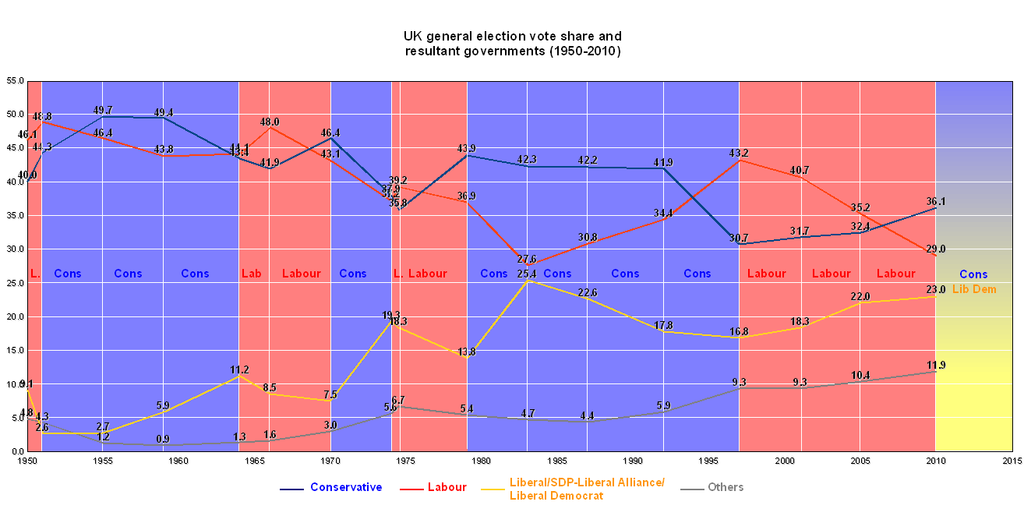
Here in jolly old Britain we’re halfway through the periodic bout of insanity otherwise known as a general election campaign. Way back when, the political parties, of which there were only two that counted instead of seven (how we used to look down on the Italians, who never seemed able to elect a stable government!) would announce their manifestos, appear in a few party political broadcasts and set off into the country for their once-in-a-blue-moon encounters with the voters.
These days the parties, or rather the leaders (because nobody counts but them, do they?) unleash a carefully choreographed cascade of announcements, photo opportunities, tweets and factory visits. And that’s before they launch their manifestos! The manifestos themselves are carefully timed so that everybody has their turn in the spotlight. Yesterday, it was the turn of the UK Independence Party, from somewhere in Tonbridge, and the Social Democratic Labour Party of Northern Ireland. Or was it the Democratic Social Labour Party, or the Popular Front for the Liberation of Judea?
Anyway, thank goodness for that. At least we know where all the parties stand, don’t we? Not without the assistance of a swarm of media analysts, we don’t. We need them to tell us of the gaping holes in logic, and warn us which policies are or are not properly costed. The empty promises, in other words.
All this desperate nonsense from well-meaning people – because yes, most British politicians are well-meaning – causes me to reflect on what a bewildering world we find ourselves in, especially if, like me, we grew up in simpler times. Not better, by the way, because I don’t buy UKIP’s bitter attempts to turn back the clock to an age when husbands beat wives with impunity, landlords banned blacks and the Irish, and stockbrokers like Nigel Farage worked two hours a day, sandwiched between boozy train rides between Brighton and the City. Just simpler.
Take the family, for example, or more specifically those in the upper strata of society.
Once upon a time the offspring of well-to-do families would have followed highly predictable career paths. The oldest male would inherit the estate or the family business. The next son would become a priest. Younger sons ones would work for a living as stockbrokers, doctors or lawyers. Alternatively they would head east (or west) to make their fortunes within the Empire or the New World. The women would be married off. Those who failed to find a match would become maiden aunts who cared for their parents as they grew elderly. If they happened to be Catholic, the nunnery also awaited.
These days – thanks to better education and the housing boom, there are many more people who would be described as well-to-do by the standards of the 19th Century. The really wealthy still hire people to do everything for them. The rest of us have to fend for ourselves. We can do the shopping without a concierge. We can look after our kids without a nanny. We can do our own cleaning without a maid from Ethiopia. We can mow the lawn, buy things online, go on holidays in ordinary aircraft, drive ordinary cars.
Career opportunities for today’s reasonably well-to-do are also more diverse. Choices of university courses are far wider. This doesn’t go down well with everyone. Graduates in the more traditional disciplines – engineering, law, accountancy and the liberal arts – might sniff at some of the newer degrees.
Media studies, for example. Don’t we have enough media types queueing up to be smacked by Jeremy Clarkson? Then there’s leisure and hospitality. I suppose you could argue that golf clubs, hotels and gyms contribute somewhat to Britain’s GDP.
But psychologists? A parasitical profession if ever there was one, busy putting chocolates at the check-out counters to pile the pressure on harassed mums, watching monkeys copulate and creating yet more “conditions” to fuel our mental hypochondria.
IT graduates? More cannon fodder to propel into ill-conceived government projects that cost the taxpayer billions but achieve little more than to compound the frustrations of the long-suffering public who have to deal with online as well as human bureaucracy. Or clambering on board Apple, Google and the myriad start-ups churning out products and apps that nobody really needs.
But in the Big Society – much touted by the Conservatives in the last election campaign – in which people help each other for free, there’s an opportunity for some of these much maligned folks to do something worthwhile. Not least to help out doddering old parents in return for their inheritances.
In the old days it was handy to have a lawyer in your family to protect your wealth, a doctor to keep you alive and a priest to see to your spiritual well-being.
If we assume that modern families still rely on the younger generation for support and expertise that they might otherwise have to pay for, nowadays very different skills are needed to keep us from going insane with worry, and enable us to spend our newly-liberated pension funds in peace and serenity. These days it seems to me that whether we know it or not are three types of person that every family should be able to call upon for help if needed: a media studies graduate, a psychologist and a techno-geek.
Why so? Well, let’s take the current election season. To start with, it should be absolutely obvious to any voter that you need to spend about eight hours a day watching TV and reading the print and online media to figure out what the hell the politicians are raving on about. Should you therefore back off, shut your eyes to the stuff coming at you from all angles and vote by your gut feeling, or according to family tradition (as in “I’ve always voted conservative”)?
Then how do you ensure you and your fellow voters are not being taken for a ride? That’s where the family helpers come in. Your media studies graduate should be able tell you what is spin and what isn’t. She will be able to help you distinguish between contrived stories and genuine ones. And if it’s not already blindingly obvious, she may be able to help you tell the difference between scare stories and real problems.
And your psychologist son may know something about micro-expressions, and be able to help you detect the transient facial tics which indicate that the very plausible politician staring at the camera with a piously sincere expression is actually lying between his or her teeth. He might also be able to point you to phrases they use that have absolutely no meaning whatsoever but are designed to send the seratonin coursing through your veins. Either that, or lull you into a contented sleep on the couch in front of Newsnight.
All that emotional stuff like assurance, well-being and security gives you the feeling that you’ll be in safe hands with this or that politician, despite the grim reality that no government – can control more than, say, 25% of the outcomes they promise. Why? Because there’s little any individual government can do to mitigate a natural catastrophe like a super-volcano, or man-made disasters like the collapse of the Chinese economy, the implosion of the euro-zone or war with Russia. Be afraid. Be very afraid, then call on your family psychologist, psychiatrist or therapist for help.
I haven’t mentioned the geeks yet have I? Apart from helping you to block unwanted emails from political parties, their use in an election is of limited value unless you’re an election geek yourself, in which case he can direct you to opinion on the social media, or help you to decipher the opinion polls that predict the outcome of the election based on the opinion of one man and his dog from Luton.
The geeks have other uses, which we’ll come to in a while.
Once the election is over, things will return to normal, and we’ll return to normal nightmares. The problem for middle-aged citizens of the 21st century like me, is that many of us are ravenous users of the internet. We’re blessed with always-on broadband. We who shop for 50% of what we buy online. We’re partial to the odd tweet and we like keeping tabs on our kids on Facebook. We suffer through hours of ads on telly, on the radio and on the web. Unless we switch off al devices and run to a monastery where we can moulder away in our final years, we cannot escape from people trying to sell us stuff – directly or indirectly.
This weekend I watched the coverage of the Oxford-Cambridge Boat Race – a feature of British heritage that most foreigners find utterly inexplicable. Not so long ago you would have had to sit through 15 minutes of nonsense about the teams, and then straight into the race. These days the whole thing is sponsored up to the eyeballs. Interminable pre-race coverage, interviews with the stroke’s granddad and the cox’s cousin, pictures of the coach’s dog. A pre-race tableau withthe teams lined up in front of – you guessed it – the sponsor’s logo. And a trophy, as if the glory of crushing the other buggers in blue wasn’t enough. For what? For the viewer? No way. For the crews, maybe. I guess the money goes towards technology that shaves a few seconds off the race time. So rowing is heading in the same direction as Formula One, where the kit rather the knucklehead behind the wheel determines the outcome. What happened to Chariots of Fire?
And has anyone noticed how smart and pervasive the online media has become? I make a search on a flight to Riyadh, and seemingly until the end of time I will get emails telling me about cheap flights to just about every city in the Middle East. I look at Amazon to check out lawnmowers, and for some reason Jeff Bezos has become convinced that I’m looking for enough equipment to maintain the gardens of Hampton Court Palace.
This is not to mention all the spam you get from people who have stolen your details from some online vendor with useless security, or because you agreed that your details could be shared with others by pressing the Agree button to terms and conditions longer than the Encyclopaedia Britannica (the very fact that I mention that august publication shows my age, doesn’t it?).
I have a Gmail account which readers of this blog can use to communicate with me if you so chose. The trouble is that a thousand social media geeks have hovered up my details, so that for every single email I get from a reader, I have to skip over a countless offerings from publicists who want to tell me that there’s a very good hospital in Abu Dhabi that specialises in repairing anal fistulas. And before you ask, no, I have never suffered from that dire affliction, nor have I ever done an online search for an elderly relative whose world is coming out of his bottom, so to speak.
So send me a media studies graduate who can tell me why I’m being bombarded with all this ordure. Give me a psychologist who can help me come to terms with this loathsome new world in which everything coming at me has a price or an ulterior motive attached to it. Call a geek to show me how I can protect myself from and army of phishers and fraudsters that want to rob and exploit me. I may be wise to the cyber-robbers now, but what about decades from now when my marbles are going but I still retain enough savvy to use the internet, and when the internet of things offers perennial temptation to press a button and buy what I don’t need?
Watching those fine athletes posing and preening before rowing their guts out down the Thames makes me wonder where the sponsors will go from here. Will we have sponsored war? Will celebrities invite magazines to be present at the birth of their children? What about funerals – sponsored by Goodbye Magazine? Will logos be genetically engineered to appear on the backsides of elephants? People are already renting their bodies for tattoos of logos, so why not embed the logo in your DNA?
It seems to me that we are in an age when the media is more important than the people it serves. When Lynton Crosby, the Conservative Party’s Aussie spin doctor virtually orders David Cameron to demote Michael Gove from his high profile job as Education Minister because the Gove brand is not playing well with the customers – aka the voters. When a star journalist like Nick Kristof of the New York Times has the audacity to tweet about the detention of a Bahraini political activist: “Bahrain’s government is enraged by @NABEELRAJAB’s post on my blog. If they really want to show Bahrain is inclusive, just give me a visa!” Yes Nick, and why don’t they make you King of Bahrain while they’re at it?
Let’s not even talk about product placements in film and TV shows, about websites that take an age to load because because of the ads, about the rubbish that adulterates social media sites like Facebook and Twitter, about brain-rotting lists from Buzzfeed and inane videos that tell you that you won’t believe what Grandma did next, and the ten calls a day from robots trying to convince you that your bank has ripped you off or that tiny dink you had in your car has given you a life-changing whiplash injury. The Mad Men now seem to rule a Mad World.
You might think of this as a dyspeptic rant of a grumpy old man. And yes, we’re all being bombarded with ads, manipulated by spin doctors and saturated with sponsors. It’s life. We should be used to it by now. But consider the role the dark arts have played in the rise of Isis, and in the capture of the Russian media by Vladimir Putin that has resulted in 87% of the population thinking he walks on water. Consider also British newspapers that are alleged to back off from incriminating stories about their advertisers; the diet industry that leads us up hill and down dale to persuade us to use products that end up discredited next week; the sustainable energy industry that rips out the rain forest in pursuit of bio-fuels; the fashion industry that clothes us on the back of slave labour; the IT and telecoms industry that sells us products with features most of us never use. I could go on, but you’d go to sleep if you haven’t started nodding already.
There are a few heroes out there who resist the temptation of squeezing every drop of commercial benefit from what they do.
Andy Murray, who got married last weekend without the benefit of a million pound fee from Hello Magazine or its analogues. Jordan Speith, who won the US Masters golf tournament at the age of 21, and has already set up a charitable foundation to help kids with special needs and injured veterans. And there are a few members of the super-rich fraternity who do some good. People like Bill Gates who, despite his company’s questionable business tactics, redeems himself by ploughing vast sums into medical research. Whereas other plutocrats pour their wealth into political campaigns that leave you wondering if any politician in the US can succeed without being hopelessly compromised by the money they receive from 0.01 percent of the population.
As for me, I will never be able to influence more than the flight of a butterfly. But rest assured that my humble efforts in this blog to inform, amuse and provoke will never be underpinned by anyone’s money. You will never see a paid ad on these pages (unless I get desperate of course!).
When it’s time to shuffle off, assuming it’s to the next world, a part of me wonders if the decision to send me to heaven or hell will have been outsourced to some celestial service company, and will, as some religions promise, be based on a gigantic database that has recorded our every thought and deed – also outsourced no doubt. After all, who knows what Steve Jobs and Margaret Thatcher are up to these days?

It’s 1971, and I’m sitting in my room in a student house in King’s Heath, a suburb of Birmingham. Not studying as usual. The gas fire is on – no central heating in those days. I have record deck, a decent amplifier and two big speakers. Somewhere on the floor are my LPs, my most precious possessions.
I have about a hundred. Some classical, the rest the usual mish-mash that a student might possess who’s at university for the experience rather than through a burning desire to follow a specific career: The Stones, the Beatles, Crosby Stills and Nash, Leonard Cohen, the Doors, the Incredible Spring Band, Jefferson Airplane, Joni Mitchell, Jimi Hendrix, Led Zeppelin, Traffic and Blind Faith. Each grabbed me in different ways: lyrics, musicianship, emotional, political and social reach.
I have a few friends with me on the floor of my room. We didn’t do armchairs in those days, just carpets and mattresses. We often sit listening to the music in silence, incapable of conversation for reasons I’ll leave you to guess.
Those were the days. If we weren’t playing records, we might have been in the pub, at parties or at gigs in the student’s union. Mornings were not a good time. I lost count of the number of 9 o’clock lectures I missed. When I look back it seems that my whole life revolved around music – and of course the usually hopeless search for romance. Later I went on for a few years to promote concerts and manage groups. Some of my friends were already writing songs and playing in pubs or student events.
None of us hit the commercial heights for one reason or another, yet for me that period – the early Seventies – was one of the most glorious times of my life. Those who stayed with their music have produced work as memorable as that of the vinyl stars I listened to back then. Andrew Morton, for example, and the late Jim Cleary.
Some of the music that inspired us in 1971 I never revisited, or if I did I laughed out loud that I was ever so enraptured – the Incredible String Band, for example. Fey, self-indulgent, over-ornate. Baroque fury signifying nothing unless your perception was chemically distorted. Other artists I listen to still, even if the passage of time and a different perspective makes me smile at the naivety of the lyrics.
But there was one person – a singer – with whom I fell in love, and I’m in love with her still, even though she’s been dead for thirty-seven years. Did I really fall in love with the person? Of course not. I only knew her through her music, through what she projected in her songs and with her matchless singing. Sadness, longing, joy, love and revenge.
That person was Sandy Denny. I still get lost in her music today. And I still mourn her early death – one of the less celebrated music casualties of the last four decades, yet no less a tragedy than the demise Hendrix, Joplin, Morrison and other contemporaries who crashed and burned.
Mick Houghton, music journalist and PR, has written a biography of Sandy. It’s called I’ve Always Kept a Unicorn. In the introduction he talks about his love affair with her. So I was not alone in my devotion. I suspect there are thousands like me and Houghton. I hope they get to read his book.
For those who are not familiar with Sandy’s life and career, here’s a nutshell. Born and raised in Wimbledon, she started singing in folk clubs as an awkward teenager with a divine voice. She rubbed shoulders with the likes of Paul Simon, Bert Jansch, John Renbourn, Richard Thompson, Martin Carthy and Dave Swarbrick. After an unhappy spell as an auxiliary nurse she went to Kingston Art College, which seems to have been a breeding ground for musicians – other eminent alumni included Renbourn and Eric Clapton.
After a brief spell with the Strawbs, Sandy joined Fairport Convention and recorded three memorable albums, What We Did On Our Holidays, Unhalfbricking and Leige and Leif. Between the last two albums the band were shattered by the road accident that killed their drummer, Martin Lamble and left Ashley Hutchings, the bass player, seriously injured. Swarbrick, Britain’s foremost folk violinist, then joined Fairport. He, Sandy, new drummer Dave Mattacks and bassist Dave Pegg were part of a band that effectively to re-invented themselves after the crash. With Leige and Leif you could argue that they single-handedly created the folk rock genre. Bands like Traffic, Steeleye Span and even Led Zeppelin followed in their footsteps.
Sandy left Fairport in 1969 and formed a new band with Trevor Lucas, her Australian boyfriend. Fotheringay recorded a single album. Sandy then released three solo albums before returning briefly to Fairport, with whom she recorded two albums – one live and one studio. Subsequently her career went into decline as she became increasingly dependent on drugs and alcohol. After her second stint with Fairport she recorded one more solo album and was then dropped by her record label. She died in 1978, aged 31, after a fall which appeared to have triggered her collapse into a coma a few days later.
Like Houghton, I lost her in her last few years, and only when she died did I realise what we had all lost. Her death had as least as much impact on me as John Lennon’s the following year. Lennon died young, but he fully explored his talent over more than twenty years of making music. Sandy’s life was full of what if’s. The commercial success many felt was her due eluded her. She was and remains a cult figure, unlike her American contemporary Joni Mitchell. What if, for example, she had settled in California, where she had a large following?
In I’ve Always Kept a Unicorn, Mick Houghton fills out the bare facts of her life with input from a host of people who knew and worked with her. Trevor Lucas, the love of her life whom she eventually married, is not around to tell his story. He died of a heart attack in 1989 at the age of 45. But by piecing together contemporary accounts and more recent interviews, the author tells a tale that would be familiar to those who believe that extreme talent, or genius if you want to call it that, often comes at the price of a tortured personal life.
Many of Houghton’s sources describe a woman who was insecure but exuberant, lovable yet sometimes hateful, stubborn yet sometimes indecisive. She struggled against being labelled a folk singer, rightly pointing out that her work went way beyond her original folk roots. Her soaring vocal contribution to Led Zeppelin’s Battle of Evermore is evidence that she was no ordinary singer.
Sandy’s own songs are almost always contemplative, often sad and frequently autobiographical. Unlike Joni Mitchell, she rarely spoke directly of her life, preferring to rely on metaphor.
As a singer, she was beyond compare. Yes, that’s a highly subjective view, but one shared by many of her friends and fellow musicians. For me, only Barbra Streisand and Celine Dion come close to her for feeling, phrasing and vocal quality. What perhaps clinched my love affair with her was her Englishness – despite her Scottish roots – and in her songs the sense of innocence and melancholy that chimed with my age at the time. Yet unlike many of her contemporaries, much of her work feels as fresh and compelling today as it did in her lifetime. Surely a mark of greatness.
If you have have never encountered Sandy Denny, you could do worse than start with Banks of the Nile, Who Knows Where the Time Goes, It’ll Take a Long Time and Fotheringay. Also take a look at this BBC recording from 1971 on YouTube. It doesn’t feature my favourite songs but captures her intensity of performance and the purity of her voice.
If you’re among the many who loved Sandy when she was alive, or discovered her subsequently, Mick Houghton’s book is well worth a read, if for no other reason than that he puts her music into the context of her life – her often stormy relationship with Trevor Lucas; the producers, managers and record company bosses who supported her, messed with her and ultimately walked away; her fellow musicians who admired and loved her but often found working with her exasperating; the underlying meanings and messages in her songs; and the final weeks and months when she fell apart.
As with all artists who die young, there is always the lingering question of what she might have achieved under different circumstances. Ironically as it turned out, one of the songs she recorded was Elton John’s Candle in the Wind – more appropriate to her life than to those of Marilyn Monroe and Princess Diana, I’ve always thought.
If you believe in predestination, then the last word belongs to Linda Thompson, whose husband Richard worked with Sandy throughout most of her career. Houghton quotes her thus as she compares Sandy with Nick Drake, another revered singer/songwriter who died young:
“I don’t mean to romanticise, but I am a believer in fate or destiny. She had such an amazing life and such an amazing talent and she left some wonderful songs and that might have been all that was meant to be. And Richard did say something like that at the funeral – something to the effect that she was never meant to write anything more, which upset some people. But we were both like that at the time. I still feel like that.
Sandy wasn’t daft. Part of her went to the country to finish the job. It was the same with Nick Drake. I never feel with either of them that it was the biggest tragedy, “How could this have happened?” It was perfectly obvious to everybody and it was perfectly obvious to them. That’s their destiny. What Nick and Sandy left behind is amazing, and I don’t think he had much of a will to live at the end. I don’t think Sandy did either.”
Whether Sandy Denny’s end was premature or written in some book of destiny, she left us plenty to treasure, for which we should be thankful. And If I was given the choice of a long life or thirty-one years in which I would match her achievements, I sometimes wonder if I wouldn’t have opted for the latter.
Yesterday’s announcement by Neil MacGregor, the Director of the British Museum, that he is leaving to set up a similar institution in Berlin coincides with news that Goethe University in Frankfurt is setting up the nation’s first professorship in Holocaust studies.
I have a few memories of Germany, some good and others not so good. I once spent an idyllic autumn walking down the Roman limes – the border fortifications that marked the limit of Roman rule – in the forest near Bad Homburg, living on a diet of grapes and wurst. I had a conversation on economics – in English – with a Stuttgart taxi driver whose knowledge far exceeded my own and probably that of the vast majority of English cabbies. In Frankfurt I got drunk for the first time at the age of eighteen. The poison was a German equivalent of scrumpy, a cloudy, toxic brew much loved in England’s West Country. Not an experience I would wish to repeat.
A few years ago I made my first trip to Berlin – and hated it. I felt oppressed by its monumental architecture. Wide streets, huge buildings towering over the inhabitants. A series of messages – from the time of Frederick the Great through the Bismarck era, the Nazis period and the rivalry of two ideologies that divided the city in two during the Cold War. Even after unification, Berlin continued to build on a monumental scale, re-building much of what was flattened during World War 2, and creating steel and glass blockbusters to evidence the German state’s modern prosperity.
For me it’s a brutal city, not built for its inhabitants but to show off. Perhaps Berliners like it that way. Certainly the couple energetically making love in front of an uncurtained third floor window opposite the pavement café where I and my friends were eating seemed to enjoy sharing their passion with the rest of the world.
I should have expected the city to make a strong impression one way or another given its history, and given its modern reputation for “edginess” (one of those clichés beloved of travel journalists that usually send me on a wide berth around the object of their attention).
Goering’s Air Ministry, Goebbels’ Propaganda Ministry, the grim remnants of Himmler’s SS/Gestapo headquarters next door to what remains of the Wall and the humble children’s sandpit surrounded by dowdy communist-era apartment blocks that marks the spot where Hitler’s fellow bunker dwellers burned his body were depressing landmarks of the city’s recent past. The concrete blocks of the Holocaust Memorial and the magnificent Pergamon Museum went only some way towards redeeming what was by and large rather a gloomy experience.
But as I often point out to friends whose only experience of Britain is a trip to London – a country should not be judged solely on its capital city. And given the damage inflicted on Germany’s cities by bombs and shells, it’s a miracle that so much survives – rebuilt or otherwise.
The wartime scars – and the enduring fascination in Britain with all things Nazi – tend to overshadow the fact that for much of the five centuries before the last one, Britain and Germany – or the constituent parts thereof, were often the best of friends – culturally, politically and militarily. We acquired a German dynasty on the British throne in the eighteenth century. It was the Prussian army that sealed the victory over Napoleon at Waterloo. Queen Victoria’s consort was a German prince, and her daughter was married to the crown prince of the unified German Empire.
If Germany and its rivals had taken a different path in 1914, perhaps we wouldn’t need Neil MacGregor to remind us of its earlier legacy. We should really speak of Germans rather than Germany, because before 1870 there was no such political entity – merely a plethora of semi-autonomous city states, bishoprics, duchies and kingdoms that constituted a major part of the Holy Roman Empire.
I missed Germany – Memories of a Nation, the British Museum’s 2014 exhibition. But MacGregor’s subsequent book of the same title more than makes up for the omission.
The author uses objects and places and artists to build his narrative, much in the same way as he did with A History of the World in 100 Objects, his renowned radio series for the BBC. Gutenberg’s printing press, Luther’s bible, porcelain from Dresden, Bauhaus furniture, the Iron Cross and the German sausage. Dürer, Goethe, the Brothers Grimm, Klee and Kolwitz. Kaliningrad and Strasbourg, now Russian and French respectively – symbols of Germany’s ever-shifting frontiers.
Over six parts he traces the origins of Germany under the Holy Roman Empire, the growth of trade and commerce, the Reformation and the Enlightenment, political upheavals, civil strife and wars culminating in Napoleon’s destruction of the Empire, unification under Prussian hegemony, the disaster of 1914-1945, the division and finally the reunification of the state we know today – all by reference to the works of art, literature, architectural landmarks, craftmanship and cultural icons.
Were it not for the bestiality of Nazism, these would be the first things to come to mind when we think of Germany – unless of course we happen to be into football.
Memories of a Nation is not an ultra-highbrow tome. Although it’s likely to appeal most to history nuts and culture fiends, it’s highly accessible and beautifully written. It has as many pictures as the average coffee table book, but far more written content across its 500-odd pages.
Much of what I previously knew about Germany was in the context of English history. Without indulging in a laborious chronological narrative, McGregor fills in some gaps. For example he uses the perfection of the Chinese technique for producing porcelain to illustrate the commercial rivalry between cities and states. He tells the story of Tilman Reimenschneider, perhaps the greatest wood sculptor of the renaissance, who found himself on the wrong side of the 1525 Peasant’s Revolt, and ended up having his hands broken for supporting the demands of the oppressed.
He discusses the origin of the Iron Cross, created at a time when the Prussian state – much of it conquered by Napoleon – was confined to the enclave of Koenigsburg (now Kaliningrad, part of Russia). A shortage of precious metals was turned into a virtue; it became fashionable for society women to wear iron jewellery. And iron became a metaphor for Prussian – and ultimately German – resilience and strength, so effectively marshalled by Bismarck, the Iron Chancellor of the unified nation.
My memories of Germany are helplessly bound up by the Nazi era, more so after reading Memories of a Nation. How could a nation – in the widest sense of the word – produce Albrecht Dürer, Martin Luther, Johann Sebastian Bach, generations of classical scholars and archaeologists, writers and philosophers like Goethe and Kant, and yet descend into barbarism? How could people who contributed so much to Western civilisation devote their talent to the industrial-scale extermination of whole sections of their society? A mass psychosis brought about by the collapse of the imperial project in World War 1? A resurgence of deep-seated exceptionalism instilled in the nation in the nineteenth century?
Those questions are endlessly discussed by post-war historians far more knowledgeable than me. But MacGregor’s book led me to revisit The Topography of Terror, a chilling documentation of the apparatus of oppression and extermination established step-by-step over the twelve years of Nazi rule. Chronologies, extracts from laws, memoranda of SS and Gestapo bureaucrats, biographies of victims and perpetrators, pictures of the huge complex of headquarters buildings in central Berlin devoted to the practical application of Nazi ideology tell an appalling story. I bought the book at the exhibition on the site of those demolished buildings, of which little remains but the basement cells in which prisoners awaited torture and death, but these days it’s also available on Amazon.
It’s to Germany’s credit that it never supported a “right to be forgotten”, even if many thousands of willing participants in the Nazi project did manage to fade into obscurity, unnoticed and unpunished. Thanks to its reinvention as an energetic, prosperous and fundamentally humane social democracy, and as the passing of time extinguishes living memories of that dark era, attitudes towards the country have slowly changed from contempt to admiration, underpinned by an acceptance that “that was then, and this is now”.
Today the history and heritage of Germany serves as a lesson as much for the rest of us as for today’s Germans. Other nations and peoples have shown in subsequent decades that what happened in Germany is far from unique; that under certain conditions we are all capable of oppression and genocide, and that civilisation is a very thin veneer, easily fractured. Yet equally many of our societies are capable of stunning acts of invention and creativity, and none more so than the Germans.
Neil MacGregor has done wonders for the British Museum. It’s one of my favourite places in London. I frequently revisit galleries that feel like old friends. And some of the temporary exhibitions, particularly those of Pompeii, the Vikings and the Aztecs, have been a joy to behold.
If he can create an institution in Berlin to rival the one he is leaving, perhaps the record of German contributions to humanity in the eyes of the city’s visitors will finally put its acts of destruction in the shade.
 59steps