
According to Daniel Finkelstein, columnist for The Times, Conservative Peer and statistical analyst. “this campaign will turn out to be the election campaign of our lives”. If last night’s General Election debate between seven party leaders is anything to go by, he may be right, but not necessarily in the way he intended.
The debate was a contest of personalities. Its format was about as conducive to exploring the issues as a stream of Twitter one-liners. For unfortunate voters who might be pondering how to cast their ballots, it was about as useful as trying to listen to birdsong in a London traffic jam.
No doubt the orchestrators of the debate would say that the limited time restricted the number of issues. They would be right, but shoe-horning the opinions of seven leaders into two hours allowed for little more than soundbites, big pictures and pointing fingers. One wonders how Churchill, Macmillan and others would have fared. Or which opponent Harold Wilson would have smacked in the face.
On the personality front the bombastic Nigel Farage, the UKIP leader, won out because he had little to lose, because everybody expected him to behave like the pub loud-mouth. I found myself waiting for each successive variant on his single theme – we must leave the European Union. He also won hands down in the face-pulling contest, rivalled only by Labour’s oh-so-caring Ed Miliband.
Commentators often explain the rise of marginal parties like UKIP on the grounds that an increasing number of voters are anti-politics. I don’t believe that the electorate is wearier with politics than in any of the dozen-or-so previous elections I can recall. I think that most of us are anti-bullshit, and our cynicism is more about broken promises than honest failure. Nothing new there. Have we not heard the same refrain at every election in living memory?
Judging by the issues selected for the debate, it does seem that we are more insular in our concerns than at any recent time. Whether that’s the media’s fault or that of the politicians, I don’t know. But it says much about our national mindset that the Iran agreement – potentially one of the most significant diplomatic breakthroughs of the past decade – took second place to the debate in the subsequent news programmes.
For what it’s worth, here are some thoughts on the topics discussed – and not discussed – last night:
- Nigel Farage claimed there was nothing any of the leaders could do about immigration as long as the UK stays in the European Union. There was no discussion on limiting immigration from outside the EU, which is something governments can control.
- There was no discussion on foreign policy. Developments in Russia, Iran, China and the Middle East could derail the best-laid economic plans. Not a single caveat that the UK’s prosperity over the next five years depends as much on factors beyond the country’s control as within it.
- Another subject that didn’t get a mention was defence. Are we so certain that we will never again need to act unilaterally in defence of our interests or against the grain of international consensus, as we did in the Falklands?
- Farage’s health tourism remark – about the cost of treating non-British HIV sufferers – snuffed out any potential debate on the benefit to the National Health Service of paid health tourism. Does the UK make the most of its reputation and facilities in treating foreign visitors who are prepared to pay?
- Nicola Sturgeon’s remarks about the benefits of free tertiary education hit home. If there was a choice between university places for all at a cost, and free places rewarding those who meet tougher selection criteria, one wonders which option the electorate would go for. With the National Health Service firmly entrenched in British politics as a sacred cow, why is education not similarly sacred?
- Why did nobody point out that foreign students, who do pay substantially for their education in British universities, play a major part in funding tertiary education? Should be not be welcoming more of them, not less, not least because of the goodwill towards Britain that these graduates bring back to their home countries?
- Nicola Sturgeon was impressive, just as Nick Clegg was in the 2010 debates. Almost certainly her Scottish Nationalist party will have greater influence in the next parliament even if they don’t end up as coalition partners. But Sturgeon should ponder the fate of Clegg, whose Liberal Democrats stand to lose many seats this time round. What goes up comes down.
- It’s interesting that there was no mention as to whether the experiment of a fixed term parliament will be repeated. Are we prepared to be stuck with a weak and indecisive coalition for the next five years?
- Finally, the leader of the Welsh Nationalists made a point that I would endorse. If there is to be a referendum on Britain’s membership of the EU, an exit should be contingent on each component of the United Kingdom – England, Scotland, Wales and Northern Ireland – voting in favour. If we believe in devolved decision-making in the British Islands, we should not be seeking to force any component in such a fundamental direction against its will.
It sticks in my craw that a single-issue demagogue like Farage, who represents the sum of England’s racist, xenophobic sentiment, was given an equal place at the debating table despite leading a party with as much substance as the national football team. Fine if there had also been debates between the parties with a realistic chance of being elected. But then I suppose it was useful to hear from the minority parties that, like it or not, are bound to have an influence over any minority government that might be formed.
All in all, for this viewer the event was a pretty futile exercise – as unsatisfying as a cardboard burger. I suspect that this was the outcome in David Cameron’s mind when he agreed to what was always going to be a political speed date.
I’m not one who writes off all politicians as self-serving careerists. There are plenty of talented, well-meaning people in all the parties represented last night, with the possible exception of UKIP. The sad reality is that the presidential-style debate format projects the participants as the embodiments of the parties they lead. Thanks to the campaign managers, other voices will not get a look in, or at least their exposure will be limited to two-minute news clips and specialist (therefore minority interest) current affairs programmes.
I suspect that this debate might be the only piece of discussion that many of our voters will tune into over the next few weeks. So if our nation’s perception of each party stands or falls on the performance – and likeability – of the not-so-magnificent seven in two hours of superficial blathering, then the outcome on May 7th is anybody’s guess, and not necessarily one I look forward to.
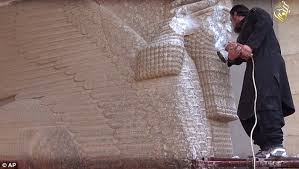
Does the desecration of Nimrud and Hatra by the so-called Islamic State add ammunition to the argument that priceless antiquities scooped up from around the world by the colonisers and the wealthy should stay within the safe embrace of Western museums?
You bet, if you believe that sooner or later the black flags will fly over Athens, Cairo and Baghdad. And to boost the argument further, it wasn’t the Daesh storm troopers who blew up the Bamiyan Buddhas and looted the museums of Cairo and Baghdad.
In conflict zones where religion plays a part, it seems that antiquities are fair game, either as a source of funds or as a means of making a politico-religious point. Nothing unusual in this – the newly powerful have a habit of trying to erase evidence of the formerly powerful by destroying things. The early Christians in their desire to eradicate pagan worship pulverised much of the finest Greek and Roman statuary. The Byzantine iconoclasts ripped down and burned thousands of exquisite religious artefacts in the cathedrals and churches of their declining domains in the hope that God would thereby again look favourably upon them.
In Baghdad, the Tigris ran black with the ink of books cast therein by the invading Mongols. When Henry VIII destroyed the English monasteries, gold and silver treasures were melted down to fund the King’s endless arguments with France. His son Edward VI and the puritans of a century later finished the job by whitewashing the walls of the churches.
And in case we imagine that great acts of cultural destruction are carried out only by invaders and religious fanatics, consider the burning the Great Library of Alexandria by Julius Caesars’s troops, and the demolition of cathedrals and churches by Stalin’s henchmen in Moscow.
Yet for all the efforts of the blind, the bigoted and greedy, enough remains from every era of history to educate and inspire future generations. Daesh may seek to erase history and make a fast buck in the process, but their task is made harder than ever by the very medium that they have exploited to feed its rise: the internet. Every museum has a website. Books are being digitised and many universities have put the efforts of their scholars online.
What is above the ground has been documented, analysed and pondered over, even if future generations will now be deprived of the opportunity to revisit the conclusions of the past in Nimrud and Hatra. But what is still under the ground is equally important, and the likes of Daesh would need a massive fleet of JCBs to erase what has yet to be discovered in the territories they control. Beyond the Middle East, two-thirds of Herculaneum lies unexcavated under metres of volcanic ash. Cities are still being discovered in the jungles of Central America, and under the sands of the deserts that skirt the ancient Silk Road.
Of course it’s sad that young Iraqis will not have the opportunity to touch the walls of their ancient cities. Not just Iraqis – anyone who has an interest in the history of earlier civilisations. In one sense, ancestry doesn’t really come into it, because there are not so many ethnic groups on our mainland continents whose genes can’t be traced back to forebears from any number of geographical areas, whether as the result of migration or conquest. I am likely to have as direct a line of descent from an inhabitant of ancient Nimrud as a modern Iraqi, just as the blood of Genghis Khan flows in sixteen million people across the world.
But national heritage counts. Egyptians – those who don’t want to raze the sphinx and the pyramids – feel proud of their pharaonic past, just as the Irish are proud of their Celtic lineage, even if Egypt is a melting pot of African, European and Asian ancestors, and archaeologists cast doubt on the central role of the Celts in the pre-history of the British Isles.
Though organisations like Daesh try to expunge physical evidence of an inconvenient past, and fashion the minds of their youth through selective education and ideological control, they have no more chance of erasing history than they have of capping a volcano. There are too many books, too many internet nodes, too many satellite dishes and too many people. Information borders are way more porous than the walls and fences that separate countries.
I’m the proud owner of a modest collection of ancient coins. Every so often I take one out – perhaps an Athenian tetradrachm or a denarius of the Roman Republic – and I hold it in my hand, knowing that I’m touching something that merchants, slaves and small farmers might have used over two millennia ago. That’s just one way in which I connect with the past. Some sing songs and recite poetry. Others listen in churches, mosques and synagogues to tales of suffering and exultation. Or read books and visit museums.
Whether we’re illiterate or hold a doctorate from Harvard, we are all touched by history in one way or another. And it’ll take more than a bunch of psychopaths with sledgehammers to wipe out the history of Iraq and Syria. Just as when the murderers are all dead, buried or atomised, the memory of the suffering they inflicted will be passed on through generations.
People in the Middle East have long memories, in case Daesh have forgotten. The tragedy is that so many of their stories are soaked in blood.
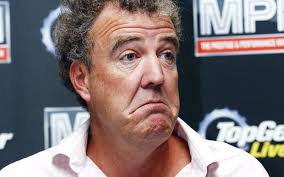
The difference between Jeremy Clarkson and the dinosaurs is that they didn’t know they had it coming.
I’ve never met the guy, yet I feel that I know him, as do millions of Top Gear fans around the world. I can number the times I’ve watched the show on the fingers of one hand, but I do read his column in the UK Sunday Times.
I don’t know him, but I know his tribe. Once upon a time, when I was at boarding school, I was thumped in the face by the son of a famous film director. I don’t remember why, but I do recall that he was several years older, and was good at sports. I’d probably behaved like a nerdish 14-year-old and hadn’t shown the necessary respect due to a prefect. A very male reaction. I won’t say he was a bully, because that was the only time it happened. Nor was bullying a regular feature of school life. But in Britain’s public schools war war has always been a viable alternative to jaw jaw.
Within the public school tribe of which I’m a member – Britain’s private schools are rather confusingly known as public schools – there tended to be two camps: those who were for things and those who were against them. The pro’s were the prefects, the captains of cricket, the upholders of the school traditions, those who excelled in the traditional things, like exams, who went to Oxford and became judges, or inherited the family land. The anti’s were the rule-breakers, the sniggerers, the mickey-takers, the poseurs, the smart-asses who mocked everything and everyone. They tended to be good at art, writing, acting and anything else that marked them out as different. Not rebels exactly, because many of them were smart enough to get to the universities of their choice.
When they left school the two camps coalesced at the edges somewhat. Comedians became doctors and head prefects became eco-warriers. More often the pro’s continued their upright path to become generals, captains of industry, politicians, academics and diplomats, though not without the occasional bout of ritualised wildness at university – as witness the antics of Boris Johnson, David Cameron and George Osborne in Oxford’s Bullingham Club. The anti’s went to art school, the BBC, the theatre or publishing, and sometimes to an early grave for one substance-related reason or another. I use the past tense because most of the public schools in my day were single sex. For the last thirty years many of them have opened their doors to girls. This has changed the dynamic somewhat, though there are a number of schools – Eton for example – that have remained resolutely male only.
Clarkson I suspect was a dedicated anti. He was expelled from a similar school to mine for various misdemeanours including, according to him, drinking and smoking. Very male activities, in which I also indulged, though not to the extent that I was kicked out. He comes over as confident within the parameters of male camaraderie. Perhaps more comfortable in male company – in the pub, in cars, doing male things. And like many fellow-anti’s, he’s intelligent, witty and perceptive. He would appeal to his smart friends like David Cameron because although Cameron took the pro path, both will sing from the same tribal hymnsheet. Also Clarkson will say things that our Prime Minister might believe yet can never afford to say himself. All speculation of course, but it’s based on my own experience.
So why would someone like him fall prey to the kind of rage that led him (allegedly) to throw a punch at a BBC producer? Was that late-night meal so important that the red mist descended when it was not forthcoming? What of the Madonna-like contract riders demanding that food be available the moment he and his colleagues stepped into their hotel after filming – so precise that they stipulated that the starter should be on the table once he crossed the threshold? Or was there an underlying problem between him and the guy he’s supposed to have hit, or perhaps against the BBC?
Did this example of “do you know who I am?” behaviour stem from the expectation of one who grew up surrounded by privilege, or was it another example of star become spoilt brat, like so many rock musicians I dealt with in my younger days?
I have no idea, because I don’t know all the circumstances and I definitely don’t know the man. But, as I said, I do know the tribe, because I belong to it too. I can spot someone who went to Repton, Eton, Rugby or Winchester a mile off. Not so much when they open their mouths, because these days many have learned to de-posh their accents. But because of signals that are imperceptible to those outside the tribe. Mannerisms, foibles, reactions, responses. Ask me to categorise the signals and I would struggle. But I know them when I see them. And I see them in Jeremy Clarkson. He may have his demons, but he’s a leader. The type of person to whom others gravitate. The life and soul.
If you took a representative sample of Britain’s TV-watching population and asked them what they thought of the man, I suspect that that they would be divided down the middle. There would be those who love Clarkson as the blokeish, brawling (ask Piers Morgan about that – he claims to bear a scar from an encounter with our hero) champion of political incorrectness. And then there would be those who see him as a boorish, bullying representative of the privileged classes with an emotional age similar to that of the guy who smacked me at school. A subset of that group would be the HR types who probably prompted his “final warning” last time round. The BBC is certainly full of them.
But the BBC of today is a far cry from the organisation that first employed John Simpson, that doyen of foreign correspondents, as a junior reporter in the 60s. When Simpson had the temerity to ask Prime Minister Harold Wilson whether he was planning to call an election, Wilson responded with a well-aimed punch in the reporter’s stomach. Did the BBC support its man by referring the assault to the police? It doesn’t appear so.
So will the BBC pull the plug on Clarkson and his show? I suspect not, unless they can come up with an astounding replacement, which seems unlikely – a bit like replacing John Lennon during the Beatles’ heyday. Also there’s too much money at stake, and the BBC is not exactly flush these days.
More likely there will be some sort of financial penalty and an apology to the hapless producer who was the target of the great man’s wrath. I also suspect that Clarkson won’t care either way. If he goes, other TV channels will snap him up in whatever form he proposes. Nothing like a new challenge.
In the long term, though, when details of the fracas become widely known, I suspect that his reputation will be diminished, especially if it turns out that the cause of his anger was the lack of a meal. Because much as we British admire a maverick, especially one with Clarkson’s charm and wit, we do have a keen sense of fair play, and there will be a number of people who might think that he should pick on someone his own size.
As for me, I don’t really care one way or another. It’s just a welcome break from all the really grim stuff that dominates the headlines. And a pleasant change to see a member of my tribe wielding a bludgeon rather than a stiletto.
One thing’s for sure: whatever he does next, he’ll always be part of an in-crowd. But whenever I see Jeremy Clarkson on TV from now onwards, it will be hard not to think of the raging thug who punched me in the face when I was 14.
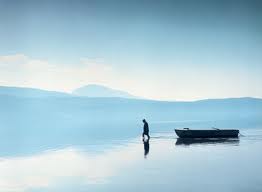
At last a break in the emotional weather. Seven weeks in which my attention has been almost entirely focused on physical ailments and a death in the family have come to an end.
During that time, Jihadi John has turned into Mohammed Emwazi, Binyamin Netanyahu delivered his rapturously-received speech to the US Congress, the Islamic State has bulldozed Nimrud and Hatra in the mistaken belief that it is erasing history, Boris Nemtsov was assassinated in Moscow, England crashed and burned in the cricket World Cup, and a number of dogs that competed at the Crufts Dog Show appear to have been poisoned. Oh, and Britain’s politicians cranking up the silly rhetoric in anticipation of the May election. But the self-serving mediocrity of my country’s politicians is a perennial condition hardly worth highlighting just because many of them are about to lose their jobs.
All stuff that I might have written about had I not been contending with three weeks in a wheelchair while on “holiday” in Bali and Hong Kong, followed by suspected dengue fever and, for good measure, the death of my mother.
So the other day we buried my mother. As 94-year-old, she didn’t have many contemporaries left. And when she died, there wasn’t much of her either. Vascular dementia had taken its toll and pneumonia following a fall had delivered the coup de grace.
But there were enough friends, family, carers and fellow parishioners at the crematorium and the subsequent memorial service at the church of St Michaels in Barnes to make the event feel like an occasion rather than a lonely and anonymous disappearance into the unknown hereafter.
Judith, the priest who officiated, had known her for twenty years, and so had been able to talk about the person rather than blather on in the pretence that she actually had some kind of relationship with her. My brother provided the perspective on her life. And the organist was Martin Neary, who was the choirmaster and music director at Westminster Abbey, and directed the music for Princess Diana’s funeral. Mum would have loved that.
I’m not a deeply religious person, though I’m fascinated, or some might say obsessed, with religion. My attendances at church services are rare, though always interesting. Weddings, funerals and last year the ordination into the priesthood of my sister have all brought opportunities for reflection and observation, whether it’s the music, the ritual, the congregation or church itself.
On this occasion the one thing I yearned for was silence. There was very little of it as it turned out – probably not enough. Music and the spoken word came in a seamless procession. Only once punctuated by the ringtone of a mobile phone.
There’s something special – in fact very precious – about sitting in silence with a group of people, whether in prayer or simply in personal reflection. Where else do you find such silence? Not the silence of estrangement, between two people sitting at dinner who have run out of things to say to each other, or the silence that goes with reading a book. And especially not silent communion with laptops, smartphones and IPads.
My mother was no stranger to silence. In the last two years of her life she suffered from dementia, and would sit in her care home, often with her eyes shut but otherwise staring into space. She was no longer able to read, and I doubt that the pictures and sound that came to her on the rare occasions when she watched TV made sense any more.
But for those of us with minds that function roughly as designed, it seems that the moments when we deliberately sit in silent contemplation are fast diminishing. When we’re on our own we instinctively look for stimulus – a book, TV or radio, the internet or the company of online friends.
One of my abiding memories of the past six weeks of injury and illness was of a line of people sitting opposite the reception desk in our hotel in Hong Kong. There must have been a dozen of them, some related, others clearly not. Over a thirty-minute period I went past them three times. Each time there was no conversation. Each person was sitting, head down reading or tapping at their mobile devices. What were they doing? Scouring Twitter or Instagram? Sending messages via WhatsApp? Or just surfing the web? Or just aimlessly checking things, because the thought of sitting in one place with no stimulus was too awful to bear? Waiting for godot.com.
Now it seems that we will soon be subjected by a barrage of peer pressure creation by Apple, who want to sell us a smart watch. So in a few years’ time there will be an outbreak of repetitive strain injury caused by the constant raising of the left arm to look at….what? Weather forecasts, email alerts, Tinder, tips on foreplay, heart rate, share prices?
Apple clearly understand their market. They understand that there’s a huge percentage of the population obsessed with measuring, defining, calibrating, monitoring. Seeing everything but understanding nothing.
I have never meditated, in the sense meant by practitioners of transcendental meditation, or by Buddhists, Trappist monks or the devout at prayer. But I’ve had plenty of practice at constructive silence.
Many decades ago, when I was at university, I had a summer job with Cadbury’s. I worked four 12-hour shifts a week. One of my tasks was to sit beside a bagging machine. For those who have never encountered one, a bagging machine sends a tube of plastic wrapping, fills it with product, – in this case chocolate – seals both ends and chucks the completed bag into a cardboard box on a conveyor belt. My job was to watch the machine, and press a button if it went wrong. Which it never did in my time of employment. For twelve hours a night, including a one-hour meal break and two 15 minute tea breaks.
You might think that this would be one of the most boring jobs on earth. Enough to turn your brain into sawdust. Yet I remember those hours as an enforced opportunity to put the brain to work. I would develop ideas and spin off new ones endlessly. Sometimes I would exhaust one train of though and say to myself “what am I going to think about next?” Sooner or later something else would pop up – sex, politics, religion, people, social behaviour. All stuff that these days I write about, but in those days stayed in my head. But the thinking was the thing, whether I replayed the output in subsequent conversation or years later in writing. There was no silence. The clattering of machines was everywhere. Yet when you’re internally absorbed you filter out the noise – or at least the repetitive sounds.
There’s some noise I find it impossible to filter – squealing babies, loud conversations in acoustically unsympathetic places and, increasingly these days, loud music. Yet for the past thirty years I’ve had tinnitus, a constant high-frequency whistling that I can probably blame on an earlier life in the music business. It bothers me not a jot because it’s become as much a part of me as the sound of my breathing.
Silence is a very rare thing. Real silence, so profound that it allows you to hear your heart pumping, birds singing, spiders crawling. Stuff that you don’t want to filter because it punctuates the vacuum. Sometimes in bed there’s a kind of silence, punctuated by the groans and creaks a house makes even though you don’t normally notice them. The deepest silence I’ve encountered has been in the desert.
But even in a noisy space, there are plenty of opportunities to sit and think – a park, a railway station, a street café. Yet I fear that small electronic devices have rid us of the habit of sitting in silence, just thinking. Is it because we feel that we’re not using our time wisely if we aren’t buried in an IPad? Are we worried about what others might think if we sit, Buddha-like, staring into space or eyes closed in contemplation? Are we mentally-unstable, demented, a religious nut or just stupid?
Another side-effect of mobiles is that we seem to be losing the art of casual conversation. When you have a smart phone, you always have an excuse not to speak to people around you. Ask yourself, dear reader, how often in a day you actually speak to someone you’ve never met before for anything other than a functional reason, such as to ask the time, or the directions to a place or to order a coffee.
A couple of days ago I struck up a conversation in a place where you normally not find a mobile phone. In a swimming pool. Aida is a 66-year old former nurse from Aden. She grew up under British rule, was educated in British schools and came to England to study nursing. She’s been here ever since. Her English-born husband died last year. She has several brothers and sisters in what is now known as Yemen. Years ago, when she went back to her homeland, the authorities took her British passport and gave her a Yemeni one. She had endless problems back in England, where she was treated as an alien despite holding down a responsible job in the NHS. She has been trying to help her sister, who is a doctor, to get a visa to visit her, but the UK immigration authorities refuse to issue one. The last time she saw her sister was in Sweden, a country she was able to visit without a problem.
Aida’s mother was illiterate, so she was very proud that her children all received an education. Several went to university, and are still working in Yemen and the Gulf. Aida will not go back to Aden because she thinks it’s too dangerous.
All this and more in a twenty–minute conversation between lengths. How many people in England would imagine that the nurse that treated them came from the Crater district, where Colonel Colin “Mad Mitch” Mitchell waged his counter-insurgency campaign in the 1960’s? How many would know that Aden was once a British colony – a convenient fuelling station for ships on their way between Britain and the Raj?
It was an unexpected and enriching conversation with a delightful person. And I wondered what those people in Hong Kong might have gained if they had put down their phones for a few minutes, turned to their neighbours and talked.
And failing that, what we all might gain from putting our phones away for a while and relying on what’s inside us for entertainment. Silent contemplation is a casualty of the wired world. Face-to-face conversation, for the joy of it rather than for a specific reason, seems to be going the same way.
Outside the “developed world” both are still normal features of daily life. But not, I fear, in my street or my town. Nor in my country, where forty-four million birds have disappeared in the past fifty years, and sixty million people are slowly losing their ability to think, listen and connect with others without the aid of technology.
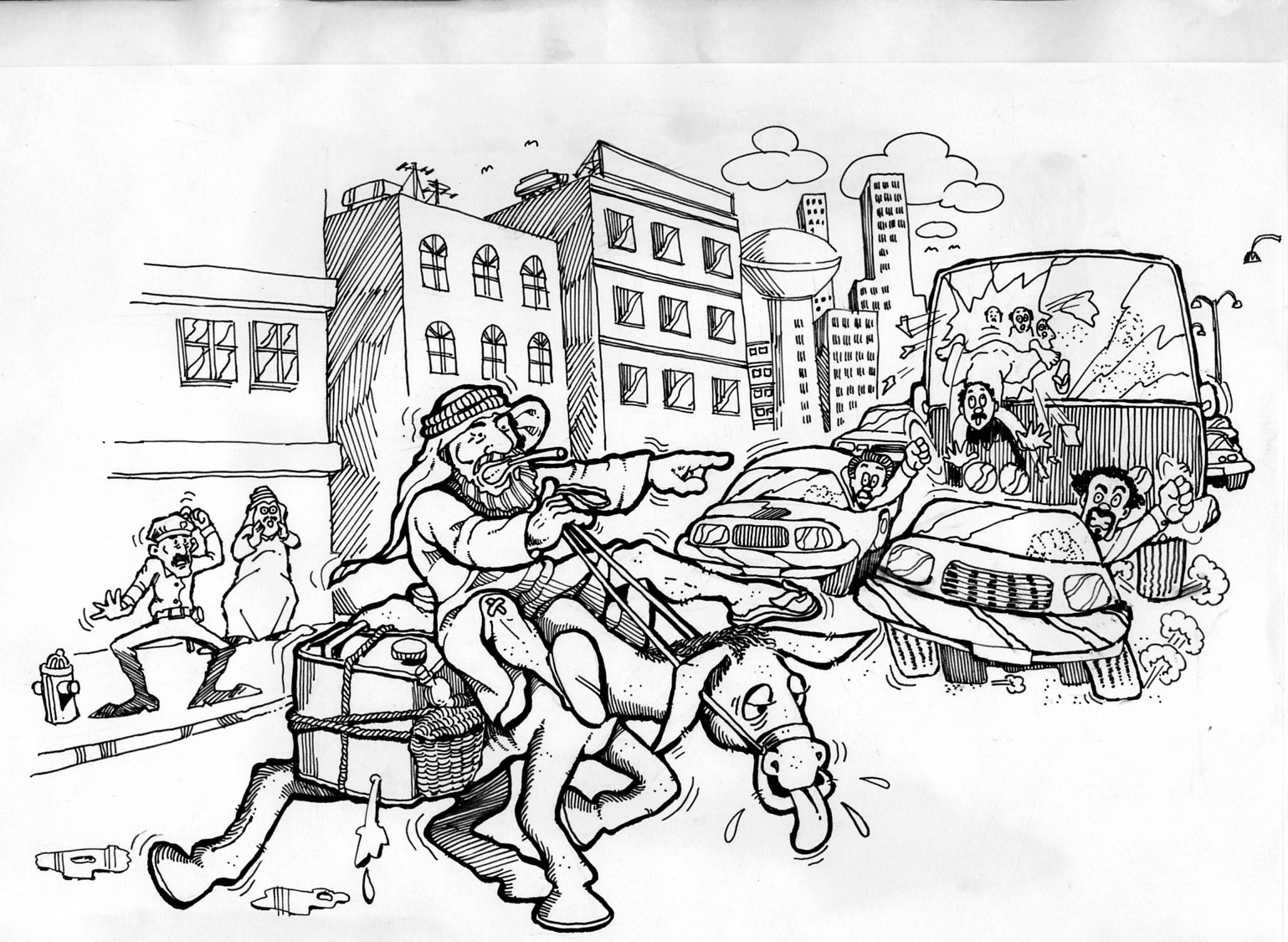
I’ve always enjoyed writing about Saudi Arabia, as regular readers of this blog will know. The other day I was delving through my digital archives and I found this piece from 1985. It was one of a series of vignettes I wrote mainly for my own amusement. To accompany them I asked a Filipino artist who worked for me to draw a series of illustrations, of which the one above is an example.
Here’s what I wrote back then about the Kingdom’s eclectic buildings:
“One of the remarkable things about Saudi Arabia is that you can live in one of its cities for five years and never see a building more than twenty years old.
This is largely because before the oil boom there were no cities in the Kingdom worthy of the name. In one of the most intensive and chaotic building sprees the world has ever seen, armies of foreigners in the space of twenty years turned villages into towns and towns into cities.
The result is an interesting mixture of conflicting styles. Almost every modern school of architectural thought is here, often juxtaposed in hideous discord. Multi-story, concrete-and-glass monsters spiced with arabesque twists so that the designers can call them examples of Islamic architecture. Outrageous Hollywood set pieces, like the full-scale replica of the White House that an admiring prince built for himself in Riyadh. Monolithic apartment blocks that could have been transplanted from Stalinist Moscow. Startling water towers, shaped like giant earth mothers, looming mountainous on the skyline, and towers rising like fertility symbols.
Some say that Jeddah and Riyadh closely resemble Dallas, that paragon of Texan good taste, in the vulgar showiness of their buildings. Having sat at the top of one of the huge buildings in central Dallas and gazed out at the rampant ugliness of that city’s golden-windowed towers, I have to agree that Jeddah could indeed be Dallas’s little sister. Perhaps the secret of the longstanding Saudi-American love affair is that when the oilmen from Texas deflowered the east of the country with their drills and derricks, they also taught the Saudis an American sense of scale. After President Roosevelt met King Abdulaziz in 1945, he followed the meeting with the gift of a Douglas DC-3 airliner; such grand gestures were bound to strike a sympathetic chord in a people newly rich.
In their headlong rush to be modern, the Saudis succeeded in obliterating most evidence of life before the boom. Luckily for the preservationists who have begun to surface in recent years, there are still older parts of the big cities where a few buildings have survived the urban planner’s contempt for the past. Wander through the back streets of Jeddah and you’ll still see coral-and-mud houses with wooden lattice window shutters, and ancient whitewashed mosques with leaning minarets. As well as air conditioners hanging out of holes hacked in the walls, and rusting loudspeakers clamped to the balconies where once full-throated muezzin called the morning prayers.
But oases of antiquity apart, the modem Saudi metropolis is very much a product of the brave new world – a place where the people end up serving the environment that was created to serve them.
For me, born and raised within a half-eaten hamburger’s throw of Birmingham’s dustbin of a city centre, urban Saudi Arabia is an endless source of bemusing amusement. To the new city dweller, who grew up under goatskin tents in the desert, it’s a terrain every bit as harsh and hostile as the one left behind, to be negotiated with fear, suspicion and lonely bewilderment.”
Much of what I wrote then still holds true. Admittedly I was gliding the lily somewhat by claiming that it was hard to find buildings more than twenty years old, but this was certainly the case if you lived in one of the newly developed suburbs – North Jeddah for example.
These days the city has more than doubled in size. The swanky new buildings I encountered thirty years ago are showing their age, especially those which were built on reclaimed land on the Red Sea coast. Salt has done its corrosive work, and a number of the buildings have been abandoned or demolished. Buildings that were old then are now in an advanced state of decay.
I still visit Jeddah regularly, and I can just about make my way around the city, but many of the landmarks of the city I lived in are diminished or gone. Our favourite mall, The Jeddah International Market, is a shadow of its former glory. Last time I visited it, half the shops were closed, and the rest were mainly selling cheap stuff. Likewise the Red Sea Palace Hotel, which in the 80s was a five-star establishment that hosted the most glorious Friday brunches. Nowadays it’s a threadbare three-star joint.
But in other respects much of the impression the piece tried to convey still holds true. The architecture of the Kingdom’s main cities remains at times spectacularly eccentric.
The cartoon was not a true reflection of life in the streets of the big cities at that time, though in the sixties and seventies friends assure me that water tanks towed by donkeys were a common sight at least in Jeddah. And even today motorised water tanks still trundle through a city whose sewage and water distribution infrastructure still leaves much to be desired.
All goes to show that plus ça change, plus c’est la même chose.
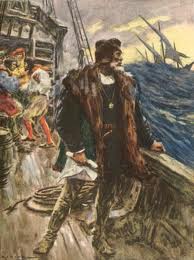
The Voyage of Columbus
Two stories about people making choices most of us would find almost impossible to comprehend hit the news this week.
The families of the three London teenagers who flew to Turkey, seemingly on their way to join the fifty-odd British Muslim women already in the tender embrace of the Islamic State, are distraught. Why would these children leave their comfortable homes and loving families for life in some bomb-scarred town in Syria or Iraq to become wives and very likely widows in short order? Effectively they’re part of a conveyor belt of brood-mares and handmaidens imported for the benefit of the battle-hardened shock troops of jihad ISIS-style.
A few months ago in This Year’s Best-Seller: The Rough Guide for Jihadis? I offered an explanation as to why young men are flocking to ISIS in such numbers:
“Read their tweets and you can recognise the immaturity of any typical 18-to-20-year old. Wild excitement, enthusiasm and yes, idealism, though not yet tempered by the harsh realities of experience. For some of them that harsh reality seems to be bearing down.
So what if for these young idealists violent jihad is essentially a form of adventure, rather like the gap year rite of passage thousands of British school leavers go through when they head off to Thailand, India, the Antipodes and the Americas in search of new experiences, fun and, in some cases, to do some good in the countries they visit? Are these mamma’s boys from Luton, Blackburn and East London basically backpackers with attitude?”
But the girls? I’m stumped. Surely they realise that there is unlikely to be a way back for them? Even if they survive the increasing military pressure on ISIS, which sooner or later will escalate into a ground war, they are likely to be scarred for life by the experience. So should they ever make it back to their families they will surely not be the wide-eyed idealists that stepped on to the plane at Gatwick airport.
And so to another one-way voyage. Last week, the organisation behind the Mars One mission announced a short list of a hundred people who are prepared be part of the first human colony on Mars. The only problem is that it will be a one-way mission. No way back.
Now the spread of humanity across the globe would never have happened without explorers and migrants setting out on journeys from which they knew they were unlikely to return. But at least they had reasonable prospects that wherever they went they would have air to breathe, water to drink and sources of food. If food and water was scarce, they could usually re-trace their steps back to the last fertile land through which they travelled.
But for the Mars colonists life would always hang on a thread. The supply of food, water and oxygen would depend on technology. No technology has ever been infallible, and none would be more critical to life than that employed on Mars. The psychological impact of life in an unforgiving, alien environment with no prospect of return is surely something for which it would be impossible to prepare the colonists.
The mission may never happen, at least within the time-frame set by the organisers. This piece in the Guardian casts doubts on many levels. I for one hope that it doesn’t happen, at least as currently planned. I think it would be immoral to send a group of idealistic young people on a mission with no prospect of coming back, even if those involved have freely volunteered to take part. Far better, before we contemplate any colony, is to send people to Mars to explore and experiment, and then return them to Earth. And even if the exploratory missions were followed by permanent colonies, those colonists should be given the option of return.
If it takes another fifty years to achieve that objective, so what? Mars has been around for billions of years. Surely it can wait a mere half-century longer for the dubious pleasure of our presence?
So there you have it. Two one-way journeys, both a matter of personal choice. The first we – at least in the West – look on with consternation and horror. The second we look on with fascination tempered with trepidation for the future of those who wish to take part.
Should we condemn one journey as the result of cynical grooming and indoctrination, and not the other, in which twenty-four brave and idealistic people make their choices under the influence of what might be the misplaced optimism of those behind the Mars mission?
A bizarre juxtaposition of choices, perhaps. That’s for you to decide.
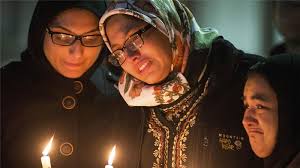
The murder of three young people in Chapel Hill, North Carolina was tragic and disturbing. Equally disturbing was that the killer has, by the act of which he is accused, fed a narrative that is all too popular among Muslims across the world.
Let’s assume that Craig Hicks was the killer. We know that he was a militant atheist, and that he had posted a number of provocative statements to that effect on the internet. We will not know until his trial whether his motive for the killings was a hatred of Muslims. Perhaps we will never know for sure.
As soon as the shootings took place, there was an instant reaction in the social media. This apparently WAS a hate killing. If a Muslim had killed three non-Muslims in Chapel Hill, the reaction in the mainstream media and on the part of politicians would have been very different. Ergo there is a deep seated hatred of Muslims in the West, the result of which is that Muslims have been victimised consistently over the past seventy years.
Hamid Dabashi goes further. He is an Iranian/American professor at Colombia University in New York City. He’s clearly much smarter than me, as evidenced by the erudite prose in an article he has written for Al-Araby Al-Jadeed entitled “We won the narrative battle”.
The piece begins with what appears to be a summary:
“The narrative of the Chapel Hill murders became a battle between us Internet plebians and the patricians of the ‘Western media’. The plebs won.”
As I said, he’s smarter than me, so it took a couple of readings of his piece to catch his drift. I stumbled over sentences like:
“There is timing to the urgency of a narrative, or as French philosopher Paul Ricoeur would say the narrative emplotment brining (sic) the diverse forces of a condition into an imaginative order.”
By which I think he means that the stronger the evidence from diverse sources, the stronger the narrative. Or maybe not. But let’s assume so.
So what’s the narrative to which he subscribes?
It seems to be that the established media is run by and written for an oligarchy of powerful white and Jewish interests. They are those he describes as patricians. The denizens of the social media, who protested in their hundreds of thousands about the patricians’ coverage of the Chapel Hill killings and whose protests apparently led to qualifications by the New York Times and Obama’s denunciation of the killings, are in Professor Dabashi’s terms “the plebs”. He clearly includes himself in that number.
Another voice of the so-called plebs that the Professor called on in evidence is Philip Gourevitch, whom he quoted from a piece in the New Yorker:
“Far more Americans are killed each year by the shooters in our midst like Craig Stephen Hicks than have ever been killed by all the jihadist terrorist outfits that have ever stalked this earth.”
With respect to a well-known journalist, that statement is unprovable, because he doesn’t define “shooters in our midst” or “jihadist terrorist outfits”. Is he saying that bigoted militant atheists or Muslim-haters kill more people every year than Al-Qaeda killed on 9/11? More than 2,977 people every year?
Enough of this nit-picking. At least we understand what he’s saying, which is that Americans have a far greater chance of dying at the hands of a shooter – regardless of motivation – than they have of succumbing to religiously-motivated terrorists.
But to return to Professor Dabashi, it’s not clear to me what he means by Jews and whites. Everybody knows who Jews are. The next step beyond his narrative – though he doesn’t explicitly say this – is that they are tacit or explicit supporters of the State of Israel by virtue of their religion and ethnic origin. But whites? What are we talking about here? White Anglo-Saxon protestants? Lithuanian immigrants? Ninth-generation descendants of British colonialists in North Carolina? Irish Catholics in Boston and New York? Amish and Mennonites in Pennsylvania?
To lump America’s hugely diverse white population into one category and characterise them as oppressors of Muslims, blacks and Latinos/Latinas is simplistic and verging on manipulative. Just as to take every Jew outside Israel and put their fingers on the triggers that fired bombs and missiles into Gaza is equally questionable.
So let’s cut to the chase. Here’s my perspective on the killings.
Any shooting of innocent people is an abomination, whether they are Muslims or otherwise, whether they are the victims in Chapel Hill or the 26 children and teachers in Sandy Hook, Connecticut.
Hicks’s motivation has yet to be proven. I know that’s not what many Muslims want to hear. Nonetheless a look at his Facebook page does at least suggest that the target of his rantings is not Muslims per se. He has far more to say about evangelical Christians, of which there are many in North Carolina. If his posts are anything to go by, Hicks is an angry man. But Facebook is not a mirror into a person’s soul. That he killed because he hated Muslims is no more proven than that the Sandy Hook killer hated children.
Richard Dawkins, the late Christopher Hitchens and other “militant atheists” are no more to blame for Hicks’s alleged act than the Prophet Mohammed for the decapitation by ISIS of 21 Coptic Christians in Libya. To act through a perverted interpretation of a belief system is not the same as being directly encouraged to commit the act.
And yes, there is undoubtedly a concerted anti-Muslim lobby in the US, as this article in Middle East Eye suggests. America is full of lobbies – the gun lobby, creationists, political lobbyists, arms industry advocates and climate change deniers to name but a few. So those who fuel Islamophobia are not the only ones in the business of shaping opinion that many would find ludicrous and abhorrent. But that’s a long way from saying that the influencers of anti-Muslim sentiment would approve of the shooting of three innocents. However, they surely know their country well enough to guess that some of their words might lead to hate crimes. Which is why the author of the piece is quite right in saying that bigotry and unproven assertions should be confronted and rebutted.
But we should also understand that there are reasons why these pressure groups can sow their seed on fertile ground. There undoubtedly is an undercurrent of fear or dislike of Muslims in America. It would be surprising that it should be otherwise in a nation that saw attacks on its citizens at home and abroad over the past 20 years (Lebanon, Al-Khobar, Nairobi, Yemen, New York and latterly Boston), and hundreds of thousands of whose soldiers have been engaged, and many traumatised, in conflict in Iraq and Afghanistan.
This is not to debate the rights and wrongs of those conflicts. It would be easy to trace a sequence of reactive wrongs committed by Christians and Muslims going back to the birth of Islam. But I do believe that much of the fear stems from ignorance rather than malevolence. I felt a similar undercurrent when I married in Ireland thirty years ago. Nothing overtly stated, but there was an underlying resentment of the British in the Republic at the time. Scratch the surface of most societies and you will find undercurrents of racism, xenophobia and old grudges.
The mainstream US media are highly inward-looking. Foreign news in all but a handful of media usually appears way past the front pages. Yes, as Professor Dabashi points out, if the killers in Chapel Hill had been Muslim and the victims not, it would have instantly slotted into the “War on Terror” narrative. But you could argue that the story was covered initially as just another shooting, not a possible hate crime against Muslims.
Yes, the media in many Western countries are controlled predominantly by wealthy, ethnically white interests. And yes, Jewish interests exert an influence on public opinion in some of those countries out of proportion to their numbers in the population. The reason for this is that typically the control of the media vests in those who control the economy.
Does this mean that every Jewish press or online media owner is a slavish supporter of Binyamin Netanyahu, or that every Jewish citizen feels greater allegiance to the State of Israel than to America, France or Britain? Peruse New York’s Jewish Daily Forward, and you might be convinced otherwise, at least as far as American Jews are concerned. Certainly this is not the case in Britain, my country. Consider also the negative reaction of leading Danish Jews to Netanyahu’s call for European Jews to settle in Israel. For very good reasons, most Jews, wherever they are, have a horror of mass political movements. And you could argue that their success in many fields is down to the independence of thought and intellectual rigour that their religion has never inhibited.
And finally to the narrative of victimhood that so many Muslims shelter under to explain the suffering of so many who share their faith. Yes, millions have suffered grievously through the intervention of Western powers in their social and political affairs over the past century and a half. And yes, much of that suffering has been as the result of the West’s determination to secure uninterrupted sources of energy for itself and to establish spheres of interest that shore up their interests against the encroachments of rival powers.
Yet that’s not the whole story. The West was not responsible for the sectarian schisms that have caused such animosity and bloodshed over the centuries. It was not responsible, or at least even by the most virulently anti-Western narrative only partly responsible, for the tyranny and corruption of so many leaders of Muslim countries. Likewise for the endemic and overt racism to be found in many of the wealthy Muslim countries towards Muslims from poorer countries. And it was not responsible for the dominance of scholarly Islamic traditions that have discouraged independence of thought, intellectual curiosity and creativity over the past two hundred years.
The notion that all the troubles in the Muslim world are the creation of non-Muslims is simple, convenient and comforting, but unfortunately false. The picture is far more complex.
And the plebs, as Professor Dabashi describes them – the millions of voices on the social media that find common cause in an instant and then vanish again like the Higgs Boson? I’m afraid they are a long way from the original plebs – the turbulent, physically threatening mob that exercised so much power in the late Roman Republic. The modern day plebs did not prevail in the green protests in Iran, the country of his birth. They did not ultimately prevail in the Arab Spring.
Those in power remain in power or have regained it. The dominant economic and political forces in the West remain in power. You can’t throw stones and erect barricades through the social media, even if you can reach gullible and easily manipulated hearts and minds. It takes more than a million tweets to generate real change, because tweets are simple and life is complicated. Talk is cheap. Doing is hard.
I come from a generation that said “give peace a chance”. Since then we’ve been rewarded for our dreamy good wishes with a succession of wars on almost every continent. We shouldn’t have been so naïve. It will take a long time to unpick the wrongs of centuries, and no amount of online rhetoric will change that.
We are in a bind, and the sooner we start thinking of ourselves as humans, not Muslims, atheists, Christians, Jews, Americans, Syrians and Russians, the sooner we can mitigate the suffering of the oppressed, the diseased, the mentally scarred, the dispossessed and those who have never possessed.
That’s the challenge, and firestorm of angry words and a million online voices are but leaves in the wind compared with the mountainous forces that stand in the way of the kind of progress that benefits the many rather than the few.
I’m not as clever as Professor Dabashi, but I do know enough to remind him that the battle between the original patricians and plebs, with whom he compares the victims and the oppressors of today, neither won.
The Roman Republic, after decades of vicious civil war, was replaced by an absolute monarchy that persisted in one form or another for 1,500 years. It took an Islamic empire to finally snuff it out after centuries of conflict on its slowly receding borders. If we are to avoid a millennium of conflict between the West, where many see our values and institutions as the philosophical New Rome, and those who resent what they see as its power, unequal control of global resources and its cultural dominance – or worse still, a swift and devastating conflagration that renders many of the battlegrounds uninhabitable for centuries to come – then we need to start creating some new narratives that include rather than exclude.
The old stories, no matter how comforting and familiar, won’t help us cope with the new.
I for one grieve for the three smiling youngsters in Chapel Hill. Just as I grieve for the kids in Sandy Hook who will never grow up to live their dreams, for the thousands of innocents who have met their deaths in conflicts in the Middle East, in Africa, in Europe and in Asia. But I refuse to bundle their deaths into a set of overriding narratives like the one being put forward by commentators such as Professor Dabashi. I don’t want to stop people from believing what they choose to believe or not to believe. I only want them to behave as humans can – with compassion, respect for others and a sense of common responsibility that transcends religion, nationality and ethnicity.
Unachievable and unrealistic perhaps, but surely something worth aiming for in this world rather than the next.
Thus speaks a Western “liberal”. Perhaps I would feel differently if the Chapel Hill shooter had taken my daughter.
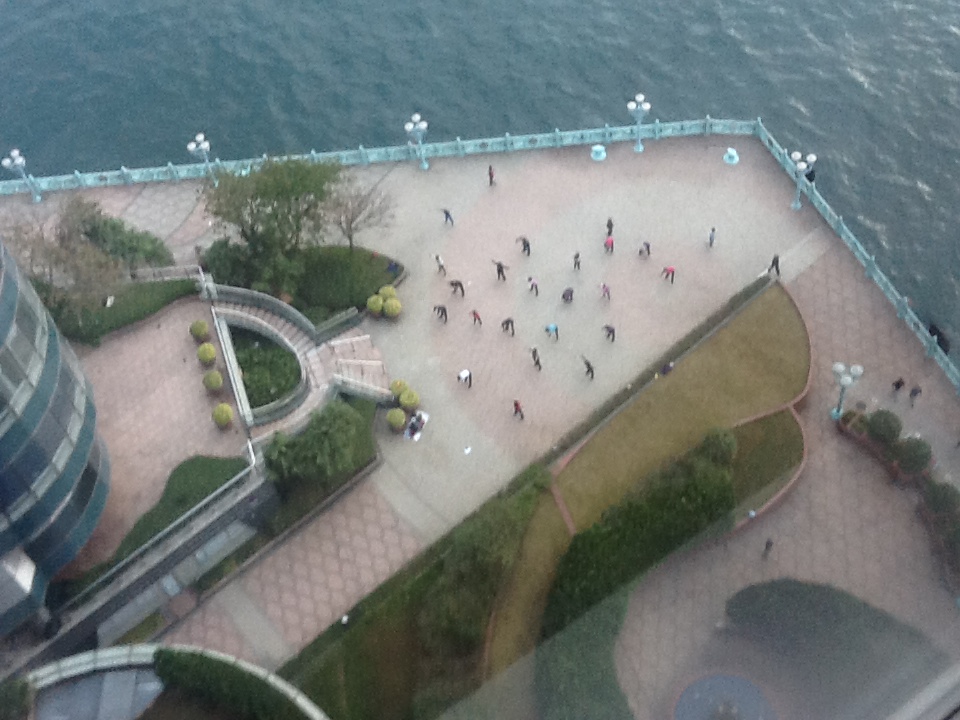
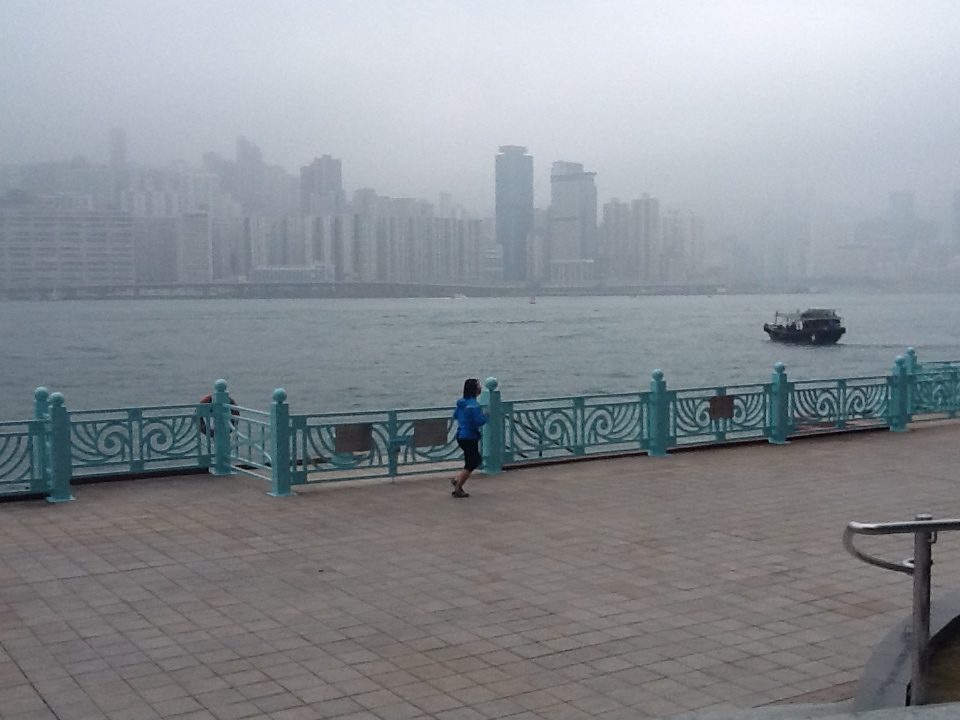
A brief stopover at one of my favourite cities on the way back from Bali. I wish I could say that we went hiking up to the Peak and strolling through the markets on Hong Kong Island, but unfortunately the best laid plans have been stymied by the hamstring I tore in England three weeks ago.
So I’m still in a wheelchair – this one kindly provided by our hotel in Hong Kong. Never mind. Lots of people watching to do, as in Bali.
The one word that sums up Hong Kong more than any other is energy. I’ve taken to sitting outside the hotel at the top of a promenade overlooking the strait between Kowloon and the island. Joggers, walkers, old and young. An old guy standing in front of the promenade railings doing Tai Chi. A woman in jogging gear posing from six different angles for a waterfront selfie. A guy running to the railings three times in ten minutes posing stiffly for a photo taken by someone out of sight. Why the same shot three times? The search for perfection perhaps.
Back in the lobby, endless group photos in front of the new year tableaux. A family of six sits in a line waiting for something or someone. Each buried in a smart phone. No conversation, no books. Just phones. Is there any other invention that better epitomises the past twenty years? Everyone talking in a personal vacuum, nobody communicating. Photos and games and Facebook and Whatsapp. What indeed is app?
For all the incessant digital exchange, it seems to me that the world through a smart phone is like a mirror. An instrument for self-absorption. A perfect accessory for the little emperors and princesses on the mainland, products of the one-child policy.
Here you can predict with some accuracy which families are from the mainland and which aren’t. If there are two or more kids, the chances are that they’re local, or maybe expatriates from Malaysia, Singapore or further afield – Australia or America for example.
In the West we read many stories about the evils of the one-child policy. Elderly parents abandoned. Female pregnancies terminated. A nation with a dangerous gender imbalance – millions of young males looking hopelessly for a mate. Not so many pundits look at the other side of the equation – the perception of the single kids. My wife knows a couple of young Chinese students in London. Their view is that being an only child is no big deal. In fact they feel lucky. All the efforts and resources of the parents focused on them alone. Could their parents have afforded to send two or three children to one of the top ten academic institutions in the world in one of the most expensive cities in the world? Most probably not.
But what of the poor? The dilemma facing the only child: do I spread my wings and go to the city, or stay at home and care for my elderly parents? And if I go to the city, and most of my earnings go back to support my parents anyway, what chance do I have of finding a mate and starting my own family? In a country that still pays lip service to the principles of communism, the one-child policy’s legacy is surely a dangerous widening of the gap between rich and poor. It may now be have been repealed, but for a generation it’s too late. The damage is done.
Back at the hotel, my wheelchair experience continues. They’ve provided me with an industrial size vehicle – far more robust than the one in Bali, from which regularly bits regularly flew off. This one is more suited to Western physiques. They’re clearly used to facilitating guests with elephantine backsides. Mine is more bear-sized, so I have a bit of room to manoeuvre.
Going through Bali and Hong Kong airports in a wheelchair is another experience altogether. So easy and fast that my wife is thinking about injuring me in time for our next trip. A preferential route through immigration. No looking up at signs and wondering where the hell to go. No messing around in duty free. But be careful what you wish for, a little voice tells me. I met another wheelchair user in Bali who looked like death warmed up. She was still suffering from the effects of dengue fever. And she wasn’t the only one. A sour-looking guy in our hotel whom I had dubbed The Professor in a previous post from Bali turned out indeed to be a professor. The reason for his permanent expression of misery was that he caught dengue several days earlier. He also could hardly walk.
The incubation period for dengue fever is a maximum of ten days, so we’re counting off the days from yesterday.
Back to England tonight. A few more weeks of hobbling around and hopefully some physio to help my recovery along. Assuming all goes well, I shall be back to my running, jumping iron-man self in a couple of months – well OK, walking will be quite enough thank you very much.
But after three weeks in a wheelchair, I will never again take for granted the ability to stand on my own two feet, and I have a new appreciation for what is a permanent reality for many.
That’s a positive I wasn’t expecting to take from what should have been an ordinary holiday, but a positive it surely is.
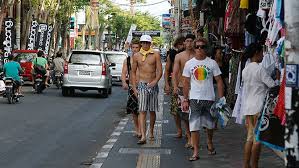
A few more words on my Balinese hamstring crisis. So I’m still in Bali, still in a wheelchair, getting fatter (arms excepted), watching enviously as Aussie backpackers head for the hills in their rented motorbikes to drink beer in exotic places.
At least I’m off the painkillers, and I’m finally able to walk a few steps without accompanying Turneresque grunts.
If we haven’t been able to do our usual walking, watching and listening holiday routine, at least we’ve got on to first name terms with a number of Balinese taxi drivers, which isn’t too difficult, because in Bali you can only have four first names.
Depending on when you were born, you’re first, second, third and fourth. The naming system is slightly complicated by regional variations and also the fact that each of the four castes has a different version of first, second and so on. But the basics are the same everywhere.
Admirably simple, and in case you’re wondering what children beyond the first four are called, it’s “first again”, “second again” and so forth. Don’t ask me what they call the ninth. First once again, or first three times. I never thought to ask that question.
This naming system might not go down too well with English parents. “Jemima, do try and eat your ratatouille” doesn’t really compare for directness with “oi Number Two, eat yer dinner!”. The Balinese are not the only people who use numbers for names. Quintus (fifth), Sextus (sixth) and Septimus (seventh) were common Roman names, for example, though they didn’t necessarily denote the person’s place in the sibling line-up.
More like the Balinese system was the naming convention used in British boarding schools. I, as the second child, was known at school as Royston Junior. Or following another Roman convention, I was occasionally called Royston Minor, as opposed to big brother, who was Major.
True to form, the British usually manage to bring rank and class into the social equation.
But whereas the British place themselves in classes with a mixture of defiance and self-effacement, as “I’m working class and proud of it” or “I suppose you could say I come from an upper-class background”, the Balinese happily identify their caste without any undertone of embarrassment or resentment. Perhaps that’s because the top two castes – the Brahmana and the Ksatria – are extremely thin on the ground. Most people belong to the bottom two – the commercial and administrative caste or their equivalent of our working class. And while caste was important a century ago, these days, as I understand it, it’s no barrier to education and success in life.
If you’re looking for the ultimate in “I am” nomenclature, look no further than Prince Al-Waleed bin Talal, the richest man in Saudi Arabia. The literal meaning of his name is “The Newborn”, but in common usage means The Boy. Probably gives you an inbuilt confidence boost if everybody refers to you as – effectively – the one. But being instantly identifiable as the first-born certainly comes a close second.
A word about the hospital that treated me when we arrived in Bali. It’s called Siloam, and it’s part of a chain of private hospitals that operate throughout Indonesia. My wife hauled me up there after three days of my incessant moaning and groaning. She was thinking of MRI scans, surgery and other drastic measures, and indeed, Siloam has all the facilities. It’s immaculately clean, and the staff are solicitous and friendly. Of course you get presented with a bill virtually every time you breathe, but that’s private hospitals for you.
One is so used to the British National Health Service, where so many of the administrative staff think they’re doing you a favour, and where each step in the treatment process requires an interrogation, several forms and a cost-benefit analysis (the honourable exception being emergencies) that the contrast is striking.
At the Siloam Hospital we saw a trauma physician, a consultant orthopod, a rehabilitation specialist and had the first dose of physiotherapy within two hours of arrival. That’s the difference between private and public medicine. We would have got there on the NHS, but the whole process could have taken weeks.
Apart from dealing with the usual range of hospital cases, Siloam has a flourishing plastic surgery business. Very appropriate considering that the shopping centre in which it’s located rejoices in the name of Lippo Mall. So presumably you can pop over for a spot of food shopping and a skinny latte and get a few inches off your waistline in the same visit. What better place than Bali – an island of artists – for a bit of body sculpture? You can hang out in your bandages at some exotic spa in the jungle while you down a few cocktails and watch the wildlife.
Unfortunately the only wildlife we’ve had the pleasure of observing while I’m temporarily incapacitated is the fellow guests who roam the resort. Which is no bad thing, because we enjoy watching people almost as much as animals – and there’s plenty of good watching to be had.
There’s Countess Botoxova for example – an eastern European lady who has the same waxy, expressionless face as Vladimir Putin, hence the nickname we’ve given her. Given the size and unusual upwards orientation of her chest, I suspect that she might be one of Siloam’s triumphs.
Then there’s Gunther the Goth, a huge German guy with a long red beard who looks like one of the warriors who fall upon the Roman army in the opening scene in Gladiator, broadsword flashing in the winter snow. Unlike Botoxova, who’s usually only to be seen at breakfast in the company of a couple of younger male acolytes, Gunther is mainly aquatic. He hangs out at the pool bar with a bunch of young Aussies whom I’ve christened The Miners – guys who you could imagine driving those outsize dump trucks in the Western Australian desert. Gunther, the Miners and a couple of girlfriends with spectacular tattoos sit at the bar getting noisier as the day rolls on.
There’s a couple of Indian families I call The Accountants. In several days of observing them at breakfast I’ve yet to see any of them smile. The name derives from their habit of coming together after breakfast and passing money to each other. One guy writes all the transactions down in a notebook. I can only imagine that they’re sharing the cost of their holiday treats and reconciling on a daily basis. The only one that doesn’t seem to take an interest in the proceedings is a teenage daughter, who does what teenagers with their parents usually do these days: she lolls around with a bored expression doing stuff on her IPhone.
There are also one or two Indian couples who look like honeymooners, except that all of them seem to have the same hangdog expressions as The Accountants. Is it not fun getting married in India?
Another notable character is The Professor. He’s an elderly American with permanent look of dyspepsia on his face, who sits near the pool holding conference calls with a bunch of people who report in to him about their daily transactions, which my wife tells me run into millions of dollars. Not that she’s deliberately listening in, but it’s hard to avoid their stentorian tones ringing out from his IPad. She has so far resisted the temptation to whisper “no peace for the wicked” as she swims by.
There are also a number of extremely large ladies of a certain age, whom I call the Gluteus Sisters. They also tend to be aquatic, or else they spread on their sunbeds covered in oil, like sleek walruses in the Californian sun. Recent medical research suggests that women who store large amounts of fat around their waists and backsides during pregnancy produce bright children – something to do with the nutritional value of the type of fat that gathers in the nether regions. In which case these ladies must all be mothers of Nobel Prizewinners.
With sights like these, who needs monkeys and elephants?
We’re leaving Bali in the next few days, but not before a trip to see an active volcano and a couple of temples. I wish we could have seen and done more, but we’ve seen enough to make us want to come back.
On a recent taxi journey I asked the driver whether Bali had changed for the better or worse since he was a boy. Worse, he said. Because of the tourists? Not really, he replied. He explained that he came from a very simple village about fifty miles up the coast. The sunsets are beautiful, and there’s a spectacular temple on the headland. In his village they grow all kinds of fruit and spices, and there are plenty of fish to be caught. He said that the tourists are welcome to visit, but now developers are building a five-star resort near the beach, and the place where he grew up is fast disappearing.
That’s the sad thing about tourism, isn’t it? The lonely unspoilt places that we want to visit stop being lonely and unspoilt because so many of us want to see them. In twenty years’ time will Bali be another Phuket, with little of its coast unmarked by hotels and resorts? Hopefully not. Tourism brings wealth to some and employment to many. But small islands like Bali can only take so much cultural invasion before they lose the character that attracts the tourists in the first place.
As I sit in my little villa garden, I hear the rumbling of building work, and a crane swings nearby. Two new hotels are under construction. Good news for some, but maybe not for the soul of this beautiful country.
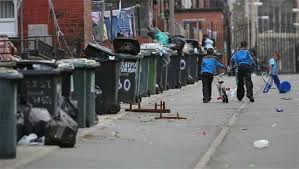
The modern Queen of Classics, Professor Mary Beard, is one of very few people whose blog I visit every day or two. In Alarm Clock Britain she laments the lack of real argument emanating from British politicians in this election year:
“….if politicians talk in soundbites, if they don’t write their own speeches and if they don’t even write their own tweets . . . how can they possibly complain that the electorate is disengaged? I mean there is nothing to engage with, apart from a brand.
My argument was NOT that the ancients got it right (people are always wanting me to say that, and it is almost never true). But I was trying to say that they did retain a real focus on words meaning something and being part of an ARGUMENT, rather than a set of disconnected slogans.”
Amen to that!
If there is a word that for me symbolises the disconnect between meaning and politico-speak, it’s “community”.
I suppose that a good non-pejorative definition of the word would be an informal group of people with common interests. But in the hands of journalists and politicians it becomes something that they’re not part of but would like to influence, manipulate, appeal to or profit from. So when urban politicians talk about “the community”, they’re usually referring to people in the same location whom they consider inward-looking and vaguely threatening. As in the Asian “community” in Blackburn, or the Somali “community” in Tower Hamlets.
A “community leader” is often a self-appointed spokesperson, or perhaps an imam or a local councillor. These are the people politicians “reach out” to, as if they were engaged in some kind of close encounter of the third kind, often with unfortunate consequences when the leader’s motives and agenda are not what they appear to be on the surface.
Community is also a word beloved of social workers, but even more dishonestly used in their hands. Because of all people they know that most communities they work in are anything but – collections of people, each with individual problems or dysfunctional families who find themselves living in the same place by accident or out of desperation.
Communities the politicians don’t generally talk about tend to be diverse, reasonably outward-looking and relatively content with their lives. Such that they don’t actually feel the need to define themselves as communities at all. Most people in communities the politicians refer to would by and large prefer not to be in them.
I’m not saying that the word should be replaced by another pejorative term, like ghetto, enclave or ‘hood. I just bristle at the well-meaning or manipulative use a word that harks back to the pre-industrial age when people were born, lived and died in the same place.
Most modern “communities” – whether they are the gated compounds of the paranoid rich, the ephemeral horde of social media users or hard-pressed inner city sink estates – are rootless and have no particular emotional attachment to where they live. I mean come on: do Bangladeshi tailors, Polish carpenters and little old ladies who remember the Blitz think of themselves as members of the same community? Paedophiles, sport fans and ISIS recruiters sharing the net? Stockbrokers, oligarchs and and media tycoons in Beaconsfield stockades? I don’t think so.
The commonality of interest among most so-called communities is often defensive and dependent on the needs of the moment rather than stemming from a deep sense of interdependence and mutual responsibility.
I’m sorry to be cynical, and yes, I’m generalising wildly, so shoot me down if you wish. But when I hear people blathering on about “the community”, my bullshit filter pops up, and I know they’re peddling an illusion behind which sits an agenda. There should be no shame in living in an economically deprived area, and the last thing the residents of Tower Hamlets and Blackburn need is patronising politicians sweeping them up into a meaningless collective cliché.
Nothing like an election to inspire a good rant!

Timothy Spall in Mr Turner
Last week I posted a couple of missives from Bali, where my wife and I are on holiday. If you didn’t catch them, let me explain that I tore a hamstring just before we flew there, and as a result I’ve been in a wheelchair more or less ever since.
I’ve become quite used to being wheeled everywhere. My lovely wife is tending to my every need, though she no longer has to help me pull my trousers up. My arm muscles are bulging thanks to all the wheeling.
There is one disturbing development, though – at least from her perspective. During the first few days, every time I moved I let out an anguished yell. That has now changed to a low grunt, so much so that she is now calling me Mr Turner. Anyone who has seen Timothy Spall in the biopic of the great English painter JMW Turner will recognise my grunting repertoire.
Where my standard expression of pain was AAAAAH, it’s now WURRRRGH. When my wife offers me a cup of coffee, it’s URRRR (pitch descending). If I ask for coffee its URRRR (pitch ascending). Getting up: a short UH. Sitting down: a long doleful AAAR culminating in a slow expulsion of breath that sounds rather like a death rattle. It’s driving her crazy, and I confess that the more she complains the more I come up with creative variants. If any organutans have escaped from West Java to Bali, I would be able to have long and intimate conversations with them.
Having said all that, we finally managed to go on a trip a little more extensive than the regular visits to the hospital for physio. We hired a driver for the day, and took a trip to the Ubud area, described in the guidebooks as the cultural heart of Bali. We made it clear to the driver that we could not/would not stop for shopping, so we did a series of drive-bys.
The odd thing about the area is that the outlying villages seem dedicated to artefacts. Paintings, mosaics, wood carvings, stone sculptures and batik furniture. There are hundreds of shops selling more or less the same stuff, some of which is gorgeous. Yet you could probably bring the combined populations of Britain and Australia down these streets and the shops would be unlikely to sell more than a fraction of their stock. So why keep adding to an inventory you might not clear in a couple of decades?
I felt much the same when wandering around the oriental carpet shops when I lived in Bahrain. A visit from a potential customer seemed like a rare event, yet each shop had hundreds if not thousands of beautiful hand-made Qoms, Isfahans, Herekes and Kilims piled up from one end of the premises to the other. But whereas it’s relatively easy for a traveller to pack a silk Hereke into a big bag, getting a six-foot hardwood carving of a rearing horse or a two-hundred kilo statue of the Buddha back to London or Perth would be a matter of eat, pray, hire a shipping container.
I’ve asked one or two locals why these shops keep such huge stocks and haven’t yet received an answer that makes sense. Perhaps it’s because sense doesn’t come into it – there’s a tradition in these villages that has its own momentum. You create things because that’s what your family has done for centuries, and if it takes a couple of generations to sell what you’ve produced, so be it.
We did manage one stop-off, an excruciating hobble to a café overlooking a terraced rice plantation on the tourist trail. Very beautiful it is too, though I suspect it’s maintained for the benefit of visitors these days, since there are many rice fields on flat land nearby that must be much easier to cultivate.

Rice Terraces near Ubud
There I had a cup of kopi luwok – allegedly. This is made from coffee beans that pass through the digestive systems of a weasel-like animal called an Asian Palm Civet. I say allegedly because it’s supposed to be the most expensive coffee in the world. Given that there’s only a limited supply of civet droppings to be harvested, I as surprised that my cup was only twice the price of a cappuccino. Apparently the beans are miraculously transformed as they pass through the civet, and the result is supposed to be a smooth and rich-flavoured brew. Anyway, it slipped very pleasantly over my uneducated taste buds even if it wasn’t the real thing.

Asian Palm Civet. Pic: Praveenp/Wikipedia
So a good holiday thus far, with no sign of the dreaded dengue fever, which is apparently endemic in Bali, and recently struck down a friend of ours so badly that he had to spend a week in hospital on a drip. Being mindful of his ordeal, we came equipped with all kinds of insect repellents and long-sleeved shirts to keep the bugs at bay, but within a day or so we were walking (or wheeling) around in shorts and t-shirts like everyone else.
I suspect that the mossies would recoil in terror at the sight of the tattoos sported by some of our fellow inmates – extremely large Aussies, Germans and Russians who like to congregate at the pool bar for much of the day. Perhaps I should visit one of the many tattoo parlours in Kuta for a tasteful rendition of a Balinese dragon to ward off the nasties. On second thoughts, I would rather eat raw civet droppings.
I write this during the glorious Bali morning, when much of the world with which we interact on a daily basis even while on holiday is asleep. A good time to plan what we might do if we visit the island again. Hopefully by then I’ll be walking as normal. So a climb up the cone of an active volcano, a bit of white water rafting and a hike through the jungle come to mind, as prompted by the Lonely Planet Guide. But the reality is that we’ll do what we normally do: walking around, looking, listening, eating, talking to people.
In other words – to use the term coined by Robert Heinlein in Stranger in a Strange Land – to try to grok this lovely island. As Heinlein put it:
“Grok means to understand so thoroughly that the observer becomes a part of the observed—to merge, blend, intermarry, lose identity in group experience. It means almost everything that we mean by religion, philosophy, and science—and it means as little to us (because of our Earthling assumptions) as color means to a blind man.”
Not something you can realistically do in a two-week trip, especially if you’re shuffling around a beach resort, but surely a concept that many of our gracious Balinese hosts would understand. And if Turner had come grunting this way, I think he would have too.
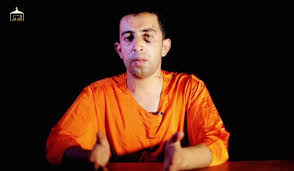
I’m not a great fan of spending hours poring over political tweets, but looking at comments on the killing by ISIS of poor Muadh al-Kasasbeh, the Jordan pilot, reminds me why. Not so much a bunch of tweets, more a swarm of angry wasps.
One article I happened upon was fairly typical of a genre that you come across frequently when a political group commits an atrocity. I call it the “blame-one-blame-all” argument.
The argument typically goes like this. You piously denounce the act, and then tell us that we’re all hypocrites for not taking a similar view of every other atrocity committed by governments across the world in pursuits of their ends.
Thus in Who can claim the moral high ground? Yvonne Ridley denounces the ISIS atrocity, but reminds us of the brutality of the Sisi regime in Egypt, the consequences of American drone strikes in Pakistan and torture in Abu Ghraib, and of Israeli white phosphorus shells in Gaza. She asks us why we don’t condemn these acts with equal vehemence.
She is using a rhetorical technique as old as rhetoric itself – using a specific to illustrate a wider point, in this case that we are all murderers and torturers if we allow our governments to act in our name.
The technique is often used in a social context. How can you continue to be a Catholic while your church “allows” its priests to abuse children? Acts of individuals are construed as evidence that the practice has become a hallmark of the institution.
How can you condemn the rape of a woman in one country when you let women in your society behave in a manner that is tantamount to prostitution?
There’s also the historical variant. Gerry Adams of Sinn Fein “regretting” the “civilian casualties” in an IRA bomb attack, but reminding us that the people who carried out the act were reacting to a series of acts of oppression starting with Oliver Cromwell’s massacres in the 17th Century. In other words, we were to blame for the bombing.
These arguments are both seductive and manipulative. They seek to draw our attention away from the act in question by claiming to put it into a wider context, when what they are really doing is using it to serve an agenda that was in place before the act was committed.
The possibilities are endless. Western colonialism is to blame for the massacres in Rwanda. The Sykes-Picot Agreement is somehow to blame for the sectarian strife in Iraq and Syria, no matter that the Battle of Karbala took place twelve hundred years before. I am to blame for the slave trade because one of my alleged ancestors was a slave trader? Despite the fact that he redeemed himself in later life by campaigning against the slave trade – he wrote the words to Amazing Grace – what right do I have to speak out against modern slavery?
My Arab friends call it “mixing”, which is a much more succinct description than I can muster.
The purpose of placing things in context should be to understand, not to blame. Not to diffuse the blast of condemnation against a particular act, no matter who carried it out.
I have no doubt that Yvonne Ridley is absolutely sincere in her condemnation of ISIS atrocities. But her reminder of our collective responsibility for other evils past and present should not draw us away from the main question, which is how to deal with ISIS. There are enough dimensions to that problem alone without linking it to all the other intractable issues she raises.
Would she prefer that the US and its allies removes all its planes and drones from the region, and leaves ISIS free to slaughter and enslave all the Yazidis, Shia and Christians in its territory free from interference? Yet these are the same forces that are attacking the Taliban in Pakistan and Al-Qaeda in Yemen.
The underlying thread of her narrative appears to be the oppression of Muslims, with which I heartily empathise. But sadly most of the oppressing today seems to be by fellow Muslims, whoever might be to blame for the present state of affairs. We are where we are, and we need to address the present and future.
I will close with a quotation from Emily Herlyn, a young German teacher from Freiburg who spent a year working as a tour guide in Auschwitz. Her article appeared in the Jewish-American journal, the Jewish Daily Forward. She worked at the Auschwitz Jewish Center, and describes a conversation with an elderly former inmate:
“Once, a group of elderly British people visited the Center. In the synagogue, I began telling them about my work at the AJC, until a man in his 80s motioned that he had a question. He explained that he had grown up in Germany. Because he was Jewish, he and his family were deported to the Buchenwald concentration camp, which they miraculously all survived. He asked how I, as a German, felt living here knowing that my forefathers were responsible for the crimes that had been committed in Auschwitz. His tone was accusing and I was stunned at how bluntly he had phrased it.
Others in the group immediately complained that this was an unfair question to ask and said that I didn’t have to answer. But I gave it some thought. Then I answered that the topic of the Holocaust had been a big part of my education, as was the question of guilt, which was discussed frequently. But the Holocaust, I continued, should not be a question of guilt, but one of responsibility. As my generation is too young to be blamed for the crimes our forefathers committed over 70 years ago, I didn’t think we should feel guilty, nor is there any benefit to be had from this. What I did think, though, was that we had a responsibility to learn and teach about that part of our country’s history, despite how unpleasant and painful it is. This was why I felt good about living in Oświęcim and about my work there.”
I hope it doesn’t take another 70 years before those who care about the Middle East start talking about responsibility rather than guilt.
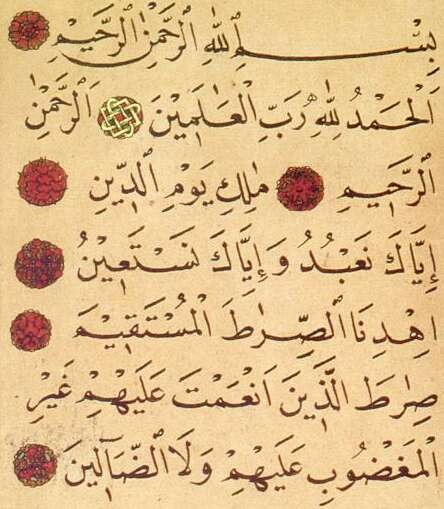
First Sura of the Quran (Wikipedia)
“Am I allowed to brush my teeth during fasting hours of Ramadan?” “Does breaking wind after my ablutions invalidate my prayers?”
When I first came to Saudi Arabia thirty-five years ago I was fascinated with questions like these that appeared in the Friday edition of the Arab News, the Kingdom’s leading English-language newspaper. They are still asked today, and answered by learned scholars, rather in the manner of an agony aunt column.
I quickly learned that the answers to most obscure and incredibly minute questions were based mainly on the Hadith – the reported deeds and words of the Prophet Mohammed. Some could be answered directly from the Holy Quran – Islam’s sacred book – but most answers were derived from the example and statements of the Prophet, and from interpretations thereof.
I have read enough books about Islam, to know the basics – the religious edifice: the revealed text of the Quran and the body of Hadiths known in the Muslim world as the Sunna. I’m broadly familiar with the four schools of law within Sunni Islam, with the Sufi movement and with the two main Shia sects.
But having just finished one of the most fascinating books I’ve encountered in a long while, I’m reminded of how little I really know about Islam.
Misquoting Mohammed is 300-odd pages of history, philosophy, lexicography and forensic analysis. It was written by Jonathan A C Brown, an American Muslim convert who is Associate Professor of Islamic Studies and Muslim-Christian Understanding at Georgetown University, and published last year.
In the book Professor Brown focuses primarily on the derivation of the Hadiths, and particularly on some of the troublesome Quranic verses and hadiths that are most frequently seized upon by ancient and modern critics of Islam: the Sword Hadiths used by apostles of violent jihad to justify their actions; the right of a man to beat his wife; the right of a man to kill his son; the seventy virgins awaiting martyrs in paradise; the prohibition on women leading men at prayer.
What I failed to grasp before reading Misquoting Mohammed was the vast body of scholarship in the Islamic world that has been devoted since the 9th century CE to sorting, evaluating, categorising, interpreting and codifying the Hadiths into bodies of law. There are thousands of Hadiths. Over a period of two hundred years countless scholars attempted to establish a clear and uninterrupted oral transmission route for each Hadith from the Prophet to the scholar who codified them. Those that came from multiple impeccable sources and passed on face to face were incorporated into canonical scriptures second in precedence only to the Quran. Others were considered weaker – perhaps because the transmission was not direct. Yet more were condemned as forgeries.
These reported words and deeds have been used over the centuries by Islamic scholars to form the basis of a body of law known as the Sharia. Except that there is no such thing as a single Sharia that is accepted and adopted throughout the Muslim world. Each of the Sunni schools of jurisprudence, as well as their Shia equivalents has its own version. Governments that have enacted secular codes to sit alongside the Shariah have always used taken the opinions of scholars to tailor their versions of the Shariah to the needs of the state and the mores of the age.
The whole body of Hadiths and learned commentaries on the meaning of the Quran is known to Sunni Muslims as the tradition. Most Sunni scholars claim that it is impossible for ordinary Muslims to understand the Quran and the Hadiths without the commentaries complied by generations of their own. The Shia have their own Hadiths and commentaries.
Thus while Sunnis have always claimed that unlike the established Churches of Christianity, there is no structural hierarchy in Islam, there most definitely is an intellectual establishment that mediates, interprets, explains and issues fatwas governing many of the most minute facets of a believer’s life. For example, there are several books of opinion over where the hands should be placed during prayer.
There have always been Muslims who have rejected the Hadiths as a source of Islamic law, and who argue – like Martin Luther in his battle with the Catholic Church – that the faithful should be able to take the unadorned verses of the Quran as their inspiration. Others see the Quran as metaphor that can be adapted according to the times, rather than the literal unvarnished truth.
Professor Brown does an admirable job in helping the reader – whether Muslim or not – to understand how the Islamic tradition grew, and how different scholars have viewed and interpreted some of the more controversial Quranic commands and Hadiths.
For him, as a Muslim, the central unchallengeable precept is the status of the Quran as the word of God transmitted to his Prophet. But for the non-believer, who may or may not accept the central premise of one God, the message of the Quran and the great edifice of anecdote, opinion, interpretation and ordinance that sits around it like an intellectual suit of armour poses questions that cannot be answered by logic and reason alone.
Why, for example, did God choose to send his revelations to more than one prophet, only for that message to be corrupted by human mediation?
Would it not have been better for the definitive word to have been sent to Moses, and for God to have made sure, as we are told he did with Mohammed, that there was no corruption and loss of meaning?
Then if the Quran was intended to be a message for eternity, why does it contain so many contradictions? Why so many references anchored in the cultural and political realities of Mohammed’s time?
And given that Mohammed was a human being, why do his successors and all Muslims consider him to be infallible?
Why did the scholars use examples of what he did not do to create a legal precedent? Where the Quran apparently permits a man to beat his wife, the Prophet never did so. Was that then a reason to override or qualify the Quranic statement?
And finally there is the question of the derivation of the Hadiths. Imagine an exercise in which you assemble twelve people in a room. Form them into a line. Take a twenty-word statement. Ask each person to whisper the statement to the next person in such a manner as nobody else can hear what is being said. Write down what the twelfth person says and compare it with the original statement.
Next repeat the exercise, but with twenty minute intervals between each transmission. After that, repeat the exercise with the same time interval, but use as your transmission team people from different countries, different mother tongues and different cultures.
And finally (though you would obviously not be able to do this!), transmit the same message through a similarly diverse series of people with an interval of fifteen years between each transmission.
Unless I’ve completely misunderstood Professor Brown, the last scenario is a simplified version of the process through which the deeds and statements of the Prophet finally reached the scholars who wrote them down.
At that point the scholars examined the transmission paths, and the more times the same message came through from different sources, the more reliable they considered the Hadith to be. Very logical. But what if the chain of transmission was short-circuited by someone in the line hearing what was said two or three people earlier? And what if three out of four transmitters were known to be unreliable witnesses? What if part of the message was lost in transmission in several of the paths?
Imagine then the effort of documenting all of the various transmission paths of thousands of these sayings. And given that the weak and forged Hadiths were widely published alongside those that were widely authenticated, what was there to stop an imam from preaching to an illiterate congregation of the faithful messages that were of dubious veracity, and possibly even forged?
If even the sacred verses of the Quran can be interpreted in different ways, is it any wonder that sometimes Muslims – inspired by these messages – use them to behave in ways that other Muslims, let alone non-believers, would unequivocally condemn?
In this they are no different from the followers of other monotheistic religions, each of which encompasses a wide variety of thought and practice. Would any Christian today fail to react with horror to the atrocities of the Crusaders? Would any non-believer fail to find some of the more extreme rituals of Orthodox Jews somewhat odd, if not downright bizarre?
In the end, for Muslims, it all seems to come down to the fundamental state of faith – submission to God’s will. If you believe, you will accept that there are some things that are beyond understanding. Just as Christians use in their rituals the words of St Paul – “And the peace of God, which passeth all understanding, shall keep your hearts and minds through Christ Jesus” – Muslims have been able to debate and question aspects of the tradition without abandoning their faith on the basis that the answers to some thorny questions are known only by God.
Misquoting Mohammed is not a dry treatise of interest only to students of religion. It offers an explanation to anyone who is interested in history, politics and human nature as to why humane and enlightened Muslims might accept and worship the same God as violent bigots bent on the destruction of all who refuse believe as they do. Islam is not – contrary to widely held opinion among non-believers – a monolithic edifice in which one version of the truth prevails.
If the book has a flaw, it is that Professor Brown introduces Arabic words for fundamental concepts and then uses them frequently without providing a lexicon that would enable the reader to access an easy reminder of their meaning. I found myself often having to go back to the passage in which each concept first appears, which took unnecessary time and effort.
But all in all it’s a fine and worthy work by someone who is able to explain his subject through a Western lens while avoiding any possible taint of orientalism.
Given that the author teaches at Georgetown’s School of Foreign Service, one would hope that the next generation of American diplomats will have a deeper understanding of the Muslim world than that of their predecessors. I say that with no disrespect to some of the fine minds who have served in the State Department. But the same observation applies to US and British politicians, soldiers, intelligence agencies and mainstream news broadcasters (Fox News for example), all of whom could benefit from reading this intriguing book.
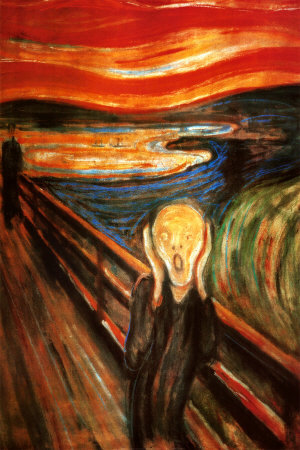
In my last post I discussed my journey through the pain barrier caused by severe sciatica. Actually it was more like straight into the pain barrier – SPLAT, like a locust hitting a windscreen. I have been sliding down the glass, oozing self-pity, ever since.
You may recall that something nasty happened to me on a golf course, and by a circuitous and painful route I’ve ended up in a hotel in Bali.
Since Thursday, when I last posted, the pain has continued unabated. But you have to relish new experiences when you find them, and there’ve been a few since then. Mainly pharmaceutical, about which more shortly.
A couple of days ago I managed to get into the hotel swimming pool. Instant joy. No pain! I could swim as though there was nothing amiss. So I sloshed around for half an hour exercising my limbs, thinking that I must be doing some good. But as soon as I stepped out, back came the muscle pain, only worse. Was my body punishing me for my mind’s ridiculous optimism?
So back to the now-familiar routine: crawling around at a snail’s pace, cursing with every step. As advised by the doc back in the UK, my compassionate but cruel wife kept pushing me to walk, and I kept telling her, in the most polite way possible, that I would not – in between unprintable curses and imprecations.
Eventually this morning she got so fed up with my grumpy, ungrateful demeanour that she hauled me off to a hospital to see an orthopod. It was an interesting, not least because we got the chance to see a little bit of Bali on the way. Not much, mind you. Kuta, where we’re staying, is about as dependent on the tourist trade as anywhere in Asia. Hundreds of restaurants, massage parlours and tattoo shops, plus one or two large malls. Traffic police booths plastered with Coke ads. No, not that kind of coke, for which the death penalty awaits. The fizzy stuff.
Speaking of the death penalty, last night we got talking to a couple of Aussies who have been coming here for twenty years. They said that a couple of their citizens are due to be executed within the next three days for drug smuggling. A salutary reminder that Indonesia, for all its relaxed appearance, has its red lines.
As in neighbouring countries like Thailand and Malaysia, the motorbike seems to be the primary form of transport for the young of Bali. Mums and Dads with a little one sandwiched between them, weaving in and out of the traffic. Every country has its own driving culture, and the taxi driver took every bike darting into his path in his stride. What you expect is what you’re prepared for, just as when I’m driving in Saudi Arabia I have eyes in every direction for lunatics carrying out spectacular manoeuvres at speeds that would make Jeremy Clarkson wince.
No such problems in Kuta, where there are too many obstacles, moving or otherwise, to allow any head of speed. So at a leisurely pace we arrived at the hospital, to be greeted by smiling security guards. The first new experience, given that surliness is normally part of the job description for guardians of safety wherever in the world you find them.
By now my latest does of painkillers had worn off, so I was able to convince the staff in ER that my ailment should be taken seriously. Down came the orthopaedics guy, who did the usually battery of prods, pokes and manipulations, and announced that I’d torn a hamstring. Hamstring, I thought? That’s what footballers do when they turn their legs into lances in order to break their opponents in two. Hardly comparable with the simple act of picking up a golf ball. But there you go. It seems these things can get you out of the blue with little provocation. Maybe my hamstring had been waiting for years to go, just as when the string hanging a picture on the wall suddenly gives way, sending the Rembrandt crashing to the floor.
So the good news is that I now know what the problem is. The bad news is that the recovery period is one to three months. Crutches, no golf until further notice. The only silver lining is that I won’t have to walk the dog when we get home. I guess if I was a fit young footballer, they’d be able to get me back into action faster, but in my state of advanced decrepitude I’ll just have to wait for nature to take its course.
Then followed a two-hour wait to see the rehabilitation doctor and enjoy a bout of physio. They very kindly leant me a wheelchair, so I had a lot of fun zapping about the hallway, until I got stuck in the disabled loo and had to reverse out backwards. This was my first time in a wheelchair. One thing that struck me was how kind people were, asking if I was OK, whether I was being taken care of, offering to push me and so forth. But as everybody for whom a wheelchair is an essential instrument probably knows, the kindness sometimes seemed to have a slight edge of condescension. Interesting. Another experience of life in someone else’s shoes.
The rehab doctor was pleasant and helpful. She didn’t really get the joke when I told her that I needed refurbishment as well as rehab. But she will when she gets to be my age.
Onwards to the physio. First, electrocution. The guy put pads on various parts of the injured leg and switched on the machine. It felt like an army of ants crawling over my skin. That lasted twenty minutes. This is supposed to deaden the nerve activity around the affected area. Then deep heat treatment, which involved placing a device on the leg that resembled the top half of a toasted sandwich maker. This felt so good that I fell asleep lying on my front face down, with the unfortunate consequence that I drooled all over the sheet. Very embarrassing.
Then the drugs. Two new prescriptions to add to the ones we picked up in the UK. I now have a veritable treasure trove of pain killers to choose from. Paracetamol, neurofen, diclofenac, cocodemol, aspirin and now tramadol and myonal. My cup runneth over!
I’m pretty careful about what I take. I religiously research the side effects of the various meds, and overdoses thereof. Paracetamol: liver failure; diclofenac: kidney failure and heart attack, and so on. So I researched tramadol. It turns out that one of the side effects is depression and suicide. Great – so if the pain doesn’t send me to a Swiss death clinic, the tramadol will.
I tried out the new combination, but the pain didn’t get better – it got worse. Last night I gratefully accepted the hotel’s offer of a wheelchair, so now my carer – formerly known as my wife – is dutifully pushing me between restaurant, pool and villa.
The question now is do we stay or do we go? The choice is between freezing Britain and balmy Bali. Well, sitting pain-free (it only hurts when I move) in front of the telly watching Andy Murray and Novak Djokovic in the Aussie Open tennis final, life feels pretty good. But when I get up, the torture starts over again. Andy, Novak, anyone – lend me your leg!
Rolling around in the wheelchair, I find myself wanting to put a sign round my neck saying “I’m not really disabled – I’m just injured”. No shame in being disabled of course, but it doesn’t feel like me – yet.
And hey, I’ve got loads of books to read, nasi gorengs and satays to eat and the company of my beloved wife. We’ll get a driver to take us into the hinterland, we’ll visit temples and I’ll take physio every other day. So I think we’ll be sticking around, even if I do look increasingly like Desperate Dan (too painful to shave).
And that’s the end of this bout of self-indulgent twaddle. Next time, I’ll write about something that actually matters.
But I can’t finish without dedicating the post to two dear friends: Paul Sommers, who not long ago spent six months on his back with a multiple leg fracture, and Fred Le Douarec, who has suffered many excruciating ailments in the time I’ve known him. Compared with them, I’m an amateur in the pain game.
There’s nothing like a debilitating injury for reducing oneself to a snivelling shadow of one’s normal good-humoured self.
How, you might ask, did I end up in the beautiful island of Bali, holed up in a hotel, unable to stand up or sit down without excruciating pain?
It all started on the golf course. My wife and I were due to fly to Bali via Hong Kong on Monday evening. Since we would be away for about three weeks, I decided to play a round of golf in the morning – something I do two or three times a week when I’m in the UK. I’ve lost count of the amount of times my inept technique has seriously threatened to drive me insane, but until this week the game has done nothing but good for my physical health.
But this time, catastrophe struck on the thirteenth hole. Well it would be the thirteenth wouldn’t it? I admit that I sometimes fantasise about dropping dead of a heart attack after holing out on the eighteenth for a sub-par round, or maybe after a hole in one, but finding oneself reduced to a gibbering wreck on an ordinary day? Definitely not in the script.
I was bending down to clean my ball on a downslope. Nothing unusual about the movement – I didn’t stretch, do the splits, fall over or adopt an extreme yoga position. As I stood up I felt as if somebody had plunged a knife into the back of my left thigh. I’d never felt anything like this before, not even when at my fortieth birthday party I accidentally opened up the back of my calf on a piece of broken glass and ended up in casualty while everyone else was toasting my health back home. This was seriously painful. I moved forward, thinking that it was just one of those inexplicable aches and pains that afflict the middle aged from time to time. But it got worse. And then worse.
I ended up having to be extracted from the course by someone who rescued me in a cart. I was OK sitting down, so I drove home, but by that time I was unable to straighten up without groaning in agony. I hobbled into the house looking rather like a nineteenth-century agricultural labourer bent double by decades of toil. All I needed was a stick and a long beard.
As I sat whimpering to myself in the most comfortable position I could find, I thought that’s it – no way am I flying tonight. Paradise postponed. Slipped disc, maybe surgery. Physio with a brisk young lady from Latvia perhaps. Weeks of recovery.
I reckoned without my wife.
A nurse in a former life, she has that blend of cruelty and compassion common in her profession (I know it hurts darling, but you have to keep walking!). She’s also a dedicated air miles collector, and thanks to her efforts we were due to fly to Hong Kong first class. No way were we going to cancel our holiday. She took me down to our local National Health Service walk-in centre, and bullied the staff into having a doctor see me within a couple of hours. I looked quite normal as I sat in the waiting room, though a few people looked askance at the golf club I’d brought with me as a makeshift walking stick.
Eventually, a couple of hours before scheduled check-in, I was seen by a young doctor, who prodded my abdomen, poked at my spine and banged my knees to see what was working and what wasn’t. Eventually, after a series of intimate questions (“everything OK down below? Have you managed Number One and Number Two?”), he determined that I had pulled a muscle. No slipped disc, in other words, though it must have been a bloody big muscle. The technical term is sciatica.
It would get better, apparently. My vision of life in a wheelchair faded slightly. With the steely encouragement of my wife, and armed with a battery of painkillers, I shuffled off to get ready for the flight.
The challenge now was to walk through the terminal without anyone noticing that I was probably unfit to fly. At this stage the painkillers had kicked in, which at least enabled me to stand up. Each step, though, felt as though the knife in my leg was twisted afresh. As I slowly made my way towards the lounge, my wife cheerfully suggested that I looked like a cross between Charlie Chaplin as the clown and Larry David in Curb Your Enthusiasm – feet splayed out, belly forward in an attempt to stand as straight as possible. I can only guess at the impression my contorted face made to the passers-by. Ivan the Terrible maybe, or Frankenstein. Not the kind of guy you’d want to meet in a dark alley.
After a relatively pain-free sojourn in the British Airways lounge, we made it to the plane, only for my wife to discover that she’d left her phone in the lounge. Too late to retrieve it, unfortunately. That rather set the tone for the flight itself. I spent the first few hours counting the minutes until my next pain fix. She fretted about her phone, wondering who at that moment was whispering sweet nothings to his girlfriend in Ulan Bator at her expense. A crisis arose mid-flight when I accidentally took a double dose of the pain medication. My wife was now convinced I would be dead on arrival, and tried to persuade me to visit the loo so that I could violently dispose of the offending medication along with the nice dinner we’d just enjoyed. I refused. I preferred to take my chances with death, which as you can see turned out to be the right decision.
A flat bed seat is pretty useless when turning over feels like you’re on a rack, so I spent the rest of the flight upright in a praying position. Fellow passengers must have thought I was seriously devout, or perhaps afraid of flying, but at least I got some sleep that way.
Things improved a little in Hong Kong. We has an overnight stay in the airport hotel, so not too much walking to get there from the terminal. By now I was getting quite used to my wife doing everything for me. Lifting the luggage, making the coffee, selecting my clothes and helping me into my trousers. A future life of dependency might not be so bad, as long as she grants me custody of the TV remote control.
The next day, no improvement, and a four-hour flight on Cathay Pacific to Bali. The sweet stewardess let us have exit seats, little realising that I would be utterly useless should the need arise to evacuate. But I suppose you forget about pain under those circumstances.
And finally, after a short transfer from the airport, we reached our destination, as the satnav says.
What to say about Bali? After two days, nothing really, because all I’ve seen is a few streets on the way to the hotel. As I write this we’re watching Andy Murray battling Tomas Berdych in the Australian Open tennis. I could do with Andy’s legs right now. My exploration of the surroundings has been limited to a stroll around the hotel gardens, where I was comforted to see a tsunami escape path clearly signposted. Unfortunately I’d probably have to take my chances along with all the other flotsam should a big wave come crashing in.
So what now? Well I’ve noticed a small improvement, though unmediated by the painkillers the leg still elicits groans that would satisfy a torturer every time I stretch the muscle. So no brisk walks through the town are on the cards. The lakes, volcanoes and Hindu temples will have to wait for a while, unless we opt for a series of drive-pasts. Andy Murray trashed Berdych, so we have the final to look forward to. But I’m afraid that a dose of Eat Pray Love self-realisation will be hard to achieve, and for now we’ll just have to content ourselves with the swimming pool, very local eateries and the pleasure of being in a balmy climate as everyone back in England freezes half to death.
But one thing I have realised, and that’s how lucky I’ve been to avoid something like this up to now despite having not the healthiest of lifestyles. Assuming things get back to normal, I’ll never again scoff at the suffering of people with sciatica and back pain. I have felt it and it’s not good.
About my only consolation as I wallow in self-pity is that should things go downhill from here and I end up a shrunken husk in a wheelchair, I can always ask Eddie Redmayne to play me in the movie of my life. You never know, he might be desperate enough by then.
But looking on the bright side, in a few weeks I’ll hopefully be back on the golf course, though I’ll have to promise my wife that I’ll never play again on the day we leave for a holiday. As for the thirteenth hole, I’ll have to figure a way to insure against future mishaps. Perhaps I’ll pay for a defibrillator in its own little hut by the green.
For now though, I’ll have to keep giving a convincing impression of someone on his last legs – or at least his last good leg. Having waited thirty-one years for my wife to pander to my every whim, this at least is as good as it gets.
I have read a lot about Saudi Arabia over the past few days, from Saudis who are grieving over the passing of King Abdullah, from analysts who worry about the country’s future and from denizens of the social media who are quick to criticise Western leaders who headed to Riyadh to pay their respects to the King’s family.
There are also those who object to flags being flown at half-mast in the UK to mark the King’s death, and those who have taken the opportunity to blame Saudi Arabia’s lavish funding of mosques and madrassas in unstable parts of the world for the rise of Islamic extremism.
One post on Facebook from someone within my circle of friends is fairly typical of the stuff being said about the country within the West:
“15 of the 19 9/11 hijackers were Saudis. A blogger was punished by flogging in Saudi last week. The world leader in beheadings is Saudi. A 79 year old half-brother of the just-dead King Abdullah …. is taking the House of Saudi. And Obama is going to the funeral? Oh please….”
I’m not a fan of capital punishment anywhere, and as a blogger I can’t support the punishment of Raef Badawi for expressing opinions that were not to the liking of the Saudi establishment. I could ask whether decapitation is any less humane than electrocution, shooting or by a twenty-minute three-stage poisoning process. But I’m not going there.
I would however like to share a few thoughts about King Abdullah and Saudi Arabia in general. One or two of them I think have been missed in the torrent of comment and analysis.
First, there is a common misconception – brought about by the description of the Kingdom as an absolute monarchy – that King Abdullah and his predecessors only had to click their fingers for their orders to be carried out without question. Not so. Saudi Arabian leaders sit at the apex of a complex structure of competing interests. Within the royal family itself there are factions with differing views about the way forward. There are tribes that compete with each other for influence and a share of largesse. The country’s merchant families form a powerful constituency. Above all, the religious establishment – with which Abdullah’s father Abdulaziz made common cause when he created the kingdom that bears his family name – is a vested interest. Without the support of the ulema the royal family would find it almost impossible to rule other than through the barrel of a gun.
In other words, Saudi Arabia’s monarchy is far from absolute, and the King’s ability to act unilaterally is arguably no greater than that of Barack Obama or David Cameron, even if the constraints on his power are more fluid and less formal than those that apply to the leaders of Britain and the United States.
Am I suggesting that King Abdullah was what we in the West might see as a closet liberal struggling with the shackles of his predecessors’ legacies? Far from it. He was one of a series of leaders who believed that the preservation of his family’s power, the welfare of his people and the conservation of his people’s culture and way of life were all one and the same thing. He may have wanted to bring more change to his country faster, but he would never have been sympathetic to Western voices who wanted Saudi Arabia to “be more like us”.
My second point is that the world leaders who are flocking to Riyadh are not concerned about what has been. They have to deal with today, and what might be in the future. They will be acutely aware that without the unifying force of the royal family, Saudi Arabia might turn into a country far less of their liking than it is today. They are not naïve enough to believe that if the Al-Saud were to disappear tomorrow, it would be replaced by government of joyful liberal democrats. More likely it would descend into factional chaos with a large dollop of sectarian conflict, aided and abetted by regional players with opposing ideologies. The current regional instability would be dwarfed by the turbulence resulting from the fall of the Al-Saud. And for all the obvious reasons, not least the impact on energy supply, that turbulence would have global consequences.
As for King Abdullah himself, I can testify through personal experience that while many in Saudi Arabia may not be comfortable with the Kingdom’s current system of government, the King was respected by most Saudis and loved by many – not an accolade that can be granted to all of his predecessors, though King Faisal was equally respected.
Those who criticise his apparent indifference to human rights sometimes fail to mention achievements that Saudis and Westerners alike can agree upon. The West would be the poorer if the Kingdom’s wealth had not been recycled into projects from which it has benefited. Not just military and infrastructural expenditure, but the investment in education under his watch. His scholarship program has sent tens of thousands of young Saudis into foreign universities. Colleges around the world have had their coffers filled thanks to his initiative.
On all of his other achievements – his efforts to promote a settlement between Israel and Palestine, his attempts to foster dialogue between faiths and his support of women’s advancement – you will find plenty of discussion in the mainstream media. Many argue that he didn’t do enough, especially to free women from the social constraints that bind them. But his critics perhaps underestimate the power of the religious conservatives who stubbornly opposed even the moderate changes he brought about.
I am not in any way an apologist for Saudi Arabia or for its rulers. They have faults and have made mistakes over the years, like most countries. They are an easy target for those who frown on their social customs and religious conservatism. Life for many who were born in the country or came there to work is neither pleasant nor comfortable.
But I do believe that whatever the world thinks of Saudi Arabia, his people have much to thank King Abdullah for. And, for his role in enduring the stability of his country through two decades, so do many of us in the West – whether or not we realise it today. What happens in the next few years will determine whether he will be known as one of the last bastions of an ancien regime or, by helping a generation of young Saudis to see another perspective on the world by studying abroad, the enabler of a more socially inclusive and outward-looking nation that others will be happy to have as a friend because of what it is rather than what it owns.
For the sake of my many Saudi friends, I hope it will be the latter.
What now? Has anything fundamentally changed?
In J.M. Barrie’s Peter Pan, the Lost Boys are children “who fall out of their prams when the nurse is looking the other way and if they are not claimed in seven days, they are sent far away to the Never Land”. Do the actions of three lost boys in Paris radically change our daily lives in the West, and particularly in the UK? Should non-Muslims look at every Muslim with a backpack on a bus, tube or train, and reach for a phone to call the police?
Should we give free rein to our government to monitor every phone call we make, email we send, tweet we post, every comment on Facebook and picture on Instagram? To share what they find with other intelligence agencies in the knowledge that information security is only as strong as the weakest link? Are we on Edward Snowden’s side or Theresa May’s?
First things first, if we think we can detect and de-radicalise every Kouachi, Reid and Tsarnaev lurking in our sink estates, middle-class suburbs or university Islamic Societies, we are mistaken, unless we are prepared to become a police state in the accepted sense of the phrase: we become subject to a government that exercises power arbitrarily through the police. Would we tolerate networks of informers in every street ran by a Stasi-like state security apparatus? And if we did become a police state, do we really think that we would be able to prevent every attack on our citizens and institutions? China, Russia, Egypt, Saudi Arabia and most of the Gulf states are all countries with highly developed, well-funded security forces. They have not been able to stop Uigurs, Chechens, Al-Qaeda and ISIS from launching internal attacks far more frequently than those we have experienced in the West, Charlie Hebdo included.
That said, should we limit the ability of the security services to read our emails, listen to our phone calls and access metadata relating to our use of the web? The debate in the UK over recent proposed legislation such as the Communications Data Bill – the so-called Snooper’s Charter – is centred on who is allowed to snoop, and on what activities they are allowed to snoop. Are organised child sex abuse, cyber fraud and human trafficking less important than conspiracies to commit terrorist offences? If the police and the security services are allowed to access this data, why not local councils, the Inland Revenue and other statutory bodies? “Snoop creep” is one of the main reasons why there is widespread suspicion of legislation that allows the state to monitor the activities of citizens.
From where I stand, the answer to the first question is that there is a case for making a limited set of criminal activities subject to “enhanced surveillance”, but with strict limits on which bodies can access the information. One of those crimes could be terrorist offences. As for the others, that’s an open question. But sex traffickers and fraudsters are not normally in the business of bringing decapitating soldiers, downing aircraft and detonating dirty bombs, though money launderers and hackers might be.
In terms of who might be entitled to carry out enhanced surveillance, access to the information should be limited to the security services and specific branches of the police – not all the police.
There should also be regular reviews of protocols governing what can be shared with foreign intelligence services. There should be no instances of “you share with me but I don’t have to share with you”. If that means that in some cases there are multi-level protocols that allow limited sharing with some countries – for example countries with shared interest in counter-terrorism but significantly different approaches to human rights – then that’s also worth considering. These protocols should be time-based – to be renewed or not depending on the level of threat at the time of potential renewal.
It should not be beyond the wit and wisdom of most countries committed to the rule of law and the right to privacy to come up with national and international agreements that do not infringe on the basic human rights of their citizens, yet provide effective tools for those whom we entrust with the task of keeping us relatively safe.
The technical issues around encryption are wickedly complex, as this article from the BBC points out. Yet whatever the protestations of technology and social media companies, a fundamental issue is often overlooked. These companies are facilitating the use of their sophisticated encryption techniques by actual and potential terrorists, by fraudsters and sex offenders. Yet they have the freedom to do business, make profits and enhance their value in the very countries that are affected by the malign activities of some of their users. Do they not have a moral responsibility to find a way to enable “dark traffic” to be decrypted by governments in those countries? If they object on the grounds that some governments are as malign as the users, this could be an issue that could be overcome by international convention, and the activities of signatories could be independently monitored, by Amnesty International perhaps. Far-fetched? Maybe, but let’s at least think about it.
Let’s now think about safety. In 2013 over 1700 people died on Britain’s roads. In the same year 551 people were murdered. The number of deaths in that year on British soil due to terrorism was just two: Lee Rigby, murdered in Woolwich by two Muslim extremists, and Mohammed Saleem, a Muslim, murdered by a Ukrainian racial supremacist. Those numbers don’t take into account how many people might have been killed had the police and security forces not done their jobs and thwarted potential attacks. But let’s just bear in mind that you would have had a greater chance over the past decade of being killed by lightning strikes (an average of three deaths per annum). The 2014 statistics are not yet available from the Office of National Statistics, but I’m not aware of any deaths through terrorist acts on British soil last year.
These figures are no cause for complacency. In 2015 there could indeed be instances where the “one attack in a hundred” actually succeeds, with mass casualties as a result. But we need to bear in mind that the 2013 death rate resulted from the current level of surveillance, not through any enhanced techniques currently being contemplated. But they do go to show that we have far more reason to fear for our safety on the roads, in our homes and in the streets for humdrum reasons than in some terror spectacular. Granted, 2013 was the year when Edward Snowden started leaking classified information. The full impact of those leaks, which the British Security Service claims damaged their efforts to monitor potential terrorists, had yet to be felt.
What the Paris attacks have undoubtedly achieved has been to increase fears among people in the West, even if those fears are unjustified by the statistics. And fear produces extreme counter-reactions, which is probably what ISIS and Al-Qaeda want. Attacks on mosques and rhetoric from extreme right organisations only serve to contribute to the extremist narrative of alienation and victimhood.
So what’s to be done about the lost boys waiting in the wings to make their bids for paradise? For those who are successfully indoctrinated, not much, I fear. The emphasis should be on those who have not yet fallen for the extremist narrative. As a number of pundits have pointed out, there is no point in trying to convince young people that the actions that they are contemplating are “contrary to Islam”, because it’s not difficult to justify any act of ISIS or Al-Qaeda by using a dark interpretation of scriptures. People will believe what best fits their own realities and offers them hope of a better life – in this world or the next.
What does make sense is to push the concept of “and” rather than “either/or”. In other words that you can be a good Muslim and a good citizen of the country where you were brought up; that you don’t have to make a choice between one and another. That starts in families and schools. Easily said than done, you might think, especially with the prevalence of self-appointed scholars preaching a message of extremism and – as the BBC’s Panorama put it the other night – leading people to the door and opening it without pushing them through.
In the long run the answer must surely be for governments and NGOs to encourage counter-narratives. Not middle-aged or elderly scholars speaking the language of the patriarch, but people who can communicate with the young at their level. And I’m not talking about state-sponsored stooges – the kids would see through them in five seconds. Any successful campaign will have to come from the ranks of Muslims themselves. The counter-narratives will need to make as much sense and use similar methods – video, social media and so forth – as ISIS and Al-Qaeda use. They must also challenge the interpretations on which the extremist ideology is built.
What to do about the poisonous imams who lead the lost boys to the door? If they are of foreign origin they can be deported. If they’re UK-born, not so easy. You can change the definition of hate crime in an attempt to silence them, at the risk of driving them underground. You can bug the mosques, as the Saudis have started doing, but that will only force them to find other venues. And even if you can clamp down on extremist agitators on British soil, you still have the problem of stopping those who use TV and the internet to broadcast their messages from other countries.
One thing you can do – preferably in concert with other countries, is to introduce laws that make the social media companies criminally or financially responsible for certain types of content that they inadvertently publish through their sites and fail to take down promptly. At the same time make it easier for individuals to issue “cease and desist” requests to the companies on pain of financial penalties. Yes, the devil is in the detail, and I know that there could be serious implications around freedom of expression with this approach, but again it should be possible to limit the scope of such provisions.
Next, how do you deal with ISIS and Al-Qaeda? Paradoxically, ISIS is potentially easier to deal with than the various Al-Qaeda offshoots, because it has chosen to create a state within defined areas even if those areas are continually expanding or contracting as the result of attempts by other countries to supress it. It therefore presents a defined geographical target.
On the other hand the groups in Yemen, Somalia, Nigeria and Sinai are waging guerrilla war from shifting bases. They are difficult to track down and their command structures are not always clear.
In another article from the BBC, Fawaz Gerges, a professor of international relations and Middle Eastern politics at the London School of Economics, argues that the appeal of ISIS is strong among the disenfranchised poor of the region, and its military success is the result of assistance from military officers from Saddam Hussein’s defeated army. He claims that its indigenous fighters are driven by social and economic motivation rather than religious ideology.
“….one of Islamic State’s most harmful lasting impacts in the region is its strategy of neutralizing or expunging civilian-driven strategies that could forge not only national but regional transformation.
Accordingly, the key to weakening IS lies in working closely with Sunni communities it has co-opted, a bottom-up approach that requires considerable material and ideological investment.
The most effective means to degrade IS is to dismantle its social base by winning over hearts and minds, a difficult and prolonged task, and to resolve the Syria conflict that has given IS motivation, resources and a safe heaven.
Indeed, there is no simple or quick solution to rid the Middle East of IS because it is a manifestation of the breakdown of state institutions, dismal socio-economic conditions and the spread of sectarian fires in the region.”
The same could be said about the Al-Qaeda offshoots, and in 2006 that approach dealt successfully – for a while – with the insurgency in Anbar Province.
The problem is that winning over hearts and minds is difficult to achieve in areas that ISIS has conquered because of its ruthless suppression of opposition. But given its stated aim of creating a global caliphate, ISIS can’t stand still and consolidate without diluting its raison d’etre. It must continue to expand, or it risks imploding for reasons I outlined in a previous post:
“His (Baghdadi’s) credibility most likely depends on being able maintain forward momentum – to expand the caliphate ever outwards. If he calculated that that ISIS had reached a high water mark beyond which, even temporarily, it could not go without risk of implosion, he might find that his creation no longer offered the same attraction to the thousands of young people who have joined its ranks over the past year. After all, a state with no enemy to conquer and no unbelievers to massacre or enslave would eventually start to feel like any other state.”
Not only that, but economic and political isolation will eventually, as Gerges argues, weaken its appeal within the Sunni tribes.
Therefore, much as governments, politicians and public opinion, horrified by events in Iraq and Syria, would like nothing more than to see ISIS crushed by military action and its leaders brought to justice or killed, a better strategy might be containment – to prevent it from expanding further and isolate it from sources of funding – thereby halting its momentum.
Critics of containment would argue that leaving ISIS in place would allow it to consolidate its hold on the territory it already controls, which in effect could create one vast training camp for violent global jihad. Whichever option the current anti-ISIS alliance selects, there’s anecdotal evidence that de facto accommodation of the nascent state is already taking place, particularly on the border with the rest of Iraq, where rumour has it that Iraqi border authorities are refusing to allow truckers passage from ISIS territory unless they have certification that they have paid a levy to the caliphate’s tax collectors.
What is certain is that military action without parallel political initiatives could well make the problem worse. It could cause thousands of deaths and yet more bitterness. Even if successful, it would cause diehard foot soldiers to go elsewhere and try again.
If political settlements – within Iraq, Yemen and Somalia, between Iran, its neighbours and the global stakeholders, between Russia and the US – were to create the conditions for economic prosperity in the areas bordering ISIS territory, they would accelerate the disillusionment of those in the territories with no ideological or religious commitment to the cause. Easier said than done, but efforts should intensify.
Last but not least, if you are Westerner, and not a Muslim, reading your paper every day and talking to your friends about the threat of Islamic extremism, listening to politicians urging extreme measures against what they believe is a Muslim fifth column in your country, it’s time to stop and reflect. If you have no personal experience of interacting with Muslim people, try meeting them and talking to them. After all, people are first and foremost people. You might be surprised at how many people don’t conform to the stereotypes.
I have employed Muslims, worked with them and have many Muslim friends, both in Britain and in countries where Muslims are in the majority – and I’m not talking about Birmingham, the city of my birth! Our lifestyles may be different in some respects, and we may not agree about some things, but isn’t that something you can say about most people you meet and befriend, whatever their religious beliefs? If you think my tone is a tad sanctimonious, consider the gesture of the people of Sydney, who reached out to their Muslim neighbours after the recent attack there.
I know this is something easy for me to say as someone living a comfortable life far away from the banlieux and the sink estates. But that was not always the case. I have lived among poor Muslims, I have seen racism and poverty at first hand both in Britain and in Muslim countries and I have encountered many people who do not blame the West for their personal predicaments and have not resorted to extremist ideologies.
There’s a commonly quoted argument that most Christians and Jews don’t take extreme action when they find their faith being mocked, and that therefore Muslims should take an equally relaxed attitude. But it doesn’t hold up when you consider that many Muslims feel that they are personally defined by their faith, and to ridicule Islam and the Prophet Mohammed is a direct threat to their identity. Maybe the cartoonists understood that, but felt that nobody should be above ridicule. Yet would those cartoonists have mocked their children or friends for being fat, for having cerebral palsy or Downs Syndrone, or simply for being less talented than them? I doubt it, because what came over in a number of the obituaries was that these were “kind people”.
Non-Muslims may feel that the Prophet does not need to be protected, and so do many Muslims. Margo Catts, who writes an excellent blog from Saudi Arabia, explores this further in her post Too Big to Hurt. Rising above insults does not make them less hurtful, but as I learned as a small child, the best way you respond to teasing from your peers is not to react – no reaction, no fun for those who would try to torment you. But that’s not how the lost boys saw it.
Ignorance, lack of education, poverty, a sense of being adrift in a hostile country with alien values may be reasons cited for the rise of extremism among young people and the attack on Charlie Hebdo specifically. But they are not excuses.
We can bomb Mosul and Raqqah into the stone age. We can lock up anyone who shows even a suggestion of views with which we disagree. We can read people’s mail and watch them from street corners. But we can’t look into their souls. And the more we isolate those who don’t look, sound, dress and believe as we do, the greater the chance that things will happen that we can’t guard against.
The problem of the uneasy relationship between minority Muslim communities and fearful non-Muslims in the West will not go away. Muslim Britons, French, Swedes and Americans are not going away. They are not “the other”. They are part of us.
As for the lost boys, there are many still out there. We need to bring them back from Neverland before they are lost forever.
It’s hard to disagree with all the pious statements from the press and politicians in the wake of the Charlie Hebdo attack. But the sad likelihood is that the vast majority of people who pick up their newspapers or check out their favourite news websites this morning will sigh, maybe feel a frisson of fear and move on.
The victims happen to be journalists, which guarantees a reaction from the media. Columnists and leader writers around the world are lamenting this latest attack on freedom of expression, while politicians are busily urging the social media to clamp down on extremists who use that freedom to recruit for their causes.
Meanwhile a cold snap has blanketed much of the Middle East with snow, and millions of refugees are shivering in their tents. Atrocities against ordinary people are taking place in Syria, Iraq, Yemen, Nigeria and Somalia on a daily basis. Most people in those countries don’t care much about the freedom of expression. They want to live their daily lives in peace. They want enough to eat, clothes for their young, gainful employment. Talk to them about Charlie Hebdo and they would say welcome to our world, where fear is just around the corner.
Most of us in the west couldn’t give a stuff about freedom of expression either, because we take it for granted. And anyway, many might reply if asked whether such things matter, do we really have freedom of the press in our countries, where so much of the media is owned by so few? And what about democracy? A choice between one bunch of wasters and another, they might say.
What use is freedom of expression if all that talking doesn’t stop a tiny minority of people from owning and controlling the vast majority of the world’s resources and wealth? If the votes we cast are of no more significance than a speck of dust in the wind?
Actually it means everything, if we would only appreciate it, but most people are not prepared to defend to the death the right of other people to say what they want. Ask most people about whether magazines should be allowed to publish provocative cartoons, and they will say sure, but those guys at Charlie Hebdo should have known the risks they ran. They were foolhardy, and look at the consequences for their families.
Freedom of expression certainly means an awful lot to me. It allows me to write about bigotry, hypocrisy, the idiocy of bankers and the incompetence of politicians, but also to celebrate the goodness that can be found in the most unpromising situations. I try not to pass judgement on other people’s faith, but their behaviour is fair game. Equally I don’t publish cartoons of the Prophet Mohammed, not because I’m afraid of some guy with a balaclava and an AK-47 knocking on my door, but because I have friends who would be offended by them.
I don’t believe that the pen is mightier than the sword. The two co-exist. The one feeds the other. More powerful than either is human behaviour – both for good and ill. The power of personal example – witnessed directly or indirectly, described by stories in oral as well as written tradition – dictates behaviour. We are inspired by tales of prophets, kings and heroes, by acts of kindness and courage that we encounter in our daily lives, by behaviour that causes us to re-think our prejudices.
The freedom to be inspired, to choose our own stories, to make our own minds up and to follow our own paths is what changes the world for better or for worse, not the freedom to insult and denigrate. And because most of us are followers, not leaders, we are not all Charlie Hebdo, sad to say, even if each time a Charlie Hebdo is snuffed out those more important freedoms are further eroded.

There’s no city I enjoy visiting more than New York, but no city I would less like to make my home. The second statement is a bit of an exaggeration perhaps – give me New York any time over Karachi, Caracas and Mosul. It’s a city for young people, and I’m not young any more. But as a place to visit it’s superb.
It’s the first Monday of 2015, and New York hurtles back into work like a stampede of buffaloes. My wife and I are here for a long weekend, and the city has welcomed us like an old friend – not that it treats new ones with any less relentless enthusiasm.
I always check out the local media in any place I visit. The news story that’s been bubbling away for a while came to a head again over the weekend: the ongoing war between Mayor De Blasio and the New York Police Department. The other story attracting most attention is the allegation against Prince Andrew, the Queen’s second son, that he had sex with minors procured from him by a zillionaire American financier and the daughter of a deceased British fraudster.
The NYPD story arises out of remarks by the mayor questioning the partiality of the police following the death of a man who died after being held in a choke hold. A number of officers responded by turning their backs on the mayor at the funeral of one of the officers killed by a mentally unstable man in Brooklyn.
Now at this point I must say that there’s any police force I would want on my side it would be the NYPD. Those guys are the roughest, toughest, meanest looking bunch of law enforcers to be found in any city I’ve visited. Not only that, but contrary to the popular myth about them being brusque and unhelpful to tourists , if you ask them directions, they will usually reply with courtesy.
I do wonder, though, whether they’ve become a little too absorbed in their own mythology. All that stuff about New York’s Finest and the affectionate if warts-and-all portrayal of the force in NYPD Blue reflects an admirable esprit de corps. But when it comes to public arguments with politicians, the gesture against De Blasio looks a little like arrogance.
Nobody in New York questions the NYPD’s bravery, and few around the world will forget the sacrifice they and the fire fighters made on 9/11. Yet the De Blasio incident gives you the feeling that here is an organisation that has forgotten that it is part of a chain of command at the head of which is the elected mayor. If members of the US armed forces were to pull a similar stunt at the expense of their commander-in-chief, the President, there would surely be an almighty row, followed by severe disciplinary action. Heads would almost certainly roll.
If the NYPD feels that it is above criticism – and I leave it to you to judge on the basis of this video whether the criticism of the conduct of arresting officers in the choke-hold incident was justified – it’s not the only police force to take that view. In my country, the UK, police forces have come in for serious hammering over the past couple of years from the Home Secretary Theresa May. Accusations of “institutional racism” on the part of the Metropolitan Police, and the more recent Plebgate affair, in which an officer invented evidence to support allegations of inappropriate language against a Cabinet Minister, suggest an adversarial culture in the police’s relationship with their political masters.
One thing does surprise me though, both from personal observation of officers around the Rockefeller Center this weekend and from the video, is how many officers seem seriously overweight. Is physical fitness a requirement of New York police officers? I would bet strongly in favour of a fleeing suspect in a contest for speed against at least 50% of the cops I saw. So if an officer is unable to chase a suspect on foot, what alternative does he or she have? Presumably to draw a gun, taser them or call for support. Does the officer’s inability to give chase increase the chance of a violent outcome? I don’t know enough about policing to say. But compared, for example, with the (more-or-less) unarmed officers of London’s Metropolitan Police, athleticism would not seem to be at a premium within the NYPD.
The story about Prince Andrew made headlines in New York partly because of America’s fascination with the British aristocracy (the latest series of Downton Abbey made the front page of USA Today), and partly because the legal proceedings around Andrew’s friend Jeffrey Epstein, a convicted paedophile, are taking place in the US. For fear of finding myself locked up in the Tower of London I will say no more about Prince Charles’s younger brother than to suggest that his finest hour came 30 years ago when he was a navy helicopter pilot in the Falklands war. Given his subsequent well-publicised private life, perhaps he should have gone on to a career as an airline pilot. He would have had plenty of opportunity to travel, not to mention regular proximity to the opposite sex.
When I say we visited New York, I should actually say Manhattan, because that island is really a city within a city. Most of the places we visited were within walking distance, or otherwise a few hops on the subway. But mostly walking, which brings its own special pleasure. New Yorkers are great walkers. Most of them at this time of the year are wrapped up as if for a trip to the North Pole, though one difference from London is the prevalence of leggings. Now leggings look good on some people, but on others they look, well, spectacular. You don’t have to walk far to encounter an extremely large woman waddling past, her gargantuan backside protected only by skin-tight leggings, leaving nothing – cellulite, dimples, wobbles and all – to the imagination. I’m not talking Kim Kardsashian here – more Walking with Dinosaurs. One of the notable sights of the city, in a gruesome kind of way.
One of the more delightful aspects of New York is the lightness with which – at least on the surface – it wears its multiracial character. Not to say that there aren’t problems, as the accusations against the NYPD attest. But on the streets and in the towers of Manhattan black, white, Asian, and Hispanic citizens work happily together. It’s also worth noting that the NYPD has a vastly more diverse workforce than any of the British forces. The two officers killed recently were of Hispanic and Chinese descent.
Even among more recent immigrants you sense the urge to be American, to fit in. The extent to which the instinct for cultural homogeneity is more than skin deep was explored in Disgraced, Ayad Akhtar’s dark play that we saw on Broadway. Take Amir a high-flying lawyer of Pakistani descent, Emily, his white wife, Isaac, a Jewish art dealer and Jory, his wife, who is black, and happens to be a colleague of Amir. Emily is an artist who has an interest in Islamic art. She is hoping that the dealer will include her work in an upcoming exhibition. Her husband is hoping to be made partner in his firm. He is a self-proclaimed apostate from Islam, yet finds himself drawn into the case of an imam who has been jailed on suspicion of promoting terrorism.
The four of them get together for dinner, at which loin of pork is to be served – an obvious symbol of the assimilation of the Jewish and Muslim participants. Amir is half drunk on scotch by the time the other couple arrives, a reaction to being told that he has not made partner, partly, he thinks, because of the adverse publicity over his comments to the press on the imam’s detention.
Banter between Amir and Isaac turns sour as each reveals a mindset less liberal than was initially apparent. The action descends into darkness and destruction in a manner only matched by Edward Albee at his best. The uneasy position of America’s Muslims post 9/11, the contradictions inherent in the Quran, tensions between black and white and the divided loyalties of Jews when confronted with criticism of Israel combine in a toxic and combustible mix. A powerful piece of theatre for the largely moneyed white audience to think about. With the best seats selling for over $400, how could they not be moneyed?
Speaking of Jews, New York is home to over a million, probably the largest population in a single city outside Israel. Not surprising then that the city boasts a museum dedicated to Judaism and the Jewish heritage. Since I’m currently reading Simon Schama’s Story of the Jews, and no trip to the city would be complete without at least one museum visit, the Jewish Museum – which is just a short walk down 5th Avenue from the Guggenheim – was an obvious choice.
It has, it claims, the largest collection of Jewish artefacts outside Israel, and very impressive they are too. Before reading Schama’s book I was relatively unaware of the historical context of pre-Christian Judaism, and particularly the strong Hellenistic influence on Jewish culture and religion. This was much in evidence in the Jewish Museum, in the form of pottery, sculpture and coinage. I was also unaware that struggle for supremacy between political and religious leaders goes back so far. The tension between the religious and the secular in the present state of Israel is merely the latest iteration of a debate that started two and a half millennia ago.
The museum is well worth a visit for the art and artefacts alone. But it also serves as a reminder to those who view Jews and Judaism through the prisms of the Holocaust and the current Israeli state that here is a rich culture that has contributed as much to human thought as Christianity and Islam. Perhaps the critical difference of Judaism lies in its exceptionalism. The idea of one small group of people being anointed by God as “chosen” is dramatically different than the other two faiths, whose followers have actively sought to convert non-believers.
There are no doubt any number of theologians and historians who know far more about this than me, but Judaism’s history as a faith that looks inwards rather than proselytises has surely contributed to the paranoia and envy that has led to persecution and isolation over its long history. Yet which religion has inflicted the most pain and suffering on humanity? One that holds others at an arm’s length, or ones that for much of their existence have used the pen, the sword and the torture chamber to convert non-believers?
Not a subject on which I’m prepared to judge. My philosophy has always been to seek humanity wherever I can find it. Museums that emphasise humanity over inhumanity would always be my preference, and the Jewish Museum certainly does that.
And that, apart from a bit of shopping, a magnificent Sunday brunch at a restaurant called 8½ on 57th Street West and a visit to Ground Zero, now the site of a glimmering new tower, was our New York weekend. The latest of many, and hopefully not the last.
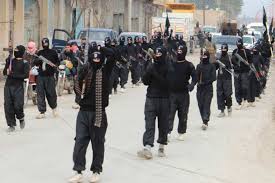
The rise of ISIS has troubled and fascinated me in equal measures. For all the global attention it attracted in 2014, it remains an entity about which there are more questions than answers – at least to onlookers like me and surely to millions of others. One way to try to understand the phenomenon is to think about the motivation of the leaders, the followers and those who oppose them.
For what they’re worth, here are my thoughts.
Let’s look at the leaders first. Is Abu Bakr Al Baghdadi just another religious fanatic with leadership skills? Does he in his heart of hearts really believe in the establishment of a caliphate – a model as flawed and unsuccessful as any other system of rule? Is he a reluctant leader – a man thrust into leadership – or is he an opportunist – a man with an eye on the main chance?
What about the followers who flock to Syria with Islam for Dummies in their backpacks? Are these boys and girls religious fanatics, or impressionable kids in search of an identity that fits them better than the choices at home? What leads them to become fighters and suicide bombers? Deep belief, or peer pressure and a desire for respect?
To the first question, it seems to me that ISIS is a political organisation first, and a religious one second. In another universe, Baghdadi and his crew would most likely be just as happy in Nazi jackboots or Mao suits. Religion is the instrument of his power, and he is using it to create a political entity. It’s an old game. His tools are ideology and hatred of the other – the other being anyone he proclaims to be non-believers. Perhaps he studied Hitler’s ideology of racial purity and the Fuhrer’s tactics in the Sudetenland and Austria. It’s a game he will probably lose, because unlike Hitler he doesn’t have the military means at his disposal to hold on to what he has for any length of time. What he has created is the result of political weakness and division on the part of regional and global stakeholders. When he is defeated – whether by military or other means – it will be at the cost of countless lives sacrificed on the altar of his personal ambition.
So perhaps we should stop being side-tracked by the religious dimension, and start treating him as just another political leader, albeit a murderous and possibly psychopathic one. We’ve come across a few of those before, haven’t we?
As for the followers, in This Year’s Best-Seller: The Rough Guide for Jihadis? I described the young men and women flocking to Syria and Iraq as gap year backpackers with attitude. The gap year analogy goes further. These are educated people, often with university degrees. But many of them are strangers in a strange land. Of a country but not part of it. Easy marks for what amounts to a cult masquerading under the cloak of a great world religion. In that other universe they could be storm-troopers or young communists. The common theme would seem to be a yearning for identity that leaves them vulnerable to manipulation by figures with spiritual or ideological authority.
Do religious considerations drive the coalition of Muslim countries determined to wipe out this dangerous interloper? There are countries close by that share much of ISIS’s ideology. Like ISIS, they police public morality on religious grounds, and exact harsh punishment on those who infringe their reading of sharia. So why would they not welcome this new addition to the fold? Although there are significant doctrinal differences – mainly centred on the definition and treatment of non-believers – the main issue seems to be that ISIS undermines the legitimacy of neighbouring regimes, and is actively recruiting from their populations. No wonder that the relatively stable states nearby regard ISIS – with good reason – as a political, military and social threat.
What of the role played by religious leaders? Are they part of the problem or essential to the solution? Critics of organised religion would claim that it’s a rare religious leader who reaches the pinnacle of their establishment for whom politics doesn’t to some extent compromise faith. They have a point. Religious leaders need political skills, especially if they are in their positions by appointment or election. They are to a greater or lesser extent beholden to those who put them there. I say this with apologies to Pope Francis, for whom principles seem to have informed politics rather than the other way round. His struggle with the Vatican Curia – an institutionalised bureaucracy for which “do what I say, not what I do” has long been a dominant ethos – is a case in point.
But who will history judge the more influential: popes, bishops, lamas and caliphs, or monks, poets, martyrs and outsiders whose examples have inspired generations? Who will be remembered longest for their spiritual impact? St Francis, Rumi and Martin Luther, or Pope Francis, Ayatollah Khomeini and Archbishop Cranmer?
As for the Muslim world, I struggle to find a religious leader universally respected for who they are, rather than for the position they hold. Most are products of the establishments that put them there, and their utterances, delivered from the safety of their state-sponsored pulpits, almost invariably follow the political line of the government in power.Worse still, clerical establishments are losing credibility with the youth of those countries. There are of course national religious figures who are respected by their own people. There are also those – such as the tele-sheikhs – who connect widely and across borders through satellite TV and the social media. But as far as I can see, there are none who appeal across the spectrum of belief; people to whom, when they speak, all Muslims – regardless of age, sect and school of thought – listen.
Abu Bakr Al Baghdadi is hardly a transcendental figure. But he is beholden to no one. His message reaches out to the excluded, the disaffected and the idealists who no longer want to be in a minority in the countries where they were born. For him, religion is politics, and politics is religion. Western powers will never neutralise the appeal of ISIS by diluting the secular nature of their societies. Distrust between generations will ensure that appeals from parents and religious figures in the west will often fall on deaf ears.
So we’re left with war, politics or a combination of the two. But to what end? To limit further destruction and loss of life, to return to a status quo ante that was already unstable and toxic, or a combination of both?
Your bet is as good as mine as to whether the defeat of ISIS by military means or by a strategy of political containment will save more lives in the long run. And to go back to the conditions prevailing that provided ISIS with its launch pad would be undesirable and impossible to achieve.
But my point is that despite the sectarian dimension that underlies the current conflict we’re not witnessing a religious war or a clash of civilisations. It’s a political struggle. If the cycle of violence is to be ended, it needs to be treated as such. Something the western powers learned to their cost in the aftermath of the defeat of Saddam Hussain. Military victory was not enough then, nor will it be now.
So what are the political options? Assuming enough force can be brought to bear to defeat ISIS militarily, the future victors should be working on a post-war political settlement now. Are they? Unlikely, since the potential participants in a decisive ground war have yet to be identified. Will Iraq, Iran, Turkey, Russia and the USA be able to agree on a post-war political settlement that stops the cycle of violence? Possibly, but there are so many conflicting interests at play that it will be extremely difficult to arrive at a workable consensus.
How about thinking the unthinkable – doing a deal with Baghdadi that recognises his caliphate in return for his undertaking not to expand its borders? To do so would be to accept that for decades to come there would be a volatile entity bent on exporting its creed by one means or another, capable of destabilising its neighbours just as Gaddafi did in his back yard. It would be a bitter pill for the new state’s neighbours to swallow, especially as it would have plenty of oil resources at its disposal.
It would also be by no means certain that Baghdadi would accept such a deal. His credibility most likely depends on being able maintain forward momentum – to expand the caliphate ever outwards. If he calculated that that ISIS had reached a high water mark beyond which, even temporarily, it could not go without risk of implosion, he might find that his creation no longer offered the same attraction to the thousands of young people who have joined its ranks over the past year. After all, a state with no enemy to conquer and no unbelievers to massacre or enslave would eventually start to feel like any other state.
On the other hand, as Osama bin Laden eventually discovered, a life of constant vigilance against bombs, drones and hit squads can have a debilitating effect on personal morale. How long can Baghdadi and his associates tolerate living in hiding, in constant fear of betrayal? The temptation to cash in his chips must eventually become very great. And even if the “caliph” himself opted to hang tough, would his lieutenants continue to stand by him, at the increasing risk of being picked off one by one?
These are all political, not religious, considerations.
In 2015 we will surely find out just how adept a politician ISIS’s leader actually is.
Ibn Arabi
On this Christmas morning, I came across a quotation from a poem written over eight hundred years ago by Muhyiddin Ibn Arabi, a Sufi scholar born in Murcia, Southern Spain, then part of Muslim Andalusia:
There was a time when I used to reject those who were not of my faith.
My heart has grown capable of taking on all forms.
A pasture for gazelles, a convent for Christians.
A temple for idols, a Kaaba for pilgrims.
A table for the Torah, the book of the Quran.
My religion is love. Whatever path the caravan of love shall take, that path shall be the path of my faith.
Which makes me wonder what we’ve learned in eight hundred years.
My thanks to Haitham Haqqi, who quoted it in an article in Al Araby Al Jadeed.
I can think of nothing more to add, except to wish all my readers, regardless of faith, a happy and peaceful day.
I woke up the other morning to the sound of voices arguing over the nature of divinity. Not something I normally do. But it’s Christmas, and I’m conscious of the message of faith struggling to make itself heard through the noise of rattling tills and jingling bells.
I’d been thinking about rockets raining down once more on Gaza. Of explosions, screaming children and righteous justifications. Of the Pope’s condemnation of the Curia, the Vatican’s civil service, as suffering from “Spiritual Alzheimer’s”, “Feeling immortal or immune”, “Suffering from existential schizophrenia”, “Committing terrorism of gossip” and “Becoming spiritually and mentally hardened”.
I’d been reading about the religious scholar in Saudi Arabia who had the audacity to question the origin of the requirement for women to wear the face veil. To back up his assertion that the practice is cultural rather than ordained by God, he appeared on TV accompanied by his wife, duly uncovered. The sheikh’s beliefs were greeted with a chorus of disapproval, and even death threats.
In my half-awake state, I imagined a giant debating platform like a floating Rubik’s cube. No matter how you rearranged the squares on each face of the cube, the same squares would be there in different combinations: full of Muslims, Christians, Jews, doubters, atheists – believers and sceptics of all stripes. All seemed to be talking at the same time. None of them listening.
The occupants of a red square were arguing about the face veils. “The idea”, they said, “that God, the all-seeing and all-knowing, busy as He is creating and destroying galaxies and universes, would be remotely concerned over whether the females of one species on one planet out of the trillion He has created should cover approximately eight square inches of their anatomy with a piece of cloth – but only under certain circumstances – is fanciful, to say the least.”
“God’s universal attention is entirely logical”, came the reply from a green square. “He is everywhere, so why would He not be concerned at the behaviour of each and every creature he has created, which is why he has sent prophets to us on order to relay His word?”
“In which case”, replied someone from a yellow square, “His word is being pretty widely ignored on this particular cosmic truck-stop. So tell us – are the billions of women who show their faces and bodies to the world condemned to that other universe He created, known to us as Hell? And what about people who have eaten and drunk prohibited things over the ages? Are they all roasting away in the other place?!”
To which the believer in the green square answered that only God will determine the punishment due to those who break His laws. “We, his creatures, can only warn of the risk you run when you disobey Him. And where He has mandated us to punish on His behalf here on earth, so you will be punished – if we can get our hands on you.”
“OK,” came a shout from a white square, “so tell me why He waited billions of years to create a species intelligent enough to understand His word? Or did the dinosaurs, the birds, the termites and the sabre-toothed tigers receive instructions from prophets of their own species that they could understand and follow? By what holy book do elephants, sharks and hyenas live their lives? And why don’t chimpanzees circumcise their male offspring?”
“Those are dumb questions,” a voice cried from a black square. “A billion years and a single second are one and the same to the Creator. So he didn’t wait a billion years as we understand them. And anyway, He created our world in a week eight thousand years ago. And all the evidence to the contrary – the dinosaur bones, the carbon dating, the 40,000-year-old cave paintings – is an illusion designed to test our faith.”
“For what purpose?” came a question from the yellow square. “Why would our faith need to be tested? If it was so obvious that a woman is worth half a man, that religious rituals must be observed without exception, that non-believers and apostates should be killed, why aren’t we all following God’s ordinances?”
By now I could no longer tell from which square the words were coming. Arguments seemed to be raging from every direction.
“Well that would be too easy. Man was put on earth to prove his worth, and to make it all the more difficult God sent Satan amongst us to sow doubt and discord. Going to Heaven is a reward, not a right. You have to earn it. Otherwise what’s the point of our existence?”
“So life is an obstacle course? And all those children killed in Peshawar get a free ticket because they haven’t even started the serious hurdles. And the suicide bombers, the preachers of hate, the oppressors of others in the name of religion get to go to Heaven? For what? To blow up the sinners there? Of course not, I forgot – there are no sinners in Heaven. So presumably there are no rules, because with no sinners there don’t need to be any.”
“It’s not for us to speculate on Heaven. Nor should we try to second-guess God’s plan for us. Just be aware that He sees everything we do, and on the Day of Judgement your sins are weighed against your good works, and on the outcome depends your ultimate destination. So follow his ordinances, and if you fail to do so, repent, and hope for his abundant forgiveness.”
“Then kindly enlighten us on this point. There seem to be plenty of good people who live by lots of different creeds. What happens to them? And what about the animals? Are you saying that there is only one way to Heaven? And for only one species? And for only one set of believers?”
“That’s exactly what we’re saying. There are no variants of belief. Only believers like us, or non-believers. If you do not believe, you will be left floundering in the darkness at the end of days, which, by the way, is due any time now.”
And so the arguments went on – an increasing babble of ever more extreme positions, accusations of superstition, sacrilege, blasphemy, bigotry and intolerance, until suddenly there was a clap of thunder, followed by a terrifying roar.
“SILENCE! ENOUGH!”
“What is this Tower of Babel you have built, in which everyone speaks the same language, and yet none of you understand each other?
Do you think it pleases me to see you standing there arguing about rules, about the nature of the universe and about why your belief is superior to others?
Do you believe it pleases me to see you going about your observances dressed in your comfortable clothes, with your fat bellies, your fast cars and your well-furnished homes?
Do you think it pleases me that you seem content with your lives of comfort when beggars sit in the streets, when your brothers murder innocents in my name, when you treat those who don’t share your beliefs as lesser beings, when you live on the fruits of exploitation, of human trafficking and slavery?
Do you think your observances are more important to me than your cruelty to others, your lack of compassion, your lies, your lack of tolerance, mercy and forgiveness?
Do you think I sent Moses to destroy the Golden Calf, Jesus against the Pharisees of Jerusalem and Mohammed against the idolaters of Mecca so that you can worship at the altar of material things, while at the same time you argue about the correct observance of a thousand rituals as though your salvation depends on them?
And you, the doubters and the unbelievers, are you so arrogant as to admit no reality beyond your experience? Do you really think it matters when the earth was created and who created it? Do you really believe that there is no mystery that science cannot solve? Are your minds so closed that you can’t see the unexplainable all around you? Are you proud when your discoveries lead to the extinction of species and threaten life itself on this beautiful planet?
I am not here to reward or punish you. You achieve those things by your own actions. I gave you life. I gave you guidance for life that you have interpreted as commandments and turned into laws. You and the generations before you have twisted my words to justify your lives of comfort and privilege. You ignore what is important because to do what is important is hard. You pay attention to trivia because the small things are easy.
I will not speak to you again. Go away and think about what is important. Not about what others should do or not do, but about what you should do. And when the time comes for judgement, be prepared to pass judgement on yourselves. For I am in you and you are in me. We are one and the same. Yet I am everywhere. When you harm others, you harm yourselves. When you harm the air, the mountains, the seas and all the things that live in them, you harm yourselves. When you harm yourselves, you harm me.
So think, and act accordingly. This is my only guidance.”
By now the voice had become still and small. The arguing rabble melted into shadows. The squares on the cube turned grey and gradually faded away. In their place was a mosaic of a thousand vistas. Of the past, the present and the future, each coming into focus as I set my eyes upon them. Each was different. Some were too painful to linger on. Others were painful to leave. And as I moved from one to another, each successive landscape became less clear, more mysterious, increasingly beyond my comprehension.
I lay transfixed in my conscious twilight, trying to make sense of what I had seen. Then it came to me. I got the message.
But you know how it is when you wake from a dream. What seems vivid, real and logical to the dreamer revels itself to be – just a dream, to be filed away in the archives of the unconscious.
But dream or not, perhaps the purpose of the whole experience was to give me my resolution for 2015.
Don’t just talk. Do. And in doing try harder to make the world a better place. Not very specific, I know. But at least it’s a start.
Neville Chamberlain – Peace In Our Time
Let me tell you a little story about politics. Actually it’s a tale from the teenage years of our eldest daughter, but it’s still about politics.
Fourteen is an age when the sweetest of little girls can turn into terrorists. Not overnight of course, but the slow build-up of hormonal forces often acquires critical mass at that age. And I’m not saying that had ISIS been around at the time she would have been on the coach towards Dover, dreaming of Syria. She was far smarter than that.
No, her terrorism was more of a domestic nature. Sulks, arguments about nothing, breaks for freedom, usually in the form of escaping the house to join her mates in the park, where tribes of teenagers would gather, seeking solidarity and the freedom to do things of which their parents would disapprove. If you’ve ever been a parent of teenagers you probably know what I’m talking about.
It was a time of walking on eggshells, of never knowing when we might trigger an emotional IED that would roll over civilised discourse in an omnidirectional blast of anger and recrimination. What made it more difficult was that she was our firstborn, and we hadn’t much of a clue about how to deal with this new phenomenon. We had conveniently forgotten what pains in the backside we were at that age – though I should really speak for myself, because I’m sure my wife was never like that.
Anyway, against this tableau of terrorism and trepidation, picture the scene one morning when our daughter, heavily emblazoned with the dark eyes of a goth and an expression of profound misery, comes to Daddy with a tale of woe. Why me? Well, at this point I should explain that she was pretty good at divide and rule.
Daddy, I have no clothes.
Yes you do – they’re all over the floor in your bedroom. I then tell her about the six layers of Troy, and how Schleimann couldn’t determine which of them was the city described by Homer. At least I was in the process of telling her when she interrupted me.
But they’re all out of date and I look terrible in them.
Ah, the fascism of fashion, I thought. The domination of the designer label. The cruelty of cool. So, after making rumbling noises about the fact that she should really learn to look after the clothes she had before coming to us for new ones, I tentatively inquired what she might have in mind.
A new coat, new jeans, several tops and a new pair of shoes. To add to the abundant archaeology already to be found on her floor.
Ridiculous, was my knee-jerk response. At which point she began to describe the deep psychic damage our meanness would cause. How terrible she looked, how unconfident she felt with her friends, how she would grieve every night at her inadequacy. And it was all our fault.
In an attempt to ward off the demons of teenage angst, I agreed to speak to her mother, if only to get her off my back for a while. Oh, another thing you should know. She had an instinctive flair for laying this kind of stuff on me at moments of maximum vulnerability – I might be busy wrestling with a problem of my own, or about to go to work, or with her in a public place where an emotional IED might cause considerable embarrassment. She also knew that I would always prefer jaw jaw to war war.
So enter Mum into the equation. My wife is definitely the Iron Lady of our family. Though she has a heart of gold and a caring instinct Thatcher never showed the world, she takes – shall we say – a fairly robust view of most things. No wobbles for her, though she’s not averse to the odd strategic retreat when pressure from her Cabinet (ie me) is applied. And in the case of our daughter’s demand, predictably, her response was a flat veto.
The inevitable and equally predictable outcome of the stand-off was a period of cold war, occasionally interrupted by outbreaks of hot war. Non-cooperation, sulking, sarcasm (another seemingly natural weapon in daughter’s armoury), sanctions and a generally unpleasant atmosphere around the house.
This state of affairs continued for several days, during which I sought refuge in my study, especially when my attempts to mediate met with little success or even appreciation by either of the warring parties. You’ll notice that by this stage, rather shamefully, I’d joined the non-aligned movement, a tendency when the going got tough that rightly earned me negative brownie points from my wife. Not for nothing did I refer to myself in those days as the Boutros Boutros Ghali of the Royston family.
And then one day our daughter came to me with the sweetest expression – no longer the gothic scowl – to offer a concession.
Daddy, I’ve been thinking about the clothes. Actually, I can do without the coat, the jeans and the top for a while. But please please please please can I have a new pair of shoes?
And it worked. After days of crawling through our domestic Stalingrad, dodging emotional shells and sniper bullets, I could see a possible peace treaty. I presented a united cabinet opinion to my wife, who agreed on the grounds that girls of 14 actually outgrow their footwear, but stipulated that the shoes should be “sensible”. After a bit of wrangling on the definition of sensible, the deal was done. Peace and amicability were restored, and my daughter skipped off to the shoe shop and returned with a very nice pair of heels. Not very sensible, but definitely shoes.
I use that story in workshops on negotiation to illustrate a variant of one of Robert Cialdini’s six principles of influence. It’s called reverse reciprocation. Start with an extreme position. Make a concession by partially backing down. The other party reciprocates with a concession from their original position, which in our case was no. The result: the party taking the extreme position is rewarded with something when nothing was originally on the table.
Does that not sound familiar? I’m not aware of any nations that have imposed sanctions on Russia in the past year expecting Vladimir Putin to walk away from Crimea, for example. A settlement that leaves the territory of the rest of Ukraine intact and ensures that Putin stops playing mind games over the future of Moldova and the former Soviet Baltic republics would be regarded by America, the European Union and NATO as a win. And Russia ends up with something that was never on the table in the first place. Sanctions lifted. Normal relations restored.
Except that such tactics rarely result in lasting tranquillity. As Neville Chamberlain found out when dealing with Adolf Hitler in the run-up to World War 2, and as we found out again and again during our daughter’s interesting teenage years. Once successful, extreme negotiators continue to push at new boundaries until they either make the fatal mistake of pushing too far or grow tired of the game. Or, in the case of teenagers, grow up to become delightful and responsible adults, as has our daughter.
If you look around the world you can see the consequences of overreach – actual or potential. Saddam Hussein might still be with us if he had not overrun Kuwait. Will the Peshawar school massacre spell the death knell of the Pakistan Taliban? Might ISIS yet consolidate their caliphate within the existing territory that they control if they cease their barbaric treatment of the unfortunates under their control, and agree not to export their ideology beyond their borders? At what stage might Iran swallow the bitter pill and abandon their nuclear ambitions?
These questions remain to be answered. But the story of my daughter and the shoes goes to show that we don’t need to gaze at the world stage to see politics in action. It’s happening under our noses every day in our homes and workplaces. The principles are the same – the only variables are the scale and the consequences.
All we have to do is watch and hopefully learn – about red lines, about listening, about reading intentions and about the importance of time in establishing a modus vivendi, It’s all there on the home front. And one more thought: children know things that adults often forget. We can learn from them as well as they from us.
“Torture is the systematic and deliberate infliction of acute pain by one person on another, or on a third person, in order to accomplish the purpose of the former against the will of the latter.” (Amnesty International)
Torture is morally wrong. It’s also ineffective as a means of obtaining information. It corrodes the torturers, the tortured and the societies in which it takes place. That being the case, why has it taken the entire span of human existence for us to realise this, and why – despite almost universal acceptance of international law prohibiting it – does it still take place across the majority of inhabited space on our planet?
Is it because we are more driven by fear than rational thought? Are we as a species less “civilised” than we like to think? Or more civilised than we think, because we’re the only species that deliberately inflicts pain on our peers for purposes other than territorial dominance and sexual supremacy? Or should we be using the term “evolved” rather than civilised?
I don’t know, and I find the subject of torture as disturbing as anyone else who is confronted with evidence of the appalling cruelty that people inflict upon others. I also have no interest in getting into the kind of debate on the subject beloved of philosophy teachers. I have opinions, but more questions than answers.
So here are ten questions we should perhaps ask ourselves when we make sweeping statements on the subject. To some the answers are obvious. To others less so. Most of them lead to more questions.
The questions use as a reference point the definition of torture I quoted above.
Is it wrong?
It surely depends on what we mean by wrong. Do we mean morally wrong? According to what moral framework? A religious framework? Which religions specifically condemn physical punishment? And which religions specifically sanction it? Undoubtedly some religious scriptures can be interpreted as condoning the infliction of pain on others. I leave it to you to figure out which.
Is it effective?
The most common practical argument against torture is that people will say anything to make the pain stop. I wonder. If the information given under duress can be verified as being false, and discovery of the falsehood will result in the certainty of further punishment, is the argument still valid?
Which is more effective, the fear of torture or the act itself?
Perhaps it depends on the certainty that torture will follow as the result of lack of cooperation. If we know that we are about to be tortured, it is an exceptional (or highly motivated) person who is not prepared to go to any lengths to avoid the consequent pain and suffering. So you could argue that yes, in the majority of cases the threat of torture is very effective. So is the fear of the unknown – not knowing what is about to happen to you. Imagination is a very powerful thing.
Can you torture groups as well as individuals?
I would say undoubtedly yes, even if Amnesty’s definition seems to exclude group torture. The random selection of individuals from a group for execution is a time-honoured practice that was used very effectively by the Nazis in World War 2.
Is it wrong to engage with torturers?
Does it not depend on who’s doing the engaging, and for what purpose? If governments ostracise other governments that knowingly employ torture, there wouldn’t be much international dialogue. What large countries don’t use torture in one form or another, at one time or another? International diplomacy is largely a process of the guilty talking to the guilty.
Would you torture to protect your loved ones?
If the answer is yes, then should you judge governments that torture those who threaten citizens that it is under obligation to protect? Would you condone the use of torture in an extreme situation, for example to prevent a nuclear attack on your city? This is the Cheney justification: “our country was under attack – we used any means necessary to defend it”.
Is war a form of torture?
Was the series of assaults on Gaza a form of torture? Was the bombing of Germany and Japan in World War 2 a form of torture? How about the bombing of Vietnam? Is the threat of war a form of torture, given the terror that it instils in populations?
Is there such a thing as non-violent torture?
Is mental cruelty – withdrawal of love, isolation, sensory deprivation, sleep deprivation, lies, exploitation of personal phobias, bullying, threats of violence – torture? If so, how many of us can honestly say that we have never used torture at some stage in our lives?
Are democracies less likely to torture than autocracies?
That probably depends on your definition of democracy. I can think of a number of countries that call themselves democracies where torture takes place unchecked. So it’s probably the wrong question. Better to ask if torture is less likely in countries that respect the rule of law. Recent history suggests that autocracies are more likely to make laws that enable torture because they can do so without public opposition. On the other hand, in extremis, elected governments are just as capable of using it. Think of the US in Vietnam, Britain in Kenya, France in Algeria. The rule of law is effective only if the law is imposed transparently.
Are we as individuals capable of torture?
Obviously it depends on the individual. But enough “ordinary people” willingly joined the Nazis in persecuting the Jews in World War 2. The Milgram Experiment, in which participants, prompted by a figure of authority, were prepared to use potentially excruciating doses of electrocution on subjects, suggested that in certain circumstances many people are capable of inflicting pain and suffering.
It’s easy to point the finger at America’s “enhanced” interrogation tactics in the aftermath of 9/11. It’s an open-and-shut case, isn’t it? Morally wrong and possibly criminal.
The reality is that the waters are far muddier. That’s why I offer more questions than answers.
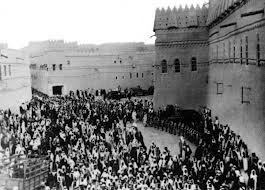
Old Riyadh
I’ve just made it back to the UK after two fairly lengthy visits to Saudi Arabia. So this is my last postcard for a while. What began with a single post about a railway trip has turned out to be a series of fourteen articles about a country that I know pretty well, but that as a foreigner I can never know really well. It’s a country that still surprises me, and is changing more rapidly than at any time I can remember.
I’ve written about a number of subjects based on my own experience, on what I’ve read in the local media, and on conversations with Saudi friends and acquaintances along the way. I’ve spent my time in four cities: Dammam and Al Hasa in the east, Riyadh in the central region and Jeddah in the west.
The posts have generally been on the subject of change. Huge infrastructure projects, evolving institutions, changing attitudes as the young become increasingly influential. Old problems in new guises, new threats. By no means a comprehensive portrait of a country I first visited thirty-four years ago, but a series of snapshots that provide a counterpoint to the internationally received wisdom that Saudi Arabia is a country resolutely standing still.
I never expected to see three successive airports at one major city in my lifetime, for example. When I first arrived in Jeddah it was to a decrepit, crowded cattle market in the middle of the city. Soon afterwards it was replaced by the shiny new King Abdulaziz International Airport, which has now become equally decrepit and is doing the Kingdom’s reputation no favours with its limited facilities. And now a new airport, complete with rail links to the holy cities of Mecca and Madinah, is under construction. So it’s quite conceivable that before long I’ll be checking out yet another spectacular piece of infrastructure. Meanwhile the UK has spent at least as long debating and dithering about the future of Heathrow.
But some things never change. Though western observers often portray Saudi Arabia as a harsh, rigid and intolerant bastion of misogyny and religious conservatism, there’s another side to the Saudi character that rarely gets a write-up. And that’s the innate warmth, kindness and hospitality of its people. Not everyone shows those qualities, of course, but I’ve experienced enough examples to know that they are to be found in as much abundance as the hydrocarbons that lie beneath the sand.
To illustrate the point, here’s something that happened to me a couple of days ago. I’d been running a workshop in Riyadh. I mentioned that I’ve had a long-standing interest in the history of the Middle East – from Sumeria to the present day. Over lunch I got chatting with one of the participants, whom I shall call Abdullah. In the course of the conversation he told me that his grandfather was killed in the decisive battle between King Abdulaziz and the rebellious Ikhwan (Brethren) – the Bedouin warriors who had been at the forefront of Abdulaziz’s campaign to unify the Kingdom but had at this stage had turned against him. Abdullah’s forebear was on the wrong side of the argument, and in 1929 met his end with hundreds of others in a hail of machine-gun fire.
The battle of Sabillah was no contest. Camels and rifles against the King’s highly efficient gunnery. It was the last revolt against the authority of the Al-Saud until the 1979 insurrection in Mecca. Abdullah also told me that his father still had his grandfather’s rifle – one of a cache confiscated from the defeated German army after World War I that the British had supplied to Abdulaziz. The rifle, he said, still bears the original military emblems.
The story of Sabillah reminds me of the climactic scene in The Last Samurai, in which Tom Cruise joins a group of rebellious Samurai in a final encounter between bows and swords and the weaponry of the newly-created Imperial Japanese Army. Another unequal clash between ancient tradition and unforgiving technology. The Ikhwan‘s last stand would surely also make a compelling movie, though probably not until the Saudis are able to view the event more dispassionately than might be the case today.
The next day, before the workshop started, my new friend presented me with a photographic history of the Arabian peninsula in the early 20th century. Some photos I’d seen before; many I hadn’t. There were pictures of the Balad, Jeddah’s original quarter, showing magnificent coral and wood buildings, a sorry remnant of which still stands today. Photos of the Haj, of Abdulaziz’s mud-brick palace in Riyadh, of Najran and Asir in the south, of Al Hasa and the east and Qasim in the north. And portraits of foreigners who played a part in the Kingdom’s early history: Captain William Henry Shakespear, who accompanied Abdulaziz on one of his campaigns and fell in battle; Harry St John Philby, father of Kim, a former British colonial administrator who spent years at the King’s court and converted to Islam, becoming Abdullah Philby; Gertrude Bell, the first western woman to meet Abdulaziz.
Though I don’t read Arabic, I was easily able to recognise many of the characters and locations – more with Abdullah’s help.
I was very touched that someone I had only met the day before would take the trouble to bring me such a gift. I was a person he might never meet again, yet my interest in his country’s history was enough to spark this unexpected act of kindness.
Over the years I have been invited to weddings, to people’s houses, on outings to camel fairs and places where Saudis gather to eat, chat and smoke shisha. Yet I don’t speak Arabic well enough to take a full part in the conversation, so my hosts have spent much of the time speaking in my language.
Such hospitality would be unlikely to be afforded so spontaneously in my country to ordinary Saudi visitors, especially now, as we come to terms with our newly resurgent spirit of xenophobia.
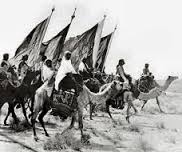
Ikhwan Warriors
Abdullah’s book, however, despite its portrayal of an innocent and largely peaceful age, also shows a dark side. I keep coming back to the famous photo taken by Captain Shakespear of King Abdulaziz’s Ikhwan marching through the desert atop their camels. The mayhem their leader sowed through his ultraconservative shock troops almost destroyed him and his new kingdom. At Sabillah it took modern technology to overcome the challenge of his disgruntled followers against the settled, law-abiding state he was in the process of founding.
Today his descendants face a similar challenge – the result, many would say, of their use of soft power rather than the machine guns of Abdulaziz. Through the funding of mosques and madrassas, and the distribution of literature promoting the uncompromising view of Islam inspired by Mohammed ibn Abd al-Wahab in the eighteenth century, several decades of influence-wielding has, claim the sages of the west, helped to produce in the Middle East and beyond a generation of extremists who are again questioning the legitimacy of the Saudi state. But today the adversary has technology that equals, and, in the case of internet and social media expertise, perhaps exceeds that which is at the disposal of the Saudis.
The confrontation with the new enemy, ISIS, will be brought to a head not, most likely, by Saudi armies but by others who feel equally threatened and have the means and the determination to see it through.
In case anyone doubts the parallel, here’s a description by Robert Lacey in his 1981 book, The Kingdom, of the Ikhwan’s entry into Taif, a town close to Mecca, when they were still following the banner of Abdulaziz:
“A deputation of Taif citizens, it is said, negotiated a surrender with Khalid ibn Lu’ay and Sultan ibn Bijad. Perhaps the gates were simply opened without formalities by local Ikhwan sympathisers. But certainly the townspeople were not considering any forcible resistance when the brethren’s takeover of Taif suddenly turned into a dreadful massacre.
Afterwards it was said that the Sa’udis had been fired on from a police post, but whatever the provocation, real or supposed, the slaughter was merciless: the town’s qadi and sheikhs retreated to a mosque, to be dragged out and cut to pieces; houses were destroyed, shops and market stalls looted; throats were cut and bodies were flung down the open wells of the town in a rampage that left more than 300 dead in a matter of hours.
The massacre of Taif threw the Hijaz into a panic, and King Husain appealed desperately to Britain for help. But he received no response, for, on hearing the news of the Sa’udi invasion, His Majesty’s Government decided to let events follow their natural course.”
The capitulation of the rest of the Hejaz, including Jeddah, followed shortly thereafter.
Yet it was the kindness of a descendent of the fearsome Ikhwan that stayed in my mind as I headed back to London. A symbol of hope that in a few decades the grandchildren of the fanatics currently rampaging though Syria and Iraq will be equally welcoming to those who don’t share their religion and their cultural values.
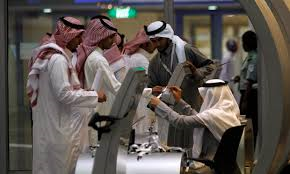
A recent story in the Arab News about a job fair in Riyadh where 44 employers were offering 1,947 jobs and only had 811 takers has caused a bit of a debate both among Saudis and foreigners.
Was this further evidence in support of the oft-repeated canard about Saudis being work-shy – content to sit at home while an army of foreigners do all the work, and if they happen to be in jobs, doing the least that they can get away with?
Rasheed Abou-Alsamh, a columnist for the paper, issues a stinging rebuttal of that view in an article published today: We aren’t a nation of lazy, spoiled brats! It’s well worth a read.
He pinpoints a number of issues that contribute to the perception. Many Saudis prefer to work in the civil service because they see government jobs as being more secure and prestigious than work in the private sector. But the government can’t accommodate all the school leavers in a country that – like many others in the Middle East – has a huge youth bulge. He goes on to comment:
I think there are many reasons behind the reluctance of more Saudis entering the private sector. And I seriously doubt that the majority of those who remain unemployed or underemployed are happy, and don’t want a shot at a stimulating job. There is no massive government scheme that I know of that pays young Saudis to stay at home and do nothing, and as far as I know most of these unemployed Saudis are from middle and working class families. For sure the educational system is partly to blame in that it is producing Saudis who are incapable of analyzing situations on their own and taking decisions when needed. With its emphasis on rote memorization has unfortunately resulted in young Saudis not being ready for today’s competitive job market. The extended family system that most Saudis are born into also tends not to encourage independence in actions, as we know that there will always be some relative there ready to help us financially when the need arises and a maid to clean up after us. Saudi families should start raising their children to be more independent and responsible. They should start with small things such as helping set the table for lunch and dinner; helping clear the table; washing the dishes occasionally; learning how to wash and iron clothes; vacuum the house and clean their own bedrooms. This teaches discipline and self-reliance. Instead of always expecting the maid or your mother/sister/aunt to clean up after you, why not do these things yourself?
Well said. The education system, the extended family and the reliance on domestic help are all factors that fashion attitudes among the young.
His take on the job fair – born out by friends – is that perhaps a number of the job specifications set the bar too high in terms of experience required.
I can believe that. I was discussing the event with a couple of Saudi friends this afternoon. One of them commented that there is a wide mistrust of job fairs, because they tend to talk up the jobs with the highest salaries. When young hopefuls turn up, they are disappointed to find that only a small fraction of the jobs on offer are at the upper level, and that these roles demand a level of experience that they don’t have. Thus highly qualified high school or university graduates find themselves being offered low-paying jobs, or not offered jobs at all.
The other friend told the story of a large fast food chain that put signs in every outlet offering jobs at SR8,500 a month – more than twice the minimum wage. Thinking that this was a pretty good deal for youngsters, he got talking to one of the Saudis who was working there about the offer. The employee told him that actually he was on a wage of SR3,500 a month, and pointed out the very small print at the bottom of the poster. It said that the higher wage was for assistant managers.
This kind of misleading hype is not confined to the job market. In Jeddah recently several well-known stores have been hauled over the coals by trading standards officials for advertising discounts that don’t exist.
All these practices lead to a sense of cynicism, not to say distrust, of advertising claims across the board.
What about the young people who do find jobs in the private sector? I learned this afternoon that in retail particularly, most young Saudis leave their jobs within three and six months. Why then would an employer invest in training and development if the people they train are out of the door in a relative instant? Well, it doesn’t help that these kids, who have no experience of work, no career guidance at school and no idea of what is expected of them, find themselves thrown into jobs with little supervision, no idea of any career path and no training or mentoring. In other words, they are left to sink or swim. And most swim away at the first opportunity, either back home to wallow in disillusionment or, if they’re lucky, to what they see as better jobs in banking, telecommunications and so forth.
In construction, which in Saudi Arabia is a particularly dog-eat-dog industry, foreign hiring managers apparently actively resist taking on young Saudi engineers, preferring to recruit from within their own ethnic groups. Very discouraging for people who have studied for years, and graduate with the expectation that they will easily find jobs in the most dynamic sector in the economy.
So this leads to a question that needs to be posed to owners of private sector businesses who moan about the poor work ethic of their fellow nationals. If you treat your Saudi employees as expensive burdens, only to be taken on because you are required to do so by increasingly aggressive government regulations, if you do nothing to train, motivate and encourage them, and if you recruit them with all the finesse of a cattle market trader, isn’t it pretty obvious that your concerns about their work ethic will be a self-fulfilling prophecy?
I agree with Rasheed – there are plenty of motivated, hard-working Saudis in all walks of life. When I visit the Kingdom, I see them, interact with them and talk to them every day. But the ones I don’t see so often are those who don’t have jobs. These are the ones who need to be cared about as well. And if employers don’t care for the young people they recruit, encourage them, introduce them into workplaces where even if the first job isn’t ideal it’s still a fun place to be, give them goals, show them where they can go, help them to achieve dreams and ambitions, there are others waiting on the internet or north of the border who will be only too pleased to give these impressionable kids ideals, dreams and ambitions. The trouble is, the kind of dreams on offer will be extremely bad for business in the long run.
As Rasheed says:
The government has for many years been trying to convince Saudi business owners that while training and employing Saudis may be more expensive in the short term, in the long term it is a much needed investment in the future well-being of our country.
I would go further. These owners have benefited from the extraordinary good fortune of being born in a country whose government has for decades bent over backwards to help them, and thanks to the Kingdom’s abundant resources, they have prospered. Now it’s time to give something back, however painful that may be in the short term. The consequences of not doing so could be disastrous, not only for their businesses but for the country as a whole.
And those owners who don’t get the point should be prepared to see their businesses wither on the vine. The sooner the better.
I usually take a large number of books with me on business trips. I know I won’t read them all, but it means that I have a choice. Two I was looking forward to reading were autobiographies published around the same time this year. The first was More Fool Me, the latest episode from Stephen Fry, and the second was So Anyway… by John Cleese. A third, very different, autobiography by Alan Munro I’ll talk about later.
Having just finished Cleese’s book, I’m trying to figure out why it took me only three days to read, and three times as long to finish Fry’s. And why Cleese, from my perspective, has written by far the better book.
Both deal with a period of the writers’ lives rather than the whole span. This is the modern way. Why spill all the beans in one volume when you can extrude them over several? Both are full of stories about famous people with whom the authors have worked or played. And there’s a good deal of self-examination, which is unsurprising given Fry’s well-known bipolar condition, and Cleese’s long-standing interest in psychotherapy.
But one difference between the two narratives is that the names dropped by Fry seem to feature mainly as supporting characters in his personal dramas. Cleese, on the other hand, uses his portraits of friends and acquaintances to illustrate his thoughts on the art of comedy. In fact you could argue that Fry’s book is mainly about cocaine, whereas Cleese’s is about comedy.
Perhaps because I’m closer in age to John Cleese than I am to Stephen Fry, I feel that I can relate more easily to the former. His acute observations of early influences on his life – his parents, his teachers and the nuances of the class system – are rivalled only by those of his near-contemporary and fellow-dramatist, Alan Bennett.
I had the same kind of education as Cleese, and like him, I taught at a prep school before going up to university, and so experienced the sudden role change from pupil to teacher that he describes. I will always treasure the memory of acting out the Battle of Cannae in front of a bunch of bemused ten-year-olds.
Also we are similar both in terms of having a pretty even left brain/right brain balance and of having a strong degree of introversion. And more importantly, we both loathe the Daily Mail. The major difference is that he has towering talents way beyond any that I possess.
I’m no less an admirer of Stephen Fry. He has a superb turn of phrase, tells a great story and has done some fine work on TV and film. Where he loses me in his latest book is in his description of his long love affair with cocaine.
The only thing I’ve ever put up my nose is nasal decongestant, so his descriptions of coke-fuelled nights at the Groucho Club leave me cold. Not with disapproval – after all most of us have our favourite methods of killing ourselves – but because I just don’t find the antics of snorting celebrities to be particularly interesting. You can read about stuff like that in gossip columns, on the net and goodness knows where else. That said, in an exception to my comment about name dropping to serve his personal narrative, he writes with great affection and respect about Hugh Laurie, his long-time writing partner.
But when Cleese talks about Peter Sellers or Ronnie Barker, for example, we learn as much about the way they went about their craft as about their personalities. Fry fills much of the later stage of his book with a diary covering a period when he was writing his second novel; his purpose seems mainly to illustrate how ridiculously busy he was at the time. Whereas at a similar point, Cleese talks us through a series of comedy scripts, and comments on why they worked and why they didn’t. Much more instructive and satisfying.
I also like Cleese’s character sketch of David Frost. He describes him as “pronoid” which is the opposite of paranoid. Frost, apparently, always worked on the basis that everybody wanted to help him. Thanks to his charm and organisational skills, they usually did. And when he claimed the lion’s share of the writing credits for some of his more successful shows, none of the writers who did the donkey work, including Cleese, seemed to object. Remarkable, when these days so many writers and entertainers seem to consult their lawyers before they get out of bed in the morning. I’m sure the fact that he was the rain-maker for so many of their careers had something to do with it. A great case study for those who make their living prattling about the power of positive thinking.
Cleese comes over as the humbler of the two. Prickly, yes, and probably a bit of a pain to work with, but never less than honest about his shortcomings and deeply committed to his life’s work. Fry does a good line in self-deprecation as well. He’s also very serious about his work, yet I get the impression that he has an inner confidence in his talent that Cleese always struggled to maintain.
I also I don’t get the same sense of curiosity in Fry’s outlook on life as I do from Cleese. We learn more about the drama around Fry than that which plays within. No problem with that. He hasn’t had the easiest time managing his inner self and he’s entitled to set his own boundaries of disclosure. But Cleese – at least on the evidence of the two books, seems more rigorous and analytical, both about himself and his work. Unfair perhaps, because Fry has done much to increase public awareness of bi-polar disorders.
A couple of years ago I review Keith Richards’ autobiography under the heading of All About the Music. By which I meant that for all the Rolling Stone’s graphic tales of drug abuse and debauchery, the underlying theme of the book was music, not Keith’s lifestyle. I feel the same about John Cleese’s autobiography. As I said earlier, it’s fundamentally about the art of comedy, whereas Stephen Fry’s book is mainly about Stephen Fry – and his relationship with cocaine. Funny? In places, yes, but lacking the light and shade – and the forensic observations – of Cleese’s work.
Anyway, enough of the comparisons. They didn’t ask to be judged against each other. I just happened to read the books in quick succession.
Both write in an engagingly conversational style, far less formal than that of a very different autobiography I read around the same time: Alan Munro’s Keep the Flag Flying.

Munro is a former high-flying diplomat. I bought his book mainly for his experience as British Ambassador in Saudi Arabia during the first Gulf War. I can’t say I learned much from his revelations. I shouldn’t be too surprised, given that he is bound by the Official Secrets Act, but apart from a few amusing anecdotes he doesn’t have much to say on the Gulf War that I don’t already know. Incidentally, isn’t it the case that the great and the good tell anecdotes, whereas normal mortals tell stories?
The writing is very polished, and in a style typical of a well-brought-up product of Oxbridge born in the early thirties, whose phraseology was honed through years of critical editing by legions of Foreign Office bureaucrats – witty, dry and understated. I could imagine him dictating his memoirs from a comfortable chair beside a roaring fire at one of London’s better gentleman’s clubs. As John Cleese wrote when describing the qualities of his favourite prep school master, Mr Bartlett, Munro’s writing evidences:
“…the Edwardian gentleman’s approach to life: courtesy, grace, restraint, the careful avoidance of embarrassing others, non-intrusiveness, considerateness, kindness, modesty – nay, more than modesty, self-effacement; the kind of qualities that would disqualify one for ever from employment by the Daily Mail.”
Though I suspect that Sir Alan might disagree. He certainly had more ambition and cutting edge than poor Mr Bartlett, who discovered late in his career that the headmaster had for years been paying him less than the odd-job man.
About the only time Munro gets close to bitchy is when he reveals his strong disapproval of Alan Clark – chancer, cad and brilliant diarist who served for a time as Defence Procurement Minister under Margaret Thatcher, and was caught up in the row about export licences to Iraq.
Still, there’s plenty of interesting stuff for a lover of the Arab world, especially his descriptions of pre-Gaddafi Libya and Lebanon before the civil war. And unlike Mr Bartlett, he has a strong sense of the absurd.
All in all, A-minus for style, B-plus-plus for content and C-minus for insight into the person behind the diplomat – just as you would expect, I guess.
But my winter term prize for autobiographies goes to John Cleese by a mile – a man much more after my own heart than the other two. At this point I confess to a bias.
In 1974, during a short-lived and not very successful career as a concert promoter, I wrote to him with an offer to come and do “An Evening with John Cleese” at the Birmingham Repertory Theatre. He wrote a very courteous personal reply – not the kind of standard rejection you might get from an agent nowadays – explaining that he would love to do it, but that work commitments made it impossible in the foreseeable future. I’ve had a soft spot for him since then.
If he hasn’t yet managed to finish paying off his third wife’s divorce settlement, with a bit of luck we’ll hear from him again. After all, we still have the Python years, Fawlty Towers and A Fish Called Wanda to come.
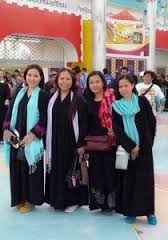
Yesterday evening I paid one of my rare visits to my nearest mall – the one underneath the giant bottle opener that is the Kingdom Tower. Since the hotel restaurant was closed on Fridays I decided to treat myself to a Big Mac – just what you need to feed a cold.
The guy who served me had probably been at work for eight hours or more. Yet he was the most cheerful, positive and charming person I’d met for days. Not just to me but to the overweight, sour-faced, spoilt-looking eight-year-old who wanted to swap the barbecue sauce that came with his chicken nuggets for ketchup.
The guy was from the Philippines. Not for the first time it occurred to me that the Filipinos are the unsung heroes of modern Saudi Arabia, and have been for as long as I’ve coming to the Kingdom. Without them, the country would struggle to get by as it does today.
I don’t want this post to come over as a “you’re a better man than me, Gunga-Din” paean to an ethnic group who are fairly well down the social pecking order. I admire and respect them.
The Filipino men are the waiters, the drivers, the mechanics, the technicians, the draftsmen, the guys in black waistcoats and bow ties who bring you your coffee in smart offices. They’re also doctors and engineers. The women are the hospital nurses, the secretaries and the housemaids. Over a million of them are currently working in the Kingdom.
I first worked with Filipinos in the Eighties. One of them was a superb cartoonist, and his work still decorates my home in England. They were diligent, hard-working and loyal. Not all of them were as outgoing as my guy in MacDonald’s, but they were all worth their weight in gold. My small daughter became so attached to Benjie, the girl who cared for her in her crèche, that we seriously considered trying to bring her home with us when left the Kingdom.
The vast majority of them are artistic, fun-loving and cheerful. They put up with a lot. Most – even those in similar jobs – earn a fraction of what a westerner can. Often they put up with pretty grim accommodation. Most of their earnings go back to the Philippines to support their extended families. So much do they depend on their Saudi income that they seem to arrive with an inbuilt deference.
As a westerner, you would have to know a Filipino pretty well before they would call you by your first name instead of “sir”, an appellation we British associate with a more class-conscious age. The fear of losing their jobs can result in their being terrified of making a mistake, so perhaps unfairly they have a reputation of lacking initiative and creativity. In fact I’ve found them to be highly resourceful, especially when it comes to making few riyals on the side to boost their remittances.
Could it be that centuries of colonisation and the years of brutal oppression by the Japanese in World War 2 have left them short of self-confidence as a nation? I don’t know. But I do sense that with their many talents their best days are yet to come.
Those above them in the pecking order often treat them with arrogance, working them long hours, clicking their fingers to summon them and, in the case of housemaids, abusing them. Yet if you see groups of guys in the mall, they will be laughing and joking in stacatto Tagalog. The same goes for the girls who work in the hospitals. Their sing-song voices remind you of the dawn chorus. Ever cheerful.
An example: recently I was doing a workshop on creating positive attitudes at work. The assistant who looks after me when I visit this particular institution is a Filipina in her early forties. Every time I go there we manage to have a chat about this and that. On this occasion she told me that she had breast cancer and had recently undergone a double mastectomy. No self-pity. She told me she couldn’t understand why her colleagues were expecting her to be an emotional mess. She took her illness and operation in her stride, and was as positive when I saw her as she’d ever been before. She put her outlook down to her faith in God and to her natural optimism. I was so impressed that I asked her to come into the workshop and close it by saying a few words about her experience. She carried it off like a professional. She could and should be a trainer, yet most likely she’ll stay in the niche assigned to her by virtue of her nationality
The Filipinos in Saudi Arabia are no saints. The Philippines can be a pretty violent country, and I’m told that here some of them form into little mafias who can be pretty ruthless if their interests are threatened. But I’ve never seen that. What I do see is a bunch of hard-working and resilient people with a great sense of humour who make many sacrifices for their families. It must be hard not being able to see your kids more than once every two years, even if skype alleviates the separation somewhat. And I can only imagine how they must feel as yet another typhoon approaches their homeland.
All the while they work away in the knowledge that the government is putting increasing pressure on employers to replace them with Saudi nationals.
Yet if I was working for the government, of all the expatriate groups I might seek to put on planes home, the Filipinos would be the last, and the most missed. They, more than any other ethnic group, are the glue that holds the Kingdom together. And for that reason, they deserve the appreciation and respect of their hosts.
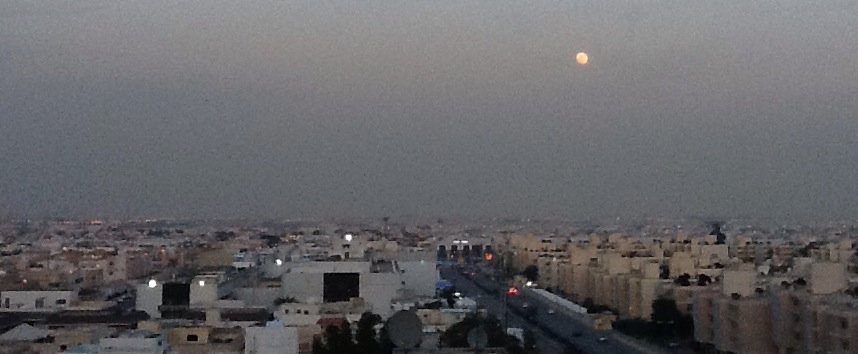
Riyadh at Dusk: December 2014
2014 may have been the hottest year on record, but try telling that to the people of Riyadh. To look at the clothes some people are wearing, you would think we were in Siberia. Over the past few days the temperature has dropped by about ten degrees. Yesterday morning it was 8C – colder, as I told one local, than it is in England.
Sometimes the temperature goes below freezing, which is hard for some to believe in this country known to the outside world for its hot desert sands. And all of a sudden residents of Riyadh respond to what we in England would see as a nice sunny day by cladding up for life on the permafrost. Ear muffs, balaclavas, thick jackets. The Saudis swap their white thobes for coloured versions – black, brown and grey. In the service stations off the highways you can buy a farwa – a full-length embroidered overcoat, rather like a woollen version of the Afghan coats the hippies used to wear in the 60s and 70s. The south Asian residents, especially those who work outdoors, not surprisingly seem to be worst affected. They wander around looking particularly miserable, scarves wrapped around their heads in a vain attempt to keep out the cold.
And of course the changing season gets blamed for the colds and flu that do the rounds at this time of year. Unfortunately I’m one of the current victims. As I write this I’m sitting in my hotel room trying to avoid flooding the laptop with my runny nose. Occasionally I shake the foundations with bouts of sneezing. Anyone next door trying to get a bit of weekend sleep will have problems this morning. Not that I’m particularly sympathetic. My room happens to be directly facing the nearest mosque, whose huge speaker mounted on top of the minaret seems to be pointed in a direct line at my window. So at 5am every morning I am wakened by the dawn call to prayer. It actually starts a good hour before daylight, and it’s loud. Whether the interrupted sleep contributed to my ailment, or it worked the other way round, is debatable.
One’s hypochondriac instincts are exacerbated by the fear of MERS. This is the coronavirus that has been popping up round the Kingdom and carrying off one in three of its victims. It’s a cousin of SARS, and research suggests that it originates from camels. Since it first emerged three years ago over 300 people have died from it. Hardly comparable with the annual mortality from flu, and a tiny fraction of the deaths from road traffic accidents. But enough to get me nervously looking at the web to check out the symptoms. I discover that those who are heading for the pearly gates usually suffer from flu-like symptoms, but also vomiting and diarrhoea. That’s OK then, it’s a common cold you wimp! And the fact that I’m able sit here at the laptop suggests that for now at least the grim reaper has left his scythe in the toolshed.
Talking about the weather is a comforting cultural norm for an Englishman like me. The Saudis like talking about it too. In the summer there are debates about the cruelty of some employers who force their workers to slave away cleaning the streets and constructing buildings in the midday sun. In the winter we read reports about “unseasonable weather”, though usually that refers to flooding and dust storms. Yesterday we learned that the King has personally donated around $100 million to those affected by the cold weather in the north of the country – not exactly the institutionalised winter fuel allowance that we get in my own country, but announced with more of a flourish.
A friend showed me a video from his home area near Qassim, which is about 400 kilometres north of Riyadh. When the rains come they create huge temporary lakes that enable the locals to engage in their version of inland water sports. The video showed a bunch of guys in a jeep ploughing into the lake at speed, towing someone what looked like an inflatable raft. The jeep became completely submerged, but kept going, while those on top of it gleefully plunged into the water, white thobes and all. Apparently they did something to the carburettors that prevented them from flooding, and sure enough, the jeep emerges from the lake still firing on all cylinders.
He showed me another video taken from the far north of the country showing snow-covered desert. Quite spectacular – rather like how the polar regions of Mars must look from the ground, I imagine. All a reminder that deserts can be very cold places as well as hot. Something that travellers in the Gobi know well.
But when the rains come, the desert briefly blooms. For a short while whole areas are carpeted with green, much to the delight of the camels. This was once the raiding season. Raiding was a ritual sport carried out under strict rules, in which bedouin tribes would pounce on rival encampments, plundering livestock and settling scores. These days, the forcible appropriation of camels is frowned upon, but city dwellers delight in making weekend forays into the desert to camp out, say hello to their camels, and perhaps do a bit of hunting for small animals and birds. If they are sufficiently well-heeled, they will use falcons – some of which cost as much as a Rolls Royce.
Once upon a time these desert pastimes were a matter of life and death. In Endings, Saudi novelist Abdulrahman Munif tells a compelling tale of a village on the edge of an encroaching desert as drought and the advent of city-dwellers threaten its ancient hunting tradition. A while ago I reviewed Munif’s monumental Cities of Salt trilogy. A great read for those interested in the Arab world.
The Saudis regard winter weather as a blessing, even if heavy rain brings with it flooding, with inevitable casualties. Every year people get swept away when they get too close to the flash floods that burst down desert gullies into the plains. The cities also suffer – mostly Jeddah but also Riyadh, where flood drainage either doesn’t exist or doesn’t work properly. See my recent postcard from Jeddah for more about this. But water brings life too, so it’s not surprising that the King leads the traditional prayers for rain at this time of year.
As for the cold, few people in this country are unaware of the plight of refugees north of the border – babies dying of exposure, families with inadequate clothing and not enough to eat. Most Saudis are generous and charitable by nature, so individuals and the government provide regular humanitarian support, even if they can’t reach all of the millions affected by the vicious fighting.
For which reason I don’t expect much sympathy as I struggle with my man flu. And anyway I’m soon to return to the UK, where my wife will no doubt be attempting to force hot whisky down my gullet – something that doesn’t feature among the many cold cures available in this shivering city. Being a man, I shall of course resist, so that I can enjoy my suffering for as long as possible.
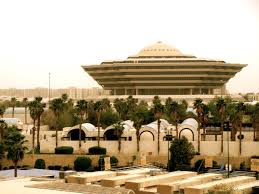
Riyadh – Ministry of the Interior
It’s an odd feeling knowing that somewhere out in the sprawling conurbation of Riyadh there might be someone who wants your blood – or that of someone like you. The Saudi media today revealed that what appears to be an ISIS video is doing the rounds of the social media purporting to show the shooting of a Danish guy in south Riyadh a few days ago.
I’ve not seen it, because I don’t make it my business to scour the net for ISIS snuff videos, or, in this case a video of an attempted snuff. Fortunately the Danish guy survived a gunshot wound to the shoulder.
But a trend might – or might not – be emerging of attacks on western expatriates. Whether they are all ideologically inspired is not proven. But the murder by shooting of a Vinnell employee near a petrol station was followed by the attack on the Dane, and last week a Canadian guy was stabbed by a “metal object” in a mall in Dammam, to the east of the country. A little disquieting, but the fact that two of the three victims survived suggests that the attackers are more likely to have been enthusiastic amateurs than hardened assassins.
The same cannot be said about the group who mowed down a group of young Shia worshippers in Al-Hasa last month. They clearly knew what they were doing and how to do it.
So I wouldn’t be surprised if there were a number of westerners across the Kingdom worrying about what to do. Is it time to get out before the trend is confirmed? Or does one take the phlegmatic view – as do many who lived through the far worse attacks in 2003-4 – that you have a far greater chance of dying on in a car accident than in a hail of bullets?
Statistically, the current odds of being in the wrong place at the wrong time are pretty low. Three victims out of maybe 50,000 westerners living in the country. Perhaps it’s worth putting things into perspective. As a British national, do I feel safer in my own country, where the security services, cheer-led by Theresa May, the Home Secretary, are pushing for extra powers to combat the threat from returning ISIS fighters, than I do in Saudi Arabia? If Mrs May is to be believed, the police and MI5 are busy foiling plots left right and centre. So if you live in one of the urban areas where plotters seem to hang out – London, Luton, Bradford and Birmingham for example – you would also surely have cause to look over your shoulder when you walk down the street, take a bus or a train. Just as I remember doing in Birmingham immediately after the IRA pub bombings in 1974.
But the fact is that it would be almost impossible to anticipate an attack in one of those centres, unless, of course, as was the case with poor Lee Rigby, you happen to be in uniform, when the odds probably shorten. Do you therefore stop going out, stop working, stop going to the shops and live out your life in fearful seclusion behind closed doors? And should people in Riyadh, Jeddah and Dammam do the same?
Not right now, I suggest. Many westerners live in compounds fortified in the aftermath of 2003-4. They might still be vulnerable once they step outside these havens, as was the guy from Vinnell. I have no doubt that security experts with various large companies are advising their people to vary their travelling routes and routines, to keep an eye out for parked cars with people inside them waiting outside the compounds or workplaces, and to watch for any activities that might seem to be out of the ordinary. That’s what security experts are trained to do. But most of us don’t have those observation skills, and wouldn’t know what to look for. And there are lots of people who don’t work under the protection of companies like Saudi Aramco and British Aerospace.
So what it probably comes down to is to what extent you will let yourself be dominated by fear, and to what extend fear dictates your actions to the point that life becomes intolerable. And that’s down to the individual. If I was a resident in one of the big cities in Saudi Arabia (right now I’m a visitor, though I was once a resident both of Riyadh and Jeddah), I would take what in my terms were reasonable precautions. I would drive to most places – it’s easier to get away from an attacker in a car than on foot, as the late Simon Cumbers and Frank Gardner found out in 2003. I would stick to places and routes I knew well, to avoid the chance of getting lost in a strange part of the city. I would avoid places with large crowds but little security presence – souks for example. If I wanted to be ultra-cautious I might drive in convoy – at least that way someone in the group might be able to raise the alarm if something untoward were to happen.
Otherwise, I would try and get on with my life, just as I would at home. I would watch and wait for further developments, if any. Should things turn really nasty, as happened in 2003, then there would be another decision to make – whether to stay or go. But right now three incidents that may or may not be related do not constitute a terror campaign. And it would be wrong to underestimate the Saudi security forces, who since 2004 have had a good record tracking down “militants” and of pre-empting further major attacks.
Nobody in this country but a tiny minority, whose sights are set on Syria and Iraq, wants to live in a war zone, least of all the vast majority of Saudis themselves. And Saudi Arabia isn’t a war zone. It’s a country that for foreign residents carries with it certain risks. Perhaps more than some, but far less than others I could think of. Johannesburg, Rio de Janeiro, Karachi, Nairobi, Caracas and even certain parts of London, for example.
It’s simple. You earns your money and you takes your chances. When the chances don’t look good, you do something about it. Hopefully, it won’t come to that. No room for complacency, but no cause for panic either.
 59steps