
Where do I look for news while I’m in the Middle East? For international news, typically the BBC website, the Times Online and a host of other sites I’ve bookmarked over the years. For local news I rely on the English-language dailies produced in whichever country I happen to be visiting. I would have more choice if I could read Arabic, but that’s a challenge too far.
Saudi Arabia has two dailies: The Arab News and the Saudi Gazette. The former is fairly conservative in its editorial policy. It doesn’t push against the unspoken red lines as often as the latter. The make-up of the staff of both papers has changed as the readership has changed. Nowadays there are far less western expatriates than there were in 1980s, for most of which I was a resident in the country. In those days there were a number of western journalists on the staffs of both newspapers.
These days the writers are mainly Saudis or from the Asian subcontinent (I would say that these days a majority of readers are from this area too), with a smattering of syndicated material from westerners and other Arabs. The other major change is that there are many more female writers appearing in print, many of them Saudi columnists commenting very eloquently on social issues.
One of the interesting aspects of reading these papers is that they challenge your ability to read between the lines – red ones usually. Of course they’re often reflecting the language of official pronouncements. Words like “deviant” usually describe religious extremists whose views are in sympathy with the likes of ISIS and Al-Qaeda. At the opposite end of the spectrum, a liberal columnist might refer to “certain people” when he’s referring to conservative elements in society – usually the more head-in-the-sand members of the religious establishment.
In other words, the papers have developed a code that is easily deciphered by the cognoscenti, but their use is oblique enough to enable them to allow multiple interpretations. Unlike Bahrain’s Gulf Daily News, whose standard description of anti-government protesters – whether violent or not – is “thugs”. Pretty uncompromising. The Saudi media are more subtle.
So for the benefit of those esteemed readers who have no prior exposure to the Saudi media, let’s look at a few stories appearing in yesterday’s Arab News, and do a bit of line-reading.
The first story – “Mosques to be monitored with CCTV cameras”, The headline is pretty self explanatory. To quote from the story:
“Mosques in the Kingdom will soon have close circuit cameras and a smart control system to monitor imams and muezzins (prayer callers) as they perform prayers, religious rituals and deliver sermons. The move will help record any irregularities or violations in the mosque.
According to Abdullah Al-Howaimel, undersecretary for administrative and technical affairs at the Ministry of Islamic Affairs, Endowments, Call and Guidance, all mosques will be managed by the electronic system that automatically records the activities in mosques.”
Later comes further explanation from the government official:
“Al-Howaimel explained that the project will address the problem of theft of appliances in mosques and will allow the ministry to fully monitor the prayer houses electronically.
“The installing of the cameras does not mean dispensing with the employees tasked with monitoring the mosques, because they have other duties such as maintaining hygiene,” he noted.
Pointing out that the new smart control system will also include air-conditioning, lighting, voice control, broadcasting messages, storage of preachers’ lectures and CCTVs, he said that the system would help reduce energy costs by 80 percent, lengthen the life span of appliances and facilities and decrease maintenance costs.”
It all sounds pretty sensible, especially the bit about energy saving. But I suspect that the main motivation lies behind the phrase “irregularities or violations”. The government has long been concerned about imams preaching extremist messages that could be interpreted as encouraging such activities as violent jihad – in other words “deviant ideologies”, which are potentially a threat to internal security, especially given the Kingdom’s experience of the extremist attacks directed at government institutions and western expatriates in 2003 and 2004. Recently there have been three attacks against westerners, one of them fatal, which may or may not have been “ideologically inspired”. Commentators have also interpreted the recent attack Shia worshippers in Al-Hasa as a direct challenge to the authority of the state. Plans to monitor what is said in the mosques therefore sends a message to imams to watch their steps.
Will it curb extremism? I suspect not, because the really subversive conversations can still take place elsewhere than in the mosques. But it is one more string in the bow of the Ministry of the Interior’s very effective counter-terrorism operation.
The next story – “Ideal: SR4,000 minimum pay for nationals” is about the Ministry of Labor:
“…considering a proposal to raise the minimum pay for Saudis in the private sector from SR3,000 to SR4,000 per month.”
What’s interesting about this is the Ministry is doing what government departments often do, which is to float and idea to test public opinion before making a decision. But in this case, it’s inviting comments on its online portal. Then we learn that:
“According to sources, the ministry will approve the resolution if the public votes in favor of its stipulations.”
Votes in favour? Is this a new form of online democracy? Government by opinion poll?
I’m sure the Ministry’s intention is not quite as portrayed in the story. Something as economically significant as a 33% increase in the minimum wage would surely need the endorsement of the country’s economic planners, and most likely the Council of Ministers as well, unless the whole deal is already done and dusted. As for the poll, you can be pretty sure that there will be a whole bunch of Saudis already lining up to say yes! Most likely far more than the business owners shuddering at the thought of the measure’s effect on their bottom lines.
By the way, whatever the cost to the private sector, I think that the proposal is a good idea. 3,000 Saudi Riyals a month is not much to live on if you have a family to support, or you’re planning to do so in the future.
Then we have “Mars facility in Rabigh to sweeten market”. This is about confectionary giant Mars opening a factory in Rabigh, in the west of the country. On one level this is good news because it will provide additional jobs for Saudis, one hopes. But on the other hand, this is a country with serious levels of diabetes. Is a chocolate factory really a wise investment in the circumstances? I suppose that wherever the chocolate is manufactured people will eat it, so you might as well make it in the country rather than have to import it. But still….
Next up, the impact of AIDS in the Kingdom. In Kingdom’s battle against Aids scourge relentless the paper reports that the country has witnessed a 26% increase in AIDS infections between 2012 and 2013. Such openness is a far cry from the early days of AIDS, when the authorities flatly denied that there were any cases. There are now over 18,000 cases in the country, of which the vast majority happened through injections (the implication being of drugs) and sexual relations.
The paper goes on to describe the plight of Saudi women with HIV:
“Meanwhile, on World AIDS Day on Monday, local journalists met with several Saudi women living with the virus. A woman infected with AIDS said she found out about her disease only after her husband was diagnosed 12 years ago.
Although she was depressed for a long time, she has survived to see one of her sons get married, and has managed to raise her other children. They stood by her when she told them about her illness.
The second shock for her came when all employees at her workplace were required to have AIDS tests. When her employers discovered her illness, they dismissed her. She then started making handicrafts at her home and became a member of the AIDS Friends Society, where she met many women living with the disease.”
In this woman’s case, her misfortune seems to have stemmed from the behaviour of her husband, though it must be said that he could have been suffering from haemophilia. Otherwise it’s a tacit acknowledgement that despite the strict social and legal prohibition of extramarital sexual relations, there are a number of men who play away from home, often, I suspect, while abroad. It’s encouraging to see the Saudis accepting that they live in the real world, and being prepared to front up about the consequences.
My penultimate story is the case of the young Saudi who got into trouble with the Bahraini authorities: Saudi gets one year for hitting Bahrain cops. Regular readers of this blog might have seen the piece I wrote the other day about the massive inflow of Saudis into Bahrain for weekends.
“An appeals court in Bahrain has handed a Saudi one year jail time for assaulting four police officers on the King Fahd Causeway. The trial court had sentenced him to three years, but it was reduced after the defendant filed an appeal at the higher court, Sabaq online newspaper reported.
The man attempted to force his way into Bahrain without completing entry formalities. When a police patrol asked him to stop, he refused and sped away. However he was detained at the security barrier on the bridge. He was arrested on the spot and when asked to get into the patrol car, he spat on the officers and struck some of them.”
Oh dear. Anyone remember what I said about young Saudis after a two-hour wait at the causeway being like corks fired from a champagne bottle? Quod erat demonstrandum.
And finally is the news from the paper’s foreign section that ISIS has banned the use of the contraceptive pill in Mosul. These guys are really thinking long-term, aren’t they? But in another development, as the local papers love to say, a majority of voters in an Arab News online poll disapprove of the use of birth control to prevent overpopulation. Ho hum.
I could have chosen a number of other features to highlight, including some trenchant letters to the editor on the subject of politics in the Asian subcontinent, an op-ed on the future of Kashmir and a number of articles in the financial section celebrating the achievements of the Saudi private sector, but I think you have enough to be going on with for now.
Just a normal day in KSA.

In my last post I wrote about the massive influx of Saudis into Bahrain every weekend. Many of them head straight to the cinemas, since such institutions are not allowed in the Kingdom.
The cinemas in Bahrain are as good as any in the west. In the multiplex I go to there are big seats (for big bums!), lots of leg room and all the trimmings: ice cream, popcorn, soft drinks, frozen yogurt and even crepes. You can book online, or you can get your tickets at the box office with minimal waiting even at peak hours.
The locals and the Saudis tend to go for the blockbusters. The current trailers are advertising The Battle of the Five Armies – the latest in the Hobbit series – and some ghastly horror movie about malevolent forces in a newly-discovered pyramid. The Bahrainis like crime too, so Night Stalker, about a body-chasing news cameraman, is also on the list.
All fine and dandy if you want to watch splattered orcs, monsters in tombs or murder in America. But the moment two pairs of lips move closer together, zap! The censor strikes. I have learned through past experience that movies shown in Bahrain that feature people doing what comes naturally to propagate the species tend to be very short.
But surely, I thought, Brad Pitt’s Fury would escape the censor’s razor. It’s a war movie after all – probably the most graphic portrayal of the Second World War since Saving Private Ryan. Pitt and his tank crew fight their way through German forces on their last legs but still resisting fanatically in the last month of the war.
About halfway through the movie there’s a scene where Pitt’s character and his newbie gunner enter an apartment in a town square in search of any remaining soldiers who might be hiding out. They discover a woman who turns out to be hiding her beautiful young niece. The two soldiers close the door, put their guns down, and Pitt produces a tin of eggs for auntie to cook. A brief respite from the mayhem outside, where drunken GIs loot the town and pass the local women around.
Young newbie charms the niece by playing the piano, and eventually they go next door. One minute he’s reading the girl’s palm, and the next minute they’re coming out of the room. Something’s happened, but thanks to the censor, we don’t know what. Judging from the smile on the young lady’s face it must have been something good. Was it a peck on the cheek or something more adventurous? No way of telling.
Either way, subsequent events put a shocking complexion on the encounter, about the only moment of “normal” human interaction in the whole movie.
Yes, after thirty-five years of coming and going from the Middle East, I know about the cultural sensibilities around love and sex, and I don’t expect them to be changed for my benefit as a movie-goer. But just occasionally I’m struck by the irony of a society whose values allow the media to publishing photos of dead bodies from road traffic accidents, where it’s quite OK to watch people’s heads being blown off in movies, where public executions are commonplace, yet where even the slightest hint of intimacy between two consenting adults is deemed to be off limits. It’s as though hate is quite acceptable, yet the love that makes the world go round is not.
A few months ago I wrote here about the motivation that leads young people in my country and others in the west to seek jihad in Iraq and Syria. I called them backpackers with attitude – kids who seek excitement in the name of religion, but whose desire for battle has parallels with the risk-taking rite of passage that is the gap year. A Saudi friend gave me further fruit for thought when he wondered whether the prospect of a night or two with an enslaved Yazidi or Christian woman, or a jihadi marriage, however short-lived, might not be an equally powerful lure. These kids may have been born in the west, but the moral code most of them grew up under is not much different from that prevailing in the Middle East.
If that should be the case it’s a strange and deeply saddening thought. But I guess sexual prudery has been the norm for longer in remembered history than it has not – ever since, perhaps, early man sought to hide his breeding mates from predatory rivals.
I would be the first to agree that the modern cocktail of attitudes to sex and love that was triggered by the “sexual revolution” of the sixties and seventies has had some sorry consequences: the spread of sexually-transmitted disease, sex trafficking, internet pornography and so forth. But equally to create a mystery out of the sexual act must surely warp the perception of those who live in a society in which it is an unmentionable subject. Those whom the authorities do not permit to witness a screen kiss may well have watched its ultimate conclusion a dozen times by going to porn sites that – no matter how hard the information police try to block access to them – can still be accessed by an IT-literate generation that’s smarter than the censors.
In the west, the attitude of a whole generation of youngsters has been influenced by internet pornography. Boys approach their first sexual contact with girls with the expectation that what they have watched on the internet is the norm. Girls feel obliged to meet that expectation by behaving in ways that they might find deeply unnatural and uncomfortable. But at least on TV and at the movies they can experience an alternative narrative that often portrays sex as an act of love rather than a degrading power game.
In countries where a simple kiss crosses a moral red line, one worries that an exclusive diet of pornography is likely to be even more corrosive.
Nothing I say or write is likely to affect the fundamental reality that in many parts of the world where sexuality is circumscribed by cultural taboos and religious belief, thwarted desire and warped perceptions result in sexual harassment and barbaric practices – Eve-teasing in India, groping in Egypt, female genital mutilation in Sudan for example. And widespread sexual ignorance within many countries in the Middle East, Africa and Asia leave whole societies exposed to disease, unhappiness and lack of personal fulfilment.
I may not be able to change that reality, but I don’t have to like it.
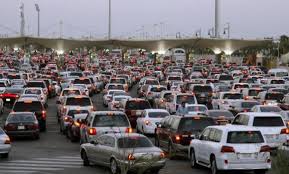
At an institution that I was visiting, a middle aged Saudi gentleman was wandering around the central atrium with a wicked grin on his face, urging all he met to “be happy, it’s Salary Day!” The line at the ATM was at least ten people deep. And yes, people were smiling, because it was the last Thursday of the month, which for most government workers is when they get paid.
I happened to be in Dammam – on the east coast of the Kingdom – on this Salary Day just passed. I asked a number of people what they were planning to do for the weekend. As I expected, “Going to Bahrain” was the answer from several.
They were not alone. Every weekend thousands of Saudis – families and young single males mostly – descend upon Bahrain from as far away as Riyadh. The young guys ditch their thobes, put on the shorts, Real Madrid t-shirts and baseball caps, pile into their Mustangs and souped-up SUVs and bomb down the highways at breakneck speed towards the King Fahad Causeway.
At which point everything stops. On Salary Day the causeway becomes so choked with Saudis trying to get into Bahrain that you are lucky if you get through customs and immigration in less than two hours. It’s partly because of the volume of traffic, and partly because the process is so brain-frying.
At the first set of booths you collect your little customs slip. Next, you, and hundreds of others, proceed to the Saudi passport booths on the Saudi side. If you’re lucky you’ll get someone who’s not on the phone or chatting to one of his colleagues. After that you hand your customs slip to a guy waiting at another checkpoint. Then you go to the Bahraini immigration stations. Assuming you pass muster there you line up for the customs inspection. Not that there are many illicit things you might want to export from the Kingdom, but anyway. You may be inspected, or you may not. The final hurdle is the insurance booths, where you are required to show insurance papers. Or not, depending on circumstances that have never been clear to me.
At this stage some of the younger Saudis are like corks ready to be fired from a champagne bottle. Inappropriate analogy, I know, but better than bullets from a gun. When they finally take off down the Bahrain stretch of the causeway, the signs imposing an 80 kilometre speed limit are gleefully ignored, and the whole thing resembles the start of a Formula 1 race. Onwards they disappear into the night. And Bahrain becomes a Saudi colony for the weekend.
The little island competes with Dubai as a favoured weekend destination for the Saudis. They love Dubai because of its bling culture, as well as the leisure facilities, which are far superior to those in Bahrain: indoor ski slopes, spectacular water parks, any number of malls and some of the world’s tallest buildings. But it’s expensive, and from most of the Saudi major conurbations it’s a long drive. So to get there you need to fly.
Bahrain’s offering is more modest: malls, shisha, restaurants, movies and various illicit pleasures denied to the mainland population. The more conservative elements on the island are doing their best to reduce the availability of wine, women and song, but there are too many powerful vested interests concerned with their continuance, so the efforts of the righteous bring limited success. And despite the country’s well-advertised political troubles, the Saudis still visit in huge numbers. In fact there are plenty of Saudis who have made Bahrain their home. Hardly surprising when you consider that to an extent the boundaries of the Gulf states are political rather than ethnic. You will find the same tribal names across the region. Many families are spread across the two countries.
In many ways, Saudi Arabia resembles Bahrain. Unlike the UAE and Qatar, where citizens form a small minority of the population, both countries – with 70% and 50% respectively, have sizeable populations of nationals. But whereas the Saudis, blessed as they are with massive oil wealth and generous social subsidies, can afford to be picky about the kind of jobs they do, the Bahrainis can’t. In both countries certain jobs – construction and cleaning for example – are off limits – but the Bahrainis are more inclined to get their hands dirty. Both countries have over the past few decades evolved a culture of reliance on domestic help, with unfortunate consequences. Stories of ill treatment of housemaids are no less common in Bahrain than they are in the Kingdom.
So would a majority of Saudis prefer to live under the more relaxed social and cultural mores they encounter in Bahrain? I doubt it.
For a start, they would not appreciate the perennial sectarian tensions between Sunni and Shia. They themselves have a substantial Shia minority in the Eastern Province. Many Sunnis look on the Shia with attitudes varying between suspicion and outright refusal to accept them as fellow-Muslims. The sectarian issue in the east has been a running sore on the body politic for as long as Saudi Arabia has existed as a unified Kingdom. See my recent post on the Al Hasa attacks for the latest manifestation of the problem.
Also, for every fun-loving young Saudi who comes to party in Bahrain, back home there’s another who looks upon the pleasure domes of the Gulf states as Sodom and Gomorrah. As for politics, even the very limited version of democracy practiced in Bahrain – in which an appointed upper council can veto each and every decision by the elected chamber – would be a step too far in a society that is still in thrall to the religious conservatives, for whom democracy is an alien and unwelcome innovation. Or so it has proved thus far.
There’s another brake on the liberalisation of Saudi society that is not well publicised. Take a look at the comments on articles in the English language press – which is mainly read by the Kingdom’s South Asian expatriate population, and it will quickly be apparent that many Asian Muslims exceed even the ultra-conservative Saudis in their religious zeal. The madrassas have done their job well. A recent poll in the Arab News on whether Saudi Arabia should allow cinemas in the country revealed that by a small majority the paper’s readers would keep things as they are. Should the most extreme of the extremists ever get the upper hand in the country, I suspect they would have willing helpers among the faithful from the subcontinent.
But for all that, I get the impression that the Saudi authorities recognise that their youth need to let off steam. Western culture – in the form of products, clothes, TV shows freely available by satellite and movies downloaded through the internet are a tide too powerful for the religious Canutes to stem. So better for the more voracious consumers to take off to Bahrain and Dubai and gorge themselves their heart’s content, so long as they return to their sober and righteous lives back home.
And gorge themselves they do. Bahrain’s City Center Mall is never busier than at weekends. Families, still dressed in the conservative attire favoured at home, mingle with more exotically dressed youngsters in the queues for the latest movies. Blockbusters, crime and horror movies tend to be the order of the day. Romcoms less so, perhaps because boy meets girl doesn’t have much resonance in a society of arranged marriages.
As for shopping, every Salary Day seems like Black Friday. I find this strange, because it’s not as if the Saudis aren’t well endowed with malls of their own. The only obvious difference – apart from the cinemas of course – is that shops in Bahrain don’t close during prayer time.
At the seedier end of things, the Saudis throng the more traditional places of entertainment, such as Exhibition Road, which is lined with restaurants, kebab shops and Thai massage parlours. The latter establishments are no doubt highly respectable and decline to offer the delights to be found in some parts of Bangkok. But there are hotels that provide more than just room service.
By Saturday night the exhausted visitors – some of whom have had little sleep for 48 hours, start dragging themselves home. Some leave early on Sunday morning. The highways of Saudi Arabia, especially the road from Dammam to Riyadh, are best avoided at those times. The effects of tiredness and overindulgence on several fronts add further danger to what at any time is a hazardous drive. And of course there’s the causeway to contend with. The Saudi customs officers know their fellow-citizens well, so they tend to be pretty vigilant in their inspections of returning vehicles, especially those driven by shattered-looking young men.
As for the Bahrainis, whose city is taken over every weekend – well, they know how much the economy depends on their well-heeled visitors. There are those among the Shia majority who did not welcome the Saudi intervention in the crisis of 2011, when troops crossed the causeway to lend a hand to the Bahraini security forces who were struggling to contain the Pearl Roundabout protests.
But money is money, and there’s never been a backlash against tourists from the mainland, even though at the height of the troubles the Bahraini authorities turned back visiting Shia, and still do so on an arbitrary basis from time to time.
I was one of the thousands who crossed the King Fahad Causeway into Bahrain this weekend. I know the island fairly well, having lived there for four years. Unfortunately Thursday wasn’t Salary Day for me, but since I was close by in Al-Khobar, it was a good opportunity to pop over and say hello to some friends. On Friday night I went to a movie, and when the lights came up at the end I saw a guy surreptitiously collapse a metal pole on which he had fixed what looked like a mobile phone. I can’t be sure he was a Saudi, but if he was, I suspect that he and his friends will be watching Brad Pitt blasting the Nazis in Fury from the comfort of their own homes next weekend.
That’s soft power in action for you. The hand-wringing of politicians and denunciations from the pulpit will not stop the spread of what has become a global culture – not just western. And at the bottom of it lies the universal notion that people just want to have fun from time to time. Especially on Salary Day.

Welcome to Saudi Arabia. Once upon a time, the words that greeted you when you arrived at any of the Kingdom’s international airports seemed a little insincere when set against the experience that awaited you during your first hour or two in the country.
At peak times, crowds of people were herded by scowling officers of the Jawazat, the immigration department, into a series of lines whose designations were clear as mud, except that expatriates went to the left and Gulf Cooperation Council citizens to the right. If you were a resident, and you found yourself in a line of new entrants, you could wait for an hour or more while those in front of you were being photographed and fingerprinted. Meanwhile those in the GCC lines were already riding off in their cars.
Nothing odd about streaming by nationality or regional origin. It happens in the US and across the EU. But in Saudi Arabia each type of visa has its own set of rules. You have the resident visa, the dependent visa, the business visa and the Haj or Umrah (pilgrimage) visas. Some people turn up with pieces of paper. Some fill out entry cards, some don’t. No apparent guidance as to what you should produce other than your passport.
My standard practice was always to bring a good book and prepare for the worst. If you were lucky, and managed to get into the line nearest to the GCC lines, sometimes the floodgates would open when all the GCC nationals had gone through and you would be beckoned to an empty booth. If you were unlucky, your arrival might coincide with the shift change, in which case you would be standing for a long period in front of an empty booth.
In short, you were left with the impression that you were entering on sufferance, and that every opportunity to deny you entry was eagerly seized upon as an act of patriotism.
The fun didn’t end once you were through immigration. You then had to form another line, at the end of which equally grim-faced customs officers took what seemed to be a malicious delight in rifling through the contents of your bags. Should they discover magazines, newspapers or photos with images that they considered pornographic, such as women with visible cleavages or parts of their limbs exposed, the offending items would be confiscated and you would be required to sign a document promising not to bring such offensive material in again. Bottles, Christmas puddings and cakes from Granny were opened, unwrapped and sniffed for signs of alcohol.
Eventually you would stagger out into the throng of unlicensed taxi drivers trying to entice you into their dodgy vehicles and wearily hook up with the person who was there to collect you.
Seasoned expatriates used to resort to sneaky tactics to avoid the worst of the ordeal. The Jawazat would often take pity on women with small children – especially if the kids were screaming – and send them to the front of a line. I know of at least one shameless mother (not my wife, I should make clear) who would pinch her child on the leg to induce the necessary volume. It had the desired effect, apparently. Others swore by the practice of placing a layer of grubby clothing at the top of their bags in order to deter squeamish customs officers from probing more deeply. I never tested that one, but I’m sure the officials would have got wise to the tactic, held their noses and plunged in.
In recent years, after the arrival of X-ray machines, the customs ordeal diminished. But the scowling, barking Jawazat still held sway at the immigration desks.
Until very recently, that is.
In what has been one of the most miraculous behavioural transformations I have ever witnessed, the whole process of dealing with arrivals has been turned into something dramatically different. I’m talking about Riyadh here, but I would be surprised if the same changes weren’t being introduced at other airports.
Gone is the barrier of desks guarded by forbidding men in uniforms. Now we have gleaming white free-standing stations manned by the same people in national dress – thobes and gutras. An animated two-dimensional official sends out encouraging messages in Arabic explaining what happens next. Smiling officials are standing around ready to look at your passport and send you in the right direction.
I’m reminded of the scene from The Life of Brian, in which Michael Palin, armed with his clipboard and in the manner of a solicitous holiday camp greeter, asks the bedraggled line of prisoners the critical question: “crucifixion?”.
After a short wait, you get to the desk, the officer greets you with a smile, stamps your passport and sends you on your way.
It’s as if the officials have had a total attitude transplant. You could almost believe that they’ve just spent a few months learning the tricks of the trade in a 5-star hotel in Dubai. I’d like to know who was responsible for the training programme that achieved this miracle. They are geniuses. They will never be out of business, especially in a region where sullen, unhelpful and downright obstructive attitudes in customer service are commonplace across all industries .
But actually I’m not sure I’m right about the attitude transplant. Saudis are by nature welcoming and hospitable people, even if in some areas they are more reserved than in others. What these trainers have done is to unlock the true natures of the trainees, and the abandonment of uniforms will have gone a long way towards the transformation. It’s amazing how uniforms dictate behaviour. They can turn ordinary human beings into officious pains in the backside. On the other side of the equation, people usually treat those in uniform with caution, if not fear. And just as dogs seem to sense fear in humans, and moderate their behaviour accordingly, so uniformed officials seem to behave more aggressively with those who fear them. Take away the uniforms and you take away much of the fear, and everybody can behave as normal human beings again.
It’s interesting as a side observation that while the Saudis have de-formalised their dress code, in my country, the United Kingdom, it’s gone the other way. In times past, officials at the immigration desks wore their own clothes. Nowadays, they’re dressed in smart uniforms, which gives an entirely different impression. Perhaps our increasing paranoia about immigration has something to do with it. Politicians rarely miss the chance to make a cheap point, so presumably the uniforms are designed to send a message that we’re serious about not letting in the wrong people. Ironic really, given that Saudi Arabia is supposed to be the doyen of controlled immigration.
So full marks to the Saudi government for realising that the first impression of a country is often the lasting one, and for blowing away the idea that its people are incapable of changing the way they do things. There’s much more work to be done, but changes in other areas, such as the introduction of electronic systems for visas, suggest that they are serious about making the stereotypical stone-faced wall of officialdom a thing of the past.
Officials in other G20 nations, such as the Russians and the Chinese, can learn from them. And they could teach the hard-ass immigration people in New York a thing or too about manners as well. As for the Jawazat, I’m not sure that their new-found attitude on the immigration desks matches their tone when rounding up illegal workers in the big cities. But you’ve got to start somewhere.
Saudi Arabia has many imperfections for which it is criticised by international observers. Unfortunately, when the government makes constructive changes it doesn’t always get the credit it deserves.
So it’s good to have the opportunity to say well done, and I’m sure that many thousands of fellow-visitors will feel the same way.
I’ve just finished reading The Spanish Ambassador’s Suitcase: Tales From the Diplomatic Bag, an interesting compilation of dispatches from British ambassadors to their masters in London put together by Matthew Parris and Andrew Bryson. It reminds me of a rather odd interlude in my life: the six months I spent in Riyadh’s Diplomatic Quarter.
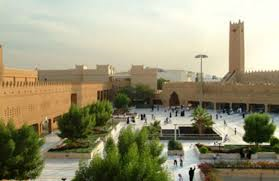
The DQ, as it’s referred to by residents, came into existence in the 1980s, when the Saudi Government decided to move all foreign embassies from Jeddah to Riyadh. It’s effectively a very large walled compound, guarded at both entrances by a hefty military presence.
Within the walls you will find most of the embassies, as well as villas, shops, offices, apartments and schools. The embassies themselves have varying levels of security depending on their importance in the scheme of things. Visit those of Britain and the USA, for example, and you will almost certainly walk past members of their respective militaries who are armed to the teeth and ready for action. Not surprising, given that the diplomats of both countries tend to be top of the hit list for those disenchanted by our respective roles on the world stage.
Outside the walls of these little fortresses, strange, un-Riyadh-like things happen. At least they used to when I was there, and probably still do. For example you could see women out jogging and riding bicycles. Anyone who has seen the much-admired Saudi movie, Wajda, will know that women are not encouraged to ride bikes, let alone jog through the streets wearing shorts and t-shirts that would not be out of place in London or New York. And anyway, jogging in the long black abayas that women are required to wear in the city proper would be somewhat impractical.
In this respect the only other place remotely like the DQ in the Kingdom is the Aramco Camp in Dhahran, where – shock horror – women actually drive cars. But whereas the Aramco residential area is, thanks to its origins, rather like a well-heeled small town American suburb – neat little villas, manicured grass verges, parks and a green golf course, the DQ is much more self-consciously “designed”, and much less well-maintained. Yes, there are jogging paths through the enclave, one or two restaurants where people sit out and eat, but not so much communal greenery, and definitely not the sense of community that comes from being part of a company town. Such communities as do exist tend to orbit around the major embassies. Otherwise the residents, mostly from the professional classes – both Saudi and expatriate – tend to do their own thing without much reference to each other.
Anyway, back then I was looking around for somewhere to live, and a colleague suggested the DQ. Pricewise, villas and apartments in the quarter are often less expensive than in the popular expatriate compounds to be found around the city. Part of the attraction was that with a reasonably-sized villa it would be possible to accommodate visiting colleagues from the US – I was the general manager of a US-Saudi joint venture at that time.
One of the problems with finding a place in the DQ was that there was a long waiting list – officially. Unofficially, if the accommodation office tipped you the wink you could do a deal with someone leaving to nominate you as the next leaseholder. “The deal”, as you would expect, usually involved a financial transaction. Not a bribe, you understand. In my case I was referred to a gentleman who was moving to another more luxurious location outside the city. In return for my paying him for all the contents of the villa – and I mean all, as will become clear shortly – he arranged for me to take over the lease.
So for a fairly stiff price I had inherited a five-bedroom villa, together with all the fittings, fixtures and furniture. But this was no expatriate villa with neat IKEA sofas, pine beds and all the usual functioning accoutrements.
I can only describe it as an old-style Saudi palace in miniature. Ornate furniture, marble bathroom fittings, huge Chinese vases, carved elephants, flock wallpaper, a U-shaped majlis (traditional gathering area) for guests, a massive TV and a battery of shisha pipes only begins to describe it. But as my colleague told me, this was not a family residence. This was an estiraha, the Arabic word for place of rest. Public estirahas are places where you can relax, smoke shisha, eat kebabs, and in some establishments get married. This one was definitely private. A place, it seemed, where my predecessor could come to get away from his family – to party with his male friends.
The odd thing was that it was as if he had abandoned it in a hurry. There were numerous personal possessions dotted around the place – some extremely, shall we say, exotic. The beds looked as if they had just been slept in. There were men and women’s clothes in the wardrobe. All the windows on the upper floor had been painted black. Downstairs, thick curtains and liners ensured that not a chink of daylight could penetrate the interior. It was a place of the night.
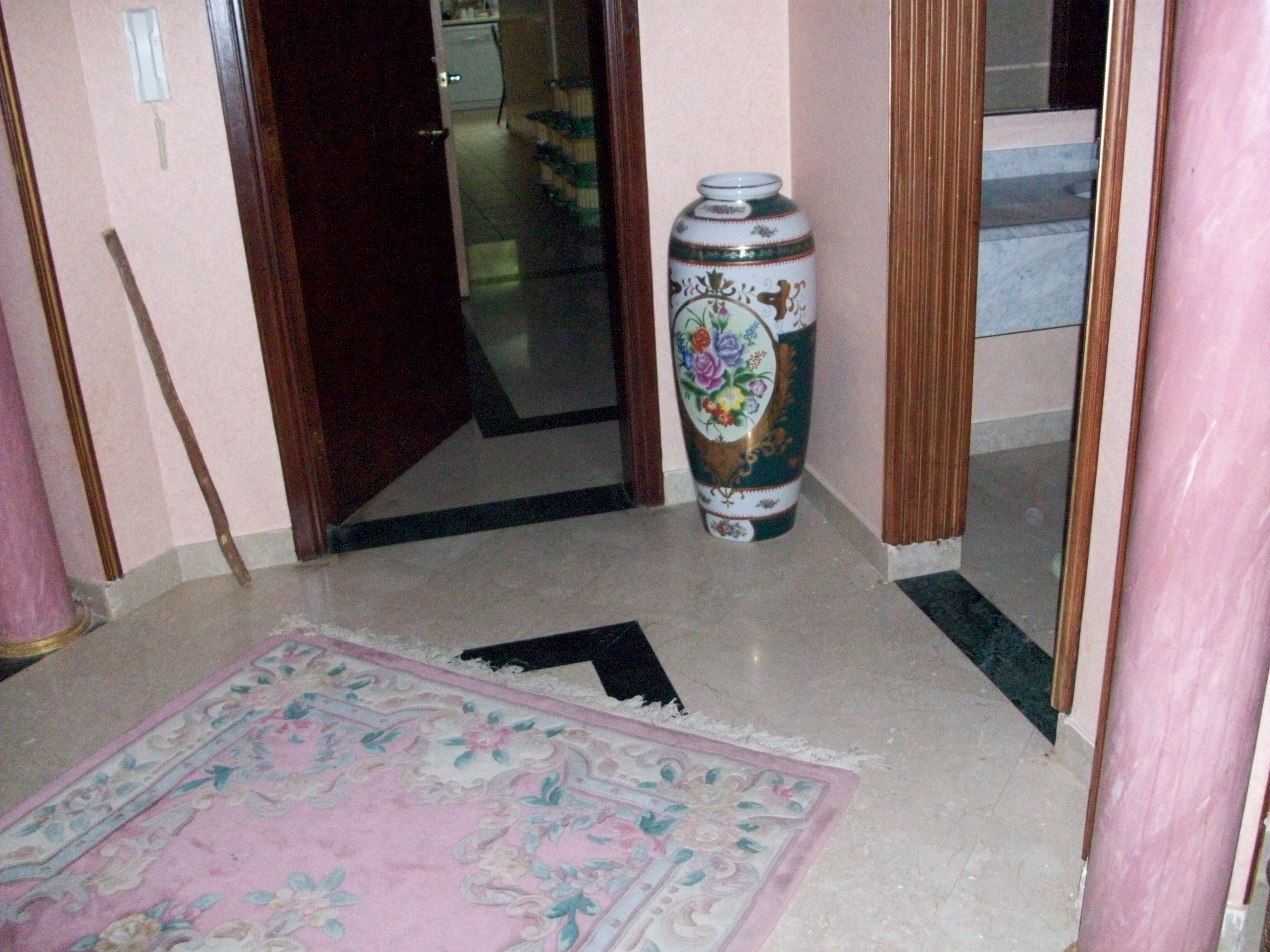
As for the fixtures, there was a massive glass-fronted refrigerated case full of soft drinks and processed cheese. The cooker was blackened by whatever had been cooked on it. Only one element worked. The dishwasher didn’t work.
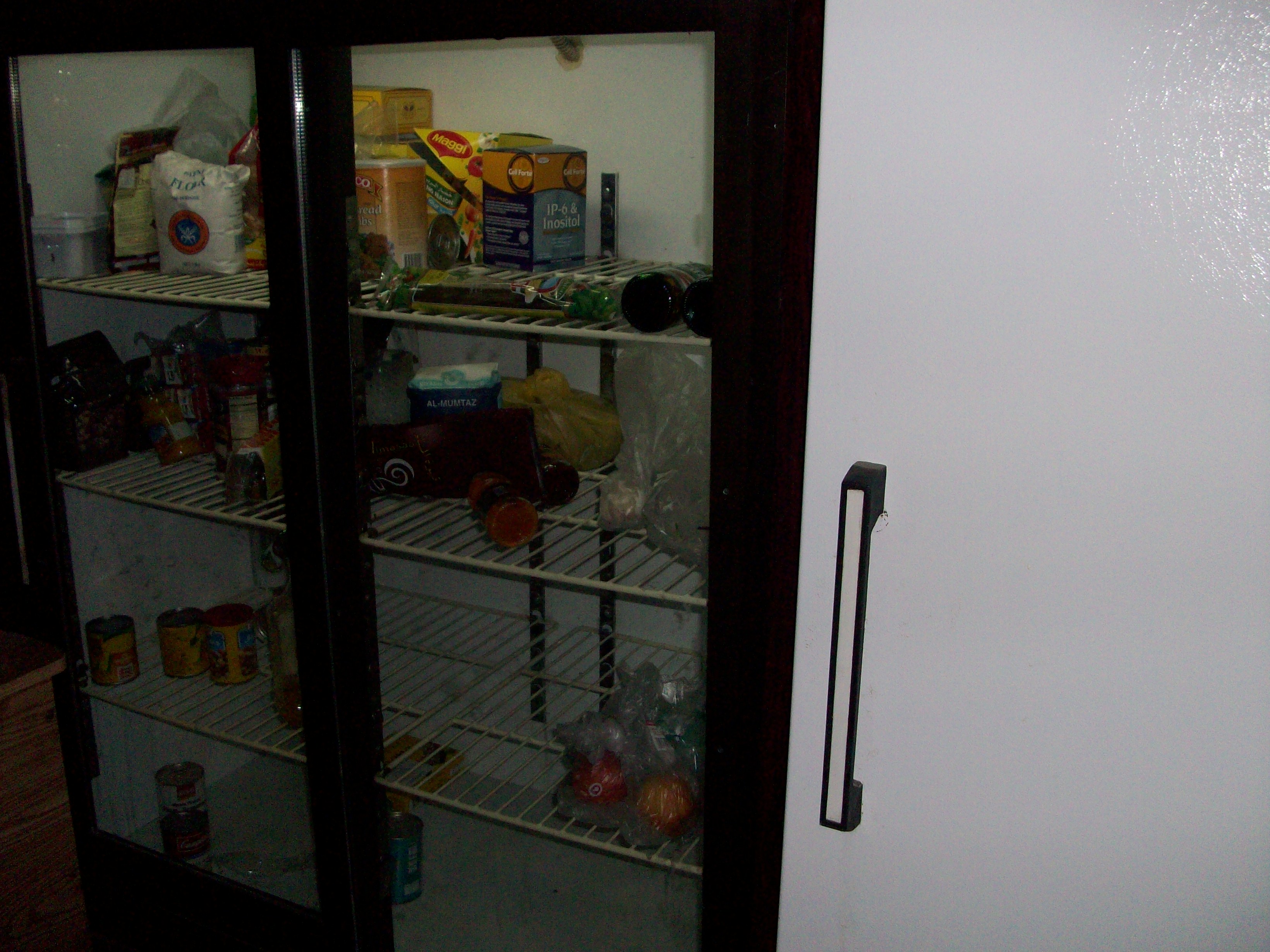
But everything else seemed to be functioning, including the phone – the previous tenant hadn’t bothered to close his account. This had one interesting consequence, which was that for the first couple of months I kept getting calls from various ladies wishing to speak to him. I couldn’t help, since I had no forwarding address or phone number for him.
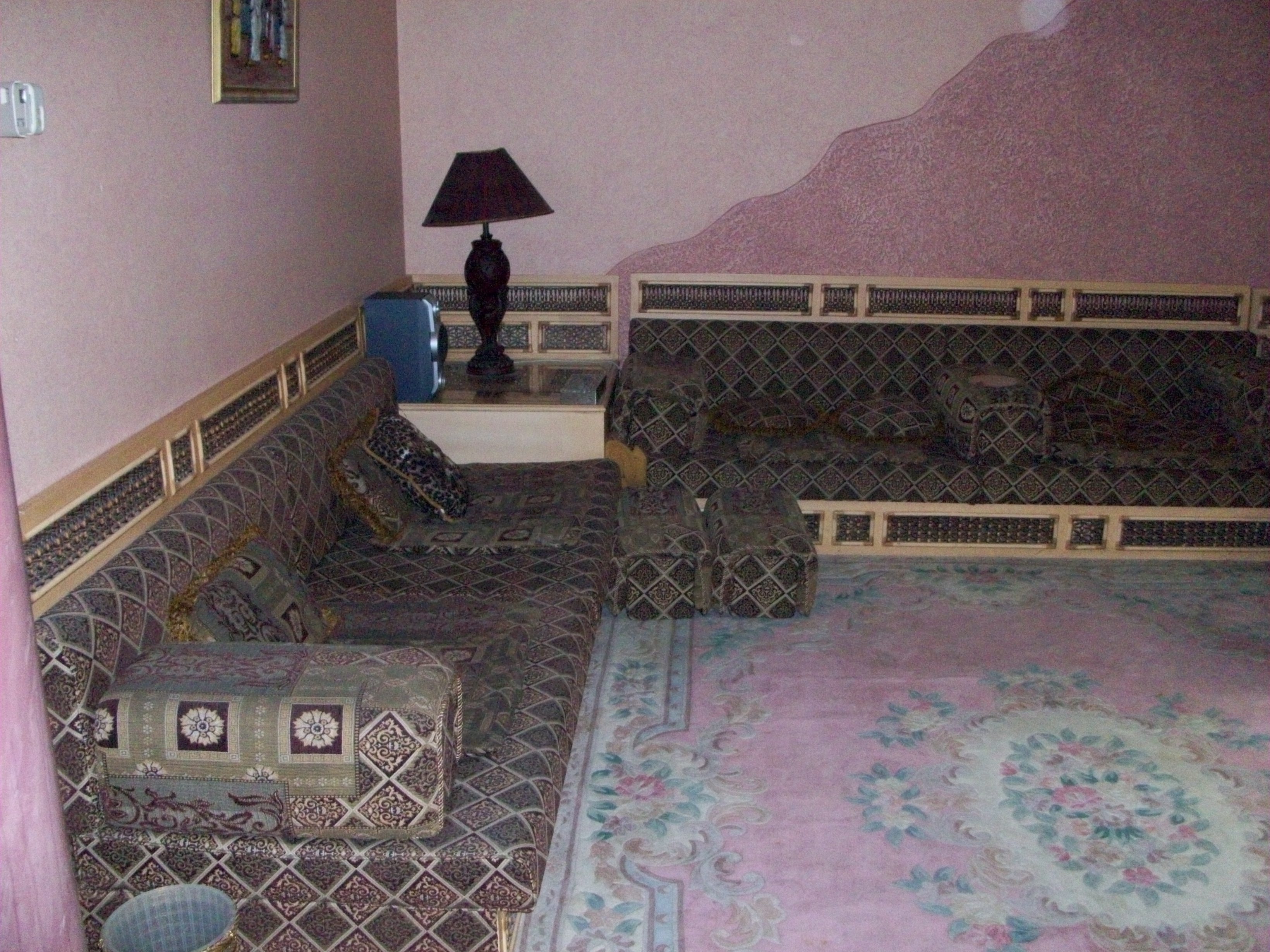
It took three days of industrial-scale cleaning to make the place ready. I held on to his bedding and the women’s dresses for a while in case he came back to claim them. He didn’t, so eventually I ditched them. I scraped all the black paint from the windows to let the light in. Some things I couldn’t fix without considerable expense, such as the burn marks on the inch-thick carpet in the master bedroom, presumably the result of over-enthusiastic use of en-suite shisha. But I managed to cover them up, and to disguise most of the other blemishes that became clear once the light made its long-denied entrance.
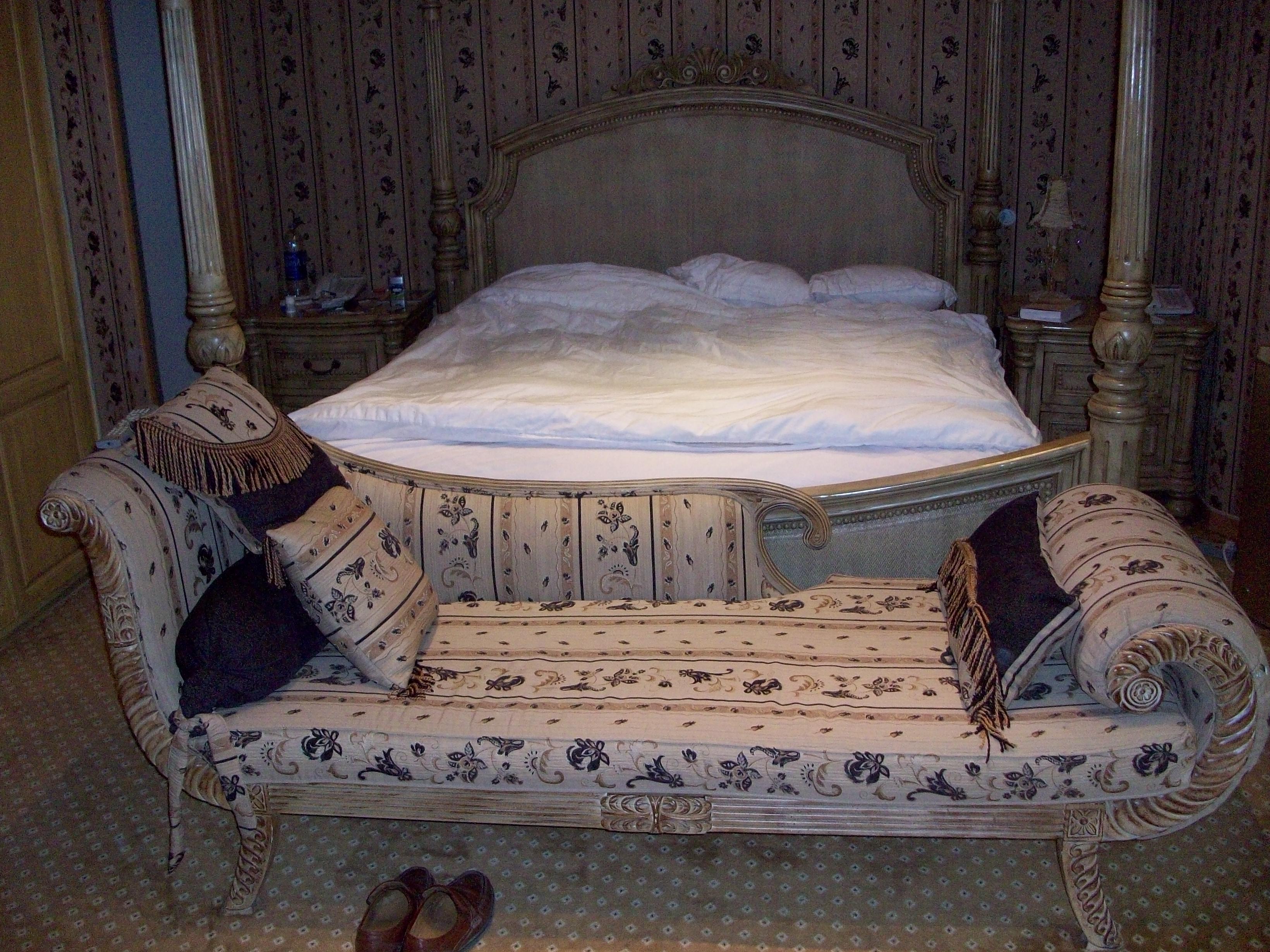
To this day I have no idea what the guy did for a living, though some of his more bizarre possessions offered clues. There was a canister of pepper spray, and one of tear gas. Even more intriguing was a spray canister of liquid that one could use to render envelopes transparent, so that you could inspect the contents within. This odd piece of kit is manufactured by a US vendor of police, military and surveillance gadgets. Before writing this I went to their website. It’s a paradise for the paranoid. It includes within its product categories a range of items it describes as “revenge products”, including one that when added to food or drink will liquefy the contents of your bowels at very short notice, and another that will produce uncontrollable flatulence. Surely there’s a law against stuff like this? Apparently not. If you want a glimpse of a bizarre and rather sinister aspect of American society, the site is here. The Envelope X-Ray Spray is still on sale.

In addition to his strange arsenal of personal security aids, he had a CCTV camera on his door that enabled him to inspect visitors before he let them in. Not unusual, but it and the other things I found did make me wonder. What potential intruders was he guarding against? Whose letters was he reading? And why did he insist on perpetual darkness? Certainly, if my colleague’s guess was correct, he must have had a rare old time there. Other clues of a lifestyle that might be frowned upon outside the walls of the DQ were also to be found. I will spare you the details, dear reader, because I wouldn’t want you to believe that I had taken over a former den of vice, or indeed that dens were commonplace in this very respectable neighbourhood. Enough to say that the evidence could be interpreted in more than one way.
Leaving aside such idle speculation, I got the place cleaned up, and settled into life as the solitary occupant of my little palace. And actually it was very comfortable, though I felt that I should really have had an army of servants to complement the surroundings. In fact there was to the side of the villa a tiny apartment for the use of the driver, housekeeper or whatever. But my budget didn’t stretch to domestic help, and anyway I was quite content with my solitude. I was sans famille, since my wife runs a business in the UK, and it didn’t make sense for her to join me for what was never intended to be more than a limited assignment.
I was happy enough to rattle round the DQ. The journey to work was a mere twenty minutes, and there were occasional Embassy invitations that prevented me from becoming a hermit.
Eventually my assignment came to an end, but not before a period of cohabitation with an American consultant sent over to reinforce the sales effort. I’d never lived with an adherent of Tibetan Buddhism before, an individual whose work schedule was circumscribed by whether or not a particular day was auspicious, and who liked to practice martial arts with a big wooden staff as I was enjoying the morning air out in the yard. It was an interesting though somewhat disconcerting experience given that about the only thing we had in common was a desire to see Barack Obama elected in his first presidential contest. But expatriate life is all about tolerance and adaptability, so we rubbed along OK.
Eventually I moved on to Bahrain, and he inherited the villa, shisha pipes, Chinese vases and all.
By and large the DQ experience wasn’t one I would willingly repeat. It’s a good place for the embassies, with the assurance of security without and within. But despite the relatively relaxed atmosphere that came from being in a protected enclave, I missed the hustle and bustle of living in the city. Having to wait for fifteen minutes behind a line of cars at the security checkpoint before entering the enclave didn’t help either.
But at least I had the opportunity to live in an authentic Saudi residence for a while, even if I could never consider it home, and nor presumably did the previous occupant. And of course I found out what to do should I ever want to read my wife’s letters, perish the thought. What a pity that nobody sends anything interesting by post any more.
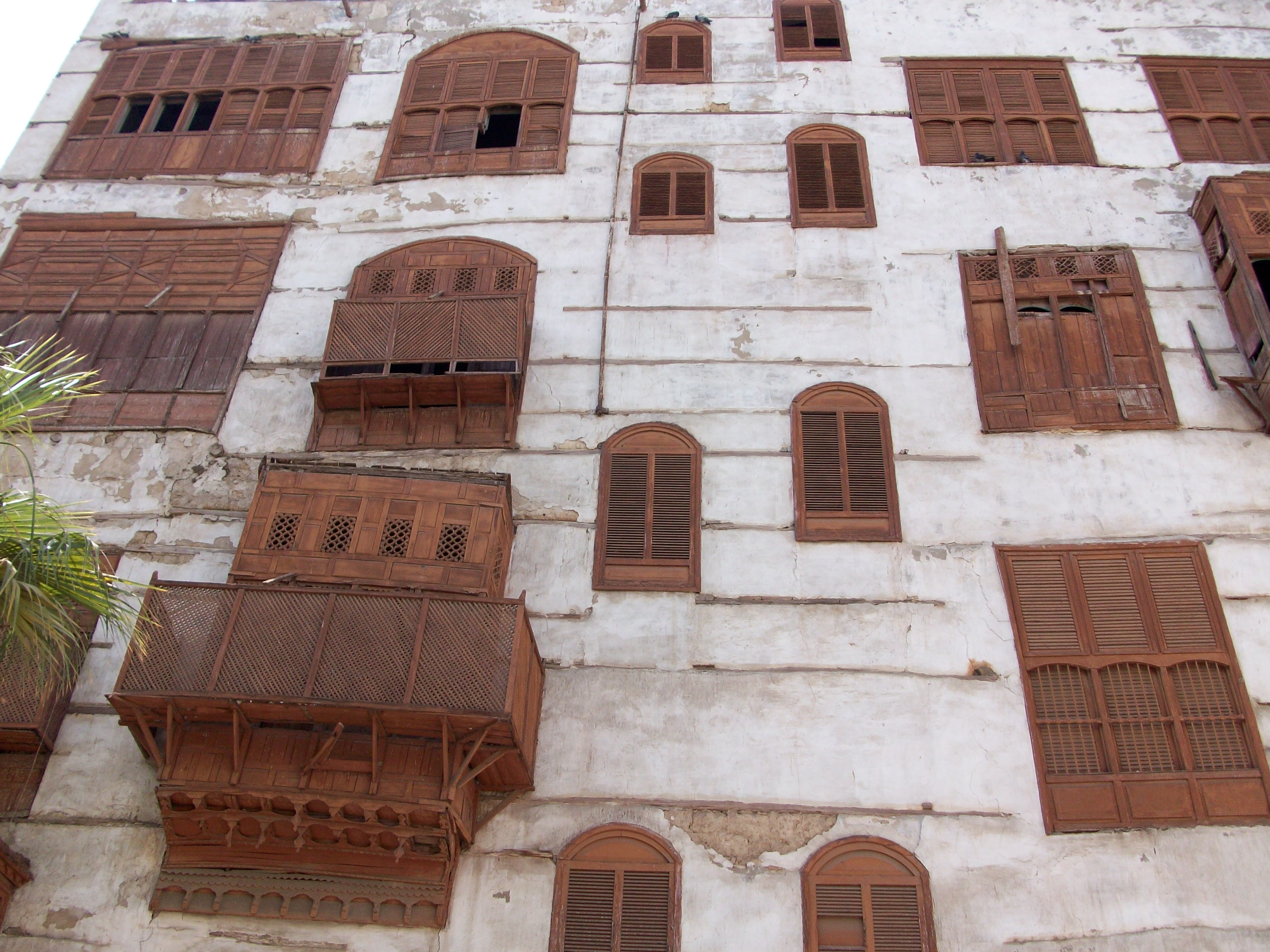
Jeddah – Balad District
I’ve just spent a few lively days in Jeddah, Saudi Arabia’s second city. It’s often referred to in the local media as The Bride of the Red Sea. These days, sadly, the term is used more out of affection than admiration, and is often followed by a lamentation over its shortcomings. But although the city has seen better days, I still love it.
Once upon a time Jeddah was the commercial hub of Saudi Arabia. For centuries it has been the main sea port of entry for pilgrims on their way to Mecca and Madinah. For the first 50 years after the Kingdom’s foundation it overshadowed the capital, Riyadh, both in terms of population and development. All the foreign embassies were there. The ruling elite would spend at least as much time in their palaces overlooking the Red Sea as they did in the dusty plains of central Arabia.
Whereas Riyadh’s visible heritage was limited to the ruins of Diriyah, the original oasis settlement from which the city sprang, Jeddah boasted a heart of elegant multi-story coral buildings with wind towers and wooden shutters, where merchants, fishermen and functionaries rubbed shoulders in the grubby streets, each doing their best to extract the maximum profit from the pilgrims passing through on their way to the Holy Cities.
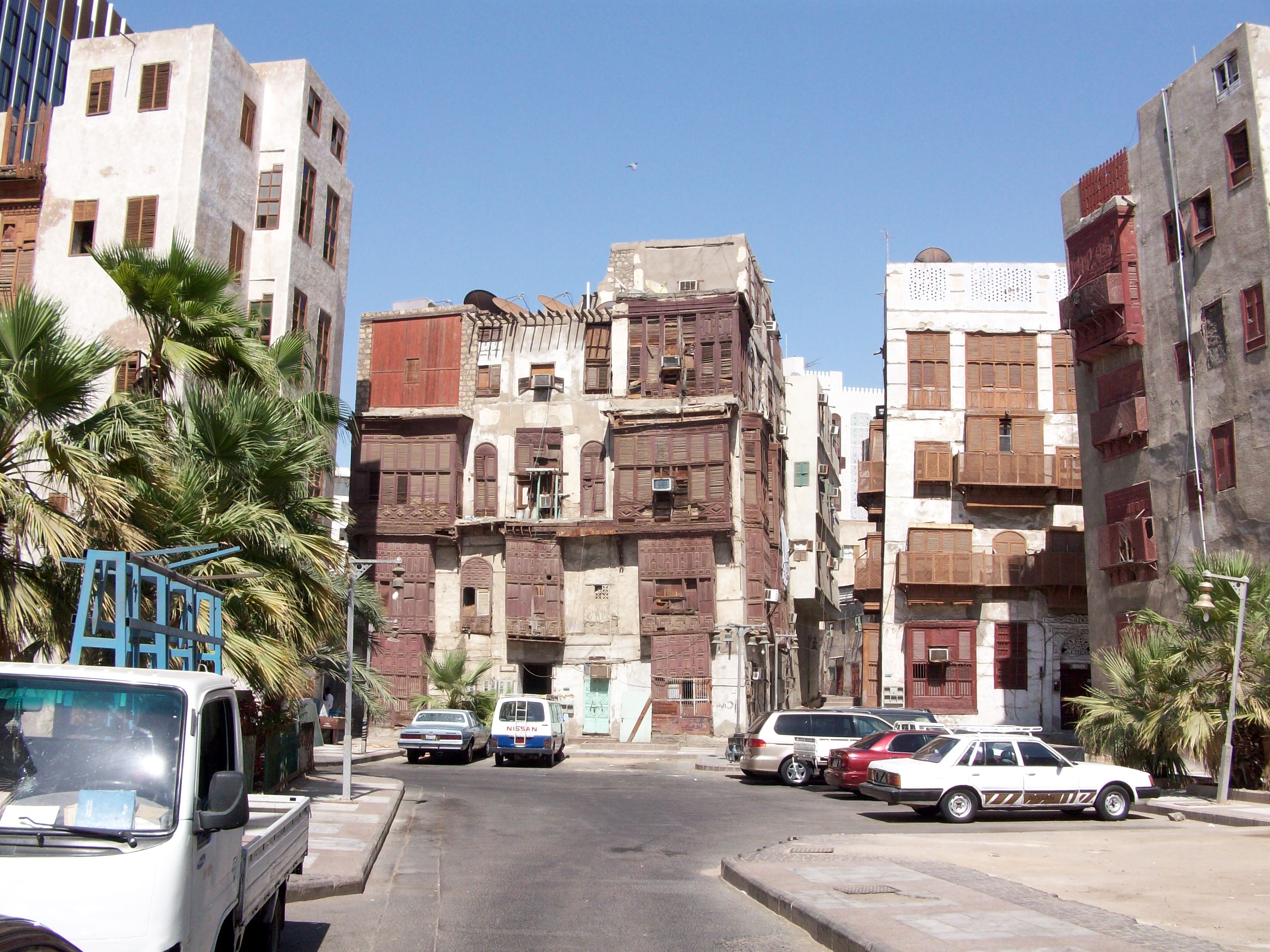
Balad District
The Balad, as it’s referred to in Arabic, is still there, officially designated as a heritage site. But although public money has been pumped into an effort to reverse the ravages of time, many of the buildings are in an advanced state of decay. Demolitions on grounds of safety are frequent. The souk is still thriving, though it’s no longer as free from petty crime as it was decades ago. Some older residents mutter darkly that things were better when thieves had their hands chopped off.
These days the Balad is something of a side-show. The Red Sea Palace Hotel, a stone’s throw from the souk, where we used to meet friends for a sumptuous brunch on a Friday, is way past its sell-by date. The rich have long departed to their palatial villas in the north of the city. The south is a sprawl of ramshackle housing around the port and along the Mecca highway. Further out lie huge industrial areas criss-crossed with dusty roads rutted by the thousands of trucks that wend their way to and from the factories. To the west is the sea, and to the east are mountains that inhibit further urban growth. As the locals say, the only way for Jeddah to grow is to the north.
Thirty years ago, when I lived in the city, the northward sprawl petered out a few kilometres away from the shiny new international airport. Now the office blocks and malls reach up the Madinah road to its boundaries. The airport – not blessed with the amenities you would expect these days from a major international destination – will soon be replaced with a more spectacular version close by the original.
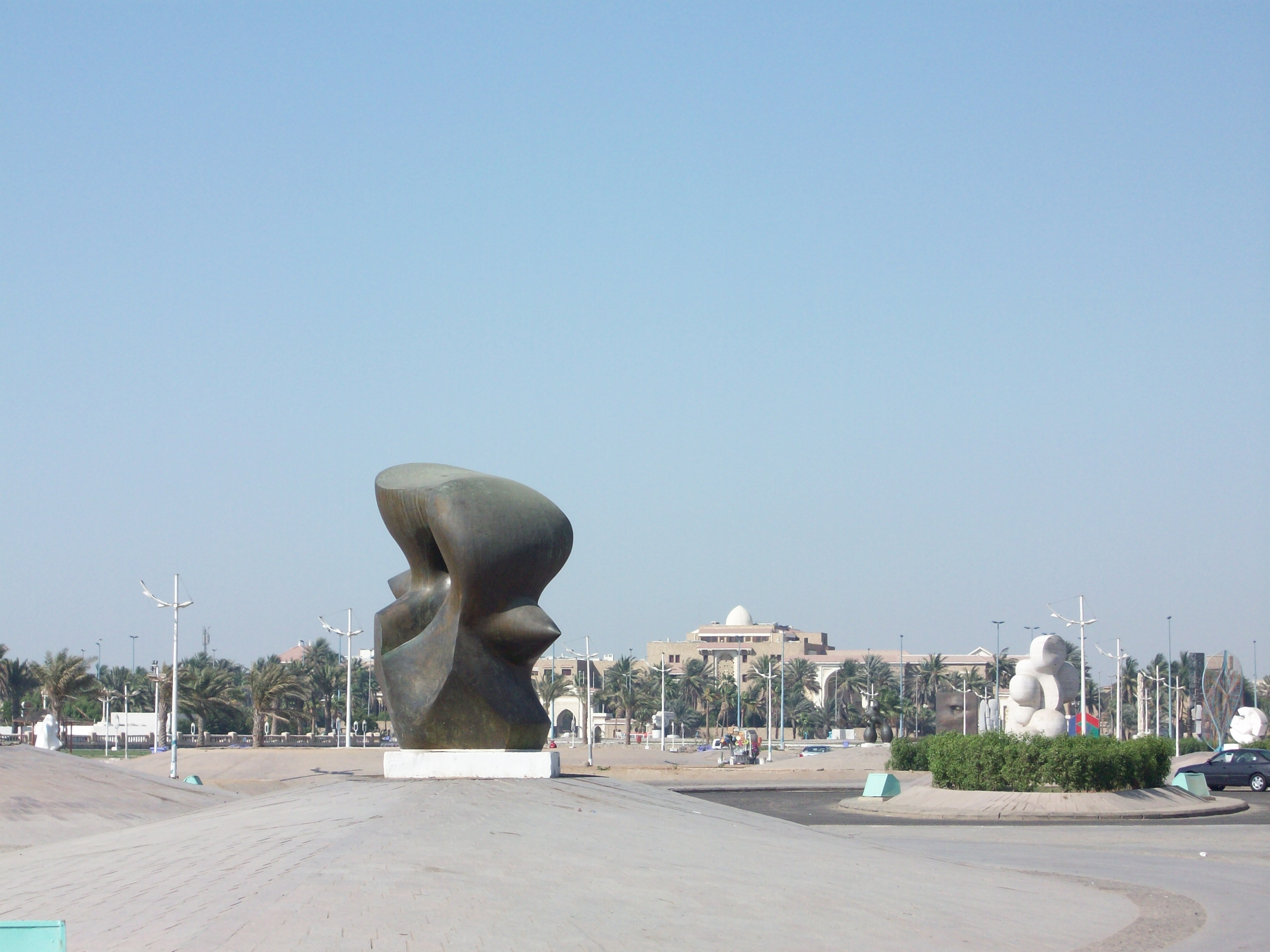
Henry Moore on the Corniche
The Corniche, one of many Middle Eastern coast roads named after the French original, has turned from its origins as a sparsely-populated four-lane stretch notable for its eccentric monuments and not much else into something resembling the Jumeirah district of Dubai – full of high-end apartments and plush hotels. And close by, the Kingdom’s premier plutocrat Prince Al-Waleed bin Talal is constructing a one kilometre high tower. The Prince already owns Kingdom Tower in Riyadh – the one that looks like an inverted bottle opener – which is the tallest building in the Kingdom. He’s clearly a man who doesn’t believe in competing with anyone but himself, so he’s building the tallest tower in the world in Jeddah.
So Jeddah has developed into a city with two sides. The bright side facing the sea, and the dark side, all urban sprawl, choked with traffic, full of crumbling buildings and half-developed infrastructure.
Tales from the dark side are legion. Five years ago the city suffered from a disastrous flood that took more than a hundred lives, carried away hundreds of cars and damaged thousands of houses. This video tells the story better than I can. The catastrophe was blamed on botched civil works designed to protect against the deluges that occur quite often during the winter. Prosecutions for fraud and corruption have resulted in several people going to jail, though locals believe that those convicted are at the tip of an iceberg of malfeasance. By a quirk of the Saudi legal system they are not named, to save their families from reputational damage.
More recently there have been two cases of people dying after falling though uncovered manholes. In the first case the municipality, that owns what lies beneath, won itself no friends by pointing the finger of blame at the supermarket in whose grounds the hole was located. An example, say its critics, of the kind of blame-avoidance tactics that characterised the reaction to the 2009 flood.
They are perhaps being a little unfair. There have been improvements. It rained heavily on the last day of my visit, and though the city was gridlocked for a few hours, nobody lost their lives, and the flood channels by the side of the highway that took me to my hotel seemed to be working well. But the disaster of 2009 has left a permanent imprint on the psyches of the city’s residents. In the aftermath of what in England would be described as a heavy summer storm, my driver was distinctly nervous, and motorists kept to a sensible speed, except possibly those involved in the smattering of accidents we encountered on the way.
One of the additional hazards of driving in the rain is that some motorists don’t replace their tyres when they get worn, and that windscreen wipers unused 360 days a year often don’t work when called upon on the few occasions when it does rain. Unfortunately the average Jeddawi doesn’t drive like Lewis Hamilton, though I’m talking about his handling of wet conditions rather than his speed.
Then there’s the traffic itself. I wrote recently about the coming of the Riyadh Metro, but if ever a city needed an alternative to cars, it’s Jeddah. It’s known around the country as “the city that never sleeps”. And indeed there’s no such thing as a rush hour. Unlike the more sober residents of Riyadh, which tends to quieten down – somewhat – during evenings and weekends, the people of Jeddah seem to delight in taking to their cars at any time of day or night. For reasons of access to my client, I stay in a hotel far from the glimmering towers of the north in a central district I used to know quite well. Today I would never be able to find it myself, such are the complexities of the road system. What makes things worse is that the municipality has an annoying habit of changing some of the road names from time to time, so if you want to go somewhere you have to choose the name that the taxi driver might recognise, which of course depends on how recently he arrived in the city.
No doubt at some stage there will be an urban Metro, but for now the main focus is on the construction of a rail link from Jeddah to the holy cities of Mecca and Madinah. But if you’re an ordinary Jeddawi, wending your way across the city to get to work will continue to be the kind of energy-sapping ordeal encountered by city dwellers in countries far less well-endowed than Saudi Arabia.
Though the flood defences are becoming more effective, the treatment of sewage still leaves much to be desired. In the poorer areas, residents still rely on septic tanks, and battalions of “honey trucks” still make their way to the infamous Musk Lake up in the hills. This is a dumping ground for raw sewage that one local I spoke to referred to as “our secret shame”. A few years ago it nearly overflowed. Had it done so it would have sent a cascade of nastiness flowing down towards the city. The municipality took emergency measures to reduce the lake, but it’s filling up again. No prizes for guessing where most of the sewage eventually ends up. It’s blue, shimmering and fish live in it – or try to. Worse still, sewage has polluted the ground water, and some farmers use it to irrigate their vegetable patches. Not good.
Another perennial source of tut-tutting in the media is the youth of the city. Full of energy but short on outlets, young men cruise the streets looking for excitement, which, according to a recent story in the Arab News, often takes the form of harassing women. Those with a more creative bent devote much of their time to customising their cars, sometimes with outlandish results – an art form for which Jeddah has become famous. If anyone doubts the inventiveness of Saudi youth, you should check this video out. You would never describe these guys as feckless wasters.
For all its problems, I still love the city for its vitality, its ethnic diversity and for the relentless good humour of its people. You can sample the cuisine of dozens of countries, you can still go for a walk by the sea and there are still empty beaches to the north and south to which you can escape, and where you can sail, dive and snorkel without too much risk of encountering things that started out from a porcelain bowl in the city. And if you hanker after a biblical vista, you can drive up to Taif in the south, and look down from the top of the escarpment at the Tihama plain, a view that will have changed little since the time of the Prophet Mohammed.
The people of Jeddah are still proud of their city and of their regional identity. A Saudi born in Jeddah, Mecca or Madinah will be far too tactful to say that they are from the Hejaz first, and Saudi Arabia second, and there are no obvious signs of any separatist sentiment. But ask them about their history and they will speak of their city’s central part in the network of commerce and devotion that stretches back well before the Islamic era. The dominance of Riyadh, until not so long ago a small oasis settlement in central Arabia, covers but a small portion of remembered time, even if the unification of much of the peninsula under the Saudi banner has brought the western region unprecedented wealth and prosperity.
Because of its long history as a centre of commerce and transit port, Jeddah is also more cosmopolitan than most other parts of Saudi Arabia. You can see African, Asian and European faces in the national dress. The proportion of women wearing face veils is far lower, though greater than it was when I was a resident. Access to the performing arts is limited – as is the case elsewhere in the Kingdom – but you can still find home-grown theatre both among expatriates and Saudis. Jeddawis appreciate sculpture, painting and graphic design. There are plenty of bloggers (take a look at the Jeddah Blog, for example), video makers, writers and fashion designers, and the two main English-language dailies have their headquarters in the city.
Jeddah has the feeling of a city that will survive the worst and still come up smelling of roses – provided, of course, that Musk Lake doesn’t overflow. And the next few months are the best time to visit. The temperatures are cooler, with none of the suffocating humidity of the summer. If you also visit Mecca or Madinah, friends who hail from those cities tell me that this is a time when the locals rediscover their neighbourhoods now that the flood of pilgrims has subsided after the Haj.
As for me, I’m heading back in a few days. As always I’m looking forward to saying hello again to a city where I spent one of the best decades of my life.

As I read updates on the progress of poor little Philae, the lander perched on a comet millions of miles from home, its batteries fading and its messages taking 28 minutes to reach us on earth, I can’t help thinking of my struggle to communicate in a place much closer than Comet 67P – the Middle East.
Forget about all the cultural nuances that get lost in translation. Most people who travel to the region – except possibly for libidinous estate agents from Essex – are aware of the potential faux pas that can leave you cast into the outer darkness. I’m talking about the more basic forms of communication. The kind of stuff for which the Arab world is well equipped and yet sometimes seems incapable of using in a way that connects with western expectations.
Business people here have the same plethora of devices as we have in the west: desktops, laptops, tablets and smart phones. Reliable telecoms systems and passable broadband. Smart phones are pervasive. No self-respecting business person in the Gulf will have less than two phones. Some have more – a phone for every occasion.
So that being the case, why do messages from west to east seem so often to fall into a black hole – somewhere in the Mediterranean perhaps, or bouncing off the stratosphere and heading off into deep space?
I can only speak for myself, but if someone from the Arab world with whom I have a business relationship sends me an email or an SMS, I respond. Maybe not always immediately. There are times when I might pause to reflect for a day or two. And if that’s necessary I usually send a holding message: I hear you, and I’ll get back to you shortly.
Yet at the other end, I’ve lost count of the number of times when I send an email in response to an urgent request and hear precisely nothing. Not a thank you, nor any acknowledgement whatsoever. Eventually, when it suits the other person, I might hear something back. Or not. I’m starting to get into the habit of routinely sending every important email twice. The first time to all available email addresses. After three days I send the same message again, suggesting that perhaps the person didn’t get my first effort. This is an opportunity for the other party to excuse themselves for not replying earlier on the basis that the problem was with the transmission rather than any failure on their part to respond.
It would be insulting to suggest that this dilatoriness is down to “Arab time” – the so-called Inshallah Factor. No, there’s something else at play here. Could it be that my humble communications are far too trivial to warrant the courtesy of a fast response? Possibly. Could it be that the recipient is so busy that a large queue of emails sits waiting for their attention, and your chance of a response depends on whether your message is near the top of the stack at the moment when the person has five minutes to sit down in peace? Also possible. Or could it be that many people are still wedded to the paper document, and discount the seriousness of any other form of communication? Unlikely, though paper still holds sway more than in most regions.
I mostly put it down to a tendency to live and think in the present, and to respond to things when they rear up at you – like someone coming at you on the wrong side of a highway. So if my present doesn’t correspond to your present there’s a gap into which ill-timed communications fall, never to be seen again.
Another dynamic that comes into play is power distance. To quote from Geert Hofstede’s Cultural Dimensions theory, this is “the extent to which the less powerful members of organizations and institutions (like the family) accept and expect that power is distributed unequally”. Middle East cultures are generally quite high on the scale of power distance; the boss, the father and the ruler do not expect to be challenged or contradicted, and the timing of communications tend to be at their discretion rather than yours if you happen not to fall into one of those categories.
In my case the inequality is not one of hierarchy – more the power gap between buyer and seller. If I’m buying from you, I have the money, and therefore the power, at least in your mind. The prospect that I, the seller, might decline to supply if not treated with what I see as due respect often doesn’t occur to you, the buyer, until I come to the conclusion that you are too difficult to deal with and start making noises about walking away. Which is where the car bombing towards you on the wrong side of the highway comes in.
It’s best to avoid that kind of situation, especially as there’s rarely any malevolent intent behind the failure to communicate. So if I really need to get through to the person, I will resort to combination tactics – follow-up email, phone calls and SMS.
SMS is generally the most effective tactic. If you call, you might catch the person at the wrong time and you’re back to square one. An SMS is like an arrow to the heart, which is where at least one of the person’s smart phones resides. Short, sweet and hard to ignore because most phone users in the Arab world check text messages far more often than email, and therefore the queue is much shorter.
I would not advise spam-like techniques to attract the attention of the target, though. Messages that begin with “if you value your grandmother’s life, read this” do not fall within the wide radius of the average Middle Easterner’s sense of humour. Nor should you let slip your irritation at your correspondent’s comatose approach to communications. There are subtler ways to induce shame than to mention that this is your fifth attempt to get in touch, though sometimes I struggle to find them.
Life can be even more complicated if you’re dealing with the kind of person whom I would describe as old school. He (for it is usually he) might have a laptop or a gargantuan monitor on his desk, but that’s mainly for show. He never uses it. Instead he relies on his secretary to select emails for his attention, print them out and lay them on his desk for further action. The panjandrum duly annotates the printout – eventually – and the secretary reverts to the sender – in due course. Due course can mean several days, especially if the secretary has not inquired of his master as to the urgency with which he should treat the missive. The default is not urgent. In that situation an SMS direct to the panjandrum is usually the only option, since being an important person he will rarely be available to speak to you.
There have been moments when I’ve considered less conventional means of getting my message across. Gift-wrapped premium dates perhaps, or maybe a box of his favourite cigars with the message appended. Or maybe even an impressive-looking Rolex watch (bought for $10 at the local souk but without an indication of its origin) with the message “Because you’re worth it”. But I’ve yet to encounter a life-or-death situation in which such extreme tactics might be justified.
The odd thing is that 90% of situations that one considers urgent become less so with time. Once a deadline’s gone it’s gone, and with luck you can resurrect it. Therefore in the end the wisest approach is often to go with the flow. If the matter isn’t urgent in your correspondent’s mind, then downgrade it in yours. Save your brain cells and accept what you can’t change.
In case you’re wondering whether I have specific people in mind as I write this, well yes, I do. Gentlemen, you know who you are. Much as I respect and admire you, there are moments when you make me feel like a box the size of a washing machine sitting on a frozen lump of rock a long way away, with my batteries of enthusiasm for your cause fading away as each day goes past without a precious word from you.
So now you know.

Ashraf Barhom and Adam Rayner
I’m currently on a quick trip home between visits to Saudi Arabia. When I’m in the Kingdom I never watch TV. I get my news via the local newspaper, the web and the London Times IPad app. Sitting in a dark hotel room browsing channels for something worth watching is not my idea of fun. When I’m not meeting people I’d rather read or post to this blog.
But when I get home I tend to go into catch-up mode. I still don’t watch that much TV. I record loads of stuff, and then watch it drop off the hard disk unwatched. What I do watch often disappoints me. I’ve had it up to here with crime series. Left to my own devices, I avoid watching violence, acts of mental cruelty, psychopaths, food programmes, football matches and Formula 1 (unless I want to go to sleep). And don’t even mention the aliens and neo-conservative conspiracies.
So what’s left? Retrospectives of musicians like Jimi Hendrix and Robert Plant. News, history, science, and occasionally a dash of comedy. The odd current affairs show. Perhaps a side-effect of approaching senility is that just as the choice of programming has massively increased over the past ten years, my preferences have reduced by the same factor.
However I do follow a few series, partly because they give me the opportunity to watch stuff with my wife, and partly because it’s not difficult to succumb to series addiction, though sometimes reluctantly. In the reluctant category I would include the work of Gideon Raff, the Israeli producer responsible for such shows as Homeland, Prisoners of War, and his latest, Tyrant.
Prisoners of War was interesting because it offered an Israeli perspective on the endless Israel-Palestine conflict The plot is pretty typical of the “national security” genre: conspiracies, interdepartmental rivalries and secret operations within the security apparatus. Brutality and collateral damage on the ground. But in its portrayal of the damaged individuals caught up in plot and counter-plot on both sides of the divide, the show offers a glimpse of Israeli society not often seen out of the country: secular, paranoid, similar to the west but not of the west. I get the same “familiar yet alien” sense when I listen to Israeli spokesmen speaking in perfect American-accented English about Gaza or the settlements. Reasonable words set in a twisted narrative.
Homeland I only caught up with during the last series, so I missed much of the early plot about Brody, the erstwhile central character, captured by an Al-Qaeda-like group and converting to Islam. Much of the focus of the past two series has been on the travails of the bi-polar CIA operative, Carrie Mathieson. Spending an hour in Carrie’s company is enough to leave me reaching for the Prozac. Her face is an ever-shifting map of insanity in waiting. Despite the calming effect of the medication, you also wonder at the sanity of her CIA boss in entrusting his operation in Islamabad to her. Not surprisingly given that the series was inspired by Prisoners of War, stable characters are not Homeland’s hallmark.
And so to Tyrant. Basically the recipe is this: take a prime cut of Syria, add some Libyan flavouring and a large dollop of pureed Saddam-era Iraq. Simmer in a broth of Truth, Justice and the American Way, and before serving stir in a soupcon of Gulf opulence.
The principal dramatis personae are the father, a durable dictator with blood on his hands, his brother, a Chemical Ali clone, the elder son, an amalgam of Uday Hussain, Maher Al-Assad and Mutassim Gaddafi, and the younger son, who escaped from his nasty family a couple of decades ago to become a paediatrician in California.
Dad dies during a family reunion, and Jamal the psycho takes over as president. Bassam, the younger son (known to his American friends as Barry – shades of Obama) is visiting with his family when Dad pops his clogs. He’s a straight shooter, in more ways than one, as becomes evident as the series unfolds. He valiantly tries to act as a moderating influence on his murderous brother. Meanwhile revolution threatens as the oppressed people of Abbudin seize the opportunity presented by the old man’s passing. Wicked uncle Tariq readies his torture chambers and lines up the troops to clear the city’s equivalent of Tahrir Square. And things develop from there.
Just about every caricature of the post-Saddam Middle East makes a cameo appearance – the tribal sheikhs, the scheming American diplomat, the exiled insurgent leader and his hot-headed son who leads the opposition within the country, manipulative wives and a palace that looks like a seven-star hotel in Dubai, in which much drinking and various deviant sexual practices take place.
Curiously enough, two ingredients in the Middle East recipe are missing: Islamism and the nearby influence of the Zionist Entity, as even politically moderate Arab politicians like to call Israel.
Ashraf Barhom, who played the dignified police colonel responsible for investigating the terror attacks against westerners in The Kingdom, the 2007 movie set in a fictional Saudi Arabia, does a fine job of portraying Jamal, the unstable elder son. Adam Rayner, all blue eyes and chiselled jawline, less so. As Bassam, the second son who rejects his Arab family and becomes an all-American version of Bashar Al-Assad, the noted former London ophalmologist, he fails to convince you that there’s an expatriate Arab under the skin, let alone the brother of a psychopath. Far too po-faced.
If you ignore all the grating “oh come on” moments of inauthenticity, some weird casting and all the usual stereotypes that so madden educated Arabs, it’s not a bad series. Think of it as a tale of a feuding family; avoid being seduced into confirming your prejudices about the Arab world and think of Tyrant as a modern Dallas without the stetsons, and you should have enough decent plotlines to keep you engaged for the duration. Actually I suspect that the worlds of Saddam, Gaddafi and the Assads were (and in Bashar’s case still is) far more mundane, yet at times far more brutal, than anything you’d see in Gideon Raff’s glossy confection.
But having sat through all these convoluted tales of betrayal and brutality in this very bloody year – and I almost forgot to mention The Honourable Woman in the list – I’m ready for something different. The horrible reality of Syria, Iraq, Libya and Gaza speaks too loudly.
If we must return to dysfunctional dictators and feuding courtiers, there’s a ten-part series that’s begging to be made: the story of Stalin’s final two decades. Now that would make Tyrant look like an minor domestic spat. And speaking of Russian autocrats, I should have thought that Ivan The Terrible was well overdue for a remake.
Mr Raff should look to the golden domes of the Kremlin, and leave the Middle East to its all-too-pervasive suffering for a while.
Do you want to read negative stuff about Saudi Arabia? How about “Ten Reasons to Disapprove of Saudi Arabia”? Executions, misogyny, mistreatment of domestic staff, the vagaries of the justice system, feckless driving, materialism, wasted energy, wasted food, environmental pollution, religious extremism?
If that’s all you want, you’ve come to the wrong place. And anyway you can look elsewhere and find plenty of horror stories that will make you purse your lips in righteous disapproval. To the US for example. I’ll leave it to you to figure out which national traits I’ve quoted above are largely absent in the Land of the Free. Not many, I’d argue.
You won’t find shock horror in this blog because my livelihood doesn’t depend on making your lips purse, or indeed giving you fodder for bad dreams. I’m not a journalist, nor do I wish to be. Besides, I consider the Saudis – or most of them – to be my friends. And with friends, you appreciate the positive and recognise the negative. You don’t go around belittling them in front of others even if on occasions they might richly deserve your criticism.
In my line of work I meet hundreds of ordinary Saudis, both men and women. Quite a lot of expatriates too. I used to be one of them. Now I just visit the country for a few weeks at a time. On my current trip, which is about to come to an end, I thought I’d post a few snapshots of the country. I particularly wanted to look at some of the changes it’s going through, and what those changes might mean to the ordinary people who live here.
So as I pack to go home, I’m delivering my last Postcard from Saudi Arabia. For a while anyway.
At this time of the year the weather is getting cooler. No more of the roasting heat of the summer. The thoughts of urban Saudis turn to the outdoors. Drive from Riyadh’s King Khaled International Airport towards the city and you will take the Prince Salman Road, a newish highway that in places has been cut through some hilly terrain. Look right up the cuttings and you will see cars parked at the top. Groups of people, many in their workaday thobes, sitting cross-legged on the ground, maybe sharing some gahwa – Arabic coffee – from a thermos, or cans of Pepsi.
If you could look further into the desert you would see tents where people gather at the weekend. Many like to sleep under the stars. Late October and November is the golden season. It’s not too hot and not too cold. Young lads come out to escape their parents. Families barbecue, kids play. People chat, maybe kick a football around, maybe listen to music, maybe smoke some shisha.
A guy I met yesterday told me that he likes to take his horse out at weekends. And then there are the camel-owners who go to inspect and cherish their beloved beasts. Poor camels – prime suspects as the source of the latest coronavirus that has been troubling the country for the last couple of years. Too valuable to cull, so now the authorities are talking of vaccinating each and every one of them. Providing, of course, that a vaccine can be developed.
Back in the city, weekend life goes on. No rest for the housemaids, the cleaners, the street sweepers and the waiters. At the other end of the expatriate spectrum and at the wealthy end of Saudi society, people are getting out their tennis rackets, hitting the gym and maybe getting ready for some social occasion in one of the city’s many walled compounds or impressive-looking villas. Round the side of the houses, live-in drivers are busy washing the sand and dirt off their employers’ SUVs.
This is the rhythm of everyday urban life in Saudi Arabia, at least in the more prosperous areas of the city. There are other parts where poor people – Saudi and expatriate alike – struggle to make it through the day. Where petty crime is rampant. And where young men dream of Syria.
Out in the rural villages, accessible not from six-lane highways but single roads, life can also be pretty basic. Mosques, minimarts and dusty dun-coloured houses where nothing much happens except births, marriages and deaths, with occasional visits from sons and daughters who have left to make their fortunes in the city, or maybe even abroad. People dream of Syria there too.
So life trundles on – dolce vita for some, careworn for others.
Then suddenly, BOOM. Something happens that shakes everyone up. Causes them to question the future. Something of that nature happened this week. In Al-Hasa, near the east coast of the country, five people are no longer alive because a car load of young men with long beards stepped out of a car outside a mosque where a throng of people were celebrating the Shia festival of Ashoura. The gunmen sprayed the crowd with machine-gun fire, got back in their car and drove off.
It seems that the ringleader of the shooters was a young Saudi who had been fighting in Syria and Iraq. ISIS? Al-Nusra? Who knows? Within hours, a number of suspects were arrested or killed in gun battles with the security forces in six locations across the Kingdom. Two of the soldiers were killed, one of them the father of a five-month-old daughter. All in all twelve people died, including five members of the alleged terrorist cell. Among the dead and wounded in Al-Hasa were teenagers and young children.
I leave the political dimension to the journalists. Here, for example, is a thoughtful analysis from Bill Law in the Middle East Monitor. I’ll summarise by saying that there is a long history of sectarian unrest in the east of the Kingdom, where most of the country’s million or so Shia population live. The vast majority of Saudis are Sunni. But this was the first attack by an armed group against the Shia population. It bears the hallmarks of ISIS or one of its affiliates.
I prefer to focus on the human impact. The deaths in Al-Hasa are a drop in the ocean compared to the orgy of slaughter, bereavement and grief that seems to be taking place every day in Syria and Iraq. But judging by a report in one of today’s local newspapers, the event has come as a deep shock to the people of this country, who are more routinely accustomed to grieving at the untimely deaths of loved ones in road traffic accidents.
It certainly shook me up. I was in Al-Hasa for a couple of days, and I left for Riyadh a few hours before the killings. I come to the town quite often. Most of the Hasawis I have met are kind and friendly people. Despite the grievances of the Shia, it’s not a community divided by sectarian differences. Sunnis live and work alongside Shia. I hate to think what these killings will do to disturb the equilibrium of life there. Will sectarian barriers form? Will friends stop speaking to each other? I saw that happen over the four years I spent living in Bahrain. Sectarian conflict is tragic to behold. Much depends on the attitudes of local leaders. The government can only do so much to calm inflamed passions. Action is needed on the ground, too.
What of the impact further afield within the country? I haven’t had the chance to discuss the situation with many Saudis because the events have only unfolded over the past couple of days. And anyway, most are reluctant to disclose their innermost feelings to foreigners. But I could read the shock on the faces of the few I have spoken to. No wonder they are reticent. After all, they have to live with an uncertain future in their homeland, whereas people like me can go home.
What of the expatriates? Most of them will be keeping their heads down and hoping not to find themselves in the wrong place at the wrong time. Among the westerners, the reaction will depend upon the length of time they have been here. I know a number of people who have been here for twenty or thirty years. In a way, I’m one of them. I first came here in 1981, though unlike them I’ve had long periods living in other places. The veterans will have lived through 2003 and 2004, when there was a wave of attacks on westerners. Compounds bombed, attacks on the street and in offices, many people killed. That generation of terrorists also went after the government. Those attacks resulted in mass arrests and widespread security measures to protect government installations, hotels and compounds.
Security is much tighter now, and for a decade the authorities have, barring one or two exceptions, managed to keep the lid on things. However I have noticed that over the past five years security has loosened somewhat, particularly around all but the most expensive hotels. That might change soon.
Most of the veterans will keep cool, despite ISIS leaders encouraging their followers to attack the west and westerners wherever they find them. They will tell you that in Saudi Arabia you have a far greater chance of being killed on the roads than at the hands of a gun-toting terrorist. That was the feeling when I lived in Riyadh five years ago, and the other day one of my long-term resident friends repeated the sentiment.
Those who did not live through the events of the mid-2000’s will, I suspect, be less sanguine. Much depends on what happens now. If the attack in Al-Hasa turns out to be a one-off, and is not followed by attacks on foreigners, it’s likely that there will be no significant exodus. A repeat of 2003-4 would be a different matter.
As I said earlier, the reaction around the country has been one of deep shock, though perhaps not surprise. The usual religious authorities have, quite rightly, been quick to condemn the attack as an attempt to destabilise the country. But I wonder how much notice the younger people pay to the pronouncements of the sheikhs who point out that the philosophy and actions of ISIS are an affront to the true nature of Islam.
The population explosion, the generation gap, and the social media are all factors that contribute to the young paying less respect to the old. Young people, it is said, increasingly regard the religious establishment as being out of touch. And that includes not only people attracted to ISIS, but also at the other end of the social spectrum those who feel that the sheikhs are acting as a brake on progress.
A westerner like me will rarely hear such sentiments expressed directly. But if you listen carefully you will hear subtle allusions. As one young Saudi said to me the other day: “in our country, if we want to recognise great achievers we wait until they are dead. Then we name roads and buildings after them”. A little unfair, perhaps, but you get the drift.
The deaths in Al Hasa have barely made a ripple in the international media. The world’s attention is focused on Syria, Iraq and Ukraine. On Ebola, on tensions in Israel and on the consequences of the mid-term elections in the United States.
As a geopolitical junkie, I’m keenly interested in all those things. But I can’t stop thinking about the dead children lying in a pool of blood outside a mosque in a country that has been a gracious host to me for more than three decades. I think of the lines of traffic heading for work every morning, and about the simple pleasures of those who like to camp out in the desert at weekends. About millions of people going about their daily lives, doing stuff they might be ashamed of as well as things of which they should be proud. Whatever their shortcomings as human beings and as a society, they don’t deserve the fate of Iraq and Syria, and I’m sure that no more than a tiny minority in their hearts want that for themselves and their loved ones.
Let’s hope the road from Al Hasa leads to reconciliation and progress without violence, rather than across a cliff into chaos.
Saudi Arabia is in mourning today. Well, not all of it – but certainly a goodly proportion. The reason? Last night Al-Hilal, the pride of Riyadh, narrowly failed to win the Asian Champions League in front of 70,000 passionate fans at the King Fahd Stadium in the nation’s capital.
Yes, I’m talking about football of course. The Saudis love football. As much as the Brazilians, the Germans and probably even the English. But like the English of late, and unlike the other two, they rarely have much to shout about when their club teams compete on the international stage. And the national team haven’t shined for a while either.
Which was why last night’s match was such a big deal. Hilal were up against Australian side Western Sydney Wanderers. They had lost the first leg in Sydney by a single goal, so hopes were high. Even in Al-Hasa on the east coast, where I am for a couple of days, interest was feverish. My hotel had arranged a soccer’n’shisha event on the terrace restaurant for Hilal fans to watch the match in the open air. 35 riyals ($10) and all the shisha you can smoke. It was packed, even though someone assured me that half of the people were rooting for the Aussies, so much did they dislike the team from Riyadh.
Sounds familiar? Think of the local rivalries in the UK, where Liverpool fans could never bring themselves to support Manchester United in Europe, and where the Scots would always back whatever opposition the England team might face.
In Saudi Arabia, the equivalent of the Liverpool-Manchester United relationship is between Hilal and Al-Ahli of Jeddah, the country’s second city. And United’s rivalry with their noisy neighbours Manchester City has its equal in the battle for Riyadh’s bragging rights between Hilal and Al Nasr, who actually won the national championship last year.
Thus far all that I have described would sound familiar to the European soccer fan, especially as Hilal were held to a goalless draw, and the home fans felt robbed by four penalty decisions that didn’t go their way.
But what would not be so familiar was the absence of female fans in the stadium. They are not allowed. The authorities apparently also refused entry to any fans wearing the colours of any other Saudi team for fear of unseemly behaviour. Not the kind of pitched battles that used to erupt in English matches, you understand. Insults hurled back and forth are a no-no.
It’s also rather difficult for fans of the away team in international matches to get to games in the Kingdom. I’m reliably informed that apart from a smattering of Aussie expatriates, a mere 13 Wanderers fans actually made it to the match. The fact that getting a visit visa to Saudi Arabia is far from a formality, combined with the cost of a flight from Sydney for a single purpose might explain the paucity of opposition fans. But no grand European occasion, such as the European Champions League final, would take place without huge contingents of fans from both sides.
While in Europe there’s a large body of opinion that modern top-flight football is played by ludicrously over-paid spoilt brats, and that the international game is presided over by a secretive and deeply corrupt organisation – FIFA – the Saudis have to contend with different kinds of critics of the national game. Every so often, one of the deeply conservative clerics pops up to denounce football as haram – in other words against the principles of Islam. You can read about an example of their attitude in an earlier post.
But although the pronouncements of the religious conservatives are taken very seriously in other areas – it’s largely thanks to their opposition that women are not allowed to drive, for example – I suspect that this is one argument the conservatives would never win. In fact I have a feeling that many Saudis would rather lose the disapproving clerics before they would give up on their beloved game. Anyone who witnessed, as I did, the joyous street celebrations in the 80’s when the national team made it to the World Cup finals would be convinced of that.
Looking forward, expect the Saudis to make strenuous efforts to qualify for the 2022 World Cup tournament in neighbouring Qatar. And whether or not they succeed, there will be a vast throng of fans making use of the chance of a lifetime – to witness a World Cup in a country just a hop across the border.
If they do fail, expect the disappointment that followed Hilal’s goalless draw against the Aussies last night to pale into insignificance compared with the weeping, wailing and gnashing of teeth that would take place at the prospect of little Qatar lording it over world football without a Saudi presence on the pitch. Quite unthinkable.
Watching the Saudis go crazy about a football match provides a counterpoint to all the controversy about the Qatar tournament. Whatever shenanigans may or may not have taken place that resulted in the Qataris winning the battle to host the tournament, the fact remains that all across the Arabian peninsula there is a deep and widespread love of the game. I for one would hate to see the fans in this region denied their day in the spotlight, whatever difficulties the hosts might encounter in staging the tournament.
Football, after all, should be about the fans, and there are plenty of them around here who can’t wait for 2022 to arrive.
There has been much ado in the Saudi media recently about young students getting into trouble in one way or another while studying in America.
Under the King Abdullah Scholarship Program, up to 150,000 Saudis are attending courses at foreign universities at any one time. The largest number go to the US, but the UK, Australia and New Zealand are also popular destinations. And an increasing number are heading east, to countries such as Japan, China and South Korea.
Inevitably, problems arise. And lately there seems to have been a rash of them in the US. One student in California was recently murdered. Another died, seemingly of natural causes. And another has just been jailed for up to 25 years for assaulting a woman.
These cases have been reported on and discussed widely.
As any parent knows, when your offspring departs from home to go to university, it’s hard not to feel a frisson of worry, especially if they opt to go on a gap year that takes them to exotic and often potentially dangerous places on the other side of the world. Many young Saudis are well-travelled by the time they are ready to go off to study at some foreign institution, but usually they will have been under the protective wing of their families. Going several thousand miles on their own to live in a dramatically different culture is another matter altogether.
The challenges are numerous.
There’s the culture. A lot of young guys have little idea of how to interest with women, especially if they come from a part of the Kingdom, such as the central region, where social taboos against encounters with unrelated women are rigidly enforced. Imagine showing up for the first time at Venice Beach, which is littered with scantily clad girls throughout the summer. If you’ve never been out of your highly conservative home town, you might be forgiven for blowing a fuse. The opportunities for misreading the signals are rife. What an American girl regards as a friendly gesture – a smile perhaps – can come over as a declaration of love to the inexperienced young student. And for the Saudi girls, what an American guy would see as good manners – the offer of a handshake for example – can be the cause of severe embarrassment when cultural norms they grew up with compel them to refuse the extended hand.
Then there’s the issue of Islamophobia. There are parts of the US and the UK where the average citizen is deeply suspicious of Muslims, for all the obvious reasons – but often irrationally so. How do young students deal with verbal attacks on their faith? They will need communication tactics for which their education at home has not prepared them. Being the object of hostile attention does nothing for anyone’s confidence. And lack of confidence can lead them to seek the company of their fellow nationals, thus depriving themselves of the opportunity to learn about a culture other than their own. Why study thousands of miles away only to spend your time exclusively in like-minded company? And where such company is not available, there’s the risk of isolation. Loneliness can corrode the motivation to study and often trigger dropping out altogether.
Money is another problem. The average young Saudi does not, contrary to popular mythology, arrive at a foreign university brimming with dollars. Like most other students, they’re on tight budgets, and like many, including me many decades ago, they sometimes comprehensively fail to manage their finances. They get into debt, and have to appeal to their parents or to the support team at their embassy – or else fall prey to loan sharks and credit card operators charging outrageous interest rates.
Some Saudis embrace the host culture wholeheartedly, and become more local than the locals themselves. This can lead to problems when they come home, and their parents wonder what became of the dutiful young son or daughter who left their shores months or years before as their loved one swaggers in exuding alien values. Others react violently against the culture they find themselves in, and cling doggedly to their religious beliefs. Those beliefs can sometimes intensify and become more extreme as a consequence, especially when they are reinforced by others who think the same way. And yes, occasionally thoughts turn to jihad.
As if all these hurdles were not enough, there’s the studying itself. Foreign education systems can be very different from what they have experienced at home, where – especially in the state schools – there is a very strong emphasis on rote learning. Going into an environment that prizes self-starting ability and critical thinking can require a shocking and difficult adjustment.
So it’s small wonder that some fall by the wayside, and when it happens it can cause resentment, grief and soul-searching, as seems to be happening in the wake of the recent incidents. Having said that, the vast majority of Saudis studying abroad come through the experience and emerge wiser and more capable individuals. I have met many of them, so I know this to be true.
However, life is not always a bed of roses when they finally get home brandishing that hard-won degree, at least initially. Many find it hard to find a job that meets their expectations, if they even find a job at all. They are competing with local graduates in a competitive job market. The government cannot accommodate them all in the civil service, which is often their preference. And the private sector is struggling to offer attractive salaries to nationals as the result of the pressure on them by the government to replace low-wage foreigners with Saudis. Female graduates in particular find it hard. The percentage of women in the workforce is still way below that of men. Despite strenuous efforts by the government to get more women into work, there are many highly qualified women – some with Masters degrees and PhDs – sitting at home.
I would hope that the majority of those 150,000 Saudis studying abroad are having the time of their lives. But I also hope that anyone reading this who encounters one of them – and any other foreign students for that matter – will remember that their life is not always easy, and will extend the hand of friendship. Like students everywhere, they can be a pain as well as a delight. But we should leave prejudice aside and remember that they’re human beings finding their own way – just like our sons, daughters, brothers and sisters. Sometimes vulnerable, and usually a long way from home.
And helping them out when needed is also a way of countering any less than benign prejudices they might be harbouring. Given the fraught situation in the Middle East today, the more we can do to break down barriers and build friendship the better.
Umm Kulthum
As readers will gather from a previous post from Saudi Arabia, I’m listening to a lot of radio at the moment, courtesy of Kamal, as he drives me back and forth to my client some forty minutes away from central Riyadh.
Aside from our regular language lessons from Silva, the Lebanese presenter of MBC radio (yesterday’s language will be very useful if and when I visit Malawi), we listen to music. Or should I say, bits of music, because Kamal’s taste is very specific. If there’s a song he doesn’t like, he gives a grunt and switches to another station. Often the new song doesn’t sound much different from the previous one. But then again would an Arab listener (he’s Sudanese actually) not familiar with western music be able to discern the subtle differences between Metallica, Iron Maiden and Guns’n’Roses? Or Brahms, Tchaikovsky and Bruch?
I’ve always had a soft spot for Arab music, though my knowledge of it is sadly lacking. I especially like traditional music for instruments such as the Oud and Buzuq, which are cousins of the lute and guitar. Listening to solo pieces for these instruments, you can hear the influence of the Arab world on European medieval music, especially from Spain, with its Andalusian Muslim and Jewish heritage. Visit Turkey and you will hear music that has echoes throughout the Muslim world as far as Morocco in the west. Two of my favourite contemporary musicians, Yasmin Levy and Azam Ali, draw on early European, Arab and Jewish musical traditions to produce work that reminds me of a more graceful world beyond ISIS, Ebola and the angst that assails us from all quarters.
Sadly MBC Radio, Kamal’s favourite channel, doesn’t play traditional music. The formula of the stuff they play is pretty uniform. Drawing on the Egyptian tradition of percussion, strings, and a male chorus, solo singers regale us with mournful ballads of sorrow and unrequited love. I don’t have to understand much Arabic to recognise the themes. The anguished tones, the occasional but inevitable habibiti (my darling – female gender) are enough to deliver the message. The chorus sings in the background from what sounds like an outhouse. You’d be hard pushed to dance to the rhythm in a disco. It sort of bounces on and then lurches. If you’ve ever had cardiac arrhythmia you’d recognise the beat, or lack of it. Music to trip over to would be an unkind description. If rock is music tuned to the rhythms of sex, to this western ear modern Arabic pop songs bring to mind coitus interruptus, with no offence intended to their millions of devotees.
Yet there’s something dramatic, almost epic, about the genre, especially when the production is high-end – mass percussionists and a full orchestra of violins with their sweeping cadences. And where the music really comes into its own is in the hands of the divas, especially immortals like Umm Kulthum, the Egyptian singer.
Umm Kulthum was the queen of Egyptian music. Her performances were monumental in length and emotional range. She would leave her audiences in tears. She would often be on stage for three to four hours and would perform only two or three songs, with endless variations and improvisations. When she died an estimated four million people attended her funeral – a tribute that Pavarotti and Callas could only have dreamt about.
Another great female singer is Ferouz. I found out about her when I mentioned my admiration of Umm Kulthum to a Saudi friend. “Oh”, she said, “you should listen to Ferouz. If I ever wake up feeling sad, I listen to her, and my day is transformed”. And indeed whatever it is that makes female singers special, she has it. Streisand, Piaf, Callas, Celine Dion, Alison Krauss and my personal favourite, Sandy Denny – she’s up there with them. Is it the purity of the voice, the phrasing, the expression, the feeling – who knows? The best singers are beyond analysis.
Ferouz is from Lebanon, and her background as a Maronite Christian makes no difference to her devoted following in the Middle East – a welcome reminder that religion does not dictate all tastes in the region. She goes well beyond the formula of unrequited love, as all the best singers do. Her songs about Lebanon, its mountains, villages and valleys transcend the language barrier, just as do the arias of Verdi and Puccini.
There’s a whole world of Arab music that I haven’t yet experienced. It’s a joy to know it’s out there waiting for me, and maybe for you too. If you’ve not listened to much traditional or modern music from the Middle East here are some places to go. Classical Arab Music is a great website full of samples. Check out videos of Umm Kalthum and Ferouz on YouTube. For modern fusions of traditional music, try Azam Ali’s Portals of Grace and Yasmin Levy’s La Juderia. Also worth a listen is Egypt, Youssou N’Dour’s tribute to Umm Kalthum. And if you’re looking for a Saudi flavour, Mohammed Abdu is your man.
As for me, for the few remaining days of my current Saudi visit, I’ll be closing my eyes to the hair-raising antics of my fellow commuters and listening to songs of longing and loss.
Longing and loss. Not a bad way to describe the predominant emotions in this troubled region really.
The officers of the Committee for the Promotion of Virtue and Elimination of Vice are known by many names, some less favoured in official Saudi circles than others: the Haia (the Committee) and the Mutawa (the pious) are the most popular. Among expatriates, especially non-Muslims, the Haia are often seen as the bugbears, the big bad wolf, the killjoys.
Anecdotes about them of varying accuracy abound, particularly among those who have never encountered them: these are the stern-faced guys who wander around the shopping malls looking for women whose heads are not covered, who whack any exposed female ankles with sticks. They try to catch unmarried couples canoodling in cars and parks. They pounce on shops rash enough to sell red roses on Valentine’s Day. They investigate reports of sorcery (here’s a case featured in today’s Saudi Gazette). They have long beards, short thobes and no igal (the black cord that surrounds the gutra – the traditional headdress).
Stories of their more eye-catching activities are gleefully leapt on in the foreign media to support the narrative of Saudi Arabia as a country of extremists who wish to recreate the morals and behaviours of the early followers of the Prophet Mohammed. Recently the western press was excited by the story of the British expatriate who was set upon by a trio of over-enthusiastic members of the Haia for the “offence” of attempting to pay for goods in a female checkout line at a supermarket. The resulting ruckus in the car park led to blows. The British guy, a well-known personality in Riyadh whose wife is Saudi, had to be extracted from the situation by British Embassy staff.
It’s not just the expatriates who have uncomfortable encounters with these moral guardians. Over the past few years there have been some famous incidents where the bitten have bit back. A video of a Saudi woman giving a religious policeman a piece of her mind went viral on YouTube. There have been cases where enraged citizens have assaulted officers whom they considered to be carrying out their duties with undue enthusiasm, and there was widespread condemnation when religious policemen chased a car that subsequently crashed, killing its occupants.
Saudi officials are well aware of the damage to the country’s image that over-officious Haia members can cause. Over the past couple of years, Abdullateef Al-Asheikh, the latest head of the Committee, has gone to some lengths to curb the excesses of his charges. The Haia is active on the social media putting its best face forward, and Mr Al-Asheikh is regularly featured in the daily newspapers explaining the mission and policies of his institution. Members who exceed their remit are punished, as was the case with the incident in Riyadh – the officers who assaulted the British man were promptly relieved of their duties.
Mr Al-Asheikh’s efforts have not been unopposed within the ranks of the Haia, as he himself acknowledges. Only recently he was subjected to verbal abuse by a couple of disgruntled members while he was praying in the mosque.
International concern is less of a worry to the Saudis than controversy among the people themselves. Decades of foreign disapproval of the ban on women driving have not any difference to government policy – the ban remains. And the Haia likewise remains firmly in place. In fact its raison d’être still has wide support among ordinary citizens, as does the ban on women drivers.
But if a recent article in the Arab News is anything to go by, it is evolving. And on face value, some of its less controversial initiatives would not be out of place in western society. The article talks about blackmail, an activity that’s frowned upon more or less everywhere, as the writer points out. The main point of the piece is that blackmail by women is on the increase. Up until now a typical case in Saudi Arabia might occur when the blackmailer has evidence that a person is breaking a social taboo – taking part in an illicit relationship, for example. Sometimes the offender has been the other party in that relationship, which has ended. He or she wants revenge by shaming the other.
Money is not always the motive. Sometimes it’s the illegitimate desire for what the Saudi media delicately call “intimacy”. The blackmail device might be compromising photos or videos, though not necessarily the kind of stuff that would have the FBI applying for arrest warrants in the US. An innocent picture of a boy and a girl in each other’s company can be enough. Public exposure of a dangerous liaison can bring shame not only on the participant but on the person’s entire family – a powerful incentive to use any means necessary to avoid that outcome.
So the Haia has set up a new department to combat blackmail. Its role is not to prosecute the perpetrators but to expose them and hand them over to the police. As the article points out, the pervasive presence of the social media makes it easier for people to blackmail others without leaving their own homes. And apparently women are susceptible to being used by blackmailers to do their dirty work on their behalf:
Wafa Al-Ajami, family consultant and lecturer in the Sociology Department at Imam Mohammad ibn Saud Islamic University, commented that females were most easily used by blackmail perpetrators to do their work for them due to their tendency to be taken for granted in both public and private life.
“This is why they fall victims of blackmails. But all of us as humans in general, and females in particular, should make a good balance between emotions and reasonable thinking, between our instincts and our needs from one side, and our faith, Islamic creed and traditions from the other side.”
She said that blackmail actions began to rise to the surface in society recently due to modern communication devices and mobiles with their high capabilities to take photos and visual and audio recordings.
Note, incidentally, the implication that women find it harder to control their emotions than men – a thought that might raise a few female eyebrows in the west!
All this reminds me of a time when in the west blackmail on moral grounds was a powerful weapon in the hands of more than just grubby lowlife looking for a fast buck and maybe an interesting social encounter.
One of the Soviet Union’s most effective methods of recruiting spies was through “honey traps” that would catch adulterers and homosexuals in flagrante. They then threatened them with exposure unless they parted with state secrets. Their efforts were only successful because society frowned on homosexuality and adultery, just as Saudi society disapproves of “illicit” relationships today.
These days being gay – or a heterosexual with a wandering eye – would not be considered so much of a security risk in the west. Apple CEO Tim Cook’s public admission that he’s gay follows that of Lord Browne, former CEO of BP. However Browne only came out after he failed in a legal attempt to prevent a former lover from outing him. He promptly resigned his position. That was in 2007. Seven years later, Cook has no intention of doing the same. Yet the threat of sexual exposure remains. If the modern-day Russian FSB were to target paedophiles, for example, no doubt they would reap rich dividends.
Just as the moral climate has changed in the west since the days of the Profumo scandal and the USSR’s successful recruitment of the homosexual British admiralty clerk, John Vassell, will social mores and laws change in Saudi Arabia such that there will no longer be a role for the Haia?
Not, I suspect, if the Haia have anything to do with it. But I can see them evolving into a more traditional vice squad, concentrating their efforts on drugs, prostitution and other activities that vice squads everywhere exist to fight. However, this being Saudi Arabia, religion will remain at the core of their mission, and their efforts are bound to reflect the beliefs of the more conservative elements in society for as long as those beliefs are shared by a majority. In the Kingdom anti-social behaviour is almost impossible to divorce from the dictates of Islamic faith, even if some argue that Islam is used as a cloak to wrap around social conventions that are based in culture and tradition rather than religion.
But perhaps some of their activities that are seen as somewhat bizarre in the secular west, such as the fight to stamp out sorcery, will take a back seat as the attitudes of succeeding generations change. Saudi Arabia may have an entrenched and powerful conservative establishment today, but as thousands of young men and women return from foreign study through the King Abdullah Scholarship Program, some at least bring with them different values and a willingness to challenge the old ways. The campaign among women to be allowed to drive has not slackened off, even if the confrontational tactics of yesteryear – women getting behind the wheel in defiance of the authorities – have been replaced by more subtle tactics of persuasion.
In the short term, the malign presence near its border of the self-styled Islamic State is likely to deter the government from approving any radical social change that might provide moral ammunition to IS supporters within the country who seek to recruit young Saudis to their cause.
But should the Islamic State lose its influence by implosion or military defeat, expect the slow beat of change brought about by King Abdullah to intensify, and quite possibly the role of the Haia to be curtailed.
One of Mr Al-Asheikh’s other recent initiatives has been a training programme to improve his people’s skills in dealing with the public, which will hopefully lead to less instances of angry young men barking in disapproval at their hapless targets.
And on the social front, changes that might appear trivial to external observers but are important to the beneficiaries are being introduced despite fierce opposition from the conservatives. For example, the government has approved the creation of sports clubs for women. In a country with high levels of female obesity and associated medical issues such as diabetes, that is a significant move.
But the nation’s moral guardians are unlikely to fade away any time soon, even if their kinder, gentler face results in the world’s media having less of an opportunity to take what many Saudis consider cheap pot-shots against their country. The odd thing is that despite their efforts to keep the good citizens of Saudi Arabia on the right path, all manner of on-line videos and satellite TV stations showing morals and behaviour that would make the average Haia member’s hair stand on end are freely available to view. Perhaps it’s a case of look but don’t touch. Just one of the contradictions of this fascinating country.
In any case, sorcerers, unmarried romantics and would-be blackmailers would be well advised to tread carefully for some time to come.
Dear Prime Minister
I’m writing to you because according to Mary Beard you don’t respond to tweets. Nor do I for that matter, but then I’m not as important as you, and even if I was, I wouldn’t be bothered with maintaining a “social media centre” to pump out an endless stream of blather that impresses nobody but my own acolytes.
Which is a shame in a way, because what I have to say to you, whether you can be bothered to listen or not, is really quite simple – tweet-length actually. It’s this:
“If you’re really serious about cutting Britain’s deficit, stop legislating.”
I can picture the scene in your Twitter Command Centre if that pithy little message materialised on their IPad screens. “Laugh? We nearly went to the loo in a hurry” to paraphrase Peter Cook in Derek and Clive Live. Much the same reaction as would spontaneously erupt from Ed’s collective, Nick’s rabble and Nigel’s real ale club.
Hardly surprising really. After all, making laws is what politicians are there for isn’t it? Just as lawyers demonstrate their value by writing 500-word paragraphs without punctuation, and charge accordingly, you pols measure your effectiveness by the number of superfluous regulations you churn out during the lifetime of your mandate.
You call them initiatives, don’t you? You tweak, you replace, you modify, you cast your net upon the few remaining areas hitherto unbounded by the letter of the law. No matter that for the past nine hundred years we have laboured (no pun intended) under the weight of thousands of statutes that line the dark oak bookcases of all those lawyers.
Is it so outrageous, Prime Minister, to suggest that we have enough laws to be going on with for the time being? Do you really think that the legislators of the past have been so stupid and negligent that they haven’t written laws to cover just about every facet of our lives? How is it that there are laws on the statute book that have survived for hundreds of years? Common law, like habeas corpus, dating from the Middle Ages? Is there so much new under the sun that needs to be revealed and burnished by your pin-striped policy advisers? I was going to say Old Etonian advisers, but that’s a cheap shot, so I won’t.
If I were to corner you with these questions in some Oxfordshire snug or Tuscan trattoria, no doubt you would very politely point out that life moves on. That we need to respond to “fresh challenges”, and that we can’t be hidebound by laws that were created for the reality of the time. To which I would respond that most of the challenges come from your opponents, not from an intrinsic need to change things. That the whole system of law-making has a life of its own devoid of purpose. That it’s there because it’s there. That it’s like a hamster in its wheel. And that it’s time the hamster took a break.
OK, I accept that you do need to pass one or two laws, especially those that sustain the body politic, like budgets. But the rest? Let’s look at the laundry list you gave our long-suffering Queen to parrot in her annual speech at the opening of Parliament. A statuary code for pub tenancies? Turning executive agencies into government-owned companies? Encouraging people to blow their pensions? More anti-slavery legislation? Yet more changes to serious crime laws? Governance of National Parks? Extending the powers of the Charities Commission? Do me a favour! No doubt these are all very worthy changes of the law, but each of them will come at a cost. New bureaucrats, or at least new desks for old ones. Reorganisations all over the place. Demands for more people, public enquiries, law suits, re-branding.
Prime Minister, stop. Think. Will our nation crumble into dust in the next five years for the want of these laws? How many of them are on the table just to keep the wheel turning, to sustain the illusion of progress, to feed the bureaucrats and to make work for the working man to do?
And yes, I know that this is the way that western democracy works. That legislators, executives and civil servants across the world – in the US, the EU, Japan and just about everywhere else the popular vote holds sway – have to prove their worth by endless, dynamic action. Hang on, did I say the EU? An exception perhaps, because the Eurocrats seem to be safely entrenched in a law-makers paradise – little accountability, squabbling members to play off against each other, a factory for concrete life jackets with its own unstoppable momentum.
But come on Prime Minister, do us all a favour. Do something really radical for a change. Freeze all but the most essential legislation. By all means deal with ISIS, and head off any other black swans that come winging towards us. But point out to the electorate that good government isn’t the same as feeding an endless conveyor belt of legislation. That 98% of the legislation any government needs to do a decent job is already in place, and for reasons of economic expediency, the remaining 2% can wait. Replace the Queen’s Speech with the Queen’s Tweet. God knows, these days Her Majesty’s getting a bit ancient for those interminable, mind-numbing declarations from the throne.
Counter-intuitive, I know, but you have a chance to claim the moral high ground from your rivals as they flood the airwaves in the run-up to next year’s election with their usual cornucopias of unachievable promises and appeals to the prejudices of the masses.
I also know it’s the longest of shots to expect you change the habits of a lifetime in politics. But I know that you’re an angry and frustrated man. Upset with the EU’s cash demand, annoyed with those pesky UKIP defectors and their “bastard” fellow travellers in your party, furious with your bodyguards for failing to head off random joggers barging into you. Half the time you look like you’re about to self-combust. It’s time to take a leap into the unknown.
You might lose the argument and be pitched into political oblivion. But that might happen next year anyway. Why not go down in flames by reminding us that despite our rather curious unwritten constitution, there is a difference between governing and legislating, and that you intend to focus on the former without leaning on the latter to convince us of your dynamism?
Who knows, you might strike a chord with all those voters who have grown heartily sick of Westminster and the futile posturing of all those MPs who have never held a “real job” outside politics, and end up winning another term. And you might end up saving us all a lot of money. If you do crash and burn, at least you can enjoy the second half of your life as an elder statesman, flying around the world as you collect fat consulting fees from all corners of the globe.
Go on, Prime Minister. Take a risk. You know you want to.
Yours in sympathy,
Steve
Riyadh is nothing if not cosmopolitan. Every day this week I have spent the journey to my client speaking a different language with Kamal, my Sudanese driver. On Monday it was Spanish.On Tuesday it was Tagalog, the language of the Philippines. On Wednesday we spoke Finnish and on Thursday Irish. Plus a little English and Arabic, of course.
Kamal has become my friend. He speaks in an operatic baritone that rarely fails to break into wheezy laughter at the slightest excuse. We have nicknames for each other. He calls me Sheikh Sleep because on the 45 minute journey I rarely fail to close my eyes at some stage, and I’m always moaning about how ridiculously early we have to set off from my hotel. I call him Sheikh Yalla (yalla means hurry in Arabic), because he’s always hustling me to get moving when he comes to collect me at the end of the day.
The reason for our multi-lingual mornings is Silva and Hani. Silva is a flirtatious Lebanese radio presenter on one of the Arabic stations, and Hani is her rather gormless sidekick. Every day this week they have been giving us lessons in the aforesaid languages.
So picture Kamal and me, weaving through Riyadh’s ridiculously dense traffic, risking life and limb as lunatic drivers overtake us from either side of the highway, counting from one to ten in Finnish, each trying to outdo the other with our extravagant interpretations of the Finnish/Lebanese accent so sweetly enunciated by the lovely Silva.
Our car is one of an estimated 18 million on the roads of Saudi Arabia. Most of them are to be found in the urban areas – Riyadh, Jeddah, Mecca and the Eastern Province. In a population of 30 million, of which 9 million are foreign workers, most of whom can’t afford a car, that’s a lot of cars. Especially when 30% of the Saudi population are under 15 and therefore – theoretically – are not allowed to drive, and when 50% of the rest are women, who are also not allowed to drive. If you exclude the elderly and the rural population, and that’s still a lot of cars and a lot of male drivers in cities like Riyadh.
It’s not uncommon for some Saudi families to own five or even six cars. One for Dad, one for Mum (complete with driver of course), and one for each of the older sons who are not yet married and away.
So it’s not surprising that the roads are gridlocked in the mornings. And every year it seems to have been getting worse. OK, it’s not quite like Lagos yet, as a Lebanese guy who has spent the last four years in Nigeria’s capital pointed out the other day. But it must be a pain for those who have to spend an hour or two every morning on the main highways into the city year on year.
All that is about to change, or so we’re told. Outside my hotel, which is on Olaya Street, one of central Riyadh’s main business thoroughfares, our side of the road is blocked off by massive red and white barriers formed into contraflows and U-turns – elegant geometrical swirls that from the coffee shop on the first floor look rather like concrete crop circles.
The arrival of the blocks adds at least ten minutes to my journey. But no matter. This is the beginning of one of those mega-projects beloved of Saudi Arabia and its wealthy neighbours in the Gulf: the Riyadh Metro.
The statistics are on a grand scale. 6 lines, 78 stations, 170km of overland and underground track, $22 billion cost and 30,000 workers who will beaver away to complete the project in four years. Yes, you read that correctly – four years. Not long when you consider that the vast majority of London’s 270 Underground stations and 402km of track took 50 years to build. Obviously technology and construction techniques have moved on since work on the London Underground started in 1854. But still, it’s an ambitious schedule.
As this article in the Arab News highlights, constructing the new Metro will not simply be a matter of sinking a few tunnels, laying the track and building the stations. Many of the buildings that are likely to sit above the tunnels were not constructed to the highest standards, and for some of them the architectural drawings will be long gone. What will be the effect of all that boring underneath houses built on sand?
Though I’m not an engineer, common sense suggests to me that four years for the whole project is a stretch target unlikely to be achieved. If they complete at least one of the lines within the period, that would be a significant enough achievement.
More to the point, will Riyadh’s shiny new Metro entice urban Saudis away from their beloved cars? For a number of reasons, I’m not sure.
The first challenge is that even with 78 stations, the Metro is unlikely to be within walking distance of every home in the city. Many Saudis have inherited the American habit of driving to the convenience store a few hundred yards away rather than walk. To an extent, this is understandable given the extreme summer temperatures. In July and August the thermometer can hit 40C early in the morning and up to 50C in the middle of the day. So if you need to get into your car to reach the station, it’s very tempting to keep driving.
The second issue is the Saudis’ famously protective attitude towards their women. Will the average father or husband be relaxed about their loved ones jumping on a crowded metro line full of men of varying nationality and social status? In the trains themselves that problem could be solved with women-only carriages. The buses have had female compartments for decades. But what about the stations? They may be new and shiny when the Metro opens, but will they be crawling with low life later on?
Then there’s the walk to wherever you’re going when you arrive at the nearest station. No doubt low-status expatriate workers will be happy to walk to the office, construction site or mall, especially if their employer no longer sees a need to provide them with transportation. But will that apply to the average Saudi? Or will we see the station approaches clogged with cars waiting to drive passengers to the doorstep of their destinations? In London, few people object to a ten minute walk through a leafy suburb to get to the tube station, and then another short stroll along the well-ordered pavements of the West End or the City to get to the office. But the Riyadh sidewalks – if they exist at all – are a different proposition. All kinds of obstacles, from potholes to concrete barriers and half-built steps, and sometimes no pavement at all, which requires you to brave the oncoming traffic and weave around badly-parked cars.
No doubt the city’s urban planners are aware of all these issues. And they will be aware that public transportation is a sensitive ecosystem. Safe sidewalks, a regular bus service – Riyadh is not blessed in this respect either – and perhaps congestion charges to deter motorists from clogging the commercial districts at peak time – all form part of a complex, inter-dependent equation.
Another factor is that every year the number of Saudis of drivable age is increasing. Despite the 8400 road deaths and 38,000 serious injuries expected in 2014, pressure on the road system will intensify. More cars, more roads, more pollution – Riyadh’s planners are facing a moving target. And if the decline in the oil price becomes a long-term reality, how many more huge capital projects will the country be able to afford over the next few years? Riyadh is not the only city that needs a Metro. The traffic situation in Jeddah is as bad if not worse.
If costs need to be cut, the concern must be that compromises may result in half-measures. That some essential components of the transport ecosystem will be delayed or sacrificed, which will mean that those components that do get finished – such as Metros – will not yield all the benefits that they should.
I wish the Metro project well, though I suspect that if I’m still visiting Riyadh in four years’ time, Kamal and I will be swapping platitudes in Basque, Japanese and Serbo-Croat, and Silva will still be soothing the frustrations of thousands of motorists crawling towards their offices. But maybe I’m wrong – I’ve learned over decades never to underestimate the Saudis.

I find myself in a moral bind about internet trolls. The story of Mrs Brenda Leyland, who was found dead in a Leicestershire hotel the other day after having been “unmasked” by a Sky News reporter as one of a number of people posting abusive tweets about the parents of missing toddler Madeleine McCann is both sad and instructive.
Before the internet, would-be trolls had limited outlets for whatever drove them to say nasty things about people. Gossip in the pub and in the secret recesses of the home would usually reach a small and geographically limited audience. Poison pen-letters, crafted with cut out letters to avoid detection would only go to as many letterboxes as the perpetrator had the time and energy to reach.
These days it’s possible to hide behind an online identity and reach millions of Twitter users in seconds it takes to write a hundred characters and press a button.
As a Huffington Post contributor noted here, the motives and states of mind of people we refer to as trolls are many and varied. Mrs Leyland, apparently, wouldn’t have recognised the description of herself as a troll. She considered herself to be a member of a community campaigning to expose some kind of conspiracy related to the McCann case. So one man’s troll is evidently another man’s conspiracy theorist, freedom fighter, holy warrior, animal lover, member of UKIP and goodness knows what else.
I’m only joking about UKIP by the way. Or perhaps I’m not, because what seems to drive many UKIP voters is exactly the same set of darker emotions that lie behind so many of those sour and abusive tweets: envy, anger, disappointment, alienation and hatred.
In the United Kingdom we have laws that prohibit abuse of various kinds – most notably racist abuse, expressions of religious hatred and threatening behaviour. So it’s entirely appropriate that the police should make efforts to track down and prosecute those who break the law. But the law is incapable of preventing gratuitous abuse that falls outside its boundaries, and there are enough grey areas to make it difficult for police and prosecutors to apply the law consistently. And where the criminal law doesn’t provide a remedy, the civil courts often allow suits for libel, as Sally Bercow, the wife of the Speaker of the House of Commons discovered when she tweeted about allegations of paedophilia on the part of a prominent political figure.
So my moral bind is this.
Leaving aside seriously disturbed individuals who spew forth their venom for no superficially apparent reason, is it not in our interest to know that there are racists, religious extremists – in fact, extremists of all varieties – in our midst? Are we better off because people no longer feel the need to keep their opinions confined to the pub, the kitchen and the place of worship?
The British security services would undoubtedly say that the social media offers them clues about the people who threaten us with their posts from Syria and Iraq. And the Saudi intelligence directorate would probably feel the same about the host of poisonous tweets emanating from that country every day. Two recent examples in Saudi Arabia particularly come to mind. 900 comments about the Saudi girl who was caught on video cheering her team in the UAE – women are not allowed to attend matches in the Kingdom, and her presence at this match unleashed a torrent of abuse. And then there was the 12-year-old who performed a poem for the Minister of Education and was rewarded with a fatherly kiss on her head, which prompted a similar reaction.
On the other hand, do we want to encourage the manipulators, the recruiters and the poisonous pack hunters who flock to pour abuse on public figures like Mary Beard? And are public figures who take to the internet with their views fair game, within the confines of the law?
Mrs Leyland’s case, along with the numerous examples of successful prosecution of online trolls, shows that anonymity is something of an illusion, so perhaps all those except people and organisations that are expert in covering their tracks will start to become more circumspect about what they post, just as life is becoming increasingly risky for paedophiles who buy, sell and swap their stuff online.
The internet was never a Garden of Eden, even though it might have seemed so in the golden days when we first discovered the joys of email, WYSIWYG and hypertext. As soon as it became possible to transact, we realised that the net could be used for bad things as well as good. The social media has merely served to bring that neutral canvas to half of the world’s population.
And anyway, how pure are we who have never posted an offensive tweet in our lives? Whether or not we use twitter as our mouthpiece, or content ourselves with sounding off among friends, an inner troll lurks within all of us. Is it less reprehensible to say nasty things about people behind their backs than to spew the poison over the net? Poison, after all is still poison. Within a circle of friends, it just spreads more slowly.
The fact is that we humans have always yielded to the temptation to say and do nasty things when we judge that we won’t have to face the consequences. People like Hitler and Stalin got others to do their dirty work for them. Personally, neither hurt a fly once they were in power, and both deliberately avoided sight of the human destruction they unleashed. At a more mundane level, how many of us who own a car have never honked our horns in anger or raised a finger at the behaviour of other drivers, knowing that the other person is unlikely to stop and take a baseball bat to us? How many of us have pulled out of a house purchase or some commercial transaction, knowing that we will not have to explain ourselves to the other party, who might suffer considerable financial loss as a result? How many bosses have the courage to fire people face to face, rather than leaving the dirty work to HR, or to George Clooney’s professional firing expert in Up in the Air?
Unfortunately for those who take to Twitter to enhance their careers, gratify their egos, sell their products or promote their politics, there will always be people emboldened to disparage, insult and hurt them, and sometimes to tell untruths about them. Anyone stupid enough not to realise that that’s the deal will find out quickly enough.
The rest of us who look on and tut-tut piously about all the sad and twisted individuals whom we call trolls should first look at ourselves, and ask how successfully we curb our own inner trolls.
Let’s encourage the law enforcers to do their jobs, and, when judging those who aren’t breaking the law, let he who is without sin cast the first stone.
The day will come when ISIS has no more hostages like Alan Henning to kill. What then?
One only needs to look at the killing of Lee Rigby and the events in Saudi Arabia in 2004 to realise that there are many options open to people who are prepared to give up their lives for a cause.
Lee Rigby’s public slaughter is relatively fresh in our memories. For those who were in or around Saudi Arabia when al-Qaeda affiliates bombed western compounds, dragged the body of a western worker behind a pickup truck and kept the head of a slaughtered hostage in a fridge, the memory of those events will not easily fade, even though the perpetrators didn’t have the benefit of the social media to advertise their murderous piety. Frank Gardner, the BBC’s security correspondent, who was gunned down in Riyadh, will not forget those times in a hurry.
The fact is that we westerners are wide open to attack, whether we are walking the streets of cities in the Middle East or going about our business in our home countries. A few weeks ago I was one of several hundred people packed into a holding area queuing up to go through security at one of Britain’s main airports. There was no evidence of any measures outside the entrance or in the hall to detect a potential suicide bomber. It occurred to me then that a detonation would cause carnage, just as it did in Moscow’s Domodedovo Airport three years ago.
As the military cliché goes, we live in a target-rich environment. Nothing new about that. In Britain there are plenty of people still living who remember the Blitz, and plenty, including me, whose lives were touched by the activities of the IRA. The only difference is that these days an essential element of the terrorist’s tool kit is a mobile phone and a Twitter account. Our wonderful digital age has served to spread the terror way beyond those immediately caught up in it.
But we also have to be aware that each three-minute horror show diminishes the impact of the previous one. Just as when the Apollo space program died through lack of public interest, our sense of reality becomes desensitised to the familiar. Consider Ebola. The world has become used to people dying of the disease in Sierra Leone every five minutes. Only when one of their own falls victim to the virus do the people of Dallas become exercised.
I remember visiting a friend in South Africa a couple of decades ago, a time when apartheid was tottering and the wave of violent crime that is now endemic in the country was getting underway. Our friend lived in a whites-only suburb. She had a panic button that summoned an armed response team. She had one room in the house protected by iron bars where she and her daughter could take refuge. Supposedly one of the gun-toting patrols would come to her aid within three minutes of getting the call. She had a guard dog. She accepted as inevitable that her housemaid might at some stage steal from her. When we were visiting her, she and my wife witnessed a murder in a supermarket. They were three yards away from a man who killed a woman at the checkout.
How can you live like this, we asked her? Well, she replied, it’s not as bad as the foreign media portrays it. And I remembered that back home we had become used to the IRA bombings, and scoffed at depictions of our country as a war zone. Being blown up in the streets of Birmingham, or robbed and raped in Johannesburg had become an accepted hazard of daily life, just as for Londoners in the Second World War death from the sky was an ever-present prospect.
The moral of this gloomy meditation is that normality is an ever-shifting thing. We adapt, our expectations change and we find blessings where we can even in circumstances that would have been unthinkable the day or the week before.
ISIS will be defeated, and we will relax again, maybe for a few years, maybe for a couple of decades. But then some other group will rise up and threaten us, and another generation will become used to looking anxiously across its shoulders while riding the tube or walking the streets. And once again, we will rage about death cults and twisted morality. We will describe the cruelty and the killings as acts of collective insanity.
Every generation discovers first hand a reality about the human condition: groups like ISIS that carry out acts of horrific violence are not collectively insane. They are simply doing what humans do under certain conditions, and have been doing for as long as there have been humans on the planet. Morality has little to do with their behaviour. It’s just that the thin veneer of what the majority considers to be civilised behaviour is easily cracked. All it takes is a convincing ideology, unfulfilled human needs and ruthless, manipulative leaders. Thus has it always been and ever will be.
One only has to think of Josef Stalin and his cabal of drunken, fawning underlings presiding over the starvation of millions of smallholders for the sake of an ideology, the torture and execution of millions of imagined internal enemies and the sacrifice of yet more millions of soldiers and civilians through his blundering tactics in the Second World War to know that ISIS is only the latest, but by no means the most virulent, in a long line of death cults.
While we should never accept the murders of Alan Henning and the other hostages as anything other than disgusting acts, we should not be surprised or shocked. This is the world we live in laid bare by media more pervasive than in any other era. Could we really have expected much different when so much money and artistic creativity is invested in mass-audience movies and TV series that depict levels of pornographic cruelty, malice and destruction far exceeding what we see in those nasty snuff movies churned out by ISIS?
Yet against that dark backdrop, even in Syria, Sierra Leone and other grievously damaged societies, people still find it within themselves to live, love and laugh. Because that’s what humans do. Thus it has always been and ever will be.
Suppose you could go back in time to when early humans were emerging from caves. You’re a genetic engineer, and you have the means to switch off a gene that causes us to form religious beliefs. You have the ability to snuff out religion before people become sufficiently organised to practice it. You know that if you do so, you will remove one of the principal causes of war, and thereby allow millions to live full lives that will otherwise end in early death by violence, starvation or disease.
But you also know that some of the most inspiring and beautiful works of art, literature and music will never be. No Iliad, Ramayana or Masnavi of Rumi. No Aya Sofia, Sistine Chapel or Angkor Wat. No Monteverdi’s Vespers, Bach’s Matthew Passion or Mozart’s Requiem. No Leonardo’s Last Supper, Michelangelo’s David or Rubens’ Descent from the Cross. No Holy Quran, King James Bible or Torah.
Would you switch off the gene?
A crazy thought, and among millions of believers in the divine hand in life, it would probably be seen as an act of blasphemy to suggest that religious faith is a mere genetic predisposition.
Certainly it would be crazy to think of just about any civilisation past or present without the religions that have defined them.
Back in the Sixties and Seventies, when television was coming of age as a medium not just of entertainment but of cultural enrichment, families like mine would be encouraged to sit down together and watch programmes dealing with such weighty matters. These days Jacob Bronowski’s Ascent of Man and Kenneth Clark’s Civilisation would be regarded as special interest, screened on satellite TV and punctuated every ten minutes with interminable ads for things we neither want nor need.
Civilisation didn’t have to compete with a thousand digital channels, Netflix and the attention deficit disorders of twitchy teenagers switching between WhatsApp, YouTube, Twitter and Facebook. For British TV viewers, it was on when it was on, and if you missed it, you would have to wait for the repeat. If you didn’t want to watch it, you watched BBC1 or ITV, or just switched off the TV. Not much choice, really. And since Civilisation occupied a prime-time slot on BBC2, it got far bigger audiences than it probably would today.
So I was surprised to hear a few months ago that the BBC was planning to produce a new version of the series. As the UK’s Daily Telegraph commented when Britain’s public broadcaster announced the planned remake:
“The original, presented by Kenneth Clark as an emphatically Eurocentric personal view of mankind’s greatest artistic achievement, was unashamedly didactic and would nowadays doubtless be seen as stiff and boring. Invariably wearing a suit and tie, Clark would stand before a painting, building or sculpture and just talk about it. To watch Civilisation was to be enriched, enlightened and educated – and no gimmicky shots were needed of the presenter walking in silhouette across a beach or lying on his back. It is hard to imagine a new version will be done in the same way, and nor should it be. But is it too much to ask that the programme is presented by someone who, like Lord Clark, knows what he or she is talking about and is not fronted by a “celebrity”?”
I got to thinking about the original programme a few nights ago as I was listening to a sublime performance of Berlioz’s Grande Messe des Morts (Requiem Mass) at London’s Royal Festival Hall. Berlioz wrote the work to commemorate the dead of the 1830 revolution in France. A religious commemoration of a secular conflict – a reminder that not all wars are caused by religious divides.
The world in which Civilisation was conceived and produced was dominated by secular concerns. It was first shown in 1969 – the year of the first Moon landing, the year after the Tet Offensive in Vietnam. In 1969 two secular superpowers – the USA and the USSR – faced off against each other in an endless Mexican stand-off. The Arab-Israeli dispute was between a largely secular Israel and nationalist regimes in Syria and Egypt. Religion had its place, but it was not the cause of conflict and anxiety as it is today. Sectarian tensions – except in Northern Ireland – were underlying, not often overt.
Today, the power of religion is at the forefront of our concerns. We in the west worry about the divisive issue of Islam in our societies and about the Islamic State. In America, the religious right has become ever more strident and assertive. Ultra-Orthodox politicians hold the balance of power in Israel. In India a Hindu nationalist government has taken power. The Middle East is riven by sectarian tension and open conflict. China battles to suppress religious sentiment in Tibet and Xinjiang. Russia has seen the return of the Orthodox Church as a major influence in society, and is engaged in a long-term counter-insurgency campaign against Islamist fighters in its southern republics. And few days pass without stories about the activities of various al-Qaeda affiliates in Somalia, Mali, Algeria, Nigeria and Yemen.
It may have been appropriate to explore and celebrate European civilisation in 1969, but today?
If there’s an underlying theme about the world that has evolved since then, it’s the role of faith and religion, and how they intersect with and define politics and society. And if there’s a consistent theme among adherents of faiths, it’s ignorance on the part of the vast majority of the faithful about the origins and essence of the beliefs of others.
So I suggest that instead of devoting vast sums of public money on further perspectives about the origins of what we call western civilisations, the BBC should be focusing on a history of faith. What did the first humans believe in? How did the great world religions evolve? What lay behind the schisms that produced Sunni and Shia, Catholic and Orthodox? What do religions have in common? What of the outliers, the deviations, the beliefs that most of us find inexplicable? How does society shape religious belief? What influence does the physical environment exert? To what extent have religions been fashioned in support of political ends?
Big questions, and there’s probably not a single individual alive who could do justice to all of them. Too big for a Kenneth Clark or an Edward Gibbon. Yet we do have a wealth of thinkers who would be able to contribute to what would be a compelling series. I have my favourites – Mary Beard, Tom Holland, John Julius Norwich, Michael Shea, Karen Armstrong and Simon Schama for example. There are many others to choose from. But to create a truly global perspective there would need to be Muslim, Buddhist and Hindu contributors, as well as archaeologists, anthropologists and even economists.
It’s unlikely that such a series would be required viewing by the occupants of an ISIS dugout. And yes, it sounds like a very liberal middle-class project, as the original Civilisation was. But if it were to cause a few people to stop and think before coming to conclusions about the religions of others, it might do more good than a hundred well-intentioned inter-faith gatherings.
Leopards do change their spots. Think of the Reverend Ian Paisley, the former First Minister of Northern Ireland, who died earlier this month. Here was a man who spent most of his life denouncing in thunderous language the Catholic Church and all its works, and championing the Unionist cause against the Irish nationalists of Sinn Fein and the IRA. And yet in his later years he felt able to work with Martin McGuinness, the former IRA chief, in a coalition government. He and McGuinness even became friends. In the end common humanity overcame political and religious differences.
If we could at least understand better the legacy of Greco-Roman divinity, the similarities between early Muslim and Christian practice, the origins of the ISIS ideology, the beliefs of the Twelver Shia, Confucian values, Tibetan Buddhism, the history of the Sikhs and the multiplicity of Hindu deities, then surely we might learn to show greater respect to “the other”. We might even learn to fear less, to tolerate more and to disentangle political and social issues from matters of faith.
You might argue that the efforts of a British broadcaster would be dismissed as propaganda in the cause of a country that is firmly aligned with the values of the western civilisation that Kenneth Clark celebrated in his broadcasts. But if any country in the west has a public broadcaster that could undertake such a monumental project it is Britain. After all, we have probably the most culturally diverse, multinational and multi-faith population in the world.
Perhaps the values of the BBC have changed since the days when Sir David Attenborough as controller of BBC2 commissioned Civilisation. The broadcaster is still funded by public money, but perhaps not for much longer. It is as much a commercial concern as it is allowed to be. A quarter of its income comes from sales of its programmes overseas. It long ago embraced the digital future. Its website is among the most popular news sites in the world.
Commissioning decisions are no longer made by visionary broadcasters like Attenborough, but by career bureaucrats anxious to protect their turf and conscious of the need to protect their organisation from the jealousy of commercial broadcasters, accusations of bias by politicians and the consequences of a culture that allowed the likes of “Sir” Jimmy Savile to treat it as a playground for sexual exploitation. Avoidance of risk would seem to be a dominant concern in an organisation under siege.
But maybe the ethos of public broadcasting embodied in its motto – that “Nation shall speak peace unto Nation” – is still to be found in the BBC’s DNA.
If so, what better way of showing it than to bring some of the best minds on the planet together with the object of promoting religious tolerance through understanding?
A History of Faith would be a project for our time.

Michael O’Leary, CEO of Ryanair
It’s a scene that anyone who regularly flies short-haul will recognise. A packed aircraft ready to depart. You’re in a cramped seat towards the back in the middle of a row of three. The passenger in the seat next to you is going psychotic because the plane has not taken off on time. She’s muttering to herself and slapping the arm-rest in the kind of repetitive routine beloved of polar bears in zoos.
You’re subjected to surround-sound baby screaming. At least five of them are expressing their frustration at being strapped into place. The mothers are anxiously trying to placate their wriggling offspring. Everyone within earshot is politely frazzled.
The doors are shut. You look around for salvation, and find two rows of empty seats at the back, and a third row with only one person in it. You leave your seat and make a dash for freedom, only to be stopped by a stone-faced stewardess and ordered to return. Why, you ask? Load and weight balance, she replies.
That was a bit of an argument stopper. It would have been churlish to have compounded a stressful day for the stewardess by making a fuss. After all, she was only doing her job.
But if I was a naïve flyer, the implications of what she said might have been mildly alarming. Was she saying that if I sat in one of the vacant back rows I might cause the aircraft to ascend too fast and eventually loop the loop? I actually encountered a safety-related weight distribution problem once. Many years ago the pilot of a twelve-seater in Zimbabwe promoted me to the co-pilot’s seat because there was a large man at the back of the plane and he needed someone similarly corpulent at the front. A memorable if slightly worrying experience.
But this was an Airbus A-320 with over a hundred passengers, for goodness sake. Would relocating little me make so much of a difference?
But then I remembered I was on Ryanair, the airline run by an accountant called Michael O’Leary. So money would have been at the root of matter. If it cost Ryanair half a Euro’s worth of extra fuel to fly me in relative comfort at the back of the plane, that would have been half a Euro too much in O’Leary’s highly profitable ledger.
Why was I surprised? After all, this is the man who, according to a recent article by Alistair Osborne in the London Times, has spent 19 years of his 20 in charge of the airline:
suggesting that those who forget to print their boarding passes “should pay €60 for being so stupid” and handling complaints with his renowned bedside manner: “You’re not getting a refund, so f*** off”.
Apparently O’Leary – whose every outburst is greeted with chortling delight by my wife, who is a compatriot of his and equally renowned for her straight talking – is trying to be nicer to his customers these days. The only evidence of his change of policy on my flight was that he now signs himself Mick at the end of his message in the in-flight magazine.
And it doesn’t appear that his new niceness extends to his staff. According to another piece in the Times:
Ryanair has been warned that it is facing a pilot manning crisis that could be puncturing the airline’s much-vaunted punctuality record.
The Ryanair Pilot Group claims that unprecedented numbers of flight crew are quitting the carrier for pastures new, typically joining better-paying Gulf airlines and the fast-expanding Norwegian aviation group that has become the Continent’s third-largest budget carrier after Ryanair and easyJet.
Ryanair denies its pilot group’s claims, blaming falling punctuality this summer on French and Italian air traffic controller strikes. It also says that its annual turnover of flight crew is less than 10%.
That may well be, but on both legs of my recent flight we were late departing and arriving, with no controller strikes in evidence. And given that “less than 10%” has a good chance of meaning “nearly 10%”, you would appear to have nearly a one in ten chance of being on a flight piloted by someone who has been with the airline for less than a year, or by someone who is sufficiently disgruntled to be planning to leave within a year. Not a particularly comforting thought.
I would certainly not be relaxed with a staff retention figure approaching two digits, if for no other reason than the resulting cost of training and induction of replacements, an issue that would surely be close to O’Leary’s bean-counting heart.
For all that, Ryanair is still a phenomenally successful airline, and Michael O’Leary a charismatic one-man PR machine for his company. He is what journalists of old would describe as “colourful”. When you fly with his airline, you know exactly what you’re going to get, and if you’re prepared to put up with its idiosyncrasies, all well and good.
I for one would be sad if the CEO manages to tame his inner beast for ever, because he would deprive my wife of a seemingly endless source of amusement, and rob me of a favourite subject to write about. So I eagerly await a sign that he’s abandoning his sheep’s clothing and returning to wolf mode.
Perhaps he should reassure us by making a subtle change to the airline’s website. When you book a flight with Ryanair, you’re subjected to an endless catechism of questions about your preferences. Do you want to rent a car? Do you want priority boarding? Do you want put a bag in the hold? And so on ad nauseam. Instead of requiring a yes or no answer, wouldn’t it be nice if the airline allowed us customers to reply with an answer that O’Leary would understand?
So how about replacing the No button with one that says “F*** off”?
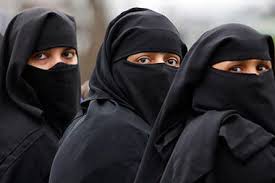
Much fuss in the British media about a schoolgirl banned from class for wearing the niqab, the full face veil. Here’s an excerpt from what the Independent reports:
In a statement, the school’s governing body refused to “discuss individual pupils” but cited “an appearance policy” which states: “Inappropriate dress which offends public decency or which does not allow teacher student interactions will be challenged.” The statement added that the policy was adopted “several years ago” and “written at a time when a girl wished to wear a niqab, and teachers found that this made teaching difficult.”
The school defended its decision as “very much an educational one” and said: “teachers need to see a student’s whole face in order to read the visual cues it provides. In addition, it is important for the safety and security of the school community to know who is on site, and to be able to see and identify individuals.”
I’m not going to get into the politics of face veils beyond what I wrote on the subject four years ago, in The Veil of Fears. My views haven’t changed since then.
But I do have some experience of teaching women wearing the niqab. For the several years I’ve run management and personal development workshops in Saudi Arabia. Those of you who are familiar with the Kingdom might ask why, as a man, I am allowed to teach women in that very conservative country. The reason is that contrary to popular myth there are several workplaces where men work alongside women – the most common being hospitals.
So a couple of dozen times a year I find myself working with mixed groups. The men tend to be on one side of the room, and the women on the other. This is not a pre-ordained arrangement, just the way they feel most comfortable. Depending on the city, some or all of the women will be wearing the niqab. I don’t have the option – like the school in London, or the French state, which has legislated on the matter – to ask the women to remove their veils. I have to deal with what I see, or don’t see.
But I can see the eyes. At the beginning, it was a bit disconcerting. But over time I have acquired the ability to read much more from the eyes, from the voice and from body language than ever before. Think about it. When you watch the theatre that is human expression, the eyes are the leading player. All the other cues are the supporting cast. If you’re unable to see, then the voice takes the place of the eyes. The brain compensates for the missing input, and after a while does quite nicely without it.
The only problem I have is recognising names without a name card being next to the person. There again, there are ways around the problem. Although most of the women are wearing black abayas, each wears distinctive shoes. So I try to memorise names against shoes, as opposed to faces.
Would it be easier if faces were visible? Of course. But not so much easier that the process of teaching and interacting is seriously degraded without visual cues beyond the eyes. These days, it feels perfectly normal. In fact the women tend to be more lively and enthusiastic than many of the men. Their personalities shine through the black gauze, and working with them is often a joy. Whether this is a conscious effort on their part to transcend the limitations of appearance, I don’t know. And for my part, I can focus on the person within rather than the meta-information that comes from physical appearance.
So my message to the teachers in that London school is that the niqab needn’t be a barrier to effective teaching – you can do it if you want to. Whether you should have to do it, and whether the girls should be allowed to cover up, is another matter. The practical objections by the school, such as difficulty of identification, can be overcome. So I suspect that the underlying concern – especially in the light of recent revelations of covert efforts to “Islamise” teaching in various West Midlands schools – is cultural and social.
And that’s a far bigger issue which goes to the heart of much of the unease in Britain’s cities and in our society in general.
“All occupations have hazards. An occupational hazard of the Internet columnist, for instance, is that he becomes the sort of person who says whatever he thinks will get him the most attention rather than what he thinks is true, so often that he forgets the difference.” Michael Lewis, Bloomberg View, September 24 2014.
Well said, Michael. The author of Moneyball and Flash Boys knows what he’s talking about, I reckon.
You could say that this blog is an internet column of sorts, so do his words apply to me? I like to think not, for a number of reasons.
First because I don’t write for money. Most people who write for money, directly or indirectly, end up being in thrall to the people who give them money. If they make money from advertising, they need to make sure that their focus is tuned to the supposed needs of their audience. That limits what they can write about, unless they happen to be Mary Beard or Jeremy Clarkson, who can write about more or less anything and still get an audience. If someone pays them to write a column, they’re subject to editing, deadlines, self-censorship and all that stuff that comes with the shilling. Novelists tend to stick to their knitting, their favoured formula, because that’s what sells, even if the tiny minority of literary giants go where their fancy takes them.
Second because I’m not into blogging to persuade, to influence, to sell, to educate or to manipulate. Only to make people think. Not think my way. Just think. Oh, and laugh occasionally.
Third because I really don’t care that much about how many people this blog reaches. Yes of course I like it when lots of people read my stuff. That’s a pay-off. And I’d be lying if I denied an element of vanity behind my motivation. But if one or two people discover something here that they might not have found elsewhere, that’s good enough for me.
Fourth because I prefer to have the freedom to write what I want, on any subject that takes my fancy, when I want and where I want. I wrote the last three posts about Scotland, for example, while on holiday in Southern France, sitting in a farmhouse looking out at rolling hills and orchards. There was no TV, so I couldn’t watch 24-hour coverage of the referendum even if I wanted to. Only a rather shaky internet connection that worked if I sat outside, and then not always.
Perhaps my attitude to writing comes with age. I’ve been writing stuff for most of my adult life. Marketing stuff, proposals, boring technical stuff, policies, procedures, tender documents and of course hundreds of thousands of emails. I still do. I can write these things at the drop of the hat. My brain is full of structures, templates, phrases, sentences, even paragraphs that I can churn out without ever having to adapt previous versions.
Have I written stuff that I don’t believe is true? Of course. Anyone who has ever written a commercial proposal who tells you that he or she has never accentuated the positive beyond the bounds of truth, or omitted something that contributes to a pattern of truth, is a liar.
But fortunately I don’t have to write much of that kind of crap any more. And in this blog, there is no reason why I should be gilding any lilies or being economical with anyone’s version of the truth for commercial gain or for any other purpose.
Which is a good job, because it’s so fiendishly difficult to make a living from writing. I’m amazed at how many books get published these days. And for every book that makes it into print, there must be a hundred or more that end up as vanity e-books or word files that never leave the frustrated creator’s desktop. Then there are the journalists who scrape a living reporting car accidents, council meetings and the unlikely antics of celebrity footballers. And finally bloggers. Millions of them, showing their photos, writing about their holidays, publishing their poems, fomenting jihad, grinding their axes and producing tomes telling other bloggers how to make money out of blogging.
All of this released into the vast ocean of the internet. So much hot air. No wonder the northern icecaps are melting.
Still, I hope I will be still be writing a blog or something similar when I move into my dotage because this is an exercise in forcing oneself to take a view on things that might otherwise float away unnoticed in the internet’s equivalent of the Pacific Gyre. Also, it beats the hell out of Sudoku as an antidote to Alzheimer’s. I have friends who have spent much of their lives trying to make money out of music. These days, I suspect that for many of them the joys of creation and performance are far more important than the money. That’s how it often is when you’ve been around for a while. As it is for me.
So in 59steps, you can rely on getting my version of the truth, even if it doesn’t happen to coincide with yours. And if you’re wading through the mucky waters of the internet looking for truth, make sure you follow the money, the motive or both before you select the truth of your choice.
Adam Smith
Apologies to my international readers for focusing in the last few posts on what must seem a parochial issue compared with what’s going on elsewhere in the world. But we Brits are a bit preoccupied at the moment with the prospect of some major changes in the way our country is run.
So a constitutional settlement for the United Kingdom in the wake of the Scottish Referendum is simply a matter of signing over to Scotland tax-raising powers subject to a levy to pay for defence, intelligence and diplomatic overheads, and then passing a law to that prohibits Scottish members of the Westminster parliament from voting on matters pertaining only to England – right?
Wrong.
As a humble voter unconnected with the corridors of power and aligned with none of the political parties, despite my relative ignorance I can see a number of tricky issues that will need to be negotiated. For instance, I shall watch with interest to see how the panjandrums deal with these little questions:
Funding for Pan-UK Institutions: Will Scotland be required to hand over a fixed percentage of the income tax it raises to pay for spooks, battleships, ambassadors and our beloved Royal family? Or will there be a specific lump-sum levy fixed in the annual Westminster budget? That’s a crucial question. If, say, we need dramatically to increase the numbers of spooks and soldiers to deal with a sudden escalation of internal threats and military commitments – as seems currently likely – will the Scots have to raise taxes or cut public expenditure to pay for the additional spend? That will affect the internal budgeting that will be within their remit, and thereby curtail their financial independence.
The other likely consequence will be some level of the hypothecation – the ring-fencing of individual budgets for specific cost centres, such as military, health and so on – that the UK Treasury has long resisted. It will no longer be so easy for governments to slosh funds about from one department to another without being subject to public scrutiny. There will be a dividing line going right through the heart of government spending, so don’t be surprised if within the two pots – regional and British – we see more lines being drawn. For those who argue that hypothecation will bring greater transparency in spending, that can only be a good thing.
If there is to be a lump sum annual levy, it will also be necessary for Westminster to negotiate an annual settlement with Scotland and, presumably, Wales, in advance of the UK budget. Whether the levy is imposed or negotiated, unless a process of consultation takes place concurrently with development of the UK budget, we will probably see a time lag between the Westminster and regional budgets, which could make the “budget purdah” governments like to impose in order to head off speculation and market anxiety more difficult to manage.
European Law: If, as seems possible, the UK leaves the European Union within the next few years, Scotland will be dragged out with it. Scotland is generally more pro-EU than England, and will be likely to want to retain much of the EU legislation currently in force – the Human Rights Act and the Social Chapter in particular. Should England repeal this legislation to create a social landscape more favourable to business, the changes will most likely result in a lower cost of employment south of the border. This then becomes a competitive issue that might disadvantage Scotland. It could affect Scotland’s chance of winning inward investment, and might even result in British firms moving jobs south. So leaving the EU could be another indirect inhibitor of Scottish autonomy.
Oil and Gas: How will the revenues be divided? Will there be a difference between levies by the Scottish government and Westminster on oil and gas production? If so, that could lead to further competition war, with investors and exploration companies focusing on one area of the United Kingdom over another. If things don’t go Scotland’s way, old resentment over who benefits from the oil revenues will not be alleviated, and instead might intensify.
Definition of “only relevant to England”: As one or two pundits have already pointed out, in this area the devil is in the detail. What are the areas that are exclusively relevant to England? What areas might have a knock-on effect on Scotland? Let’s say that financial regulation of the Scottish financial industry becomes a matter for Scotland to determine. If Westminster decides to change the regulations that apply to firms in the City of London, what will be the effect on Scotland’s counterpart?
Supposing Westminster raises fuel duty for England, and Scotland declines to follow suit. Will we see a new line of business for criminals: smuggling fuel across the border, as happens between the north and south of Ireland? How would that be policed? Who would pay for the additional policing?
There will be a whole host of similar scenarios to be considered and resolved. Clearly there are many areas where the different authorities will need to coordinate and cooperate even if they are under no constitutional obligation to do so. In public health and farming policy, for example, as long as the UK is in the European Union, European law will maintain commonality. But if we secede, it will be down to the constituent parts of the UK to ensure that there is a consistent approach to dealing with foot-and-mouth disease, epidemics and immunisation policies. And what about environmental and air transportation issues?
So here’s the bottom line.
Devo max – the term used by the politicians to describe the stretching of fiscal devolution to the greatest possible extent – will not give the Scots, the Welsh and the English control of their own destinies, or anything like it. The Scots will be able to build a few roads, hospitals and universities if they can afford it. They will be able to vary tax rates – upwards or downwards – and take measures to create jobs and industries.
But just as the earth’s gravity prevents the moon from flying off and becoming a planet in its own right, Scotland’s ability to operate independently will still be circumscribed by the big bad wolf down south. It will remain in England’s orbit, whatever level of independence it achieves. And the same goes for the UK and the EU. So in one sense independence was always an emotional rather than a practical construct.
Enough of the problems. What about the opportunities?
Instead of moaning about being bounced by the Scots into some form of federal constitution that we neither sought nor felt we needed, perhaps we English should start looking on the bright side. If the home of Adam Smith can come up with some imaginative initiatives to improve the lives of the people north of the border, can we not learn from those new ideas? If the best talents in England, Scotland and Wales are motivated to work for the benefit of their national governments, cannot each of the nations in the UK benefit from their efforts? True devolution is surely the devolution of talent, of minds.
Nobody wants to see the central government in Westminster populated with even more functionaries and dead-heads than is already the case. But if bright people can make more of a difference in the regions where they were born and grew up, then surely those regions will be the stronger as the result. And we, in our still-United Kingdom, will all be stronger too.
The tide is flowing fast away from the shores of central government. Let’s ride it and see where it takes us.

8 am Friday 19 September:
So the angry accountants won.
For all the rhetoric swirling around about no return to the status quo, what needs fixing that didn’t need fixing before this whole exercise started? Not much, except a million-or-so broken hearts in the grieving north.
We are no more and no less beset by problems than we were before. In Scotland, the Poles, Latvians and Romanians who cheerfully locked arms with the Bravehearts and voted yes will return to their previous status as the others. The English who voted no will continue be the subject of the low key resentment for their presence – perhaps a little louder for a while. The politicians will return to politicking. Stickleback and Flounder will be mercifully spared the backlash that would surely have come their way when the populace discovered that they are just like any other politicians – over-promising and under-delivering.
All the while, the birds will sing, the fish will swim and the stags will rut, blissfully unaware of the kerfuffle that has so exercised another species over the past few months. Scotland will still be a beautiful country, and its people a mix of passionate, mean, creative, delusional, industrious and self-centred, just like the rest of us in the still-United Kingdom.
Further south, those of us who watched aghast at the possibility that 8% of our population were on the verge of imposing upon the rest of us a profound change in which we had no say will breathe a sigh of relief and return to our everyday worries.
But the referendum has had one significant effect. It has caused the English citizens of the Union to think afresh about a political order that most of us hitherto have considered – if we ever paused to think – to be as permanent as the granite in our hills and the muddy water flowing through our valleys into the sea.
The British stage is now set for bigger questions to be debated. Should we leave the European Union? How do we deal with the upcoming energy crisis? Should we still insist on “punching above our weight” in foreign affairs? How will we deal with the consequences of massive immigration to our shores? How will we cope with the enemy within that some see as the product of our multicultural society? Will we soon be dusting off our nukes and pointing them eastwards again? And will we manage to re-invent ourselves after the decline of our industrial base, whose destruction played so large a part in triggering the nationalist resurgence in Scotland in the first place?
These are the challenges that face us today. In time they will be replaced by new challenges. Life goes on. Meanwhile, the leaves fall from the trees, the sheep graze on the hills, the brown fug rises from our cities, babies are being born, lovers argue over breakfast and politicians polish their words.
Twas ever thus.

Today’s the day then. Throughout the Scottish referendum campaign, I’ve refrained from trying to influence my thousands of Caledonian followers either way (actually, it’s more like three men and a couple of red squirrels, but then this is a season of exaggeration, is it not?).
Like the Queen, I don’t have a vote and I’ve chosen to remain silent throughout the campaign. Unlike the Queen, I’m going to say my piece now that the babble has given way to the sound of boots on their way to the polling stations.
The reason for my silence is that I haven’t been convinced that either side has made a clear case for their cause. On the No side we have heard many economic arguments as to why separation would be a bad thing. It seems to boil down to the opinions of geologists as to the amount of oil and gas left within Scotland’s reach. If the geologists can’t agree, I have nothing further to add.
The closest they’ve come to a non-economic argument is that the two nations would have diminished influence on the world stage.
Given the UK’s recent failure to influence the EU over the appointment of Mr Jean-Claude Juncker to the Presidency of the European Commission, and our seeming inability to influence our traditional ally, the United States, in any direction of late, I wonder what political influence we would actually lose.
Without the Scots, I can’t see our cultural influence diminishing one jot. Yes, it would be a shame not to think of the Edinburgh Festival as a British event any longer, but at the risk of offending our neighbours I would say that London on its own exerts as much influence as the whole of Scotland.
What of commercial influence? Well, Scotland accounts for a single-figure percentage the UK’s economic output. London dwarfs Edinburgh as the UK’s financial centre. I can’t think of a Scottish region to match Cambridge and Manchester as centres of technical innovation. And Scotland’s manufacturing base is much reduced, whether you blame the wicked Mrs Thatcher or the malign forces of globalisation.
Education? In the recent QS Survey of world universities, four of the top six are English. In Scotland, only Edinburgh makes the top twenty. Military? I have no doubt that Scots will still be recruited into the British army in their droves. If we continue to recruit the world’s fiercest fighters, the Ghurkas, why would we turn away the world’s second fiercest? Health? How many of the world’s health tourists come to the home of the deep-fried Mars Bar for their specialist treatment? Yes, I know the last point was a cheap shot – I just couldn’t resist it.
But in any event, it would do us no harm for our delusions of national grandeur to be cut down to size. We should be competing for influence on merit rather than through a false sense of entitlement.
As for the Yes camp, I have an uneasy feeling about the heady tide of emotion that has pushed Scotland to the brink of declaring for independence. Emotions are powerful levers to pull when they are used to influence popular decisions of this magnitude. I have an uneasy feeling that Flounder and Stickleback (my pet names for Salmond and Sturgeon) are doing a great job of making the facts fit the emotions rather than the other way round.
Emotions are fickle. In the US, revulsion at the deaths of two of their citizens in Syria appears to have turned public opinion dramatically towards approval of US involvement in a military campaign against the Islamic State. If Obama’s war doesn’t yield the desired results, it will not take long for opinion to swing back to fearful disengagement.
Emotions with limited scruples are also the stuff of bad politics. In my opinion Alex Salmond, like his English opposite number Nigel Farage, is a demagogue. I have nothing more than a gut feeling to back up what I’m saying here, but I feel that he is more concerned about his place in history than the wisdom of what he proposes. I believe that for him Scottish independence is vastly preferable to the current status quo whatever the consequences for his compatriots. He is the equivalent of a batsman in cricket who closes his eyes and swipes at the ball because he can see no other way to play the game.
He is, in other words, hitting and hoping. For Salmond the game is political immortality. I suspect he knows that his arguments for independence are at best debatable and at worst wildly optimistic. Only on the emotional level does he score a boundary.
This is not intended to be an ad hominem attack on the SNP leader. He’s a politician, and he’s doing what politicians do. His integrity is no higher or lower than any of the other leading politicians on the British stage. But I hate to see such a fundamental issue determined on the basis of hit and hope. I fear for the future of an independent Scotland, because, to use that cherished Scottish legal term, the case is “not proven”.
So if today’s vote is No, close to half the population will be bitterly disappointed. If it’s Yes, I worry that the disappointment will come slowly, be long lasting and equally bitter.
I have kept silent throughout the referendum campaign because I have nothing to offer other than gut feeling, which I guess is the first cousin of emotion. But sometimes it can be worth more than all the manipulable statistics, ecstasy, joy, rage and tears that will ultimately sway a sizeable portion of the voters today.
There was once a theory beloved of pop psychologists that divides the human brain into two competing hemispheres. The left brain was supposed to be the domain of logic, caution and analysis. The right was the source of emotion, risk, imagination and creativity. The two halves were thought to be battling for supremacy. It’s a shame in a way that it turned out to be a myth, because it’s a neat analogy for the battle that’s been going on in Scotland: the left brain of Alistair Darling against the right brain of Alex Salmond.
Will the dusty balance sheet of the accountant win the day, or will it be the flailing cutlass of the salesman? I suspect that the fictional left brain will prevail. And I for one will give thanks for that.

Winchcombe
I sometimes wonder if I don’t waste too much energy writing about war, pestilence and foolish politicians. It’s time to talk about some nice people for a change.
Last weekend my wife and I went to a wedding in the beautiful village of Winchcombe, near Cheltenham in the Cotswold Hills. For those of you who don’t know the area, it’s full of villages and towns built from honey-coloured limestone. It’s an archaeologist’s paradise, covered with of ancient settlements from Neolithic to Roman and Saxon. More recent inhabitants gained much of their wealth from the wool trade, and ploughed it into the handsome stone churches, high streets and stately homes that still stand today. No wonder the hills and meadows of the Cotswolds were designated an area of Outstanding Natural Beauty.
It wasn’t what you would call a society wedding, full of people with titles before their names. More a gathering of achievers – people with letters after their names. Not too much ostentation, but plenty of hats – some mutated way beyond the original purpose of the garment – as you would find in grand social events like Royal Ascot. The leading men were attired in full wedding garb – morning suits, elegant waistcoats and flowers in their lapels. The bride was gorgeous in traditional white, eyes shining with that special ecstasy that only a long-awaited wedding can induce. The groom was confident and gracious.
It was a wedding that had been planned for over a year. Agonised over, wept over, argued over and rehearsed down to the finest detail. Loving parents on both sides, no fractured families with awkward exes coming together for the occasion. Each with their own stories of achievement and heartbreak, united on a day that was as special for them as it was for the loving couple.
The weather for which we all prayed came to be: sunny, but not too hot. The ceremony was traditional. The choir, the hymns, the oft-repeated vows. The priest, good humoured and informal, assisted by an uncle of the groom who delivered the homily. The flower girls, the bridesmaids, the best man and his supporters, all decked out to perfection and playing their part as the chorus in this timeless opera. The counterpoint of carefully selected roles: the father of the bride duly delivering his only daughter, the mother of the groom reading a poem about marriage, friends and relatives reading from the pulpit. We, the congregation formed the base of a pyramid of love, at the apex of which stood the bride and groom – the reason we were there.
Everything you expected to see and hear was as it should be. There was even the obligatory Scotsman, whose kilt reminded us that the union we were celebrating might shortly be followed by the dissolution of another.
The reception was in the grounds of Sudeley Castle, once a feudal stronghold and the resting place of Henry VIII’s last wife, Catherine Parr. Now – as so many castles are – it’s put to work as a tourist attraction and a sumptuous wedding venue. Champagne, canapés, music and dinner in a big marquee close to the castle walls. The speeches, carefully scripted but delivered from the heart. The usual embarrassing tales about bride and groom. Laughter, tears, embraces and dancing. And of course the inevitable early retirement of one couple, overcome by the hospitality and helped gently into a taxi by the groom’s attendants. Such things always happen at weddings, said the mild-mannered father of the bride, and indeed they do.
Though the wedding was a very English affair, it brought together people from many parts of the world. From India, Canada, the US, the Caribbean and Saudi Arabia, the latter being where the bride’s parents – American and British – have lived and worked for many years. Like the couple themselves, the younger contingent were articulate, friendly and seemingly well-established in professional careers. In thirty years’ time perhaps they will be watching their children walk down a similar aisle.
In what kind of country, I wondered. Will we be balkanised, afraid of our shadows, unable to find any place where we are free of security cameras and safe from random or premeditated violence? Will we have to choose between living in cities where English is just another language, or in country towns where economic barriers of affordability combine with rising xenophobia to create enclaves of “essential Englishness”? Will it be down to their parents’ wealth whether our young learn their values in sink schools ravaged by cultural and religious divisions, and spend their lives in debt and insecurity, or end up in private schools, privatised universities and jobs tacitly reserved for a self-perpetuating minority? Will their future be marred by resentment and envy, or by fearful concern for self-preservation?
Or will we overcome the political, economic and social woes that are causing our country to fracture and shudder with anxiety? Will we start recognising what is good about the new? Will we build on new strengths and mobilise all the talents at our disposal in an inclusive, outward-looking and socially mobile nation, whatever borders end up defining it?
The parents of the newly-weds – Isobel, Fred, Ian, Jennifer – and all the other people of my generation at that wedding will be increasingly incidental to whatever outcomes await us.
We have helped to create the uncertain present. This post is dedicated to you, Jessika and Chris. You gave us a sunny respite from the cares that bear down on all of us. The future belongs to your generation. Make the best of it, and have a long and happy marriage.
The opening of the Invictus Games – the British athletics competition for members of the armed forces of various nations injured in recent conflicts – has received plenty of media publicity over the past few days. In the UK much of it is because of the identity of the main organiser, the Queen’s grandson Prince Harry.
That the event coincides with Harry’s thirtieth birthday clearly helps, as we are regaled with articles about his wild youth and new-found maturity.
One distinctive characteristic of the British royal family is that it has never been averse to its members putting themselves in harm’s way while serving in our armed forces. Harry served two tours of Afghanistan as a forward air controller and then as an Apache pilot. In the Falklands War his uncle Prince Andrew was also a helicopter pilot. Going further back, Lord Mountbatten, Harry’s great uncle, was a destroyer captain whose ship was sunk during the evacuation of Crete during World War 2.
Britain is not alone in this tradition. The sons of several leading politicians, including Vice-President Joe Biden, have also served in war zones, as did descendants of Presidents Eisenhower and Theodore Roosevelt. Two of Roosevelt’s sons died in action – one in each of the world wars. Not only that, but distinguished war records have always been an advantage for Americans standing for high office. Presidents Jackson, Grant, Sherman, Roosevelt, Eisenhower, Kennedy, and George H. W. Bush, among others, could all point to their military achievements, as can recent presidential candidates John Kerry and John McCain.
Some Arab leaders, however, seem quite happy to pose in uniforms and send their death squads into action (as witness Maher Al-Assad and Mutassim Gaddafi), but exposing themselves to bullets and shrapnel is quite another matter. A notable exception is the House of Saud. King Abdulaziz, the founder, proudly bore the scars of wounds he suffered in numerous battles, and his sons Saud and Faisal fought alongside him. More recently, Prince Khaled Bin Sultan, the commander of the Saudi forces in the first Gulf War, happily exposed himself to snipers at the opening skirmish in the Saudi border town of Khafji.
A bit of a cheap shot perhaps, because not many of the bemedalled Sandhurst graduates strutting round the Middle East have had the opportunity to display their prowess in battle. However, if the Islamic State has its way, they may yet.
But one wonders how many of the shadowy financiers of IS have sent their sons and daughters off to Iraq and Syria to risk their lives for the cause they espouse. Unlike the sons of tinpot dictators, they themselves are unlikely to end their days facing firing squads or falling under a hail of bullets in some final redoubt.
A case of do what I pay for, not what I do.
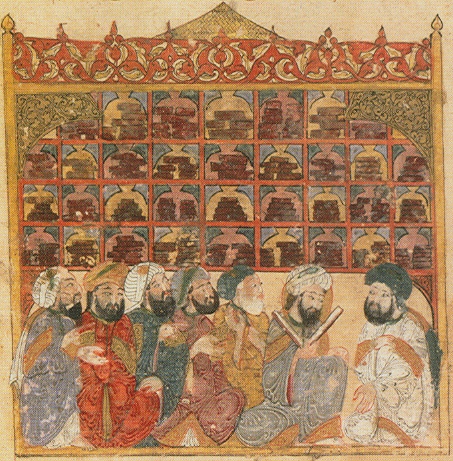
Scholars at an Abbasid library. Maqamat of al-Hariri Illustration by Yahyá al-Wasiti, Baghdad 1237
There are times when I wonder whether religions can be compared with chemical elements. The relatively stable ones are the most durable. Those that are most volatile and unstable give off most energy, and have the most destructive potential. But they decay over time – sometimes very rapidly.
I fully confess that my knowledge of physics and chemistry is no greater than that of any other non-scientist. You could knock holes in the analogy by pointing out that plutonium has a half-life of thousands of years, so some of the most potent elements take a very long time to decay. But I do feel that that it’s not a bad way of looking at the Islamic State. Volatile, unstable, attracting and repelling human electrons in an unending frenzy – it’s surely destined for a short half-life in its current toxic form.
What of Islam itself, the religion that spawned the ideological obsessions of the Islamic State? A durable faith that has periodically reacted violently with other belief systems, but remains one of the great world religions.
Which element would you compare it with? Plutonium, with a finite – albeit long – life, or gold, a stable element likely to remain intact until the end of time?
No prizes for guessing what a devout Muslim would say. But Arabs Without God, a new book by Brian Whitaker, an Arabist and former Middle East editor of the UK’s Guardian Newspaper, explores a phenomenon rarely discussed openly in the cradle of Islam: atheism, or more specifically believers who drift away from their faith.
This is a serious book about a serious subject. Those who leave Islam can be subject to a range of dire consequences – from social ostracism in a culture where family ties are all-important, to judicial execution or murder by vigilantes. And it’s not only Muslims who frown on atheism. In Egypt, the most populous Arab nation, Coptic Christians face widespread disapproval when they move away from their mother church.
Atheism, especially in countries where Islam is embedded in the law and the social fabric, worries governments whose legitimacy is based on their role as upholders of the faith. It worries extended families that face social disapproval because of their ties with the non-believer. At a personal level it worries parents and siblings who fear for the safety of their errant loved one in this world and for their ultimate destination in the next.
In Arabs without God, Whitaker explores atheism in the Arab world in terms of its theological foundations, its history and the wide-ranging social and political implications of what appears to be a socially unmentionable but growing phenomenon. He looks at the influence of the social media in enabling like-minded non-believers to find each other, at the effect of the Arab Spring – however short-lived – in stirring up debate on the subject that would have been unthinkable only a decade ago.
In the context of various international conventions and national commitments to freedom of speech and belief, he looks at attempts by governments in the region to satisfy criticism by human rights activists in the west while satisfying the devout, and sometimes the extremists, within their borders. Across the Arab world, governments range from equivocal to rigid on the subject. Yet even the most uncompromising, Saudi Arabia, has held back from the most extreme penalty for apostasy, even though a survey in 2012 stated that 19% of the population describe themselves as not religious.
Attitudes towards loss of faith in religious circles range from outright condemnation to acceptance that people can’t be bullied into belief. Saudi Arabia is full of clerics who hold views that provide fuel for western critics of Islam, yet runs a well-publicised programme to integrate Al-Qaeda members back into society. It executes drug smugglers, yet goes to great lengths to avoid doing the same to people its clerics claim are guilty of the sin of apostasy. All goes to show that reality is far more complex and nuanced than that portrayed by some of the louder voices in the western media.
According to the wide range of people Whitaker interviewed while researching his book, many Arabs start on the road to atheism by asking an age-old fundamental question:
“Without realising it at the time, he had stumbled into a debate about free will and predestination (al-qada’ wal-qadr in Arabic) which has exercised the minds of theologians for centuries. If God is all-knowing, He can surely foresee evil deeds; if He is all-powerful He must be capable of preventing them; if He is good, why does He allow evil deeds and then punish people for them? A verse in the Qur’an says: “Ye shall not will, except as Allah wills.””
It seems that loss of faith is a gradual process for most Arab Christians and Muslims. It can be accelerated when a person’s misgivings are answered with a refusal to debate them. Exposure to western philosophy can be influential – hence the widespread if implied concern on the part of conservative factions in Saudi Arabia over the well-funded scholarship programme that sends many thousands of young Saudis to western universities.
The book dwells at some length on Islamophobia and the debate in the west over confrontation versus self-censorship. As Whitaker points out, the robust views of the “New Atheists” such as Richard Dawkins and the late Christopher Hitchens potentially provide intellectual weapons to the extreme right that enable them to cloak their views in a veil of respectability. He also notes that the Swiss ban on minarets and the French prohibition on the wearing of face veils are at somewhat at odds with cherished western tenets of freedom of expression and belief.
Arabs Without God is an even-handed and sober exploration of its subject. Whitaker rarely lets his personal beliefs intrude – he allows his interviewees to speak for themselves. That’s not to say that there aren’t moments of dry humour – for example when he tells the story of the Iraqi cleric who expresses the opinion that cucumbers and tomatoes should not be sold next to each other since the former is symbolically male and the latter female. The cleric goes on to rule that women should not handle the cucumbers.
It’s a shame in a way that he limits his focus to the Arab world. As he makes abundantly clear, Islam is not a monolith. Beyond the Arab world, it is the dominant faith in much of Asia and West Africa, and it encompasses a huge variety of sects, ethnicities and cultures. It would have been interesting to have heard opinions from countries further afield – especially Iran, Pakistan and Afghanistan – where intolerance of other faiths, of blasphemy and apostasy is more extreme and less constrained by the rule of law than anywhere in the Arab world other than the territory now controlled by the Islamic State. But his chosen brief is probably wide enough. The region he writes about is abundantly diverse – from Morocco in the west to the Iraq and the Gulf states in the east.
What of the future? Whitaker observes that in most Arab countries establishments pay lip service towards concepts of liberty that western societies hold dear. He notes that authoritarian enforcement of a state religion is not the only way to encourage a devout population. He cites the United States as a nation in which secularity is embedded in the constitution, and yet which has one of the most fervently religious populations in the west. But he does believe that attitudes towards freedom of religious belief are slowly changing in most parts of the Arab world – Saudi Arabia being a notable exception.
For a number of reasons I’m not confident that the cracks he identifies in the religious edifices of the Arab world will fundamentally change the landscape any time soon.
Firstly, fear of discord – fitna – is deep-rooted within Arab cultures. More now than ever before, I feel that the majority of those not affected by the various conflicts in the region will value peaceful existence far above religious or social tolerance. They may wish for greater elected representation, but not if it leads to the sort of chaos they are witnessing in Iraq and Libya.
Secondly – and this particularly applies to the conservative societies in the Gulf states and Saudi Arabia – many countries are still coming to terms with the rapid influx of petrochemical-derived wealth and what some see as the consequent encroachment of alien – western – values in their societies. This has resulted in a sense of cultural defensiveness that is unlikely to dissipate in the short term.
And finally, the Arab world has never experienced a period comparable to the Age of Enlightenment in Europe, in which much of the religious intolerance of earlier times gave way to a tide of scientific and philosophical exploration. The changes in attitude in Europe evolved over more than a century, and even then were not sufficient to prevent outbreaks of bigotry and intolerance – authoritarian government, pogroms and of course genocide – up to the present day. “Enlightenment” (with no intent to patronise by use of the term) is not something that can be forced upon societies in the course of a few decades.
My sense is that it will take much longer for the Arab world to become sufficiently confident and secure in its cultural identity to accept in its heart – rather than in theoretical terms – that diversity of faith and belief, and particularly non-belief, are not threats to the coherence of society. And for that security to come about there will need to be greater equality and distribution of wealth, particularly among nations – such as Egypt, Yemen and Jordan – that are not blessed with an abundance of natural resources.
There is much talk among the oil-rich Gulf states of the desire to develop knowledge economies in which human ingenuity supplants mineral resources as the mainstays of their economies. But for that to happen, the people of the region will have to re-acquire the habit of curiosity, questioning and critical thinking, the very faculties that many state education systems have traditionally not encouraged, particularly when it comes to religious belief. So you could argue that these societies seek the impossible – to encourage free thinking while placing one primary subject off limits.
Nevertheless I do believe that even the most conservative Arab societies will eventually embrace diversity of belief without fear, but that it will take several generations and much pain and turbulence before that day arrives.
That’s not to say that Arabs are not debating the subject. This recent opinion piece by Mohammed Al-Osaimi, originally published in the Saudi daily newspaper Okaz, and reproduced in its English-language sister publication Saudi Gazette, shows that even Saudi Arabia, the ultimate bastion of conservatism, is not averse to discussion on political and religious freedom:
Those who lose their mind ultimately lose their ability to be logical. I thought of this when I read a reply from a reader to a tweet I had written. I said in my tweet that the Arab world would advance only when the value of an Arab was equivalent to the value of a man in the West.
In his reply the reader said: “The sheep you call human beings in Europe have been enslaved by their own democracy. We will plunge down to their low level when we give up our religion”. I want to say to this reader that I cannot understand how people who live in a democracy and who respect human rights can be called “sheep”.
In the West, Muslim and non-Muslim men and women are respected and valued as real human beings. They are given their full rights. They are provided with all the facilities necessary for them to practice their religion.
If any European is displeased with the religious practices of others, he can file a case against them in the court. He does not have the right to take the law into his own hands. People in the West do not take up swords, daggers or rifles to express their opposition to the followers of other religions. Arab and Muslim countries, however, are replete with mad extremists who say that they worship God by chopping off the heads of those who are not of their religion.
In the democratic West, mosques and Islamic centers are built according to the rule of law under which all people are equal regardless of their race, color or religion. Muslims there are looked upon as real human beings who are worthy of respect. In the democratic West, the police will provide you with protection if you decide to demonstrate peacefully in support of any cause even if this cause is against Western interests. In the democratic West, freedom of expression is guaranteed by law. You can say whatever you want to say and do whatever you want to do as long as you respect the rule of law.
In the West, all people are equal before the law. There are no big or small people. A prime minister may be given a traffic ticket just like any other driver. He can be taken to court if he is accused of embezzling a single penny. A Swedish female minister resigned because she used the credit card of the ministry instead of her own card to fill her car with gas.
In the democratic and free West, there are things which for an Arab remain dreams that will never come true. In our Arab and Islamic countries, some people put on the dress of religion in order to coerce us, block our minds and force us to follow their ideology no matter how good or bad it may be. They are ready to exclude you if you are not one of them. These people see democracy in the West as a method of enslaving people. Therefore, it is not surprising when they look at people who live in a democracy and consider them to be sheep.
A somewhat rosy picture of the west with which I suspect many westerners would disagree, but Al-Osaimi’s piece represents a sizeable, though probably not dominant, constituency of opinion in Saudi Arabia today.
Arabs Without God provides many important insights into a region that the rest of the world ignores at its peril, as recent events clearly demonstrate. At present it’s only available as an e-book. You can find out more about it by going to Brian Whitaker’s website, Al-Bab. I recommend a visit – the site is full of interesting articles by a writer who shows deep knowledge of his subject in everything that he writes about the Middle East.
Anybody who’s done a reasonable amount of business travel outside what pampered business travellers from the west define as civilisation – in other words, the major metropolitan centres of North America and Western Europe – will be familiar with the scene. The pasty-faced, grumpy middle-aged businessman (and yes, it’s usually the men) bristling with indignation at some imperfection in the hotel he’s just checked into, giving the management and staff a hard time and spreading an air of disgruntlement wherever he goes.
I’ve done enough travelling, especially in the Middle East, over several decades to realise that explosions of outrage rarely bring more than raised blood pressure on the part of the exploder.
Quiet persuasion followed by weary resignation is more my style unless grievously provoked. But a recent three-week trip around Saudi Arabia and Bahrain served to remind me that the niggles never seem to go away. So, in the grand tradition of listicle blogging, here are my top ten moans about business hotels in the Middle East:
Bath Taps: is it beyond the wit of bathroom designers to indicate which way you push the handle to get hot water, and which way for cold? You read the sanctimonious notices in hotels about conserving water, and yet it takes on average three minutes of water flowing down the drain before you can get the shower temperature right. Sanctimonious the notice may be, but water is a big issue in the Gulf. Governments are turning the waters of the gulf into a salty soup devoid of life with their desalination plants. They are steadily draining the aquifers beneath the desert, yet here is a prime example of needless water waste.
Internet: the internet in most hotels may be free, but it’s steam-powered. So whenever I check in, I search the corridor top see how close the internet hub is to my room. More than five yards way, and I try to change rooms. It’s extremely irritating when your email server times out, and your skype calls fall over every few minutes. Equally irritating to be offered a premium “fast service” when the bog standard free version hangs like a giant sloth.
In-room supplies: why is it such a struggle to extract more than two sachets of coffee, tea and “creamer”. If you’re a coffee addict like me, you run out within an hour. I’ve gotten into the habit of going off to the local store to buy my own supplies of milk and coffee. Anything to avoid the dreaded room service! Oh, and why does someone have to check the minibar every day???
Air-conditioning: Just as I have a regular problem with hot and cold shower handles, I’m constantly amazed that when you enter the room it’s as if you’ve wandered into a refrigerated meat wagon. Why 18C when it’s 45C outside? It usually takes about half an hour to figure out the controls sufficiently to reset the climate to the equivalent of the British summer rather than temperatures prevailing in Greenland. And speaking again of waste, you wonder why these hotels seem to keep their rooms so ridiculously cold whether they’re occupied or not. Perhaps it’s something to do with the fact that in many Gulf countries the cost energy is highly subsidised. And because it’s cheap they waste it with gay abandon.
Buffets: in most hotels I stay at there is an evening buffet. But the last thing I need is a three or four course meal every night. Yet if I want two courses or even one, I still have to pay the full price. Would it be so difficult to set a variable tariff for people like me who want to pick and choose? Burgers and french fries in the coffee shop do get rather boring after a while.
Breakfasts: why do you have to be asked for your room number every morning even if you are there for a week? And why are you asked to sign a bill even when breakfast is included in your package? And wouldn’t it be nice if the hot dishes were changed a little more regularly than the same boring options every two days?
Currency exchange: why do hotels offer such a ludicrously unfavourable exchange rate for currency? Would they not make far more money if they provided rates closer to the commercial exchange companies? I can understand that they would rather not exchange currency at all, which is probably why they offer such rip-off conversion rates. But aren’t hotels supposed to be in the business of customer service?
Room phones: Outrageously inflated external call rates is an age-old beef against hotels everywhere. It’s less of an issue now that everybody has mobiles. But wouldn’t you think that they could use a competitive landline rate as an additional benefit for customers?
Room safes: a good percentage of all safes in Middle East hotel rooms don’t work, or have indecipherable instructions. I generally don’t bother with them, but if I was carrying jewellery or large wads of currency I’d be pretty irritated.
Power Cut-Off devices: why do power cut-off devices switch off all power outlets in the room? Power saving is all well and good, but if you leave phones or laptops in the room to charge, you have to get another room card to put into the slot so that they keep charging while you’re out. Would it not be a simple fix to install one “always-on” socket?
Another more general moan is about branded hotels. In the Middle East, mid-market chains like Holiday Inn and Ramada are mostly franchises. So the brand promise of these big names – that you get the same standard of service wherever you are in the world – is usually subtly degraded by the owner-operators under the justification of cultural difference. Whereas the real cause is usually poor training and poor treatment of staff, leading to high staff turnover.
One of my favourite sayings about business and public life in the Gulf is that the real objective of many initiatives, especially those involving social change, is not the change or improvement itself, but “the appearance of” the desired outcome. Thus when you check into a hotel with an international brand name, you often get the feeling that the hotel has “the appearance of” a Marriot or a Hilton, but the reality is far fuzzier.
This is particularly the case with hotels that have been around for a while. They may have started off bright and gleaming under the eagle eye of the corporate brand police, yet slowly but surely they gracefully degrade under the weight of apathy and cost-saving measures. Décor looks tired. Things don’t work very well because of poor maintenance. Managers value job preservation over customer service.
Thankfully the hotels in the Middle East haven’t yet copped on to the Ryanair model of customer service, namely that the profit is all in the add-ons. You can still negotiate a late checkout at no extra charge, for example. Gulf nationals often like to sleep late and work (or party) late, so I suspect that they would be outraged at having to pay extra for a long sleep-in followed by a leisurely check-out late in the afternoon.
Moans apart, the one redeeming factor of most of the hotels I visit is the poor, hard-worked, put-upon staff. Most of the waiters, bellboys, room service and maintenance guys are unfailingly polite, cheerful and helpful. They tend to come from low-wage regions such as the Philippines, Nepal and the Indian subcontinent. They work long hours. Some only get home every couple of years. They put up with guests barking at them, clicking their fingers to summon them and sometimes far worse. I heard one story about a housekeeper at a five-star hotel in Riyadh who knocked on a room door several times. On getting no response he went in to clean the room. He was met by a husband who, outraged by the fact that the housekeeper had seen the man’s wife unveiled, beat the poor guy so badly that he had to be hospitalised. An Egyptian I met on a plane the other day told me that he once worked in one of the big hotels in Sharm El Sheikh. A drunken Russian tourist took offence at some minor issue, invited the guy outside and punched him so hard that the poor chap fell and broke his leg.
And yes, when I hear such tales, I do feel like a bit of a prima donna for getting aerated about the trivial annoyances I’ve listed above. Spoilt? Most definitely!

I’m just home from a business trip to Saudi Arabia. I’ve been travelling back and forth to the country for over thirty years, ten of them as a resident. In that time I’ve made countless internal flights between the major cities, and sometimes to outposts most western expatriates never get to see – from mountainous areas with green valleys and as many baboons as people, to small towns notable only for the size of their airports.
I’ve also eaten up my fair share of kilometres on the road, swerving on the highways to avoid manic drivers risking death to shave a few minutes from their journeys, running into sandstorms that strip the paint from your car and pit your windscreen, colliding with swarms of locusts that leave a nasty yellowish goo all over your radiator, all the while staying ever-vigilant for wandering camels.
The one Saudi mode of transport I had never used – until a week ago – is the one most of us in Britain usually resort to when we couldn’t be bothered with driving and flights are too much hassle: the dear old train.
I am not alone. What was until recently the only train line in Saudi Arabia is the country’s best kept secret – at least as far as outsiders are concerned. It runs from Riyadh, the capital, to the eastern port city of Dammam. There are two stops in between: Hofuf, one of the towns in the Al Hasa oasis – a conurbation famous for its date palms and once one of the ten most populous cities in the world – and Abqaiq, one of the main centres for the all-important Saudi oil industry.
Much of the traffic on the line is goods. Half-mile processions of containers and wagons full of the materials that feed Saudi Arabia’s endless development boom. Minerals, cars, white goods, downstream petrochemicals, frozen food. Trainloads of stuff that if carried by truck would render the Dammam-Riyadh highway even more dangerous than it already is.
But in amongst the goods traffic there are six passenger trains a day in either direction. The journey times compare favourably with equivalent car trips unless you’re in the suicide class of driver whose speeds would be enough even to give a German autobahn jockey a dose of atrial fibrillation.
On this trip a quirk in the schedule led me to abandon my usual drive-or-fly mode and step out into the unknown by sampling the Saudi train experience.
When I told a Saudi friend in Riyadh of my intention his eyebrows raised a little, and he murmured about the carriages being rather old and a bit stuffy – not a ringing endorsement given that the summer temperature here gets up to 50C. He gave a smile that I took to be the Saudi equivalent of “nowt as queer as folk”, and wished me good luck.
I inwardly scoffed at his misgivings, thinking that here was another luxury-sated Riyadi, and that I, with the pioneer spirit running through my British veins, was made of sterner stuff. If it turned out to be a nightmare, then at least it would be a good story to write about.
So I went to the Saudi Railway Company website, and set about making a reservation, only to discover that I couldn’t. There’s no online booking, which was a bit surprising. Everyone does online bookings these days, don’t they? Anyway, I checked out the times and found one that worked well. The second surprise was the price. A single second-class ticket for the 300 kilometre ride to Hofuf is 60 Saudi riyals – the equivalent of US$12. Compare that with $130 for a flight to Dammam, plus a taxi to Hofuf – 130 kilometres away – which would be another $90.
I decided to go first class, for all of 100 riyals, or $26 – still a steal at around one tenth of the airfare and taxi cost. But what was I buying, I wondered?
First class is called Rehab. Rehab? Is this a train for alcoholics or drug addicts? Surely not, for this is Saudi Arabia! If I didn’t know better, I might have thought of another meaning of the word. The only other long-distance train line in Saudi Arabia stopped running at the end of the First World War, before the Kingdom even existed. It was called the Hejaz Railway, and took pilgrims from Damascus to the holy city of Madinah. The Turks used it to bring troops and supplies for the defence of Madinah against the Arab revolt, commanded by Lawrence of Arabia, or El-Orens as the Arabs called him. What fun to have been travelling in a reconditioned carriage of that era, with the ghosts of El-Orens and his Bedouin tribesmen lying in wait for the train, dynamite at the ready.
The Hejaz Railway
Actually Rehab is the Arabic for welcome, a much more logical meaning of the word in this context. But still, it set me wondering when you’re offered the choice of train: “Regular” or “Modern”. Assuming that Regular means ancient in Saudi marketing-speak, I opted for Modern. Perhaps my Saudi friend was thinking of the former when he gave me his understated warning.
A few days before the journey, my sponsor duly made the reservation and picked up the ticket – an A4 sheet of paper in Arabic with what I assumed was my name – “SAEP H E” in English letters – about as remote an equivalent to Stephen as the imagination could conjure. On the other side of the ticket was a full colour ad offering me a pepperoni pizza or a chicken wrap for 59 riyals – about the price of the second class fare. More significantly the pizza company made use of the space to advertise for Saudi staff – a big issue these days since the Ministry of Labor started a recent initiative to get Saudi into jobs, with serious penalties for those firms that fail to reach their quotas of nationals on their payrolls.
On the appointed day I showed up at the station, which sits in an unprepossessing suburb of Riyadh. It’s near the famous Batha souk, which is the antithesis of Riyadh’s shiny, mall-studded centre. A place full of shabby shops selling designer stuff of dubious provenance and at unlikely prices. Batha doesn’t benefit from the watered greenery of the wealthy areas. It’s dusty and desiccated, like the most of the terrain around the city. The station itself sits next to what looks to be a massive industrial estate. In fact it’s the Riyadh Dry Port, where all the containers arrive from Dammam. It becomes pretty obvious what the main purpose of the line is. The passengers are a bit of an afterthought.
Riyadh Railway Station is not a monument to the heyday of the train as the ultimate passenger transport mode, like Grand Central or St Pancras. Not surprising since it was built long after the end of that era. But it’s spacious, cool and well laid out.
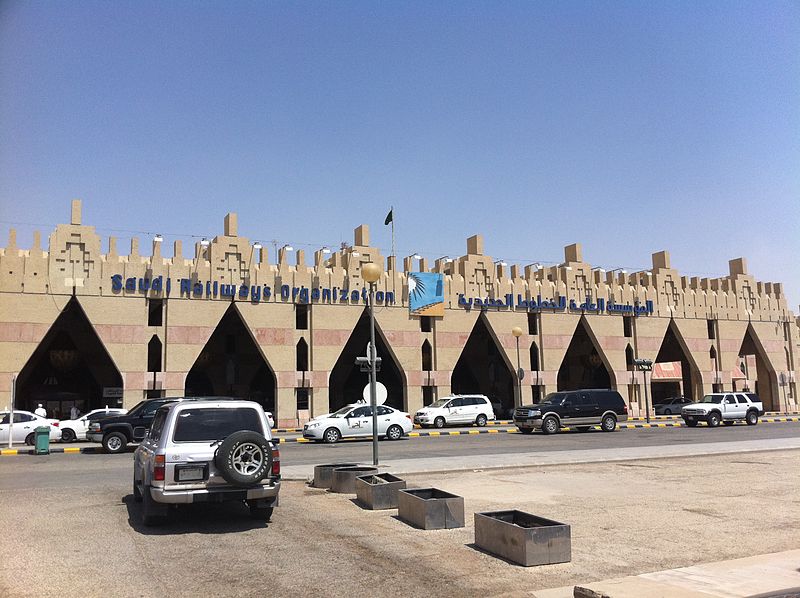
Riyadh Station
The great thing about trains in most places – with the possible exception of India – is that you don’t have the usual airport hassle. You can turn up 20 minutes before departure and get straight on the train. The Riyadh check-in was fast, despite the inevitable X-ray machine, and there’s even a first class lounge. Not quite akin to an airline lounge – you get offered a cup of gahwa (Arabic coffee) and a couple of dates, but that’s the limit of the hospitality.
When departure time came up I had a momentary panic. The trolley with my bags disappeared. It turned out that an enthusiastic porter had thought they belonged to another passenger, and was about to put them on the train – without me. I stopped him at the last moment, and, reunited with my bags, stepped on to the carriage.
What followed was not one of the Great Railway Journeys of the World, but having driven from Riyadh to Dammam, I knew what to expect of the terrain. My allocated seat was comfortable enough. And none of that awful rush of the Gadarene sheep (no swine in Saudi Arabia) as passengers fall over each other to squeeze into their pitifully small seats on a domestic economy flight. All very calm. Plenty of room for kids to run up and down the aisle rather than spend the journey screaming with frustration at being held in the iron grip of a frazzled mother.
The carriage was cool – too cool for my taste actually. 40C outside and 18C in is just a bit too much of a contrast, but the same goes for every hotel room I stay in. I’m constantly fighting a battle against over-zealous air conditioning. In this case, there wasn’t much I could do about it, and everyone else seemed comfortable enough, so what the hell, when in Riyadh…. Also I was the only westerner on the train, so there wouldn’t have been much tolerance of mad dogs and Englishmen trying to jack up the temperature.
There really wasn’t much to see as we rolled out of the station. The industrial area – dun-coloured and dreary – seemed to go on for miles. It was eventually replaced by semi-open desert with ramshackle cabins, pick-up trucks and roaming camels – the Saudi equivalent of the country dacha, sans birch trees and gardens of course. And what there was to be seen was obscured by a thick layer of dust on the windows that created a grey-brown filter.
The guy sitting opposite me was an Egyptian soil specialist on his way to Al Hasa, where he spends his time measuring the salinity of the soil around the date plantations. He told me that since the national oil company, Saudi Aramco, started boosting production from depleted oil wells by injecting sea water into them, water salinity in the area has increased fourfold. In the old days sweet water springs would bubble up all over the oasis. These days it has to be pumped. One can imagine that there will be a tipping point at which the date plantations will no longer be viable. He and his colleagues had flagged the problem up with officialdom, but to no avail. After all, he said with more than a tinge of irony, Saudi Aramco knows best, and oil is more important than dates.
The sun set, and fortified with coffee and a sandwich from the trolley, I got stuck into a book. Two hours and fifteen minutes from departure, exactly on time, the train rolled into Hofuf station, disgorged me and a few other passengers, and set off for Dammam.
And then followed the final joy. Most major airports in the Kingdom are at least half an hour’s drive from anywhere. By the time you’ve retrieved your baggage and dragged yourself out through the throng of freelance taxi drivers, you’re looking at a minimum of an hour between touch-down and final destination – sometimes longer. In Hofuf, I jumped into a cab and was at my hotel in ten minutes.
And that was my first experience of Saudi trains. Now if you’re a regular train user in Europe or North America, you might say no big deal. But trust me, if you’re used to at least three near-death experiences every time you hit the highway, and hours of hassle and waiting around when you cross the Kingdom by air, you would not have taken that journey for granted. It was a relative joy.
Though there’s no railway network as such at the moment – just the one line to the East and a train system that takes the pilgrims in Mecca from one holy place to another, Saudi Arabia is beginning to catch up. Among a number of projects under construction is a line that goes all the way from Jubail in the Gulf to Jeddah on the Red Sea. It’s known as the Saudi Land Bridge. Also there’s the North-South Railway that goes from Riyadh up to the tribal heartlands of Buraydah and Hail up to Al-Haditha in the far north. This will be primarily for goods, and is important because the country is ramping up its mineral production – particularly bauxite – in the north. But apparently there will also be a passenger service.
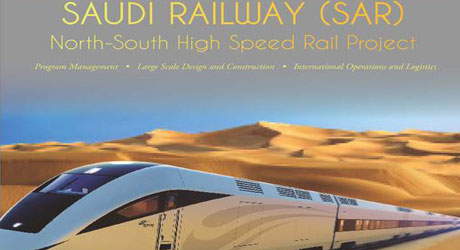
And then there’s the long-awaited Haramain Railway that shuttles the faithful from the port city of Jeddah to Mecca and on to Madinah. If you’ve been on the Haj, the annual pilgrimage, along with up to 3 million others, you will know what the dust and pollution caused by the endless procession of buses and cars making the triangular journey does to the lungs. Take a flight out of Saudi Arabia after the Haj, and you will be surrounded by passengers coughing and spluttering in the attempt to rid their bodies of all the gunk that accumulates over that journey of a lifetime. Not pleasant for you or for them.
Finally, there are long-term plans to link Egypt, Jordan and Syria, as well as several of the Gulf states into the network.
The railways are the last piece of the Saudi transportation jigsaw. The country has highways connecting all the main population centres, some of them excellent, some in need to upgrading. It has numerous international and domestic airports, with improvement projects underway in Riyadh, Jeddah and Madinah. If the population can be enticed on to a fully developed railway network, as well as urban metro systems like the one currently being built in Riyadh, one would like to think that at least some of the 7000 people who die on the roads every year and the 38,000 who are seriously injured can avoid their misfortune.
For a whole host of reasons, including not least the benefit to public health and the environment, the railways can’t come to Saudi Arabia soon enough.
 59steps