The sacking of Health Minister Abdullah Al-Rabeeah, about whom I wrote a couple of years ago, comes at a difficult time for health services in Saudi Arabia. Whether his dismissal is the result of the sudden spike in new infections by the MERS-CoV coronavirus or for other reasons remains to be seen. It cannot have helped his cause that his ministry issued statements to the effect that it had the virus under control at precisely the time when a number of new cases were reported in Jeddah.
Also, as John Burgess reported in Crossroads Arabia, the statement that experts from a drug company were in discussions with the Saudis about developing a vaccine may be comforting for a worried population, but developing and testing vaccines can take months or even years, depending on the virus. The virus in question is a relative of the common cold and also of the more lethal SARS, which caused 800 deaths and a worldwide scare in 2003. I’m not aware of there being a vaccine for either, despite the cold being responsible of millions of days of absenteeism every year around the world. This is partly because there are so many variants of coronavirus, and also because rapid mutation renders a specific virus a constant moving target.
What is spooking the region about the new MERS-CoV clusters – cases have now been reported in the UAE as well as several population centres in Saudi Arabia – is that whereas previously it tended to attack older people with immune systems compromised by other conditions such as diabetes, its victims are getting younger.
Most people assume that infections move as people move. But there’s another interesting possibility. Because the virus has been identified in camels, is it possible that it’s the camels moving around that are causing the problem. If you drive on the main highway from Dammam to Riyadh you pass a huge camel market. Trade in camels is brisk, not only within Saudi Arabia but across neighbouring borders. I’m sure that the authorities are looking at camel mobility as a contributing factor.
An additional concern is that in October around three million pilgrims will be pouring into Makkah and Madinah for the annual Haj pilgrimage. Many of them will pass through Jeddah, where the new outbreak started. It’s highly likely that the authorities will attempt to prevent the elderly and infirm from travelling to this year’s Haj, but if the virus is now infecting the young and fit, this measure would most likely reduce but not eliminate the risk of mass infection.
This is not the first time that health fears have focused on the Haj. The last time was in 2009, when swine flu was the concern. In that instance the festival took place with no adverse consequences. But that doesn’t mean that mass infections can’t take place in the future. Think of the consequences of an Ebola outbreak, for example. Although the Saudis are making noises about not issuing visas to Haj applicants from Guinea and neighbouring Senegal and Liberia, it would only take two or three infected people to find their way to the Holy Places for the authorities to have a major health emergency on their hands.
However, if there’s one area in which the Saudis have deep and long-standing experience, it’s in the logistics of the Haj. No doubt there are contingency plans in place for dealing with unexpected outbreaks of disease among the pilgrims. But anything that weakens that confidence, particularly on the part of the World Health Organisation, which monitors global disease outbreaks and has strict protocols to which the Kingdom is a signatory, is likely to have weakened the position of the Minister.
Dr Al-Rabeeah is an eminent surgeon whose speciality – separating conjoined twins – has brought him and his country considerable prestige. Even while serving in the government he still practised medicine. Only two weeks ago he supervised the separation of twins from Iraq. He will not be unemployed for long.
As for Adel Fakeih, the Minister of Labor, who has taken over Al-Rabeeah’s duties on a temporary basis, he adds a second sensitive brief to his existing portfolio. His regular job is stressful enough. I hope that he is taking good care of his health in what will be a difficult period for him.
Employment is a perennial hot topic in Saudi Arabia. Successive Ministers of Labor have struggled with the conundrum of how to replace foreign labour with qualified Saudis. The latest figures from the Saudi Central Department of Statistics and Information suggest that as of the last quarter of 2013 the unemployment rate for males is around 6%, and that among females who want to work it’s 36.7%.
One statistic I have never been able to find is for multiple employment in the Kingdom. By this I mean the number of people who work in more than one job, or who carry out a number of activities that might not technically be regarded as employment but are nonetheless income-producing.
It’s well known that many Saudis in government jobs have businesses on the side. They may be anything from import-export to small family shops. Though there are restrictions limiting their extra-curricular business activities, it seems that many government employees are adept at getting around them.
On a recent visit to the country I encountered a couple of examples of what is effectively an alternate economy. Not black, because taxation in the Kingdom is minimal, but certainly sufficiently grey to creep under the radar of the official employment statistics.
The first example emerged from a casual conversation with a couple of young Saudis in a hotel lobby. After going through the ritual enquiries “where are you from?”, and “what do you think of Saudi Arabia?”, we started talking about their jobs. One works in the private sector, and the other with what you could describe as a semi-government organisation – a company wholly owned by the government.
People kept coming up to them to say hello, and I wondered why they were there. Training perhaps?
Mohammed and Abdullah (not their real names) proudly produced a lavish brochure with pictures of watches, other accessories. They turned the pages and showed me the logo of a Swiss university, and details of its distance learning MBAs and PhD courses. It seems that they are into network marketing.
The way network marketing – also known as multi-level marketing – works is that when you sign up with a company, you start by selling their products to your friends. You get commission on the sales. Then you recruit two people to sell to their friends. You get commission on their sales. They then recruit two of their friends, and so the story goes, your network grows to tens or even hundreds of people. The larger your network, the more commission you earn. It’s a time-honoured system in the West, though much criticised because of the inflated income expectations many of the operators appear to engender in their recruits. In many cases, such schemes actually break laws against pyramid selling in the US and the UK.
Mohammed and Abdullah did not seem to be concerned about any ethical considerations. They considered themselves to be entrepreneurs. Both said that they are doing very well. Mohammed claimed that he earns more than his day-job salary in commission. Abdullah, who has a smaller network, is apparently well on his way towards doing the same.
It seems that many of the sales agents are women. And certainly network marketing would be a logical outlet for non-working women who have time on their hands and plenty of female friends. There are enough of them – a 2012 survey by consultants Booz and Co claimed that 78% of female graduates were unemployed. Some prefer not to work. Others are not allowed to by their families or are put off working because of the low salaries on offer. But network marketing allows them to earn money from the comfort of their own homes and without breaking any social taboos.
I asked the two guys when they thought they would be able to give up their day jobs. Neither said that they were planning to do so – clearly they have enough spare time for network marketing despite holding down full time jobs. They told me that the marketing company assured them that they should be able to make enough money to stop working altogether within three to five years. Retire is probably not the most appropriate word to use when you’re talking about a couple of people in their twenties. So I asked Abdullah what he would do when he reached that point. “Sleep!” he said with a big smile.
I was curious as to whether these guys were pioneers. How widespread is network marketing in Saudi Arabia? Before they went back to their friends, I posed the question. The answer came back loud and clear: 1.2 million people.
I have no idea whether or not this was a gross exaggeration – it’s not, according to several people I spoke to subsequently – or whether my new friends’ claims about their own success stacked up. But even if you halve their estimate of the number of network marketers, they would represent a very significant percentage of the working-age population. It’s also worth noting that neither of them said that there was any problem with their effectively having two jobs.
But I did discover that in 2012 the Saudi government banned the company Mohammed and Abdullah are associated with. A local newspaper reported at the time:
“This network marketing activity involves deception of citizens and has been banned in a number of countries,” the Ministry of Commerce and Industry said.
The ministry urged Saudis and expatriates not to take part in the activities of such network marketing companies.”
“This business activity has not been registered with the ministry. Moreover, there have been official instructions in the past banning activities that involve deception and stealing others’ money through falsification,” it explained.
The ministry stressed that it would take all measures to stop this form of business activity in the Kingdom with the support of relevant agencies.”
I suspect that the company in question eventually managed to persuade the Ministry that it was not breaking any rules, which was why my friends were openly talking about their involvement. Or maybe they changed their business model to address the concerns of the religious establishment that network marketing might be forbidden under Islam.
If not, then large numbers of people in Saudi Arabia would seem to be earning income illegally but with apparent impunity.
My second encounter with Saudi Arabia’s grey economy came a couple of weeks later, when I got into conversation with another parallel entrepreneur. Hamza (also an assumed name) is a 29-year-old government worker. In his “spare time” he runs a car importing business. He has over twenty staff and three showrooms.
Hamza’s business is used cars. My immediate thought when he told me about his company was that he must surely have some stiff competition from companies much larger than his. All around the country you can easily find used car sellers. Some are huge. But this is a country where the death toll on the roads is a fifth of that in the US, but whose population is one tenth of the size. Drive from Dammam to Riyadh on the six-lane highway and you’ll see plenty of evidence of the reckless habits of Saudi Arabia’s drivers in the form of detritus on the side of the road. So would you buy a used car when you don’t know its accident history?
Hamza’s solution is to import used car from the US, where drivers are somewhat more careful with their cars. Each car he sells has a certificate from the US guaranteeing its accident-free history. Clearly this assurance is a comfort for his customers, because last year he sold 400 cars.
His next business, he told me, will be importing motorbikes into the Kingdom. Given the love of bikes among young Saudis – go to Riyadh any weekend and watch the kids doing wheelies in Olaya and Tahlia Streets and you’ll see the evidence for yourself – I reckon he’s on to a winner.
I was impressed, and told him so. Here was a guy who will be running a very big business in ten years’ time if he keeps going at his current rate of expansion. But one thing didn’t make sense. Why, with this obviously successful business, was he still working for the government on a very modest salary? He gave a cryptic reply: “I’ve been working in this job for four years, and I need to convince my family that I’m capable of holding down a government job”. I didn’t press him further, but I suspect that the respectability of working for the government was more important to his family than his burgeoning career as an entrepreneur.
For a young Saudi a government job is the key to a good marriage and much else besides. One of the factors that prevent the private sector from employing more Saudis is the perception of risk, especially at the smaller end. Families – and equally importantly, families of prospective brides – will accept their sons working for one of the big industrial firms like Saudi Aramco and SABIC on the grounds that they’re virtually part of the government. Banks are fine, as are the long-established family conglomerates. But go lower down the scale to the level where young entrepreneurs like Hamza operate and the greater the chance that status-conscious Saudi families will view your career prospects with increasing scepticism.
Which could explain why Hamza works eight hours a day for the government and spends the rest of his waking hours on his own business. For all that, he must be good at delegating, because he insisted that he didn’t work at weekends.
If these stories are representative of a wider phenomenon, it’s no wonder that Minister of Labor Adel Fakieh is scratching his head to come up with ways to get more Saudis into paid employment. Nitaqat, the quota system by which the private sector is judged on its success in replacing foreigners with Saudis, and Hafiz, the employment benefit scheme of which many of the unemployed women avail themselves, can only partly address the problem if large numbers of women are finding ways to create incomes for themselves outside employment, and if large numbers of government workers are running businesses on the side – either in their own right or through proxies.
The concern must be that those benefiting from the grey economy are likely to be from the better-educated and better-connected echelons of society. If this is the case, the question still remains of how to prevent the underprivileged and undereducated members of Saudi society. The last thing the country needs if it is to maintain stability and social cohesion is a growing perception that the rich are getting richer and the poor are becoming a marooned underclass.
Add to the employment conundrum an education system whose well-documented shortcomings are contributing to a lack of work readiness on the part of high school graduates, and staunch resistance to labour reforms among powerful business owners and you wonder how the Minister doesn’t wake every morning with a severe headache. If he doesn’t have the toughest job in the Saudi government, I don’t know who has.
Mohammed, Abdullah and Hamza are living proof that entrepreneurial spirit is alive and well in Saudi Arabia. The government’s challenge, it seems to me, is – rather than curtail their activities – to find ways of harnessing that spirit in the interests of the greater good by making entrepreneurship not only socially respectable but an accepted and celebrated bedrock of the national economy.
Not an easy task, but a critically important one.
Just a couple of quick thoughts, in contrast to my usual blatherous outpourings.
I’m speechless in admiration of the nine million Afghans who went to the polls in defiance of the Taliban. Yes, the Afghan reality is different from mine, and perhaps it’s less of a big deal to go out to vote when bullets and bombs are an ever-present threat in your normal daily life. Nonetheless the Afghans yesterday showed collective courage beyond my understanding. Let’s hope that the leaders they risked everything to elect are worthy of them.
As for individual courage, I saw The Railway Man last night. It’s the story of Eric Lomax who, alongside thousands of other British and Australian prisoners of war, suffered appalling cruelty at the hands of the Japanese on the Burma railroad in World War II. Again, his courage was in a different universe to mine. Would I have forgiven the person who tortured me? I’m not sure.
Interesting also that the harrowing centrepiece of the torture sequence was the two weeks Lomax was most reluctant to talk about, in which he was waterboarded in an attempt to find out why he built a radio. This of course was one of the “enhanced interrogation techniques” employed by the CIA in Afghanistan and elsewhere. It didn’t work on Lomax, and as the US Congress appears to be discovering, it probably didn’t work for the CIA either.
It’s easy for those of us who have never been at the wrong end of a rifle or a torturer’s tools to pass blithely on to the next news story or action movie. It does us no harm to stop and reflect now and again about acts of courage that few of us need to summon up in our lives, yet are commonplace in the lives of others less fortunate.
When is an airline not an airline? When it’s an heirloom.
Such is the fate of Gulf Air, Bahrain’s flag carrier and perennial financial basket case. It’s the airline that can’t find a CEO – as the transport minister noted a couple of months ago in a fit of dangerous candour – because nobody in the aviation industry wants to take the job. The reason? According to the minister, too much government interference, which is not surprising given that there are three cabinet ministers on the Board, and that each time the airline goes to its masters for another subsidy to shore up its losses, questions are asked in Parliament.
For a Gulf state, a national carrier is more than a means of ferrying its great and good from A to B. It’s a symbol of national prestige. If Gulf Air were allowed to fail, it would be a humiliation – an admission that this tiny country couldn’t stand shoulder to shoulder with its oil-rich neighbours in the Gulf Cooperation Council: Saudi Arabia, Kuwait, Qatar, the United Arab Emirates and Oman.
Some might argue that Bahrain already suffers from a bit of an inferiority complex. Although it was the first of the Gulf states to discover oil, it was also the first to feel the effects of depletion. Today it’s a minnow in production terms compared with every other member of the GCC. Was “small-man syndrome” at play when the country decided to upgrade itself from an emirate to a kingdom? Apart from Saudi Arabia – a zillion times larger in terms of territory, population and economic output – none of the other hereditary rulers in the Gulf have seen fit to place a crown upon their heads.
And also, apart from Saudi Arabia, none of its neighbours invests so heavily in the cult of royalty. Pictures of the leading royals are hard to escape. They are on highway hoardings, buildings and shop windows. In every hotel reception, office entrance and even in school classrooms. (That said, I’d take royalty any day over the cults of personality pursued by the gimlet-eyed action man in Russia or the grim clerics of Iran.)
So it’s hardly surprising that the country’s prestige-conscious rulers would be reluctant to let their beloved airline go to the dogs, despite losses that critics claim should be going towards other much-needed development: education, public transport and affordable housing, for example. Not to mention the clean-up of a spoilt environment and measures to reduce air pollution.
In one way, Gulf Air has been a success story. 60% of the airline’s staff is Bahraini, a far higher proportion of nationals than the local giants, Qatar Airways, Emirates and Etihad employ. But therein lies the dilemma. If you follow the ruthless dictates of capitalist theory, you might be tempted to put the airline out of its misery, despite the impact on thousands of Bahrainis who either work for Gulf Air or supply it with goods and services. A couple of thousand job losses from a single enterprise would make headlines in Britain, France or the US, even if the consequences would barely dent the economies of those countries. But in a nation with 600,000 citizens and only half that number of working age, the economic impact of Gulf Air’s disappearance would be significant – the more so given that Bahrain is not without its political problems right now.
Leaving aside its massive year-on-year losses, how does Gulf Air shape up against its rivals? Pretty well, at least in my experience.
I use the airline frequently on short-haul flights around the Gulf. The online booking system works well, the aircraft don’t look as if they’re falling apart and the cabin crew are friendly and helpful, even if they’re relatively hopeless at settling back the surge of passengers who rise from their seats even as the aircraft is taxiing to the terminal – it takes the British Airways memsahib death stare to sort that one out.
What often makes or breaks the customer experience is how an airline deals with problems. The other day I arrived in Bahrain at midnight on a flight from Riyadh. I got to my hotel at 1am, and discovered that I had left my IPad in the aircraft. Panic ensued. It was in the seat pocket, and I had visions of the morning flight winging its way back to Riyadh with my device serving as an additional attraction for some lucky passenger. I called the Gulf Air helpline. No response. I called the airport lost and found number that was on the website, and got through to a customs officer who gave me a couple of numbers to try. No response.
So at 2am I jumped into the car and headed back to the airport. The airport information desk couldn’t find anyone to help. But in the booth next door I spotted a guy from the airline. He made a couple of calls, ascertained that the cleaners had found the IPad and suggested I come back for it the next morning. I told him I had a full morning – couldn’t I have it now? Without any argument he said sure. It would take about twenty minutes, because the plane was not parked at a gate, and he would have to drive out to it. I went for a coffee, and before I’d finished it he was back with the IPad.
Now I’m pretty sure that it was not his job to go off and fetch my lost property. He would have been within his rights to make some excuse not to get off his backside and insist that I came back in the morning. After all it was my senior moment that created the problem in the first place. But he made the effort, for which I was extremely grateful.
Therein lies one of the secrets of good customer service. It’s not enough to have a well-honed process that makes one human interchangeable with another – I’m thinking of Qatar Airways here (see Qatar Airways – Operational Excellence, but at What Price? for more about them). It’s having people prepared to deal with the consequences of Murphy’s Law using their own initiative rather than reading the rulebook before taking action. Or, as is perhaps the case with Qatar, being afraid to deviate from the rulebook.
This was not an earth-shattering example of going the extra mile, but it was clear that the guy made an extra effort. Both government and private sector organisations in the Middle East are full of bureaucrats who wouldn’t lift a finger without the requisite forms and a dollop of bowing and scraping – unless you happen to be a friend or a relative. I have written before about that great international beacon of customer service (not) – HSBC – for example.
But what this guy’s helpfulness does show is that a single act of decency can transform one’s perception of the organisation that the person represents. All the better if the attitude that engenders the act is part of the culture of the organisation, because then you have the ultimate prize: operational excellence with a coating of customer intimacy.
I’m not sure that Gulf Air matches Qatar Airways in operational excellence, and it certainly can’t compete with its neighbour’s opulent faculties. However all other things being equal – such as price and convenience – as long as an airline is reasonably efficient, I would always choose travel with the one that has people like the guy who retrieved my IPad.
Does the high proportion of nationals that work for the company make a difference? Maybe. Certainly friendliness and willingness to help are endearing personal qualities of many Bahrainis, even if those attitudes can be ground out of them by years of working in hierarchical bureaucracies. I would far rather travel with an airline staffed mainly by nationals than one whose workforce is mainly foreign and lives in fear of being caught committing some peccadillo by a rampaging CEO on his frequent forays through his empire masquerading as Attila the Hun. No worries on that score for the Gulf Air staff, because they don’t have a permanent CEO, let alone a rampaging one.
In recent years the airline has had to slim down and abandon its pretensions to be a major world player. In the process it has cut down its losses. That clearly makes sense. I would hate to see it disappearing altogether. This is not because I believe in sacred cows or national heirlooms. But countries like Bahrain have in recent decades become so drenched with the vanilla of globalisation that it’s hard to find institutions with a genuine local flavour. I defy a visitor to the City Centre Mall to find a single shop selling Bahraini products outside a small area called The Souk that sells incense, traditional clothes and trinkets. The rest are outlets you could just as easily find in London, Paris or New York.
Gulf Air may have started under the ownership of several Gulf states, but now it’s exclusively Bahraini. It should capitalise on that, and seek to reflect the positive qualities that endure in Bahrain despite the country’s current problems: hospitality, friendliness, tolerance, openness to new ideas and an abundance of talent in its young people. Perhaps a re-brand is called for. Since the demise of Bahrain Air, there is no airline that carries the name of the country.
I for one believe that Bahrain is better off with Gulf Air than without it. It’s not the perfect airline, but it’s more than a just a business for the country. It will have a future if Bahrainis continue to believe in it and want to work for it. Just as I love the gnarled and slightly eccentric taxi drivers – all Bahraini – that pick you up from the airport, I appreciate their friendly sons and daughters who check me in.
Bahrain might be a minnow, but as long as it retains its distinctive qualities it doesn’t have to be overshadowed in any sense by its big-boy neighbours. The same goes for Gulf Air.
I’m currently in Bahrain on business. This weekend we have the Formula 1 Grand Prix. My hotel is overrun by British engineers, technicians and racing fans. Despite the unseasonably cool weather, they congregate at breakfast in their shorts and sleek tee-shirts emblazoned with logos. They spend the meal discussing stuff like torque, power units, fuel consumption and other subjects beloved of petrolheads.
At a table nearby, a couple of bearded guests in short white thobes – most likely weekend visitors from Saudi Arabia – survey the scene with expressions varying between bemusement and stern disapproval – perhaps exacerbated by the aroma of bacon emanating from one of the hot-plates.
F1 is a travelling circus, brought to Bahrain at considerable cost. It brings with it a flurry of economic activity. Whether the economic boost is worth the price is not for me to say. But my hotel benefits like all the others on the island. When the circus moves on, the 600,000-odd foreign workers will resume their normal daily lives alongside a roughly equal number of locals, and occupancy at my hotel will drop down to normal levels.
Watching the throng of Brits strutting around the buffet caused me to reflect on the polyglot multitudes that have settled in my own country, and our attitude towards them.
For four years Bahrain was my temporary home, as it is for thousands of other Brits, Irish, Americans, Canadians, continental Europeans, Indians, Filipinos, Pakistanis and a smattering of people from just about everywhere else in the world. These days I come back and forth from my permanent home in the UK.
Non-Bahrainis frequently refer to themselves as expatriates. Among the British “community” in Bahrain, you will find that the majority of people would describe themselves a conservative with a small C. If you pushed them to say who they would vote for in the next general election I suspect that the majority would go for the Conservatives or the UK Independence Party. The reasons will be primarily economic. Nobody who goes abroad for the money is likely to opt for a party that will tax them until the pips squeak when they finally get home.
I lived in Saudi Arabia in the Eighties, a time when the country boasted a much larger British population than it does today. In those days expatriate was a term reserved for to Westerners, or more specifically people with white skins. The guys who came from poor countries to sweep the streets, climb up buildings and stack the supermarket shelves were bracketed under the rather disparaging term “third country nationals” or TCNs for short. A tinge of racism in a country where just about every ethnic group found a reason to look down on the next group for one reason or another.
While a century ago we British came to the Middle East to run the empire, today we do so for less exalted reasons. We are attracted by the tax-free salaries. Some would say that another reason for fleeing UK is because it is “not what it was”. By that they usually mean that the essential nature of the country is being changed by unfettered immigration. Britain is, they might argue, overrun by Poles, Lithuanians, Albanians, Kurds, Asians of various origins, and currently by a wave of Romanians and Bulgarians.
If they’ve had a few drinks they might describe these people as foreigners, maybe with a few salty qualifying adjectives. On the other hand, if the BBC interviewed them, they might more politely describe them as economic migrants.
So we are expatriates, and they are economic migrants. The first term sounds distinctly grander than the second, doesn’t it? Which is a sublime irony. Because ever since we set about acquiring an empire, we British have been the ultimate economic migrants. Hundreds of thousands of left Britain to “seek our fortunes” abroad. We went to the Americas, the Middle East, the Far East and the Antipodes. In other words, we engaged in wholesale economic migration.
We still go to the Middle East in large numbers. We expect countries like Bahrain, Saudi Arabia and the Emirates to welcome us with open arms because we are Westerners, and by implication more knowledgeable, educated and skilled than the locals. Even when we know that this is not the case, we make no effort to deny our implied superiority. Why would we? It’s hardly in our financial interest to do so.
Right now there are over a million Brits working abroad. And yet we complain when a million foreigners come to our country to work. Have we ever considered the effect that we have had on the countries where we work? Many of our favourite Middle East destinations have been under our political or commercial influence for decades, not to say longer. We would probably say that we are contributing to the development of those countries – making them better places. Really?
Some would argue that thanks to us there are many countries that live under rulers who siphon off for their personal use large proportions of the oil wealth we and the Americans helped them to discover. Their young people are hopelessly conflicted between the seductive freedoms of the West and the socio-religious values that underpin their culture. Like our society, theirs have become venal. Observance passes off as spirituality. Their language is diluted with English words and phrases. Their literary heritage is drying up because less and less people have the patience to read books. Western media determine the vast majority of what they see on TV or in the cinema – assuming they’re allowed to go to the cinema.
While we can’t be held responsible for all the ills of the countries where our footprint landed in the past couple of centuries, it seems to me that Britain has changed many parts of the world far more – and not necessarily for the better – than the current crop of migrants is ever likely to change us.
So aren’t we being just a wee bit hypocritical in railing against the economic migrants who arrive on our shores, the vast majority of whom, contrary to popular belief, wish to find better-paid work rather than gorge themselves on benefits, when thousands of us head for Saudi Arabia, the Emirates, Bahrain, Australia and the United States for exactly the same reason?
Just a thought…..
For a related post see: To Be or Not to Be….. British
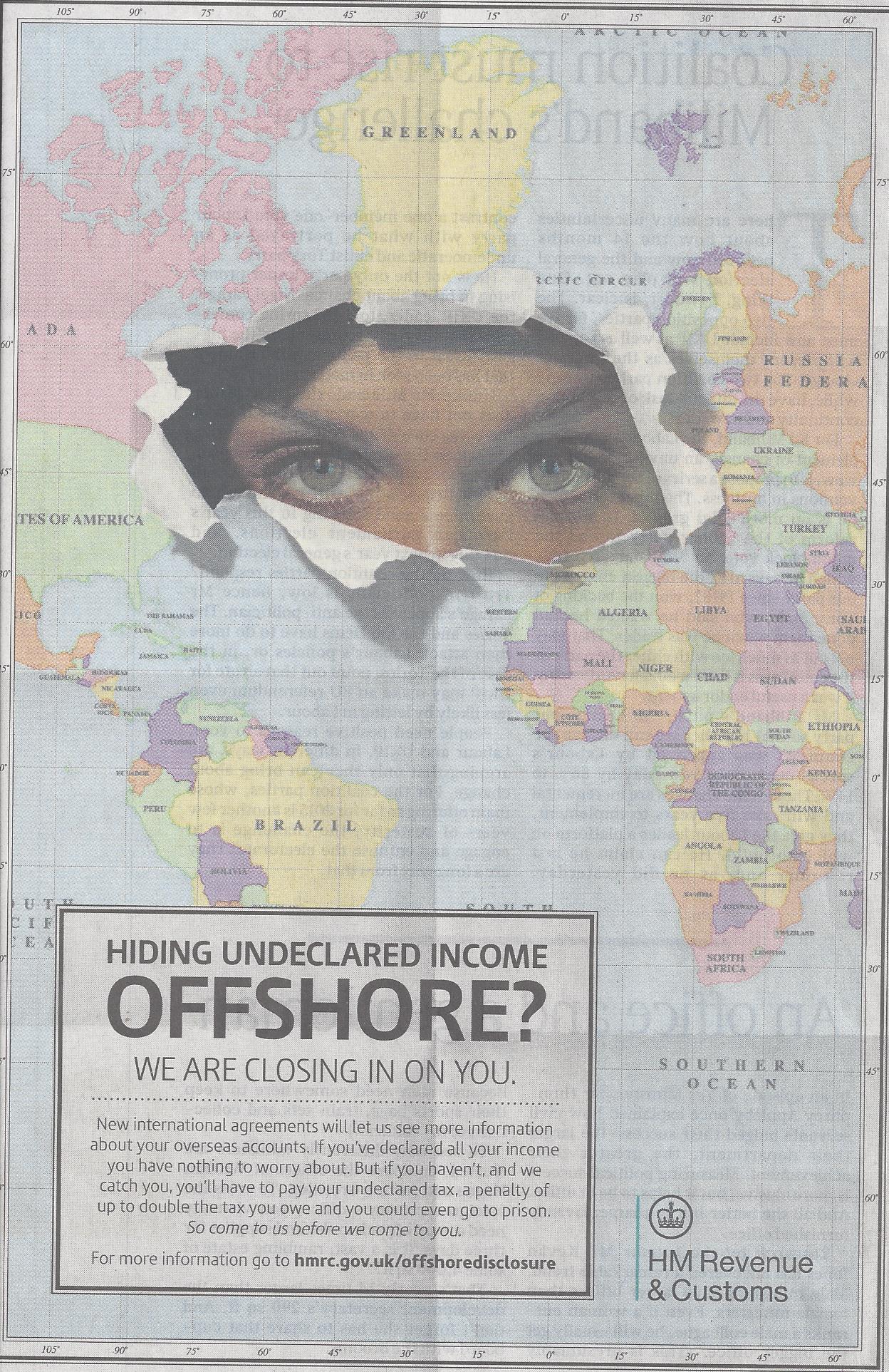
I came across this interesting advertisement in yesterday’s Sunday Times newspaper. What appears to be a woman using an atlas as a hijab is in fact a message from Her Majesty’s Revenue and Customs, the UK government body responsible for collecting our taxes.
In the small print it reads:
New international agreements will let us see more information about your overseas accounts. If you’ve declared all your income you have nothing to worry about. But if you haven’t, and we catch you, you’ll have to pay your undeclared tax, a penalty of up to double the tax you owe and you could even go to prison. So come to us before we come to you.
Apart from the ethnic and religious overtones of the woman’s picture (assuming she is a woman), it’s a pretty unsubtle message. I wonder who will respond to it by coming out with their hands up. Can there be anyone with sufficient funds offshore to warrant the HMRC’s attention who is not aware of the rules and penalties around undeclared offshore income – apart that is from gullible comedians, footballers and actors who place their trust in sharks who devise allegedly rock solid tax avoidance schemes characterised by their cynicism and amorality? Apparently there are. HMRC claims to have raised £600 million from tax evaders in the last financial year.
But let’s face it, the really high net worth individuals whose ill-gotten gains might conceivably contribute more than an infinitesimal increase in Britain’s tax take have enough accounting and legal brainpower behind them to tie the HRMC up in knots. So presumably with this kind of meat-axe campaign, out tax collectors are aiming at the small fry – the low-hanging fruit.
If they really want to raise some serious money, they should remember the exploits of Hervé Falciani, whose alleged theft of the details of 130,000 potential tax evaders from his employer, HSBC (known to readers of this blog as my favourite bank), led to the creation of the Lagarde List. This list, a subset of Falciani’s, contains the names of 24,000 European “potential” tax evaders. was named after Christine Lagarde, then the French finance minister and now the managing Director of the International Monetary Fund. She shared nearly two thousand names from the list with the Greek government, who have failed to prosecute any of those named, presumably because they as as innocent as new-born babies.
It was a nice idea, so why does the HMRC not announce that it will pay a bounty of 20% of tax recovered to anyone who blows the whistle on tax evaders, with no questions asked as to how they came by the information? That surely would attract the attention of a whole host of people in the know about the various scams used by the seriously wealthy on a n-win-no-fee basis, most likely with a modest witness protection programme thrown in.
Either that, or the tax man should prevail on the GCHQ – our national snooping service – to spend less time looking at the naughty pictures they came across by hacking into Yahoo’s video traffic and more time going after the tax evaders.
On the other hand, perhaps they have been persuaded that the consequences of getting too tough on the UK-domiciled plutocrats might be that these guys would get out of the UK for good, precipitating a sudden glut of large houses on the property market, thereby leading to a house price collapse and a dramatic decrease in negative equity, with all the resulting negative consequences for the national economy.
If its hands are thus tied, it’s not surprising that the HMRC should choose to spend our money on nasty little ads like the one in the Sunday Times. The only trouble is that the £600 million raised from 617 prosecutions in the 2012/13 tax year represents a mere 0.13% of the £470 billion raised – according to the Guardian newspaper – in tax revenue during that year. Still, I suppose that’s enough to pay for a couple of extra hospitals, or maybe a school or two. Or, to put it another way, it contributes 6% of the total cost of the National Health Service patient records computer system abandoned last year.
Oh well, at least we have another slug of money to set aside for the next bank bail-out, or maybe to waste on another ill-conceived IT project. One step forwards, three steps back. Meanwhile, watch out for the mean-looking lady in the paper hijab….
As Facebook reaches its tenth birthday, it claims to have 1.23 billion subscribers. That’s more users than any country has citizens, with the exception of China. I suspect that like most countries, it has a silent majority. But while many real-world regimes thrive on the apathy of their populations, silence is not golden for the world’s leading social media company.
When I first became one of those users five years ago I felt like a grouchy old interloper in a youthful world of parties, restaurants and foreign holidays. I hated the feckless narcissism of many of the posts, forgetting that in my twenties I did a good line in feckless narcissism myself, even though I didn’t have an application like Facebook as a mirror for my fragile vanity, and I couldn’t afford foreign holidays.
Though I’m as ambivalent about the site as I was then, I have to admit, grudgingly, that it’s become one of my most frequently visited websites. Not because I’m any fonder of the airware that people insist on sharing with their public, but because I’ve managed to pare the content I see down to posts from people who have something to say that I sometimes find interesting.
Of the posts that do appear on my home page, I’d say that maybe one in ten is worth reading. Ignoring the nine that are profoundly uninteresting is no more effort than ignoring the ads in a newspaper. So that’s enough to keep me scrolling.
Yes, I know, I’m just an antiquated killjoy who can’t stand seeing people taking pleasure in other people’s meals, fluffy animals, boozy nights out and one-liners about hangovers and phones not working. And yes, new babies are cute, and while parents and grandparents are entitled to post endless bulletins about the size of their nappies, their delightful burp-precursor smiles, you can definitely get too much of a good thing.
Most people post photos and little vignettes about their own lives, or links to other people’s content they find interesting. But the posts that attract me most are from people who do stuff themselves. People like Robin Valk, who writes a great music blog. And my own daughter, Nicola Royston, who posts the music she writes for films. Or Andrew Morton, an old friend, songwriter and Tolkien expert, who after a lifetime in music reckons that he’s probably writing the best stuff in his career for his two bands, Café Culture and The Details. I wouldn’t disagree with him, by the way. Then there’s Hunt Emerson, a superb cartoonist whose work I first came across in Birmingham in the early 70’s. And John Whelpton, author of a history of Nepal, who writes many of his posts in Latin, and who provides well-chosen links to political stuff ranging from Nepal to Ukraine, as well as cultural pieces, often about language. All provide stimulating content of a kind that keeps me coming back.
One of the classic criticisms of the site is that it dilutes the meaning of friendship. It takes some effort of will to avoid allowing people into your magic circle who are no more than acquaintances. And indeed, why should you refuse to admit them? So I do make friends with some people I barely know in the hope that they might have something worth looking at. I’m sure you do too, assuming you’re a user. Otherwise, how would you manage to accumulate 1345 friends?
Which leads to the strange phenomenon of millions of people opening a window into intimate areas of their lives to other people who otherwise would never have had the chance to peer through.
But what happens within, for mere acquaintances, is largely without context or meaning. So all you learn is that the person through whose window you are peeping has lots of friends, drinks a lot and likes tiramisu. Not so intimate, maybe. On the other hand, not knowing someone well is no bar to appreciating the links they post, be they political analysis or videos of talking dogs.
And speaking of political analysis, Facebook is also a useful conduit to writers I admire, such as the redoubtable Robert Fisk, whose angry writing about the Middle East is always worth reading, even if I don’t always agree with his views.
I actually post very little on the site apart from my blog pieces, but I do quite often comment on other people’s stuff.
So as an old fart, I have more than enough bombulous (as in bombulus, Latin for fart) content to keep me interested in Facebook thanks to the efforts of those who escape my periodic purges of friends whose posts are so tedious that blocking them is a significant contribution towards energy conservation.
That the site’s appeal has widened to encompass people of my age is not, I suspect, the result of a deliberate policy by Facebook beyond a general lust for users. Now that there are over a billion users, how many of them are real users, as opposed to people for whom having a presence is not much different from having their name in the phone book (if such things still exist)?
To put it another way, how many of those 1.23 billion users are inert – there because they’re there, not posting, not visiting and not contributing in any way to Facebook’s economic success? The company doesn’t tell you that.
To get a snapshot from my own friends, I did a quick survey. I looked at every friend, and made a judgement on the extent of each person’s activity. I split them into three categories: inactive, posts less than once a month and posts more than once a month. Out of my modest total of 168 friends the result was:
- Inactive 90 (55%)
- Less than once a month: 22 (13%)
- More than once a month: 53 (32%)
You could argue that the sample is too small to extrapolate from it the total number of inactive users on Facebook, but I’ll do it anyway: it’s 670 million users. In some countries I suspect that the proportion of inactive users is higher. I know that what follows is anecdotal evidence, but a few weeks ago I chatted with a group of young Saudis about the social media. They said that Facebook is being abandoned in the droves by his friends. Their favourite social media are Twitter, Instagram, YouTube and WhatsApp.
That would be of concern to Facebook because Saudi Arabia is a country, like others in the region, that’s going through a youth boom. There are over 5 million Saudi subscribers out of a population of 20 million, so if the number of active users in that wealthy country is falling, that’s not good news for the company.
But Saudi Arabia is also a country whose demographics justify Facebook’s move towards mobile. I’m regularly told by young Saudis that they don’t watch TV any more – virtually everything they view is via online media, and primarily through mobile devices, despite the fact that bandwidth that supports video streaming is not cheap.
So if I was running Facebook, my main concern would not be to acquire another billion users, but to convert existing users from inactive to active, and preferably economically active. And in this respect I wonder whether or not they’re missing a trick. Speaking as a user of, shall we say, advanced years, I can safely claim that I have contributed no economic benefit to Facebook beyond making my content accessible through the site and adding my vacuous comments to the zillions of others that flit like meteors across the cyber-sky. I never read the ads, and I can’t remember any corporate page that has caused me to buy anything. I don’t access the site through my IPhone when I’m on the move, though I do through the IPad. But that’s not 3G – I only have Wi-Fi.
And yet my generation typically has greater disposable income than Facebook’s early user base, with the possible exception of Zuckerberg’s Harvard colleagues, who by now are most likely as rich as Croesus as they scale the commanding heights of America’s robber economy. So what is the company doing to grab a piece of baby boomer action? Not a lot, as far as I can see. And if a sizeable number of users are like me, then they are wasting an opportunity to sell effectively to us.
Looking at the ads that Facebook believes are appropriate to me, I see that I’m invited to join a dating website for “mature Brits”, to enter a care home (or maybe put someone else in one), to get some false teeth, to become a day trader, deal with tinnitus, join a gym and buy life assurance. A pretty scatter-gun attempt to anticipate the needs of a male in late middle age, I would have thought.
But I’m not particularly important to Facebook, though my presence and those of millions more of my age do have consequences. As the site becomes universal, it becomes progressively uncool. After all, what university student wants a censorious parent, a potential employer or a religious policeman looking through their wild and woolly window? So rather than unsubscribe – because that would be far too much effort – people for whom Facebook is no longer “our thing”, slowly disengage and let their accounts go dormant.
If the declining participation of active users is fact rather than supposition, then that has to be a contributing factor towards the purchase of WhatsApp, – definitely a “cool” service that shelters its users (for now) from the prying eyes of the silent majority. The gadarene rush to mobile – so important for Facebook’s market value – also deselects people of a certain age with poor eyesight and fingers like sausages.
Which leads me to wonder whether when Zuckerberg’s creation turns fifteen, its younger users will have abandoned it to their parents, and the site will be left with a massive majority of inactive users and a sizeable minority of people like me who are growing old disgracefully and flaunting it.
O fortuna, velut luna. Or, in the clichéd vernacular, what goes up comes down.
I’d love to remember what it was like being born. Unfortunately I can’t, and I’m not about to put myself in the hands of some regression therapist to find out. So I have to content myself with one utterly inconsequential memory from my first six years of life. It was of my father having to produce petrol coupons to fill the family car during the Suez crisis. Since petrol rationing was effective between December 1956 and April 1957, I can reasonably assume that the memory dates from that period.
Was this a genuine memory or a confabulation? After all, I’ve always been fanatical about history. Perhaps I read something that subsequently found its way into my personal narrative. I can’t prove it happened, but I can argue that it’s highly likely that I was in the car on at least one occasion during those four months. So here’s a problem: I believe it happened, but I don’t know it did. If there’d been a photo of me as a grinning five-year handing the coupons to an avuncular pump attendant, then I would pretty much know it happened. But I have no such evidence.
A few days ago, a friend reminded me of a couple of things that happened in the Seventies of which I have no memory whatsoever. One of them involved the two of us being stopped by the police late one night in Nottingham, and my prevailing upon them to give us a lift to where we were staying. Another involved my obtaining tickets to watch my football team, Aston Villa, playing his team, Notts Country. Trivial stuff, but entirely consistent with what I do remember of my life at the time.
My faulty powers of recall made me think about what else might have happened of which I have no memory. Are there unknown skeletons in the cupboard? Are there other people who might suddenly pop up to say I did some dark deed? I very much hope not, because I always erred on the side of caution both then and subsequently. I sleep well at night.
But I wonder what went through the minds of the two British celebrities, the Coronation Street actor William Roache and Dave Lee Travis, the disc jockey, who over the past couple of weeks have been acquitted of various sexual offences, some of which were alleged to have taken place in the Sixties and Seventies. Their defence will have been based on their knowledge that the offences never took place. And their credible portrayal of that knowledge will have led to a belief by the jury that they were not guilty.
In the absence of documentary evidence, DNA tests or eye-witness accounts, it will have been extremely hard for any jury to convict Roache and Travis “beyond reasonable doubt” for acts alleged to have taken place, in some cases, thirty or forty years ago.
But given the unreliability of memory, can a defendant say definitively that they knew something did or didn’t happen without corroborating evidence? And did those guys at any stage wonder whether there were things that happened all those years ago of which they now had no recollection?
If we accept that in the absence of definitive evidence, there’s no such thing as knowledge, only belief (which is sometimes qualified as “to the best of my knowledge”), then another problem springs from the origin of the belief.
If I was by temperament inclined towards a negative view of myself, would I believe memories suggesting that I had a happy childhood unless I could point to an event that created my subsequent unhappiness? Or would I be more inclined to buy into memories that supported and explained my current misery? In other words, would I let the happy memories atrophy- or slip into inaccessible areas of my brain – but keep the bad memories at the forefront by calling upon them regularly to support my personal “life narrative”? Would the same logic also lead me to believe in memories that are demonstrably false?
I ask these questions rather than make statements because I’m neither a psychologist, nor in any other way qualified to answer them except through my own experience of life and my observation of others. I’ve read a few books that touch on memory, including most recently Will Storr’s The Heretics: Adventures with the Enemies of Science, in which the author explores the nature of memory and belief. But that doesn’t make me an expert.
I do, however, know quite a bit about the Seventies, because I lived through them, even if a few details might have slipped my mind. And for much of that decade I was involved in the music business, as were Jimmy Savile, Dave Lee Travis and others caught up in the current rash of prosecutions.
And I don’t buy the argument that in those days “standards” were different to those that apply today – at least in respect of rape and under-age sex.
Most of my contemporaries were familiar with the term “jailbait” – as applied to girls too young under the law to have consensual sex. We knew about Jerry Lee Lewis’s marriage to a 13-year-old, about the Roman Polanski statutory rape case. We knew we could go to jail. That said, was having sex with under-age girls a common occurrence among rock stars and others involved at the sharp end of the music business? I’d say it was, whether or not they transgressed through ignorance of their sexual partner’s age. And you can be sure that perpetrators will have been fully aware of the consequences of being caught, even if in their glittering cocoons they felt fireproof, or if they were so saturated with drugs or alcohol that they didn’t care either way.
Rape was as much a no-no in those days as it is today. But you can also be sure that many unpunished rapes took place within the borders of show business. As for groping, however you define the term, that was common enough too. But one man’s grope is another man’s hug, as was argued in the Travis trial. Still, I honestly believe that forced non-penetrative sexual contact was as unacceptable in the Seventies as it is today. People are still getting away with it today, as they did then.
All in all, I don’t see “different standards” as a reason for believing that the prosecutors made a mistake in focusing on high profile individuals in the wake of the Jimmy Savile investigations.
Some things have changed, though. Today we have a compensation culture that didn’t exist in 1970. Yes, you could sell your story to the News of the World and make a few bucks that way. But I don’t recall many examples in the UK of victims of sex crimes embarking on civil actions against the perpetrators. In those days we didn’t have “no win, no fee” lawyers. Today we live in a much more litigious society. Logic suggests that some people will be tempted to come forward in the hope of financial gain, even to the extent of making spurious allegations
And what about the practice of using multiple allegations to bolster the prosecution case? Now things get murkier. Is crowd-sourcing hostile witnesses a fair process if there’s a chance that someone facing a single allegation is less likely to be convicted than someone facing multiple allegations. The likelihood of “believability” would seem to be loaded against the person who has people lining up to accuse him, especially if that person is a high-profile celebrity who has encountered thousands of young people over a long career. To me, that doesn’t feel like blind justice.
In the case of Messrs Roache and Travis, it’s not for me to question the sincerity of those who gave evidence against the defendants, nor would I question that the verdicts were the right ones. But because human memory has been proven again and again to be fallible, particularly relating to events that took place many decades in the past, isn’t it worth asking whether there should be variable criteria for determining whether or not a prosecution should go ahead? Should a case be allowed to depend on “his word against mine”, with no other evidence presented beyond the credibility of the witness, if the event in question took place forty years ago?
Just as I’m not a psychologist, neither am I a lawyer, but I can’t believe that it would be impossible for legislators come up with stricter rules of evidence based on the age of the alleged crime. Not a statute of limitation, but a recognition that over time memory deteriorates, and for a successful prosecution it must be backed up by other evidence. The problem with sexual offences is that they rarely take place in front of witnesses unless they involve gang rape or consensual group sex. So in the absence of positive DNA tests, verdicts come down to personal testimony backed up by circumstantial evidence, weak or otherwise.
Several other high-profile cases will soon be coming to trial. Will the two recent acquittals increase the chances of others being found not guilty of the offences of which they have been charged? No doubt the judges will direct the juries to concentrate on the cases in hand and not to let other trials influence them, but I think it’s inevitable that the Roache and Travis verdicts will have some effect on juries in upcoming trials.
Which leads to another question. Stuart Hall, a TV presenter, pleaded guilty of multiple sexual offences, some of which dated from the Sixties and Seventies. He did so after the Savile revelations went public, but before the Roache and Travis acquittals. Would he have stuck to his original rebuttal of the charges, in which he claimed that they were “pernicious, callous, cruel and, above all, spurious” if his case had come to trial now? Clearly only he can answer that.
One final factor worth considering in the wake of the celebrity trials is this. In the Seventies we had no DNA testing, camera phones, Facebook, Twitter, YouTube, email, Instagram and CCTV – technology and media likely to increase the chances of building a case of sexual misconduct against an individual. Given the vast number of electronic and physical traces we leave without even thinking about it, perhaps within the next decade we will see an end to prosecutions based purely on the credibility of witnesses, as opposed to strong circumstantial and factual evidence.
Should that be the case, there may well be a number of geriatric rock stars breathing sighs of relief, but also hopefully a lot fewer damaged people angry that they had to wait so long for their accusations to be taken seriously.
I don’t go to to much live music these days, which is a shame. Music used to take up much of my life, both personally and professionally. So you might wonder why I would drive over a hundred miles to see a guy playing to eighty people in a suburb of Birmingham.
The reason was that the artist was a person whose music I have been listening to for over forty years: Martin Carthy. In all that time I had never seen him live.
Even if you’ve never heard of Martin, you may have heard of Scarborough Fair. Simon and Garfunkel used his arrangement on one of their early albums, and thereby immortalised an old English folk song that might otherwise never have been heard outside its country of origin.
Folk music is one of my favourite genres, even though my taste always veered towards the likes of Bert Jansch, John Renbourne, Sandy Denny, John Fahey, the Chieftains, Fairport Convention, Ry Cooder. In other words, folk tinged with something else, be it blues, country, Irish or even Latino.
Above them all, though, stands Martin Carthy.
Search on YouTube, and you will find a number of videos of Martin in action, including this profile which appeared on the BBC in 1998. Also have a listen to this interview by Paul Morley with Martin, accompanied by his wife Norma and daughter Eliza, both of whom are also leading lights in the folk world. He is a master of his genre, which is why I had to see him live before age renders him incapable of performing and me incapable of going to see him.
I’ve no idea how many people go to live “folk music” gigs, or how many CDs are sold. But it’s still popular enough to warrant its own section in stores like Virgin, usually sitting next to “world music” and “blues”. In the late sixties and seventies a huge number of artists drew from the English folk tradition and its regional American cousins – Led Zeppelin, Traffic, Dylan, Simon and Garfunkel and countless others.
These days the form that sprung up in the fifties and sixties doesn’t get the same attention as it did, which is why Martin Carthy performs to eighty people as opposed to eight hundred. That might not be great for Martin in terms of income, but for those who love his music, the opportunity to hear him in small and intimate venues enhances the experience of watching a master at work.
A master of what, you might ask. Well, there’s his guitar playing. Melodic, rhythmic, underpinning the songs in a way most folk artists can’t. With him the guitar is another voice, not a pretty, tinkling finger-picked backdrop. Then the voice, maybe not as powerful as it once was – at the age of 72, he’s allowed – but a sinuous tenor. The delivery, the words enunciated with the precision of an actor – if you were to put Tom Waits on one end of a clarity scale, Martin would be on the other. And finally his personality – charming, unassuming, no airs and graces.
The songs are extracts from the oral history of England. A counterpoint to the top-down histories we study in academia. We’re not talking just about maypoles, hearts and flowers. He sings about poverty, revenge, blood feuds, rape, doomed love, adultery. Subjects Thomas Hardy wrote about. Thanks to pioneers like Cecil Sharp, we have a large body of songs going back centuries – both urban and rural – that reflect the hard reality, as well as the joy, of life away from the dining rooms and country houses of England. And it’s these songs that Martin draws on, sometimes updating them with references to today’s hard lives.
My favourite Carthy album is Prince Heathen, which he recorded in 1969 with fiddler and long-time collaborator Dave Swarbrick. At the Birmingham gig he did two of the songs from that album – Polly on the Shore and Seven Yellow Gypsies, as well as another classic, Famous Flower of Serving Men. Wonderful songs. To paraphrase his own words, it can take days to read a novel, hours to watch an opera, a play or a movie, but an English folk song tells a story in minutes.
Unlike many other musical genres, folk music remains accessible. No stadia, ludicrous contract riders, minders, PR people. Just the artist and the audience. Would you be able to have a chat with Prince, Yo Yo Ma, Springsteen or Beyoncé in the middle of a gig, as I did with Martin? And within his field, Martin is on the same level of eminence as the people I’ve just mentioned.
If you think I’m writing this just for my generation, the baby boomers, you’re wrong. Many of those who were at the Birmingham event were in their twenties and thirties. My daughter’s a fan, which is why she sent me the tickets for Christmas. And there are many festivals in the UK where folk artists still play for large, multi-generational audiences.
Even if you’ve never heard a folk song in your life, it’s not too late to start listening to music that will still have a place in the musical canon in a hundred years’ time. Its themes of subversion, love, magic, hatred and hardship are to be found throughout England’s theatrical heritage, from the the plays of Shakespeare to modern masterpieces such as Jez Butterworth’s Jerusalem. It will never be more than a minority taste, yet it speaks to the soul no less than music that draws audiences a hundred times larger.
Martin Carthy still plays regularly across the UK. If you live in the London area, you can catch him at the BBC Radio 2 Folk Awards event at the Royal Albert Hall.
I’m only sorry I waited four decades before seeing him live.
Up to now I’ve resisted writing about the inundation of Britain’s seafronts, valleys and floodplains. But as the umpteenth storm sweeps across the land, dumping a month’s worth of rain upon us, causing elderly people and Shetland ponies to be rescued and disabling infrastructure we have long taken for granted, there’s one aspect of the emergency that troubles me.
Before I sound off, I should declare an interest – or rather a non-interest. Though I live in Surrey, I’m not one of the unfortunates whose ground floor is several feet deep in effluent-charged floodwater. I’m lucky enough to live a good bit above sea level, so it would take a monster tsunami or the melting of both polar icecaps for the murky waters to reach my doorstep.
What has seriously raised my hackles is a campaign by a nasty rag called the Daily Mail to divert funding from Britain’s overseas aid budget into the creation of new flood defences. It was first mooted by Nigel Farage, the leader of an amalgam of special interests, closet racists and xenophobes, homophobes and God-knows-what-else-phobes masquerading as a political party – The UK Independence Party. The Mail then hoisted the flag, and yesterday announced that 100,000 people had signed the petition.
It seems to me that popular reaction to disaster largely depends on the speed with which it unfolds. If it strikes suddenly – as it did in London on 7/7 – the disaster usually sparks an instant response – heroism, compassion and generosity of spirit. Recrimination usually follows in the aftermath.
If it develops gradually with a cumulative intensity – as is the case today – the finger-pointing starts during the event rather than after it. And if it happens within striking distance of a general election, the real-time response to the crisis tends to be calibrated by political calculation – what plays well with this or that section of the voters. So both blame and restorative action are dished out with one eye on the polling booths. Politicians of all stripes make pious noises about now being the time to deal with the emergency, not to debate its origins and perpetrators, while doing exactly the opposite through unattributable briefers, mavericks and proxies.
So the Daily Mail, acting as Farage’s proxy, has a go at foreign aid. The natural home of hypochondriacs, alien abductees and xenophobic Tories seems be moving towards endorsing UKIP at the next election. Certainly UKIP’s utterances seem ever more fine-tuned to be in harmony with the Mail readership. Either way, the attack on foreign aid is opportunistic, unprincipled and illogical. Prime Minister David Cameron should resist it.
Yes, there’s a superficial connection. You could argue that instead of funding efforts to alleviate the effects of monsoon flooding in countries like Bangladesh we should build river barriers and new coastal walls in England and Wales. But there is not a single family in the United Kingdom at risk of death, water-borne disease and economic melt-down every year as millions are in other parts of the world. Should we really withdraw assistance from populations whose standard of living – even on dry land – is a tiny fraction of ours?
Of course we should look at every project we support through foreign aid to determine its effectiveness and value for money. And no, perhaps we shouldn’t provide aid to countries that send rockets to Mars. But even in the case of India, we should look at whether we are delivering a benefit that the recipient country is incapable of delivering, or lacks the political will to do so. Why otherwise would we send aid to Syria?
So while I agree that foreign aid should be continually reviewed and reallocated as necessary, I don’t believe that the ring fence around it should be abandoned to suit short-term political expediency.
The Government has access to contingency funds to deal with emergencies. If flood defences are rapidly becoming a long-term priority for government spending, then the cost should be factored into the overall mix of spending and saving that is the perennial concern of thousands of civil servants in the Treasury and the spending departments. If the defence of the realm is clearly threatened, we have no qualms in increasing our spending on soldiers, ships and aircraft even if it means that a few libraries have to close, or that we have to live with less high-speed railway lines. And if we are concerned about the enemy within, we’re quite happy to allocate a few million to the security services if that keeps us safe from the murderous ambitions of jihadis returning from Syria.
To create a link between overseas aid and domestic flood defences is as specious as arguing that we should buy less cars because too many of them are manufactured by foreign companies.
Charity doesn’t begin at home, or at least it shouldn’t. It should begin with those who need it most. Otherwise I don’t see how you can call it charity. And while we can argue that foreign aid is sometimes misdirected, it’s still capable of making a difference to lives that are immeasurably less privileged than those we live in our home country.
I don’t doubt the sincerity of those who signed the Daily Mail petition. They are most likely angry people, especially if they’re entertaining ducks in their sitting rooms. But that anger is being channelled by unscrupulous politicians and newspaper editors with political axes to grind. The thinking is at the same level of rationality as calling for the death penalty to be re-introduced after a particularly gruesome murder. A knee-jerk reaction where long-term thinking is called for.
If the flooding we are seeing today is no longer a once-in-a-century event, then we need challenge many assumptions about the future of our countryside and coastal areas. If it costs millions to re-house the inhabitants of fifty houses in the Somerset Levels, but hundreds of millions to protect them from future flooding, which option makes most sense? If we need to revise our farming techniques to make the land more permeable, how does the cost stack up against dredging rivers and destroying the natural habitats of our wildlife? And ultimately why are we so often presented with alternatives rather than complementary measures?
If the current weather is the result of climate change, regardless of what measures we take globally to reverse the effects, it could still take a hundred years for those measures to make a difference. And I’ve not heard any scientist able to tell us whether the actions on the table now will return us to the pre-industrial Arcadia to which we seem to aspire.
As the birthplace of the industrial revolution, we in the United Kingdom have been both the beneficiaries of industrialisation and one of the leading causes of climate change – if as, seems likely, that change is proven to be man-made. So it’s a bit rich for us at this stage to disclaim all responsibility for the underprivileged beyond our shores to whose plight we have directly or indirectly contributed.
We are not yet at the stage where we declare every man for himself. So I sincerely hope that the British electorate will see Farage’s argument as a red herring, and treat it with the contempt it deserves.
Qatar Airways is an airline I’ve flown quite a number of times. The planes are modern, the service is good and its flights usually arrive on time. Doha Airport – the current one – is efficient enough, though getting from the aircraft to the terminal can take some time. Flights are relatively affordable, though they are starting to get more expensive – perhaps because QA have managed to carve for themselves a decent slice of the Middle East market. The cabin crew are young and well trained, though they don’t seem to have the confidence to let their personalities shine through, in contrast to some of the more idiosyncratic employees of western airlines that I regularly use.
British Airways, for example, where the word “sir” is uttered by some staff with a slight curl of the lip which suggests that the person is using the expression only because they are paid to do so, despite it being against their better instincts and beneath their social standing. Or American Airlines, whose staff are often of advanced years and give you the impression that they’ve just stepped off their porches in rural North Carolina to dispense the time-honoured pizza that heralds journey’s end – y’all. Or Virgin, whose cabin crew are portrayed by the company’s ads as sex goddesses, but in the flesh often come over as matey and a bit giggly – rather like teenagers in their first jobs. Or even Ryanair, whose staff’s demeanour varies depending on whether or not you meekly accept the company’s diktats, designed to extract cash from the customer for the slighted infringement.Try encountering their cabin baggage police, for example.
With Ryanair, the buccaneer spirit of their CEO, Michael O’Leary, permeates the business. Qatar Airways have an equally high-profile boss – Ahmed Al Bakr. But unlike Mr O’Leary, whose public image is of a lovable rogue, QA’s chief seems to have a darker reputation – a cross between Genghis Khan and Torquemada, the Grand Inquisitor of the Spanish Inquisition.
Mr Al Bakr is said to be fanatical about quality – and I have heard this directly from a former senior manager at the airline. Unfortunately, he seems to use fear as the primary means of enforcing his standards. The airline’s treatment of its staff has raised eyebrows in the aviation world for some time.
When Qatar Airways joined the oneworld alliance, Paddy Crumlin, president of the International Transport Workers Federation (ITF) commented in a press release:
“The labour relations at Qatar Airways are a running sore on the face of the global aviation industry. Autocratic, overbearing and near-dictatorial, this airline gains control and competitive advantage by ignoring International Labour Organization conventions on worker rights. Its treatment of its employees borders on the appalling.
“In its current form it is not a fit partner for the members of the oneworld alliance. Its inclusion is a disgrace. If it is going to be accepted as a world class airline then it has to make fundamental changes throughout its entire structure. Those changes have to start at the top, with the replacement of its CEO, Ahmed Al-Bakr, who is responsible for much of the disastrous relations with its own employees – and then be carried right through Qatari society, as the recent shocking revelations about the treatment of construction workers there demands.”
Strong stuff. The ITF clearly believes that Qatar’s flag carrier is part of a wider attitude that prevails in the country. According to many reports, the same attitude manifests itself in the treatment of foreign workers involved in building the infrastructure for the 2022 FIFA World Cup.
So what’s the fuss all about? A few days ago the online version of the Swedish tabloid Expressen ran a story based on interviews with several former members of QA’s staff. Here’s an extract:
“The cubicle where the guard sits, at the entrance to Qatar Airways’ staff housing, is strictly guarded. There are cameras everywhere. At least that’s what the management says – that they should expect everything that happens at the entrance to be reported to the managers, to be registered and be incorporated into each flight attendant’s personal track record.”
“Any action on Gina’s part can be construed as an attempt at bribery. After all, the guard is there to monitor her. To ensure that Gina never sleeps anywhere but the staff housing. Never gets home later than mandated by the company. Never allows an unregistered guest into her room, never leaves during her leisure times or has anyone sleep over.
At the same time, he is below her in rank – at least Gina can apply to leave the country if she wants to visit her Swedish family. The guards change buildings every third month, to really make any friendly relations impossible between them and the flight attendants. But Gina has noticed that this guard is sick. And that he is getting worse. She defies the rules and starts talking to him every day. Convinces the guard to go to the doctor.
“What did the doctor say?” she asks the following morning.
“I have diabetes,” replies the guard at the staff entrance.
Gina is silent. She tries to solve the equation of insulin injections and the salary of a Nepalese migrant worker in Doha.
“He says I shouldn’t eat rice,” continues the guard.
“But you’re poor! All you eat is rice. What are you going to eat now?”
“I don’t know.”
Gina and the guard don’t talk again. He’ll soon be relocated to a new building anyway. But before he changes his posting, Gina figures out that there is a tiny blind spot in the entrance where the cameras don’t reach. One morning, on her way to a flight, she ducks into this corner.
On the ground, she leaves a blood sugar meter and a Qatari five hundred note. 500 riyal.”
On another occasion, the same person gets in trouble for her culinary technique:
Gina boils some eggs. She has only just arrived home from a flight. She is tired and removes her makeup slowly. The saucepan overheats when the water evaporates and suddenly the fire alarm goes off. Gina switches it off quickly and tells the security guards that it was a false alarm. Too late.
Three different managers from Qatar Airways arrive at the guarded staff building. Question her in detail about what happened and ask her to prove her story.
“You were boiling an egg? Show us the egg.”
Gina rummages through the garbage and finds the egg. The managers aren’t satisfied. They decide that she should be removed from flights for the next few days and she is summoned to the office the following morning. As there is a twelve hour resting rule before any work event, whether it is a meeting or a long haul flight, Gina is grounded until the time of the meeting.
At the office at Qatar Airways Tower, she is once more asked to give an account of the event. The fact that she was boiling an egg, how could she be so careless, how can they be certain that she will never do anything like that again? Gina is given a severe warning.
Then she is given a pen and paper. Qatar Airways now wants Gina to explain the egg incident in writing and to conclude by saying how sorry she is and that it will not happen again. They dictate and she writes. “I am very sorry, it will never happen again.”
The whole piece makes interesting reading. Mr Al-Bakr in particular comes over as the kind of boss that used to rule the roost in many cultures during the last century, but today is seen as something of a dinosaur. His style is in stark contrast to the chummy and collegiate style of Richard Branson, and the image of the cheeky chappie with a chip on his shoulder that Michael O’Leary emanates. In the Middle East and the Far East, though, authoritarian leaders survive and prosper. Take Vincent Tan, the Malaysian owner of Cardiff City Football Club, for example, about whom I wrote recently. But if Expressen is to be believed, Mr Tan is a pussy cat compared to the Qatar Airways boss.
Are the airline’s practices unusual in the region? Not really. There are authoritarian leaders aplenty, and many organisations in the region are equally harsh with their staff. But it’s rare to see such a comprehensive basket of alleged employee maltreatment in a single company. Intimidation, micromanagement, unpredictable dismissals and institutional humiliation of staff are the kind of practices you would expect from the late Muammar Gaddafi or Kim Jong Un, but not from an airline that represents a country keen to promote a positive image to the outside world.
Maybe the allegations in the Expressen story are exaggerated. After all, the article is based on accounts from ex-employees who clearly have grievances. But I have certainly seen instances of similar behaviour in the region on a regular basis. Bullying, exploitation and financial maltreatment of staff from developing countries are rife, but it’s rare to see those attitudes applying across all levels of an organisation, which appears to be the case with Qatar Airways. Certainly a culture of fear – and a sense that Big Brother, in the form of Mr Al- Bakr, is watching – could explain the curious reluctance of his staff to show their true personalities to the customers.
What is also rare for the region is the use of these tactics in pursuit of operational excellence rather than as the natural inclination of idiosyncratic owners and leaders. Qatar Airways is probably the most operationally excellent airline in the region. But Mr Al-Bakr’s leadership style may ultimately turn out to be a millstone around the airline’s neck if its rivals manage to emulate its good qualities and entice its best people into gentler, kinder workplaces. The likes of Emirates and Etihad are the vehicles of equally ambitious owners who have no intention of letting the Qataris barge their way to regional and global ascendancy.
Even Saudia, whose reputation in recent years has been of inefficiency and chaotic management (see this earlier post), seems to be turning round since its entry into SkyTeam. A couple of days ago I flew with them between Riyadh and Jeddah. The online booking and check-in were easy, the seats in economy were comfortable and the service friendly.
The culture at Qatar Airways will most likely last for as long as Mr Al-Bakr stays in his job. But with 2022 looming up, the ultimate owners of the airline may become increasingly uncomfortable with stories of its antediluvian management philosophy.
But then again, like Vladimir Putin, whose beanfeast at Sochi begins tonight, they might not give a damn.
A while ago I wrote a tribute to a Birmingham songwriter and musician who was at the heart of my world for much of the 1970s: Jim Cleary. Jim passed away in 2012 – too young, and sadly for me, before I was able to catch up with him again after many years of no contact.
It seems I’m not the only person who deeply regrets losing touch with Jim. Here’s a new comment from Bernard Martin on the original post. Bernard knew Jim before I did.
I’m re-posting it here because Jim’s friends with whom I’m still in touch would enjoy it, I think.
A moving piece about someone who was hugely important to me at one time. Jim and I were close when we were at Matthew Boulton College in Brasshouse Passage together, 1967-68. We were among those students who were grabbing a second chance at an education for one reason or another (I’d dropped out of school prior to A levels; can’t remember what Jim’s reason was) and thought of ourselves as a cut above the poor souls – the majority – whose parents were making them retake and retake…
So as well as working for the exams we spent hours in the disgusting canteen probing the relative merits of, for instance, Paul Simon and Bob Dylan (‘Simon: better songwriting; Dylan: better poetry’ I think we concluded) of Walt Whitman and John Donne, of e e Cummings and, as Jim would have it at the end of a session, I I Going…
I started and edited an ‘independent’ magazine for the students (‘Forge’) and Jim deputy-edited and contributed a number of poems. The only way we could get it printed was via the college office (this is before access to things like duplicators, remember, let alone photocopiers!) and the college Principal vetoed certain content, including all but one of Jim’s poems. The one that finally sneaked past the old fool did so despite referring to a man kissing a boy. I had to insist it implied no sexual content… I can’t remember what the others were about. The magazine finally appeared shortly before the end of the year, so was very much a non-event – though it taught me all I needed to know about the importance of controlling the means of production.
At the Carousel (?) Coffee Bar on Broad Street, opposite the Rep, or at parties at his Mum’s flat or the flat of his girlfriend Kathy, Jim would get out the guitar and lead the singing. Not, then, as far as I remember, his own songs but folk and pop songs we all knew.
I went away to Uni, Jim stayed in Brum. For the first three years, whilst my father still had a house there I’d return to Brum in the vacations to get work on building sites. I’d seek out Jim and usually find him in one of the regular haunts – a big Irish pub on Broad Street or the back room of The Windmill (?) off Needless Alley or Cherry Street and things were just like before, with added new friends: beery and full of song.
Then I went away to Germany and different British cities and lost touch. I’d send cards but Jim was not a great one for replying. In the 90s with the arrival of the internet I began sporadic attempts to locate him without success. It was two nights ago, unable to sleep and surfing, that I tried again and discovered your blog.
Though I hadn’t seen my friend for 40 years I now feel a great sense of loss. But it’s good to know he was still surrounded by people who loved and appreciated him.
For those of you who haven’t a clue who Bernard and I are talking about, here’s a post about Jim from Robin Valk, another great Birmingham musical institution (if he’ll forgive me for saying so), which contains a video of the man in action a few months before his death.
The surest sign that a movie has made more than a superficial impression on me is when I dream about it. In the past couple of weeks I’ve watched three of the most talked-about movies in this Oscar season: Inside Llewyn Davis, Twelve Years a Slave and The Wolf of Wall Street.
I should have dreamed about the first two, but didn’t. More on them later.
Martin Scorsese’s Wall Street orgymentary was the one that gave me nightmares. Was it the dwarf-throwing, the hookers or the quaaludes and coke? No, though the excesses of Jordan Belfort and his acolytes were on a scale that would have left Cecil B De Mille gasping with admiration.
It was the naked amorality – not the full-on call-girls – that really got to me. Belfort’s story was not shocking, in the sense that everything he got up to – the rock star debauchery, the shameless robbery of hapless punters to whom he sold worthless penny shares, the fraudulent IPO, the arrogance, the contempt of the financial regulators – exemplified behaviour that seems to have been fairly typical of the time, at least in retrospect. But what is shocking is how his mindset still seems to permeate the finance industry.
In 2008, ten years after the Wolf was busted, a stone was lifted and all kinds of strange life crawled out from under. Bernie Madoff, for example, whose fraudulence exceeded Belfort’s by a factor of ten or more. So surely, with the humbling of great financial institutions and the near-death of financial system itself, the business ethos – the contempt – so graphically portrayed in Martin Scorsese’s film is now a thing of the past?
Not so, if the numerous cold calls I have received in recent years from kamikaze salespeople who might well have received their training from Belfort are anything to go by. The technique was eerily similar to that practiced in the film, though in my case they were wasting their time. But then I guess they’re used to people hanging up on them.
Perhaps it’s unfair to think of the entire financial service industry as a pack of Wall Street wolves, but then again every so often you hear a story that makes you wonder. A charming gentleman called Anton Casey, for example, gets himself fired from his fund management job in Singapore because of his Facebook post about the “stench” of his fellow humans in the local mass transit system. His Porsche, you see, was being repaired, so he had to travel with the locals, poor man.
Mr Casey, apparently, used to work for HSBC. Anyone who has read this blog over time will know of my deep affection for that organisation. Sadly the World’s Local Bank has blotted its reputational copybook in the UK by demanding of customers who want to withdraw a few thousand quid that they provide documentary evidence of the reason for the withdrawal. In an act of Belfortian contempt, this they did without letting their customers of any policy change. As one customer, according to the BBC, said:
“I’ve been banking in that bank for 28 years. They all know me in there. You shouldn’t have to explain to your bank why you want that money. It’s not theirs. It’s yours.”
I couldn’t have put it better myself. While I’m all for stamping out money laundering and other financial crimes, if I want my money, and I can prove my identity, it’s my business as to whether I want it in cash, gold bars or any other negotiable instrument as opposed to through an infernal bank transaction. If I happen to be in the money laundering business, I will answer to the law for it, not my bank. And after all, the five thousand pounds that the HSBC customer was seeking is not exactly indicative of intent to purchase a shed-load of AK-47s and start a small war, or sufficient to set up a cocaine business in Colombia.
Demanding evidence smacks of contempt for the customer. It implies that you can’t be trusted to keep yourself out of trouble, so the bankers, backside-covering weasels masquerading as sober guardians of your money, poke their noses into your private affairs. Because they can, and because a few years ago one of them got fined billions for facilitating the money movements of Mexican drug cartels. Demanding the life story of some guy in East Grinstead is not exactly the same as keeping tabs on the multi-million transactions of murderous South American bandits, I would suggest.
One wonders what documentary evidence would lead them to deny a person their own money. If any bank asked me to provide documentary evidence of my need for cash, I would be sorely tempted to tell them that I needed it to invest in penny shares, hookers and quaaludes, and since I hadn’t yet identified the suppliers, I couldn’t provide the evidence. At least that way they’d know I was one of them, and might look more sympathetically on my request. If they then turned me down, I would switch banks forthwith.
Which brings us back to The Wolf of Wall Street. Jordan Belfort may be out of the broking business – he’s in the process of paying back $100 million to the people he ripped off by teaching other people the sales techniques he used so effectively in his heyday (if the film is to be believed) – but his legacy of amorality and contempt for us ordinary punters lives on.
As for the other two movies, Twelve Years a Slave is the one that “opinion” – in other words the Hollywood lobbyists – is touting as the overall winner at the Oscars. I’m not so sure it will turn out that way.
Maybe I’m developing an immunity to movies that are supposed to shatter me into a thousand emotional bits, but this one left me cold. Perhaps because from beginning to end it battered me over the head with its cruelty to the extent that I found myself incapable of any kind of emotion. Other movies have dealt with equally harrowing subjects, and yet managed to bring a tear to the eye. Take the final scene in Saving Private Ryan, for example, where Ryan breaks down in front of the grave of the man sent to save him. Or the closing of Schindler’s List, where people Oskar Schindler saved from the Nazis lay stones on his grave in Jerusalem.
For all the fine performances in Steve McQueen’s movie, by the end of it I didn’t feel any more contemptuous of the Southern gentlemen who lived off the fruits of slave labour than I did before. Maybe there are a few ole boys in Georgia with the Confederate flag stitched to their backsides who might think a little less nostalgically about what their great-grandparents fought to preserve, but I’m not sure how many folk enduring this tour de force of viciousness will think differently about slavery as a result.
If McQueen’s purpose is to remind us of the origins of the black communities of America and the Caribbean, then Alex Haley’s Roots did so at least as effectively. Yet maybe each generation needs its own education on the subject, just as the Holocaust bears frequent re-telling.
I for one would like to see more attention paid by the financiers of Hollywood towards the modern forms of slavery – sex trafficking and indentured labour for example. These unlovely practices are flourishing in the first world – in Britain, in the USA – not just in the diamond fields of Zimbabwe and the brickworks of Pakistan. But hey, think the movie moguls, you’ve got sex in Wall Street and sadism in Twelve Years – what more do you want?
And finally we come to Inside Llewyn Davis. The Coen Brothers do music well. O Brother Where Art Thou is one of my favourite movies of all time, in equal parts because of the story, the acting and the music. Llewyn Davis has the acting and the music, but not the story. Great script, fine performances by Carey Mulligan and Oscar Isaac, and a diamond of a cameo from John Goodman. Yet the movie left me cold, though not as cold as Llewyn Davis as he trudged through slushy Chicago looking for his big break.
Yes, there were some marvellous set pieces, such as the car journey to Chicago punctuated by frequent pit-stops in which John Goodman’s bloated, tottering junkie refuels on what sees him through the night. But whilst this meandering story of a music-biz loser who ends up opening for Bob Dylan in early sixties New York is well worth a watch, it isn’t the classic some movie critics have made it out to be. Are the Coen brothers held in such esteem these days that their efforts tend to be greeted with a notch more enthusiasm than those of other directors?
Perhaps my eye is jaundiced through having encountered any number of “losers” in the music business who were far more interesting than Llewyn Davis.
It’s pity the directors didn’t include a postscript telling us what the hero did for the rest of his life. Who knows, perhaps he would have gone to Wall Street – through not as one of Jordan Belfort’s minions, given the poor guy’s dire inability to sell himself.
This year sees the centenary of the outbreak of the First World War. So it’s not surprising that in Britain we are facing an avalanche of commemorations, TV documentaries and books to mark the event.
Predictably, much of the focus is on the run-up to the war. How did it happen? Why did it happen? In my country opinion tends to be polarised along political lines. On the left: it was the result of a collective miscalculation by politicians and generals on all sides, and therefore everyone and – and by implication no individual nation – was responsible. That there could be no justification for the four years of slaughter that followed. On the right: it was the inevitable result of German imperial and economic ambition. Germany had to be stopped – either then or later. Unfortunately for much of the world, it turned out to be both then and later.
When I was growing up, the more recent experience of the Second World War, in which a number of my teachers participated, tended to influence the debate in favour of innate German aggression. We weren’t encouraged to consider the innate aggression of other nations – the French under Napoleon, and Russia in the Caucasus, for example – and we didn’t spend much time thinking about the possibility that our own acquisition of an empire didn’t come about because we were a retiring, pacifist people who kept ourselves strictly to ourselves.
These days we are friends with Germany, and no phrase better sums up the sentiment amongst the political and professional classes than “don’t mention the war” – Basil Fawlty’s instruction to his staff upon the arrival of German guests. And if we do mention it, we put it in a box labelled “that was then, this is now”.
In fact we mention the war incessantly, through comedy, drama. TV, theatre and film and, of course, in books. So to an extent what’s in store for us in 2014 is not so much an avalanche, more the intensification of a torrent that has been rushing down on us since 1945.
Catastrophe – Europe Goes to War 1914 is Max Hastings’s contribution to the torrent. Though the bulk of the book is focused on the initial campaigns of the war, he starts by wading into the debate on the causes. He comes down firmly on the side those who claim that the war – at least from the perspectives of Britain and France – was a necessary and justifiable response to Germany’s ambition to be the dominant political and economic force on the continent.
He points out that Kaiser Wilhelm and his ministers were predisposed towards military rather than diplomatic means of overcoming obstacles to their ambitions:
“Germany’s rulers, like many men of their generation, accepted war as a natural means of fulfilling national ambitions and exercising power: Prussia had exploited this cost-effectively three times in the later nineteenth century. Georg Müller, head of Wilhelm’s naval cabinet, told his masters in 1911, ‘war is not the worst of all evils’, and this belief pervaded Berlin’s thinking. The Kaiser and his key advisers underestimated the magnitude of the dominance their country was achieving through its economic and industrial prowess, without fighting anybody. They were profoundly mistaken to suppose that European hegemony could be secured only by the deployment of armies on battlefields.”
Mistaken indeed. If the Kaiser had been able to travel in time to 2014, he would have seen conclusive proof of the last statement in the peaceful dominance of Angela Merkel’s Germany.
Hastings also highlights paranoia as one of the catalysts for German decision to go to war. Though Britain and France were the two best-equipped great powers standing in Germany’s way, Russia, the third member of the alliance – was coming up fast on the rails. It was industrialising rapidly, and a railway network that would vastly enhance the Tsar’s ability to make war was nearing completion. So the Kaiser’s strategists calculated that if there was to be a war with Russia, it was best waged before the rail system was complete.
Then there was the rising tide of socialism within the Kaiser’s realm, matched by similar movements in the remaining combatant nations. The Kaiser saw war as means of uniting his subjects behind him and the armed forces.
Once the final sequence of events was triggered by the assassination of the Archduke Franz Ferdinand by a weedy Bosnian teenager, the Kaiser’s carte blanche declaration of support for Austria-Hungary in its dispute with Serbia, as the alleged instigator of Gavrilo Princip’s act, virtually guaranteed that when Russia, Serbia’s ally, mobilised against the Habsburgs, Germany would go to war.
Catastrophe’s narrative of the conflict itself provides a panoramic view of the theatres of war rather than concentrating mainly on the Western Front. Hastings places equal emphasis on the Balkans campaign and the fighting in the East between Russia and its two opponents.
He makes clear that in the West, the bulk of the fighting in the first few months of the war was between Germany and France. Though Britain’s contribution in men and machines played a critical part in the remaining three year of the conflict, the British Expeditionary Force that sailed for France in 1914 was relatively puny, and not highly regarded by the French. In particular they had low opinion of Sir John French, the BEF’s commander, who suffered a crisis of confidence after the mauling his forces received at Mons, and did his best to avoid further engagement, to the frustration of the French generals.
Hastings also points out that Britain’s small professional army was virtually wiped out in the first year of the war, to be replaced by volunteers and subsequently conscripts. France suffered a similar fate – the greatest sustained period of slaughter of the whole war was not at the better known battles of Verdun or the Somme, but was suffered by the French within three weeks of the start of hostilities. On one day – August 22nd – the French lost 27,000 men, and many more wounded and missing.
Catastrophe, like the author’s earlier accounts of the Second World War, is a fascinating tableau of high-level analysis interwoven with the minutiae of individual experience. His argument for the greater culpability of Germany is well made, but of questionable value.
In the end, who caused the war and why it took place is of academic interest, but hardly relevant to the world we inhabit a hundred years on, except inasmuch as the qualities of the politicians and generals who led their troops into war – vanity, ambition, pride, complacency and chauvinism, are present in many of our leaders today.
Two world wars and the destructive power of the nuclear age make it unlikely that the combatants of 1914 will go to war again except in the knowledge that to do so will result in their total extinction as nations. Unfortunately there is still plenty of scope for lions led by donkeys, as the unfortunate people of the Middle East are learning to their cost.
For me and for millions of other Britons, the First World War has a personal meaning easily to be found on a trip across the Channel to the war graves, where three great uncles from both sides of my family lie buried within a few miles of each other. And in my family we have the diaries of my grandfather, who served on the Western Front and came home to a life foreshortened by his years among the gas, shrapnel and disease.
If there are any lessons to be learned from the events of 1914, it is not that the war was a catastrophe, but that the decisions that precipitated it only seemed foolish to any but a small minority of opinion until after it was too late to reverse them. Can we say with confidence that those who hold our fate in their hands today are any wiser than their counterparts a century ago? Are the institutions and treaties designed to prevent another catastrophe sufficiently robust? Only as robust as our leaders, I suggest. And that’s a truly frightening thought.
It’s 1933. You’re an 18-year-old English school leaver. You haven’t a clue what you want to do with your life. So you decide to walk from the Hook of Holland to Constantinople. You persuade your parents to give you an allowance of £1 a week, and off you go. You communicate by letter every month or so, and wait anxiously for every consignment of funds at postes restantes in obscure towns.
We British think of the gap year as a chance to see the world for the first time. To strike out on your own, to take a few risks – aided by air tickets from Mum and Dad and Skype conversations at cyber cafes along the route. Thus hardened, you go on to University, and thence to your career.
Not Patrick Leigh Fermor. His journey took him via Holland, Germany, Czechoslovakia, Austria, Hungary, Romania, Bulgaria and though Turkey to Constantinople. From there he went to Greece, to the monasteries of Mount Athos and onwards into an idyllic relationship with a Romanian Princess several years his senior.
Six years after the journey began, he left the princess in Moldavia to join the army on the outbreak of the Second World War. He found fame when he led a mission by the British Special Operations Executive (fore-runner of the SAS) to kidnap a German commander in occupied Crete. Together with a team of British operatives and a number of Cretan partisans, he abducted General Heinrich Kriepe. After a hair-raising journey in which he and his comrades evaded 22 German checkpoints, he finally deposited the general in a motor launch bound for Egypt.
After the war, Leigh Fermor’s exploits were celebrated in the film Ill Met By Moonlight, in which he was played by Dirk Bogarde.
The Broken Road is an account of the last leg of his transcontinental trek – through Bulgaria, into Romania and finally into Turkey. It’s unfinished – he was working on it at the time of his death. His literary executors stitched the manuscripts together, and added his diarised account of his visits to the monasteries of Mount Athos.
The author’s journey contained all the elements of the traditional backpacker experience. Walking across mountain ranges and through passes, staying at cheap lodgings, the occasional boat trip. Yet at various points along the way he drops in on aristocrats and diplomats to whom he has been introduced through family connections and his own charm in securing onward introductions. So one week he sleeps in a cowshed, and the next in the apartment of a German diplomat in Bucharest, or at the British Embassy in Sofia.
Why do I bother to review a book that will never reach a mainstream audience?
First, because it was my introduction to a character reckoned by his many admirers – including an acquaintance, Tim Mackintosh-Smith, whose books I have reviewed elsewhere in this blog – as one of the finest travel writers of the 20th Century.
Also – and the timing on my part is accidental – he provides a fascinating portrait of two countries very much in the news in Britain as we debate the wisdom of unfettered movement of labour within the European Union.
Bulgaria and Romania, the countries we are most concerned about today, were themselves on an uncertain journey in the 1930s. In true Balkan fashion, they had been part of one empire or another for most of recorded history, and their component peoples frequently at each other’s throats. The Bulgarians twice ruled over substantial empires, before first the Byzantines and later the Ottomans brought them to heel. Most recently the region had emerged from the collapse of Habsburg Empire, which itself had supplanted the Ottomans as the principal power in the region.
By arrangement of neighbouring powers, they, along with neighbouring Serbia, found themselves with foreign monarchs – or at least members of the great network of interrelated dynasties that also produced a Danish/German member of the Greek royal family who eventually became the consort of our own dear Queen Elizabeth – a lady whose bloodline is testament to the enthusiasm with which the apex of the establishment pyramid has always welcomed foreigners, provided they have the requisite pedigrees.
The Romania and Bulgaria Leigh Fermor visited were countries with many ethnic groups – Roma, Byzantine Greeks, Jews, Germans, Russians, and Turks to name a few. His encounters with these groups, who would occupy quarters of towns and cities, he documented vividly. The closer he moved towards Turkey, the stronger the Ottoman influence. He visited mosques as well as churches gleaming with centuries-old icons – a testament not only to the ancient rivalry between Christianity and Islam, but of the struggle between the bishops of Rome and Constantinople that eventually produced the Orthodox and Catholic faiths.
Before long the diversity of these ancient countries was to be submerged by the tides of fascism, and upon the defeat of Germany, communism. It would be nearly seventy years before a person could once more walk from Holland to Turkey.
The Broken Road is the work of a man who spent much of his life travelling. He was endlessly curious. He delighted in the minutiae of the cultures in which he immersed himself. He spoke many languages, and his ability to sing folk songs from Greece and Bulgaria amazed his hosts in those countries. His descriptive powers stayed with him to the end of his life.
Here, for example, is an excerpt from Leigh Fermor’s account of a drunken evening with a group of Greek fishermen and Bulgarian shepherds in a cave on the Black Sea coast:
On a rock near where I sat was the heavy, low round table that I had eaten from. Revolving past it, Costa leant forward: suddenly the table levitated into the air, sailed past us and pivoted at right angles to his head in a sequence of wide loops, the edge clamped firmly in his mouth and held there by nothing but his teeth buried in the wood. It rotated like a flying carpet, slicing crescents out of the haze of woodsmoke, so fast at some moments that the four glasses on it, the chap-fallen bagpipe with its perforated cow’s horn dangling, the raki flask, the knives and spoons, the earthenware saucepan that held the lentils and the backbones of the two mackerels with their heads and tails dangling over the edge of the tin plate, all dissolved for a few swift revolutions into a circular blur, then redefined themselves, as the pace dwindled, into a still life travelling in wide rings along the cave. As Costa sank gyrating to floor level, firelight lit the table from above, then he soared into the dark so that only the underside glowed. Simultaneously he quickened his pace and reduced the circumference of the circle by rotating faster and faster on the spot, his revolutions striking sparks of astonished applause through the grotto, which quickly rose to an uproar. His head was flung back and his streaming features corrugated with veins and muscles, his balancing arms outflung like those of a dervish until the flying table itself seemed to melt into a vast disc twice its own diameter spinning in the cave’s centre at a speed, which should have scattered its whirling still life into the nether shadows. Slowly the speed slackened. The table was once more a table, looping through the smoke five feet from the floor, sliding out of its own orbit, rotating back to its launching-rock and unhurriedly alighting there with all its impedimenta undisturbed. Not once had the dancer’s hands touched it; but, the moment before it resettled in its place, he retrieved the stub of the cigarette he had left burning on the rock, and danced slowly back to the centre with no hint of haste or vertigo, tapping away the long ash with the fourth finger of his upraised left hand. He replaced it in his mouth, gyrated, sank, and unwound into his sober initial steps – the planned anti-climax again! – then having regained his motionless starting point, straight as an arrow and on tip toe, he broke off, sauntered smoking to the re-established table, picked up his raki glass, took a meditative sip, deaf to the clamour, and subsided unhurriedly among the rest of us.
Truly a feat that would have caused Zorba the Greek to die with envy.
I write this at a time when the British immigration debate has reached hysterical proportions. The entry of large numbers of workers from Poland and the Baltic states in the early 2000s has stoked concerns – thus far unsubstantiated – that a mass immigration from Romania and Bulgaria will follow the opening of our borders to citizens of those countries.
Leigh Fermor’s book shows the reader that while a slice of public opinion in the UK regards the eastern Balkans as a semi-alien outpost of Europe, the people of that region have a heritage as rich as ours. Poor they may be, but they don’t deserve the grudging welcome they receive on our shores – a welcome conditioned by images of itinerant peasants whose main mode of transport is carts and horses.
Whatever the economic arguments over whether Britain can sustain another wave of immigration (more thoughts on this here), we should welcome those who do arrive with respect and warmth, just as we have the Poles, Czechs, Lithuanians and other migrants who – often temporarily – have become part of our demographic landscape over the past ten years. The alternative is to break treaties and ultimately to leave the European Union. To bring about such an outcome is clearly one of the motives behind the fear-mongering.
The Broken Road is a superb piece of descriptive writing. In one sense it’s a poignant tale, both because of the destruction wreaked upon the societies portrayed by war and despotic regimes, and because of the fate of some of the people he met, of which two particularly come to mind.
Josias von Rantzau, the German diplomat with whom he stayed in Bucharest, manifestly not a Nazi, ended up in the Wehrmacht in the Second World War. He married in 1941. Shortly thereafter he left his wife and baby child for the Eastern Front. Like many of those taken prisoner by the Soviets, he never came home. He died in captivity in 1952.
Balasha Cantacuzene, the Romanian princess, who does not feature in the book, ended up after the war living in an attic, having lost her estate under communist rule. She and her sister scraped a living teaching English until her death in 1976. Leigh Fermor had met her again clandestinely on a visit to Romania, and stayed in touch for the rest of her life. It’s Balasha that we should also thank for The Broken Road. For during an intense 36-hour encounter, she handed back the author’s green notebook that she had kept safe since 1939. It subsequently served as the primary factual source for the work.
The road has been broken many times over the past century for the people of the Balkans, rich and poor. So I for one look kindly on the new arrivals to British shores, and wish them the best of luck, as well as happiness – something their ancestors enjoyed so fleetingly in recent times.
Imagine: your capital city has been under occupation for four years. Food is scarce, trains are barely running, electricity supply is sporadic. All manner of opportunists are working with the occupier. Resistance fighters are being swept up by the occupier’s secret police working closely with your police. Some are taken into nearby forests and shot. Shipments of Jews are being shepherded to a transit camp in the suburbs before being bundled into cattle wagons heading for the east.
As forces of liberation approach the city, the occupiers start to panic. You watch as they stream out of the city in commandeered cars full of plunder, from champagne to livestock.
2.35 million of your compatriots are in the occupier’s country. A million of them are prisoners of war, 750,000 are slave labourers and 600,000 have been deported.
Resistance fighters have set aside their faction differences to form a coalition, of which the principal members are communists and the supporters of an army of exiles who accompany two allied powers in the march on the capital. A provisional government has already been declared, but the occupier is still in control of the city – just. They have the heavy artillery and tanks. You have rifles, hand guns, a few machine guns and Molotov cocktails. But by now there are only 20,000 of them. Against them is a whole city ready to rise, united in their desire to be rid of the oppressor. A long awaited insurrection is nigh.
The city was Paris in August 1944. The capital of France was gripped by excitement and fear. Excitement at the coming liberation, and fear that the German occupiers might first destroy their city and massacre the insurgents, just as they were doing in Warsaw at that moment in response to the Home Army uprising.
The momentous events that followed have been vividly documented in Eleven Days in August, a new book by Matthew Cobb, a Manchester University professor who lived in Paris for eighteen years and also wrote a history of the French resistance, The Resistance, The French Fight Against the Nazis.
The liberation of Paris is heavily documented both in writing and pictures. But Cobb’s book is an hour-by-hour reconstruction that surpasses the two books I already have on the subject both in its pace and through the multiplicity of sources – both German and French – on which he draws.
As I read the narrative, I kept imagining such an event taking place in London, my own capital city. Notre Dame became Westminster Abbey. Drancy, the transit point for the stream of Jews and resistance fighters became Earl’s Court. The Hotel Meurice, where the last German commander, Von Choltitz, was holed up, became the Savoy. And the barricades across Paris were transported to Kensington, Ealing, Brixton and Oxford Street.
Robert Harris in Fatherland, and C J Sansom in Dominion expertly created a fictional Britain overrun by Nazi Germany, but neither captured the wild swings of emotion and high excitement, laced with fear and grief that the citizens of Paris experienced on the eve of their liberation.
For students of the last two world wars there is no shortage of staggering and heart-rending events by which those conflicts are often defined – Verdun, the Somme and Passchendaele in World War 1; Stalingrad, D-Day, Operation Bagration, Iwo Jima and Burma in World War 2.
Yet it’s the catastrophes that strike cities, where military meets civilians, and the normal is transformed into terrible abnormality and then into a new normality – sometimes in an instant – that provide the richest source of human evidence, and linger longest in the memory. Paris, Berlin, London, Coventry, Warsaw, Dresden, Hiroshima, Nagasaki, Tokyo. And in the 70-odd years since WW2, Saigon, Hanoi, Kigale, Goma, Baghdad, Fallujah, Kabul, Aleppo, Homs and Damascus.
In a way, the plight of civilians in a great city caught up in warfare can move us more than the mass slaughter of combatants. And Cobb tellingly captures individual perceptions as he sweeps us along the tortured road to liberation. Here he quotes a Swiss journalist, Edmond Dubois after the BBC has announced the liberation as an accomplished fact:
“In front of my windows, to the south-east, there is another extremely violent thunderstorm. The sound of cannon fire is drowned by this celestial racket. In the flashes of lightning, I can make out Paris, which has been proclaimed as liberated, huddled in its isolation and ignorance, fearing the worst, fighting on the barricades, without transport, light or food, a Paris streaming with rain, a Paris turned in on itself, a Paris desperately waiting for the Allies. And yet, tonight, listening to the radio or reading the newspaper, the farmer in Texas, the Swiss mountain dweller, the fisherman in Madagascar, the shopkeeper in Saigon or the notary in Carpentras will feel their heart beating joyously as they whisper ‘Paris is liberated’.”
And here is Walter Dreizner, a German soldier, now a prisoner:
“A flood of abuse swept over us. These curses came from so many throats that they numbed our ears. They turned into a battle cry: from all sides the masses pressed against us with calls of ‘Hang them!’, ‘Murderers!’, ‘Band of Pigs!’, ‘Band of Murderers!’, ‘Thieves!’ and ‘Down with the Huns!’. They hit us, pushed us and spat at us. They were completely out of control. Wild beasts had been unleashed against us and we were their victims, victims who could not defend themselves and were not even allowed to do so. This meant death, a torturous death. The Parisians were in their element. In the midst of this unbelievable screeching we were pushed, hit and forced to the Palais Royale opposite the Louvre. The tall railings around the Palais offered us some protection. We could breathe. I felt as if I were in a cage, but a cage where the beasts were outside, pushing up against the iron bars.”
And finally, from the diary of Jacqueline Mesnil-Amar, whose husband Andre, a resistance fighter, was packed on to the last train from Drancy, on his way to an unknown destination:
“This is the time of night when I ask myself 20 or a 100 times: Where is his train going? Where is it now? Has it passed into the shadows? Is it still in France, this train that the Resistance should be stopping, this train in which he just has to be locked up? Yet another night in which he is taken from me….”
Deliverance finally came with the arrival of General Leclerc’s Free French 2nd Army, and, in a much less prominent role, American forces. Hitler’s threat to destroy the city proved impossible to achieve, and on August 27th General de Gaulle led a triumphant parade through the heart of Paris after the last German garrisons surrendered.
The agony was far from over for many of his fellow citizens. The 2.35 million French men and women in Germany had yet to be freed. And in an orgy of revenge – both informal and judicial – over 100,000 collaborators were executed in the subsequent months.
De Gaulle and his government put in place a raft of state-controlled institutions that survive to this day. And from time to time, his fellow countrymen have continued to man the barricades.
Eleven Days in August is a chronicle of fear, weakness, sacrifice, agony, nobility, savagery and love. It stands as a testament to the effect of war on a great city, and perhaps also speaks for the traumatised millions in other cities, many of whom never had the chance to speak for themselves in the way that thousands of participants and bystanders did so eloquently when Paris was liberated.
What do Roman Abramovich, Vincent Tan and Assem Alam have in common – apart from owning English football clubs of course?
The obvious answer is that each is a successful entrepreneur from beyond these shores, and none is inclined to do what used to be expected of football chairmen: keep ladling out the money, enjoy being a local celebrity and let the managers get on with managing. With one or two exceptions, this was the prevailing ethos in the days when managerial greats like Jock Stein, Bill Shankly and Matt Busby were kicking lumps out of each other on the football field.
Today most of the senior clubs in English football are in the hands of owners who are as different from the shoe shop owners and toffs of yesteryear as Bambi is from Godzilla. Many of them are foreign.
I was inspired to write this piece by Mr Tan, the Malaysian owner of Cardiff City, who has just fired his manager Malky Mackay and appointed Ole Gunnar Solskjaer to succeed him. More on the formidable Mr Tan later, and the less obvious connection with Messrs Abramovich and Alam.
But first, a thought about an Englishman. Ron Noades, the owner at various times of Crystal Palace, Brentford and Wimbledon, died a few days ago. Noades achieved what many subsequent investors in football crave. He made money out of the game. He pulled of this remarkable feat by selling Crystal Palace to a wealthy fan by the name of Mark Goldberg. Goldberg, who bought the club from Noades but not the ground, bet his entire fortune on the club and lost it. A few bad decisions on the playing side, and Palace went into administration.
Noades came out of the deal with a handsome profit. He was a hands-on owner – so much so that he actually had a spell as manager of his next club, Brentford. In that respect he was unusual, in that you would be unlikely to see the likes of Roman Abramovich or Vincent Tan in the dugouts of their respective clubs. But the fact that he had coaching qualifications is evidence that he may have been a businessman first, but his love of the game was never in doubt, and his knowledge far greater than that of the average modern club owner.
The thing about Noades was that he was one of the first high-profile owners to successfully apply a conventional business principle to football: invest, develop, enhance value and exit. Was he lucky that a buyer came along whose enthusiasm trumped his common sense? Probably. Nonetheless Noades played the game and won, which is more than can be said of most subsequent investors in all but a few elite clubs.
What of today’s owners?
They are many and varied. Some, like Stan Kroenke at Arsenal, Randy Lerner at Aston Villa and John Henry at Liverpool, appear to be in the game for the long term. As owners of other “franchises” in the United States, they understand the importance of tradition and the need to keep the supporters onside. Sure, they are in football as business investors with an eye on an ultimate exit, but whatever their individual foibles, their personalities do not obviously intrude on the corporate structures they have put in place to manage their investments.
To this group you can add the Glaser family, owners of Manchester United. But their stock with the supporters is less than high as the result of the financial engineering that has left the club with a huge debt that didn’t exist when they entered the arena. Is there a slight tinge of anti-semitism that drives the opponents of the Glasers? Perhaps. But probably no more than anti-Arab sentiment caused the British establishment to look askance at Mohamed Al Fayed’s acquisition of Harrods, another hallowed national institution.
Fayed, who owned Fulham for a number of years, was the forerunner of a wave of Arab investors. In his footsteps have followed an Abu Dhabi sheikh’s acquisition of Manchester City and a Bahraini consortium’s takeover of Leeds United. Lower down the pecking order, you have Fawaz Al Hasawi, a Kuwaiti businessman taking over Nottingham Forest, and a member of the Saudi royal family buying a 50% interest in Sheffield United. Assem Allam, who owns Hull City, is atypical, in that he made his fortune in the UK after leaving Egypt in 1968.
Then we have the Russian investors. Roman Abramovich is the quintessential oligarch who is notable for having managed to hold on to his fortune while staying on the right side of Vladimir Putin. His investment in Chelsea will have been viewed by many of their fans as a golden age, even if he gets through managers at an alarming rate. Other clubs that ended up as oligarchic chattels have not been so lucky. Heart of Midlothian in Scotland ended up in administration after a spell under the control of Vladimir Romanov. Portsmouth, having been tossed around between Arab, Hong Kong and Russian investors over the past ten years, went bust twice – the second time under the stewardship of Vladimir Antonov, a London-based Russian banker. Then there’s Alisher Usmanov, a heavyweight with resources that rival those of Abramovich, who sits on a minority stake in Arsenal. His influence is relatively limited, though that might change if Kroenke should seek an exit.
Which brings us back to Vincent Tan. The most hated man in Wales, according to one media report. Yet this is a man who has poured millions into Cardiff, the result of which the club have reached the top flight for the first time in 60 years. Not only that, but Tan has pledged to donate £1 million to local charities every year they stay there. He is, according to another report, revered by his 30,000 employees in Malaysia. A saviour, surely?
He must be outraged at the reaction to his firing of a manager who appeared to question his spending policy. He is probably mystified at the outrage that greeted his decision to change the club’s colours from blue to red – a lucky colour in Chinese culture – and substitute the bluebird in the clubs logo with the Welsh dragon – also a symbol that will be deeply significant to him.
After all, it’s his club and he can do what he wants with it. Which of course he can. But he is fast discovering that ownership has more than one dimension. While he may have physical ownership of the club’s assets, you could argue that the supporters have emotional ownership. And therein lies the conflict. No fans, no club. No money, no club, or at least no success.
Leaving aside for a moment the origins of Britains’s foreign owners, let’s slice and dice them according to the motives behind their acquisitions.
Broadly speaking, you could divide the owners into corporates and entrepreneurs. The former view football clubs as just another asset in their chosen sectors. Emotion plays no part in their decision to invest. Think of the Glasers, Kroenke and Henry.
For many of the entrepreneurs, I suspect the motivation may be more complex. Yes, they would like to turn a profit, but other strong drivers come into play. Among them are influence, reputation and ego. In some cases there must also be an element of fun, at least at the time of the initial investment.
What’s in it for Roman Abramovich? Surely a man who values his privacy as much as he does could have chosen a more low-key and profitable investment than Chelsea? A gold mine or two, or maybe a couple of casinos.
But ownership of Chelsea serves as something of a reputation laundering vehicle. No longer the ruthless oligarch who rose from nothing in the wild and woolly days of Yeltsin’s reforms. Now the billionaire owner of one of the world’s leading football clubs – a man whose enigmatic smile in the director’s box can be seen on TV by Premier League fanatics in Bangkok, Lagos, Riyadh and Sydney.
Few entrepreneurs succeed without a high-octane ego. And what beats sitting in the posh seats like an emperor in front of fifty thousand adoring fans? Provided they are adoring, of course. Wherein lies one of Vincent Tan’s problems.
Many owners like to think that sometimes they know better than the managers they appoint. So, like Noades, Romanov and, it’s rumoured, Cardiff’s owner, they will try and influence team selection. And undoubtedly some play a major part in determining what players the club buys, even if their choice doesn’t chime with the manager’s preference. Take Andriy Shevechenko at Chelsea, for example. A personal favourite of Abramovich, yet a player whom Jose Mourino, in his first spell at the club, didn’t want, and used as little as he could get away with.
They also know better than the fans. The mindset that leads Hull City’s owner to comment about those protesting the club’s name change to Hull Tigers – “I don’t mind ‘City till we die’. They can die as soon as they want, as long as they leave the club for the majority who just want to watch good football.” – suggests a man who does not like being contradicted.
One person who would look at such activities with a knowing eye is Geert Hofstede. A social scientist who has spent much of his life observing cultural differences between different countries and regions, Hofstede popularised a number of dimensions that he believes apply to cultures and organisations that operate within those cultures. Much of his work was done with IBM, who had a vested interest in optimising their many operations around the world while maintaining an overarching corporate culture.
One of Hofstede’s dimensions is power distance, which essentially is the extent to which people in a culture defer to others because of rank, age, position in a hierarchy and professional standing.
Though you will always find individual exceptions, a number of surveys run by Hofstede and his colleagues place different countries at various positions across a scale from large to small power distance.
And this leads me to the less obvious answer to the question I posed at the beginning of this post. Why is power distance relevant to Vincent Tan, Roman Abramovich, Assem Allam and all the other self-made football club owners?
Because out of 76 countries surveyed, Malaysia, Tan’s homeland, comes out at the very top of the scale as the country with the largest power distance. Russia is sixth, and the Arab countries are collectively ranked twelfth. In other words, the cultures from which almost all foreign owners apart from the Americans have emerged are in the top quartile of countries where society places great value upon respect for power and deference to authority. In Tan’s case, Confucian values underpin the large power distance among Chinese communities.
In contrast, down in the bottom quartile you will find Britain, the United States, the Nordic countries and, as the sole representative of the Middle East, Israel. Countries full of awkward, stubborn, individualistic egalitarians.
So is it any wonder that a Malaysian businessman finds it hard to deal with a traditional British manager and thousands of grouchy fans? And is it surprising that American owners seem to deal with the traditions and sentiments around our football clubs with a defter and less confrontational hand?
Not every person conforms to his or her home cultural stereotype, of course. But employees of clubs acquired by owners from countries where large power distance prevails should prepare themselves to deal with autocrats who don’t expect to be argued with, and are used to having an active hand in everything that goes on in a company they control. That includes appointments to the management team, branding, marketing and even, as we have seen, team selection.
As I write this, Solskjaer, the former Manchester United star and hitherto a successful manager in Norway, is getting used to his new office in the bowels of Cardiff’s stadium. But given the power distance gap between Norway (small) and Malaysia (large), I fear that his appointment will lead to a marriage made in hell. He says that he’s going into the job with his eyes wide open. I wonder.
Another destabilising aspect of entrepreneur owners is a tendency to seek an exit within fairly short order, especially if the ownership experience is not a happy one. Two Premier League clubs, Newcastle United and Tottenham Hotspur, have owners who are unlikely to be adverse to an exit if the price is right. Regular changes of ownership can create uncertainty, which in turn discourages the best players and managers from joining them. Though Liverpool seem to have settled down under John Henry and Fenway, the previous owners, George Gillett and Tom Hicks, hardly helped the cause by failing to raise finance for a new stadium, arguing amongst themselves and thereby earning the contempt of supporters as they witnessed the decline of a great club.
In the case of Portsmouth, the frequent changes in ownership were disastrous. From being FA Cup winners and a Premier League team on 2008, the club are now in League One – the third tier, after two spells of bankruptcy and five owners in ten years.
So is British football better off with low-key corporate and sovereign wealth fund investors, and without colourful and sometimes capricious owners like Vincent Tan and Roman Abramovich?
To the disinterested observer the game would be less interesting without the antics of the maverick egotists who seem to be attracted to it. But for a Portsmouth fan, the past few years will have been extremely painful. And maybe the Cardiff faithful are in for a rough ride in the coming months and years, especially if Mr Tan tires of his image as a James Bond villain and decides to head for the hills.
The relative ease with which owners like Vincent Tan can dispose of clubs like used cars that no longer suit them is, in my view, one of the major flaws in the modern game.
There are regulations designed to prevent the wrong people getting involved in the business end of football, but they don’t go far enough.
The senior British leagues have a “fit and proper person” test designed to prevent the wrong people investing in clubs. Unfortunately it’s hard to anticipate when a proper person becomes an improper person – for example when the owner, after investing, is revealed to be involved in corruption, faces bankruptcy or is charged with criminal offences.
Europe-wide, UEFA has introduced a set of financial fair play regulations designed to ensure that wealthy investors cannot buy success with massive investment and ongoing loss-making. These rules theoretically encourage long-term financial planning and make it harder for investors to splurge the cash without regard to how they will deliver sustained success.
Whether UEFA will be able to recreate the kind of level playing field in which teams like Nottingham Forest, Derby County and Aston Villa capture the top prizes remains to be seen. The three Midlands clubs have a number of European Cups and English championships to their name, but haven’t won a sausage since the Eighties. At present, the level playing field consists of about eight top clubs. The rest gorge themselves on TV money, and do little to fulfil the dreams of their long-suffering supporters beyond improving the quality of their meat pies.
I believe that there’s another measure that UEFA and the leagues could introduce in order to stabilise club ownership and ensure that the investors have the long-term interests of the club at heart. UEFA should to set a condition that an owner will remain in place for a minimum period – five years at least, but maybe even ten years. If the owner breaks the rule by selling out before the minimum period, the club is automatically relegated two divisions.
This would effectively stymie the sale because nobody would want to buy a club like Manchester United if it thereby ended up in League One. It would also ensure that the buyer took a long-term view of the investment, and was sufficiently capitalised to weather the inevitable storms that hit even the best clubs from time to time.
Whether or not my idea is feasible, I’m growing tired of seeing preening autocrats strutting in and out of director’s boxes.
I also think it’s sad that the vast majority of football fans have two choices: be content with their clubs fighting over scraps from the plutocrats’ table, or transfer their allegiance to the handful of teams that have a realistic chance of sustained success, and in the process weakening the lesser clubs.
And I think it’s a shame that owners like Messrs Tan and Allem feel able to run roughshod over the sentiments of supporters and traditions that have evolved over many decades.
If more owners took the view that – to paraphrase that toe-curling luxury watch ad – “you never actually own a football club, you merely look after it for the next generation”, perhaps our national game might be in a better place.
Fat chance of that, unfortunately. Greed conquers all.
Why is it that streams of immigrants arriving in the United States since its foundation have been spurred on by an “American Dream”, yet the main motivation for those coming to the United Kingdom appears to have been “streets paved with gold”?
Both countries have welcomed their share of the oppressed and the persecuted, yet the American Dream – a new world, a new life, where an immigrant’s son can rise to be the President – seems a far more idealistic notion than the prospect of gaining a beachhead in the nation of shopkeepers.
Is that the reason why so many immigrants to the United States think of themselves as Americans first, and within a single generation produce proud, patriotic and fully-integrated citizens, whereas many first and second generation new Britons, especially those who have arrived from outside Europe, think of themselves as Somalis, Indians, Pakistanis – or in some cases Muslims – first, and Britons second?
What is it about the “American way” that inspires the loyalty of successive waves of new Americans, whereas so many new Britons still identify with their old country, or indeed the all-pervading Kingdom of God?
Throughout my adult life I have listened to British politicians of one political stripe or another warning about the consequences of unfettered immigration or blaming opponents for mishandling national policy on the issue.
The big bad wolf of my youth was one John Enoch Powell. Powell was a classical scholar, politician and orator who hailed from the same neck of the woods, Birmingham, as me. In 1968 he warned of the dangers of immigration in his famous Rivers of Blood speech:
“As I look ahead, I am filled with foreboding. Like the Roman, I seem to see ‘the River Tiber foaming with much blood’. That tragic and intractable phenomenon which we watch with horror on the other side of the Atlantic but which there is interwoven with the history and existence of the States itself, is coming upon us here by our own volition and our own neglect. Indeed, it has all but come. In numerical terms, it will be of American proportions long before the end of the 20th century. Only resolute and urgent action will avert it even now.”
He was, of course, speaking at a time when the United States was racked by race riots. The town he represented in Parliament, Wolverhampton, had a high proportion of Asian and Afro-Caribbean immigrants. He was immediately cast into the outer darkness by his own Conservative Party, and thereafter was demonised by the political left.
Fast forward to 2013, and there are many who would still subscribe to Powell’s concerns, not least the UK Independence Party. They would point to our own race riots, to 7/7 and the rise of Islamic fundamentalism in the UK as evidence that he was a prophet crying out in the wilderness.
More recently we have seen senior Labour Party politicians such as Jack Straw, admitting that his government’s failure to push for restrictions to limit the influx of migrant workers from the new members of the European Union – such as Poland and the Baltic states – was a disastrous mistake. The government at the time – in 2004 – anticipated that 15,000 such migrants would come to Britain every year, whereas the next influx in the 8 years since then has been over 1.2 million people, including half a million Poles.
The Poles were not in Enoch’s cross hairs back in 1968, even though there was a substantial community that settled in Britain during and after the Second World War. It was mainly citizens of the commonwealth – and specifically those with dark skins – to which he was referring, with the result that he became the poster boy for every racist fringe group of the time, not to mention a large number of frightened middle Englanders who had never seen a dark face in their small towns and villages.
So today we have a pervasive narrative. Potential terrorists in the suburbs. Lithuanian waiters, Polish builders, Albanian gangsters. And coming soon to a street corner near you, hordes of Roma sucking benefit cash out of the system and camping in the parks. Our own people unable to find jobs because the East Europeans are hovering up employment opportunities and undercutting the locals.
At the upper end of the scale, we hear that foreign plutocrats, bankers and oligarchs are buying up central London and, because they are absent much of the time, turning it into a lifeless wasteland, a city without a heart. No affordable housing for nurses, firemen, teachers and dustmen – people who keep the city running and humming.
People who don’t see a foreigner from one day to the next live with a sense of unease, stoked up by politicians and the loud end of the media. A feeling that the British – or English, Scottish, Welsh, Irish – way of life is under threat as never before. That Polish sausage and halal chicken will soon trump the good old Sunday roast in the public affection. That before long no churches will have lead roofs because of itinerant metal thieves.
And horror of horrors, that whole neighbourhoods will become no-go areas because “the Muslims” have taken them over and implemented an informal sharia, with vigilantes patrolling the streets, pubs closed down and advertising hoardings with images offensive to fundamentalists torched or ripped down. And in those neighbourhoods women dressed head to toe in black robes drifting like malevolent phantoms from one shop to another.
But hold on.
What is this way of life that is so under threat? And if you could preserve it, what would you preserve? The News of the World? East End sweatshops? Pubs that don’t serve food? Dirty, inefficient trains? Coal mines spewing out workers after every shift who are destined for an early death through lung disease? Foxes disembowelled by packs of killer dogs? Dreary seaside towns with poisoned surf?
Or would you be nostalgic about young kids vomiting in the streets after a night of clubbing? Cocaine, corrupt police, Methodist ketamine users, reality TV and daytime shows about home improvement?
Probably not, but try defining the essential elements of Britishness you would like to preserve, and you will find any number of criteria depending on where you go to get the answer and who you ask.
And before we start blaming the foreigner for our fractured identity, can we point to any sustained period in our country’s history when our island has been closed to foreign influence and immigration?
Looking at the past three hundred years, you could say that the rise of Britain to imperial greatness was achieved through conquest and trade – the latter greatly assisted by the former. Did we close our doors to merchants and metalworkers? To labourers, jewellers, glassblowers, tailors, merchant bankers and mercenaries who kept our colonies in order? To Huguenots, Jews, Irish, and latterly Italians who were once prisoners of war, and Poles who fled the Nazis and died in the defence of our country? To Asian Muslims whose kinsmen died in their thousands crewing the convoys that re-armed us and stopped us from starving at the hands of Hitler’s U-Boats? To Indians, Nepalis, Kenyans and Barbadians who fought for our cause in Africa, Europe and the Far East? And after the war, Jamaicans, Trinidadians, Pakistanis, Sri Lankans, Nigerians and Cypriots who came to Britain to enhance our depleted workforce?
So we lost our empire, and had to start living by our wits rather than brute force and the barrel of the gun. No more conquest, but plenty of trade. The transition was painful, especially when our industry was outclassed and out-priced by competitors both close to home and far away.
To speed pour regeneration we welcomed foreign investors with open arms. Japanese car manufacturers, American chip makers, Swedish phone makers and German bankers. So why were we surprised that after we let letting so many of our own industrial powerhouses wither on the vine, the newcomers brought a new wave of immigration in their wake?
Companies who invested in Britain did so because they could become honorary members of an immensely valuable club – the European Union. Through us, the markets of continental Europe were open as they never were before. And as the price of our membership, we chose to accept freedom of movement and labour for citizens of the EU.
Did we sign a pact with the devil when we joined the EU and started selling off the family silver, as Harold Macmillan described Margaret Thatcher’s wave of utility privatisations?
It makes no difference now. We are where we are.
So is it too late to find a way to define an essence of Britishness? Perhaps one answer lies in our constitution, or lack of one.
English law is a patchwork of statutes and common law, some of which date from the middle ages. Overlaid on top of this massive body of acts of Parliament and legal precedents is the more recent addition of pan-European law, binding upon us by treaty, of which perhaps the most significant are the Social Chapter and the Human Rights Act. Yet we have no written constitution.
Compare our system with that of the US, where a written constitution is the bedrock of the nation. There you will find laws guaranteeing freedom of speech, assembly and religion, fair trial and the due process of law. The constitution has been amended a mere twenty seven times in the 250-odd years of its existence. But it can only be changed by a two-thirds majority of both houses of Congress. There is a federal court system with the Supreme Court at its apex that rules on whether any proposed legislation – either at state or federal level – is unconstitutional and has the power to strike down the offending legislation.
In the United Kingdom, no such constraints exist. Only the will of Parliament, where a simple majority often elected by as few as 35% of the voters, hold the whip hand. The lower house of Parliament can enact any law, foolish, draconian or otherwise, by a simple majority. The upper house can only delay the law’s passage, but cannot block it. UK legislation trumps all legal precedents. Our Supreme Court exists only to adjudicate over the grey areas, where a law might not be clear, or has not anticipated a new condition or scenario, or where an issue is not manifestly dealt with by legislation and needs to be tested in the light of centuries of precedent and case law. Yes, there is a set of overriding principles, such of habeas corpus, that have existed for centuries and in some cases are enshrined in legislation. Yet even a principle as fundamental as habeas corpus can be qualified by legislation, as was the case in the post-9/11 anti-terrorism legislation that enabled the police to hold suspects without having to show just cause for a far longer period than any time in our recent history.
The meaning of citizenship is another telling difference between the UK and the US. When you become a US citizen, you swear to defend and uphold the constitution and the laws of the country.
A new British subject, however, only swears loyalty to the Queen. Note that we are subjects. Americans are citizens.
So consider the difference in clarity between the US constitution and our mishmash. In the US, a citizen is able to say “as an American I have fundamental rights and obligations enshrined in the constitution”.
But in the UK, for each fundamental right you first have to identify which statute guarantees you that right or places an obligation on you – not an easy task without a lawyer sitting by your side. You might even find that more than one statute has a bearing on that right, as we will see later. In other words, there is no fundamental big picture.
I’m not suggesting that we Brits adopt wholesale the checks, balances and separation of powers at the heart of the US constitution. But a written constitution that can only be changed with the approval of two thirds of the each house of the UK parliament might well provide us with a politically neutral benchmark against which to assess new legislation. It can also provide a statement of what as a nation we consider to be the most fundamental characteristics of our identity.
A good case in point is the anti-terrorism legislation in the UK and the US.
The US constitution did not stop Congress from passing the Patriot Act in the wake of 9/11 despite the opposition of many Americans. The most controversial provisions of the Act, among other things, gave the federal government enhanced powers of electronic surveillance over individuals, businesses, public institutions and cross-border communications. But since it was passed, and renewed in 2006, the Act has been subject to a number of legal challenges, many of them on grounds of potential violation of civil liberties. The federal courts have ruled several provisions to be unconstitutional, with the result that the 2006 Act incorporated a number of changes.
In the United Kingdom, according to the Civil Rights organisation Liberty, “there are over five Acts of Parliament and numerous regulations, rules and Orders which provide for special counter-terrorism powers and offences”. In an Overview of Terrorism Legislation, Liberty goes on to list what it believes are “the worst excesses of counter-terror law passed since 2000”:
“- indefinite detention without charge of foreign nationals if suspected of involvement in terrorism;
– unsafe and unfair control orders imposing severe and intrusive prohibitions, including indefinite house arrest for up to 16 hours a day without charge, let alone conviction;
– pre-charge detention in terrorism cases, currently allowing for 28 days detention without charge, more than seven times the normal criminal period and the longest period of any comparable democracy;
– section 44 of the Terrorism Act 2000 allowing stop and search without suspicion which has been disproportionately used against peaceful protesters and ethnic minority groups;
Other counter-terrorism laws that raise grave concerns include:
– the dangerously broad definition of terrorism which applies to action taken to advance any ‘political, religious, racial or ideological’ cause designed to influence the government of any country or international organisation or to intimidate any member of the public anywhere in the world. Many offences are linked to this definition of terrorism which means that large numbers are potentially criminalised. The definition stretches to action which is designed to seriously disrupt an electronic system.
– broad new speech offences including the ‘encouragement of terrorism’ which encompasses making statements that glorify terrorist acts. It is an offence even if the person or group making the statement doesn’t intend to encourage terrorism. As the definition of terrorism is so wide this could criminalise people speaking out against repressive regimes anywhere in the world. These offences have the potential to seriously infringe free speech rights, criminalising careless talk and having a chilling effect on free speech surrounding, for example, foreign policy.
– the offence of photographing anything that might be useful to someone committing or preparing an act of terrorism. This measure has seen many tourists and professional photographers stopped from taking photos of police officers or landmark buildings.
– the banning of non-violent political organisations, amounting effectively to state censorship of political views, which has the potential to drive debate underground.
– the power given to a constable, immigration officer or customs officer at a port or border to question, detain and (for the police) to take the DNA of anyone entering or leaving the UK to determine whether they are involved in some ways in acts of terrorism – a power that can be exercised without any reasonable suspicion of such involvement.
– the extraordinarily broad powers under the Civil Contingencies Act 2004 which allow a Minister, whenever there is the threat of terrorism, to make emergency regulations that could temporarily override almost all other legislation.”
While clearly Liberty has a specific axe to grind in making these observations on Britain’s anti-terrorism legislation, it’s hard to believe that some of the provisions about which it is most concerned would escape a legal challenge on constitutional grounds if they had been enacted in the US. The fact that these regulations are enshrined in four separate pieces of legislation speaks volumes about the confusing and opaque nature of our legal landscape.
So is a written constitution the answer to our quest for a defined national identity?
Although it might provide us with a framework on which to hang our Britishness, a formal constitution is hardly likely to stir the emotions of the average Brit. After all, patriotism and national pride are emotions, which are often the opposite of logic. For example, is there a more illogical statement than “my country, right or wrong”?
There are no epithets that characterise our nation in the same way as Liberté, Egalité, Fraternité, nails the French tricolour to the mast, or Land of the Free sums up American aspirations, or even Deutschland Über Alles celebrates a belief in German superiority.
We are a fairly cynical bunch and we wear our patriotism lightly. The tears only seem to form in our eyes when we celebrate the traditions of our component parts, often on the sporting field. So Scotland becomes The Brave. Wales is the Land of our Fathers, and England is Jerusalem and Hearts of Oak. Northern Irish sentiment, sectarian as it is, appeals to tribes rather than nation. Rebel songs and ditties about King Billy divide as much as they unite.
So, with the distinct possibility that Scotland the Brave might soon morph into the Kingdom or Republic of Scotland, should we not use the opportunity to encourage Englishness, Welshness and Irishness?
I leave it to the Welsh and Irish to define their national characteristics. As an Englishman, I’m primarily interested in Englishness. Curiously enough, England, the major component of the Kingdom that imposed its will, often in brutal fashion, over half the planet, has been praised over the centuries for its passive and rather inward-looking virtues. We’re seen as reticent. Our home is our castle. We are tolerant of the next man. We are courageous, stubborn and sometimes truculent, in a hedgehog kind of way. We are modest, yet when you scratch our surface we are smugly confident that we live in the finest nation on earth.
For all that our empire was built on commercial greed, our ancestors convinced themselves that by colonising all the pink areas we were bringing civilisation to a dark and barbarous world.
Our long and only occasionally uninterrupted adherence to the rule of law, and perhaps our attitude to sporting endeavour, has given us the reputation for “fair play”, even if the French delight in referring to their nearest and closest rival “perfidious Albion”.
Unfortunately none of these qualities is enough to capture the imagination of the would-be Englishman, let alone the would-be Brit. We do not live in a land of opportunity, but in a land with a superior welfare state, of job opportunities and disparate communities where newcomers find themselves welcomed into a familiar sub-culture.
So how do we bring together these communities and forge some kind of enduring national identity?
A written constitution that clearly enshrines our civil values might be a start. But perhaps we should also remember that we are the home of Shakespeare, Newton, Brunel, Fleming, Whittle and Lennon. That we invent things, make things, discover things, and through our artists, writers and musicians we articulate, dream, create and transcend.
So instead of lamenting our fractured society, perhaps we should re-double our efforts to honour and encourage our writers, musicians, scientists, doctors and engineers instead of Scrooge-like cutting of subsidies here, grants there and research projects everywhere. And we should ask yourselves why we put potential Nobel prize-winners who want to come here to study and conduct research with the brightest of our scientists and technologists through such ludicrous hoops before they can get leave to enter the country.
Perhaps we’re overreacting as we face what the media forewarn is an imminent deluge of Rumanians and Bulgarians across our borders. Yes, this is a practical and financial issue, and perhaps we should take measures to restrict further immigration from the EU – but on the basis of common sense, not xenophobia.
Finally, should we not remind ourselves that the immigrants of a century ago have long since spread out from the East End of London and other refuges of the poor, and except perhaps in the matter of religion are indistinguishable from the rest of us? Should we not cherish the hope that, barring disaster, within a generation the current crop of newcomers will be writing, singing, inventing things and healing people just like their predecessors? Maybe a little patience is in order.
There’s no turning back. But while we shall for ever after be the multi-racial society that we always were, there’s no reason why, like the United States, the United Kingdom should not share a common culture based on purpose and values to which all the British subscribe – no doubt in our apologetic, shambling but hopefully not complacent British way.

Nuclear weapon test Romeo (yield 11 Mt) on Bikini Atoll
There are natural events that leave you stupefied by their power, and sometimes by their beauty. Volcanic eruptions spewing lava into the air. Pyroclastic flows racing down a mountain like a malevolent genie long bottled up. Tsunamis altering the face of a coastline in minutes, creating chaos out of order. Tornadoes streaked with lightning, bearing down on man, beast and building with irresistible force.
Then there’s the Bomb. Is there a more beautiful sight than a hydrogen bomb detonation, with the white-gold orb at its core, the raging column ringed by glowing doughnuts, and finally the mushroom, with little tendrils of vapour falling away like creeper from a tropical tree?
Maybe not for you, but if you can divorce yourself from the apocalyptic consequences and focus on the spectacle, you might agree that it’s up there with the most awesome sights in the natural world, even if its genesis is decidedly unnatural.
I’ve been fascinated by the mushroom cloud – and by its implications – for as long as I can remember. I lived through the Cuba crisis. I’ve repeatedly watched Dr Strangelove, Stanley Kubrick’s immortal black comedy about nuclear miscalculation. I’ve read books and watched countless documentaries on Hiroshima, Nagasaki and the fear that gripped the world as the US and the Soviet Union built up their nuclear arsenals, each blinded by fear of the other, and threatening oblivion that could arrive as easily by mistake as through deliberate intent.
For all that, even if like me you are a bit of a nuclear nerd, Command and Control, Eric Schlosser’s book about the vulnerability to mishap of America’s nuclear arsenal since World War 2, offers a fresh perspective on the subject.
Command and Control tells the story of an emergency a few miles from the small town of Damascus, Arkansas. It happened in September 1980. It was a period of high tension in US-Soviet relations. The US had boycotted the Moscow Olympics in protest against the Soviet invasion of Afghanistan. The ailing Leonid Brezhnev, soon to be replaced by the equally ailing KGB boss Yuri Andropov, presided over a stagnant Soviet economy and a paranoid military establishment. Under Andropov, the leadership was convinced that the US was planning an attack on their country. He sent his spies out around Britain and America looking for signs of unusual activity that might indicate preparations for war – stockpiling of foodstuffs, for example, and lights burning late in government offices.
Since the beginning of the Cold War, the United States was no less paranoid. Dotted around the country in obscure locations were silos encased in concrete and steel. They were populated with intercontinental ballistic missiles, ready to be launched at the Soviet Union at a moment’s notice in the event that America’s early warning stations detected a Soviet attack. One of the missile types was the Titan II, an aging weapon that relied upon two types of liquid fuel to ignite. Sitting on top of the Titan was a fully-primed hydrogen bomb.
When a maintenance technician dropped a wrench into the Damascus Titan II silo, his tool pierced the missile’s skin, causing a leak in one of the fuel tanks. One of the fuel components, designed to ignite when mixed with the other, started to fill the void.
Over several hours US Air Force technicians struggled to fix the problem to no avail. Help arrived from various sources, but as the seriousness of the situation became ever more apparent to those in the command chain, the speed of decision-making slowed accordingly. People in the locality, and even the state government, were told that the Air Force had everything under control, until it became apparent that this was not the case. Eventually the order came for civilians to evacuate the area.
Six hours after the emergency began, the missile exploded in its silo, forcing the massive steel roof hundreds of feet into the air and creating a huge debris shower. By a miracle, most of the Air Force staff near the explosion were not in the direct path of the debris. But one technician died, and several others were wounded. The blast left a huge crater where the silo once was, although the command bunker remained intact.
The bomb? It was discovered in a ditch in a remarkably intact state. Had it detonated, it would have taken half of Arkansas with it.
Schlosser splits the narrative of the Titan II accident into a number of chapters. Between episodes he tells the story of how successive generations of bombs were developed within a culture that valued reliability of detonation over safety. He describes the determination of the military to gain control of nuclear weapons from the civilian body originally entrusted with their custody, the Atomic Energy Commission; the inter-service rivalry that caused the development of separate delivery systems for the Air Force, the Army and the Navy; the creation of the SIOP, the war plan that would have launched thousands of missiles at cities and military installations in the Soviet Union, Eastern Europe and even China. In its first incarnation, the SIOP was all-or-nothing – no gradation, no escalation phases, just a devastation attack.
As the narrative progresses, we learn of some of the notorious accidents, such as Palomares, the Spanish fishing village that became the unwitting recipient of four hydrogen bombs. Then there was the incident when a B-52 bomber released two bombs over North Carolina. One of them went through the normal arming sequence as if it had been released in anger. It was a single open circuit away from detonation..
After the Damascus incident, the Titan II was scrapped, but under President Ronald Reagan investment in new weapons continued apace, not least the Star Wars initiative.
Safety features on atomic weapons, at least American ones, have improved, but command, control and delivery systems have become so complex that technical failure is an ever-present threat. As is human error. Like the time when a technician accidentally sparked a nuclear alert by loading a training tape into the command and control system. Within minutes, it appeared that the US was under massive attack. Bombers were scrambled and missiles readied. Before it was too late, the error became apparent and the alert cancelled.
Schlosser tells a tale of lax security and weapons handling – for example a single soldier with a hand gun guarding nuclear ordnance at an Italian air base, and bombs falling onto runways or incinerated in fires. At the end of the book he makes the point that if one of the world’s most technically advanced nations has struggled to develop weapons that work when they’re supposed to and not when they aren’t, it doesn’t give one much confidence that other members of the nuclear club, especially the newer ones – India, Pakistan, Israel and North Korea – are not still struggling to ensure that their weapons will not detonate by accident, or that they even care about the risks.
Command and Control is a pretty chilling account of technical and human fallibility. One only needs to look at failures in America’s other great engineering enterprise over the past 50 years – the space programme, to realise that two downed shuttles could have been two detonated hydrogen bombs. If I have a beef with his book, it is that Schlosser only briefly touched on near-misses on the “other side”. Almost certainly there would have been a similar story to tell.
Just as was the case with the US in 1945, if you are a country struggling to develop your atomic bomb, would safety be your first priority? Unlikely. The thought process would surely be “let’s build the damn thing and worry about safety later”. Cause for concern on the part of the people of Iran, perhaps.
Command and Control serves to confirm in my mind a number of fundamental rules governing nuclear weapons, their control and use. They are:
-
It would be naïve to accept at face value 100% of what any government, including your own, tells you about their weaponry, readiness, safety and deployment policies.
-
It is impossible to build nuclear weapons and command and control systems that are 100% immune from technical breakdown
-
Even if the technology works, without full automation systems will always fail because of human error
-
Even if I’m wrong about the previous two rules, we may only ever be safe from nuclear conflagration if those entrusted with making launch decisions are thinking rationally. That said, one person’s rationality is another person’s madness
-
For as long as the technology exists, we will never be able to eliminate nuclear weapons. Unless, of course, the world is reduced to a smouldering ruin
-
If you have an option as to which country you live in, chose one that neither hosts nor deploys nuclear weapons. Failing that, live in a country that has a semblance of the rule of law – that way there’s at least a chance that you will be informed up to a point about what your government is doing in your name.
All things considered, the odds of a nuclear detonation as the result of accident, technical failure or a deliberate act – possibly leading to multiple detonations – somewhere in the world over the next century seem extremely high. My gut feeling is that it is a certainty.
On the other hand, we live, love, dream and die in the full knowledge that events great and small will eventually carry us off. Earthquakes, volcanoes, tsunamis, hurricanes, tornadoes and even lightning strikes are happening all the time. There are many natural and unnatural ways for us to die.
Just as most of us don’t spend our days looking up in the sky for the meteorite that ends it all, perhaps we should think of the hydrogen bomb as one of those hazards that probably won’t affect us, and just get on with our lives hoping for the best.
Or perhaps we should be watching our masters like hawks and holding them to account for the mishaps that they can’t conceal.
What Command and Control teaches me is how much we owe to a few scientists, engineers and technicians who have dedicated their lives to making nuclear weapons as safe as they know how, often against the obstacles placed in their way by bureaucrats and bull-headed cold warriors. Without them, it’s almost certain that there would be many more little patches of our planet where nothing will grow again as nature intended for the foreseeable future.
59steps book reviews on related subjects:
Hiroshima Nagasaki: The Real Story of the Atomic Bombings and Their Aftermath, by Paul Ham
So ends the longest deathbed scene featuring a political leader since the passing of Spain’s Francisco Franco in 1975. There the similarities end.
Franco was a warlord who took power by force and held it for nearly 40 years. Mandela was a symbol of forgiveness and reconciliation who served but one term as president.
I can’t add much to the eulogies pouring out from so many sources. But while we celebrate Mandela’s life, we should also remember and appreciate the contribution of others without whom there might have been an entirely different outcome in South Africa. Two people stand out. FW de Klerk, who recognised – perhaps just in time – that majority rule was the only option for his country in the long-term. And Archbishop Desmond Tutu, who added so much moral weight to the reconciliation process through his role in the Truth and Reconciliation Commission.
Of these two, I would reckon Tutu the greater man. Like Mandela, he fought a life-long battle with courage, grace and humour. Yet De Klerk, despite being a beneficiary of apartheid for most of his life, though his actions over a relatively brief period allowed the decisive breakthrough to take place before fading into obscurity.
Though both are still living, we should celebrate their achievements as well.
For the past few years, drama on British TV has been a battleground for foreign imports. Tight, taut American series like The Wire, Breaking Bad and Homeland have been vying with dark Scandinavian thrillers like Wallander, Borgen and The Killing.
Of late we Brits have produced little to rival the foreign fare, with the exception of good old Aunty Downton. While shows like The Wire smack you in the face, and Borgen envelops you in a morass of Nordic gloom, Downton Abbey proceeds like a slow waltz with an elderly relative.
These shows deserve their massive audiences and Emmy accolades. But one series with a growing cult following provides a welcome contrast to the slick, immaculately-produced mass-market drama that dominates our flat screens.
I speak of Inspector Montalbano, another European import that leaves one wondering how any politician could have conceived of a political union between two diverse cultures such as those of Denmark and Southern Italy.
Montalbano is a crime series based on the stories of the Sicilian novelist Andrea Camilleri. The setting is a coastal town full of gorgeous old buildings built of honeyed stone. The inspector in question is Salvo Montalbano, played by Luca Zingaretti. With his motley crew of detectives and assistants, Salvo solves a succession of murders that convince you that violent crime is not the sole preserve of the Mafia. What provides extra spice for me is that he bears a distinct physical resemblance to a character who narrowly failed to bring down my business many years ago. But there the resemblance ends. Whereas my protagonist was Iago made flesh, Salvo is charming, upright and incorruptible.
The series is clearly produced to a tight budget, because many of the scenes rotate between Salvo’s seafront home, where he downs endless espressos on his balcony, and the Inspector’s favourite restaurant – seafood of course. When he’s not saying ciao to the local fisherman outside his balcony and devouring cephalopods over long lunches, he puts in the hours at an office any self-respecting Northern European would regard as a primitive throwback. No laptop on his desk, no mobile chirruping in the inside pocket of his elegant suit. Technology is for the other ranks, including Catarella, a uniformed officer so clumsy, disorganised and hysterical that he would surely be packed off to the Sicilian equivalent of Bedlam were it not for his fiendish ability to hack his way around the laptops of suspects.
The said Catarella also serves as Salvo’s gatekeeper, passing on messages and putting calls through (on the landline of course) with a demented, high-camp aplomb that reminds me of Manuel from Fawlty Towers.
Everybody seems in awe of Salvo, apart from his bosses, who regard him as a bit of a loose cannon. Oh, and the local TV station, that never misses the opportunity to stick the knife in when it believes that the great man is falling down on the job.
He is treated by the public and his colleagues with a deference that would have the average British police inspector spitting with envy. His subordinates call him “dottore”, a respectful address that does not imply he holds a doctorate, much as the term sheikh in the Middle East isn’t exclusively reserved for a religious scholar.
His world is suffused with power structures that don’t conform to what we would think of as an establishment. People of power in Sicily can be Mafiosi, the wealthy and local politicians not afraid to use their influence to dubious ends. Salvo stands out as a beacon of rectitude, even if he’s not afraid to cut corners in the pursuit of justice. He’s good looking in a bull-like kind of way, and is what young Brits would call a babe magnet. And babes there are aplenty, most of them beautiful, even though many end up as beautiful corpses.
Episodes of Montalbano unfold rather than explode. There are many diversions – most of them around Salvo’s somewhat complicated personal life. In this he’s similar to Inspector Morse. And just as episodes of Morse frequently ran way beyond the one-hour format that most TV stations regard as the limit of the average viewer’s attention span, so the average Montalbano is as long as a feature film.
I love the series because it portrays a world very different to the one we Northern Europeans inhabit. A world of corrupt institutions, nods and winks, unspoken influence and implicit hierarchies, all played out in the beauty of a southern Mediterranean town in which everyone has time to relax, eat, drink, plot grisly murders and solve crimes. Yes, there’s corruption up North too, but in Sicily it seems to be the devil’s instrument in a glorious symphony. And the Swedes and the Danes are fairly similar to the Brits, whereas the Sicilians are often spectacularly different.
If Downton is a slow waltz, Montalbano is a leisurely open air lunch in the company of lively and unpredictable friends. But a lunch where there’s a head of the table, and most people know where they should be sitting without having to be told.
Despite the pervasive presence of the Mafia – which is not overplayed in the series, by the way – Montalbano must be doing wonders for tourism in Sicily, and rightly so. For there are few more beautiful parts of Italy, and few locations in Europe with a richer and more diverse cultural heritage. Not surprising, given that Sicilian DNA boasts strands from the Greek, Carthaginian, Roman, Arab. Norman and Spanish colonists who for the last three millennia fought over and ruled this Mediterranean jewel.
Which makes me wonder whether the series’ success might not open the door to drama from other countries around the Med, and especially Egypt and the Maghreb region – Morocco, Tunisia, Libya and Algeria. And further afield, from the Levant and the Arabian Peninsula.
While it’s unlikely that the grossly overacted soaps that often serve as staple fare in those parts of the world would appeal to Western audiences as anything more than comic curiosities, there are plenty of talented writers and actors in the region capable of producing material that would have a wider appeal beyond their home audiences.
Two of the more impressive performances by Arab actors in recent years have been those of Ashraf Barhom as the brave and dignified Saudi police chief investigating an Al Qaeda-style terrorist attack in The Kingdom, and Ghassan Massoud as Saladin in Ridley Scott’s Crusader epic Kingdom of Heaven. I would love to see those guys as leading players in Arab drama that might help Western audiences see beyond the usual hackneyed stereotypes.
In any event, Inspector Montalbano shows that you don’t need to psychopaths, big sweaters and seasonal affective disorder to reach a respectable international audience. Programme makers from sunnier climes take note.
Is there any company in the so-called first world that matches British Telecom for incompetence, obfuscation and opaqueness?
Well probably quite a lot, but right now BT is on my radar on account of their mastery of the art of upsetting their customers.
Now I know I’m about to come over as a spoilt brat ranting from the comfort of my safe, technologically-blessed home, when all around the world there are millions who would give their right arms for smart phones, satellite TV, super-fast internet, and maybe for fridges, washing machines and a reliable source of water and electricity.
But this is my reality, and I’m not best pleased when a service you rely on – in this case broadband and landline – suddenly stops working, and then you can’t don’t seem to be able to do damn thing about it.
Put it another way. It doesn’t impress me when you try report a problem online, your supplier’s website asks you to enter your phone number and then claims that you’re not a customer. When you finally succeed in reporting the fault, the supplier – still through their website because you can’t talk to a human – accepts there’s a problem.
Then, when you finally get through to a human after three days of trying, they tell you that they’ve fixed it, and promptly hang up. This despite the fact that evidence to the contrary is staring you in the face in the form of a big red light on your router telling you that broadband is down – five days after you reported the fault. And when you get through to another human – after an age in a queue – you’re told that it will take another five days before they can send anyone out to fix the problem you’ve helped them to realise still exists.
So what started on a Saturday night and was supposed to be fixed by the following Thursday would now – assuming they actually got their act together – not be fixed until next Tuesday. That’s a ten-day wait.
What made things worse was our inability to speak to a human until yesterday, the date by which the problem was due to be fixed, according to their website.
All of which was a cue for the intervention of my beloved wife, the scourge of banks, insurance companies, utility providers and anyone else foolish enough to cross her. My wife doesn’t take prisoners. When I see her in this mode I think of Vlad the Impaler.
Her conversation with the BT call centre was, shall we say, robust. So robust that it sent the dog scurrying for cover and me reaching for the noise-reducing earphones. She is the sort of angry customer those polite Indian agents are trained to deal with. Yeah right – as my offspring would say – much in the same way as the Japanese designed the Fukushima reactors to withstand a tsunami.
She has a well-established routine for this kind of conversation. She times the call and writes detailed notes so that she can quote chapter and verse what is discussed. She has been known to insist that one of the objects of her ire retrieve the recording it makes of all conversations in order to prove her point. In this case it was one hour and twenty seven minutes – relatively short by her standards.
What made things worse for the unfortunate person on the other end was that she took it upon herself to offer a temporary solution that was demonstrably not a solution. While our normal connection was down, we could use a BT WiFi Hotspot. Not acceptable, there isn’t a hotspot anywhere near us, said my wife, how can you call it a solution when it won’t work for us? I want a dongle, she said. We don’t provide dongles, said the agent. Let me speak to your manager, said my wife, sharpening her bolt. He’ll only refer you back to us, said the agent. Don’t care, let me speak to him. After a couple of minutes on hold, the agent came back and said we can have a dongle, with one gigabyte of data. One gigabyte? Not acceptable. Yesterday alone, my husband used half a gigabyte through his IPhone. It’s costing us a fortune, and you’ll have to pay. After more “constructive engagement”, the agent finally came through with unlimited data. Anything to get my beloved Vladette off the line.
It seems as if the default position of companies like BT is nyet. To get something out of them you need to become an Impaler – to be prepared to make so much fuss that you reduce the person on the other end of the phone into a gibbering wreck. And to do that you have to abandon all your long held beliefs about fair play in order to arrive at an acceptable solution. Effectively, you have to acquire the ruthless focus of the psychopath. Otherwise you risk joining the thousands of other callers who end up being fobbed off.
Only a week ago a neighbour had a similar experience. You could argue that his was the worse predicament, as he had three internet-hungry offspring at home during the school half-term at the time. No need to spell out the withdrawal symptoms. He was cut off for a similar time, and was told on several occasions that the fault was in his house, and that if he wanted an engineer to visit it would cost £130. Being a corporate lawyer, his choice of weapon was a stiletto rather than the bolt to the chest favoured by my wife. Eventually the engineer he prevailed upon BT to send claimed that the junction box outside our houses was a mess and needed to be replaced. By implication, he blamed all the other suppliers who relied on BT’s copper wire connections to provide their services.
In our case, the fault came at the worst possible time – 24 hours before the heaviest storm in years swept through southern England. This of course gave BT a perfect excuse for the absence of a human response in our hour of need.
To be fair, BT are only the latest in a long line of new worst suppliers. One more than one occasion in this blog I have waxed lyrical about the inadequacies of HSBC, the world’s so-called local bank. In BT’s case, the people who could solve our problem work from an anonymous location less than five miles away from where we live. To activate their services we have to talk to a bunch of long suffering call centre agents halfway around the world. Crazy huh?
Why stay with BT, you might ask? Well, the problem lies in those few metres of copper wire between the roadside junction box and our house, which is their exclusive and monopolistic preserve. And because of the company’s fragmentation into numerous semi-autonomous businesses – for example broadband is handled by one company and landlines by another – you find yourself constantly being batted from one business to another.
The balkanisation of services has become a plague in the United Kingdom. Our National Health Service is a patchwork of quangos, trusts and business units created by successive meddling governments, each with their own ideological axes to grind. British Gas, even though it’s only one of a number of energy companies these days, is similarly fractured. And a couple of weeks ago, the postal service was privatised. Well sort of. Now we have something called the Royal Mail that is a public company. But there’s something else called the Post Office that isn’t.
The result across all the sectors that the public relies upon most is hundreds of little principalities, each of which must have their own CEO, their board of directors and their senior management teams. All these people are receiving salaries and benefits beyond the dreams of those who once ran the old GPO (post and telecoms), the Gas Board and the Health Service. In a dark moment one could be mistaken for thinking that the meaning of competition was not vying with the next guy to provide the best service to the customer, but a race between executives to grab the most personally lucrative piece of the action.
Whatever the vision of the Blessed Margaret Thatcher when she launched the wave of privatisations back in the 80s, things have surely not turned out the way she expected. And BT is just one example of the incoherent, baffling and dysfunctional corporate spaghetti with which the long-suffering British customer has to deal on a daily basis.
Back in our little world, the dongle arrived this morning with commendable speed. But before we opened the package, without notice or fanfare, the internet returned, even though the speed is about a third of that promised by BT’s much-vaunted Infiniti service. Perhaps that’s BT’s version of “under-promise, over-deliver”. But we still have no landline. For that, I suppose, we will have to wait until the instruction pings back from Bangalore to our neighbourhood service depot just down the road.
I’m fully expecting that the fix will take the full ten days, which is about the same length of time it takes for a letter with a stamp on it to arrive from that fine Indian city. Back to the future, you might say.
Can’t get job above the minimum wage? Can’t buy a house? Are you part of a lost generation of people who feel they’re missing out on the good life their parents have enjoyed? Talk to my two twentysomething daughters, and you’ll hear such sentiments.
Alan Milburn, the British government’s “social mobility tsar” has published a report that makes depressing reading for people who have entered the workforce over the past decade, and those coming up behind them. As reported in the Daily Telegraph, he and his colleagues:
“…believe that policymakers have to come to terms with a new truth that emerges from the mass of evidence that is contained in our report,” he said
“Although entrenched poverty has to be a priority and requires a specific policy agenda … transient poverty, growing insecurity and falling mobility are far more widespread than politicians, employers and educators have so far recognised.
“There is the growing cohort of low and middle income families squeezed between falling earnings and rising house prices, rising university fees, rising youth unemployment, who fear their children will be worse off than they have been.
“Many of today’s children face the prospect of having lower living standards than their parents when they grow up.”
It needn’t be that way. Here’s a speech I’ve put in the mouth of a business leader 17 years from now who is looking back on a transformation:
As we enter 2030, we in the United Kingdom can congratulate ourselves on the recent UNESCO survey rating us as having the top education system in the world both at secondary and tertiary levels. Our economy has recovered since the bad old days following the 2008 financial crisis. British talent is coveted everywhere, not just because of our technical ability but because of the balance of skills that separates mediocrity from excellence.
How did we achieve this?
Seventeen years ago our education system was in a tailspin. Kids were leaving secondary school with qualifications that had been steadily devalued over the previous thirty years at the initiative of successive governments keen to prove that they were raising educational standards. In reality they were progressively lowering the bar. As a result, more people were getting better grades because the exams were easier to pass.
The same thing was happening at tertiary level. The creation of tens of new universities meant that more people had access to university places. But not only were those places available to school leavers with exam results far less impressive than were required of entrants a generation before, but an “everyone’s a winner” attitude pervaded these institutions. Students were obtaining “good degrees” in far greater numbers. This was not a testament to good teaching, because even at the most highly-rated universities tutorial time had dramatically decreased, and the number of lectures students were required to attend had also declined.
Within the institutions themselves, attitudes had changed. Universities no longer regarded themselves as temples of learning, but as businesses. They were encouraged to do so by successive governments that saw everything in terms of business. Competition and return on investment were the primary drivers. For university staff, job protection and the imperative of maintaining self-sustaining organisations became more important than the needs of the individuals who were relying on them for the best possible education.
After 2013, it became clear to many students that they were not getting value for money. Most universities had raised their fees to the maximum level permitted by the government, and an increasing number of young people were entering the workforce saddled with crippling debt. Not only that, but they were discovering that their degrees no longer gave them a competitive advantage in the employment stakes. After all, there are only so many jobs available in the media, leisure and tourism.
Worse still, the idea that gaining a first-class honours degree in any subject was sufficient proof of a person’s intellectual rigour was increasingly questionable. Academia and employers started encouraging students in increasing numbers to re-mortgage their future by undertaking further specialised degrees. A bachelor’s degree was no longer a passport to a decent job. You needed a master’s as well.
The traditional respect accorded to degree-holders steadily eroded, as it became clear that even a doctorate was no guarantee that the holder was capable of making an effective contribution in a stressed and competitive workplace.
What was life like for an employer in those days?
We were increasingly faced with job applicants – many with “good degrees” – whose CVs provided shocking evidence of poor language skills, of an inability to organise information in a coherent way. While they may have come to us packed with recently acquired knowledge, many were sadly lacking in the kind of skills that would make them effective members of our workforce. They were naïve. They were poor communicators. They lacked empathy and common sense. They knew little about what would be expected of them, so their learning curves were long and steep. Some believed that success would spring from the number of hours they worked in a day – regardless of how productive their efforts.
Others – often products of the most privileged families, the best schools and most prestigious universities – brought with them a sense of entitlement. They saw career advancement as their right, and although many were prepared to work hard, some were reluctant to do more than the minimum necessary to achieve success. And we, the employers, were more than willing to open doors for them because we were overly impressed by their glittering backgrounds, their confident manners and even their looks.
Once the new measures were bedded down, the change started to happen. More and more young people took the view that university education was not worth the investment. Instead of going to a run-of-the mill university, they chose instead to enrol in company apprenticeship schemes that equipped them to succeed in their chosen professions.
The worst of the universities closed down. Many of those that remained devoted themselves increasingly to the multitude of foreign students who still regarded the UK as the gold standard of tertiary education. Eager to maintain their positions in the league tables, those surviving second tier universities used the more lucrative fees they gained from foreign students to raise their standards. By 2018 the number of places available to home-grown students declined by 50%. This resulted in greater competition for places, and pressure on the government and the secondary schools to impose more rigorous standards in the curriculum.
In another significant development, the universities started to look at the context of the academic achievements presented by their applicants. Much as Oxford and Cambridge have done for decades, these universities started to look beyond results for evidence of the whole person. They looked for what made the person special – for ingenuity, emotional intelligence and lateral thinking. For life experience that set one person apart from another.
This presented a challenge for the secondary schools. Gradually it dawned on them that they must equip their pupils with life skills, not just the narrow academic learning to which all but the elite private schools confined themselves. Skills that were seen as essential under the increasingly stringent university entry criteria. And skills that enabled students to become productive employees in the shortest possible time. And last but not least, skills that enable them to become independent and functional members of society.
Government recognised the need. In 2018 it introduced a set of reforms that affected both the national curriculum and employment law.
The first measure was the introduction of compulsory classes on life, employment and citizenship skills up to GCSE level. Students learned how to manage their finances, how to network, how to stay healthy, how to apply for a job, how to negotiate, how to influence and persuade. Schools were not allowed to reduce the teaching of other subjects. The additional subjects would be accommodated by the addition of 30 minutes to the standard school day.
The second introduced statutory limits to the amount of homework that schools could require students to carry out. This reduced the workload on teachers required for assessing homework projects.
The third measure was to introduce a minimum of two weeks of compulsory work experience during the GCSE year (Year 11). Businesses willing to take students for work experience were allowed tax breaks and subsidies to reimburse them for the burden of facilitating the scheme. Where work experience was not available, registered charities were encouraged, again through financial incentives, to organise community work projects in which the students could participate. The outcomes and reflections on their work experience became a part of the test criteria for the Life Skills GCSE qualification. Teachers were required to actively monitor the schemes in which their students were enrolled.
The fourth measure was to require 20% of the national curriculum from primary school onwards to be devoted to collaborative learning – wherein students worked together on projects and were assessed both on the outcomes and on their contribution to the collaborative group.
Finally, all universities were required to include in every degree marks awarded for communication skills – written, verbal and non-verbal.
On the employment side, the Government passed a law prohibiting employers from discriminating in favour of job seekers who held university degrees over those who did not. The exception to the law was degrees requiring specific university qualifications in order for the applicant to carry out a specific job – for example medicine, applied science and engineering, but not accounting and law, since other routes were available for accountants and lawyers to gain the necessary qualifications.
The test for employment switched from “what you know” to “what you can do” and “what you can learn”. Employers were required to demonstrate that they had selection criteria in place to measure actual skills, knowledge related to the job and learning ability. The focus shifted from the past – degrees and other qualifications as passports to employment – to the present and the future – knowledge and skills that are useful today, and indicators of future potential.
The apparent downgrading of degrees as a criterion for hiring led to howls of protest from the academic establishment. It predicted the demise of the liberal arts and pointed out the futility of a student striving for the best degrees. Those in favour of the measure argued that the government had no desire to snuff out the study of subjects like languages, philosophy and history. The point was that these courses should be designed to give the student the best possible chance of employment.
An additional measure allayed the fears of the naysayers. Fees for non-occupational courses – pure science and the liberal arts – were reduced by 80%. This made such courses far more affordable, on the basis that careers in academia, government and education were likely to be less well remunerated.
The result of these changes was the rejuvenation of the UK university system. While a minority of universities – Oxford and Cambridge among them – continued to function as multi-disciplinary centres of learning, a number of newer universities started to follow the German model. They set themselves up as specialist schools of medicine, engineering and natural science. This enabled them to attract the cream of foreign talent, many of whom remained in the country to carry out cutting edge research, and whose inventions and entrepreneurship created thousands of new jobs.
The government introduced one final measure to foster competition and talent in the workplace. Foreign graduates wishing to remain in the United Kingdom for further study were granted work permits for up to five years after the completion of their studies. At the same time they were allowed to apply for British citizenship under a fast track process that would result in them gaining citizenship after three years of residence. The measure was greeted with outrage by the newly-merged Conservative Independence Party. But supporters claimed that it was not sufficient for the UK to be the home of much of the world’s financial capital, and that we needed a matching inflow of human capital.
The scheme enabled the UK to benefit from the wealth created by many people who otherwise might have returned to their home countries after completing their studies. Just as the England victory in the 2022 FIFA World Cup was attributed to foreign players helping to raise the standards of English footballers in the game’s top echelon, the presence of international talent in the British workforce compelled home-grown talent to raise its game.
So how do we, as one of the leading British technology companies, attract the best available people?
First of all, employment doesn’t begin with the milk round. You may remember that twenty years ago, Britain’s largest employers would talent-spot potential employees by staging road shows for undergraduates in their final year of study.
These days the process begins much earlier. Whereas in the golden years of the social media companies saw the likes of Facebook and Twitter as a means of promoting their brand and products, some organisations started to reverse the paradigm. In addition to encouraging people to follow them, they started to follow people.
It was a form of ethical grooming. Using the demographic data that the social media and blogging sites were generating, these companies started to identify potential employees on the basis of interest, activity, location and evidence of the kind of thought processes that they believed were potentially valuable to them. They would offer them opportunities for internships and paid collaborative projects. In some cases they would enrol them in sponsored study groups and ask them to undertake research on their behalf. And at the appropriate time they would invite them to apply for permanent employment.
By the mid-20s, in some cases up to 50% of corporate hires came from these sources. To meet their remaining needs, companies like mine developed a battery of tests to ensure that the basis of hiring was not “have done”, but “can do”. In our case, we assess written English, the ability to listen, to influence, to persuade. We look for evidence of resilience, of critical thinking and creativity. We set great store by emotional intelligence – self-awareness, the ability to empathise, to manage one’s self, to work effectively in teams. These tests, combined with occupational testing to ensure that applicants meet the minimal practical requirements for the jobs for which they are being hired, have resulted in our new employees being able to become productive far more quickly than in previous decades.
And once they are in place, we engage them in learner-centred programmes that include personal development, action learning, problem-based learning and self-directed independent learning. Much of our occupational training is outsourced to the new technical universities. These days they are flexible enough to provide in-house training as well as traditional courses on their own campuses. We also take enrol our staff in virtual classes offered by some of the leading international universities such as Harvard, MIT and Beijing. Our investment in learning is equal to what we invest in research and development. Why? Because we believe that if our company is to succeed, the learning journey on which our new employees embark is far more important than that which they have been on thus far.
Many organisations have followed our lead, even down to start-ups and small businesses. Those who invest in advanced recruitment techniques and employee learning programmes, including apprenticeships, have emerged as the real success stories of the 2020s.
Today our workforce is the envy of the world. The economic recovery that started in 2013 has continued ever since. The generation that feared it would never see the prosperity enjoyed by the baby boomers is wealthier and more content than any of its predecessors. The commanding heights of the economy are no longer controlled by corporate psychopaths. The 2008 crisis taught us that short-term thinking and corporate greed benefit the few and not the many. We survived the decline of the financial sector and are the stronger for it, because we have come to realise – like our German colleagues – that the longer view always wins.
And finally, after decades of post-imperial angst, Great Britain has redefined itself as an empire of the mind.
Far fetched? Probably. And what do I know? After all, I don’t have degrees in politics, sociology, education or economics. I’m just an ageing baby boomer who refuses to believe that his children’s generation can’t fix the problems that his generation helped to create. Things could get worse, but isn’t it time we started dreaming of how they can get better?
Over thirty years of coming and going to the Middle East, the intimate lives of ordinary people in my host countries have remained opaque, not to say impenetrable to me and most of my fellow travellers from the West. Occasionally windows would open, in the form of invitations to homes, weddings, revealing conversations and stories in the local media. But social occasions – especially in the more conservative societies – were almost invariably single-gender events. Discussion about affairs of the heart – and body – remained off limits to all but those closest to those involved, and would normally exclude anyone from a different culture, faith or ethnic background.
For a Western man, no subject is more opaque than sex and sexuality within the Arab world.
I came of age in the late 1960s. It was the era of what the media referred to as the permissive society. Laws prohibiting abortion and homosexual acts had been repealed. The contraceptive pill made it easier for women to have sex without worrying about getting pregnant. Recreational drugs became freely available. Pornography – apart from “soft porn” magazines sitting on top shelves in newsagents – was a specialist vice, not easily available to the majority as it is today through the internet. In the space of a few years, sex leapt out of the confines of marriage, and was written about, talked about, sung about, depicted and practised in all levels of society in a way never witnessed before in Judaeo-Christian civilisation. Or so it seemed to my generation. As the British poet Philip Larkin commented in Annus Mirabilis:
“Sexual intercourse began / in nineteen sixty-three / (which was rather late for me) – / Between the end of the “Chatterley” ban / And the Beatles’ first LP”
It became socially OK to have children out of wedlock, to live with your partner without being married. We could read D.H. Lawrence’s Lady Chatterley’s Lover, with its explicit sexual descriptions, without having to wrap its cover in brown paper to disguise the title. Fear of sexually-transmitted disease was focused mainly on conditions that could be treated with antibiotics at what was known at the time as the “clap clinic”. Many of my generation had multiple partners before settling down to married (or unmarried) life with a single person.
In the 1970s my peers gaily went about their sexual lives without fear of AIDS. People wrote and talked about sex incessantly. At the same time women’s liberation movements sprung up. Writers and thinkers like Germaine Greer and Gloria Steinem not only mobilised their sisters, but challenged the attitudes of us men about the role and rights of women in society. We began walking on eggshells as we strove to avoid overtly sexist behaviour, even if deep in our hearts the caveman still lurked.
Perhaps none of this would have happened if my generation had not undergone other profound changes in attitude. We lost our respect for the religious establishment. We didn’t abandon spirituality, but we looked further afield for spiritual inspiration – to the East, and to the belief systems that our ancestors would have regarded as primitive. We lost respect for the political order and to some extent, for our parents, whom we saw as exhibits in the stuffy social museum of post-war Britain.
We were rebels – mods, rockers, hippies, anarchists, trotskyites, gurus, bra-burners, gays, lesbians, transsexuals, punks, heroin addicts, rock stars, strikers. We rejected war. We wanted to make love. We wanted to change the world while our elders and betters wanted to go to the moon and hold back the tide of communism.
But “we” were only a small part of a minority of nations on the planet, even if what we saw as new and exciting eventually radiated out beyond our cultural borders. But for us at the time, it was our world, and within our perspective it might as well have been the whole world.
Yet outside our delirious bubble, others were living very different lives. In Russia, China, Africa and the Far East, poverty and the grim discipline of totalitarian rule afforded the many no opportunity to think beyond the next meal, and no freedom to act outside the constraints of family and ideology.
In the Middle East, the three constraining, and sometimes conflicting, forces of nationalism, faith and family worked together to ensure that the essence of the developing Western social mores did not sweep away the long-established social order, even if the desire for Western technology and fashions, not to mention forbidden pleasures, eroded it. The presence of a supposedly Western society, Israel, in its midst acted as a perennial irritant.
The consequence was that what we in the West think of as the sexual revolution passed the Arab world by.
To a greater or lesser extent, attitudes towards sex and sexuality remain circumscribed by respect for family, faith-based values and the diktats of the state. Sexual relations outside marriage are frowned upon and in some countries prohibited by law. Homosexuality is frowned upon, and homosexual acts attract severe punishment. Female genital mutilation is rife – a pre-emptive act based on a widely-held tradition that female sexual desire needs to be curbed. Sex education is patchy and rarely delivered without a vein of moral instruction. Family expectations lead to a reluctance to deviate from established norms for fear of abandonment. Where the welfare state is minimal or non-existent, the family continues to be the bedrock of social and economic security.
The sexual landscape of the Arab world has always been a point of popular in the West. Perhaps because it’s shrouded in mystery for an outsider, it exerts the same fascination that my young ancestors had for the few parts of the female anatomy that were commonly on view in eras of prudery – in late Victorian England, for example, when ankles became objects of sexual desire because all other parts of the female form were clothed. Witness the nineteenth century obsession with white slavery, the huge popularity of the Valentino movie The Sheikh, and in more recent times books by Jean Sasson about the trials and tribulations of the female elite in Saudi Arabia.
I’ve also been interested in the obsession of many Muslims for the minutiae of intimate life as it related to the observance of their religion. In the 80’s the local media were full of letters from people who were clearly agonising over whether their acts of observance were invalidated by an accidental act or omission, many of which involved sex. And not so long ago I was amazed when an educated Arab friend with much experience of the West told me that on more than one occasion he had been approached by friends for advice, because they didn’t know what to do on their wedding nights.
But if the Arab world has looked on at the sexual revolution in the west with a mixture of disapproval and envy, what have been the effects of the revolution that has swept over the region since 2011?
Shereen El-Feki tries to answer that question in Sex and the Citadel, her study of sexual attitudes and behaviours in the Middle East.
El-Feki is a journalist and academic born of an Egyptian father and a Welsh mother. She describes herself as a liberal Muslim. With a foot in two cultures she’s in a good position to lift the lid off a subject that is still riddled with taboo and inhibition. She does so with stories, humour and acute observation.
Her book is neither a polemic nor an academic tome. It’s a highly readable and sympathetic account of societies in transition. Although the majority of her research comes from Egypt, she also looks at the Maghreb region (Algeria, Tunisia, Libya and Morocco), the Gulf and Lebanon. She deals with marriage and sexual behaviour; the social impact of religious belief about sexual behaviour; prostitution, and marriages sanctioned some religious scholars that in the eyes of a Westerner look and feel like prostitution; and finally attitudes towards what many in the region look upon as deviant practice – gay and lesbian sex – as well as the plight of those who chose to change gender.
El-Feki reminds us that today as much as at any time there are wide differences in interpretation of Quranic verses relating to sexual behaviour. She also looks back to an age when the erotic was celebrated in Muslim literature, and maintains, as do many others, that Islam is not a faith that frowns on sexual pleasure. Indeed, many Muslim scholars look down on Christian thinkers as being responsible for sexual repression for which there is no place in Islam. Many of the differences of opinion among Muslims arise not from the Quran itself but from the interpretation of Hadiths – the stories of the acts and utterances of the Prophet handed down through successive generation – many of which are considered by some scholars to be of dubious authenticity.
She believes, as I do (albeit from the far more limited perspective of a non-believer), that many Muslims miss the big picture of their faith by focusing on the rituals of observance, as dictated by generations of scholars each with their own particular axes to grind, many such axes reflecting the social and political ethos of the age.
Here’s a passage that encapsulates that view, and could equally apply much Christian thinking down the centuries. El-Feki’s interviewee is Olfa Youssef, a Tunisian professor of linguistics and psychoanalysis and author of Hayrat Muslima (A Woman’s Confusion).
“For her, homosexuality and sexuality in general are entry points to a deeper understanding of Islam’s holy book and a fertile ground for itjihad, which she aptly describes as “a perpetual adventure in search of the real meaning of the Qu’ran, which is known only to God” Unfortunately much of the response to her book, particularly on Islamist websites, has focused more on the sex and less on that deeper purpose. “I understand [why], because sex is sacred and religion is sacred”. Youssef laughed. “Together it’s a Molotov cocktail, and especially when it’s a woman [involved] as well.”
She was quick to point out that her arguments draw on more than a millennium of Qu’ranic interpretation – although the earlier thinkers she cites were unlikely to have been branded sluts for their intellectual pains, as Youssef has been. “Why is the new ‘ulama’ [community of Islamic scholars] so much more closed and rigid towards sexuality than the ancient ones?” she asked rhetorically. “It is extraordinary. The old ones talk about homosexuality, no problem”. Then, ever the teacher, she offered an answer. “There are several reasons why we went from an open to closed interpretation. The first is that Muslims were colonised by a Christian point of view. In Christianity, sex is not just taboo, it is locked up,” she opined. “Another reason is Wahabism. [The Wahabis] are people who show Islam in a completely different way to its real essence. To have power, you need to subjugate people. What is the thing that is freest and most shared by human beings? It’s sexuality. So it’s the best way to block all desire to be individual, to be different. We are all the same; therefore there is control.” The final straw, in Youssef’s opinion, is the general decline in religious education. “The other reason is ignorance,” she said, her eyes alight with frustration. “People don’t read any more. They listen to Al-Qaradawi, Amr Khaled [television preachers]; they don’t read what Al-Tabari, al-Razi [two early Islamic scholars] said. They don’t even read the life of Muhammed.” Her indignation suddenly turned to a smile at the name of the Prophet. “I like that man. He never had a problem with the sexual.”
This winding down of individual religious thinking – a sort of spiritual and intellectual malaise – may seem at odds with the rise of Islamic fundamentalism and religiosity over the past few decades. But, as Youssef and others argue, religious form has come to replace spiritual substance for many. “In Islamic countries, if you stop someone in the street and ask them, ‘what is haram?’ they will say fornication and alcohol, things on the surface. But everything else, we don’t talk about it: love your neighbour, honor – forget it. We throw rubbish in the road, no problem; we say bad things about our neighbour, no problem. Religion, it’s [now about] sex. But this is the institution of religion, not religion [itself].”
Faith and scriptural interpretation are themes that run throughout the book. For example, she cites the religious justification for summer marriages in Egypt, wherein men from the Gulf, often elderly, conclude temporary marriage contracts with young, impoverished Egyptian girls with the connivance of their families. It’s a practice that would be viewed in the West as little more than prostitution, yet it is permitted in some schools of Islamic thought, and serves as a vital economic lifeline for the families.
Sex and the Citadel is no prurient peep-show about sex in the Middle East. It’s a serious yet lively study of a subject rarely dealt with by non-Arab thinkers. El Feki is optimistic that a more coherent and pragmatic attitude to sex, sexuality and sexual heath will eventually emerge in the Arab world, hand in hand with the development of what she calls “a vibrant and independent civil society”. She acknowledges the possibility that political Islamists will put the brakes on serious reform, but believes that their influence will eventually wane. The book was published, by the way, before the July ousting of Morsi and the Muslim Brotherhood in Egypt, though I’m not sure that the Brotherhood’s replacement with a military-backed government will have changed her mind about the speed of the changes she anticipates.
The tone of the book is not judgemental – she lets her interviewees speak for themselves – yet nor is it coldly objective. El Feki is clearly proud of her Arab antecedents and cares deeply about the future of the region, and especially that of its women. Sex and sexuality are embedded in the DNA of any society. They affect all aspects of human behaviour. She will have made a significant contribution to Western understanding of the Arab world, if only we would listen to the wider implications of her work before rushing to judgement, as so many of us do when thinking about the region’s seemingly endless struggles.
Thirty years ago, my expatriate bubble in the Middle East was populated with many people who were openly gay – at least among their peers. They could not admit their sexuality to their hosts. By the end of the 1980s before the advent of systematic HIV testing, many of them fell sick and died upon return to their home countries. Even while this was happening, the local media faithfully published the government’s assertion that there were no cases of HIV within the national population, despite the fact that medical professionals of my acquaintance were strongly suggesting otherwise.
We’ve moved on since then. Even the most conservative societies in the region accept that HIV is a problem, even if they’re reluctant to accept its primary cause. Yet a prominent official in Kuwait is even now calling on religious grounds for mandatory gender tests on incoming foreign workers, with the implicit intention of preventing gays and transsexuals from infiltrating the local workforce.
One wonders how he would have coped in the court of the Abbasid Caliphs, where, according to El Feki, in the eighth century CE, ghulamiyyat – girls dressed as boys – plucked their eyebrows and painted their lips, yet also drew on moustaches. Apparently there were over four thousand of them in the court of Harun Al-Rashid. One suspects that the ghulamiyyat would have been quite at home in the bars of London, Bangkok and San Francisco. Clearly there are aspects of the Golden Age of Islam with which some modern functionaries within the former domain of the Abbasids would be less than comfortable.
One would hope that in a couple of generations Shereen El Feki’s optimism will have been borne out, because it seems to me that sexuality is the cause of great unhappiness and unresolved tension across the Arab world – a major factor in a region that has seen more suffering over the past century than its people deserve.
As for me, I still cling naively to that slogan of my permissive youth: “all you need is love” – in whatever form brings you lasting happiness and health, and does no harm to others.
I remember the day I saw someone kill himself as if it was yesterday. Every so often something triggers the memory, and my internal YouTube launches the sequence.
A spring morning in 2002. I’m standing on a platform waiting for the London train. The usual assortment of people are there – commuters with blank expressions going through the daily ritual. School kids in blue uniforms chattering away, joshing, shoving and laughing.
The track vibrates with the sound of an approaching train. A recorded announcement tells us to step away from the edge of the platform because this train isn’t going to stop. It’s heading in the other direction.
Without warning, a guy in his thirties, bearded, light brown hair in usual commuter garb – gabardine raincoat, brown leather briefcase – steps through the throng and jumps down on to the track. I have enough time to think “idiot, that’s a bloody dangerous way to get to the other platform”. Except that’s not what he wants.
The train comes towards the station at speed. The guy runs towards it, drops his briefcase and stands to face the train with his arms stretched out as if in a welcoming embrace. Bang. At the moment of collision, unidentifiable bits of something fly into the air, and the train is past, brakes screeching as the driver brings it to a halt. By the time it stops it’s beyond the station.
On both platforms there is silence. People standing around too shocked to share their thoughts. If they’re like me, there’s a phrase repeating in their heads. “Oh my God”, “bloody hell”, “what the f**k?”. Something like that.
And a couple of minutes later my train arrives. As if on autopilot, I get in and sit down as if nothing has happened. So do all the others. The train pulls away, and we return to the ordered reality of the morning commute. Walton, Hersham, Esher, Surbiton and London Waterloo.
Except that my reality has changed forever. The video is embedded and can never be deleted. That day, I can do little but think about what I saw. What led the guy do what he did? Why did he bother to dress for work? Was it a spur of the moment decision, or had he planned it that way? What happens to a human being struck by a train travelling at fifty miles per hour? Who has to pick up the pieces? What effect will this have on the driver? Will he ever drive again? Does the train company offer trauma counselling for their staff? What about the school kids? It happened right in front of them – how will they cope with the experience?
I went to work in a dream-like state. Not in denial at what I’d seen, but in that alternative reality that set in on the train – that was then, and this is now. Shortly afterwards – I’m not sure when – a local newspaper ran a story about the guy. He’d been depressed, apparently. Little more than that. These events are commonplace in commuterland. No big deal. Nothing on the internet. Every week or so, on the London Underground or the suburban train network, delays are explained away as being caused by an “incident” on the line. So the sandy-haired guy with the beard and glasses was an incident. Forgotten by all but those who witnessed his death, and an indeterminate number of family and friends.
For a while I felt angry at the person who killed himself. How selfish of you to do what you did in front of all those people. Did you realise the effect you would have on the ten, eleven and twelve-year old who witnessed you exploding in front of them? Couldn’t you have found a less public way to die? Pills, maybe? A cliff, like Beachy Head? Or just a warm bath and a razor blade?
Soon, though, I came to realise that the man must have been in such pain that the impression he left on others was the least of his concerns. His overriding aim must have been to get it over with quickly, and with no chance of survival. Nothing else must have mattered. I’ve heard it said that men tend to go for spectacular exits – hanging, jumping in front of trains, crashing cars – whereas women prefer to go away quietly – by overdose for example, or, as in the case of Virginia Wolff, jumping into river. Well, my man was true to the stereotype.
I have been touched by suicide before and after that day on the platform. Many years before, the two children of our family doctor killed themselves. The son was a struggling barrister who felt he was unsuited for his profession. The daughter died later for reasons I never discovered. I’ve also heard that one suicide often begets another. When one person dies, the chances of a close relative – a sibling or a child – following suit increases. Perhaps this partly explains the death of the daughter. In the sleepy Welsh town of Bridgend, twenty-five young people killed themselves between 2007 and 2009, mostly through hanging. Nobody has yet found a conclusive explanation.
In 2005, a businessman of my acquaintance hung himself in a farm outbuilding after being indicted for fraud by the US Securities and Exchange Commission. He was about to be extradited to the US, and chose death over a likely jail sentence.
Why am I recalling these sad events?
A few days ago I wrote a piece about death not being an event, more a journey that can last for a long time. A friend posted a heartfelt comment. His life, he said, had been touched by suicide, and he recently lost his mother in what he described as a digital event. One moment she was alive, and the next she was struck down by a stroke. At the age of 45 he felt very alone, and wondered at times why it was worthwhile carrying on. He couldn’t see why suicide had so much stigma attached to it. He suggested I write about the subject.
I’ve been thinking about the subject ever since. And I find it hard to offer any insights. Because I have never – whatever the ups and downs in my life – come close to reaching a state of mind where I have contemplated ending my life. So I can’t say “I know how you feel”. Yes, I can listen – and have done so – to the despair in others. I can coach a person to look at the alternatives. I can tell them that they are worthwhile people with worthwhile lives yet to live. And I can listen – quietly, as the despair pours out, in the hope that the simple act of articulating feelings will make the contemplated solution less likely. But I can’t walk with them through the tunnel.
Should we make it easier for people to end their own lives by abandoning the assumption that “the balance of the mind is disturbed”? Is there a difference between a sense that there is no point in prolonging one’s life, and being prepared to die in battle, or sacrificing one’s self so that others might live, like the victims of Al-Shabaab in Nairobi who helped others to escape at the cost of their own lives?
The obvious difference is that a deliberate suicide wants to die, whereas a soldier or bystander in a massacre does not. We’ve come to the point at which in a number of civil societies it is acceptable and legal to seek assistance in ending your life if you suffer from an incurable disease and your quality of life is no longer tolerable. Is it not therefore logical that those who suffer from mental disease should have a similar option? Or even those whom society judges as sane, but who for whatever reason don’t want to continue with their lives?
In the latter cases, those who are capable of killing themselves will often do so, whether society tolerates their act or not. Yet the taboo against suicide means that those who wish to die have to do so in sordid and often violent circumstances. Their deaths, which are often sudden and without warning, cause shock, pain and sometimes guilt among their loved ones. So is it impossible to devise a set of rules – a pathway if you like – that facilitate a peaceful and orderly death? A death with dignity for which loved ones are prepared, that takes place after exhaustive efforts to convince the person that life is worth persevering with have failed?
For some people, perhaps, the answer would always be no. Those who chose a spectacular end sometimes do so for a reason – to make a statement, to demonstrate their political or religious beliefs.
But I do believe that we should not assume that an able-bodied person who chooses to take their own life is by definition insane. And perhaps instead of asking why that person should be allowed to end their life, we should instead ask why they should not. We don’t stop people from going into battle, indulging in extreme sports or wading into a stricken nuclear reactor on a mission that is certain to end in death. All acts of temporary insanity, you might say. But that’s not how society sees it.
This is a debate for which I suspect most of the world is not ready. In many religions suicide is a sin. Civil society rightly has a horror of euthanasia programs under which people might be manipulated into the death chamber. Yet should we reach a point where we cannot sustain a human population beyond a certain point, or where disease, disaster or climate change creates violent competition for diminishing resources, then will we become less squeamish about letting people go, whatever their reasons for wishing to go?
I hope we never get to that point, because a few voluntary deaths are unlikely to mitigate the suffering of the vast majority who try to cling on to life at all costs. Euthanasia should never be seen as an easy alternative to investing in physical and mental healthcare. The need to mitigate such suffering could then lead to institutional euthanasia – the stuff of Nazi Germany and sci-fi movies like Logan’s Run.
I for one, if my life were to become so intolerable –for physical or psychological reasons – that it was no longer worth living, would certainly prefer an easy way out to a prolonged and painful descent. So I guess that’s a clue to where my vote would go should the issue of voluntary euthanasia as a human right in my country should ever be put to the test.
There are currently two countries where suicide by euthanasia is legal under some circumstances – Belgium and the Netherlands. The case of the transsexual in Belgium who was helped to die because he could not face the consequences of a three failed gender reassignment operation is a recent example.
If your view is that life is a gift from God not to be thrown away except at a time of His choosing, you are unlikely ever to find suicide morally or socially acceptable.
But are the rest of us – particularly in the West – moving closer to the institutional view in the Low Countries, where the right to a dignified death overrides religious considerations? If it meant that thirty-odd impressionable school kids were spared the sight of a man being obliterated by a fast-moving train, would I support that view? I think so.
There’s a silly statistic that has been floating around for donkey’s years: men think about sex on average every seven seconds. There have even been studies designed specifically to challenge the assertion – and unsurprisingly it seems that we men are far less obsessed by sex, and women even less than men.
But whether we think about sex once or a hundred times a day is of no particular interest to me. There are other fundamental subjects that compete with lust for our attention. Money, for example. And then there’s the great unmentionable: death.
At different stages of our lives each of these big three subjects compete for attention. I suspect that sex wins out in our teens and twenties. Money takes over between our thirties and fifties. And when we hit our sixties, if we survive that long, the grim reaper starts taking a starring role in our waking thoughts and dreams.
Since I’m just past the cusp of one of those stages, I’m much more interested in discovering at what point the average person thinks more about death than any other big subject.
I’ve certainly reached that point. Not that I obsess about my own death. That will happen when it happens, though I wouldn’t mind knowing what disease or accident will eventually take me.
My thoughts are mainly about the nature of death. I always used to think that death is digital. One moment you’re alive, and the next, you’re dead. Whether you’re snuffed out by a gas attack in Syria, keel over with a heart attack or take a long road to extinction at the hands of motor neurone disease, the moment your heart stops beating, you’re gone.
These days I see more complexity. For the past three years I have watched my 93-year-old mother slowly lose her mental faculties since she entered an old people’s home. Once upon a time we called the process she’s going through senility, or going gaga. These days we decorate the condition with grand title of Alzheimer’s. Whatever. The fact is that since my father died in ten years ago, her world has slowly shrunk, and so, seemingly, has her mind.
The visits to the supermarket and church on Sundays gave way to a life confined in her home, with the occasional trip out on special occasions. A couple of falls, and subsequent fear of falling finally led to the acceptance that she could no longer live an independent life. By that time her world was the ground floor of her small house. A final tumble led to a broken bone and a prolonged hospital stay, after which she moved into a home.
Three years on, her short term memory is largely gone. When I visit her I have to remind her who I am. We go through a memory-jogging ritual. We talk about the past. My father, her parents, the family dogs, places she went to on holidays. I point to the pictures around the room, and we identify the people in them. We, or rather I, talk about what her children and grandchildren are doing. Talk about the future is pointless, because for her one day is the same as the next.
When more than one person visits at the same time, she seems to suffer from information overload. You speak to her, and get no response. Yet fragments of long-term memory endure. The other day, we were talking about the historical dates we learned at school. 1066? “Battle of Hastings” she said. And from time to time she bursts into song: “Daisy, Daisy, give me your answer do. I’m so crazy all for the love of you”. Anyone who watched Stanley Kubrick’s movie 2001, A Space Odyssey will recall that this was the ditty with which HAL, the rogue spaceship computer signs off when finally shut down by the crew. Deliberate irony on her part? I doubt it – she wasn’t into sci-fi – but you never know.
As I watch her slow decline, it strikes me that death is not digital. It is incremental. Bits of her are dying every day. The person I knew ten years ago is already largely dead. And the person of ten years ago was half of what she was when I was growing up.
For some people, disappointment, trauma and disability seems to spur new life – regeneration. For others, like my mother, it strips away parts of the person – diminishes them. Now all the events of the past are gone – lost in the fog beyond her immediate consciousness – and she lives quite happily in the present. Like so many of the other residents, she sits in silence, neither reading nor watching TV, but responding when spoken to. All the struggles are over. I can’t say she lives for our visits, even though she’s delighted to see us. Ask her a couple of hours after we’ve gone who came to see her, and she wouldn’t be able to tell you.
So what’s going on here? Is there a heavenly cloud out there that stores our memories and our personality, ready to return them to us when our bodies finally give up? Or, as Richard Dawkins would assert, are we just machines slowly degrading, losing capability with every successive year until the inevitable catastrophic failure?
Watching my mother slowly diminish, it’s hard to accept that there’s anything lurking beyond the fog, much as I would like there to be. Does that make me an atheist, an agnostic or a lapsed believer? That’s not for me to determine.
But one thing’s for sure. Grieving is about life as well as death. I have been grieving for my mother for many years. I grieve for the living as well as the dead. For the relatives and friends of people who have died. For the end of relationships, of friendships. For people whose humanity is stripped away because of their own decisions or factors entirely beyond their control.
So yes, I think a lot about death these days. The more so because I have lived for several years in a region – the Middle East – that is soaked with grief, and remembers grievous events that happened a thousand years ago as if they took place yesterday.
For this reason I no longer have an appetite for TV shows and movies that show murders and serial killers, cruelty and horror. I’ve seen enough of that at close hand. Real life always trumps fantasy.
Yet I don’t think of myself as a morbid obsessive. I enjoy life to the full. But as I get older, and the occasional friend drops off the perch, awareness and contemplation of death becomes that much more a part of life – a natural partner in the thinking process that still takes in money, sex, goals, achievements and disappointments.
And when my mother finally goes – to where I know not – I will have done my grieving, save for the ten percent of her that remains. I will be free to think of her as she was, and to celebrate the positive aspects of her life. Though I would prefer to go with all my marbles intact, hopefully it will be at an age when those who love me will be free to celebrate rather than grieve.
I leave the last word to my mother. In a rare moment of insight, she observed that she and her friends in the home are “waiting around for something to wait for”. I hope I’m gone before I get to that point.
One of the joys of living as an expatriate in Saudi Arabia in the 80s was the lack of officially-sanctioned artistic entertainment. No public cinema or theatre. Musical performance was very rare. So we had to create our own – behind closed doors, in compounds, schools and embassies.
Things have moved on since then – somewhat. There are still no public cinemas where Saudis can celebrate the success of Wadjda. Musical performance is still a touchy area – witness objections by conservative elements of society to the use of music at the annual Janadriya heritage festival in Riyadh.
But theatre seems to be emerging from the shadows. Earlier this week the Arab News reported on a theatre festival in my Saudi home town, Jeddah:
“The Jeddah Theater Week concluded on Saturday after presenting seven plays.
The Saudi Cultural and Art Society organized the event with the cooperation of the Ministry of Culture and Information at the Literary Cultural Club Jeddah.
The aim of the week was to promote Saudi theater, artists and Saudi production companies, producers and filmmakers from around the Kingdom.”
The article goes on to describe some of the shows. Some taboos remain in place. For example there do not seem to have been any performances involving women and men on stage together. But the approval by the Ministry of Culture of the event indicates that attitudes are changing.
“Saud Al-Shaikhi, head of the Ministry of Culture and Information’s branch in Makkah, appreciated the efforts of all the participants who worked hard to present their message and entertained the Jeddah audience. He also said there is a lot of talent among Saudi theater artists but they never got a chance to express themselves on a large platform. There are no specialized schools and institutes for them to learn more and polish their talent.
He also said that the plays were full of information about society’s problems, providing solutions and highlighting issues that begged to be tackled.
Through this festival the ministry tried to give artists and theater makers as much support as they needed to bring their talent in front of an audience, said Al-Shaikhi. This support will continue.”
For me, the most telling comment was about the final play:
“The last play ‘Hala Bara’ by Kusar Media was very much appreciated. The message of the play was that in olden days people did not have lavish lifestyles but they had feelings. Now we don’t have any feelings but a modern life, technology and luxurious living. We seem to be forgetting our values and what matters most.
The set displayed a coffee shop where people come and go. It used to be a place where people would sit together and share their feelings. Nowadays not much of that is left.”
The loss of values is a theme that comes across loud and clear in Abulrahman Munif’s novel Cities of Salt. A few weeks ago I reviewed the second of the Cities of Salt series, The Trench. Perversity being my middle name, I got round to the first book of the series this summer.
The Trench is a thinly disguised story based on the coming of age of a “fictional” Arabian kingdom – easily recognisable as Saudi Arabia – in the early years of the oil boom. It describes the growth of the capital city from mud-brick to marble, and the effect of the change on the ordinary people of the city, as well as on the elite and on the flood of incoming foreigners attracted by the opportunities to be carved out from the cascade of wealth.
Munif’s Cities of Salt is set in the 1930s, twenty years earlier, initially in a small desert village called Wadi al Uyoum. The villagers live a simple life little changed over centuries. They cultivate their date palms and tend to their livestock. They serve as a stopping point for the frequent caravans that make their way through the Arabian desert. There are good years and bad years, depending on the abundance of the seasonal rains. But they survive, and are content with their lives.
Everything changes with the arrival of a team of Americans who begin to survey the wadi for oil. A few months later the Americans return and, with the support of the government, proceed to raze the wadi to the ground. The villagers are forcibly relocated. Some of them make their way to Harran, the coastal village which the American oil company has chosen as its headquarters.
Very quickly three communities emerge. The Americans create a massive enclave with offices, accommodation for their expatriate workers and processing plants for the newly discovered oil resources. There is a separate, very basic, compound for the Arab workers who do the manual labour. And then there is the original village where the indigenous Arabs live.
The Arab communities share a bemused and suspicious incomprehension of the ways of the foreigners. But money is to be made, and very quickly one or two leading merchants establish themselves as commercial leaders of Harran, and the primary interface with the Americans. They cosy up with the local emir, and win his favour by dazzling him with their gifts of modern technology – a telescope, through which the emir can view the comings and goings of the American ships, a radio, which he proudly demonstrates to the local worthies, and finally a telephone.
Gradually industrialisation transforms the area – paved roads, modern buses, pipelines and plant. The old ways are replaced by the new, and those who live by ancient tradition find themselves displaced and marginalised, often with tragic consequences. The novel ends with an epic confrontation between old and new. The winner is never in doubt.
As in The Trench, Munif tells the story through the eyes of those affected by the changes. You could criticise the way in which characters come and go. Yet the focus is always on the nascent city. And in a way, the disappearance of characters is typical of an age without passports and ID cards, where people can ride off on their camels and never be seen again.
One such character is Miteb Al Hathal, the patriarch of the wadi who from the first arrival of the Americans realises that the writing is on the wall for his community and way of life. Eventually, with a stream of curses and Quranic invocations he departs for the desert. He remains a ghostly presence of the rest of the story, appearing from time to time – whether in the flesh or the imagination of the protagonists is never clear. He is the symbol of the old, an avenging angel never far from the thoughts of the people of the wadi and of the authorities who fear his revenge.
Abdulrahman Munif wrote from the standpoint of an Arab nationalist and a former Baathist. His very pointed portrayal of the greed, corruption and destruction of traditional values did not win him friends among the elite in his homeland of Saudi Arabia – to the extent that he was stripped of his citizenship and died in exile. Yet despite his pan-Arab political leanings and his career in the oil industry that triggered the destruction of traditional ways, his theme chimes strongly with the sentiments expressed in the recent play in Jeddah – technology and wealth trumping humanity and values.
Cities of Salt, like The Trench, is a sad and moving tale. As a portrayal of a clash of culture in the eyes of the “primitives” whose lives are changed by forces beyond their control, it has few equals.
As an example, here’s a passage about the arrival in Harran of a ship full of American women:
“When the huge ship dropped anchor at sundown, it astonished everyone. It was nothing like the other ships they had seen: it glittered with coloured lights that set the sea ablaze. Its immensity, as it loomed over the shore, was terrifying. Neither the citizens of Harran nor the workers, who streamed from the interior to look, had ever seen anything like it. How could such a massive thing float and move on the water?
Voices, songs and drums were heard as soon as the ship neared the shore; they came from the shore as well as the ship, as all the Americans in the compound flooded outdoors. Music blared as small boats began ferrying the passengers from the now motionless ship. There were dozens, hundreds of people, and with the men were a great many women. The women were perfumed, shining and laughing, like horses after a long race. Each was strong and clean, as if from a hot bath, and each body was uncovered except for a small piece of colored cloth. Their legs were proud and bare, and stronger than rocks. Their faces, hands breasts, bellies – everything, yes everything glistened, danced, flew. Men and women embraced on the deck of the large ship and in the small boats, but no one could believe what was happening on the shore.
It was an unforgettable sight, one that would never be seen again. The people had become a solid mass, like the body of a giant camel, all hugging and pressing against one another.
The astonished people of Harran approached imperceptibly, step by step, like sleepwalkers. They could not believe their eyes and ears. Has there ever been anything like this ship, this huge and magnificent? Where else in the world were there women like these, who resembled both milk and figs in their tanned whiteness? Was it possible that men could shamelessly walk around with women, with no fear of others? Were these their wives, or sweethearts, or something else?
The people of Harran stared, panting. Whenever they saw something particularly incredible they looked at each other and laughed. They clicked their teeth sharply and stamped their feet. The children raced ahead of them and arrived first to sit by the water, and some even dove into the water to swim towards the ship, but most of the people preferred to stay behind on the shore, where they could move around more easily. Even the women watched everything from afar, though none of them dared to come near.
This day gave Harran a birth date, recording when and how it was built, for most people have no memory of Harran before that day. Even its natives, who had lived there since the arrival of the first frightening group of Americans and watched with terror the realignment of the town’s shoreline and hills – the Harranis, born and bred there, saddened by the destruction of their houses, recalling the old sorrows of lost travellers and the dead – remembered the day the ship came better than any other day, with fear, awe and surprise. It was practically the only date they remembered. ”
The translation from the Arabic is by Peter Theroux, the late brother of the eminent travel writer Paul Theroux.
Perhaps Munif upset the authorities with his novels because he was too close to the bone. My guess is that in modern Saudi Arabia it’s OK to regret the passing of the old values and traditions just so long as no blame is attached to those responsible, most of whom are no longer with us, but some of whom are still alive.
Nonetheless, as I said in my review of The Trench, one can only hope that one day the Saudis will find it within themselves to recognise and celebrate this fine writer as one of their own. To see his work on sale at the Riyadh Book Fair in years to come would be a hopeful symbol of the spirit of open-mindedness that seems to have taken root in other areas of the Kingdom’s artistic landscape
Thirty-odd years ago, when I first lived in Saudi Arabia, I was surprised at how uninterested people back home were about what I felt was a fascinating country. Such questions as came my way were usually started with alcohol (how do you get hold of it?) and public executions (have you ever been to one?).
Occasionally I came across people who wanted to get beneath the surface – away from the lurid tabloid headlines. They would often ask how safe the Kingdom was for Western expatriates. Pretty safe, I would reply, so long as you had the reflexes of a Formula 1 driver on the roads. If I still had their attention, I would go on to say that Saudi Arabia was a land encircled by a ring of fire. All around its borders there was chaos and conflict. To the north, the Palestinian intifada. Moving clockwise, the Iran-Iraq war. Further south, the Yemeni civil war. At 8 o’clock the Eritrean insurgency, and at 11 o’clock the civil war in Lebanon.
And yet, in the middle of all this chaos, the Kingdom remained stable and secure, bolstered, it must be said, by the United States – a superpower with a compelling reason to maintain the status quo: the need to ensure an uninterrupted supply of oil to the homeland.
Not that there haven’t been a few crises to navigate between then and now. The first Gulf War in 1991, 9/11, the Iraq invasion in 2003 and the Al-Qaeda attacks on foreigners within the Kingdom and against the government itself. But the state and its rulers, the Al-Saud, have endured.
Which leads me to On Saudi Arabia. Karen Elliott House, a distinguished American journalist and former Wall Street Journal executive, published her book at the beginning of this year. The fact that she chose this title is a testament to the relative paucity of books about the Kingdom. Would she have been able to have got away with a book about the US called On America? I doubt it.
Saudi Arabia is a big subject to cover in 256 pages. And for this reader, it’s a pretty superficial view of a deeply complex subject.
Her intended audience seems to be educated Westerners who know very little about the country. The kind of people whose eyes glazed over when I tried to explain the intricacies all those years ago. What prompted me to buy the book was the part picked up by the international media, and by people I know, that suggested the strong possibility of the demise of Al-Saud. House cites a confluence of factors that might lead to their downfall: the royal succession challenge, the youth bulge, the continual reliance of the economy on oil, the fracturing of the religious establishment, and last but not least, the threat from Iran.
She doesn’t mention another factor, which is the decreasing reliance by the US on Saudi oil as its own unconventional extraction programme picks up speed. Also – and this is no fault of hers since it’s a recent development – whether Obama’s reluctance or inability to use America’s military muscle in Syria is an act of pragmatism or the beginning of a longer-term policy of non-intervention in the region. If it’s the latter, Saudi Arabia will have to find other protectors.
I for one am by no means convinced by her doomsday scenarios. As she points out, Al-Saud have always been adept at bending with the wind. Three factors are likely to work in their favour. First, the examples of Libya, Syria, Iraq and Egypt are at the forefront of the minds of Saudis. Only a tiny minority are likely to be in favour of risking similar horrors by bringing the house down. Second, even if the US weans itself off Middle East oil, there are plenty of other consumers – notably India and China – that will be ready to step into the breach by guaranteeing the Kingdom’s security in return for a stable supply of oil and gas. And finally, even if Saudi Arabia’s capability for confronting external aggression is relatively weak, its internal security apparatus is strong. The National Guard is well capable of dealing with overt insurrection, and the Interior Ministry has a sophisticated internal intelligence service that showed its effectiveness in dealing with the Al-Qaeda threat since 2003.
On Saudi Arabia is well written, as you would expect from a leading journalist. Perhaps because I started with a reasonable knowledge of the subject, I ripped through the book in short order. Each of the chapters deals with a different aspect of Saudi politics and society: the survival skills of Al-Saud, religion, the restless youth, women, education, the economy, dissidents. She uses stories to build a patchwork of dark clouds on the horizon. Interesting as her interviews with women across the social spectrum are, and likewise her discussions with four of the 7000-odd princes, I’m left with the feeling that the results of her “extraordinary access to Saudis – from key religious leaders and dissident imams to women at university and impoverished widows, from government officials and political dissidents to young successful Saudis and those who chose the path of terrorism” are overstated. Anyone with a modicum of experience of the Arab world will know that its people can be adept at telling you what they think you want to hear, especially when they know that you are going to publish the conversations. Private thoughts usually remain private and are shared only with trusted confidants.
So if you’re looking for a big picture that will confirm your western-centric prejudices about the Kingdom, then On Saudi Arabia is the book for you. But there are other more nuanced pictures. For anyone planning to visit or do business in this intriguing country, I would suggest that Robert Lacey’s two books on the subject are far better portraits. The Kingdom, published in 1980, was my primer when I first worked there. I still refer to it today. The follow-up, Inside the Kingdom (2010) is equally worth reading.
But a book that so obviously starts with a hypothesis – “be afraid” – and builds a body of anecdotal and historical evidence to justify that fear, is essentially date limited. The future is muddy, and events are moving so fast in the Middle East that House’s book – first published only a year ago – is already out of date. The Saudi leadership, for example, will be sleeping more soundly after the removal of the Muslim Brotherhood government in Egypt. But the recent deal on chemical weapons in Syria decreases the chances of Bashar Al-Assad’s removal, thus leaving the Iranian sphere of influence intact for now – a development that the Saudis will not welcome. There will be many more bumps in the road ahead that can dramatically change the wisest predictions.
Saudi Arabia is still surrounded by fire, just as it was thirty years ago. It’s a different country from the one I first lived in, and will doubtless change much more in the next few decades. Will the family that has ruled it since 1932 still be in control in 2032? In this writer’s limited view, highly likely.
 59steps