The death of Merrill Lynch intern Moritz Erhardt after an uninterrupted 72 hour working stint at Merrill Lynch shows that the culture within that particular institution is not only evil, but stupid.
The stupidity stems from any organisation believing that it can get productive work out of a person who works for 72 hours non-stop. The evil comes from a culture that encourages young people to endure such a baptism of fire in order to prove themselves worthy of a job. No matter that interns are paid for their work. No matter that they are driven by the desire to join a club where they can achieve fabulous wealth if they are successful.
There are times in the life of any high achiever when it’s necessary to work exceptionally long hours to achieve a specific short-term objective. Though I don’t consider myself a particularly high flyer, I’ve worked 24 hours or more without sleep on several occasions. But once the project is over, I’ve reverted to a normal working day – during my career, that has been anything between eight and ten hours.
But to put pressure on young interns to work ridiculously long hours over a sustained period of time is, in my view, plain evil. And this practice is not confined to the financial sector. Young lawyers – as I know from my experience of dealing with them – often work similarly stupid hours. As did junior doctors – to the potential detriment of their patients – until the practice was stopped.
No doubt Erhardt signed an opt-out from the maximum 48-hour working week laid down by the European Union Social Chapter. But that doesn’t get Merrill Lynch off the hook for allowing him to work such ridiculous hours. By encouraging interns to work 18 hours a day or more, employers are breaking the spirit if not the letter of the law. As employers they have a duty of care towards those who work for them. Even if they can’t be prosecuted under the criminal law, they should be liable for civil action for negligent disregard of an employee’s health.
I’m not generally in favour of parents receiving large sums of money in compensation for the loss of a child, especially when that child is 21 years old and capable of making his own decisions. But if that’s the only way that Merrill Lynch can be punished for its lack of care, then so be it. And if every bank that employs interns in a similarly negligent manner – whether or not they fell down dead afterwards – was also punished, all the better.
The twentieth century saw a raft of legislation designed to protect employees. And where the legislation offered exemptions – as in the case of the junior doctors – in most cases employers have been shamed into revising their practices. We don’t send kids down coal mines any more, and we react with righteous indignation when high street stores sell us goods that have been produced by indentured labour in the sweatshops of the Far East.
Yet since the financial crisis of 2008, we seem to be tolerating increasingly exploitative work practices. Although we have not seen unemployment in the UK at levels experienced by Greece and Spain, those actually in work are under pressure to do more work for less pay. Those who want a job – particularly young people just starting out – find themselves accepting significantly worse terms and conditions than their brothers and sister signed up for ten years ago.
Local councils employ care workers on the minimum wage, yet fail to pay them for their travel to the old people they look after. Ad agencies and interior designers take on interns for long stints and pay them nothing, on the basis that they are gaining experience that will make them employable. You could argue that for a one month stint that’s OK, but for a year? When a company’s business model depends on the use of free labour, it’s crossing a line. One of my daughters lost her job not so long ago for precisely that reason. The interior design company she worked for replaced her with an unsalaried intern on a year’s contract.
I’m not suggesting that the UK is returning to the age of dark satanic mills. But I would say that in a market economy, if organizations can exploit workers, they generally will, unless there are sanctions to curb their behaviour. Should those sanctions be the preserve of the law or of trade unions? Probably both. Neither are ideal. Laws often produce unintended consequences that raise the cost of employment or result in expensive litigation. Unions often protect their members even if by doing so they cause economic damage to workers who are not members as well as to the wider economy.
But societies recovering from economic traumas need to be particularly vigilant at a time when the youngest generation of workers is desperate to get on to the career ladder. Thanks to mobility of labour within the EU, many who are suffering in other economies far worse affected by the meltdown than ours will continue to come to the UK to work, thus competing with the local workforce. Nor should we complain about this, because root of the euro-zone’s problems lies at least partly in the marble banking halls of London.
Britain’s leading financial institutions have been bailed out, subsidised and mollycoddled for the past five years. The Erhardt case and other apocryphal evidence (see an excellent piece in the UK Sunday Times about this) shows that they may have restructured their businesses, but they have failed to fix their rotten, venal cultures.
New legislation can plug loopholes, but laws can’t change mindsets. That can only happen when society as a whole gets the message through the ivory towers in which the elite reside that exploitative work practices are unacceptable. We seem to be pretty good at acting in the interests of badgers, campaigning against human trafficking and hounding the frackers, but not so good at protecting the Moritz Erhardts of this world.
Shame on us.
If I believed in the Devil, I would be awestruck by his work in Syria. My sister emailed me the other night to ask if I was going to post about the current events in that country. I replied that I was not sure if I could add anything to what has already been written – that the situation was almost too distressing for words.
She’s a Church of England minister, so she would probably be well equipped to answer the question of what kind of God allows such evil to prevail. No doubt the one or two Muslim clerics of my acquaintance would have an answer too.
Now that the conflict in Syria is starting to suck in Western powers, and the weapons specialists are making ready the cruise missiles, I keep coming back to one thought. That of all forms of conflict, civil war is the most vicious. The chances of reconciliation between warring nations, where is invasion, victory, defeat, withdrawal and treaty are far greater than they are when communities are ripped apart, families and neighbours massacre each other and one side ethnically cleanses another. The scars of civil war can take centuries to heal.
In Syria, where regional interests fall over each other to exert influence and swing the conflict one way or another, the agony is even greater. Different opposition groups equipped and funded by different neighbours, foreign jihadis drawn in to the latest playground where they can enhance their fighting skills and the hardened street fighters of Hezbollah drafted in to add muscle to the fading regime. Was there ever a people so cursed?
The answer of course is yes. Time and time again. It didn’t take poison gas for Timur, the Mongol conqueror, to create pyramids of skulls out of the slaughtered populations of cities he besieged – Damascus, Aleppo and Baghdad among them. Long before bombs and bullets, combatants found ways to slaughter in the hundreds of thousands.
It’s hard to see any positive outcomes in Syria. No doubt there will be “never again” memorials erected by whoever ends up in power. But the statues, the flowers and the inscriptions will serve only to remind the living of their dead, and the unspeakable acts that brought about their end. Whereas Britain, France, Germany, Japan and the United States can put the bitterness of recent conflict behind them in a generation or two, the legacy of civil war smoulders through the centuries, especially when there is a religious dimension. The battles of Kosovo and Kerbala are remembered in churches and mosques. The folk memories of religious conflict act as rallying cries for each successive generation of potential combatants.
So I have no earth-shattering insight into the events in Syria and its immediate vicinity.
There are many Arab commentators who offer a range of diverse views on the situation. For me, the wisest of them is Abdulateef Al- Mulhim, a retired officer in the Saudi Navy, whose perspectives I always appreciate. In Wednesday’s Arab News – Saudi Arabia’s leading English-language newspaper – he contends that the Arab Spring was bound to fail, because the Arab world is so hopelessly divided:
“The Arab Spring erupted in many Arab countries, from Tunisia to Libya and from Egypt to Syria.
Yet I have always maintained that the Arab Spring was dead on arrival although I have the highest respect for people’s demands for better living standards, social equality, freedom to think and ask questions and to eradicate corruption.
I also have no fond sentiment for Tunisia’s Zine El Abidine Ben Ali, Egypt’s Hosni Mubarak and his sons, Yemen’s Ali Abdullah Saleh, Libya’s Muammar Qaddafi and Syria’s Bashar Assad, but I wasn’t optimistic about the outcome of their departure.
The Arab and Western media welcomed the changes, but apparently, many analysts don’t know the complexity of the Arab world.
When you talk to a Syrian from Damascus and a Syrian from Aleppo, it is like talking to two people from two different planets.
A Libyan from Benghazi is completely different to a Libyan from Tripoli. An Egyptian from Cairo would not be welcome in Egypt’s Sinai.
A Yemeni from Sanaa considers a Yemeni from Aden his sworn enemy. The simple fact is that these countries are already divided beyond imagination. “
Mulhim also talks about the disastrous legacies of Gamal Abdul Nasser and Saddam Hussein, both of whom aspired to lead the “Arab World”. In a way, the Pan-Arab ideal is as unrealistic as Zionism. Both are relatively modern constructs that aspire to a unanimity that has never existed and probably never will.
It takes more than a common language and a religious belief shared by a majority to create a unified and harmonious order. Arabs have been divided for as long as people have thought of themselves as Arabs. Such unity as existed in the past only arose by force – through entities created by personal fiefdoms – caliphs, kings, emperors and latterly dictators.
Nor are other linguistic and cultural conglomerations much different. The history of Christian, English speaking peoples is marked by bloody conflict – in England itself and in America. The German-speaking world equally looks back at centuries of conflict.
The savagery of Bashar Al-Assad, Saddam Hussain and their ilk just serve to remind us that we are as capable of dark acts as we ever were. As long as humanity survives, and as long as a sizeable slice of its population holds religious beliefs that exclude others and hold adherents as chosen people, peace and tranquillity will remain fragile and impermanent things, never to be taken for granted.
A sobering thought for those of us who live quiet lives in ordered, well-policed societies, and want nothing more than to live in peace and die in our beds.
Following on my post about spin doctors a few days ago, all manner of hullabaloo is breaking out over the British Labour Party’s attempts to keep the “communications” pot boiling while the leader, Ed Miliband, is away on holiday. This time Sam Fleming in the London Times reports:
“Allies of Mr Miliband have said that too few Shadow Cabinet members were on hand to defend the party while he was on holiday in the South of France. The main contributions have come from figures still outside the Shadow Cabinet, including Chris Leslie, Shadow Financial Secretary to the Treasury, Stella Creasy, a Shadow Home Affairs Minister, and Mr Bryant.
One Labour source said: “I think lots of Shadow Cabinet members think they won’t be around in their current jobs in a few weeks. This is the halfway point in a fixed-term parliament, so they have thought: ‘Why not? I’m going on holiday’.”
Another said that the leader’s office had failed to co-ordinate the summer media announcement “grid”, leaving most Shadow Cabinet ministers assuming that they had not been part of a careful plan. Some pointed to the way that Mr Miliband’s office had sent out an e-mail only a day or so before recess asking for holiday story ideas.
Stephen Twigg, the Shadow Education Secretary, and Liam Byrne, the Shadow Work and Pensions Secretary, are thought to be among the most vulnerable in an impending reshuffle.”
Media announcement grid? Holiday story ideas? What kind of insane self- referencing box have these politicians placed themselves into? The British public will not be electing a new parliament for another two years, for goodness sake. One would have thought that we all deserve a break from political “holiday stories”.
The world will not come to an end if the politicians and their spin doctors go off on holiday, and leave us in peace for a couple of weeks. If some great crisis occurs in the meanwhile, surely they will have laptops and phones?
And as for those who suspect that their number will soon be up, they can switch off their mobile phones too. The rest of us will not be gasping desperately for the lack of their pronouncements. We will be quite happy with the usual diet of silly season stories. Ice cream recipes, drunken celebs and fractious footballers will be a welcome relief from the usual fare of political axe-grinding.
In my previous post I expressed some sympathy with poor old Stephen Twigg, the shadow Education Secretary. I’m not sure whether The Times, that previously employed Michael Gove, the current minister, as a columnist, has got it in for Twigg. Four days ago Rafael Behr anticipated his downfall. The prediction is repeated in Fleming’s piece. Surely not a coincidence. Which leads me to wonder who is briefing against the guy. Is Miliband’s office preparing us for an earth-shattering announcement?
My advice to Stephen Twigg, Liam Byrne and all the other Labour politicians facing imminent political demotion is go to Tuscany or Frinton-on-Sea for a couple of weeks, keep smiling and start dreaming of the fat consultancy fees to come.
Above all, don’t let the Tuckers get you down….
Go to almost any town or village in the United Kingdom, and you will find a war memorial. It could be just a stone column with a metal plaque on which is recorded the names of those who died in the two world wars of the last century – provided that the plaque has not been stolen by metal thieves, that is. It could be something grander. Moving as these monuments are, a list of names tells you nothing about how the people whose names are inscribed lived and how they died.
A few years ago, I inherited many hundreds of books from my late father. Since then I’ve dipped into them from time to time. As I also read a great deal of contemporary work, it’s been hard to find the time to do more than scratch the surface of his additions to my library.
But the other day I happened on a volume that clearly meant much to him.
In 1943 my mother’s brother, John Newton Hickson, was killed when the ship carrying him to Sudan was torpedoed by a German U-Boat. He and my father were school friends, and he was the reason why my father and mother met and eventually married.
In 1950, John’s university alma mater, the Queen’s College, Oxford, produced a memorial book with brief biographies and pictures of all the Queen’s alumni who died in World War 2. John, of course was included.
As I browsed through the biographies, one thing stood out. Of the 79 men whose lives were commemorated, a quarter died not in action, but as the result of accidents. A further 10% died of illness.
Here are some examples of those accidents:
Edwin Walter Beech (RAF): “On a return journey from India, he was caught in a storm. His aircraft was struck by lightning and crashed at La Rochelle near Rochefort on the coast of the Bay of Biscay, and he was killed.”
Arthur William Bisat (Army): “He was killed on Salisbruy Plain …. In an accident with a trench mortar”
Norman Arthur Brittain (Navy): “In 1942 his ship was ordered home for refitting and he was transferred to a sister ship HMS Curacoa. While acting as an escort to the Queen Mary carrying troops in the North Atlantic, Curacoa was accidentally struck by the Queen Mary and was split practically in two. There were few survivors and he was not among them. His body was later washed ashore on the West Coast of Scotland.”
John Austin Denham (Army): “He went to Normandy soon after the invasion of France in 1944 and was engaged in liaison duty with a French unit near Caen. On the night of 3rd November 1944 he was killed in a road accident.”
Richard Mowbray Jenkins (RAF): “After training in Florida and Canada, he was stationed at Lossiemouth, where in April 1942 he met with a flying accident which proved fatal, and he died in hospital….”
Peter Joliffe Johnson (Army): “On 20th June 1944, whilst engaged in field exercises at Maji Moto Camp, Narok (Kenya), he was killed by an explosion; six of his African soldiers were killed with him.”
Peter Noel Loxley (Civil Servant): “In 1941 he was back at the Foreign Office and was appointed Permanent Undersecretary of State. In this capacity he was a member of the Prime Minister’s Mission to Yalta early in 1945, and while on his way he was killed, together with other members of the party, in an aircraft accident on 1st February. He was buried in Malta.”
Ronald Edgar Martin (Navy): “On 9th of May 1943, when the submarine menace was great, he lost his life in an accident while serving in the Escort Carrier HMS Archer, which was hunting U-Boats in the North Atlantic.”
Anthony Guy Mole: (RAF): “He was commissioned in October 1942 and became an instructor to USA cadets. On 13th January 1943 while acting in this capacity he was killed in a flying accident at the Cochran Flying Field, Macon, Georgia, and was buried in the RAF Cemetery at Montgomery, Alabama.”
Denys Keith Turnay Montserrat (Army): “While on duty driving a car in Tunis he was involved in an accident and received injuries from which he died on 25th August (1943).”
George Richard Gorton Roberts (Army): “on 13th April 1942 he was killed in an accident at Warminster when a Hurricane pilot missed his target and fired on an enclosure where a large number of official observers had assembled.”
John Anthony Scott (Army): “He became a Captain in the RAOC and saw service in Egypt, Cyprus and again in Egypt. In July 1942 while crossing a desert area the car in which he was travelling broke down. He tried to walk to his destination, but owing to an insufficient supply of water he failed to reach it. Before he died he left a note on his tunic pin-pointing the position of his driver, who was rescued on the verge of exhaustion.”
Thomas Leonard Williams (Army): “In February 1941 the unit was recalled to Egypt to train for combined operations. On the 13th of the following month while he was in charge of the preparation of a number of bangalore torpedoes one of them exploded; a dump of explosives went off also, and he, together with number of men, was killed.”
The others died of similar accidents, mainly involving motor vehicles or aircraft.
If this little sample of accidental deaths was representative of the 383,000 British military deaths in World War II, then 95,000 combatants would have lost their lives other than through action against the enemy. A sobering thought. Extrapolate the 10% of Queen’s alumni who died through illness and you have another 38,000.
Of the 79 who died in the war, 27% were born between 1920 and 1924, including my uncle, who was born in 1922. Most of them never had the chance to use their education. They joined the armed forces straight from college.
As you would expect from the alumni of a prestigious Oxford college at that time, most of the casualties were officers. Those who did manage a career were mainly lawyers, teachers, civil servants, academics and professional soldiers. There were also scientists, businessmen, and even a poet and an actor.
They were a sporty group – cricket, rugby, athletics and hockey (see the picture below of John Hickson in hockey garb) seemed to be the preferred activities. But many also pursued a typical range of interests on offer through the university societies – music, drama, politics and art. I find it poignant that the biographers of those who died young compensated for the lack of substance in the short lives of their subjects by going into great detail about their college activities.
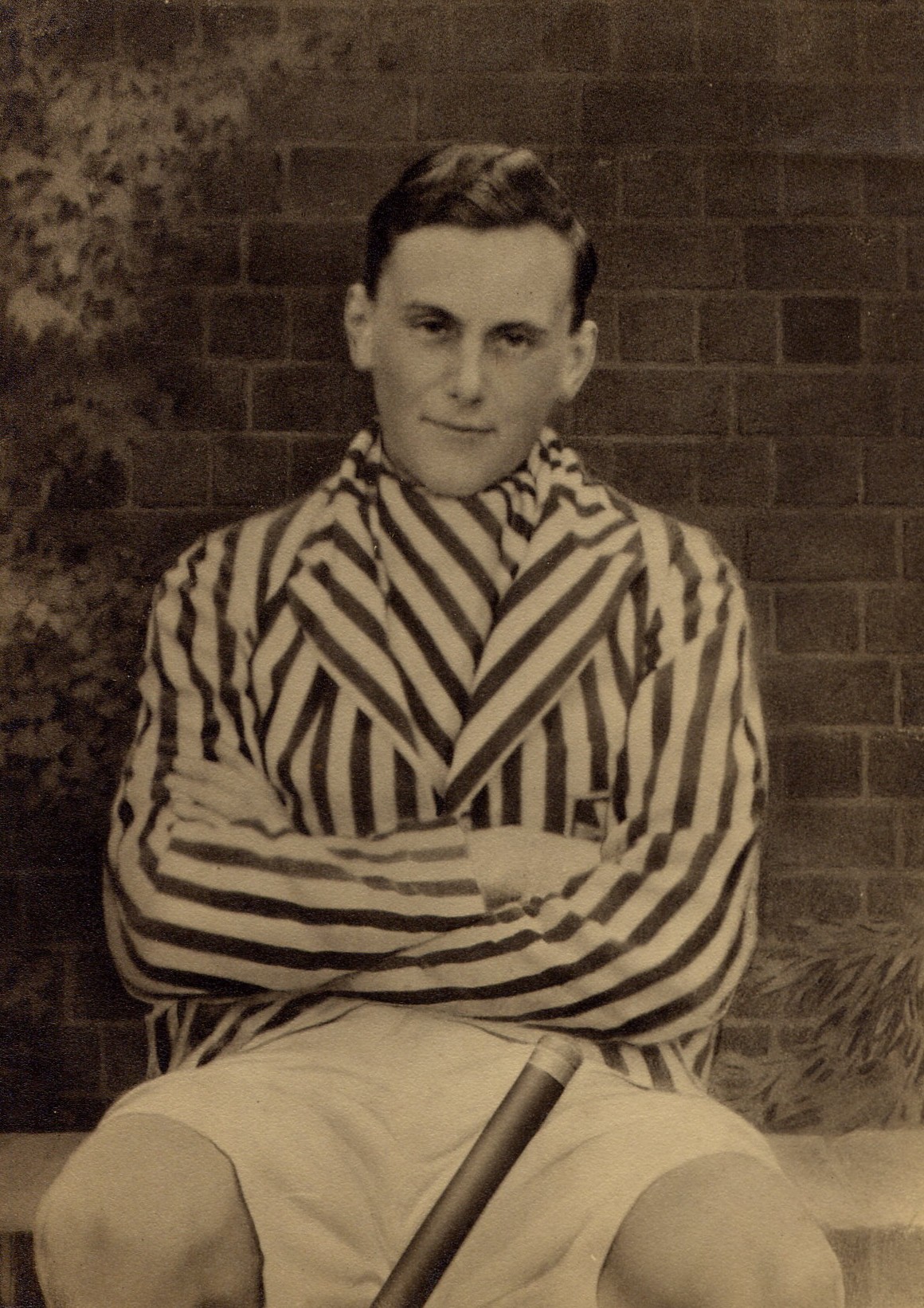
There were few British families not touched by the war across all echelons of society. For those mainly well-heeled sons of the Queen’s College who died, there must have been many more survivors who were wounded, and yet more civilians killed or injured. I and my siblings lost an uncle whom we never met, and my grandmother and mother a beloved only son and brother.
I don’t buy the cant about soldiers, especially those who were conscripted willingly giving up their lives – immortalised as “the old lie” in Wilfred Owen’s World War 1 poem Dulce et Decorum Est. Most of them had no choice, and made the best of a bad time. Yet the book is full of acts of great bravery in situations I could hardly imagine.
Take, for example, John Anthony Ronald Coulthard:
“At the outbreak of war he joined the Royal Warwickshire Regiment and was posted to the Intelligence Corps. After a brief training he went to France in April 1940 and was captured by the Germans on 20th May 1940. He was sent to Stalag XXA, situated at Thorn on the Vistula, where he became camp interpreter and took a leading part in organising educational classes and entertainments for the camp. In August 1942, he escaped with another prisoner but was recaptured at the Swiss Frontier. He made a second attempt towards the end of 1943 but was again recaptured, at Gdynia, and returned to the camp.
In January 1945 he was among those prisoners who were sent on a forced march of 800 miles from Poland to the West of Germany. Fatigue and privations proved too much for him, and he died on 24th March near Domitz, on the River Elbe, where he was buried.
He was posthumously mentioned in Dispatches ‘in recognition of gallant and distinguished service on the Field'”
I’ve no doubt that our volunteer soldiers in Afghanistan have been just as brave, even if they not infused with the naive idealism of the WW2 generation. As we wave our soldiers off to the next war, we could do worse than to look at snapshots like those in the Queen’s College book of the ordinary soldiers, sailors and air crew whose lives were cut short in the last global conflict, and hope for a kinder fate for their successors.
Back in ancient Pompeii, the subject of my last post, if you had something to communicate, you did so with your voice, or you wrote on a papyrus scroll or a little wooden tablet covered with wax. If you wanted to make a public pronouncement, you made a speech. If the information was important enough, it might be carved in stone for all to read. If you were an emperor wishing to spin his achievements, you might put a coded message on the back of the coins you issued. And if you were the ancient equivalent of an internet troll, you scrawled graffiti on a wall.
In the former Roman province of Britannia, the business of communications has flourished beyond the dreams of the average Pompeian citizen.
I was truly shocked the other day when the London Times reported that the UK government employs 3,500 communications staff. The total spend on staff is around $750 million, with the same amount spent on “communications work including campaigns and advertising”. So that’s $1.5 billion in total – as much as the gross domestic product of a small nation.
As far as I’m aware, that sum doesn’t include spend by local government. So let’s say that each of the 432 local authorities employs an average of three officers responsible for communications; then we can add another 1,200 staff to the list. And what about the 700-odd quangos that have survived the current government austerity cull? If each employs a single communications officer, then between all the bodies funded by the taxpayer we’re looking at in excess of 5,000 people, not including the consultants hired to deliver specific campaigns.
Now the last thing I want to see is diligent government workers thrown out of their jobs, but for goodness sake, at a time when we Brits are asked to tighten our belts, can’t we make do with a little less communication? If householders can cope with their refuse being collected every two weeks instead of every week, surely we can deal with the government keeping its mouth shut one week in two.
Much of the time, I have no idea what these people are communicating and to whom. I have a vision of rooms full of Malcolm Tuckers (for the uninitiated, Tucker is the foul-mouthed spin master in the BBC’s comedy series about the dark arts, The Thick of It ) scouring their calendars in an effort to figure out when would be “a good day to bury bad news” as one spin doctor famously remarked on 9/11.
The Times suggests that the Prime Minister is planning to bring all government communications staff under its direct control. The justification given by government sources is – surprise, surprise – efficiency. According to the report:
The Prime Minister wants to get better value for money by creating a single professional network of skilled staff capable of being “trouble-shooters” in any department when there is a crisis or extra work.
“We now have a comms team employed by each department but we want to give them much more flexibility so that they can move in and out of other departments when needed,” said one Whitehall source. “We want more skilled operators under a single employer … to drive up standards and get the Government’s message across. Lots of press officers are extremely good but work to different standards.”
I have no problem with the idea that quiescent departments can do without permanent spin doctors. But it’s very easy to see where this is going, and I’m not sure it’s the right direction. The next step will be a Ministry of Information, that entity beloved of governments for which information is a weapon rather than a right. Orwell’s Ministry of Truth and Goebbels’ Propaganda Ministry come to mind.
The obsession with presentation is everywhere in Britain’s political life. It determines the government’s policies and those of the opposition. It is often the criterion on which politicians are found wanting. In an op-ed piece also in the Times, Rafael Behr, the Political Editor of the New Statesman takes Ed Miliband, the Labour leader, to task for failing to assert himself, and his party for failing to come up with the kind of big ideas that will win the next election. Well yes, that’s adversarial politics. You wouldn’t expect Miliband do say that the current lot are doing a good job.
But I felt sorry for Stephen Twigg, Labour’s Shadow Education Secretary, whom Behr nominates for the chop simply because he has “failed to unsettle Michael Gove” (the current Education Secretary). Poor Mr Twigg would probably make a competent and diligent education minister. His crime is that his opposite number is one of the higher profile ministers whose reforms have attracted much public attention – both negative and positive. The onus is therefore on Twigg to come up with a series of eye-catching ideas – whether he believes in them or not – that discredit Gove’s policies. And Gove’s job is to use all those spin doctors in his department to defend his reforms.
So the debate is all about ideas, an ever-flowing river of them, rather than competence. About the personalities of those who promote them, rather than their ability to execute.
You might think all this is kid’s stuff – an ABC of politics – and you’d be right.
But I do find it worrying that politicians and civil servants outsource the task of communications to others in the same way as managers outsource key aspects of their jobs – dealing with people – to armies of HR staff. The Civil Service has a rigorous selection process designed to produce effective government employees with a wide range of skills and capabilities including, presumably, the ability to communicate. Why, therefore, do they need an army of communicators to do the communicating for them?
And do we really need the blizzard of information blown in our direction by government departments anxious to endure that we “get the message”.
Freedom of information is fine and dandy, but when we get it spun at us in such a way as to make it difficult to see the wood from the trees, surely we have to conclude that there are times when less is more. Is it really necessary to have to rely upon journalists and analysts to interpret everything for us because stuff we really need to know lies buried in 500-page documents no ordinary citizen is going to bother to read?
This is not just a rant. Consider the government budget statement, in which Gordon Brown during many years as Finance Minister, made an art form of burying his stealth taxes in the small print. In the private sector think of the late unlamented Enron in the US, whose regulatory filings were as long as the bible, yet contained hints of the illegal transactions that might have been exposed before thousands of people had to lose their jobs if analysts had been bothered to pick up on them.
The trouble with maintaining such a huge army of “professional communicators” is that the government of the day has a vested interest in keeping the numbers up. How otherwise will they justify the dubious and sometimes downright unjustifiable policies that lurk in the bureaucratic undergrowth? If they can be booted out of office every five years, why wouldn’t they use all resources available to them to shore up their reputation for competence?
So if the government has no motivation to ask the question, how can we be sure that the efforts of those 3,500 spin doctors represents value for money – not just in terms of the quality of their work, which seems to be the main concern of the Prime Minister, but in terms of whether what they do is needed in the first place? Can we rely on the media to expose any waste and inefficiency? Perhaps, but remember that less information means having to work harder for stories.
If I was a diligent hack, I would invoke the Freedom of Information Act to assist an in-depth analysis of one government department – perhaps the Ministry of Health, which according to The Times spends around $90 million a year on communications. I would ask how many staff they deploy in the area, and seek a comprehensive list of deliverables for which these people are responsible – press releases, pamphlets, reports, advertising campaigns, social media and so forth – along with the resources dedicated to producing them. I would then compare their output with that of other ministries, and I would then look for comparable data in other countries – say Germany, France and the US.
And what could we hard-pressed taxpayers do? Well we could start by pestering our local elected representatives whenever we see or receive a communication that is plainly irrelevant, inappropriate or of dubious purpose – the “Go Home” posters on vans targeted at illegal immigrants clearly ticks two of those boxes in my book.
We could also get more media savvy, and ask ourselves where the stories we read in the print media and the internet are coming from, what motivates those that generate them and why they are appearing at a particular time. We should be sceptical, not accept information at face value and not afraid to complain if we suspect that the wool is being pulled over our eyes. Even if we don’t have the time to write to our MPs or local councillors, we can take advantage of the politicians’ obsession with the social media by posting our opinions online.
Or we could simply close our eyes and sleepwalk our way through a life increasingly plagued by misinformation, disinformation and too much information.
Our choice, I guess.
There is nowhere like Pompeii and Herculaneum. Mary Beard, one of the subjects of my last post, who has done much in recent years to educate us about the two Roman towns buried under a cataclysmic volcanic eruption in AD 79, would most likely agree. Even if you are only vaguely interested in ancient history, a visit to the excavations on the bay of Naples is a must.
But this summer, if you’re not heading for Naples, you can still take a trip to the British Museum.
There you will find the Pompeii and Herculaneum Exhibition, as good an introduction to the Roman world as you are ever likely to find. What’s more, many of the finest artefacts recovered from the ash that buried them are not to be found in their normal home – the Naples National Archaeological Museum. That’s because they’re in London, along with frescoes, mosaics, body casts and other features that are normally spread out between the two excavation sites and the museum, which is some way away in central Naples.
I’ve visited the sites several times, because as a classicist by education and a lifelong student of Roman history I can’t get enough of them.
Of course in a two-hour wander through the exhibition in the British Museum, you don’t get a feeling for scale. You’re not walking down ancient streets with Vesuvius glowering on the distant horizon. But you do get a vivid sense of the dolce vita that made these towns popular holiday destinations for the rich and the powerful who needed to get away from the heaving metropolis of Rome, two hundred kilometres to the north.
Most of the exhibits are not new to me. I’ve seen them in situ or in the Naples museum. Yet it’s a delight to find them all in one place, bound up with a narrative that takes you from an anatomy of the fatal eruption through various aspects of Roman life to the sudden and devastating end of life. Jewellery, sculptures, furniture, 3D animations of a luxurious town house and elegant paintings of gardens, family activities, commerce and cookery.
Even if you’re not interested in ancient history. the exhibition is worth a visit for another reason.
It’s not just that you can look through a window into a civilisation where the familiar jostles with the alien. The volcanic event has bequeathed us the finest illustration – anywhere – of what life was like before the industrial revolution. No internet, smart phones, no electricity. No mass production, cars or global transportation systems. What’s more, no weapons of mass destruction, and no evidence of any event that was likely to cause mass extinction unless you include the earthquakes that frequently afflict the Italian peninsula. Nobody saw Vesuvius coming – it had not erupted in living memory or even folk memory.
These days we face all manner of threats that could derail human life, or at least degrade it such that we, too could be returned to a pre-industrial age. There are still parts of the world where people live without modern technology and others where conflict has returned them “to the stone age”.
But most of us have never had to live without the technology we take for granted. We know all about climate change, conflict and natural disasters. We see the consequences of wars, tsunamis and hurricanes on TV. Yet we find it hard to accept in our hearts that that our lives – rather than those of unfortunates elsewhere on the plant – could change or end suddenly. We’ve become used to being scared in the comfort of our living rooms.
Pompeii and Herculaneum were no gardens of Eden. They were societies powered by slave labour. Life expectancy was far shorter than we enjoy today. Medical knowledge was crude, and the skeletons recovered show evidence of a number of chronic conditions for which there was no cure. Yet there was a form of consensual local politics, and plenty of scope for upward mobility – most of the citizens of Pompeii were former slaves. The population across the social spectrum lived on a rich diet of sea food, fruit and vegetables. Though life for the slaves in the surrounding agricultural land may have been grim and short, many of the coastal town dwellers had it pretty good by the standards of the time.
if you want to imagine a world free of industrial technology, you have a number of options. You could watch the Mad Max films depicting a post-apocalyptic wasteland. You could visit a village in the Andaman Islands or the Brazilian rain forest. Or you could spend a couple of hours in the British Museum. Better still, you could make the effort to visit the sites themselves.
So why should we should peer through this unique window into a sophisticated ancient society? Because our past could be our future.
But don’t wait too long. The British Museum Exhibition closes on September 29th. You can book tickets online, or take your chance that you can pick up some of the five hundred released every day. It’s wildly popular, so be aware that you’ll have to wait for crowds around the most popular exhibits to clear.
Back in the bay of Naples, there is increasing concern that Vesuvius will erupt again, perhaps in our lifetimes. We might then witness death and destruction on a far wider scale than afflicted the ancient towns. Naples, a city of a million inhabitants, could be wiped out. Pompeii and Herculaneum could be reburied under metres of volcanic ash.
Hopefully the worst will not happen any time soon. Meanwhile, one fascinating aspect of Pompeii and Herculaneum is that large areas have not yet been excavated. In the case of Herculaneum, one third of the town still lies beneath the modern village of Ercolano. Efforts to excavate more of Pompeii have been inhibited by lack of funding. The cash-strapped Italian state has determined that such limited resources as are available should be best spent preserving what is already over ground rather than exposing more of the remains to the elements. That has to be sensible, especially as the frescos are already fading and several buildings have collapsed over the past decade.
Another reason for leaving what remains unexcavated is that future exploration will avoid the destruction caused when the ruins were first discovered in the eighteenth century – much the same reason that the Chinese cite for not excavating the burial chamber of the emperor Qin Shi Huang that lies in the midst of his terracotta legions. Many of those who first stumbled on the Italian sites were little more than treasure hunters, who ruined as much as they recovered.
While I accept that I may never live to see what still lies buried, there’s still a side of me that longs to know what is yet to be discovered. I pray for an oligarch or an internet billionaire to come forward and spend a piece of their fortune on uncovering all or part of what remains. They could do a deal with the government to offer generous compensation to those living above the sites, and to endow a foundation with sufficient funding to preserve and maintain the newly uncovered areas.
Also the chances are that there are villas and hamlets beneath open ground throughout the area that we still know nothing about. A systematic geophysical survey of the whole area covered by the ash could reveal new treasures without disturbing the lives of the people of Ercolano.
If I had a few spare billions, I’d be the first to beat a path to Italy’s door. In my dreams, unfortunately. But are there not philanthropists among the current gang of super-wealthy demi-gods who might fancy their own slice of eternal renown through associating themselves with such a project? Well, perhaps not eternal, but at least until the next eruption comes along.
I live in hope.
Try as I might, I don’t get Twitter. Perhaps it comes down to the fact that I don’t choose to be confined to 140 characters when there’s something I want to say. Maybe it’s because I’m not a celeb with half a million followers hanging on my every inanity. I’m not a politician, an author, a revolutionary or a chef. And for God’s sake, I have no desire to strike fear in others, let alone blow up a middle-aged lady or rape a member of Parliament.
I adore the lady in question – Professor Mary Beard – and all her works. She’s a breath of fresh air. A gorgeously uncool representative of my generation who has done more to popularise the Classics – a subject close to my heart – than any other academic. I don’t know what drives her to tweet. Does Twitter her help her to sell more books? I have no idea. Or does the epigrammatic possibility of the tweet appeal to the classicist in her? Maybe.
Whatever the reason, it’s shocking that she should attract such vicious online harassment from people who probably wouldn’t be able to distinguish Latin from Chinese, or Pompeii from Chicago because of the way she looks, and because of her opinion, expressed on TV, radio and, of course, Twitter, that anonymous abuse should be confronted and stamped out.
In the UK we have laws prohibiting expressions of hatred and threats of criminal acts. They should be enforced. And in a democratic society governed by the rule of law there should be no place for anonymity. A poison pen letter is poisonous whether it’s online or whether it’s constructed from cut-out letters stuck on a piece of paper and sneakily slipped through a letterbox.
Things get complicated when the rule of law extends beyond expressions of hatred. When it’s illegal to criticise individuals or government policies. Should critics of human rights abuses or corruption in high places – who run the risk of arrest on matters of principle – be protected by the cloak of anonymity? What about corporate whistleblowers who open themselves to retaliation by their employers and their colleagues?
If we condone anonymity in one country and not in our own, are we being hypocritical? Should we celebrate the role of Twitter in the Arab Spring, yet condemn its use in the London riots of 2011?
You could argue that applications like Facebook and Twitter – like the internet on which they sit – are blank canvases that can be used for good and evil. That the owners are responsible to their shareholders for managing the risks of operating on a country-by-country basis, including places with a different view of social control than those that apply in western democracies. You could take the view that morality doesn’t come into the picture unless the shareholders and customers deem it to be relevant. That owners should either comply with the law in each country without regard to the perceived morality of those laws or refuse to operate in countries whose laws run counter to their principles.
But it’s not a simple as that. How, for example, do you stop a religious extremist posting hate-filled messages on Twitter via a proxy server even if the application is banned in the country of the user? Where there’s a will there will be a way.
So are we at the point at which we have created a place that we cannot control? Where the dark internet seeps into the light, where the trolls surface to do their dirty work, where the hackers boast about their exploits and the leakers expose the stuff our governments don’t want us to know?
The answer most likely is yes. Manning, Snowden and Assange, the plotters and money launderers of Al Qaeda, the cyber-fraudsters, the hackers for hire and the trolls will always be one step ahead of government efforts to stop them. And when governments themselves use similar tactics and techniques for their own ends – state-sponsored hacking attacks, online surveillance and disinformation campaigns – it’s little wonder that lines are blurred between morality and expediency, official and freelance, criminality and justice.
So in a way, those pathetic individuals sending their billets doux of hatred to people like Mary Beard are as irrelevant in the big picture as everyone else who for a variety of reasons spends an inordinate amount of time tweeting narcissistic inanities. They are part of a much larger phenomenon.
As India Knight wrote in last week’s UK Sunday Times, Twitter is like a huge pub where like-minded people gather to vent their prejudices. The fact is that you don’t need to go to the pub, and you don’t need to use Twitter, however seductive it might seem.
Mary Beard is entitled to express herself freely using whatever medium she chooses. But you have to ask whether Twitter is worth the grief, the anxiety and the expenditure of police time in tracking down the droves of malicious losers that haunt it.
The nasties are out there, virtual or physical. Just as going into the wrong place at the wrong time can entail certain risks, so it is with the virtual neighbourhoods that can be fun to visit yet where danger also lurks.
The internet was never the Garden of Eden. Every application that sits on it is capable of being subverted, perverted and exploited, and anyone who thinks otherwise is naïve. So don’t be surprised if each criminal prosecution for harassment, each libel action and each dumb utterance sparking public ridicule increases the likelihood that Twitter will wither on the vine and disappear as quickly as it emerged.
I for one won’t mourn its passing. Not because I’m a miserable killjoy, but because something else is sure to take its place. That’s the world we live in.
What do you have to do to be stripped of your citizenship by a Middle Eastern monarchy? Well, you could be on the wrong side of a political divide, as has been the case with a number of prominent Bahrainis who are now living in exile in London.
Or you could write a number of novels lamenting the corruption of values and traditions in your society – including a novel about a fictional sultanate in the 1950s as its capital city is transformed by the arrival of oil wealth.
This was the fate of Abdulrahman Munif, a one-time oil executive turned writer whose travels took him to Iraq, Syria, Yugoslavia and Egypt. Always a Pan-Arab nationalist, his political sympathies drew him into the Baath party, and out again as he rejected the despotism of Saddam Hussain’s regime.
He, like Edward Said, the Palestinian-American author of the landmark treatise, Orientalism, blamed Western imperialism for many of the woes facing the Arab world over the past century.
The novel in question is The Trench, the second in a quintet that explores the corruption of society by oil, and of those who extracted it, exploited it and enriched themselves in the process.
The first three novels in the Cities of Salt quintet were translated by Peter Theroux, the brother of the travel writer Paul Theroux. Presumably the final two books have not interested Western publishers because of the relative lack of success of the first three. It’s a shame, because if the other two translated novels are of the same calibre as The Trench, the West is ignoring a body of literature that offers a valuable insight through the eyes of an Arab writer into the origins of the oil-rich monarchies of the Arabian peninsula.
Despite the dramatic transformation of the Gulf states since the 1950’s, it’s not difficult to recognise mindsets in The Trench that are still in evidence today.
The novel is set early in the oil boom. A small desert capital, Mooran, finds itself transformed in a few years from mud brick to marble. We look through the eyes of an opportunistic Syrian doctor who by virtue of his medical skills becomes an intimate of the Sultan – the son of the founding patriarch. The newcomer uses his political acumen and his experience of the wider world that increasingly impinges on Mooran to become the chief advisor to the monarch.
He gradually inserts family and friends into the court of the affable and easily-influenced Sultan, all the while increasing his wealth by taking a slice of new companies set up to capitalise on Mooran’s growing appetite for the fruits of the new-found oil wealth – cars, palaces, luxury goods and massive infrastructure projects. He discreetly purchases large tracts of real estate around the capital in the knowledge that land will be at a premium in the rapidly expanding city.
As time goes on, his associates become powerful in their own right. One of them, a member of a prominent local family whom he engineers into the job of setting up the country’s national security agency, eventually becomes his nemesis. Others turn into silent enemies who work against him, yet he manages to cling to his pre-eminent position as the Sultan’s advisor.
Meanwhile we meet some of the leading lights in the city’s souk, who act as a baleful chorus as the march of progress threatens and ultimately destroys their livelihood as traders and intermediaries. Not much call for selling sheep and shoeing donkeys when the streets become filled with swishy Cadillacs and the new markets are stocked with imported food. Embittered, they continue to meet at the local coffee house, where they hurl oblique curses at the ruling elite and their scheming advisors.
In the hothouse of the court, the doctor veers from despair and paranoia to moments of joyous triumph. As he gets older his perception of his own brilliance steadily inflates, and he spends increasing amounts of his time developing a grand theory of life which will amaze the world when he finally gets round to publishing it.
Meanwhile the women of the palace pursue their own agendas. Their main preoccupation is the Sultan’s insatiable appetite for new wives. By the end of the story, he is rumoured to have married at least thirty women, with deadly consequences for at least one of them. And the doctor’s wife lives a double existence of which her husband is blissfully unaware.
Munif portrays the court of Mooran as venal and intrigue-ridden – a rat’s nest of flattery, jealousy and hidden grudges. Ordinary subjects are fed official news glorifying Mooran, the Sultan and the nation’s achievements. The coffee house, however, is rife with rumours and scandalous talk.
It’s hard not to associate the story with Saudi Arabia, even if the narrative doesn’t explicitly map on to the history. The founder, his son the Sultan and the austere Crown Prince bring to mind the first three Saudi monarchs – Abdulaziz, Saud and Faisal. And the coastal city of Harran, where the doctor gained his first foothold in the sultanate, is a dead ringer for Al-Khobar, Dammam and Dhahran, the oil-producing conurbation on the East coast.
For the malcontents of the souk, the oil wealth is a curse, yet you are left with the impression that it is no less a curse for all the other protagonists. There are no truly contented characters in The Trench, even if they enjoy brief moments of joy. Nobody, not even the Sultan, is truly in control of his life. All are in thrall to external forces, especially to the Americans, who are portrayed as puppet masters manipulating events in the background.
As a Saudi national who occupied prominent positions in the Middle East oil industry, Munif was undoubtedly in a position to observe the comings and goings of the elites of his time. I have no idea how close he was to the centres of power in the 50s, but his description of the intrigue and the opaqueness of decision-making within the Arab autocracies – and not just of the monarchies – rings true even today.
In the UK, if David Cameron appoints advisors, they are subject to scrutiny and criticism both in the media and in parliament. Only recently he was accused of appointing his friends and “people like him” into key positions at the expense of talented individuals from different backgrounds.
In many Middle East states, such concerns would be greeted with incredulity. For every official advisor there is a host of shadowy figures who also exert influence through friendships, family ties and mutual dependence. Public criticism of government appointments and individuals in positions of power is frowned upon, to say the least. The lines between friendship and business are frequently blurred. And, as in The Trench, ministries serve as personal fiefdoms – often jostling for power and influence – especially when the minister is a member of the ruling family. Relationships and trust mean everything.
Even today, though many institutions have sprung up that seemingly render decision-making less opaque, in most of the absolute monarchies the process for making the critical policy decisions remains mysterious by Western standards. As a result, the rumour market continues to thrive, and no region revels in conspiracy theories more than the Middle East.
I can well understand why Munif’s writing upset the Saudis, who would prefer to portray the history of the Kingdom as one of uninterrupted progress. Yet today’s media has greater freedom to criticise than ever before, even though attacks on individuals remain out of bounds. There is an increasing debate over problems that have their origins in earlier decades – the reliance on foreign labour, failings in the education system and endemic health issues. So has Saudi Arabia – and its wealthy neighbours for that matter – come to terms with the cost to society and human values of the oil era? I suspect that the answer is yes.
But one reason for tensions in the region is that the pre-oil generation have not forgotten the relative simplicity of their younger days, and their children share their nostalgia. There are many who look back rather than forward, and yearn for a society that is fast vanishing. Religious belief apart, this is one of the roots of the conservatism that still characterises Saudi Arabia, and is the cause of much of the tension within its society.
For all that, it would be nice to think that today’s elite would find it within themselves to forgive Abdulrahman Munif, who died in 2004, for his perceived offence. Because to my mind The Trench is great literature – no less than the work of Alexander Solzhenitsyn, who similarly fell foul of the Soviet establishment, only to be rehabilitated late in his life.
There are not so many Arab writers who have successfully reached international audiences over during past century. Of these, the Egyptian Nobel prize-winner Naguib Mahfouz is probably the best known, but the list is short. Saudi Arabia should be proud of Munif, though I suspect that not enough time has passed for his talent to be recognised and celebrated at all levels within the Kingdom.
And the non-Arab world needs to hear more authentic Arab voices, even if their messages are not always comforting. Because like it or not, the Middle East is unlikely to decline into geopolitical irrelevance any time soon.
Every so often I happen upon discussions in the Arab media about culture. One such is currently to be found in today’s edition of Asharq Al-Awsat.
Two writers debate the proposition that Gulf states do not do enough to foster Arab culture. Hamad Al-Ammari says that the Gulf should do more. Shaikha Mai Bint Ibrahim Al-Khalifa, Bahrain’s Minister of Culture, says that the Gulf is doing enough.
But the question is: what culture? And is culture something that people should “do something” about?
I’m writing this on a brief visit to the in-laws in Ireland. It’s a country that is very aware of a culture that distinguishes it from its big neighbour, the United Kingdom. When Ireland became an independent nation, the government, societies and dedicated citizens went to great lengths to promote their vision of Irish culture. Gaelic, the Irish language, was dying before independence. For the past 90 years every school teaches it as an obligatory part of the curriculum. Today it sits proudly alongside English, as the official language of government.
Irish sports – hurling and Gaelic football – have also flourished under government sponsorship. Irish music, epitomised by the Chieftains, the Dubliners and countless other musicians who cut their teeth in pubs, clubs and dancehalls, is recognised throughout the world as a symbol of hibernian culture. Irish dance, in the adapted form of Riverdance and similar shows, pulls in thousands of theatre goers in New York, Sydney and London. And few big cities in the world are without the obligatory Irish bar where you can rejoice in a pint of Guinness.
Yet 90 years on, how different is Ireland from the UK, the US and continental Europe, from which it draws on cultural influence?
Read the Irish Daily Star, Ireland’s leading tabloid, and you will see stories of celebrities and sex, drugs and murder, scandals and sport. Listen to piped music in a pub, and you will not find the Chieftains. Ask the average Irish city-dweller how often they speak Irish, and many will tell you that the last time they spoke Irish was before they left school. They will tell you that they love Gaelic games not because they are examples of Irish culture but because they are great sport. Likewise, Guinness is a great drink.
Ireland, in common with several other European countries, is bending under the weight of austerity programmes. It obsesses over English Premier League football, Pop Idol and the cult of celebrity. It worries about its immigrant population, about house prices. Those who can afford it still take holidays in Florida, Spain and Portugal. In these respects it is little different from the UK. Read an English tabloid, and you could be reading an Irish one. In the final analysis, has nearly a century of state-sponsored Irishness made a significant difference to the attitudes, behaviours and quality of life of the Irish? I’m not convinced it has.
Look now at the Arab world. What is the culture that governments are anxious to preserve? The Arabic language? For sure. But when it comes to what needs to be preserved and what does not, the region is deeply fractured in its perceptions, just as it is politically and socially.
Is wall graffiti in Beirut and Sana’a any more or less representative of Arab culture than the remnants of earlier times – wind towers, basket-weaving and calligraphy? What is the “set of doctrines, values and rules that all members of the society share, something that distinguishes them and reflects their civilized stature” to which Hammad Al-Ammari refers? Is there any society in the Arab world that universally shares such doctrines? Beyond the Arabic language and the rituals and rhythms of Islam, I see no such universality.
In the Arab world you will find camels and Cadillacs, souks and shiny western malls, poetry and hip-hop, gahwa and Big Macs, bedouin and city boys, Umm Khalthoum and Arab Idol, qat and cocaine, authoritarian governments and failed states, Arabs and expatriates, Sunni and Shia.
How do you determine the culture to be supported and promoted within such a mish-mash of influences? Only, I suggest, by looking at the past rather than the present. By creating artificial contours in the landscape – by changing the direction of rivers of human consciousness, creating tidal barriers and buttresses that delay the inevitable course of nature.
And this is precisely what many of the Gulf states are trying to do, with limited success. Just as the Irish did many years ago.
Al-Ammari seems to blame governments for the dilution of Arab culture through the malign influence of the West – a familiar song:
“As for Gulf governments that failed to keep pace with the ever-developing civilization that accompanied their vast oil wealth, their interest in culture was superficial. This is demonstrated by their building huge museums and buying world-famous paintings at astronomical prices, as well as promoting clamorous musical performances and bringing in international singers, as if culture was something to be bought and sold.
It is unfortunate that these governments shirk their responsibility towards their own culture as well as towards raising new generations, particularly since they are oil-producing countries and are not short of financial resources. It is not sufficient to sing the praise of the Arab Peninsula or of old Arab travelers and historians. Rather, the enormous energies of youth must be exploited, for they are more vulnerable to external influences like the prevalence of the English language, Western culture, Western media and satellite TV channels, films and music. There are also several domestic effects represented by the large numbers of foreign laborers and the domination of foreign companies, institutions, universities and schools that attract our sons, particularly from the young generation. This is not to mention that their school syllabuses and programs are not commensurate with our Arab culture and identity.”
Shaikha Mai, on the other hand, firmly believes that top-down interventions by governments are effectively promoting Arab culture:
“Gulf governments have worked on developing their cultural and intellectual identities, with the help of their people. This can be seen in the fact that some Gulf governments have worked for many years to form a cumulative, over-arching culture that encompasses the natural development of its people, traditions and customs. This process is an exceedingly complex and lengthy one, and does not produce instant results. It is a process that can be understood through its results, strengthening and entrenching the country’s intellectual and cultural identity.
Looking at the cultural movement across the Gulf, there are a number of institutions that seek to develop Gulf culture. Art galleries, music events and humanities studies at universities and colleges provide people in the Gulf with the opportunity to get involved in cultural events, creating harmony between individual identity, regional identity and global cultural development. In addition to this, there are cultural exchange programs and events that are open to the public, including local and national festivals and celebrations. These social gatherings can strengthen the character of the nation, and help people understand others.
Gulf countries have adopted a system that absorbs their people’s skills and talents, in an effort to create an environment where past experiences and future aspirations are able to coexist. Governments have encouraged the establishment of cultural clubs, centers and institutions to support cultural development and attract experts, researchers and intellectuals, with the purpose of integrating seamlessly with local communities. This is a civilized way of integrating cultural development, particularly following the urban growth in the Gulf that has provided a suitable place for cultural, intellectual and artistic activities. In addition to this, there are also cultural institutions and public libraries that specialize in cultural activities for children, to help them develop a love of and desire for culture.”
Al-Ammari is wrong. This is not about the corrosion of values and traditions by the influence of the West. The Arab world has constantly absorbed influences from its neighbours from before the age of Islam. And in recent centuries, you could argue that the influence of the East is equally as strong. Jeddah, the gateway to the Haj, has the widest gene pool in Saudi Arabia, and owes as much to Persia and the Indian subcontinent for its culture and traditions as it does to its Arab roots, many of which come from Egypt, the Levant and Africa. Bahrain is also deeply influenced by its citizens of Indian and Persian origin.
And, with all due respect to the Sheikha, she is being unrealistic if she believes that the government initiatives she refers to will effectively change the natural evolution of popular culture, because there is no “cumulative over-arching culture that encompasses the natural development of its people, traditions and customs.” One can hardly describe the changes in Gulf since the discovery of oil as naturaI, any more than one can fabricate consistency between the urban cultures of the trading cities with the Bedouin culture of the hinterland.
If any group of states is responsible for the cultural confusion currently reigning in the Arab world, it is those in the Gulf. By exploiting the resources that lie beneath the earth, they have sucked in the rest of the world, for better or for worse. They have lost what little control they had over their pre-oil culture, and all the billions that they sink into cultural landmarks and programmes will not bring it back.
In my humble opinion, they should let the culture evolve naturally, as it always has, and stop trying to create mammoths from corrupted DNA. What resonates will flourish. What no longer seems relevant to future generations will end up in museums, folklore festivals and history books.
So let the kids support Barcelona, study abroad, write their poetry, send their texts in Arabezi. But also help them to discover their history, their ancestry and the myriad of influences that created the societies in which they live, and which they in turn will influence and change.
What will evolve will evolve, and in the long run, there is little that governments, bureaucrats and nostalgic conservatives can do about it.
Hey nonny no – today’s the day when we kiss goodbye to the British Summer. Sixteen days of heatwave brought to a fiery, watery end by thunder, lightning and torrential rain.
True, there are a few more weeks ahead before what we formally recognise as summer gives way to autumn. But this will be the period we Brits will remember when we think back on 2013. Andy Murray winning Wimbledon, England stomping all over the Aussies in the first two matches of the Ashes series. Phil Mickelson, gentleman golfer beloved of the Brits, winning the Open. And that not quite British Kenyan cyclist Chris Froome winning the Tour de France across the Channel. Not to mention the ludicrous fuss surrounding the birth of the new third in line to the British throne.
It’s been the summer when the jetstream decided to do us a favour and plonked itself west of the country, allowing a big fat anticyclone to kid us into thinking that we’re in southern France.
For me it’s been quite special because it’s the first time for a while that I’ve spent the month in my home country. Ironic that an escape from the torrid summer heat of Bahrain should leave one gasping for a spot of air-conditioning during these hot sweaty nights.
I will remember the month not just for the traditional set pieces – politicians glowing like lobsters at set-piece sporting events, creating stories out of nothing, doing their best to tell us how awful things are, or how we are on the road to recovery, depending on their political persuasion.
My highlight was an open-air staging of Shakespeare’s As You Like It – a typically English event in a typically English town – Guildford in Surrey.
I’ve always enjoyed watching – and on rare occasions performing – open-air theatre. At school we had a Greek theatre where we staged big summer productions. Brecht’s Galileo, for example, and the Bacchae of Euripides, in which I played Pentheus, the king who got too curious about the female Dionysiac rites and was decapitated by his mother (played by a teenage Harriet Walter) for his audacity.
At this time of year you can go to all manner of open air theatre events. Regents Park in London, where I saw a fabulous performance of the Pirates of Penzance. The Minack Theatre, built into a Cornish cliff, where I went to George Bernard Shaw’s You Never Can Tell. Some of the venues are purpose-built. Others, like the school garden where I made my stage debut at the age of ten as the hole in the wall in Shakespeare’s Midsummer Night’s Dream, temporarily transformed.
The Guildford show was at the College of Law, in the gardens of an elegant Jacobean mansion surrounded by the ghastly school buildings thrown up in the Sixties by some dumb architect whose idea of sympathetic blending was akin to a requiem mass by Black Sabbath. Who taught these people their trade?
But ignore the monstrosities and focus on the mansion with its woody grounds, and you have the perfect setting for one of Shakespeare’s pastoral comedies.
The audience was middle class and mostly middle aged – a typical cross-section of the arts-loving burghers of Guildford, who like their theatre safe. The youth of the town were seemed to be occupied in the two drinking holes in the centre, where scantily dressed teenagers performed their version of the Bacchae.
Meanwhile their parents gathered a few miles down the road, with rugs, camping seats and discreet bottles of wine. It’s a shame that young audiences are often dragged along to Shakespeare plays under duress – usually because one of them is on the reading list for the current year’s English literature curriculum. Maybe in this case it was because the state school term ends this week, or perhaps because it was a Monday, but director Tom Littler’s young cast played largely to a youth-free audience.
Littler’s production was set in July 1913, a year away from the war that ripped out the fabric of a Britain that had known little conflict within its shores for seventy years. A duke has usurped his brother. Two noble siblings fight each other. The main female protagonists – daughters of the present and former duke – take the stage in an oppressive court with suffragette sashes, while in the forest of Arden, the exiled duke and his entourage play cricket among the shepherds and farm labourers.
The play’s themes are love, forgiveness, redemption and the purity of nature. The forest heals the conflicts and liberates the heroines, who end up in the arms of the brothers. The usurper duke repents his actions, and the exile is restored to his previous eminence.
The whole cast attacked the play with verve and joy. None more so than Matt Pinches as Touchstone the court fool, who accompanies the cousins into exile. He’s an outstanding comic actor who deserves a much wider audience. Rhiannon Summers was a luminous Rosalind, deftly weaving her boyish façade into her passion for the downtrodden Orlando.
The Guildford Shakespeare Company, which produced the play, is one of many companies all over the country that keep grassroots theatre alive. They rely on individual and corporate sponsors, as well as the efforts of many volunteers, to deliver high quality professional theatre. They also run classes and workshops for all ages.
Theatre, far more than TV and film, is art that you can see, feel and sometimes touch from close range. It’s very tempting for educational bureaucrats struggling with funding constraints to cut back on everything outside the core school curriculum. So if there are cuts to be made, they are likely to fall on the performing arts rather than sport, in which the politicians have invested so much of their prestige. Teachers who produce school plays devote vast amounts of their own time to making them happen. Without the complementary efforts of groups like the GSC, it would be understandable if many schools – and volunteer teachers – decided not to bother with theatre at all.
Which would be sad, because being able to perform in front of others is an invaluable life skill. And for me, a thriving theatre culture is the mark of a civilised society.
Thousands of young Saudis will soon be heading off to foreign lands for their summer holidays. Some are out of the Kingdom already, as their families take a break during the Holy Month of Ramadan.
The chances are that many of them will be heading to the movie theatres to catch up with the bumper harvest of summer blockbusters on offer from Hollywood.
It’s an irony that Wadjda – the award-winning film shot in Riyadh about a young girl’s efforts to buy a bicycle – cannot be seen on a big screen by Saudis at home, since commercial cinemas are not allowed in the Kingdom.
Wadjda is a movie Saudis can be proud of. A couple of days ago I went to a preview in the UK. As I watched the nuanced and bitter-sweet portrayal of a schoolgirl negotiating the conservative social conventions that define her life, I was in an audience consisting largely the middle class and relatively well-heeled readers of the London Times. While none of the sub-plots that portray the place of women in Saudi society were news to me, I wondered how many eyes were being opened for the first time about life inside the Kingdom, even for those who regularly keep an eye on media coverage of the Middle East.
One thing that might have surprised them is the extent to which Western culture bumps alongside traditional ways even within the most socially conservative Saudi families. While Wadjda enters the school Quran memorisation competition so that she can spend the prize on her longed-for bike, at home she listens to western music and plays video games with her Dad.
The social themes in the movie would be as familiar to a Saudi audience as those portrayed inthe films of Mike Leigh or the plays of Alan Ayckbourn would be to a British audience. And though the story was beautifully crafted and entrancing, I also wondered about the intended audience. Was director Haifaa Al-Mansour primarily making a point to her own people, to the rest of the world, or both?
The reality of life for women in Saudi Arabia’s conservative heartland is woven into the story. That it is shameful for women to be seen by men – let alone interact with them – unless they are related to them. That the girl’s schools are often harsh and prescriptive, and run by women fully supportive of the Kingdom’s “customs and traditions”. That for men, having sons is a social imperative, and cause enough to take a second wife if the first cannot deliver. That there is a range of activities, including riding a bike, that are deemed unsuitable for women. That young girls upon reaching puberty are often married off without having much choice in the matter. That even among the less wealthy, foreign labour – in this case a South Asian driver – is essential if a woman is to work. That female teachers often have to travel long distances to reach their places of work.
The art of the movie is that it draws us into that reality without making overt statements that might offend the home audience. Apparently the director did receive death threats, but these are a fairly common currency of intimidation from extreme conservatives, usually anonymously through the social media. Still I find it amazing that we are offered this unveiled glimpse into a Saudi woman’s world – in Riyadh of all places.
But in the end, it’s only a movie. A simple story that will have been far from simple to bring to the screen. A tale of love, sadness and feisty individualism. No sex, no violence, no CGI, no cataclysms.
Just a beautiful movie that I heartily recommend to Western film fans – whether they are familiar with the Middle East or know little of the region and need convincing that Saudi Arabia is not a society of wife-beating ogres, even if its values and culture are very different from ours. Wadjda opens in UK cinemas on July 17th.
It’s a measure of the evolution of Saudi society that the movie was even made, and encouraging evidence that the cultures of the West and the Middle East will continue to develop to the point that they no longer grate on each other. That point may be a while off, but I’m convinced we will get there.
Best of all for this jaded movie goer, it’s a reminder that there is an alternative to movies like World War Z, even if Hollywood has turned into a crass and predictable blockbuster factory.
On a festive note, this is an appropriate place to wish all my Muslim friends a joyous and peaceful Ramadan.
There is Islamophobia, and then there is silliness.
When I first skimmed A.N. Wilson’s rant in yesterday’s Daily Mail about the UK’s Channel 4’s plans to broadcast the first prayer call during Ramadan, I thought oh oh, here’s the Mail doing its usual bit to rouse Middle England against the creeping erosion of our national culture by scary, fanatical religious minorities.
Then, having read the piece in greater detail, it occurs to me that A.N. Wilson is coming over like a learned prat. His piece is more about a violent antipathy to Channel 4’s “liberal” tendencies, as exemplified by its willingness to give air time to a certain Anjem Choudary in the wake of the recent murder of a British soldier in Woolwich. Here’s an extract:
“The fact that this is still a country in which the huge majority of people, when questioned, still claim to be some sort of Christian counts for nothing in the eyes of the secular liberals who control most of our media.
They will, in fact, do anything to undermine religion. If that means setting Muslims against Christians in this essentially subversive gesture, so be it.
They are using a sacred Muslim custom as a weapon, not of religious inclusiveness, but of secularism disguised as friendship.
Channel 4 has done very little to raise public awareness of mainstream Muslim opinion.
It prefers gestures and controversialism — witness its decision to give air-time to Anjem Choudary, former head of the banned Islamist organisation Al Muhajiroun, who refused to denounce the murder of Drummer Rigby in Woolwich earlier this summer.
A nice quiet imam telling viewers not to forget their prayers would not raise the viewing figures. It wouldn’t be ‘edgy’.
If I were a Muslim, I would be disgusted that an anti-religious organisation such as Channel 4 has hijacked my prayers for the purposes of seeming hip, cool and trendy.
Channel 4 is a public service broadcaster with specific responsibilities to the taxpayers who own it. If I were a TV regulator, I would stop the company from proceeding with this divisive and publicity-seeking gesture.
But then our toothless TV regulators are cut from exactly the same secular liberal cloth as the channel’s producers.
So, just as with Anjem Choudary, Channel 4 will get away with another revolting gimmick — dressed up as a serious piece of programming that caters for minorities.”
Dear oh dear. Talk about making a mountain out of a molehill. Most Muslims I know will be profoundly unmoved that a TV channel chooses to broadcast the Fajr prayer. Wilson may be right in his assertion that Channel 4 are staffed by a bunch of attention-seeking, idolatrous hypocrites.
But the fact is that it’s one of many mainstream TV channels. Christian faiths receive plenty of air time on national TV and radio. And for Muslims, the BBC covers the Haj – the annual pilgrimage to Mecca. Muslim speakers feature from time to time in Radio 4’s Thought for the Day. And I’m sure that devout Muslims have a number of stations to watch in among the myriad of satellite options. So Channel 4’s contribution would hardly be newsworthy were it not for Wilson’s hysterical agenda.
I really can’t see why a short broadcast at 4.30 in the morning is going to create much of a stir among many Muslim viewers who, during Ramadan, typically rise in time for a meal before prayers and need no reminding of the time of day. Nor, without A.N. Wilson’s intervention, is it likely to have enraged Daily Mail readers or the attack dogs of the English Defence League.
His diatribe is a bit rich coming from someone who apparently was a vocal atheist for 30 years before embracing his faith a mere four years ago. But then I guess it’s the kind of manufactured controversy that sells papers to Middle England and pays his salary.
For someone like me, born and raised in middle England, the Anglican Church is a familiar feature of the national landscape. Its church spires rise above villages and towns. Ruined abbeys stand among well-tended lawns, testaments to the upheaval that accompanied its birth. Bells ring out on Sundays, calling the rural faithful to prayer.
Its leaders are part of the fabric of establishment – presiding over the weddings and funerals of the great, popping up now and again to comment on matters of national importance.
Its lower orders toil away, shepherding diminishing flocks. Parishes no longer able to sustain themselves merge with others. Churches are de-consecrated, vicarages sold to stockbrokers.
The Church is mocked by the media when its priests misbehave – usually in affairs of the heart. TV shows like The Vicar of Dibley and All Gas and Gaiters portray the Anglican clergy as eccentric figures of fun in a world seemingly far apart from the gritty reality of modern Britain. Alan Bennett’s sermon in Beyond the Fringe brilliantly captured the sense of separation that many of us felt from the religious establishment in the Sixties. Perhaps because of the Church’s status as part of the establishment, the mockery is relatively gentle – less savage than the Irish sitcom Father Ted.
My own family, mainly on my mother’s side, is dotted with clergy. A cousin here, a great-uncle there. My great-grandfather’s parish was in Liverpool, just a stone’s throw away from Anfield, the home of Liverpool Football Club. My mother was born in his vicarage. My grandmother married a vicar after losing my grandfather. My great-aunt, a gentle primary school teacher, was so enamoured with the clergy that a standing family joke was to pipe up in her joyous tones whenever one of us spotted a a man of the cloth on our travels.
When I was a child, the clergy seemed to exemplify the phrase in the children’s prayer: “Gentle Jesus, meek and mild”. Meek and mild, forever suppressing the red-blooded side of their nature. As I grew up, I came to see them as emasculated, anaemic. No passion – anger, greed, joy or envy. And ultimately irrelevant.
I was confirmed in the Church at the age of sixteen, and from that point onwards, as soon as I was no longer compelled to do so, my visits to church were confined to wedding and funerals, along with the occasional Christmas service for the sake of appearances.
Those clergymen – for there were no women priests in those days – and lay Christians who caught my attention were not the members of the clerical establishment. Not the bishops and archbishops, but the mavericks and the brave. Canon Collins, who founded War on Want and the Campaign for Nuclear Disarmament. Terry Waite, who was rewarded for his efforts to free Hezbollah’s hostages in Lebanon by being kidnapped and imprisoned himself.
I never divorced myself from the Church of England. Like so many others of my generation, I just drifted away. Yet it stayed in my heart because its place in our history and its role in the evolution of the England I am a part of today. I still love churches – the stained glass windows, the soaring ceilings, the mystery of what might lie behind the whitewashed walls, or underneath the stone floors. I spend time in graveyards looking for insights into the communities in which the dead were buried. I am deeply moved by church music and the grand rituals of faith, even if the small print leaves me cold.
For me, religion is about emotion, not logic. Yet I find it hard to be swept up in communal feeling. My emotion is a very personal thing, not to be released in an incontinent outpouring, even if I allow myself the occasional burst of fury at my incompetence on the golf course. For this reason, organised religion doesn’t sit well with me, just as I prefer to watch football on TV in my own company, rather on the terraces, swept along by communal joy, anger or frustration.
But worship in the Anglican Church is far from incontinent, unless we’re talking about the evangelical, tongue-speaking wing. Even expressions of grief at funerals are understated – discreet tears forcing their way through the formality. George Osborne’s tears at Margaret Thatcher’s funeral caught the attention of the media only because his visual emotion was an exception from the sombre masks adopted by his neighbours.
My world over the past five years has been the Middle East. I have been living in a Muslim country, where funeral processions are mass outpourings of emotional energy. Where imams weep from the pulpit, and the sounds broadcast from the mosques range from harsh, barking instructions to grief-laden keening. Where communality is all, even though one community is set against the next because of ideological and doctrinal discord. Where people pray together in homes, streets, offices and roadsides, not merely in the buildings set aside for them. And where believers consider themselves free from the organisation that binds the Christian churches, yet cannot resist the temptation to create structures and hierarchies, since to do so is a universal human instinct.
So it was an interesting contrast to revisit the understated Anglican rites at Bristol Cathedral this Sunday. All the more so because it was an event I had never attended before. An ordination ceremony – in which new priests are formally accepted into the Church – is a curious hybrid of public worship and the Church attending to its internal business – the creation of a new cadre of priests to minister to the faithful.
We were there to welcome another member of my family to the priesthood. My sister, who has spent her life attending to the sick as a family doctor, was one of ten new priests being ordained. So now she is officially licensed to tend both to our physical and spiritual needs.
The service was probably the longest Anglican ceremony I have ever attended – two hours. The cathedral was thronged – the congregation was probably swelled by the presence of friends and families of the new priests.
As you would expect, the established church was there in force. Two bishops, two archdeacons, a host of priests and a gentleman with a lawyer’s wig whose role I never discovered all entered in procession, led by a fearsome looking lady in black vestments and what appeared to be a form of mace.
The niceties of hierarchy were there in subtle as well as obvious ways. The senior bishop was the centre of attention, to whom all deferred. He even wore a mitre slightly longer than that of his junior colleague.
There were prayers, motets (sung by a cathedral choir that curiously broke the grand tradition of including boys for the upper register), hymns and the rituals of ordination. The sermon was on the theme of the disciple St Matthew, who gave up a lucrative career as a tax collector to answer the call from Jesus. Very appropriate considering the number of ordinands who were entering the clergy late in life after other careers, yet full of vernacular expressions that sat a little awkwardly within the sermon, as if the archdeacon who delivered them felt that she needed to use “modern language”, perhaps against her better instincts. A faint echo of Alan Bennett.
The Bishop of Bristol, the Rt Rev Mike Hill, was a calm and authoritative figure, his demeanour fully reflecting his place high in the Anglican pecking order. He bore a disconcerting resemblance to the comedian Harry Hill, although as far as I’m aware they are not related. His use of the shortened version of his first name suggested an intentional informality that might have caused the formidable archbishops of old to raise their shaggy eyebrows.
As the service went on – so well-oiled and rehearsed that even the small children seemed lulled into silence – my mind drifted into the minutiae of the doctrine. I couldn’t help thinking about the violent birth of the church that spawned these well-crafted words of ritual. Of Henry VIII, of Archbishop Cranmer and other “martyrs” burned at the stake. Of monasteries stripped of their treasures and reduced to rubble. Of Catholic priests hiding in holes. Of persecution and exclusion, wars and rebellions, all in the name of faiths whose DNA differs less than that of the average brother and sister.
Anglicans may argue between themselves about whether women should be priests, let alone bishops, and whether homosexuality is a sin. Yet by and large these days it’s a discussion with words, not weapons.
Their predecessors fought to the death about the wording of the Common Prayer Book – the work of man, but those becoming priests are asked to “accept the Holy Scriptures as revealing all things necessary for eternal salvation through faith in Jesus Christ”.
But what are these holy scriptures? The Anglican Church worships with many bibles, as my sister pointed out. And what we read in English comes to us from a mishmash of sources and through the lens of translation – from Aramaic, Greek and Latin. Each version is subject to the translator’s interpretation, as I learned at school when I translated the Gospel of St Michael from the original Greek and compared the sense with that of the King James Bible.
So are the scriptures priests are asked to accept the translations or the source? And how can we be sure that what we understand to be the source actually is the source – be it divinely received or the invention of man?
No doubt the seminaries have all the answers to these questions, but for ordinary souls like me they are an unsolved mystery.
Perhaps because of the uncertain origins of its scriptures and the malleability of its ritual, the Anglican Church seems to me like a smooth stone, rounded by centuries of qualification and compromise. Whereas Islam is like a jagged rock, seemingly in the same form as when it was hewn from a cliff face.
Muslims believe that the Holy Quran is the pristine and complete word of God, received over a lifetime by his prophet. No translation of the Quran is accepted as representing the original, so believers constantly refer to the source for inspiration and direction as to how to live their lives.
Even though more than a thousand years of scholarship have produced a secondary scripture – the Hadith – based on the reported words and deeds of the Prophet, the Quran remains the bedrock of Islam, for all its inconsistencies and untranslatable language. Right is right, and wrong is wrong, with no compromise, if the Quran clearly states so.
Today, if I was a Muslim and I questioned the fundamentals of Islam, as a minimum I would be subject to disapproval and abuse, and in some parts of the world imprisonment and even death through vigilante attack. If I renounced Islam, I would be condemned as an apostate and, according to some believers, subject to the ultimate punishment.
The Church of England, on the other hand, no longer has heretics, merely people who disagree. And those who disagree with the essentials of the Anglican faith are free to part company without being hounded to death by state or vigilante.
Yet in many countries, Christian as well as Muslim, the concept of blasphemy is alive and well, and I for one am glad to be associated, even distantly, with a church that does not seek to physically punish people for what they believe. I am also happy to look upon many Muslims as friends because I know that they in their hearts do not believe in coercion and persecution, and nor do they accept such practices as part of their Islam.
After the ordination ceremony, I met a number of my sister’s new colleagues. I was impressed by their open-mindedness and humour. These were strong people not afraid to express their opinions, far from the anaemic ditherers often portrayed in the media.
I’m sure it’s significant that the Church recruits many of its priests from other walks in life, and that ordained ministers tend to continue their existing careers while giving time and effort to their communities on a voluntary basis. Even the two bishops, who are paid for their work, came to the Church from other occupations. And the current Archbishop of Canterbury was a successful oil company executive before answering the call.
Our career politicians should take note.
But despite this fascinating look at the inner workings of the Church of England, I can’t see myself returning to the fold in any meaningful way. Christian values remain embedded in my make-up, but I still can’t reconcile myself to being part of an organised religion.
That said, I have gained a new respect for England’s established church, and I would hate to see it fade into obscurity. At the risk of sounding patronising, which is not my intention, the Anglican community is a force for the good, and my country would be diminished without its heritage, traditions and the efforts of its ministers.
I know little about the new ruler of Qatar. But by the normal customs of Middle East monarchies, his accession to power at the age of 33 is an extraordinary event. Over the past fifty years we have come to expect that the absolute rulers of the Gulf states will be middle aged at least, if not pushing towards elderly.
I say fifty years, because it’s easy to get the impression that Arab rulers need to be of a certain age before they can win the respect of their families, let alone their people. But let’s not forget that King Abdulaziz, the founder of modern Saudi Arabia, was a mere 28 when he took the first steps towards creating his kingdom by capturing Riyadh from a rival tribe. King Hussein of Jordan acceded to the throne at the age of 17 following the assassination of his father. And Sultan Qaboos, the current ruler of Oman, succeeded his father at 30.
What’s different about Emir Tamim’s accession is that the Gulf rulers tend to hang on until the end – rather like my own dear Queen. Tamim’s father Emir Hamad has always followed his own path in developing his country, and by abdicating at 61 did it his way to the last.
Though my knowledge of the new Emir is limited, I understand that he was educated at Sherborne School and Sandhust Military Academy in the UK. If his experience of those institutions was a happy one, there’s a fair chance that, like his father, he’s reasonably well-disposed towards my home country.
Sherborne is a school I do know, since they were fierce sporting rivals of my own school, Bryanston. So the chances are that he’s the only current Gulf ruler to be handy with a cricket bat as well as an assault rifle, like Hussain of Jordan, who went to Harrow and Sandhurst.
Whether Tamim’s accession influences other rulers to follow Emir Hamad’s example remains to be seen. Personally I doubt it. But I have no doubt that when the new Emir grasps the elderly hands of his fellow rulers at the next GCC conference, there will be younger members of some of the ruling families looking on with envy. Not to mention, I dare say, a certain “younger” member of my own royal family.
I wish the Emir the best of luck. His father is a hard act to follow. And how long before Qatar bids for the cricket World Cup?
It seems to be open season on the British baby boomer generation. According to a host of commentators, we’re spendthrifts, debt junkies – economic vampires feeding on the futures of our children, stunting their development, creating a dependent generation and bequeathing a financial black hole that will prevent them from living the kind of life that we have come to take for granted.
We, the blood-sucking baby boomers and our political leaders, are responsible for the feckless millions living on benefits, watching Sky on their 40-inch TVs, going on foreign holidays and guzzling fast food, all at the expense of the taxpayer. It’s our fault that school leavers are incapable of writing a CV or stringing a few coherent thoughts together at a job interview. We are the reason that 25-year-olds can’t get 100% mortgages on their first homes.
Well maybe. But we’re also the generation that includes millions who can’t afford to retire. Who grew up without the cushion of employment rights enshrined in the European Union Social Chapter. Who didn’t expect as of right to own a property and a car, or go to university. At a time when nuclear war was at the back of everybody’s mind, on occasions we were never even sure whether we would wake up in the morning.
And we’re the generation whose scientists created the web, e-business, smart phones and MRI scanners. Whose legislators and business leaders enabled cheap air travel. Whose musicians encouraged us to give peace a chance.
As my peers move towards retirement in increasing numbers, the line between work and retirement is fuzzier than ever. In the UK, now that few people in the private sector can afford to retire at 60 or 65, a record number of people are working beyond retirement age. Blame the baby boomers again. People whose pensions have taken a knock since 2008, who have to keep working to achieve the income they thought they would have at retirement – the greedy generation blocking jobs that young people should be filling, the story goes.
The line is fuzzy for another reason. Many people no longer believe in the plunge over the cliff of retirement. They don’t want to stop working. They don’t accept the convention that you are no longer socially and economically useful past the age of 65, so you might as well spend your declining years working the allotment or hacking away on the golf course.
But In the early 20th century, when the concept of retirement became enshrined in the legal systems of most Western countries, retirees couldn’t expect more than a handful of years before they fell off the perch. These days many people will still have a quarter of their lives ahead of them at 65. So should they spend their remaining years inventing things to do to stave off the boredom of slow decline?
Today we have politicians (too many to mention, especially within authoritarian systems), lawyers, accountants, actors and musicians who think nothing of carrying on well into their eighties. And nobody’s asking why octogenarian composers like Kurt Masur, theatre directors like Peter Brook and writers like PD James don’t shuffle off into a non-productive departure lounge. And the same goes for a pensioner who chooses to work for Asda into his eighties.
And why should they? As long as you have something to offer, does it matter if you’re 16 or 86?
It matters very much according to a growing chorus of opinion that blames my generation for all the ills currently facing the UK.
One such critic is Ed Howker, the co-author of a book called Jilted Generation. A couple of weeks ago we wrote in the UK Sunday Times that:
“The crisis facing the young should chill the old. Without jobs, kids cannot grow up, cannot realise their hopes; they will be unable to pay the taxes to keep the state solvent. Yet we never seem to talk about all this.
Instead, we seem trapped in an endless conversation about the baby-boomers. Generations do not have political agency. Boomers are not meeting in secret, plotting their children’s downfall.
On the contrary, they are wondering why their brilliant, hard-working, well-educated kids are trapped in workfare schemes and unpaid internships, cannot afford to rent or to buy a house and cannot grow up.
What is wrong is obvious: politicians, the state and our public debate have ignored the needs of new generations for decades. They have not invested in new workers and built new homes; they encouraged the racking-up of debts without care for the consequences.
Generational inequity will not foment a revolt; it will force the young to become more dependent on the old.
Insecure, impecunious, ignored — it is young people who are suffering. I am sorry to break this to the boomers: it is not all about you.”
No, it’s not all about us. And it’s not all about his generation. In case Howker didn’t notice, over the past five years we have been in a period of economic downturn not experienced since the Great Depression of the 1930s. My generation may be part of the story, but we are not the story itself. Globalisation, the sociopathic behaviour of the banks and the short-term thinking of politicians all have much deeper roots.
He blames politicians for decisions that favour the old against the young. I would agree with him to an extent, but I don’t accept that successive governments have failed to invest in the young – billions of pounds have been spent over the past decade on employment creation schemes and in making a university education accessible to a wider slice of the population. The problem has been that many of these policies have been misguided, and failed to produce the desired results.
The underlying cause of the current crisis may be unsustainable debt, but let’s return for a moment to the world before Howker was born, and compare it with the world he is writing about today.
In 1968, when I left school, only 10% of school leavers went on to study at university. Foreign holidays were luxury items restricted to a minority of people who could afford them. There was no internet, no broadband, no smart phones, no e-business and no social media. Britain was in the middle of a severe financial crisis. The year before, the then Prime Minister, Harold Wilson was forced to devalue the pound. At the time, this was seen as a national humiliation.
The seventies were even worse. Exchange controls limiting the amount of money one could take abroad. Rampant inflation, industrial confrontation and mass unemployment sparked by the oil shock of 1973. I lived through the three-day week and the power cuts during the miners’ strike. For me, there was no Bank of Mum and Dad, and the idea that I should buy a house, or even want to, was out of the question. Prospects for the baby boom generation in the sixties and seventies were very grim indeed.
I spent the eighties in Saudi Arabia, and it was only for that reason that I was able to buy my first property, at the age of 32. I missed out on the Thatcher years, financial deregulation and money for nothing from the privatisation boom. When I got back to the UK, the thing that most surprised me was the cascade of mail offering me cheap finance.
Fast forward to the nineties and noughties, the era of cheap credit, interest-only mortgages and stock market booms – and busts. Many of the things we learned to take for granted are still with us today – cheap foreign holidays, affordable telecommunications and computers, cheap food and clothes, a generous welfare state.
In 2013 50% of our school leavers go to university. We can visit more or less any country in the world. We can work anywhere in the European Union – assuming we can find the opportunity. We have an unprecedented access to ideas, people and knowledge through the web. Yes, as Howker says, it’s harder to get on to the property ladder, and unemployment is higher than in recent times. But in the UK, the jobless figures are nowhere near the crippling levels currently experienced in Greece and Spain.
We may be 3% worse off in GDP terms as a nation than we were in 2008, but we are still far better off financially than we were when the baby boom generation was starting out.
If there’s a major difference in attitude between the generations, it’s the sense of entitlement that seems to have taken a grip today. When I was growing up, I didn’t have the sense that the state owed anything to me. These days there seems to be a a widespread feeling that we all have a right to own property, to have a job that pays better every year. We expect our living standards always to improve, never to decline.
Howker has a point when he worries about how future generations will cope with the debt built up over the past twenty years. He fears that the current generation is becoming incapable of standing on its own feet – that they are relying increasingly on hand-outs from their parents.
Perhaps he should remember that the concept of generational independence is far from the norm in many parts of the world where extended families support each other way beyond childhood. In the Middle East, for example, unemployment does not necessarily mean being forced to live on the street – families take the strain of additional mouths to feed as a cultural and social imperative. Is it such a terrible thing that we should move in that direction in the West? In my case the Bank of Mum and Dad has been doing business for the lifetime of our kids – our oldest is now 27 – and we see no prospect of it shutting down any time soon.
Yes, you could argue that our kids are relatively privileged, and that there are many families so fractured that to live at home on the dole is an unacceptable option even in the short term. Yet the fact remains that our welfare system at least takes care of basic physical needs, even if it doesn’t have an answer for the spiritual emptiness felt by the long-term unemployed.
He also has a point when he implies that we are not equipping our kids with the skills they need to become independent. But we are not failing to provide them with a traditional education – the three Rs. The failing lies in the lack of life skills, such as communications, and in our not imbuing the sense that our destiny is in our hands, that we have to go out and grab opportunities instead of waiting for them to come our way.
There are still jobs to be had. Many of them may not seem attractive to the legions of new graduates who have come to expect a ready-made career by virtue of their freshly-minted degree certificates. Is it so inequitable that we should exchange our time unpaid for a limited period in return for experience? And if graduates have to work at McDonalds while waiting for their first “proper job”, are they not aware that in the process they are gaining life skills that will help them in their subsequent career?
Turning to property, if a person can’t own their home before they are 30, is it a disaster? Have we forgotten that there are many countries in the EU that have a far lower percentage of property owners than the UK? How is it that many families in France and Germany spend their lives in rented property, yet do not have the sense that they are socially disadvantaged?
This is not intended to be a “you’ve never had it so good” rant from a complacent representative of the fortunate generation. Nor am I a social conservative who believes that the answer to all our ills is to “get on your bike”. In fact I’ve always voted for political parties that have compassionate and socially inclusive agendas. I do accept that my generation has bequeathed big challenges to its successors. But I can’t accept that these challenges are any greater than those facing my fellow baby boomers, or the previous generation that went through World War 2.
It’s part of the human condition that we can’t resist pointing the finger at our elders, and holding them responsible for our own ills. If it were not so we would be less motivated to play our own part in making the world – or at least our own little part of it – a better place.
Today’s “brilliant, well -educated and hardworking kids”, as Ed Howker refers to them, are not impotent victims. They have the power and the ability to make a difference, even if they need more of a helping hand from my generation to get there. They are not disenfranchised, and they have as much power to organise themselves politically and socially as previous generations – you could argue more so given the availability of the social networks to facilitate horizontal communications. Perhaps what they are lacking is the will and the know-how.
If we want to help today’s youth, it’s time we started to think of some new solutions, both short term and long term.
In the long term, we should be looking to redefine the meaning of progress. The message sent out by educators and politicians that we should expect a continuous upward curve in health, wealth and happiness is a ludicrous fallacy. Every age has its challenges and setbacks, as well as positive achievements. The teaching of history should emphasise that point. We should not be so quick to blame others for our own misfortunes. Equally we should not destroy our confidence by blaming ourselves.
When the population of Europe was decimated by the Black Death in 1348, the pestilence was seen as an act of God, sent to punish us for our sins. Though there are still many who believe in divine agency, be that agency God or Gaia, we could also argue that many of the setbacks that face us are the result of our fallibility – unintended consequences of well-meaning actions. Climate change as the result of industrial and social development. Drug-resistant disease as the result of over-prescription of antibiotics. Pension deficiencies as the result of people living longer.
The people of Syria need no reminding that progress is a fragile thing, not to be taken for granted. Perhaps we in the West need to accept that fragility, and be more prepared emotionally as well as physically for the lean years.
In the short term, we need to marry the needs of an aging population to extend its working life – and sense of purpose – with the needs of young people to acquire useful skills and experience. Degrees and other qualifications are not the currency for career progression that they once were. People need experience, knowledge and wisdom. Is it impossible to devise a system of tax breaks and financial incentives to make it worthwhile for those in the retirement zone – for these days it’s a zone rather than a fixed cut-off date – to pass on their knowledge by teaching, mentoring or even funding the development of young people?
Life skills programs such as the one set up by Barclays Bank will definitely help to make the young more employable by filling the gap between academic education and the skills needed to be an effective employee. But no single entity can meet the need. Parents, schools, universities and employers should play their part. And government can set the agenda with changes to national curricula and financial incentives.
Yesterday I passed through central London on my way to a meeting. It was a mild day, and the city was thronged with tourists. The flags were out to celebrate the 50th anniversary of the Queen’s coronation. The pubs were overflowing with customers, and the streets were full of shoppers and office workers. On the same day we learned that we had avoided a double-dip recession in the winter of 2011-2012, an upward revision of previous more gloomy statistics.
Central London is not the same as the deserted coalfields of the Welsh valleys and the sink estates in Manchester and Nottingham. Yet the fact that millions come to Britain as tourists, and that we are a prime destination for work-seekers from other EU countries, is surely evidence that we are our own worst critics. As always, the media feeds on bad news, which in turn accelerates the spiral of gloom that seems of have descended upon us.
As the convent nuns used to say to their pupils who refused to eat their lunches, we should “think of the starving millions”. Yes, we’re in a difficult period, but difficulty is relative. And I refuse to accept that my children’s generation is incapable of dealing with the challenges they have inherited.
Allowing, of course, for the fact that stuff happens.
I’m surprised at the announcement that Bahrain is considering curbs on VoIP applications, as reported in today’s Gulf Daily News:
The Communications Ministry is conducting a study to examine ways it can manage Voice over Internet Protocol (VoIP) technology, including Skype and Viber.
Minister of State for Communications Affairs Shaikh Fawaz bin Mohammed Al Khalifa confirmed the procedures aimed to prevent breaches of the country’s “moral values and traditions”.
He said introducing controls would help enhance security in line with GCC-wide efforts to preserve the rights of service providers to prevent misuse of Internet and communications applications.
Bahrain believes introducing controls would also ensure the protection of data and boost the security of international calls.
But news of the plan caused shockwaves on Bahrain’s social media websites yesterday with many people fearful that it could lead to their private conversations being monitored.
Shaikh Fawaz said the ministry intended to develop Bahrain’s communications sector and the study was being conducted to set up the appropriate legislation.
A recent study found around 100,000 VoIP calls were made within four days.
It also indicated 50 applications can be used via the sector, with Skype the most popular VoIP used at home and Viber via mobile phones.
International calls reportedly consume most of the VoIP time and people stay on the line for longer.
I’m not sure what Sheikh Fawaz means by moral values and principles, and I’m equally confused by the idea that a ban on VoIP – because that’s surely what we’re talking about – will help protect data.
I’m not going to repeat my observations about a similar move in Saudi Arabia, so let’s cut to the chase. It’s primarily about security.
The trouble is, it won’t work. If the government believes that banning Skype, Viber et al will make it more difficult for the small minority of people it believes are plotting its downfall to communicate, it’s probably right. But will it stop them from plotting anyway? Absolutely not. People have plotted successfully and securely for thousands of years before the arrival of VoIP, and they will continue to do so.
If the intention is really to help the development of the telecoms sector, then building a protective barrier around the current players will not work either. It will simply delay their decline and ultimate death by reducing their incentive to innovate.
And if we are to take seriously the desire to protect moral values and principles, then the government is making a classic mistake in blaming technology for the erosion of morality. Morals come from the heart, not from Skype.
In terms of realpolitik, there’s a big difference in consequences between Saudi Arabia curtailing VoIP and Bahrain doing the same. Saudi Arabia is an economic powerhouse, and can call the shots. Bahrain is not. Anything that weakens Bahrain’s attractiveness as a place to do business will have a negative effect on its economy.
I for one am a frequent VoIP user in Bahrain, not only in my personal life but in my communications with my other business interests in the US, the UK, France and Malaysia. I would not appreciate the additional costs of having to use mobile or landline telephony when I’m in the country.
If the government is placing security and the preservation of moral values ahead of inward investment and the development of its economy, then I would understand that decision, even if I question the efficacy of the measures it is contemplating.
But to the outside world, and especially to international business contemplating setting up on the island, restrictions on VoIP may come across as a defensive measure that is unlikely to inspire confidence. One of Bahrain’s major attractions is that it has its own unique character. It has never been afraid of being different from its neighbours.
Is its aspiration for a closer union with its fellow Gulf Cooperation Council members in danger of eroding that difference?
So. Syria. Let’s see if I’ve got this straight.
A land that has been fought over by Egyptians, Hittites, Babylonians, Canaanites, Judeans, Samaritans, Greeks, Phoenicians, Romans, Persians, Arabs, Franks, Turks, Mongols, British, French and Israelis. Not necessarily in that order, and in the case of some of the combatants, more than once.
Home to a variety of Muslim sects and Christian churches, not to mention a substantial community of Druze. A highly diverse gene pool, some with red hair and green eyes, others with fair hair and blue eyes, others with darker complexions, dark hair and brown eyes, much like their cousins to the South.
Unwilling hosts to foreigners from many different lands, from Britain to Yemen to Chechnya. Hosts and guests pounding each other with weapons from Russia, Libya, Saudi Arabia, Qatar and any number of other origins.
Three thousand years of civilisation being reduced to rubble by high explosives. 600,000 refugees according to the UNHCR. Perhaps double that amount that have fled their homes, according to the European Union. 90,000 killed, countless more injured.
That’s approximately 10 people killed and 75 new refugees in the time it will take me to write this post. The batteries of hatred are being re-charged for another few generations.
All around the borders of this tiny land and in countries far away, rulers, politicians and generals make calculations that shift with each atrocity and change of fortune on the battlefield.
While the Syrians keep dying.
America’s leaders are afraid of appearing weak. Red lines dematerialise. For them, the conflict is framed around the prospect of a weakened Iran and a neutralised Hezbollah. But weapons now being smuggled into the country can shoot down airplanes. A new generation of jihadis is earning its spurs, ready to take the fight once again to America’s shores. And proliferation of the conflict into the oil-rich areas may not overly affect America in its second age of Big Oil, but would certainly destabilise the world economy, with a serious knock-on effect on America’s tenuous recovery.
Great Britain is struggling to maintain its influence on the world stage. It too fears arms proliferation and an escalation of the conflict. It worries about its Muslim youth flocking to join the jihadi brigades, and then returning to the UK to wage war against the state in the name of a notional Caliphate.
The Gulf States are anxious to neutralise Iran and its proxies in Yemen, Iraq and Lebanon. The weapons that Saudi Arabia and Qatar feed into the conflict are reaching groups who might conceivably turn on their benefactors in the not too distant future. They would like to see a Sunni government in Syria, but not one run by liver-eating fanatics who kill children for insulting Islam.
Russia fears a blow-back from returning Chechen fighters. It is determined not to lose its only Arab ally, and especially its only deep-water Mediterranean base. Though successive revolutions created the modern Russia, its leaders are not keen to see the violent disruption of its client turf. Its leaders have a history of caring little about casualties – the country lost 20 million citizens in the Great Patriotic War while Stalin sat drinking vodka in the Kremlin.
Syria’s other neighbours have their own axes to grind. Jordan is buckling under the weight of the refugees, and fears the export of jihad into its own territory. Israel is happy to see its enemies consumed in an internecine meat grinder, but fears the prospect of Hezbollah acquiring potent new weapons to be deployed against it. Turkey fears the spread of the conflict across its borders. Yet perhaps more active intervention will give its Prime Minister a much-needed distraction from the increasing turmoil within – a similar accusation being levelled at President Morsi of Egypt. Lebanon faces the possibility of renewed factional and sectarian strife destroying the progress it has made since the end of its own bloody civil war.
For Iran the loss of its key ally Bashar Al-Assad would be a serious reverse. It would isolate its Lebanese proxy Hezbollah, and destroy its dreams of hegemony over a Shia crescent from Iran to Lebanon. It would enable its rivals to weaken and pick off the proxies it has spent decades building up. So it gives the nod as Hezbollah plunge into the fray alongside regime elements from its own armed forces that have been trying to plug the gap since 2011.
Of course these are just highlights. At a granular level the picture is richer, deeper and darker.
And the Syrians keep dying.
90,000 and counting. Axes grind. Calculations are made, futile conferences are held, ending with empty communiques and humanitarian platitudes. While the rest of the world – those of us who don’t have to worry about national interest and take the time to look beyond our own bubbles of self-interest – looks on in impotent horror.
If the devil exists, then truly he is at work in Syria. He has created a fire of malevolence with enough fuel to last a lifetime.
So what can the Western stakeholders do? Create a firebreak in the fighting and impose a peacekeeping force by threatening Assad with unlimited arms and support to the rebels, thereby earning the enmity of those who support the agenda of the rebels? Let Assad regain control of his country in the interest of saving lives in the long term? Or stand by and let the combatants keep grinding away until another 90,000 lose their lives?
Perhaps an act of spectacular courage is required. Like the new President of Iran, Ayatollah Sistani of Iraq, the Grand Muftis of Saudi Arabia and Egypt, rising above their sectarian differences, going hand in hand to the battlefields, placing themselves between the combatants, and appealing to their consciences to end the fighting. After all, is not conflict between Muslims the fitna (chaos) they actively preach against in their own countries? And surely these are the people with the moral standing to make a difference?
All this is above my pay grade. I don’t have an army of advisors, and nobody is going to kick me out of office if I make the wrong decisions. All I know is that both sides in the conflict have carried out evil acts, and to supply either with more arms – whether or not politically expedient – is immoral, unless it contributes to the preservation of life, which arms rarely do.
The sad thing is that national and personal interest always trumps humanitarian instincts. And when parties are at war who value their cause above their lives – or at least above the lives of those they have put in the front line – they will usually have their way until the last man falls, and to hell with the consequences for the innocent bystanders. As in Lebanon. As in Libya. As in Iraq.
Saladin, who knew how to make peace as well as war, will be turning in his grave in Damascus – if it still exists. Some parts of the world are truly cursed.
A couple of generations ago, banks were a necessity of life. Neither good nor bad. Just there. Today I know few people who regard them as anything other than a necessary evil.
This little tale might go some way towards explaining why.
Four years ago, I opened a corporate bank account for the newly established company I co-own in Bahrain. Being British, I looked no further than good old HSBC. You know HSBC – the World’s Local Bank. The one that didn’t need a bail-out in 2008. Nice and safe.
They’re also the one that had to pay a $1.2 billion fine to the US banking regulator for doing business with money launderers in South America. Oh yes, and one of several banks that are currently under investigation in the UK for possible involvement in the LIBOR fixing scandal.
Of course neither of those little peccadilloes – proven or not – were apparent when I signed up with them in Bahrain. I’d done business with them before both personally and at a corporate level, and they were OK. But that was in the UK.
The Bahrain experience was a completely different story. For the first year, things went OK-ish. Customer service was not great, but I quickly discovered that it was no better or worse than that provided by any other bank on the island. In the Middle East, you don’t get stressed about poor customer service unless you want to end up on Prozac in short order. You expect the worst, but are prepared to be pleasantly surprised. I have learned over many years to greet each cock-up with a resigned shrug, followed by a few choice curses out of earshot. Fortunately I had a relationship manager who put things back on track whenever the service went awry, which it frequently did.
About 18 months ago, things started going seriously downhill. I discovered by accident that I no longer had a relationship manager. Then I got a letter telling me that my monthly charges had risen by 150%, and that I would no longer be issued with a company cheque book. After two or three attempts to find out why I was being asked to pay far more for a drastically reduced service, I discovered that the bank had cut back on services for corporate customers with annual turnovers of less than $30 million. No apologies, no explanation. Just the kind of impersonal, stonewall attitude that any self-respecting bureaucrat would be proud of.
So why did they do that?
This is just speculation, but my best guess is that the bank’s senior suits sat down for a nice lunch – or series of lunches – and applied the Pareto Principle to their business. They determined that 80% of their profit came from 20% of their customers. Perhaps their algorithm was a bit more sophisticated than Pareto – after all they are masters of the universe – but the effect would be broadly the same.
So what could they do about it? Get rid of the unprofitable customers! A good idea, and while they were about it, scale down operations in their most unprofitable territories and shed 30,000 jobs in the process.
But how to get rid of the customers? Well how about making our service so stripped down that we force them to look elsewhere? And if they don’t get the hint, we’ll double or treble the cost of doing businesses with us.
The attrition continued when last year they switched off their much-vaunted regional internet banking service – apparently because they had experienced “many problems” with it. Not half as many as I had. Payments failing without any notification or explanation, mainly. So I had to sign up for their global platform, for more money of course. By now I was paying up to $2500 per annum for running a checking account with no cheque book!
At this point you might ask why I didn’t switch banks. Good question. At the time I took the view that none of the other banks were likely to be any better. And since for my company, being a subsidiary of a US company I co-own, changing banks would involve sending someone from North Carolina to Washington DC to get various documents certified by Hillary Clinton, a local notary and God knows who else, and finally stamped by the Bahrain Embassy, I decided to opt for a quiet life and stump up the outrageous charges until I had the time and energy to make the change.
Last month HSBC took the decision out of my hands. I received a letter, with the scrawl of an unnamed signatory and the name of the country misspelled, telling me that the bank was planning to close the account within 60 days.
The letter opened with this wonderful passage:
“We write to advise you of some important changes to HSBC Business Banking services that will directly affect you.
“HSBC Business Banking has been focused on helping SMEs grow and trade internationally for almost 150 years globally and for over 68 years in the Kingdom of Bahrain. As such, international business remains a key competitive strength that lies at the heart of our strategy, and we now aim to devote more resources to those customers we are best placed to help.
Following a strategic review of our business customers, we will now be providing a relationship manager in all cases but subject to qualifying criteria. This is partly so that we are able to provide expertise and support in line with our key strengths as a leading international trade and business bank, but also due to HSBC’s stringent regulatory obligations as a global banking provider.
Based on the above, we are sorry to advise that you will no longer qualify for business banking services from HSBC, and we will need to close your account with us.“
So what the bank is saying is: “the good news is that we are planning to improve their service to corporate customers. The bad news is that your company doesn’t qualify, and you’re fired!”
A few days later I took the letter to the bank and spoke to a person at the front desk. Since they don’t have name tags, I will call her Mrs X.
“I got the letter”, I said. “Ah, the letter”, she said. “Yes, lots of people have received this letter.”
I will not put Mrs X’s job in jeopardy by quoting her further, except to say that I got the clear impression that she was not much more impressed by her employer’s actions than I was. Or perhaps this was her way of showing empathy. During the conversation, she confirmed that the criterion for having the privilege of continuing to pay exorbitant fees to the bank was a having turnover of $30 million or more.
Rather short-sighted, I would have thought. How were they to know that we would not hit that number in 2013? And what about all the owners of fast-growing Bahraini companies they are “encouraging” to go elsewhere? Unless they are making exceptions to their cut-off criterion, HSBC’s door is no longer open to budding entrepreneurs.
Certainly they would have had no way of knowing about the state of my business, since over years I have been banking with them, I have not had a single conversation with any officer of the bank about what my company does, how it’s getting on, what the prospects are – all the kind of information that you would expect a bank to want to know. So much for the “stringent regulatory obligations”.
I did once have a meeting with the CEO in which I shared my thoughts about their customer service. But of course my comments were as water off a very sleek and pinstriped duck’s back. Not the slightest interest shown in my business.
I have no problem with the concept of culling customers that don’t fit the business plan. But to do so in such a graceless and cack-handed way shows a company long on vision but disastrously short on implementation. A phone call or a meeting to explain their policy change would have made all the difference. But they couldn’t be bothered.
I am not one to wax nostalgic for the good old days when well-meaning and avuncular managers offered you unsolicited advice about how to run your life or business, and ignored the occasional financial slip-up committed by their impoverished customers. But the approach did work for the bank I signed up with as a student, and with which I still do personal business 45 years later. But these days it’s quite shocking how cynical and impersonal banking has become for all but the wealthy.
HSBC delivered their cuddly message shortly before I left the country for an extended break in the UK. This gave me no time to make alternative arrangements, so our business will shortly become bankless in Bahrain. Not a problem, since we have other accounts. But it’s a sour ending to a relationship that has caused me more grief than any other over the past four years. So as far as I am concerned, it’s good riddance to bad rubbish, since I can say without reservation that HSBC in Bahrain are the worst bank with which I have had the misfortune to deal over a forty-year business career.
And that’s the end of the story. The tale of a bank that has earned the undying enmity of at least one customer, and I suspect many others who, like my company, were first welcomed with open arms and subsequently dumped like a half-eaten takeaway.
The reputation of Britain’s clearing banks – once the jewel in the City of London’s crown – is currently at an all-time low. The World’s Local Bank is doing an excellent job in dragging it down further by its activities in at least one of its foreign subsidiaries.
If Sir Thomas Sutherland – the entrepreneur who founded HSBC in Hong Kong and Shanghai nearly 150 years ago on the back of the opium trade – could see what a lily-livered, risk-averse entity his creation has become – I suspect he might turn in his grave.
Three controversial issues seem to have converged yesterday in a single news story from Saudi Arabia.
The Arab News reported that a number of Indian nationals were arrested for running an illegal Voice-Over-Internet (VoIP) business in the Kingdom’s second city, Jeddah:
“This comes just over a week after the Communications and Information Technology Commission (CITC) banned the Voice over Internet Protocol (VoIP) firm Viber in the country. Reports stated that the ban was because the three telecom operators — STC, Zain and Mobily — were losing millions in revenue.
The CITC has also stated that it may take action against other Internet companies offering free or cheap voice, text and audio messaging on the Internet, including Skype and Tango.
The telecom providers and Internet service providers are believed to be using VoIP blocking software to protect their revenues by preventing Internet-based VoIP traffic from running on their networks.
There are no specific regulations over the use of VoIP software in Saudi Arabia and this gray area has led to confusion. According to the VoIP regulatory framework, set by the CITC, all telecom operators can offer Internet telephony services in Saudi Arabia, but none of them does so.
However, the regulations state that it is forbidden to use unauthorized methods to make phone calls. Saudi Arabia is one of two countries in the Gulf region that have tolerated a VoIP culture, while other countries have dealt severely with offenders.
The majority of expatriates from India, Bangladesh, the Philippines, Nepal, Sri Lanka and Pakistan, use the Internet to talk to their families and friends back home using the software on their smart phones or computers. Many are not even aware that it is illegal. They have almost abandoned calling through the local telecom operators.
Because of the cheap and illegal VoIP calls to Asian countries, Saudi telecom companies often offer special discounts, sometimes reducing overseas calls by 50 percent, at 55 halalas a minute, to most of these countries.”
Ho hum. So Zain, Mobily and Saudi Telecom use software to prevent the use of VoIP applications. That’s news to me and zillions of others, who have happily been using Skype from the Kingdom for many years. And there are no specific regulations over the use of VoIP, yet it is “forbidden to use unauthorised methods to make phone calls”. Something does not compute, unless you take the view that anything that is not specifically authorised must be illegal. I can think of a lot of activities that might be caught under that criterion.
The piece suggests that the prohibition of Viber is specifically about money – in other words, the Government is seeking to protect the three major telecom operators in the country. I wonder what the World Trade Organisation – of which Saudi Arabia is a member – would have to say about that? The WTO frowns on protectionism, and while I’m sure that the Kingdom is not breaching its obligations to the WTO, helping its telecom operators shore up revenues at the expense of VoIP providers might appear to some onlookers as being against the spirit of free competition.
After all, in the West, operators have long been faced with the threat of VoIP. Companies like British Telecom have changed their business models to face the threat to their traditional revenues. BT has invested in upgrading its network to provide higher internet bandwidth, and has diversified into broadcasting and teleconferencing. At home in the UK, I have faster internet than ever before, and happily Skype around the world.
On the other hand, Saudi operators, as the Arab News pointed out, do not provide VoIP services. It might seem that that they have failed to adapt their business models, know it, and are hurting. For example, Zain, the third major player, has recently agreed to a substantial loan package following the Government’s deferral of $1.5 billion in licence payments over the next six years.
So money is the first issue.
The second is social control. A reason frequently cited in the Saudi media for moves against VoIP operators like Skype is that their encryption software makes it very difficult for governments to monitor message and voice traffic. The Saudis are concerned that extremists make use of these tools precisely because they are difficult to monitor. Recent cyber-attacks against Saudi Aramco, the national oil company, have not helped their nerves.
Also the good humour of the authorities will not have been enhanced by the statement from Talman Marco, the CEO of Viber, who told the Arab News that “We will not rest until the service has been restored in Saudi Arabia,” adding that “We are developing technology that will circumvent this block. It will be rolled out in phases. We hope to have the first step in a couple of weeks.” Not exactly the kind of discreet negotiation favoured in the Kingdom.
The final issue is the desire by the Ministry of Labour to stamp out businesses illegally owned and operated by foreigners. Recent clamp-downs against foreigners operating under the sponsorship of Saudi nationals who act as sleeping partners, but effectively owning the business themselves, have resulted in the potential closure of many small businesses. Combined with an initiative to regularise the status of thousands of foreign nationals who are working legally, yet not in the roles specified in their work permits, the move against illegal business operators has caused much anxiety in the labour market and resulted in the expatriation of large numbers of workers, many of whom originate from South Asia, as do the men arrested in Jeddah.
So which of the three issues is bearing down most heavily on the Saudis? I would make an educated guess that social control is at the top of the list, followed by the labour issues, with the plight of the telecom operators coming in third.
With the ever-present threat from perceived enemies within and beyond its borders, the deadline for the regularisation of the status of workers looming next month, and the pain being felt in the telecoms sector, Saudi Arabia has plenty to think about right now. Add to the mix the worrying outbreak of the MERS coronavirus which the Saudis are trying to get a grip on before the arrival of millions on the annual pilgrimage in October, as well as the creeping proliferation of the Syrian conflict, and you have quite a confluence of challenges.
I suspect that a number of officials in the Kingdom will not be enjoying their customary summer breaks this year.
This will be short and sweet, unlike many of my posts.
Carol Fleming, known to the blogosphere as American Bedu, passed away on May 27 after a long illness. I never knew Carol, but she was one of the reasons I took up blogging. Her posts about life in Saudi Arabia were illuminating, balanced and always worth reading. She set a standard for others – like me – who write about the Middle East.
As a former American diplomat married to a Saudi, she was able to write about the country with the curiosity of an expatriate but with the insight of someone who was much more than a mere guest.
Her blog is immensely popular, and rightly so. The best way to commemorate her is to urge you to visit her website. If you are unfamiliar with Saudi Arabia, you will find a rich source of information, stories and perspectives that will bring that fascinating country alive.
Saudi Arabia often gets a bad press from the international media. Sometimes it deserves the criticism, sometimes it is undeservedly stereotyped. Carol did not shrink from talking about the dark side, but she always drew her thoughts from a well of love.
She did more than any other person I know of to portray a society that shares the same hopes, fears and dreams as the rest of humanity. For that, Saudi Arabia should thank her, as should all of us whose understanding of that country has been much enhanced by the light she shined on it.
I wish I had been her friend.
About fifteen years ago I took my elderly parents to a couple of war cemeteries in France. We were there to visit the graves of my mother’s uncle and my father’s half-brother. Both were killed in the First World War. They were buried within a few miles of each other.
It’s impossible not to be moved by the endless rows of gravestones, sitting in perfect symmetry among lawns and flowers on a breezy summer’s day. For me, as no doubt for the multitudes who have visited the same places before and after me, it was an unforgettable experience.
I think back to those graves when I read about yet another mass killing or mutilation in some part of the world. And in a curious kind of way I give thanks that the vicious attacks on the soldier in Woolwich and the runners in Boston produced such shock and outrage. Because the war in which my relatives died was an example of industrialised killing that has happened relatively infrequently in the past seventy years and hardly at all in the back yards of Britain and America.
That we can still be shocked shows how far we have come since 1945, when casualties in the thousands were the norm, and when weary populations were hardly capable of feeling any emotion, except when death touched those nearest to them.
Yet it’s hard not to get a sense that there is evil all around us. As a friend commented in an email this evening:
A deepening culture of total violence is setting in (or returning from the dark ages) by the day, that is the situation. That violence is financial sometimes (as in Bangladesh), physical (as in France), or political (as in the UK and in Mali). But it’s all around.
I don’t share his pessimism, but I understand it.
There are many parallels between the Boston bombers and the two men who took their cleavers to the young soldier who was in the wrong place at the wrong time. In both cases they were on the radar of the security forces. In both cases the apparent perpetrators had roots in other countries. The Tsarnaev brothers and the Woolwich killers were well educated and at some point fell by the wayside form the mainstream of the societies in which they lived. It also seems that none of them expected to survive their encounters with the police.
Beyond that we’re in the realm of speculation. Were they part of a network? Were they manipulated by others? Were they alienated youngsters desperate to belong – who found no sense of belonging in the society in which they lived? Perhaps we will find out in the course of time.
The main difference between the Boston and Woolwich attacks was the public reaction to them. In the US, the dignified memorial to the victims set the tone for a far more emotionally intelligent response. By and large one got a sense that the thoughts of the many were with the victims, and focused on affirming Boston’s way of life, rather than on a flood of Islamophobic sentiment.
In the UK, the reaction of the English Defence League extremists was almost instant, and so were reports of fear among the Muslim community. This is not a good augury for the future.
Two more thoughts in the immediate aftermath of the Woolwich killings, neither of them particularly original.
First, it would be foolish to start pointing fingers at MI5 for their “failure” to stop the killers. We – and I’m speaking as a Brit – should be profoundly grateful for their efforts in heading off any number of similar threats in the years since 7/7. Of course there should be an investigation, but if there were failings they should be seen in the light of many successes.
Second, I’m left with a strong sense of “is that the best you can do?” If the vicious act of a couple of individuals is the return on six years’ effort on the part of tens and perhaps hundreds of jihadis who spend much of their lives mainlining extremist propaganda, then it doesn’t say much for their intelligence. This is not to say that there is no threat, and that the threat will not grow when those who survive their killing adventures in Syria return home. But one unfortunate soldier is a pretty meagre reward to date.
When the shock dies down, perhaps we should reflect on those gravestones in France, and give thanks that unlike our parents, grandparents and great-grandparents – and unlike many in today’s conflict zones – we are not living with the threat of instant death from the skies, or sitting in a corpse-strewn battlefield waiting for the shell that has our name on it.
Can you feel economic growth? Can you touch it? In fact, does it really matter to the average person trying to muddle through a life of uncertainty?
Isn’t it really a matter of the odds changing – the odds that you will keep your job, find a job, make ends meet, succeed or fail in business? And do those odds change so dramatically if your country’s gross domestic product goes up or down by a couple of percentage points over a given period?
And even if they do change significantly for the worse, can’t you mitigate the odds by various means? Saving for a rainy day, being in a growth industry, or simply by making good use of the accident of birth that might give you a more privileged place in society, or perhaps inherited resources unavailable to others?
These are the simple questions that always go through my mind whenever I hear experts talking about economic growth as though our lives depended on it. If Ronald Reagan was a practitioner of “voodoo economics”, then my economic consciousness remains rooted in the Stone Age.
Which is why I do try to become more enlightened every so often. The other night I went to an event organised by Bahrain’s Economic Development Board and the Bahrain Institute of Banking and Finance. It was entitled Making Sense of Economic Growth: Global Experience and the Bahraini Context. The four speakers were very smart people: The EDB’s Chief Economist, Dr Jarno Kotilaine, the Executive Director for Banking Supervision at the Central Bank of Bahrain, Khalid Hamad, the BIBF’s Head of Research Dr Mohammed Omar Farook and Marwa Al-Eskafi, a research officer at the EDB.
The audience included academics, businesspeople like me, and a rather curious group of women sitting in front of me who appeared to have come to the wrong meeting – stopping long enough to scan the room, blow air kisses to their friends and then disappearing for the rest of the proceedings.
The speakers were intentionally brief, and the floor discussion was lively enough. It ranged through subjects like the importance of the non-oil sector, of focusing on growing existing small and medium-sized enterprises rather than spending resources on new start-ups, of building knowledge-based businesses rather than investing in more labour-intensive heavy industries (usually staffed by foreign labour) and intensifying efforts to prevent corruption, of paying closer attention to other sectors of fundamental importance to the region, such as IT and agriculture.
There was also an interesting observation from Dr Kotilaine about the cyclical nature of regulation: how regulation was increasingly perceived to be stifling enterprise in the decades up to the 70s, only to be dramatically loosened by the likes of Margaret Thatcher and Ronald Reagan. It seems that we are now in an era when – post 2008 – tighter regulation has again become fashionable, especially in the financial sector.
We were treated to an array of statistics from the EDB which I didn’t fully understand. But one stat leapt out: a dramatic increase in the proportion of non-Bahraini workers over the past decade.
There was much talk about building a knowledge-based economy. Though I fully buy into the concept, as a short or even-medium term driver of economic growth I’m sceptical about its relevance. Building an economy that relies on human rather than physical resources takes generations. In recent decades, most of the dramatic turnarounds in growth have been sustained by discovery of natural resources – North Sea oil and gas in the UK, shale gas in the US, minerals in Africa for example – or underpinned by cheap labour – in China, India and other parts of the Far East. Knowledge plays its part, but without other catalysts it is difficult to grow and sustain.
Interesting as the session was, I didn’t hear anything that disturbed my Stone Age economic theory – that barring a dramatic economic collapse, the consequences of minor variances in growth are for most of us a matter of shifting odds, of decreased or increased risk, and that most of us can mitigate a moderate degree of risk. And that ultimately whatever the sober predictions, we are all vulnerable to infectious shifts in sentiment – also known as emotion: Franklin D Roosevelt’s fear (“we have nothing to fear but fear itself”) and Alan Greenspan’s “irrational exuberance”.
As a businessman who has started and grown businesses through recessions, I have always operated on the basis that a shrinking market is still a market – you just have to work harder and smarter to keep growing your share. Very naïve, I know, but it’s worked for me!
But back to Bahrain. Looking out from my neolithic cave, I’m far more interested in the country’s economic development. The majority of country’s economic growth – depending predominantly on oil and gas – is something that we can do little to influence. The bit that all Bahrainis should be concerned about is the 19% of the economy that depends on non-oil revenue. Of that small slice, banking and finance contributes by far the largest proportion.
Diversification is not a tin can to be kicked down the road much further. It’s an urgent issue that will become more urgent even if the impact of US’s dramatic increase in unconventional hydrocarbon extraction has only a minor impact on the income that the Middle East’s oil and gas producers will derive from their product over the next decade.
So economic development is surely far more important than small variants in growth. And I would be really interested to know what the EDB thinks are the most important indicators of that growth. Not just more statistics, but evidence that we can see, hear, smell and taste.
Here are the questions that I would ask if I was an ordinary Bahraini – if there is such a person:
- How much of the economic output of the country is retained in Bahrain?
- How much is retained by Bahrainis?
- How much is spent in Bahrain?
- What proportion of the wealth generated in Bahrain reaches each stratum of society?
- How much is spent on infrastructure to support the growing army of foreign workers that would otherwise not be needed?
And finally there’s that big elephant stomping around the room: what is the cost of not resolving the current political unrest? You’d probably have to resort to voodoo economics to answer that one. Certainly I’m not aware of any published research on the subject, though anecdotal evidence is widely available.
These are some of the statistics that would be useful to know. Then there are the touchy-feely things that are perhaps even more important. Here we’re perhaps straying into the Bhutanese concept of Gross National Happiness, but surely we should be considering visible – and not just statistical – indicators of health, environment, transport, safety and above all education.
Evidence of poor health, chronic diseases, pollution, traffic accidents and congestion, industrial hazards, quality of housing, education infrastructure is reality that we can see all around us.
The intangible and less measurable factors are around us too. Back to sentiment: to what extent do Bahrainis across the spectrum feel that the country is a good place to bring up children, get a job, start a business, speak freely, influence the future of their country?
Put all these factors into the mix, and then you have a set of evidence that could inform the development of the country in a far more holistic way than the narrow confines of economic growth and even the wider dimensions of economic development.
But having a holistic view is all very well. What counts is creating the consensus that leads to effective action. And it’s clear that creating consensus depends not just on leaders but on leadership – at every level. Not just on the acts of leaders but on sustained, long-term demonstrations of leadership within communities, interest groups and institutions.
Mindsets will have to change, both socially and politically. The elite will need to revisit the concept of ownership and levels of wealth distribution. Society will need to reconcile itself to lower or variable levels of entitlement, perhaps to less subsidies for those who don’t need them. The very scarcity of natural resources will force the country to make painful adjustments sooner rather than later, whereas other states in the region can afford to keep kicking that can down the road.
Consensus is in short supply in Bahrain right now. But I remain convinced that of all the countries in the Gulf Cooperation Council, this one has as good a chance as any in the long term to develop into a contented and prosperous society, even if the process will continue to be painful for some time to come.
You don’t need oil oozing from every hole in the ground, the tallest buildings in the world, the biggest airports and Maserati police patrol cars to achieve a modicum of national happiness.
Other posts on Stone Age Economics:
https://59steps.wordpress.com/2011/09/22/double-dip-recession-yes-and-so/
https://59steps.wordpress.com/2011/09/22/double-dip-recession-the-view-from-private-frazer/
Getting the Western take on the utterances of Saudi religious leaders is always an interesting exercise – for me anyway.
A couple of days ago Sheikh Abdul Lateef Al-Ashaikh, the head of the Saudi Commission for the Promotion of Virtue and Prevention of Vice (also known as the Haia, or the religious police) – raised a few eyebrows among social media aficionados by saying, as reported by Sebastian Usher of the BBC, that:
“anyone using social media sites – and especially Twitter – “has lost this world and his afterlife”.”
Yesterday he was joined by a Huffington Post regular, Betty Isaacson, who piggybacked on Usher’s report and stated under the headline Twitter, Saudi Arabia’s Top Cleric Says, Will Damn Your Soul:
“….with 70 percent of Arab Twitter users classified as “youths”, according one social media report, it’s no wonder Saudi authorities fear a disgruntled — and possibly more progressive — younger population speaking up. The desire to discourage Twitter users in Saudi Arabia is probably exacerbated by the recent history of youth-led “Arab Spring” revolutions in the Middle East.”
Isaacson’s piece was written through the lens of “Arab Spring good, religious conservatives bad, dissidents want Saudi Arabia to be more like the west”.
Usher was more balanced, but he failed to point out one key qualifier in the Sheikh’s statement. According to the Arab News, which first reported the story in English, Alasheikh’s exact words were:
“Those who resort to social networks and microblogs, especially Twitter, as their core life component, have lost their lives and their afterlife,” Abdul Lateef Al-Asheikh was quoted as saying in local newspapers. “Twitter has become a platform for those with no platform,” he said.
The bold type is mine. And I’m sure that many people – not necessarily of a religious disposition – would agree that living in an online bubble is not necessarily a great way of life, even if they might not use the Sheikh’s rather biblical language to describe the consequences.
So contrary to the impression you might get from reading either article, as I read his words, he is not saying that if you tweet “hurray, exams are over!”, you will be instantly condemned to an eternity in hell. If you interpreted him more kindly, you might take his advice as meaning “nothing in excess”.
It’s also worth adding a little more perspective to the story than either Usher or Isaacson managed to reflect in their short pieces.
First, to describe Al-Asheikh as being part of a “Saudi establishment” as Usher did, is to forget that among the elite there are many shades of opinion. Does he represent a monolithic bloc of opinion, even among his fellow clerics? Not necessarily.
He is actually something of a reformer. Appointed last year by King Abdullah, a major item on his agenda has been to curb the abuses of Haia members by more clearly setting out their rules of engagement. And contrary to Isaacson’s assertion, he is not the most senior cleric in the Kingdom. If such a person exists, that honour belongs to another Al-Asheikh, Abdulaziz, the current Grand Mufti of Saudi Arabia, who has come out with even fruitier remarks about the social media.
Secondly, the voices of the conservative clergy may be loud and occasionally discordant to western ears, but they do not run the country. They are powerful stakeholders, but what they say does not automatically translate into government action.
Third, contrary to the perception of western observers who like to characterise divisions in the Kingdom in terms of the “clash of civilisations”, the Saudis, in my opinion, are concerned less about the progressive voices that urge reform on a western path. What keeps them awake at night is the extremist wing, whose ideological soulmates unleashed a reign of terror by their attacks on expatriate compounds and government institutions in 2003.
As Jamal Khashoggi comments in Al-Arabiya in an article reflecting on the events of 2003:
“What is more dangerous is that those who were rubbing their hands when the young Saudis blew themselves up and killed innocent people 10 years ago, and even after subsequent attacks took place, these people are still standing rubbing their hands, lying in wait for the state and its reform projects. They express their opposition through raising the “detainees” issue at times, and by classifying the reforms as westernized and a betrayal to the kingdom. They also claim many other allegations, including that the country is under atheist attack.
These are the thoughts and convictions that we fear. We feel that they are roguishly spreading with speeches about religion. There are neither weapons nor explosive belts here, but an ideology that can create them as soon as security is shelved to one side. This is why the kingdom has not removed the high walls and barbed wire yet. Only when we are able to remove them, then we will then be able to say that we won the battle with terror, and that we have become a country where people live without barbed fences.”
And if you read the Arab News story about Abdul Lateef Al-Asheikh carefully, you will notice that he is echoing those sentiments:
“The Kingdom has one of the highest rates of social media use in the Arab world amid reports that social media was reported to be the medium of choice among young girls and women for chatting and keeping themselves updated on the latest social developments, arts and fashion trends. However, online media networks have also been used by religious groups to propagate their ideologies and to enlist support from various countries.
The official said there were “segments” who were misusing social media to “demoralize young people and influence naive minds.”
“There are attacks on the country aiming to cause chaos that can lead to death, destruction and the separation of families,” he said.
“Security and stability can only be achieved through the solidarity of Saudis and through united efforts to deter attempts to mislead naive and simpleminded people,” Al-Asheikh said.”
So yes, “progressive bloggers” are being stamped on and occasionally arrested, but I don’t believe that they are seen as the primary enemy within. Recent protests have not been by those calling for democracy and freedom of speech. They have been by relatives of prisoners whom the west would describe as extremists, and also by activists from the Shia minority in the Kingdom’s sensitive Eastern Province, where most of the oil and gas industry is based.
Another observation is about the talk – some of it from official sources – about an impending clampdown in the social media, to which both Usher and Isaacson referred.
If you take the talk literally, you will believe that there is a Royal Decree just around the corner banning Skype and requiring anyone who wants a Twitter account to provide their national ID number – thus putting them within reach of the authorities if they step out of line.
But my experience is that these proposals are examples of a common practice in Saudi Arabia, which is to float an idea to gauge reaction before implementing it. In other words – to use western parlance – hoisting a flag and seeing who salutes it.
Perhaps there will be action, but perhaps also the words of the Haia chief and the announcements of impending action are shots across the bows – a warning that toleration has its limits.
Either way, perhaps if we apply some context to Abdul Lateef Al-Asheikh’s remarks, we would not be so hasty to condemn them as yet another example of the conservative religious faction fulminating against the ungodly habits of the Saudi youth.
Finally, the Sheikh would doubtless be interested to hear this interview with Jake Davis, the young Briton who has just been convicted for his involvement the Lulszec hacking group. In the interview by Susan Watts for the BBC, there is a telling comment:
Jake Davis, who went by the online alias Topiary, says he now regrets “95% of the things I’ve ever typed on the internet”.
“It was my world, but it was a very limited world. You can see and hear it, but you can’t touch the internet. It’s a world devoid of empathy – and that shows on Twitter, and the mob mentality against politicians and public figures. There is no empathy.
“So it was my world, and it was a very cynical world and I became a very cynical person.”
If we focus on the Sheikh’s core message rather than the headline-catching references to the afterlife, is Jake Davis not the kind of person he is talking about?
“Let me put it this way, I have never met anybody except perhaps Palestinians who really give one good goddamn about the Palestinian people. The love of the Palestinian people is largely a function of the hatred of the nation state of the Jewish people. People who don’t care about the Kurds, who don’t care about the Armenians, who don’t care about the Tibetans, who didn’t give a damn about the Cambodians, who didn’t say a word about the people of Rwanda and the people of Darfur, suddenly have discovered the Palestinian people. The deep hatred that people have of Israel– I’m not talking about criticism; I was very actively involved in the anti-apartheid movement, I remember how strongly we felt about white South Africa, it didn’t come close to the kind of hatred that many people feel today about Israel. Let me put it this way, Stephen Hawkings [sic] would not refuse to attend a conference in a country that was equally oppressing another country, say China and Tibet, or Russia and Chechnya– it’s all about the fact that Israel is the nation state of the Jewish people. You cannot understand the hatred of Israel if you eliminate the fact that Israel is the nation state of the Jewish people. Is that anti-Semitism? You know– you name it, I’m describing it.”
The words of American lawyer Alan Dershowitz, spoken in a debate with Peter Beinart, as reported by Mondoweiss via Mideastposts.com.
If it were not for the fact that Dershowitz is such a prominent figure in US public life, one could dismiss his words as the rant of a blinkered extremist.
His argument is a variant of the old line that if you criticise Israel it is because you are anti-Semitic. He also implies that if you criticise Israel, you hate Israel.
Who are these people who don’t give a damn about Armenians, Tibetans and Kurds, who have “suddenly discovered the Palestinian people”? And how offensive to suggest that people who have a deep sympathy for the plight of the Palestinians, of whom I am one, feel that sympathy because they hate Israel.
I have sympathy for the Palestinians because I have visited the country. Because I have known many Palestinians over thirty years. Because I have spoken to Palestinians about life before and after the nabka. And because only someone with their eyes shut would be able to ignore the injustice done to them since 1948.
And yes, I have also visited Israel. I have Jewish friends. I have listened to holocaust survivors. And no, I do not hate Jews. I don’t hate Israel. And only someone with a minimal knowledge of history – or a selective memory – would be able to ignore the persecution of Jews over centuries, culminating in the holocaust.
Dershowitz’s arguments might work with an American jury. But they don’t wash with me, and I suspect that they won’t convince others who are able to distinguish between the actions of a state and its leaders, and the human beings who populate that state.
As for Stephen Hawking, Dershowitz could be right. Perhaps Hawking would accept invitations to Russia or China, despite their human rights records. But would that invalidate his decision to protest in his own way against the actions of Israel? Is there any universal principle that says one must follow identical tactics in protesting against each country accused of human rights violations?
I certainly suspect that Hawking’s decision not to travel to Israel will have made a bigger impact on public opinion than a similar protest against China, for the simple reason of Israel’s pride in its democracy, its tradition of free speech and its scientific heritage.
Alan Dershowitz is a distinguished and talented man who has never been afraid to express his opinions. I agree with some of them – such as his stance in favour of gun control and animal rights.
But I find it hard not to be insulted by his cavalier dismissal of the motives of people like me who are able to be outraged by acts of inhumanity without that outrage being rooted in hatred.
Previous posts on Israel and Palestine:
https://59steps.wordpress.com/2011/08/12/jerusalem-blood-ecstasy-and-the-end-of-days/
https://59steps.wordpress.com/2011/11/11/postcard-from-galilee-rocks-ruins-churches-and-birdsong/
https://59steps.wordpress.com/2011/12/30/palestine-the-demolitions-continue/
https://59steps.wordpress.com/2011/12/06/palestine-education-under-the-gun/
https://59steps.wordpress.com/2011/11/16/oh-little-town-of-bethlehem-life-on-the-checkpoints/
While I was in Jeddah last week I had a pleasant chat with a guy called Mourad. I was facilitating a workshop at a government organisation, and Mourad was sent to collect me from the hotel.
The conversation didn’t start well. He told me that he didn’t speak much English. After I said a few things in my usual broken Arabic his eyes widened and he laughed with amazement that I spoke in his native language at all. Then I asked him his name, again in Arabic. When he told me I said “ah – you are a caliph!” He laughed even more when he realised that I had connected his name with the Ottoman rulers who also bore the name Mourad. “How do you know this?”, he asked. “Ana talib”, I replied – I’m a student. And it’s true – I’ve been studying the history of the Middle East for a long time.
Things went famously from there. His English turned out to be far better than my Arabic, so we talked in my language. He had studied English at high school from a British teacher. His vocabulary was OK, he said, but he struggled with grammar – the same problem I have with Arabic. He was desperate to learn more English, but where he worked he rarely had the chance to speak to someone like me – everyone around him spoke Arabic.
Mourad is in his twenties – he never went to university, but he’s hungry for knowledge. He sees proficiency in English as a passport to greater things. What’s more, in contrast to the perceived wisdom that government workers are content with working six hours a day and doing little in that time, he has another job in the evening – again as a driver.
The point of this tale was that the little Arabic I possess went a long way towards opening up an interesting conversation. The fact that he was amazed that I spoke any Arabic at all was also telling.
Which leads me to the proceedings of a conference of Arab academics about the influence of non-Arabic speakers on the Arabic language in the Gulf countries (thanks go to Crossroads Arabia for putting me on to this story).
Here’s an extract from the Saudi Gazette’s report on the conference:
One of the academics, Latifa Al-Najjar, professor at the United Arab Emirates University, said the presence of non-Arab speaking labor in the GCC countries contributed, along with the use of colloquial Arabic in audio and video media, to the creation of a distorted Arabic language, negatively affecting the process of acquiring knowledge of standard Arabic.
“So, a possible solution would be to make Arabic language a requirement, at various scales, for foreign labor coming to work here, taking into account their type and level of jobs.
“It would be one of the most important mechanisms to consolidating the status of Arabic language and protecting it in these countries.”
She said GCC countries are still ignoring the fact that it is their right to impose such conditions on foreign labor.
The other academic, Hasna Al-Guenaier, professor at King Saud University in Riyadh, said the GCC countries have workers from up to 120 nationalities who speak around 50 different languages. They run over 600 schools, of which 200 are Indian.
She said: “The continuous increase of non-Arab labor in GCC countries is posing serious risks to the Arab identity, the demographic structure and the security and stability of these countries.
“We are seeing at present one sign of these risks, marginalizing the language of these countries, Arabic, in day-to-day dealings.”
She called on the authorities to implement the necessary laws to make all transactions in government departments and agencies in Arabic language without delay, otherwise the language of the Holy Qur’an will be gradually abandoned, leading eventually to abandonment of the Arab and Islamic identity.
At first glance you would have to say “too late, brothers and sisters – the damage is already done”. What’s more, colloquial Arabic has co-existed alongside the classical language of the Holy Quran for centuries. So you could argue that the increased subversion of colloquial variants with alien words and phrases is just another linguistic evolution that has been taking place ever since the Prophet received the words of the Quran fifteen centuries ago.
It would also be good to remember that this is not a one-way street. The English language has many words with Arabic roots and is assimilating new ones every day – jihad and fatwa are the obvious recent additions, but the language of Arabic cuisine has also spread around the world as Lebanese dishes become common currency – think of tabouleh and falafel.
I suspect that these academics realise that they’re flying a lonely kite – especially in the Emirates, where the national population is vastly outnumbered by expatriates, and where you would be lucky to find a western “knowledge worker” who has an Arabic vocabulary of more than ten words.
But they do have a point. I know a good many Bahrainis and some Saudis who only speak English at home. And text language is often an awkward amalgam of English and Arabic. Though I question the linkage with Islam as a key problem – after all there are many non-Muslim Arabic speakers in the Middle East – I’m with them in the sense that language is a heritage, and underpins cultural homogeneity. After all, there are many British English speakers who regard American variants with the same lack of enthusiasm that they reserve for the grey squirrel – another import from the Americas. And the French have an entire academy devoted towards protecting their tongue from Anglo-Saxon pollutants.
But leaving aside the practicality of insisting that a fund manager from London or New York should be able to find their way around their temporary home in Arabic, requiring expatriates to speak some level of the local language could have some intriguing consequences.
Saudi Arabia, for example, is making strenuous efforts to reduce its expatriate population. Giving stronger preference to Arabic speakers – as opposed to or in addition to the current regulations related to quotas of foreigners – would change the national demographic considerably. Not only would you find an increase in workers from the Arab world, but you would probably create thousands of new jobs in the Arabic language schools that would spring up as a consequence of workers already there scrambling to brush up their Arabic.
Clearly the devil would be in the detail. Professor Latifa made the point that there would have to be a scale of proficiency depending on the occupation of the worker. If it was mandatory that every construction worker from Bangladesh or China spoke fluent Arabic, the construction industry would seize up through lack of staff.
Would the presence of more non-local Arabic speakers create a more homogenous society in countries like Saudi Arabia, the UAE and Qatar? I’m not sure.
Right now there are more than a million Egyptians working in the GCC. My experience is that they are tenacious in holding on to their jobs. In circumstances when they are required to share their knowledge for the benefit of locals who might seek to replace them, they have the reputation of being slow in coming forward. As well they might. After all, the Egyptian economy is not exactly flourishing. Life in the GCC is stable, salaries are good, and Cairo is only a short hop from any of the GCC countries.
So if I was a Saudi or Emirati policy maker, I would thinking carefully whether I really wanted to expand my population of “other Arab” guest workers – for two reasons.
First because for an Egyptian, Jordanian, Yemeni or Palestinian, the host country feels much more like home than it does for a Brit, an Indian or a Filipino. Therefore all the more incentive to settle for the longest time, even if that means they are blocking advancement of the local population.
The second reason is that if there is a future threat to the social order in the GCC countries, it could well come from Arabs who feel that they have contributed for a lifetime to the prosperity of their host country, and yet are denied the rights, subsidies and hand-outs enjoyed by the locals with whom they work side-by-side. The desire for “justice” might be expressed in religious terms, but fundamentally it will have its roots in economic inequity.
And what would the GCC countries lose if it became more difficult for non-Arabs (and by extension, non-Muslims) to enter and work in those countries? For the past fifty years those countries have relied heavily on foreign expertise. Perhaps less so now because more and more nationals are studying abroad and picking up skills that were unavailable to them at home.
But not every foreign worker will have the patience or desire to learn Arabic, and although there are many highly skilled Arab doctors, scientists and engineers who could fill the gap left by departing Americans and Europeans, there would surely be a loss in terms of reduced cross-fertilisation of ideas, innovation and invention. After all, a more homogenous society is not always a more creative one. Britain and America have for centuries benefitted from the catalyst of immigration – regardless of race or religion.
Much as I sympathise with the desire of the academics to preserve their language, I would suggest that persuasion will work better than compulsion. The GCC countries aspire to become knowledge economies. They will not do that by shutting the door on foreign influence and ideas.
That was not the way of the Muslim scholars of Bayt Al Hikma (the House of Wisdom) in the golden age of Islamic learning, who took it upon themselves to translate all the knowledge of the world and in the process preserved much of the learning that underpins what we think of as western civilisation.
Nor should it be the way in our era, when a globalised House of Wisdom can be found anywhere and everywhere, but where real advances are made when people meet and interact with people in real space.
There’s been a lot of coming and going in the Gulf region of late. In Saudi Arabia, which is making strenuous efforts to slim down its expatriate population, and Bahrain, where foreigners are reconsidering their status in light of the country’s continuing instability, the going has been more frequent than the coming.
I’m currently on a short visit to the UK. And it’s often on trips away that I turn to thinking about the ups and downs of expatriate life. At the moment, the contrast between the UK and Bahrain, where I am based, is between fire and ice. Temperatures rising to summer highs in Bahrain, and tyres still burning. Frosty mornings in the UK, and an economy seemingly in deep freeze.
Though I hope to be living in or visiting the Middle East for some years to come, that’s not a given. It’s not a financial imperative – it has more to do with attitude. What you laugh at today might make you mad tomorrow, and vice versa.
My views are from a relatively privileged perspective. I’m not a construction worker perched on a girder in 40C temperatures. Nor am I a salesman with a target to meet or a salaryman in thrall to a soulless bureaucracy. As the founder of a business, I have stakeholders to satisfy, but broadly speaking I set my own agenda. I made up my mind a while ago that I wouldn’t work in any other way.
So when I leave the Middle East, I intend that it will be at a time of my choosing, or at the very least as a result of choices I make in full knowledge of the possible consequences. Hopefully.
When you make a life-changing decision, be it moving to a new job, a new location or even a new career, it can be useful to have thought through not only the practicalities but also the emotions that you are likely to feel after you’ve made the change. That way you are prepared for them, you’ve weighed up the emotional pros and cons in advance, and you won’t be too surprised by feelings that sneak up once the die is cast.
One way of doing this to list the things that you will miss about your former life, and those you won’t miss. So here’s my current list. Ask me again in a year, and it will probably be different, though many of these are perennials.
Things I would miss:
Generosity, kindness: A good place to start. Over the years I have been the recipient of many acts of kindness – from the gift of a ruler to a gesture in a souk. This is not just because of the traditional rules of hospitality, though these are written into the DNA of the Arab people even if they are fading among the globalised youth. I would miss that spontaneous generosity, and I would miss the friends who have shown it.
Respect for age: There are old fools and young fools everywhere in the world, and the Middle East is no exception. But here at least you have the opportunity to demonstrate that you are not a fool, rather than being automatically written off as no longer useful once you are past the age of 60. There is a genuine respect for wisdom born of experience, even if the downside is that uncritical respect can often lead to unthinking deference, and wisdom is sometimes an illusion.
Food: I would miss the laban and hammour, Bahraini breakfast, the Saudi kabsa, Iraqi kebabs, Al Hasa dates and the universal shawarma. Fortunately Lebanese food – a common currency in the region – has gone global, so wherever Arabs travel you can always find a mixed grill, tabouleh, kibbis and all the other glories of Levantine cuisine.
Prayer calls: Well performed, the call to prayer is an art form, even if that is not its original purpose. Listen to this example in Karl Jenkins’ work The Armed Man – a Mass for Peace. I even don’t mind the competing calls from neighbouring mosques. When I hear the calls drifting over the fading skyline at sunset, I know I’m in my second home.
Calligraphy: for all the bombastic architecture of the wealthier parts of the Middle East, there is nothing that sums up the Arab culture like calligraphy. It’s a tradition that has outlived trends, fashion and cultural transition. Elegant, abstract expressions of thought that inspire whether or not you are a reader of Arabic, and whatever your faith.
Camels: Grumpy, individualistic creatures with attitude. It’s not just that a camel is such a versatile beast. I love the affection with which they are held among Arabs. I will always treasure the memory of a colonel in the Saudi Arabian National Guard taking me to a camel market and waxing lyrical on the finer points of the ideal camel physique. To be able to appreciate the beauty of a camel is not easily granted to someone who has not grown up with them. They may be status symbols these days, but camels are at the heart of Bedouin culture.
Youth: To talk of youth in generic terms is meaningless. I can only speak of the many young people with whom I have interacted professionally over my time in the Middle East. Many of them are now studying in some of the best universities the West has to offer. I would miss the enthusiasm – misplaced or otherwise – and idealism of the young people I know. It’s a long way from the street-smart cynicism so common among kids in the West. Hopefully their idealism will not be blunted by the education factory that many Western institutions have become. Long may their dreams continue.
Women: Never underestimate the women of the Middle East. The ones I know – and they include the allegedly downtrodden women of Saudi Arabia – are smart, feisty and thirsty for knowledge. Their personalities shine out, even if their eyes are sometimes the only physical indicators. If only more of them were running their countries.
Humour: Watch a bunch of people in a café smoking shisha. You will rarely see them sitting in solemn silence. Humour, even in adversity, is a precious gift that the Arabs have in abundance. Sometimes you have to penetrate masks of shyness to reach it, but it’s always there, waiting under the surface.
Emotion: Emotion is a double-edged sword. It can lead to irrational and impulsive actions – something very apparent every time you hit the road. But show me a people who can laugh and cry without inhibition, who can surf the waves of emotion, and I will show you a people who love life, even when their inability to control their emotions pitch them into disaster.
Stories: Stories retain a place in Arab culture that is fading in the West. The ability to learn from a story, instilled from early age through the monotheistic scriptures, is a precious gift. Western story-tellers are often seen as eccentric revivalists. In the Arab world stories are a normal part of the life of adults, not just children, even if in some parts – Morocco for example – the tradition is dying out.
Things I wouldn’t miss:
Drivers: Kids hanging out of front windows, lunatic speeding, cutting in, cutting out, cutting off. The passivity of traffic police. Macho behaviour, lack of consideration for pedestrians and other drivers, a ridiculously high death and injury rate. Need I say more?
Racism: A problem not just of the attitude of nationals for other races and cultures. It’s between races and between cultures. Westerners, Arabs, South Asians and East Asians all indulge in it. Sometimes it reflects the financial pecking order, sometimes social divides and sometimes it finds expression in religious differences. But it’s racism all the same. And it’s so endemic that the honourable exceptions stand out. It surprises me to see a wealthy or powerful man saying thank you to the guy who makes him a cup of tea, but not to see one barking an order at a waiter or a barista in a coffee shop. In a region where the scriptures speak of equality of all Muslims before God, I’m constantly surprised at how widely that message is ignored.
Entitlement: Particularly in the wealthier countries, a sense that the state should provide has grown as rapidly as the oil revenues. I’m amazed to hear stories such as that of the physical education graduates staging a protest in a ministry because the government has paid for their education but cannot guarantee them a job. The West is also addicted to entitlement, but when expectations that others will provide spills over into laziness, procrastination and reactiveness, it makes the business environment a frustrating place.
Pollution and Waste: The island where I live sits in a haze of pollution. Industrial gases, automotive fumes and the occasional waft of burning garbage and tyres make Bahrain one of the worst cases. You could argue that current unrest makes it a special case, but cross the causeway into Saudi Arabia and you will encounter a similar noxious fug. I will also not miss the casual attitude towards waste – stuff chucked out of cars in the knowledge that someone else is paid to pick it up. Food waste, water waste, energy waste. Waste is costing the region a fortune. Governments are fully aware of the problem, but seem incapable of getting their citizens to share their concerns in any significant way.
Sectarianism: A new phenomenon, yet an ancient one as well. There’s no doubt that local political and economic rivalries – as well as interventions from outside the region – have stoked the fires. But the fuel has always been there, waiting to be set alight every few generations. It’s ugly and shameful – a fault-line in Arab society that will seemingly never go away.
Authoritarianism: I will not miss the blame culture – where leaders look for a culprit before seeking a solution. Nor the expectation of loyalty without conditions, the fear that many employees have of their bosses, and many citizens have of their leaders. Some of that fear is eroding. In some countries it has fractured, to be replaced by fear of more basic things – civil disorder and personal danger. After all my years in the Middle East, I still find it a contradiction that tradition prohibits the depiction of the human being held to be the ultimate messenger of God, yet in many Muslim countries images of today’s leaders find their way into every public place – schools, offices, hotels and even emblazoned across entire walls of buildings. For me, the “big I am” speaks more of insecurity than entrenchment.
Time Wasting: I have no problem with my time being wasted, as long as it’s an enjoyable process. I have no problem with dhow time – the boat will leave when it will. I like the foreplay of social interaction before business, and I accept that it takes time to build trust, and that trust is a personal matter. If you live in the Middle East, you accept the flexibility of time or you ship out pretty fast. What I don’t like is time wasted through incompetence, short-sightedness, laziness and poor customer service by those who should know better.
Surveillance: It’s not just bloggers and tweeters whose utterances are monitored by zealous information police. The fact that you cannot send an email or make a phone call without the possibility that someone is listening doesn’t sit well with me, even if I’m not the target of the interceptors. An environment where some opinions can only be expressed in closed rooms or on the street is not a healthy one, even if those who watch and listen may have very good reasons to do so.
Print media: The other day I read a leading article in a local newspaper that blatantly misquoted an authoritative source in order to make a political point. The guy who wrote the leader is well connected and influential. I resent that calling him out on his distortion would not be wise, and that he counted on his readers like me swallowing the stuff in the first place. I would not miss him or his newspaper. A pat on the back for the Saudi media, though. They tend to be braver than most of their regional colleagues in pushing against the unspoken red lines, even though the occasional editor loses his job in the process.
There are many other things that I would miss – living in a multicultural society, the souks, the taxi drivers of Bahrain and the courtesy of strangers. And yet more things I would not miss – the casual attitude towards maintenance; low standards of health and safety; religious intolerance of all shades; selective and inconsistent application of criminal justice; weak enforcement of civil judgements; the cynicism of many expatriates for whom the Middle East is a meal ticket to be clung on to at all costs, and who pay little attention to the vibrant culture in their midst.
My perspective is largely of the Arabian peninsula. I have spent some time in other Arab countries, and intend to spend more – wars permitting – in the future. In the Eighties I grieved for the people of Lebanon, whose country I would have loved to have visited before the conflagration. And I grieve today for the people of Syria and Iraq, and for the destruction of their archaeological heritage – the souks, the citadels, the churches, mosques and the burial sites. And one can only hope that the people of Iran don’t have a similar orgy of destruction in store for them.
All are countries that I failed to visit in happier times. Shame on me, since all are a short hop from where I live.
The phenomena I have described are not unique to the Middle East. My country, the United Kingdom, has many aspects that I do not miss today, and a few that I yearn for. But one way to prevent memory from fading into mushy nostalgia is to take snapshots of thoughts before they turn rosy. Diaries are great ways to do this, but I’ve never had the discipline to write one.
Which is one of the reasons for writing a blog.
Am I the only person who has noticed that of late some of the airports in the Middle East have closed with greater frequency?
A couple of weeks ago, a colleague was diverted to Bahrain in a flight from Paris to Doha. Doha is only 150 kilometres from Bahrain, and yes, there was some rain in the area. But was this reason to close an airport for several hours? There was a similar weather-induced delay, though not for so long, on his trip back.
Last year I was stranded in Abu Dhabi because of bad weather. So what’s causing these closures? Are the airport authorities being overcautious, or is their equipment due for an upgrade? It’s true that the Gulf is often affected by sandstorms. Landing in those conditions is not fun, and low-level wind-shear has been the cause of many accidents around the world.
Back in the 80’s when I worked in civil aviation, Jeddah airport would suffer regular outages to their instrument landing systems, such as that they became known as “fair-weather ILS” – the irony being that ILS is there to help aircraft land in poor visibility and bad weather.
Who knows, perhaps airport operators have become sensitive to the popularity in the region to satellite programmes like “Air Crash Investigation”.
Not that I’m complaining, you understand. I’d rather be sitting at an airport waiting hours for a flight than dead at the end of a runway. And sitting in an airport is infinitely more pleasurable than sitting in an aircraft these days, as the 59steps’ petulant alter ego argues in Creative Flying Solutions – Coffin Class, posted today.
 59steps