I was – sort of – lucky enough to fly the Dreamliner from London to Doha at the beginning of this month, before the hoo-haa over malfunctioning batteries, or whatever else the engineers identify as the root cause of the new aircraft’s teething problems.
Whoever cam e up with the term “Dreamliner” was clearly not thinking of passengers when they came up with that sexy epithet.
When I checked in for the flight, the agent proudly informed me that I would be flying on the new aircraft. Interesting, I thought. Let’s see what the hype was all about.
I hate to say that as far as this passenger is concerned, the Dreamliner experience was far from dreamy. No worse than any aircraft I’ve flown, but not dramatically better. Same old economy ordeal in which the human body is assumed to be oblong, with no inconvenient protruding bits like elbows and knees. No improvement in seat comfort or pitch. Nothing significantly different in the entertainment system except that the screen is marginally larger.
None of this is surprising, given that an aircraft is basically a shell, to be filled and configured at the airline’s request. So the airline basically puts old wine in a new bottle. Bigger windows are pretty irrelevant if you’re not sitting in a window seat or flying at night. Pastel-shaded lighting? Not much of a calming influence if you’re seated next to a passenger whose obesity overflows into your extremely limited personal space. Reduced engine noise in the cabin? Not that I noticed. Improved air quality? Well anything is likely to be better than Boeing’s 777, where you feel that you’re breathing at high altitude without the compensating benefit of freshness and spectacular view. Same old bugs circulating around, as far as I can tell.
There is one improvement. You can actually stand up in the loos, even if, like me you’re over 6ft tall. This is a distinct advantage over other aircraft, where you have to bend your frame to fit the contours of the fuselage to do the needful. I suppose that there will be those who extol the erotic possibilities of the Dreamliner loos, if that kind of encounter is to your taste.
And that’s it folks. So to come back to the question: whose dream? Not the passenger’s dream. Not the cabin crew’s dream either. I got talking to one of them, who told me that the aisles are narrower and the distance between galleys is greater that on the aircraft they previously flew. So their jobs as human pack animals have just become significantly more tiring. Narrow aisles do not bode well for passengers with long legs that reconfigured on every flight by obligatory collisions with passing carts.
So the Boeing 787 may be the airline’s dream with its fuel efficiency and range. But for you, dear passenger, it’s more of the same, with the added prospect of an exciting ride down a chute at the end of the flight.
Of course they will fix the battery issue – there’s too much at stake for it not to be fixed, and fast.
As a passenger, my dream is simple. Space, speed and ease of embarkation, ease and speed of disembarkation. And none of these things are under Boeing’s control. As far as I can see, unless you are prepared to shell out thousands for business or first class travel, there is nothing that a 787, an A380, or any other “next generation” aircraft can do to improve the flying experience.
So get used to it – the new normal is the old normal. It’s the price of cheap travel – still relatively cheap despite the efforts of grasping governments to extract ever more revenue from the aviation economy.
As different as night and day.
Budaiya is a district of Bahrain where the fault lines of Bahraini society are starkly visible.
Opulent villas and estates full of date palms and vegetable gardens sit side by side with Shia villages where many of the worst disturbances of the past two years have taken place. Evening confrontations – between protesters and police, accompanied by the full repertoire of fiery road blockages, burning tyres, Molotov cocktails and retaliatory tear gas and baton charges – are still regular events in similar hot spots across the island.
But there is another side to Budaiya. Early this morning I visited the Ministry of Agriculture Park just off the main highway. Among the palm trees, water features and shaded lawns of the park the weekly farmers’ market was taking place. If it wasn’t for the palm trees, it could have been the kind of market you might see in a small town in England or France. Stalls full of fresh local produce. A row of trestle tables where you could buy breakfast – Spanish omelettes, Arabic bread and milky tea. The produce was mainly fruit and vegetables – no meats, cheeses and bread as you would expect to see in a French market. But it was fresh and varied. Everything from peppers, aubergines, beetroot and carrots to herbs and fat, shiny melons.
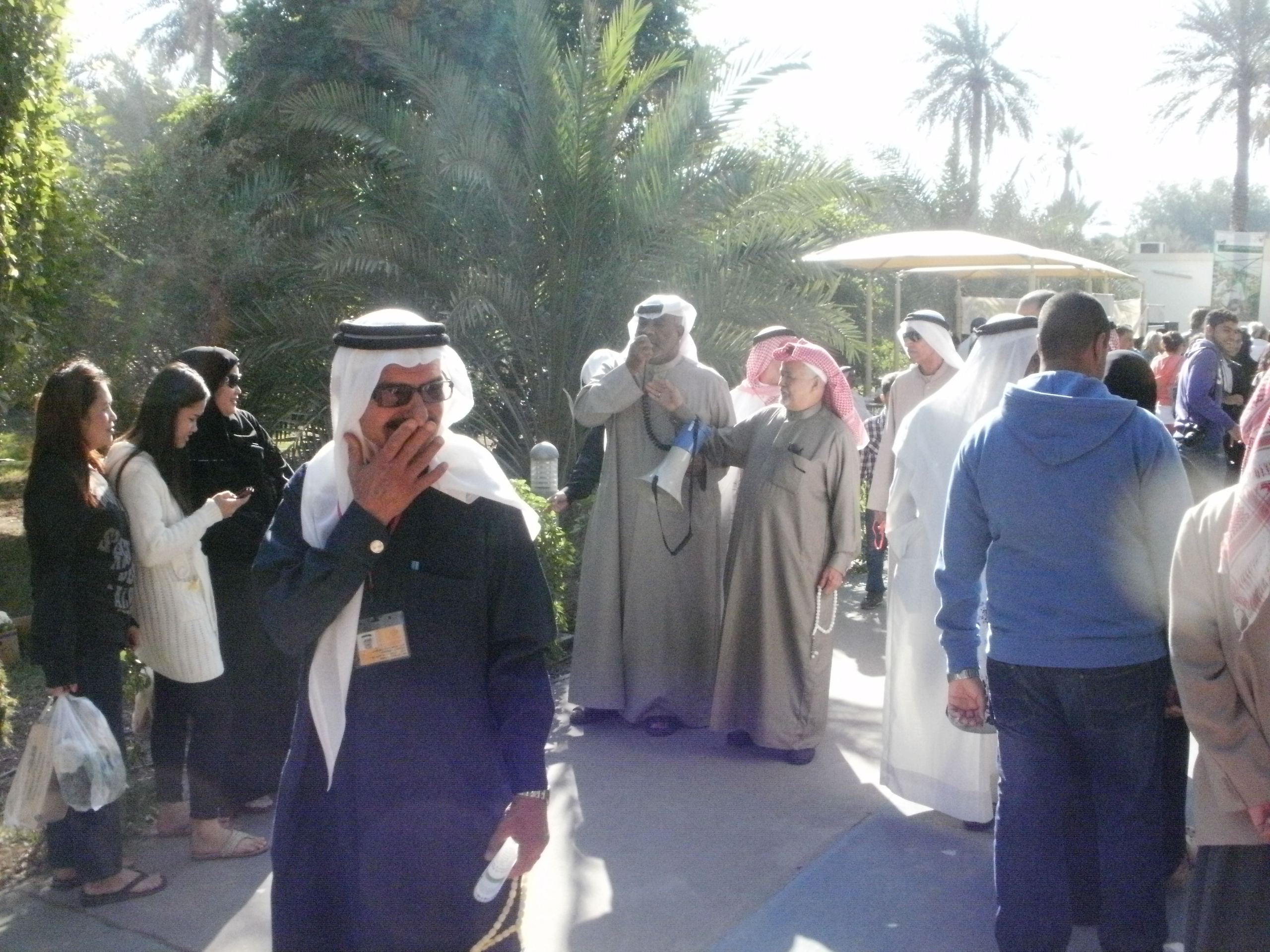
As I was admiring the produce, a group of old men wandered past singing old pearling songs, and the stallholders joined in the whooping refrains.
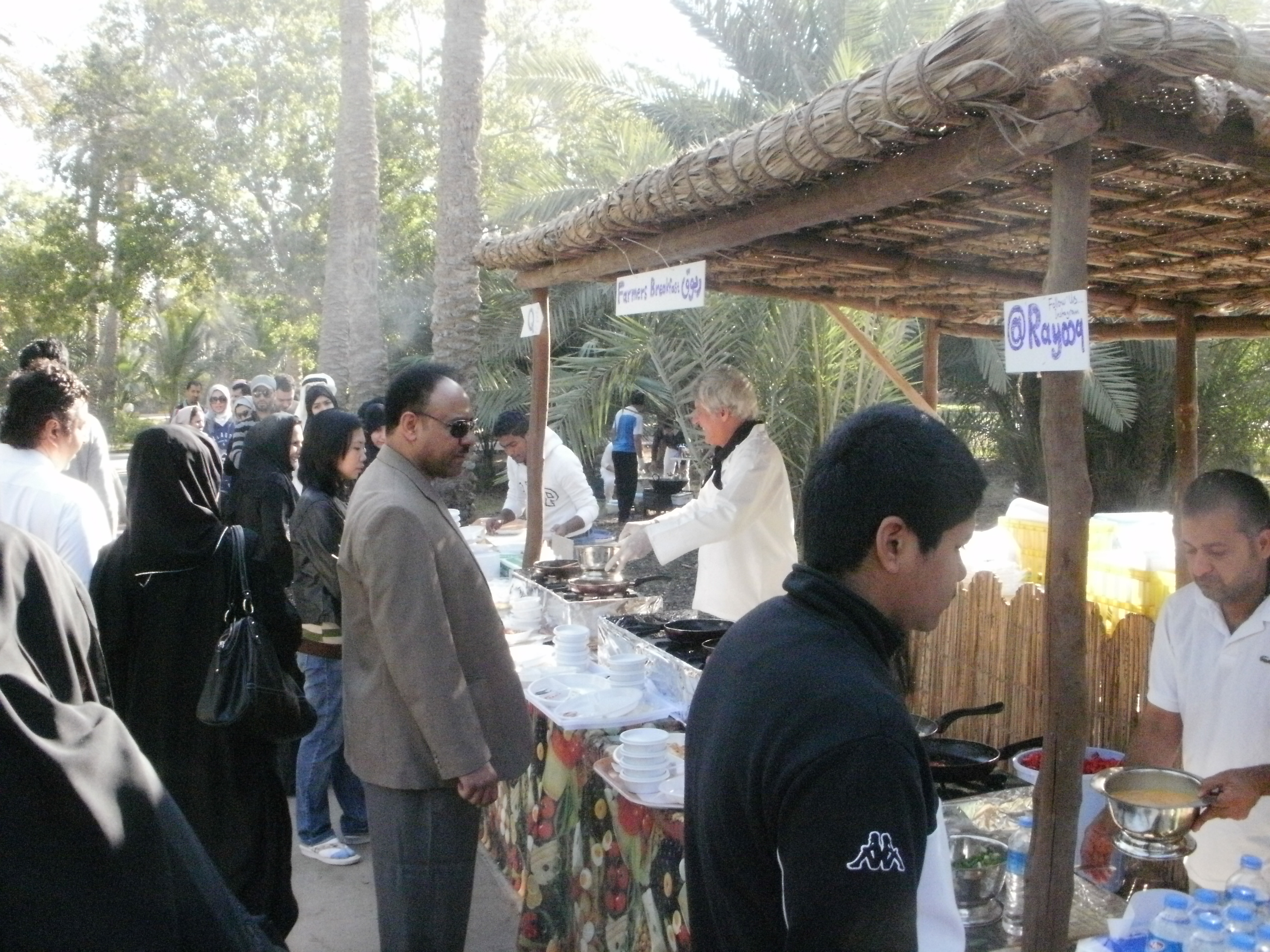
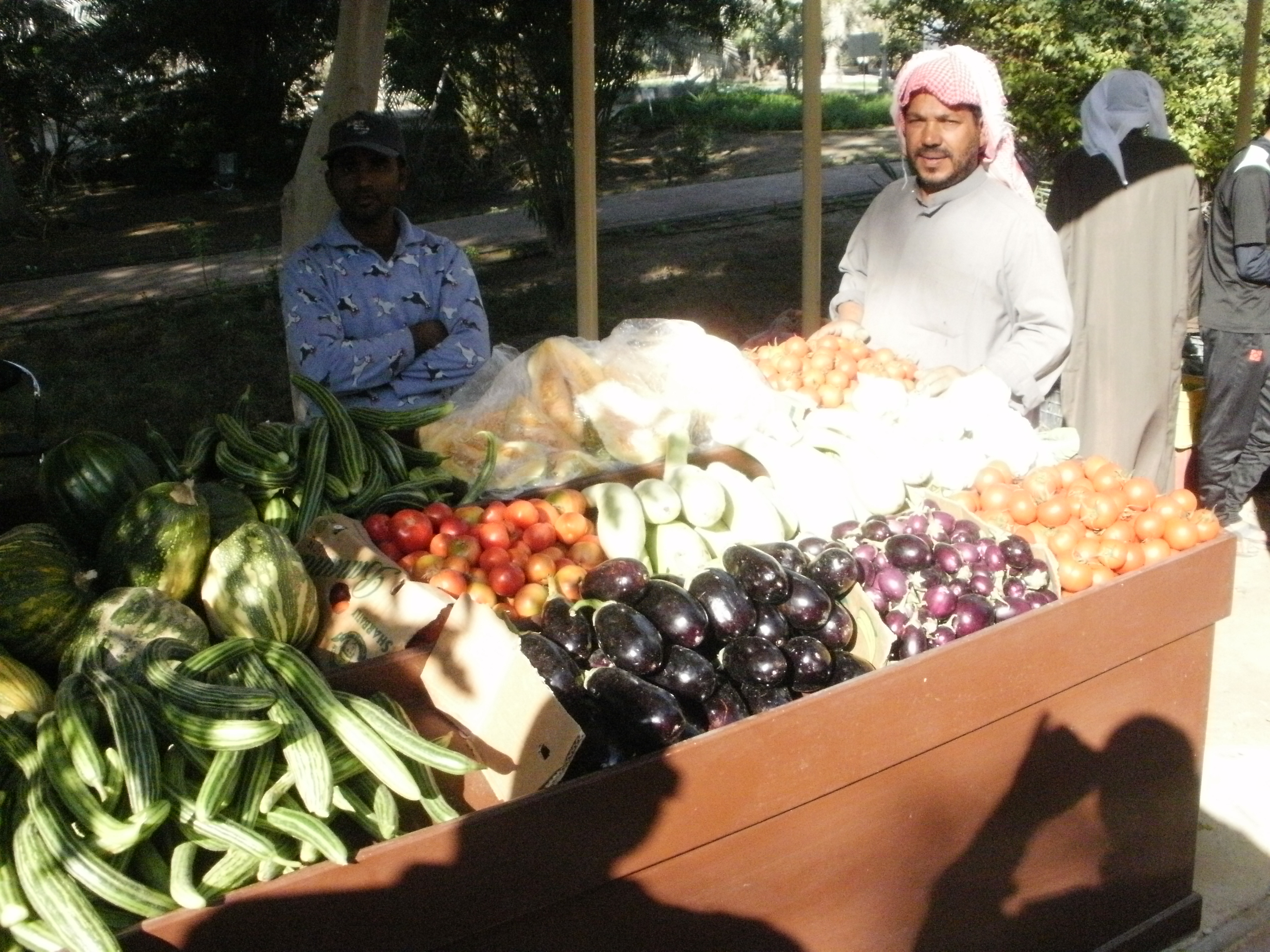
I passed a stall selling baby date palms. According to the owner, the larger plants will produce kilos of dates within a couple of years. A sample of the fruit, washed down with gahwa (Arabic coffee) was enough to convince me that if I had a garden, two years would be worth the wait.
On the way back from the market I passed by a few local landmarks. A castellated palace, Disney-style, overlooking the sea, built by the brother of the late ruler, Sheikh Isa. A row of fine government-built houses lining the shore. A jetty where fishermen were departing in their small boats. And a camel farm built by the same sheikh who owned the palace.
Yet the main road was pitted with the scars left by burning rubbish and tyres, and graffiti – painted over yet still visible – adorned many of the walls.
The market was full of people – Bahrainis and expatriates from the nearby Western compounds. I talked to one of the stallholders. He works as a messenger in the financial district. He cannot not support his family on the salary alone, so he runs the family farm in his spare time, producing vegetables, eggs and milk from his cows.
Look around the market in its idyllic setting, and you would never believe that this was in an area regarded as a hot spot for the kind of street conflict that has plagued the country. Where political activists have been arrested and torture is alleged to have been widespread in the early days of the troubles.
Bahrain boasts many cultural and sporting events. Last night the Gulf Cup – the biannual football tournament between the Gulf nations – ended with the UAE triumphing over Iraq. The place has been flooded with football fans as passionate as any in the world. There is a new National Theatre which this week will stage Rigoletto to celebrate the 200th anniversary of Verdi’s birth. And soon the island will reverberate with the sound of the Formula 1 Grand Prix.
Personally, I didn’t come to Bahrain to watch football, opera or motorsport. Give me the farmers’ market any time, and those old guys singing songs about the sea – so much closer to the island’s roots as an agricultural and fishing community, blessed with abundant springs and coastal waters teeming with shrimps, hammour and yaneen.
Most of the springs have now dried up. Fisheries have been disrupted by land reclamation. And the only pearls retrieved from the sea are taken for tourists on boat trips.
That’s progress, I guess. Traditional industries would never have funded the lavish villas of Budaiya’s elite. The gap between rich and poor was always here, but before the discovery of oil it was at the subsistence level. A matter of land, livestock, boats and food on the table.
Nobody should begrudge the people of Bahrain and the other Gulf states the comforts we in the West have come to take for granted. But with those comforts has come the price of agonising complexity.
In an area so riven by envy and hatred, how precious is the simple pleasure of a farmers’ market.
It’s that time of the year again. Rather than bore you with a litany of disappointment over the missed opportunities and troubles that have afflicted the Middle East in 2012, here are my awards for people and phenomena – some positive, some less so – that have made me sit up and notice:
Politician of the Year: Mohammed Mursi , for his post-chaos power play in Egypt. He and his supporters have clearly studied the history of the communist takeovers in the aftermath of World War Two and applied the lessons in post-Mubarak Egypt – organisation, discipline and the creeping annexation of the levers of state.
Ruler of the Year: Prince Mohammed bin Naif – the first of the third generation of the Al-Saud to be elevated to a key ministry in the Saudi Government. Honourable mention to Crown Prince Salman of Bahrain. If anyone can break the political deadlock in his country, he can – if he’s given the chance.
Blog of the Year: Riyadh Bureau, Ahmed Al-Omran’s news site about Saudi Arabia. Thought-provoking, brave and informative – everything that the local print media usually isn’t.
Book of the Year: Hiroshima Nagasaki, a reminder to Israel and Iran of the collateral damage that will be inflicted on the region if their nuclear squabble reaches its ultimate conclusion.
Sporting Moment of the Year: Wojdan Shaherkani and Sarah Attar competing for Saudi Arabia in the Olympic Games. They gave new meaning to old adage that the Olympics is not about winning, but taking part. Tokenism in the eyes of some, but for me an encouraging sign that the Kingdom is finally starting to recognise that sport is not an exclusively male preserve. Special mention for Wojdan’s father, who resisted the hate mail that followed the announcement of her participation.
Antediluvian of the Year: The Saudi cleric, who, according to the Riyadh Bureau, is intending to pray that Adel Fakieh, the Saudi Minister of Labour, gets cancer if he refuses to reverse his policy of allowing women to work in retail. The gentleman concerned had more competitors for this award than is practical to mention here. I wish continued good health to the energetic and determined Mr Fakieh.
Expatriate of the Year: Robin Barratt, whose untiring efforts to build a Writer’s Circle in Bahrain brought together novelists, poets, non-fiction writers and wannabees of many nationalities. Robin not only developed a thriving community of writers, but created an anthology of their work in My Beautiful Bahrain, which was published early this year. He has now left the country, and will be sorely missed.
Airline of the Year: Gulf Air, only because it may not be around in its current form this time next year if its financial troubles continue.
Journalist of the Year: Marie Colvin, killed in Syria. The war correspondent whose stories I would read before all others.
Cliché of the Year: “Thug”, closely followed by “activist”, “dialogue” and “external interference”.
Promising Newcomers: 60 bright Bahraini teenagers with whom I spent three weeks this summer. They put their elders to shame with their enthusiasm, energy and open-mindedness. Unfortunately I am unable to reveal their identity, but they know who they are.
I would have liked to have cited a Peacemaker, Humanitarian or Leader of the Year. Sadly, no obvious candidates come to mind. But 2013 is upon us, and I live in hope that some heroes emerge who value common humanity above money, power and self-interest – heroes because their actions and achievements match their words and intentions.
I wish everyone in the Middle East a happy and peaceful New Year.
Merry Christmas to everyone who has followed 59steps over the past year.
If you are from the Middle East, it’s been a tough twelve months, and foremost in my thoughts are the many people of all faiths who are enduring the hardest of times – in Syria, Lebanon, Palestine, Israel, Yemen, Iraq, Iran, Egypt, and, last but not least, my country of residence, Bahrain.
I can’t think of a more dangerous time in the region since I first lived here over thirty years ago. Fear, instability, hatred and violence are more widespread, with no end in sight, even though the other side of the coin has been courage, outspokenness and an end to the resigned shrug of the shoulders that signals a reluctant acceptance of the status quo.
As many have discovered, ending the status quo has not been a happy experience. There will be those who, like the Russians who yearn for the “stability” of the Stalin years, would wish to turn back the clock to the certainty of autocratic rule.
Too late for that. I can’t see anything but trouble for the Middle East on a macro level for the next few years. But people will still fall in love, raise families, and try to get on with their lives despite the best efforts of their fallible rulers to determine otherwise.
And I hope that one day they will do so in the knowledge that dissent is not a crime, that speaking out will not result in deprivation of liberty and that disputes do not have to be settled by violent means.
I will probably be in another place when that blessed state applies throughout the region. But I do believe that it can happen. It will be the least that the lovable and loving people of the Middle East deserve.
We all have our blind spots.
Some of us believe in a God so all-seeing and unforgiving that the slightest infringement of the minutiae of ritual directly affects our chances of a blissful afterlife. Some believe that socialism is the root of all evil. Others feel the same way about capitalism.
Me? I have a problem with rigid ideology of all kinds, with absolutes, with certainty. And I’m not very fond of banks for that matter.
In that curious country called the United States of America, there are people who believe that the justification for citizens carrying lethal armaments is that somehow their handguns and semi-automatics protect them from the tyranny of the state. As if force was the only form of tyranny. As if, when the chips were down, any determined state actor would be deterred from using their tanks, drones, howitzers and bombs by a group of citizens wielding the ordnance equivalent of pea-shooters.
Americans who point fingers against nations governed by the precepts of a leader’s words and ordinances uttered in the context of the 7th Century have the nerve to justify their positions in the context of laws created when the scope of lethal force was limited to cannon, bayonets and flintlocks.
And so a mentally-ill youngster in Connecticut marches into a primary school and wipes out a class with the weapons his Mum was so proud of. Oh, and wastes his Mum in the process. A congressman from Texas says that legislators in Connecticut who banned weaponry in schools have blood on their hands because they deprived the teachers of Hook Hill of the means to defend themselves and their charges. As if a 26-year-old female teacher is likely to go to the gun-rack, grab an Uzi and start spraying the perpetrator! Is the congressman suggesting that all lecturers and teachers have weapons training and that every school should have a well-stocked armoury? Or that the thousands of cash-strapped schools in America should put a Rambo on the payroll, ready to fire off a clip at some random intruder?
Here’s another blind spot. A society with an insatiable demands for books, movies and games depicting violent acts thinks that the odd misfit from a generation of kids sitting at their laptops at home obliterating virtual humans will not be tempted to do the same to real ones?
It will take a few cities wiped out by nuclear bombs for the world to say never again to nuclear weapons. Clearly the dead of Dunblane, Oslo, Columbine, Virginia Tech and Sandy Hook are not a sufficiently powerful reason for the living to say never again. And anyway, “never again” is not an absolute. The effect fades with time. One generation’s determination born from experience is insufficient to deter the next generation.
Much as I love America, I find it hard to accept messages to the world of moral primacy from a nation that puts lethal force in the hand of almost any individual who asks for it.
One British tradition unlikely to be imported by the Gulf states any time soon is Speakers Corner, in Hyde Park, where anyone can stand up, announce the end of the world, warn us about alien abductions or cast derision upon the nation’s political leaders.
I’ve been writing a fair amount lately freedom of expression, and especially about the implication of the Leveson Report in the UK. This was the result of a judicial inquiry into abuses of privacy by the British press, and in particularly the illegal hacking of mobile phone voicemail. Leveson has stirred up a big debate on the role of the state in regulating the media.
The BBC’s Bill Law has written an interesting article that provides a stark contrast to the somewhat theoretical concerns about threats to freedom of expression in the UK post-Leveson. He describes the increasing tendency of the Gulf States to take draconian action against bloggers and tweeters who do not show respect for the state and its institutions, as exemplified by a recent measure in the United Arab Emirates:
The amendments to the UAE’s existing law on internet crime were announced last month in a decree by President Sheikh Khalifa bin Zayed al-Nuhayyan, the ruler of Abu Dhabi.
It says citizens who create or run a website or use the internet to deride or damage the state or its institutions face up to three years in prison. Foreign nationals will be deported.
The institutions include the president, vice-president, any of the rulers of the federation’s seven emirates, their crown princes and deputy rulers, as well as the national flag, national anthem, or any symbols of the state.
The law also prohibits “information, news, caricatures or any other kind of pictures” that authorities believe could threaten security or “public order”.
He goes on to look at the other side of the coin – the explosive growth of the social media in Saudi Arabia, and its role in promoting social change. Even if he hadn’t quoted me in the bit about Saudi Arabia, I would still commend Bill Law’s article as a balanced view of the pitfalls of being an online activist in the Middle East, as well as changes in mindset that the social media is bringing about.
For someone like me who is not a journalist or a citizen of the country in which I am a resident, writing a blog about the region does imply certain risks. While I steer clear of the kind of red lines Sheikh Khalifa has unequivocally put in place, I can never be certain that something I write might give offence where none was intended. If I criticise, I try and frame it in a constructive spirit. And so far, there have been no knocks on the door, though one or two supporters of Binyamin Netanyahu were less than happy with some of the stuff I have written about Palestine.
Being relatively careful about what one writes and says in the Middle East becomes an ingrained habit after a while, partly through recognition of the fact that one is a guest in the country in which one resides, and partly because apoplectic prose is bad for the blood pressure. It will be interesting to return to the UK, where public expression is somewhat more robust. It will probably take me a little while to get out of the habit of watching and listening before I speak.
There is much controversy in business circles within Saudi Arabia over the latest measure by the Ministry of Labor to intensify the effort to replace foreign workers with Saudis.
The Ministry has introduced an annual fee of SR2,400 ($640) per expatriate worker payable by private sector companies that employ less than 50% of Saudi nationals in their workforces. Diana Al-Jassem in the Arab News explores the issue in this article.
The problem is that 90% of the private sector workforce is foreign. The reasons are simple. Foreign workers are cheaper than Saudis. Most are tied to a Saudi sponsor, and except through abuses of the system cannot sell their labour to the highest bidder.
Another factor is that many of these workers are doing jobs that Saudis do not wish to do – or so the received wisdom maintains. And I would agree that there are few Saudis who would accept that they were born into of the wealthiest nations on the planet to clean lavatories or slush concrete around on a building site.
Leaving aside the most menial jobs, there is currently a big gap between wages paid to blue collar workers from overseas – factory workers, technicians and so forth – and what a Saudi would consider to be a living wage. The same goes for non-professional administrators and clerical staff. And I suspect that these are the areas of employment that the Ministry is targeting with the new measure.
The difficulty is that many expatriate workers are in the Kingdom without their families. Their remittances support dependents still living in their home countries where the cost of living is lower. Whereas young Saudis expect to “live in the style to which they have become accustomed”. They want to marry, live in a decent home, raise families and employ domestic workers to provide childcare and attend to menial domestic chores. You could call this the “Saudi Dream”. And the kind of wages paid to foreign workers at the lower end of the scale will never support that kind of lifestyle.
It’s a problem all over the Gulf region, but greater in those countries with large populations of nationals to support – Saudi Arabia and Bahrain in particular.
Whole books have been written on this subject, and I don’t propose to go through the complex economics here. But a conversation with a Saudi friend the other night set me thinking.
He believes that Saudisation is dead in the water – the current measures will never solve a problem that the country has been wrestling with unsuccessfully for the past thirty years. And he contends that until the current system of sponsorship is abolished, it will remain so. Why he asks, would a private sector employer hire a Saudi national for SR3,000 a month when he can take on an employee from Pakistan or the Philippines for SR1,000 a month? The Saudi can switch between employers at will. An employer might spend six months and considerable resources in developing that person, only to find that the employee takes their new skills to another employer who offers SR4,000 a month.
Foreign workers, on the other hand, are tied to the employer, and need to return to their home countries in order to apply for a new job in the Kingdom. The only exception is in the case of people who are brought in by sponsors who have no intention of employing them, but allow them to work for other companies. Thus the sponsor generates an income of several thousand riyals a year for each worker under their sponsorship in return for doing precisely nothing except renewing their work visa and residence permit every couple of years. Another widespread practice is for sponsors to act as sleeping partners as their foreign employees effective run businesses in their own right, and take a share of the profit. Critics of this practice say that such Saudis are getting something for virtually nothing, though it’s fair to say that they still have responsibility for their employees, and can get into serious trouble if things go wrong.
To compound the wages gap even further, there is a substantial number of foreigners working in the country illegally. These people work for cash in order to stay under the official radar, and almost all are in low paying jobs.
The Ministry of Labor’s recent measures have been designed to stamp out abuse of the system. In addition to the levy on expatriates, the Ministry has introduced the Nitaqat programme, under which companies lose hiring and visa privileges if they fall short of Saudisation quotas. And it is setting up a number of employment agencies through which the large-scale importation of foreign labour will largely be channelled.
One of the reasons why the latest levy is likely to be diluted is that the owners of private businesses in the Kingdom include some very powerful families, as well as a number of senior royals. These people have much influence, both individually and collectively through chambers of commerce. It is clear that they are lobbying furiously against the measure.
I well remember an episode in the 80s when the Arab News ran the front page headline “Saudi Arabia to introduce income tax on expatriates”. The next day, the headline ran “Income tax on expatriates still being considered”. And the day after, it read “Income tax for expatriates rescinded”.
What happened was that the announcement was met by a flurry of actual or threatened resignations by senior staff in the private sector. Senior businessmen went to the top of the government and complained that mass defections by key staff – many of whom were highly paid westerners at the time – would have a catastrophic effect on their businesses. The only way they could keep their top people, they argued, was by paying the tax for them. The tax was therefore effectively on their businesses, not on the individuals. Their argument won the day, and the Ministry of Finance duly received orders to reverse the decision.
This time round, the Ministry of Labor seems to be made of sterner stuff. And they are not without their supporters within the private sector. Prince Al-Walid bin Talal, the country’s leading businessman, weighed in with a defence of the levy, saying that most nations have some sort of tax on employment, and that SR200 ($53) per month was not an onerous sum.
He has a point. But as my friend commented “why does the government need the money? And anyway it won’t work, because you will never be able to persuade workers to replace low-paid foreigners with Saudis in industries like construction, which is where most of them are.” Others are complaining that the additional cost will be passed on to the government and to ordinary Saudis, who will find that the cost of living will rise.
Another measure advocated in some circles is to introduce a minimum wage across the Kingdom. If that wage was set at a level sufficient to allow young Saudi men to live the “Saudi Dream” of a family, home, car and domestic help, the effects would be dramatic. Combined with the other measures, this would seriously deter the private sector from hiring any but those workers whose jobs Saudis will never agree to do. But it’s hard to see how the increased costs to businesses would do anything but stoke inflation and lead to many small enterprises going bankrupt. Unless, the government agreed to support them over a transitionary period, and special pleading from the worst-affected business sectors resulted in exemptions that applied to manual workers.
All these measures are a combination of carrot and stick.
There is, however, another option that could transform the Kingdom. Again, it was suggested by my friend. Grant citizenship to substantial numbers of foreigners who have been in the country for a long time – perhaps working in jobs that involve a high level of responsibility. Give them the opportunity to start businesses in their own right. Harness their entrepreneurial talents. Use those talents to create jobs. Long-term expatriates, after all, know the country, its culture and business environment as well as many Saudis, and they would be in a strong position to start the kind of small businesses that are the engine of growth in many Western countries.
What’s more, give wealthy outsiders the equivalent of green cards. Encourage them to start businesses. Since 2006, Saudi Arabia has been a member of the World Trade Organisation, and has opened its doors to foreign companies wishing to set up 100%-owned subsidiaries in the Kingdom in certain industries.
But although allowing foreign companies to set up in the Kingdom without needing an agent or Saudi joint venture partner, the hurdles for all but the well-funded are high. The government could lower the hurdles, and in return make it a condition for new start-ups in the SME sector to staff their businesses predominantly with Saudis. That would encourage the kind of businesses that could and would hire Saudis without difficulty.
Perhaps Saudi Arabia should look at the example of its biggest trading partner. The United States has been welcoming immigrants for two hundred years. It has been invigorated by the entrepreneurial spirit of each successive generation of immigrants, many of whom in a generation or two have integrated into society and contributed massively to the prosperity the country enjoys today. The very success of America’s immigration policies has led to fierce opposition to proposals aimed at restricting immigration in the wake of the 2008 financial crisis. Opponents say that shutting the door will stifle the influx of new energy and ambition that immigrants have always brought with them.
Saudi Arabia could be a Muslim equivalent of the “land of opportunity” that is integral to the American national identity. Instead of grudgingly welcoming foreigners and resenting its reliance on them, it could welcome them with open arms, and create an entrepreneurial society unmatched in the Muslim world.
It would take strong and determined leadership to undertake such a transformation. There would be many opposing forces. The current business establishment would fight tooth and nail against the threat to its vested interests. Many members of the indigenous elite of central Saudi Arabia would be disturbed by the prospect of entrepreneurial Egyptians, Jordanians, Pakistanis, Bangladeshis, Indians, Malaysians and Indonesians calling themselves Saudis.
These are the same people who have always looked down their noses at citizens in the West of the country whose ancestors came from other parts of the Muslim world and settled in Jeddah, Mecca and Medina. Yet many third, fourth and fifth generation Saudis from Jeddah are among the most successful entrepreneurs in the Kingdom. The Binladin and Mahfouz families from Yemen. The Alirezas from Iran. The Al-Amoudis from Ethiopia, and many more from Egypt, Lebanon and other neighbouring countries.
Looking askance at immigration is a natural instinct shared by “indigenous” British and Americans. But in truth, Britain has absorbed waves of conquerors and immigrants over two thousand years. And only a tiny minority of Americans can trace their American ancestries further back than a handful of generations.
If Saudi Arabia can absorb millions of foreigners as guest workers, it can also assimilate many of them into citizenship.
India and China have shown what can be achieved through economic liberalisation over the past twenty years. Saudi Arabia could achieve the same or better. Faced with competition from the “new Saudis”, today’s citizens would need to step up to the plate and prove their worth.
To defray the costs of bringing new citizens into the social umbrella and benefit from the prosperity they create, the Kingdom could introduce an even more radical measure: universal income tax.
Why taxation?
Because the country’s citizens are addicted to entitlement. The state provides free education and health care, employment subsidies, interest free loans and, recently, unemployment benefit. Utilities such as water and electricity are heavily are subsidised. If this is to be sustainable in the long-term, Saudis are going to have to get used to giving something back.
Today, Saudi Arabia is burning oil and gas equivalent to four million barrels of oil a day on its own energy needs. Every increase in consumption reduces its ability to export. That’s fine while the oil price stays well above $80 per barrel – the level that the International Monetary Fund believes is necessary for the Kingdom to balance its budget. But if it falls below that level because importing countries – like the US – are becoming self-sufficient thanks to new techniques in extracting oil and gas, and other countries step up their investment in alternative energy sources, things will change. With its current social costs and a rapidly growing population, Saudi Arabia’s massive financial surplus could quickly turn to deficit.
The government is investing in its own alternative energy projects, notably in solar and nuclear power. But will that be enough?
Taxation is a tricky subject. For example there would be the thorny issue of “no taxation without representation”. But the Saudi leadership is smart enough to find ways to preserve its power yet still provide an enhanced level of representation. Indeed, it is moving in that direction today.
But the idea of income tax should not be beyond the pale, and is an option that would instil in society the idea that not everything in life is free.
The Kingdom’s ultra-cautious leadership is likely to regard the last two measures as steps too far, at least for the near future. Each could generate a level of social and political instability that it might consider unacceptably risky, especially as the next twenty years in the region are likely to be as turbulent as the last two.
But who knows – perhaps the third generation of the Al-Saud are even today thinking the unthinkable, weighing up the risks and honing their arguments. Too much is changing around them for standing still – or even advancing at a snail’s pace – to be an option in the long term. Every day, as a senior government official told me a few years back, enough babies are being born to fill a new primary school.
Some challenge. But one should never underestimate Saudi Arabia.
More views from my friend Andrew Morton on press freedom. His comment and my reply are to be found under the comments attached to the previous post. But I’m reproducing them here also.
Referring to my argument that a “unified code” dealing with all media would be almost impossible to implement, Andrew came back with:
Just to ride my little hobby-horse a little longer before I dismount – regarding the much vaunted 300 years of press freedom- I assume this is referring to the 1689 “Bill of Rights”. However, the Bill of Rights, rather like Magna Carta was really about readjusting the power relationship between one set of aristocrats and another. Admittedly, both documents have a powerful symbolic significance, and in reality mark stages in the tortoise-like crawl of this country towards some kind of democracy. Those who cite the Bill of Rights are likely to be exactly those people who want to keep the debate about press freedom in the privileged arena of powerful interest groups regardless of the potential dire effects of press freedom on ordinary citizens. Having said all this, I agree that the matter is complex and to be approached with extreme caution.
My reply, with a few additional thoughts inserted here, was:
One of the reasons I blog is that after decades of watching the world go by while getting on with the mundane job of making a living and tending to the needs of the next generation, the internet has given me an independent platform to air views I have shared and discussed with people – such as yourself – on an individual and collective basis since childhood. And I can air my views without having to become a politician, a journalist or a preacher. That’s not to say that I’m free to write everything I would like to without consequences. I live in a region that is increasingly paying attention to online ramblings.
I don’t really care how many people choose to visit this site, only that those who do find it interesting. The important thing is that the axe I grind is mine alone. No need to squeeze through the portals of the opinion-formers in the print or even the mainstream online media. And an opportunity to reach anyone in the world who sits at the end of a copper wire, an optical cable or a satellite signal.
Millions of people, like me, write for love, not for money. What we write may not be of more than passing interest to any but a tiny minority of internet users, but that’s for the user to decide, not the writer, and – unless the writer falls foul of current legal and moral codes – not a mediating third party.
The print media is not yet in its death throes, but it certainly appears terminally ill. From my standpoint it is more important in the long term that national or international regulators and commercial interests do not exert the same type of control – often stemming from monopolistic and ideological instincts – over the online media as they do over TV and newsprint. Otherwise my voice, which matters to me even if it doesn’t to anyone else, might in the future fade away and return to the confines of four walls.
The increasing migration of conventional media to the internet means that we have a greater choice in what we view and read. And that means that we cannot so easily be prevented from access to content that others might not want us to see. And that content, as we all know, can be malevolent, manipulative and destructive as well as life-enhancing. The internet gives us a choice. We can exercise our critical faculties or swallow without thinking. At the risk of sounding like Eric Cantona, now we’re wandering through the forest and picking our own mushrooms – instead of buying them in a supermarket safe in the knowledge that what we buy is unlikely to kill us.
So for me, the debate over control of the internet is the big one. Arguing about the print media is starting to look like a quarrel over a sick man’s will.
In my previous post on Leveson, I referred to the UK’s Prime Minister throughout as David Campbell. He is, of course, called Cameron! I suspect that in my mind at the time he was in the process of morphing into Tony Blair’s ferocious press secretary, Alistair Campbell. The gentleman who pointed out my senior moment, Andrew Morton, an old friend, commented on Facebook:
I remember years ago having a discussion with you, Steve, where we agreed there was just too much legislation going through. And I agree that in this case it’s a moot point – to legislate or not, and how. However, I’m getting a bit cheesed off with this trumpet call about “the press has been free for 300 years” – clearly some dimly remembered history lesson some posh boy has dredged up and spread about. Governments have been interfering with press freedom one way or another throughout this period and it may be that we have to reassess ideas of press freedom and the rights of citizens in a radically new media environment.
I agree with Andrew. The BBC is a case in point. The poor old Beeb, even before it was battered by the recent Newsnight controversy (about which I commented here), has been accused of bias in favour of the other side by just about every government over the past 30 years. Much as visitors to Manchester United’s fortress, Old Trafford, complain that referees are afraid to award penalties against United for fear of the wrath of Sir Alex Ferguson. And, more recently, that whenever United are losing at home, referees seem to allow more injury time than when they are winning – which turns out to be true in recent seasons!
Yes, especially in times of war, the government does indeed heavily curtail the activities of the press in reporting “sensitive information”. In peacetime, it has frequently used the D-notice to prohibit the publication of information that it deems not to be in the public interest, particularly in matters of national security. Other methods of control and manipulation have included “off the record briefings” to the Press – in other words, unattributable leaks from Government sources, sometimes against other members of the government. Over the past 20 years, an army of unelected spin doctors, of which Campbell (Alistair, that is) was the doyen, have perfected the art of conditioning public opinion via the media.
Interestingly, Jon Ungoed-Thomas of the Sunday Times reports in today’s edition that Ed Richards, the Chief Executive of Ofcom, the broadcasting regulator:
Outlined his ambitious vision for media regulation: a common set of standards that could be applied to all forms of publishing, from an internet broadcast to a newspaper article.
It was a simple notion that a unifying code of principles could be applied to every media outlet in the land. But it raised one vital question: who would oversee it?
Ungoed-Thomas goes on to say that Richards was a strong supporter of Tony Blair, and that Cameron does not want Ofcom moving into the domain of press regulation, so that idea is not likely to fly.
The same article speculated that Ed Miliband, the Leader of the Opposition, who initially backed full implementation of Leveson, is now having second thoughts. Sensible chap.
Andrew’s point on “reassessing press freedom and the rights of individuals in a radically new media environment” is well made. But creating a new law, or even a new code, would be a challenge. Britain’s legal system is a mish-mash of statute and common law, overlaid in recent years by legislation adopted throughout the European Union such as the Social Chapter and the Human Rights Act.
As I see it, there are two impediments to creating a “unified law” dealing with the media.
First, the United Kingdom needs to decide whether it wishes to remain in the European Union. If it opts for the status quo, any media law passed will need to be continually in synch with EU ordinances. It also needs to decide whether it wishes to remain a united kingdom. The succession of Scotland from the UK would produce its own round of legal nightmares.
Second, “the media” is changing so rapidly – particularly as traditional outlets converge and merge into the internet – that it may be beyond the ability of legislators to keep up with those changes. The McAlpine defamation saga is a case in point. Who does he sue? The tweeters? The re-tweeters? Under what jurisdiction does he sue foreign re-tweeters? And if he is unable to sue individuals who are subject to foreign jurisdictions, how can he protect himself from the lingering effects of the defamation? Would the UK be willing to apply internet filters to stop domestic surfers from accessing references to him on sites hosted outside the UK? Would such filters work? Ask the Chinese.
Prince William’s efforts to prevent the publication of topless pictures of his wife is another example of the difficulties of controlling content on the internet. He was unable to stop the pictures appearing in foreign print media, and no doubt they are still out there on the internet today for those who could be bothered to find them.
As far as the internet is concerned, Great Britain is not an island. So any law designed to protect individual rights can only be partly effective as long as the internet continues its current path towards domination of the media. Unless, of course every foreign jurisdiction can be persuaded to pass similar legislation. And that will never happen.
So any proposed unified media law passed in the UK will inevitably occupy its creators for a long time, and is only likely to be partially effective. And my guess is that no UK governement will make the effort any time soon. That’s the price we pay for living in a wired world.
“The trouble is, my dear Mozart, there are too many notes……. there are, in fact, only so many notes the ear can hear in the course of an evening.”
I can quote the Emperor Joseph’s reaction to Mozart’s Marriage of Figaro in Amadeus with a little authority, having once played the Emperor in a stage production of Peter Schaffer’s masterpiece.
How is this relevant to UK Prime Minister David Cameron’s lukewarm reaction to a key recommendation in the Leveson Report on Culture, Practice and Ethics in the Press in the United Kingdom – that new legislation is needed? Well, it’s a quote that would most likely be well known to the thespian victims of press malpractice interviewed by Leveson in the course of 16-month inquiry. And if the Emperor returned today to share his wisdom about the UK’s legal system, he might say that we have “too many laws”.
Sir Brian Leveson recommends legislation to oversee a new regulatory body that would replace the current Press Complaints Commission. Cameron stated in Parliament that he was unconvinced that a new statute was necessary. He believes that the press should be given the opportunity to create an effective regulatory body without statutory controls. He didn’t rule out the possibility that if they failed to do so, he would step in and legislate.
While generally I’m not a great fan of Cameron or his pantomime horse of a government, on this issue I’m with him. I’m no Tea Party-style small government libertarian, but I do believe that laws should be made as a last resort when all other means of achieving a desired result have failed. I discussed this in The Lawmaker’s Holiday a couple of years ago:
Great ideas are one thing, but proper execution is another. Governments thrive on new ideas, new initiatives. When they fail, they try to divert attention from that failure by launching yet more initiatives. Perpetual motion is not the same as effective government. By slowing down the conveyor belt of new laws, politicians would need to find other ways to justify the trust placed in them. Improved scrutiny of public programs. Fixing what is not working without having to resort to new laws. And spells in the paddy fields for politicians and desk-bound civil servants – in the form of regular and direct engagement in the lives of the people they govern – would do more to re-establish popular trust in politicians in my country than yet another byzantine system for controlling expenses racked up by Members of Parliament. It might even help them to make better decisions.
Change that improves the lives of the many for the better tends not to come as the result of legislation thought up in policy think tanks. It comes as the result of groundswells of sentiment among large segments of a population. Lyndon Johnson would not have been able to end a century of institutionalized discrimination in the United States had it not been for the efforts of the Civil Rights Movement, a coalition of black and white activists given voice and inspiration by Martin Luther King.
There will be massive pressure on the Prime Minister to change his mind. The natural reaction on the street to a systemic problem in society is that “there ought to be a law against this”. Parliament is in business to make laws – it is therefore predisposed to legislate in order to justify its existence. Leveson is a lawyer – he would be a brave man if he had spent two years and not came up with a report that advocated some form of change in the law. Governments are judged by the voters on what they do – not on what they don’t do. Opposition parties are judged on what they say they would do.
So it takes a little courage to stand against an overwhelming consensus in favour of “immediate action”. Yet has nothing happened in recent years in the wake of the phone hacking scandal that triggered the Leveson Inquiry?
On the contrary. Individuals responsible for phone hacking have been prosecuted and sent to jail. Victims of phone hacking have received large sums of money in settlement of damages from the main perpetrator, the News of the World. There are criminal cases pending against News of the World executives. The newspaper itself was closed down by its owner, News International.
At the time, I commented rather gloomily in Phone Hacking and the Death of a Newspaper:
As for Rupert Murdoch, he did a good job of convincing us in the recent parliamentary hearings that he was a clapped-out, much diminished 80-year old. His son came over as a diligent corporate apparatchik, far from the man his father is, or was. Yet Murdoch still controls a media empire that encompasses the rational – The Times, BSkyB, the Wall Street Journal – and the rabid – The Sun newspaper in the UK (the NoW’s former sister daily) and Fox News in the US (the platform for such eminently objective figures as Sarah Palin and Glenn Beck).
Which makes you wonder about his values. A self-confessed libertarian – a title that can be interpreted in many ways – his career suggests that he is one of those individuals whose value system is subordinate to the needs of his business, not the other way round. How otherwise could a man own both the Times and the News of the World? And how would you explain his support for such diverse political figures as Margaret Thatcher, Tony Blair, Barack Obama and the Republican Governors’ Association? I don’t doubt that he lives by a set of personal values in his private life. But whatever they are, they don’t seem much in evidence in his business life.
Murdoch is a man of his times. He jumped on an opportunity to create a transnational empire by riding the tide of globalisation. His time will soon be over. Other Murdochs will take his place. Those who call for greater regulation of global media empires are whistling in the wind. By and large, companies like News Corporation will be continue to do their business in the knowledge that no single state is strong enough to stop them from plying their trade wherever a financial, legislative or political regime best suits them.
And the rest of us will continue to be snooped on, lied to and manipulated, not only by organisations like Murdoch’s, but also from time to time by our own governments. Conversely, those same entities will sometimes entertain us, enlighten us and improve our lives. Just occasionally, a Watergate scandal or the suffering of a bereaved family will put the brake on things getting too out of hand, and cause us to think about the impact on us of media and government, rather than simply go with the flow.
And now, thanks to Leveson, we are thinking. For me, there are two key issues:
First, we already have laws that deal with excesses by the print media – covering data protection, defamation, corruption and illegal surveillance, for example. Several of them have been brought to bear in the phone hacking case.
Over the past fifteen years the state in all its various forms has acquired new powers relating to privacy and freedom of expression – they include enhanced powers of surveillance and the criminalisation of expressions of racial, religious and ethnic hatred. The existing Regulation of Investigatory Powers Act (RIPA) – originally introduced in 2000 as a measure primarily designed to counteract the increasing threat of terrorism – empowers numerous national and local government agencies to conduct electronic and physical surveillance of individuals and organisations. It has been used to monitor activities entirely unrelated to terrorism, such as dog-fouling and attempts to claim residence of an area in order to secure school places for children.
At present, the government is seeking to extend its powers to monitor and require the storage of mobile phone, email and internet use. Are we absolutely sure that data thus stored will not be used in a manner unintended by those who are drafting the legislation? And equally, can we be sure that by rushing to legislate in the wake of Leveson, we are not opening the door to future government cutailment of the freedom of the press, as those who argue against of immediate implementation point out?
Second, regulating the print media will only address part of the problem. Recently, a prominent politician, Lord McAlpine, was falsely branded a paedophile in the wake of the Jimmy Savile scandal. The accusations, which naturally caused him deep distress, did not come from the print or broadcast media. They came from the internet. So if the purpose of legislation is to protect people from such distress, then surely it should also address the internet? Leveson only devoted a single page to this issue, which was understandable, since it was outside the scope of his inquiry. It’s also not surprising that it was excluded. Like News International, the internet is transnational, and UK legislation can only regulate acts carried out in the United Kingdom.
But since the McAlpine case is still rumbling on, it would be very tempting for the government to say “OK, if we’re going to sort out the press, let’s deal with the internet at the same time”. So we then get another raft of legislation in an area fraught with difficulty, with further potential for unintended consequences.
But let’s assume that Cameron ignores the bigger internet picture for the moment, and concentrates on Leveson’s recommendations.
A free press acts as an invaluable counterbalance against infringements by authorities of civil liberties. Although Leveson goes to great lengths to point out that “regulation of the regulator” in no way curtails the freedom of the press, I do believe that no harm is done by taking the time to think carefully about the implications of the legislation he proposes, in order to avoid the potential for scope creep that followed legislation such as RIPA.
The phone hacking scandal has generated a widespread sense of revulsion against abuse of the freedom of the press. Leveson’s report puts those abuses even more firmly in the public eye. Even if it takes six months or a year for the government to make a decision on legislation, I doubt that the press over the next year will be foolish enough to carry out the practices so heavily criticised in the report. And that period of reflection opens the door to public consultation based on a green paper. As Cameron says, it also gives the press the opportunity to come up with new proposals for self-regulation.
I live in a region where freedom of the press is a fragile thing – continually redefined by laws that are often sweeping and vague, where proprietors routinely promote political, social and commercial agendas far more rigorously and blatantly than Rupert Murdoch ever did. For all the shortcomings of the British press, I would not exchange it for any other.
Cameron is right. We should take time with this. The issue is too important for hasty decisions. And we have too many notes already….
In all the furore over President Mursi’s decree placing himself beyond the remit of the judiciary, one question occurs – where does the newly-enthroned Pharaoh stand with the military?
One of the President’s early actions on taking office was to “retire” the chairman of the Supreme Council of the Armed Forces, Field Marshal Mohammed Tantawi, and his chief of staff General Sami Annan.
It’s a question pertinent to the current goings on, because while the dismissal of Tantawi and Annan made a big splash both domestically and internationally, there was little mention of any move to lessen the grip that the armed forces exert over the economy.
In June of this year, the BBC website ran a story about a massive new sports centre recently constructed by the army. The article went on to say:
“As the debate over the role of the military in post-Mubarak Egypt intensified, General Mahmoud Nasr, the assistant defence minister, told a press conference in Cairo last year that the army would never hand over control of these projects to any other authority, adding that these were not state assets but were “revenues from the sweat of the ministry of defences and its own projects”.
At around the same period it was announced that the army had come to the rescue of the ministry of finance by lending the state a substantial amount of money to shore up its rapidly-depleting coffers.
This sums up how the Egyptian military operates like a state within the state.
Estimates vary as to the size of their industries – they account for around 8%-40% of Egypt’s gross national product.
But since all the military’s accounts are kept secret no one knows for sure.”
Since Tantawi’s dismissal, there has been no mention in the international media of any attempt by Mursi to reduce or gain control of the army’s economic interests. I am no expert on the murky world of Egyptian politics. But common sense suggests that in order to assure the loyalty of the military, he might have come to a tacit understanding that he would not threaten those interests.
Could it be that because he is confident that he has the army’s might on his side, he felt secure enough to issue the decree?
In the event of a prolonged stand-off between Mursi’s supporters and his opponents, the actions of the army, as they were in 2011, would be critically important. And if the army maintains its control over a substantial slice of the economy, is it accurate to describe Mursi as the latest Pharaoh?
One of my favourite bloggers from Egypt, Mahmoud Salem (aka Sandmonkey), wrote a very cutting post about this issue shortly after the departure of the generals. Since then he has been inexplicably silent.
I find it strange that the potential role of the military has not featured in the coverage I’ve read about the current crisis. Perhaps I haven’t read enough.
If you have never been to Saudi Arabia and only have a passing interest in the Middle East, you might think of the Kingdom as a monolith of social repression and intolerance, and only pay attention when stories emerge to support that view.
If so, this post is for you. Even if you can’t be bothered to wade through my prose, at the very least follow the links.
I lived in the Kingdom for many years. Today much of my business is there. And yes, there are powerful conservative interests in the country whose influence is putting a brake on social change that would be recognised as meaningful in the West. But the country is no monolith. There are as many different opinions and attitudes as you would find in any other country, even if the authorities make it difficult for many outside the Muslim world to visit and find out for themselves.
If you need evidence of Saudi social diversity, take a listen to this podcast from Jeddah, the city where I spent most of the 80s. It’s the latest in a series of conversations that I’ve dipped into over the past three years.
http://www.jeddahpodcast.com/2012/11/episode-60-ahmed.html.
In the podcast, three young Saudis discuss a variety of subjects, including journalistic standards, freedom of expression, attitudes towards women, sexuality and other subjects high on the taboo list of the social and religious conservatives. One of the participants, Ahmed Al-Omran, is a well-known blogger. His site, Saudi Jeans, has been active for eight years. Recently, after returning from the US, where he studied for a Masters in journalism and worked for National Public Radio, Ahmed started Riyadh Bureau, a website full of thought-provoking stories from the Kingdom.
The podcast is in English. The broadcasters are bright, articulate and insightful – serious, yet full of life and humour. They are clearly aware of the red lines not to be crossed, yet they are not afraid to push at the boundaries. Most important of all, any young Westerner listening to their conversation is likely to think “wow – these people are just like me!” And guess what – in all that is important, they are.
You might think that these three people represent a privileged elite, and that the vast majority of Saudis conform to the stereotypical Western view. You’d be wrong. I meet many Saudis in my work, and I can tell you from my experience that the attitudes you will encounter in the podcast are far from unique, and not limited to young people.
What’s more, as thousands of Saudis return each year from studying abroad under the King Abdullah Scholarship Program, voices like these will increasingly be heard. This is not to say that people returning from the US or the UK will be born-again Westerners. Many return with the same mindsets they had when they departed – be they liberal, conservative or any shade between. If you listen carefully to what one of the women was saying about the need to behave in different ways depending on the company they keep – work, family, friends – it will be clear that there are no social ghettos to which “progressive thinkers” can retreat. There is no denying the need to conform to social contexts that may still appear alien outside the Middle East.
The internet culture within the Kingdom is just as important a driver of change as the return of foreign-educated Saudis. In the podcast, Ahmed said that he has over thirty thousand followers on Twitter. At least as many young people get their entertainment on YouTube through their mobile devices as watch TV. There are nearly six million Facebook users – 23% of the population. There are numerous Saudi blogs, both in Arabic and English, of which Ahmed’s site is one of the most popular.
Saudi Arabia is not utopia. Nor is it the authoritarian monolith it is made out to be. It is home to many different schools of thought, and its society is ordered by a complex balance of interests, sometimes competing with each other and within themselves – government, business, religious and tribal structures. Social change is slow, and the country has other pressing issues to contend with, not least an extremely high level of youth unemployment. If you were to ask the average Saudi whether they would be prepared to risk the kind of eruption experienced in other parts of the Arab world for the sake of faster changes to social mores, I suspect that the overwhelming majority would say no.
I’m pretty sure that the pace could accelerate without the risk of a meltdown, as no doubt the three podcasters would like. But it’s not simply a matter of waiting for older, more conservative, generations to pass on. It’s more complex than that. Polarisation of opinion is vertical as well as horizontal.
But I get the impression – without concrete evidence to back up the assertion – that those pushing for faster social change have a greater mastery of the social media than those resisting it. And in the coming years, the combination of returning scholars and the wide exchange of ideas through the social media might be the catalyst.
Meanwhile, it will serve us all well to celebrate what the people of Saudi Arabia have in common with the rest of the world rather than to focus solely on what sets them apart. If you get the opportunity, go visit and see for yourself. This is a country that matters to us all for many reasons beyond its primary export. And I for one cherish my Saudi friends as much as I do all others.
A couple of days ago the BBC World Service ran a feature on Big Data. This, apparently, is the kind of information we have been collecting since the dawn of computing. Stuff about us, willingly or unknowingly donated as we go about our daily lives. Stuff about our world and the cosmos beyond that flows into data centres from satellites, weather observatories and sensors on the ground and in the sea. And stuff collected by humans before the age of computers, meticulously digitised and integrated into models that help us predict the future. Or not.
It was the kind of radio where you could predict the age and appearance of the contributors without the benefit of video. Apart from the US Army general who’s “excited” by the use of big data to improve the treatment of brain injury in soldiers and NFL footballers, the experts were Jobsian corporate types, whose excitement leapt out from the airwaves. The kind of enthusiasts who are too young to remember that “cool” was invented in the 1940’s.
According to a chap from Virgin Media, there is the data equivalent of 83 billion high definition movies stored in computers around the world. The same guy waxed lyrical about big data helping him to eliminate mundane tasks and freeing up his time to focus on important stuff – presumably like watching high definition movies or flogging them to other people.
This led me to think about how this thing called big data affects my life – or doesn’t. On a day-to-day basis, most of us don’t think about data, unless we’re in the information business. We take it as a fact of life if we blunder into inner city London and get sent a bill because we haven’t paid the congestion charge. We’re annoyed if our phone bill is incorrect, and when we contact the call centre in Bangalore, we expect the charming operator to have our customer information in front of her in seconds. We sneer if the weather forecast is wrong, not thinking of the zillions of calculations that enable us to find out if it’s going to rain when we play golf this afternoon, or how things are looking at the holiday resort we’re heading for tomorrow morning.
Some of us remember life without much obvious big data. Early in my professional life I operated one of those monstrous IBM mainframes that took 24 hours to process a payroll run that could be done today on a laptop in five minutes. For many people growing up today, the fruits of big data are no more startling than switching on the kettle for a morning cup of tea.
So I got to asking myself what kind of data makes a positive impact on my life, what I can do without, and what leaves me indifferent. One of the mundane tasks beloved of men is apparently creating lists. As a member of the anally retentive fraternity that enjoys counting from one to ten instead of doing more important stuff, I humbly offer five types of data that I want, five that I don’t want, and five that I don’t care about. Obviously it’s a very personal view, and I doubt that anyone reading this would choose each of the items below. For which reason, I welcome your thoughts and comments.
Want:
Google: my life would be diminished without Google. Actually any old search engine will do provided it can deliver what Google does. Where else would I go to find out the plot in a movie I haven’t time to see through to the end? If I want to do a bit of personal media monitoring and see how many pics there are of me on Page 1 of the image search on my name? (The answer, by the way, is five on the first line of images – my own little personality cult.) If I want to find some massaged statistics or loony views on a subject?
Wikipedia: despised by academics who discourage its use as reference points in indigestible PhD theses, preyed upon by PR companies who want to burnish their shady clients’ backgrounds, Wikipedia is still a marvellous resource. Where else can I find – in seconds – stuff about poisonous snakes, obscure 1930s politicians, reptilian conspiracies and combatants in the Hundred Year War? Yes, it’s pretty hit and miss, and you need to exercise your critical faculties on what you read, but there has been nothing like Wikipedia in the history of humanity. I thank Jimmy Wales and his friends for that.
Census Data: censuses have been around since the time of the early Pharaohs. In the 30s, thanks to the good offices of IBM, the Nazis industrialised the process and used the Big Blue’s punchcards to record the throughput of the Holocaust. More recently, records from successive British censuses have been digitised. I’ve always been one for family history – I managed to find out how many servants a couple of my ancestors had in 1901. Before I croak, I fully intend to do the genealogy bit. How nice to discover that I’m descended from a bastard of Charles II, a cutpurse from Dartford, a merchant from Istanbul or just a boring sheep farmer from Flanders. Genealogy uses data to bring history alive, and we can’t have enough history.
Genomes: I’ve dropped enough hints over the past few years that I’d like a DNA profile done. Even better would be a full genome. Not that I want to know what horrible disease is likely to claim me in the course of time – my lifestyle almost guarantees that a self-inflicted condition will see me out before any genetic predisposition. But I’d dearly love to know how much Neanderthal lurks in my genes, or whether I’m one of the millions whose ancestors sprung from the loins of Genghis Khan. So far, my family have not come through. Maybe this Charismas.
Surveys: I love surveys, and I use them often in my business. Web-based tools like Survey Money are easy to use and cheap to buy. The best thing of all is that you can produce any result you want. That’s not true of course. But when you have some bone-headed person who can only be convinced of a point by being presented with some quantitive evidence, these days you don’t need to hire Gallup for millions of dollars to make your point.
Don’t Want
Economic Data: Am I alone in zoning out when politicians start spouting economic statistics? You know they’re being selective. They know you know, yet still they do it. Gordon Brown, the former British Prime Minister was a walking, talking teleprinter. As Barack Obama once said, you can put lipstick on a pig, but it’s still a pig. It got so ridiculous in the recent US elections that there were teams hired by both sides specifically to dissect the statistical blather uttered by the candidates, and expose the bull.
Illegible charts: I’m one of those people who struggle to understand complex graphics. There must be a neurological condition that describes my problem – graphical recognition disorder perhaps. Nothing annoys me more than sitting through a presentation full of pie charts and process diagrams which the speaker assumes must be intelligible because some bright acolyte has spent a few days creating them in Powerpoint. And they’re so bloody detailed that you need the Hubble Telescope to make any sense of them. The worst offenders are business consultants trying to sell you something, and TV journalists trying to explain the inexplicable, especially when they’re talking about finance.
Rocket scientists: How the big financial institutions allowed a bunch of unhinged mathematicians to screw up their businesses is beyond me. Complex financial and trading models nobody – including decision makers – can understand apart from their creators, are one of the major reasons why we’ve gotten into the mess we landed in back in 2008. When a concept is too complex for an executive, a politician or an EU auditor to grasp, then God help the rest of us, because most of them are just a dumb as we are. Rocket scientists are the high priests of wilful obscurity, and data is their sacrament.
Decision support systems: I don’t trust systems that suck data from multiple sources, digest it and spew it out in the form of a few simple numbers on a sexy software dashboard. If you think that’s all you need to run a business from the commanding heights of an enterprise, then you’re no smarter than politicians who sit in ivory towers and make decisions that affect the lives of people about whom they have zero understanding. Data never, ever, ever, tells the whole story about anything.
Labour saving apps: the whole idea that we can use data to free up our time for more “valuable” activities is one of the myths of our time. Just as the mania for kitchen devices has created demand for products that we buy but never use – teasmades and vegetable peelers in our parents’ generation, and now bread makers, talking fridges and cappuccino machines – the modern software equivalents fail to take into account that if we spend all our time doing “valuable things”, we’ll keel over with stress. I actually like doing mundane things that allow my brain to idle. I have no problem with peeling potatoes, weeding the garden and checking the use-by date of food in my fridge. Doing mundane stuff puts me into a kind of dream state. It serves as a contrast to all the brain-draining stuff the modern world considers valuable. Routine is good. Boring is good. Making lists is good.
Don’t care
Facebook: if people want to post pictures of goofy dogs ten times a day, tell us about their drunken holidays or bombard us with obscure quotations and motivational slogans, that’s fine by me. If they end up regretting the consequences when their youthful (or senile) indiscretions go viral, that’s also fine by me. Any Facebook user who makes naïve assumptions about the privacy of the personal information they entrust with Mr Zuckerberg has only themselves to blame when their silliness, vanity or narcissism comes back to bite them in the bum. I have no problem with Facebook or with people who use it, for I am one of them. But for every benefit it delivers I can see a downside. Personally, I don’t care if it lives or dies. The same goes for Twitter, by the way.
Personal data: when I say I don’t care about the fact that information about me is sitting on a thousand databases, many of which are increasingly talking to each other, it’s largely because my life is so unremarkable that I can’t conceive of anyone finding data about me to be remotely interesting. I might feel differently if some government of the future marks me down for euthanasia once I reach a certain age. The problem is that we signed our pact with the devil when we started using computers, and with the arrival of the internet, the pact has become a tender embrace. I do object to having my identity stolen and my credit cards cloned, and I don’t like the idea that someone’s listening to my phone calls and storing my emails. But I’m afraid that these are realities we will find it difficult to roll back. So the sensible approach is to be aware and take evasive measures. And don’t forget to vote out any bastards that want to take things too far. Thank goodness we can still do that in many countries.
Personalised marketing: I’m not fine with spam, which is not in any way personalised except in as much as some criminal has got hold of my email address and wants to sell me Viagra or scam me out of money. But by and large I am OK with companies like Amazon trying to sell me things on the basis of my previous purchases. The point is that with most of these guys you can opt out and unsubscribe. If you can’t, it’s spam. And yes, I do get a lot of email from organisations that are getting ever smarter at hitting my personal spots. But I really don’t care that much, and spending an hour or two every month clearing them out is one of those therapeutically mundane tasks I was talking about earlier.
Climate data: I can see a few of my beloved readers bristling when I say I don’t care about climate-related data. Wait. This is not the same as saying I don’t care about the consequences of climate change. I surely do. But I’m fed up with swivel-eyed followers of the true faith bombarding us with stuff that turns out a month later to be either false or just half the picture. So while I’m always interested in the detailed science, I only pay attention to the balance of probability – informed, of course by data and spiced by a measure of common sense. Maybe that has something to do with the likelihood that I won’t be around to experience the worst case. That doesn’t stop me from supporting mitigating initiatives. But I do so on the basis of logic rather than faith.
Health data: if I paid attention to the theories related to the causes of high cholesterol, I would have spent the past few decades oscillating between states of fear and relief. As with climate change research, medical data is a moveable feast. I read about it, study it and move on. I keep swigging back aspartames and cooking my omelettes with butter as Atkins, Dukan and all the other diets rise and fall. I can’t stand Flora margarine, and did a little jig when a study claimed that it was just as detrimental to health as butter. One day, no doubt, my arteries will remind me of my folly. I pay more attention to my own experience and perception than to the barrage of advice I encounter from media of all kinds. Remember the joke about the accountant who, when asked by his boss what 2+2 equals, answers “what would you like it to equal?” With health data, if we look hard enough, we can always find a conclusion that suits our purpose. So why bother? Just leave it to fate and the balance of probability.
I’m sure I could come up with a dozen more examples along these lines. But I’m far too busy attending to valuable activities like washing the dishes, reorganising the directory on my laptop and pondering the future of mankind. By the way, has anyone got around to defining what small data might be? Lists would probably be a good example.
Your thoughts welcome.
I’m not in the least surprised at a Gallup survey finding that Bahrainis are the third-most emotional people in the world. Personal warmth and willingness to show emotion are among the most endearing characteristics of the Bahrainis I know.
Emotions are interesting, are they not? If you feel them but don’t show them openly, you don’t stop being an emotional person. The Najdis of central Saudi Arabia, for example, have the reputation of being outwardly reserved, yet my experience is that once you have penetrated their reticent shell, they are warm and kindly people, and just as emotional as Bahrainis are supposed to be. Rather like us Brits, if external perceptions of us are to be believed.
The Gallup poll also suggests that Bahrainis rank high on negative emotions, which is hardly surprising given the difficulties the country has been through over the past eighteen months.
I’ve always felt that people who feel emotions strongly are higher up on the evolutionary scale than those who don’t. The complex range of emotional responses, after all, is what distinguishes us from other species. This is not to say that some animals do not also feel emotion. But the infinite combinations of feelings like jealousy, hope, admiration, hatred, love, frustration, approval, and disapproval, grief and joy are, the scientists say, the result of brain functions unique to humans.
Like most of us, I have my highs and lows. While I love the highs, I accept that there will always be lows, because both are a function of our being able to feel strong emotions. The glory of being human is in the contrasts of perception and experience.
Beyond the psychobabble, the issue with emotion is not whether we feel them – because most of us do – but how we deal with them.
In Bahrain, negative emotions are tearing society apart. Fear, mistrust, inclination to take personal offence, anger, contempt. You can see them in words and actions from high to low. The more colourful the language, the more extreme the emotions. As I write this, in the Shia mosques and matams, the festival of Ashoura brings tears of remorse for the fate of the Imam Husayn. At a time of social and political and tension, we sense from political leaders indignation at challenges to authority and frustration at perceived intransigence. From ordinary people, there is fear for the future and grief for the loss of loved ones. All understandable, and perhaps inevitable.
But if the country is to move on from the current state, there needs to be a way of channelling those emotions. Not denying them, not repressing them, but understanding them and moving beyond them.
One possible approach is to focus on some of the concepts that fall under the heading of emotional intelligence.
The phrase was first used in the 90s by psychologists in the US. The author, journalist and psychologist Daniel Goleman, believes that there are two forms of intelligence – cognitive and emotional. Broadly speaking, cognitive intelligence is measured typically by IQ. It is what enables us to reason. Ultimately, it is the intelligence – along with technical skills – we use to pass exams and get degrees. He argues that our cognitive ability does not grow significantly beyond early adulthood.
According to Goleman, emotional intelligence, on the other hand, is about five core abilities:
Self-Awareness: Our ability to build personal confidence, to understand our emotions and to assess ourselves with a degree of accuracy.
Social Awareness: Our ability to empathise with other people – to relate to groups and individuals, and to see things as others see them.
Self-Management: Our ability to turn our self-awareness to good effect by controlling our emotions and developing positive characteristics and behaviour that will be visible both to us and to others.
Relationship Management: Our ability to inspire, to help others, to influence and to collaborate.
Motivation: Our ability and drive to achieve for the sake of achievement.
Many of us develop these abilities and traits naturally as part of growing up and growing older. If, like me, you have children in their mid-twenties and you look back at their teenage years, the growth in emotional intelligence is obvious. But equally we can all probably think of one or two people whose personal growth is stunted by an abiding emotional hang-up.
An important aspect of Goleman’s theory is that although we reach the limits of cognitive intelligence relatively early in life, there are no such limits on the growth of our emotional intelligence. In other words, we can and usually do improve on all five aspects of emotional intelligence throughout our lives.
When we think about someone we consider to be wise, do we define their wisdom in terms of their ability to store massive amounts of information, their prowess in chess or Scrabble, or their ability to quote from the Quran or the Bible? I suggest not. Surely wisdom is about being able to make sense of things, to advise, to make considered decisions, to make positive use of personal experience.
In most parts of the world, we acquire emotional intelligence not from schools and universities, but from our parents (if we’re lucky), from friends, teachers (as opposed to the educational system), colleagues at work and from role models in public life. Would it not then be sensible that schools should also play a greater part in helping students to understand and deal with their emotions? After all, the teenage years are often emotionally turbulent times. Parents struggle to deal with the raging hormones, and so do teachers. There is training available in emotional intelligence, and I believe that dealing with emotion should be on school curricula from infancy onwards.
From my perspective, gaining an understanding of how to deal with our emotions is at least if not more important than algebra, grammar and physics. Yet because, as Goleman says, schools and universities are designed to develop and test only cognitive and technical ability, the products of the education system – in the absence of positive influences elsewhere – often find it difficult to cope with adult world they are entering.
So going back to the Gallup survey and its findings on Bahrain. I see no shortage of smart Bahrainis. But I do see shortfalls in emotional intelligence. And that, for my money, is the main reason why the country is seemingly incapable of moving from the present deadlock. It’s a problem many other nations in the Middle East face for a host of reasons – in fact it’s one of the reasons for much of the conflict throughout the world. Emotion makes us human, but it can also make us inhumane.
I admit to a personal bias. Goleman’s ideas permeate the way I try to do business and the human development programs I deliver. They influence my approach to leadership, customer service, negotiation, teamwork, sales and a host of other areas relating to personal and corporate effectiveness.
If you’re interested in exploring Goleman’s ideas, he has published a number of books on the subject. But as a primer you could do worse than to take a look at this video of the man himself talking about emotional intelligence in the workplace:
http://www.youtube.com/watch?v=NeJ3FF1yFyc.
His theories are not universally accepted in the world of psychology. And I for one would not say that a high degree of emotional intelligence is a failsafe predictor of effective leadership. There are some pretty loopy yet successful leaders in history whom you could describe as seriously emotionally crippled, and probably a few today. But for me, there is a basic truth in what Daniel Goleman says that resonates with me and matches my experience of life.
And I’m pretty sure that many people in Bahrain will instantly recogise that truth as well.
Middle East investment in English football is set to increase with the imminent sale of Leeds United to a Gulf investment company.
Leeds United has an illustrious history. In its heyday between 1965 and 1974, the club won many trophies under the management of Don Revie. The Leeds style was, shall we say, robust. Two of its hardest men were captain Billy Bremner, and defender Norman “bite yer legs” Hunter. Here’s an example of Hunter’s not very pacific style, where he meets his match in the equally combative Francis Lee of Derby County:
http://www.youtube.com/watch?v=V8kxMnc5KUs.
Whatever you might have thought about Leeds’ style, which was not so unusual for the time – this was the era of Chelsea’s “Chopper” Harris, and Manchester United’s fearsome Nobby Stiles – they played great football. These days, the club’s reputation for robustness has been long expunged, though still remembered by those of us who followed the game in those days with a gruesome fondness.
After Revie’s departure, the club went into a decline that, despite a revival in the 90s, ended with it going into administration in 2007 and the newly-constituted club being relegated into the third tier of English Football. The current owner is Ken Bates, who had previously sold Chelsea to Roman Abramovich.
Here’s the odd thing from the perspective of a resident of Bahrain. When the possibility of the deal was first announced, our local English language daily, the Gulf Daily News, was keen emphasise the Bahraini connection:
A DUBAI-BASED private equity firm, GFH Capital Limited, is in the final stages of sealing a deal for a possible takeover of Leeds United. It is a subsidiary of the Bahraini investment bank Gulf Finance House. (Gulf Daily News 25/9/12)
The day after that story appeared, the GDN enthusiastically proclaimed the Bahraini antecedents of the GFH Capital Board:
POTENTIAL takeover of British football club Leeds United by Dubai-based GFH Capital has a distinctly Bahraini flavour.
Not only is GFH Capital an affiliate of Bahrain’s Gulf Finance House (GFH), but one board member who reportedly attended a game at the club’s Elland Road stadium on Saturday is a Bahrain University graduate, while another worked for GFH in Bahrain.
Prior to joining GFH Capital, board member Salem Patel was an executive director at GFH in Bahrain, while Hisham Alrayes obtained a Bachelor’s degree with honours in electrical engineering from Bahrain University before embarking on a distinguished banking career.
Mr Alrayes’ other roles include the chief investment office position at GFH in Bahrain, chairmanships at Bahrain’s Cemena Holding Company and Gulf Holding Company, as well as board memberships in companies including Bahrain Aluminum Extrusion Company and Naseej Development Co. (Gulf Daily News 26/9/12)
Yesterday came the announcement that the deal was done. Mysteriously, though, the GDN referred to the buyer as “Capital Limited”. The GFH bit had disappeared, and the story makes no connection between the buyer and Bahrain:
Dubai-based Capital has signed a deal to buy former English soccer champions Leeds United, the latest foreign group to invest in one of the clubs with hopes of promotion to the lucrative Premier League.
Leeds were one of the top names in English soccer in the 1970s and won the Premier League in 1992 but are now struggling in the second-tier Championship. “The signing of this deal marks the start of a one-month transitional period in terms of full change in ownership and control of the club,” the Yorkshire club said in a statement on its website.
“Following Football League approval, Capital Limited will be 100 per cent shareholders,” it added. Leeds majority shareholder Ken Bates will remain as chairman until the end of the season and will then become club president. (Gulf Daily News 22/11/12)
Leeds United’s website does mention the full name of the acquiring company, but not the Bahraini connection.
I find it strange that the GDN should seem to be downplaying GFH’s and Bahrain’s connection with the takeover. GFH is a respectable Bahraini financial institution. Bahrainis are mad about football, and I’m sure would welcome the opportunity to follow the fortunes of an alternative to the usual suspects – clubs like Arsenal, Manchester United, Barcelona and Real Madrid. Investment in sport is not a novelty for the Kingdom. Mumtalakat, the sovereign wealth fund, owns a major stake in McLaren, the leading Formula One motor racing team. Arsenal runs a well-regarded football school here.
The GDN’s utterances are rarely accidental. So why, I wonder, the sudden coyness? I should have thought that this is the kind of good news story that all parties would be glad to shout from the rooftops. Oh well, good luck to Leeds. I hope the deal leads to a swift return to the Premier League, where they can resume their fierce rivalry with the great powers of English football.
PS: Today’s edition of the GDN, which I’ve just seen, fully acknowledges the Bahrain connection, so why the coyness in yesterday’s edition? Curiouser and curiouser….
I’ve just finished Keith Richards’s autobiography. It can be summed up in a few words that read like tags. So I’ll spare you the review, and focus on the tags. You’ll get the gist:
Blues, guitar technique, songs, Mick Jagger, Anita Pallenberg, heroin, cocaine, police busts, guns, knives, death by excess, groupies, sex, sexism, shysters, hangers-on, megatours and survival against the odds.
The book was actually published two years ago, and has been sitting in my library unread until now. What prompted me to read it? Well to start with, I bought it! And then the other day I was looking back on an earlier time, as I guess we all do occasionally. The Rolling Stones were of my era, but I lost them in the late 70s when I gave up youthful dreams and got a proper job.
I can’t say my life in the 60s and 70s was in any way comparable to that of Keith Richards. But I did spend a few years in the music business, and I did witness excess at close hand, even if for reasons of finance and lack of inclination I tended to be an observer rather than a participant.
What I found interesting about his book, Life, was how much the guy cares about his music. Yes, in order to sell a few million copies of the book, he had to bring up all the other stuff, like his feud with Jagger, his chemical habits and countless encounters with cops in a number of countries.
But the consistent theme throughout the book was his deep love of his craft. He talks about his own technique and what he has learned from other musicians. He tracks his development as a musician over his 50-odd-year career, and goes into great detail about the genesis of many of the Stones’ greatest songs.
Which goes to show that lasting success in a given field often comes from passion, curiosity, open-mindedness and resilience, even if the chaos you leave in your wake conspires against you.
You don’t have to like the guy, but you do have to respect him.
Here’s what he says about getting old:
I can rest on my laurels. I’ve stirred up enough crap in my time and I’ll live with it and see how somebody else deals with it. But then there’s that word “retiring”. I can’t retire until I croak. There’s carping about us being old men. The fact is, I’ve always said, if we were black and our name was Count Basie or Duke Ellington, everybody would be going yeah, yeah, yeah. White rock and rollers apparently are not supposed to do this at our age. But I’m not here just to make records and money. I’m here to say something and to touch other people, sometimes in a cry of desperation: “Do you know this feeling?”
I can relate to that.
Poor George Entwistle.
Appointed to the top job at the BBC 54 days ago, and blown away by two successive scandals in which the organisation played a part: Jimmy Savile and the alleged involvement – subsequently shown as false – of a senior politician in the abuse of children in care homes.
As many commentators have pointed out this morning, Entwistle’s career was over the moment he limped out of the interview with veteran BBC inquisitor John Humphrys. Basically, Humphrys skewered him. The Daily Telegraph runs a transcript of the interview here.
Unfortunately for Entwistle, he will be the star turn in a case study that will be used by business schools for years to come. He is likely to be portrayed as an exemplar of the Peter Principle – a man promoted into one job too far.
Leadership theorists will no doubt dissect his handling of the twin firestorms that have engulfed the BBC. Some will use the affair to illustrate four of the most widely recognised leadership styles: transactional, laisser-faire, situational and transformational.
Let’s look at the Entwistle saga through these four lenses.
Transactional: the transactional leader typically presides over an organisation where requirements placed upon employees are clear, processes tightly defined and compliance with rules and procedures and instructions is at a premium. The transactional organisation rewards defined results and punishes failure to achieve them.
The BBC is clearly a strongly hierarchical organisation. In the Humphrys interview, Entwistle says, referring to the decision to broadcast the allegations about the senior political figure:
“But from the enquiries I’ve been able to make so far this was a piece of journalism referred to senior figures within news, referred up to the level of the management board and had appropriate attention from the lawyers.”
So the issue seems to have been one of judgement. And this is where transactional leadership can fall down. Issues of judgement muddy the waters. You can have a watertight process. But if that process says “if any programme has the potential to generate political controversy, it must be referred directly to the Director-General”, then for that process to work effectively, someone in the hierarchy needs to make a judgement call. And on that call potentially rests a career.
Another danger of a transactional approach is that too many decisions can go up the chain to the person at the top, a situation Entwistle was keen to avoid. An editor-in-chief who edits everything is someone who will soon lose a sense of perspective. But in this case, he missed the one issue that should have arrived at his desk.
Laissez-faire: laissez-faire leaders tend to trust their people to get on with the job. Their door is usually open. They typically react rather than pro-act. They will take the view that their organisation will bring problems to them if needed. Otherwise they tend to be incurious about the machine they preside over.
This perhaps best describes the way Entwistle led the BBC, if the Humphrys interview is anything to go by. Strongest evidence of this approach is the D-G’s description of “the system”:
“The editor-in- chief has to take complete responsibility for the BBC’s journalistic output but that does not mean the editor-in-chief sits and signs off every single piece of it.
The organisation is too big, there is too much journalism going on.
The way the system works is that things brought to the attention of the editor-in- chief are effectively handed over to him – responsibility is given to him at the moment.
If the system is not referring things it should be referring things it should refer to the editor-in-chief then it’s not working properly, this is one of the things that we have to look at.”
So unless I’m taking Entwistle’s comments out of context, he relied on “the system” to call matters to his attention. This suggests that he regarded himself as the ultimate cog in a well-oiled machine. Incurious George.
In another part of the interview, he states that:
“I run the BBC on the basis that the right people are put in the right positions to make the right decisions.”
It’s hard to escape the conclusion from these comments that he did not run the BBC – the BBC ran him.
Situational Leadership: A situational leader recognises that there is no optimum leadership style. It all depends on the situation that requires leadership, and on the maturity or capability of the organisation or group being led. So inexperienced or lower-skilled members of a team will typically get more attention than those more capable of acting autonomously. A situational leader will typically be prepared to focus proactively on problems and crises, and on struggling groups or individuals.
Entwistle clearly didn’t pay sufficient attention to the Newsnight team. After getting the editor to step aside after the Savile affair, he then relied upon the deputy editor to make the right calls, and on the chain of command to sign off on the second programme. What’s more there was only one editor in place out of a normal team of three. He could have put Newsnight under crisis watch, and insisted on getting advance visibility of the subject matter of each programme until the investigation over the first programme was completed.
Hence Humphrys’ question:
“Can I just be absolutely clear? Nobody said to you, or to anybody on your staff who would then report it to you at any time look we’ve got this Newsnight film going out – Newsnight should already light a few bulbs with you – but we’ve got this film going out on Newsnight that is going to make massively serious allegations about a senior, a former senior political … Nobody even mentioned it in the context that we understand, nobody even mentioned it?”
To which Entwistle’s answer was “no”.
Transformational Leadership: transformational leaders are typically associated with change. They are visionaries, idealists, exemplars. They inspire people with their vision. They personally encourage people. They are rule-breakers. They manage by walking around. In their most extreme forms they can develop a cult of the personality, in which they as individuals see themselves as the human manifestation of the organisations they lead – l’état c’est moi. When they leave, they can create a vacuum unless they have successfully created a cadre of leaders with values and charisma similar to their own.
Viewed from afar, the BBC does not do transformational leadership. Ask any person in the street to name one of Entwistle’s predecessors as BBC Director-General, and I suspect you would be hard pushed to find anyone capable of coming up with a single name – until now.
In fact, many transformational changes have taken place in the BBC over the past couple of decades. Outsourcing of whole areas of programme making to external production companies. The addition of specialist radio and TV channels. The creation of a very substantial web presence, including a superb news website. The creating of a commercial arm to exploit the BBC’s intellectual property – selling books and DVD box sets of popular series.
But these changes have taken place without massive fanfare, and under the watch of a series of rather grey leaders, some well-liked and others deeply resented within the organisation for the changes they forced through. With the exception perhaps of Greg Dyke, they have been perceived outside of the media industry as apparatchiks.
We will never know how George Entwistle might have turned out had he not been swept away by a tsunami of scandal. One of his high-profile supporters, arch-inquisitor Jeremy Paxman, suggests that the BBC is an organisation full of time-servers in key management positions, and that Entwistle was in the process of addressing the problem.
The Chairman of the BBC Trust, to whom the Director-General reports, is Lord Patten, a former cabinet minister and the last Governor-General of Hong Kong before the handover of the colony to China. His reaction to the crisis is that the BBC needs root and branch reform. A natural politician’s response. Maybe he is right. But is root and branch reform necessary to fix what appears to be a localised issue with a specific news department – one of many? Or will that reform seek to fix a bigger issue within the organisation – the culture?
The problem is that when you seek to make widespread changes in the wake of a crisis, you are in danger of fixing what is not broken. And you also risk focusing on the wrong things. A crisis can be the catalyst for positive change, especially when that change – which may not be directly related to the crisis – would otherwise be difficult to bring about.
But here’s a question for the management gurus: would it not be better to replace the roof before it starts leaking, rather than wait for the flood? Taking an example from the business world, should Nokia, a company renowned for its powers of reinvention, have changed its business model and products before its phone business bucked under competition from Apple, RIM and Samsung? Well yes, of course it should, just as it evolved from rubber goods and pulp mills into to a telecoms giant over 50 years.
Which is where the transformational leaders come in. There is a difference between crisis management and transformation. And if I were to so bold as to advise the BBC and its masters, it would be to stabilise, fix the obvious problem, improve morale, look at the organisation outside the context of a crisis and only then look at transformation.
Transformation of the BBC can only be a long process. It is not a commercial business. There are powerful forces against change amongst the organisation’s stakeholders. Speaking as a Brit, I can say that I millions of other Brits feel a sense of ownership of the corporation. And theoretically speaking, as licence payers, we do own it. Our views count. So do those of the trade unions, the employees and the politicians. So to make the necessary changes, a high degree of consensus will be needed.
The BBC is the proverbial tanker that takes a long time to change direction. The danger is that hasty and radical change could rip the heart out of the organisation by driving out the talented as well as the dead wood. Equally, announcing root and branch reform, and then taking five years to implement it, could produce a dangerous perception of uncertainty within the organisation that could also result in talented people jumping ship.
So understandable as the demand for radical reform might be from a politician’s standpoint, for an organisation stricken by crisis such reforms could be the road to disaster, just as Nokia’s recent measures to catch up with its competitors is seen by many as evidence of a death spiral.
So what happens now is critical. And now is not the time to bow to demands for fast action except in the areas that are obviously broken. The BBC has many virtues. Whatever the media might claim, its stock is still high in the UK and the rest of the world. So let heads roll, as they inevitably will, but as a stakeholder of the BBC, I sincerely hope it will not throw out a whole bunch of beautiful babies with the bathwater.
And feel sorry for George Entwistle – a product of “the system” – evidently a decent man who has paid for the mistakes of his predecessors and found himself unable to cope with the perfect storm.
Maybe I haven’t been watching enough CIA, espionage or international conspiracy movies lately. Or maybe I’m just plain dumb. But I have to admit that the latest front page story coming out of the Bahrain media has me baffled.
Today’s Gulf Daily News runs a story about a substantial terror plot. Quoting a Kuwait newspaper, the GDN reports that operatives from Hizbollah and the Iranian Revolutionary Guard have entered Bahrain and other GCC countries with the intention of unleashing a terror campaign over Christmas and New Year. It also claims that British security sources have confirmed Hizbollah’s involvement in Monday’s explosions in Manama.
The paper goes on to say that:
According to Nato intelligence, Hizbollah reportedly withdrew 600 to 700 of its Iran-trained terror experts from their bases in Bekaa, North Litani and other villages in Southern Lebanon and sent them to Syria to back the beleaguered Damascus regime.
The Lebanese militia had also deployed 300 to 400 of its agents to join other Iranian-linked terror cells in Bahrain, the Saudi Eastern Province, Kuwait and the UAE.
These agents have all been trained in intelligence operations, car bombings, planting deadly explosives in public and official places, in addition to assassinations.
According to the British security sources, pro-Assad regime Syrian and Lebanese dormant cells have also been activated to target the GCC countries.
The sources warned that Qatar, in particular, could be targeted by a devastating campaign of terror and sabotage.
Middle Eastern diplomatic and security reports have also warned that the GCC countries could be targeted by the “biggest campaign of sabotage, explosions and assassinations” in their history.
Lebanese, Israeli and Jordanian security reports said that local as well as Lebanese, Iraqi and Iranian Shi’ite cells and gangs are being mobilised to target the GCC.
According to the same sources, these “sleeping terror cells” were formed to retaliate to any US or Israeli attack on Iran.
The cells have reportedly been reinforced by hundreds of killers, saboteurs and explosive experts to foment internal unrest in GCC countries and deter them from supporting the Syrian revolution.
Quite a dramatic assertion, all told. It seems also that David Cameron, the UK Prime Minister, warned GCC leaders of the threat, presumably on his recent visit to Saudi Arabia and the UAE.
I find the last two quoted paragraphs quite intriguing. So we understand that the hit squads were originally formed and implanted so that they could retaliate in the event of the long awaited Israeli attack on Iran. Then we learn that they will be activated in order to deter the GCC countries from supporting the anti-Assad forces in Syria.
As an ordinary bloke on the street who has no access to inside information of any kind, far be it from me to question the story on any but the most obvious grounds. And the obvious question which occurs is this. If these lethal sleeper cells are waiting for the wake-up within the next month and are planning to wreak havoc in the countries named, surely by coming into the open they make it more likely that they will be detected and neutralised before any Israeli strike takes place?
I would have thought that if you are going to launch a terror campaign, you only have one chance. Unless there are tens of cells with no knowledge of each other, and you activate only half of the cells in the first strike, your chances of launching a second terror campaign hot on the heels of the first one would seem to be limited.
Another obvious question is why, if information on the threat comes from British intelligence and was passed on to the GGC leaders by David Cameron, the advice provided by the British Foreign Office to British residents in these countries and visitors has not changed to reflect the enhanced threat? When I checked the FCO website this evening, the advisory for Bahrain did indeed reflect the Monday bombings, but maintained that travel restrictions are not necessary:
This advice has been reviewed and reissued with amendments to the Safety and Security section (pipe bomb in Gudaibiya area on 7 November). The overall level of the advice has not changed; there are no travel restrictions in place in this travel advice for Bahrain.
So is this a bluff by Iran to intimidate the GCC countries, or is it real? We have seen similar threats come to nothing – most notably by Saddam Hussain in 2003. Kuwait, Bahrain, Qatar and the UAE are relatively small countries with, I believe, sophisticated intelligence services that are continually using all the techniques available to them to monitor and detect potential threats. Could such a large number of operatives easily infiltrate those countries undetected?
Hopefully not. There remains another possibility, of course. And this is that an Israeli strike could be imminent, and that the Iranians have set the wake-up call now in anticipation of that strike.
Again, hopefully not. But certainly the story supports the narrative consistently maintained by Bahrain and Saudi Arabia since March 2011 that the hand of Iran is orchestrating much of the unrest both in the island and in Saudi Arabia’s Eastern Province.
Yet we now seem to have three different themes behind the Iranian interference – support for the opposition in Bahrain, deterrence against support of the Syrian opposition and retaliation for an Israel strike. At a time when the Iranian regime may well perceive itself to be in mortal peril as the result of multiple threats – both military and economic – one would think that it would focus on a single strategy of deterrence in order to protect itself against the main threat: Israel.
Whatever the situation, the good news is that the GCC governments have an opportunity to take pre-emptive action in defence of their populations over the next month. Let’s hope they can do so without having to take drastic measures beyond those already in place.
Monday’s bombs in Bahrain were a bit close for comfort. All of them went off in areas I know well and visit often. The reaction in the local press was predictable – expressions of outrage and determination to catch the perpetrators. Unfortunately, to blame the current situation on a tiny minority of people is stating the obvious. The power of terrorism is that it is asymmetrical – as had been seen in countless campaigns throughout the world.
The timing was perhaps linked to the fact that the Government has banned all demonstrations and public gatherings – the first time this has happened since the ban on association was lifted in the aftermath of the protests of 2011. Given the increasing polarisation of opinion on the island and the seemingly endless “activities” in the villages in recent months, the latest move is hardly surprising.
Some form of reaction from “the other side” – whether it be continued violent assembly in the villages in defiance of the ban, or worse – was also predictable.
And that worse has happened. Sadly, the victims were the most vulnerable members of the community – Asians in low-paid jobs, many of them living in the densely populated areas where the bombs were planted. Many of them live in crowded, low-grade accommodation, and struggle to pay off debts that they incurred as the price of getting jobs in Bahrain. Over the past year, more than 30 Asians have committed suicide.
If this is an example of economic insurgency, then I question the intelligence of the insurgents. If the motivation for attacks on Asians is the desire for revenge for the actions of their compatriots in the police force, then I could understand the twisted logic. But if the idea is that killing a few Asians will bring the economy to a standstill, then the perpetrators are naïve in the extreme. The life of a low-paid expatriate worker is dangerous enough already, as the high incidence of domestic fires, road accidents and industrial injury attest. Yet another risk is unlikely to spark an exodus. Even if some do leave, there are surely many in their home countries ready and waiting to take their places.
The Government and those behind the bombings know that there are many targets of higher value than the poor Asians that were killed or maimed this week. I won’t spell out what those targets might be. Suffice it to say that there are many people in Bahrain – expatriate and local – who have a far higher impact on the prosperity of the economy than cleaners and street sweepers.
Whether or not we are now on a dangerous escalation path depends not only on the effectiveness of the Interior Ministry in catching the bombers. It also depends on a political process. Clamping down on demonstrations is, as I said, unsurprising and logical. But it will not be easy. For example, we need to bear in mind that we are a few days away from the Islamic month of Muharram.
The festival of Ashoura during Muharram normally brings the Shia devout on to the streets in processions mourning the death of Husayn bin Ali, son of the first Shia Imam, in the Battle of Karbala.
It would be tempting to compare the Ahourah commemorations with the marching season in Northern Ireland, when the lodges of the Orange Order take to the streets to commemorate the victory of the Protestant King William III over the Catholic forces of James II at the Battle of the Boyne. Since the Troubles in Northern Ireland started in the 1960s, the Orange Marches have been annual flashpoints in the sectarian violence that have dogged the province ever since.
There are parallels, but also differences. The Orange Marches are tribal events with sectarian and political overtones. Ashoura is a religious event with (currently) political undertones. If the Government’s intention is to ban the Ashoura processions, it must be aware that there is a strong risk of increasing violence in response to the ban.
But even if the authorities manage through the ban to keep the lid on the violence, efforts to reach political solutions should continue in step with law enforcement activities.
One of the reasons why I am somewhat discouraged by the prospects for a settlement – viewing the efforts as I do from afar – is the relative immaturity of the political system.
Members of Parliament react emotionally both to events and to views opposed to their own. Feuds seem to break out between individual members, and Parliamentary sessions seem often to descend into shouting matches and exercises in finger pointing, with fingers most regularly pointed at government ministers and officials.
Government ministers and officials, unused to the art of politics, often take personal umbrage. So the net result seems to be a culture of backside covering, blame avoidance and bickering.
Perhaps Parliamentarians should take some lessons from some of the more mature democracies about what it takes to be effective MPs – learn to influence quietly as well as make noise publicly. Argue points coherently rather than surrender to the red mist of emotion. Stop blaming the usual suspects for the current problems. Focus on the big issues on which they can gain national consensus.
And I wonder whether Ministers should learn to persuade rather than dictate, implement rather than obfuscate, and go more quietly about their business instead of grandstanding in front of the media. I see too many meetings, too many events, too many press releases, too many photo opportunities.
The hallmark of a mature political system is also the attitude of ordinary citizens. In Bahrain I see too much reliance on the state as the universal provider of social welfare. The government cannot provide employment for everybody. It can provide healthcare, but citizens need to take greater responsibility for their own health. It can provide roads, but cannot keep repaving highways scarred by burning tyres. It can provide education, but cannot provide effective education without the active support and involvement of parents. It can provide emergency services, but can only do so much to stop irresponsible drivers, negligent property owners and businesses that ignore health and safety regulations.
Perhaps the citizens of Bahrain should ask themselves how they would have coped with the effects of Hurricane Sandy on the East Coast of the USA. Would they have shown the same level of self-help, resilience, community spirit and bi-partisan political will that the people and the authorities of New York and New Jersey have shown? I hope so.
The justice system is also a concern. I will steer clear of criminal justice, because the controversies in this area are pretty well known, and I cannot offer an informed opinion on the outcomes of the many criminal trials relating to the events of 2011. But there seems to be a chronic problem in the civil courts. There is a widespread opinion that the courts have not been keen to enforce judgements in favour of plaintiffs. I know of one person who has been waiting for ten years for recompense, despite the positive judgement of the court, and others who are in similar situations. There are many disputes pending that involve property developers that have taken deposits from investors and failed to deliver the promised properties.
Whether the problem lies with the courts or the legislation available to enforce judgements, I am not qualified to say. But I am left with the impression that to become involved in a court action to recover payment could be a painful, protracted process that would not necessarily end with the legal judgement. And that is not good for business.
So reforms to the justice system should focus in shortening the time (and cost) of reaching judgement, and providing stronger mechanisms for enforcement. This is not just a Bahraini problem, by the way. Saudi Arabia has similar issues, but the signs are that the Saudis are taking steps to address them. See this article in the Saudi Gazette about new measures to enforce the payment of alimony as an example.
I make these comments in a constructive spirit. I remain a friend of Bahrain, and I want the country and its people to prosper.
There is a way forward for Bahrain, and it has to be political. All parties should try to meet anger with calmness, intransigence with patience and aspiration with a sense of reality.
I apologise if this comes over more as a sermon than a blog post. The obstacles to be resolved are too complex and deep-rooted to be overcome purely by changes in attitude. But a little more demonstration of higher brain function, and less of the lizard brain, would surely help right now.
You know an experience has struck home when you wake up thinking about it the following morning. Cultural events rarely have that effect on me. Music and theatre: sometimes, cinema, almost never, art exhibitions, almost never.
I had one such experience the other evening. A moonlit night in Bahrain, a magical venue, and a middle-aged British guy talking for an hour about his favourite subject. One person and a slideshow. Not exactly a Skyfall experience.
But Tim Mackintosh-Smith is not the kind of Brit you meet every day in the streets of Manama, Dubai or Riyadh. He’s a travel writer with a career-long passion for the work of Ibn Battuta, who, in the 14th century, left his home in Tangiers to go on the pilgrimage to Makkah, and kept on travelling over the following 30 years. Ibn Battuta went to the edges of the Muslim world – to West Africa, Spain, the Maldives, India and China, not to mention stop-offs all over the Middle East.
Ibn Battuta I know a little about. I have Tim’s edited version of the The Journey, the book the traveller wrote on the orders of the Sultan of Morocco when he finally made it home.
But I knew little about his disciple. It’s rare enough to find a Western Arabist in the Middle East outside of academia who uses his language skills for purposes other than commerce, politics or diplomacy. Even rarer to meet someone who has chosen to spend the past 37 years in the country his fellow travel writer Jonathan Raban once described as Arabia Demens (demented Arabia) – the Yemen.
Tim lives in the heart of the capital, Sana’a – hardly an oasis of stability in a country riddled with problems – water shortage, political upheaval, kidnapping, youth unemployment and insurgency. It says much for his love of his adopted home city that he remained in situ during the events of the past 18 months, when the Yemen teetered on the edge of civil war. Life for a British resident cannot have been easy as Islamist militants lobbed grenades at the British Ambassador, and protesters took to the streets in an attempt to prise Ali Abdulla Saleh, Yemen’s long-serving President, from office.
No doubt he could talk for hours about the Yemen, the subject of one of his earlier books which I am currently reading. But his subject the other night was equally enthralling. Ibn Battuta was probably the best-travelled man of his age. Many others travelled extensively, but not so many returned. Travelling was a dangerous pursuit, and the man himself got into a number of scrapes including shipwreck, pirate attack and robbery.
If his account is to believed, he journeyed over 75,000 miles, and visited lands now occupied by 44 different countries. Many people over the past fifty years have travelled a similar mileage or more – myself included. But our journeys – whether as backpackers or dipping into one place or another from the comfort of a luxury hotel or cruise line – bear no comparison with his. There was no tourist industry in the 14th century. Ibn Battuta travelled by foot, by horseback, by camel, by river and by sea, through lawless lands and pirate-infested waters. He joined commercial caravans for safety, and occasionally attached himself to the courts of capricious rulers. And he lived through the Black Death, which accounted for up to 30% of the population of the known world.
What brought Tim’s talk alive was the modern connection he made with the places and people Ibn Battuta visited. The Malian musician who could trace his ancestry back to a personage mentioned in The Journey. The possible site of the Indian “suttee” (female self-immolation) described in the book. The bathhouse in Granada that he visited, still hiding in the basement of a modern hotel.
But more impressive than the content was the speaker himself. I’ve read my fair share of travel writing – Stark, Thesiger, Kapuscinski, Theroux, Raban, Thubron and Tahir Shah among others. But Tim Mackintosh-Smith was the first of the breed that I have actually encountered in person.
There is a bedrock of erudition and scholarship that underpins everything he says. That clearly comes not only from the fact that he is an Arabist, but though a deep immersion in the Arab world. He frequently drops into Arabic, but stops to explain in English despite the fact that most of his audience are Arabic speakers. He quotes Arabic poetry and literature from memory. Yet he speaks with a lightness of touch, gentle humour and a humility that belies his achievements as a writer.
Why am I bothering to write about a lecture to fifty people by a writer who occupies a literary niche that will never appeal to more than a small proportion of book buyers? Because the motivation that led him to live in the Middle East is, I suspect, essentially the same as mine. He is different from me in many ways. He has immersed himself in the culture in a way I never did. He has vastly superior linguistic and writing skills. He has committed to a way of life in a way I never did. I envy him for all those things.
But here’s what I feel we share. A love of history, an affinity and appreciation of the underlying culture of the Arab world and a desire to be here entirely unrelated to financial gain That might sound strange coming from someone who has been in business for most of his life. But believe it or not, my reasons for coming back to the Middle East five years ago had nothing to do with the need to earn a living, and everything to do with a sense that the decade I spent in the region years ago was not enough. For me, there was unfinished personal business, and no matter how long I stay in the region, I doubt if it will ever be finished.
Wherever I travel in the Middle East I see vulgarity, greed, hypocrisy, bigotry and racism. I see inequality, fear, envy and a ruthless instinct for self-preservation at the expense of others. But I also see generosity, idealism, energy and hope. And I see an underlying culture that endures despite the ravages of sudden wealth, globalisation, sectarianism, tyranny and conflict. I find that in the people I meet, not in the headlines I read.
I have no romantic delusions about Ibn Battuta’s time, any more than I have about the current state of the lands he passed through. But I do believe that those who spend time in those lands today should try to gain a deeper understanding of what lies beneath and behind the land and the people. And I firmly believe that if those who make decisions about this region from afar had just a little of the insight of Tim Mackintosh-Smith, Tahir Shah and a handful of others, their thinking might be much the wiser.
And it’s good to know that there are still Westerners at large in the region who are here for love, and not purely for material gain, even if such people are relatively rare.
You can find out more about Tim’s books at his website. They are well worth a read. If I was a Yemeni, I would regard him as a national treasure. In my mind at least, that country is no longer Arabia Demens.
In Britain we watch a feeding frenzy over the alleged paedophile Jimmy Savile, who died last year
For those not familiar with the story, Savile was BBC disc jockey who, over a 40 year career, appears to have successfully avoided attention as a serial paedophile. Under cover of his charitable activities on behalf of hospitals and schools, and at numerous BBC events, he is now accused of having preyed on underage girls, including patients at hospitals where he worked as a volunteer. He had many rich and famous friends. He spent eleven Christmases with Margaret Thatcher.
Today, he is a dead man convicted without trial. His gravestone has been removed. There have been calls to rescind his papal knighthood. Three hundred people have contacted the police to inform them of Savile’s abuse. A witch-hunt in the BBC to find out those responsible for covering up Savile’s crimes. Others who took advantage of the libidinous climate of the 60s and 70s quaking with fear at the possibility of being named and shamed. Rumours of a paedophile ring in Number 10, Downing Street. Even suspicions of necrophilia on Savile’s part.
I say “alleged” not because I have any doubt that the guy was a paedophile both by the standards of the time and those of today. I lived through those times. So did Roman Polanski, Jerry Lee Lewis and Jonathan King. For a period, I was involved with the music business. I saw enough in the 70s to convince me that there are a number of famous people in that business still alive who will be looking back nervously at stuff they did in those days.
But the paradox is that if three people come forward with accusations about Rock Star X, who happens to be still alive, the burden of proof will be far greater in a court of law than it would be if that person was dead. Already, the late Jimmy Savile is condemned as the worst paedophile of our times, on the basis of three hundred complaints to the police, most of which have not yet seen the light of day. Of one thing you can be sure. There will be no barristers lining up to defend Savile’s reputation with writs and extensive investigations designed to discredit the witnesses.
So where will it end? Apologies? Handouts? Compensation? Heads rolling in the BBC and the police? Famous men disgraced? And then what? A political imperative to do something, no doubt. New legislation that fixes what was perceived to be broken forty years ago, and in the process introduces yet another layer of regulation to be used for purposes way beyond the stated intention? Just as the anti-terrorist legislation introduced after the London Tube bombings opened the door for council officials to spy on citizens in the hope of catching them chucking baked bean cans in the wrong wheelie bin?
The Savile scandal will ruin reputations and cost people jobs. There will probably be some form of public inquiry. Among other things, it will ask whether people in high places chose to ignore Savile’s “peccadilloes” because the £40 million he raised for charity was an overriding greater good. As public inquiries often do to justify the fees of the participants, it will probably recommend changes in legislation.
But the way I see it is that the fix is not to create another law, but to enforce the law that exists. In the Middle East we have a word that describes the use of undue influence. It’s called wasta. One man’s wasta is another man’s corruption. In the West, we look sanctimoniously on the application of wasta in the Middle East, China, India – in fact almost everywhere except in the West. And we British look at the goings on in Greece, Italy and other hotbeds of financial crisis, and comfort ourselves in the knowledge that when we find such practices we act to stamp them out.
That a seedy jerk like Jimmy Savile managed to avoid prosecution for forty years should cause us to think again. There’s no point in having laws unless you’re prepared to enforce them.
Last week Citi’s CEO Vikram Pandit “resigned”. According to the New York Times the manner of his departure was brutal in the extreme. Chairman Michael O’Neill gave him three options: go now, go at the end of the year or be fired without cause. Pandit took the loaded Luger there and then. Citi’s Chief Operating Officer followed him out of the door in close order.
O’Neill had, apparently, been plotting the CEO’s removal since he became Chairman in April. According to the London Times, the motive behind the coup was, you guessed it, those hallowed long-term concerns: profit and share price.
Good to see that the corporate values of US banking pre-crisis are alive and well. Short-term thinking, greed, ambition and a total absence of humanity. Not so good for Citibank is that the manner of Pandit’s dismissal has shocked many of the company’s senior executives, and rumours that a number of them are currently burnishing their CVs, as I would in their shoes.
I have no idea how effective Pandit was as a CEO, but I do remember that he played a major part in keeping the show on the road in 2008. Whatever his perceived shortcomings, no organisation that puts employees down like lame dogs deserves any sympathy if it loses its best people and goes into a death spiral.
Perhaps Mr O’Neill should have taken some advice from Mr Pandit on what karma is all about.
“Golf? Bloody hell!”, Sir Alex Ferguson might have said if he had been managing the European Ryder Cup team as they came back from the dead last night, just like Manchester United on so many occasions.
Instead we had Jose Maria Olazabal falling off a cliff of emotion in every interview as his interrogators pressed the inevitable Seve button. I rarely stay up until two in the morning to watch anything on TV. Moon landings, elections and the last day of major golf tournaments are about the limit of my tolerance. As the first two days unfolded, and the Americans were battering “our” boys into the ground, I slipped away at around midnight, telling myself it was inevitable, and anyway, it’s only a game of golf.
Only a game of golf? You must be joking. To paraphrase the late Bill Shankly, another football manager, the Ryder Cup isn’t about life or death. It’s more important than that.
Notice that I say the Ryder Cup, not golf. I’ve been to a few golf tournaments, and have found them to be dreary affairs. As a spectator, you are herded, barked at and required to stand in silence while the grim-faced competitor spends an age sizing up every angle of his putt, or goes into endless consultations with his caddy on the fairway. The closest you come to interaction is an occasional sour-faced nod when he sinks his put. You get the impression that your usefulness on the golf course is limited to your contribution to the prize money.
Not so in the Ryder Cup. Once every two years, the golf course is transformed into eighteen rowdy football stadia, ringed with people who might have been plucked from one of Hogarth’s engravings of dissolute London in the 18th century. Beer-fuelled, chanting, hollering, urging doom and disaster on the players from the other side. And the players themselves, actually showing emotion – though a little less imaginatively than footballers, to be sure. The golfer’s repertoire is strictly limited to the grim-faced air-punch, the bug-eyed look of Churchillian resolve and the occasional high five with the caddy. No cartwheels, knee-sliding on the manicured greens and body pile-ups – at least not until the end.
The Ryder Cup is so far removed from the normal game of golf as to be almost a different species. It made for wonderful TV, especially on the last day as the situation in the match changed minute by minute. In a strokeplay competition attention normally focuses on the tournament leaders, but in a team competition, every individual match counts, and we had a panoramic view of the greatest comeback since Lazarus – well certainly since Manchester United against Bayern Munich in 1999.
The competition is also unique in that it has to be the only sporting event – or any other event for that matter – in which Europe lives as an entity with which people positively identify and get emotional about. Where else would you see a bunch of Danes, Brits, Spaniards, Italians, Germans and Irishmen uniting in a common cause, both on and off the course? That sense of European unity only diffused slightly when the winning team members started draping themselves with conveniently produced national flags, as in the Olympics.
You can gather from this unseemly enthusiasm that I’m addicted to golf. But my golf is not the game beloved of stuffy ex-colonels, of wood-panelled clubhouses with pictures of past captains glowering from the walls, and clubs where your CV is posted on a noticeboard with our membership application. Of silly rules and self-important committee members.
My golf is the joy of competition, of playing with golfers of all ages and from all backgrounds, of eccentrics and eccentric acts, of the struggle against one’s own worst instincts, against red mist, petulance and frustration. It’s the joy of the occasional triumph – a perfect hole or even a single shot, of war stories told and retold over the years among people with one thing in common – the love of the game.
And for me, the Ryder Cup, like no other competition, exemplifies golf at its best.
Would-be members of the nuclear arms club wanting to remind themselves of what Mutually Assured Destruction is likely to mean for their citizens would do well to read Hiroshima Nagasaki, Paul Ham’s account of the first and only use of nuclear weapons in war, and their terrible consequences.
It’s one of the disturbing books I have ever read. Not just because of the horrific eyewitness accounts of the survivors on the ground. Also because it brings one face to face with the brutalised attitudes of the victors and vanquished leading to an event that carried off over 150,000 people through the initial blasts and the radiation poisoning that followed.
I have read other accounts of the downfall of Japan in World War 2 – Nemesis by Max Hastings being chief amongst them. But Ham places Hiroshima and Nagasaki in a perspective that keeps bringing me back to the present day.
The first striking fact is that the development of the bomb did not just involve a tight group of engineers in Los Alamos, New Mexico. Over 100,000 people were employed in manufacturing the first three devices at a cost of $2 billion – the equivalent of $22 billion in today’s money.
Clearly Pakistan and North Korea, both of which covertly developed their nuclear arsenal, did not do so from a standing start, as did the Manhattan team. Yet the massive development effort reminds us that you don’t create a nuclear bomb with just a few scientists in an underground bunker.
Only a tiny minority of the 100,000 had any idea about what they were building. Such was the power of the state in imposing secrecy that Congress knew nothing about the project. Nor did the workers. They only knew what they were employed to manufacture – not the overall nature of the end product. In 1943, Harry Truman, then a Senator leading a commission of inquiry into war expenditure was informed by Henry Stimson, the Secretary of War, as Ham relates:
not to inquire further into the cost of building a series of mysterious factories around America. ‘I am one of the group of two or three men in the world who know about it,’ Stimson had said. ‘It’s part of a very important secret development.
‘That’s all I need to know,’ Truman had replied. ‘You don’t need to tell me anything else.’
The project remained a secret until Truman, by then the President, announced to the world that America had dropped the bomb on Hiroshima.
Think for a minute of a project of this size and scope remaining under the public radar today, blessed (or cursed) as we are by the internet. Imagine any western legislature today giving a blank cheque to a government to spend S22 billion on a secret project, and a senior member of that legislature meekly accepting that he should not be privy to a spend of that size.
Also imagine a workforce of 100,000 working under conditions of strict secrecy, with not a tweet or a leak giving the slightest hint to a watching world. In China perhaps, but surely not in the America or Britain, the two major partners in the Manhattan Project. Which reminds us how very different those countries – in conditions of war – were to the America and Britain we know today.
I also find it almost impossible to imagine a nation today becoming so numbed by the casualties suffered by its own side and that of the enemy that the policy of area bombing carried out against Germany and Japan should take place with so little effect on the consciences of the decision makers.
It’s easy to forget that even before Hiroshima and Nagasaki, the Allies’ overwhelming air superiority, and the deliberate policy of wiping out cities regardless of civilian casualties, had reduced Japan, and Germany before it, to smouldering ruins. Area bombing had reduced much of Japan to ashes. One incendiary raid on Tokyo produced 100,000 deaths – more casualties than either of Hiroshima and Nagasaki bombings.
By the time of the nuclear holocaust, Japan was already ruined, starving and blockaded – incapable of offensive action. According to Ham, by July 1945, American bombing raids “had firebombed 66 cities, destroyed 2,510,000 Japanese homes and rendered 30% of the urban population homeless.” The official record of the US Army Air Force states that US bombers “killed outright 310,000 Japanese, injured 412000, and rendered 9.200,000 homeless.” All this had happened before Hiroshima and Nagasaki.
Truman always publicly justified dropping the bomb on the grounds that it would end the war quickly, and thus save hundreds of thousands of American lives that would otherwise be lost in an invasion of mainland Japan. As Ham demonstrates through the evidence presented in the book, this was a lie. Truman had already decided that an invasion would not be necessary. The major motivation appeared to be that he and his advisors wished to deprive the Soviet Union from having a say in the future of the region. Russia entered the war against Japan at the last moment.
At the “Big Three” conference between the UK, Britain and the USSR at Potsdam in July, Truman outwardly encouraged Stalin to enter the war. But while the conference was in progress he learned that the first nuclear device had been successfully tested in New Mexico. He then realised that America could win the war without the Russians, so he privately did nothing to hasten the date of Russia’s entry into the war.
Stalin, meanwhile, had spies at Los Alamos who kept him in touch with the progress of the Manhattan project. This prompted him to bring forward the date of the Russian declaration of war. The downfall of Japan had become a race for the spoils.
In Japan, the ruling elite had known for months that they could not win the war. But equally, they would not accept the Allied demand for unconditional surrender. As Ham shows, they clung to the hope that they could win concessions in return for surrender. The critical condition was the retention of the Emperor as the head of state after the war. For that principle they were prepared contemplate the total destruction of the country in a land invasion. In the month preceding Hiroshima, the two sides inched towards the ultimate capitulation.
Despite Emperor Hirohito’s reference to the Bomb in his surrender address to the nation, he was using its deployment as a face-saving mechanism. Accounts of discussions within the ruling elite show that it was not the driver for surrender. The fear of a Russian invasion of Northern Japan – and the possibility that part of the country would be turned into a communist vassal – were what tipped the balance.
Only when America gave assurances of the continuation of the Imperial system did Japan surrender. For the empire’s military leaders, the Bomb was merely a continuation of the obliteration of their country that had begun via conventional means months before. Moreover, the Emperor communicated Japan’s surrender before the second bomb was dropped on Nagasaki, by which time it was too late to recall the aircraft.
Thus pride and unwillingness to lose face on the Japanese side, and an ignorance by the Allies of the samurai culture that was prepared to see the annihilation of their nation for the sake of the Imperial ideal, resulted in the twin holocausts of Hiroshima and Nagasaki.
Do Israel and the US have any better insight into the mindset of the Iranian regime today?
Ham believes that Truman’s underlying motivation for the use of the Bomb on Japan the realisation that post-war, America’s main rival would be the Soviet Union. Stalin’s land grabs in Europe, contrary to previous agreements with Roosevelt and Churchill, convinced Truman that he was not to be trusted. The bomb would be a demonstration of America’s new power, and would serve to curtail Stalin’s further territorial ambitions.
It’s hard to believe now that after the war, there was a powerful lobby in the US favour of sharing the nuclear secrets with Russia in return for agreements over limitation of their use in war and cooperation in developing atomic energy for peaceful purposes. Prompted by the military and members of his cabinet who believed that Stalin could never be trusted, Truman turned down the proposal.
Little did he realise how quickly the Soviets would catch up – assisted by the espionage of Klaus Fuchs, one of the scientists at Los Alamos. By 1949, Russia also had the bomb, and the stage was set for fifty years of nuclear rivalry.
And then there were the casualties. When the survivors started dying of radiation sickness, the US sent teams of doctors and scientists to the stricken cities – not to assist those suffering from awful burns injuries, cancers and collapsing immune systems – but to examine the patients and collect data which, presumably, would assist in planning the response to a future nuclear conflagration.
At the same time, under the direction of the US authorities, the post-war Japanese media downplayed the effects of the radioactive fall-out, and the government did little to assist the survivors – not even recognising publicly that radiation-related illness actually assisted. Only in 1957 were the victims recognised as casualties of war, and not until 2009 did the Japanese government agree to provide unconditional medical relief to the 235,569 survivors of the attacks. By this time the average age of the survivors was 75.9 years.
Ham’s narrative is fast-paced and compelling. It encompasses cynicism, posturing and a fatal warping of values on both sides; a sense of revenge on the US side for the attack on Pearl Harbour, and a callous disregard for human suffering by the Japanese High Command; racial contempt on both sides; suffering even more hideous than that of the victims of firebombing; and the legacy of the bombings – a paranoia-fuelled and immensely expensive arms race that endured until the collapse of Soviet communism.
One could question the proportionality of the revenge for the deaths of 2,386 Americans that lead to over 150,000 deaths in Hiroshima and Nagasaki, just as one could compare the death toll from 9/11 with the subsequent deaths of civilians and combatants in Afghanistan and Iraq. But revenge is rarely symmetrical.
Today, especially in the Middle East, the arms race is alive and well, if we are to believe those who claim that Iran is developing nuclear weapons. If Iran succeeds, there will be condition of mutually assured destruction between it and Israel, and perhaps a triangular standoff between Iran, Israel and other Arab countries that will attempt to develop their own atomic arsenals.
Other axes of confrontation are already in place. India and Pakistan. China and India. North Korea and South Korea, with the South sheltering under the American nuclear umbrella. America and China. Russia and China. China and Japan, the latter also benefiting from US assurances. And finally, between the original rivals America and Russia.
Personally, I am convinced that within the next thirty years we will again witness a nuclear detonation, probably sparked by conflict for resources. I don’t believe that the detonation will kick off a global conflict. I hope that it will be sufficient to remind both combatants and non-combatants for another few decades that such an event “should never happen again”.
It’s hard to imagine that any nation or government could press the nuclear button in the certain knowledge that equal or greater destruction would be wreaked on their own side. But I also have no doubt that if Japan or Nazi Germany had acquired the bomb before the US they would have used it. Even if they acquired it in the knowledge that the US already had the Bomb, they would have had no compunction in bringing about the extinction of their own countries – for that indeed was the mindset both of the Nazi leadership and of the samurai of Japan in the death throes of their war efforts.
Would Israel risk its own destruction? Would the Islamic Republic of Iran? Those are the calculations playing out today both in the Middle East and among the atomic superpowers.
We are in a very dangerous time. Within a few years, nobody who witnessed Hiroshima and Nagasaki will still be alive. Paul Ham does us an important service in preserving the voices of nuclear holocaust, and in reminding us how uncivilised the civilised can be.
I write quite a lot about education. This is partly because it’s been pretty central to my business for the past twenty years, but also because of lessons I have learned from my own education and that of my offspring. The consumption bit is more or less over. Next week I visit the UK for my younger daughter’s graduation – a BA in music. No doubt there will be the usual silly mortar boards, and black gowns fluttering in the autumn breeze.
And I will rejoice at her overcoming the challenge of dyslexia to gain a very respectable 2.1. Just as I did when Daughter Number One got her degree four years ago.
But it will also sadden me to see the succession of beaming youngsters walking off the podium – many of them straight to the dole queue. It seems that a first degree is not enough these days. You have to differentiate yourself with a Masters, which is something Nicky will perhaps go on to do. And we’ll be glad to fund it if it helps her follow her dreams.
Dreams are part of the joy of youth, and in my humble opinion, the education industry – for that is what it seems like these days – does a pretty poor job in helping all but a select few to achieve them. I’ve felt this for a long time.
In my opinion there are few “industries” more entrenched, more full of sacred cows, more resistant to change, than education. What country in the world does not have the same ruthless process of paring down, from kindergarten to university – a system that has remained the same for nigh on a century and a half?
What other aspect of our society has remained so static over such a period? Is it because we shouldn’t fix what’s not broken? Well, I agree that it’s not broken for the tiny percentage of the world’s population that rises to the top of the academic pile and goes on to join the elite of every nation. But for the rest, yes, to a greater or lesser extend it jolly well is broken.
Here are a few ideas for reform. Only a fool would believe that such a deeply rooted system can be transformed in a generation, let alone two. But there are incremental changes that could set us on that path.
This is not an academic paper full of statistics and citations. I’m not an educationalist. Nor am I a policy wonk with somebody’s election to win. I have absolutely no axe to grind – well, only a little on that you will discover later. These are just ideas. Take them on board or scoff at them – that’s up to you. Some of them will cost money, and there’s not much of that around these days in most parts of the world. But this is a long game. Whatever we can’t do now we can do later. And anyway, if it means we have to buy a few less guns, tanks, shiny offices, airports and motorways to improve the future of our children, then I know what I’d vote for.
These ideas don’t apply specifically to one country or another. Some countries run their education systems better than others. But I know of none that have it right in all respects. Those that think they do are deluded.
Paid leave for further education
Life-long learning is, for most people, a noble ideal not grounded in reality. The truth is that most of us associate the concept with going on training courses or advanced degrees as adults, usually paid for by someone else – an employer, the state. Of course, when we think about it, we are learning all the time, through life experience and work experience.
We are not easily going to change a system whereby people only have the opportunity to stretch themselves – to take on more challenging and better-paid work – if they provide pieces of paper as evidence of their capabilities. Pieces of paper are not evidence of capability – they are pieces of paper.
In most of the developed economies governments have passed laws compelling employers to pay for maternity leave – sometimes for many months – with few outcomes for the employer beyond disruption, loss of productivity and additional cost of maternity cover. Yet there is no such legislation compelling employers to develop their workforces by allowing them and paying them – as of right – to pursue further education.
And just as the state contributes towards maternity leave, it could also subsidise education leave. I’m not about to antagonise half the planet by suggesting cutbacks in maternity benefits, even though I do believe that some European economies are starting to find the cost hard to bear. But we should remember that while there is payback for maternity leave when women return to work, there can also be also payback when people return to the workforce with new energy, ideas and confidence gained through further education.
Yes, I know that such a system would be open to abuse. But measures could include safeguards. For example eligibility rules – you do not become eligible for employer-supported education until you have worked for that employer for two years. And claw-back provisions – if you leave the company within two years of completing the education you are obliged to refund all or part of the cost of the education to the employer.
Governments spend vast sums on educating children. Yet many they fail to pay due attention to adults, many of whom only discover their strengths and weaknesses once they have left the formal education system. The result is millions of people whose potential is being wasted. With the appropriate encouragement, those people can make an immediate difference to their own lives and the success of their employers by getting the chance to upgrade their knowledge and skills.
No age limit for public schools
In almost every country in the world, governments have invested in real estate and purpose-built infrastructure for education. If we assume that most schools are in use for 40 weeks in a year, 8 hours a day, that’s 1,600 hours of use in a year. Yet there are 8.760 hours of theoretically available hours in a year. A simple calculation shows that 81% of the time in a given year, schools are lying empty.
OK, I’m not suggesting that they should be operating 24/7. But what if we declared that schools are for all ages? That they should be available in the evening for adult education – to enable people to catch up in areas where the K-12 education system – for any number of reasons – did not prepare them for work. Literacy, maths, another language, science, for example.
Teachers are not the best-paid people in the world. I suspect that many would welcome the opportunity to earn additional money by teaching, say an additional few hours of classes in the evening. And if not, what about trainee and retired teachers?
If we moved away from the idea that school is for children, and started thinking that it is for everyone, we could transform the lives of many people who missed out first time round. The infrastructure is there – everywhere. Let’s use it.
Tax breaks for technology
The standard formula for educational technology is that typically the schools take responsibility for the technology that students use in the classroom. So a child may or may not have access to a computer, depending on how well-funded the school might be. The wealthier ones do their homework on computers provided by their parents at home.
My elder daughter went to a school that uses a different model. They provided the infrastructure – the networks and the technical support. The parents equipped their children with computers – normally laptops – of a minimum specification set by the schools. Result? Less capital investment by the school, and the child uses the same equipment at home as they do at school.
Where the state is funding the school, the savings could be passed on to the parents in the form of tax breaks or, for families paying no tax, subsidies.
Schools generally do not provide children with uniforms, books, calculators and mobile phones. There are enough technology firms around the world supplying low-cost laptops for them to be affordable for all but the poorest families.
A computer is an essential piece of technology for most school students, at least from secondary level onwards. Subsidies for laptops instead of top-heavy investment in school-based computers would level the playing field between rich and poor, and bring additional technology into the homes of families that might otherwise not be able to afford it.
Life skills in the mainstream curriculum
I think of myself as a lucky person. I went to a school that did not set out to be a sausage factory, totally focused on churning out people with qualifications. In those days there were no league tables, so less pressure to produce only academic results.
At my school, you could gain as much respect and kudos if you excelled at theatre, music, art or sport as you would if you were the brightest child in the place. The values of the school reflected those of my parents, which was why they sent me there.
We had visiting speakers talking about current affairs, business and science. We were obliged to work on improving the school’s infrastructure and grounds. A generation before, the students built a Greek theatre for open-air productions. There was mentoring, tutoring, much self-study time, all designed to prepare us for the self-discipline we would need to cope with university.
It was a private school. But that was not the reason why I consider myself lucky. It was because the school aimed to produce an education for human beings, not a production line of clones with certificates. And there were many private schools even then that were overwhelmingly focused on academic results.
And yet, despite receiving an education as good as any available at that time, I still left school lacking some skills that would have served me well in the next stage of my life. For example, I was useless at managing money. I was not particularly well organised. I was confident in some areas but not in others, but with no idea why. I lacked what many people these days refer to as life skills.
At this stage I should declare an interest. Life skills are my business. But they are my business because I believe that there are skills that every school leaver should at least have the chance to understand and practice. Too often children pick them up by accident – from their parents, from friends, from life. But too often they don’t. It’s hit or miss.
I’m talking about skills that help people to navigate through life in a way that maths, reading, writing, science and even the humanities do not.
Emotional intelligence, for example – the ability to understand what prevents us from relating to other humans, to rise above an emotional response to situations, to find a balance in the way in which we manage our relationships.
The ability to negotiate effectively by understanding the principles and processes through which we reach agreements that work for others as well as for ourselves.
And there are many more. The ability to manage time and money. Understanding the difference between influence and manipulation. Understanding other cultures, and how people from other cultures behave in ways that that might differ from one’s own. Understanding what employers expect from their employees. The ability to work in a team. To manage a project. To make a decision.
If all these skills were taught in schools as a normal part of the curriculum, then surely we would be equipping our children to “meet with Triumph and Disaster and treat those two impostors just the same”, as Kipling said.
Safety and survival education in the mainstream curriculum
How many schools teach children about the art of staying alive? About basic personal hygiene? What to do if you find yourself alone in a city, a forest or a desert? How to keep warm, how to stay cool? How to deal with a crisis?
It’s a sad fact that in most parts of the world there is no such thing as a safe environment. Even in the developed economies, danger can be just around the corner. On the streets, or even in the home. Parents cannot protect their children from every danger, every eventuality. To do so would be to cocoon them and then to set them free in the world full of fear or reckless risk takers.
In my experience, education on how to deal with the worst case is patchy at best. Often it’s left to parents and voluntary organisations like scouts and guides. You might say that it’s up to parents to teach their kids to stay safe. Except that many don’t have a clue themselves. At the moment, there is a furore in the UK about the exploitation of children by gangs of sexual abusers. Some of the kids come from “respectable” homes, and their parents knew nothing about what was going on. Police forces are coming under fire for failing to deal effectively with reported cases.
Schools often organise external visits from police and community workers to lecture kids about the dangers of drugs. Yet many of those being lectured are smiling to themselves, then heading to the streets to do the very thing they are being warned against.
The West rarely has to deal with natural disasters such as earthquakes and flooding. In other parts of the world they are commonplace. In some countries children are drilled on what to do in an earthquake or a tsunami. In Japan, for example. Yet Fukushima carried off thousands.
You may think that it’s absurd to teach children how to scavenge or light fires. Yet most of us encounter extreme danger at some time in our lives, and as the planet warms up, every indicator suggests that future generations will have to deal with threatening situations more often rather than less.
Parent education
Most of what I’ve written thus far concerns schools. Let’s focus for a minute on parents.
When my kids were at school, there were some aspects of their homework where I could help them – history and languages, for example. With science I was marginally helpful – not because of what I learned at school, but because what I picked up later through personal interest. But when it came to maths, I was worse than useless. Maths was a problem for the simple reason that the way I learned maths was dramatically different to the way they did. In between their education and mine, teaching methods had changed. The kids were learning “new maths”, which made no sense to me whatsoever.
Helping parents to understand the curriculum being taught to their children – in a regular, coherent and structured way – is one measure that could improve the support they are able to provide to their children.
There are others. Is it too nanny-state to suggest that parents should go to school to learn how to help their kids be successful at school? To make it compulsory for at least one parent to attend a day’s seminar at the beginning of each phase of the education process – kindergarten, primary and secondary?
How would you enforce it? Simple. By law. And if the parent fails to turn up, the same penalties would apply as if the child does not register for school. Other sanctions could include loss of benefits (in the case of the UK, child benefit, for example).
I accept that this kind of compulsion is hardly likely to win over hearts and minds, and that it would be far better if the school were able to apply its own sanctions. But parents in most countries are subject to other legislation concerning their responsibilities to their children. Why not in this area too?
No legislation can force parents to support their children’s education. Nobody would like to see a homework police, for example. But too many parents regard education as entirely the responsibility of the school, as opposed to a partnership between school and home. That attitude is quite common in the West and the Middle East, but less so in high-growth Asian countries like China and South Korea, where parents often drive their children to excess. There is a balance, and parental indifference is as dangerous as parental force-feeding.
Regulated parent education would at least give the schools an opportunity to set expectations as to what needs to happen in the home, and to help parents understand that they can and should have a role in helping their kids through the system.
I suspect that any parent who gets to read this is committed, supportive and fully engaged with their kids’ education. But there are many who aren’t, to the long term detriment of their kids.
National standards for career guidance
Career education is another of those hit or miss affairs.
Schools are reluctant to pay for a full-time career guidance specialist. Teachers are often deputised the task, and see the additional responsibility as a burden – not what they are there to do.
Thanks to the internet, children can do much to find out about careers for themselves. So in that respect things are better than they used to be. But I am continually surprised at the absence of national and international standards for career guidance.
Here’s what the OECD had to say in a report from 2004. I have no reason to believe that the situation described in this extract is much different today :
“There is little regular and systematic evaluation of the quality of career guidance provision in most countries. Service standards for provision do not exist or are present in some sectors but not in others. Quality frameworks, where they exist, tend to be voluntary rather than mandatory, and to operate as guidelines. Users of career guidance services have a key role to play in the design and evaluation of services.
The evidence base for policymaking for career guidance service provision is very weak. At present, few governments have in hand the data needed to provide an overall picture of career guidance provision, or of its effectiveness in meeting public policy objectives. Few government ministries are able to state precisely how much public money is being spent on career guidance services and how it is being spent.
Information about private investment and expenditure in this field is not available. Collaboration among stakeholders (such as users, administrators, social partners and practitioners) at national level will help to identify relevant and useful data types and procedures for evaluating inputs, processes, outputs and outcomes for career guidance provision.
Career guidance objectives are weakly reflected in policies for education, training and employment in most countries. Given the inadequate evidence base for career guidance, this is not surprising.
Furthermore career guidance provision is often a collection of disparate sub-systems within education, training, employment, community and private sectors, each with its own history, rationale and driving forces, rather than a coherent and integrated set of arrangements. The establishment of a national forum for guidance policy and systems development, which includes both government and key stakeholder representatives such as employers and trade unions, as well as the key organisations that deliver services, is an important step that governments can take to help to focus and develop policy agendas and to strengthen policy making.”
In other words – reading between the lines of the ususal wonkspeak – it’s a shambles, and a low priority for most governments. Children are therefore reliant on unrepeatable miracles – dedicated teachers or islands of best practice that don’t get replicated or learned from elsewhere.
Why? What could be more important than giving children the chance to make an informed decision about their futures, based on objective information – psychometrics perhaps – free from parental and societal pressure? How often do misguided career decisions ruin lives, or at least waste resources?
I have a friend who spent five years at medical school, only to quit a month before his final exams. Medicine was never for him – for a start, he couldn’t stand the sight of blood! He ended up designing and creating stained glass. Whether he kept going to please his parents and only at the end had the courage to admit that he could never have become a doctor is immaterial. The outcome was five years of state-funded university education down the drain.
Not having national standards for career guidance is as bad as giving someone a car without driving lessons or a map.
Incentives for companies providing work experience
What if every employer with over 100 staff received a tax break for providing a week’s work experience to a student in the final three years of secondary education? For every 100 employees, they would receive a tax credit for taking one student. So an employer with 1000 employees would take 100 students a year. And no, being told to go to the corner of an office and work the photocopier all day is not work experience. I mean real work experience. Real projects, shadowing staff as they are doing their normal jobs and learning from them.
And what if students got the opportunity to do a work placement in a different industry sector in each of their final three years?
What if there was national recognition for each company providing mentors to school students? All it would take would be a few hours a year of online advice by a motivated set of employees – perhaps paid for out of corporate social responsibility funding.
Perhaps tax credits are not the only way of persuading employers to engage with students. Social pressure, award schemes, and the opportunity to take an early look at a potential employee could all create a head of steam for such a scheme.
Compulsion would not work here. In fact, the best way to set up a scheme would be to start small. To encourage schools to form partnerships with local employers, and experiment with models that work best.
I have provided work experience both to students in secondary and tertiary education. The experience can be rewarding for both parties. Some of our interns ended up working with us. For students unsure about their future careers, the opportunity to look at three different jobs or employers could lead to a much more informed choice.
Busting the Paradigm
And finally, how can we break the sausage factory mentality in our current education systems?
For the past century and a half our education systems have been dedicated to the pyramid model. They are designed to reward academic excellence above all other qualities. The cream rises to the top. The curdled fall away.
Our systems do not reward human qualities, only our ability to pass exams. Only recently have any allowances been made for students with special needs, such as dyslexia, autism and Asberger’s.
The certificate is everything. High grades are critical if you wish to study at a top university. Only a select few universities take the time to interview applicants. The rest select by numbers. Personal statements are the same as CVs – often they are stylised works of fiction.
And thus it is into the workplace. The degree is the first hurdle for many jobs. Only if you pass that hurdle will other criteria come into consideration – such as what kind of person you are.
Yet the brightest are not always the best. Human qualities can often outweigh intellectual achievement. Emotional intelligence is often more valuable in the long run than IQ.
And too often our educational systems do not take into account that every human develops at a different pace. By and large, you get one shot, whether you are prepared for it or not. Few people get a second change, and even if they do, they have to run to catch up.
Our education systems can be compared with supermarkets. For every carrot that gets on the shelf – perfect size and no knobbly bits – countless carrots – perfectly edible and nutritious – are discarded into land fill or fed to animals. The product we buy is often bland and tasteless. The system is wasteful and inflexible.
How can we change it?
Only if we stop taking the easy path. If we judge people by their potential instead of their track records. If we take more factors into account than just academic achievement – values, interests, passions, creativity, critical thinking, life achievements, resilience, determination. If we give people a second chance – the opportunity to enter further education at any stage in their lives and benefit from that education at work. If we break away from the teacher-student model and increase one-on-one interaction. If we use technology for collaboration across disciplines, institutions and geographies.
Do people choose their life partners on the basis of what degree they have (or don’t have)? Some, maybe. But most choose a wife or husband because they believe that their partner can make them happy, and that they can make their partner happy. That each can give to the other, and that together they can live better lives.
How is this different from an enlightened employer, who recognises that both parties can benefit from the employment contract, and that the employee can bring value to the workplace as a human being as well as through their knowledge and skills?
So why is it that the education system filters the humanity out of the sausage machine, and focuses on the narrow spectrum of academic achievement?
And recognising that there are millions of kids across the world who will never get to university, whose parents are primarily focus on getting by, here’s something I wrote a while ago:
“I don’t have answers that will address the problem of the educational have-nots any more than I have bright ideas to eradicate poverty, disease and conflict. I also see no chance that the rigid structure of education – primary, secondary and tertiary, academic and occupational learning – is likely to change any time soon. There are too many vested interests that will work to prevent it.
But I also keep thinking about technological leapfrogging. Countries which can’t afford a traditional land-based telecommunications infrastructure, but go straight to mobile telephony, and from there to the internet. Is it possible that these countries can develop systems of education that also run parallel to the conventional structures? Systems that deliver education to the many rather than to the few without having to build hundreds of schools and universities and hire thousands of teachers?
Perhaps we should be rethinking the purpose of education, and looking to create an alternative construct that focuses on basic human needs – food, shelter, security, community – and builds from there. If you don’t understand crop rotation, how will algebra help you? If you don’t understand basic hygiene, does it really matter whether you can read or not? For most of our history, know-how was passed on via hands-on instruction, through learning by doing, not through the use of textbooks and the internet.”
We can do better than this, and we should.
I don’t have all the answers. After all, as I mentioned earlier, I’m not an educationalist. But I know a broken system when I see one.
It’s July – a time when the temperature in the Gulf gets up to 50C, and rarely goes below 40C. My team are in one of the Gulf states. We are in various school classrooms running a summer program for some of the brightest teenagers in the country. The program includes classroom modules that are highly interactive – lots of questions and answers, group exercises, role-play and student presentations.
The workshops are mixed gender, so not all the students know each other. Many of them are used to single-sex schools. Some of the girls are a little shy, and speak in quiet voices. Each classroom contains two wall-mounted air conditioning units, supplemented by overhead fans. If they are all working at the same time, the quieter girls are virtually inaudible – both to the instructors and to their fellow students. If we turn one of the AC units off, the students soon complain about the heat.
The classrooms themselves are pretty standard for schools in the Middle East. They are kitted out for up to 25 students. We have classes of 14, so we have the opportunity to arrange the seating for maximum interaction and audibility. We create half-moon desk configurations, which give the students the opportunity to address each other as well as the instructor, and break-out areas where they will do group work.
Every time we move the students to the break-out areas there is a hideous screeching of chairs, as metal scrapes against hard floor. The classrooms have hard surfaces on the floors, walls and ceilings – perfect conditions for sound to bounce around the room. Without the air conditioners, the acoustics are just about OK, except when a chair moves. With the air conditioning on – essential in the summer heat – they are not good at all. The acoustics are just about acceptable if the method of teaching is standard chalk and talk, the teacher consistently speaks with a loud voice and the students are required to listen passively. But this is not what we do.
There is also a larger lecture room that holds up to 80 students. It is impossible for a lecturer to reach the back of the room without a microphone. The air conditioning is ridiculously loud.
In the classrooms we sometimes use two instructors in a single session. This enables me to sit at the back, listening to my counterpart. She is audible. Just.
What make things more difficult for the students is that we are teaching in English, their second language. When acoustics are poor in any environment, the human brain has an amazing ability to extrapolate meaning from information only partially received – we do this all the time over poor telephone connections. But to do so in a second language is much tougher.
There was no point complaining about the environment. It wasn’t about to change. And I like to think that we delivered a good programme despite the acoustics. Certainly the students thought so. But as the programme ended, it struck me that we were only in those classrooms for three weeks. The students who normally attend that school are there for several years.
There is nothing intrinsically wrong with the school. The teachers, some of whom I met before our programme started, seemed competent and caring. It was a lively place, full of lively kids. It’s not the oldest school in the country, and nor is it the newest. It’s typical of its genre.
But I wondered how much both teachers and students are missing out because of the classroom acoustics – the teachers because of the stress of having to talk over the ambient noise, the kids because they couldn’t hear the teachers and each other.
Then I saw this video – one of the TEDTalks series – and I found I was not alone in my concerns. Julian Treasure is an acoustics expert. In the video, he talks among other things about the consequences of poor classroom acoustics on students and teachers. Reduced understanding, especially for students with impaired hearing or being taught in a second language. The risk of heart attacks for teachers consistently exposed to sound levels above a threashold of 65 decibels. He doesn’t deal with the problem of noisy air conditioning – that’s a further barrier to communications.
These are conditions I have often in the Middle East. Environmental problems are working against all the efforts and dollars invested in improving the schools systems. Investing in new computers, labs and shiny electronic whiteboards is fine. But if the students can’t hear properly, or if they’re too hot because of inefficient air conditioning, or too cold because central units are set at fixed levels that are difficult to adjust – another common problem – they are studying in a sub-optimal environment.
The cost of improving acoustics in classrooms is not prohibitive, as Treasure points out. It would be a tiny percentage of all the money being thrown into education, especially in the GCC countries. So why not do it?
I would urge every education minister and head teacher in the Middle East to look at this video, and think about diverting some dollars into improved acoustics. Not just the Middle East in fact – but that’s the area where I work and am therefore most concerned with. One modest and unspectacular change will reap enormous dividends.
There are many problems with education in the Middle East that are far harder to fix. This one’s relatively easy. But so obvious that it doesn’t seem to have occurred to anyone!
Hats off to Dr Abdullah Rabeeah, the Saudi surgeon who, as the Arab News reports, led the successful operation to separate a pair of conjoined twins in Riyadh a couple of days ago. Dr Rabeeah is a rare animal. Although he is a specialist in separating twins – he carried out his first such operation in 1990 – he has an important day job. He is the country’s Minister of Health.
Outside of the financial arena, it is not common for governments anywhere to appoint Ministers who know much about their briefs, at least when they start the job. In my country, the UK, I can’t remember the last time a minister inherited the Health portfolio. Andrew Lansley, the minister recently moved from the job in David Campbell’s recent cabinet reshuffle, tried to establish his credibility on the basis that he suffered a stroke in his thirties, and was treated by the UK’s National Health Service.
You can look at things both ways when ministers inherit portfolios about which they know nothing.
They could succumb to the “Yes Minister Syndrome” and end up being wound around the little fingers of civil servants who have been at the department for donkey’s years, so presumably know their business. The source of the comedy in Yes Minister was a naïve politician being taken for a ride by a wily advisor dedicated to nothing more than the preservation of a comfortable status quo.
Or they could bring the ideological principles of the government of the day and apply them aggressively at their new department, riding roughshod over the sage advice of the non-political mandarins whose job it is to implement policy.
Both approaches can produce good and bad outcomes. Staying with the status quo can lead to continuity and stability, yet it can also deliver stagnation and ossified thinking. Forcing through radical measures against advice can be a game changer, transforming the social landscape and the career of the politician responsible. On the other hand it can demotivate civil servants, lead to half-hearted implementation or unsatisfactory political compromise, and result in a situation worse than that which it was designed to cure.
The UK’s National Health Service is a case in point. For the past thirty years successive governments have tinkered with it. They have introduced one structural change after another – fragmentation, market-style competition between hospitals and regions designed to give patients a choice of service. Strenuous efforts to reduce waiting lists for operations. Agencies to evaluate and approve the purchase of new drugs. Post-code lotteries – some services and drugs available in one area and not in another. A massive growth in management overheads. An obsession with statistics and league tables. Too many doctors, not enough nurses. Incompetence in some areas, excellence in others. Helplines, walk-in centres. MRSI in hospitals. Failed IT projects. Reduced hours and higher pay for general practitioners. Fuzzy boundaries between private and public health. Confusion, uncertainty.
In the end, does the UK have a better health service? In some respects, yes – better equipment, better training, a number of world-class hospitals, an awareness that the patient is a customer – that the NHS and its staff is not doing the public a favour. In other respects, no. Staff demoralised by constant change. An outsourcing culture that makes blaming the contractor an easy escape for responsibility. Decentralisation of authority that has left some local NHS Trusts in permanent deficit. Hot spots of sub-standard care. A young generation of nurses trained to practice but not to care. Massive reliance on foreign staff. Still a long way away from Margaret Thatcher’s vision of decentralised islands of service competing to provide excellence to satisfied customers at a cost affordable to the state.
Also a far cry from the ill-informed characterisation of the service by US politicians of a Republican hue as “socialised medicine”.
Speak about the NHS to an otherwise perfectly rational person from across the pond, and the eyes glaze over. Socialised medicine is the new communism – by wide consent un-American and unacceptable.
They ask why they should subsidise the less healthy with their tax dollars. Look at the UK system, they say – bloated, inefficient and wasteful – despite being unable to provide any evidence to that effect and having never sampled the goods themselves.
Yes, I know it’s complicated, and we non-Americans wouldn’t understand the deep aversion that Americans have for socialised anything. That freedom for many of our cousins means freedom to make their own choices, to spend their hard-earned dollars as they think fit, and to live their lives untrammelled by the burden and control of a centralised state. Therein lies the ancient tension between federal and state government, and the roots of the American Civil War, in which, lest we forget, the federal government won the argument.
And you can have some sympathy with the libertarian view given that the US has massive federal bureaucracy – some would say bloated, inefficient and wasteful – and is one of the most heavily regulated nations on the planet. So why impose more bureaucracy on the suffering citizens, when the federal government and its various agencies is already the largest employer in the nation? And why throw all those diligent insurance company workers out of a job to create a UK-style behemoth?
Well, you don’t create behemoths out of nothing. They tend to evolve. And the US has built a private heath behemoth of its own sitting on top of the bureaucracy that underpins the country’s safety net systems, Medicare and Medicaid. So you could say that they’re even more bloated than we are. Which is perhaps why it cost my business partner in North Carolina in excess of $60,000 for a hip replacement – five times the typical cost of such an operation from a UK private provider, and up to twenty times the cost of a like-for-like procedure in India.
But leaving comparisons aside, let’s step back for a moment and consider what most countries consider to be the pillars of civilised society. Would they not include health alongside defence, law and order, education and financial protection for the poorest and weakest members of society?
The US does not allow its taxpayers to opt in or out of the nation’s nuclear deterrent, or to choose not to pay for its wars in Afghanistan and Iraq. And although the private security industry is thriving, I haven’t heard any Americans calling for the option of not being protected from mugging and armed robbery. Nor does there seem to be any appetite for abolishing the public school system or the multitude of state universities. So why would the nation not have the same concern for the health of its citizens, and reckon that it’s OK for an unhealthy underclass to remain mired in a cycle of ill-health, poverty and chronic unemployment? For will not a person who receives decent healthcare have a better chance of leading a productive life?
Yet half or more of US voters are likely to opt for a candidate whose church espouses the doctrine of the survival of the fittest, and seems to have little sympathy for the underdog, except for those who struggle to pull themselves up by their own bootstraps.
Going back to Saudi Arabia, I do not know Dr Rabeeah personally, but I do have a little experience of Saudi healthcare both professionally and as a patient. The Kingdom’s system, if you can call it that, is definitely a work in progress. Many private hospitals, some good, some less good. Public hospitals that will treat anybody without charge. Specialist hospitals such as the King Faisal in Riyadh that boast the cream of Saudi and expatriate consultants. Semi-public hospitals created by large institutions of the state – the National Guard, for example, the Armed Forces and Saudi Aramco, the national oil company.
All private sector employees in the Kingdom – Saudi or foreign, are obliged to take out health insurance to a minimum level. The more senior the employees, the more extensive their coverage – dependent on employers being willing to pay higher premiums. The health sector is one of the few in the country where women work freely alongside men, subject to the usual dress and social norms. Medicine is one of the most prestigious professions in Saudi Arabia, yet it has taken generations to reach the point at which female Saudi nurses are not subjected to social stigma for their profession, especially among the more conservative elements in society, many of whom regard them as women of loose morals.
Dr Rabeeah has to contend with many challenges. Raising the standards of the private sector. Shocking levels of lifestyle diseases like type 2 diabetes. Genetic conditions such as sickle-cell anaemia. The consequences of generations of consanguineous marriages – cousins marrying cousins. Growing recognition of psychiatric illness – until recently a social taboo. High demands on accident and emergency services as a result of inconsistently applied health and safety regulations, and of the Kingdom’s frightening road safety record. The reluctance of doctors to work outside the country’s main centres of population – Riyadh, Jeddah and the Eastern conurbations that have grown up around the oil and gas industry. And finally, the demographic bubble – a rapidly growing population, resulting in a high demand for paediatric care.
But in one respect he is fortunate. Saudi Arabia has abundant resources to throw at these problems, unlike the US and the UK, where health services are competing for funds in what looks to be a long-term period of financial restraint.
Saudi doctors are held in the highest esteem, both by their patients and in society generally. So on the surface it makes sense to put a medic in charge of the country’s health ministry. But a minister must have more skills than knowledge and expertise in the department’s primary business. Ability to manage a budget, for example. Political skills – in Saudi Arabia particularly, the ability to negotiate through the minefield of conflicting views of society held by the religious conservatives and the western-educated progressives. And most of all, the ability to lead and inspire.
Dr Rabeeah’s track record of leading large multi-disciplinary teams in what is one of the most complex of surgical procedures – twin separation – speaks well of his ability to lead and organise.
If Saudi Arabia is able to find a minister with genuine knowledge and insight into his country’s health challenges from within its population of 22 million, is it beyond of the world’s most populous and technically advanced nations to entrust a medical professional with oversight of their citizens’ health?
At least there would be a chance that among those who treat healthcare as a political football, there might be somebody who knows what they are talking about with a say in the circles where the decisions are made. Easier in the US and Saudi Arabia, where ministers are appointed rather than elected. Not so easy in the UK, where ministers are appointed from a pool of elected members of parliament, of which a tiny fraction have a medical background.
Where would I prefer to receive my healthcare? If I was wealthy, any of the three countries. If I was poor, I would choose the UK without hesitation.
But even a cursory glance at three very different systems suggests that each can learn from the other. And the good Dr Rabeeah, when he finally moves on from his arduous duties in Saudi Arabia, will deserve to be listened to by health authorities well beyond his native country, including the UK and the USA.
 59steps