Monday’s attacks on the US consulate in Benghazi and embassy in Cairo, and today’s in Sanaa, are yet another example of the warped ladder of inference that comes into play whenever the name of Islam is perceived to be besmirched.
A film is released defaming the Prophet. Where was it made? America. Ergo, America is responsible for allowing it to be released. And by America, we mean the US Government, don’t we?
And then the reverse ladder. Who did this? Muslims – Arab Muslims. Why did they do it? Because they hate us and want to destroy us. What can we do about it? Build more drones and bomb the bastards. We’re in a War on Terror – we can’t afford to let our defences down, so let’s keep pumping the dollars into the Pentagon.
We’ve seen it before. Time and again. From Pastor Jones and his imbecilic Quran-burning stunt, to Danish cartoonists lampooning the Prophet, way back to Islamabad in 1979, when Ayatollah Khomeini blamed the US for the Mecca insurrection, and a Pakistani mob stormed the US Embassy and killed four people.
This month’s attacks neatly coincide with the publication of Salman Rushdie’s account of his years in hiding following Khomeini’s fatwa urging Muslims to kill him because of his blasphemous book, The Satanic Verses.
Manipulation by rabble-rousing Muslim clerics, followed by manipulation by rabble-rousing Christian clerics.
So what comes next? Death squads scouring the US, hunting down the enemies of Islam? Attacks on Copts in Egypt because one of the wackos that made the film happens to be an expatriate Copt? Car bombs in Israel because one of their own also seems to have been involved?
And from the US, Obama announcing new measures against “terrorism” to pre-empt criticism by Romney of his weak response? Attacks on innocent US citizens in Dearborn?
Emotion, emotion, emotion. Fear, hate, anger, paranoia. Is Islam not strong enough – the message not secure enough in the hearts of the faithful for a Pakistani kid of sub-normal intelligence not to be in fear of her life for an unthinking insult to the Quran?
And is there not enough for Muslims to be concerned about within the Ummah? Sectarian slaughter in Syria, Iraq and Pakistan? Discrimination on the basis of belief in other countries?
The answer is yes, there is more than enough. More than enough to blame “the other” for the poverty, instability and grief wracking the Muslim world. Which is where the mobs come in. And the shoe bombers, the hate preachers and all the other narrow-minded bigots out to make a name for themselves on YouTube, in the mosques or the matams.
Notable political figures like King Abdullah of Saudi Arabia are doing their best to promote dialogue between Muslims of different hues. But while the great and the good can talk until the cows come home, their sermons will never reach the hate-filled Imams who stir up the half-educated rabble who have never known much beyond lifetimes at the bottom of the societal pond, oppressed and controlled by their political betters. Or the rabid extremists of other faiths whose votes can twist policies against the better judgement of presidents and prime ministers with their fingers on the nuclear button
Much of the violence we are witnessing today is the legacy of revolution. Some achieved, some thwarted, some desired, some stirred up by agendas light years from the aspirations of their foot soldiers.
Is there a grand political settlement out there that will bring peace and prosperity to all the inflamed hot spots in the Middle East, South Asia and North Africa? No. Are there leaders capable of channelling the energy of the angry into peaceful cooperation and common purpose? Probably not.
Because like it or not, we are in a connected world in which interests coincide and collide. The best we can hope for is small wins.
Improved education, by which I mean education fit for purpose, not the one-size-fits-all learning pyramid designed to produce successive generations of self-interested elites. Imaginative programs that bring economic resurrection, not through subsidies and debt but through ground-up initiatives that spread outwards through their success.
We’d best understand that there are no quick fixes. We are looking at a process that will evolve over generations. And it will be a process not based on economic growth for one nation or group at the expense of another. At some stage we will understand that prosperity is not about growth. It’s not about China becoming rich as Europe grows poor. Or about one Arab nation enjoying temporary ascendency because it’s lucky enough to be floating on a sea of oil, much to the resentment of its neighbours.
Yes, some economies need to grow in order to combat the frustration and wastage of unemployment. And the enforced distribution of wealth through communism or popular revolution only serves to create a new elite that gathers the wealth and privilege seized from others around itself.
Capitalism as practiced over the past two centuries has served to create its own elites. Despite the fact that most of the more successful capitalist societies have grown up in democracies that curb the worst abuses of the winner-takes-all mentality, 2008 has shown us that even in the most regulated societies capitalism is an inherently unstable system. Regulators cannot easily reach beyond their jurisdictions. Most large enterprises are transnational, and their leaders can pick and choose their own nationality and the location of their businesses in order to preserve their wealth.
Has anyone come up with an alternative to all the failed models? Muslims would say yes, we have the Shariah. But has the Shariah delivered peace and fairly-distributed prosperity in countries which claim to be led by its principles? Not in my experience.
My personal view is whoever ordained that growth is the primary measure of progress did not reckon that for each action there is usually a reaction. We must look to other measures of prosperity, including ditribution of wealth, productivity, fair use of resources, health, education, and yes, happiness.
So what’s the answer? Small steps leading to bigger ones. Alternatives to current economic systems will not arise because of the great visions of political leaders, business leaders and economists. They will evolve like life. Through incremental improvements, through things that work and are copied by others. Through example and sometimes through responses to catastrophe.
So no quick fixes. Hold hard, don’t let your values be perverted by others, and be prepared for a lifetime of change, of sporadic outbreaks of violence and suffering, much like the lifetimes of all our predecessors. But hope that we can leverage the connected conscious brought about by a wired world to everybody’s advantage, that we can extend freedom from deprivation and ignorance to ever more people, and make this century one in which we truly learn from the mistakes of our parents.
Use your goodwill, your time, your personal example and your vote, if you have one. It will not be easy. But then it never was.
It was a big, loping hound, about the height of a small child. It belonged to the owners of a nearby cottage in L’Éruption, the small hamlet in southern France where we used to take our summer holidays in the 90s. Toto was a gentle animal of advanced years. Gentle was good, because there were often small children around, including our own.

One year, when we arrived at L’Éruption, we encountered Toto, but no owners. The husband, James, was a writer. He had recently taken off to the US. The wife, Annie, had a new relationship with a guy in the local village, and was spending more time at his place than at hers. Toto, it seemed, had friends in the hamlet who fed him, including the local farmer, M Charpentier. But beyond seeing to his basic subsistence, none of them appeared to be keeping a close eye on him.
This was immediately apparent because the poor mutt had lost much of the use of his back legs, and was dragging them along in a hideous limp. We asked around for Annie’s whereabouts, and it turned out that she was not even in the country at the time. So something had to be done.
We went down to the village to see the local vet, and explained Toto’s predicament. He was mystified as to why we were getting involved, but assuming we were prepared to pay, offered his assistance. “You want me to kill the dog?” he asked. Well, no, we said – not wishing to be party to an act of canicide on an animal for which we had no responsibility. “OK”, he said, “I will prepare a cortisone injection, and you can give it to him.” It was, after all, the end of the week, and he was not prepared to come out and do the job himself.
Which was how we ended up in a French country lane late at night, surrounding the unfortunate dog and plunging a big needle by torchlight into the creature’s neck. Or rather my wife did, since she had injected countless humans during her career in emergency medicine. Without any great expectation of a result, we left Toto to hobble off and slump into his familiar repose.
For a couple of days he was not in evidence, and we worried that the cortisone had not done the trick. Perhaps he had gone off to a quiet place to die. Until he came galumphing towards us on four perfectly working legs, looking as perky as pensioner on pep pills.
“Il marche!”, cried one of our number eager to practice his French. “Le chien – il marche!” We crowded round, eager to witness a drug-fuelled miracle. Toto, clearly revelling in more attention than he had enjoyed for most of his benighted life, lurched happily from person to person, scattering small children like ninepins in the process. That night he demonstrated his renewed gusto for life by stealing two large steaks from our barbecue.
The miracle of Toto was the last notable event to go into the family’s French annals. The next summer we went to Cornwall, so we never found out the ultimate fate of L’Eruption’s very own Lazarus. But he was an old dog, so he probably didn’t stumble on much longer.
If that tale sounds like a poor imitation of Peter Mayle in Provence, it’s not the only one. A haunted death mask on the wall of our barn. Incessant rows between Sandy and John, a young British couple who had moved to the hamlet to live the dream, culminating in John waking one morning from a wine-fuelled sleep to find his vital documents, passport and all, ripped in shreds and floating in their swimming pool. James, equally oiled, attempting to mediate between the warring parties, while another member of the group crept up to their window to eavesdrop, ready to intervene if a three-way war broke out.
Then there was James’s and Annie’s relationship. Annie’s fury when James took himself off to a nearby town so that he could concentrate on his writing, only for Annie to find him soaked in pastis, misbehaving in an unspecified manner in one of town’s numerous bars. The sleepovers, that attracted youngsters on holiday from miles around. The fetes in their barn, during which Annie’s elderly mum was wheeled out from the converted cowshed next to the house to regale us with Irish rebel songs. The brouhaha when Sandy – in the act of walking out on John – ran over the foot of a very fierce Corsican friend of James’s.
Never a dull moment. When James and Annie parted company, she put the house up for sale. We thought seriously about buying it. But when Annie became aware of our interest, the price mysteriously rose a few points, and we moved on. Besides, without the main dramatis personae, L’Éruption was unlikely be the source of such gruesome fun in years to come.
Fast forward fifteen years. It’s 9.30am in the middle of nowhere, near another hamlet that doesn’t appear on the satnav. I’ve been sitting out on the terrace for the first couple of hours of daylight, looking out at fields, woods and, in the foreground, trees whose branches are bent with the weight of fat quinces and peaches a week or two away from ripeness.
Our kids have grown up, and last year we decided to join the Volvos full of Brits of a certain age who come to this region after the pesky youth have gone back to school and university. Lo and behold, we’re here again this year.
At night, it is so silent that you can hear your heart beating. Right now, all you can hear is the sound of cooing doves, the occasional tractor and rustling leaves from trees that show little sign of summer’s end.
Southern France in September has little of the bite of the English autumn. Here, in the region of Lot et Garonne, the evenings are still warm enough for sitting out – in the few restaurants that are still open, or in front of the converted wine vault that is our home for the next couple of weeks. There is a fair chance that the weather will stay fair – 30C during the day, dropping to 18C at night – for the duration of our stay. In England, September nights are chilly, though daytimes can be quite warm when the jet stream allows us a last defiant blast of summer sun.
As regular readers of this blog will know, my wife and I are Francophiles. We love the food, the countryside, the chateaux, the continuity of architecture from Roman Gaul through mediaeval gothic to the splendour of the Age of Reason. The transport system is as good as any in Europe.
And once again we are thinking of buying “a place in France”. But what? And where? And for what purpose? My wife looks longingly at the ads in the estate agent shop windows, and we have agonised discussions about the pros and cons.
So if you’re a Brit – or any other nationality for that matter – thinking about property in France, here are some of the factors we’ve thought about over the years.
In this neck of the woods, foreign property owners tend to be British or Dutch. The buyers tend to fall into two categories. First, those looking for a second home. Typically they might buy a house, stay there for four or five weeks over the summer, and pay the mortgage by letting it when they are not using it themselves. For the Brits and, I suspect, the Dutch, Lot et Garonne, just south of the Dordogne, is about the furthest place you can reach in a day. If you’re driving rather than flying, and you have a place, say, in Provence, then you face part of your holiday being eaten into by an overnight stop both ways. You can fly, of course, and hire a car from the airport, but the joy of taking your own car is that you can bring all your stuff without EasyJet or Ryanair charging you a fortune for your bags. And, if you’re so inclined, you can pack the trunk with cheap booze on the return journey.
So the question is: if you have a young family, why would you tie yourself down to going to the same place year after year? Simpler surely to rent a gite. And , or even if you’re old farts looking to tick off your bucket list, why tie up your hard earned cash in a property whose value in the current market might decline for the foreseeable years ahead?
Think also about maintenance. Winter months in the South of France can be quite hard. The owner of the place we’re renting at the moment told me that last winter the temperature went as low as minus 19C. When he came over from the UK in April to open up the place, there were eleven leaking pipes to deal with.
And who sorts out the garden? Maintains the pool, if you have one? And if the tenants’ washing machine goes belly, who will fix it? All sortable, of course, but these are levels of complexity you need to think about if you’re going down the second home route. The best situation of all is if you can afford to buy somewhere that you don’t let. That way, you can keep all your nice stuff there, safe in the knowledge that it won’t be vandalised by some scruffy little kid from Eindhoven or Stevenage. But having a place that will only be occupied a few weeks of the year is not an option for most of us. And you are unlikely to be very popular with your neighbours, since your participation in the local economy is likely to be minimal.
The alternative is to go native. To hell with those rotten British summers, the predations of the taxman and those rapacious offspring, let’s up sticks and settle in La Belle France. If you’re going to do that, here’s some advice from a seasoned expatriate.
First, learn the language. If you’re even considering moving to France, you probably have a decayed version of the French you learned at school, which has been enough to get you by in restaurants, supermarkets and the occasional close encounter with ordinary locals. But before you even become an owner, you will have to start engaging with officialdom – notaries, mayor’s offices and so on. True, you can employ an English-speaking intermediary – at a cost – to help you navigate the bureaucratic waters.
But you are only just embarking on what might be a lifetime of dealing with official France. If you are a house owner in the UK, think of all the ways in which you have to interact with government and business. The ability to ask for a croissant will not equip you to pay your property taxes, buy your insurance, apply for planning permission for the pool you’ve always wanted or explain your way out of a parking ticket.
You also have to ask yourself whether you really want to confine yourself to a limited group of fellow nationals. For me this would be hell on earth. One of the reasons I left Saudi Arabia after nearly a decade was that I couldn’t face the prospect of spending another ten years in an extended social circle whose only common denominator, when it came down to it, was money. Groups of expatriates that do not try to integrate with the society around them tend to be inward looking – bound by a defensive sense of community.
I have no problem with people spending much of their spare time enjoying cheap French wine, talking about Arsenal, the progress of their investments and what a crappy place England is. But to do so week in, week out for thirty years must pall after a while. So why not learn some decent French and find out from your neighbours what a crappy place France is?
Second thought. If you move to France as a couple, think carefully. Are you doing this to revitalise your relationship? Because you’re bored with life in your home country? If so, be aware that living in a foreign country will give you a buzz for a couple of years, but the strains that were there before you moved won’t have gone away – they will have been buried in the excitement and sense of purpose. There’s a good chance they will return. And as for boredom, who is responsible for that? The world around you, or the world inside you?
Expatriate life can be destabilising for another reason. Yes, fine, give up your life in the city and drink the slow delights of rural France. But think also about the balance of your relationship. You may both end up not working. Many couples who are quite happy with each other’s company for a few hours every evening and at weekends can end up with homicidal tendencies if they have to put up with their spouse’s company 24/7. Ask some newly retired couples.
Remember also that you are moving into a different culture. You might think that a country thirty minutes away from the UK by Eurostar has a culture pretty similar to yours. After all, we’re all Europeans now, are we not? And most of us would heartily subscribe to the principles of liberté, egalité and fraternité. But here’s a story that might make you think again.
An Arab student from one of the Gulf countries went to a French town not do long ago to study for a masters degree. In her culture, the norm is that a women should not have any physical contact with a man who is not related to her. This caused the student a problem in France. She found herself becoming increasingly isolated. Why? Because many French people consider that failure to shake hands with an acquaintance or on being introduced is an insult. It implies that you don’t care about the other person, and that you don’t value their company. Shaking hands in France is a deeply important gesture, far more so in the UK.
France differs in other ways from the UK. In business, there is a high degree of what occupational psychologists often refer to as power distance. In simple terms, this means that there a great respect for hierarchy and authority – far more so than in the UK or the US, for example. So if you start working for a French company as a junior employee, and get into the habit of questioning the decisions of your elders and betters, you will not be seen as bright spark with plenty of ideas. You are more likely to be marked down as a troublemaker. There are exceptions, of course, and the younger generation are less likely to react in this way. But the power is still largely in the hands of seasoned technocrats who have worked their way up the system. Look around – there ain’t many Mark Zuckerbergs in France.
Consider also why you’re moving. Especially for couples, it’s important to have an achievable sense of purpose that you both share. Dreams are not enough. How many times do you read about people who come to France to set up a business – an equestrian centre, an origami school or simply a holiday letting service – who fail because they have no practical experience in running a business.
No detailed business plans can see you through unless you have certain qualities that have already been tested. Determination, resilience, flexibility, communication skills. So it’s not a bad idea to sit down and interview yourselves. Search for examples of when and where you have shown those qualities in your pre-expatriate life. Take a long hard look at what you’re good at and what you’re not. None of us are superhuman. We all have weaknesses. If you can identify them, you can work out where you will need help and support. This is good advice for starting any business. But starting a business in a foreign country – and I speak from experience – demands more in all areas.
Next up – always have an exit. As you would in a decent business plan. There are hundreds of thousands of expatriate Brits who have bet everything on a better life in sunnier climes – mainly France, Spain, Portugal and Italy. Spain, Portugal and Italy – do those names ring a bell? Along with Greece, they are the financial lepers of Europe – also known as the PIGS countries. How often can we read tales of woe from Brits who have sold everything to live abroad, and now, for a variety of reasons often related to the local economies, have lost everything?
Notice that at no stage thus far have I suggested that property in France, and still less the PIGS countries, is to be treated as investment. Values in many areas have tanked since 2008, and I wouldn’t bet a single Euro, or whatever local currencies might succeed it, on property values appreciating any time in the next ten years. The French economy shows most of the signs of going the same way as Italy’s – floating on a sea of debt and hoping that debt-fuelled growth will pull them out of the hole. The barricades are ready for any sign of serious deficit-reducing measures. And the French are very good at barricades. If you think I’m being over-gloomy, take a look at this assessment in the Economist on France’s prospects, written before this year’s Presidential elections.
So one obvious strategy, if you’re still determined to make the move, is not to put all your eggs in one basket. Make sure you have a plan to get you out of the merde if all goes wrong. Keep a few pennies aside to enable you to move back to your home country. Even better – enough to put down a deposit on a home despite being stuck with a French property you can’t sell for the price you need. All going wrong is not just failure to make ends meet. It can be the collapse of your business or the end of a relationship. Unpalatable as it may be, it pays to work out the what-ifs before you take the plunge. Too many people don’t, and end up suffering the consequences.
France is a great country. If you’re young, single and want to expand your horizons, go work for a French company for a few years. I have employed many UK contractors in France, and I know few who regretted the experience.
If you want a holiday home, there are few more beautiful places in the world than the usual French holiday haunts – great food, lovely countryside and (usually) friendly locals who will be very happy to take your money.
And if, after weighing up all the pros and cons, you decide that your permanent future lies in France, visit those holiday haunts out of season. See what they’re like in November and February. Or even in September, when the sunflowers bend in a deathly kowtow towards the earth, and elderly tourists shuffle around like human equivalents of Toto the miracle hound. Then make your decision.
If any of these options appeal, there’s plenty of reading available. Peter Mayle’s books, such as A Year in Provence, are old chestnuts now, but spawned an industry of clones. Still worth reading though. Also take a look at Stephen Clarke’s Merde series, of which the first was A Year in The Merde.
On reflection, I think we’ll stay as we are. It’s fun looking at all those stunning farmhouses, but quite another matter going through all the hassle of ownership. But you never know. Every time we visit France, the country seduces us anew.
PS: Names of the protagonists (including the dog) have been changed to protect the innocent and make sure I don’t get sued.
Anybody mystified by the furious hoo-ha between China and Japan over ownership of a few scrubby, uninhabited islands between Okinawa and Taiwan could do worse than to immerse themselves in Robert Bickers’ book, The Scramble for China – Foreign Devils in the Qing Empire, 1832-1914.
Most of us learn very little about China at school. Perhaps now more than when I was a boy. A peek at the UK National Curriculum suggests that today’s pupils are potentially exposed to three subjects on China. One in British history (the Opium Wars) and two in world history (the Qin Dynasty in China; Imperial China from the First Emperor to Kublai Khan; the Manchu invasion and the fall of the Ming dynasty). Only one of these subjects, the Opium Wars, would appear to address critical events and conditions in the 19th Century that enable us to understand at least some aspects of today’s China.
When I was at school, China was primarily a subject for current affairs, and seen mainly in the context of the struggle between communism and capitalism.
We learned about Mao Tse-tung, as his name was spelt then, the communist revolution, and about Chaing Kai-shek, still at that time doddering on in his nationalist enclave of Taiwan. We looked at the scary pictures of thousands of cheering workers thronging Tiananmen Square, all wearing their Mao suits and waving their Little Red Books at the great leader as he appeared beaming from the balcony. Alien and threatening, even though China was not at that time the economic and political powerhouse it is today. But they did have nukes, and there were 750 million Chinese. David Willey graphically evokes that time – 50 years ago – in a recent report for the BBC.
These days the Chinese wear “ordinary clothes”. They make things that we buy in huge quantities. They have economically colonised half of Africa. America is in hock to them. They control 90% of the rare metals without which we would not be blogging, messaging on our I-Phones and wiring the world.
China is a tourist destination, with a modern infrastructure and a growing middle class. Its athletes have won more medals than any other nation in the past two Olympics. Although nominally still a communist state, it is in reality a capitalist oligarchy. Ambitious, sometimes corrupt, by no means stable. Impossible to ignore. Proud of their culture, the Chinese send terracotta soldiers around the world to remind us of their ancient civilisation. They still have nukes, and the population is now over two billion.
My knowledge of Chinese history remains patchy. Through various books over several decades, I have dipped in and out of different eras. I’m a frequent traveller to countries within the Chinese orbit – Hong Kong (now part of the People’s Republic), Singapore and Malaysia.
Though I’m reasonably au fait with the recent history – the war with Japan, Mao’s takeover, the Cultural Revolution and events thereafter, my knowledge of 19th century China was limited to episodes in the life of Harry Flashman, George McDonald Fraser’s fictional anti-hero who bluffs his way through key events in the Victorian era. In Flashman and the Dragon, Fraser’s caddish voluptuary witnesses the Taiping rebellion – a massive uprising of believers in an idiosyncratic form of Christianity led by the charismatic Hong Xiuqan, who claimed that he was the younger brother of Jesus Christ. Flashman is also present at the destruction of the imperial Summer Palace in Beijing in a punitive raid led by Lord Elgin – he of the Marbles fame. And, being the mighty-loined Flashman, he manages in the process to spend some prime time in the bed of an imperial concubine.
But what were the British doing in Beijing? And where did the unorthodox Christian beliefs of the Taiping spring from? And why do modern Chinese regard the experience of China in the 19th century as a humiliation that can never be repeated?
Robert Bickers’ history provides many of the answers.
The Scramble for China starts its narrative in 1832, when the Western presence was limited to a small trading enclave in Canton. By 1914, the last imperial dynasty – the Qing – had collapsed under the weight of competing foreign incursions, not only by the dominant Western powers – Britain, Germany, France, Russia and America – but also by Japan, which had emerged from centuries of isolation as a newly industrialised and militaristic force in the region.
Bickers portrays a China convulsed by the influence and ultimately by the imperial ambitions of the Great Powers. As in India in the previous century, trade was the bridgehead. Chief among the commodities traded was opium. Grown and refined in north India, the early Canton traders exported the drug to China in huge quantities despite the best efforts of the Qing to curtail its use because of its debilitating effect on the population, not to mention its military forces.
Frustrated by the restrictions placed on trade by the Qing, who saw the foreigners in Canton as lesser peoples, the Canton merchants started using provocative tactics – such as forcibly entering the offices of the local administrators – to impose the respect they believed was their due. An attempt by the Qing to prohibit the opium trade led to war with Britain, and the subsequent imposition of treaties that extended the trading outlets to a number of cities on the South China coast, the most significant of which was Shanghai.
As Western influence spread through the activities of the traders in the treaty ports, the missionaries inevitably followed, often with tragic consequences for both missionaries and converts. Christianity was a faith that challenged traditional Chinese values, destabilised families and societal structures and provoked frequent outbreaks of xenophobic violence. The resulting massacres in turn led to military action by the European powers, egged on by the traders who saw the opportunity for further concessions from the weakened Qing authorities.
Bickers’ narrative is not just about rapacious foreign traders. The inability of the Qing to control its empire led to it outsourcing the business of collecting revenue from foreign trade to a handful of Western officials who formed the Imperial Maritime Customs Service. The towering figure among the Customs officials was Sir Robert Hart, its long-serving Inspector-General. Hart was a colonial official who went native. He remained in post for 50 years, and devoted his life to bringing Western technology and institutions to the sclerotic empire.
Under Hart’s leadership, the Customs Service became a kind of development agency, importing Western know-how for the benefit not only of the trade from which the imperial government derived much of its revenue, but for ordinary Chinese also. Among his achievements was to establish an effective postal and telegraph service and the construction of a string of lighthouses across the south coast that served both to guide shipping safely to port and as outposts of the Qing administration.
For the first 50 years of the treaty ports, the western traders practiced a form of privatised imperialism mainly designed to increase opportunities for the enrichment of the leading merchant families. The British Crown established its presence in Hong Kong – ceded to Britain on a long lease as part of the original package of concessions granted at gunpoint in 1843.
There followed a succession of rebellions, increasing missionary activity, and a steady increase in the aggressive involvement in Chinese domestic politics by the Great Powers. The typical pattern was pushback against the merchants and missionaries, armed intervention, reparations and further concessions.
In 1894 everything changed. Until then, the Qing had maintained an illusion of control over their vast territories. Then China suffered a disastrous defeat in its war with Japan, losing hegemony over Korea. In 1900, a secret society of disenfranchised youth known to the West as the Boxers launched a rebellion against Western influence. They particularly targeted the missionaries. Many were slaughtered. Christian communities and centres of worship were destroyed. The Qing, long resentful of the foreign role in their increasing debilitation, opportunistically decided to ally themselves with the Boxers.
Under the pretext of defending the missionaries and foreign legations, the great powers pounced on China like hungry wolves. Russia, Japan, Britain and France all carved out spheres of influence. Of these, only Russia actually annexed territory – much of Manchuria including the ports of Dalian and Port Arthur. The others were content with “influence”, which effectively meant control.
Bickers’ book is full of larger than life characters. Pugnacious merchants and consular officials like Hugh Hamilton Lindsay and Sir Harry Parkes. The voices of the Chinese actors tend to be reflected in Western accounts – consular and company records and the archives of the Customs Service. He goes beyond the broad sweep of events to look at smaller players.
For example, George Taylor, the semi-educated British lighthouse keeper in Taiwan, protected against the indigenous tribes by a stockade ringed with Gatling guns, yet inquisitive enough to contribute papers to the journal of the Royal Geographical Society. And Zhang Zhixi, who came to the British Legation in Beijing looking for his missing brother. He had heard the widespread rumours that the foreigners kidnapped locals, and gouged their eyes out for use as medicine, before killing them and using their hearts for the same purpose. The same accusation was levelled at the missionary nuns who paid families for orphans whom they could bring up as good Catholics. Their graveyards, it was said, were full of children.
Lest we believe that the 20th Century was the first that saw killing on an industrial scale, China in the previous century saw repeated pogroms and massacres, not to mention famine and epidemics, some as a consequence of the repeated upheavals, some through natural disaster. Many of the rebellions had their origins in the influence of the West. Some were the result of the steady weakening of the Qing’s authority – death by a thousand cuts. The Taiping rebellion alone may have taken 20 million lives – more than the total deaths in World War 1.
The continual instability also triggered mass economic migration. An estimated 30 million Chinese left the mainland over the period, populating nearby settlements in South East Asia, as well as providing cheap labour for massive infrastructure projects – such as the railroads in the USA – further afield. The Chinatowns in modern American cities are among their visible legacies.
The story ends in 1914, three years after the abdication of the Qing Dowager Empress, as the country slides into yet more disorder. The Western powers become preoccupied with conflict closer to home, and China’s new-born Republic falls into the hands of regional warlords. The stage is set for the Japanese invasion of Manchuria in 1937, and yet more millions of deaths as the country becomes a vicious sideshow in the better known conflict between Japan, Germany, the US, Britain and Russia.
And then came Mao.
Today you can visit the stately buildings of Shanghai’s Bund where the foreign traders made their homes, though the monuments to the foreign devils that adorned the elegant boulevards a hundred years ago are nowhere to be seen . And the legacy of the opium traders and robber barons remains in the form of companies that still exist today. The Hongkong and Shanghai Banking Corporation, better known as HSBC. Cathay Pacific, 40% owned by the Swire Group, founded in 1866 by John Samuel Swire. Jardine Matheson, founded in Canton in 1832, and still with many fingers in the Asian pie – property, banking, shipping and major brand franchising.
For those who want to do business with modern China, or who watch with concern as the country grows in power and influence, Bickers’ book will surely make the inexplicable less so. The Scramble for China is a dispassionate account of a period that means little to the watching world but much to the new superpower. It is not a rant against imperialist tactics practices used by empire builders before and since. Nor does it characterise the Qing as inncocent victims – their savage treatment of their own people contributed as much to to the suffering of the population as the actions of the foreigners.
It’s a story that deserves a wider audience. Well worth reading.
I remember the location, the time, the company and the commentators. It was the last of my five “I remember where I was when” events in the Sixties. The first was Kennedy’s assassination. Then there was England’s World Cup win, the first time I heard the Sergeant Pepper album, and a year later the Russian invasion of Czechoslovakia – the precursor to the end of the Cold War.
The Apollo 11 moon landing was the first and only event in my lifetime that seemed to bring humanity together. No matter that it was conceived as a weapon in the space race – itself an extension of the rivalry between the US and the Soviet Union. No matter that the world quickly lost interest as each successive landing seemed to turn the extraordinary into the routine, until the death of Challenger reminded us that space exploration is a dangerous enterprise.
I had been a space nut ever since the first Sputnik launch. I had followed the exploits of Gagarin, Glenn, the Gemini missions. I was captivated by space photography, culminating in the Apollo 8 photos of the earth from space. I and millions of others. But that night was the night – like no other.
I was 18, at home, watching with my father and older brother. James Burke, smooth and authoritative, and the spiky Patrick Moore, the mad professor, interpreting the terse messages from Armstrong, Aldrin and Mission Control. None of us knew at the time what a close run thing it was, and how much the mission owed to Neil Armstrong’s piloting skills. Yes, the program error kept us on a knife edge, but we didn’t know the half of it.
In those seconds before landing, as Armstrong called fifty feet, twenty feet, I was watching pictures in my mind of the dust flying up and Eagle finally touching the surface of another world.
And when the real pictures came – grainy images of Armstrong and Aldrin bouncing onto the moonscape – there was nobody else alive apart from me and the two astronauts. My world was on the moon.
It didn’t last for long, of course. As soon as Richard Nixon came on the radio to congratulate the heroes, Vietnam, Northern Ireland, nukes, cricket, summer holidays and my impending first term at university came flooding back.
Since then I have followed all the space missions. Apollo 13 gripped us anew, as did images of Challenger plummeting to earth. Later in life, I got to meet some of the NASA people, and shared their wide-eyed enthusiasm for all things extra-terrestrial. And now we watch the first crawling of Curiosity in its Martian crater. The fascination has never left me.
We landed on the moon at the dawn of my adulthood. Life has since piled on layer after layer of experience – success, failure, sadness and happiness laced with a measure of cynicism and world-weariness. Some wisdom gained, many mistakes made and many more “I remember where I was when” moments.
But none matched that moment, leaning forward in an armchair in our family home, witnessing an event that will never be repeated and will perhaps never capture the attention of humanity in the same way again. A moment of pure wonder, for me at least.
And for that I thank Neil Armstrong.
Last night I went to see Nicholas Hytner’s production of Shakespeare’s Timon of Athens at London’s Royal National Theatre.
Timon is not one of Shakespeare’s most popular plays. Many Shakespeare scholars believe that it only partly his work, and that at least a third was written by his contemporary, Thomas Middleton. Whoever wrote it, Timon speaks to me, especially in the hands of Hytner and Simon Russell Beale, who played the trusting Athenian lord who lavishes gifts and hospitality upon friends who, when his wealth runs out, abandon him to poverty.
Hytner moves the setting from ancient Athens to modern London, mired in financial crisis. Timon’s guests are senators, sycophants and supplicants. Lurking in the background are the poor, the dispossessed and the protesters in hoodies, stirred up by the demagogue Alcibiades.
When Timon’s money runs out, he trusts his false friends to bail him out, and is rejected by each in turn. In a fury, he invites them to a last banquet, in which the feast turns out to a measure of his contempt (stones in the original; what appears to be dog shit in Hytner’s production).
After railing against them, he leaves Athens for a life of misanthropic poverty outside its walls. He discovers a cache of gold with which he funds Alcibiades’ assault on the old order in his native city. Alcibiades prevails, and imposes a new order on Athens. As the play ends, Alcibiades receives word that Timon has died, his epitaph cursing the world.
Hardly a bundle of laughs, yet no more so than King Lear and the Bard’s other tragedies. The moral of the tale? Few of us have friends that can be relied upon in the worst of times as well as the best. And a rich man never knows who his true friends are until those friendships are tested in adversity.
All too true in the case of my father who, when I was in my teens, was struck by a financial calamity. Like Timon, he was a pillar of his community, sought out for his advice and his money. Overnight – save for a few compassionate souls who saw more in him than his money – his friends headed for the hills, in this case the smug uplands of the West Midlands business community.
Yet unlike Timon, he did not react by turning against the world. He was bigger than that, and as he was rebuilding his life, he made new friends who proved more enduring, perhaps because there was never a profit motive in those relationships. Yet throughout the rest of his life, he was hopelessly trusting, and often exploited by people who made use of his legal expertise under the guise of friendship – a situation that my mother, who tended to look at the dark side of human motivation, found endlessly vexing.
Was he the happier for his misplaced trust? I suspect so. After all, is it not better to give than to receive? Is it not wrong, as Timon believed before his disaster, to think of relationships in terms of balance sheets – favours given against favours received?
My father was no saint, but his example to me was to look at the world and the people in it without malevolence and bitterness. I too have tried to do that, but perhaps having lived through his experience I have tended to have less expectations of people. I am also much more careful to distinguish between personal and professional relationships. If you happen to be a workaholic – which I have tried not to be – you run the risk that if all your relationships are forged through work, when the work goes away, you can be left with an empty life.
Hytner’s treatment of Timon breathes life and relevance into an age-old morality tale. How does the failed banker, the rejected politician or the bankrupt businessman feel about friendship? How many of those who revelled in their influence and fed off their celebrity are with them now? Where are Asil Nadir’s friends? Fred Goodwin’s? Gordon Brown’s?
A good night, and a privilege to see Russell Beale – theatrical knight in waiting – in a magnificent display of stagecraft, as he descends from expansive bonhomie to hunched bitterness in the course of two magical hours.
And then there is perhaps the most potent curse ever written for the stage, uttered by Timon as he addresses the walls of Athens:
“Let me look back upon thee. O thou wall,
That girdlest in those wolves, dive in the earth,
And fence not Athens! Matrons, turn incontinent!
Obedience fail in children! slaves and fools,
Pluck the grave wrinkled senate from the bench,
And minister in their steads! to general filths
Convert o’ the instant, green virginity,
Do ‘t in your parents’ eyes! bankrupts, hold fast;
Rather than render back, out with your knives,
And cut your trusters’ throats! bound servants, steal!
Large-handed robbers your grave masters are,
And pill by law. Maid, to thy master’s bed;
Thy mistress is o’ the brothel! Son of sixteen,
Pluck the lined crutch from thy old limping sire,
With it beat out his brains! Piety, and fear,
Religion to the gods, peace, justice, truth,
Domestic awe, night-rest, and neighbourhood,
Instruction, manners, mysteries, and trades,
Degrees, observances, customs, and laws,
Decline to your confounding contraries,
And let confusion live! Plagues, incident to men,
Your potent and infectious fevers heap
On Athens, ripe for stroke! Thou cold sciatica,
Cripple our senators, that their limbs may halt
As lamely as their manners. Lust and liberty
Creep in the minds and marrows of our youth,
That ‘gainst the stream of virtue they may strive,
And drown themselves in riot! Itches, blains,
Sow all the Athenian bosoms; and their crop
Be general leprosy! Breath infect breath,
at their society, as their friendship, may
merely poison! Nothing I’ll bear from thee,
But nakedness, thou detestable town!
Take thou that too, with multiplying bans!
Timon will to the woods; where he shall find
The unkindest beast more kinder than mankind.
The gods confound–hear me, you good gods all–
The Athenians both within and out that wall!
And grant, as Timon grows, his hate may grow
To the whole race of mankind, high and low! Amen.”
Well yes, I sometimes feel that way on an off day….
If you are lucky enough to be near a participating cinema – not just in the UK but around the world, you can see a live broadcast of this production on November 1st. Details here.
Last week my wife and I went to two very different events: a wedding and a funeral. They set me thinking about what it means to belong.
The need for love and belonging is the third level in Maslow’s Hierarchy of Needs, perhaps the most influential psychological theory of the 20th Century. According to Maslow, we are driven by five basic needs – physiological, safety, love and belonging, esteem and finally self-actualisation. Under normal circumstances, he claimed, these needs are hierarchical – it is hard to feel safe, for example, unless our basic physiological needs are satisfied.
There have been many challenges and qualifications to Maslow’s theory since he first published his it in 1943. I’m not about to go into a learned discussion on the pros and cons of Maslow here. I’m not learned and I’m not a psychologist. But if theories about human motivation are to be relevant and meaningful beyond the high priesthood of academia, they need to speak to the rest of us. They need to help us to make sense of what we experience in the world around us, and help us understand our own motivations as well as those of others.
Personally I don’t fully buy into the neat hierarchy of needs proposed by Maslow. But I do believe that the needs he defined are indeed the fundamental drivers of humanity. My own experience tells me that of the five needs, by far the most important is the need to belong. For me, belonging – or standing apart – underlies most human joy and sadness.
Which leads me back to the two very different events that touched me last week.
The wedding was actually a renewal of vows by a couple at whose original wedding, back in 1979, I was a witness. As in the first wedding – a registry office ceremony followed by a celebration in a pub by the happy couple and the two witnesses – religion did not play a part. Instead, our hosts carried out the ancient Celtic ritual of handfasting, a tradition that long preceded church-endorsed marriage.
It was an idyllic weekend at Nic and Victoria’s home – set in a few acres in Norfolk, only walking distance from the coast. Victoria teaches at a local primary school. Nic, who dropped out of a medical career a few weeks ahead of qualifying, has made a living from many things over the 43 years since we first met at university – paper recycling, stained glass, breeding rabbits and growing Christmas trees – all from the base of his smallholding that features numerous monuments to their lives. The caravan they lived in while renovating the house, the workshops where Nic creates his church windows, greenhouses where the bunnies once bred, and a copse of overgrown fir trees, still waiting for Christmas. And now a large pit that will eventually become a pond with water lilies, frogs and toads.
The revellers came from four generations. In addition to family, there were friends drawn from all the various tendrils of the couple’s life. Many of the guests, including us, slept in tents in the grounds – my first night under canvas for a very long time.
For me it was a bittersweet occasion. A joy to meet people whose lives I had followed through reports from a mutual friend. Yet I had not seen the hosts for twenty years, and there were others whom I had last encountered even further back in Bob Dylan zone of impaired memory. Yet here we were, still friends, swapping war stories as if they had happened yesterday – mad trips to Cornwall in vans with dodgy brakes, sleepless nights, parties and great disasters.
I felt sad that I had missed their important moments in the intervening years, and that they had missed ours. There really wasn’t much that bound the guests together apart from friendship with our hosts, yet that was enough to spark conversations and make new acquaintances. That and the live music, fire-eating, fireworks and barn-dancing. Oh, and my fellow member of the worst band in the world – now a consultant psychiatrist – rolling back the years, writhing on the floor in a death embrace with his harmonica.
A few days later we went to the funeral of a close friend in deepest Hampshire. Mike had been a serving army officer, a golfer – whence our friendship – and as decent and caring a person as you could hope to meet. A man whose appetite for life was as great as his prodigious ability to eat, as our mutual friend Shon observed in his eulogy to his best mate. He died of cancer at 54 after a three-year struggle in which at one stage he recovered sufficiently to play golf and still beat Shon and me despite his dramatic weight loss. But once the cancer had spread, there was no way back, and his death two weeks ago was the end of a long downward road.
I knew very few people at his memorial service. One or two golfing friends were there, and of course his family and numerous army colleagues. As I sat among the congregation in a village church dating from the 12th century and still boasting an array of gargoyles around the eves, I found it hard to share the certainty embedded in the Anglican liturgy of another life. I also felt angry that such a good man had been taken from us while so many venal, selfish, cruel and feckless individuals end up living into old age. What kind of plan is at work here? And it’s easy to ask what kind of cop-out it is to explain the inexplicable by telling us that there are things that are beyond our understanding, known only to God?
And yet I would never try to undermine the certainty in those who were present that Mike had moved to another plane, as would we all in the course of time. And nor would I deny people a ritual that they find comforting even if they harbour doubts about the fundamental meaning behind the rites.
At the wake, I met some of the people who served with Mike in the Army. One of them is due to leave the service within the next three months. As someone in his mid-50s, he should be able to look forward to a good few years of employment before he retires. We talked about his difficulties in finding a new job, and also the kind of job he was looking for. “A job where I can belong, just as I do in the Army” he said.
He’s right to seek that sense of belonging in his life after the army, but I fear he will find that hard. Organisations – be they public or private – are not there for the benefit of employees. Companies are properties, to be bought, sold and profited from, usually by a small elite of owners or managers. Public organisations live for ever in the shadow of their paymasters, and in the case of today’s UK that usually means politicians all too willing to wield the axe regardless of the consequences on employees and communities. The only consequence they fear is bad PR.
So in what sense did the partygoers in Norfolk and the mourners in Hampshire experience a feeling of belonging? Through shared rituals, certainly. And of course through a common affection for the people whose lives they were celebrating. These bonds, though strong, were temporary. When the events were over, the attendees walked away. Some are joined by much deeper bonds – family, army, village life, religious congregation. But when the reason for the gathering is over, the bond between many disparate groups of people usually disappears too.
We also feel a temporary belonging during events that involve much larger communities than the small groups to which we typically belong. In the UK we have recently experienced happy events like the Olympics and the Queen’s Golden Jubilee. And a few years ago we went through the shock of the 7/7 London bombings. Yet the sense of wellbeing or sadness soon dissipates when the day-to-day realities of life return to the centre stage.
Another kind of belonging is to be found in the social media. We have Facebook friends. Yet could anyone say that they truly belong to anything when they look at their hundreds of Facebook friends, and ask themselves how many share intimate bonds of friendship? The hollowness of the weak bonds of Facebook friendship is surely reflected in the tanking of the company’s share price since flotation.
The times when a sense of belonging is typically strongest is when the interests of a group are threatened. This is what brings us on to the streets. It’s what leads to conflict, insurrection and civil war. And when the interests of a group are more than threatened, but are actually damaged and supressed over the long term, it can lead to violent revolution. It is easier to unite in order to preserve the status quo, or to throw off the yoke of oppression than it is to promote “world peace”, to “save the planet” or to prevent the extinction of other species. The forces of personal preservation are always stronger than those that aim to bring about change with no immediate and tangible results.
Personally, I have never been strong on belonging. Beyond my immediate family, I have always avoided activities where I would have to subordinate my individuality in a common cause. I don’t go for the usual British communal activities. I don’t drink much alcohol, I avoid parties when I can, and I avoid mass gatherings like the plague. When I do find myself in large groups I’m often far more interested in the crowd than in the reason for the gathering. I people-watch. I observe behaviour and try and make sense of it. Mass rituals are not my thing.
For all that, I don’t see myself as a misfit. I can be gregarious. I just prefer the company of small groups of individuals. I’m a great believer in teamwork and in the discipline needed in order for complex tasks and projects to succeed. But I also believe that to suppress individuality over the long term in pursuit of a common goal can often result in compromise and sub-optimal results. So you could say that I’m a fairly typical product of a Western individualist culture.
But for most people a sense of belonging – to a family, an organisation, a church or a society – is absolutely fundamental to their wellbeing.
The upside of this need is the support of others, the comfort of thinking and doing things in the same way, and the feeling that we’re part of something bigger than ourselves.
The downside, as religious leaders, politicians, generals and dictators know only too well, is that we can be manipulated, coerced by peer pressure and morally seduced into suspending our critical faculties. We do things because others around us do them, even if the still, small voice inside us is telling us that what we are doing is harmful to others or even downright evil.
For this reason, of all the human needs so succinctly defined by Maslow, the need to belong is by far the most powerful and potentially destructive. It is what leads us to place the needs of others before our own, but it is also the need that spurs us to commit genocide. It is the god of war as much as the voice of peace and tranquillity.
It is the source of all comedy and all tragedy. Without the need to belong, we would not be human. With it, we are all too often inhumane. And so it has been since first we came down from the trees and emerged from our caves.
Fortunately, another aspect of humanity is that we have a choice. We don’t have to belong to anything or anyone for ever. We can opt in and we can opt out. We can recognise our mistakes and try to make amends. For all but the most terminally damaged among us, there is a way back, a way out.
As for me, I shall continue to follow the Groucho principle of refusing to belong to any club that will have me as a member. And I shall continue to believe that true belonging can never extend beyond personal experience.
More on what Maslow means to me in future posts.
So what do the London Olympics say about Britain that we didn’t already know? Not much, I would suggest.
That we can organise a good ceremony? Watch any state event – weddings, funerals, commemorations and celebrations – and you know there will be something that will bring a tear to the eye. That we are friendly and welcoming to foreigners? If we weren’t, the millions who flock to our country every year despite the horrendous price of things in the capital and elsewhere would surely give us a miss? That we have good athletes? We’ve always had our stars, but the difference this time is that we have used more than balsa wood and glue to produce them. That we like winners? Witness the grief that accompanies every failure of our national football teams to make the grade in major championships, and our joy when our golfers destroy the Yanks in the Ryder Cup.
So will a New Britain emerge in the wake of the medals, the stadia and the triumphant closing ceremony? I don’t think so. We are, and will continue to be, what we are.
In equal measures grumpy, pessimistic, racist, tolerant, inventive, creative, philistine, irreverent, envious, magnanimous, chippy, chauvinistic, snobbish, precious, lazy, energetic, wise, foolish, humorous, brave, resilient, combative, small-minded and cruel.
I’m not proud of my nationality – which after all is an accident of fate – but equally I’m not ashamed of it. I am proud of the achievements of my compatriots while at the same time I’m sometimes ashamed of their misdeeds.
But I do feel lucky for the things I enjoy through having been born being British. Our language – beautiful, complex and multi-layered – and the huge body of literature stretching back to Chaucer and beyond. Our music – from Tallis to the Beatles. Our national sports – cricket, football and golf. Our mongrel culture – still absorbing new ways, words and attitudes from successive generations of immigrants. Our countryside – mountains, lakes, rivers, cliffs and meadows – still green and pleasant. And even our weather – four seasons in a day, yet rarely threatening us with death and destruction.
And flawed though they are, I appreciate our institutions. Our legal system – drawn from generations of precedent and still evolving despite the often foolish interventions of the lawmakers. Our parliamentary democracy – still the least worst form of government. The monarchy – quaint, antiquated, sometimes stuffy yet ineffably at the centre of our identity. Even the press – prepared to investigate, reveal and speak out despite its occasional excesses and the snaffling control of its proprietors. And yes, our National Health Service, ready to treat me in my hour of need without questioning my ability to pay.
I have visited and lived in countries that have some elements of the British patchwork. Wealth, health, landscapes, institutions and culture that match or exceed ours. And others that fall far short except in the qualities of their people.
But for all our faults and failings, and for all that we are nobody’s chosen people or promised land, I have never for a second wished to be other than a citizen of this infuriating yet magnificent country.
It would be easy to jump to conclusions about the banks currently under investigation for offenses ranging from fixing the LIBOR (Barclays), money laundering in the US and Mexico (HSBC), and now breaking US financial regulations by “processing” up to $250billion of Iranian transactions over a decade through its New York operation (Standard Chartered ).
None of these banks have actually been found guilty of any of these offenses. But given post-2008 tendency to accept greed and self-interest as the default for the world’s major banks, the alleged activities of these beacons of financial integrity, most of which have strong British connections, will not have enhanced London’s reputation as a global financial centre.
Equally worrying for Britain – whose economy over the past thirty years has been stripped of its ability to make things by the twin depredations of globalisation and the twisted vision of the Iron Lady – is that these days we make much of our living by buying and selling. And a major part of our transactional economy depends upon the financial sector.
If the image of our banks as ruthless, unprincipled, bonus-hunting shysters is not bad enough, accusations of incompetence make matters even worse. Step forward RBS, who have just announced a provision of $200million against likely compensation to customers affected by their recent computer crash. Those likely to be in for a payout most likely include the guy who spent the weekend in a remand prison because he couldn’t access the cash for his bail payment.
Today Lloyds TSB took a bow. An employee responsible for online security was today convicted of defrauding the bank to the tune of nearly $4 million over a three-year period. Red faces all round in the compliance department.
My own little example of banking incompetence concerns my corporate bankers in Bahrain, one of the international banks I refer to above. I don’t really know why I refer to them as “my bank”. They are their own bank, and nobody else’s.
Not content with imposing from out of the blue a charge for the privilege of banking with them equivalent to around £900 per annum (that’s $1500 in greenbacks), they announced a few weeks ago that they would be switching off their current internet banking service and replacing it with a new one – at a cost, of course, while the current system is “free”.
The published deadline was July 20th. I resolved to make the change when I got back to Bahrain in mid-September. But for one reason or another it is turned out that I will need to do some banking while I’m away.
So a few of days ago I decided to see if the service had really been switched off. I duly logged on and made a transfer of funds to a supplier – a week after the scheduled shut down. I then went to the head office corporate desk to find out what was doing on, and how I could carry out normal banking transactions while I was away without the online banking service. How, for example, would I be able to monitor my cash balances?
The guy at the desk, who performs the same function for TWLB customers as Geoff Boycott did for the England cricket team – po-faced stonewalling – appeared mildly surprised when I told him that I could still access the service. He disappeared for fifteen minutes to consult with his colleagues, and returned with the news that the service was due to be switched off until the end of the month – ie today. It seems that they are staggering the shutdown.
So how can I make transfers when I am abroad, I asked. By fax or email? No fax, no email, he said. The only way you can do it is by couriering the necessary forms to us. Or by using the normal post, he added with what I took to be an ironic smile.
I ran out of reserves of choleric indignation with these guys some while ago. Call it outrage fatigue. So I smiled and said I would think about Plan B.
When I got back to the office, I thought of a wizard scheme. Why not call the folks who run the internet banking service and ask them to schedule my shutdown later, so that at least I could get my transactions out of the way and enjoy a quiet break without having to think of banks and all their foolish works?
So I called them. And from them I got a third version of the truth. It seems that internet access under the old system will be extended until the end of September. In the manner of the Pharisees, I asked the same question three times: so I will definitely be able to bank online until the end of September? And three times the lady said yes.
This was the answer that suited me best, so I documented the conversation with an email to myself – just in case they change their minds yet again.
The bank in question may be the one of the world’s largest, but three versions of the truth from three different sources offer compelling evidence that it doesn’t know its arse from its elbow, as we Brits like to say.
And if it can’t get its act together in matters so small and insignificant, why should I have any confidence that it knows what it is doing further up the food chain, while it and its competitors are stashing away sums equivalent to the GDP of a small country in the likelihood that they will have to pay out those sums in fines and compensation?
I feel so much better now that I know that the grand a year I now have to pay them for allowing them to hold my cash on an interest-free basis is helping to pay for their misdemeanours and incompetence.
Of course the big picture is that my business is irrelevant. These guys have long forgotten why banks came into existence in the first place – to look after people’s money, and use that money to lend to reliable customers so that the wheels of commerce could be oiled. The simple things I ask of them – to make a few payments on my behalf, keep my cash safe and send me the odd statement – are the corporate equivalent of looking after Granny’s pin money.
You get the impression that they feel life would be simple if they didn’t have customers – at least not small ones. How can I compete for their attention when Mexican drug barons, Iranian money launderers and the great derivatives casino offer such tempting opportunities for corporate and personal enrichment?
I feel sorry for the thousands of decent and industrious employees of these banks who are as much the victims of the foolishness of their superiors as are the customers and shareholders. Not only are their jobs at risk in the constant rounds of downsizing, but they have taken over from tax inspectors as being the least likely to reveal their occupation at parties for fear of the sniggering contempt that their disclosure might induce.
Are the banks beyond redemption? I’m not sure the current generation of leaders actually cares. After all they have already made their money and can safely retire to their townhouses and country estates, leaving others to deal with the chaos. Extreme wealth, I’m told, is a pretty effective balm for wounded pride.
The obsession with leadership is a symptom of a sick society – discuss.
As someone with a keen interest in education, training and personal development, I often think about leadership. In my career, I have developed, bought and taught “leadership programmes”. I live in a region where pictures of leaders adorn streets, schools, homes, government offices, hotels and even homes. There are many such regions in the world.
For me, leaders are not just figures of religious and political authority. Leaders are also people who inspire by example even if they don’t see themselves as leaders. People who influence as opposed to command.
And yes, we need leaders. People we can look up to, respect and emulate.
And yet is it healthy that a society is constructed around the concept that to lead is the gold standard? That if we are not leaders we are failures? That if we cannot lead, the default path is to become an inert, passive follower?
And is it healthy that a vast majority of training and educational dollars is dedicated towards producing “top people” – academic high flyers, business leaders, politicians, Olympic gold medallists, zillionaires – when 99% of us will never reach those heights?
Is the world digital – you are either a leader or a follower? Is leadership about creating wealth, economic growth, “progress”, be it technical, scientific, artistic or philosophical?
And what about the second target of those dollars – personal development, self-expression, “finding our own path in life”, “fulfilling our potential”? Our potential, or the potential deemed acceptable by others? When most people in the world struggle to get from one day to the next with a full stomach and some semblance of health, is not sometimes unrealistic and even fraudulent to lead people to believe that they can gain more than a minimal level of control over their lives, let alone to think about whatever potential lies within them?
And what do we mean by control? External levers, such as money, power, fame and influence? Or what lies within us – the core that cannot be controlled by others?
Since the vast majority of us are destined to end up not as leaders but as followers – constrained by social, political, legal and economic frameworks – should we not be teaching people how to follow as well as how to lead? Or better still, how to do both?
What might a Follower Development Program look like?
Muslims would say that Islam is the perfect way to follow. After all, Islam means submission to the will of God. Christians and Jews likewise. Each Abrahamic religion has an intricate set of values and rules of behaviour laid down by its respective scriptures that people of those books would say are the recipe for a perfect life. Yet for as long as recorded time itself, a succession of political and religious leaders have consistently perverted those ordinances for their own social and political ends, often with disastrous consequences.
If, like me, we accept that as imperfect human beings we will never live up to divine strictures, how can we reconcile ourselves with a life of following?
By learning when not to follow, for a start. By accepting that each of us have it within ourselves to question received wisdom and think for ourselves. By understanding the difference between loyalty and slavery. By questioning, rejecting or reaffirming our personal values.
All big asks, you might think.
But there are more practical tools we can use. We can learn the art of emotional intelligence – how to manage our emotions and those of others, how to create empathy, how to see ourselves as others see us. We can learn how to negotiate in a manner that doesn’t produce losers and cycles of resentment. We can learn how to influence others without manipulating them. We can learn how to listen without emotional or cultural filters. We can learn how to wait for things to happen over which we have little control without burning with frustration. We can learn how to network with confidence. And we can learn how to think creatively and dream constructively.
Many of us learn some or even most of these things on the laps of our parents, in the hands of a good teacher or through role models – at work, in society or in history.
But many of us don’t. We grow up in the shadow of other peoples’ expectations. We enter the educational production line and emerge the other end like processed food – produced to a standard set by others. We enter the work place and abide by rules made by others. In time we get to be the rule makers, or if not we see our dreams crushed by reality. Economic and social imperatives process our aspirations just as education processes our knowledge and perceptions. And we never acquire the ability to make sense of it all.
If we are lucky, we have learned the art of following – which is how and when not to follow – and when we get to the end of our lives we do so without regret and with no unfulfilled ambitions. But many of us, as we get older, become consumed with anger or sadness that we didn’t live our dreams.
The other day I had a long conversation with a friend. He is about my age. A person who has all the hallmarks of success. A great track record in his chosen field – HR and organisational development. A challenging job, a good income, children he is proud of. He told me that in his opinion I have missed my vocation. That I have a talent for teaching, and that instead of 30 year in business I should have become some kind of professor. I pointed out that I couldn’t have become an effective teacher without my business experience, because the way I teach is from the heart, from experience and with stories that mean something to me.
I asked him if he had missed his vocation. He said yes, in a way. He would have liked to have been a professional musician. He knew he had the talent to make a living from his music. But he was strongly influenced by his father, who was a successful salaried businessman, to get a “proper job”. And when he was 35, my friend reached the point where his salary exceeded that of his father. At that point the father declared that his son had made it, and that he had fulfilled his obligation of parenthood.
Is my friend satisfied with his life as it turned out? Did his father do the right thing? Not for me to say. But I suspect that this intelligent high achiever would have happily sacrificed many things in his life for the ability to spend it creating music.
So to return to the question. Is it right to spend most of our education and training dollars developing a few leaders, and only partly meeting the needs of zillions of unhappy, unfulfilled followers?
I think not. And I believe that most educational systems around the world pay scant attention to those needs except by reference to standards of high achievement. Hence exams, certificates, degrees and diplomas that purport to identify those most likely to succeed. And create a sense of failure in the rest.
By focusing more on those life skills likely to produce contented human beings, perhaps we will produce more leaders – and benign, effective ones at that – without even having to try. Leaders who reject the dominant ideology that leadership and personal development exists for the personal good. Leaders who strive for a collective good that satisfies the needs of the majority without crushing the needs of the individual. Perhaps less grasping bankers, self-serving politicians and narcissistic celebrities. Less tribalism, sectarianism and bigotry. More sacrifice for the common good – common in the sense of every human being on this planet rather than just those who look, think and behave like us.
If, on the other hand, we accept the Darwinian view that evolution is about the survival of the fittest, then perhaps we should also stop trying to change a world in which people starve, live lives of desperation, hatred and envy, kill each other in civil wars and go to their graves wondering about what might have been.
Do we not have the wit to defy the rules of evolution just a little?
I’ve been a bit quiet lately because of something politely known as work. Four months of endless trips around the GCC and 16 hour days in here in Bahrain have finally come to a close. For the next six weeks at least I expect to be writing a few words on my favourite themes.
As I peer above the parapet, not much seems to have changed. Though maybe some behaviours have intensified. Jackasses are still jackasses, bigots are still bigoted, tyrants still tyrannical and banks still stupid – as well as venal and profoundly self-serving.
Oh, and we have the Olympics in my country – Danny Boyle and the London transport system confounding the world’s low expectations (and Mitt Romney’s) and our athletes confounding the country’s high expectations (at the time of writing anyway).
Then we have India reminding us as it swelters in the dark that the much vaunted BRIC countries with their high-growth economies should show a little more humility when it comes to boasting about their achievements. It only takes a major infrastructure failure to look very foolish.
And Syria reminding us that civil war brings the worst out of the participants, whatever their original intentions.
Any good news then? Well, perhaps that away from the media headlines the majority of the world’s six billion are pottering on with their lives, finding small happiness amid the global sourness and uncertainty.
Other than that, not a lot. But that perception is what comes of living off headines for a few months.
A few rounds of golf, and a couple of weeks in rural France, and everything will no doubt look rosy again. Maybe.
Across the United Kingdom and in all the present and former colonial outposts, Brits are working themselves into a frenzy about the Queen’s Diamond Jubilee celebrations. They mark the 60th anniversary of the accession of our dear Queen.
Here in Bahrain, sturdy patriots are getting ready for a knees-up at the British Club, and no doubt they will be singing God Save the Queen at the Embassy.
Of course the media in Bahrain has given prominent coverage to the presence of HM King Hamad at the lunch the Queen hosted for royalty from around the world. In addition to King Hamad, the guests included the Emperor of Japan, the Kings of Malaysia, Swaziland, Lesotho, Jordan, various Princes and Emirs from the GCC, or close relatives thereof, and most of the crowned heads of Europe, who also happen to be relatives of Her Majesty.
During my customary five-minute read of the local paper, I came upon a magnificent spread covering King Hamad’s presence at the lunch. In addition to a picture of HM the King being greeted by Prince Philip, there was a formal group photo of the event.
That’s what surprised me. I addition to all the crowned heads – and in prominent positions around the Queen – sat the Kings of Greece, Bulgaria and Romania. Well, ex-Kings actually.
Now I know that there has been some comment in the UK media about the presence of certain monarchs at the lunch, which the Queen has quite rightly ignored. After all, this was a private lunch. She can invite who she pleases, and knows better than to insult Britain’s friends.
Yet people do take offence, and I would have expected a little hoo-haa from our European partners in Greece, Bulgaria and Romania, all of which last time I checked were fellow-members of the European Union and republics to boot. Would the media in those countries take issue with this little cabal of ex-Kings being given equal status to the crowned heads? After all the Queen of Spain declined to attend because of her fellow-citizens’ sensitivity over our 300 year occupation of Gibraltar. Perhaps Greece at least has more important issues to concern itself with than the presence of Ex-King Constantine at Her Majesty’s lunch.
Then I wondered why only three ex-Kings were invited. There are a number of ex-royals out there whom you would have expected to be there. the exes of Italy, Serbia, Albania to name a few. And what about the successor to Kaiser Wilhelm II of Germany, one of the Queen’s closest relatives. How about a Habsburg and a Romanov, or Henri D’Orleans, claimant to the French throne?
Come to think of it, why stop there? Would it not have been possible to invite a representative of the Mongol Empire from the millions of descendants of Genghis Khan? Or possibly an Ottoman or a Byzantine heir?
Since I – in common with every other male in the world – have a 1 in 200 chance of carrying the DNA of Genghis, I would have been delighted to attend on behalf of the family of the Great Khan.
I suspect that Her Majesty took the view that if she was too liberal with the invitations, the ex-royals might outnumber the royals. Which would be a salutary reminder of the tenuous nature of royalty.
Anyway, it sounds as if they had a splendid lunch. Somehow I suspect that the British Club will not come up with English asparagus, Windsor lamb and Kent strawberries.
Like millions of loyal fellow Brits, I wish the Queen well. I hope she has a lovely day out on the Thames in her special barge, and that for once, it will stop raining.
At three o’clock the other morning, as I was drifting in a half-sleep, Jim Cleary came to me.
The time was right, because almost all of my memories of Jim were of nights. In the pub. At gigs where he was playing his luminous songs. Or at parties where he would pick up a guitar, with a couple of mates accompanying, and go through those songs all over again. Once I even ended up in his bed after a particularly riotous night. Not that he would have remembered. He was far too far gone. All very innocent – there was nowhere else to sleep apart from the floor, and that was littered with bodies in various stages of progress towards the afterlife.
Jim Cleary was a songwriter who lit up my twenties. He died of cancer two weeks ago. I missed his funeral because I was en-route from Bahrain to the UK at the time. I heard of his death from a friend, and he had been quietly sitting in the back of my mind. And then he came to me, and I have been unable to stop thinking about him ever since.
Jim was in some ways an Irishman in the grand tradition. In the early days he reminded me of a bearded collie – you could hardly see his eyes for thick black hair. He was literate, witty, sentimental, genial but with a cutting edge that permeated his songs. He was a Birmingham man for many years who left his native Dublin as a boy. In his voice you could hear inflections both of the Brummie and the Dub. He liked a drink, and as a performer was at his best in pubs and clubs where he would surf with his audience on waves of Guinness and soapy local ale.
Jim Cleary circa 1973
He was no great shakes on the guitar. He accompanied his songs with meaty swipes across the strings. When he finger-picked, his stubby fingers often fumbled. But none of that mattered. It was all about the songs.
Jim was part of a close-knit Birmingham music scene in the 70s in which I also played a part, though more peripheral than his. Many of my friends were musicians struggling to get “a deal”. The Birmingham rock nobility at the time were the likes of ELO, Fairport Convention, Black Sabbath, the Moody Blues and half of Led Zeppelin. Most of us knew someone who knew someone else who had made it big – a case of “I danced with a man who danced with a girl who danced with the Prince of Wales”. Take a look at Pete Frame’s Rock Family Trees and you will see all the interrelations between the musical nobility, gentry and even some of the journeymen. And occasionally some of those gods descended from the heavens to help those who were struggling up the ladder.
My connection was initially through friends at Birmingham University, many of whom, unlike me, went on to take sensible jobs while following their musical dreams on the side. I ended up spending several years managing bands and promoting concerts – a time I would never regret, but in which I made only an imitation of a living.
I was lucky enough to have Jim on the bill in a number of gigs – some in pubs, others in larger venues such as Birmingham Town Hall. Add to that all the parties and regular events in the pubs and clubs around the West Midlands, and I must have seen him play many dozens of times.
I wouldn’t say I was one of Jim’s closest friends – there were many drawn to his flame, but few with whom he shared his inner story. But we had some moments that will never leave me, such as Jim’s attempt, after a very liquid lunch, to sabotage the grease-caked assembly line at the Longbridge car factory. A number of students were working there on a summer cleaning job during the industrial holiday fortnight. We just managed in time to stop him from inflicting grievous damage to British industry as he staggered around, wielding a large metal bar and roaring like an angry grizzly bear.
Jim’s music ranged from alehouse belters to songs of love and loss, peppered with literary allusions as befitted an English graduate, and often set in faraway places. A fellow musician, Dave Morgan, once said about one of Jim’s finest songs:
“….it was a slice of music I just wanted to hear again and again. It glowed with a timeless message that came through loud and clear – Nothing Says Goodbye like a Tear – but the musical pirouettes it danced around to transport that message was upon first hearing a pure enigma to me. Jim had a way of honing chords that confounded any rules of music I knew about. After meeting him and hearing more of his songs, I soon discovered that ‘Nothing Says’ was not a fluke or a one-off, but just one of a series of devastatingly original songs….”
Dave went on to record an album with Jim under the aegis of the fearsome Don Arden – manager of the Nashville Teens, the Small Faces, Black Sabbath, the Move and ELO, and father of Sharon Osbourne. Sadly, for whatever reason, the album was never released. But that was just one episode in a series of attempts over many years by friends and admirers to help him reach the audience we all felt he deserved.
I’ve often wondered why he never found that audience.
Perhaps it was because his time coincided first with the stadium rockers – the likes of Zeppelin, Queen and Yes – and then with the feeding frenzy that sent every record company A&R manager flocking to press large wads of cash upon musical illiterates with safety pins in their noses.
Maybe also because he wasn’t a wispy, tortured soul clearly destined for a sad ending in squalid flat full of needles. The Jim I knew was a big personality who radiated bonhomie and love of life.
And perhaps, as much as anything else, it was that Jim lacked the all-consuming drive for self-promotion of a Madonna or a Freddy Mercury. He was a modest man who seemed happy to let others promote his cause, but not so keen to head-butt his way to success.
More fool the music business.
But when I look back three decades or more, and remember the dreams of so many of the people I knocked around with that were never quite fulfilled – including my own – I think differently today about their notional lack of success. They may not have platinum discs on their lavatory walls, and they may not be living in country houses. But most of them produced superb work, and many continue to do so. They have had varied and useful careers – some in music and others not – and they have never given up on their art. Above all, they have lit up the lives of countless others.
Does it matter that they missed out on the stadia, the Blue Nun and canapés in the dressing rooms and the fat royalty cheques? Maybe the money would have been useful, but I wonder how many would have gnawing regrets about what might have been. I certainly don’t. As we get older, we accept the limits and move on.
Just like the guys pictured around him – Dave Carroll, Bob Wilson, Nigel Darvill, Andrew Morton, Jim Simpson and Bob Boucher, who are seen here at Jim’s final recording session a month before he died – Jim has left a legacy of music loved by those who came across it. Recordings, videos and memories.

L/R: Dave Carroll, Bob Wilson, Jim Simpson, Jim Cleary, Nigel Darvill, Bob Boucher, Andrew Morton. Photo courtesy of Andrew Morton
Among his fellow musicians, the love was not just for the music but for the man. It shines in the faces of those who accompanied him in his last live performance. Check out this clip of Jim and friends performing Café Au Lait at that gig late last year.
At the end of the 70s, I lost contact with him. He moved to Kent, I to London and ultimately Saudi Arabia. I very occasionally picked up news of him from friends in Birmingham, but nothing substantial.
I wish I’d been at his funeral. Perhaps I could have filled some of the gaps, and shared stories again with those who were closest to him. I also deeply regret that I never made the effort to contact him when I came back to the UK. He can’t have been more than fifty miles from where I lived.
But I thank him for coming to me the other night, because he awakened memories of a vibrant period in my life in which he was always one of the central dramatis personae. And his passing reminds me that there are still people around who played an equal part, with whom I must try to reconnect.
People are still playing and listening to Jim Cleary’s music. There must be hundreds of hours of recordings from various stages of his life preserved by friends and fellow musicians. There could be no better tribute to a man who was better than a thousand Pop Idols than for his friends to gather up their recordings and release the best of them, so that those of us who knew his music can marvel again at his talent, and those who didn’t can discover what they missed for so long.
I wrote yesterday about the French Election, and quoted the thoughts from 18 months ago of my garrett-dwelling polemicist friend, Fils De Danton on Nicolas Sarkozy.
Here are his thoughts in the aftermath of the campaign and the presidential debate:
Having watched the campaign, and Sarkozy in particular, I’ve noticed a few obvious things:
- The president’s performance was good, and in my view he won the big debate. What’s interesting is that during the first three years of his term, he appeared to be exactly as you describe him. In the last two years, he turned presidential, and the view is that he worked hard at it, successfully in my view. But the negative perception of the first three years has remained, strong and lasting.
- In many ways, he tried to be a different President in the 5th Republic, and he was. He is no product of the typical French elites (not from the ENA, Science Po or whatever) and he went out of his way to break all rules. He tried to sound like one of the people, thinking that would make him popular, and to be an unusual President, because at bottom, he hates the system he presided over.
- But it didn’t work. It is surprising that he did not proceed more lightly in the matter, but maybe he couldn’t because his personality is just what it is. Even in the campaign he could have said look, I made mistakes, I could not do everything, give me another term. But he never said that. You are right in saying that the French take issue with his style perhaps more than with what he did or attempted to do. But not just that. He is also blamed for not having done what he said he would. Almost everyone in France knows the system should be deeply reformed, and everyone wants that. He had a massive victory in 2007, and his program was admittedly ambitious. But still, he ruined the opportunity and as a result, Hollande will bring the country back full speed to its old evils. Many, including me, will not forgive the Sarkozy for that. At that level, you need to be supremely good at emotional intelligence, and he wasn’t. There were a few people like him in French history before, notably Napoleon III, the Emperor’s nephew, who was never popular and faced very similar failures as Sarkozy.
- But then, the very day after the “big” debate between the two candidates, I watched a 10-minute video of the President in a French radio studio (RTL). He was being asked what his views on the debate were, how he was assessing his performance, and so forth. And there I was watching and listening to a really nice guy, full of restraint, full of humour with journalists he was at war with for 5 years, expressing no bitterness and yet still expressing confidence. A guy you would really enjoy having a drink with, full of intelligence and respect for others. Far from his image of a Hyper-President telling a farmer to simply “f…ck off” a few years ago. Could it be that the pressure was off at last, that revenge was no longer necessary, that he was possibly looking at “another life”, as he put it, should he lose the vote? During his campaign, which was very good in my view, he played the game to the full, pushing unfavourable opinion polls aside, displaying even more positive energy than in 2007. Does he actually think the game is over? I am inclined to think that way. Was he the man he REALLY wanted to be in his 30 years of political life, during which he was the most efficient political “killer” of all? He sounded like a liberated man, and that I must say, took my breath away. But then it may be logical. Finding yourself, whatever you do in life, is no simple affair, and sometimes people take up careers in the belief that this is their meaningful way and then realize there may well be a better, different life after that. It goes the same way with politicians as it goes with many folks in a position of responsibility…
- What is such a great shame is that the clock is likely to be moved further back as the result of his Presidency than before. I persist in thinking he was not up to the job, and yet I strongly believe that a second term would have made him a much better President. It is as if he needed to blow so many fuses for a number of years before he calmed down a little and reconciled the man, the function and the way forward. At least more than in the early years. At this level, there is no room for second best.
But who knows ? Perhaps on Sunday the voters will give him that second chance. I very much doubt it, and I have always doubted it. Playing image games because you wanted something for so long out of revenge on life and love simply cannot propel anyone into the closed club of great leaders. And that is true in business and politics alike…De Gaulle, and to some extent Mitterrand, were not out for revenge. They were convinced they would have a place in history; they were not angry, vengeful men. Which was and always will be the problem with this man. What is likely to happen on Sunday will therefore be plain, human logic, independently of France.
So what is the future for Sarkozy? Perhaps not, as I facetiously suggested yesterday, Libya. Hopefully, as Fils de Danton suggests, he is on the verge of finding peace with himself – something we would all wish for ourselves.
Much talk about Shisha in recent weeks.
The Saudis plan to ban it within the Makkah city limits. The Bahrainis are considering loosening restrictions applying to its use in hotels.
I’m with the Bahrainis, provided it’s confined to outdoor locations.
I mentioned in my previous post the café near my home, where I can take an Arabic mixed grill and sit among the shisha smokers as they chat, laugh, play dominos and cards and spend a few hours in peaceful contemplation. The other day I was in Abu Dhabi, and found myself in a café near the Marina. Again full of shisha, though in this case there were as many groups of women and couples as single men enjoying the evening breeze. In my Bahrain haunt it seems to be men only, except when my wife and I invade the sanctum. This pic comes from Cairo, by the way, not Bahrain.
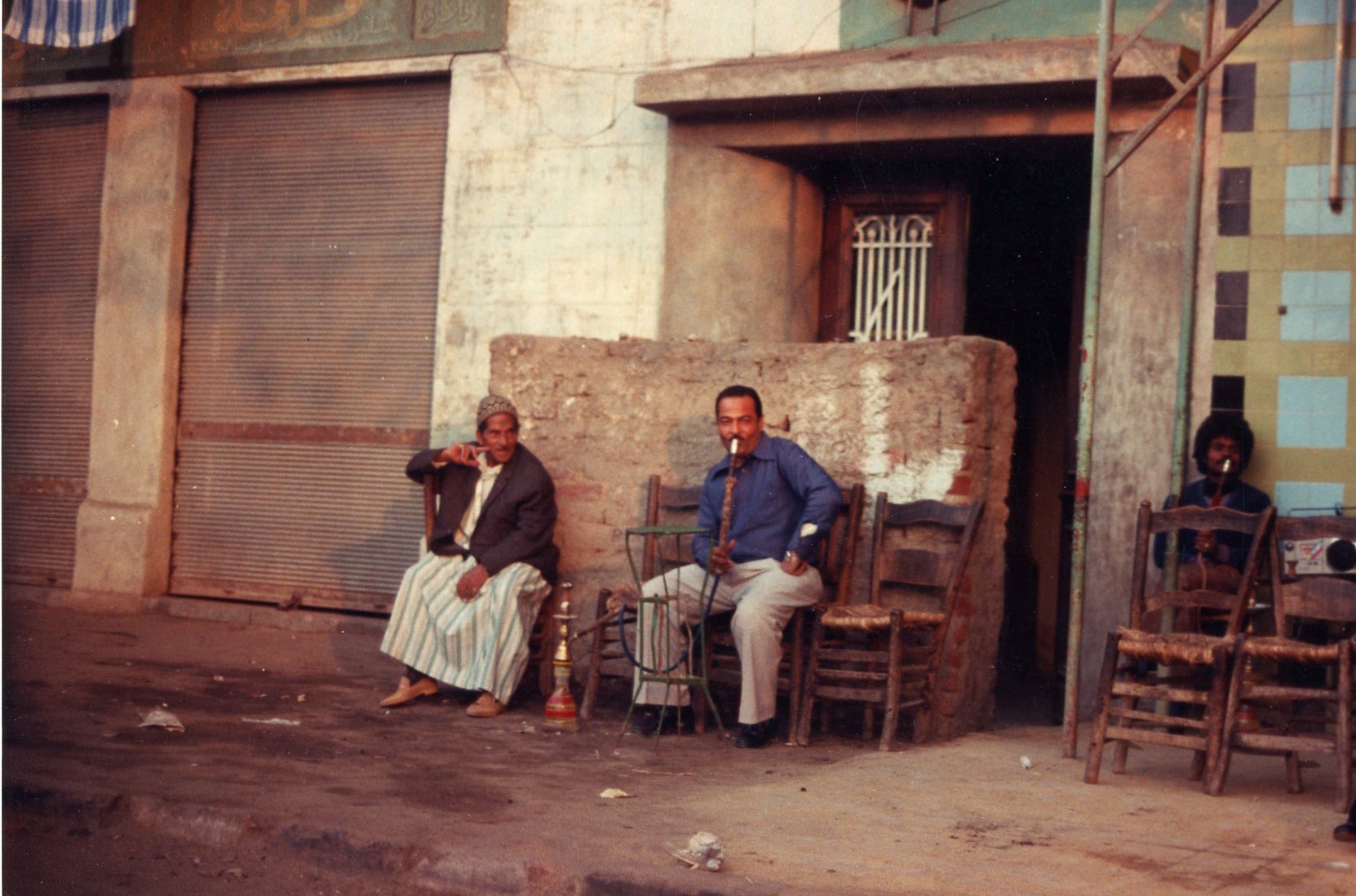
As a smoker, I’m a bit of a libertarian about ingesting things that harm you, though I draw the line over habits that can harm other people in the process. In that category I would include anything that induces physical or emotional violence, debt or road accidents.
Shisha does none of those things. And as I watch old and young drawing on their pipes, I think of a comparable street scene in my native UK.
Young clubbers and pub-goers lurching around the street, some throwing up against a lamppost, others collapsing in a heap on the pavement, the odd fist fight (or worse). An unfair comparison, perhaps. But such weekend scenes in Britain’s big cities have become regular fodder for the social hand-wringers who lament the breakdown of our social cohesion (more of a cyclical downturn, I reckon – they should remember the 18th century booze binges so graphically portrayed by Hogarth).
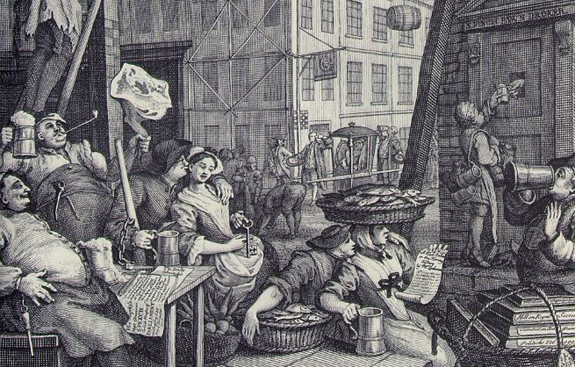
Yes, governments have a duty to point out the hazards of smoking, and should include the consequences of shisha consumption in those warnings – though I doubt if those who partake would appreciate stickers of diseased lungs and rotten teeth adorning their decorous water vessels.
But shisha is one of the great social traditions of the Middle East. Given the choice between having my ears blasted out and my brain sozzled in some club, and a quiet evening on the pavement taking in the fruity aromas of shisha smoke, I know what I prefer.
Maybe I’m just getting old and censorious…
As political footballs go, the Bahrain Grand Prix is not exactly major league.
The cancellation of the 1968 England cricket tour to South Africa, the black power salute at the Mexico City Olympics in the same year, the US boycott of the 1980 Moscow Olympics and the USSR’s reciprocal gesture in Atlanta four years later – all easily outrank the current brouhaha on the political Richter Scale.
I for one hope the event goes ahead, not for the sake for Bernie Ecclestone and the faceless suits who run F1. Nor would I have much sympathy for the preening narcissists in the flashy helmets – brave and talented though they may be – if the race is called off. For them, another day, another race.
I don’t know how many genuine FI fans there are in Bahrain. Perhaps quite a few if the ducking and diving on the Kingdom’s highways is anything to go by. For them the race will be a welcome distraction from the daily activities in the island hot spots – a taste of normality perhaps. But my hopes are more for the small business owners, the traders in the souks, the malls and the corner shops, whose businesses have been slowly strangled over the past year.
Of course there are others who have lost more – the traders of Homs, Hama and Damascus for example. But we all have to face our own realities, and life is not good for many Bahrainis who are impoverished bystanders in the current troubles. They deserve a break.
As for the race, I shan’t be there. I can’t see the point of sitting in a stand watching a stream of projectiles zizzing past every three minutes at a speed faster than the eye can follow. I’d rather watch it on the box, even though the departure of Murray Walker has bled the colour out of the TV coverage. These days it’s all technospeak and celebrity hunting.
The portrayal of the race as a unifying event has unfortunately turned it into something of a hostage to fortune. True, not quite on the scale of Kim Jon Un’s ballistic folly that dropped into the sea in front of the watching world yesterday morning. But the Bahrain Grand Prix has become a large and obvious target.
The sentiment of unity is good. Turning sentiment into reality will take more than a few speedfests around Sakhir.
So here’s hoping that the petrolheads of Bahrain and thousands of visitors have a thrilling weekend, that some of Bahrain’s long-suffering small businesses reap the dividend, and that the country then returns to the business of building bridges and finding a way out of the current impasse.
Nothing saddens me more than to sit in a corner café of an evening watching young and old smoking shisha, playing dominos, laughing and joking – and to wonder if some of those youngsters will be back on the street an hour or two later, lobbing rocks and Molotov cocktails at the police in yet another fiery confrontation.
The sooner Bahrain emerges from its national psychosis the better. The older generation should know better than to stoke the fires. The younger generation will only realise later what they are losing by being consumed with resentment.
A little more emotional intelligence from all parties is called for. Ask the people of Northern Ireland, who endured thirty years of pain – for what?
As for the Grand Prix, it’s only a race, for goodness sake.
The people of Bahrain have weighty issues to contend with at the moment. But while what some euphemistically describe as “activity” ratchets up as we approach the anniversary of the Day of Rage, discussions are going on about constitutional amendments. Some of them may soon become law, so it would be sensible for Bahrainis not to forget that they are taking place.
One of the more interesting proposals on the table is that members of parliament should not be allowed to stand for election unless they have a “bachelor’s degree or equivalent”.
Ho hum. With the greatest respect to those who drafted the proposal, I beg to differ.
Should such a rule have applied in the United Kingdom in the first half of the 20th century, the Labour Party, which drew so many of its members from trade unionists, would never have got off the ground. While there will be many in the UK who blame Labour for the economic troubles facing that country today, few would argue that to create a balanced society there needs to be a political organisation that takes the side of the less privileged members of that society – a role that Labour has undertaken for much of its history. I say much of its history, because I’m not sure that it’s still the champion of the underprivileged. But that’s another discussion
To bar individuals from elected office because they lack a piece of paper potentially skews the legislature in favour of demographic groups in society with greater numbers of graduates. At this juncture in Bahrain’s development, I should have thought that it was in society’s interest to see that the same opportunities to take a leading part in the democratic process were available all.
Equally interesting is the mindset that sees a degree as being an appropriate hurdle to cross before being eligible for election. A clean criminal record, sure. Perhaps a minimum period of employment. But a degree in what, I wonder? Is an accountant better qualified to enter parliament than someone who has worked their way up the ladder in industry, and seen life at the coal face for the past thirty years?
The British politician Aneurin Bevan did just that. He left school at 13 and went to work in the coal mines of South Wales. At 19 he became a prominent trade union leader, and eventually made his way into parliament. As Health Minister in the post-World War II Labour Government, he was instrumental in setting up the National Health Service to the benefit of millions. As Housing Minister, his department built hundreds of thousands of new houses to replace dilapidated and ruined homes resulting from war and neglect.
In 1959, shortly before he died, he was elected deputy leader of his party. Would he have been a more effective politician and leader with a university degree? I doubt it.
The idea that a university degree is evidence that you can lead, negotiate, analyse and make informed decisions is to my mind highly questionable. Yes, it is evidence that you have been through an educational process, that you have acquired some knowledge – which, incidentally, you might never use again – but absolutely not evidence that you can actually do a good job at anything. Sometimes I fear that we revere university education at the expense of other qualities such as objectivity, judgement and common sense.
And think of a few individuals past and present who, if they were Bahraini nationals, would be ineligible to stand for parliament: Bill Gates, Steve Jobs, Richard Branson, John D Rockefeller, Mark Zuckerberg and Steven Spielberg. None of them exactly lacking in intelligence or judgement.
I suspect that in the end the lawmakers will use that wonderful get-out clause that you will find in a thousand job descriptions- a degree or equivalent – to give them wiggle room. The trouble is, “or equivalent” is rarely defined, and if left vague can lead to accusations of inconsistency.
My advice would be to let the electorate decide who is qualified to represent them. I imagine that the MPs who are pushing back at the proposal – some whom would have to give up their seats because they don’t have degrees – would argue likewise.
An Angell visited Bahrain the other day. Not one with feathery white wings and a halo, but a stocky Welshman with a biting tongue, the rhetorical skills of David Lloyd George and the optimism of Cassandra.
The occasion was the 4th Arindon International Investor’s Conference in Bahrain. Arindon are an investor relations consultancy. Every January they bring the great and the good from the Middle East’s investor community to share their views on the outlook for investment in the region.
The excellent conference programme was full of sober assessments of economic prospects for the Arab world. The consensus seemed to be Saudi Arabia and Qatar good, the UAE OK, and Egypt one to watch for the future.
Stimulating as the panel discussions were, the star turn was the Welshman in question, Ian Angell, Emeritus Professor of Information Systems at the London School of Economics. The professor is a man with opinions about almost everything. So tying him down to a subject relevant to investment in the Middle East must have been a challenge to the organisers.
I first heard him speak twenty years ago. In those days I went to a fair number of conferences. Most of the speakers were deeply forgettable, and thus forgotten. But the Ian Angell experience is not one that slips easily from the memory. What he was talking about I haven’t a clue, but he stuck in my mind as a man who loves to trash conventional wisdom, and upset as many people as possible in the process.
You could say that Angell is an academic shock-jock. But to compare him with the likes of Rush Limbaugh and Glenn Beck is a little unfair, because unlike those reactionary windbags he is quite happy to subject his views to forensic debate, which I guess is the hallmark of an academic. But no ordinary one. In his ability to wind up his audiences he is perhaps more comparable to Socrates, though I suspect that the old boy wouldn’t have approved of Ian’s bulldozer debating style. Fortunately we live in more enlightened times than in ancient Athens, and nobody so far has proscribed the professor a cup of hemlock to rid themselves of his contrary views.
These days Angell is retired from the LSE, and makes his living through public speaking, hence his visit to Bahrain. His subject at the conference was “The High Net Worth Individual and the Future of Money”.
The gist of his talk was that the economies of the United States and Western Europe are in terminal decline because over-taxation is stifling innovation and driving the very wealthy away from punitive tax regimes. He argues that taxing the super-rich – above a certain level – is counter-productive, because they have the means to take their wealth to any country that will let them hold on totheir assets.
Many wealthy individuals in the US , he says, are giving up their nationality and seeking other shores in order to escape the rapacious clutches of the Internal Revenue Service. Tax evasion – a criminal offence that can land you in jail – is no longer an option, because you can no longer hide your wealth behind secrecy laws in foreign tax havens such as Switzerland and Liechtenstein. The computer database, eminently hackable, has seen to that.
So legal avoidance tactics are apparently the order of the day. And when a high net worth individual moves away from a tax regime, the secondary benefit of his or her presence goes too. Employees lose their jobs, no more investment in new businesses in that country and no other collateral benefit from the individual’s wealth. Angell points out that in the US 40% of tax revenues come from 1% of the population, so if significant members of the privileged few take their cash and nationalities elsewhere, the economic impact on the old country is serious.
He went on to say that in the US, in 1960 2 million people worked for the government, and 15 million in manufacturing. Today those numbers are 8.7 million in government and 11.5 million in manufacturing. Economies in the West, he argues, are collapsing under the weight of paying for government employees who do nothing to create wealth and foster innovation, and much to prevent them through taxation and over-regulation.
I agree with him when he says that there is a super elite who treat a passport as a travel document rather than as evidence of loyalty to a specific country – I wrote about this 18 months ago in Ruthless and Rootless, which was a piece about the Russian spies expelled from the US at that time – but I think his argument on the secondary benefit of wealth is overstated. High net worth individuals tend to employ people around the world regardless of nationality.
And I also think that he undervalues the philanthropic activities of people like Warren Buffett and Bill Gates. Gates was recently in London on his way to Davos, and argued in favour of higher taxes for the wealthy. But I suspect that those who jump nationalities to avoid tax are not those inclined to give their fortunes away. Why, if you are worth a few billion dollars, you would have a problem with parting with a proportion of your wealth to the taxman or for the wider common good is beyond me. But then I also don’t understand why sharks never sleep.
Speaking about money, Angell reminded us that the entire financial system depends upon a “promise to pay” that you see on bank notes. So effectively money is debt. Governments, he observed, have an interest in controlling money, which is why they have always disapproved of alternative currencies. Yet in the past, private corporations issued tokens that were widely used for currency, and today the internet is spawning virtual currencies that have a real value – ie they are negotiable instruments.
So money of the future – be it cowrie shells, local exchange trading systems or Linden Dollars – is increasingly likely to be beyond the control of governments. But governments always strike back. It is fast becoming affordable for them to insert electronic tags into bank notes, which will enable them to cancel your cash of they think you’re a money launderer or tax evader!
He delights in throwing out provocative sound bites. To an audience of bankers for example, “we don’t need bankers, we need banking”, and “money is a gigantic confidence trick, but don’t tell that to the ignorant”!
To give you an idea of his style, here is a quotation from a talk he gave in 2006 at the London Stock Exchange:
The state is the beast, and its number is 666, the symbol of everything evil. Society will be turned into a Panopticon prison, where the Revenue can, not only calculate every tax bill, but also seize payment. “The complete delivery of the individual to the tyranny of the state, the final suppression of all means of escape not merely for the rich, but for everybody”?
Then we can expect ‘differential rights’ for ‘differentiated citizens’, identified in a data-base and policed by smart ID cards. Party members, will use the card to gorge on benefits – euphemistically called entitlements, while opponents, trapped by their Ahnenpass, are harassed, suppressed, and worse. How long before ‘Human Rights’ becomes as outdated as the “Divine Right of Kings’?
Rome used the threat of the Visigoths to extort penal taxes from its citizens. Today terrorism and organized crime are the equivalent justification. If parliament defines terrorism as ‘a threat to the financial viability of the state’, then tax collectors will have the right to sweat a suspected tax evader for 28 days without charge. You have been warned.
The US government may claim it is chasing narco-dollars, but it is using money-laundering laws to track down tax-flight dollars in Switzerland and Grand Cayman. Every global corporation is now at the regulatory sharp end of US extraterritorial muscle. Failure to comply will lead to the seizure of their dollar assets. Compliance with the demands of government: both in US and UK! That’s the next big issue for business; Sarbanes Oxley was just the start. Forget about computer hackers; government regulations are the ultimate denial of service attack on the corporate sector. It’s going to find itself knee-deep in compliance officers.
Dark words spoken in an age of innocence two years before the 2008 financial crisis….
That evening Arindon hosted a dinner at which Ian Angell spoke again. This time he moved beyond money and the rich and had some interesting things to say on other subjects. Intellectual property law is a nonsense, he said, because it encourages an all-or-nothing approach. Either you steal other people’s images, content and ideas, or you pay a fortune for them. He was once quoted a fee of $750 for using a 30 second clip of and Ella Fitzgerald song at a talk because the copyright conditions did not distinguish between a person wanting to use a piece of property for a one-off gathering and someone wanting to use it for a movie that might be watched by a few million people.
So you have a world in which intellectual property is protected to the hilt in the major Western jurisdictions such as the US and Europe, and third world countries pirate away with impunity to their heart’s content – fake Rolexes, illegally copied DVDs and images of David Beckham on cheap teeshirts.
In China, the prevailing view is “we won’t pay”. And they don’t. Instead they brazenly steal ideas and technology wherever they can find them. Little wonder that they descended on Abbotabad to bargain with the Pakistanis for a little piece of the stealth helicopter that went down in the Bin Laden raid.
Angell points out that in many cases cracking down on piracy can be counter-productive. If you deny people the right to use an image, you lose the opportunity to increase awareness of the very product you might be wanting to promote. And if you are a film maker concerned that free copies of your work are being illegally downloaded, then you should remember previous disruptions to intellectual property such as the videotape, which viewers could use to record TV programmes at no cost. His advice to the entertainment industry is to find other ways to make money from the content – through product placement, for example.
In the area of intellectual property he is not just an observer. As chairman of the Creative Commons organisation in the UK, he works to bring about sensible copyright rules for the use of content in such a way as not to discourage innovation. In an era when scientists are queuing up to patent human cells, that’s no bad thing.
In answer to a question on the future of mobile phones, he suggested that in the future most banking transactions are likely to be through mobile devices, and that phone companies might end up becoming the new banks. An intriguing thought. They couldn’t be any worse than the ones we have right now, and they certainly beat them hands down when it comes to customer service.
Politically, the good professor describes himself as a conservative, in case you had any doubts on that front. More of a libertarian, I would say. His talk was full of references to wishy-washy liberals. He clearly has no time for bleeding hearts. The world he describes seems ruthless, self-centred, dog-eat-dog. In some respects he is the Tea Party on steroids, but he has more intelligence than a stadium full of Palins and Bachmanns.
And yet the man who painted this bleak picture of decline and degradation is warm, engaging and funny. He spoke for an hour in the conference, and for two hours over dinner. His record for non-stop speaking, he said, was over seven hours. I would wager that he kept those people more engaged than Fidel Castro, also noted for his staying power.
Whatever you think of his views (here’s an interesting interview in which he talks about science), he is not a buffoon. He has consulted with a large number of companies and governments during his long career, and his published works have won widespread respect.
I disagree with him on many things. I can’t buy into his politics, and I’m not sure that turning countries like Bahrain and Malta into havens for flinty-eyed robber barons and a slew of Russian oligarchs would bring much benefit to their new hosts. The prospect of yet more Apple products adorning my favourite movies is a grim one. And would I trust my money with Vodafone? I don’t think so.
I suspect that Angell’s tongue occasionally strays into his cheek. Serious as his views are, he never misses an opportunity to take a far-out position if he thinks it will lead to a reaction. And that’s a pretty good formula for a career in public speaking. I guarantee that most of his audience won’t forget this turbulent academic in a hurry.
The world needs more Angells.
Tomorrow it will be exactly a year since protests began in Egypt against the regime of President Hosni Mubarak. While not ignoring events in Tunisia, you could say that the Arab Spring began in earnest when the protests arrived in Tahrir Square.
There have been many consequences of the human fires that set Tunisia and Egypt ablaze. Many hopes set alight and, for now, dashed. Many killed, and many whose lives are no better, or are even worse, than they were before 2011.
Of all the changes that have taken place, it seems to me that one is more significant and far-reaching than any other.
The received wisdom in the Middle East is that education systems in the region do not sufficiently promote or encourage critical thinking.
For all the billions of dollars being poured into education, especially in the GCC countries and particularly into tertiary education, the events in the Arab world over the last twelve months have done more than a million university degrees and high school certificates to help young Arabs to think critically about subjects of life-and-death importance.
They have learned to look at the media with a sceptical eye, not to accept “received wisdom” at face value. And they have learned to come to their own conclusions about political and social structures in their own countries.
Of course there will always be manipulation of emotions and outright deception. The Syrian government’s attempts to fool the Arab League monitoring team are a typical but rather extreme example of this. ‘Twas ever thus, and not just in the Middle East. Just watch the shenanigans around the Republican primaries in the US to be convinced of that.
And of course there will always be those who slavishly follow the party line, be it religious, sectarian, tribal or political – who think what they are told to think
But as I see it, the real awakening in the Arab world is not the removal of a few tin-pot dictators. If that were the case, in some instances it would be an awakening from a nightmare to find an even worse reality.
It is that events have forced people to think again. What do I think about my country, my rulers, my faith, my society and my culture? What do I think about the future I want for my family? Where do I stand?
Are these questions just being asked in the households of the intelligentsia, the middle classes and the university-educated minority? I doubt it. There can very few Arabs who have not searched their souls and consciences over the past year, even if many not have not voiced their opinions outside a trusted circle of friends and family, and even if after reflection they have opted for the status quo. The important thing is that they have asked the questions.
For those who have benefited from the status quo, the last year will have been frightening or even disastrous. But for many others the experience will have been exhilarating, even if it has not always been comfortable.
The essence of critical thinking is to question, to be curious and to challenge before coming to a conclusion. There have always been critical thinkers in the Middle East, whatever educationalists might say. The legacy of Arab Spring is that today more people than ever are thinking about the big things as well as the small.
And that – for me – is probably the most profound change that I have seen in 30 years of living in, visiting or watching the region.
Michael O’Leary, chief executive of airline from hell Ryanair, would have made a great columnist. My wife has just passed on a clipping from the London Times that she’d cut out a few weeks ago, knowing my oft-repeated admiration for the man.
Helen Power reported from the EU’s Innovation Convention at which O’Leary and other luminaries had spoken. She noted that whereas most of the speakers had provided po-faced photos and boring CVs for the Convention programme, our Michael provided a picture of himself hugging a model of a Ryanair plane, and a CV that reads:
Born in a stable in 1961, he was a boy genius, who excelled both academically and at sports. Having represented Ireland at bogsnorkelling and flower arranging, he graduated from Trinity College in Dublin as soon as they could get rid of him.
He then became another boring KPMG accountant until divine inspiration sentenced him to a life of penal servitude in the airline business. It is widely known that women find him irresistible.
OK, maybe not enough evidence for a career in journalism, but certainly the credentials to apply for the role of CV writer to the Respected Leader of North Korea, Kim Jong Un, successor to the great golfer Kim Jong Il.
Michael, I forgive you for your wretched airline because you made me laugh out loud after a rotten day in the dentist’s chair. Until the next time I fly Ryanair.
2012 is shaping up to be a year of fear. To many people it feels more uncertain and dangerous than any before it.
Like many media gluttons, I have spent some time over the recent holidays reading reviews of 2011 in the print and online media. The great, the good and the wise have not been short on gloomy predictions for the year we’ve just entered.
I’m not great, good nor particularly wise. So I’m not about to bore you with a specific set of punts about the next twelve months. I’m much more interested in the continuum – about longer term trends, questions that need to be answered, issues that need to be resolved.
Most of us – especially those who have feel they have little ability to influence events and trends – look at the future through emotional lenses. We’re afraid, we’re angry, we’re happy, we’re sad, we’re confident or we just don’t care.
In this post I’ve provided a series of personal thoughts on aspects of our future that I care deeply about. Some reflect mainstream opinion among people who, like me, raised and educated in the West. Some don’t. There is no deep analysis here, but some of the subjects I have covered in greater depth in earlier posts. It’s a set of snapshots, if you like, of concerns and questions about where the road we’re currently travelling on is likely to take us. And in each area, I humbly offer a few reasons to be cautiously optimistic.
I’ve called this post “Reasons to be Fearful – Or Not”, because we can all find reasons to be afraid or to be confident. Fear and confidence are both individual and collective emotions. They are contagious and not necessarily rational and logical. We wake up with them one day, and without them the next. The interesting thing about our species is that emotions are herd instincts. Logic and rationality are not. Therein lies our problem, as Mr Spock would be quick to point out.
Creative Arts
Fearful
E-Books to replace paper books: a paper book is a thing of beauty and utility that can survive for centuries, and sometimes millennia. Do we really want to replace this elegant device with a set of ones and zeros that can vanish in an electromagnetic pulse? Do we want to restrict access to wisdom and knowledge to those who can afford a computer? Will those who don’t own a Kindle or an iPad have to rely on mediated knowledge because they cannot access the source? We are by no means at this point yet, but this is the road we appear to be travelling down.
IP theft of music, TV, film and image: There is hardly a work of music, a movie, TV programme or an image that can’t be grabbed and downloaded from the internet for free. When the majority of internet users come to believe that all content is free, will artists be left with only a short window of exclusivity in which to profit from their work? If so, who will invest in creative work? And will we be left with nothing but news, reality TV and low-budget soaps?
Fine art: decreasing public subsidies of painting and sculpture make it harder for artists to establish themselves. Are we moving back to an age when the only successful artists are those with wealthy patrons, each with their own agenda? And will governments that continue to subsidise art only do so in order to further and approved ideological agenda? Remember the suppression of “bourgeois” art under Stalin, and “degenerate” art under Hitler.
Cheerful
Do it yourself: it’s getting easier all the time to make a name for yourself through the internet without a commercial gatekeeper of dubious taste to tell you that your work won’t sell. You can self-publish a book without the prohibitive cost of an initial print run. You can sell your music directly through the internet. You can get a million hits on YouTube with your viral video. You might not make much money, but hey, whatever happened to art for art’s sake?
Who needs subsidies? If we need to move to the survival of the fittest as an alternative to mediocre art subsidised by professional arts administrators armed with government grants, so be it. We are only reverting to a state that existed for the entire history of humanity before the last century. Cave painters, Greek sculptors, Renaissance painters, Elizabethan playwrights and baroque composers did not have government grants or lottery funding to help them along. My one reservation would be that governments should continue to fund museums. They are repositories of human wisdom and creativity, and they are too important to be entrusted to philanthropists.
Society
Fearful
The human mind: the internet is moulding the attention span of the young. Short means simple, broad brush, easily digested. It can also mean unsubtle, ambiguous and untrue. Will the next generations be incapable of reading a book, or concentrating on anything – apart from a video game – for more than three minutes? Will they be easier to manipulate because they have never learned to see both sides of an argument?
Dumbing-down of language: we don’t write letters any more. We express our feelings through emoticons. We text and tweet. Are we starting to think in 140 characters? Are we losing the power of language to the fast food of slogans, clichés, acronyms and symbols?
Infrastructure degradation: as most of us in the western world become used to fiscal austerity, will we also become used to a creeping degradation of infrastructure – roads, buildings, social services, health care? Will the minimum level of “universally-available” infrastructure in the West eventually pass that of the developing world on the other side of the highway of progress? Are the Western nations reverting to two-tier societies, in which there is no baseline of expectations, no safety net, to which the state will commit, and in which survival and prosperity is entirely in the hands of individuals and the social tribes to which they belong?
Surveillance: Phone intercepts, CCTV, drones, social media, government databases. Is there any government – democratic or otherwise – that would not succumb to the temptation in extremis to use the vast amounts of digital data to erode the civil liberties of its citizens rather than to uphold the rule of law? Is not individual privacy at least as precious as national sovereignty?
Corruption: is both a source of and a response to inequality. It is everywhere in the world. As citizens lose confidence in the impartiality of declining, cash-strapped institutions, will corruption in the West become as pervasive as it is in other parts of the world?
Cheerful:
Free speech: there is still a window of opportunity for people in countries that do not encourage free speech or free association to communicate via the social media. And by the time governments get round to routinely monitoring Facebook, Twitter, IM and so forth, some bright spark will have figured out a new avenue inaccessible to conventional power. For better or for worse.
Free movement: however oppressive a government, it’s harder than ever for them to stop their people travelling. Be it for business, tourism or education, people are having the opportunity to see “the other” for themselves rather than having to rely on orthodox opinion in their own societies.
Education
Fearful
Decline of liberal arts: as funding decreases for any learning other than that required to get people into work, and we focus on professional, technical and vocational education, will we miss our historians, anthropologists, philosophers and creative writers? Are we entering an era in which all education is tactical? In which the pursuit of knowledge for its own sake is confined to a smattering of well-endowed institutions such as Harvard, Yale, Oxford and Cambridge?
Anachronistic teaching: for a hundred years our educational models have been based on teacher and pupil, with rapidly expanding ratios between the two. In many parts of the world, learning is still primarily by rote. Has the classroom reached the end of its useful life? How many educational systems encourage learning by doing? Group work? And how many countries have alternative systems to help the underprivileged to find their own way out of the daily struggle for survival? Of what use is a university degree to a nomad or a subsistence farmer?
Elitism: as university fees increase, will the financial barriers to obtaining a top quality education lead to increasing inequality of opportunity? If young people no longer have easy ways to earn money in order to support their education, and parents no longer have the financial means to support their children, will we move backwards to an era in which the very best education is only available to the offspring of the rich and powerful? Or are we largely there already?
Cheerful
You can’t channel curiosity. Even if state education systems are crushing upholders of ancient orthodoxy, there is nothing to stop you from becoming an auto-didact. In fact, the internet is the surest path towards life-long learning, provided you use it as a signpost rather than a destination. You don’t need a university degree to change the world. And you never did!
Politics
Fearful
Isolationism: with the crisis in the Eurozone and the financial downturn in the United States, are we moving towards a new age of aggressive self-protection, where nations and blocs of nations declare every man for himself? Will the US mount trade barriers against China? Will the US call a plague on all our houses and retract from its self-appointed role as the world’s policeman? Who will fill the power vacuum? Ron Paul probably has the answers to all these questions. Will his views become as acceptable to mainstream US public opinion as they appear to be to the voters of Iowa?
Extremism: extremism is on the rise. Not just religious extremism exemplified by the Taliban, the ultra–conservative fringe of the Jewish orthodox faith, elements of the religious right in the United States and Hindu nationalists in India, each of which are dictating political and social agendas out of proportion to the numbers of their adherents. Secular extremism of the far right, as exemplified by Anders Breivik in Norway, and ultra-nationalism of the kind being tapped by Vladimir Putin in Russia, are eroding civil liberties, either through the policies of authoritarian leaders or in response to perceived threats to society. Outlawed extremists punch beyond their weight because they no longer need the weapons of the state to pursue their ends. Asymmetric warfare, use of the internet and lack of regard for human life are all hard to combat. Will cyber-attacks join suicide bombing as a standard weapon against the “soft and decadent” democracies of the West?
Commodity wars: China controls 90% of the world’s identified reserves of rare earths – those metals increasingly used in computer and communications technology. Russia has more than once cut off its gas supply to neighbouring Ukraine. Iran has threatened to close the Straits of Hormuz in order to choke off the supply of oil and gas to the Gulf States’ customers in Europe and elsewhere. Commodity wars are nothing new, but at a time of global economic uncertainty they are a potent weapon, even if they turn out ultimately to be self-destructive. Will the next wars be about water, food and raw materials?
Cheerful
Secrets: thanks to the pervasiveness of the internet and mobile communications, it’s getting much harder for nasty dictators to hide their misdeeds. Whether or not they are called to account is another matter, but at least we know what we’re dealing with. What surprises me is that exposing corruption by the same techniques – video and phone technology – has not yet caught on among ordinary citizens. Government officials, watch out….
Time: the powerful eventually depart, whether by natural causes or otherwise. The more powerful they are, the greater the opportunity for positive change. The demise of Mao and Brezhnev kicked off big changes in China and Russia. What of North Korea after Kim Jong Il? Of Iran after Ali Khamenei? It doesn’t always take revolution or invasion for economic and social conditions to turn around, though change is a double-edged sword, as the people of Iraq and Afghanistan will testify.
Business
Fearful
Lack of predictability: Most businesses need clear visibility of at least the near future in order to thrive. Right now, who can predict beyond the next couple of months with any clarity? The Eurozone and Iran are perhaps the major question marks facing the world economy. Who would bet on other uncertainties raising their heads over the next couple of years? The bursting of the Chinese housing bubble, perhaps.
Corporate greed: there is a saying – sanitised for this blog – that goes: “why does a dog lick its tail? Because it can.” The practice by large companies such as Google of minimising tax liabilities by skipping from one tax haven to the next is at best amoral. The same goes for high net worth individuals. When will these supra-national tribes realise that austerity is not just for “other people”?
Institutional short-termism: even if they wanted to, it is extremely difficult for listed companies to take long-term decisions because they are in thrall to institutional investors whose managers depend for their jobs on short-term performance. Warren Buffett is an honourable exception, perhaps because age has given him wisdom lacking in the younger fund managers. Will CEOs ever again be able to build for the long term without having their legs chopped off by the knee-jerk reactions of institutional shareholders and fund managers?
Cheerful
Opportunities in adversity: downturns have their upsides. Many great businesses are born in recessions. They are leaner, more flexible, more fit for purpose. During the UK recession of 1991 my business partner and I started a business that ten years later was in eight countries and employed over 400 people. The additional challenge today is to do so in an era of tight credit. I believe that there are many opportunities for companies that are built to last, rather than fattened up by speculative investment and designed for sale or IPO like a force-fed turkey being readied for Christmas. Lack of credit can mean slower growth, but if you build firm foundations you can create a business with longevity and real worth.
Technology
Fearful
The cloud: businesses in increasing numbers are entrusting their data to third parties. Whatever savings they may make by hitching a ride on the internet cloud, they run three risks: cyber-espionage, denial of service and degradation of service. The first two could come directly from government-sponsored actors. The third is a potential outcome of progressive deterioration of infrastructure. Satellite failure and subsea cable damage might not put them out of business, but can dramatically slow down their transactions, thus degrading their businesses.
Cybercrime: Fraud and industrial espionage on the wane? Unlikely. Entrepreneurs from the dark side will always be one step ahead of legitimate business because they are creating the threats. It’s fine for security teams in large companies to “think like criminals” in order to avert threats. But there are many more would-be bad guys out there than people out to stop them. As the terrorist would say, “you need to stop us every time – we only need to succeed once”.
Cheerful
Cheap Telecoms: Skype has transformed international telecommunications. To be able to make a free video call to someone halfway across the world is something that we take for granted today. Thirty years ago it was the stuff of dreams. We are only at the beginning of this revolution.
Environment
Fearful
“Unconventional” oil and gas: when it comes down to it, very few countries will take seriously the environmental consequences of extracting shale oil and gas. No international treaty or convention will get in the way of a country transforming itself into a Qatar or a Saudi Arabia to avoid a few minor earthquakes, exploding tap water or worse. They will look for technical fixes. If they are not feasible, they will hide the damage until it is too late. They will speak of a trade-off between environmental damage and the well-being of their populations. Get used to it. It will happen. It will produce cheaper energy and transform the balance of economic power throughout the world. Not yet, but soon enough. What will be the consequences for economies that rely mainly on exports of oil and gas?
Global warming: it will take something truly dramatic to induce governments to respond to a global threat. Doom-laden statistics, educated guesses, evidence from icecaps, the odd island disappearing and a few million poor souls being flooded away will not be enough. The trouble is that when that dramatic event occurs, it will probably be too late to avoid further even more dramatic events. Human beings have never before been faced with a real threat to our existence. As a global species, we are no more capable of acting in concert than any other species. Every other environmental crisis, from the Pacific Gyres full of plastic detritus to the exhaustion of fish stocks, has shown us that individual, tribal and national interest will always trump the interest of the species. Will our redemption will come through luck, technology and palliative measures that might give us more time to develop solutions?
Cheerful
We’re not impotent: we may not be able to solve the big problems, but we can save species, we can reduce atmospheric pollution, and we can develop cleaner energy sources. Environmental entertainment (such as The Frozen Planet, the Blue Planet et al) is reaching wider audiences. Easy access to environmental content over the internet is increasing awareness of the issues. And don’t bet against technological fixes to the big issues. We’re not done for yet.
And a final thought for the pessimists. A few days ago, the eminent astrophysicist Professor Stephen Hawking celebrated his 70th birthday. This was a man given a few years to live when diagnosed with motor neurone disease at the age of 25. For much of his life, he has been incapable of speech and movement beyond the twitching of a facial muscle that has allowed him to communicate through a computer. His disability has not stopped him from contributing hugely to our understanding of the universe, both by his theoretical work and through his best-selling book A Brief History of Time.
45 years on, even though his physical condition has declined to the point that he is incapable of communicating more than a word per minute, he and his medical support team are still hopeful that they can find other ways to help him write more quickly.
He is an example to all of us of the power of the human spirit. His life sends us a simple message: don’t give up.
Thirty years ago I acquired a strange dictionary. I was in Saudi Arabia at the time, and departing expatriates regularly held sales. They would dispose of stuff they couldn’t or didn’t want to bring home with them. You could acquire furniture, hi-fi equipment and books for knock-down prices.
The dictionary in question was by all appearances the Concise Oxford English Dictionary. It had the sturdy black hard cover binding familiar to millions of schoolchildren and Scrabble players throughout the English-speaking world. Yet the publisher was the Libraire de Liban. To this day I have no idea whether it was a pirated version of the Oxford original. If it was pirated, it was clearly a serious piece of work, because the quality of the printing and binding was high.
There was one problem with the book that was always bound to frustrate a Scrabble player like me. The dictionary had no words beginning with Q.
To this day I have no idea why such a critical letter in the alphabet – the difference between crushing victory and abject defeat in Scrabble – was missing. The only explanation I could come up with was that publisher had a limited page count, and decided to spare Arabic users from having to deal with a letter that in translations of Arabic words could be substituted by “kh-” and “g-” – as in Qadaffi, Khadaffi and Gadaffi. Highly unlikely, I know – the rational explanation would be that it was a simple cock-up (or qoq-up, if you like).
I thought of the Q-less dictionary the other day as words rattled round my head that would best describe both the state of my golf game and prospects for the world in 2012. As I stumbled down a marshy fairway on a wet December morning towards the little white ball nestling at the foot of a large clump of trees, I started spitting out the words like a gin-soaked vagrant looking for a sympathetic audience.
It was a day of despair. Would decline and decay be followed by distress, depression, degradation and devastation – or worse still, divorce, destruction, death and universal doom?
And then it struck me. If all words beginning with the letter D disappeared from the English language because of some cosmic cock-up, we would be deprived of at least fifty percent of all the negative words available to us.
Beyond the words I used above, we would lose disgrace, discredit, discord, danger, discomfort, derelict, defect, disease, defeat, default, decrepit, dirty, debacle, damnation, demon, doldrums, dowdy, doubt and downturn. No doubt readers more literate than me could come up with a hundred more. You can largely blame the Romans for this cascade of negative meaning. Few words beginning with de- and dis- are harbingers of happiness.
So maybe a good start to 2012 would be to ban the use of all words beginning with D from the written and spoken media. That way at least, we would all have to stop and think before we add to the mountain of gloomy musings that assail us at the beginning of most years, and this one especially.
Deprived of all those Ds, perhaps we can all look forward to a Year of Reluctance to Face Reality.
On second thoughts, dumping all the Ds is perhaps not such a good idea. Let’s stick with Year of Denial.
On that frivolous note, I wish a Happy New Year to all my friends and readers.
Those of you who are dreading the next twelve months, despair not. Bad dreams don’t always come true.
In July of last year, Apple’s cash reserves were higher than those of the US government. Although this had more to do with the stand-off between President Obama and the US Congress over the national debt ceiling, it is nonetheless interesting to note that at that time Apple could have settled half the national debt of Ireland, one of the Eurozone’s struggling members.
Three weeks before Christmas I contributed to Apple’s impressive cash mountain by buying an iPad 2. I was fed up with lugging a laptop to meetings and waiting minutes for the thing to do the equivalent of getting dressed in the morning before it was ready to do my bidding, while the person I had come to see was waiting, iPad at the ready, with an indulgent and slightly pitying smile.
Time to get slim, trim and elegant. Time to join all those people at airports, coffee shops and hotels wearing out their index fingers massaging the pixels on their sexy little tablets.
An opportunity to take part in those techie conversations at Christmas get-togethers. To impress the next generation, and listen to the silver surfers trilling about how their iPads have changed their lives. Time to send a message about my membership of the Apple club.
So early in December I found myself in Raleigh, North Carolina, and decided to take the plunge. I headed for the Apple Store in the nearest Mall. The place was packed. To get served, you had to pick up a number and wait. Outside the store were people hanging around, waiting for their moment to worship at the temple of cool. Inside, store assistants ranging from young Zuckerberg clones to old hippies were having deep technical conversations with potential customers. Fortunately, there was a fast track for people who knew exactly what they wanted. I was one of them, or thought I was. So in short order I walked out with a 64gb iPad 2 with WiFi but without 3G.
The assistant tried to sell me an extended warranty. I asked if Pads break down often, I asked. Of course not, she said. End of conversation.
In financially stricken America, the Apple product was flying off the selves. You would have thought it was launch day for a Harry Potter book.
So apart from impressing others with my tech cred, what did I want out of my iPad?
My must-haves were the ability to access email, Skype and the web on the run, to deliver presentations and to show videos and pictures. The nice-to-haves were to watch the occasional movie or video clip, and to listen to music.
As for the fabled apps that would expand my world beyond my stunted imagination, well, they would have to wait until I had satisfied the basic needs.
Three weeks on, how have I fared with my gleaming black fashion icon? The answer is: mixed.
Admittedly falling in love with my Ipad has not been a priority during a busy period taken up with holidays and other pressing priorities. And anyway, what kind of idiot falls in love with a computer? The same person who falls in love with a car, I guess.
It hasn’t helped that I am a relative newcomer to the Kingdom of Apple. My only previous experience has been as a long-term iPod user, mainly on planes and in hotels. And the iPod – though a marvel in that it can hold hundreds of albums – is not so great if all you want is listen to all the CDs you have transferred to it, and easily find what you want to hear. It has no search capability, and though you can order your content by album or artist, if the titles have not come over fully from the CDs, you are struggling to find what you want easily, especially with classical music. All the other options strike me as fiddly and time consuming to set up.
With the iPad, I was expecting the much-touted Apple interface to make things much easier. And some things were easy. Setting up my email accounts, for example.
But when it comes to moving multiple files from the laptop, you are immediately faced with hurdles. Because Apple allows no direct interface between my Windows laptop and its device, you have to use third party storage and transfer devices like DropBox, or Apple’s own iCloud. When I tried to transfer some pictures via DropBox, I found that I could only do so file by file. Not good if you want to transfer 2000 pictures. Then I discovered that to do this I needed a different version of DropBox for the laptop. To date, I have not managed to transfer a single file.
When I spoke to a fifteen-year-old acquaintance about this, he said “it’s easy. You just do this, that and the other on your laptop, connect them up and you’re done”. “Hang on”, I said, “you have an iBook, right?” “Yes”, he said. “Well, how do you do this with a Windows laptop?” “Er, not sure”, he said.
It was then that I realised what this was all about. Apple is the mother of all closed systems. All roads lead to and from iTunes. Yes, you can interface with Windows devices, but the whole Apple commercial machine is dedicated towards getting you kitted out with Apple products – iBook, iPhone, iPad, iPod, Apple TV and so on. And when you spend thousands of bucks on an all-Apple set-up, you are rewarded with the nearest thing in computing to a seamless interface. But an interface available only to the subjects of the Apple kingdom.
And I laughed at the irony.
For the past twenty years, the watchword in the IT industry has been “open good, closed bad”. Poor Bill Gates and his Microsoft creation have been castigated as the evil empire. Anti-competitive practices, market dominance, aggressive elimination of rivals.
Yet what Microsoft has achieved has been to take us further than any other company towards fulfilling the dream of computing as a utility. Switch on, communicate and interchange via an interface that almost everyone in the world understands. Yes, Microsoft’s software is often over-complex and memory hungry. But at least it serves as the nearest thing we have to a common currency.
Apple, on the other hand, has – whether by accident or design – created a set of highly attractive products that work best together, and not so well with non-Apple products. Sometimes not at all, as was the case with Flash. You could argue that this is good marketing, and that if you don’t like having to shop at one store for all your computing needs, you can find alternatives to each of its products.
You’d be right of course, but I personally resent being convinced by slick marketing and a measure of fashion pressure to buy a device that works most easily and effectively only if you buy other products in its stable.
It seems to me that by virtue of genius marketing and inspired design, Apple has created a competitive firewall, with little of the criticism levelled at Microsoft and all those proprietary vendors that flourished before the days of “open systems”.
And the corporate mythmaking that has elevated the late Steve Jobs to secular sainthood has brushed under the carpet contrary views that Apple was led by a rather unpleasant person – a man at least as ruthless as any of his rivals, and vindictive to the point of obsessiveness towards those who crossed him personally or commercially.
No doubt there are millions of Apple devotees who would dismiss my concerns as unfair generalisations born of ignorance and prejudice. But my point is that as a newcomer to Apple I am ignorant, so I only have generalisations to rely on. And I don’t want to spend hundreds of hours trawling through iTunes for solutions, or bothering friends for hints as to how to get the best out of a product that is supposed to be at the cutting edge of usability.
At this stage in my relationship with my iPad, I feel just a little bit conned. The world I have entered is not what I thought it would be. So I guess I have to go back to the old refrain: no pain, no gain.
Perhaps I will come through to the other side as a fervent convert. But right now I feel that it wasn’t supposed to be like this. Have I stumbled on the real evil empire? Will the emperor be revealed as having no clothes? Only time will tell.
This is the final report from Linda Baily, who has been working in Palestine for the past three months. I have posted her previous reports on aspects of life in occupied Palestine here:
https://59steps.wordpress.com/2011/11/16/oh-little-town-of-bethlehem-life-on-the-checkpoints/
https://59steps.wordpress.com/2011/12/06/palestine-education-under-the-gun/
Linda works for Quaker Peace and Social Witness (QPSW) as an Ecumenical Accompanier serving on the World Council of Churches’ Ecumenical Accompaniment Programme in Palestine and Israel (EAPPI). The views contained below are personal to her and do not necessarily reflect those of her employer (QPSW) or the World Council of Churches.
One of the most heart-rending things I have witnessed during my three months in the occupied Palestinian territories has been the aftermath of demolitions.
I cannot imagine going out to work and receiving a telephone call from a neighbour informing me my house was being demolished. Yet this was the reality for three families in a small community outside Jericho. When I and another team member arrived it was all over. No soldiers or bulldozers, just enormous piles of rubble and traumatised people gathering. There was no one at home in any of the houses at the time and in only one did the soldiers enter and remove some of the contents. The others were demolished with all the families’ worldly goods inside. No written or verbal warnings were given to these families and all three houses were less than two years old, one family having moved in only six months ago.
These were the first house demolitions I had attended and as we sat in the yard, some of us on a three piece suite, others on plastic garden chairs I felt embarrassed by our intrusion into their misery. Saying how sorry you are just doesn’t feel adequate. Yet they wanted us to tell their story, as they know theirs is not the first and will not be the last house demolished by Israeli forces. All the home owners wanted to know was “Why my house? Why this house and not the one next door?” The Israeli press said they were demolished because they were close to archaeological remains yet there were others closer. One house was on a corner plot with others on both sides. The owner of the demolished house told us he had been taken in for questioning one month ago and twice while he was there he was told his home had been demolished. He was then asked if he would work with them and if he did any problems could be smoothed over. He refused, and as he left he was told they would meet again. He had previously lived in Jerusalem, but following two house demolitions he moved to Jericho. When I asked if he would rebuild his reply, like the others was, “Of course”.
In East Jerusalem a large house in the Silwan district was given notice of imminent demolition. It is next door to The City of David, a tourist site, which was handed over to “Elad”, a private organisation of extremist settlers despite opposition from the Israeli Antiquities Authority. I saw a photograph taken from the air of Silwan, home to 40,000 Palestinians. On the photograph was marked the houses not destined for demolition. There were two. All the rest are to be demolished to continue excavating and to make a park and car parks.
Israel is the occupying power and in article 53 of the 4th Geneva Convention (1949) it states, “Any destruction by the Occupying Power of real or personal property….. is prohibited, except where such destruction is rendered absolutely necessary by military operations.”
In an isolated area of wild beauty between Nablus and the Jordan Valley the small community of Khirbet Tana continues in a life style that has changed little in the past century. Their homes have no running water or electricity and mobile networks are non-existent. However, life today is considerably harder for the farmers trying to make a living. They use to live in stone houses or caves with stone shelters added on, but in 2005 they suffered six demolitions. Most solid structures were destroyed and the entrance to the caves filled with rubble. Twice this year the Israeli Defence Force (IDF) has carried out demolitions including the school, one of the few concrete buildings left, so now they are not destroying stone and concrete buildings, they are destroying tents and shacks of canvas, corrugated iron and bits of wood.
One farmer told us his family have been in Khirbet Tana for 100-120 years, others came in 1948 as refugees. Khirbet Tana is important to the Israeli’s for a number of reasons. It is preventing the illegal settlements of Itamar and Mikahar joining one another and also it has one of the few abundant water supplies in the area. This year the IDF removed ten of the villagers’ water tanks so now they carry the water in jerry cans. The villagers, however, are doing what they can to keep their community alive. An Italian NGO has supplied a bright yellow canvas school with the only flushing toilets in the area! They are involved in a court case so there is a halt to demolitions, at least until February 2012 and each summer the residents of Beit Furik, a nearby town, have a day in Khirbet Tana, picnicking and playing sports.
This week I visited two Bedouin communities who out of the blue had animal shelters demolished. Twelve vehicles, 36 soldiers and a bulldozer gave the family five minutes to move their animals out of a canvas shelter and pen before it was flattened. Another metal frame structure with a canvas roof was completed the day before. The farmer agreed to take it down himself rather than have it demolished, but he was told if he put a roof on again they would return and damage his home- a large tent. This family has the official papers of ownership and have been there for 60-70 years.
We sat outside drinking sweet tea while they told us their story, an extended family of fifteen people including six children have been affected by this mindless and random destruction. I watched a young mother in the background carrying a little girl of about one year old, who was obviously suffering from cerebral palsy, and I wondered what the future holds for her. Looking towards Jordan I could see the lush green from an illegal Israeli settlement and I think once again how unfair the world is in its treatment of this and countless other Palestinian families.
The assertion of illegality of the Israeli settlements is backed up not only by the Geneva Convention, but also by the International Court of Justice. The State of Israel argues to the contrary.
Whatever the arguments one way or another, it seems to be much easier for a group of settlers to establish a substantial town in occupied Palestine than for a Palestinian subsistence farmer unlucky to find his land in the Israeli-controlled areas of Zone C to provide shelter to his animals.
For further background on the situation in Silwan, visit the Wadi Hilweh Information Centre. And for those wishing to find out more about Khirbet Tana, in February of this year the United Nations Office of Humanitarian Affairs published an informative fact sheet on the demolitions in the village.
I have reproduced Linda’s reports because they tell stories about real human beings suffering on the ground. The arguments of lawyers and politicians mean little to the people she writes about.
It is possible to write books about the suffering on both sides of the divide – land grabs and demolitions in Palestine and suicide bombings in Israel, for example. But until each side – and by this I do not just mean the political and religious leaders – recognises the reality of the other’s suffering at the basic human level and acknowledges its responsibility for it, this conflict will fester on. And voices from Palestine, encouraged by the awakening of political consciousness in the region, will grow louder, while Israel, no longer able to rely on a status quo in the region, will find it increasingly hard to rebut charges that it is just the latest in a long line of conquerors, heedless of the suffering of those who find themselves under its heel.
One of my dearest wishes for 2012 is that the political leaders of Israel and Palestine find the determination and imagination to cut the gordian knot that prevents a just and lasting settlement. As each year goes past, the stakes are getting higher.
At this time of year in England, millions will rise from their post-Christmas torpor, venture out to a nearby stadium or slump back into their armchairs to watch the nation’s favourite sport – football. Kids with the names of heroes emblazoned on the back of the new club strips they got for Christmas will sit with Mums and Dads to watch the investments of Russian oligarchs, American sports tycoons, oil sheiks, porn barons and chicken killers battle for supremacy on a mercifully mild English afternoon.
There will be goals, incidents and injuries. Puce-faced managers will be screaming from the touchline at their thoroughbred charges. Players will be ducking, diving and using every tactic short of assault and battery to gain an advantage. From the terraces, insults will fly. Racist, sexist, fascist – and just about every other ist they can think of.
From the director’s boxes, corporate centres and mansions of the owners, the oligarchs will be thinking about the next signing, and whether the time has come to dump the manager because another season does not look like enhancing the brand. And from the posh seats, agents will be looking forward to another rich haul of commission from the upcoming transfer window, as their campaigns to persuade their star clients that the grass is greener – and more lucrative – on another field come to fruition.
Former players earn a living through radio and TV commentaries, or by being “ambassadors” at corporate hospitality centres and boxes. Others squander their savings on businesses that they are hopelessly ill-equipped to run. Household names of yesteryear hobble to their old stamping grounds, awaiting artificial hips and knees on the National Health Service, and making ends meet by selling their medals.
And today’s stars roll up to training in their Porsches and Range Rovers, and while away the hours between training sessions playing video games, tweeting inanities and indulging their expensive wives and girlfriends – and other people’s wives on occasion – with shopping raids for designer clothes, house furnishings and diamond-encrusted trinkets.
This is English football in 2011 – or at least its top flight – as the media portrays it and as the actors portray themselves.
Is it better or worse than the game of my youth?
Neither, just different.
When I was growing up, the big stadia were not places where you would want to linger. So few toilets that fans on the standing terraces would relieve themselves where they stood. Foul food and crowded bars. Death-trap design that led to overcrowding disasters like Ibrox and Hillsborough. Fans waiting with bicycle chains to scourge opposing fans foolish enough to stray into the wrong enclosure.
Players were just starting to earn decent wages. Most managers ruled by fear rather than science. The really successful ones were, as today, superb motivators, but they were also men who had lived through war and deprivation. Owners were butchers, bakers, landed gentry and merchant bankers for whom ownership was a key to local social kudos, national fame and little else. Nobody noticed whether clubs were in profit or loss. Owners courted popularity by signing star players and picking up the tab themselves. Few clubs went out of business.
Players were almost exclusively white, and recruited from the four “home nations” – England Scotland, Wales and Northern Ireland, as well as the Irish Republic. Supporters were loyal to their home clubs, and each club had a large number of home-grown players – Londoners, Liverpudlians and Mancunians. Their earnings were good by the standards of the time. A top player could afford a semi-detached house in the suburbs and a Ford Zephyr car. They could earn useful extra income by opening boutiques and supermarkets. Image rights belonged to the clubs, not the players. George Best stood out as a wild child because there were so few others like him – either as a player or as a pursuer of a rock star lifestyle.
There was no such thing as a squad. The manager would pick his best team, and stay with them throughout the season. If anyone lost form or was injured, he would be replaced by the next best guy from the reserves.
In the Sixties, England’s stock in world football was pretty high. We won the World Cup in 1966, and the head of FIFA was an upstanding former referee called Sir Stanley Rous. Manchester United won the European Cup for the first time two years later, and Liverpool were gearing up for a decade of dominance in which they won the premier European trophy five times.
Today, the connection between the club and the local population, while still existing in the cheaper seats, is noticeably weaker. There are Manchester United supporters in China, Thailand, Malaysia and Mauritius, in Ireland, Devon and even Liverpool. A young kid dreaming of playing for a Premier League team could just as easily be growing up in Seoul as in Salford. And his hero might be Aguero, Nani, Reina or Van der Vaart, as easily as Rooney, Lampard or the feckless John Terry.
So, better or worse?
Better in that the game is now open to the cream of world football. Foreign players in the English top flight no longer come to England in the lucrative last gasp of a fading career. Worse in that the game is clogged up with mediocre foreign players that are denying top flight experience to promising home-grown youngsters. Watch a match between Arsenal, Manchester City or Spurs these days, and you’re unlikely to see more than half a dozen English players on the field.
Better in that you can watch a game in relative comfort, and have a decent chance of getting out of an opposition stadium without broken bones or stab wounds. Worse in that the price of tickets makes live football for the traditional supporter an occasional luxury rather than a weekly rite of devotion.
Better in that for all the efforts of supporters and the occasional player to prove otherwise, racism on the pitch is virtually a non-issue. African players in English football are as much role models for white kids as for black, and furthermore give hope to youngsters in their own countries of a way out of poverty. No different in that football culture makes it impossible for a player to admit he is gay. Worse in that the parasites of the game treat young players from poor countries as commodities, to be owned, profited from if successful or ruthlessly discarded if not.
Better in that the TV coverage of matches is light years ahead of the grainy pictures of the old “outdoor broadcasters”. Worse in the cynical and contemptuous treatment of referees by players and managers.
Better in that the quality of football is undoubtedly on a higher plane. Worse in that only a handful of wealthy clubs have a chance of winning the game’s top honours. To challenge for the trophies, you need a Sheikh Mansour, or you need to take on so much debt that you risk going bankrupt in the process, like Leeds United. At least these days most clubs don’t have the opportunity to rack up the debt. But if you’re a supporter of Nottingham Forest, three-times winners of the European Cup, you’re reduced to aspiring to the FA Cup as the summit of your club’s achievement.
These days I support no particular club, but I will always watch teams with imagination, flair and a talent for the unexpected. Over the past decade the “English” team to watch has been Manchester United. But hell, I even watch Arsenal from time to time.
Stretching out on the sofa to watch the average Premier League match is the surest recipe for an afternoon nap. Ten minutes is usually all it takes. And I wake up ten minutes before full -time. As a sleep-inducing spectacle it’s only rivalled by Formula 1.
And then there’s the national team. I do stay awake during England matches, though usually writhing in angst. If I look back at the hundred -odd England internationals I’ve suffered through since the 1966 World Cup, three satisfying matches – against Holland in the ‘96 Euros, Argentina in the Japan World Cup and Germany in the 2001 Euro qualifiers seems a pretty poor return for the time.
So given that I’m such a miserable git with such a down on our national game, why do I bother? Why do I check the results every Saturday and Sunday afternoon, and devour the football coverage in the national newspapers?
Maybe because all human life is there – heroes and villains, the corrupt and the unselfish, leaders and idiots. And occasionally you get to witness moments never to be forgotten – of skill, courage, mental resilience and gut-wrenching pathos. Busby’s face after the ‘68 European Cup Final; Banks’s save against Pele in ’70; Maradona’s Hand of God in ’78; Gazza’s tears in ’90; Manchester United coming back from the dead in ’99 European Cup Final; Beckham’s penalty against Argentina in ’04; Barcelona’s destruction of Manchester United in the ’08 European Cup Final. And all those bloody England penalties. It’s not a beautiful game, but it does have beautiful moments.
And those are enough to keep me interested. Somehow.
In my last post I wrote somewhat unflatteringly about one New York Times luminary, Nick Kristoff. In this one I write in praise of another, Karl E Meyer.
In 2008 Meyer and his co-author Shareen Blair Brysac wrote Kingmakers – The Invention of the Modern Middle East. I’ve only just got round to reading it, and it’s a treat.
Over twelve chapters Meyer and Brysac provide short biographies of Britons and Americans who have shaped the Middle East over the past century and a half – as imperial proconsuls, agents provocateurs, spies and politicians.
The biographies are weaved into a common thread of commercial and political interest, of interference, manipulation and as the title suggests, king making. The first few characters in the book are agents of the British Empire who sought to secure British influence in the Middle East as a bulwark against the Empire’s rival European powers – France Germany and Russia – and to protect the passage between Britain and the jewel of its empire, India: Lord Cromer, Lord and Lady Lugard, Mark Sykes, Arnold Wilson, TE Lawrence and Gertrude Bell, Edmund Ironside and the three Sir Percies – Cox, Loraine and Sykes.
As Britain’s influence wanes and America’s waxes, others play a key role in the shifting balance of power. Harry St John Philby, Glubb Pasha and finally a trio of Americans, Kermit Roosevelt, Miles Copeland and the only protagonist still living, Paul Wolfowitz.
Together these characters had a profound effect on the key nations of today’s Middle East – Egypt, Saudi Arabia, Syria, Iraq, Jordan, Israel and Iran.
In a way, I’m glad I waited until now to read Kingmakers. In the year of the Arab Spring, Meyer and Brysac’s account of the personalities they describe remind one of some of the lesser-known history of the Middle East. For example, the use of bombing as an economic means of bringing the Iraqi tribes to heel in the aftermath of World War I and the dissolution of the Ottoman Empire. And the coup devised by the British and executed by the US Central Intelligence Agency that deposed the Iranian Prime Minister Mohammed Mossadeq following his nationalisation of the Anglo-Iranian Oil Company.
Here, for example, is an excerpt from the chapter about the Mossadeq coup:
“The CIA’s Roosevelt and Wilber now travelled to London with the coup proposal they had drafted together in Cyprus. After meetings with MI6, a reworked version emerged. The plans were next submitted to the Americans at the famous July 25 meeting mentioned earlier. Churchill greenlighted the operation on July 11. (Woodhouse notes that “Churchill enjoyed dramatic operations and had no time for timid diplomatists”.) Wilber instigated what he described as “a war of nerves” with the help of two Iranian assets, code-named Nerren and Cilley. A CIA courier arrived with a large number of anti-Mossadeq cartoons and posters that enabled Wilber to launch a massive propaganda campaign aimed at discrediting Mossadeq’s government. Articles stressing the communist threat were planted in the foreign and local press. Intelligence networks were meshed, and agents provocateurs, specialists in inciting trouble that could be blamed on the communists, were hired. Weapons were distributed to the tribes. An armed gang kidnapped, tortured and killed Tehran’s chief of police. The Grand Ayatollah conveniently issued fatwas against the communists.”
The fall of Mossadeq led to the transformation of the Shah from an insecure figurehead to the tyrant finally deposed by the Iranian revolution of 1979. Is it any wonder that today’s Iranian regime delights in referring to the US and Britain as the Great Satan and the Little Satan respectively?
Kingmakers is full of stories of high-minded imperial idealism as well as lies, duplicity and treachery in the name of national interest. The characters in the book range from benevolent paternalists to comic buffoons.
In and out of the narrative step the local protagonists – King Abdullah of Transjordan, King Faisal of Iraq, Gamal Abdul Nasser of Egypt, David Ben Gurion of Israel, Hafez Assad of Syria and King Abdulaziz of Saudi Arabia to name but a few.
Connections abound. H Norman Schwarzkopf, father of the Desert Storm commander of the first Gulf War, stiffening the backbone of the wavering Shah during the Mossadeq coup. Kim Philby – son of Harry, who was instrumental in helping the US gain the Saudi oil concession – a drinking buddy of Miles Copeland in Beirut before disappearing to Moscow after being unmasked as a Soviet spy, bringing with him his wife, who was formerly married to the CIA station chief in Lebanon. Boutros Ghali, the Egyptian Prime Minister assassinated in 1910, who was an ancestor of Boutros Boutros Ghali, the recent Secretary General of the United Nations.
The only connection I can claim with the dramatis personae is that in the 70s the sound equipment company I managed worked for The Police on a few occasions. The Police’s drummer was Stewart Copeland, son of Miles Copeland. From CIA agent to rock star in two generations. So it goes.
Kingmakers is not only compelling history but also gripping narrative. A must for anyone interested in getting under the bonnet of today’s Middle East.
Nick Kristof, the Pulitzer Prize-winning journalist from the New York Times, was back in Bahrain for the first time since he famously reported from the Salmaniya Hospital at the height of the unrest earlier this year. At the time I commented on his reporting in this post.
There is something about the man that irritates me. Perhaps it is because his reporting tends to be as much about Nick Kristof as about the events he describes. In his February piece, he is in the Salmaniya Hospital as the casualties arrive. In his recent report, Getting Detained and Gassed, he once again gets to be part of the action. He and a colleague go into a Shia village, become embroiled in one of the regular flare-ups between police and youngsters, and end up in the back of a police car for half an hour. Nothing wrong with being on the scene, but becoming a protagonist as well as an observer can leave you vulnerable to accusations of being manipulated by one party or another.
Our hero also revisits doctors from Salmaniya and and human rights campaigners that he encountered on his last visit, and – presumably for balance – talks to a member of the ruling family who makes the case for the progress that the country has made since March.
The article is long on opinion and short on analysis, and the interviewees in the accompanying video rarely have the chance to voice more than a few broad-brush opinions. And I suspect that Saqer Al-Khalifa will not have been overjoyed at the editing of his interview.
Kristof’s gist is that Bahrain is a friend of the US, and that the US should be more careful about who it selects as its friends in the region.
In his latest pieces he does acknowledge actions by the government to address the issues facing the country, one of which, of course, is to grant Nick Kristof a visit visa.
Maybe what bothers me is that Bahrain is a soft target. I can think of a couple of neighbouring countries where someone in his position would not be allowed into the country in the first place, let alone to witness scenes of disorder or interview political or social dissidents. And one of them is a firm friend of the US. That he has been able to come and go in Bahrain in itself differentiates the country from its less tolerant neighbours.
I leave it to others to comment on the content of his latest report. But I would suggest that it is relatively easy for a big cheese reporter to parachute in and out of Bahrain every few months and pontificate on “the situation”. As those of us who live in the country will testify, the challenges facing Bahrain are far more complex than can be summarised in a thousand-word article or an eight-minute video.
Nick Kristof is a distinguished and highly acclaimed journalist and author. I admire him for his efforts to raise awareness of human rights violations in Darfur, and for his work on the 2003 Iraq war. He has achieved so much in his career that questioning his work almost feels like criticising the Pope. Yet I can’t help feeling that at times the story takes second place to his personality, unfair as that may be.
I prefer journalists who are a little less arrogant and a tad more reflective. Maybe that’s because I’m more used to the likes of the BBC’s John Simpson and Frank Gardner, who tend to use a less abrasive technique but are no less distinguished than Kristof. I prefer to be led to a conclusion rather have it slap me in the face. And if I am to be slapped, give me the contrarian hand of the recently departed Christopher Hitchens any day.
 59steps