Since this is the time of year when newspapers in the West start publishing short stories to amuse readers incapable of rising from their armchairs amidst the torpor of over-indulgent Christmas weekends, I thought I’d do the same.
As usual, I have a sneaky agenda that will become clear later.
But first, enjoy this short story by Andrew H Morton, an old friend. Andrew is a writer, musician, composer and a proud son of Mercia, the Anglo-Saxon kingdom that used to encompass most of the English Midlands, from where I also hail. He has written two highly-regarded books about JRR Tolkein, the creator of Lord of the Rings. Ever since we became friends at University, words and music have poured out from him, while for much of that time I have followed a much more humdrum path in business. But happily for me, we have stayed in touch for forty years.
Here’s the story:
Anglo-Saxon
Irwin slewed down the pebble slope past sheep’s skull and flint, sea flung, gold and chalky white, to flat sand. Two herring gulls squabbled on a wooden groin and further out terns hovered and dived into grey brown water after herring fry. Late sun shot his shadow out long across the beach, down ribbed sand where starfish stranded waited for the turning tide. Over grey waves, sullen as roughly hammered lead, rarely if ever blue, or from dunes, westward over dim fenland the sky here is always half the world. Here waters come and go as they will over long years, sometimes leaving a seaside town miles inland, or taking back fen and field without a by your leave.
Fifty yards out, at low tide, stumps of trees reared like rotten teeth. Five hundred years ago, the bells of Ingoldby rang among these ruined trees. Children played and farmers came to trade their wares. Folk said you could sometimes hear the bells calling forgotten flocks to church. He would wade out among the tar-black trunks, stick in hand and bag over shoulder. Taking off his boots, he strode through sea’s brim, filthy with mud and salt stew. Gold grit turned to mud beneath his feet and here he knew that he would find some little dab, flounder, or, if he were lucky, red-spotted plaice. The skill was to feel with your feet until a fish were found then spear him with your stick. Old knowledge taught doggedness in this work.
Feeling with his feet in the soft mud he cursed as his toe met something hard and sharp. Finding man made things out here among the old dwellings was not unheard of – often shards of rough-wrought pottery, but sometimes spoons and coins. Mud preserved them well. Reaching down and groping by his feet he pulled up a cross shape, six inches long, coated in a rind of black sea grime. “Well, there’s a thing” he said to himself and dropped the cross into his bag to look at later. It was a good afternoon’s work, and as he crossed a low saddle in the dunes, he had a handful of dab and two flounders in his bag. From this height, perhaps twenty feet above sea level, he could see where the setting sun cast long shadows from the hedges, making the fen world half black half golden. Daneby farm, half a mile inland, was a squat huddle of buildings down a road that men had made and wind and weather were unmaking slowly. Sparks of the late sun set the hawthorn ablaze by the roadside as he neared the farm. Cows still standing cast weird shapes on the tussocky grazing.
When the evening work of the farm was done, and man and wife had eaten, Irwin turned his thoughts to the cross. He cleared the kitchen board and got to work with a small file.
“What’s that you’ve got?” asked Hilda, peering at the cross. Her eyesight was poorer than his now. It was a worry.
“Just summat I found down by Old Ingoldby,” he answered. “Looks like a cross – perhaps from the church.”
It would be painstaking work. He put on his reading glasses and turned a lamp round to see better. Bit by bit the black rind flaked off until he could see grey metal cunningly etched with round and swirling shapes. Spitting on a nose-rag, he rubbed until the iron grey took on the hue of silver. At the middle of the cross and around it were five raised shapes set in the silver. He shook some household cleaner on his cloth and rubbed again. First there was a glimpse of gold, but it shone from within, see-through, a deep yellow gemstone. The feel of it was light – not cold like glass – more like smooth wood or wax. He knew it to be amber, old hardened tree gum – a rare thing but sometimes found by the North Sea.
For days, the cross stood propped up on a shelf above the hearth and Irwin and Hilda stopped every now and then to look. Whoever made this, thought Irwin, had a good eye and great skill to make the cross like a tree entwined in shapes like twisted vines or snake-like things. The five beads of amber glowed like little suns against the pale silver background. He wondered that it had lain so long, lost and dumb beneath the sea, but now was speaking its maker’s mind again.
After a few days, Hilda said: “Well, what are you going to do with it? “
“Do with it?”
“It looks like it might be worth a bit. We could do with some income the way this place is going.”
It was true. Times had been they had made a fair living with milk and beet, but now the farm trade had fallen on hard times and it was as much as they could do to break even. A little cash would come in handy.
“You could show it to Mr Eavers at All Saints,” she said. ”He might have a mind what to do with it.”
The next day, Irwin drove the two miles to All Saints with the cross neatly wrapped in cloth on the seat beside him. He had not the slightest holiness about him and lacked belief. It was all well and good this talk of God, God’s will and God’s kindness, but he had seen little proof of it in his life. Since the children had left, his life often seemed empty, an unforgiving round of hard work. He and Hilda had been married in the church thirty years back, and his two children christened there. Each time he had awkwardly muttered the words on the page, reading with difficulty and painfully aware of his gaping lack of belief. This was why he felt a little sheepish as he knocked on the priest’s door.
“Ah yes, Mr Bleasby, from Daneby Farm,” said Mr Eavers. “I believe we see you wife every now and then.”
Irwin nodded and doffed his headgear as he went inside.
“Now what can I do for you?”
Irwin unwrapped the cross.
“I found this,” he said,” in the sea, by the tree stumps at Ingoldby as I was fishing. The wife thought you might know something about it.”
Eavers took the cross in his hands and a look of wonder came over him.
“I’ve cleaned it up a bit,” said Irwin. “It shows well now, don’t you think?”
“This is old – very old,” said the vicar. “Older even than Ingoldby. It’s Anglo Saxon work from the look of it. Seven to eight hundred years A.D. It’s a very good find.”
“And worth a bit I would think?”
“Quite a lot. You should see something from this. A few hundred pounds at least.”
“I’m not sure I want to sell it,” stammered Irwin.
“ The best thing, “ said Eavers, ”is to leave it with me. I’ll take it to Lincoln and show it to someone who knows more. Most likely they will offer you a great deal of money for it, but it may take some time to work out.”
Something inside made Irwin bridle, a feeling of unease, not to do with the worth or even ownership of the cross, but where the thing belonged.
“I’d like some time to think about it,” he said, and Eavers felt his unease.
“You can’t sell it, Irwin. You can’t keep it either. It would be wrong. The world needs to see this thing. You can’t keep it to yourself.”
Irwin fought to find words.
“Go on,” said the vicar, as Irwin fumbled with the cross.
“Whatever happens,” said Irwin, “I’d like it to stay here. It belongs here, not in Lincoln. I don’t mind where, but somewhere that folk round here can see it. You could put it in the church, perhaps?”
“I’ll bear that in mind,” said Eavers. ”I’ll see what can be done.”
After dinner that night, Irwin took the dogs and walked up the lane to the sea. It was a still evening and the tiny black shapes of bats flitted back and forth on the landside of the dunes. Further on, all was grey as the beach melted into the sea and the sea melted into the sky. The only lights came from a little coaster and the on- off beam of the Anderby lighthouse. Now he knew what he had wanted to say to the vicar, but dared not for fear of seeming a fool.
You could not love this land. You could barely make a living from it with business the way they was. If he could sell mud, he would be a rich man, he often grimly joked – the slippery mire of the cowsheds or the sticky furrows of the crop fields, which always threatened to flood if the drains got blocked. Now, in summer it was bearable- just about. A few hardy folk even came from Sheffield or Nottingham to breathe the bracing North Sea winds, fly kites and play on the sands, shivering in sheds where they brewed their hot drinks. But in the winter –when the east wind wields its ruthless blade and sleet or snow billows in from the sea, no man would thank God for living here. Irwin had no time for God. But in this half-light, the cross loomed above and before him in his mind’s eye. When he had chipped away the black coating and seen the silver and amber shine once more, it was not God who spoke to him, but some other man of great skill and understanding who, a thousand years ago and more, had made this land his own; who had doggedly clung to this rim of the world and named it in his own tongue. The edge of the land had frayed, undone his world, sunk it beneath sand and mud. Held firm in earth’s grasp, a ghost now, the nameless maker had whispered once again life’s old riddle of love and pain. Everything is lent to us – land, children, love, friendship, riches and whatever happiness comes our way. Everything is taken back in the end but, while we live, we cling on for dear life and try to make the best of what we have.
I reproduce this piece for its own sake as an unusually vivid piece of writing that speaks to me in a special way. It reeks of the country where I grew up. And as a lover of history and collector of ancient coins, I have always wanted to be one of those people who roam the fields of England with metal detectors, hoping to find buried treasure. Sadly, time has never allowed.
But there is another reason for sharing Andrew’s story. If you’re interested in the English language and its origins, you may already have figured it out. In the next post I will reveal all….
Here is the second of Linda Baily’s observations on Palestine. As the article makes clear, one of Linda’s major concerns, and that of the organisation she works with, is the dwindling Christian presence in the Occupied Territories.
The reason I have been able to be in Palestine for three months as part of the ecumenical accompanier program in Palestine and Israel (EAPPI) is because in 2002 the heads of the Churches in Jerusalem called for an international presence in the Occupied Territories. The EAPPI is the World Council of Churches response to that plea and my group, Team 41, has 32 people in it, aged 25 to 72, from 14 different countries and we are based in seven places throughout the West Bank and East Jerusalem.
Our mission is to be a protective presence to vulnerable communities, living alongside them, to monitor and to report human rights abuses we witness; we support and work with Israeli and Palestinians towards a just peace. Palestinian Christians welcome our presence and we participate and support Churches and Christian Communities.
I met with a young couple to discuss the difficulties that they had experienced being Christian in a mainly Muslim city. Rula and Sammi are young, articulate and committed Christians in Nablus, a city with a population of 250,000 of which 600 are Christian. They use to live in Haifa in Israel, Rula and their children are Israeli citizens, but Sammi as a Palestinian, had to constantly renew his work permit to enable them to live together. The Israeli authorities do not distinguish between Muslims and Christians, they are just Arabs, but in Nablus although they are a minority they are invited to participate in the development of the city. Sammi told me that until recently there was always a Christian on the council and a Catholic Priest was appointed by President Abbas to be one of fifteen trustees at the university. The local Anglican priest holds a meeting once a month with thirty five Imams, not to discuss religion but the problems that affect all of them – to talk. He also organised a trip with them to Hebron to visit the Tomb of the Patriarchs and then the Church of the Nativity.
The coming together of different faiths is also evident between the different Christian denominations, Sammi is an Anglican but one brother is a Roman Catholic and one an Orthodox Christian, they have a successful Sunday school in the Anglican church, but all the teachers are Orthodox, “Children hear different stories, but they can believe and they can decide, we are all Christians together”. For three years they have run a summer camp for children, with 20 each of Christians, Muslims and Samaritans, trying to prevent children growing up as strangers to one another.
Sammi had recently returned with Father Ibrahim from a conference in Jordan discussing the plight of Christians in the Middle East. No one from Syria was able to attend and Sammi expressed their concerns, “Here Muslims and Christians suffer together, but we do not know if they (Christians in Syria) are suffering with others or alone”. They have tried to send financial help, the widows mite springs to mind!
He also worries about what will happen in Jordan when or if the King leaves, what is happening in the Arab world may not be good for minorities, Christians included. They discussed what can be done about the number of Christians leaving Palestine, the reason they are leaving has nothing to do with the Muslims, it is the occupation which is making them leave. Canada is funding a project to link communities between the two countries together. Sammi declared, “The occupation is my enemy, not the Jews, not Israel, we need to work with the good people”.
Coming back to the West Bank they had to pass through an Israeli check point, all the others on the road passed straight through with minimal fuss, Sammi and Father Ibrahim waited two hours for someone to look in their bags.
I asked Rula and Sammi about the UN bid to have Palestine declared an independent State, a question I have asked many people while I have been here. Some welcome the idea while others say a two state solution is impossible and yet others that there will be no change as Palestine is dependent on Israel for its infrastructure. This time I received a new answer, “Palestine will have its own state, but on its own it cannot stand up. It cannot be separated from Israel or even from Jordan, one cannot live without the other, maybe there should be a federation of States”.
Sammi asked what right the countries who voted “No” had. To Germany,( who voted no), he asked, “Why do we pay the price for what you did?”
“Israel can negotiate forever, the longer it takes the more land they cease. You are giving them the time, you should border the time – tell them, you have one year and then we will vote “Yes”. Prime Minister Netanyahu and foreign minister Leiberman are good for Palestine as they show the true face of Israel to the world.”
I asked Rula as an Israeli citizen what she and other Jewish Israelis thought about the settlements. She replied, “The settlers are eating the Israeli economy. Many people in Israel hate the settlers and the cost, also that some do not work and do not serve in the military. But you do not speak of this openly”.
Sammi and Rula are two of the “living stones” in the holy land. Many, many Christians come here to visit the holy sites, the holy stones, but ignore the plight of those who are trying to keep Christianity alive in the place of its birth. The Christians in the West need to pray for and visit these communities, to support them in their struggle to keep the light of faith alive here. If you do visit, you will find as I and others have, that you are welcomed with Palestinian generosity and hospitality.
If we abandon them we will all carry the responsibility of having turned off the light when the last Christian leaves.
There are plenty of opportunities for people to turn against each other both in Israel and the Occupied Territiories on political, ethnic and religious grounds. Linda’s article shows a more complex and subtle sample of opinions than often come across in the strident messages from domestic and international stakeholders.
Within the larger region once known as the Levant – Lebanon, Syria, Jordan, Palestine and Israel – it is easy to see a big picture in terms of three faiths – Islam, Christianity and Judaism. But those who live there know that outsiders often fail to consider the rich tapestry of variances in belief. Within the mainstream faiths, Sunni, Shia, Sufi, Christian Orthodox, Catholic, Armenian, Coptic, Judaic Orthodox and Secular. And rooted in the Abrahamic faiths, yet sometimes condemned as heretics by one faith or another, Druze, Bahai, Samaritan, Ismaili and Alawite to name a few.
Just as the extinction of a species diminishes our biosphere, so the snuffing out of human diversity diminishes humanity. Species die of their own accord, as do languages and faiths. But do we want to live in a world divided into regions where everyone shares the same belief and nobody is willing to act according to their individual conscience?
The Levant is a human rainforest. What makes it precious is three thousand years of races, cultures and faiths intermingling, evolving, arguing, learning and adapting together. If it loses that diversity, it will become a human desert, devoid of individuality and stunted in its ability to create and innovate.
In my view, this is why it is important that the Christian faith survives and prospers in Palestine, that Copts live peacefully alongside Muslims in Egypt, that Sunni and Shia respect each other and that Jews continue to share the holy places of Jerusalem with Christians and Muslims.
Unless the politicians of the region start acting in the interests of all of its citizens regardless of boundaries, human diversity in the Levant will be transformed into ghettos, enclaves and touristic zoos. And we will all be diminished as a result.
This is the first of two articles by Linda Baily about her experiences in Palestine. Linda previously allowed me to reproduce her article about the work of an Israeli activist group monitoring the treatment by the Israeli Defence Force (IDF) at the checkpoints between Israel and the territory controlled by the Palestinian Authority.
Linda works for Quaker Peace and Social Witness as an Ecumenical Accompanier serving on the World Council of Churches’ Ecumenical Accompaniment Programme in Palestine and Israel (EAPPI). Here she describes her visits to various schools in the West Bank, and the corrosive effect of unemployment on the prospects for children in Palestinian communities that prize education and have an exceptionally high literacy rate:
“The occupying Power shall….. facilitate the proper working of all institutions devoted to the care and education of children.” (Article 50, 4th Geneva Convention)
Many parents today worry about sending their children to school. In Britain if you go back two generations many children walked to school but today most are delivered to the door by parents worried about their children’s safety. Whilst in the occupied Palestinian territories, as an Ecumenical Accompanier (EA), I have visited a number of schools and in some of them any parental concerns over their children’s safety is totally justified.
In Tuqu, near Bethlehem EA’s regularly observe the children of the village going to school. The girls and small children’s school is at the top of a hill with a busy road running past the school, and the boys school is down the bottom of the hill and halfway up the next, in between is a large area of wasteland. Running alongside the busy road is a wall with a large chain-link fence on top to prevent children throwing stones at the cars, also standing on the wall are four armed Israeli soldiers. The EA’s stand and observe from the wasteland as children appear from all over the hillsides. Some are going up and some are going down, some are only six years old, but all have to walk on the wall past the soldiers and their M16 assault rifles. We are there, monitoring the situation, at the request of the headmaster of the boy’s school, after soldiers had been searching the boy’s school bags and had even entered the school the previous week. The soldiers are there to protect the passing motorists not the children.
In a Bedouin community north of Jericho in the Jordan Valley a school is being constructed out of mud bricks. They previously had two caravans in which they taught fifty to sixty children but these were removed by the Israeli Defence Force (IDF) as they had no permit and they are in Area C (under the Oslo Accords the West Bank was divided into areas A,B and C. Area C, is 60% of the West Bank and under Israeli military control which allows no building, (except for the settlements, which are illegal under International Law, they are under Israeli civil control and are able to build and expand) The mud brick building now has a demolition order on it.
Further up the Jordan Valley is the village of Al Aqaba also in Area C where 95% of the village buildings have a demolition order on them including the school and kindergarten. The pupils here not only have to deal with the normal difficulties of education but are also in the middle of a military exercise area. These happen regularly without warning and can involve up to 1000 soldiers, tanks and planes. The children have been ordered off the school bus by the military and made to walk to school, not surprisingly; both teachers and pupils report being scared and finding it hard to concentrate on lessons when the army is about. One pupil in September had to be informed by his teacher that whilst he had been in school the IDF had demolished his home. Maybe that is why when we asked him, what he wants to be when he grows up, he responded “a lawyer”. Full marks for attempting to find a way he can try and prevent the destruction of his community without resorting to violence.
The Palestinians as a nation are well educated and put a great emphasis on educational attainment. According to a youth survey carried out by The World Bank and Bisan Centre for research and development in 2003, 60% between the ages 10-14 indicated that education was their first priority. Youth literacy rate (ages 15-24) is 98.2% while the national literacy rate is 99.8%. Sadly, due to the state of the Palestinian economy, even those who work hard and go on to further education often have little hope of finding meaningful employment. The headmistress at the girl’s school in Tuqu told us that there were 3000 new teachers from Bethlehem University, but the Palestinian Authority only employed twenty. A young graphic designer asked us if there was any way we could help him leave the country to find employment and it is not unusual to discover your taxi driver has more qualifications than his passengers!
These young people are the future of a Palestinian State, they have so much to offer and have achieved their education under difficult circumstances and often at great cost to their families, they need to see the world encouraging them on to a better and brighter future than the one that they find themselves in now. They need to experience the richness of life in peace, not the bitterness and futility of life under occupation.
Depressing reading, and deserving of a wider audience than I can provide. How many more generations will be blighted in Palestine before the politicians finally do the right thing by them?
In her next article, Linda discusses the plight of Palestine’s dwindling Christian community….
A few months ago I wrote about Ryanair, Ireland’s “favourite” airline, and its idiosyncratic CEO Michael O’Leary. Whatever one thinks of the airline – and I don’t think much – they are clearly getting the basics right, as a 23% second-quarter increase in profit seems to indicate.
One story I missed last month was that O’Leary is planning to launch a pornography app for customers of the airline. Within the next year he hopes that customers will be able to download “adult” content to their IPads and Galaxy tablets to while away the pleasant hours on Ryanair’s flying vending machines. His stated rationale, as reported in the UK’s Daily Mail, is that since hotels allow pay-for-porn, why not airlines?
What would be unfortunate would be if he were to act on his stated intention of reducing the number of lavatories on the flight, because I should have thought that the loo would be the only place where a porn-loving customer could view the content without the possibility of nuns and small children getting an unwanted eyeful.
If it were not for the fact that a very respectable US airline is already operating under the name, I wouldn’t have ruled out O’Leary renaming the airline Jet Blue.
The received wisdom in these blighted times is that you need to innovate to survive, but I wonder what the wise might think of Ryanair’s latest caper.
Later on this week I shall be flying to the US on American Airlines, the latest operator to succumb to Chapter 11 bankruptcy. Fortunately – at least for most of us – they are unlikely to turn their flights into airborne massage parlours in order to restore their fortunes. Replacing flight attendants with robots similar to those introduced in South Korean prisons might be more AA’s style – especially if they’re equipped with tasers to make sure we keep our seatbelts fastened. Back to the original subject, here’s a nice story my regular internet joke provider sent me the other day:
“Spare a thought for Michael O’Leary, Chief Executive of Ryanair. Arriving in a hotel in Dublin, he went to the bar and asked for a pint of draught Guinness. The barman nodded and said, “That will be one Euro please, Mr. O’Leary.”
Somewhat taken aback, O’Leary replied, “That’s very cheap,” and handed over his money.
“Well, we try to stay ahead of the competition”, said the barman. “And we are serving free pints every Wednesday evening from 6 until 8. We have the cheapest beer in Ireland”
“That is remarkable value” Michael comments.
“I see you don’t seem to have a glass, so you’ll probably need one of ours. That will be 3 euro please.”
O’Leary scowled, but paid up. He took his drink and walked towards a seat.
“Ah, you want to sit down?” said the barman. “That’ll be an extra 2 euro. – You could have pre-book the seat, and it would have only cost you a euro.”
“I think you may to be too big for the seat sir, can I ask you to sit in this frame please”
Michael attempts to sit down but the frame is too small and when he can’t squeeze in he complains “Nobody would fit in that little frame”.
“I’m afraid if you can’t fit in the frame you’ll have to pay an extra surcharge of €4.00 for your seat sir”
O’Leary swore to himself, but paid up. “I see that you have brought your laptop with you” added the barman. “And since that wasn’t pre-booked either, that will be another 3 euro.”
O’Leary was so annoyed that he walked back to the bar, slammed his drink on the counter, and yelled, “This is ridiculous, I want to speak to the manager”.
“Ah, I see you want to use the counter,” says the barman, “that will be 2 euro please.” O’Leary’s face was red with rage.
“Do you know who I am?”
“Of course I do Mr. O’Leary,”
“I’ve had enough, What sort of Hotel is this? I come in for a quiet drink and you treat me like this. I insist on speaking to a manager!”
“Here is his email address, or if you wish, you can contact him between 9 and 9.10 every morning, Monday to Tuesday at this free phone number. Calls are free, until they are answered, then there is a talking charge of only 10 cent per second.”
“I will never use this bar again.”
“OK sir, but remember, we are the only hotel in Ireland selling pints for one Euro”.
That one could only have started in Ireland.
You have a brutal dictator who – directly or indirectly – has stirred up trouble in Africa, supplied arms and explosives to the Irish Republican Army, attempted to assassinate the Crown Prince of Saudi Arabia, blown up a Pan Am jet over Scotland and is actively engaged in building an arsenal of chemical and nuclear weapons.
For one reason or another, he decides to turn over a new leaf. He abandons his WMD programmes, opens up his country to Western oil interests and compensates the victims of the Lockerbie bombing in return for the lifting of economic sanctions against his country. Although he remains brutal in his suppression of dissent in his own country, he ceases to be a threat to his neighbours in his region. By all appearances, he is as securely entrenched as any dictator in the Middle East and North Africa.
His son and heir apparent gives the impression that he is in favour of moving his country towards democracy. He reaches out to Western leaders, donates money to a famous business school where he has studied for a PhD and spends much time rubbing shoulders with the great and the good, including royalty and senior figures in the British government.
Come the Arab Spring, the rebellion in his country takes hold, and his family closes ranks. With military assistance from the West, the rebels prevail, the dictator is killed and the son is captured trying to escape from the country.
The current circumstances of Seif Al-Islam Gaddafi are a long way from the halcyon days when he counted Tony Blair and Peter Mandelson as a personal friends, and held a lavish birthday party in Montenegro with royals and Russian oligarchs as his guests.
Today, the media, especially in the UK, are speculating with gleeful amnesia what secrets Seif has up his sleeve to embarrass Blair and others because of their links to the regime that so brutally dealt with its rebellious citizens in its death throes.
Apart from circumstantial evidence that the release by the Scottish authorities of Abdulbasit Megrahi, the Libyan official convicted in Scotland for the Lockerbie bombing, was connected with oil deals for BP, and that Megrahi’s release was staged-managed by the British government at arms-length, no improper act by any British politician in connection with the Gaddafis has ever been substantiated.
I find it offensive that elements of the British press should smear Blair by implication because of his “cosying up” to Seif and his father. Is it not possible that Blair was acting in what he felt was the best interests of his country in attempting to coax Gaddafi into a more politically moderate stance, and in encouraging Seif to use his influence in order to bring about a less troublesome and oppressive regime in Libya?
Should the British press not give the former Prime Minister the benefit of the doubt as to his motives in cultivating the Gaddafis, instead of gloating over Seif’s return to his “true colours” during the civil war in Libya? The implication of this thinking is that Western democracies should have nothing to do with brutal dictators, even if those dictators show signs of mending their ways. The implication is that Hillary Clinton should certainly not have visited Burma this week to meet with the generals who have oppressed the Burmese opposition for fifty. And there would be no dialogue with Zimbabwe, North Korea and – most significantly – with Iran.
Should Colonel Gaddafi have died in his bed, and Seif had brought about a more democratic and less oppressive government in Libya, would not the actions of Blair and his successors have been hailed as a triumph of diplomacy over force? It is conceivable that this would have happened, and 50,000 Libyans would not have died and countless others would not have ended up maimed in the vicious conflict of 2011.
Political leaders sometimes have to do deals with nasty people while holding their noses. If such deals are done in good faith and for the common good, it not always fair to criticise those who did the deals retrospectively on the basis of subsequent events.
You could even argue that the LSE, by allowing Seif to study for his PhD, may have had an influence on Seif’s moderate stance. The LSE has properly come in for severe criticism for accepting money from Seif’s foundation. But again, such criticism was only levelled once the dice were loaded against his father’s regime. A recent article in the UK’s Daily Mail, Blair government tried to get Saif a place at Oxford… but he wasn’t bright enough is typical of several reports, emanating mainly from the right wing press. It focuses on the circumstances of his PhD, but manages to drag Blair into the general opprobrium by noting that his government tried to put pressure on Oxford University to grant Seif a place
I am not saying that Sief was a warm and cuddly person, or that his statements criticising the lack of democracy in Libya were sincere. But for the British media to use the demise of the Gaddafis to trash Blair’s reputation without the evidence to justify their sentiments is irresponsible and unjust.
Tony Blair’s actions as Prime Minister are of course subject to public scrutiny. And indeed a public inquiry is currently preparing its report into the circumstances of the 2003 Iraq war. Blair’s role may or may not come in for criticism in that report. But the innuendo and implications of reporting on Seif’s links with the UK seems to be part of a wider agenda to discredit Blair and his legacy.
Of course Tony Blair made mistakes during his ten years in office. Few politicians do not screw up from time to time. But he also achieved much during his term as Prime Minister. Not least among those achievements was his part in ending the conflicts in former Yugoslavia, Northern Ireland and Sierra Leone. Notwithstanding the damage caused to Iraq and its people by the 2003 war, many people in other countries are here today because of his actions who might otherwise have lost their lives.
For that and for his other achievements as Prime Minister, he deserves credit. And he does not deserve to be damned by his association with the former Libyan regime unless and until conclusive evidence of impropriety emerges.
A responsible press does not feign amnesia to support campaigns against politicians that it does not favour. It should consider the circumstances at the time when actions were taken before condemning them in the light of subsequent events.
Anwar Abdulrahman, Editor-in-Chief of Bahrain’s Gulf Daily News, treated us to a history lesson in yesterday’s edition of the newspaper. In Why Iran believes in death – not dialogue, he warned that the ancient cult of the Assassins, which caused havoc in the Middle Ages in its relentless campaign against the Seljuk overlords – or at least the cult’s tradition of political assassination – is alive and well in Iran today. His latest salvo against what he perceives as the Bahrain Independent Commission of Inquiry’s failure to highlight the involvement of the Iranian regime in the events of February-April in Bahrain follows an earlier editorial on a similar theme.
In his hard line against Iran, Mr Abdulrahman is starting to remind me of Cato the Elder, the stern Roman politician at the time of the epic struggle between Rome and Carthage. It is said that at the end of every speech in the Roman senate – whatever the subject – he would conclude with the words “Carthago delenda est” – Carthage must be destroyed.
Fascinating as the story of the Assassins is – and I bow to Mr Abdulrahman’s knowledge of Persian history – I think a little context is called for. Assassination is a tradition endemic among authoritarian regimes in the modern Middle East and North Africa. Muammar Gaddafi, Saddam Hussain, the Assad dynasty and various extra-national factions have consistently practiced the art over the past fifty years. And then we have Israel’s Mossad, generally regarded as the supreme exponents. So Iran is not alone.
Thankfully, whatever criticisms are levelled at various GCC members in their methods of dealing with internal dissent, assassination of opposition figures in exile is not a tool employed by those countries “pour encourager les autres”. So in this respect, Bahrain and its neighbours in the Arabian Peninsula can rightly claim the moral high ground.
The real question is this. Does the Iranian threat – whether it took the form of moral support or actual logistic intervention earlier this year – deserve to remain at the forefront of Bahrain’s national consciousness at this critical time? If Iran’s influence is preventing all political parties from joining the National Commission set up by King Hamad to frame a reform programme that addresses the recommendations of the Bassiouni Report, then perhaps the answer is yes.
If this is the case, then I suggest that the political imperative is to persuade those parties that do not wish to join the Commission that they should look at the realities on the ground. They should recognise that whatever the ultimate aspirations of some of their members to achieve a political alignment with Iran, those aspirations are unrealistic in the short term, and probably in the medium and long term as well. That considered, perhaps the interests of their constituents will be best served by their leaders working to ensure that the reforms improve the social and economic welfare of those who feel that they have been marginalised and discriminated against.
I can understand the logic of reminding the people of Bahrain of the cruelty, injustice and ruthless ambition of the Iranian regime. But I doubt that those reminders will change the minds of the true believers in the theocratic model of governance. And besides, Iran currently has so many detractors and so many forces lined up against it, that Bahrain’s political process is unlikely right now to be at the forefront of the regime’s decision-makers.
Bahrain needs to focus on Bahrain. It has many friends both locally and internationally upon whom it can rely to assist in pre-empting any Iranian threat. And Iran is currently doing an excellent job of digging ever-bigger holes from which to extract itself.
In a conscious echo of Tony Blair’s message to the factions in the Northern Ireland peace process, one diplomat I met this week pronounced that Bahrain’s wavering politicians should recognise that the train is leaving the station, and that they should make sure they are on board. I would rephrase his statement: they should help to drive the train.
With the greatest respect to Mr Abdulrahman, much as history informs the present, it does not necessarily predict the future, thank goodness. Bahrain should always be aware of history, but at this moment it should concentrate on the art of the possible. The opportunity to shape the country’s future has not gone away. The stakeholders should demonstrate their leadership not by saying “no, because”, but by declaring “yes, despite”.
Now is a time for a period of reflection, as one politician observed after Wednesday’s publication of the Bassiouni Commission report. He is right, but the reflection needs to be informed.
The independent report into the events in Bahrain of early 2011 has one vulnerability. It is 500 pages long. One of the features of life in the GCC is the increasing reluctance on the part of a large section of society to read long documents – books, reports or any other piece of information beyond a certain length.
The same issue applies in the West, though perhaps to a lesser extent. But everywhere in the wired world there is a tendency to seek the summary and look no further. Since the advent of the web, designers have followed a de facto best practice that you should display information in screen-sized chunks, with links to further chunks. Equally, the three-minute clip has become the standard length of the most popular videos on YouTube.
The Bassiouni report appears online without a summary. I suspect that this is deliberate. The authors most likely wished to ensure that readers view the whole landscape rather than specific features. This is fine, but it means that others are left to do the summarising.
Already, various media, politicians and commentators have picked on bits of the report that best fit their predetermined views, while downplaying or ignoring others. Bias can manifest itself not only in what is said, but also in what is not said. And in any culture it is easier to rely on the views of the opinion formers rather than to reach conclusions based on the original source – especially when that source is 500 pages long.
One religious leader is reported in the Gulf Daily News as having made this point when referring to Sunnis who consider Bassiouni’s findings to be biased:
Shaikh Salah Al Jowder, a Sunni Islamic scholar, said yesterday it was vital for people to read the report to promote understanding between communities.
He will deliver his Friday sermon today at Qalali mosque, where he intends to speak about the findings of the Bahrain Independent Commission of Inquiry (BICI) and call for a fresh start to coincide with the start of Islamic New Year tomorrow.
The respected clergyman admitted the report had already come in for criticism from some in the Sunni community having been perceived as “one-sided”, but said that was largely because they hadn’t read it – having only watched coverage of the launch on television.
“They (people) are upset indeed and there is a lot of anger,” Shaikh Al Jowder, a former municipal councillor, told the GDN.
“But they should not judge the commission report based on the recommendations made by Professor Bassiouni in his speech.”
He said he was himself working his way through the report and had found it to be sound.
Yet the same newspaper leads with a story about rather than from the report. In Al Wefaq Blamed, it focuses on comments in an interview by Professor Bassiouni about attacks on the Commission headquarters allegedly provoked by “groups close to the opposition society Al Wefaq”. Note that the text of the story falls short of directly blaming Al Wefaq, whereas the message of the headline is unequivocal.
So it seems to me that the period of reflection should also be accompanied by one of restraint by opinion formers – both in the mosques and the print media. They should follow the Sheikh’s lead in encouraging the people to Bahrain to look beyond the sound bites, read the document for themselves and reflect – for themselves – on what kind of society and values they want for Bahrain.
Critical thinking is sometimes hard work. Much harder than eating the cherries picked by others. As enlightened educators in the Kingdom are aware, the country will grow much faster if its people – especially the youth – develop the habit of thinking for themselves rather than relying on what others tell them to think.
In my professional life here in Bahrain I have seen plenty of evidence that this is already happening. I have met many young people – both from government and private schools – who are not reluctant to read a long book from cover to cover.
The Bassiouni report is one long book that every Bahraini citizen should read.
Shocking. But what now?
Many people in Bahrain, myself included, will have worn our eyes out last night going through the online version of the Bahrain Independent Commission of Inquiry report into the events of earlier this year.
To my sore eyes, the report is magisterial, dispassionate and distressing to read. Accounts of torture, violence and intimidation – between both sides of the sectarian divide, against the South Asian community held to be connected with the security forces and by elements of the security forces – are not surprising if you have lived through the events, read the media coverage and spoken to people involved. In an island as small as Bahrain everyone knows someone.
The report is extraordinary in that it deals with events so recent. In the United Kingdom it took a quarter of a decade for the government to commission an inquiry into the events in Londonderry known as Bloody Sunday. The Chilcot Inquiry into the circumstances of the Iraq war of 2003 is not due to report until 2012. Truth and reconciliation commissions in a number of countries where human rights abuses have taken place typically review events from many years in the past.
I don’t propose to comment in detail on the Bassiouni report. Bahrainis and international observers will no doubt be speaking and writing extensively on the subject over the coming weeks. There will be conflicting views both within and beyond the island.
What is important now is that the actions of the Government – as documented in Bassiouni – to repair the damage, the measures announced in recent days and the recommendations in the report create a head of political steam sufficient to bring the parties together in order to create a new consensus. Without that consensus, nobody wins.
A few days ago I was in Saudi Arabia. A Saudi friend observed that it is a common trait in the region for people to work out their excuses in advance of anything going wrong. And when things go seriously wrong, to form a committee of inquiry that churns away for years, and for any findings – should the committee ever get round to reporting – to be quietly buried. By that time, the thinking goes, the problem will have gone away, to be replaced by newer, more pressing issues.
In contrast, to commission an independent report carried out by a team with impeccable credentials, publish it so quickly, and then sit in public beside the authors of the report on its release, knowing its painful contents, were acts both of courage and leadership by King Hamad.
Whether that courage is matched by leaders of the various factions in looking beyond their entrenched ideological positions, and by ordinary people whose lives were so dramatically affected by the events of 2011 in rising above their personal pain, remains to be seen. I have no doubt that it can be done. The peace process in Northern Ireland, the Truth and Reconciliation Commission in South Africa and the personal forgiveness by countless victims and relatives of victims in those countries point the way for Bahrain.
Finally, when reflecting on the horrific accounts of inhumanity inflicted during the unrest, I thought back to a post I wrote fifteen months ago called The Thin Veneer. Although the theme of the piece was about how corporate values disintegrate in adversity, the observations about individual values in political crises are worth reprising here, I think:
It’s easy to go along with behaviour which you know in your heart is wrong, especially if your personal wellbeing depends on it. Very few people have the courage to stand up and blow the whistle. Change does not come about because of a spontaneous uprising of people who simultaneously stand up and protest. It usually happens because one or two people are brave enough to risk everything to bring it about. The rest of us join in when we feel we have sufficient strength in numbers to guarantee the preservation of our jobs, families and way of life. Most of us just go with the flow, or worse still subordinate our values by actively taking part in the wrongdoing.
When Robert Maxwell’s UK publishing empire came crashing down, and it was revealed that he had plundered the Daily Mirror pension fund to keep the business afloat, many of his employees and associates rushed to condemn Maxwell as a cheating monster. Did they protest while they were taking his shilling, even though they knew that his business ethics were deeply flawed, to say the least?
It’s easy to take the moral high ground when we have nothing to lose by doing so. Daniel Goldhagen in his book “Hitler’s Willing Executioners” presented compelling evidence that the holocaust was not a crime perpetrated by a small group of Nazi fanatics. It was, he claimed, an event in which huge numbers of Germans enthusiastically participated. The victors in the Second World War were able to take that high ground (despite one of them, Stalin, being responsible for many more deaths in his own country than Hitler and his cronies managed in the countries they occupied) and execute the leading perpetrators at Nuremburg. The rest were left to live their lives. As People of the Book would have it, they would await their punishment from God.
Yet I suspect that if Britain had been defeated and occupied by Hitler, we would have been just as willing to participate in the holocaust as the citizens of the counties defeated by the Nazis. Just as many in Rwanda, including Catholic priests, abandoned their values and participated in the slaughter there. Not to mention the Bosnian Serbs, the Cambodians, and, as I write this, the people of North Korea, Darfur and the Congo.
Let him who is without sin cast the first stone.
Tomorrow, Wednesday 23rd November, is a red letter day for Bahrain.
The Independent Commission of Enquiry’s report into the events of February and March of this year is due to be published. In advance of the report’s release, the Government has already indicated that it will make a number of reforms based on its understanding of the findings – torture outlawed, an independent Human Rights watchdog – as described in today’s Gulf Daily News. It knows that the report will highlight abuses of human rights by officials, and says that it is prepared to prosecute those responsible.
Meanwhile the world media once again turns its attention to Bahrain after months of absence. Star journalists are arriving in their droves – either from their safe havens in London or New York, or on rest and recreation from more rigorous assignments in Libya, Egypt or the Syrian border.
Over the past few months those of us non-Bahrainis who have a stake in Bahrain’s future – people who work, own businesses and bring up their families here – have lived through an uneasy eight months since the forces of the Peninsula Shield intervened to help bring an end to acts of open insurrection that threatened the authority of the Government.
Away from the glare of international media attention, the local media has tried to make the case that it is “business as usual” in Bahrain. In that message it has been supported by influential business groups – notably the British Business Forum.
The Economic Development Board has carried out roadshows across Europe promoting the country’s liberal business environment and encouraging bilateral investment. Senior Government officials have been making the case for Bahrain in numerous foreign visits. As they should.
Leaving aside the social damage caused by the unrest, the economic harm has been substantial, and it affects ordinary people across the island. I visited the souk the other night at around 9pm – a time when last year it would have been thronged with people. It was virtually empty. Half the shops were closed. One trader I spoke to told me that times were very hard.
In hot spots around the island, there has been a constant theme of low-level attrition against the security forces. Small groups of youngsters block roads with oil and burning garbage, and throw rocks and other projectiles at the intervening police. Many of us have smelt tear gas for the first time.
Every weekend over the past couple of months, a few hundred yards from where I live, we hear sound grenades echoing across the neighbourhood, police sirens and loudspeaker warnings. The other night, a sixteen-year-old boy died after being crushed against a wall by a police car that had apparently veered out of control on a patch of oil poured on the street by protesters. Different versions of the incident abound, but I see no reason to disbelieve the official one. At such a sensitive time, yet another death brings no benefit to the security forces or the Government.
It is counterproductive for anyone to claim that “normality” has returned to Bahrain. On the positive side, many of the Saudis who used to flock to the island for weekends have returned. This has been good for the hotels, malls and traders in the areas they frequent. Events that were thin on the ground in the aftermath of the crackdown have started to return. The Bahrain Boat Show, for example takes place this weekend. The island continues to be a convenient jumping-off point for businesses that are looking to penetrate neighbouring markets – particularly Saudi Arabia, a few miles across the causeway.
But the country lost much revenue this year because of the cancellation of high-profile events such as the Formula One Grand Prix, as well as conferences that bring large numbers of delegates. Liners that had started to stop regularly on Middle East cruises no longer visit the island. Although government investment in infrastructure continues, and there is continual construction by the private sector – apartment blocks, hotels and offices – life for small and medium business that are not able to benefit from government contracts continues to be tough.
So difficult economic conditions create further discontent, and it will be hard to halt the downward spiral.
This is why the Commission report is so important for the country. The Government hopes that the Commission findings, and follow-up measures, will draw a line across the unhappy events of Spring 2011. It is undoubtedly calculating that not everybody will be satisfied by the findings. Some in the Shia community are already naming tomorrow as a Black Day. There will also be government officials unhappy at the finger of blame being pointed at them.
But I do believe that now is the time for all parties to pause and reflect. It will take years for the wounds to heal. But if elements of the opposition continue to mount what is effectively a long-term campaign of social and economic insurgency, the results will damage Bahrainis from all sects and political persuasions without any guarantees of the long-term success of their efforts.
Because the reality is that Bahrain is a border state sandwiched between two competing regional powers – Iran and Saudi Arabia. Saudi Arabia, as long as it has power and influence, will never accept the establishment of a Shia-dominated Islamic Republic on the island. Yes, there is scope for reforms that will improve the lives of citizens who feel that they are second-class. But that basic political reality will not change.
Those who protested on a non-ideological basis in February and March can achieve many of their aims within that reality. Some reforms might take time to achieve. Others, who are motivated and inspired by the neighbouring theocracy, will be content to let Bahrain degrade. Any destabilising influence Iran can exert on its Gulf neighbours will keep Saudi Arabia and the rest of the GCC on the back foot. I have no idea as to the true extent of the influence being exerted by Iran and proxies in Iraq on the discontented in Bahrain. But Iranian influence will surely continue to be a factor for as long as the regime in Tehran continues with its current foreign and domestic policies.
Leaving aside all political complexities, I believe that the Government should have the chance to right wrongs where it can, and to put measures in place to ensure that wrongs which cannot be righted never recur. And I look forward to a new era of less spin, denial and manipulation from all sources. It is unrealistic to expect that these black arts will entirely disappear from Bahrain any more than in any other country – my own, Britain, included. But increased freedom of expression of all shades of opinion can only be a positive development.
If the Commission delivers lessons for all to learn and act upon, that will be an excellent first step. The rest will be down to time, events and people of good will.
As I have said many times before, my thoughts are with the delightful people of Bahrain. They deserve better times.
A few days ago, I posted a description of my recent visit to Jerusalem. The piece also appeared in mideastposts.com, and there I was accused of anti-semitism by one irate reader. I guess that’s an occupational hazard whenever you write about Israel in anything other than glowing terms, although I did take the trouble to mention the things I admire about the country as well as some downsides.
My sister – who recently visited Palestine and wrote to UK Prime Minister David Cameron protesting about the treatment of villagers in the occupied territories by the settlers – sent me an interesting link to an Israeli site the other day. Machsomwatch.org is run by a group of female Israeli activists who send daily reports from the numerous checkpoints between Israel and Palestine.
As the home page says:
“Machsomwatch, established in 2001 by Israeli women peace activists, opposes the occupation and denial of the Palestinians’ right to free movement in their land. We conduct daily observations at IDF checkpoints throughout the West Bank- on paved roads and dirt tracks, along the seam zone, at Civil Administration offices and in military courts. Our observations disclose the nature of everyday reality for Palestinians; we publish them on the Machsomwatch web site and send them to public officials to influence Israeli and international public opinion to end the occupation destructive to both Israeli and Palestinian society. We also try to assist individual Palestinians at checkpoints to the best of our ability.”
The reports, pictures and videos from the site make fascinating and disturbing reading. Here is an example written by a British woman who has been working in Palestine as a volunteer through a Quaker organisation. Her comments are personal, and don’t necessarily reflect the views of the organisation for which she works. She provided the photo.
“Oh little town of Bethlehem, how still we see thee lie, above thy deep and dreamless sleep the silent world goes by”
I could hear the noise of a great crowd long before I could see them. It was 3.45 am and I was heading with two other ecumenical accompaniers (EA’s) to the Bethlehem 300 checkpoint. This long narrow caged pathway is the main way into Jerusalem, through the enormous concrete separation wall, for Palestinians who rely on travelling there each day to earn a living. Hundreds of men are already queuing. Many have been there since 2am and are squatting down on the floor. The turnstile out of sight in the distance, will not open until 4am. I follow Jean as we squeeze through, trying to avoid stepping on anybody’s legs, slowly moving up the long queue. We grab the bars of the cage to stop us from falling as even though the men try to make space for us everyone is tightly packed. Occasionally I hold on to Jean’s identifying jacket to try and stop the tide of men closing the small gap before I can follow her. I try to stay calm as it would be easy to be overcome by panic, so many people, so enclosed, all intent on moving in the one direction. I close all thoughts of the Hillsborough disaster from my mind.
The pathway ends at a small square caged room and we can go no further as it is packed and still more are pushing trying to get in. Just after 4am the turnstile starts to let the men through one at a time. We wait and then it is our turn to go through and show our passport to the soldier. Another EA on the other side of the cage is counting the men, women and humanitarian cases that pass. We continue on across a yard to join another queue to get into a large warehouse with a raised walkway for security guards and soldiers. My journey is now over as our task is to observe the men queuing to get through the metal detectors, similar to those you have at airports. Only one is open when we arrive. All three should be open at 5am and we have a phone number to ring if there are too many delays. We can only tell that the metal detector is working by the queue slowly moving behind the screens and the noise of the trays, for belts and belongings to be placed in, being slid back for the next man. I have only seen one person at the passport check, and one other looking down on us from the walk way, it is all automated and faceless. How can you appeal to someone or question a decision if you cannot see the people? One man I spoke to told me it had taken him two hours to reach this point since leaving home.
Two and a half thousand people went through the checkpoint while I was there and it takes between one and three hours depending on the person operating the turnstiles, passport control, ID sensors and metal detectors. No information is given about the reason for the frequent and sudden closures or the potential waiting time ahead of the men and there is no one to ask.
The economy in Palestine is in such a poor state that the only way these men can feed their families is by making this daily crossing into the Palestinian area of East Jerusalem and some go further and cross into Israel and those that have a job are the lucky ones. A Palestinian cannot enter East Jerusalem or travel further, without his identity card, his work permit and his hand print matching the papers. Israel will not allow Palestinian men to enter until they are 28, although another told us the age was 32, which is possible as the rules are constantly changing. To enter East Jerusalem and Israel to work they must have a work permit, which they obtain through their employer who must be registered and who has paid the tax on “foreign workers” by the 15th of the month or the work permit is cancelled, many workers only discover this at the checkpoint. There are according to Machsomwatch*, many incidences of corruption and forgery with work permits, even when valid an employee is unlikely to challenge an employer over any illegal or dangerous practices in the workplace, as they would risk having their work permit cancelled.
My morning is over and with the other EA’s I head back to the house and bed for a few hours’ sleep. For the men no such luxury, they will put in a full day’s work before returning to Bethlehem, knowing they will face the same ordeal the next day and every day of their working life, but only if they are “lucky” enough to get the correct paperwork!
It is time we changed that favourite Christmas Carol and the world no longer goes silently by when such injustices are happening in Bethlehem.
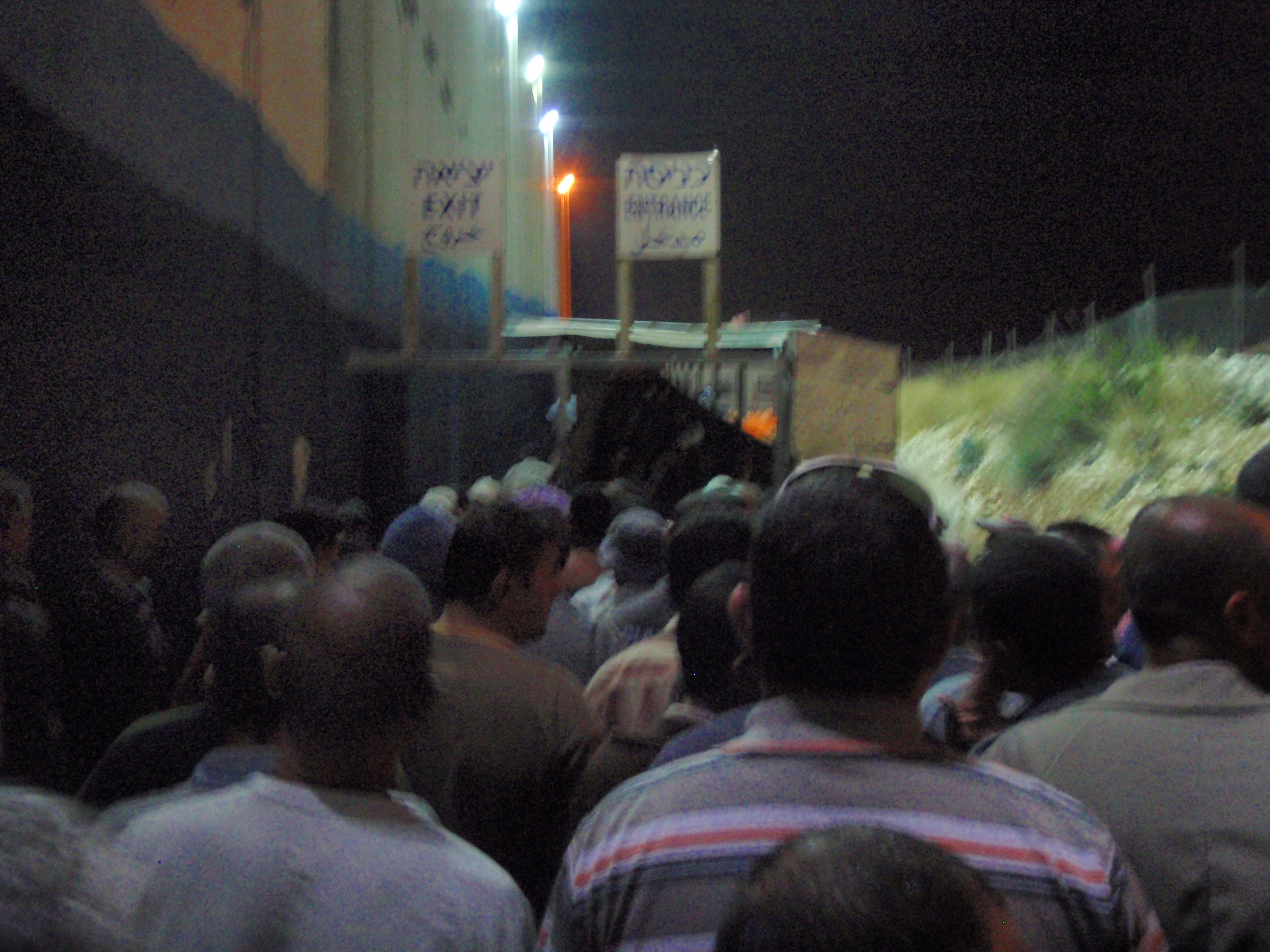
I believe that the checkpoint she was describing was the same one through which I entered Bethlehem. We entered during the day by coach, so I can’t say I witnessed a scene comparable to that which the correspondent describes.
As I understand it, the majority of the volunteers are Israeli. It cannot be easy for them to do what they do.
I think the words in the report speak for themselves, and if publishing them here makes me an anti-Semite in the eyes of some, I’ll take that on the chin.
I don’t normally propagate stuff I receive via the internet.
But a banker friend sent me this little nugget about derivatives, those nasty financial instruments that caused so many problems in 2008. It’s probably been pinging around inboxes around the world by now, but if you haven’t seen it, it’s a treat:
A Lesson in Economics: Understanding ‘Derivatives.’
Heidi is the proprietor of a bar in Detroit .
She realises that virtually all of her customers are unemployed alcoholics and, as such, can no longer afford to patronise her bar. To solve this problem, she comes up with a new marketing plan that allows her customers to drink now, but pay later. Heidi keeps track of the drinks consumed on a ledger (thereby granting the customers loans).
Word gets around about Heidi’s “Drink now, pay later” marketing strategy and, as a result, increasing numbers of customers flood into Heidi’s bar. Soon she has the largest sales volume for any bar in Detroit. By providing her customers freedom from immediate payment demands, Heidi gets no resistance when, at regular intervals, she substantially increases her prices for wine and beer, the most consumed beverages. Consequently, Heidi’s gross sales volume increases massively.
A young and dynamic vice-president at the local bank recognises that these customer debts constitute valuable future assets and increases Heidi’s borrowing limit. He sees no reason for any undue concern because he has the debts of the unemployed alcoholics as collateral! At the bank’s corporate headquarters, expert traders figure a way to make huge commissions, and transform these customer loans into DRINKBONDS. These “Securities” then are bundled and traded on international securities markets.
Naive investors don’t really understand that the securities being sold to them as “AAA Secured Bonds” really are debts of unemployed alcoholics. Nevertheless, the bond prices continuously climb – and the securities soon become the hottest-selling items for some of the nation’s leading brokerage houses.
One day, even though the bond prices still are climbing, a risk manager at the original local bank decides that the time has come to demand payment on the debts incurred by the drinkers at Heidi’s bar. He so informs Heidi. Heidi then demands payment from her alcoholic patrons. But, being unemployed alcoholics — they cannot pay back their drinking debts. Since Heidi cannot fulfil her loan obligations she is forced into bankruptcy. The bar closes and Heidi’s 11 employees lose their jobs.
Overnight, DRINKBOND prices drop by 90%. The collapsed bond asset value destroys the bank’s liquidity and prevents it from issuing new loans, thus freezing credit and economic activity in the community.
The suppliers of Heidi’s bar had granted her generous payment extensions and had invested their firms’ pension funds in the BOND securities. They find they are now faced with having to write off her bad debt and with losing over 90% of the presumed value of the bonds. Her wine supplier also claims bankruptcy, closing the doors on a family business that had endured for three generations. Her beer supplier is taken over by a competitor, who immediately closes the local plant and lays off 150 workers.
Fortunately though, the bank, the brokerage houses and their respective executives are saved and bailed out by a multibillion dollar no-strings attached cash infusion from the government. The funds required for this bailout are obtained by new taxes levied on employed, middle-class, non-drinkers who have never been in Heidi’s bar.
Do you now understand?
I have no idea where this came from, but I suspect Detroit, which is the city most often quoted as the biggest casualty of the 2008 financial crisis. Still relevant today, I think.
The last stop on our cruise around the religious Mediterranean before we returned to Istanbul was Ephesus. Well, actually, Kusadasi, a port city on the Turkish Aegean coast a few kilometers away from the Graeco-Roman ruins from which this card is posted.
This time, in contrast to the official cruise trip to Jerusalem in which forty-five of us were crammed into a large bus for a route march through the holy places, we were six in a minibus. Much more flexible.
Our guide was a sweet young Turkish woman from Izmir. How you manage to retain a sense of enthusiasm when you go to the same places two hundred times a year I know not, but she managed it admirably.
Her chat on the way to the first stop was subtly revealing. She spoke of the traditions of Aegean Turkey. How the Aegean Turkish were much more European in their outlook than the more conservative people in the East. Code for secular rather than religious. Also of how much culture the Greeks and Turks share thanks to the ancient Greek and Roman heritage of the region. She touched lightly upon the forced expatriations of Greeks and Turks from their ancestral homelands in 1923 based on their religion – Orthodox Christians from Turkey to Greece, and Muslims vice versa – without mentioning that the Treaty of Lausanne was seen by many as the ex post facto ratification of an ethnic cleansing process that had been going on in both countries for years before. But we were simple tourists, so her presumption was probably that we didn’t want to hear too much of that political stuff.
Our first stop was yet another holy place – The House of the Virgin Mary. Tradition has it that after the crucifixion, Mary, the mother of Jesus, was spirited away by St John to Ephesus, and spent the rest of her days living in a quiet place in the mountains above the city. Our guide faithfully recounted the tradition and its origins, but as an archaeology graduate, made it clear that her heart lay with the sceptics. The location of the house was “revealed” in a dream to a sickly German nun in the 19th Century. When discovered according to the description of Anne Catherine Emmerich’s dream, the ruins quickly became a shrine, despite the fact that – as our guide pointed out – they dated from well after the 1st Century.
But religious leaders don’t let small details get in the way of basic truths, and the little shrine enjoyed visits from Popes Paul VI, John Paul II and the current incumbent, Benedict XVI. So it must be authentic, mustn’t it?
Authentic or not, it is a beautiful location. High in the mountains, surrounded by pine trees and with a little stream tinkling nearby. A good place for quiet contemplation, whatever your religion. And even better because we were near the end of the tourist season, so were spared the usual throng. If the Virgin Mary hadn’t got there first, I would have been happy to spend my days up there before being called to account. Provided it had an internet connection, of course.
Then back down the hills towards Ephesus, the main attraction. At which point here are four things I didn’t know about Ephesus:
- Its name comes from the Hittite word for bee, one of the few words of the Hittite language to survive into Latin (Apis) and so into the present in the form of apiology, the study of bees.
- Ephesus lost its power as a commercial centre when the River Meander started silting up. It is now five kilometres away from the coast. As with most of the coastal cities, it was a political football, suffering numerous conquests and sackings.
- A big earthquake in AD 270 hastened its decline, and the malarial marshes left by the silted-up river made it an increasingly dangerous place to live. It lingered on until the 15th Century, and finally gave up the ghost.
- The famous temple of Artemis, one of the ancient Seven Wonders of the world, was a ruin by the 6th Century, at which point the Emperor Justinian, on the hunt for building materials for the Basilica of Hagia Sophia in Constantinople (now known as Ayia Sofia – see previous post on Istanbul) removed many of its beautiful columns for his new church.
Sic transit gloria mundi. But luckily for us, the Ottomans were not much given to archaeology, so Ephesus slowly sunk under the soil, waiting to be rediscovered by British, German and Austrian archaeologists in the 19th Century. And what a magnificent site they uncovered. Theatres, temples, aqueducts, commercial centres, a huge library and a well preserved terrace of houses dating from the Roman period that give as good an insight into the lifestyle of the wealthy as any buildings in Pompeii and Herculaneum. Oh, and a very impressive communal lavatory where the citizens would sit side by side at their ease, gazing out on the city and discussing the events of the day – the waste sluiced away a few feet under the row of marble seats.
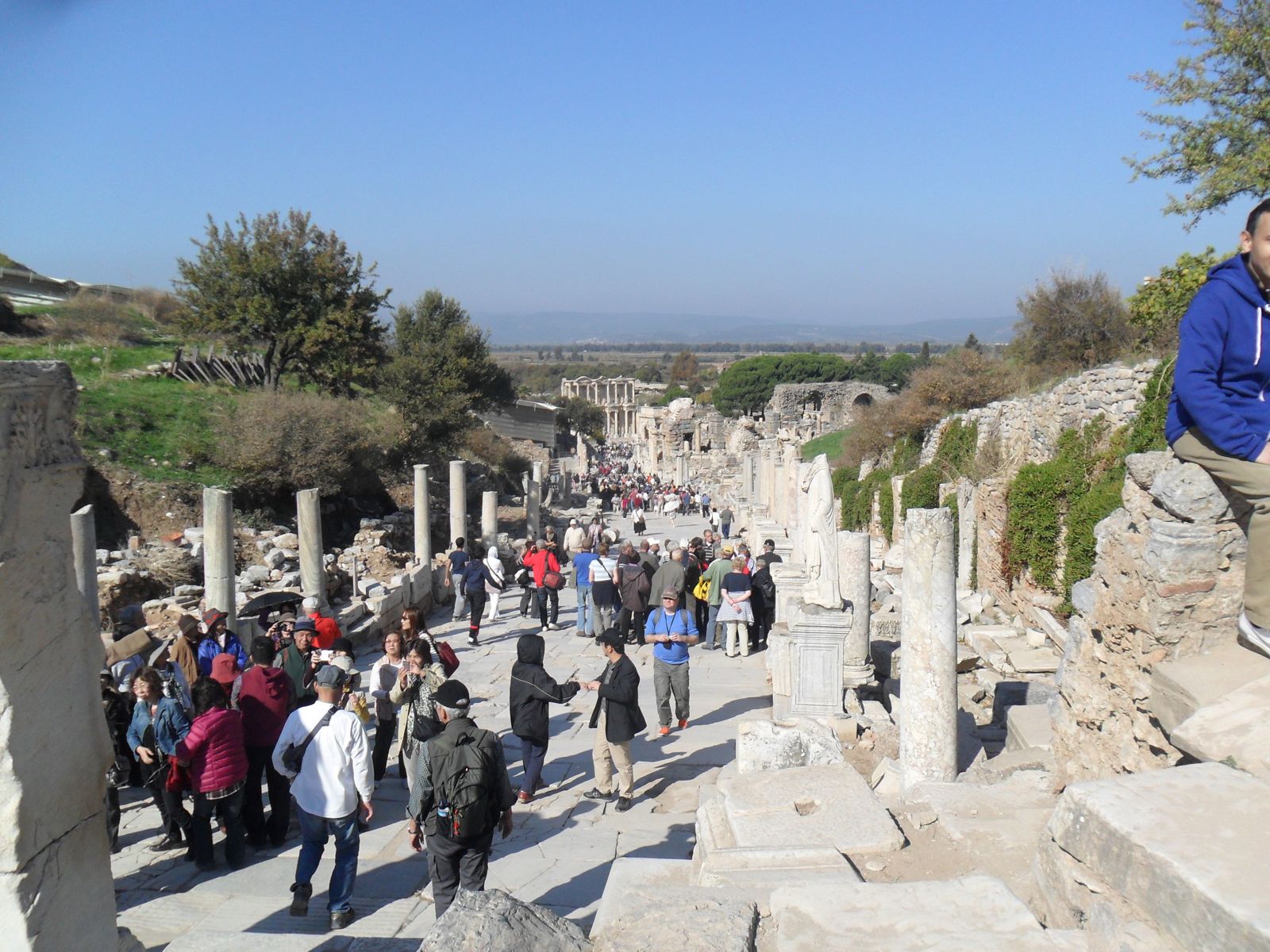
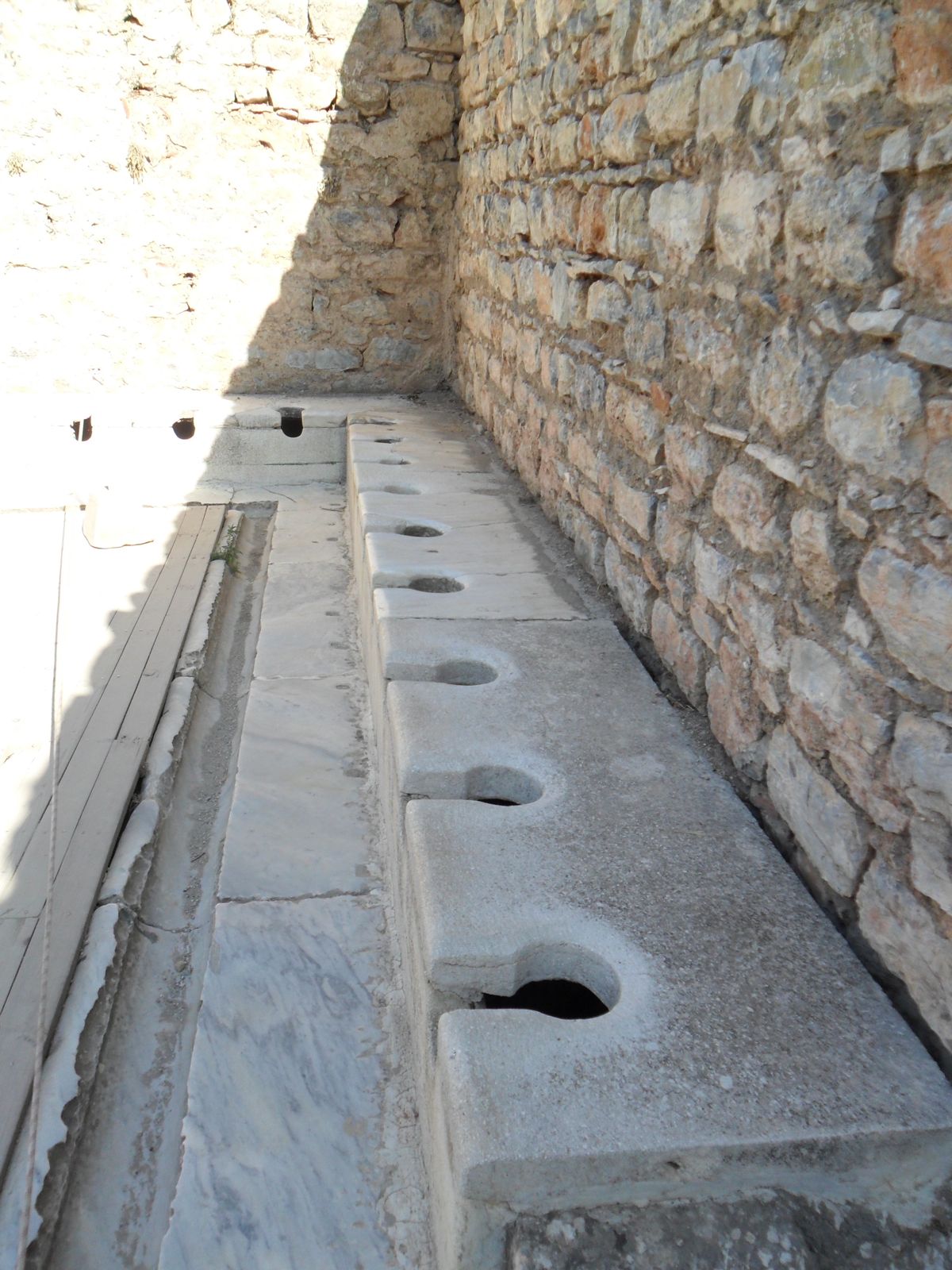
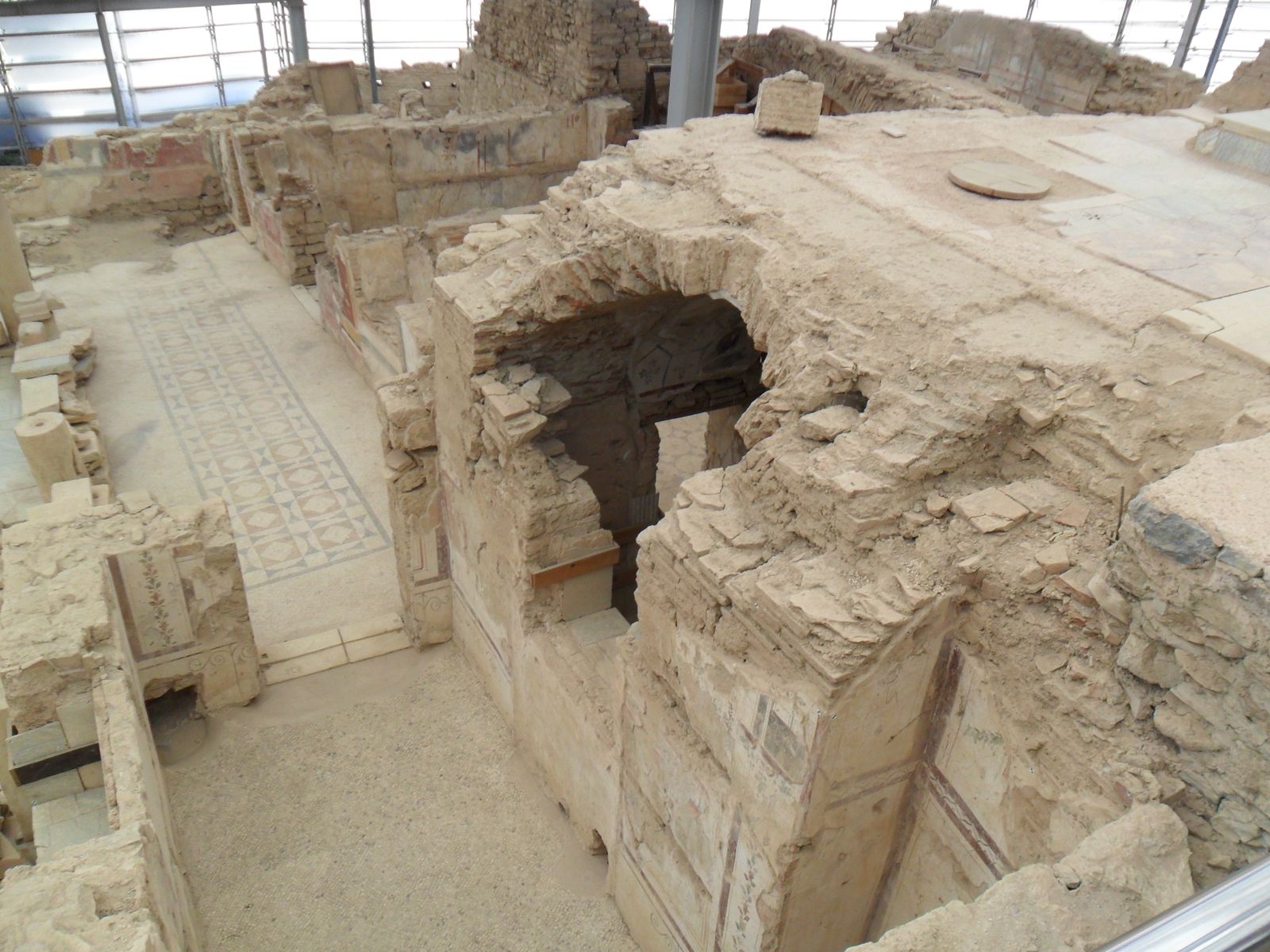
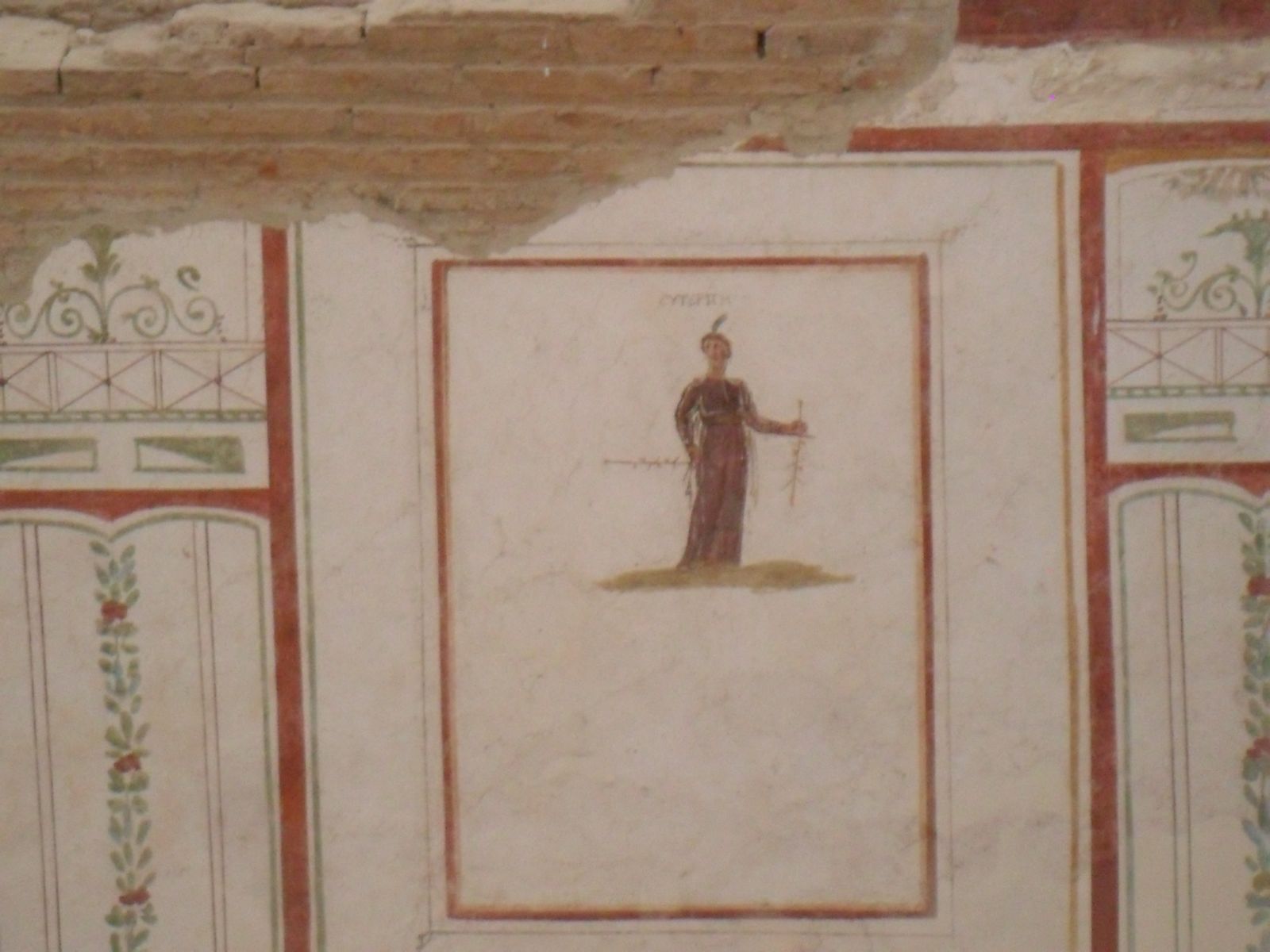
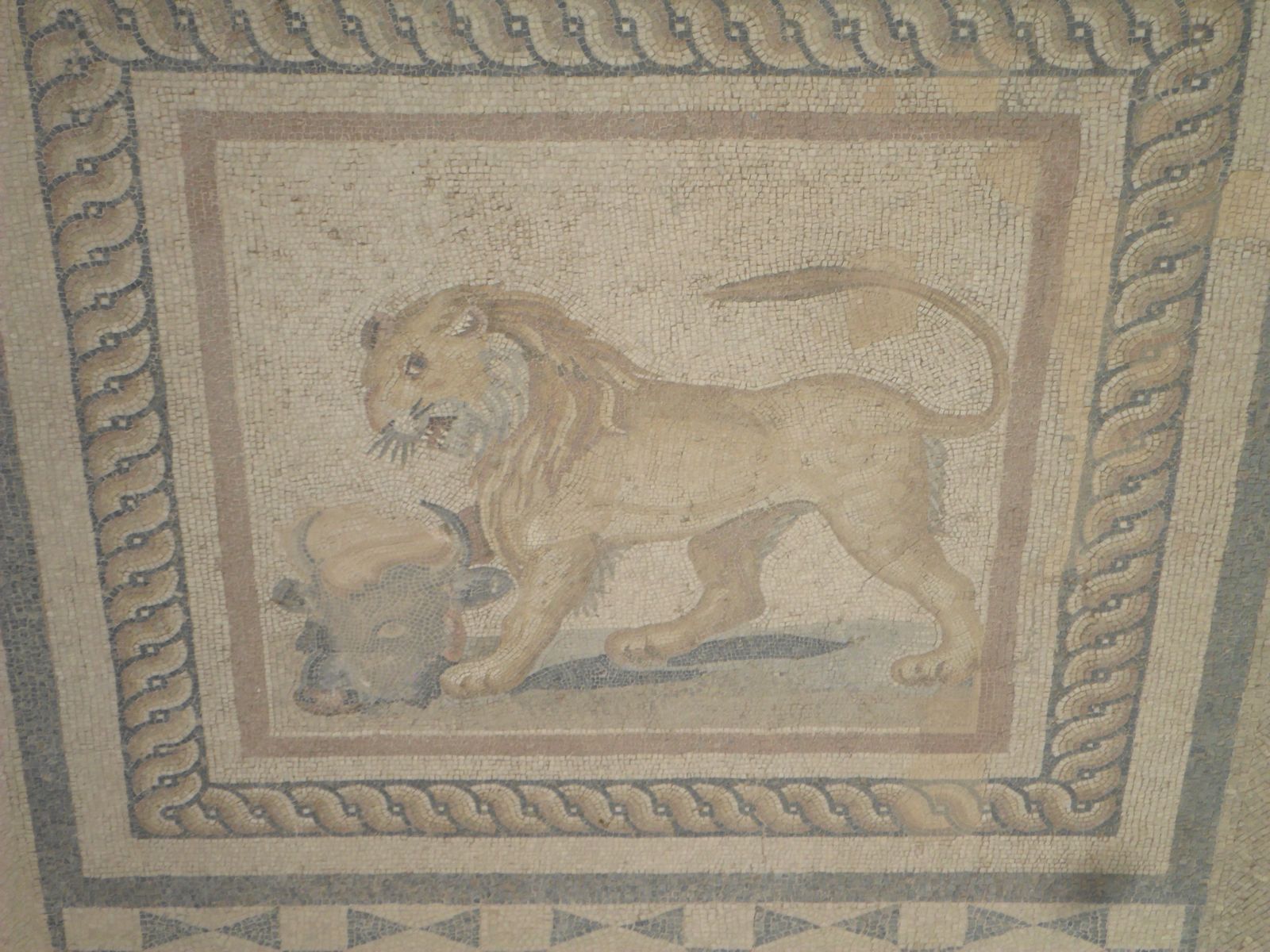
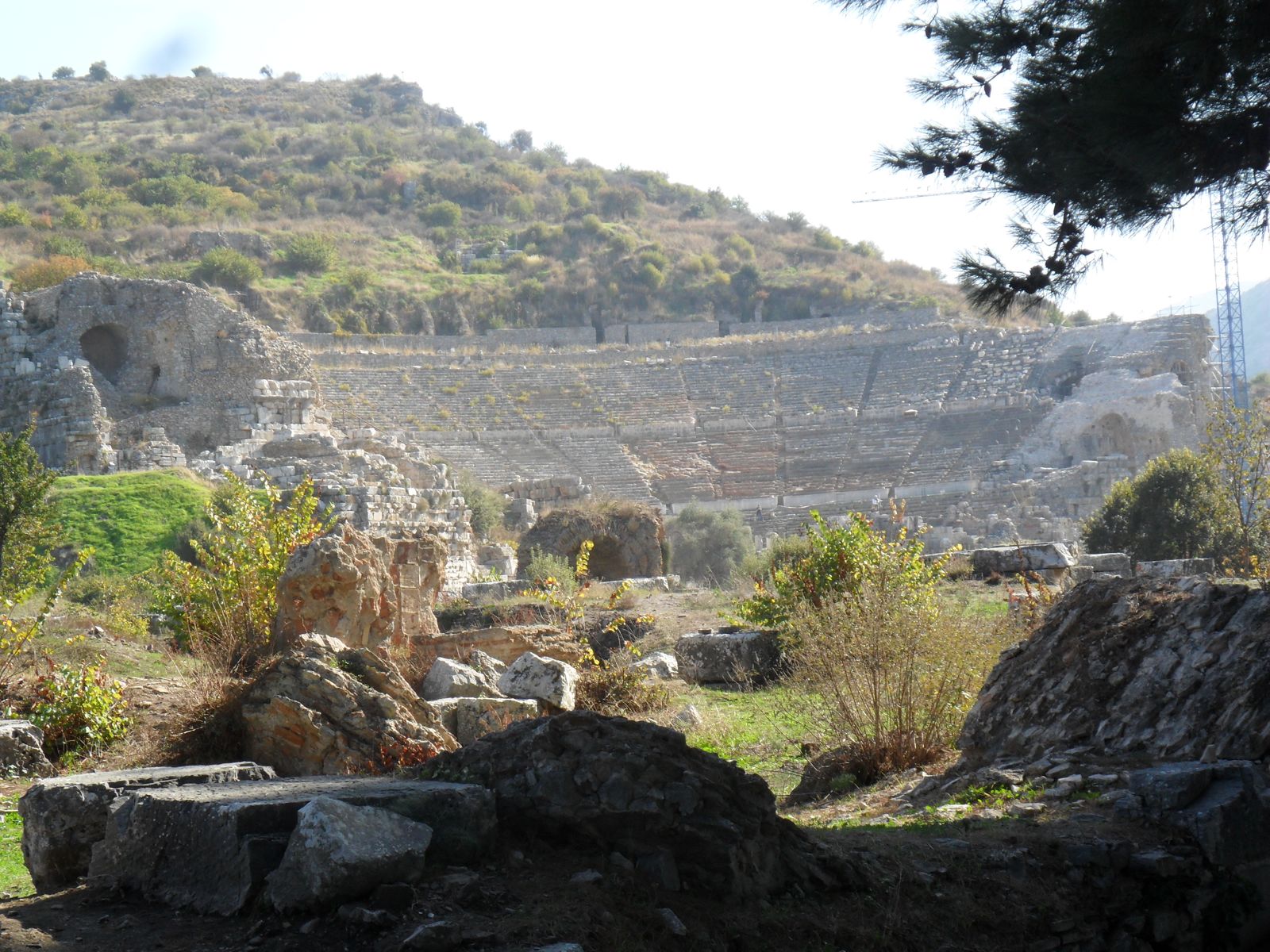
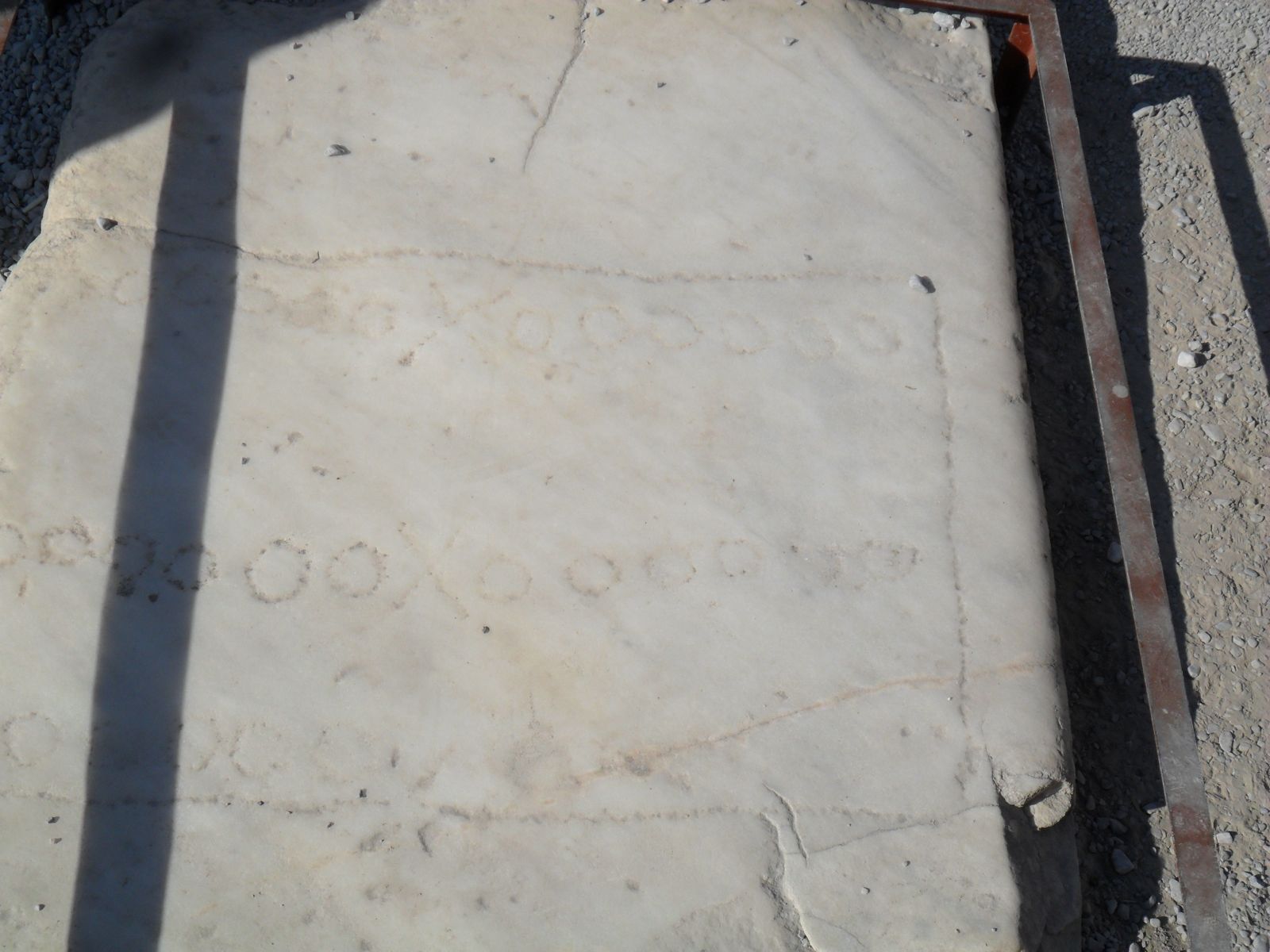
It’s not just the big picture sites that impress. Touching small reminders of the lives of the inhabitants – such as the backgammon board etched into a marble slab, and the intimate mosaics on the floors of the terrace – are to be found throughout the city.
Modern Turkey is well aware of the value of its Aegean sites, and continues to discover new wonders all around the region, often with the help of international archaeologists such as the Austrian team that has excavated the Ephesus terraces. I have been to more ancient sites in Italy, Greece and Turkey than I care to remember, but Ephesus is up there with the best of them. Truly magnificent, even if few traces of the earlier Greek city remain.
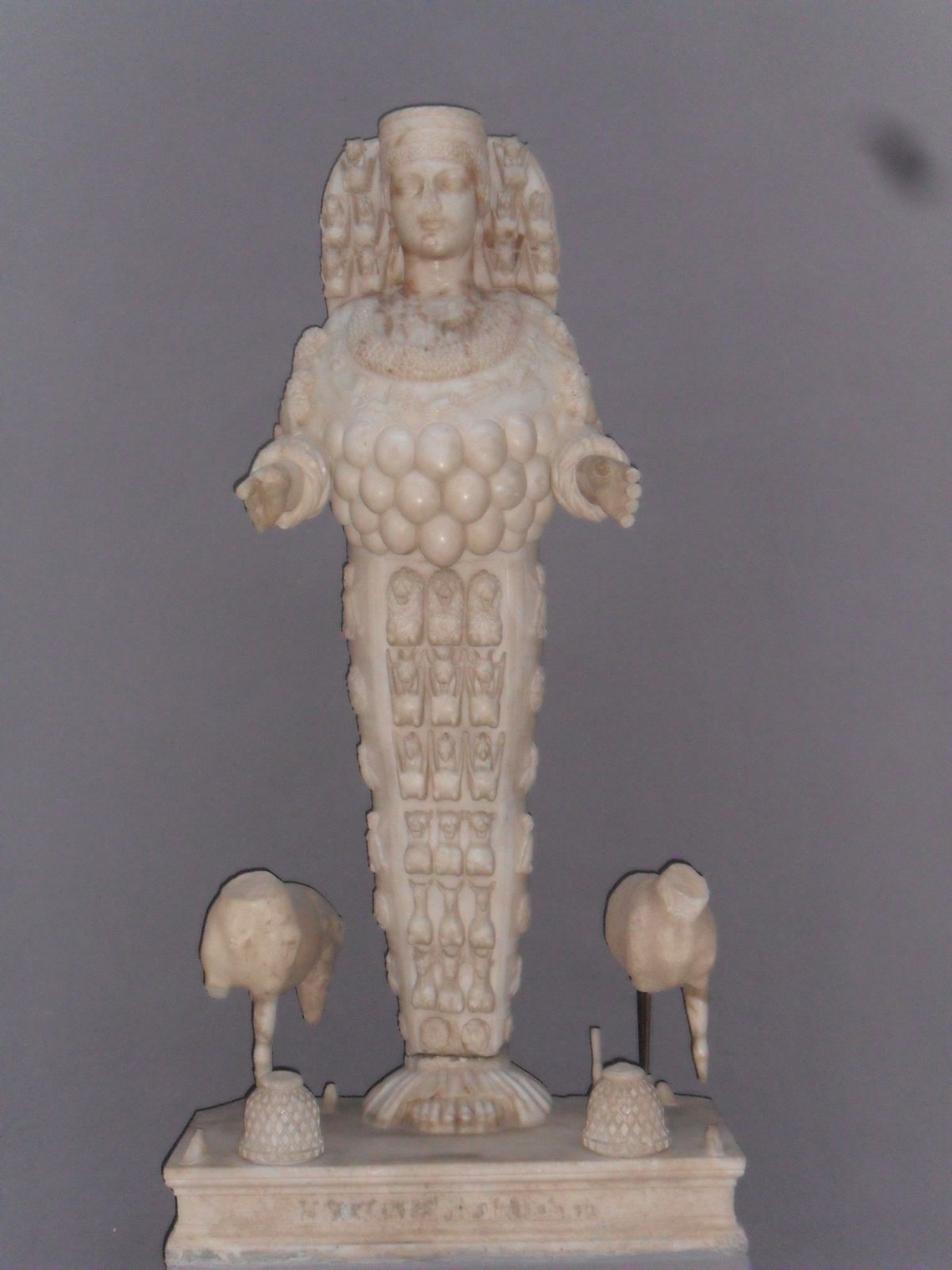
A brief visit to the Ephesus museum, crowded with statues and sarcophagi, as well as a couple of very un-classical looking statues of Artemis retrieved from the massive temple dedicated to the goddess, and we were away for lunch. For all the photos, grateful thanks to my friend Shon.
On the way to lunch we stopped by the site of the famous Artemision. Very little remains beyond the temple base a and a pile of broken columns. A single reconstructed column stands to show us the height of the building. On the hill above, a sturdy fort built by the Seljuk rulers to defend themselves against the Crusaders in the 12th Century.
Finally, no tour would be complete without the commercial opportunity. Our little restaurant was next to a carpet workshop, where local girls were demonstrating how Turkish carpets are made. My wife sat this one out, muttering to me “you are NOT going to buy another bloody carpet”. I wasn’t, but it’s always a pleasure to see fine handicraft, even if the finest examples would have set us back $20,000. She also missed a demonstration of silk spinning – from the cocoon to the thread – which I had never seen before.
Back to the port, and a quick stroll the thought bazaar offering “genuine fakes” – branded shoes, tee shirts, Rolexes and so forth. I prefer fake fakes myself. The whole fake business is something the Turks would have to deal with should they finally gain entry to the EU. But that’s unlikely to happen for a while, if at all, so I imagine that the fake business will continue to flourish for years to come.
So ended the last of our excursions, and it was back to the ship a day’s sailing through the straits of Gallipoli towards the cooler air of Istanbul.
In the three countries we visited, the unifying theme was an endless cycle of conquest, liberation and re-conquest, of prosperity, decline and resurgence.
The resurgent country today is clearly Turkey. Whatever its murky past, many aspects of which it denies or glosses over, modern Turkey is vibrant, energetic and, in its cities, sophisticated. Greece is downtrodden but still alive. Israel effectively came into being through a form of conquest, and suffers from the fact that the world acquired a conscience after World War II, whereas its neighbours acquired their domains in a period when conquest was considered something to be proud of, and the names of the conquerors adorn the streets of their capitals today.
For me, Turkey comes out top of the three as a place to visit. Though I believe it is the poorer through the departure over the past century of many of its ethnic and religious minorities, the diversity of its heritage remains in its cities, archaeological sites, customs and culture. Much as it tries to emphasise its “Turkishness”, it has more in common with its neighbours than meets the eye. It is part of Europe and the Middle East, and should rejoice in its ability to speak the language of both cultures, whatever its future political affiliations.
Since we got home from the cruise, Greece has a new government, Turkey suffered a second earthquake in Van, and Israel is rattling the sabre over Iran’s nuclear programme.
Nothing stands still for long in this neck of the woods.
Dear Mum
Went to Athens today.
Not much to report, really. Nearly froze to death on an open-topped bus from Piraeus to the Acropolis. Traffic awful. The Piraeus Road lined by sex shops. The Parthenon is still there. You can’t get a decent photo because of the cranes, but at least you’re above the pollution. Nearly decapitated by low-hanging oranges on our way to the Archaeology Museum. The Schliemann treasures from Troy and Mycenae are fantastic. Unfortunately we couldn’t see everything because they kicked us out at 2.45. It was Friday, you see. So we went for a coffee nearby and people-watched for the next hour. Nobody seemed particularly down-in-the-mouth despite the financial crisis. Checked out Syntagma Square – all quiet despite the Papandreou vote of confidence due at midnight. Took the Metro back to Piraeus. Packed but efficient.
This was the cradle of democracy, the city of Pericles, Euripides, Plato and Socrates. The civilisation I spent all those years learning about in that expensive school you and Dad paid for. Did I miss much?
Maybe I’m toured-out by now after seven days on a cruise ship. If you haven’t seen it already, get the DVD of Joanna Lumley’s Greek Odyssey. She does Greece far better than I can. I suppose it helps having a production company pay for you to meet a Venetian Count in Corfu, Melina Mercouri in Epidaurus, oily wrestlers, shipping magnates and old ladies picking asparagus for supper in the Peloponnese. She’s a bit gushing, but always a pleasure to hear her honeyed voice.
There’s much more to Greece than sad old Athens, thank God.
Much love
S
“When we get off the bus, leave all your belongings behind. Only take a few dollars. Do not bring your passport or your credit cards. When we enter Jerusalem, you will be surrounded by people who will try to take your money. I know these people. If you want to shop, wait until we get to Bethlehem. We will go to an approved outlet where everything will be much cheaper than in Jerusalem. Why? They do not have purchase taxes in Bethlehem. Also you will be contributing to the Christian community there. They need your money.”
This was the message from our Israeli guide – a wiry, shaven-headed guy in his thirties with a mordant sense of humour and the appearance of a commando.
We were on our way to Jerusalem on an official tour sold by our cruise operator. There were forty-five of us, rolling out of Haifa on the coast road towards the Holy City. Our guide proudly briefed us on the top four industries in Israel: tourism, technology, defence and diamonds. The diamond industry began after the refugees from the holocaust arrived with the asset they could most easily hide about their persons. Defence – well, we all know about Uzi sub-machine guns and a host of other instruments of death originating from this neighbourhood. Technology – Microsoft, Facebook and Intel are heavily represented in Israel, and the country has a substantial home-grown IT industry. And the seven cruise liners docked in Haifa are compelling evidence of the strength of the tourist industry.
Whatever else you might say about Israel, it has a culture of invention, especially when compared with some of its well-endowed neighbours that rely on the expertise and intellectual property of foreigners.
Once we had received this homily on the local economy, we were allowed to enjoy the view in relative silence over the following hour, with the backdrop of an endlessly-repeating loop of fervent songs extolling the holy land. I think the assumption was that we were here as pilgrims, a description that certainly didn’t apply to me. I fell asleep, and woke as we approached the city through one of the well-appointed suburbs on the outskirts of the Old City.
The first stop was a photo-opportunity atop the Mount of Olives. We poured out of the bus to look down at a hill side that boasted a few rows of scratchy olive trees. Some of them, our guide told us, were more than two thousand years old. Beyond the hill stood the limestone walls of the Old City, with the golden Dome of the Rock shimmering in the mid-morning sun.
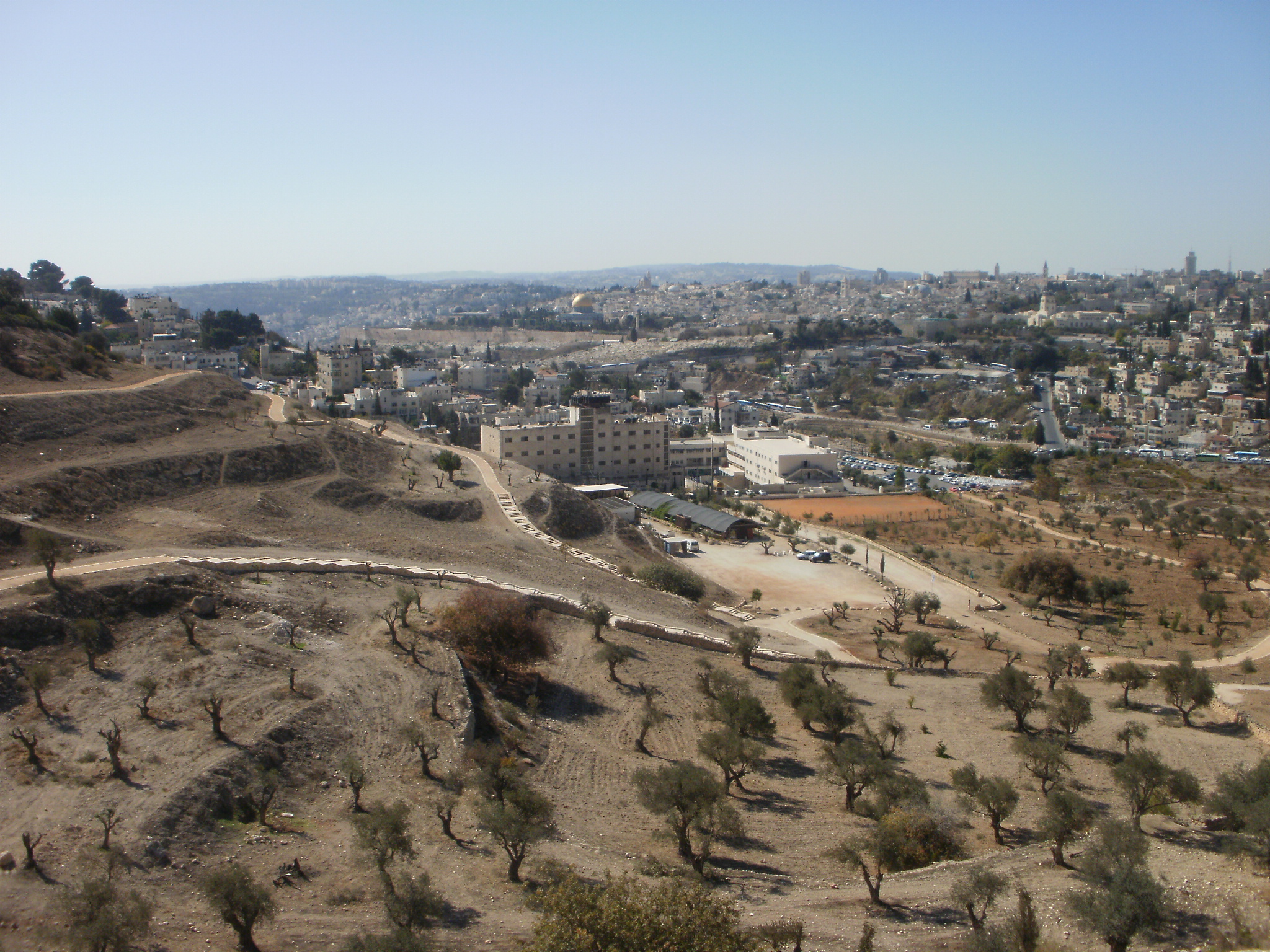
After photos, we descended to the Garden of Gethsemane, where we met our first street sellers, offering beads, trinkets, water and postcards. As instructed we ignored them, even though I didn’t get the impression that we were about to mobbed by voracious pickpockets. Inside the walled Garden, we wandered past an unremarkable church to a small fenced enclosure circled by a few ancient olives and patrolled by a fierce-looking monk who reminded me of one of those slightly unhinged characters you encounter on a bus from time to time – make eye contact and you’re doomed to an impassioned tirade about aliens.
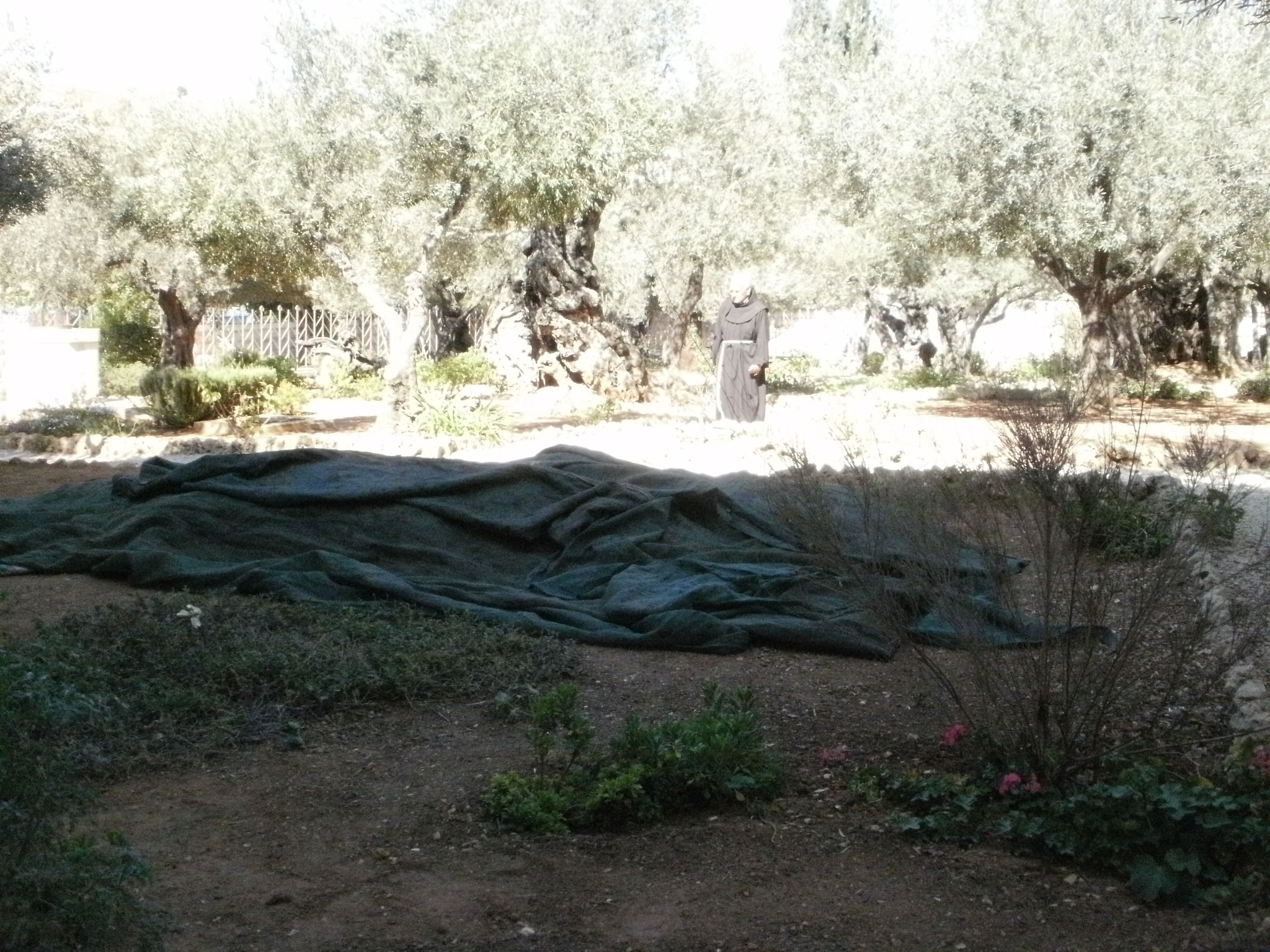
The whole area was choked with visitors, each led like sheep by the guide holding up a badminton racket converted into a numbered sign. The odd party of holy rollers would occasionally launch into a chorus of hallelujahs and similar devout utterings, while our party struggled to keep up with the raised racket. I couldn’t wait to get out of there.
So onwards through the gate to the Old City, past the Mount of Olives Cemetery where that devout media mogul, fraudster and man of principle Robert Maxwell is buried, past a drum-banging, marching Bar Mitzvah party to the Western Wall, also known as the Wailing Wall. To the right was the leaden dome of the Al-Aqsa Mosque, to which our guide scarcely alluded. Shame – I would have liked to have visited the Muslim shrines, but for some reason they were not on the itinerary of any of the tours offered by the cruise operator.
The massive slabs of the Western wall, the last remnants of Herod’s temple at the base of Temple Mount, sit in front of a large square. On the day we visited it was fairly empty, but the wall itself was lined with the devout, inserting their little pieces of paper bearing prayers into the cracks. It is divided into two sections, one for women, and an area twice the length for men. Was it to stop the women from being harassed, or because of some misogynistic ordinance? I shouldn’t have been surprised. After all, mosques (except the Grand Mosque of Makkah) and Orthodox churches have traditionally separated the worshipping women.
I went down to the wall. Men were standing silently with their hands on the stones. To the right, in a roofed area, orthodox Hassidim in their funereal black suits and hats were sitting reading the scriptures or incanting while nodding their heads as their ritual demands. One man was swaying next to the wall, weeping and moaning. Lamenting the loss of the temple two thousand years ago. I felt like an intruder, and quickly moved back to the square.
Impressive and atmospheric as the wall and its rituals are, I was not uplifted by the experience. Not because I am clearly not among the chosen, but because I was among people who believe they are. And because religious exceptionalism, together with its political manifestation, is deep in the soul of this city, the cause of centuries of conflict that continues today.
From there we moved down the Via Dolorosa, the route Jesus is supposed to have taken on his way to his crucifixion. We passed through narrow alleys of shops, through the Jewish, the Muslim and finally the Armenian quarters. They all looked much the same. Storekeepers looked resignedly as we passed by, knowing that the cruise parties had been warned against trading with them. I went into one of several selling ancient coins. Long enough to discover that I would have paid ten times the asking price for items I could have bought in the UK. No doubt that would have been only the beginning of the conversation, but negotiation takes time, and meanwhile the man with the badminton racket was moving us on to the next station of the cross – one of a series of locations where Jesus is held to have stopped on his journey.
I love souks, and I could happily have spent hours in the shops lining the Via Dolorosa, but it was not to be. We were moving towards the Church of the Holy Sepulchre. The church sits not on some impressive hill, but as one of a number of tall buildings accessible through winding alleys. There is a small square in front of it, which was packed with the faithful queuing to get inside. The interior is dark and gloomy. What little light gets in comes from grimy windows and from the top of the dome that covers the alleged site of the tomb. For centuries the Catholic, Orthodox, Coptic and Armenian churches have vied with each other for the guardianship of the church, and for their little piece of the building, often coming to blows, and neglecting the maintenance of the building because of disputes over responsibility. Exceptionalism at work again.
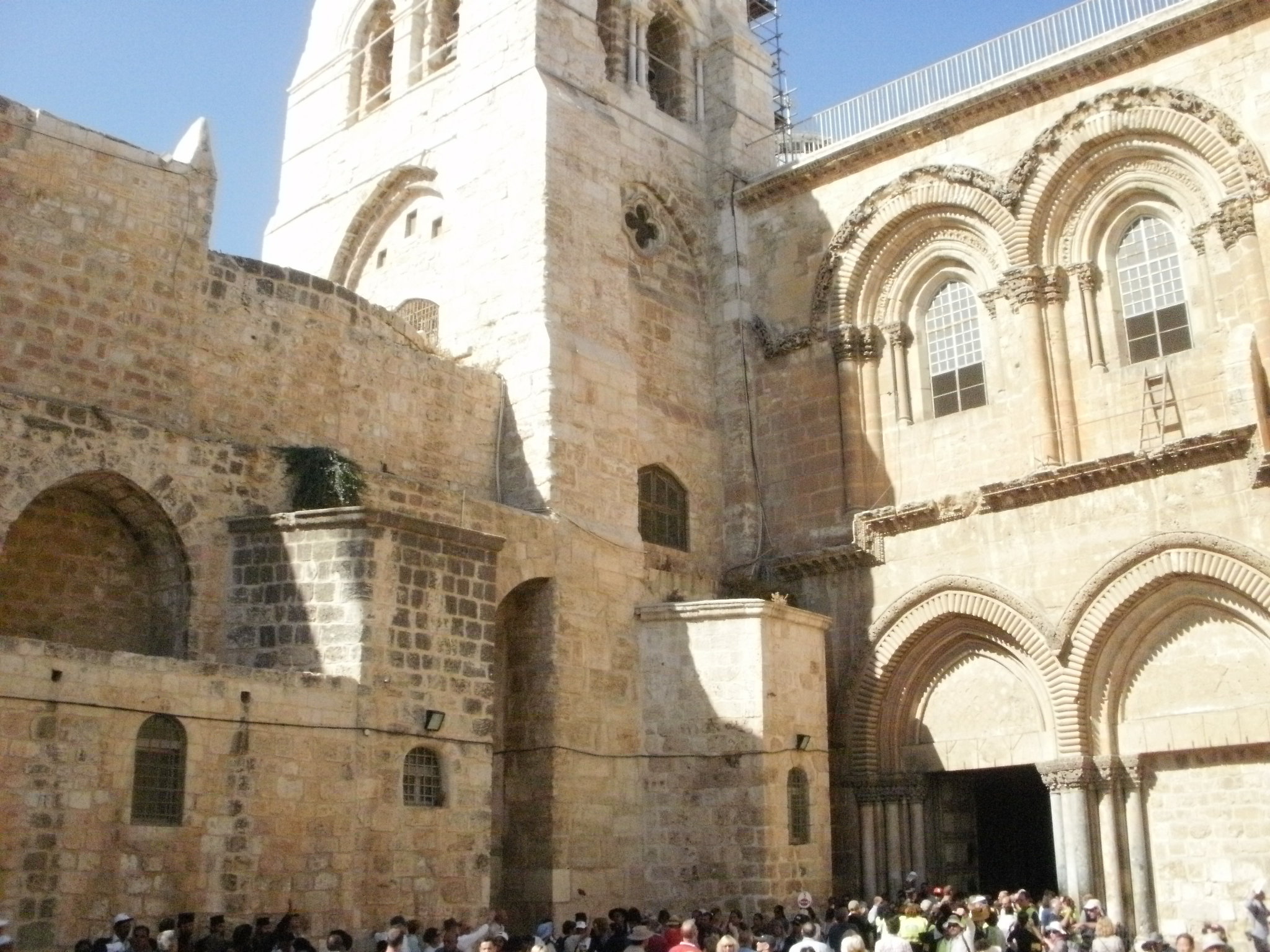
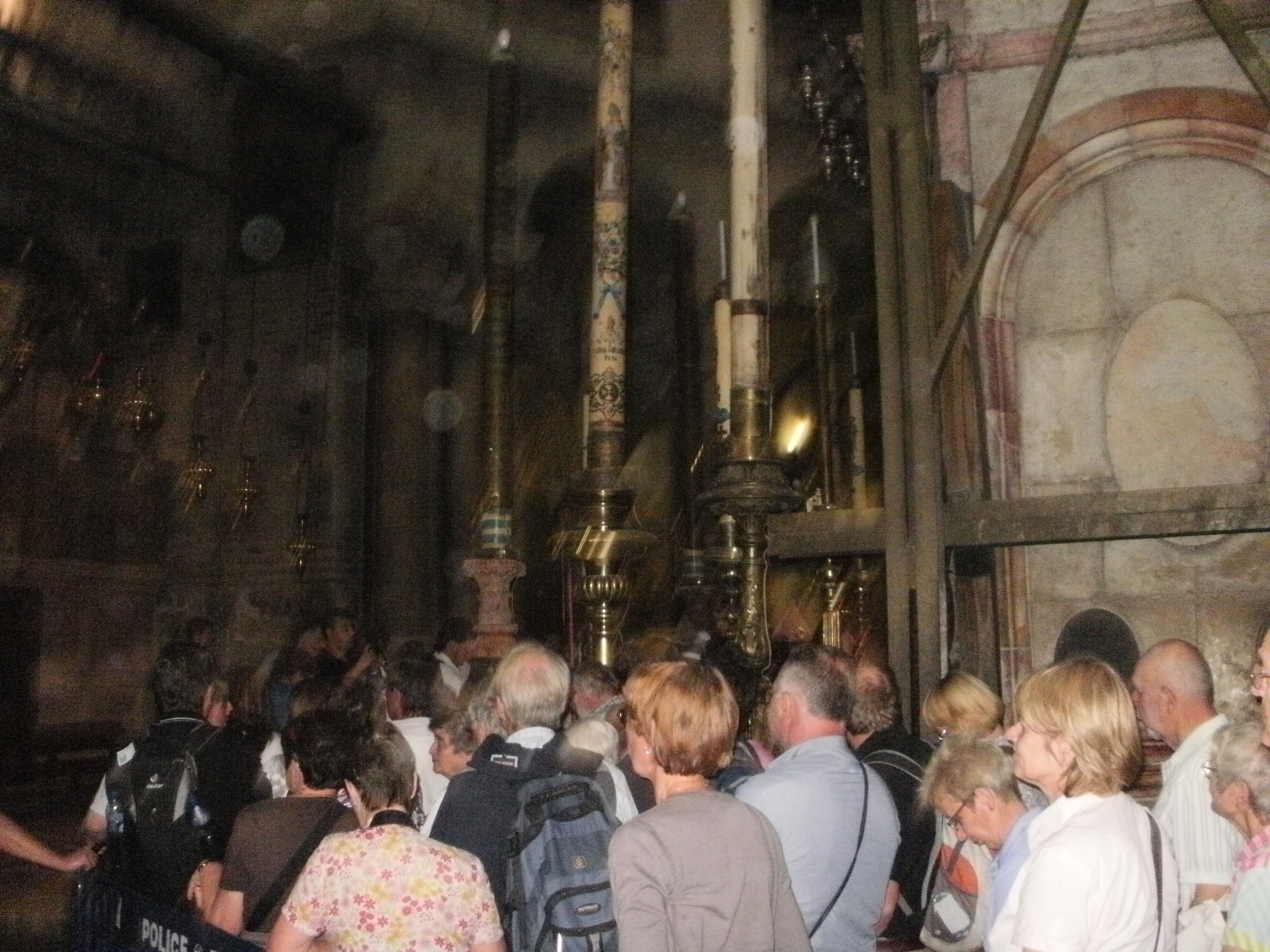
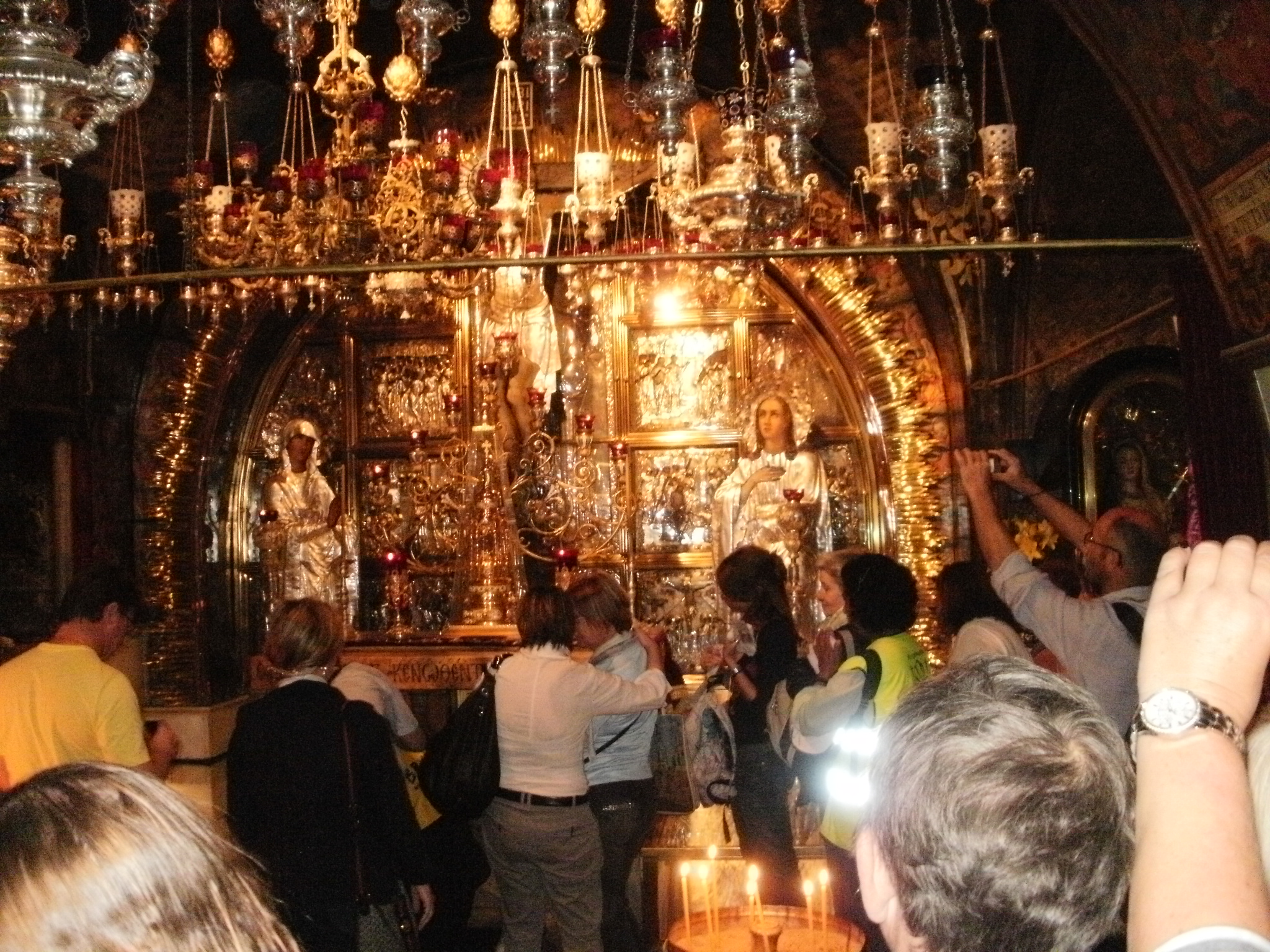
The church was packed with babbling groups of tourists. We went upstairs to the site of the crucifixion. How three crosses could have been erected in such a small area – and why people believe that this was the site when biblical references claim that it happened outside the city walls – is a testament to credulity, as is the tradition that his tomb lay but a few yards from the site of the cross. It is as if the builders of the first church decided to create a theme park whose attractions then became real. And real it seemed to many of the visitors, who knelt to kiss the marble slab covering the site of the anointment of Christ’s body, even though the slab is freely acknowledged to be a later addition.
Perhaps I missed the point. There is now way of knowing whether these sites are authentic, just as the various church-covered rocks in Galilee where Jesus is supposed to have stood are the result of tradition, and can never be otherwise. Jesus’s ministry only acquired significance many years after the events described in the scriptures. His crucifixion was a fairly routine event in a first-century land of zealots, robbers and religious mystics. So does it matter where the events actually occurred? Centuries of veneration of the so-called holy places have given them an atmosphere of their own – a holy aura in the minds of the faithful. And plenty of opportunities for commercial exploitation.
In the end, I suppose what matters is what you believe, and in those terms, one rock is as good as another. For believers, faith is surely everywhere.
So that was Jerusalem. There were many places I would like to have seen. This was just a sampler, if you like. The city is an archaeological treasure trove. Layer upon layer of habitation and destruction. Remnants of custom, culture and conquest. Centre of faith, hopes and dreams. Site of battles past and probably future. Perhaps even of the ultimate battle at the end of days if you happen to be of that persuasion.
Fascinating as it is, I still believe that this blood-soaked region would have been a happier place if the Emperor Hadrian had left Jerusalem alone, and had not built his colony among the ruins in the second century. But memories were long, and no doubt if Jerusalem no longer existed someone else would had to have invented it in due course.
We trooped out through the Jaffa Gate, to a quick lunch and back on the coach for Bethlehem, the birthplace of Jesus. Bethlehem lies within the area controlled by the Palestinian authority, so we needed to pass through the border and acquire a new guide. The border checkpoint was a narrow gap in the notorious concrete wall that divides today’s Palestine and Israel. Israel’s way of curbing armed incursions, suicide bombers and intifada mongers. An ugly concrete thing several meters high that runs through borders disputed by Palestinians, dividing families, property and businesses. On the Palestinian side of the wall, the ubiquitous graffiti – pictures of Yasser Arafat, slogans and cartoons depicting the plight of the enclosed.
Bethlehem is one of the few Palestinian towns with a sizeable population of Christian Arabs. Its poverty compared with Jerusalem and Haifa is immediately apparent. Crumbling buildings and ancient cars. From the bus station we headed to the Church of the Nativity. Like the Church of the Holy Sepulchre in Jerusalem this is an ancient shrine. The first church on the site was built at the behest of Helena, mother of the Roman emperor Constantine in the fourth century, and rebuilt by the Eastern emperor Justinian – the builder of the magnificent Ayia Sofia in Istanbul – in the sixth century. As in Jerusalem, there are clear demarcation lines between the Orthodox, Armenian and Catholic faiths. The adjoining Catholic church is a relatively new addition. The old church is under the sway of the Orthodox priests.
Also as in Jerusalem, maintenance of the church has for centuries been neglected because of turf wars between the custodians. But it is an imposing interior with fine floor mosaics, far less cluttered than the Holy Sepulchre. As our guide tried to give us a commentary on the building and its origins, he struggled to be heard over the voices of many other guides doing the same thing. The babble quietened down whenever the security guard barked “silence!” and then rose again.
Behind the glittering altar, where Orthodox priests stood swapping liturgical responses, is a tiny grotto, said to be the stable where Mary gave birth to Jesus. On that spot is a silver star that the faithful kneeled over to touch or kiss. A few yards away, a niche in the rock where Mary swaddled the infant.
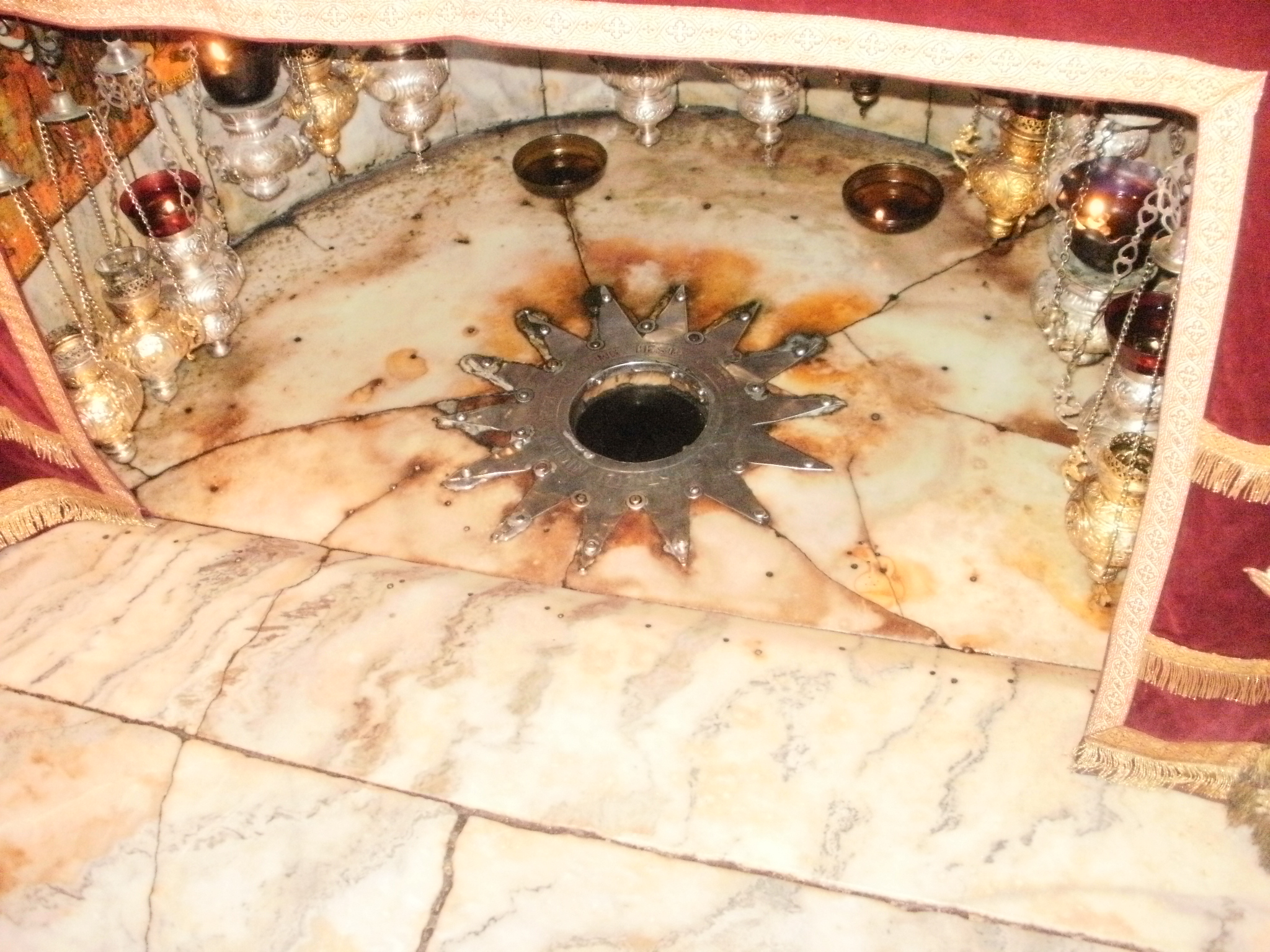
Again, a place of great meaning to those who believe in its provenance. And whatever its origins, an experience to stand in a place of continuous worship for eighteen centuries – in the footsteps of the Persian invaders – who spared the church because the magi depicted on the wall were in Persian dress – the Umayyad caliphs, the Crusaders, the Ottomans and the monastic orders that clung doggedly to their church over centuries.
And finally came the inevitable shopping opportunity. We were driven to the “authorised outlet” a mile or so from the church. There we were shown nativity scenes carved with olive wood, jewellery, icons, key rings, cheap bracelets and necklaces and souvenir mugs, not to mention the gift packs containing little bottles of holy water, olive oil, frankincense and the earth of the Holy Land. Just the sort of thing to bring home for those not fortunate enough to make the trip.
The place is owned by a consortium of Christian Arab merchandisers. No doubt the faithful felt some obligation to support the businesses of the Christian minority, because business was brisk.
A good hour passed before the next coach tour arrived, and then it was back in the bus for the long hike back to Haifa. The trip took a good three hours – the ship was originally scheduled to dock in Ashdod, which is much closer to Jerusalem. But Israel’s decision to launch a missile raid on members of the Islamic Jihad group in Gaza led to fears that Ashdod might come in for a few retaliatory rocket attacks.
So we crawled back through the checkpoint and down the motorway, sharing a stop-off with a coachload of soldiers brandishing their heavy machine guns as they sipped their cappuccinos. Back in the coach, the CD of patriotic songs returned to its endless loop. At the port, our guide gave us a farewell exhortation to tell all our friends what a wonderful country Israel is, and to come again soon.
In some ways he has a point. Israel has an impressive infrastructure. It is far from the haven of fanatics it is made out to be. Its people have brains, energy and determination.
And yet at what cost? Will the pressure of having few friends in the region, the aggression born of a constant sense of external threat, the legacy of dispossessions brought about by its birth, and the disproportionate influence of the religious over the secular finally lead to the dissolution of the Jewish state – an outcome many of my Arab friends believe in and fervently pray for? Not without collateral damage on a biblical scale, I suspect.
At last, back to the ship. So farewell “plucky little Israel” – home of the kibbutz, irrigators of the land, scion of Nobel Prize winners, avenging angels, demolishers of homes, expropriators of land and moderators of a dozen squabbling faiths and sects. And human beings like the rest of us.
Onwards to Athens.
The day before we landed in Israel, an Israeli immigration team miraculously arrived on our ship as it steamed towards Haifa. Formalities duly completed, six of us left Haifa on a sunny morning for a tour of Galilee. Our guide was Ramzi, a Palestinian Christian from Bethlehem. He wasn’t a guide in the sense that he provided us with a running commentary on the places we visited. He was happy to answer questions, but left it to us to ask them.
We started in Acre, the site of the last Crusader power base in the Holy Land. The Crusader citadel was the headquarters of the Templars – the great military monastic order. A squat and massive projection of medieval power. The buildings are well preserved and substantially restored, as befits a UNESCO World Heritage Site. The thick walls enclose a huge complex of buildings, including dungeons, meeting halls and refectories. There is also a tunnel carved from solid rock that once led out to the port, through which the inhabitants could presumably escape and resupply. The average height of the crusaders must have been a good deal less than today’s visitors – we navigated most of the tunnel at a crouch.
From there we took the road to Galilee. As we drove past olive trees, mango and banana plantations, I was immediately struck by how green the landscape was. Not just the areas obviously irrigated, but the hills covered with grass and trees. We drove past Hattin, where Saladin won a decisive battle against the crusader army of the Kingdom of Jerusalem. Accounts of the battle tell a tale of a Christian army unable to find water, succumbing exhausted and parched in an arid landscape. Very different from today’s terrain, scrubland dotted with olive trees and surrounded by irrigated plantations.
The green intensified as we rolled down towards the Sea of Galilee, where the apostles plied their trade as fishermen. The first of the “holy places” we encountered was the small hill where Jesus was supposed to have delivered the Sermon on the Mount. Again, a scrubby hillside, far from the impressive terrain that features in all those movies about the life of Christ.
Further down towards Galilee was the Church of Multiplication, where Jesus is supposed to have performed the miracle of the Loaves and the Fishes that fed the five thousand witnesses to his sermon. This was a relatively modern church built by an order of German Franciscan monks on the site of an earlier structure from which only a magnificent floor mosaic remained. It was a quiet and peaceful place – a simple design, bare walls and a forecourt with a pool full of carp. Despite the large number of visitors disgorged from the tourist coaches, the predominant sound was of birdsong and the trickling of water in the pond.
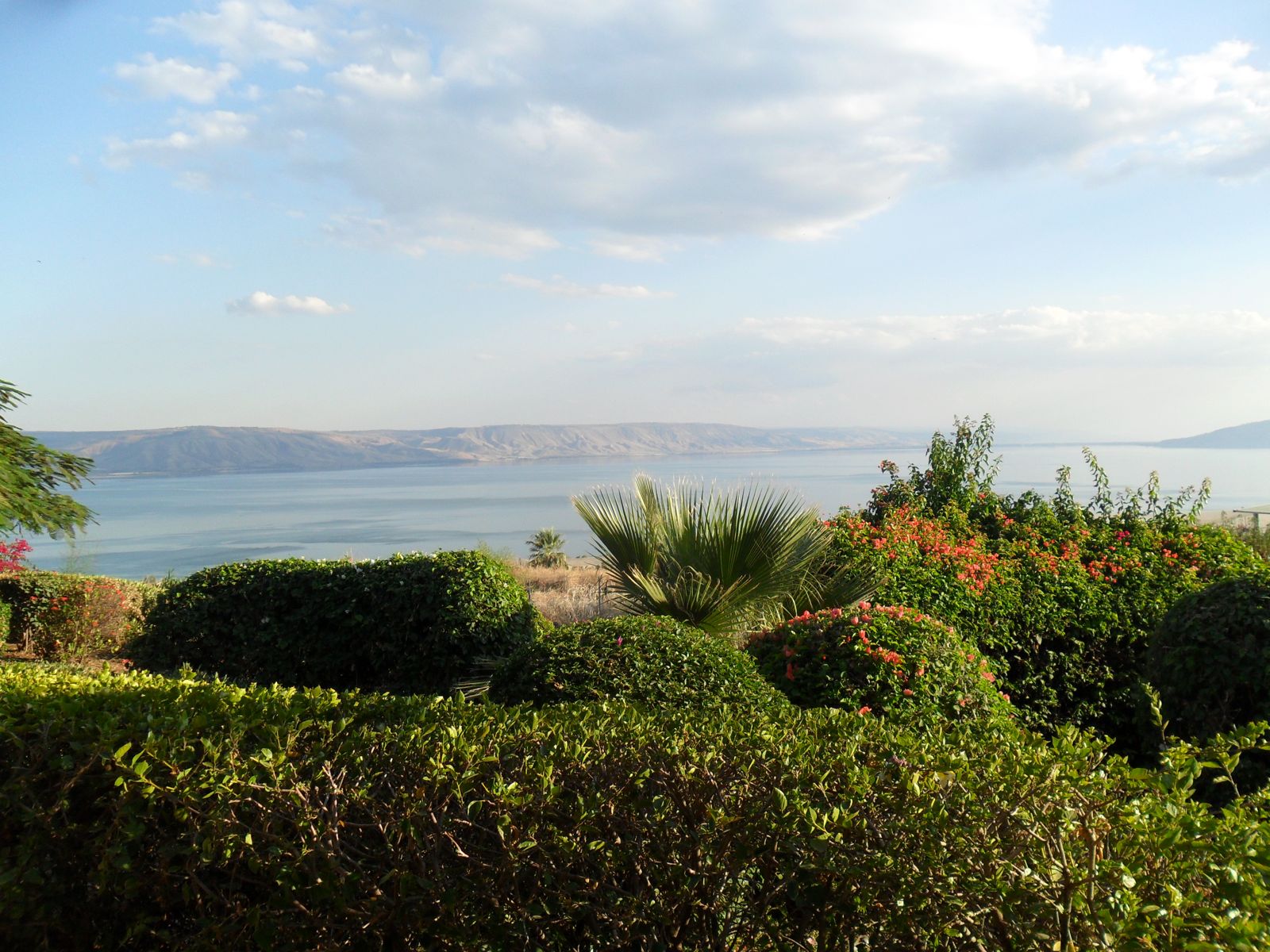
The German presence in Galilee was a surprise, but shouldn’t have been. Germany was allied to the Ottoman Empire in World War 1, and the Kaiser was keen to cement ties with the Ottomans. German archaeologists have been active in the Middle East ever since Schliemann excavated in Troy and Mycenae in the 19th century. The tomb of Saladin was restored by the Kaiser in Damascus, and the foreign quarter in Haifa is known as the German quarter. He also visited Jerusalem and was responsible for several public works in the city.
Beside the Benedictines of the Church of Multiplication, Germans were very much in evidence on our trip. We encountered parties singing in German both in Galilee and Nazareth. A reminder that the Christian tradition of which Johann Sebastian Bach was a part long predates the genocidal thuggery that was partly responsible for today’s State of Israel.
A few hundred yards on, we came to a second church that houses a rock on which Jesus also stood. We walked past the church to the shore of Galilee, and then drove up to yet another church on top of the Mount of the Sermon. From there, a superb view across Galilee to the Golan Heights, captured by Israel from Syria in the Six Day War. Immersed as we were in the peaceful surrounds of the Galilee shore, it was hard not to think of the families separated by the annexation of the Golan Heights – where relatives speak to each other across the border through loud hailers. And a few miles further, where the unfortunate Syrians are enduring their bloody repression.
Onwards to Capernaum, where Jesus’s ministry gathered pace. This was a substantial archaeological site, with a remains of a Herodian synagogue and, under yet another modern church, the walls and foundations of what the faithful believe was the house of St Peter’s mother. How they identified this site as the holy place is beyond me. I guess the answer is through centuries of tradition. To me, it looked like any of the neighbouring sites.
In the synagogue, an English guide was haranguing his customers in eloquent style. He spoke of the ministry of Jesus as the “greatest revolution in the history of man” – a message that seemed to go down well with his devout listeners, but one that might spark an interesting debate in a less febrile setting.
We then set off for Nazareth, where Jesus grew up. It was late in the afternoon, and as the sun went down we were stuck in a massive traffic jam on the only road through Cana, the site of Jesus’ first miracle – the turning of the water into wine. Had we stopped off in this ugly-looking town, we would have had plenty of opportunity to stock up on souvenir bottle of Cana wine. Predictably.
But after crawling a few kilometres in an hour, we finally arrived in Nazareth – a sprawling, hilly town full of tourist shops, cheap hotels and restaurants. There we were led to the Church of the Annunciation, alleged to be the site where the Angel Gabriel appeared to the Virgin Mary. This was a massive structure – again built over a set of rocks. And like the other churches, it’s relatively new. Yet another testament to the huge amount of money that has flowed into the area – presumably from churches and individuals around the world – over the past century.
From there, back to Haifa – a long hike jam packed with traffic that would not have looked out of place in any Middle Eastern conurbation. As we crawled back Ramzi pointed out this and that Arab town. For some reason we didn’t seem to pass many areas populated by Jews. One thing was clear though. The Holy Land is far more densely populated than I ever imagined, as we would also discover on the road to Jerusalem.
Our guide was charming yet reticent. He was one of the lucky Palestinians – he had a job. We asked him about his life in the occupied territories, and he gave a tactful answer. “Complicated”, he said.
From the superficial view of a day-trip tourist, the Galilee region is surprisingly pastoral. It lies within the territory of the State of Israel established in 1947, and as such seems firmly under the control of the state. I saw little of the edgy atmosphere to be found in our next destinations, Jerusalem and Bethlehem. But you don’t get under the skin of a place in a day, and had we the chance to talk to more of the people who live there, a richer and perhaps less sanguine picture might have emerged.
What is it that leads us human beings to congregate in our millions in a dusty city in order to walk seven times around a rock? To stand before an ancient wall in another dusty city in black attire nodding, chanting and weeping? To prostrate ourselves in a yet another city and kiss a silver star?
If faith were somehow erased from our DNA, would we find other reasons to indulge in what some might view as acts of collective delusion? Would we still kill, oppress and discriminate against each other if we did not have the intangible catalyst of an exclusive relationship with a God three major religions claim to share?
And how does that God view us as we follow our communal rituals to the letter of an ancient scripture, yet on a daily basis commit acts and omissions in blatant contradiction of the basic teachings around which the rituals have been constructed?
Were we incapable of faith, would we still have evolved value systems that resembled those imposed by great world religions? Thou shalt not kill? Thou shalt not steal? Thou shalt not bear false witness? Thou shalt not cover thy neighbour’s house?
And in a world without faith, would we have found other pretexts to kill, steal, lie and conquer to the same extent as we have managed in the name of God?
To the first questions I don’t have an answer. To the last, I would say that humanity needs no pretext to do bad things. Whether our acts are in the name of religion, tribe, factions of countries, we don’t need faith in a God to destroy each other and ourselves in the process. Nor do we need belief in Satan, Shaitan, the Devil to spur us on. We do bad things because that’s the way we are. Capable of good and evil. Divinely created or creatures of Darwin or Dawkins, I know not.
Those were my thoughts on visiting what the faithful call the Holy Land for the first time. I could have said “on visiting Israel”, but the state of Israel is a minute slice of the continuum represented by the walls, rocks, altars, churches, synagogues, mosques, symbols and trinkets that abound in the territory Israelis and Palestinians call their its own.
In one sense you could view Israel as a side show. All the suffering that created it and the pain that its existence causes its own people and its neighbours is just the latest event in three thousand years of blood and turmoil.
Were the lives of the Canaanites, the twelve tribes, the followers of the Macabees, the exiles in Egypt and Babylon, the subjects of Herod, Augustus, Vespasian, Hadrian, Justinian, the early Caliphs, the crusaders, the Mamelukes, the Ottomans and the British any better than those of the Jews, Muslims and Christians who rub uneasy shoulders today?
Side show or not, we can’t travel back in time to examine that question. The reality of today is all we have to deal with.
My trip to Israel was brief. To Bethlehem in modern Palestine even briefer. My wife and I made two day trips from Haifa, where our cruise liner was docked for three days. I never expected to come to any startling conclusions in what I saw as an opportunity to witness places and phenomena I had read about for decades. Nor do I claim any fresh insight that might change anybody else’s perception. What follows is just a set of personal impressions on a path trodden on by millions before me for much of recorded history.
The last time I went on a cruise was almost exactly ten years ago. We had sold a business a couple of weeks before an event that would have scuppered the deal had we encountered any delay in completion: 9/11.
Given all the complications of air travel in the aftermath, but wanting to celebrate the end six months of nerve-wracking activity, Paula and I looked around for an alternative break. We finally fixed on an eight-day cruise from Southampton to the Canary Islands. November was not a great time for sun-kissed cruises starting from the UK, but the Canaries are pretty close.
So we booked a cruise on a Cunard liner called the Caronia. Compared with the monsters that ply their trade today, it was an aging dowager. Rather like Cunard. And definitely like most of the passengers.
I called it the Cruise of the Living Dead. We were not young, but the average age of our fellow cruisers was at least thirty years older. Days at sea consisted of the usual gorging routine – breakfast lunch and dinner, sandwiches and cakes for tea and late night snacks for anyone who survived the scheduled mealtimes and was still unsated.
Cunard provided middle-aged men to dance with the dowagers. There were dominos, card schools and lectures on various earnest subjects from resident experts. A number of the guests were surely on their last legs. Several brought nurses along to help keep them alive and administer the oxygen
As the air became warmer and the skies gradually transformed from the slate-grey gloom of Southampton in November, passengers started to appear on the deck, decanted from their wheelchairs on to loungers. Paula and I got into a routine of vigorous walks round the main deck. As we passed by the lounger area, I would glance at the reclining elderly. Some would be reading their Joanna Trollope and Jilly Cooper paperbacks. Others would be asleep, mouths open in a rictus yawn, expressions that would not alter from one deck circuit to the next. So static that I would ask myself if they were actually still alive.
But, thank goodness, they would shuffle into the next eating session and duly replenish themselves. This being Cunard, the whole mealtime routine was somewhat stuffy. Black tie for dinner, and the same guests at the same tables throughout the cruise. I enjoy the challenge of finding common ground with people, and the elderly – if their memories are intact – often have far more interesting stories to tell than my one-track, money-obsessed fellow baby-boomers. Our companions on the table were good company, which was a relief, because nothing would have been worse than being stuck with a bunch of gin-soaked droners three times a day for eight days. But who knows – maybe they felt that way about us!
The shore trips were fun, the food was good, there was plenty of reading time and we made it back to Southampton in good spirits. But memories of eight days with the living dead put us off the cruising experience for the next decade.
Since then, the cruise industry seems to have lightened up a little. You can go just about anywhere on a cruise ship these days. The former Iron Curtain countries in the Baltic have become major destinations. You can go to Alaska or Antarctica if you don’t fancy two weeks in the sun. And the traditional cruise ports in the Mediterranean and the Caribbean have seen ever increasing numbers of people of all ages decanted into Jamaica, Antigua, Barcelona and various Greek islands.
Here in the Middle East, you can get your “Arabian experience” from stop-offs in Dubai, Oman and – until the Arab Spring took hold – Bahrain. And trips to Egypt, Israel and Turkey have always been popular.
As I mentioned in my recent post, it was the decision of one cruise company to cancel its Egyptian stop-offs that led to some very attractive deals on a rescheduled cruise to Israel, Greece and Turkey that finally persuaded us back to the ocean waves. Why Caribbean Cruises might consider Israel to be safer than Egypt right now is beyond me, but there it was.
So Paula and I duly gathered together in Istanbul with some old friends for a cruise to Haifa, Ashdod, Athens, Kusidasi and finally back to Istanbul.
The ship was about twice the size of the Cunard boat that took us to the Canaries ten years ago. The Vision of the Seas, operated by Royal Caribbean Cruises, is one of those massive floating hotels – so tall that it looks as if it would keel over in a gentle breeze. Every port we visited had rival ships docked alongside us. In Haifa I counted seven. Cruising is big business, which explains why the UK newspapers have several pages of cruise adverts in their travel sections most days of the year.
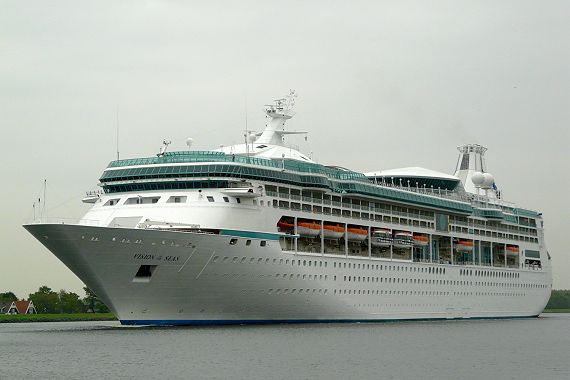
The passenger complement was relatively dowager-free. I would estimate the average age as 55-60, which put our party fairly close to the median. But there were plenty of younger people, a few school age kids escaping with their parents and yes, large numbers of the elderly.
The majority of the two thousand-odd passengers were from the US, closely followed by sizeable numbers of Brits, other Northern Europeans, Italians, Spaniards and South Koreans. The crew was truly multinational – 67 nationalities we were told, led by the debonair captain, Srecko Ban – a man whose looks and charisma would have made him a natural cast member alongside his fellow Croatian heartthrob Goran Visnjic in the cast of ER.
As we boarded the ship on a gloomy Istanbul morning, the first thing we noticed was a number of portable hand sanitising stations – put your hand under the dispenser and you get a shot of alcohol -based gel. This, it turned out was one of the measures put into place to deal with the plague of all cruise ships – the dreaded Norovirus. It turned out that on the cruise just ended there were thirty unfortunates struck down with this nasty bug that causes diarrhoea and vomiting. All were confined to their cabins until they were no longer infectious.
Fearful that the same would happen on this cruise, the crew placed sanitizers at the entrance to every restaurant, and wiped down all the surfaces that people might touch – such as handrails and banisters – every two hours. The crew were forbidden to shake hands with passengers, and we were advised not to do so with each other. Clearly this had the desired effect, since only six people came down with the bug on our cruise. But it did create something of plague mentality. I half expected to pass by cabins daubed with red crosses, which would have been very appropriate since we were on our way to the Holy Land. By the time we finally left the ship I felt myself instinctively reaching for the sanitizer like Howard Hughes in his obsessive-compulsive pomp.
The on-board experience was extremely jolly – though likely to have produced tremors on the Margaret Rutherford-style triple chins of the Caronia dowagers. Our “cruise director” was a hyperactive Welshman called Simeon. He and his rather mournful sidekick, referred to as Urkey from Turkey, would pop up regularly on the ship’s TV channel urging us to take part in the adult karaoke, assault the rock-climbing wall and blow our dollars in the casino. There was live music everywhere – on deck, in the central area and every night in the ship’s theatre. There was a card room full – my bridge-playing friends told me – of cursing Spaniards playing for high stakes.
And of course the ritual breakfast, lunch and dinner, from the cafeteria on the upper deck or the posh dining room below. The food was excellent and the service just as good. The Australian head chef took a bow at the end of the cruise, and informed us that we had consumed over forty-five tons of food. God knows what they did with the downstream result of all the eating – hopefully not dumped in the Med.
Those of you who have not been on a cruise, beware. Although the price of cruises these days are quite reasonable, operators tend to take advantage of your captivity by making huge margins on the extras. $30 per hour for a very slow internet service. At least $36 per bottle for wine and about $10 per glass. Their shore excursions are also not cheap. We took a day trip from Haifa that cost $180 each. Even the ice cream and coffee outlets came at a price. So if you are an average holidaymaker who wants to get out and about on shore, and likes the occasional glass of wine at dinner and an aperitif on deck, you could easily end up spending as much again as you did for the basic cruise. Should you think about sneaking a bottle or three into the cabin from the duty free outlets in the ports, you risk having your bottles confiscated and returned at the end of the cruise.
For most of our fellow passengers the main reason for the trip was pretty obviously the chance to visit the holy places in Galilee, Bethlehem and Jerusalem. The faithful were everywhere, as evidenced by the Sunday service held on board before we arrived in Haifa, which, from what we could hear, had a distinctly holy roller flavour. We were also treated to a lecture on the State of Israel by a female rabbi from New York. To my sceptical ears the message was predictable. The history of Zionism, the achievements of Israel, a host of impressive statistics and a selective statement of the political reality, in which she characterised the Palestinians as “a problem”.
I would imagine that the cruise operator knew its audience, and calculated that the good rabbi’s message would go down well with the American evangelicals rooting for the end of days. Which indeed it did. It left me a bit queasy though.
Of course, not all the passengers were from the scary American religious right constituency. For many, a visit to Israel was an opportunity to see the sites they had read about in the Bible throughout their lives. And I suspect that, like me, their interest was strictly historical and sociological. As for faith, I think of myself as an observer rather than a participant. My religious views are nobody else’s business. Though I find communal worship fascinating, it’s not for me.
As a dedicated people watcher, I spent many hours sitting on deck and watching the inmates go by. The older I become, the more fascinated I become with the faces of the elderly whose ranks I will soon join. I compare them with rocks by the sea. Some faces are like the pebbles smoothed out by millennia of interaction with grains of sand on the beach. Others are like boulders at the bottom of cliffs, deep cracks gouged out by the constant battering of the waves. It’s strange how many negative emotions seem to be etched into those faces – fear, disappointment, envy, irritation and spoilt expectation. Are those the emotions we have to look forward to in our advanced years? Hopefully not. Perhaps it’s just that faces at rest default into apparently unhappy compositions whether we experience the emotions or not. It’s certainly no accident that great artists such as Leonardo Da Vinci found so much satisfaction in portraying elderly subjects.
I was particularly interested in watching the elderly Koreans. Short compared to the Westerners, many of them walking uneasily, bent-backed and bow-legged. These were people who grew up before and during the Korean War in the early Fifties. What sort of lives had they lived? Was it malnourishment and hard physical labour that twisted their frames? And what is it about their society that causes them to be the only ethnic group to walk around with name badges around their necks. A need to belong? And why do a sizeable majority of Korean women –even the young ones – sport unnaturally curled hair styles, even the young ones, when the rest of the world distains the elaborate perms beloved of the older generation? Note to myself: I must visit South Korea sometime soon.
But the more you look and fail to engage, the more you generalise. I struck up plenty of conversations with charming and lively people on the cruise – both staff and passengers. The Nicaraguan waitress whose husband works in maintenance. They have a one-year-old child who lives with his grandparents. “We are doing this for him, she says”. The Egyptian Copt who lives in London and fears for his fellow Christians back at home as attacks on them intensify. The young musician who gave up his successful rock band to teach music in a church school in California.
It’s surprising how many people regard cruising as their preferred vacation. We met one retired woman who was on her forty-ninth cruise. She would think nothing of ending one cruise and going straight onto another. How she has avoided the fate of the exploding diner in Monty Python’s Meaning of Life (avoid this clip if you’re squeamish) is beyond me.
Will we wait another decade before sailing out again? Probably not. But for me there has to be a compelling reason beyond life on board. Places to visit, people to meet, things to do. I doubt if I would cruise the Caribbean, for example – not enough history to keep me happy. I probably would have enjoyed the late-lamented Swan Hellenic programmes, packed with experts taking about this or that destination laden with history – archaeologists, retired professors and that ilk. And maybe a literary cruise with a couple of novelists on board. Fighting my way through an army of obese tourists in shorts at some Caribbean outlet mall is definitely not idea of a good time.
But that’s just snobby me. Millions of people sail around the world providing a much-needed economic boost to economies sorely in need of their business. And good for them.
Next up, Israel.
I flew into Istanbul a couple of weeks ago to rendezvous with my wife and two other couples. We were en route to a ten-day cruise that started in the city.
The earthquake in Van had taken place only a few days before, and Turkey was in shock. I stopped off in Sultanahmet, the old city that is part of every tourist’s itinerary, and struck up a conversation with the owner of a carpet shop. My new friend – for everybody who wants to sell you a carpet is your friend – was outraged by what he saw as the dilatory response of the government to the disaster.
He pointed to the flags that were flying everywhere to mark Turkey’s national day, and from his personal patriotic standpoint let loose a stream of invective about Prime Minister Recip Tayyip Erdogan and his government. What particularly irked him was that ten years ago Erdogan had put in place an emergency tax in order to raise a fund for mitigating precisely the kind of disaster that struck Van.
Istanbul is not immune to earthquakes, and some estimate that up to 600,000 buildings in the city are vulnerable to collapse because they do not meet national earthquake protection standards. The earthquake tax has apparently raised over $50 billion, but instead of keeping the money in reserve to deal with disasters like the Van earthquake, the government has diverted most of the funds into infrastructure projects– primarily highway development.
The result has been that Turkey has had to ask for international assistance to deal with the situation in Van, something that my new friend believes should never have been necessary if the revenues from the special tax had been properly applied. Clearly, he is not the only person in Turkey with that view. When we passed through Istanbul on the way home from the cruise, I happened upon an article by Yousef Kanli in the Hurriyet Daily News, Istanbul’s English-language newspaper. In ‘I don’t have socks, Mr President!’, Kanli writes:
“Well, back in 1999 this country initiated a revolutionary – and biting – quake tax on a variety of consumer products including cigarettes, alcohol, fuel and so on. Since then, 50 billion dollars have been collected, giving the state a lot of resources to deploy against natural disasters. Instead, this government used that money to building the double-lane highways it pledged in its election campaign. Should the state not be more serious in its dealings with its citizens?”
Van is not one of Turkey’s better-known cities. But almost a century ago it was the scene of one of the few instances of armed resistance by the beleaguered Armenian minority against the Ottoman army during World War I. 1915 was the year of what the Armenians regard as genocide against their minority community in the Ottoman Empire. Estimates of the number of people killed by the Ottoman authorities across the Empire range between 500,000 and 1.2 million. The alleged genocide is still a hot political issue between Turkey – whose government disputes the definition of the events of 1915 as genocide – and the neighbouring modern state of Armenia – which demands Turkish acceptance of responsibility for the massacres as a precondition for normalisation of relations between the two countries.
Memories and interpretation of these events serve as the backdrop for Turkish writer Elif Shafak’s outstanding 2006 novel “The Bastard of Istanbul”, which was on my reading list for the cruise. The last time I visited Istanbul I came armed with two of Nobel prizewinning author Orhan Pamuk’s books on the city – “My Name is Red”, and “Istanbul: Memories and the City”. Anyone interested in getting under the skin of modern Turkey should as a minimum look at the works of Shafak and Pamuk.
What the two authors have in common is that both faced prosecution under Article 301 of the Turkish Penal Code, which states that “A person who, being a Turk, explicitly insults the Republic or Turkish Grand National Assembly, shall be punishable by imprisonment of between six months to three years.” Shafak was indicted for the words she put in the mouths of her characters in her novel. Pamuk for a public statement referring to the death of 1 million Armenians. The specific indictments referred to accusations that the authors had “insulted Turkishness”. In the end, both prosecutions were dropped.
Critics of Turkey’s touchy relationship with its past, as enshrined in Article 301, have used such cases to argue against the country’s prospective membership of the European Union. Much as I sympathise with the stance of both authors on freedom of expression, those critics should remember that challenges to historical orthodoxy can be also perilous within the EU, as the historian and alleged holocaust denier David Irving discovered when found guilty under Austrian law prohibiting “National Socialist Activities” and sentenced to three years in jail.
Istanbul has always been a hotbed of debate, whether prohibited or not. From its birth as Constantinople it was wracked with arguments, sometimes violent, about issues such as the true nature of Jesus Christ. Did he have a dual nature as a man and as the Son of God? Does the Holy Spirit emanate from the father and from the son? Theological debate continued after the conquest of the city by the Ottoman Sultan Mehmet II. Throughout the Ottoman rule the city was host to Orthodox Christians, Sunni Muslims, Sufi sects and Jews. The Ottoman court was rife with plots, intrigues, purges and the ruthless actions of successive Sultans to consolidate its power.
Today, even a casual tourist will find it hard not to bump into the current political issues – the Kurdish insurgency, the strains between the followers of Kemal Ataturk’s secular political philosophy and the growing Islamist hue of the Erdogan government. Much as Turkey is touted within the Middle East as the role model for the moderate Islamist factions that are gaining influence in the wake of the Arab Spring – such as the Tunisian Ennahda party – within the country there seems still to be anxiety about the future. My friend the carpet seller is by no means optimistic. He believes that the next two years will determine whether the differences of opinion will degenerate into social discord. When two of our friends took a guided tour of the Ayia Sofia museum, their guide took them into a corner, and speaking quietly so as not to be overheard, told them of his concerns – intolerance, arrests and the slow erosion of the secular society established by Atatürk.
Yet the media in Turkey still seems a long way from the muzzled press in some of its neighbours in the Middle East. For example, the Daily News carried an opinion piece by Mustafa Aykol decrying what he called Turkey’s secular blasphemy laws prohibiting criticism of Atatürk:
“The real issue, though, is not who Atatürk really was. The real issue is that we still don’t have the right to discuss that freely in Turkey. Prosecutors are always ready to put critics on trial for “insulting Atatürk.” And millions of hate-filled Kemalists are always ready to unleash the ugliest insults against those who simply think that Atatürk was a mortal who made serious mistakes.
The zeal here is most staggering, and it is only paralleled by the “blasphemy laws” that are found in some Islamic states such as Pakistan. In those countries, what is protected by law from any “insult” (and actually criticism) is Islam and its sacred symbols such as the Prophet Muhammad. In Turkey, a similar veneration is imposed by law, but this time for “Turkishness” and Atatürk.
Which gives us hints about the bizarre nature of Turkey’s much-cherished “secularism.” Unfortunately, this principle is not about creating a civil public square in which various religions and philosophies can co-exist and engage in rational discussion. Turkish secularism is rather about replacing traditional religion, especially Islam, with ersatz religion. Atatürk is the latter’s both demigod and prophet, and his words and deeds constitute a new form of scripture.
To me, that would have been still fine, had Kemalism existed as mere ideology and belief, to be followed by those who are convinced and inspired. The problem is that it is the official creed that is imposed on everyone, and that its blasphemy laws threaten us all.”
Earlier in his piece, Aykol discusses the furore that arose when a journalist referred to Atatürk as a dictator. I very much doubt that when the generals ruled Turkey he would have been able even to suggest anyone might hold that opinion. So I guess that’s progress of a sort.
Byzantine citizens of Constantinople who argued about the definition of the Holy Trinity would, if they were alive today, smile knowingly as their successors debate the definition of genocide and dictatorship.
All that physically remains of the old Constantinople are the land walls, the magnificent Ayia Sofia, a couple of other churches and a host of ground level archaeological sites. Yet spiritually, today’s Istanbulus are not so different from their Byzantine predecessors. The majority may now be Muslim, but the delight in debate and intrigue has survived throughout the city’s long history.
That’s a major reason why Istanbul is one of my favourite cities in the world.
And for me, a newly discovered delight: the view across the city from the Hamdi restaurant near Galata Bridge. On top of the view, Hamdi is held by many to be makers of the finest kebabs in Turkey. Magnificent panorama, memorable kebabs. A perfect way to round off the trip.
I have visited most countries in the Middle East. I am familiar with the souk, the mosque, the wealth and the squalor. I have met thousands of Arabs and talked politics with more than a few. Those who dare to talk about their own back yards are divided in their opinions on most subjects, just like people anywhere. On only one thing are they united – in contempt for the state occupying a little dagger of land south of Lebanon and north of Egypt on the southern Mediterranean coast: Israel.
Whether they tolerate Israel as an ugly scar on the region, refuse to recognise its existence while dealing with its reality, or grudgingly connive with it as an enemy’s enemy, almost everyone in the Middle East sees Israel as a bad thing.
So when the chance came to pay a short visit to Israel as part of a last-minute cruise deal with my wife and two other couples, it was an opportunity to fill a big gap in my experience of the Middle East. The fact that we would also be visiting one of my favourite cities, Istanbul, and Athens – another city that has been a reluctant political epicentre for the past year – made the trip a must.
The next few posts are a series of postcards from a trip that only took place because of the Arab Spring. The original cruise schedule included Egypt, and was changed a few months ago because of concerns about the safety of a stop-off in Alexandria.
Ironically, the new schedule was subject to a last minute change even as the trip was underway. The cruise line cancelled a stop-off in Ashdod – the nearest port to Jerusalem – because the recent Israeli missile raid in Gaza raised concerns that Ashdod was within rocket-lobbing distance.
But the trip was not just about Israel. So what follow are some thoughts from the various stop-offs – starting with Istanbul – and reflections on the experience of spending ten days on a cruise ship, not something I do on a regular basis.
I’m going to upset some New Zealand rugby fans with this post.
I’m delighted for the All Blacks that they won the Rugby World Cup. It’s always a disappointment for the host nation when their team doesn’t win, even if the watching world might sneer about home advantage.
But what is this absurd reverence for the Haka – the eye-popping, chest thumping, thigh slapping ritual that precedes every All Blacks match? Even the sport’s administrators connive in it by regularly fining opposing teams that come up with a similarly aggressive response. They did it again a couple of days ago by fining the French team £2,500 for linking arms and edging forwards in a V formation.
The London Times reports that Ma’a Nopu, the New Zealand centre commented on a previous infraction by the Welsh thus: “People back home will have been hurt by what they decided to do. Standing in the way they did is asking for a fight.”
So it’s OK that opposing teams should have to stand by meekly while fifteen bruisers built like brick outhouses spew torrents of testosterone, giving the distinct impression that they are about to disembowel the opposition?
Mike Miller, the Chief Executive of the International Rugby board was also reported as saying that “these cultural aspects of the game are important. We should respect them.”
Well, I’m sorry, as a casual observer who has little respect for the cultural aspects of a sport in which my only experience was one term at school – during which I regularly ended up struggling to breathe at the bottom of a pile of writhing, smelly teenage bodies, having the crap kicked out of me in an orgy of licensed sadism – I beg to differ.
If we must pay deference to national cultures at the beginning of a rugby international, why not allow other teams their moments? The English for example. How about a ritual raising of two fingers in the direction of the opposition, followed by simulated lifting of beer glasses, drunken staggering and fondling of breasts? The French? Surely hands poised to gouge the eyes and remove the testicles. The Welsh? Well, some ritual involving the abuse of sheep would do them nicely. And what if the South Africans enacted a Zulu war dance, reminding opponents of the massacre at Isandlwana? I could go on, but you get my drift.
I’m only joking of course. Racial stereotypes have no place in sport, as our England soccer players will eagerly testify.
Sport is sport. It is not war. Cultural rituals don’t belong on the rugby field or any other field, for that matter. Leave them to the gorillas and the rutting stags. Rugby is violent enough.
I guess that rules out my ever getting a visa to visit New Zealand. Shame – it seems like a very nice country.
A few weeks ago I heralded the final series of the British spy drama series Spooks. Six nail-biting and emotionally draining episodes, ending ten years of just-in-time disaster avoidance, littered on the way by the deaths of countless characters in a variety of ingenious ways.
The final episode went out last Sunday. All was revealed in the tortured relationships that linked the one ever-present over the ten-year life of the show – Harry Pearce, the MI5 Section Head who masterminded all the mayhem. With Ruth Evershed, his long-term unconsummated squeeze, with Elena Gavrik, his KGB mole from the 70s, with her son Sacha by her relationship with Harry (we are led to believe) and with her husband Ilya, who was Harry’s great KGB adversary.
As always, we had an intricate plot – love and loss interwoven with a (seeming) conspiracy to crash a Russian plane over London. As in all the interventions by the heroic team, disaster was averted with seconds to spare. Of course we also had the inevitable dead body waiting to be discovered when they made it to the scene too late. And no series of Spooks could possibly end without the death of one more much-loved (or lusted after) character.
So that was it. The furrows on Harry’s brow grew into fissures as the episode went on. The cellos – the instrument of choice for music accompanying spy fests ever since Le Carre’s Tinker Tailor Soldier Spy appeared on the BBC back in the 70s – became darker and ever more soulful. And you knew that we were at the very end when Tom Quinn (played by Matthew McFadyen) – last seen in 2002 – made a fleeting return to deal the death blow to the Russian Mr Big behind all the fuss. Remember how ER exhumed its former stars for the last episode?
I have to say that I found it all a bit of a let-down. I’m a sucker for happy endings, and happy it was not. Although the plot went in some surprising directions, the emotional journey went only one way – towards a predictably mawkish end.
As Harry disintegrated into a gibbering mess of grief and self-recrimination in his role as Spooks’ very own biblical Job, my final thought was for God’s sake give the guy a break. No such luck – things don’t work out that way when you’re serving the greater good. As many of our retired politicians have discovered, it always ends in tears.
I’m not a hankie man myself, but for all my reservations, I’m pretty sure that the Kleenex consumption around the UK was unnaturally high as the series finally slipped into the grave.
So farewell to Spooks, and bye bye to poor Harry Pearce, who deserved a better send-off.
The return to Washington of US Ambassador to Syria, Robert Ford, as reported by the BBC yesterday, caught my intention.
Ambassador Ford is not exactly a proponent of quiet diplomacy, despite an admiring profile in the Washington Post that suggests otherwise. A few weeks ago, I heard a radio interview in which he lambasted the Syrian government about their tactics in suppressing the unrest around the country. He has since been the recipient of various foodstuffs thrown in his direction by government supporters in Damascus. His forthright style is quite a contrast to that of ambassadors of other countries in the region, who tend to leave the tub-thumping to their political bosses.
When I read the BBC report yesterday, I went to Wikipedia to see what it had to say about him. I was a bit gobsmacked to see a long email exchange between him and Mohamed Tamalt, an Algerian journalist living in the UK. It was not the most friendly exchange. Over four emails he and Tamalt argue over Tamalt’s claim he is a covert CIA agent, and Tamalt’s alleged links with an Algerian Islamist faction.
It also dealt with an article Tamalt had written about “the wikileaks cable sent by Ford when he was an ambassador in Algeria requesting a military plane to transport a sick child to the USA in order to promote the image of the American army after what happened in Abu Ghrib and Guantanamo”. The passage quoted is from the Wikipedia profile of the Ambassador.
The whole exchange was a rather undignified ding-dong – what some of my American friends would describe as a pissing contest. At one stage Tamalt claims that Ford lost his temper with him. Ford replies “you have never seen me lose my temper”! Ford more than once asks to be removed from Tamalt’s email list.
My original reason for posting about the brouhahah was that it illustrates my long-held belief that email is not a good medium for debate – much better to confine yourself to exchanges of information and documenting transactions. But then a strange thing happened.
I have no idea how the exchange found its way into the Wikipedia profile, but there it was. Yesterday. When I went back to the profile today, lo and behold, the whole exchange had disappeared! What remained was a reference to Tamalt’s claim that the Ambassador was a CIA agent.
I find the CIA allegation to be profoundly irrelevant. After all, one would expect senior US State Department officials to be working pretty closely with their CIA colleagues, would one not? So why Ambassador Ford would be sufficiently sensitive about the issue to enter into a long email debate with a journalist when he knew that there was a danger the exchange would go public is beyond me. Unless the whole episode was a piece of mischief-making by persons unknown.
So I then tried to find a reference to the exchange elsewhere on the web. I happened upon a YouTube video in which Tamalt seemingly makes the same accusation. Surprise, surprise, YouTube said “an error occurred, please try later”.
Is it a coincidence that these strange happenings coincide with the Ambassador’s return to Washington? Perhaps not, or perhaps I was imagining yesterday’s email exchange…..
The last episode in my trilogy of ignorant and unfair critiques of the great business clichés of our time. It’s by no means comprehensive, and you are welcome to contribute your favourites, just as long as you are no more offensive than I have been – which gives you some latitude. In fact, if the list goes viral (see below), I might be tempted to launch a Cliché of the Year award. Sponsored by Verve Cliché, perhaps.
Seedbed
I saw this one the other day. It belongs to the environmental family of platitudes. A seedbed, in business terms, is where you plant the seed of a business and let it grow until it’s ready to be re-planted in a more robust environment. A nice, gentle way of describing the deliberate fostering of new businesses. Better, I think, than incubation, which implies an element of intensive care. Sits nicely alongside “green shoots of recovery”.
Whenever I think of these agricultural metaphors, I can’t help remembering one of Peter Sellers’ last movies, Being There, in which he plays a simpleton gardener who is mistaken for a sage by a gullible US president. Enjoy this clip.
Singularity
I mention singularity – the point at which computers become more intelligent than humans – because it’s a prime example of the creeping conversion of adjectives into nouns ending in …ity. If I want to appear smarter than you, this is an ideal device. We use “modality” instead of “way” or “route”. “Polarity” to describe two factions beating the crap out of each other. How long will it be before we describe the state of being inspired as “inspirationality”? Oh Greeks and Romans, we have much to blame you for.
Soft
Soft power, soft skills and so on. Toilet paper is soft. Skin is soft, beds are soft. The exercise of power by suggestion and manipulation and influence definitely is not soft. Nor are the skills needed to lead, decide, negotiate and manage.
Smart
Smart phones, smart cars, smart drugs, smart everything. One of those emotional trigger words beloved of the admen, like sustainable, green and friendly. It implies that those who don’t buy smart products are not smart, not to say stupid. Think about it folks. Every product that improves upon a predecessor is smart, right?
Stakeholder
Facilitators love stakeholders. When calling a meeting they summon three times the number of people who actually need to be there, because they need to “get all the stakeholders involved”. The result: three times the hot air, three times the time wasted.
When companies talk about stakeholders, they really mean all those annoying people who stop them from getting on with their business of “maximising shareholder value”. They are the same organisations for whom “people are our greatest asset”, that are “environmentally friendly” and “socially responsible”. But not at the expense of the annual bonus, preferably.
Sometimes I think that the only truly honest businessmen in the developed world are the Chinese, who don’t seem to give a cuss about their employees, the environment or any other obstacle to the pursuit of profit.
State of the art
What art? Is an oil refinery art? Is a computer art? Well, if you’re Steve Jobs, I guess so. But for the rest of us, art is something that enhances our lives, not some piece of tin that we’re persuaded to buy because everyone else on the bus has one.
Sustainable
Sustainable energy, sustainable development, sustainable business. This one of those words that means everything or nothing. I’ve used it myself, I’m ashamed to admit. But what is sustainable? A mayfly’s life is sustainable if you happen to be a mayfly. Sustainable under what definition? A house built to last for 20 years would not be sustainable to the Normans, who built castles that still stand today, a thousand years after they were built. And how about plutonium-239, that has a half-life of 24,000 years? Now that’s sustainable.
The word is no better than verbal sugar. Empty calories that make you feel good for a short time but end up hardening your cognitive arteries.
Talent
Another of those pervasive words that have strayed far from the original. Often used by the HR folks to describe the process of making the best people in an organisation better. It’s been my experience that the best people don’t need some corporate bureaucrat armed with flow-charts, forms and psychometric tests to bring nurture their abilities into a corporate-shaped talent sausage. What they actually need is for people to take an interest in them as humans, to encourage them and spend time with them. And maybe give them a little love. For a previous and possibly more sensible post on this subject, go here.
Einstein, Gates, Jobs and Brunel, people of true talent, blossomed because they had an inner engine that drove them to success, not because they came within the orbit of a “talent manager”.
Think
The use of the word think in the context of comparisons annoys me intensely. As in “think Adolf Hitler in ballet shoes”. Or “think Lord of the Rings meets Gardeners Question Time”. Often used by very cool travel and food writers. What did that poor little preposition “of” do to be excluded from its rightful place?
Transparency
Usually a word that describes our expectation of others. When it comes to being transparent ourselves, our enthusiasm wanes somewhat. Ask Julian Assange. In truth, transparency is an illusion. Behind every layer you peel away lies another.
Rationalise
What we need here are some good Anglo-Saxon words of one syllable. Fire, cut, slash, burn. In most cases, there is nothing rational about rationalisation. It’s what you do when you don’t have the imagination to do anything else. It’s what you do to save your own skin. It’s the consequence of short term thinking either before the crisis you’re dealing with or in your method of dealing with it.
Nobody will criticise you when you fire 30,000 employees if the corpse of a company you’re left with turns a profit for a few quarters. Until you wake up to find that you’ve lost huge chunks of knowledge, and the survivors are busy packing their parachutes. All because you did what conventional wisdom expected you to do, rather than what you should have done.
Remember also that another meaning of the word is to explain something away by reasoning, often false. A very useful business tool, no?
Viral
With apologies to Malcolm Gladwell, author of the Tipping Point, everyone is chasing the viral holy grail. Mostly they fail to find it because it is very difficult to manufacture a virus. They tend to happen by accident. Hit or miss.
So don’t be fooled by all those gurus who try to take money from you because they know the secret of viral marketing. If they did, they’d be using the techniques for their own enrichment. Remember Royston’s First Law:
“Those that can, do. Those that can’t, facilitate.”
Royston’s Second Law, by the way, states that
“Those who can’t do or facilitate go into HR”.
That way the HR people can facilitate the facilitators.
World class
OK, so presumably world class means “up there with the best in the world”. Notice that few users of the phrase bother to qualify their claim. Biggest, best, most profitable? And what defines “not world class”?
Worst-case scenario
Come on folks, there’s no such thing as a worst-case scenario, apart from a global extinction event, the apocalypse (for those who are not saved), and the unfortunate discovery that the afterlife we’ve been counting on doesn’t exist.
Actually, there is a worse scenario than the absence of an afterlife. That is the possibility that we will roast in hell for eternity. Not good.
And death is a good place to end this little anthology of ranting, I think.
This is the second instalment of my guide to most prevalent business clichés rattling around the business world. A mixture of linguistic snobbery, gross generalisations and cheap shots – dragged up from my dark side – that probably amounts to professional suicide in three easy steps. Oh well, publish and be damned…
Future-proofing
Look at a hundred business websites. The chances are that the company will offer future-proofed services or products. Have these people learned nothing about life? The glorious thing about our existence is that we can’t predict the future. All the future-proofing in the world did not save Lehman Brothers, the Fukushima nuclear plant or Muammar Gaddafi.
True, you can mitigate risk. But depending on what you believe, either God knows what’s in store for us, or nobody does. So perhaps we should stop peddling the lie that anything created by humanity is immune from the cliff that is only yards away from us for as long as we’re here. It’s what makes life interesting, after all.
Gendering
Now this is a new one to me. But the practice of turning a noun into a gerund is all too common. In this case it seems to be popular among female academics and consultants to describe the process of instilling stereotypical gender-related behaviour into young people. You know the score – girls wear pink, boys wear blue, and all that jazz.
I came across the word in a flyer for a women-only workshop here in Bahrain to be delivered by an expert whose credentials include:
“Her interest in Equality and Diversity has included ten years (sic) experience as a Springboard Women’s Development trainer and a co-designer and co-facilitator of the Gender Sensitive Management programme”.
All very worthy, but slightly scary.
Way back when, for many years I ran a business in which the majority of the staff and the entire executive team were female. So I’m not sure I’m ready for lectures about diversity. I suppose the fact that I and my male business partner actually owned the business makes me typical of the species. “That’s just like men – they’re always going about starting businesses…”.
I should stop now on this one before I become seriously politically incorrect, and a pariah among the sisters.
Haircut
This has special resonance for me. A few years ago, the same business partner and I faced a couple of renegade executives who manipulated a financial crisis and covertly tried to acquire the company at a knock-down price. They told us that we would need to “take a haircut” – meaning accept that a large portion of our investment in the business would disappear down the pan. We found out what they had been doing, turned up unannounced and fired them. And lo, we’re still here today!
These days, haircut keeps cropping up in connection with Greek debt – holders of Greek government bonds have apparently agreed to take a 21% loss on their investments. Where the perversion of this innocent word came from, I have no idea. For most of us, a haircut is a pleasant experience. A little brief if, like me, you don’t have much hair left. Could the corporate haircut be the revenge of the baldies over the hirsute, perhaps?
Inspirational
Back to the spiritual family. Often used to describe speakers who roam around the world inspiring us with their wisdom. Think of George Clooney in Up In The Air, who blathers on about abandoning our personal rucksacks. Or Tom Peters, the Billy Graham of business. Here in Bahrain there are hundreds of posters advertising a workshop by a guy called Randall Munson, a former IBM executive who inspires us with stand-up comedy and even conjuring tricks. All with the very serious purpose, of course, of sending us out better equipped to survive in the business jungle.
A friend tells me that some of these guys charge $50,000 per engagement. Imagine – half a million bucks for ten days work a year! Even better, you don’t have to wear a tie.
You might think I’m just jealous. Too right I am…
Knowledge economy
We all want to be knowledge workers, don’t we? That way we don’t have to get our hands dirty making things, growing things. We sit in our air-conditioned offices thinking great thoughts, innovating and inventing. And we rely on lesser beings to water the plants, dig our holes and fight our wars. “Building a knowledge economy” is the mantra of the haves. It’s an elitist concept, and it fits perfectly societies that like to leave things just as they are – in the hands of the elite.
Mantra
As in “my mantra is customer intimacy”. Yet another perversion of an original meaning designed to produce an aura of spirituality into a very unspiritual activity. Another example of cod spirituality in business is use of the word “Zen”. And of course we’re all “Jedi Warriors” these days, are we not not?
Multimodal
Up there with Gordon Brown’s “neo-classical endogenous growth” for opaque pomposity. Whatever happened to “doing things in different ways”?
Outcomes
Another soft, new-age version of “results”. A nice way of dressing up things that might happen over which we have no control. Like negative outcomes, of course.
Passionate
Now there’s an interesting word. Everyone’s passionate these days. Passionate about earth worms. Passionate about shareholder value. Passionate about passion, even. Of course passion is an emotion. And emotion is what leaders use to manipulate followers, sellers to manipulate buyers.
The fashion for passion is such that unless we spout our incontinent joy for all to witness, we are seen as lesser human beings – buttoned-up, emotionally unintelligent.
Passion must be loud, not quiet. Public, not private. And if we have no passion, we must invent it.
Reach out
“Why don’t you reach out to x”, say the corporate-speakers. Whatever happened to “talk to”? Another of those phrases that carry a metaphysical connotation that decorates the very physical world of commerce.
Shareholder value
Equals profit, dividends or unrealistically valued stock. But for the CEO who drones on about “delivering shareholder value”, the subtext is “bonus, baby, bonus!”
Solutions
As Margaret Thatcher once said: “bring me solutions, not problems”. So everyone these days is a solution provider. And don’t worry, if you’re not aware that you have a problem, we’ll make damn sure we find one that matches our solution. As Steve Jobs once said: “You can’t just ask the customers what they want and then try to give that to them. By the time you get it built, they’ll want something new.”
I like to think of myself as a happy, positive sort of person. But those who know me well will be aware that I have a dark side. Underneath my sunny exterior lurks a nasty, cynical and destructive alter ego. I keep him chained in a dark room usually. But occasionally it can be worthwhile letting him out to play for a while, so that he doesn’t get too resentful about his incarceration.
So in the next three posts I shall be giving you a glimpse of the Steve you don’t want to know. The subject is business clichés. Words and phrases you and I use with monotonous regularity when we write, speak and think about business.
As we grow up, we develop a vocabulary that we use without a second thought. Very rarely do we stop and think about what we’re actually saying. As long as the other person understands what we’re talking about, that’s OK, isn’t it?
Well, I suppose so. But sometimes I like to stop and consider the language I use. And when I do, I often shudder at the fact that I’m complicit in peddling words and phrases that are manipulative, woolly, inappropriate and even plain false.
And that’s when the alter ego comes roaring out of its dark room. So here – in three parts – are the words of the beast – unkind, bitchy and full of gross generalisations and cheap shots – on some of the great business clichés of our time:
Adding value
Also known as adding profit – the value bit is often debatable. The most abused phrase in corporate-speak. Most often used in connection with my current most favourite three-word prefix – “the appearance of”.
Best practice
A hoary old phrase that I am as guilty as anyone of trotting out on occasion. Often used in connection with the spurious concept of benchmarking. So what we do is go to twenty companies that we think do things well. We find out how and why. We package up a neat set of metrics and indicators, and hey presto, there’s our best practice!
The only problem comes when we sell benchmarking to other companies to persuade them to buy our expensive consultancy. By the time we run the rule over our client, often as not the benchmarks we use are out of date. So we are advocates of best practice that may already be redundant. After all, a lot changes in a couple of months, right? Anyone following the January 2011 best practice for effective dictatorship would by April have been donning a concrete life jacket, I suspect.
Business as usual
When a business starts on about “business as usual”, it is usually making a statement in the face of overwhelming evidence to the contrary. Otherwise, why would they bother to make the statement in the first place? And when states use the phrase, who are they kidding? Name a single country or region in this interesting year that could honestly claim that it’s business as usual in their backyard. Apart from North Korea, perhaps.
Challenge
The world is full of self-help philosophers who preach that we should always put a positive spin on adversity. To use a negative word implies negative thinking. So these days, instead of problems, crises and disasters, we have challenges.
If I’m about to lose my house through foreclosure, I’m sorry, that’s not a challenge, it’s a personal problem that needs resolving.
Champion
A champion in business is not a winner, not a defender of the true path, as the word is used in other contexts. In business, the champion is at the vanguard of the revolution. The person that the executive sends into battle to convert the unbelievers. The evangelist. The advocate.
In other words, it’s a person who is encouraged to put their head above the parapet. And when the thing they’re championing fails to gain traction, they are the ones who crash and burn, not the executives who put them up to it. They sail on serenely – another day, another cause.
Change agent
First cousin of champion. A change agent, apparently, is someone who acts as a catalyst in an organisation for bringing about change.
Let’s think about this. Do we mean someone who influences, persuades and manipulates? So that rules out Stalin, Hitler and Saddam Hussain as great change agents. Maybe, maybe not. At the beginning of their careers, they definitely had to do their fair share of influencing and manipulating. But as soon as they weaseled their way to power, we all klnow what happened.
So beware the change agent. Today’s touchy-feely propagators of the new are tomorrow’s tyrants of orthodoxy.
Corridor of uncertainty
This is a phrase that has not emigrated from the cricket field, but surely will. It’s supposed to have been invented by Geoffrey Boycott, former England cricketer, to describe a ball bowled in an area that leaves the batsman uncertain how to play it. The revered Geoffrey, perhaps the most boring, self-obsessed and blinkered batsman in the history of cricket rarely encountered such uncertainty. He just kept grinding away to century after century (note for non-cricket lovers – a century is a mark of achievement), oblivious of his colleagues and the state of the game, as we spectators dozed the afternoons away.
It seems tailor-made for corporate use – “friends, we are facing a corridor of uncertainty..” Only a matter of time, I suspect.
Empowerment
A word beloved of corporate cultures whose denizens clearly are not empowered. What they usually mean is “the appearance of empowerment”. But when it comes down to it, as the redundancy notices are handed out, the disgruntled survivors start muttering “you can fool some of the people some of the time…”.
Employee engagement
Engagement used to be what you did before you got married. Or the process of entering into some form of contact with another. These days it’s a fluffy catch-all beloved by HR consultants, who sell expensive surveys to companies whose managers could find out all they need to know about the state of mind of their employees by bothering to walk around, look and listen.
Employer of choice
I like this one. It’s a pompous way of describing a great company to work for. These days, sadly, few people have a choice of whom they work for. Most people are grateful that they still have a job. Only the Brahmins of business and the most adept self-publicists can gaze from their commanding heights, point their fingers at the companies that pay the best bonuses, have free organic restaurants and innovation pods resembling the Big Brother House, and say “I choose you!”. This is an era of necessity, not choice.
Evangelist
There is a strong spiritual element to today’s corporate language. Is it because the US, the true home of corporate-speak, is so heavily influenced by the religious right that so many buzzwords with spiritual or religious connotations have entered our business vocabulary?
Partly, I would say. Actually, I reckon that corporate America is caught in a spiritual pincer movement – between the holy rollers and the new age mystics. Lloyd Blankfein of Goldman Sachs (“I’m doing God’s work”), and Steve Jobs of Apple (the prince of Zen minimalism) are prime examples of the two camps. Either way, it’s hard to do business in the US without paying lip-service to faith and spirituality of some sort.
Unfortunately, we Brits are a touch more cynical. I remember a vendor conference organised by a leading telecommunications company in the 90’s. Inspirational speakers, stirring music, calls to action – a cross between a revivalist meeting and a Nuremburg rally. It went down like a lead balloon. On the whole, we are not given to outbursts of irrational emotion, unless we happen to support some no-hope football team.
It’s much the same in British politics. As Alistair Campbell, Tony Blair’s press secretary once remarked: “the Labour Party doesn’t do God”.
Facilitate
A dictionary definition of facilitate is “to make easy, to help bring about, to preside over”. Sadly, the business world is full of people who facilitate, but their purpose is primarily to avoid actually doing anything themselves. Modern facilitators float, delegate, network and influence. The last thing they want to do is actually roll up their sleeves and achieve anything. That’s for others to do.
There is a very unkind saying that denigrates the noble profession of teaching. It goes: “those who can’t do, teach”. It’s cruel and unfair, but there’s a grain of truth when applied to lousy ones. I have a variant, which I call Royston’s First Law:
“Those who can’t do, facilitate”.
Managing large projects can be an aging experience anywhere in the world. You need vast reserves of patience, resilience and tact to deliver on time, on budget and to specification.
Here in the Middle East, add the challenges of dealing with multinational and multicultural workforces, and working in organisations where authority as often derives from patronage as from boxes in an organisation chart. So successfully steering a big project to completion can depend heavily on political skills.
And when the project manager is working within an authoritarian management ethos, fear of failure often causes people to be less than frank about things that are going wrong, or to try and shift the blame on others. Small wonder that the same people try to preserve their positions by being reluctant to share knowledge.
Saira Karim, who is a project manager and trainer, writes an interesting blog that sets out to be a forum for project managers in the Gulf and Saudi Arabia. In a recent post she explains why a competent project manager should have a high degree of networking skills. And she is right. Influence, persuasion and willingness to share knowledge are essential tools in the armoury. Without them, it is easy to win battles and lose wars.
As a consultant, I had an interesting conversation with the CEO of a fast-growing Saudi construction company a few months ago. The company was benefiting from the construction boom, but the CEO felt that they were being held back by the fact that authority tended to reside in a small and dynamic group of leaders, many of whom had been with the company since its foundation three decades ago.
It had a reputation for competence, but as often is the case in fast-growing businesses, its business systems had not caught up with its growth. So the CEO bemoaned that fact that he was still working a sixteen-hour day, but much of his time was spent dealing with issues such as approving exit visas and holidays!
Another concern was that although they did outstanding work, they had no common project management methodology. Each manager did things his way, with the result that although from one project to the next the technical language was the same, the method of carrying out each project was slightly different.
I suspect that they are among many companies that rely on unrepeatable miracles for their success, which is why a blog like Saira’s can be influential in helping to promote best practice within the region.
Another problem that an eager project manager will face in this region is the gap between intention and reality, especially where organisational change is concerned.
A friend in the Gulf who is involved in a major business transformation programme recently highlighted the problem by quoting a rather cynical colleague who was working on the same initiative. “One thing that you have to realise about our company”, the colleague said, “is that no project that we undertake makes any sense unless it is preceded by three hidden words.” “Which are?” asked my friend. “The appearance of….” replied the colleague.
Three words to send a project manager prematurely grey!
I visit Saudi Arabia often.
When you’re familiar with a country, you sometimes forget to view it afresh, free of preconceptions. You get used to the pollution and the crowds in some Asian cities. In the cities of the Gulf, you take for granted that you can rarely travel a hundred yards without passing a building site crawling with labourers who work under conditions that would horrify your average health and safety official in a Western country.
People who view the Kingdom from afar – and even those who make short visits – tend to observe the usual stereotypes through the lens of their preconceptions. What they expect to see, they see, and they filter out the contrary.
Foreign women often see Saudi women – from a Western viewpoint – as an oppressed class. Unable to drive a car, unable to start a business without having a man to front it up, unable to travel without a male guardian. Good, they say, giving women the vote in municipal elections and letting them serve on the Shura Council – the Kingdom’s advisory body – is a step forward. But hey, there’s helluva long way to go, right?
Foreign men and women will be primed to see a highly regimented society. The Saudi men they encounter for the first time might be reserved, slightly grim, and obsessed with the minutiae of their religion while around them are blatant abuses of central tenets of Islam. Arrogance, corruption, contempt for the lower orders in society – the Filipinos, Indians, Pakistanis and North Africans who make their lives comfortable by doing all the dirty jobs that they would not stoop to carry out.
All the while, the story goes, they expect the government to provide – jobs, education, loans, housing, healthcare and other public services – with minimal contribution from themselves save an acceptance of the political and social status quo.
Those foreign men rarely get to meet Saudi women. Those they do meet are often veiled, and almost always kept at arm’s length by social convention. It’s difficult to engage in a meaningful conversation with a woman when the only part of her body you can see are is her eyes, right?
These are the stereotypes you will find in countless books, newspaper articles and TV documentaries. Very few people outside the Middle East have the chance to get under the surface of the Kingdom and its people. Students at Western Universities have that opportunity – there are over a hundred thousand Saudis currently studying abroad – but I wonder what impression the natives get of fellow students who are trying hard to fit into the foreign environments in which they find themselves.
Outside the campus, the average person on the street in Leicester, England or Akron, Ohio may never meet a Saudi in their lifetime – even though they may never forget that Osama Bin Laden was a Saudi, and that fifteen Saudis cut the throats of airline pilots and crashed passenger planes into the World Trade Centre, the Pentagon and a Pennsylvania wood.
Some – perhaps on their way to a winter break in Dubai, the Middle East’s Arabia Lite – might pick up a paperback full of lurid tales of pampered Princesses, illicit relationships and expatriates in desperate scrapes. A minority might buy Robert Lacey’s incisive books on the Kingdom, and an even smaller minority might sample the vibrant Middle East blogosphere, examples of which you will see on the blog roll to the right of this post.
But for the majority, the stereotypes endure. A received wisdom that portrays a backward, oppressive society, dominated by religious extremists and a monarchy whose main mission is self-preservation. A society that funds and produces terrorists who inflict unspeakable violence on us peace-loving Westerners. A plutocracy that is ostentatious and wasteful. And, unfortunately, a country whose resources we can’t live without.
As the Arab spring erupted, some in the West fervently wished for an uprising in the Kingdom, bringing democracy, human rights and a secular society. Of course, they might think, it would have been worth the price of a few thousand dead, as in Syria, or the wholesale destruction of the country’s infrastructure, as in Iraq, or the razing of cities, as in Libya, wouldn’t it?
Before we make those judgements, perhaps we should look back 40 years to the Soviet Union at the height of the Cold War. Missiles in Cuba. Khrushchev banging his shoe at the UN General Assembly, threatening to bury us. Russians, we thought, were slaves of communist tyranny. Aggressive proselytes of a system that sought to control the thoughts and actions of its citizens. Grim, regimented and dominated by a pampered pyramid of privileged bureaucrats.
Of course we never met a Russian from one life to the next. By and large, we couldn’t visit their country and we couldn’t visit ours. Those who did make it to the West were diplomats, spies and the occasional defector seduced by the plenty they did not enjoy at home.
The Russian bear threatened us with nuclear winter, dispatched its dissidents into gulags in the Siberian wasteland and slowly let any infrastructure not dedicated to the arms race decline into wasteful, inefficient mediocrity.
Our knowledge of life in the communist system was confined to what we read in books, newspapers and TV documentaries. Occasionally we would sample Communism Lite by taking a cheap holiday on the Adriatic beaches of Yugoslavia. Brave visitors to Russia would endure the privations of Intourist hotels, where every room was bugged and our movements were controlled by minders spouting the party line in robotic fashion, afraid to step out of line by revealing their real feelings.
The tiny minority of Westerners who read the works of Solzhenitsyn and Pasternak, who listened to the music of Shostakovich and the concerts of Richter and Rostropovich, or watched the dancing of Nureyev would glimpse through the monolith. They saw that Russians loved, dreamed, hated and hoped like the rest of us – that their humanity was the same as ours, even if their values reflected the society built by Lenin, Stalin and their successors. And when Reagan and Gorbachev – products of vastly different cultures, social and political philosophies – started engaging on an emotional level, they found common interests that broke down the barriers and paved the way for the end of the Cold War.
Today, even if the political structures of the Russian state are still some way away from those of Western countries, we in the West are engaging with ordinary and extraordinary Russians in a manner unthinkable forty years ago. St Petersburg is an established stop-off on the tourist trail. Ordinary Russians work in the bars and restaurants of London. New York teams with Russian taxi drivers. Two of London’s Premier League football clubs, Chelsea and Arsenal, are owed or part-owned by Russians. And the more we engage, the less threatened we feel.
The parallel between Saudi Arabia today and the Soviet Union of my youth is not exact. But In both cases, our perception is and was coloured by broad stereotypes. Big pictures – many born of ignorance – which we are unwilling or unable to explore beyond.
In the case of Saudi Arabia, the big picture endures because of its pivotal place in the world’s political and economic order. As the birthplace of Islam, its influence over the Islamic world, which includes almost every Western country with a significant Muslim minority, is huge. And as the possessor of the world’s largest reserves of oil, decisions emanating from Riyadh about the price and supply of oil affect markets worldwide, and through those markets, ourselves. It is a country to be reckoned with.
The more important the country, the more we tend to mythologise it, especially when there is some aspect of that country of which we disapprove or fear. So we make statements from afar about China, Russia, the US and Saudi Arabia even if we have never visited those countries. When we do visit Beijing, New York, Moscow and Jeddah, we tend to stop talking about countries, and start describing people, customs, culture and diversity. Suddenly another dimension opens up. We have long realised the absurdity of generalising about the US, because we can easily visit, and see at first hand that it is a nation of so many different facets – faith, ethnicity, political belief, geography, climate and social customs. And as China and Russia open up to tourism, those of us who saw them as monoliths start seeing the same diversity that we have always seen in countries with developed tourist industries.
Saudi Arabia does not welcome Western tourists, despite having much to interest a curious traveller. Muslims come in their millions for what the Kingdom calls religious tourism – the pilgrimage to Makkah and Madinah. Yet anyone else wishing to explore the country can only do so if they are there for another reason – business or employment.
So the demolition of myths through travel and personal experience tends not to touch Western perceptions of Saudi Arabia. By its inaccessibility, its myths and mysteries remain largely intact in the eyes of the majority, while most Western personal interaction with Arabs and the Arab world takes place in neighbouring countries – most notably Egypt and Dubai.
When I occasionally write about the Kingdom, I try to act as a window into a world relatively few Western non-Muslims experience. In my own small way I try to puncture the sweeping generalities that inform Western opinion. I fully accept that my perception – as a middle-aged Western professional – will be different from that of an Egyptian office worker or an Indonesian housemaid. I try to be neither an advocate nor a critic of the Saudi way of life. But I do try to share experiences that go some way towards enabling Westerners to see the country in something approaching the third dimension of personal experience.
One of those experiences came last week when I visited a city in the Eastern Province of the country. I was there to deliver a workshop on empowerment and personal development to an eclectic group of individuals from an organisation that was unusual in that men and women worked side by side. Even more unusual was that those who attended the workshop were Saudis and expatriates of both genders in the same training room. The usual cultural proprieties remained, though. The men were in one half of the room, the women on the other. There was a separate presentation screen for each half of the room, but the room itself was not partitioned.
All but one of the Saudi women wore the full face veil – the niqab. This was the first time I had done a workshop with a mixed-gender group in Saudi Arabia where I was unable to judge the interest and engagement of a significant number of the participants through their facial expressions. So I had to rely on eye contact and body language – as well, of course, on what they were saying. I also found myself charging from one side of the room to the other like a hyperactive rhino in an attempt to engage with all attendees equally.
When I carry out a workshop, I tend to use the training materials as a framework. I do not slavishly adhere to them. Instead I try to discover as much as possible about the interests, drivers and motivation of the attendees, and I adapt the course as I go along in a desire to meet their needs as closely as possible.
In this case, I knew only a top-line concern that the management of the organisation was seeking to address. So I used a technique that worked well in a previous programme that I organised in Bahrain over the summer. It’s called “Fear in a Hat”. I asked each participant to write down on a piece of paper their most important and prevalent fear – either in their personal or professional lives – anonymously. They then put the piece of paper in an envelope – no hat being available. And I then read out their fears.
Here are some examples:
“Being unjust in taking a specific decision
Losing what I have
Being unemployed
No development – being in the same work area for a long time
Routine
Failure
Overwork
Being alone
Unfulfilled in terms of career development
My future job is not qualified with my major
End of life/death
Competition for training in (specific field)
My kids will not be fine if I am away from them next year.”
These are fears with which we can surely all identify, regardless of what culture we come from. Just as in any other part of the world, people are afraid for their careers, their job security, their financial future and their families.
This exercise brought two benefits. First, it established common ground, and second, it gave us specific issues to address in the workshop. But for me it was a telling reminder that even in one of the most wealthy nations in the world, humans remain humans, and their hopes and fears are not so different wherever you look.
And for those who criticise the slow pace of change in Saudi Arabia, it’s worthwhile considering the potential effect on these people of radical change that could produce fissures in Saudi society. The Arab Spring was exciting for many observers, but they were not the ones who had to hide in burnt-out buildings in Misrata, or who were dragged away to be tortured in Homs, imprisoned in Cairo or shot in Sana’a.
I’m not suggesting that such events are likely to take place in the Kingdom, but I would make a plea for understanding of its leaders when they appear to be addressing urgent social issues at a snail’s place. They rule a country with many shades of opinion, some dramatically opposite. Self-preservation is clearly a motive, but I also respect their desire to avoid subjecting their people to the traumas other countries have suffered by introducing change gradually.
My recent visit reminded me of another stereotype – the downtrodden woman in a face veil. My client was a young, unmarried Saudi woman. She is bright, enthusiastic and ambitious, with a great sense of humour. And she wore a face veil. We Westerners are used to dealing with women in a business context. Even though there are no connotations other than doing business, we instinctively judge a person not only by what they say, but by how they look, how they dress, their facial expression and their tone of voice. Just as we judge our fellow men.
For me – a person with eyesight and hearing – the removal of many of the sources of visual information I would instinctively use to form an opinion about a person forced me to focus on eye contact, tone of voice and the vibrant personality of the person in front of me. For a young and eligible Saudi man, who is to say that being obliged to focus on personality before looks is a bad way of assessing a future partner? After all, some would consider that looks are for youth, but personality is for life.
I am no advocate of face veils, but I offer this anecdote to show that underneath the broad brush there are complexities that would not immediately occur to those who judge Saudi society from afar.
Saudi Arabia is no paradise. It faces many problems, both social and political. But neither is it the evil empire often portrayed in the media. Sometimes it is its own worst enemy, especially when projecting its image to the world. Giving women the vote one day and sentencing a woman to lashes for driving a car the day after is a good example of this.
But leaders are human, and so are ordinary Saudis. And I’m happy to have the opportunity to visit the country often enough to see that the country is full of people with talent and goodwill. Many do not share our Western values, and some I’m proud to call friends.
So when we criticise this complex society, perhaps we should remember the imperfections of our own societies, and remember the words of a predecessor of the Prophet Mohammed:
“Let he who is without sin cast the first stone.”
The death of Steve Jobs seems to have unleashed a wave of communal mourning the like of which we have not seen since John Lennon met his untimely end in New York thirty-one years ago. I immediately thought of Lennon when I read about Jobs. Then I read that an ex-Apple employee was making the same comparison. So, as Lennon said in “Imagine”, I’m not the only one.
Like Lennon, Jobs has died relatively young, and at a point where his powers did not seem to be diminishing. Whether the world would have seen more works of genius from Lennon, and more products driven by Jobs’s inspired judgement in “dreaming up things that people will want before they want them”, we will never know.
Jobs shared with Lennon a rock star’s charisma. Both men knew how to promote themselves, in style as well as message. Both had a mystery about them – their personalities were not open books. Yet they had the ability to express concepts that most of us can undertand and relate to. Lennon gave us “Give Peace a Chance”, and “Imagine all the people, living life in peace”. Jobs expressed himself through his products – simplicity, usability and elegance.
Whatever we think about the Apple products – I personally have never got beyond the IPod – like Lennon, he was an icon of his age. Which of the two will remain longer in the consciousness of succeeding generations remains to be seen.
But for me, the significance of Steve Jobs is not just what he achieved, but what his life story exemplifies. Born of an Arab immigrant father and an American mother, adopted by a working class couple, co-founder of Apple from nothing, ejected from his own creation, co-founder of NeXT and Pixar and finally the inspirational driving force of the Apple we know today.
America does not have a monopoly on innovation and entrepreneurial spirit. Yet its preparedness to take financial risks, its perennial habit of taking ideas – many of them from other parts of the world – and turning them into world-beating products and technology, and its willingness over the two and a half centuries of its history to welcome and assimilate new Americans from all parts of the world set it apart from other nations. Those qualities are woven into the story of Jobs and Apple, and for me they sum up the American genius.
It was America that went to the moon, aided by German rocket scientists. America turned Briton Tim-Berners-Lee’s invention into the Web. Without the early adoption by American business of email, the world would be a different place. Bill Gates’s success with Microsoft moved computing many strides towards becoming a utility. And Jobs showed how parallel technologies can converge into elegant, multi-functional products. Not to mention Google – co-founded by a Russian immigrant – a company whose technology is so pervasive that we could scarcely imagine life without it.
If Steve Jobs had been born of a Korean father in Japan, would he have found the same success? Would he have done so in prickly, defensive China, whose economic success seems to have been based on its ability hoover up foreign technology and create its own versions at, shall we say, “competitive” prices? Or in the Middle East, the homeland of his birth father, where education in most countries seems designed to produce conformity before innovation? Or even Europe, where talent seems only to take you so far before you get lost in a tangle of envy, bureaucracy and risk aversion?
The story of Steve Jobs, college drop-out, visionary and marketing genius – a man whose persona and products are revered from Taipei to Turin and Tunis – is a compelling reason why, for all its current troubles and imperfections, you write off America at your peril.
POSTSCRIPT: For a similar sentiment from someone far wiser than me that I happened upon after originally posting this piece, go to this article by Juan Cole in Mideastposts.com.
News that the Danes have imposed a tax on food with a high level of saturated fat has rippled across the world. How come Nanny Britain missed that trick? After all, we Brits consume vast amounts of burgers, butter, chips and pizza (extra cheese please), and our obesity level is allegedly 5% higher than that of the Danes.
The Danish rationale is interesting. Nothing to do with raising money, apparently. The extra revenue will go towards anti-obesity campaigns. The Danes want to be fitter and live longer. Why people should want to live longer in that damp, boggy land is beyond me. As I recall, the Vikings couldn’t wait to emigrate. Fitter I can understand. You can’t win football tournaments and Olympic gold medals if you’re waddling about like an over-ripe pear.
Just kidding of course. I find the Danes to be a charming and civilised people, and I fully understand why they should wish to ease the burden on their health service of all those fat-induced heart attack victims. As we all would. But I’m not sure that a 10% increase on the price of a Big Mac or a slab of butter will make much of a difference.
Such a tax would definitely not fly in the US, where a move in that direction would guarantee the demise of any politician who voted for it. You could imagine the whippet-like Barack Obama having a sneaking sympathy for a fat tax, but surely not the proudly rotund Chris Christie, the governor of New Jersey, who appears to be the undeclared white hope of Republicans who are struggling to find a credible candidate for next year’s presidential elections. After all, burgers and pizza are part of the American birthright, despite the ludicrous asceticism of size-zero actresses who force down no-yoke omlettes for breakfast.
I also dare say that out own dear Eric Pickles, the gargantuan Minister for Local Government, would choke on his bacon sandwich at a tax that would seem to target the riotous underclass whose dietary habits so diverge from his Prime Minister’s healthy salads.
And I could name a few of the great and good here in the Middle East who are not likely to run a three-minute mile.
As for me, I’m not quite in the Christie/Pickles class, but I am not exactly a paragon of healthy eating either. I’m a devotee of French cuisine – creamy sauces, foie gras and crème brulee. I have for many years engaged in – shall we say – an ongoing conversation about butter with my beloved mother-in- law, who is a staunch supporter of the Irish Heart Foundation and a devotee of Flora margarine. When studies revealed that Flora can be as bad for you as butter, my childish heart rejoiced. All those years of eating wall filler in your sandwiches, and you’re still no better off than if you had regularly spread a layer of butter the size of a shale deposit on your bread.
When I was a child, we four children competed for cream at Sunday lunch so fiercely that our mother resorted to pouring portions into four egg cups to keep the peace. All the while my father would adopt his usual strategy of “accidentally” pouring half the carton on to his apple pie to raucous protest from his offspring. And why not, as I say to my daughters? Droit de seigneur is an eroded privilege these days. Much to the disapproval of said daughters, wife and other concerned friends and relatives, I remain an incorrigable fat devourer.
So that will be it then. We’re bound to have a fat tax in the UK sooner or later. It won’t work of course, just as taxing tobacco and booze seems to make little difference to the national health.
But taxes do make money. So we Brits can cut the deficit by stuffing down the butter. Not to mention increasing our alcohol consumption, ramping up on the ciggies and making more 300 yard trips to the supermarket in our gas-guzzling SUVs. Yes, we will increase the burden on the health service, but most of us would sooner keel over rather than end up in the care of our new generation of nurses who are too busy interpreting heart monitors to hold your hand as you wheeze your last.
So once we get the fat tax under – or should I say, over – our belts, what else can we tax? Well, dangerous sports for starters. In that category I would not only include para-gliding, rock climbing and cycling on the streets of London – all pursuits that are just as likely to put you in hospital as a regular diet of Big Whoppers. How about supporting the England football team, which can seriously damage your mental health? Or competing in Pop Idol, which will send you crazy if you win or condemn you to a lifetime of depression and low self-esteem if you don’t? And being a banker, despised by all but other bankers and protested against if you happen to work on Wall Street? All the gated mansions and black-tinted Range Rovers in the world will not protect you from the contempt of your peers. Even if you can pay for the therapy, an extra slug of tax to compensate the victims of your greed and stupidity would certainly not go amiss.
Oh yes, there are plenty of health-damaging activities out there just waiting for an innovative Finance Minster to latch on to. George Osborne, I challenge you. Be bold. Take the risk, the joy and the stress out of our lives. As you gaze from your window at 11 Downing Street at the benighted cyclists, bullied civil servants and bloated motorists, utter the clarion call: “Let Them Eat Prozac.” And keep paying the tax.
 59steps