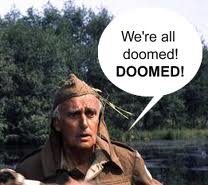
Royston? It’s me, Private Frazer from Dad’s Army, speaking to you from this horrible place beyond the grave.
What a complete bunch of bananas you wrote yesterday about double-dip recession, Royston. Do you really think that anyone will be taken in by your sentimental hogwash?
It’s easy for you to pontificate about the natural order of things and finding happiness in small ways – most of your life is behind you, and you don’t have to worry about the horrors that will face your children and grandchildren.
Not everyone is into golf, and anyway, what will become of the golf courses when food wars, water wars and rare earth wars will join the inevitable energy wars? And don’t you realise that we are delicately poised on a cliff-edge? If we – the major economies of the West – slip back into recession, we will unleash a domino effect of instability, the likes of which you will never have lived through before – assuming you live long enough to see it, of course.
When will you get it into your head that the only reality that keeps our society together is perception? For a prisoner in the gulag, happiness was a whole fish head in his watery soup as opposed to a few gelatinous bones. If we perceive, or are manipulated into perceiving, that there a problems way beyond our ability to solve, and that our personal livelihoods are under threat, then we will naturally take defensive measures that will trigger a collective domino effect.
If, on the other hand, enough of us kid ourselves into thinking that our bankers and politicians, idiots though they may be, will find a way to muddle us through the present crisis, then we might, just might, be able to avoid the inevitable comeuppance for a few more years.
But even if we manage to boost our economies by using the money our governments will print on new TVs and patios, the reckoning will surely come soon enough. Don’t think that China and India, with their booming economies, will pull us through either. They are reliant on their exports of things and people. If there is a weakened demand beyond their borders for what they have to sell, their bubbles will burst, and their societies implode in a fury of unrest. So we in the West are not the only ones gripped by fear right now.
So quit this talk right now about double-dip recession not being a disaster. And join everyone else in hoping that enough people, and most of all the shadowy collective known as the financial market, buy sufficiently into the illusion known as confidence – the twin brother of fear – to give us the time to pack up our belongings and head for the hills.
So there you are, Royston, a nice dose of healthy pessimism. You know you wanted it, don’t you?
As I told ye thirty years ago, and ye didnae believe it, we’re all doomed!
Here’s another short thought in the financial crisis.
The International Monetary fund issues another gloomy report stating that a number of leading economies, including those of the UK and the US, are in danger of falling into a double dip recession. Pundits in the media react as though recession is the ultimate misfortune. Why? If we invest in equities, the law in the UK requires the seller to advise the buyer that the value of shares can go down as well as up.
Isn’t recession phobia another of those artificial constructs that politicians, the media and the financial services industry uses to manipulate us in one direction or another? Yes, there is a difference between recession and depression. Nobody wants to see the decline of their country’s economy by 30%, let alone 4% or 5%, which appears to be the current outlook for Greece. And nobody likes to see jobs disappearing or houses repossessed.
But let’s be realistic here. Economies do sometimes contract for a variety of reasons. If the UK economy goes into double dip, and contracts, say, by 1.2% over the next year, this does not exactly equate to drought, plagues of frogs and rivers running with blood. And if the average person’s spending power declines by a few percent over a sustained period, this is not the equivalent of having your home washed away by monsoon floods, or your children dying because you can’t feed them.
Double-dip or not, most Western nations are wealthy, and the majority of their populations are well capable of absorbing a slight decline in their spending power. No nation has a god-given right to economic growth, just as individuals have no reason to expect ever-increasing health, wealth and happiness. Bad things sometimes happen, and on the scale of things, not being able to afford a new car, bigger house or luxury foreign holiday for a while does not compare with what the majority of the population on this planet have to deal with on a regular basis.
I and my business partner ran a companycin the UK through two recessions. We did not go into a terminal decline each time the economy took a downturn. We took the view that if our market for the next year or two stood to decline by 5%, that left the other 95% to chase. We got through the lean times, sometimes with difficulty, but never at the cost of our sanity.
So I encourage our politicians to be brave enough to say that recession is not a cataclysm – it is part of the normal scheme of things, like illness, sadness and the British weather. And if we stop making such a big deal about economic downturn – and that means you, politicians, the media and the financial industry – then maybe reactions arising from fear of the future would be less pronounced, and we would be more inclined to make longer-term decisions which take into account that what goes up can come down.
We Westerners are the privileged ones. Most of us have access to high-quality healthcare. We have material wealth beyond the dreams of our ancestors. Most of us live under the rule of law in democracies – albeit with varing degrees of imperfection. We are able to speak, think and travel freely. It seems to me that the one quality that is on the decline is happiness. If we are to avoid a state of permanent disappointment and thwarted expectations, we – and I speak of the generations that have never experienced war and real deprivation on our doorsteps – need to get used to the fact that there is more to life than an ever-growing salary, a new flat-screen TV and cheap food in the supermarkets.
If we’re lucky enough to have jobs, somewhere to live and a reasonable quality of health, we should count our blessings, and remember that we have what many have not. I know this sounds like a “think of the starving millions” sermon. I also know that in the previous posts I have used a lot of words in blaming the idiot bankers and politicians who contributed to our current plight. So perhaps it’s a bit rich for me now to maintain that recessions are natural phenomena. But look back over centuries, and human folly seems far more part of the natural order of things than the mistakes of our contemporaries.
We may be worried about the future, and with good reason. But there’s only so far you can go with blame, recrimination and fear. Ultimately, I suggest that there are always way to find happiness in small things even in the hard times. We just need to know where to look.
As regular readers of this blog will know, I’m something of a history nut. So if I’m not dipping into the inexhaustible well of history books, I’m always on the lookout for films and TV series that reflect my historical interests.
While Hollywood seems convinced that the way to riches is via an endless series of “action” movies, which I refer to in a previous post as crash-bang-wallop, British producers have evolved a successful genre of their own that I would describe as slash-clang-thank-you-mam. In this genre historical settings become a convenient vehicle for sex, intrigue and elaborate acts of violence.
Rome was the first of the genre. It was set in the terminal years of the Roman Republic, when Julius Caesar was battling with Pompey for supremacy in the crumbling oligarchy that preceded the emperors. I enjoyed it because it was reasonably faithful to the history, and struck a balance between political intrigue, the coupling of the great and the good and the murder and mayhem committed by the low life of Rome. The acting was better-than-average, and the sets were gorgeous – bling-strewn in the palaces and splendidly seedy in the backstreets.
Then came Spartacus. I lost interest after an episode or three. Muscle-bound gladiators, plenty of intrigue, vague historical references, but mainly fight scenes and sex – both desired and delivered – in which a group of Roman wives lust after the gladiators like ladies at an Ann Summers party. Coupled with a pretty awful script that made capable actors like John Hannah, who played the gladiator owner and chief pimp, seem pedestrian. I gave up after the wife of the house arranged a naked parade of the gladiators for the benefit of a simpering ingénue, who proceeded to select as her partner in lust a strapping Gaul, largely because of the length of his appendage. Disgusted by her prejudice against Thracians, I switched off.
Now we have the Borgias. A renaissance Sopranos, in which a well-connected gangster of Spanish origin intrigues his way to the papacy. I had to watch the Borgias for two reasons. First, because I’m currently ploughing through The Popes – a History by John Julius Norwich, also the author of a monumental history of Byzantium, another of my obsessions. Second, because one of my favourite actors, Jeremy Irons, is in the title role as the godfather, also known as the Holy Father – Rodrigo Borgia, who became Pope Alexander VI.
It’s unfortunate in a way that I was reading Norwich’s book when the series began. I already knew from the portraits of the Borgia pope that Alexander was monstrously fat, with bulbous lips and a nose like a hog’s back. Not an apt description of Jeremy Irons’s physical make-up. But leaving aside such quibbles, Irons is a treat.
Drawing from Brando’s melancholy sneer in the original Godfather, and Raul Julia’s satanic sentimentality as Gomez in the Addams Family movies, with a dash of Vincent Price as Dr Phibes, Irons uses his trademark clipped delivery and dark brown intonation to great effect. A weary prelate with occasional twinges of conscience, Alexander and his consigliore son Cesare, whom he makes an archbishop in his teens and a cardinal in his twenties, proceed to plot, poison and garrotte their way to Borgia domination of Italy and beyond. He sells his children into dynastic marriages, and does his utmost to bring down his rival for the papacy, Cardinal Della Rovere, later to become the even more appalling Pope Julius II.
Cesare is a murderous lecher typical of his time – a very secular cardinal who later leaves the church to carve out the family’s dominions. The main “love” interests thus far are the Pope’s mistress, Giulia Farnese, and his daughter Lucrezia, whom Alexander sells to Giovanni Sforza, a prominent member of another influential clan. Sforza treats the sweet Lucrezia brutally on her wedding night, and so provides the hardening she needs to emerge in the Michael Corleone role.
The supporting cast are all relatively unknown, apart from Derek Jacobi and Steven Berkoff. Jacobi appears in the first episode as a bitter old cardinal outraged at Alexander’s election tactics – and the new pope’s failure to give him a lucrative sinecure. Sadly but unsurprisingly, he becomes the first casualty of the new pope’s regime, and expires in front of His Holiness at his own dinner party in a spectacular poisoning. Berkoff appears as the choleric monk Savonarola, who inflicts a reign of terror on the Florentines, as he rants at the evil ways of the Medicis and the other merchants of the city, and burns his way through idolaters with his fundamentalist zeal. He also meets his end in due course via Borgia machination, naturally.
We’re currently two thirds of our way through the series, as Alexander fights to pre-empt Della Rovere’s attempts to bring the French army into Italy to depose him.
As is typical of the genre, the sets and costumes are superb – tights, tresses and renaissance streets in abundance. The opening sequence shows animated close-ups from paintings of the time – men in varying stages of violent dispatch, and serene beauties in their silken dresses. The quirky theme music is by Trevor Morris, who also wrote the music for The Tudors, another series in the historical sex’n’swords genre.
The director and scriptwriter is the esteemed Irish filmmaker Neil Jordan, of Crying Game and Interview with the Vampire fame, so I guess it’s cool to be a Borgias fan even if all you’re really into is renaissance rutting and sneaky slaughter.
For me, the series is well worth watching if only for the performance of Jeremy Irons, who is moving through middle age with great aplomb.
And I can’t wait to see how Jordan handles the Pope’s demise. Wikipedia has an excellent thumbnail of Alexander VI, and quotes John Burchard, a key papal official and contemporary diarist, as describing
“how the Pope’s mouth foamed like a kettle over a fire and how the body began to swell so much that it became as wide as it was long. The Venetian ambassador reported that Rodrigo Borgia’s body was “the ugliest, most monstrous and horrible dead body that was ever seen, without any form or likeness of humanity.” Finally the body began to release sulphurous gases from every orifice. Burchard records that he had to jump on the body to jam it into the undersized coffin and covered it with an old carpet, the only surviving furnishing in the room.”
A bit rich even for 2011 TV viewers, I fancy.
As previewed in my last post, the BBC got underway last night with the last series of Spooks, its long-running show about the efforts of a group of glamorati within Britain’s security service to save the country – not to mention Western civilisation – from unspeakable catastrophe.
These days the BBC commissions most of its drama from independent production companies. The company responsible for Spooks is called Kudos Productions. Kudos was also the name of a group of companies I co-owned during the 90s and most of the last decade. For this reason perhaps, I was sometimes asked if I was an ex-spy. The other major Kudos at the time was a gay nightclub. I was never mistaken for a gay nightclub owner, although close friends did once question my orientation after seeing me acting in some awful 50’s comedy in Jeddah. Very Burgess and Maclean, they said.
Which brings us back to Spooks. The principal character is Harry – later Sir Harry – Pearce. Harry is the section head. Occasionally a superior pops up, usually in an obstructive role, but for a mere section head, Harry seems to spend much of his time hob-nobbing with the Home Secretary of the day – something that a real MI5 head would be unlikely to allow.
Harry is old school. Po-faced, sarcastic, but a man whose commitment to his country and job shine through. Also someone who has to assume a stoic mask in front of his living colleagues each time one of them gets knifed, blown up or deep fried in a vat of cooking oil.
Through successive series, the chinks in this lonely man’s armour are slowly revealed. He is accused of disloyalty, he nurses a long-hidden passion for Ruth, one of his key sidekicks, and in yesterday’s episode he is revealed to have had an affair with one of his key Russian assets while station chief in Berlin. Unfortunately she happens to be the wife of his opposite number, who is now a minister, and who is visiting London to head up a negotiating team that will discuss a radical rapprochement between Russia and the UK.
Ruth appears to be the only person apart from Harry who is beyond her third decade. The early Spooks series boasted a number of geeky characters of a certain age. It seems that ageism has taken its toll of the oldies – actually most of them have been bumped off – and these days almost all of Harry’s team are under thirty. To a man and woman, they would grace the catwalk at the London Fashion Week were they not sporting gun-shaped bulges in the usual places. Clearly the makers of the show have caught the spirit of the times in portraying a brave new workforce unpolluted by the wrinkly and obese.
Perhaps the reason for the lack of oldies, who tended to be the boffins, is that the tech is so high these days that anyone over twenty would be incapable of using it. The latest innovation is software that can identify a person by their gait. Imagine – a database of millions of silly walks, each with a recognisable owner. In which case I wonder which version of my walk is captured on some spook-driven CCTV: my shopping walk – focused and purposeful – or my limping shuffle after 36 holes of golf. Perhaps this is one of the nifty little tools the software giant Autonomy have up their sleeves. No wonder HP bought them.
The team used this wonderful application to identify an assassin, who gets his comeuppance after he infiltrates a reception at which the ex-KGB minister is the guest of honour. But who commissioned the hit? The Chechens, or even the sour-faced CIA man who comes to London to warn Harry of Uncle Sam’s displeasure at the UK cozying up to Russia? And what will happen to the FSB man assigned to the Russian security team who happens to be the son of the minister and his traitorous wife, and knows her dark secret? Next on the hit list? Perhaps not, because at the end of the episode he is revealed to be Harry’s son, the result of his affair with the minister’s wife.
No wonder this is the last series. Spooks without Harry Pearce would be like the six wives without Henry VIII, and Harry – already compromised in the eyes of his superiors because if his herniated relationship with Ruth – is surely on the downward trajectory towards discreet retirement or a grisly end.
Yes, it will be sad to see the end of Spooks. The last word comes from Peter Firth, who plays Harry Pearce. In my last post I marvelled at how the BBC managed to assemble such a talented team of actors for their 1979 serialisation of Tinker Tailor Soldier Spy. In an interview published on Saturday, Firth was asked if he had managed a pay rise for his Spooks contract. He replied “if you start getting shirty and saying “I would like to be recompensed in a higher way”, they’ve got a brilliant out on Spooks – it’s one of the great successes of the show: it kills its heroes”.
Now there’s an idea for George Osborne, the British finance minister, as he struggles to cut the cost of Britain’s bloated civil service.
Continuing down the Cold War track from the previous post, last night I went to see the film version of John Le Carré’s spy classic, Tinker Tailor Soldier Spy. Gripping stuff it was.
I read the novel and watched the 1979 BBC serialisation. But beyond the central theme, the hunt for a mole in the UK’s Secret Intelligence Service, otherwise known as M16, I had forgotten much of the plot. My two lasting memories of the series were the haunting theme music – a setting of Nunc Dimittis by Geoffrey Burgon – and the towering performance of Alec Guinness in the role of George Smiley, the mole hunter.
Looking back at the cast list from the original series, you wonder at the ability of the BBC to attract the cream of British theatrical talent of the time – Guinness, Ian Richardson, Sian Phillips, Joss Ackland and Patrick Stewart to name a few. In the novel, Le Carré described the central character as a seemingly anonymous, melancholy and yet authoritative figure. Few modern actors seem able to capture the stillness and economy of Guinness’s performance – so little said, so much revealed.
Gary Oldman, as Smiley in the movie, did so superbly. The main difference between the two performances was that you sensed that inside Oldman’s Smiley was a man with a compelling desire to rip your throat out, whereas Guinness would have sent you to your end with a look of sadness and mild distaste. Though he gave a different interpretation of the character, I kept hearing Guinness in Oldman’s intonation – particularly in the irony that was never far from the surface when dealing with his colleagues, and his quiet menace when closing in on the traitor.
The movie cast was as impressive as the BBC’s line-up – John Hurt, Colin Firth, Toby Jones, Mark Strong and Kathy Burke, all solid performances. But perhaps because the seven episodes of the original series gave more scope for the slow unfolding of characters and events typical of most of Le Carré’s novels, I didn’t get a strong sense of an ensemble performance. Smiley apart, the characters didn’t flower.
But that’s a quibble. Tinker Tailor Soldier Spy is a fine movie, and a great antidote to the crash-bang-wallop, CGI-enhanced steroidal crap that the film industry seems to think we all want to see.
It was also great to be reminded of the ironic names the author gave to the institutions and denizens of the security service: The Circus, The Inquisitors, The Ferrets, and, best of all, The Reptile Fund – the source of money for covert operations. Book, series and movie reek of the cerebral, life’s-a-game Oxbridge culture that gave birth to the service and nurtured its greatest traitors – Burgess, Maclean, Philby and Blunt.
The movie’s release roughly coincides with the tenth anniversary of 9/11. The BBC’s current long-running spy series, Spooks, has, since its launch in 2002, dealt with modern issues with which MI6’s sister service, MI5 – the internal security service – has had to deal: terrorism, financial shenanigans, nuclear proliferation and so forth.
I am a bit of a Spooks addict. Each episode provides a strong element of the crash-bang-wallop I’ve just turned my nose up at. The spooks in question die spectacularly on a regular basis, and the world is regularly saved from catastrophe by Harry Pearce’s intrepid team. But the plots are well written, the actors are good and the characters believable. If only we Brits could make that kind of difference in real life.
The series about to start is the last. John Le Carré, in an interview promoting Tinker Tailor Soldier Spy, described Spooks as total balls. As a former spook himself, he speaks with authority. Smiley’s world – grey, grimy but rather posh – was his world, and no doubt the reality of MI5 is far from the high tech, visceral cliff-hanging we see in Spooks. But it’s been fun, and I’ll miss it.
Speaking of posh, I caught the last few minutes of one of the BBC’s annual Reith Lectures on the car radio driving back from the movie. The lecture, by coincidence, was none other than Baroness Eliza Manningham-Buller, the former head of MI5, talking about her and MI5’s conviction that the use of torture to gain intelligence was wrong. I caught ten minutes of the programme, in which she was fending off questions with an expert dead bat. “I’d love to answer that question, but…..”.
Now there is a character who must be Le Carré’s kind of person. Articulate, very posh and slightly scary. I imagine that if you were a young MI5 officer, an interview with her would have a brought about a sure and rapid cure for constipation. Very establishment, and possessing the knack common to senior civil servants and politicians of making you feel that you have asked a stupid question, but with language that suggests otherwise. Rather pompous in fact.
I reserve judgement on what she actually said, because I didn’t get the chance to hear her full lecture. I have probably got her completely wrong, but first impressions… More on her thoughts when I get the time to listen to her properly.
One night in October 1962, I went to bed wondering if I would see my parents again. I was an 11-year-old pupil at an English boarding school, and this was my introduction to the Cold War. The Cuban Missile Crisis passed. At the critical moment of the confrontation Khrushchev blinked, and his missiles headed back to Russia.
Eleven years later, I went to work on the night shift at Cadbury’s, and asked myself if I would see the dawn. It was the day when the US raised its nuclear alert levels in response to a threat by the Soviet Union to intervene in the Yom Kippur War.
Most people born after 1980 will have no experience of living in the shadow of the Bomb. The rest of us do. My world was defined both by the ever-present threat of nuclear war, and by the experience of the preceding generations in the Second World War. Most of my parents’ generation lost relatives in both world wars. The slaughter came to a climax in 1945 with the carpet bombing of German cities, the destruction of Berlin and finally the flattening of Hiroshima and Nagasaki by the first and only nuclear bombs dropped in anger.
For as long as I can remember, I was fascinated by the footage of the nuclear mushroom cloud. To me, the sight of a hydrogen bomb explosion was as beautiful as newsreel of starving concentration camp survivors was ugly. Both have been central themes in my perception of the world. I became a Cold War junkie and a World War II obsessive.
Both strands come together in one of my favourite movies of all time, Stanley Kubrick’s 1964 masterpiece Dr Strangelove, in which the world faces nuclear conflagration through the machinations of a demented American Air Force general. The chief scientific advisor to the US President, one of several roles played by Peter Sellars, is a wheelchair-bound former Nazi whose knowledge – like that of Werner Von Braun, the architect of the US space programme – proved useful enough to his new employers for them to ignore his distasteful antecedents.
Which brings us to The Dead Hand, a Pulitzer Prize-winning book by Washington Post journalist David E Hoffman. In a long but riveting narrative, Hoffman describes how at the beginning of Ronald Reagan’s presidency, the new leader’s aggressively anti-communist stance convinced the Soviets that the US was planning a nuclear attack on the USSR. The KGB alerted all its stations in the West, but particularly Britain and the USA, to report back on any signs of preparations, such as mass slaughter and cold storage of farm animals.
The paranoia was accentuated by Leonid Brezhnev’s failing health, and his eventual succession in short order by two sick and elderly leaders, Yuri Andropov and Konstantin Chernenko. As the tension ratcheted up, a false nuclear alert picked up by the Soviet air defence computer system was only prevented from triggering a retaliatory strike by the common sense of a single officer. And the shooting down of a Korean airliner that accidentally strayed into Soviet airspace sparked a predictable reaction from Washington. Only later did it emerge that the Soviets mistook the Boeing 747 for a US spy plane that was also in the area.
After this hair-raising opening, Hoffman develops two themes. First, the massive and covert biological weapons program pursued by the USSR in contravention of the international treaty banning the development of such weapons. Second, the relationship between Reagan and the new Soviet leader Mikhail Gorhachev, a man 35 years the President’s junior.
The germ warfare programme employed thousands of scientists whose job was to develop new and deadly pathogens as well and variants of existing bacteria and viruses such as anthrax, smallpox and plague. The task was then to weaponise these pathogens. The authorities justified that program to telling themselves that the US had a similar program. In fact the American program had been scrapped in the 70s by Richard Nixon, a fact demonstrated to Soviet inspectors much later. So hermetically sealed in their institutes were the scientists that most of them were not even aware of the treaty.
An early leak of anthrax spores in the city of Sverdlovsk resulted in 70 deaths, which the Russians covered up for twenty years until confronted with overwhelming evidence. Across the USSR, institutes with innocent names continued to work on these weapons in secrecy throughout Gorbachev’s and even Yeltsin’s presidencies, all the while denying their existence.
Meanwhile Reagan and Gorbachev began to get to grips with each other. Reagan, the sunny optimist whose Strategic Defence Initiative, also known as Star Wars, reflected his desire to break out of the mutually assured destruction (MAD) paradigm by developing means of destroying incoming missiles. Gorbachev, who inherited an economy in terminal decline because of the defence burden – defence spending at its peak amounted to more than 20% of the national gross domestic product.
Both had a motive to end the arms race. Reagan because of a deeply-held desire to eliminate nuclear weapons entirely – a belief he kept quiet about before he was elected. Gorbachev because the defence burden was crippling the Soviet economy – in most ways apart from weaponry, his country was backward, inefficient and stifled by the state bureaucracy.
Hoffman is compelling when he describes the summits between the two men, culminating in the Reykjavik meeting in which Reagan proposed a timetable for eliminating all nuclear weapons by 2000. Only the thorny issue of the Star Wars program, which Reagan refused to abandon, prevented a deal, much to the relief of the generals in Washington who thought that Reagan’s proposal was madness.
Although there was no deal at Reykjavik, the summit opened the floodgates for a succession of arms reduction treaties signed by Gorbachev, Reagan and Reagan’s successor George H W Bush. But these developments came too late for Gorbachev, who presided over the disintegration of the Soviet Union, starting with the withdrawal of troops from the other nations in the Soviet bloc, which in turn precipitated the revolutions in Poland, Hungary, Romania and East Germany.
When a disaffected group of KGB and military hardliners in the Politburo engineered an attempted coup against Gorbachev, only to be thwarted by Boris Yeltsin, who had built his own power base, Hoffman’s story moves towards its close.
Gorbachev resigned, leaving Yeltsin to dismantle the apparatus of the Soviet state and preside over the creation of independent states from the old Soviet republics. Hoffman graphically describes the chaos in the post-Soviet order. Thousands of nuclear warheads and other fissile material, minimally guarded and attracting the keen interest of the North Koreans, the Iraqis and the Iranians. No money to pay the scientists, some of whom became resources hired out to the nuclear aspirants. Inspection programs set up through arms reduction treaties revealed the full extent of the biological warfare effort. Vials of plague virus casually placed in tin cans on the shelves of rotting warehouses.
Through international efforts and a law enacted by two US senators that earmarked funds for the decommissioning and safe storage of warheads and the destruction of pathogens, proliferation was largely contained.
The heroes of the piece are clearly Reagan and Gorbachev, each for their own reasons. Sam Nunn and Richard Lugar, the senators who pressed a cautious George Bush to sign the bill allocating funds for weapons decommissioning also emerge with credit, as do a host of lesser players on both sides who helped to break the deadlock, and the Russian scientists who blew the whistle on the germ warfare program.
Others do not emerge with much credit – most notably Robert Gates, Secretary of Defence under George W Bush and Barack Obama, who as deputy director of the CIA consistently advised the older Bush that Gorbachev’s desire for reform was insincere.
Hoffman is unable to answer the question of why Gorbachev, while moving full steam ahead on arms limitation, continued to sanction the development biological weapons. Yeltsin hints at the reason. He implied that the military leadership held the upper hand over both him and Gorbachev, which meant that neither man had the power to stop the program until the disintegration of the political and military establishments.
He also makes no attempt to explore the ethical issues around nuclear and biological weapons. Is one any worse than the other? A nuclear winter with billions dying of starvation and radiation poisoning or the same billions dying from viruses and bacteria resistant to drugs, including the resurgence of smallpox, anthrax and plague? Neither outcome strikes me as any less evil than the other. Is the act of building nuclear bombs any less contemptible than turning germs into offensive weapons? I’m not sure, though I do buy into the rationale that if you have one set of WMDs, surely you don’t need another.
For me, the most telling evidence of the end of the cold war that obsessed my generation came in the early 2000s when my elder daughter started at my old boarding school. We went down to see her after the first couple of weeks, and asked her about her new friends. She cheerfully described a Russian boy who was teetering on the brink of expulsion because of his very obvious liking for vodka. I asked his name, thinking that he must be the offspring of one of the wealthy oligarchs who made their fortunes from the privatisations of the Yeltsin era.
I nearly fell off my chair when she provided an iconic family name – one of those grim-faced leaders who waved at the missiles from the Kremlin wall every May Day. Equally striking was that she had no idea about the significance of her friend’s notorious ancestor.
As for the Doomsday Machine beloved of Dr Strangelove, it turns out that the USSR built a device not dissimilar, and it remains in place today. The Cold War as my generation experienced it may be over, but its infernal devices never went away.
With the billions and trillions being bandied about in our fevered financial crisis, I had a grim laugh when I read about the UBS employee arrested today for alleged rogue trader activity. According to the BBC, Kweku Adoboli is accused of losing UBS $2 billion through unauthorised trades.
It’s odd when $2 billion sounds like small beer. Contrast that with former UK Finance Minister Alistair Darling’s assertion that RBS’s liabilities at the height of the 2008 financial crisis were in the order of $3 trillion – $600 billion more than the entire British gross domestic product of the time.
Of course one could never apply the epithet of rogue trader to the leaders of RBS, Lehman Brothers et al. Perhaps we need a special phrase for them. I dare say the shareholders can come up with one.
My second foray to France in a month began last Thursday. Fourteen golfers from the UK, Ireland and the US gathered for the annual SHAGGS tour. Long-time readers of this blog might remember my description of the event last year, Lost (Balls) in France.
This year our base camp was in the port city of Boulogne, a few miles from the French end of the Channel Tunnel, and within striking distance of a number of golf courses much visited by the British – Le Touquet, Hardelow and St Omer among the best.
Boulogne is a ferry port. Two thousand years ago it was the launch pad for the Roman invasion of Britain. Two hundred years ago it was to be the port from which Napoleon planned to launch his invasion of my native land. He even went so far as to assemble an army of 200,000 ready to sail, before the strength of the British Navy caused him to have second thoughts. In World War II British bombers obliterated the port in preparation for the allied invasion of France.
Today it is a nondescript city, windy and a little bleak. It has the highest unemployment in the region, partly because it lost much of its ferry business after the opening of the tunnel. But it does have an impressive fortified city and a typically sturdy chateau that used to be the seat of the Counts of Boulogne. The chateau is now a museum, boasting an eclectic collection of exhibits that seemed to reflect the tastes of its benefactors rather than any coherent theme – Greek vases, Alaskan face masks, African figurines and paintings by esteemed Boulonnais artists such as Georges Mathieu. Oh, and a very handsome collection of Napoleonic military uniforms, perhaps to remind us Brits what we missed when the Grande Armee failed to cross the channel in 1804.
Our hotel was directly opposite the main gate of the old city, only a few hundred yards from the restaurants serving the inevitable moules (mussels) and other fare beloved of English visitors. Nothing special or noteworthy, apart from the Wren-style cathedral we would pass by on our way to eat.
But France always has the ability to surprise, especially in cultural matters. There was a concert scheduled in the forecourt in front of the old city gate. When we got back from the golf on Saturday afternoon, rehearsals were going on. Bits of Bizet’s Carmen, excerpts from Handel’s Fireworks Music, some sacred arias from Vivaldi and Bach.
Nothing odd in that, you might think, except that the stage was directly in front of a major traffic roundabout. Brass bands, full orchestra, soprano and contralto soloists preparing to perform to a procession of transient cars! In the event we never found out if they were planning to close the roundabout, because that evening the rains came down. Since there was no canopy over the stage, the whole event was transferred to the Cathedral.
As for the golf, it was the usual mixture of sublime and ridiculous – sublime on the part of others, and ridiculous on mine. Sadly, it will forever be known in the annals of SHAGGS as the Tour of the Car. If you made a movie of it, the strapline would be “Four went on the mission. Only two came back”. On the first night, one of our cars had an argument with the concrete wall of an approach to the autoroute. The result: the car written off in a cataclysm of exploding airbags. One of us was unable to continue because of bruising to the chest caused by the seat belt. Another broke the windscreen with a head butt and yet carried on with no apparent ill effect.
Our evacuation dilemma loomed – how would we fit extra people into three cars packed with clubs, bags and cases of wine – when on the last night my car went on the blink. Engine overheated, and coolant spewing out of the engine with a nasty hiss. I had the car towed to a garage in Boulogne. In the morning, the party had to decide how to fit everyone into two cars for the return journey. I considered suggesting the Sangatte gambit, used by people attempting to get into the UK illegally – one person strapped under each car – but being one of those responsible for the problem, I kept a regretful silence. In the end everyone made it back, though it was hard to see the passengers for the array of baggage crammed into every available space as the diminished flotilla moved off from the hotel.
Leaving me. Instead of a pleasant final round of golf on a hilly course in driving rain and 35 mph winds, I found myself negotiating with the garage to fix the car. This was made difficult by the fact that that they opened at 9am, shut for a two-hour lunch, and seemed to regard customers as a necessary inconvenience. It took those three hours to discover what was wrong and agree the repair before they chucked me out into the rain and shut the shop. What would have cost €250 in the UK was set me back €700, not including the €400 (“double time on Sunday, Monsieur”) I had to pay the recovery driver who scooped the car off the road in the first place.
The car took two days to repair, so I ended up with a little extra time to enjoy the delights of Boulogne – hence the visit to the museum.
I spent the rest of the time reading the weighty tome I had luckily packed, lunching and dining in the restaurants of the old city, watching parties of old ladies and school kids on day trips wandering through the cobbled streets, and having repeated encounters with a guy who was desperately trying to reach relatives in Kent and needed a Euro for breakfast.
Boulogne doesn’t seem to be the happiest place in France. While waiting at the garage for news on the car, I struck up a conversation with a retired English teacher who spent 40 years vainly trying to persuade the municipality to take advantage of the city’s proximity to the UK by offering more than booze cruises and moules.
An anglophile who holidayed in Britain every year, he lamented the lack of interest of the locals in the neighbour a few miles over the sea. He tried to interest the city in setting up language colleges and cultural centres celebrating the long links between Britain and France, but to no avail. Now he had sold his house at a knock-down price and was leaving the unpredictable weather of Boulogne for Alsace, near the border with Germany – home of fine wine, Arsène Wenger, superb Franco-German cuisine and the European Parliament.
My stay in Boulogne strengthened the suspicion that the relationship between Britain and France is an unequal one. A French person would not naturally think of coming to the UK on holiday, whereas we Brits swarm into France, not just for visits but also to thousands of second homes – many of them ruins lovingly converted over the past thirty years. For sure, our money is welcome, but there remains an implicit resistance to the influence of what the French call the “Anglo-Saxon” culture. Perhaps a little jealousy too, and certainly a measure of resentment of what they see as our arrogant and boorish ways.
The last three weeks have taken me to four very different areas of France – St Malo on the Brittany coast, La Baule on the Loire estuary, Monflanquin in the deep South and finally Boulogne. Visiting each in close succession was a rare opportunity to take the temperature of one of my favourite countries.
I love France no less as a result. But I was reminded that the closer you go towards the maritime border, the lower the esteem in which we Brits seem to be held. Maybe because it takes more than a decade or three of Euro-fraternity to override centuries of intermittent conflict and uneasy peace.
As for the golf, well, as always, the pleasure was in the company.
A week in the South of France cures many ills. Warm and balmy – the temperature hovered around the 30C mark – quiet and peaceful. While England froze and drowned, and Bahrain baked, the Départment of Lot and Garonne slept.
Around the little farmhouse we rented for the week, lizards jumped, frogs hopped and black scorpions lurked. Outside our veranda, we were greeted each morning by roses in late flower, a quince tree loaded with fruit the size of a fist, and an olive tree in its sixth year, yet to fruit. Nearby, apples, pears, peaches, fields full of browning sunflowers and rows of broad beans.
Every night you could gaze at the Milky Way as it can’t be seen in the UK, where there are few areas not tainted by urban light.
The nearest village, Monflanquin, was fortified against the English in the 12th Century – clearly without success, because it boasts a house slept in by Edward the Black Prince, the victor of Crecy and Poitiers, the warrior son of Edward III. Thirty miles to the south sits Saint Sardos, a tiny village where the first hostilities of the Hundred Years War between England and France broke out. Fifty miles to the South, in 721, the invading army of the Umayyad Emirate of Crodoba was defeated. Eleven years later, a couple of hours to the North, Charles Martel, the grandfather of Charlemagne, stopped the Arab advance into Western Europe at the Battle of Tours.
If I needed any further reminder that peace and tranquillity is not France’s birthright, it came in the form of a Napoleonic musket – complete with bayonet – mounted on a wall in the idyllic country home of a French friend and colleague a few miles from Saint Sardos.
As my friend pointed out, the long history of Anglo-French engagement both as military protagonists and more recently as collaborators continues today. Whatever squabbles exercise the politicians are over the EU economy, the level of military cooperation between the countries is high – as NATO partners in Afghanistan, and, more happily perhaps, as prime movers in the Libyan intervention. Neither country can afford the military of old, nor is there any serious likelihood that any of the Western European nations will be making war on each other in the near future barring a catastrophic collapse in the current political order.
So it makes sense for the two nations to pool resources and work together when needed, even though, as in the case of Libya, both militaries are likely to continue to rely on big brother America in any major engagement for the foreseeable future.
Even in the beautiful heart of France, surrounded by silence occasionally punctuated by the clump of ripe fruit falling from nearby trees, it was hard not to think of war and peace. Not only because of the evidence of previous wars. From time to time a French military jet would streak through the sky on a low flying exercise, shattering the rural quiet.
And as someone who spends much time in the Middle East, I could also not forget that while I was enjoying the late summer sun, millions of Muslims were celebrating Eid-Al-Fitr, the festival that marks the end of Ramadan. Muslims are still dying in Afghanistan, Libya and Syria, and not all by the evil hand of the unbeliever. And for all the pious utterings of the imams about peace, reconciliation and personal spirituality, the killing didn’t stop for Eid.
Whether the murderous regimes in Libya and Syria will be replaced by more benign leaders remains to be seen. But whoever ends up running those countries, and whatever becomes of Afghanistan after the promised NATO withdrawal, the political and social aspirations of those who supported the change will not be met by any new regime.
No regime can guarantee freedom of speech if society doesn’t value that freedom. Fathers and brothers will continue to carry out honour killings of their women if society doesn’t condemn the practice. Unless society determines that it is unacceptable, corruption will always find a way. Families will carry on treating their housemaids as slaves. Employers will abuse their vulnerable employees. And the powerful of different religious persuasions will not stop using their power to oppress “the other”.
For all the emphasis on personal struggle, closeness to God and consideration for humanity that is part and parcel of the experience of Ramadan and other festivals of the Abrahamic religions, it seems to me that such festivals come and go with no noticeable contribution to humanity beyond a short period of heightened personal spirituality.
In the first Christmas of World War I, the soldiers facing each other in the trenches may have left their posts to fraternise, but shortly thereafter, they were killing each other again on the orders of their outraged officers.
And I have been through half a century of seasons of goodwill and personal resolutions in times of relative peace without seeing any significant improvement in societies I have lived among because of those good intentions.
Societies change over the long term, and rarely through the acts of governments or the piety of individuals. Sometimes they evolve over long periods of peace, and sometimes as the result of some abrupt and violent catalyst.
The broken walls of Monflanquin that have been witness to much violence in the past are today the setting for easy conversations between visiting Brits and the restaurateurs who welcome their money.
But as France debates the future of the Euro, a reminder that we are in a period no less stable in the long run than in any previous era comes in the form of a credit card receipt that shows the purchase in Euros, and underneath “for your information” the price in French Francs – a currency that has not existed for 10 years. Just in case, perhaps.
If in twenty years’ time the occupants of the ancient cities of Libya, Syria and Afghanistan are sitting in cafes debating the future of their currencies without worrying about roadside bombs and secret police, that will surely be progress. But if they could speak, the city walls would remind them that progress is for now, whilst instability is forever.
The village of Oradour-sur-Glane, a hundred miles north of Monflanquin – where only 67 years ago the German occupiers, as punishment for the abduction of an SS officer, shot 190 men of the village in a barn and then incinerated 247 women and 205 children in the local church – is testament to that instability even in beautiful, peaceful France.
The middle-aged man steps into the restaurant with his family in tow. He has a small dog on a lead. Suddenly, with an elegant flick of the wrist he whips the dog airborne in its harness like a yoyo on the end of a string. With a slightly surprised expression, the dog lands in the man’s arms. The family are seated at their table. The dog takes his place next to the man. Without being asked, the waiter brings an elegant dish of water for the dog.
We are in La Baule. It’s a seaside resort at the mouth of the Loire valley in southern Brittany. Every year thousands of Brits head for France in their Volvos and Thule luggage capsules on the roof rack. They don’t come to La Baule. Most are headed for the Dordogne or Provence. Brittany is too like Cornwall for most of my compatriots, who seek warmer climes and the sunflowers and lavender fields of the south.
We are on our way south as well, but we decided to stop off at La Baule for a few days on our way. We had spent a weekend there many moons ago, and wanted to introduce our younger daughter to its charms.
La Baule is French posh. Unlike Le Touquet and Deauville, its rivals on the north-east coast of France, the British influence is light. As far as I’m aware, King Edward VII never took the waters here. By French posh, I mean that it’s ridiculously expensive, and seemingly full of well-heeled Parisian exiles.
Clones of Dominique Strauss-Kahn – the satyr of French politics – silver-haired and serpentine, stroll down the promenade in immaculately ironed white shorts, with navy sweaters casually wrapped across their shoulders. There are very few baldies in La Baule. All the men – apart from me – appear to have a full head of hair – among those of a certain age, dyed, or otherwise magnificent DSK silver.
Accompanying the men are middle-aged ladies who look as if they have spent a couple of hours preparing for the beach – not to swim, but to show themselves off. Designer clothes from their painted toenails to their immaculately coiffed and highlighted hair. Even the elderly shuffle around in panama hats, aping, it would seem, the patriarchs staring sternly from the photos of a century ago to be found in some of the more genteel restaurants. And hunchbacked old ladies gingerly stepping their way to the market, looking like matriarchs from Jean de Floret.
Then there are the dogs. No elderly or middle-aged couple would be seen without one. Usually a small animal – a Yorkshire Terrier or Jack Russell, and often in the arms of the owner. When walking to the restaurant area I marvelled at how clean the streets appeared. Where do the doggies poo? Only in daylight does the answer reveal itself. Everywhere. The concept of a poop scoop does not appear to have crossed the channel. But the municipality seems to be very efficient in removing the canine detritus on a regular basis, and at least the owners have the courtesy to make sure their dogs do their thing up against the apartment walls rather than the middle of the pavement.
Bigger dogs lurk in the gardens of the sturdy Victorian villas behind the beachfront. Dobermans, Alsatians and English setters, prowling around their domains and barking furiously at anyone rash enough to walk past their front gates.
Further down the food chain are the young men and women – again designer-clad. The guys in stylish long shorts and “real” polo shirts. The girls anorexic thin with skin-tight tops and jeans.
And of course there are les enfants. To aaahs and oohs from my wife and daughter, the little ones traipse past dressed in their cute outfits that must have cost a bus-driver’s monthly salary to buy from one of the up-market Parisian children’s boutiques.
The architecture of La Baule seems locked not in one but two time warps. Across the seafront are block after block of apartments that could have been built at any time over the past sixty years. The sole criterion provided to their architects seems to have been balconies and big windows. The same as you will find in every French resort. All have seen better days, except possibly the grand Edwardian hotel that offers its guests the joys of thalassotherapy – various things done to you with sea water, kelp and mud – as well as the usual battery of new age pampering that appeals so much to the pill-popping hypochondria of the monied French. Colons irrigated, mudpacks and cucumbers, hot stones on naked spines – that sort of thing.
Behind the fading apartments on the seafront lies another time warp. Streets of sturdily-constructed villas that seem to have been designed under the influence of absinthe, the hallucinogenic liqueur beloved of fin de siècle artists like Toulouse Lautrec. Mini-chateaux with grey-slated conical spires and rough stone battlements. Gothic follies with exotic names and brightly painted inscriptions. Small gardens patrolled by – you guessed it – fierce guard dogs.
Our hotel was slightly set back from the beach, but still offered views of the sea, as well as views of a block whose cheerful blue façade was somewhat degraded by smudgy mould brought on by decades of exposure to the moist sea breezes. The hotel décor was stuck in the 1970s. It reeked of respectability – rather like Fawlty Towers, though happily without the malign influence of Basil, Sybil and gang. In fact the owners were delightful – a mother and son who did their best to meet our strange English needs. “You need a kettle? Er, of course.” Long pause. “But you will not be boiling milk in it, will you?”
So what’s to do in La Baule? Well if you were us, you could sit in cafes people-watching. Or you could go for bracing walks down the promenade, and think about going for a swim in the sea. We never got beyond the thinking on that one. Our excuse was the rotten weather – chilling breezes and regular downpours – that has plagued the resort throughout the peak season. Then you could experience the French take on English seaside gentility – the Salon de Thé. The one around the corner from us was a replica of an English teashop from the 1930s. Floral wallpaper, delicate chairs, wooden dressers and a captivating array of cakes beckoning from a central table. Oh, and at least twenty types of tea. All overseen by a fragile lady who would not look out of place in an Agatha Christie murder mystery.
Or if you were one of the well-heeled French visitors, you could spend an agreeable three-hour lunch at one of the wickedly expensive restaurants, then place the dog temporary care while you visit the spa to ease which ever ailments you spent lunch discussing. A couple of aperitifs on your balcony, followed by an equally long dinner – dog in tow of course – and finally a session at the casino where you drop a few hundred euros and are reminded of those ailments that require urgent attention at the spa the following morning. Unless, of course, you happen to be one of those silver-haired roués in town for a discreet weekend with the mistress and a packet of Viagra, in which case I’ll leave the rest of the evening to your imagination.
Whatever your nationality or social status, a visit to the market is obligatory. It’s easy to find. You just follow the stream of old ladies with empty bags, or those returning with fresh baguettes. Many French towns have open-air markets once or twice a week. In La Baule it was open every day. Stalls selling clothes, shoes, second-hand books, oriental carpets and roasted chickens on spits. Bars, cafes, patisseries and charcuteries. And in the centre, the permanent food market that reminds you that there are alternatives to antiseptic supermarkets. Counters full of gleaming fruit and vegetables. Others packed with examples of the exotic ways in which the French use every piece of an animal that can possibly be eaten. Pigs trotters, foie gras, tongues, intestines and brains. Finally, since this is a seaside town, seafood counters with bright-eyed fish, oysters, crabs, tanks of mussels and piles of live lobsters squirming in indignation at the string binding their massive claws tightly together.


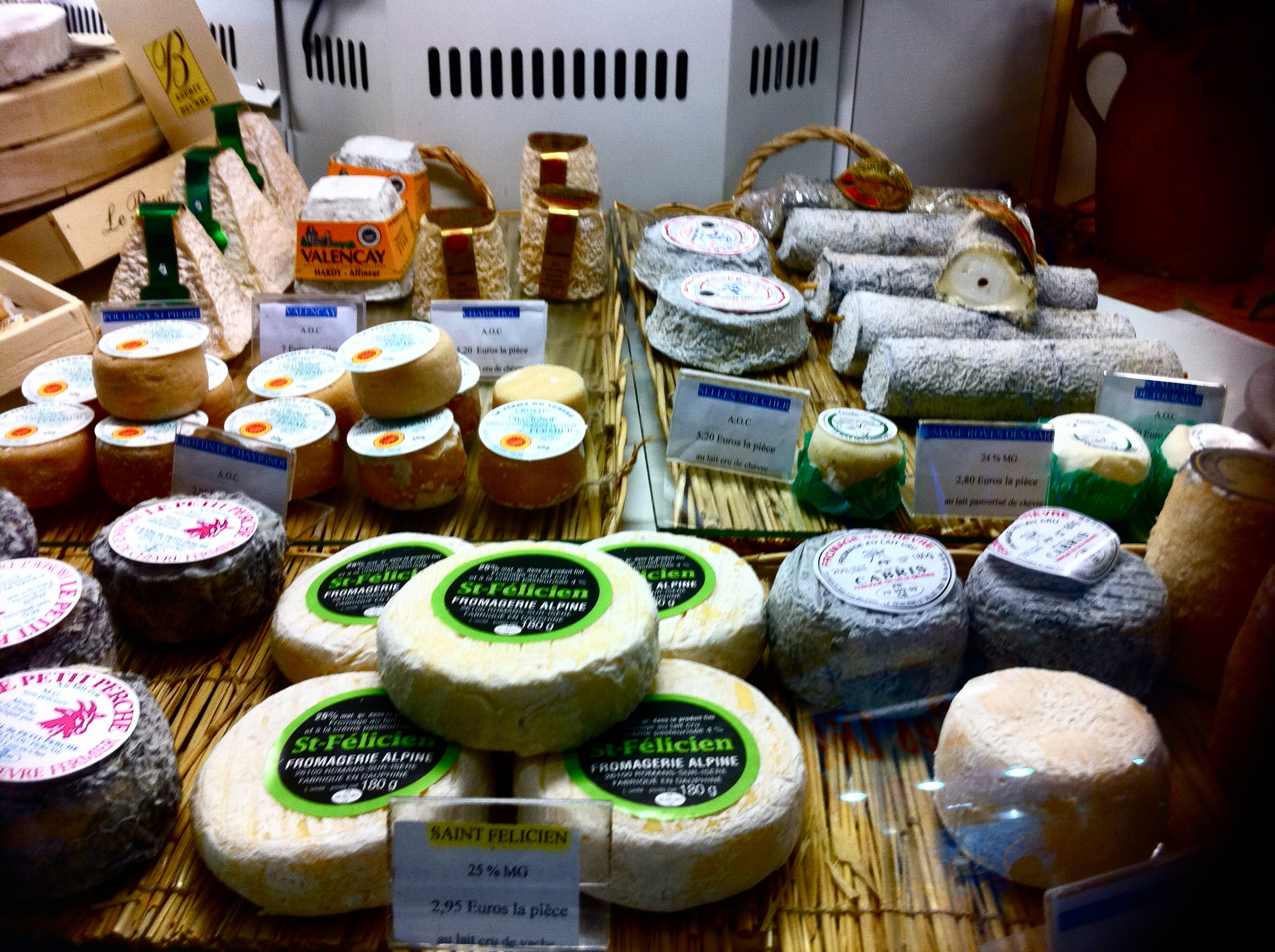
As you emerge loaded with produce, you will even find – weather permitting – an earnest young man at an upright piano playing Debussy and Satie for the lines leading to the patisserie or the cashpoint machine. Busking La Baule-style.
This was affluent France at play. No whiff of the inner city banlieux here. Barely a black face, let alone a hijab, in sight. I have no idea of the town’s political inclinations, but it struck me as the kind of fantasy France that Jean-Marie Le Pen and his far-right supporters might view as their natural stamping ground.
The good bits? A beach to die for, a magnificent market and the endless amusement of watching the self-conscious urban bourgeoise strutting their stuff. The bad bits? Ridiculous prices in the restaurants, the odd surly waiter for whom you were merely passing trade, never to return, and a sense that although you were in a very French resort, this was not a France known to most of the country’s diverse population.
Three days in La Baule were quite enough. We packed up our car and set off for the south – to medieval villages, rolling fields and real chateaux. No less France than La Baule, but the France that my Norman-English ancestors fought to retain, now colonised by thousands of Brits who own or rent refurbished barns and cowsheds beside the rivers and across the fertile plains of Charante, Dordogne and Gascony.
Much as I love Brittany as whole for its wild coastline and its rich Celtic heritage, I don’t think we’ll be passing by La Baule again anytime soon. Too genteel for my taste, though it didn’t seem so last time we visited. Maybe we’ve changed more than it has.
The lemmings of the financial markets were at it again this week. As a result, as one of the UK newspapers points out, the UK taxpayer is sitting on a financial loss of £40 billion ($64 billion) from the nation’s investment – a.k.a. government bailout – in two of the largest UK banks. Shares in Lloyds TSB and RBS currently stand at 20p and 28p respectively. This is less than one twentieth of the value of those shares pre-2008.
Many financial pundits in the UK are now predicting that the financial services sector will never recover its pre-eminent position in the British economy, or at least not in the foreseeable future. They see this as a bad thing, because we do not have income streams ready to replace what economists coyly refer to as “invisible earnings”.
I see this as a good thing. Our economy depends upon institutions that have spent the past twenty five years leeching money from countries, businesses and individuals. They have made it easy for nations to load themselves with unsustainable debt. They have created an environment in which the treasuries of many companies are their most important profit generators, as opposed to the core businesses themselves.
By reckless lending they have contributed directly or indirectly to the impoverishment of millions of pensioners worldwide, whose funds have dramatically declined as a result of the banks’ adventures in the sub-prime housing market. Through their lack of attention both to the details and to the fundamentals of their businesses, The Mirror Group, Enron and WorldCom crashed and burned on their watch. And now they are up to their necks in dodgy Southern European debt, while still paying their senior executives handsome bonuses for their outstanding success.
Long ago the banks abandoned any pretence at having a purpose beyond the enrichment of shareholders and an elite group of senior employees. Since 2008, shareholders have suffered a massive loss of fortune. Run of the mill bank employees – those whose jobs survived the orgy of outsourcing that took place over the past twenty years – have seen their jobs disappear or their working conditions substantially worsen as their employers seek to squeeze more work out of those that remain. And for banks such as HSBC, strategic planning means cutting back functions and regions that do not deliver the necessary levels of profit at the cost of 35,000 jobs worldwide. Some strategy. Some planning.
Yet while employees, shareholders and customers are reeling over the effects of collective stupidity and greed on the part of the banks, their senior employees are still finding one way or another to enrich themselves, using the perverted rationale that relative failure equals success.
This much can be garnered from even a superficial analysis of the events of the past three years. Yet the malaise goes way back. A friend who has worked in occupational medicine for thirty-odd years tells the story of an investment banker at a conference in Paris who foolishly remarked that money isn’t everything. When he returned to London there was a message waiting for him. He was instructed to report to the occupational health department, which was under orders to assess the man’s sanity, and to report back to HR with an opinion as to whether he would ever be able to work in banking again.
The story sounds like a variant of a famous anecdote about Bill Shankly, the celebrated manager of Liverpool Football Club, who was asked by a reporter “surely football isn’t a matter of life or death.” “You’re wrong, laddie”, Shankly replied, “it’s far more important than that.” Except that my friend swears that his story is true.
That this self-referential industry, managed by greedy and clever fools, should continue be at the heart of the world’s sixth largest economy seems to me to be the UK’s most pressing national issue – far exceeding the problem of how to fix the social problems at the heart of the recent riots.
Yes, of course we need banks. But banks that recognise that their customers’ savings are not assets to be thrown on the table of a global casino. Banks that do not achieve massive cost savings through mergers and then squander them – as RBS did – on disastrous acquisitions. Banks that do not urge their customers to carry out extensive due diligence before making acquisitions, yet – as Lloyds TSB did – comprehensively fail to do so when agreeing to merge with the basket case that HBOS had become.
We need banks that fulfil the needs of the societies in which they operate rather than function as multinational opportunists taking a piece of every action from which they can make a turn. Banks that provide a safe haven for savers and don’t exploit the inertia of customers by rewarding new savers above existing one. Banks that lend fairly and sensibly, unlike the major bank that a few years ago lent a restaurant £6 million for refurbishment – more than the value of the premises. Banks that don’t send their customers on magical journeys through call centres and regional hubs in search of answers to simple questions.
So what’s to be done? It would seem to me that the UK should be following a twin strategy.
First, it should reduce its reliance on financial services as a deliberate policy rather than by a slow process of deterioration beyond its control. The government has a rare opportunity to make changes now. As the majority owner of two of the country’s largest banking groups, it has the power to create a ring-fenced retail banking industry and a regulatory structure designed to ensure that savers are protected without recourse to government bail-outs, that the everyday business of lending is less prone to upheavals in the global markets. If profitability takes second place to stability, so be it.
Banks that wish to continue to play in the global casino should be allowed to do so, provided that investors and shareholders are made fully aware of the risks involved in doing so. If the divorce between retail and casino banking diminishes the UK financial industry, so be it.
The second strategic track is to take a cold hard look at what we are as a country today, and where we can go from here. What are the industries that we should be encouraging? What are we good at as a nation? And what are the sacred cows that are holding us back?
Let’s start with the things we still do well, and, if we play our cards right, that could make up lost income from a decline in financial services revenue.
Educating people: despite misguided policies by successive governments, we still have some world-class universities and – believe it or not – some world-class schools. Instead of deterring foreign students from studying in the UK by imposing increasingly draconian visa regulations, we should be redoubling our efforts to sell our education system abroad. If we award 50% of places at our universities to foreign students, the fees earned by those institutions can enable them to invest in their facilities, staff and research capabilities. If we encourage families from abroad to send their children to fee-paying British schools, those children will be more likely to go to British universities.
We should focus on making the United Kingdom the best place in the world to study and carry out research. And if we cannot entice people to study here, we should export our best institutes to countries where their expertise is prized – the Middle East and Asia, for example. More on this in a future post.
Curing people: whatever ails the National Health Service, we still have a large reservoir of medical expertise. Foreigners have long chosen the UK as a location of preference for specialised treatment. The UK trains thousands of foreign doctors. When it comes to medical treatment, excellence usually wins out over cost. A thriving private health industry should not degrade the NHS – it should complement it.
Welcoming people: we have the heritage, we have the culture, we have areas of outstanding natural beauty. Yet most visitors to the UK never venture beyond London. Do we have joined-up strategy that embraces visitors whatever their reason for coming to the UK – educational, health and sports tourism for example?
Creating things: we have actors, musicians, writers, fashion designers and artists. Our mother tongue is the dominant world language. We have a film industry. We have theatres, opera houses, ballet companies. We have a music industry. We should support, encourage and promote our creative industries rather than progressively starve them of funding. They bring visitors to our country and income from abroad. They are part of our national brand.
Inventing things: last but not least, we still invent things. We need to invest in our research capabilities rather than allow them to wither. Our scientists, engineers, software designers and medical researchers continue to win Nobel Prizes and invent world-beating technology. We should encourage our inventors to work abroad, and foreign inventors to work here – we should think in terms of cross-fertilisation rather than brain drain.
As for the sacred cow, it’s time we recognised that defence means defence. We can no longer afford to be the world’s junior policeman. In extremis, we still have our nukes, and should keep them. We should be able to contribute to international military action, but in proportion to our size and diminished influence in the world. We should focus on research and development, on smart technology and on developing our expertise in diplomacy and dispute resolution.
We are, after all, a smallish European country. Punching above our weight economically does not require us also to do so militarily.
By weaning ourselves off our addiction to the financial services sector, recognising our military limitations and by focusing on what we’re really good at today – not yesterday – we have a chance to renew ourselves as a nation, or at least to manage the decline in our fortunes with grace and the minimum of social disruption.
All easier said than done, and no startlingly original thinking in the broad principles. But in future posts I’ll do my best to challenge conventional wisdom on one or two of the themes covered here.
The trouble with history is that there’s too much of it. More than most of us can comprehend in a dozen lifetimes. The more you discover, the more there is to discover.
History comes in all shapes and sizes. Fat chunks of narrative and analysis about short periods of time – Tudor England, the American Civil War or the Spanish Inquisition, for example. Or journeys through centuries and even millennia. Gibbon’s Decline and Fall of the Roman Empire. John Julius Norwich’s history of Byzantium. Winston Churchill’s History of the English Speaking Peoples.
Both fat slices and sweeping narratives give us problems if we are to draw meaningful lessons from them. Historians who delve deeply into a specific period risk leading us to conclusions that are light on context. And those who present us with the grand sweep of history give us big pictures, but often fail to provide us with evidence that allows us to draw our own conclusions.
At school in England, most of us were given the grand sweep. We learned about the history of our own country from the Roman occupation onwards. We learned about kings and queens, generals and wars, winners and losers. And as we progressed towards the present, we learned enough about the social history of Britain to understand the reasons for the wars, the social developments, and how Great Britain moved from being an agricultural economy to the industrial power and empire that reached its peak fifty years before I was born.
All the other history I learned was by choice rather than compulsion. As a classicist, my focus was inevitably drawn towards the Middle East. First, the Greeks, the Romans, the Persians and the Carthaginians. And as time went on, the Byzantines, the Parthians, the Huns, the Arabs, the Mongols and the Turks.
And the more I read, the less I knew. But the central reference point in so much of the history of the region was always one city. Not Cairo, not Constantinople, not Baghdad.
Jerusalem. A city I have never visited, yet a name that is ingrained both in Western and Middle Eastern culture. I grew up learning about Jerusalem, from the bible, from teachers and from a hundred church sermons. I listened to religious music in which Jerusalem was the dramatic centrepiece. Works by Bach, Handel and Vivaldi. And as I learned more about the city’s history, it seemed that even where events passed it by – during times when the city was a ruined backwater in a province of an empire – it had its own gravity that slowly drew back the attention of the world.
A few years ago, I was talking to an American colleague in Riyadh about the Arab-Israeli conflict. I quickly discovered that, like many of his fellow citizens, his understanding of the origins of the conflict was, to say the least, sketchy. So rather smugly, I took him through the Balfour declaration, the Jewish immigration of the 20th Century and the dispossession of large number of Palestinian Arabs of what they considered to be their birth right. Smug because I believed that my knowledge was superior to his.
But over the past couple of months I have been reading Jerusalem – The Biography, a history of the city by Simon Sebag Montefiore. And I have come to realise how arrogant I was in believing that my meagre knowledge gave me some kind of intellectual ascendancy over my colleague.
For Sebag Montefiore’s book showed me realise how little I knew, let alone understood, about Jerusalem’s pivotal role in shaping the world’s dominant civilisations.
On the back of the cover is a statement that “The Story of Jerusalem is the Story of the World”. Perhaps the Indians and Chinese might beg to differ, but for a number of different reasons you will have no difficulty in finding Jews, Christians and Muslims who would agree with the sentiment.
The book begins with a tiny Canaanite settlement first evidenced around 2000BC. It traces the city’s development as King David’s capital, the location of Solomon’s Temple, of Herod’s Temple and the cycle of destruction and resurgence that culminated in the destruction of the city by the Roman general – later to become emperor – Titus in 70AD. Settlement, enslavement, dispersal, return, and finally the diaspora that scattered the Jews to the ends of the known earth.
After a fallow period and the rebuilding of a model Roman city on its ancient foundations by the Emperor Hadrian, Jerusalem found itself again as the spiritual home first of the newly converted Christian Roman Empire. And soon after – bowing in ascendancy only to Makkah and Madina – as a sacred city for the new Muslim empire founded by the successors of the Prophet Mohammed. All the while, Jews around the world wept for the loss of the Holy of Holies and yearned for their return.
The narrative then takes us through periods of Christian, Muslim and Jewish ascendancy. Episodes of cohabitation and mutual respect between the faiths, vicious infighting within faiths, particularly among Christian claimants to the Church of the Holy Sepulchre. The Byzantine emperors, the Abbasid and Fatimid caliphs, the Crusader kings, the Mamluk sultans, the Ottoman caliphs, the British, the Hashemite kings and finally the triumphant State of Israel all held sway of the city in the two thousand years since the destruction of Herod’s city. All created, and all destroyed.
It is hard to find heroes in Sebag Montefiore’s book. He portrays Jerusalem’s protagonists as creatures of their times. Cruel, venal, corrupt, ambitious and treacherous, yet often high-minded and courageous. Characters with qualities we might admire, such as Saladin, – a man willing to stop the cycle of slaughter that began in the first Crusade, yet at the same time prepared to behead and crucify those who breached his personal moral code. And many others of all faiths with seemingly no redeeming qualities whatsoever.
In fact the endless cycle of destruction and violence led me to wish in a way that Hadrian had never resurrected the city, and that it had suffered the fate of ancient Carthage – its vineyards sown with salt, and fields of broken pottery as the only physical evidence of a once-great civilisation.
It seems that throughout its history, the rulers and inhabitants of the city were unworthy of a place held holy by so many faiths. So many potentates wanted a piece of Jerusalem, and ended up degraded by their ownership – even to the present day. Almost as though their God was punishing them for their sacrilegious ambition.
Better surely that Jerusalem had remained a city of the mind. An ethereal entity to be formed to their spiritual requirements by the faiths that hold it holy, rather than a piece of blood-stained real estate that serves as a magnet for fanatics who accept no creed other than their own as a legitimate path to God, and seem intent on hastening the arrival of their version of Armageddon.
The sad aspect of Jerusalem’s recent history is that the present impasse – if Sebag Montefiore is to be believed – could have been avoided on a number of occasions by accommodations that were widely seen as acceptable and yet were rejected by the power brokers of the time. From the end of the First World War onwards, intractable leaders on both sides – Zionists and Palestinian Arabs – declined political solutions that could have spared much of the blood that was shed during the past century and is still being shed today.
At the same time, the book leaves me wanting more than ever to visit Jerusalem, even though on one level I expect to be shocked and disappointed, like so many visitors before me. But how could one visit Rome and Istanbul, and not Jerusalem?
Jerusalem – The Biography is compelling and scholarly work by an author whose own Jewish antecedents have not stopped him from delivering an even-handed account of the city’s four thousand year history. Just as Peter Ackroyd’s London – a Biography, illuminated my capital city, so Sebag Montefiore’s book has added immensely to my patchwork understanding of the Middle East.
Commentators on the British riots have come up with all the predictable reasons for the destruction and looting that have ravaged the UK over the past few days.
Politicians, judges and media pundits fulminate about a sick and dysfunctional society. And of course, blame is being spread around with self-righteous glee. Labour politicians blame the coalition government’s financial cuts. The government blames the culture of entitlement ingrained by years of politically correct Labour rule. Victims of the looting blame the police for standing and watching. The police blame the rules of engagement foisted on them by anxious politicians.
And so it goes on. All the favourite words and phrases trotted out on such occasions. Lack of empowerment, underclass, criminal gangs, racism, financial crisis, laissez faire. Etectera, etcetera.
The most sensible words in the media came from Matthew Parris of the Times. He described a Britain in decline, and the main task facing any British government as managing that decline. Our fantasy of resurgence during the Labour years, as in many other countries, floated on a sea of unsustainable debt. As for the riots, Britain has a history of social disorder. London has seen far worse in its long history, and it will see disorder again. It is well-nigh impossible to eliminate an underprivileged minority. Demographics change over generations, and one underclass is inevitably replaced by another. There will always be people at the bottom of the social pile.
Rather a grim view, but close to mine.
What has gone against the grain for many “ordinary people” has been the apparent willingness to join in of people who do not fit the conventional profile of an underprivileged looter. University students. People with steady jobs. One or two kids from wealthy backgrounds. What led them to break windows, snatch TVs and make off with designer clothes and IPhones?
For me, the answer is fear, and the absence of fear. The fear lies in being swept along on a mob-handed roller coaster, doing things you would never contemplate under normal circumstances. Of being out of control and beyond control. Of being caught up in a thrilling moment of strangeness. The lack of fear is the protection of the mob. What ordinary soldier would go over the top on his own? And on those first couple of nights, when the police seemed to hold back, the exhilaration of believing that you can get away with it. The triumph of right brain over left brain, of emotion over logic.
Yes, no doubt there was some calculated manipulation by gangs who saw a once in a lifetime opportunity to enrich themselves with little risk of arrest. But for many involved, I suspect it was the thrill of a lifetime.
For vastly different reasons, it was the same thrill that gripped thousands in Tahrir Square and other focal points of protest in the early months of this year. Again there was fear – of retribution, arrest and physical violence far more extreme than faced by the British rioters. But also the absence of fear among those who discovered that they were part of a tipping point – that their strength in numbers was powerful enough to cause the forces of law and order to back off. The difference, of course, was that the Arab protesters were not in search of a free PlayStation, but of regime change.
Whatever the motivation and the outcomes, one night in London and a month in Tahrir Square will produce memories for the participants that they will never forget – for good reasons or bad.
In Britain, there will be riots again. So long as we live in a society that prizes individual liberty as well as “order”, the forces balancing the two will always go out of kilter from time to time. I will always plump for my occasionally edgy country over a society in which any form of group activity is seen as a threat to the majority unless proven otherwise and liable to be supressed with an iron fist.
I am proud that our police forces did not resort to baton rounds, yet ashamed at the vengeful statements of policemen humiliated by their inability to cope with the rioting. I am proud of the eloquence and conciliation of the Muslim father whose son was run over and killed by car in Birmingham, and ashamed at the tired old truisms trotted out by commentators across the spectrum of opinion.
Declining or not, I will take my imperfect Britain over China and its ilk any time.
While watching the current financial bloodbath, I can’t help being amazed at how three credit ratings agencies can determine by a single email the financial futures of millions of people in debt-stricken nations.
How is it that Standard and Poors, Moody’s and Fitch, organisations that are ultimately accountable to nobody but their shareholders, have the power to trigger financial meltdown on a worldwide scale by pronouncing on the creditworthiness of nations?
By downgrading the status of sovereign debt, these agencies create a spiral of consequences that often lead to further downgrading. If a country is, in the estimation of S&P, likely to default on its debt, lenders will charge a premium for lending it more money. The country then struggles to repay the higher interest on the debt, making it more likely to default. S&P then downgrades the debt further, and the cycle starts again.
The issue of the US debt, which S&P has just downgraded for the first time in the country’s history, raises other interesting implications.
For example, each of the agencies use complex financial models developed by armies of mathematicians to determine objective measures of risk. Fine in principle. But are there really objective measures of risk? Isn’t one risk relative to another?
If you determine that the world’s largest economy is a tiny bit more liable to default on its debts, how can you say that countries like the UK, Germany and Canada are not equally at risk because of the potential effect on their economies of a default by the USA? So isn’t it a nonsense for any country to be rated AAA when the US is rated AA+?
No country would emerge unscathed from a default by the US. So is it not meaningless to talk about a safe haven – some nirvana economy that goes on its merry little way while chaos erupts all around? If Jupiter were to change its orbit round the sun, would we earthlings in our goldilocks planet continue in our perfect life-sustaining orbit? Not likely.
Just as a volcanic eruption in Indonesia affects the climate in Sweden for years if not decades, would not the demise of Citibank or Boeing have a similar effect on the economies of the UK or Germany?
Surely this is a matter of common sense – something that all the algorithms ever invented are unable to take into account, because common sense is a human quality. It’s about judgement based on all the facts available, and then overlaid with an understanding of human nature. The messages emanating from the ratings agencies seem to be “be afraid”. Well yes. It doesn’t take a few thousand rocket scientists to figure that one out.
So I would suggest that to downgrade US debt while leaving other sovereign debts at a higher rating is a meaningless exercise. You might as well downgrade everyone. And much as the Chinese, the largest investors in US government bonds, might complain about America’s failure to get a grip on its deficit, the question for them is where else can they more safely invest?
There is an oft-repeated saying about borrowing from banks that comes to mind here:
“If you borrow a million dollars from a bank that you can’t pay back, you have a problem. If you borrow a hundred million dollars that you can’t pay back, the bank has a problem.”
The Chinese know this. So do the Americans and so do the ratings agencies.
Which returns us to the question of why the ratings agencies have acquired such clout in determining the health of the global financial system? What gives them the right to pontificate on Greek, Spanish and American debt?
The answer is the very governments that are currently railing against them. The US Federal Reserve, for example, have effectively outsourced the assessment of the creditworthiness of securities by making it a requirement that securities be rated by two of the three major agencies.
If the agencies’ track records over the past decades were impeccable, placing a high level of trust in them would be just about acceptable, although the potential for conflict of interest arising from their for-profit status will always be there. But their failure to flag up the systemic problems of the US housing market in 2008 showed them to be as incompetent as the regulators that relied on their judgements.
To rely on private rating agencies for judgements on national economies seems to me to be political cowardice that has come back to bite not only those who have placed their trust in them, but ordinary people across the world.
When the dust settles on the current crisis, is it too much to hope that those who hold our financial futures in their hands – governments, regulators and central bankers – can come up with a better way of managing debt crises in the future?
If you are a master of the universe, don’t bother to read this. What I have to say you know already, even if you’re not letting on.
Yesterday morning I posted a piece called Swoosh Crash. It was about junking things you don’t need, and sometimes junking people you don’t need. But it was also about the death of preconceptions. Realities you hold dear because they’re real for you. Myths you believe in that are shattered by events.
A few hours after posting, I boarded an airplane for London. By the time I got to my English home, I discovered that the financial markets had thrown a collective fit about the state of the Eurozone, the possibility of bail-outs on an unprecedented scale, concerns about the US economy and fears of a second global credit crunch.
The operative word is fear. The glass, which was half-full yesterday, is half-empty today. Does “the market” know more today than it did yesterday? A wee bit, maybe. The decision of the European Central Bank to deflate the bond market by buying Irish and Portuguese debt appears to have been a catalyst for the market crash. But did those clever people who constitute “the market” have a significantly altered view of the big picture that has dominated the European economies for the past few months? Hell no.
They panicked. They said “I just can’t cope with this anymore. I’m out of here.” A few less emotional masters of the universe will even now be rubbing their hands with glee in anticipation of the profits they will make when the glass becomes half-full again.
Meanwhile, old people’s pensions will take a hit, and young people will find it even harder to get a home loan. How far have we come from the days when a stock market was a means to trade in shares of individual companies. When the value of an individual company’s shares was dependent on the performance of that company and its leaders, not by somebody’s judgement on an industry sector, or by that company’s membership of a composite index.
These days the market is a giant casino. Complex derivatives – also known as bets -that few people understand can make or break banks, companies and individuals. You could say that the world financial system is run by bookmakers – but this would be an insult to all the bookies I’ve met, who have always struck me as eminently sane individuals.
From a Middle Eastern perspective, it has always surprised me that Muslim countries actually allow stock exchanges – especially Saudi Arabia, that paragon of shariah compliance. Surely only by denying what becomes increasingly obvious with each successive crash – that buying and selling shares is effectively to commit the sin of gambling. No doubt the scholars have convinced themselves otherwise, and far be it for a non-believer like me to contradict them. But…
Humans are driven by emotion. Hope or despair, and the ability of people to transfer those emotions on to other, are often the reason for victory or defeat in battle. Routs in battles and financial markets have been with us ever since our ancestors started forming into organised societies.
But these days international finance is far more complex than it was when fortunes were made and lost on the price of a tulip or even on the prospects for an American railroad. It is so complex that it is seemly beyond the ability of even the brightest and the best to understand, let alone control.
The events of the last couple of days are yet another reminder that the systems most of us depend upon for any kind of stability in our lives are run largely by people who don’t know what they are doing. Why? Because there’s too much to know.
Those who do know are selective about what they reveal. And what they know is only part of a massive patchwork of signs and indicators – a notional big picture. They recognise that they are only able to interpret the present and predict the future with a great degree of uncertainty. They protect themselves accordingly. They also recognise that the markets are an art, not a science, and will remain so until we know enough about the human brain to predict how individuals will react to events. Meaning forever.
The former are the blind. The latter are the one-eyed kings. The rest of us are worse than blind. We are deaf, dumb and powerless. Whereas the blind are at least able to grope in the darkness and steer clear of walls and ditches, the rest of us don’t have the faculties even to recognise the wall or the ditch for what they are.
So swoosh crash goes the notion that we are in any sense masters of our own financial destinies. We are all part of the giant casino – even if we choose not to play, you can be sure that our governments will do so on our behalf with the taxes they raise from us.
If the crew of Star Trek were running our financial system, Captain Kirk would be an investment banker, Mr Spock would be a branch manager at a retail bank, Bones McCoy would be a regulator and Scotty would sell at the first opportunity. And the Klingons would manage the hedge funds.
Chances are they’d all do a better job than their real-life counterparts.
So to the other big story that crashed and splashed during my virtual absence last month – the phone hacking scandal, the demise of the News of the World and the humbling of Rupert Murdoch, proprietor of the said British newspaper and half the world’s media besides.
What blew the half-open lid off the phone hacking epidemic – half-open because the practice first surfaced in 2006, and a couple of people have served jail sentences as the result – was the revelation that the NoW hacked into the phone of the murdered schoolgirl, Milly Dowler.
Now I have a personal interest in the Milly Dowler case. Milly grew up near my home town. She was a couple of years older than my younger daughter, went to the same school as her, and my wife was a governor of the school for several years.
I never knew Milly or her family, but I was a witness to the effect her abduction had on the school, her fellow students and their parents.
The phone hacking allegation surfaced during the trial of her murderer, in which information about the Dowler family was revealed of such intimacy that it constituted a fresh trauma on top of the original devastation of losing their daughter. I can hardly imagine what the poor family went through.
That some grubby piece of low life, as is alleged by another newspaper, hacked into Milly’s phone and deleted some messages, thus giving hope to the parents that she was still alive, took the scandal way beyond the illegality of wading through the murky messages of various celebrities and minor royals.
I’m not sure what kind of book the police are preparing to throw at the perpetrators. Equally, the chain of responsibility for the hacking is unclear – again subject to police investigation and the recent grilling of Murdoch, his son and the paper’s editor at that time by a UK parliamentary committee.
But the fact that other hacking cases were proven said much about the mindset in the UK’s biggest-selling Sunday newspaper. After all, someone must have approved of the practice. Even if those who did approve it were fairly low down the food chain, it’s hard to believe that the seasoned muckrakers at the highest level of the News of The World did not question the source of whatever information the hackers dredged from the electronic closets of the targeted celebs.
So Murdoch closed down the newspaper. Quite a big deal, considering that the NoW had been around for over 150 years and had the largest circulation of any British publication.
For those who know nothing about the paper, its popular alias was the News of the Screws. “The World” generally accounted for a tiny minority of its subject matter. Most of its content was sport, sleaze, sex and celebs. In recent years its turf had been threatened by a relative newcomer, the Sport, whose content tends to be even more fixated on “tits’n’ass” than the NoW. That must have increased the pressure on the NoW’s editors to dig up yet more dirt for the breakfast tables of its readers.
Before phone hacking became à la mode, the paper had long used other standard tabloid methods of digging for dirt. Long lens cameras, waiting for the celeb to emerge worse for wear from some nightclub, pictures of a coke addict’s shattered nose. The habit of sifting through people’s garbage, lifting used tea bags and tampons off fragments of a love letter. And then of course the great doorstep confrontation, where the object of attention is caught off guard by the eager beaver reporter who asks whether it’s true that they have been sleeping with their best friend’s wife, or ripping off a few pensioners. The stuff of many movies.
The NoW would have described its practices as “investigative journalism”. But for me that phrase refers to a kind of journalism with which, if I was a journalist, I would be proud to be associated. After all, where would we be without Russell Crowe bringing his friend the corrupt congressman to justice in State of Play? Or the real-life Woodward and Bernstein, the Washington Post reporters who exposed Richard Nixon’s complicity in Watergate?
But to compare the work of the Watergate duo with the sludge-dredging indulged in by the British tabloids is akin to comparing Barcelona’s football team with a bunch of lump-kickers in a municipal cow field.
So apart from taking a rich seam of titillation off the market, and giving us an excuse to rage against the media, will the demise of Murdoch’s muck-sheet change the lives of the average Brit?
I doubt it. Other newspapers will fill the void. And besides, any celeb who doesn’t PIN-protect their phone today has to be either stupid or an exhibitionist. Phone hacking has become passé. The tabloids will find ever more ingenious ways of prising out secrets. The appetite for other people’s secrets will never go away, just as people will continue to gossip on their deathbeds. And we’re generally fine with that, just as long as it’s not our secrets they are talking about. Julian Assange knows that as well as any tabloid news hound.
I for one feel distinctly unparanoid about those who would pry into my private life. Perhaps that’s because if you looked through my garbage, the most interesting exhibit you might find is the occasional evidence of untrammelled gluttony. If you want to hack my mobile phone, go for it. I hope you get prurient satisfaction from messages about golf games and missed meetings. Anyway, you won’t get far, because it’s long been PIN-protected.
That may be because over many years I have learned the rules of the privacy game. You won’t find my name and address on any paper thrown away for recycling. You will not find me in the midst of an orgy on Facebook. And if I want a private conversation, I filter my words through a mental privacy checker that takes into account all the people who could be listening to my phone call, monitoring my email or overhearing a face-to-face conversation.
None of this is because I have anything particular to hide. Some while ago it was revealed that contemporaries of mine such as Jack Straw, now a senior British politician, were under surveillance by the British security services when they were student activists. I was not surprised, because as long as I can remember I had a sense that even in “fair play Britain”, any of us could be being snooped on by any number of entities far more potent than some tabloid sewer rat, and that there’s little most of us can do about it.
And since I sometimes visit countries whose surveillance policies are far more arbitrary and opaque than those of the United Kingdom, I have developed an inbuilt caution about what I say, when I say it and where I say it. The danger is not so much what you say or do, but how it might be interpreted – or misinterpreted.
There was a period after 9/11 when I got the third degree – special treatment, in other words – whenever I entered the US. Why? I can only surmise that some immigration official looked at all the Middle East stamps on my passport, entered a code on a database somewhere, and for a while after, this white, middle aged guy gets hauled to a corner, has his hand luggage searched and is groped in areas normally only the preserve of his wife.
This is the world we live in. Am I offended? No. Do I feel threatened? Not particularly. And would I be grateful if the same surveillance stopped another 9/11, 7/7 or massacre in Oslo? Yes.
But if I was the Dowler family, I would be deeply offended and more at the intrusion, official and freelance, into their privacy. Even if some private matters came to light in the course of a legitimate police investigation, the UK legal system should never have allowed them to become public knowledge once it was clear that no member of her family was under suspicion for Milly’s murder.
As for Rupert Murdoch, he did a good job of convincing us in the recent parliamentary hearings that he was a clapped-out, much diminished 80-year old. His son came over as a diligent corporate apparatchik, far from the man his father is, or was. Yet Murdoch still controls a media empire that encompasses the rational – The Times, BSkyB, the Wall Street Journal – and the rabid – The Sun newspaper in the UK (the NoW’s former sister daily) and Fox News in the US (the platform for such eminently objective figures as Sarah Palin and Glenn Beck).
Which makes you wonder about his values. A self-confessed libertarian – a title that can be interpreted in many ways – his career suggests that he is one of those individuals whose value system is subordinate to the needs of his business, not the other way round. How otherwise could a man own both the Times and the News of the World? And how would you explain his support for such diverse political figures as Margaret Thatcher, Tony Blair, Barack Obama and the Republican Governors’ Association? I don’t doubt that he lives by a set of personal values in his private life. But whatever they are, they don’t seem much in evidence in his business life.
Murdoch is a man of his times. He jumped on an opportunity to create a transnational empire by riding the tide of globalisation. His time will soon be over. Other Murdochs will take his place. Those who call for greater regulation of global media empires are whistling in the wind. By and large, companies like News Corporation will be continue to do their business in the knowledge that no single state is strong enough to stop them from plying their trade wherever a financial, legislative or political regime best suits them.
And the rest of us will continue to be snooped on, lied to and manipulated, not only by organisations like Murdoch’s, but also from time to time by our own governments. Conversely, those same entities will sometimes entertain us, enlighten us and improve our lives. Just occasionally, a Watergate scandal or the suffering of a bereaved family will put the brake on things getting too out of hand, and cause us to think about the impact on us of media and government, rather than simply go with the flow.
The demise of the News of the World may not be much consolation to the Dowlers. But it will certainly remind other media moguls that they can sometimes be held to account for placing the interests of their business ahead of their personal morality. Or at the very least, it will encourage them to become more aware of what their businesses are doing in their names.
I love Bahrain and its people. It’s not the kind of blind and unconditional devotion you might feel for your family. More the clear-sighted love that recognises all the ways in which human beings from time to time fall below accepted standards of behaviour and attitude, fall below their own value systems and do things that in their hearts they might regret. But also the kind of love that looks beyond behaviour and sees essential qualities – in Bahrain’s case, generosity of spirit and enthusiasm for life – that transcend the acts and failings of individuals.
The past six months have been hard for Bahrain. When I have written about the country, I have tried to do so with sympathy and without taking sides. If I have had no positive conclusions to draw from events I have tended to keep silent. It is for Bahrainis to determine their future – I leave it to others to comment on rights and wrongs.
Over the past few weeks my feelings for Bahrain have deepened, thanks to my involvement in a youth program that has been more intensive and uplifting than any in my recent professional life. My colleagues and I have been working with around sixty of the brightest sixteen-year-olds in the country. They are candidates for the Crown Prince Scholarship Program. In May next year, ten of them will be selected for scholarships that will enable them to complete their secondary education in the UK or the USA, study at the best universities in either country, and if they wish, to gain Masters degrees. More on the Scholarship Program later.
So throughout this month my team and these students have been enveloped in a bubble of learning – away from all the bones of contention that have been rattling around the country in recent months. Many of the students met each other for the first time. They came from a variety of backgrounds. Some privileged, other less so. Some girls, some boys. Some painfully shy, others brimming with confidence. They arrived with a uniformly high level of academic achievement. They left with bonds that I suspect might last for a lifetime.
The event started with a series of workshops designed to hone their skills for the big step forward from school to university – time management, communications, project management, teamwork and leadership. Following that, Going West, a week-long program – as the name suggests – specifically about dealing with the pitfalls, terrors and opportunities inherent in leaving home for the first time and travelling thousands of miles to study in what for many will be a totally alien environment.
And they spent the final week creating ideas for the economic development of the country, and presented them to a panel of entrepreneurs and corporate executives.
It was heart-warming to see these young Bahrainis gradually coming out of themselves as the event progressed. Shy ones from the villages who could hardly be persuaded to let out a squeak in the first week became enthusiastic and assertive team players by the end. Private school kids who had an advantage in social skills and confidence, helping those who hadn’t had the benefit of their expensive educations. Role-play acted out with the panache of seasoned performers. And presentations that would put many adults thirty years their senior to shame with their clarity, incisiveness and quality of delivery. All in English, their second language, although some would consider themselves bilingual.
What impressed me also was the maturity of their presentation subjects: reflections on childhood, the ethical issues around genetic engineering, early detection of special needs in children, treatment of cleft palates. When I was sixteen, in my private school bubble, my main preoccupation was the next Beatles album and catching the spot on my forehead before it turned nasty.
These sixteen-year-olds have idealism and an absence of cynicism that you would rarely find in a street-wise British or American kid. They really want to succeed, they really want their scholarships, but they also really care about their peers, their families, their country and their environment.
There were times when you forgot that you were dealing with youngsters. But occasionally – such as during a series of team problem-solving exercises – the child would come out whooping and squealing as they raced from one decoding task to the next.
There are many other young people like them in Bahrain. Serious, focused and yet exuberant and fun-loving.
While the two generations above them were thrashing out the nation’s future in the National Dialogue, these kids were showing us how Bahrain has been in the past and can be in the future – working together in harmony, goodwill and common purpose.
They represent the qualities that originally attracted me to Bahrain, and I pray that life doesn’t knock too many lumps out of their hopes and plans for the future. They, and thousands of others – perhaps not quite so bright but with the same qualities – are the future of their country.
In fact, youngsters like them all over the Middle East are the Arab future. For all the uncertainty across the region, we would do well to remember that the long-term future of the Arab world doesn’t lie with the adults who are fighting, arguing, reliving ancient battles and re-igniting old resentments. It lies with the region’s abundant and talented youth.
The Crown Prince is to be congratulated for an initiative that has transformed the lives of those who have taken part. His scholars are working in high-profile jobs both in Bahrain and abroad, and have competed on equal terms with some of the brightest students in the Western world. Yes, it’s an elite program for a relatively small number of people. But it shows what young Arabs can achieve, and it rides roughshod over the often narrow and ill-informed Western perceptions of the Arab world exemplified by the likes of Geert Wilders and Anders Behring Breivik.
If Bahrain is to be the home of inventors, innovators and creators of wealth, rather than importers of foreign expertise and traders of foreign technology, it needs more initiatives like the Crown Prince’s Scholarship Program, and it needs the spirit of his program to inspire the education system across the island. An investment in human infastructure that will be far longer-lasting than tower blocks and flyovers.
I make no apology for the untempered optimism of this post. Bahrain needs good news. These kids are definitely it.
This is Voyager reporting from somewhere beyond Pluto. No, I’m not dead.
I’m in the middle of one of the most exhausting yet uplifting projects of my professional life. Working eighteen hours every day for three weeks does not allow much time for blogging. But this Voyager will be back very soon with a fresh set of perspectives that you might find interesting.
When you return to your home country after a while away, changes in mindset do not creep up on you, but tend to slap you in the face.
As excitement mounts in advance of next year’s London Olympics, the London Borough of Wandsworth has decided that its adventure playground facilities will no longer be free. They have introduced a pilot scheme for their Battersea Park Adventure Playground that involves each child between five and fifteen having to pay £2.50 to use the playground.
The council justifies this piece of summer madness on the grounds that thousands of kids from outside the borough use the facility. This, they say, places an unfair burden on Council Tax payers within the borough. Plus they’re strapped for cash thanks to the government funding cutbacks. The story in the London Evening Standard is here. I understand that a number of other councils across the country are thinking about following Wandsworth’s example.
So a parent and his or her three kids visiting the playground four times a week after school would be charged £30 ($45) per week. Therefore the most likely scenario is that kids from wealthy families will continue to use the playground, and the rest will run around the grass outside, slipping on dog turds and having their heads knocked off by stray footballs. Or worse still, playing on the streets among speeding cars and delivery vans.
If I were a parent who regularly visits that playground, I would ask the council a few questions:
- Since when did London become a set of little empires that think it’s OK to tax the use of facilities that clearly aid the fitness, development and confidence of the kids that use them?
- The Government gives every council a large dollop of taxpayer’s money to supplement the money councils raise from householders. Does that money not more than subsidise a facility that should be available for all, regardless of ability to pay?
- By their accountant’s logic, why does the council not also charge outsiders for roads, seats at bus stops and public conveniences (if any used for their original purpose still exist)? In fact why don’t they co-opt Ryanair’s management team to parse each and every service the council provides and charge individually for them (see my recent post on that wonderful airline)?
Joined-up government this is not. We in the UK launch initiatives to provide healthier food at schools, to inspire kids to strive for athletic excellence through the Olympics, and these dolts with more letters behind their names than cells in their brains want to charge kids for swings, chutes and for scrambling around play houses.
I know I sound like one of those Mr Angry columnists beloved of the British tabloids. But there are times when I wonder how we can boast about our education system when its graduates come up with such prime examples of uncritical thinking. And if this kind of thinking is a typical example of how the UK is going about reducing its deficit, then I wonder whether we’re finally losing that quality of which we Brits have always been so proud – our common sense.
I first flew Ryanair in the early days of Ireland’s second airline. The concept of first-come-first served for seats on the plane was very novel. I remember competing with a scrum of burly nuns in the charge for the best seats. The nuns, returning to Holy Mother Ireland, won out of course.
Its planes were second hand, the fights were far cheaper than the flag carriers, and both the Irish and the British embraced Europe’s first short-haul budget airline – with patriotic enthusiasm on the Irish side, and thoughts of the extra Chianti to be afforded on the part of the Brits.
Ryanair today is an altogether more sophisticated operation. It long ago eclipsed Aer Lingus, Ireland’s national flag carrier, both in terms of profitability and routes served. It’s success is largely down to its charismatic chief executive, Michael O’Leary, who is, in Irish parlance, one “cute fella”.
O’Leary has parsed the whole flight experience. He charges virtually nothing for the flight itself. But all the features of modern air travel come at an extra cost. Check-in at the airport? Extra charge. Baggage for the hold? Charge per bag. Priority boarding? Extra charge. Met at the terminal by a buggy? Extra charge. Coffee and sandwiches on the flight? Extra charge. If your cabin baggage – one piece allowed, no matter what you buy in duty free – doesn’t fit in their measuring frame, extra charge. O’Leary would like to charge for use of the on-board toilets. He would like to create standing room space on his flights so that he can pack more people onto the flights. If he could find a way to charge for the cabin air supply, he would undoubtedly do so.
Process, process, process. With Ryanair, you follow the rules and fly for virtually nothing. No flexibility, no exceptions. When you check in online, you are assailed by options for which you will pay a premium. My wife says that you need extreme concentration to avoid inadvertently clicking the yes button for one of O’Leary’s multitude of add-ons.
Airlines often reflect the personality of their owners and chief executives. Think of British Airways under the arrogant, snotty Lord King. Virgin under the laid-back, informal and infuriatingly cool Richard Branson. But no airline embodies the values of its CEO more than Ryanair. Its logo is a flying harp. More appropriate would be a winged middle finger raised defiantly at the world.
The airline has fought battles with advertising standards authorities about allegedly misleading advertisements. It has fallen foul of EU regulations requiring it to maintain an online complaints channel. It regularly runs ads ridiculing its competitors. It ruthlessly uses its purchasing power to negotiate favourable landing fees – not hesitating to walk away from any destination that doesn’t see things its way. And the same goes for its relationships with aircraft manufacturers.
Ryanair’s relationship with its customers is similar to that between citizens and officials of a totalitarian state – fine if you play things their way, stony and unyielding if not. I remember coming back with my family from Pisa a couple of years back. The flight was supposed to land before midnight, but was delayed. It took two hours to get our baggage because, according to the airport information desk, the airline had refused to pay extra staff overtime to unload the bags. So we sat in the hall waiting for our bags with absolutely no information as to when they would appear. Our efforts, and those of a number of angry fellow travellers, to find a Ryanair representative who could tell us what was going on were to no avail. The customer service people seemed to have headed for the hills. Which left the impression that our convenience was of absolutely no importance to the airline.
The Irish attitude towards Ryanair seems to be a mixed kind of pride. Something along the lines of “we know they’re bastards, but they’re our bastards.” And certainly the chippy O’Leary appeals to the innate Irish sympathy with the underdog. Most of the Brits I know can’t stand them, but equally can’t resist the low fares. So they board the flights with the grim resignation of gulag inmates.
O’Leary wouldn’t care either way. He clearly views his job as delivering shareholder value. And he’s certainly doing that. Contrast Ryanair’s financial performance with that of Air Asia, which I have found to be a delight to travel with, but which does not have a similar record of profitability. The airline also has a good safety record and respectable punctuality statistics, so the balanced scorecard is by no means all negative.
So I suppose I shall continue to use Ryanair when I need to. It’s the epitome of operational excellence, at least in terms of its own internal processes. Customer intimacy? Forget it.
But if I was a Ryanair shareholder, I would be a wee bit worried at the domination of its charismatic chief executive. When the Great Dictator finally moves off, will his creation revert to the grey flabbiness of its competitors?
Meanwhile, an Irish icon flies on, leaving competitors, regulators and disgruntled passengers floundering in its wake.
Abdulateef Al-Mulhim is one of my favourite Saudi current affairs commentators. In his column Why Arabs fail to influence Americans in today’s Arab News he weighs into the debate on the relative ineffectiveness of Arab lobbying in Washington when compared to the Israeli lobby. Here’s an extract:
“Arab officials come to Washington and meet officials and never think about visiting a college in the American countryside or meet their fellow American Arabs. And to my amazement, any Arab official wouldn’t give a lecture if there is an Israeli official present —even if it is a medical or science conference that talks about new medicine or new discovery that saves and help humans. The irony is that the same Arab medical staff would use the medicine that those Israelis have developed. This is bad public relations from the start.
We, the Arabs didn’t know how to handle the strength of the American media and to take advantage of how liberal the media are. Is it because Arab officials care about their personal interest rather their own people? Or is it because some Arab officials are exposed to avenues of corruption and human rights abuse? We never saw an Arab official on meet the press. Can you imagine Muammar Qaddafi setting next to former Ohio senator and astronaut John Glenn and talk about achievements for the world? What did the Israelis do in the US? They simply talked to the American people first.
I came across the name of the current Israeli prime minister in the 70s when I read the story of the Netanyahu operation in Entebbe where Benjamin’s brother was killed. And from that day Benjamin Netanyahu was present in the American media. And during the invasion of Kuwait, he was part of CNN. And on May, 24, 2011 he was getting more standing ovation than the president of the United Sates when he was giving his speech to the US Congress. And my question is, why was he able to overwhelm the Congress? I think, because he started to study the American mind and he took advantage of it. He lived in the US and knew how to play their games. At the same time, there are millions of Arabs who lived in the US, but unfortunately they stood idle and spent days and nights complaining about Jewish organizations such as AIPAC and never thought of integrating into the American life and politics. Egyptian President Anwar Saddat had an open channel to the American media. He became a very close friend to Walter Cronkite, a very influential media figure. But, what did the Egyptians do to their president? They assassinated him.
We have 22 Arab states and we complain of why the Israelis over took the helm in the American media. The Arabs couldn’t have an organized public relations with the world. There are a lot of congressmen and congresswomen who would like to see an Arab figure to speak to the American Congress, but the figure must have charisma, language skills and international track record of achievements and it is important that he has a relationship with his own people back home. The Arabs must be present in the international arena, but they must fix things at home first before talking to the outside world. The world will not listen to a leader who has billions in their vaults while poverty is widespread in his country and the world will not listen to a leader who orders his air force to bomb his own cities. When Netanyahu went to the playground, he already knew the cheering crowd before he knew the referee. The crowd is the Congress and the referee is Barack Obama.”
Mr Al-Mulhim is right when he sets out the criteria under which an Arab leader will be listened to at the level where lobbyists function. As he says, the Arab world consists of 22 nations. Each has its own interests which, to a greater or lesser extent, compete with each other. The Arab League has great difficulty in finding common denominators. The Gulf Cooperation Council has the commonalities of oil wealth and monarchies intent on maintaining their own positions within their domains. But even they cannot reach consensus on critical issues such as a common currency.
There are talented and media-friendly leaders both within the GCC and the wider Arab world.
The most influential and powerful Arab nation outside of the GCC is Egypt, which is still going through its period of turmoil – there is no guarantee that a leader with the charisma of Anwar Sadat will emerge through the revitalised democratic process.
The monarchies of the GCC have never placed a priority on appealing to the grass roots of Western politics. They have never had to deal with the rough-and-tumble of the democratic process as Netanyahu has. They view challenges to their authority or views as impertinence or even lèse majesté – not a productive way of dealing with the US congress and the parliamentarians of Europe.
Probably the most charismatic monarchs of the past fifty years have been King Faisal of Saudi Arabia and King Hussain of Jordan. Of the two, Hussain had the requisite common touch, whereas Faisal generated respect rather than empathy.
Of today’s hereditary leaders, Hussain’s son, King Abdullah II of Jordan and Crown Prince Salman of Bahrain stand out as the two leaders of vision who would most eloquently address a joint session of the US congress. Unfortunately, neither would be able to claim to have the weight of the entire Arab world behind them.
So the challenge facing the “Arab Lobby” is immense. A single highly-motivated state with long-standing cultural ties to the West and politicians skilled at pressing the flesh, competing against a disparate collection of states, many in turmoil and divided by a common language.
Unless a charismatic leader emerges who can do more than pull the political levers, can reach out to the “Western street” and enjoys widespread respect within the Arab world, the contest between the Israeli and the Arab lobbies will continue to be unequal.
I suspect that it will take some time before such a leader manages to transcend local rivalries and overcome the fratricidal instincts of the competing power bases within the region. And sadly, such is the cultural gap between the Middle East and the West, it’s hard to see a universally respected non-political figure from the Arab world – a humanitarian businessperson, a cleric, scientist, artist or novelist perhaps – who could touch the hearts and minds of Western opinion-shapers in the same way as Archbishop Desmond Tutu, Albert Einstein or Alexander Solzhenitsyn.
But we are where we are, and as Mr Al-Mulhim says, the Arab nations should continue to pay the maximum attention to “fixing things at home”. They should also encourage their leaders to acquire the skills and mindset to connect with foreign constituencies, and promote passionate Arabs like Wael Ghonim to project the future face of the Middle East.
I’m currently in Ireland on a short break visiting the in-laws. The next few posts are about aspects of life in one of the debt-slapped nations of the European Union.
A very long time ago, when I was an impoverished student, I ran through a typical gamut of holiday jobs. There was the two weeks during the British Leyland industrial holiday shovelling gunk and metal shavings from the car assembly line pits, usually with less efficiency after the obligatory liquid lunch. There were the bar jobs, often spent avoiding flailing fists and head butts at closing time.
And then there was my brief career as a Betterware representative. It was the first job that required me to sell. Betterware was and continues to be a mail order company. It sells gadgets of all sorts and sizes – for the bedroom, garden, kitchen and bathroom. It satisfies the eternal longing for a better mousetrap, an easier life.
My job was to be dropped off at a housing estate with a suitcase of samples, and to knock on doors. I would show the householder the catalogues, and sing the praises of the brushes, dishcloths and tin openers to be found within my suitcase. I was trained to reassure the startled housewife with the cheery “it’s only the Betterware man”, as if the magic name was enough to convince the subject of my sales patter that she was not about to become the fifth victim that morning of the scruffy, long-haired serial killer with the rictus smile who stood before her.
But in those days people had never heard of serial killers, and I was a pretty unthreatening nineteen-year-old. I hadn’t mastered the Jack Nicholson grin from The Shining, and I didn’t have the scrawny menace of Antony Perkins in Psycho.
In fact I was a pretty pathetic salesman, better able to exhibit a sense of hopelessness than a messianic belief in the product. I did sell a few brushes, but mainly to kindly old ladies who felt sorry for me. I suppose I did learn that appealing to the motherly instinct was a useful sales technique in the great game of love that every student from a single-sex boarding school embarks upon at university. But many of my rivals were far better at acting pathetic than I was, so it didn’t really work for me.
Anyway, three weeks on, and a miserly thirty pounds to the better, I decided to quit when I was ahead, or at least while I still had a head. I never forgot my career as a Betterware man.
Fast forward to today, and my brother-in-law has a nice little business as the local Betterware man. Amazingly, the business model has changed little in the past forty-odd years. The company has made a nod in the direction of online sales through their website, but according to Colm, it’s predominantly still a door-to-door business. The product range, on the other hand, has expanded massively. The Betterware catalogue is a fascinating reflection of the domestic preoccupations of the modern Irish family.
Cats defecating on your lawn, Madam? Try our metal pussy with glowing eyes that you plonk on the lawn. Next door’s moggy will never bother you again. Limescale on the inside rim of your toilet bowl? Try our specially shaped brush that scrapes away that embarrassing crust in a jiffy. A sense of serenity on those balmy summer nights in the garden? You need our solar Buddha garden light made of weather-resistant resin – once darkness falls, its face is illuminated by the light below. I’m not sure what the church makes of gardens full of glowing Buddhas in Catholic Ireland, but times have clearly changed since the theocracy of old.
Mind you, the old religion does strike back, with solar memorial angels, graveside tributes and a decorative crucifix with the Lord ’s Prayer set in a crystal – “keep the Lord’s Prayer close to your heart” says Betterware. Its catalogue is packed with aids for the forgetful – glowing glasses trays and luminous key rings – cleaning products of all sizes and descriptions, kitchen tools, storage units, dust mite inhibitors, zipper repair kits, digital luggage scales, anti-bark collars for noisy dogs, glowing guardian angels, invisible bras, facial hair removers, jumbo remote controls and of course that essential intruder repellent, the motion-sensing owl – it hoots and its eyes light up when it detects movement within 6 feet.
According to Colm, these products sell by the bucket-load. Nothing over 40 Euro, and if you don’t like what you buy, you get your money back, no questions asked.
So why, you might ask, have the customers of Betterware not succumbed to the lure of on-line ordering? Colm says that most of them can be classified as low-to-medium income families. Many don’t have internet connections, and those that do are suspicious of internet transactions. Also, with Ireland’s banking system in such chaos, credit facilities are hard to come by. So it’s easier to put the money in an envelope and wait for your delivery in two weeks’ time.
But there’s another dynamic at play – almost forgotten by the process-driven MBAs, lawyers and accountants that run big business in the West. It’s the joy of buying from a human you know. Colm knows his customers. If Mrs Murphy wants her deliveries before mass on a Sunday, he will oblige. If she wants stuff dropped in the dog kennels in the garden that’s where they will go. Despite the presence of Betterware’s deadly rival, Kleeneeze, trawling the same streets, many of Colm’s customers will buy only from him.
How many large businesses do you know that have operated the same business model for the past eighty years, as Betterware has? Car manufacturers? Not without massive restructuring and a transformation of manufacturing processes. Most household names have undergone many iterations of reinvention since 1928, when Betterware was founded. Nokia, for example, was in those days into timber and wellington boots, and even now is apparently thinking of selling its mobile phone business. Meanwhile Betterware and Kleeneeze continue to slug it out on the streets of Ireland’s country towns
And I suspect that if and when Ireland goes to the next stage of its debt trauma and ends up defaulting, the lean-and-mean modern businesses that put greater premium on process than on people will fare less well than those companies that employ people like Colm. In Ireland, perhaps more than in many of its neighbours, relationships count. The downside is that there may be a higher degree of corruption and sweetheart deals in the Emerald Isle than in the UK, but people, especially in the country, still like to buy from people. And that is a lesson that the soulless suits in the head offices of Ireland’s corporates seem to have forgotten. When the reckoning comes, I suspect that many of them will be history – they will find it hard to work again.
And Colm will still be in business.
Here’s a written version of a talk I gave yesterday to a group of businesspeople in Bahrain about blogging for business. Not particularly profound, but hopefully useful to people whose companies haven’t woken up to the possibilities of getting their people to cast their bread upon the cyberwaters. Funny thing was, I was the oldest person there!
What is blogging?
If you were unkind, you might say that of the estimated nine million people writing blogs today are, in the main, sad individuals who write about their inconsequential lives, their inconsequential jobs and their equally inconsequential opinions.
Most people use blogging sites like WordPress. It takes fifteen minutes to get up and running, and hey presto, you can tell the world about your miserable spouse, your cat, how depressed you are and how Osama has joined Elvis in a desirable residence on the moon.
But if you were more charitable, you would say that there are a few hundred bloggers, or a few thousand at most, whose views are highly influential, and whose sites attract visitors in the tens and even hundreds of thousands. You would also say that blogs give people a voice unmediated by the conventional media. Whether you want to listen to those voices is up to you.
What have blogs to do with business?
Let me start with a couple of personal stories. I started a business in Bahrain about twenty months ago. Throughout that time I have resisted glossy brochures. My business very much depends on personal credibility, and brochures don’t deliver credibility. Anyone can produce a brochure, just as anyone can produce a flashy website. But by and large, people buy from people. Provided you can convince your potential customers that you are not one man and his dog – that you have something real and valid to offer – the decision they will make about doing business with you largely rests on your personal credibility.
So when I arrived in Bahrain, I started writing a blog. I wrote articles about all the things likely to interest my customers – education, training, organisational development, and people issues. When I wanted to keep in touch with people, I not only made the obligatory visits and phone calls. I also sent them links to my blog. And the stuff I wrote was my take on issues – not the kind of starchy white papers you’re likely to find on a company website. Some of the stuff I wrote, and still write, is quite idiosyncratic – designed to provoke, to make people think. And by writing this stuff I forced myself to form opinions on a wide range of topics related to the Middle East. So even if people didn’t follow the links I emailed them, I still had “a view” on a wide range of topics close to their hearts
Eventually I started writing about other topics – history, sport, politics and religion for example – some of which you aren’t supposed to discuss in polite society.
So for those who bothered to read my stuff, there was the possibility that I would come over as a three-dimensional person rather than some boring apparatchik when I met my customers.
Has this helped me? Undoubtedly yes. To give an example of how, I was on holiday a couple of months ago, and I got a call from a PR person who subscribes to my blog. She had been given three hours to prepare some messages for the CEO of a local investment bank who had a TV interview the next day. He wanted to talk about examples of countries that have recovered from worse situations than the one Bahrain has found itself in over recent months. She contacted me because I was the only person she knew who in such a short time could give her a briefing on Truth and Reconciliation processes in other countries. Being highly susceptible to flattery from charming women, I said yes. And in that time period I was able to come up with briefings on South Africa, Argentina, Rwanda and a couple of other countries.
Blogging, together with the social networking tools such as Facebook, Twitter and YouTube, has developed beyond a community of angry, axe-grinding, lovesick denizens of the night. CEOs are realizing that by writing a personal blog, they are giving their companies a human face. Techies are communicating with other techies, and talking about new products their companies have developed. And employees are giving a personal window into life at their companies that can significantly boost employer brands.
What’s more, everything you can say about companies even applies to politics. For goodness sake, even Mahmoud Ahmadinejad has a blog!
Finally, it’s worth noting that not only are companies using blogging to enhance their brands, but they are using monitoring tools to find out what people think about their products and their reputations.
So blogging is entering the mainstream – an important weapon in a communicator’s armoury.
Here There be Dragons
Ah, you might say, the thought of my downtrodden employees moaning about my company in a blog doesn’t bear thinking about. Fair comment – so there need to be guidelines. About what they can say and what they can’t. About confidentiality and intellectual property. In fact, if you haven’t inserted some clause in employee contracts about how and under what circumstances they can talk about the company – on the social media as well as blogs, you ought to start thinking about that now.
If you manage to persuade your CEO to write a blog, you’d better make sure he or she writes lively and engaging content. Otherwise their blog will have the opposite effect – people will think that the company is run by robots. So if they can’t write, get someone to write for them. And make sure that they post regularly – the occasional sermon from the corporate mount is not likely to inspire the multitude.
Remember also that blogging and the social media are only one weapon in the armoury. In other words, if your CEO or marketing people get the idea that you can cut your marketing budget by 80% by using the social media to the exclusion of more conventional methods of branding and marketing, politely put them right. The chances are that you will still need the dark arts of conventional PR. You still need TV, advertising, cozying up with the print media, especially if your audience is not social media aware. But don’t forget that there are plenty of retired 70-year olds on Facebook these days, and putting their life stories into interminable blogs. The social media is not just for the young and cool. Am I young and cool? I don’t think so.
Also, don’t think of blogging in terms of the conventional media. The best blogs are interactive – they are a conversation. So make use of the ability of readers to post comments to talk to people one-on-one. You will have a chance to rebut, elaborate and even learn from your readers. A much richer mix than “broadcast only”.
Finally, if you are going to blog for your business, do it properly. Take advice on how to reach the widest possible audience. Consider offering your stuff to blogs of blogs. Huffington Post and the Daily Beast attract audiences larger that most conventional print media in the US. Here in the Middle East, there are a few sites that use many bloggers, and they can usually attract larger audiences than you can. For example, a site in Dubai uses my stuff, and each of my articles has a respectable readership. Not huge, but great for my purposes. In time you will build up your own subscriber base – people who get an email every time you post – so you can start pushing your message as well as waiting passively for people to visit your site.
So that, in a nutshell, is blogging for business. If I’ve been preaching to the converted, I’m sorry for telling you what you already know. If not, I hope this talk has given you some food for thought.
It was interesting to find that on a show of hands, there was only one blogger present apart from me, and about 50% of the audience never read blogs. So maybe blogging is not so mainstream after all. I should also note that although I originally started blogging for a specific business reason, these days I write for love, and any business benefit is “collateral damage”. Evidence of that is that you will never see my company name on any post.
Sepp Blatter will be re-elected as FIFA president tomorrow. Attempts by the English and Scottish FAs are too little too late. I listened to an interesting discussion on BBC Radio World Have Your Say. Contributors far smarter than me suggested that the best way to get shot of the bandits running FIFA is a variant of the virtual Day of Rage I suggested yesterday. That variant is to target the FIFA sponsors, whose brands stand to be tarnished by any corruption proven at FIFA.
I agree. Companies like Coca Cola, Adidas and Hyundai, who monitor social medis traffic for adverse comments, will surely be pretty spooked by massive Twitter and Facebook campaigns taking them to task for associating themselves with FIFA’s tarnished brand. They will also note the swift disassociation of many high-value sponsors from Tiger Woods. Accenture, Gatorade, Gillette, and AT&T all pulled away from Woods on account of his extramarital escapades. If proven, would widescale corruption be seen by the corporates as a lesser crime than Tiger’s floozie addiction? I don’t think so.
All the signs point towards Blatter’s triumph being short-lived. Should he succumb to pressure from FIFA’s sponsors, then, as a Brazilian contributor to the BBC programme suggested, it is not enough to skim off the leadership. The whole rotten edifice should be subject to a root and branch reform.
More parallels with the Arab Spring. Likely to happen? Well, the army’s still ruling Egypt….
I have just watched an excerpt from Sepp Blatter’s press conference in which he commented on recent allegations of corruption within football’s ruling body.
Blatter adopted his usual persona of an arrogant international statesman. He referred to FIFA as a family – his family. He was adamant that FIFA is not in crisis, and confident that all allegations of corruption could be resolved by FIFA internally. The BBC’s report on Blatter’s press conference is here.
Blatter leads a team of preening, self-satisfied and allegedly corrupt politicians and bureaucrats. Millions of people play the game. Billions follow it. The money generated by football is greater than the gross domestic product of some nations. Many of us care passionately about the game – not as much, quite possibly, as we care about our families and our nations. But FIFA is more than a family. Families are accountable only to themselves provided that their members do not break the law. The football community is a virtual nation, and football’s governing body should be as accountable as a real government.
At a time when accusations are swirling around about the integrity of FIFA’s potentates, not just now, but over a period of years – see my previous post about FIFA from last November – it is not enough that investigations into corruption should be the province of an internal ethics committee. Whether or not Blatter is correctly following FIFA’s rules and constitution by insisting on an internal inquiry is as irrelevant as the supposedly legal actions of the deposed despots of the Middle East in shoring up their power.
At the very least, he should postpone the presidential election and call on an independent forensic team to carry out a thorough investigation into the behaviour of FIFA’s officials, with powers to seize documents and examine electronic records. If it finds sufficient evidence of corruption, the team should be empowered to refer cases to criminal prosecutors in countries where any alleged acts were carried out. Only then can the negative perceptions surrounding FIFA be laid to rest.
For Qatar, which is preparing to spend billions in hosting the 2022 World Cup, such a process is essential if it is to gain the full benefit of its investment and see its finest hour take place untainted by rumour and innuendo. It is the least that millions of young Qataris, waiting with excitement for their moment, deserve.
As his formerly loyal colleagues turn on each other like rats in a cage, and Blatter lectures us like Hosni Mubarak in his final days of power, perhaps FIFA needs a day of rage. A virtual nation doesn’t have real Tahrir Squares where protesters can gather, but a few million votes on a Facebook page might go some way towards convincing the complacent Mr Blatter that after thirteen years, enough is enough. Assuming he’s listening, of course.
PS: As Steve Harrison points out in his comment, there are only about half a million Qataris. I refer to millions because when the World Cup comes around I expect that the whole football fraternity in the GCC and beyond will take the view that “We are All Qataris” – unless another team from the region qualifies!
 59steps