There’s a nice story in today’s Gulf Daily News about a couple of Bahraini students who have invented the equivalent of an aircraft black box that will enable crash investigators to determine the cause of the accident:
A BLACK box for cars, similar to those found in airplanes, has been invented by two Bahraini students.
Bahrain University College of Information Technology students Fatima Al Ansari and Latifa Jamal came up with the device, which contains basic information about the car – such as its motion, function and features.
The aim is to provide vital information to crash investigators. However, the equipment also has a built-in GPS system.
“We depended on our practical experience and created a special programme to design the device, which is a first in the country,” said Ms Jamal. “Over time, we plan to perfect it and add more features.”
First off, congratulations, Fatima and Latifa. I hope you have patented the device and go on to sell millions of them to GM, Toyota and all the other car companies. Though I suspect that Porsche and Ferrari will not be the first to licence your technology.
Equally importantly, I hope that you will employ many fellow Bahrainis should you decide to form a company to develop the technology on a commercial basis. Bahrain’s love of cars and hi-tech gadgets should mean that you will have no problem attracting bright and motivated people to your company.
I can see many potential avenues for you to explore as you look for more features. Here are a couple:
The Rage Detector: a built-in heart monitor – either in the steering wheel or the seat belt – that picks up the heart rate and displays it on the dashboard. Combined with sudden acceleration, violent course deviation (particularly to the right), the Rage Detector triggers a voice response: “Calm Down!”. Note, though, that the voice should preferably be of the same sex as the driver – men don’t like being told what to do by women in a car, as Fiat found out when they had to change the voice command in their cars from female to male because Italian males objected.
The Stress Detector: Uses the same heart monitor as the Rage Detector, but with an additional monitor to measure hand perspiration. Picks up ambient noise, such as hooting cars, road drills and the bass response from nearby cars with turbocharged in-car music systems. Combines this input with sound from the interior of the car, such as men arguing and children screaming, and displays your stress level on a meter in the dashboard. At a given point the Stress Detector triggers a voice response with a number of calming messages, such as “Relax – you are only two kilometres from your destination”, or “Don’t worry – there is a Starbucks to your right in three kilometres”.
You could also have a special female setting that sends calming messages like “Relax, they’re only men”. But be prepared in your algorithms to recognise the Level 10 stress indicator – a voice in the car screaming at 120 decibels: “I AM NOT STRESSED!” This triggers a response such as “OK, you’re not stressed, but slow down anyway.”
On a more serious note, a device that automatically alerts police and breakdown services in the event of a catastrophic mechanical failure would be worth looking at, especially if you’re not in a position to make a call. I would find that a very comforting fall back on a long journey – Dammam-Riyadh for example.
So go for it, Fatima and Latifa – the sky’s the limit. Well, at least the road is, and there are plenty of them on the planet. Bahrain needs more inventors like you two.
Anyone reading this who has more ideas for Fatima and Latifa: feel free to post a comment.
Ernst and Young have released the results of a survey of bank customers in the GCC. The study, Retail Banking in the GCC, claims that 25% of customers in the GCC plan to switch banks in 2011.
The Gulf Daily News runs the story in today’s edition as Clients set to switch banks. Here’s a telling excerpt:
“The survey points out that customer experience needs to be driven by the operational excellence of each transaction.
About 71% of respondents said trust is highly important to their relationship with their primary banks but 70% cited transaction speed and 66% tagged service quality.
While 45% consider personal attention to be highly important, 7% confirmed they get that from their banks.”
On the face of it, pretty damning statistics, particularly the one about only 7% of customers agreeing that they actually get personal service. In my experience, the issue is not so much about personal service or the lack of it. You can usually find a person to talk to. It’s what they do and how they do it that counts. I wrote a post for the Career Advantage website about my experience with my own bank a few months back. At the time, I was waiting for a new ATM card. The whole process was something of a saga, which I describe here.
I haven’t seen the EY report yet, but I will be interested to see how they have segmented the survey. Friends in banking tell me that one of the consequences of the 2008-2009 financial crisis is that many of the banks have taken a hard look at the kind of customers they really want. If the survey shows that the level of discontent applies to their most profitable customers – those transacting frequently with large sums of money and using multiple services – then the banks have cause to worry. But if the results include large numbers of small customers whose profiles suggest that they will never be serious sources of profit, then perhaps they don’t care if they lose them.
Any significant level of dissatisfaction is bad news, and the banks should care. But reality suggests that if they invest in customer service, granddads drawing their pensions once a month will be pretty far back in the queue.
One of the companies I’m involved in has come up with an interesting technique for assessing customer service. You might want to use a variant of it for yourself to run a sanity check on the service you’re getting from your bank.
The technique involves looking at five dimensions of customer service. These are Environment, Communications, Attitudes in Interaction, Process in Action, and finally, Dealing with Unusual Situations.
So next time you visit your bank, bring a little notepad with these headers listed out. Ideally, so that you can assess the last dimension, do the exercise when you have a problem that needs sorting out.
During your visit, focus on these questions related to each of the five dimensions:
1. Environment: Did you find the branch a pleasant place to visit? Comfortable? Clean and tidy? Well guarded? Not too noisy? Clear signs telling you where to go for what service? Plenty of seats?
2. Communications: Did you find it easy to get the information or service you were looking for? No language difficulties? Clear instructions? Body language of staff? Tone of voice?
3. Attitudes in Interaction: How did the staff interact with you? Taking responsibility? Friendly? Professional?
4. Process in Action: How did you feel about the processes the bank followed in providing you with the service? Easy to understand? Designed for the bank? Designed for you? Logical? Time efficient?
5. Dealing with Unusual Situations: How effective was the bank in solving your problem or answering your query? Did they react quickly enough? Did one person take ownership? Did you feel that they were concerned? Did they make promises that they kept?
When the visit’s over, score the first four categories out of ten, and the final one out of twenty. Problem resolution is perhaps the most important aspect of customer service, so you should give it twice the weight of the other scores. If you had a problem that could not be resolved on the spot, put a provisional score in for Dimension 5, and a final one when the problem is sorted out.
If you score your experience at less than 30 out of a possible maximum 60 points, then consider changing banks.
You could argue that most of the criteria are subjective. But your perception is more important to you than objective measures – it’s how you feel. The technique my company uses is more complex. But what you have here are the basic essentials. And you can use the same technique when you visit another bank to talk about switching your account!
In fact, you can use it in any situation where you are concerned about customer service – shops, phone companies, government offices and even restaurants.
So my message to the banks is: when you see people wandering around your branches with little notebooks, be on your best behaviour – it isn’t necessarily a robber planning a heist!
Here’s a welcome break from all the serious stuff I’ve been publishing lately. This is the story of my broken laptop and its replacement. It’s published in today’s Bahrain Gulf Daily News.
I returned to Bahrain this week after a short break in the UK. While I was away, I bought myself a shiny new laptop. The old one had suffered injury from an unknown assailant at a recent conference. I had left it open in the press room, and when I returned I found a sinister black line running down the screen. Since then, the line has extended from the top to the bottom, and turned into an ugly green and black smear. It seems that someone had inadvertently dropped something on it and cracked the screen.
A laptop’s useful life is getting to be shorter than a hamster’s. This one was about three years old. When I switched it on it would emit a grumbling, grinding noise. I guess the hard disk was struggling to access all the stuff I stored on it. I’m one of life’s hoarders, and that goes for email, documents and pictures as well as material possessions. Anyway, the green smear spreading across the screen like seaweed at low tide was a sign. Time for retirement.
So I went off to the local store in search of a bargain in the New Year sales. Half an hour later I paid for a shiny new laptop at half the price of the old one. Twice the speed, twice the memory, and a hard disk three times bigger than the old one. Such is the reality of the computer business. Everything gets cheaper, faster and more efficient year by year. Laptops are commodities these days. Use them, and chuck them away when they stop working. Or at least, that’s what the manufacturers would like you to do.
Once I got home, I switched it on, and lo, it was silent. No grinding, no hissing of fans cooling down an overworked processor.
New computers are like new-born babies. Pristine. Innocent. No secrets, no baggage. Ready for us to animate them, personalise them and put then to whatever perverse use we might have for them. The first thing I did was transfer all my files and settings from the old laptop. Rather like a brain transplant really.
And then, more like Frankenstein than a new-born baby, it woke and snarled. It started downloading eleven thousand emails stored on my email provider’s server in a torrent that I couldn’t stem. I tried to stop them because I had them already, but they kept coming. In the end I decided to let them come, and then delete them. The whole process took about twenty four hours.
Meanwhile I was bombarded with requests from multiple sources to access the laptop in order to download the latest versions of the software on my “new” computer. Microsoft alone uploaded 19 updates in one day – some “important” and some “recommended”. Presumably the recommended ones were not important, in which case why did they bother me with them?
Then I opened the web browser. Microsoft informed me that I had a choice of browser. I chose Internet Explorer, only to discover that the version loaded on my laptop will not play videos. So I need another browser to look at YouTube. So now I use two browsers.
My conversation with my new laptop continues. Downloading this, resetting that, struggling to return to the benign, pristine creature that I welcomed to my world a few days ago. Is it superior to the old one? Not really.
And I ask myself: if I buy a new car, do I expect some helpful mechanic to offer to replace the headlights, tune the engine and replace the seat covers within a few days of my driving away with it? I think not.
But that’s computers, folks. Just like babies, you need to teach them, nurture them, feed them and spend money on them. Even then, there’s no guarantee they’ll do your bidding.
Since I wrote this a few days ago, the laptop has continued to behave itself. One accidental consequence of the failings of 64-bit Internet Explorer – I’ve fallen for the delights of Google Chrome.
I write this in the aftermath of the Tunisian upheaval. There will be many people in the West, both governments and individuals, who will be asking themselves whether the conditions that gave rise to the toppling of President Ben Ali – primarily unemployment – will spur a domino effect in neighbouring countries. They will also be asking whether the upheaval will create a power vacuum which Islamist factions will seek to fill.
I’m not an expert on Tunisia, so I don’t know. But the Tunisian situation set me thinking about relationship between religion and politics. A big subject, you might say. But not one that should be left exclusively to the experts. We should all be thinking about what sort of societies we want to live in. Do we want to live in communities where religion is used as a means of political control? Where our activities are controlled by the dictates of an entrenched clergy whose interpretation of what behaviours are or are not permitted end up being enshrined in law?
And in case you think I’m embarking on a polemic against Islam – a religion for which I have the greatest respect – understand that I’m not talking exclusively about the Sharia and the fatawa issued by Muslim clerics across the Middle East and beyond. Since the birth of Christianity, the confusion between spiritual and temporal leadership has ebbed and flowed in just the same way as it has in the Muslim world. For the ulema, substitute bishops. For the Sharia, substitute the Ten Commandments and laws based upon them in just about every country throughout history under the control of a Christian monarch or ruling class. The stoning of adulterers, the killing of apostates and blasphemers, the burning of witches, the persecution of Catholics, Protestants, Cathars, Gnostics. Are these the will of God, or are they political acts approved of or committed by rulers who chose to interpret the will of God for us? Acts that enable them to gain power or retain it?
Look beyond Islam and Christianity, and consider Judaism, from the Pharisees who encouraged Pontius Pilate to crucify Jesus to the extremists of today who so strongly influence the intransigent government of modern Israel.
Is not the fundamental precept of the Abrahamic faiths that what is all-important is my responsibility to God? That I am answerable to God for how I live my life – for my sins and for my good works?
In behavioural terms, at the core of Islam are the Five Pillars. At the core of Judaism are the Ten Commandments. And at the core of Christianity are the lessons of the Sermon on the Mount. In this age of enlightenment, mass communications and universal access to information, are we so weak that we need an army of priests, imams, mullahs and rabbis to do our thinking for us? Yes, we all need guidance from the wise from time to time – from our brothers, sisters, husbands, wives, parents, teachers and friends. And from religious leaders and mentors who can offer us advice, insight and empathy in our efforts to reach a closer relationship with God. But do those religious leaders have the right to mediate our responsibility to God by their interpretation of His word, by their personal agendas and by their willingness to justify the actions of their political leaders?
These are questions, not statements. Whatever we feel about our personal relationship with the Creator, the Abrahamic faiths are communal religions. They are stronger when people gather in mosques, at the Haj, in the church and synagogue – or in a mob on a Pakistani street protesting in favour of the blasphemy law, or in a church hall in Florida planning “Burn the Quran Day”. Benign or malign, to be an accepted member of a community you need to follow its behavioural rules.
And in societies where freedom of expression is limited, where people do not feel that they have a voice in decisions made on their behalf, the natural reaction is to politicise the one behaviour that no government can easily interdict, the practice of faith. So the extreme Islamist agenda is to restore the caliphate – to reject what they describe as the hypocrisy and corruption of temporal rulers. And it’s a message well received by people who feel trapped in a cage of unemployment, poverty or lack of personal fulfilment.
Whether those rulers are or are not corrupt is irrelevant. The impulse is for change, any change. Blame is always laid on others, with little thought as to whether the downfall of one government will lead to another with solutions to problems that go way beyond national boundaries. Problems based here on earth – climate change, demographics, dwindling natural resources.
In societies that are highly paternalistic, and where much of the educational curriculum is devoted to rote learning at the expense of critical thinking, is it surprising that citizens who grow up being told what to think fall prey to those who use the scriptures to justify their political agendas?
So yes, it’s right to fear power vacuums that can be occupied by extremist ideologues. In secular societies, by extremist nationalists. In societies bound by a dominant religion, by extremist proselytisers. Because in both cases the extremists latch on to common beliefs – patriotism and faith – and pervert them into malign ideologies.
It is easier to blame others than to take responsibility ourselves. It is easier to destroy than to create. And here in the Middle East, I would argue that creative solutions will address many of the problems facing the people of the region far faster than destructive conflict. If it takes a rethink on the role of the clergy in ordering society to produce new generations of creative thinkers, then the governments of the Middle East will ignore this issue at their peril. And their peril will ultimately be the world’s peril.
The argument is not about secularity versus religion. It’s about building societies in which people are not afraid of thinking for themselves, and are free to express themselves without fear of censorship, persecution and death threats – either from governments or from ordinary members of society. There is nothing that I’m aware of about the basic precepts of Islam, Christianity or Judaism that should inhibit creativity and freedom of thought. If it were so, then the great inventions and discoveries of the Golden Age of Islam, of the Western renaissance and of the Industrial Revolution would never have happened. It is men, not God, who curtail us.
As a Westerner living in the Middle East, I suppose I’m open to the accusation that I’m an outsider. That I don’t understand the culture of the region, and as a non-Muslim I have no right to comment on how Muslims organise their affairs. Even that I’m a cultural imperialist. Fair enough, so I will end this post by quoting in full (so that I am not accused of taking his words out of context) from a recent article in Saudi Arabia’s Arab News by Dr Khalid Nowaiser, a Muslim and lawyer from Saudi Arabia. In his article, entitled Religious Intolerance in Saudi Arabia – Enough is Enough, Dr Alnowaiser says:
I realize I am taking up a very sensitive subject.
I also understand that I would be stereotyped as liberal or secular, but I don’t care as long as this article provokes readers to consider thoughtfully the future of our country.
My thinking was stimulated by the participation of Sheikh Ahmed Al-Ghamdi, director of the Commission for Promotion of Virtue and Prevention of Vice in Makkah Region, at a forum held recently at Khadija Bint Khowailid Business Women Center in Jeddah. The strident reactions to his speech deserve an answer. I commend Sheikh Al-Ghamdi for his modern and civilized views in spite of the numerous difficulties he has faced. I also applaud those women who organized and attended the Jeddah forum and who daily combat the tough and inflexible culture of relegating women to second-class status because of intolerant religious edicts.
Despite all the difficulties that currently exist, the bigger issue is how to address the misguided conservative interpretation of Islam that seeks to justify greater repression of Saudi women. This fundamental issue is so problematic and complex that it has dominated and controlled ways of our thinking and the intellectual discourse in the Kingdom.
The present situation requires that we ponder the following points:
First: Certainly, Saudi Arabia is the birthplace of Islam, where Islamic Law is followed. However, certain puritan religious leaders have ignored Islam’s tolerant and flexible nature and have imposed a kind of strict interpretation that betrays our religion and the Prophet’s (peace be upon him) teachings. Islam is a faith that does not require persons to establish a direct link or relationship with the Creator. Yet, regrettably, many of our clerics are still talking in the name of God and his Messenger and advancing the mistaken view that “He who opposes me also must oppose God and his Messenger.” This is quite similar to the Catholic Church’s stance in the Middle Ages where many people were persecuted in the name of God. One must ask, “How can Saudi society progress if it allows such a defeatist culture teaming with fear, skepticism and unequal relations between men and women?”
Second: The prevailing attitude for the past three decades is to relegate Saudi women to an inferior status. I doubt that anybody can equal this school of thought in its dogmatism and strictness with the exception of a few Muslim countries that still live in the Dark Ages. Those of us who grew up in the 1960s still remember when we could go to movies and attend festivals and other forms of entertainment in Jeddah without being harassed. Engaging in these activities was not prohibited until the rise of religious dogmatism in the recent past. Never before has our society experienced such an arbitrarily enforced separation between men and women as that which currently exists. Does this mean that Islam has changed or simply that our religious leaders have failed to keep up with modern societal trends?
The failure of this ideology of religious fanaticism is apparent, yet it continues to dominate and control Saudi society in the guise of the pious and in the name of Islam despite preaching intolerance.
Third: Saudi religious schools must enter the modern age or be an impediment to Saudi Arabia’s economic and political development. Many reforms depend on an informed and tolerant citizenry. Justifying intolerance and ignorance breeds terrorism that strikes at the very security of the Kingdom. We need to consider these leaders of thought, who are called our religious scholars, of whom we should revere? Who among them has contributed anything to the advancement of the human race with scientific breakthroughs like those of Newton, Einstein, Edison, Socrates, Aristotle, or Archimedes? Instead, could they simply be memorizers who celebrate and continue to live in the past and ignore the rapid changes taking place in the world?
Fourth: Most irritating is the way that these religious dogmatists wrongfully meddle with our lives and personal freedoms contrary to the very teachings of Islam. Who gave them the power to decide how our lives should be lived? Why should a social issue like women driving cars be so contentious?
Shouldn’t a woman decide this? Moreover, why is a woman not entitled to travel without the consent of a man? Why are her employment opportunities so constricted?
Fifth: When Saudis meet together, their talks center on: “This particular Sheikh has sanctioned doing this, while another Sheikh has prohibited it, describing it as an illicit taboo based on a fatwa.” So, they become obsessed with what individual Sheikhs say rather than the true message of our faith. To combat this nonsense, we need to pay attention to current issues, such as the environment and climate change, the technological revolution, genetic engineering, medicine, industry, research, philosophy, and art. If we fail to do this, we would find ourselves living on the margins of history.
Sixth: In short, there is a prevailing conviction and belief that the existing situation is what the majority of Saudi society wants and, therefore, the country should listen only to the majority. I believe this is wrong. If we look at history, we will see that those who challenged current ways of thinking and advanced reforms were often in the minority. Indeed, constructive change sometimes comes about through the act of a single person, such as Nelson Mandela, Mahatma Gandhi, the great founder of the Kingdom, King Abdul Aziz, and all the prophets and messengers, including Prophet Muhammad, the Messenger of God. In order to move forward as a modern civilized society, we must make a clear and decisive choice: Either accept the current reactive and intolerant school of thought which seeks to control our lives and restrict our country’s progress, or promote tolerance and intellectual pursuits to create a better and more productive future for all Saudi citizens.
That Dr Alnowaiser was able to express his opinion freely in the Saudi media is to the credit both of the government and the media themselves. In order to discuss solutions you must first discuss the issues. And I’m not saying that Dr Alnowaiser would agree with everything I have said in this post. But his words give me hope that there are solutions to the problems of the Middle East, and that we are not heading inevitably towards widespread political meltdown – a consequence that would almost certainly not be to the long-term advantage of the disaffected, disappointed and disenfranchised in this region for which I have great affection.
This blog is in danger of becoming a one-trick pony with all its recent emphasis on entrepreneurship and learning. But I can’t resist commenting on this article in the BBC website. It’s a review of The Genius In All of Us, a book by David Shenk. The article ends with the following statements:
It would be folly to suggest that anyone can literally do or become anything. But the new science tells us that it’s equally foolish to think that mediocrity is built into most of us, or that any of us can know our true limits before we’ve applied enormous resources and invested vast amounts of time.
Our abilities are not set in genetic stone. They are soft and sculptable, far into adulthood. With humility, with hope, and with extraordinary determination, greatness is something to which any kid – of any age – can aspire.
It’s the phrase “far into adulthood” that grabs me. In a recent post on entrepreneurship in the Middle East, I made the point that it’s unwise to focus exclusively on encouraging young people to go straight into an entrepreneurial career on graduation. This would be to ignore the huge number of mature adults who work in paid employment, sometimes for decades, and then think to themselves “I can do this better myself”. What counts, at any age, is the “enormous resources and vast amounts of time” referred to in the article. And many people invest that effort while working for others – not only in the private sector but in government and academia – before starting out on their own.
Which is why the conventional paradigm that results in people “getting their education out of the way” by their early-to-mid-twenties is so unfit for purpose in a knowledge economy. It’s not a matter of education opportunities being unavailable to adults. They are, in most regions of the world. But in many cultures, especially in the Middle East, where the certificate is everything and whole careers depend on what you achieve in your twenties, it’s incredibly hard for people to break out of the low achievement straitjacket that results in not having a decent first degree, or any degree at all.
So our increasing understanding of the science of intelligence should persuade employers to look at the hidden potential of their staff who haven’t made it sucessfully through the first hurdles to a high-flying career. Educating Rita, the inspiring story of a young hairdresser who gets a second chance to go to university, should be the rule, not the exception.
For those who want to look further at Shenk’s book, here’s another review in the New York Times.
In my last post about entrepreneurship in the Middle East, I suggested that it might take 40 years, or two generations, before a culture of innovation becomes embedded into many of the countries of the Middle East. The trouble is, the oil-producing countries are involved in a race against time. There are many variables that will determine what the world will look like in 2050: population growth, employment levels, climate, the availability of food, water and mineral resources, and last but not least, the availability of energy sources.
Saudi Arabia is the economic kingpin of the region. How the Kingdom deals with these issues will to an extent determine the overall future of the Middle East. As it inches crab-like towards social and economic reforms, many commentators both within the country and abroad argue that the process is not fast enough. Others argue that slow, incremental reform is the only way in which the leadership can ensure that the country holds together. Rapid and fundamental change would be unlikely to bring the support both of the conservative and reformist wings of society. So the risk would be of civil unrest or worse.
The counter-argument is that high unemployment among the 70% of the population currently under 30 will, if not addressed rapidly, sooner or later also bring unrest.
What’s to be done? Well, in the spirit of thinking the unthinkable, here’s one scenario.
King Abdullah, upon his return to Saudi Arabia after successful surgery in the United States, broadcasts to the nation. And this is what he says:
In the name of God the Merciful and Compassionate. Beloved brothers and sisters.
I am delighted to be back among you in full health, so that, God willing, I can spend the remaining years of my life in the service of my beloved people.
During my absence I have had the opportunity to consider carefully the challenges facing our country. They are many and varied. And I know that there are many different opinions as to how we should deal with those challenges.
Of one thing I am sure. We cannot stand still. Today our economy is stronger than ever. We are a respected member of the G20 group of nations. We have carried out many initiatives to foster a new economy that will remain strong after our blessed patrimony, our reserves of oil and gas, have been depleted. But we have to face the prospect that within the next fifty years those resources will no longer be as valuable to the world as they are today. Our neighbours and trading partners are, as I speak, developing alternative energy technologies which are reducing the world’s reliance on hydrocarbons.
We must do the same. Whether the long-term solution is nuclear, solar, wind, wave power or a combination of all these technologies, Saudi Arabia must be at the forefront in developing solutions for ourselves. This is why I authorised the establishment of the King Abdullah University of Science and Technology and other research initiatives.
But these are long-term programmes. They will not solve the pressing problem facing many of our young people – the curse of unemployment. Therefore, after consulting members of the Shoura Council and the Council of Ministers, I have decided to issue a Royal Decree announcing a number of measures designed to stimulate employment, reduce our reliance of foreign labour and move towards a knowledge-based economy.
The first and most important measure will be to divide the country into two areas with separate commercial and social policies. The cities of Jeddah, Rabigh, Yanbu, Dammam, Al-Khobar and Jubail, together with their surrounding areas, will be designated as International Zones. The remaining cities, including Riyadh, Makkah, Al-Madinah and Hail, as well as the rest of the Kingdom, will be designated as Heritage Zones.
The Western cities, and particularly Jeddah, have long been at the commercial heart of the Kingdom. The conurbation of the Eastern Province plays a vital role as the centre of our petrochemical industries. It is in these regions that we will be implementing new regulations to encourage trade and investment, employment and the free movement of labour. If the measures succeed, then we will consider implementing them in the Heritage Zones also. If they fail, then those who accuse us of being resistant to change will not be able to say that we were unwilling to consider new approaches.
The new measures in the International Zones will include free association between men and women in the workplace, in education and in public gatherings. Women will be permitted to drive. Women will be permitted to practice as lawyers and in all other professions open to men. The sponsorship system for foreign labour employed in these zones will be abolished. The incentives currently in effect in the Royal Commission cities of Yanbu and Jubail will be extended to all the cities in the International zones. Several government departments currently located in Riyadh will move to the International zones, but staff will not be guaranteed lifetime employment, and their working conditions will be similar to those in effect in the private sector.
The Heritage Zones are at the heart of our culture as Arabs and Muslims. Riyadh and Hail best exemplify the purest Arabian traditions of hospitality and observance of the customs of our ancestors. The Holy Cities have been entrusted to us by God, and we will cherish and preserve them as living monuments to our Islamic values. In these regions, life will continue much as it does today.
There will be no discrimination between the Zones in terms of the basic rights and entitlements of our people. But by these measures we recognise and cater for the differences of aspiration and social preference between one section of our society and another. Our policy of investing in business, education and research across all areas of the Kingdom will continue. It will be the choice of our citizens whether to live and work in either Zone.
Saudi Arabia cannot stand apart in the world. We recognise that not all of our neighbours share all of our customs and values. We have learned from their successes and failures. These measures make certain areas of our Kingdom more aligned to the commercial and social practices of our neighbours and trading partners, while preserving in the heartland the way of life practiced by previous generations. They open the way for Jeddah to become the third great commercial and financial centre of the Middle East, rivalling Dubai and Bahrain, but with the advantage of being the only centre in the West of our country. The Eastern Province can similarly develop to become the centre of excellence for engineering and petrochemical technology in the Arabian Gulf, capitalising on the experience and expertise of Saudi Aramco. By these changes in social regulation, we even open the door for the cities of the International Zone to host major sporting competitions such as the Olympic Games and the FIFA World Cup.
Other measures will include regulations requiring a rigorous examination of productivity both in the public and the private sector with adjustments to work permit allocations and labour laws based on the findings. Schemes to re-train Saudi nationals in mid-career into new and rewarding occupations. Anti-corruption legislation that imposes stiff penalties with no exceptions on those who abuse positions of trust for personal gain. The requirement that foreign companies operating in their own right or as joint ventures contribute either to a national research and development fund or invest in their own research and development in the Kingdom, with the rights to their inventions remaining in the Kingdom. Standardisation of procedures for granting business and visit visas common to all our embassies abroad. Investment in non-religious tourist attractions within the International Zones. Extension of tourist visas into the International Zones for non-Muslims.
Finally, beloved brothers and sisters, we must reduce our reliance on foreign labour across all fronts. We have so many domestic staff that many of us have become lazy – we have lost the ability to look after our own lives without the assistance of paid labour. So we will be examining ways in which we can replace manual labour with technology, and reduce the use of domestic staff unless the employment of male and female members of a family unit makes it strictly necessary. And we must become used to the idea that working in the service sector, in hotels, restaurants and shops is not demeaning.
We will never be able to eliminate foreign labour entirely, but our priority in the future will be to give preference in welcoming those who contribute their knowledge above those who can only contribute their hands.
God did not give us our wealth of resources so that we could squander it on a life of comfort while others less fortunate toil around us. We must take our future into our own hands and put the wealth He bestowed upon us to good use for future generations.
None of these measures I am announcing compromise our basic Islamic values or our integrity as a united Muslim nation. But they give us a way forward that I am confident will revitalise our society and help our young people to live useful and productive lives. And it is in the young that our future rests.
Far-fetched? Maybe. Fraught with practical difficulties? Undoubtedly. But a zoning policy would be a way to recognise and deal with the divisions in Saudi society, and give the people of the Kingdom the opportunity to find their own way in whichever space suits their personal preferences. I have many Saudi friends, and I want the best for them. Adel Fakieh, the new Minister of Labour, has indicated his openness to ideas on how to fix the Saudization dilemma. So this is my humble contribution to their debate!
Comments on blogs often don’t get read as much as the original posts. I think that’s a shame, because in many cases, when I’m reading a blog, I get as much out of the dialogue following an interesting post as I do from the piece that kicks it off.
So I’m reproducing a comment from Tatjana de Kerros on the last post about Entrepreneurship in the Middle East, as well as my reply. She wrote:
Thank you for sharing this article and discussing the events that occured at the 10th International Entrepreneurship Forum. I think that you’ve raised some very good points, particularly in regards to the lack of representation from Asia, especially Singapour and China. Their influence in the Middle East goes beyond energy and business- many SME incubators, particularly within universtities such as KAUST in Saudi Arabia, have modeled their incubation centers after the highly successful ‘Singapour model’. In addition, the amount of knowledge and tech transfers between both continents is substantial, and has a strong impact on joint venturing and partnerships.
You raise another point regarding the expectation that youth will launch themselves into entrepreneurship upon graduation. It is important that fostering entrepreneurship, and fostering the entrepreneurial mindset are differentiated. The entrepreneurial mindset among youth and graduate should concentrate on providing skills which respond to a skill-set needed within the job market, and shifting the focus away from wishing to work in the public sector to the private sector, whilst instoring a spirit of innovation and contributing to becoming facilitators of change.
As entrepreneurship is about creating value and innovating- entrepreneurship for entrepreneurship’s sake is not the be-end and end-all. At the end of the day, self-employment reduces to a bunch of statistics- but what is the contribution to economic growth and diversification?
I would be interested to hear your opinion to which institutions and programs are best-placed to contribute to SMEs development in the region- do you believe it is private sector organizations, or government-run programs?
I look forward to following your posts and blog!
I suspect that Tatjana knows as much on this subject as me, if not more. But anyway, here’s my reply:
Tatjana, thanks for your feedback and for subscribing to the blog. I agree with your comments, especially the one about fostering an entrepreneurial mindset.
Regarding your question about who is best placed to contribute to SME development, I think it depends on what kind of SMEs you are looking to encourage. The Middle East has strong tradition of trading. If that’s what governments are looking to foster, then I think that the traditional SME incubation models – wherein government sets up structures, removes bureaucracy and provides finance on easy terms – work fine. For all the received wisdom about people in the Middle East preferring the security of working in government to the risks of starting a business, there will always be people who are willing to strike out on their own, especially if they have family members as role models. I often hear young people in Saudi saying that they want to start their own business “like my father did”.
Creating a culture in which people look to start businesses based on invention and intellectual property is another matter altogether. People and governments the Middle East yearn for this. You see more and more references in literature and the media to the Golden Age of Islam. Indeed, when he opened KAUST, King Abdullah explicitly referred back to the Beit Al Hikma – the House of Wisdom established in Baghdad by the Abbasid Caliphs – as the inspiration for the initiative. But with great respect to what the Saudis are trying to achieve with KAUST, without an underlying culture of innovation, research institutes like KAUST are oases in the desert – literally and metaphorically.
And in my humble opinion, to create that culture in the Middle East will take time – certainly way longer than the five years Daniel Isenberg was talking about at the conference. Government has an absolutely indispensible role in making it happen, because, especially in this region, it needs to reinvent the education system. This is what the Saudis and the Bahrainis are trying to do. But it’s a tough task, because there are strong vested interests in both countries (Bahrain less so than Saudi because of its relative cultural liberality) which resist the change.
Bahrain is focused on a 2030 vision – because they believe it will take a generation to change mindsets. I actually think it will take longer than that. Why? Because families in this region are so important. By reforming the education system now you can certainly produce a first generation of inventors. But to get to the point when a youngster (like those Saudis) says that he or she wants to become a software entrepreneur or rocket scientist because “that’s what my mother/father did”, you need the innovation virus to have spread widely enough for there to be any number of role models to inspire the next generation. So I would say that 2050 is a more realistic target date, even though in PR terms that’s not a message likely to capture the imagination of today’s society.
We have to remember that the “West” has a 300-year-old tradition of technological innovation. Also that it took Japan 100 years or so from the ending of their period of isolation really to get into their stride as inventors, rather than replicators of technology. China is getting there faster, but has the benefit of that underlying culture of self-improvement that we discussed earlier. If you didn’t catch it, there was a great article in this week’s Sunday Times by Amy Chua (unfortunately I can’t send a link because of the ST’s subscription policy) in which she talks about the relentless pursuit of excellence on part of Chinese parents – so far from the Western and Middle Eastern child-rearing ethos as to be on another planet.
So is the private sector best suited to lead the way in creating a culture of innovation? Absolutely, but only after government has done the extremely tricky task of laying the groundwork by reforming education. The private sector can only move as fast as government. There are ways of kick-starting the process. The Saudis are trying to do this by sending 100,000 students to foreign universities. As they return home – especially the women – and find limited or unsatisfying employment opportunities – they will create a groundswell of support for change. Joint ventures between foreign and local companies can also help, but these should increasingly focus on R&D that stays in the country in which it takes place.
Maybe I’m being pessimistic about the time it will take. It will be a long haul, but it’s definitely doable.
Creating a culture in which entrepreneurs thrive is a hot topic throughout the Middle East, and nowhere more so than in Bahrain.
Here’s a story I wrote for the Bahrain Gulf Daily News about a conference on entrepreneurship. It’s published in today’s edition under the heading Culture of Innovation Backed.
The Government of Bahrain, and Tamkeen in particular, have made great efforts in recent years to encourage a culture of innovation and entrepreneurship in the Kingdom. So it was fitting that Bahrain should host the 10th International Entrepreneurship Forum under the patronage of HH Sheikh Mohammed bin Mubarak Al-Khalifa.
As someone who has been involved in starting a number of companies over the past couple of decades, I was a more than interested observer. From the opening day’s proceedings, there were a number of statements that rang true for me.
Professor David Storey of Sussex University made the point that being an entrepreneur is not easy. He quoted statistics from the UK to show that only 30% of start-ups remain in business after five years. He also asserted that chance plays a major part in whether a new business will succeed or fail – well-run businesses often fail while badly run businesses succeed. So the past track record of an entrepreneur is not necessarily a reliable guide to their future success.
I know this from experience. My business partner and I sold one of our businesses in August 2001 – three weeks before 9/11. If the deal had still been pending on September 12th, it would have collapsed. Even if we had sold the company subsequently, it’s unlikely that we would have achieved the same sale price or anywhere close to it for some time.
Another telling observation was that entrepreneurs of the kind being encouraged in Bahrain should add real value. There are all kinds of entrepreneurs – people who start businesses, people who transform their businesses, social entrepreneurs who launch initiatives to help their fellow citizens. To be an entrepreneur is to take risks, not to be afraid of failure, and to have a genuine passion for what they are doing.
Bahrain has always had an entrepreneurial culture. The great trading families, the Al-Mowayyeds, the Kanoos, the Fakhros and the Zayanis, each had founders who started from nothing. Today’s Bahraini self-starters, for all the efforts of the Government, face stiff cultural and practical hurdles. Family opposition, the desire for job security, an education system that in the past did not encourage creativity. As one of the speakers pointed out, the motivation of an entrepreneur should not be simply to make money. There should be other drivers – a desire for achievement, for excellence, or an urge to create something never done before. Wealth flows from these motivations, not of its own accord.
And today, it is not enough for Bahrainis to compete with other Bahrainis in the same fields – replacing one company with another will not add economic value to the country. Bahrain needs entrepreneurs who export knowledge, expertise and competitive products, who bring money into the economy and create new jobs. That’s a big difference from starting a coffee shop at the expense of another. Or even setting up a telecoms company and thereby putting another one out of business.
Looking beyond the local perspective, Professor Zoltan Acs of George Mason University in the USA focused on the projection that by 2050 there will be another 3 billion people in the world, and most of these will be in the so-called developing countries. How do we help countries like Somalia to build an entrepreneurial culture that will generate the innovators of the future? His point was that the recent engine rooms of innovation – the countries of the West – are suffering declining populations. If the additional three billion are to live in peace, security and prosperity, then they, and the countries they will live in, will need to deliver a much higher share of innovation and entrepreneurship.
Had space allowed, I would have added these thoughts on the conference:
The event was one of a series organised for the past ten years by the OECD and Essex University in the UK. I was surprised not to find any representatives from China, one of the world’s most ferociously entrepreneurial nations. And if not China, then Singapore or Malaysia, both of which are heavily influenced by the Chinese business culture. Most of the speakers were from Europe and the US, although the developing world was represented by speakers from Nigeria, South Africa and India (if the latter can still be described as “developing”). The absence of speakers from the Far East was a shame, especially given the increasing ties between the GCC and countries like China, Japan and South Korea.
There was quite a lot of debate over whether or not self-employment counted as entrepreneurship. I sided with those who believe that they are separate activities, and that a self-employed person does not naturally become a value-generating entrepreneur. The key difference is ambition and acceptance of risk.
Perhaps because many of the speakers were academics, whose focus is strongly on young people, there was a heavy emphasis on pitching people straight into careers as entrepreneurs as soon as they graduate. I agree that an entrepreneurial mindset should be imbued in youngsters from primary education onwards. But it should not be taken as a given, especially in the Middle East, that graduates are necessarily ready to start businesses. The example of Gates, Jobs and Zuckerberg, each of whom began their entrepreneurial careers in their teens, were rightly used as inspring examples. I wrote a recent post on the same theme.
But these are special people. They came from relatively privileged backgrounds. And, as Malcolm Gladwell points out in his book Outliers, by the time they launched their companies they had notched up many thousands of hours of programming experience. They also created intellectual property, which is a fundamental component of the knowledge economies that Middle Eastern countries are striving to create. To date, the region is behind the curve in investing in research and development, although some countries – particularly Saudi Arabia – are making significant efforts to catch up.
Although Zuckerberg and the others are great role models for would-be entrepreneurs, there’s also a lot to be said for learning about the world of work – and making mistakes – as an employee before striking out on one’s own. People become entrepreneurs at all ages. In the Middle East, there’s a strong tradition of senior ex-employees setting up their own businesses after substantial careers with established companies – Saudi Aramco particularly comes to mind.
So it was encouraging to hear Dr Samir Fakhro of the Arab Open University describing the entrepreneur education that his university delivers to would-be starters in mid-career. I and my business partner both fell into that category when we started our first company. We never had any entrepreneurial education other than what we picked up in our earlier careers. But that work experience, combined with the strong motivation we shared, played a large part in our success.
Finally, it was interesting to hear Nedhal Al Aujan, the CEO of the Bahrain Development Bank, talking about the work his organisation does in supporting entrepreneurship in Bahrain. Apart from being a major source of finance for start-ups, the BDB provides training and mentoring for their clients to a far greater extent than any of the commercial banks I’ve come across.
But one slide in Al Aujan’s presentation – a diagram showing all the organisations involved in fostering start-ups in Bahrain – brought back mixed memories for me. At the back end of the 90s, I spent four years as a non-executive director of one of the UK’s largest Business Link organisations. Business Links were tasked, among other things, with fostering the growth of small and medium-sized enterprises within their regions.
While they did, and I believe still do, excellent work, my main memory as a board member was listening to endless debate and angst about all the other organisations with their fingers in the SME pie. In the UK, there were many publicly-funded groups that were set up by successive governments with the purpose of supporting the UK’s economic growth. Each had a strong interest in supporting SMEs. And government continually tinkered with their remits. The result? Confusion, paranoia and turf wars, not to mention a steep learning curve in coming to grips with such a byzantine landscape.
When I saw the BDB’s diagram, I remembered those days. I hope that Bahrain does not fall into the same trap. The country has a strong economic vision for 2030. There is great enthusiasm for promoting innovation and entrepreneurship, and initiatives across a broad front.
But creating an entrepreneurial culture in a country, as Professor Daniel Isenberg of Babson College pointed out, requires determination, a lot of money and a united sense of purpose. He also believes that a single organisation, accountable to government but not necessarily a permanent part of it, needs to be entrusted with the primary responsibility and the authority for achieving that end. If Isenberg is right, then perhaps Bahrain needs to fine tune the way it’s going about building its knowledge economy. And, I would argue, the same might go for many of the other GCC countries.
It seems that Pakistan is approaching the point at which it will be unable to resist the accession to power of the religious extremists who, by a combination of political and violent actions, are challenging the rule of law and the constitution of their country.
In an article on the BBC website, M Ilyas Khan, commenting on the assassination of the governor of Punjab, Salman Taseer, asks whether or not Pakistan has not already reached that tipping point:
Political and defence analyst Dr Hasan Askari Rizvi believes that if it has not already, it is nearly at that point.
“The radical element, which uses violence as a political tool, is limited in numbers,” he says.
“But the mindset that sustains militancy, that dilutes or prevents action against it – I think that has become fairly widespread.
“It has seeped into our educated classes, governmental institutions and the armed forces, where you can detect sympathy for militancy, and also to an extent for the Taliban.”
Dr Askari says that both the civil and military leadership of the country appear to be in disarray.
“In a country like Pakistan, which has a large population, it takes just a few organised individuals to cause havoc in a crowded market place, and the government is too weak and insecure to make a strong response,” he says.
Professor Ijaz Khan, who heads the Department of International Relations at Peshawar University, believes that while sympathy for militancy may be on the rise, it is still not popular.
“Although the religious organisations declared participation in Mr Taseer’s funeral a sin, tens of thousands of people held funeral prayers for him in every nook and corner of the country,” he says.
In addition, he points out, the religious forces have never attracted more than 6% of votes in any election.
Pakistan’s government should remember that lack of popularity is no bar to a small and determined group of like-minded individuals seizing power. They should look back at the events of 1917, when a coalition of middle-class parliamentarians forced the abdication of Tsar Nicholas II of Russia and formed a provisional government under the leadership of Alexander Kerensky. Within eight months that government was overthrown by the Bolsheviks, led by Lenin and Trotsky. The Bolsheviks were considered a minority faction within a broad-based socialist group, yet by determination and ruthlessness they established the regime which became the USSR.
Those who look on at the events in Pakistan with horror at the bigotry and savage tactics of the religious extremists should reflect that this outcome was never inevitable. Pakistan has had a turbulent history since partition. Yet it has only been over the past thirty years that the seeds of militant extremism were sown with the establishment of the madrassas teaching a philosophy that easily transformed itself into a creed of hatred and intolerance.
You could also argue that today’s situation is the logical outcome of the birth of a nation that began with massacre. But the founder of Pakistan, Mohammed Jinnah, never anticipated anything other than a secular, though predominately Muslim, nation.
I have recently read Tariq Ali’s new novel, Night of the Golden Butterfly. It’s the latest of five novels he has written on the theme of Islam. The narrative is set against the backdrop of Pakistan before and after the rise of the current religious extremism. I doubt if Tariq Ali made any friends among the current crop of extremists with his book. But, like his other novels in the Islam Quintet series, it shows another Islam, more tolerant and enlightened than the harsh creed espoused by the bigots, bombers and assassins in Pakistan and other parts of the Muslim world. It’s well worth a read.
As events in Afghanistan show, violent insurgency is hard to counter if the population as a whole feels a sense of grievance against the incumbent government. The government of Pakistan, a coalition of tribal and feudal factions, needs to take a hard look at itself. So long as millions of Pakistanis live in abject poverty, dispossessed by natural disasters and feeling abandoned by a corrupt bureaucracy, the lure of extremism will continue to be compelling.
The most likely outcome from the present crisis would seem to be yet another military coup. In that event, if factions within the military side with the extremists, the result could be revolution. And the sad thing about revolutions is that in the long term many of them replace one repressive regime with another. As the oppressed of the Soviet Union and Iran discovered.
In my last post I discussed the decline of British Airways – no longer the “World’s Favourite Airline”. Heathrow, neither in its own opinion nor anyone else’s, has never been the world’s favourite airport. Its owner, BAA, presided over a disastrous holiday season in the snowy run-up to Christmas. Hundreds of flights cancelled. Travellers stranded in terminals for days on end. Inadequate information on the status of flights. Airlines blaming BAA and vice versa. As the crisis unfolded, we learned that Heathrow didn’t have enough de-icing fluid or snow ploughs. It was not prepared for an event that happens every 20 years or so. Gatwick Airport, on the other hand, took less than a day to clear their runway, and although flights were severely disrupted for 24 hours, passengers suffered far less pain than at Heathrow.
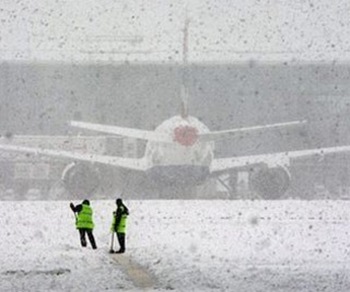
On the 23rd of December, BAA announced that they had commissioned an external inquiry into “what went wrong at Heathrow”. Meanwhile Colin Matthews, the BAA Chief Executive, announced that he would be foregoing his annual bonus. I don’t doubt that the experts appointed to the committee will come up with some interesting conclusions and recommendations. Among them will probably be “buy more de-icer and snow ploughs”.
What they are unlikely to conclude is that in order to deliver “shareholder value” in the form of increased profits, BAA failed to provide for an event that, though rare, had the potential to cause great disruption and economic damage to its customers. One could also ask who BAA considers its customers – the flying public or the airlines. Either way, don’t be surprised if lawsuits follow both from the airlines and travellers who fail to get satisfaction from other sources.
The committee is also unlikely to identify weak regulation on the part of the UK Civil Aviation Authority as one of the root causes. Why did the regulator not insist that every airport operator met minimum standards of preparedness for such events? If disaster recovery is not within its supervisory remit, why not?
And on the matter of Mr Matthews’s bonus, is the committee likely to observe that as in many other sectors, not least banking, the BAA executive reward structure was geared to delivering short-term financial results at the expense of long-term sustainability? True, BAA is investing heavily in new and upgraded terminals at Heathrow. But in its annual presentation of results for 2009, the company also boasts of increased turnover (8.3%), increased EBITDA – earnings before interest, depreciation and amortisation – (17.1%) and reduced underlying adjusted operating costs (-1.7%). To you and me, that means higher profits and reduced costs.
It’s interesting to note that the cost reductions include an 8% decrease in general expenses over the previous financial year. Although snow-clearing equipment would show up as capital expenditure and therefore affect the profit-and-loss account as depreciation, de-icing supplies would almost certainly be included as an expense. The difference in financial terms would be that all the cost of de-icing fluid would affect the profit for the year, whereas only a percentage of the cost of the snow ploughs would show up as a depreciation charge.
The point of this speculation about BAA’s accounting practices is that if I was the CAA, the UK’s aviation regulator, I would ask to what extent Mr Matthews’s bonus was dependent on annual financial results, and why BAA’s Board of Directors was satisfied with the company’s level of preparedness for extreme weather events.
I doubt if BAA’s investigation committee will ask those questions. They should. Financial commentators bang on about bonus-driven short term thinking within the banking system. Perhaps they should look at other sectors.
Some months ago, I wrote a post for another blog about the airline industry. I focused on how Middle East airlines – Emirates, Etihad and Qatar in particular – are challenging the European players. Not only are they taking passengers off the likes of British Airways by the droves, but as instruments of state economic policy they are establishing their home bases as hubs to service traffic between Europe and the Far East.
Since then, the case for avoiding European hubs like Heathrow and Schiphol has strengthened. Airports in Western Europe have struggled in the recent bad weather. Heathrow in particular has left an impression of incompetence among those who ended up stranded in Britain for several days because the operating company failed to provide for adequate runway clearing facilities. British Airways, the biggest user of Heathrow, did themselves no favours by cancelling flights wholesale while other airlines managed to get a limited number of flights off the ground.
In my earlier piece I was rather unkind to British Airways. I characterised them as bedevilled by industrial disputes, a legacy fleet and patronising customer service. I usually travel on Qatar Airways between Bahrain and London. Although there’s a stop-off in Doha, the layover is short and the service excellent. There’s also the matter of price. The Qatar fare is significantly cheaper than that charged by the carriers which fly direct.
A couple of days ago I flew the London-Bahrain route on British Airways. I hadn’t flown BA for a while, and there was a competitive fare to be had. It was also a good opportunity to compare the BA of 2011 with its Middle Eastern competitors. Here’s what I found.
Flying out of Heathrow’s Terminal 5 is a delight, if that word can safely be used to describe any airport terminal. The terminal has clearly overcome the disastrous teething problems that accompanied its opening a couple of years ago. Compared with Terminal 3, which is a rat’s nest guaranteed to send regular users psychotic, it’s calm, spacious and well laid out. Rather like a superior shopping mall, which is not surprising since operators like BAA, the owners of Heathrow, seem to see themselves these days as retailers first and transport facilitators second.
The flight itself? The ultimate destination was Doha. Why anyone would want to fly to Doha via Bahrain is beyond me, especially as you can get a direct flight on Qatar and pay less. Maybe something to do with BA’s code-sharing partnerships.
The aircraft was a Boeing 777, which these days could be described as legacy. My seat in economy was comfortable enough, though the seat pitch was at least an inch shorter than in a comparable Qatar seat.
The flight got underway half an hour late. The captain explained that this was because a passenger had checked in and not shown up for the flight. So they had to unload bags from the hold, which caused us to miss our take-off slot. The usual story.
The meal was truly awful. “Roast beef dinner”, as it was described. A single slice of beef rolled up into a sausage shape that looked rather like… well, I’ll leave that to your imagination. A soggy piece of what must have been intended to be Yorkshire pudding. So wet and formless that you could have dredged better from the wreck of the Titanic. Vegetables so soft and tasteless that they must have been prepared according to an antique British cookbook – nuked till dead. And finally a dessert labelled crème brulée. It tasted OK, but I’ve never before encountered a vanilla mousse on a cheesecake base masquerading as a crème brulée.
The inflight entertainment system didn’t work. Well, I suppose it did work, but it was invisible to me without my going into an unnatural crouch, because the seat-back TV was locked into one position and couldn’t be turned to face the viewer when the seat in front went back. On the Qatar flights you get a choice of 50-odd movies. On BA, you have to look at the flight magazine and select from one of the movies advertised. I didn’t bother to complain about the malfunction, because it was a shortish flight and I’m usually quite happy listening to music from my IPod.
The cabin crew were pleasant enough, but slightly scatty. I was served by the purser, who had the forced jollity of a Home Counties memsahib fallen on hard times. Maybe my British nose for the nuances of the class system was letting me down, but I got the impression that she would have been happier hosting a tea party in an English country house surrounded by beagles. Scatty because when it came time for the tea and coffee they kept shouting at each other across the aisles every time they ran out of a requested beverage – “got any tea over there love?” Being a helpful sort of chap, I had the instinctive urge to act as a go-between and pass messages from one memsahib and another. But in the end I got neither tea nor coffee, because the trolley moved past me without the question being popped. I was clearly invisible by that stage. Again, I could have complained, but lack of a cup of coffee was no big deal, so I didn’t bother.
Anyway, we got to Bahrain on time, and I’m not so spoiled that I was seriously concerned about broken entertainment systems, inedible meals, missing coffee and barking memsahibs. My customer experience confirmed that nothing much has changed with British Airways. No longer the world’s favourite airline, but operationally efficient when it does fly. Aircraft tired but not ancient. Cabin service almost quaint compared with that of its Middle East competitors.
I imagine that a few billion dollars of investment might spruce things up a bit. But would inward investment change the company’s DNA for the better? For that you’d need gene therapy.
One thought occurs, though. At what stage does the market value of British Airways become so depressed that it becomes an attractive takeover target for the likes of Qatar, Emirates or Etihad? BA is still a giant. If, say, the Qataris have the ambition and resources to stage the 2022 FIFA World Cup, why wouldn’t they consider swallowing up the BA/Iberia conglomerate and creating the biggest airline in the world?
I for one would shed no tears if the Downton Abbey of the aviation industry followed other iconic British brands like Cadburys and Rolls Royce into foreign ownership.
For me, one of the most welcome pieces of news from the Middle East this week comes from Bahrain’s Gulf Daily News. The GDN reports that the Bahrain parliament might not assemble next week because there is nothing for them to discuss. Good for them!
I have a long-held desire to vote for a political party that promises to implement no legislation during its term in government. In the United Kingdom, where I come from, when the Queen opens parliament, by tradition she delivers a speech to the assembled members of both Houses of Parliament. The speech is written for her by the government. Essentially, it’s a statement of the aims of the Government during the forthcoming session of Parliament.
Britain has over 600 members of the House of Commons and over 700 members of the upper house – the House of Lords. They are supported by an army of secretaries, clerks and researchers. To carry out Parliament’s will, thousands of civil servants, many of whom are employed specifically to present options for new policies to the Government, draft new laws and then implement them once they are passed by Parliament.
What if the Queen stood up at the opening of Parliament and delivered a speech along these lines?
“My Government believes that we have more than enough legislation. There is therefore no useful purpose to be served by introducing any new laws in the forthcoming session. My Government’s policy will therefore be to concentrate on making our existing laws work.
Apart from legislation to renew existing regulations, and any emergency measures required in response to a national crisis, there will be no legislative program for the next three years.
As a result of this reduction of Parliament’s duties, my Government estimates that the workload of Members of Parliament will be reduced by 50%. MPs will therefore have a choice. Either they can accept a voluntary reduction in salary, or they can offer their services at no charge to industry or the public sector in order to understand better the challenges faced by both sectors in the coming years. Civil servants whose workload is similarly reduced will have the same choice.
In short, my Government’s policy for the future will be less law and better governance.”
Unlikely, I agree. Parliamentary democracy is a self-perpetuating legislation factory. Politicians need new laws in order to justify themselves to the electorate. They sell themselves on the basis that the other lot screwed up, so they need to fix the mess they inherited. Senior civil servants, eager to hold on to their jobs, encourage programs of “change” because they know that the workload involved in drafting and implementing new laws will keep them and their departments perpetually busy.
But what if the hamster’s wheel were to stop? Wouldn’t it be a refreshing change if politicians devoted their energy towards making what’s currently in place work more effectively? When times are hard, ordinary people by necessity make do with what they have. In developing countries, when things break, people repair them rather than chuck them away and buy replacements. Even in the wealthy economies, when recession bites, people hold on to their cars, laptops, fridges and washing machines for longer. They improve their homes rather than buy new ones.
Governments, however, tend to keep their legislative programs grinding away regardless of economic circumstances. Yes, they make cuts, scrap missile systems and abolish redundant public schemes. Yet they insist on filling the vacuum with new schemes and new laws to suit their ideological bent. Even if the net result of the changes is reduced costs, governments rarely count the cost of the engine that generates the changes.
I have no political tub to thump here. I don’t subscribe to movements that seek to “take back” their countries. In my world, tea parties are for old ladies and mad hatters. But I do believe three things about government.
Firstly, great ideas are one thing, but proper execution is another. Governments thrive on new ideas, new initiatives. When they fail, they try to divert attention from that failure by launching yet more initiatives. Perpetual motion is not the same as effective government. By slowing down the conveyor belt of new laws, politicians would need to find other ways to justify the trust placed in them. Improved scrutiny of public programs. Fixing what is not working without having to resort to new laws. And spells in the paddy fields for politicians and desk-bound civil servants – in the form of regular and direct engagement in the lives of the people they govern – would do more to re-establish popular trust in politicians in my country than yet another byzantine system for controlling expenses racked up by Members of Parliament. It might even help them to make better decisions.
Secondly, change that improves the lives of the many for the better tends not to come as the result of legislation thought up in policy think tanks. It comes as the result of groundswells of sentiment among large segments of a population. Lyndon Johnson would not have been able to end a century of institutionalized discrimination in the United States had it not been for the efforts of the Civil Rights Movement, a coalition of black and white activists given voice and inspiration by Martin Luther King.
And the example of Martin Luther King leads me to the third point. Political change rarely happens unless there are leaders who articulate, inspire and organize. And these days, governments are rarely the first to provide that leadership. Whatever our opinion on their personal philosophies, religious leaders like Archbishop Desmond Tutu and Sayed Qutub of the Muslim Brotherhood paved the way for political change in Southern Africa and the Middle East respectively. Secular dissidents, Alexander Solzhenitsyn and Andrei Sakharov chief amongst them, provided the catalyst for change in the Soviet Union. Businessmen like Warren Buffett and Bill Gates can do more than most governments to help the lives of the impoverished by devoting large slices of their wealth to medical research. And politicians out of office, like Jimmy Carter and Nelson Mandela, can often achieve as much positive change as they did when in office.
No doubt the lawmakers of Bahrain will find plenty to do in the forthcoming months. But while they enjoy their unexpected break, and governments around the world ease off for the festive season, perhaps it would help us all if politicians took time to reflect on the proposition that lasting change comes from the heart rather than the statute book.
This is my column in today’s Gulf Daily News. Essentially it’s a look back at the sucesses and failures of democratic processes in the past year. I’ve given Iran an honorary place in the line-up even though their election took place in 2009, because the ramifications of that upheaval continue to unfold. Here’s the piece:
As 2010 draws to a close, TV channels and newspapers around the world are starting to publish their reviews of the year. This is also a time when managers review the performance of their subordinates, recognize achievements and set objectives for the following year.
So my contribution to the orgy of end-of-year reviews is to assess the performance of one of the world’s most important employees: democracy.
Democracy’s objectives for 2010 were unchanged from previous years. Reflect the will of communities and nations through a process universally recognised as fair and transparent. Then ensure that decisions arrived at through the process are respected and implemented in a way that benefits the nation without unduly harming the individual.
This year’s performance was the usual mixture of outcomes.
First, the successes. Brazil, where President Lula stepped down and was succeeded by a close colleague without disputes or unrest. The UK, where a coalition government took power for the first time for seventy years. The US, where mid-term elections have not yet prevented President Obama from reaching accommodation with his opponents on key political issues. Australia, where Julia Gillard won by a whisker without any subsequent paralysis in decision-making. And Bahrain, where recent municipal and parliamentary elections passed off peacefully.
Second, dubious process but some positive outcomes. Iraq, where six months of wrangling finally look likely to deliver a functional government. Burma, where an opaque process ended with the release of Aung San Suu Kyi.
Third, disputed results with painful consequences. Iran, scene of violent confrontation with no apparent positive outcomes for anyone but the ruling elite. Afghanistan, where elections seemingly mired in corruption led to the US and its partners supporting the least worst outcome – the continuation in power of President Karzai. Belarus, where protests about fairness were swiftly suppressed.
Finally, too soon to tell. Egypt, where not a single one of the 88 Muslim Brotherhood opposition members of parliament managed to be re-elected in the first round of voting. Ivory Coast, which currently has two claimants for the presidency in a military stand-off. Sudan, where a referendum on dividing the nation looks certain to deliver dramatic change, not necessarily for the good, to the beleaguered Sudanese. Haiti, where the mere staging of elections is a miracle in itself.
Democracy comes in many forms. The democracy of ancient Athens was often a vicious process in which an enfranchised minority behaved as a rabble roused by ambitious demagogues intent on pursuing personal agendas and vendettas. The same went for the Roman Republic. The “democracy” practiced in the Saddam-era Iraq and the soviet communist regimes of the last century were charades resulting in overwhelming verdicts in favour of entrenched regimes.
Modern variants provide an appearance of competition, but among competitors handpicked for their acceptance of the status quo of the real power structures. Many regimes claim that their systems of government, which involves processes of consultation without elections, are in themselves valid systems of democracy.
However we define democracy, just government is a delicate organism which requires the right environment and nutrients in order to flourish – respect for human rights, the rule of law, absence of corruption and above all the perception of justice and fairness by a nation’s citizens.
It’s fair to say that for many, the concept held self-evident by the founders of the world’s most powerful nation – government for the people and by the people – is as far from a reality at the end of 2010 as it was at the end of any other year in this troubled century.
For 2011, perhaps the best we can hope for is modest successes, and for the voices of people of goodwill to be heard more clearly above the clamour of hatred, self-interest and greed.
It’s customary among people of all faiths to wish each other happiness at special times of the year. And in that spirit I wish all my friends – Christians, Muslims, Jews, Hindus, Buddhists, atheists and agnostics – many moments of happiness at this time of year.
I say “moments” because happiness exists on many levels. Happiness can be sense of deep contentment that is unaffected by seasons, festivals and other transitory states that move across the passage of time. It can also be the oblivion of ecstasy – a moment when we forget ourselves in a contemplative state, or when we are doing something that temporarily obliterates the conscious mind. Moments that we only recognize as happy when they’re over.
Happiness can also come in short bursts of pleasure – a child receiving a gift at Christmas, an unexpected visit, a hug from an old friend. It’s that kind of happiness that we typically experience at festivals, both secular and religious – Thanksgiving, Christmas Day, Eid-al-Fitr, birthdays and other anniversaries.
If we stop to think about it, the kind of happiness we wish others for the new year is of a different kind. Fulfilled ambitions, resolution of long-standing problems, advancement to that state of deep contentment.
And at this time of the year, it’s those altered states that I wish for. For people I know and love who have had a hard time to see better times. For people I don’t know whose suffering radiates beyond their personal pain and contributes to a human climate of frustration, hatred and despair.
One could wish for many things. Yesterday I listened to a radio interview with Oleg Gordievsky, a Russian KGB officer who for many years was an agent of Great Britain. Twenty years after Gordievsky finally defected to the West, the BBC asked various commentators to assess the impact of the information he regularly provided to the spymasters. A senior diplomat commented that the most important contribution Gordievsky made was to reveal that in the early 1980’s the Soviet Politburo was terrified that the West was planning a pre-emptive nuclear strike on the Soviet Union.
That information prompted President Reagan and Margaret Thatcher to tone down their antagonistic rhetoric (“Empire of Evil” and so forth) and embark on confidence-building measures designed to assure the Soviet leaders that the West had no such intentions. From that point, relations between the West and the USSR started to improve. Reagan reached out to Gorbachev, and the two sides signed arms limitation treaties that slowly reduced the climate of fear that had dominated US/Soviet Union relations since 1945. The end of the Cold War was nigh. Fear subsided.
Today, regional and global fears abound. North and South Korea, India and Pakistan, Israel, Iran and their neighbours fear obliteration in a nuclear conflagration. The people and governments of the West fear terrorism and the corrosive effect of debt. They fear economic eclipse by the rising powers of the East. In the Arab world, governments and entrenched establishments fear loss of influence and personal power. They fear the dilution of traditional values and beliefs, and the marginalization of their language. Ordinary people across the world fear the effects of climate change, and the consequences of diminishing natural resources.
Some fears are well-founded. Others are the result of the failure of dialogue, in the inability of one party to understand the concerns of another. In some, fear has metastasized into a malignant hatred that will never be altered.
But so long as we recognize that in this world there is no such thing as ideal, no paradise, no utopia, we can wish that as individuals we can reach out in small ways to each other, and that our leaders have the wisdom to accept what can be achieved rather than founder on the dream of the perfect state.
Fear, not hatred, is the other side of love. And my wish for 2011 is that in ways big and small we can temper our fear with confidence and hope, and that those in pain will find at least some relief.
Am I stating the obvious? Of course I am. But it does no harm to remind ourselves from time to time, as Reagan and Gorbachev did, that the things we have in common are more important than those that divide us.
Love and best wishes to all.
As friends and regular readers of this blog will know, I spent most of the 80s in Jeddah. In those days we didn’t have the internet, mobile phones and skype to keep us in touch with home. In the absence of satellite TV, the only live English-language was Saudi Channel 2, then in its infancy and a useful if not excessively critical reporter of foreign news.
There were foreign newspapers, which typically arrived at hotels and supermarkets one or two days after publication, and in a state of completeness largely dependent on the extent to which the content was deemed appropriate. The British tabloid newspapers tended not to get a look-in for this reason. The exception was the Daily Mail, the opinion-former for reactionaries, hypochondriacs and sports fans across Middle England.
So if you were, like me, a news-hungry political junkie from the UK, your main options were the BBC World Service on scratchy long wave radio, and the Arab News, which then and now was one of the two English-language newspapers in Saudi Arabia, and published in Jeddah.
I have had a long friendship with the Arab News. I used to be fascinated by its coverage of world events, which catered for all the English-speaking constituencies in the Kingdom at the time – Brits, North Americans, Antipodeans, Filipinos, Indians, Pakistanis, Indians and Sri Lankans. I learned about ambitious politicians in Manila, ructions in Delhi and intrigue in Islamabad.
I also read with interest the endless questions on religious observance – the faithful seeking guidance on tiny minutiae of practice and being answered with benign solemnity.
Best of all was the letters page. The Arab News published an incredibly eclectic selection of opinion from its readers. Subcontinentals ripping into each other about Mrs Ghandi’s latest misdeeds. Extensive rants about the evils of America, Israel and other issues of the day (some things never change!). Letter writers ranged from unctuous through to vitriolic, though in those days extreme emotions tended to be directed at issues not related to the host country.
But king of all the letter writers was a chap called Francis A. Andrew. Every day or three throughout the decade the paper would publish a long, rambling missive from Francis A. Andrew. He had opinions on everything. I never discovered who he was and why. But from his letters I formed an impression of a cranky Brit in some desert outpost who spent every evening churning out letters criticizing every opinion and political development that didn’t fit in with his world view that the finest edifice known to man was the British Empire.
Politically he was to the right of Attila the Hun. He particularly reserved his scorn for the European Union, or Common Market as it was then known. His opinions about the way former colonies such as India had strayed from the true path provoked streams of outraged replies from “disgusted of Hyderabad”. He even provoked me into writing a long rebuttal of one of his silly letters – the first time I was moved to write a letter to any newspaper. I still have it somewhere.
After a while, I began to wonder if Mr Andrew wasn’t a long-running in-house joke on the part of the journalists of the Arab News. In other words, if he didn’t exist it would be necessary to invent him. In early 80s the British satirist William Donaldson wrote a stream of letters with ridiculous questions and requests to famous people under the pseudonym Henry Root. The bizarre correspondence that resulted became a series of best-selling books. But as the letters kept coming, and no compendium of The Thoughts of Francis A. Andrew was ever published, I began to realize that the guy actually did exist. Curiously, in all that time I never met a soul who knew him.
Twenty years passed, and apart from the occasional visit to Riyadh and Dubai, the Middle East fell out of my orbit. When I came back to Saudi Arabia in the late 2000s, the Arab News was still there. It was not much different from the paper of the 80s, though I was struck by how much more outspoken its journalists were on local issues. Ever since then, even when I have been unable to buy a copy, the online version has been one of the four default sites on my web browser. After all these years, it’s still one of my major sources of information about what’s going on in the Kingdom.
A few days ago I was browsing the site, and, joy of joys, happened upon a letter from…. Francis A. Andrew! Thirty years on, his themes are the same:
“Neil Berry’s article, “UK: A crisis of legitimacy for govt” (Dec. 20) brings to mind that almost every government since the war (with the exception of Margaret Thatcher’s) has lacked legitimacy.
The two most treacherous acts have been mass immigration and Britain’s membership of the EU. Neither of these was sanctioned by the electorate. A complete halt to immigration followed by a policy of voluntary repatriation coupled with a termination of our membership of the EU would save billions of pounds. There would be no need to increase student fees, pensions could be raised and schools and hospitals could be built. Other savings could be made by pulling out of NATO and thus pulling our troops out of far-flung places that are of absolutely and utterly no concern to us at all.
Finally we should end our membership of the UN — a totally worthless and useless body that has never taken Britain’s side in any of her conflicts with other nations.”
And, predictably, the outraged replies, along the lines of
“Francis Andrew never misses an opportunity to regale us with his colorful and often idiosyncratic worldview…..”
It appears that these days the old chap (for he must be getting on a bit by now) is somewhere in the Oman. Since he sent the letter by email, I thought that he might have got round to writing a blog. So I searched the web. No blog. But he has taken to reviewing books for Amazon. In fact there are no less than ten reviews to his name, most of them of books written or co-written by the eminent astronomer Fred Hoyle. All are five-star reviews, written in typically dense Andrewsian prose. Clearly he’s a Hoyle fan, perhaps as the result of all those evenings in the desert gazing at the universe.
Then I noticed something odd. His email to the Arab News containing the latest missive appeared to be from Oman. Yet his book reviews, the latest of which was dated October this year, appear to be from Francis A. Andrew located in Zarqa, Jordan. It is, of course, possible that he moved from Jordan to Oman during the past couple of months. Given his interest in astronomy, it’s also possible that he has used his knowledge to replicate himself, and that there are two FAAs in different parts of the region. The mystery continues.
Either way, Francis A Andrew, I wish you a very Merry Christmas whoever you are and wherever you are. The world would be poorer and far less outraged without you. Should you ever choose to tell the world about yourself and why you have spent the past thirty years as the Middle East’s most prolific letter writer, I hope you will let me be the first to review your book.
The term gerontocracy usually means rule by the elderly. Its use has not been as popular with the media as it was in the days when the rulers of two of the most powerful countries in the world – China and the then Soviet Union – were comfortably in their eighties. Deng Xiaoping and Leonid Brezhnev were very different animals. Deng was an old man in a hurry – working with a vengeance to transform China into the totalitarian capitalist state it is today. Brezhnev presided over the slow decline of Soviet Russia, and bequeathed to his successors a rotten system that ultimately imploded, bringing down the Iron Curtain in the process.
China and Russia have a new breed of leaders today. Technocrats in late middle age like Wen Jiabao, and vigorous nationalists in their 40s like Vladimir Putin and Dmitri Medvedev.
Here in the Middle East, gerontocracy survives. The word does not imply rule by infirm geriatrics. President Hosni Mubarak is 82, and remains well in control of his country. King Abdullah of Saudi Arabia is 86. Despite his recent back operation, he also seems to be in full command. His immediate heirs apparent are not much younger. Both countries appear to the outside world as forces for stability in the region. Older leaders have witnessed many turbulent times in their long lives, and (Deng notwithstanding) tend to be disinclined to take too many political risks that disturb the status quo.
Of the two rulers, King Abdullah more closely resembles Deng in his pursuit of reform. Unlike Deng, however, the King’s chosen path is iterative rather than transformational. Unlike Egypt, Saudi Arabia could not be described as an electoral democracy, although it has taken tentative steps in this direction with the introduction of municipal elections. But the ruling class in the Kingdom would claim that its political system is at least as democratic as that of neighboring countries where citizens can elect presidents and parliaments every few years.
It’s one thing casting a vote every four years, they would say, and quite another being able to make your voice heard in the intervening time. Saudi Arabia would point to its intricate system of consultation: an appointed advisory council, the Majlis Al-Shoura; the right of every citizen to petition the King and his regional governors; access to the King and his Council of Ministers granted to business and tribal leaders. Formal and informal structures that enable the Kingdom to respond to the needs of its people without resorting to elections.
What right, the leaders might say, do the mature democracies of the West have to criticize the Saudi political system when the country has for the past 70 years been an island of stability surrounded by an ocean of discord in so many of the flawed democracies on its borders?
And they would have a point. But that stability, underpinned by Saudi Arabia’s key position in the world order as the leading oil producer, is under threat from within.
The aged leadership of the Kingdom is not an isolated oligarchy that clings to power through military might and overt internal repression. It is at the pinnacle of a society that has a deep respect for its elders. If you are introduced to a gathering of Saudis, etiquette demands that you first shake the hand of the oldest person. Saudi gerontocracy is institutional. It’s derived from centuries of cultural and religious tradition.
But the Kingdom’s prosperity and success have in themselves created conditions that are challenging the established order. At the heart of the problem is demography. Today, best estimates suggest that 70% of the population is under 30. Unemployment among Saudi youth is high. Efforts to step up the Saudization program have had limited success. Meanwhile, the young population is benefitting from the billions of dollars the government is investing in education. A young, educated and partly idle population is a dangerous mix.
Efforts by traditionalists to keep the lid on untraditional thinking often conflict with the barrage of western influences arriving through the media and the experiences of young Saudis who have been educated in Western universities. Youngsters with too much time on their hands are prey to the seductive messages of radical Islam – what the leadership describes as “deviant thinking”.
And commendable efforts by the government to encourage greater openness in the media have led to the rapid take-up of the social media – an alternative reality in which the young can express themselves among their peers in a way unknown to previous generations.
An interesting example of how the highly prescriptive, top-down system of government reacts to challenges to the status quo can be found in a recent Arab News article about efforts in Jeddah to organize inter-school sporting completion for girls. Conservative elements in Saudi society frown on the participation of women in sport. Despite rising obesity and associated medical problems among the female population, many people regard competitive sports like swimming, athletics and volleyball as “unladylike”. The governors of the schools involved quickly came under pressure both from the Ministry of Education and individuals to stop the contests. The full article is here.
The growth of the social media in Saudi Arabia, through which young people freely discuss such issues, is graphically shown in a post by Wael, a young Saudi blogger.
So if there truly is a growing disconnect between an increasingly irreverent youth and the remainder of the population brought up to respect the wisdom of elders, how can the Kingdom’s establishment bridge the gap? By accelerating the process of reform along Western lines with increasing electoral representation? Possibly, though not without the risk of losing control of the process.
There are a number of institutions set up to interact with youth. There’s the General Presidency of Youth Welfare, a government department. Also WAMY, the World Association of Muslim Youth. The Chambers of Commerce give a voice to young businessmen. And there are social programs that have the backing both of the private sector and the state, such as Bab Rizq Jameel, which is dedicated to helping young people into the workforce. But I get the impression that most institutions operate on the basis that “father knows best”. I may be wrong, but none seem to operate on a peer-to-peer basis in the same free-form manner as the social networks.
If we accept that the government is unlikely to risk radical change, it seems to me that it still has options to engage its youth without talking down to them.
How about creating a junior Majlis Al-Shoura appointed from representatives of the population between the ages of 18 and 30? Giving such a body the same access to the leadership as the senior Majlis enjoys would enable the King and his ministers legitimately to claim that they listen directly to the unmediated concerns of young people?
And what about a virtual Majlis, in which young people of both sexes are able to interact in a formal manner without treading on the toes of the conservative factions which frown on the physical proximity of young men and women? Such bodies could emulate the present reality of the social networks. They could serve to channel the creativity that abounds among Saudi users of Facebook and internet forums to the benefit of the country.
How about virtual think tanks, in which groups of young people are encouraged through the internet to focus on specific issues, with the active participation of ministers and other senior officials? The present involvement of the government in the social media seems to be limited to the occasional tweet by the Minister of Information.
If the leadership wants to defuse the potential demographic timebomb, perhaps it needs to start by engaging with the young people of the country on their turf and using their language. By scaling back on instruction and stepping up on dialogue, perhaps it can get a better handle on some of the vexing problems facing it today – extremism, drug abuse, unrealistic career expectations, an entitlement culture.
I’ve long held the opinion that Saudi Arabia has the answers to many of its problems in its own hands. A few million riyals spent on new ways of communicating with its youth might pay off far more in the long run than yet another study from an expensive foreign consultancy.
But what do I know? I’m just another foreign consultant!
For all you white supremacists who happen on this post, move on swiftly – what follows is nothing to do with race, and everything to do with snow.
This is a version of my latest column in Bahrain’s Gulf Daily News which was published today. You can see the original here.
How the British love a crisis! And no crisis suits us better than an extreme weather event like the current cold spell that has closed airports, blocked roads and cut off thousands in remote locations across the United Kingdom.
It gives us a perfect excuse to curse the airlines for giving us insufficient information about flights – the airlines tell us to contact the airports, and the airports tell us to talk to the airlines. We rail at the politicians for leaving us unprepared for an event that only happens once every 30 years. The media rejoices in regaling us with stories about weary travelers at Heathrow and Gatwick. And one glorious photo of two men clearing a runway seemingly on their own. “Will you look at those eejits with shovels!” says my wife, shrieking with laughter at a scene that reminded her of her native Ireland. We worry about running out of this and that, about further looming disruptions to our safe, comfortable lives.
In the Royston household we had our own little travel crisis as our younger daughter struggled to reach us in Bahrain. Frantic calls between daughter, airline, taxi firms, airport, supportive friends finally delivered her to us after 24 hours of tribulation and wading though bodies at Gatwick and Doha. Here’s her Facebook take on the experience:
“So it’s taken just over 24 hours of waiting and flying, eating and looking like a tramp, meeting and becoming best friends with loads of Aussie randomers (plus an Italian airport cleaner) seeing people getting very annoyed and being annoyed at them…because they are annoyed! My arms have toned up nicely from the amount of times I had to pick up and put down my heavy hand luggage. Saw many films during the flight, including Inception (which through the whole film I was in shock and confusion as my brain was half mush at this point from all the flight hassle). My jaw was slack pretty much through the whole film. When it ended, I saw my reflection in the mirror of the small TV and realised what a total retard I looked like. Anyhow I’m finally safe with mama and dada.”
Perceptions of adversity are not what they were. I’m old enough to remember the Great Freeze of 1963, when my friends and I spent many happy hours tunneling through 12-foot snow drifts, blissfully unaware of the potential of a snow collapse to snuff out our young lives. No health and safety in those days. And the whole country was white for three months.
As I was manning the family Situation Room during the daughter crisis, I thought of my maternal grandfather, who spent two Christmases on the Western Front During World War I. Here’s the entry in his diary for Christmas 1917:
“Xmas Day. Rather incongruous to think of peace and goodwill when we are at war. I got up at 9am., it was snowing heavily and did so again this afternoon. The Germans were very active with high explosive shells and shrapnel. Went up to Foch Farm for tea and back to the mess at Canal Bank for dinner. We had a nice cheery dinner indeed. It was well cooked and all were in good spirits…. A very enjoyable day and no bombing for a change.”
As the people of Britain in 2010 battle with the coldest Christmas season for years, and grumble about travel chaos and rising fuel prices, a reminder that the occupants of the Western Front would have swapped their lives for ours at any time of year.
No apologies for the excerpts from the previous post – re-use of content in a different context!
Last month I wrote a post about the Haj, the annual pilgrimage to Mecca. Saudi Arabia’s Arab News has published an amazing gallery of photos of this year’s event. The photos do a better job than any words of showing the huge scale of the modern Haj.
Contrast this with the photos of a Dutch explorer from the 1885 Haj. A telling microcosm of the development of the Middle East over the past century and a half.
This is the latest in a series of extracts from the World War I diaries of my grandfather, Harry Hickson. Harry was an artillery officer who spent the last two years of the war on the Western front. The fraternization between British and German troops that took place at Christmas 1914 was never repeated. By 1917, when he wrote these entries, hundreds of thousands of soldiers had died on both sides, and the weary stalemate continued.
Shortly before these entries begin, Harry was selected to be the Gas Officer for his regiment – a poisoned chalice if ever there was one. He then learned that he had been granted two weeks leave – his first since he had arrived at the front. But first he had to make it through to his departure date…..
December 19 1917: A lovely day, sharp frost and then sun shining. The Corps chemical adviser (Capt Pheasey) came to see me to arrange about my job. Wrote letters later. A Bosche came over in a plane today and made three attempts to bring down a balloon near us, in spite of everyone firing at him, he must have been a brave fellow and full of pluck. He was brought down himself near Polecapelle on his return journey, he deserved to get away for being so plucky. Major Brook and Newman came to dinner and we had a very nice meal, played bridge afterwards. Comfy night.
December 20th: Very sharp frost and bitterly cold. Went up to see them at 185 (Harry’s old battery), and Mawby returned with me for lunch. Slack day. Wrote letters. Played bridge later. Comfortable night but very cold.
December 21st: Very sharp frost, but a nice day. Went to Pop. and had lunch at the Club and did some shopping. Jumped lorries each way as no car was available. Wrote lots of letters for Xmas. Played bridge.
December 22nd: Lovely day, slight thaw. Searched for a dentist as my teeth really need attending to, but could not find one. The Huns were firing at our balloons all the morning, but could not hit them. Lots of the pieces fell too near us to be pleasant! Slack afternoon. I hear that my old 401 section has been transferred to 264 Siege Battery. A comfortable night, but the Bosche were bombing heavily.
December 23rd: Lovely day with sharp frost. The Chemical Adviser came to see me this morning and told me my leave was granted. Joyful news! I feel so frightfully excited about it. Went to 185 for lunch, and afterwards went up to St Julien to look for souvenirs. Got some Bosche 77 mm. cases. The Bosche were bombing a lot at tea time, one Gotha was brought down this afternoon. Comfy night.
December 24th: It was frost this morning, but thawed very quickly this afternoon and then rained. I went to Headquarters and lunched with Colonel Haig, a relation of Sir Douglas I believe. Up to 185 this afternoon, then wrote letters. Played bridge after dinner. Comfy night.
December 25th: Xmas Day, rather incongruous to think of peace and goodwill when we are at war. I got up at 9am., it was snowing heavily and did so again this afternoon. The Huns were very active with high explosive shells and shrapnel. Went up to Foch Farm for tea and back to the mess at Canal Bank for dinner. We had a very nice cheery dinner indeed, it was well cooked and all were in good spirits. I played one rubber at bridge and then went up to see my old friends of 185 as I had promised. I found them having a very rowdy and merry time, celebrating Xmas Day in real earnest! So escaped after staying about half an hour and got to bed about midnight. A very enjoyable day and no bombing for a change.
Harry’s reference in the Diary to “Pop” relates to the Belgian town of Poperinghe, which was the location of TOC H, a famous soldiers’ rest place set up by the Rev. Tubby Clayton.
As the people of Britain in 2010 battle with the coldest winter for years, and grumble about travel chaos and rising fuel prices, a reminder that the occupants of the Western Front would have swapped their lives for ours at any time of year.
You can find other excepts from the diary here:
https://59steps.wordpress.com/2010/07/21/harry-hicksons-war-part-one/
https://59steps.wordpress.com/2010/07/24/harry-hicksons-war-part-2-passchendaele/
https://59steps.wordpress.com/2010/07/30/harry-hicksons-war-part-three-aerial-war/
As I sit in my balcony enjoying a balmy winter evening in Bahrain, three very different sounds compete for attention. To my left, a raucous party blaring out from a nearby apartment block – Filipina girls having a rare old time singing Christmas carols. In front of me, shouting from a football game at a nearby recreation ground. To my right, the mournful sound of an Ashura ceremony – drums and cymbals in a slow rhythm, a Shia cleric reciting verses of lamentation in a strong baritone, and a choral response from the faithful. In an island of tolerance, a very Bahraini tableau.
We are in Muharram, the first month of the Islamic calendar. The tenth day of Muharram is known as Ashura – which is Arabic for tenth. For Muslims of all schools of thought it’s a special day. For Sunnis, Ashura marks the day on which Moses (known as Mousa in the Koran) and his people escaped from Egyptian servitude by walking through the Red Sea, parted by divine intervention. For them, it’s a day of fasting.
For the Shia, Ashura and the ten days preceding it are days of lamentation for the death of Husayn, the third Shia Imam and grandson of the Prophet Mohammed. At the Battle of Karbala, Husayn and many members of his family were vastly outnumbered and killed by the forces of the Sunni Caliph, Yazid of Damascus. His fall crystallized the schism between the Shia and the Sunni branches of Islam. This was rooted in a dispute about the legitimacy of competing claims for spiritual and temporal leadership of the Muslim world between Husayn, as a direct descendent of the Prophet, and the line of successors chosen from the Prophet’s companions.
Here in Bahrain, at least 65% of the population are Shia, so across the island, communities gather to lament the passing of Husayn. A few nights ago I accepted the invitation of a friend, Mohamed, to visit the Islamic Awareness Centre Muharram Camp near the Manama souk. For the first ten nights of Muharram the Centre is the venue for gatherings to commemorate and explain Ashura and the suffering of Husayn. In a large courtyard there was a tent containing a library of commentaries in many languages explaining the meaning of Shia Islam. At a nearby table, women volunteers offered free refreshments – sandwiches, cakes, tea and coffee. Next door was a sheltered auditorium where a scholar in a white turban and black robes was seated on a podium in front of a few hundred people – men on the right and women on the left.
The scholar was reciting Arabic verses in long, slow incantations. When Mohamed joined me, he explained that the speaker, Idris Samawi Hamid, was an American from Colorado with a degree in Physics and a doctorate in Islamic studies. Although the majority of the gathering appeared to be Arabic speakers, the scholar started speaking in English. He surprised me by commenting that great strides have been made in expressing the meaning of Ashura in English – most Muslims I have met have emphasized the purity of the language of the Koran, and therefore the impurity of translations into other languages.
He spoke of the Battle of Karbala and the tribulations of the family of Husayn. Karbala, he said was symbolic of the struggles we face in our daily lives when dealing with adversity. As he continued on the theme of breaking through from observance to true acceptance in word, deed and spirit of the message of Islam, I was struck by the underlying mysticism of the faith he was describing. Western perceptions of Islam tend to focus on the observance of ritual and behavior mandated by the Koran and Hadith. Yet here was a man talking in a language that any mystic would understand – transformation of the inner person and communion with God.
As the scholar’s address was coming to an end, my friend took me to a nearby street where we could hear the drums of a procession. At the front was a pick-up truck with loudspeakers. The leader was singing to a slow, rhythmic drumbeat. Following him was a line of around fifty men and boys dressed in black. In time to the rhythm, the followers were brushing their backs with flails made of gold beads. This, and hundreds of other parades around the island, was a precursor to the mass marches on the day of Ashura, in which many followers beat their chests and often draw blood with real flails. Lamentation and guilt at the failure of their ancestors to prevent the wrong done to Husayn and his family.
I’m not a Muslim. Nor am I a theologist or a mystic. In the two hours I spent listening and watching, I couldn’t begin to understand the intricacies of Shia theology. But I was struck by the gentle emotion of the occasion, and by parallels with the Christian observance of Easter. Those who look askance at the ritual self-mutilation practiced by some Shia at the height of the Ashura observance should think also of Easter processions in many devout Catholic communities around the world, some of which involve ritual crucifixion. Themes of guilt, redemption and inner contemplation are common to both faiths. But the raw emotions and seeming harshness of the climactic Shia observance of Ashura were not in evidence, and I was touched by the warmth of the welcome I received.
During my time in the Middle East, I have mingled both with Sunni and Shia Muslims. Images of Islam reach the West via TV, YouTube and the print media – the Haj, Ashura and Ramadan. Historical and current events frame our picture of Islam – the Muslim conquests, the Golden Age, the Crusades, the fall of Constantinople, the Ottoman Court, and today, jihad, terrorism, the Taliban, veiled women, Iran, sectarian strife and Iraq. In the West, we fuel our paranoia by seizing upon messages of hatred rather than love. And that hatred is often reciprocated.
For all the posturing of politicians, propagandists, sheikhs and scholars, I also see millions of members of the human race who wish to live their lives in peace and prosperity without harming others and imposing their beliefs upon them. And when the crises of today pass into history, to be replaced no doubt by others, it will still be the common humanity of people like those I met the other day that will give us hope for the future.
Let’s not forget the people of good will.
The relationship between Great Britain and the United States has long been fertile ground for political journalists – at least in the UK.
Paul Reynolds, the BBC’s world affairs correspondent, provides some interesting analysis on the state of that relationship in his article on the BBC website. The Wikileaks cables, he says, show a hardheaded attitude on the part of the US administration towards Britain. His conclusion on the assessment by US diplomats of the attitude towards the US by various British politicians is this:
The overall impression given by these telegrams is that Britain is regarded as a useful asset for the United States and that it must not be allowed to think otherwise.
But the underlying message of all this is that the relationship is defined in this way and if, or probably more likely when, the day arrives when the Brits cannot or will not offer so much, they will find that the relationship they still regard as “special” will be very much more ordinary.
If we were privy to British diplomatic cables on the subject, we might see a similar opportunistic and hardheaded attitude, especially among those who have studied the long history of the relationship.
And if I was a British diplomat, I would be pointing out to my masters, living as they do in their political bubble, that the relationship between the two countries has never been one between siblings or even cousins. Tribal perhaps, thanks to a common language and, to an extent, cultural heritage. But Brits forget that America is an amalgam of many cultural traditions. Among the power elite of America, politicians and businessmen of Irish, German, East European and Jewish (not to mention Kenyan) descent have no reason to love Britain. Even those with British genes proudly remember the part their ancestors played in casting off the colonial yoke in 1776.
It’s much more appropriate to observe that today’s Americans feel an affinity with “European” culture rather than the British heritage. People of German immigrant stock in Wisconsin and Pennsylvania might just as readily point to Goethe as to Shakespeare when talking about their European roots. And America’s newer immigrants from China, Vietnam, Korea and even Russia have a wholly different set of cultural bearings. Among them there is little affinity with “Old Europe”.
So there is and always has been a mismatch between the veneer of commonality shared by what Winston Churchill referred to as “English-speaking peoples”, and the underlying reality. Shared languages do not automatically result in similar mindsets.
My second point would be that relationships between countries are dynamic, not static, and always powered by self-interest. The generation that fought the Second World War was very different from that in power today. Churchill may have had an emotional affinity with the United States – his mother was American – but emotion played no part in his ruthless efforts to drag a reluctant America into the war on the British side.
Only the folly of the Japanese in bombing Pearl Harbor was enough to make the difference. Even then, President Roosevelt pursued an agenda designed to rid the world of the British Empire in the post-war world order. The Second World War may have been portrayed as a just war by the winning side, but my view is that altruism played no part in it except as a device to motivate those who were being asked to sacrifice themselves for the cause.
Today, politicians continue to use right and wrong to justify their foreign policy actions. But in a wired world, protestations by politicians about doing the right thing in Afghanistan and Iraq come under global scrutiny in a way unknown to the combatants of 1941. And the Wikileaks revelations provide us with an insight into the kind of underlying thought processes that took decades to surface after World War II.
My final point to my notional political masters would be that America has throughout its history undergone periods of national psychosis – periods of turmoil, division and ugly emotion. Previous episodes include the Civil War of 1861-65, the Great Depression of the 1930s, the anti-communist frenzy of the 1950s and the Vietnam War.
It is in one now. 9/11 traumatized America like no event since Pearl Harbor. The financial crisis of 2008-09 caused unemployment and financial distress not seen since the Great Depression. The level of paranoia – about terrorism, the economic and political rivalry with China and the perceived dilution of the “American way of life” by immigration and the policies of a President seen by many as an alien influence – is high. The ugly emotions and polarization of opinion caused by recent traumas make America an unpredictable political partner.
So who are Britain’s natural partners? An America convulsed by self-doubt and extreme polarities of opinion? A European Union in which the poorer nations are suffering from the economic hangover of a decade of debt-fuelled expansion, and the richer nations are struggling to insulate themselves from the debt contagion of the Eurozone? Commonwealth nations busy pursuing their own national agendas and paying little attention to the “mother country”?
The truth is that partnerships between nations are marriages of convenience. And Britain is no longer a centre of gravity in a political or economic sense, and can only react and respond to external circumstances beyond its control. Unless we discover hitherto unknown deposits of uranium, gold, oil or rare earth minerals, this will be our fate for the foreseeable future.
So we Brits would be well advised to learn to love ourselves as we are, not as we were or aspire to be. We should, to use a cricketing analogy, play each ball on its own merits. Economically, we should accept that we are no longer an industrial power but still possess the power of technological and intellectual innovation. Politically, we should accept that our relationships with other countries, like empires and political alliances, will wax and wane according to the dictates of events and mutual interest. Socially, we should rejoice at the opportunity to explore and be part of the bigger world while it is still open to us, and before political and environmental factors further erode the diversity of life and thought in front of us today.
We are among the least patriotic of nations, and I see that as a strength. Patriotism can breed nationalism and sometimes xenophobia. We don’t imprison people for insulting the Queen. We don’t outlaw the burning of the national flag. We are a tolerant nation, even if that quality might seem to be a disadvantage in the short term. We accept diversity of political thought, religious belief and sexual orientation. We still produce artists, scientists and thinkers who enrich the world.
Even though we may be going through our own national psychosis brought about by economic, social and political strains, I’d still put money on Britain in 50 year’s time being a better place than most to live in. So let’s celebrate what’s right about the country, and concentrate in the future on being good citizens of the world – regardless of the shifting sands of political relationships.
A couple of months ago my wife and I got chatting to a young woman at a party in Bahrain. Although she spoke with a perfect American accent, it turned out that she was from Saudi Arabia. She had studied in one of the best universities in the US, and now lived and worked in Bahrain. We asked her if she missed her family in Riyadh. She said yes, she did, but that she never intended to return. She had not been home for eight years.
As I mention in the introduction to this blog, I look at many current events and trends through the prism of history. In my last post about employment in Saudi Arabia, I talked about the extreme events in the 20th century – two world wars – that dramatically accelerated the employment of women in the United Kingdom beyond traditional boundaries. I suggested that these step changes are unlikely to occur in Saudi Arabia any time soon.
An article in today’s Arab News by Tariq Al Maeena, whom I consider to be one of the finest columnists in the Middle East, set me thinking again about historical parallels with the current situation in the Kingdom.
In his article, Settling in your neighbour’s yard, Al Maeena talks about an increasing trend among educated Saudis to seek their fortunes in neighboring countries. He maintains that in countries such as Qatar, social norms and legal structures make it easier for them to set up businesses or find employment in fields where they find themselves shut out of the job market in their own country. He quotes sources that put the number of expatriate Saudis in nearby countries at up to 8,000.
People emigrate from their home countries for a number of reasons. From the mid 19th century, there was a stream of emigrants from Ireland. Their motivation was economic. The famines of 1845 and 1852 decimated the Irish population. It’s estimated that a million people died of starvation, and that a further million left the country. The trauma of the famine led people to believe that their futures lay in the British mainland, and in the new worlds of the USA, Canada, Australia and New Zealand. Irish emigration continued for the next century and a half. The new emigrants were so successful that, according to studies in the US, 60% of today’s Americans have Irish ancestors – a heritage highlighted when US presidents Kennedy and Reagan made high profile visits to Ireland to “rediscover their roots”. If you visit Boston, you will find all around you evidence that the Irish tradition is alive and well.
As Tariq Al Maeena points out, Saudi Arabia is a wealthy country. Famine is unlikely ever to be a driver for emigration. But inability to find rewarding and fulfilling employment might be. If the 100,000-or-so Saudis currently studying in universities around the world under the King Abdullah Scholarship Program are unable to find jobs in the Kingdom that satisfy their aspirations, what are their options? A large percentage of scholarship students are women. And if they were able to fulfil their ambitions in other GCC countries where bureaucratic obstacles do not get in their way, why would they not do so?
So perhaps an unintended by-product of the Saudi scholarship program will be to trigger increasing emigration of educated and talented Saudis to areas where they feel that they can use their talents to the best effect. Not necessarily just to the GCC countries, by the way. There are many other regions of the world where Saudi technocrats can prosper. Their Western-honed skills combines with knowledge and connections in their home region could be of great benefit to employers in China, North America and the European Union. The Middle East is an economic powerhouse. Entry to that market depends more on relationships than in many other markets. So Saudi Arabia’s loss could turn out to be other nations’ gain.
And if the emigration that Tariq Al Maeena speaks about continues apace, it won’t be too long before success stories emerge. Saudi women in Qatar, the UAE or even the US who build high-profile businesses and become role models for their sisters at home. Such examples will either accelerate emigration or increase the pace of domestic reform.
The Middle East has a long history of migration and emigration. People have moved from one area to another to escape poverty, war and oppression. Millions, most notably from the West, from the poorer Arab countries and from the Indian subcontinent, have moved here simply to better themselves.
Could it be that the next wave of migration will come from the very class of people that Saudi Arabia sees as its future – potential contributors to the knowledge economy that the Kingdom, conscious of its depleting natural resources, has set its heart on fostering?
That would be a bitter harvest from the billions invested by the Saudis in the education of their people.
There’s an interesting article by Fatima Sidiya and Diana Al-Jassem in Tuesday’s Arab News about employment of women in Saudi Arabia.
According to Princess Lolowa Al-Faisal, who opened the Women in Leadership Forum in Jeddah this week, only 15% of the Kingdom’s employed manpower is female. So if you take away the large number of female teachers, the percentage of women in the economy in general will be considerably smaller.
This is a situation that has parallels with that in the United Kingdom before the First World War, when the majority of working women were in domestic service.
What changed the game in the UK was the disappearance of hundreds of thousands of male workers to fight in the war. In order to keep the munitions factories churning out war materiel, the authorities were forced to admit women en masse into industry. Thousands of women were also required both at home and at the front to nurse injured soldiers. And many others were recruited into administrative roles in the civil service and the private sector. After the war, many never returned into domestic service.
Similarly, during the Second World War women found themselves in jobs they might never have contemplated in peacetime – working in the fields to assure Britain’s food supply at a time when imports were drastically curtailed through German submarine attacks on ships supplying the country. Women even found themselves in a vital role flying military aircraft from factories to air bases.
So the employment of women in the UK workforce took two huge leaps forward because necessity forced changes in social norms. In addition, the increased role of women in the workforce during and after World War I led to their political emancipation. In 1918, women were for the first time able to vote for members of Parliament.
One would not wish such circumstances to enforce the change in Saudi Arabia yearned for by many women. Nor are they likely to. But I refer to the British experience to make the point that big and relatively sudden changes usually have external drivers. Because of its wealth, Saudi Arabia is somewhat insulated from extreme economic drivers to employ more women.
Yet social drivers remain. High youth unemployment. The return of thousands of students from Western universities – many of them women – with expectations of receiving well-paid jobs. Difficulties in implementing an effective Saudization program in an economy reliant on foreign workers who will work for wages that would never support a young Saudi family.
Difficulties facing women who wish to enter the workforce are only part of what the Saudi leadership recognizes is a slow burn of discontent.
Since the Saudi way is gradual incremental change rather than potentially destabilizing step changes, we are seeing increasing debate at events like the Women in Leadership Forum that raise the profile of employment issues. Adel Fakieh, the new Minister of Labor, has on a number of occasions declared his determination to fix the Saudization problem, and has engaged foreign consultants to advise him on new strategies.
I’m not sure that hiring McKinsey or any other Western consultant will provide him with the answers he needs. I am sure that within his own people, who know better than any external consultant what the issues are, lie the answers. It’s time for the educated Saudis who have a foot in both camps – Western education and an understanding of the social and cultural dynamics within their own country – to step up to the plate.
To return to women’s employment, the Arab News article cites several factors inhibiting change:
Office politics, said Al-Anjari, is one of the main reasons why many Saudi women avoid working. “Office politics is a very dangerous phenomenon and widespread among women. Joining one group of colleagues and ignoring others will affect employees negatively,” she said.
Sexual harassment in the workplace, she said, also deters women from working. “Women should not allow men to compliment them with nice words. They should put up red lines that no one can cross,” she added.
Amal Asaad Sheera, director of human resources at Schindler and deputy chairperson of the Human Resources Committee at the Jeddah Chamber of Commerce and Industry, said Saudi youth, of both genders, are unable to develop the required skills for the Kingdom’s job market. “Most youths refuse to go on training courses for a few months. They don’t have patience. Saudi families should teach their sons and daughters how to build themselves by accepting challenges … Our role as human resources consultants is to be close to young employees, support them and manage their expectations,” she said.
She also said Arab families want their women to be beautiful wives, supermoms, successful businesswomen and excellent at socializing. “Women can’t do all these things together. They need to manage their time and prioritize,” she added.
Both Al-Anjari and Sheera said women should not wait for opportunities, but create them.
The full article is here.
There are other inhibiting factors. One Saudi manufacturer of my acquaintance has a women-only assembly plant. The annual attrition rate of male Saudi employees 30%, which is not great. But the company loses 65% of its women employees every year, and suffers substantial absenteeism.
There are a number of reasons for this. The availability of a male guardian to take them to work. The fact that most of their female staff are aged between 18 and 25, and apparently are of an age where social life and upcoming marriage takes precedence. The company is planning to address the problem by providing transport to work, and by hiring older women who they believe are likely to have more stable personal lives.
As for graduates, it’s wrong to think that all women who study at university wish to go straight into work. A friend who has worked extensively in female education tells me that some Saudi women want degrees because they believe that as graduates they will have the chance to secure a better class of husband.
Attitudes to marriage also play a large part in discouraging women from going into nursing. The Arab News recently ran a story about female nurses in the Eastern Province leaving their jobs because of pressure from husbands who object to their wives working unsocial hours. The article also mentioned that some proposed marriages fall through when the prospective husband’s family discover the bride-to-be’s profession.
As with most issues in Saudi Arabia, the employment challenge is far from black and white. Of one thing you can be sure. The Kingdom’s leadership will allow no changes that will upset the delicate social equilibrium in that unique country. Gradual change will continue to be the order of the day, whatever frustrations might be encountered on the journey.
Following on from my last post on the 7th International Institute of Strategic Studies (IISS) Regional Security Summit – the Manama Dialogue, which ended yesterday, here are some more impressions of the event.
Frisson of the Week:
Hillary Clinton and Manouchehr Mottaki, foreign minister of Iran: did he say hello? The two sat close to each other at the opening session. She said hello to him, but according to her, he turned away and didn’t say hello to her. He said that he did say hello. If they couldn’t produce a joint communiqué on a basic courtesy, there’s a long way to go before any accomodation will be in sight. Let’s hope the back-channels were more productive.
Most Impressive Speaker
King Abdullah of Jordan: the King delivered an eloquent address on the Israel/Palestine problem. His main messages were that time is running out for a two-state solution, that “politics as usual” is not enough, and that the choice for Israel is true democracy or apartheid. This was the first time I’d heard the King. Speaking in English, his message was clearly for a wider audience than just the Middle East. Many world leaders radiate ego and self-importance from the podium. The most impressive quality the King showed was humility. His speech was a conversation rather than a diatribe.
Most Impressive Speaker – Runner Up
Sheikh Dr Muhammad Al Sabah Al Salem Al Sabah, Deputy Prime Minister and Foreign Minister of Kuwait: At the end of a long day of speeches, the Sheikh was a breath of fresh air. For starters, he began with a story, a rhetorical technique seemingly lost on the other speakers. Perhaps they felt that their subjects were no laughing matter. We were treated to a commentary on changes in the polarity of power, the growth of the UN (41 affiliated NGOs in the 40s, over 3000 today), the implications of demographic shifts between “old North” and “new South”, and the employment challenges facing the Middle East. He struck me as the kind of person with whom you could have an entertaining couple of hours on a terrace somewhere.
Most Impressive Personality
Prince Turki Al Faisal: Prince Turki is a member of the al-Faisal branch of the Saudi Royal Family – sons of the late King Faisal. Like his brothers, Saud al-Faisal, the foreign minister and Khalid Al-Faisal, the governor of Mecca, Prince Turki has the look of his father, perhaps the greatest of the Saudi kings who have followed the founder, King Abdulaziz. Founder of the modern Saudi intelligence service, he speaks with a measured authority. I watched him during a panel discussion on Yemen’s problems. When he wasn’t speaking, he was staring out at the audience as if sizing up those who were in front of him. Still, watchful and inscrutable, like a hawk. Like his father.
Best Anecdote
I was talking with a delegate from the Middle East about the personal style of Arab leaders, comparing the inscrutability of Prince Turki with the animation and emotional style of others who were on the podium. He told me that he once worked for the United Nations on the staff of Kofi Annan, the Secretary General of the time. In a meeting he attended between Annan and a notoriously eccentric Arab leader, the leader started berating the Secretary General, waving his arms in the air and making aggressive pointing gestures. The bewildered Annan was left with the impression that the leader was about to attack him. He turned to my friend, and said “what’s going on?”. “Don’t worry”, said my friend, “this is his usual style when he wants to make his point”. Annan replied that if the leader had used that body language in Ghana (Annan’s home country), someone would have killed him. A lesson in cultural misunderstanding.
On a more serious note, perhaps this is at the heart of the Wikileaks story about King Abdullah of Saudi Arabia urging American diplomats to “cut off the head of the snake” when referring to Iran. The vivid nature of the Arabic language, especially classical Arabic often used in speeches, has led to misunderstandings in translation more than once in the past. The utterances of Saddam Hussain come to mind. How do you translate “mother of battles”? Literally, or as a “significant conflict”? Likewise, do you interpret “jihad” as conflict or struggle? A very significant difference.
Historical Inaccuracy of the Week
Iranian Foreign Minister Mottaki’s assertion that the Balfour Declaration was a mechanism designed to enable Jewish refugees to enter Palestine after the Second World War. Wrong war, minister.
Mantra of the Week
Liam Fox, the UK Defence Minister’s oft-repeated assertion that his government’s quarrel with Iran, to paraphrase, is not with the people of Iran, but with its rulers. Straight out of the 1991 and 2003 pre-conflict phrasebook on Iraq……
Uniform of the Week
Well, there were a lot to choose from – generals and admirals, gold braid everywhere you looked, as well as the magnificent bishas worn by many of the civilian Arab delegates. But for elegance and simplicity, the Iranian delegation took the prize. Dark suits, immaculate haircuts, and the tie-less shirts with high collars that have become as distinctively Iranian as Mao suits were in China not so long ago. Austere-looking and serious, they radiated discipline.
Discombobulation of the Week
The conference was well organized, as you would expect given that this is the seventh staging of the event, but Foreign Minister Mottaki’s press conference descended into chaos as the simultaneous interpretation technology hit a glitch. Expressions of frustration and “what the hell’s going on” among the interpreters broadcast to all and sundry caused much amusement, though not to the minister. Classic noises off.
And that was that, apart from one significant sign of globalization – the arrival of Japanese toilet technology in Bahrain. The Ritz Carlton Hotel boasts full carwash facilities in its lavatories – washing, drying, front and rear. Not sure about waxing though. Happy days!
I’ve just spent three days at the Manama Dialogue regional security conference under the banner of the Gulf Daily News. We agreed that I’d write some comments on the conference. Here’s the piece, Climate of fear drives dialogue of hope, which was published today:
WHAT does power sound like? This week, it was the swish of a motorcade as it delivered the world’s most powerful woman, Hillary Clinton, to the Ritz-Carlton Bahrain Hotel and Spa. It was the ripple of respectful applause as King Abdullah of Jordan and His Royal Highness Prince Salman bin Hamad Al Khalifa, Crown Prince and Deputy Supreme Commander, entered a packed conference hall at the beginning of the seventh Manama Dialogue.
And what does it look like? The watchful expressions on the faces of Ms Clinton’s entourage as the US Secretary of State swept into the hotel. The stream of dignitaries that flowed into the ballroom in front of the VIPs as they took their places for the opening address.
The Manama Dialogue, organised by the International Institute for Strategic Studies (IISS), is an annual gathering of the great and the good – who come to our city once a year to talk about security in the Middle East. It’s probably the largest assembly of government ministers, generals and security analysts you are likely to see in the Middle East at any time in a given year.
This year’s Dialogue was spiced up by the presence of foreign ministers from both the US and Iran. Would they talk? Would there be any attempt to inch closer to an accommodation in advance of crucial talks on nuclear issues between Iran and members of the UN Security Council?
To add to the flavour, we had the issue of WikiLeaks. How would the countries whose intimate discussions with US diplomats have been revealed to the world comment on the disclosures?
In the end, WikiLeaks turned out to be a sideshow. Most of the participants, when asked about the revelations, played a dead bat – dismissing them as an irrelevance.
The three dominant themes that emerged from the Dialogue were the problems of Yemen, the deadlock in Palestine and, of course, the nuclear ambitions of Iran.
On Yemen, there was consensus that inward investment is as important as counter-insurgency support, while the standout message on Palestine came from an eloquent address by King Abdullah of Jordan. His view that time is running out for a two-state solution was widely endorsed by conference delegates. As for Iran, the hand of friendship offered by Ms Clinton seemed to fall on stony ground. Iranian Foreign Minister Manouchehr Mottaki maintained the government line in denying that Iran wishes to develop nuclear weapons and blaming most of the tensions in the region on foreign interference.
However, analysts I spoke to did detect a slightly softer tone than they were used to hearing from Iranian leaders. Cause for hope, perhaps?
But at any conference that brings together such a gathering of movers and shakers, it’s in private discussions where the real business is done – outcomes we may never know about; discussions by unlikely partners; enhanced understanding of respective positions; sharing of information… Except this time I’d put money on none of that information reaching Julian Assange and his colleagues at WikiLeaks. After all, this was a security conference.
In the end, the main driver of a conference on security is fear. In this case, fear of civil war, nuclear conflagration, disruption of oil supplies, piracy, terrorism and the abuse of power. For most of us living in the Middle East, the fear is for the future of our children, for our personal safety and for our ability to live useful and productive lives.
If the Manama Dialogue helps even in a modest way to reduce the causes of fear in our region, then we will all thank the organisers, delegates and Bahrain for making it happen.
In the next post I’ll share some further impressions of the conference.
Here’s a column I wrote for the Bahrain English-language newspaper, the Gulf Daily News, published today under the heading Rewarding Careers. It’s about the need for people in the Middle East, especially the Gulf, to stop bringing people in from other parts to do their inventing for them, and to start inventing things themselves. You have the talent. Use it!
I have a friend who has a rather quirky view on the world of work. Most people, he says, see the workforce as divided into thinkers or doers. Or the skilled and unskilled. Or masters and servants.
He thinks in terms of bees and beekeepers. The bees are those who do things. They invent, create, design, build and produce. The beekeepers basically live off the efforts of the bees. In his world, the bees are the engineers, the architects, the software engineers, the builders, the technicians and the construction workers. The beekeepers are the managers, the lawyers, the accountants, the HR people and the administrators. In his view, the vast majority of the beekeepers are parasites. The things they do to for the bees amount to little more than making sure that they are safe and productive in their hives.
The smart bees, he says, are those who realize that they can build their own hives without the beekeepers continually stealing their honey. Riskier, yes, but at least they get to keep their own honey.
My friend is a software engineer, so I guess you’d expect him to have a very idiosyncratic world view. I come from a family of beekeepers, so we have some interesting conversations. My father was a lawyer, and I’ve spent the past 30 years running businesses through the efforts of my friend’s bees.
But as a parasite of many years standing, I do accept that he has a point, particularly as regards the Middle East. It seems to me that the parents of many Saudi, Bahraini and Emirati kids instill in their sons and daughters (and particularly their sons) the idea that the only respectable career path is in management. By all means become an engineer or doctor, they say, but use your qualifications to become a manager as quickly as possible. This way you’ll have a good salary and job security. Better still, do a degree in management, and you’ll be qualified to start managing people right away!
You can’t fault the logic. But what if the son or daughter loves making things or healing people, and just wants to be a better engineer or doctor? Doesn’t the future prosperity of Bahrain and the other GCC nations depend not only on having good managers, but also on having inventors, designers and architects who lead the way in their fields, so that the economy no longer depends on bringing in foreign expertise?
And what of the business leaders? Would it not be better for aspiring entrepreneurs to look at the example of Bill Gates of Microsoft and Steven Jobs of Apple. Before they started their businesses, Gates and Jobs, at a time before access to computers was not nearly as easy as it is today, spent thousands of hours from high school onwards becoming the best software developers of their generation. When they went on to form Microsoft and Apple, what they created was the result of their own labours and those of a small team of likeminded individuals, many of whom are now billionaires. Would they, or the founders of Google or Facebook, have made their fortunes if they’d taken a management degree and assembled a team of programmers without having a clue about how to program themselves? I doubt it.
So my message to parents and teachers in Bahrain is that it there is an alternative to management, and it can be just as rewarding in the long term. To the kids, I’d say, wouldn’t you like to be the first Bill Gates from the Middle East? Then look at how he achieved his success, and follow his example.
In the aftermath of Wikileaks, everyone seems to be getting into the act. I received this yesterday from a confidential source:
CABLE:
FROM: HE THE AMBASSADOR OF RURITANIA TO THE REPUBLIC OF POLYMANIA
TO: HE FOREIGN MINISTER OF RURITANIA
YOUR EXCELLENCY
FIRST OF ALL, CONGRATULATIONS ON YOUR FORESIGHT IN INSTALLING OUR SECURE NETWORK. NO WIKILEAKS FOR US!
SO, KNOWING THAT THERE IS NO CHANCE OF THIS INFORMATION FALLING INTO THE HANDS OF OUR ENEMIES AND OTHERS WHO WOULD SEEK TO DISCREDIT OUR GLORIOUS NATION, I HAVE THE HONOUR TO PRESENT THIS BRIEFING ON THE EVENTS OVER THE PAST WEEK.
MONDAY: AS YOU KNOW, THE VOTE FOR THE WORLD CUP 2018 IS IMMINENT. I AM PLEASED TO REPORT THAT OUR BID TEAM IS TELLING US THEY HAVE SPOKEN TO EACH MEMBER OF THE FIFA EXECUTIVE COMMITTEE ABOUT VOTING INTENTIONS. NONE OF THEM INTENDS TO VOTE FOR US. THIS IS WONDERFUL NEWS. IT MEANS THAT OUR VICTORY IS CERTAIN!
TUESDAY: AS YOU ASKED, I HAVE BEEN DOING MY BEST TO GATHER CREDIT CARD DETAILS OF THE TARGET MINISTERS. NO PROGRESS SO FAR, BUT I HAVE TO TELL YOU THAT OUR FIRST SECRETARY FOLLOWED THE FOREIGN MINISTER TO A CHINESE RESTAURANT, WHERE THE MINISTER WAS ENTERTAINING A VOLUPTUOUS UKRAINIAN BLONDE. AFTER THE MEAL, OUR MAN WENT TO THE CASH DESK AND ATTEMPTED TO BRIBE THE CASHIER TO GIVE HIM THE MINISTER’S CREDIT CARD DETAILS. UNFORTUNATELY, IT TURNED OUT THAT THE CASHIER WAS THE MINISTER’S NEPHEW, AND OUR FIRST SECRETARY ENDED UP BEING ARRESTED FOR ATTEMPTED CREDIT CARD FRAUD.
I MANAGED TO HUSH THINGS UP, AND OF COURSE OUR FIRST SECRETARY CLAIMED DIPLOMATIC IMMUNITY. BUT I HAD SOME EXPLAINING TO DO TO THE MINISTER. A FURTHER $10 MILLION DEVELOPMENT GRANT WILL DO THE TRICK. OR ALTERNATIVELY, DO WE HAVE ANY OF THOSE CLAPPED-OUT FIGHTERS WE DECOMMISSIONED THE OTHER WEEK?
WEDNESDAY: YOUR EXCELLENCY, YOU MIGHT HAVE SEEN A PHOTO OF ME WITH A BROKEN NOSE. I MUST EXPLAIN. I WAS IN BILATERAL MEETINGS WITH THE FOREIGN MINISTER. THINGS WERE GOING NOWHERE. I WAS GETTING MORE AND MORE FRUSTRATED. I KNEW THE MINISTER WAS LYING, AND IN THE END I TRIED THE SARKOZY GAMBIT IN THE HOPE OF BREAKING THE LOGJAM. WHAT I DIDN’T REALIZE WAS THAT THE MINISTER HAD BEEN A FOOTBALL HOOLIGAN IN AN EARLIER LIFE. WHEN I GRABBED HIS LAPELS, HE PROMPTLY HEADBUTTED ME AND BROKE MY NOSE. THERE WAS BLOOD EVERYWHERE. WE BOTH REALIZED THAT WE’D GONE A BIT FAR, SO WE AGREED TO KEEP IT TO OURSELVES. I EXPLAINED AWAY MY INJURY TO OUR STAFF BY CLAIMING THAT I’D COLLIDED WITH A STATUE OF KARL MARX AT THE BOTTOM OF THE STAIRS. I ONLY MENTION THIS AS A WARNING TO HIS EXCELLENCY THE PRESIDENT IN ADVANCE OF HIS STATE VISIT. I KNOW THAT HIS EXCELLENCY IS A JUDO BLACK BELT, BUT THESE PEOPLE DO NOT PLAY BY THE RULES.
THURSDAY: THE FOREIGN MINISTER AND I ARE THE BEST OF FRIENDS AGAIN. IN THE EVENING HE INVITED ME TO DINNER. THE UKRAINIAN BLONDE WAS PRESENT. BOTH GOT EXTREMELY DRUNK. THE MINISTER STARTED QUOTING SHAKESPEARE. APPARENTLY HE SPENT A YEAR LEARNING ENGLISH IN THE UK. PERHAPS THAT’S WHERE HE PICKED UP HIS HEAD-BUTTING SKILLS. ANYWAY, I THINK HE WAS TRYING TO SEND US A MESSAGE. HE KEPT REPEATING “OUT, DAMN SPOT”, AND “PUT OUT THE LIGHT TO PUT OUT THE LIGHT”. I INTERPRET THIS AS MEANING THAT THE GOVERNMENT IS KEEN FOR US TO TAKE OUT AMAZONIA’S NUCLEAR FACILITIES BEFORE THEY ACQUIRE SUFFICIENT ENRICHED URANIUM. I FEEL THAT THIS IS A VALUABLE INSIGHT – HE SEEMED TO BE TELLING US THAT THEY WOULD NOT INTERVENE TO STOP US SHOULD WE LAUNCH A STRIKE ON AMAZONIA.
THERE WAS AN ADDITIONAL BONUS. THE MINISTER WAS SO DRUNK THAT HE COULDN’T FIND HIS CREDIT CARD. HE HANDED HIS WALLET TO ME, AND I QUICKLY RAN ALL HIS CARDS THROUGH MY POCKET CARD SCANNER BEFORE PAYING THE BILL ON HIS BEHALF. SO NOW WE HAVE HIS THREE CREDIT CARDS, AS WELL AS THE KEY TO THE HOTEL ROOM WHERE HE KEEPS THE UKRAINIAN BLONDE. I AWAIT YOUR FURTHER INSTRUCTIONS ON THIS.
FRIDAY: I SPENT THE DAY AT THE PRESIDENT’S COUNTRY ESTATE. HE WAS HIS USUAL MIXTURE OF GENIALITY AND MENACE. AFTER AN EXTREMELY LIQUID LUNCH WE WENT ELK SHOOTING. THE PRESIDENT SHOT TWO, BUT NOT BEFORE ACCIDENTALLY PUTTING A BULLET IN THE BACKSIDE OF THE FOREIGN MINISTER. AS THEY CARRIED THE MINISTER OFF TO HOSPITAL, THE PRESIDENT TURNED TO ME AND REMARKED WITH A MALICIOUS CHUCKLE, “PERHAPS WE SHOULD INVITE DICK CHENEY NEXT TIME. HERE WE CAN SHOOT OUR FRIENDS WITHOUT EMBARRASSMENT, NO?”
AFTER THAT, I’M AFRAID THAT THINGS WENT FROM BAD TO WORSE. WE THEN WENT A SAUNA ON THE SHORE OF A NEARBY LAKE. AS YOU KNOW, THE LAKES ARE FROZEN OVER AT THIS TIME OF THE YEAR. I KNEW WHAT WAS COMING NEXT. THE PRESIDENT WAS ACCOMPANIED BY AN EXTREMELY FIT-LOOKING FEMALE BODYGUARD. THE VOLUPTUOUS UKRAINIAN FRIEND OF THE FOREIGN MINISTER WAS ALSO PRESENT, ALTHOUGH THE MINISTER HIMSELF WAS, AS YOU KNOW, INDISPOSED.
MORE VODKA FLOWED, AND THE PRESIDENT INSISTED THAT WE ALL JUMP NAKED INTO A HOLE WHICH HAD BEEN CUT IN THE LAKE ICE. THIS WAS EXTREMELY UNPLEASANT, AND QUITE PAINFUL. HOWEVER, WHEN WE RETURNED TO THE SAUNA, THE RELIEF WAS INTENSE, AND WE CELEBRATED WITH MORE VODKA. THE PRESIDENT THEN DECIDED TO ARM WRESTLE WITH HIS FEMALE BODYGUARD, AND ENCOURAGED ME TO DO THE SAME WITH THE FOREIGN MINISTER’S COMPANION. UNFORTUNATELY THE WRESTLING PROGRESSED WELL BEYOND THE BOUNDS OF NORMAL SPORT. IT WAS AT THE CONCLUSION OF THE BOUT THAT I NOTICED WHAT LOOKED LIKE A SMALL VIDEO CAMERA IN THE ROOF OF THE SAUNA.
ONLY LATER DID IT OCCUR TO ME THAT I HAD LEFT MY WALLET, COMPLETE WITH CREDIT CARDS, UNATTENDED WHEN WE WENT FOR OUR TRAUMATIC JUMP IN THE LAKE.
SATURDAY: AS I REVIEW THE EVENTS OF THE WEEK, MY CONCLUSION IS THAT THE GOVERNMENT HERE WILL GO TO ANY LENGTHS TO PERSUADE US TO TAKE ACTION AGAINST AMAZONIA. I’M SURE YOU WILL UNDERSTAND THAT MY ACTIONS WERE ALL CARRIED OUT IN THE BEST INTERESTS OF OUR COUNTRY. YOU SHOULD ALSO BE AWARE THAT WE MAY NOT BE THE ONLY COUNTRY SEEKING CREDIT CARD INFORMATION FROM OUR ALLIES, AND WARN THE PRESIDENT AND VISITING MINISTERS ACCORDINGLY.
I REMAIN, YOUR EXCELLENCY, YOUR HUMBLE SUBORDINATE AND DEVOTED SERVANT OF RURITANIA.
Which goes to show that the enemy of diplomacy is complacency!
Initial thoughts on the World Cup decision.
From an English perspective, the failure of the bid to garner more than two votes, and the bid’s elimination in the first round was, in hindsight, a predictable humiliation. The whole of the FIFA power structure is threatened by accusations of corruption from two influential British media giants: the BBC and the Times.
In terms of the national morale, imagine the effect if we had won the bid. The quality of the national team is unlikely to improve any time soon. If we had won the tournament as hosts there would have been many who would have said that as in 1966, we only won it because of home advantage.If we had crashed out at an early stage, the same people would have said that we couldn’t even win the damned thing on home turf!
From a Bahrain perspective, Qatar’s 2022 win is fantastic news. The proposed causeway linking Bahrain and Qatar is likely to be open by then, and you can be sure that there will be thousands of fans who would prefer to stay in the relatively liberal environment of Bahrain and cross the causeway for matches. And that would also apply to many Saudis, for whom Bahrain has become a weekend playground. If the Qataris are smart, they will encourage the participation of Bahrain in soaking up some of the demand for hotel accommodation, thus avoiding the necessity of building many new hotels which after the World Cup end up as expensive white elephants.
Finally, from a footballing perspective I refer to my comments about FIFA in a recent post, Football’s Death Spiral. Sepp Blatter may not be financially corrupt. His corruption is of the ego. But the organisation he runs would appear to be riddled with financial corruption, if the Times and the BBC are to be believed. Tear the house down and begin again.
But however FIFA arrived at its decisions, if the motive in awarding the World Cup to a country is to put football’s leading tournament into areas where there’s a passion for the game, then the choices of Russia and particularly Qatar are good ones. Nobody who has witnessed the celebrations when a national team from the Middle East has achieved success would doubt that. I’d get into serious trouble if I suggested that foorball’s up there with religion. But it runs a good second.
The other day I read a news snippet reporting a new Council of Europe initiative to combat sexual violence against children. At the opening ceremony of the “One in Five” campaign, Maud de Boer Buquicchio, deputy secretary-general of the Council, is reported as stating that “one child in five in Europe is a victim of sexual abuse”.
One of the more powerful weapons in the armory of the politicians, pressure groups and lobbyists is the uncorroborated statistic – numbers flung into the public domain without qualification or provenance. In other words, a factoid.
Is the Council of Europe statement one such factoid? In this case, it doesn’t matter whether or not the worthy Ms Buquicchio, when she made that statement, qualified it by saying that “available data suggest that…” (which is a quote from the CoE website). When the message reached the press, it was compressed into the bald statement I quoted above. And what journalists report, many of us believe.
But hang on a minute. I am expected to believe that if I visit an average primary school playground during lunchtime, and cast an eye on a hundred screaming, cavorting, giggling kids, twenty of them will have been victims of sexual violence? Though I fully accept that child sex abuse is a serious problem, as a father of two daughters who have been through the UK school system, my whole experience of parenthood tells me that the Council of Europe is talking baloney, at least about my home country.
So I went to the Council website to see if I could find out where this statistic came from. All I could find was links to various studies that seemed to be saying that there is a need for more research. Indeed.
When I searched for the website, I used the term “one in five”. Google very helpfully provided me with a number of other findings using that ratio. For example, one in five Americans allegedly believes that Barack Obama is a Muslim. One in five Americans has some sort of disability. One in five Britons never eats at the table, would like to be French, is descended from aristocracy, and believes that Oliver Twist was written by Charles Darwin. Google even has over 30 search results asserting that President Obama is a cactus. At which point I stopped.
The great thing about factoids is that they are gifts for the axe grinder. If you have a strong, not to say obsessive opinion, go to Google and you’re bound to find a factoid to back you up. Things become less funny when influential groups pick up on information from a questionable source that is likely to outrage a sizeable community and intensify their prejudice.
The cleverer communicators deliberately seize on statistics from a reputable source and quote them out of context. Gordon Brown, the UK’s former prime minister, seemed to think that the art of oratory lay in banging out a stream of numbers to illustrate the utopia he was building, or the crisis he was averting. Clever as he was, his speechwriters weren’t always quite as smart. Earlier this year Mr Brown got a severe telling-off from the Chairman of the UK Statistics Authority for damaging the integrity of official statistics by his distortions and misquotations.
Returning to the child abuse issue, let’s look again at that statement, “one child in five is a victim of sexual violence”. First off, what are the demographics? Is this an average across all member states of the Council? Or is the figure for Germany one in two? For Italy one in ten? As a parent, I’d quite like to know if there was a 50% chance that my next door neighbour, child minder or school bus driver is a child abuser.
It’s also quite important to understand how long this is supposed to have been going on. Let’s say that the claimed level of abuse has been a constant for the past forty years. Let’s also say that average child abuser has ten victims before he or she is caught, loses interest or turns to even more serious crimes. And let’s say that 50% of the 800 million citizens of the Council of Europe member states is under the age of 40.
Now we’ll crunch these numbers to arrive at some big statistics. If the assumptions are correct, there are 80 million people within the total population who have been abused or will be abused in childhood. And there are 8 million adults, if they’re still alive, who should be behind bars, or at least on a sex offenders register somewhere. If the assumption about the average number of children abused by a single individual is too low by a factor of ten – in other words, the average abuser has one hundred victims, not ten – then there are less abusers. But we’re still left with enough adult abusers to populate a city the size of Liverpool.
Whether or not you believe that there are up to a million child molesters lurking in various corners of Europe is up to you. But I’ve just constructed a scenario based on the original quotation of Ms Buquicchio. And this scenario, if propagated by a headline-seeking journalist or maybe a Facebook campaign, is likely to frighten the living daylights out of the average parent. The resulting paranoia would be likely to increase pressure on governments to take action which might be wholly unsupported by facts, as opposed to factoids.
I have no opinion about levels of child abuse in Europe beyond what my gut feeling tells me. But what I take from this rather convoluted logic is that all of us – not just politicians and lobbyists, should get into the habit of asking more questions about the validity of statistical information before coming to potentially dangerous conclusions.
And it seems to me that with the advent of the internet and its trillions of bytes of unmediated information, our increasing addiction to small and easily digestible nuggets of news, and the willingness of elected and unelected public officials to play fast and loose with reality, we are becoming ever more gullible.
How many died in the Holocaust? How quickly is the sea level rising? How many people die every year from AIDS? How many tigers are left in the world? How much oil is left in the ground? Is gun crime on the rise or on the wane? Nobody knows the precise answers to any of these questions, yet we form opinions based on the advice of experts who claim a high level of certainty on each issue. And often enough, we believe what it suits our pre-existing prejudices to believe.
So beware of the factoid, especially when it seemingly emanates from a credible institution such as the Council of Europe.
As I write this, I’m watching England make a dramatic recovery against Australia in the first Ashes Test. Yes, I know I should be working, but this, my friends, is cricket.
I’m not one for bragging about the accomplishments of my home country. Of course we can talk about giving our language to the world. And we can be proud that Englishmen discovered gravity and penicillin, built the first steam locomotive and jet engine, and more recently invented the web. But the chances are that somebody in some other part of the world would have got there eventually if our guy hadn’t.
But cricket? Cricket, like the plays of Shakespeare, was an accident of place and time. If Shakespeare had not been born in the leafy hinterland of Warwickshire, and cricket had not emerged in the wealds of Kent, no substitute for either would have emerged.
When I first started watching the game, professional cricket had only one form – the long game. First-class matches lasted three or four days. Test matches between countries lasted five days, and still do. Some years ago, the cricket authorities even experimented with open-ended test matches. They thought again when one match lasted twelve days, and only ended when the visiting team had to catch the boat home!
The first test match I went to was England versus the West Indies in 1963 at Edgbaston in Birmingham. Garfield Sobers was in his prime as the greatest all-rounder. Wesley Hall and Charlie Griffiths were the scariest fast bowlers of their era. Watching Wes Hall steaming in virtually from the boundary and sending projectiles at close to 100 miles per hour fizzing past the batsman’s head (no helmets in those days) – was a spectacle never to be forgotten.
Since then, the game has changed on many fronts. Different forms have emerged to cater for new fans with shorter attention spans. One-day cricket, in which there’s no such thing as a draw. And recently 20:20, which is over in a few hours and involves loud music, cheerleaders and all the finesse of a sledgehammer. Both great fun, and hugely popular.
Cricket has even started to move beyond its original roots in the colonies of the British Empire – Australia, New Zealand, South Africa and the Indian subcontinent. For goodness sake, the recent Asian Games in China hosted a 20:20 tournament in which the host country played Japan! Incredible to think that in those countries there are people who can pronounce the name, let alone play the game.
But for me, the original form of professional cricket, the four-innings match, is the beautiful game. No matter that players these days wear helmets and all manner of other high-tech protection, and that video technology has made the experience of watching from afar as good as sitting in a stadium. The five-day game is still the ultimate.
These days we expect our pleasures at speed. We send text messages. We watch three-minute YouTube videos. We’re assailed by soundbites and subliminal messages. We don’t like things to unfold. But cricket comes from an age when election results took weeks to be declared. When it seemed quite normal for a Prime Minister like William Gladstone to deliver a five-hour speech.
There is no other sport in which a single contest takes five days, and even then doesn’t necessarily produce a result. The long version of cricket is like a chess game. A game of psychology as much as strength. Periods of relative quiescence followed by sudden drama – rather like the long wars of the 19th century and the early 20th. It has nuances, subtleties, tactics. It demands resilience and guts. Its complexities and quirks are perhaps the reason why test cricket has never reached beyond its roots in the same way as the shorter game.
But if I sit down next to an Indian or Pakistani in the Manama souk, and I mention the name of Sachin Tendulkar or Imran Khan, great test cricketers both, the eyes light up, and we have a bond, even if we don’t share a common language or have any other cultural reference points. England may have given the world other sports, most notably football, and rugby. However, no game, except possibly golf – another long game, but invented north of the border – can come close to test cricket, with its changes of fortune, acts of individual and collective heroism and the subtle dynamics of captaincy.
As a child, I used to stay up late into the night to listen to Ashes Tests on the radio. Here I am today, a little closer to Australia and nearly half a century on, still listening. This is cricket. There is no other.
 59steps