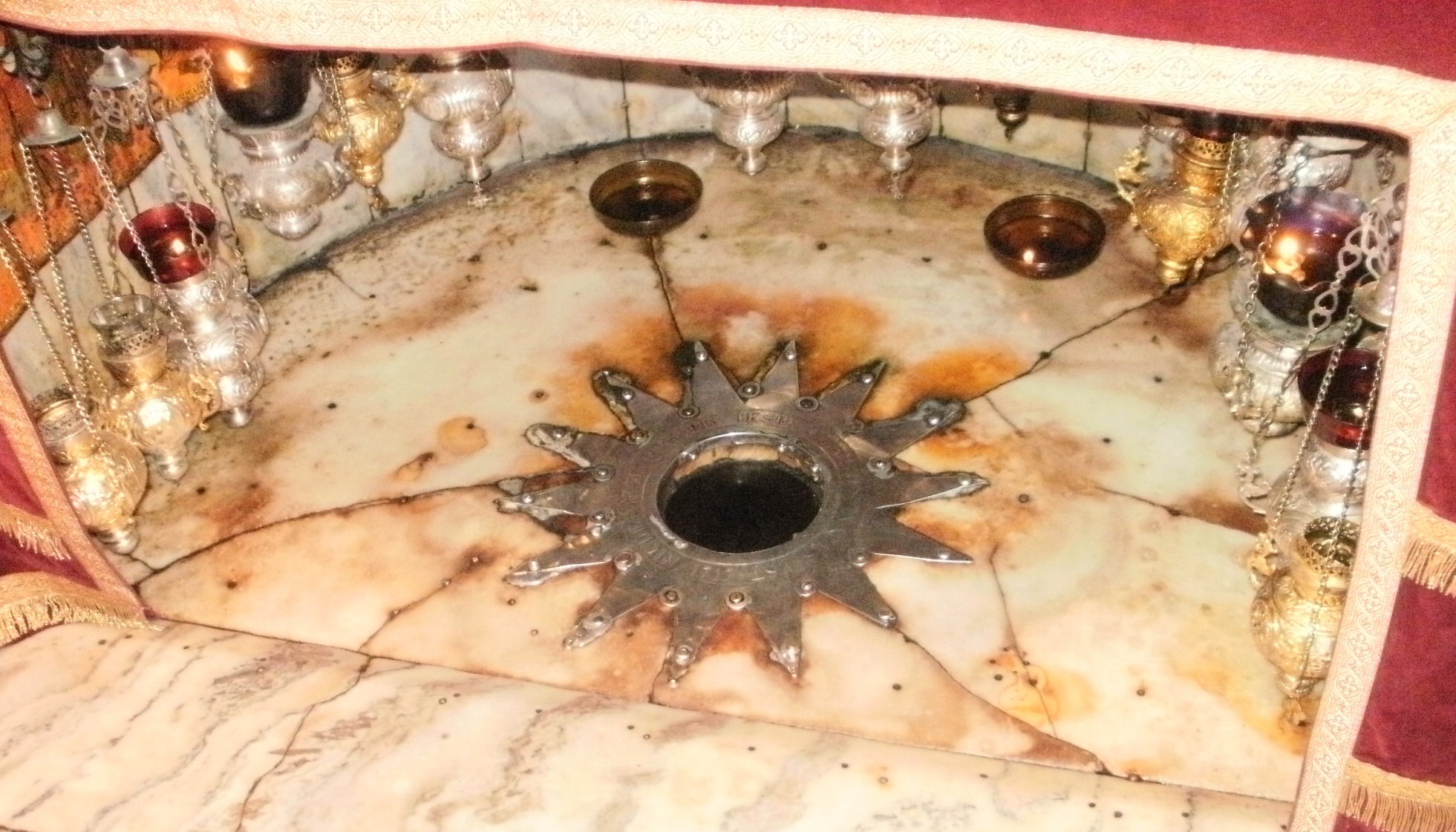
Last night I celebrated Christmas Eve with a post about faith – how difficult I find it to go the extra mile it takes to believe in a deity, yet how important it is to have some form of faith.
As I was posting my piece, my sister, who is an Anglican priest in Bristol, was preparing to deliver a sermon at midnight on what Christmas means for her. In it, she talked about a personal experience in Palestine that brought her faith into focus.
With her permission I’m quoting from it:
Just over two years ago I visited Bethlehem. I went there from Jerusalem- only about 8km but it was a hairy journey where we had to cross a check point with Israeli guards who were not helpful or welcoming. And it took most of the morning. Bethlehem is a town full of conflict but that’s nothing new. When Jesus was born, it lay in territory ruled over by Herod: not a safe place to grow up in.
When I visited, the town, as it does now, had a huge Israeli military presence especially around the church of the nativity reputed to be where Jesus was born. Some of our group were told by the organisation that sponsored them that it was too dangerous to be out after dark and that they would have to return to the safety of their hotel in Jerusalem. A few of us decided to stay to look round further and we ended up having a meal at the “Shepherd’s Field” restaurant at Beit Sahour overlooking the place thought to be the place where the shepherds might have lived. We could only get back to Jerusalem that night by taxi because the check points were shut to public transport. And that taxi journey- brief though it was touched the heart of what the gospel is all about. This is what happened.
We were whisked into three taxis by smiling Palestinians but after a mile or so the taxis turned off the main street. All three taxis stopped and the drivers got out. I began to feel uneasy- worrying about hijackings and mugging but after a few minutes the drivers were back in the car and took us off to the check point. When we got out of the taxis they laid before us boxes of cake and encouraged us to share the cakes with them. They smiled and laughed and did not want any money apart from the taxi fare. They thanked us for coming to visit Bethlehem and asked us to tell the world what life was like living under the shadow of the separation wall and the Israeli occupation. They had an exuberance and love of life that was so infectious despite having very little- it made me realise that sometimes those who have nothing can be free because they have nothing to lose.
The journey I made to Bethlehem that day was totally unexpected. I was made welcome and shared hospitality with those who had very little and didn’t need to offer us anything. It was a real reminder of the real hospitality and welcome that is at the heart of the gospel- the welcome of the arms of God outstretched in the life of Jesus- longing to welcome us to share and break bread with each other.
I am not sure if anyone saw the BBC drama “The Nativity” a few years ago. One of the most powerful images occurred at the end where both the wise men and the shepherds are seen kneeling before the crib. Balthazar wipes tears from his eyes, and tells the other wise men that this vision before him was what he had longed for all his life, and that this tiny child was truly the saviour of the world. And the shepherds, often at the bottom of the economic pile simply looked in wonder and said “He has come for such as us”. The powerful and the powerless found their healing and hope in a tiny baby.
Whether or not you believe in the story and meaning of the Nativity, it’s a powerful message.
I too have experienced kindness in the Middle East from people who have little to give, and yet are prepared to give so much. I have found no hearts warmer than those of many Arabs I have encountered.
On this particular day I have no desire to get into the politics of immigration and refugees, but for me the most hopeful story I have read today is that of the 24 Syrian refugees who settled in a remote part of Scotland, and whose presence appears to be changing the Isle of Bute for the better:
Now almost every other shop space along the front is an empty one. But as well as the Orient Salon, a Syrian bakery and patisserie will soon open. The Syrian people fleeing terror have possibly brought with them the miracle of life for Bute.
A small regeneration is taking place on the island. Four new babies have been born to the Syrian families and another is on the way. In their own way they are bringing optimism to a west of Scotland community that had almost forgotten what it meant.
The whole article in The Guardian is here. I leave it to you to draw your own conclusions. But I do know that if you open your doors, and equally importantly, your hearts, to people in dire need of a helping hand, good things often happen when you least expect them.
And at the risk of sounding excessively pious (for which I apologise in advance), as good a message as you could possibly send to those who advocate keeping the door shut on principle, regardless of need, is this: perhaps it’s time to re-examine your principles.
This Christmas my wife and I are in different countries. She, grieving with her brothers and sisters for her recently-departed mother, and me, ready to lend a hand if needed to support our daughter and her partner, who are about to become parents themselves. It’s the first time we’ve been apart at this time of year in thirty-four years of marriage.
It feels strange, though not because of my temporary solitude – I’m quite used to that, and entirely comfortable in my own company. But what it does mean is that the family rituals of Christmas Eve and Christmas Day are stripped away. No visits, no midnight mass, no present opening, at least on the night before the day, when the frenetic preparation slowly subsides.
Tomorrow, on Christmas Day, our daughter and her partner will be coming over to cook. Another first. The Christmas dinner is my job, just as it was my mother’s job before she became to feeble to handle the multi-tasking ballet required to bring the traditional elements to the table. The mantle fell on me a long time ago, and now it is about to slip on to someone else. I shall become a recipient, not a giver, at least in terms of physical effort. A watershed that points towards decline and death.
But not for a while, I hope.
So today, relieved of the usual obligations, I’ve enjoyed an opportunity for contemplation as my country prepares for the holiest day of the year. In any other terms Christmas is meaningless. It must be a focus for faith or it is nothing. Or at least, no more significant than Black Friday.
I’m not religious, but I am a Christian to the core. I’m profoundly moved by the rituals, the music, the sublime works of art and architecture inspired and created by the faithful. My values are Christian, and I try, usually unsuccessfully, to live up to them.
But long ago I lost the ability to make the leap of faith that would allow me to accept a deity that sees all, knows all, and yet is so disengaged as to allow humans to do to each other unspeakably awful things. A deity that allows the good to die young and the hateful to live long malignant lives.
The fault is mine, not the deity’s. I’m perfectly happy to accept other things in life that “pass understanding”. The mystery of love, for example. Why can’t I just submit, as Muslims say, to the ultimate unknowable?
I don’t ask that question of myself too often. Most of the time I’m busy dealing with the knowable, often with a cynical, knowing veneer. This morning I was going to write about Brexit (yet again), and news items such as the suggestion that being fat makes you happy, and the story of the French doctor who hasn’t worked for thirty years but still draws a salary because his colleagues won’t let the hospital fire him. I was going to grieve for the aardvark and the meerkats whose lives in captivity ended with a fire at London Zoo, and I was going to cast scorn on the idea that anyone would be prepared to eat a plate of spinach every day to stave off dementia. And I was going to join the chorus of contempt for those in Britain who think that changing the colour of our passports will make anybody but an idiot feel better about the fate that awaits us as an “independent” nation.
But I couldn’t. My heart wasn’t in it. The only thing that really engaged me was a sense of wonder that an idea, unknowable and unprovable, should impel so many millions of people, believers or otherwise, to focus on the symbols, the rituals, the expectations and the traditions of one special day in the year. And why people should act with kindness and generosity that is often beyond them on other days. And why it is that the idea should have inspired so many acts of sublime creativity.
The only way that I, who cannot embrace the deity, can explain the conundrum is to suggest that the catalyst that drives our behaviour is not so much the deity, but the mental condition of faith. If we have no faith, be it in the Muslim or Christian god, in the teachings of Buddha, in the Hindu gods, in the spirits and the ancestors or in the secular works that inspire our behaviour, we find it very difficult to function as human beings. If we stop believing in the possibilities of the future, we surely stop wanting to live.
I envy those who leave their future to God, who accept that there is something bigger than us, and that we can better understand what that something is by worshipping together, praying together and believing together. I do accept that we are part of a higher order of things – but I simply don’t have a clue about what the higher order might be. That’s why I’m fascinated by religion in all its forms, and curious about faith in all its diversity.
Perhaps I’m also waiting for something that will impel me to make my own leap of faith, which I suspect is harder to do for an adult scarred by decades of life experience than for a child who has never questioned the reason for believing.
Or perhaps I have as much faith as I will ever have: in the power of love, in the ability to rise above suffering, in the strength that forgiveness brings.
Whatever your faith, this Christmas I hope that you are strengthened by it, nurtured by it and use it to make our world a better place.
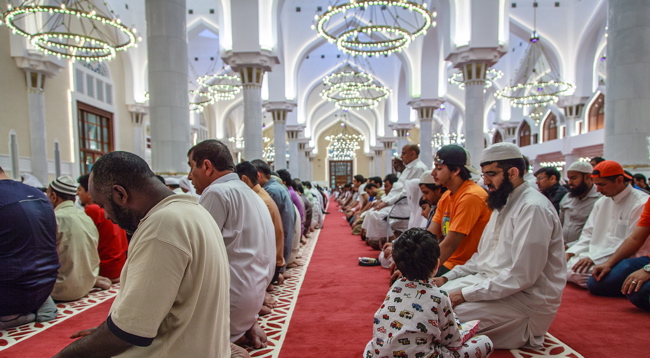
This post, the latest in my RetroSaudi series comparing the Saudi Arabia I lived in thirty years ago with the country today, is about my experience of the rules of observance in Islam.
As someone brought up in the mild traditions of the modern Church of England, I was never much attracted to the symbolism and the rituals of Catholicism. For me, faith was always about the big things – belief, attitude and behaviour – rather than what I saw as the minutiae.
When I first came to Saudi Arabia, I was constantly surprised by the emphasis among devout Muslims of rules – rules for worship and rules for daily life. Lots of them. Big ones, medium-sized ones and little ones.
In the Anglican church, apart from the Ten Commandments and the Sermon on the Mount, we didn’t seem to have many rules that we were expected to follow if we were to avoid going to hell.
We once even had a Bishop of Durham who doubted the Virgin Birth. Enough to have had him burnt at the stake as a heretic in earlier centuries. And he certainly wouldn’t be very popular if he was a Muslim expressing similar sentiments about the origins of Islam.
Although I had long possessed a rudimentary knowledge of the Holy Quran, and the importance of the Hadiths, in which the acts and words of the Prophet, and, by extension, the example he set, are enshrined, it only fully dawned on me how important rules are in Islam – or at least the Islam practised in Saudi Arabia – when I became a regular reader of the Arab News.
This august broadsheet was Saudi Arabia’s first English-language daily newspaper. Many of the cuttings from previous episodes of RetroSaudi came from copies of the newspaper I brought back to the UK when I finished my first stint in the late 80s.
As anyone familiar with the Muslim world will know, Friday is to Muslims what Sunday is to Christians – a day of rest and religious devotion. Yes, I know, in the West it’s become a day for shopping, football and DIY. But wherever Islam is practised, Friday is still the day for putting your best togs on and going to the mosque, even if you don’t manage it at any other time of the week.
In keeping with the requirement for religious contemplation, this was also the day when the Arab News would publish a centre spread devoted to Islam. I’ve always been interested in the great religions, so it became one of my favourite reads of the week, and not only because of the learned articles contributed by the sheikhs.
What fascinated me most was what could be described as the agony column. Whereas in the West, agony aunts try to unravel a host of sexual and emotional conundrums for their suffering readers, the Arab News agony column was devoted to dilemmas of faith.
People would write in with what to a non-Muslim’s eyes were bizarre questions about religious practice. Many were related to what the business world would describe as compliance issues. What amazed me was the minute detail of observance that clearly worried the readers.
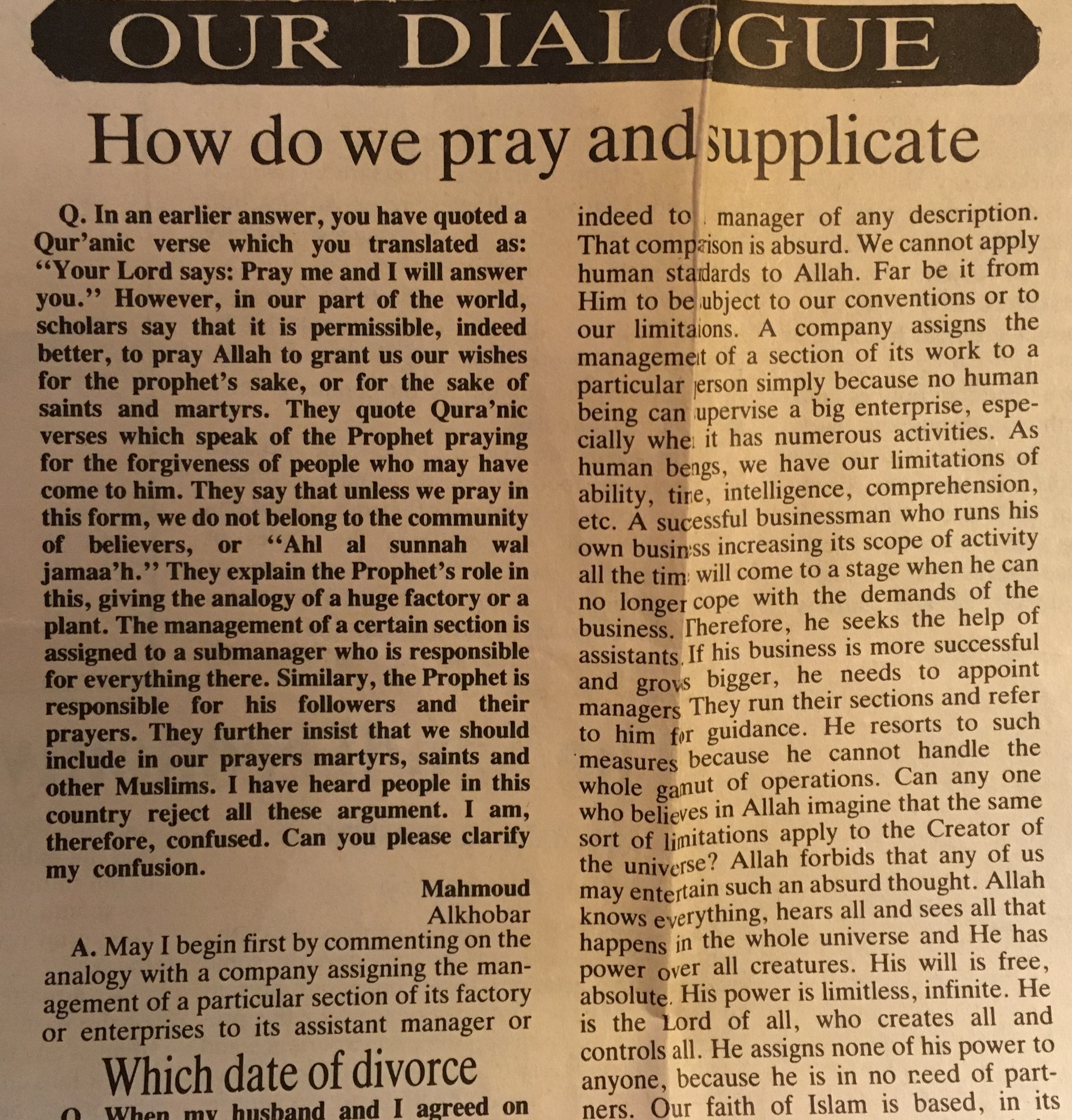
Sometimes the queries were broad and quite fundamental, such as this one on the nature of prayer:
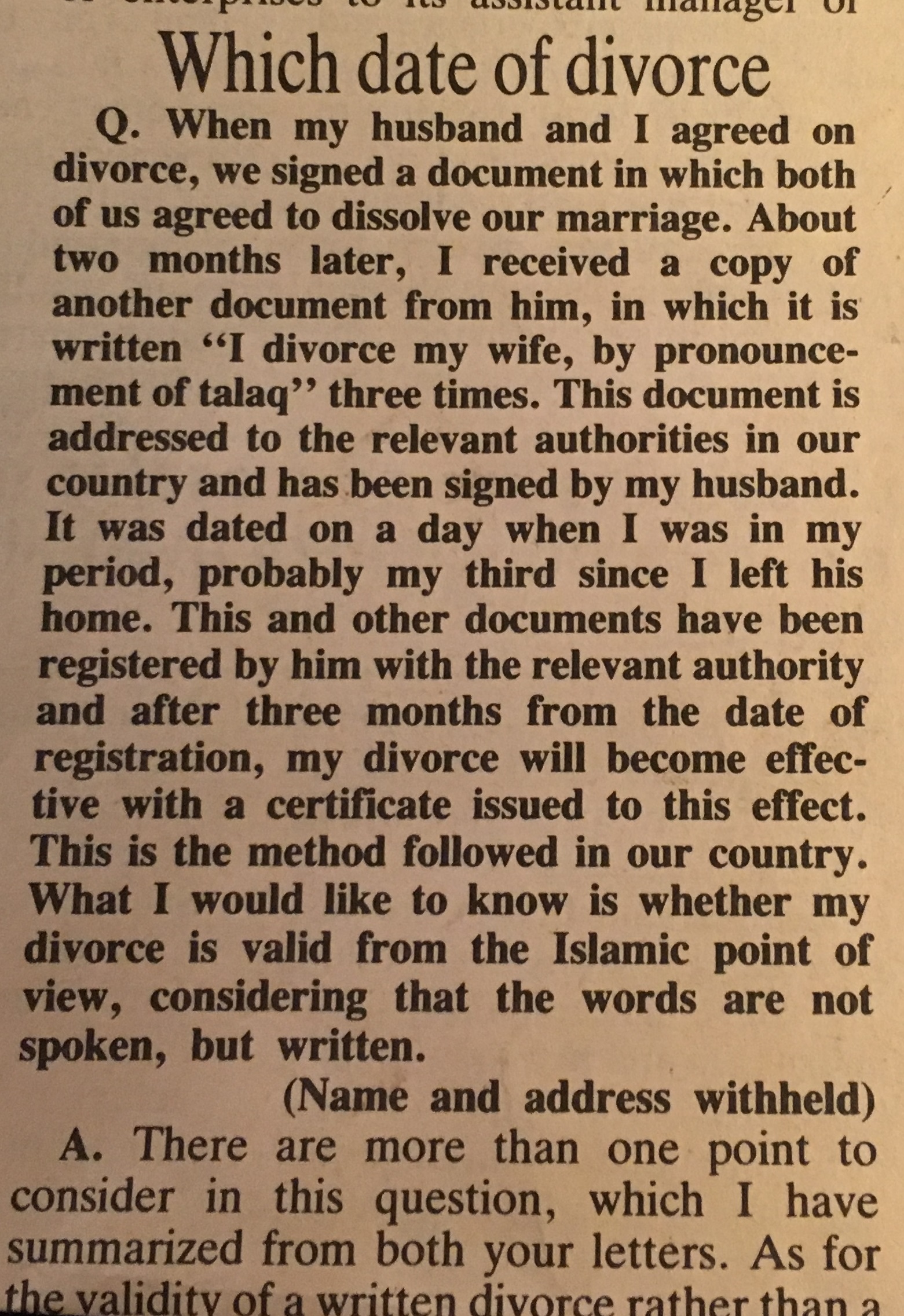
And this one about divorce:
Other questions were related less fundamental issues, such as bodily functions invalidating acts of worship. They are in excruciating detail, as are the answers:
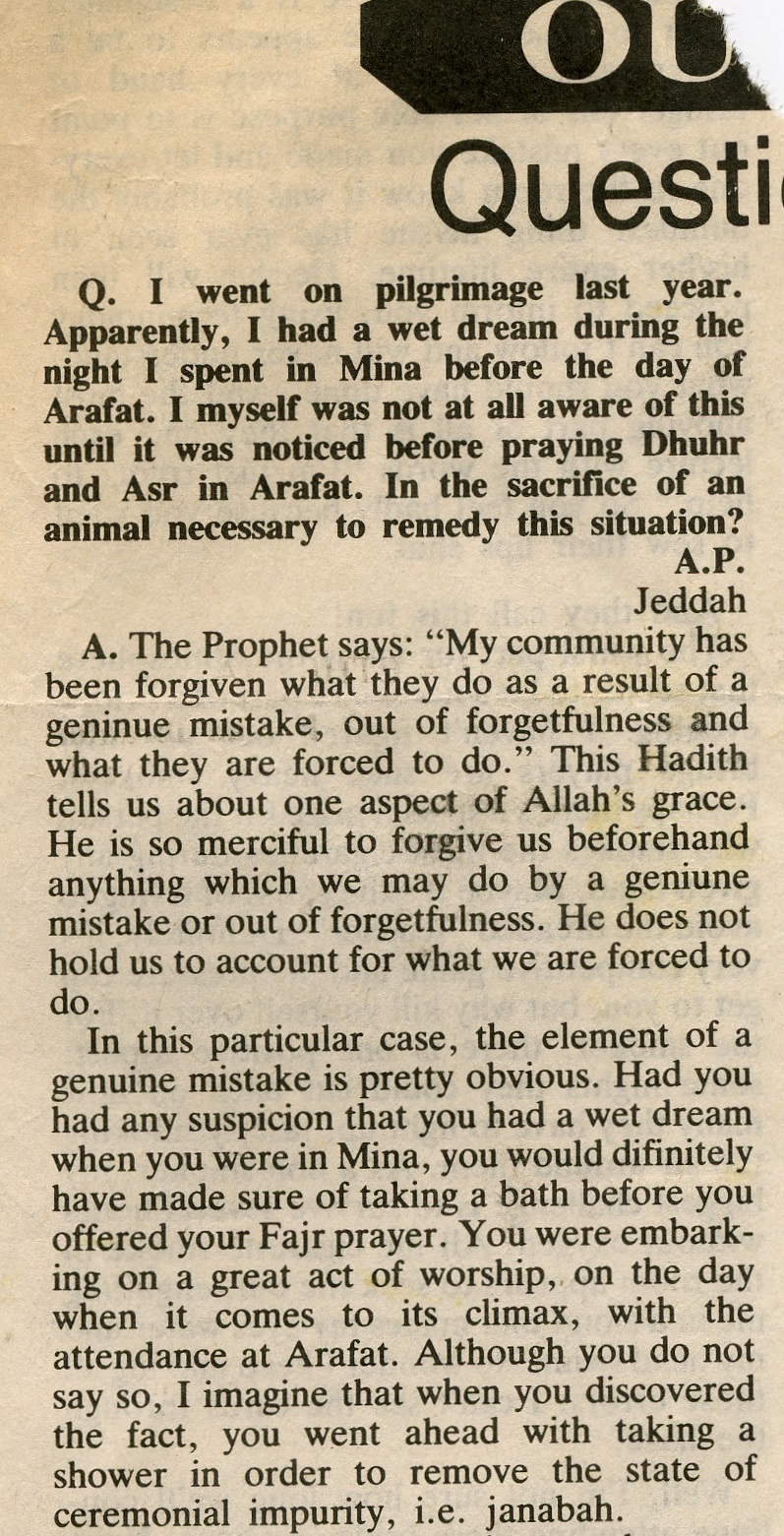
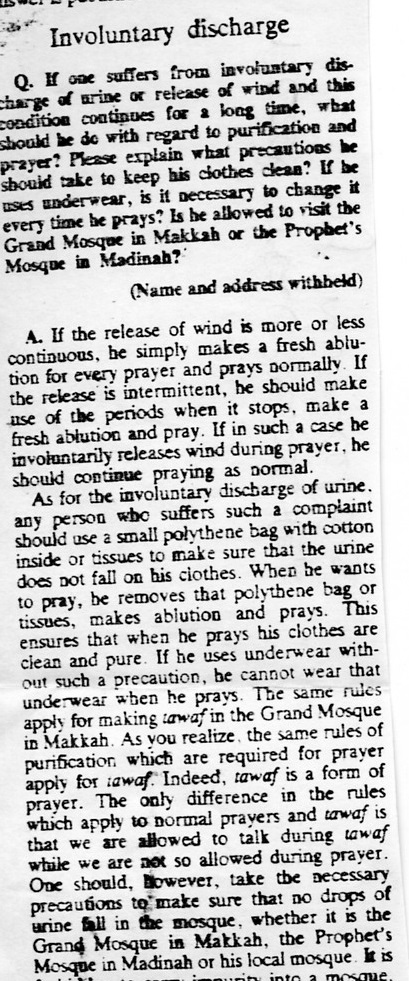
Since the questions appeared in an English-language publication, I doubt if those seeking answers were Saudi. There were numerous Arabic publications with similar sections. I suspect that most of those who wrote in English were expatriates from the Indian subcontinent. As this clipping illustrates, concern with the form rather than the content of devotion was a theme that exercised people back home, too:
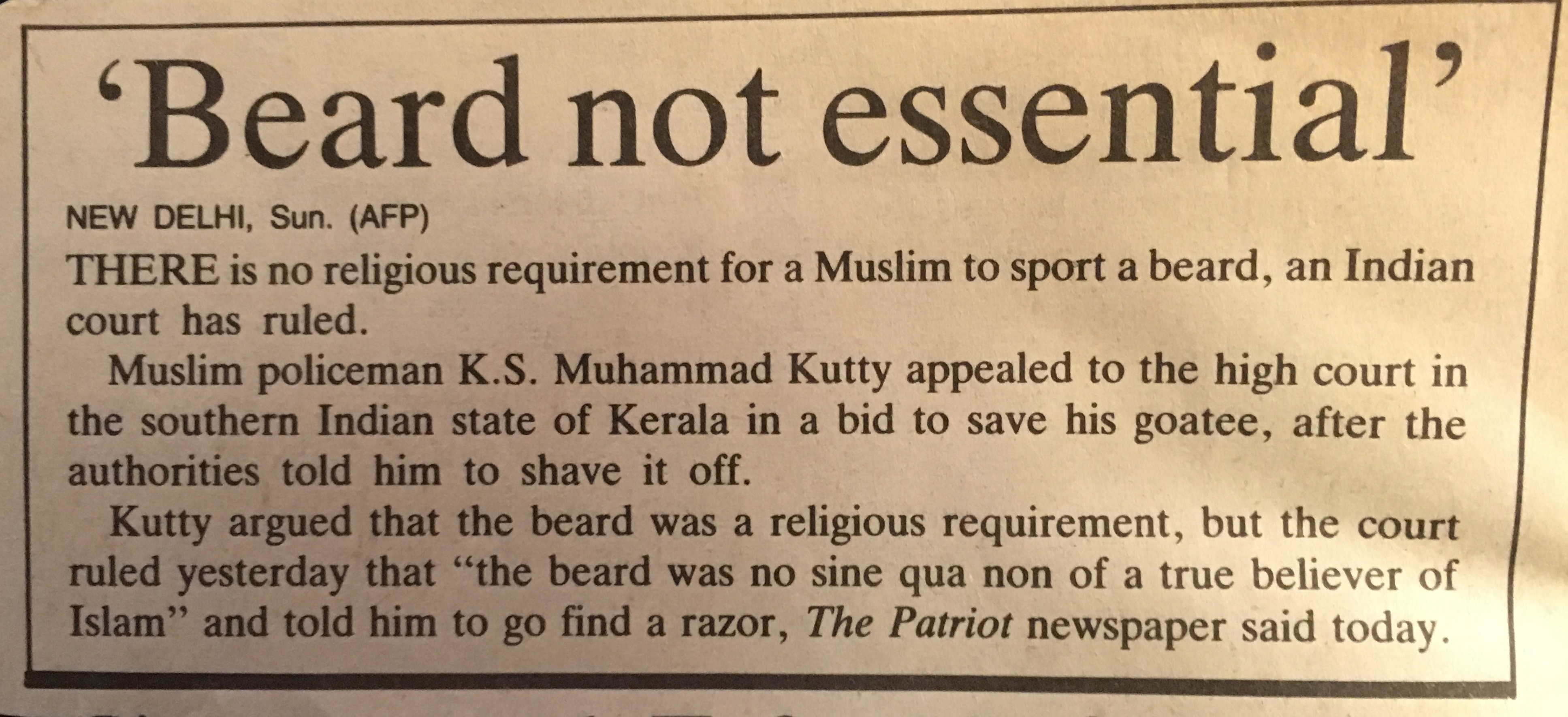
The purpose of these cuttings is not to mock, but to illustrate how important detailed observance is to the Muslim faith. It would be highly presumptuous for me to offer an opinion about the minutiae of another person’s religion. I think it’s important to keep an open mind.
In fact I once had a highly informative discussion with a Saudi doctor at a workshop I was facilitating. He was keen to stress the health benefits of the physical act of praying. He then took me into the bathroom and talked me through the process of ablution, which he had me try for myself. I have to say that I would find it hard to carry out such a ritual five times a day, but clearly for an observant Muslim it’s part of the rhythm of life. But as someone who injured his back a while ago, and needs to carry out regular stretching exercises to keep a recurrence at bay, I can certainly appreciate his point about the bending and stretching required at prayer.
More than anything else, what these letters from anxious people conjured up for me is lonely men in their male-only accommodation – and occasionally women, perhaps working within Saudi families – worrying about whether they’re on the right path to the hereafter. After all, money was not (and still isn’t) the only reason for so many from Pakistan, India and Bangladesh to leave their families and friends and live often thankless lives in the birthplace of Islam.
A wider perspective is that these agony columns were a precursor to the internet forums and religious channels that abound today. Religious TV is as popular in the Middle East as reality TV in the West. Broadcasting from a number of countries in the region, sheikhs deliver their opinions on matters great and small. They have huge followings, even if some of their utterances are met with popular derision.
A few years ago a sheikh in Saudi Arabia, Saleh al-Lohaidan, ventured the opinion that driving was detrimental to women’s health. As the BBC quoted him at the time:
“If a woman drives a car, not out of pure necessity, that could have negative physiological impacts as functional and physiological medical studies show that it automatically affects the ovaries and pushes the pelvis upwards,” Sheikh Lohaidan told the news website Sabq.org.
“That is why we find those who regularly drive have children with clinical problems of varying degrees.”
Soon afterwards, at least partly in response to the sheikh’s advice, a video appeared on YouTube featuring a young Saudi singing No Woman No Drive, a glorious adaptation of Bob Marley’s classic.
Never let it be said that Saudis lack a sense of humour.
More recently, Sheikh Mohammed Al Arifi, one of the prominent clerics who avoided Crown Prince Mohammed bin Salman’s recent clampdown, drew a less humorous response when he expressed a view on whether it was permissible to wash the feet before prayers without taking socks off. One Twitter follower commented “Jerusalem is lost and you are talking about socks”.
The agony columns of the 80s seemed to indicate a hunger for guidance. This in turn suggested a lack of confidence, or an unwillingness to rely on one’s own knowledge. Perhaps it also reflected the possibility that religious education was scantier for South Asians thirty years ago than it is now.
The hundreds of madrassas funded by the Kingdom in the intervening years across the subcontinent will undoubtedly have improved understanding among their students of the faith, even if the teachings are not necessarily to the liking of all Muslims, and certainly not to westerners who blame them for the spread of jihadi violence.
Today, most of the religious channels are in Arabic, a language spoken only by a minority of South Asians, which suggests that at least in the Arab world, the hunger for guidance is still strong. Since some of these channels – and those who broadcast on them – are beyond the reach of the most determined autocrats, it’s easy to understand why one country could nearly go to war with another that it accuses of supporting what it considers the pernicious influence of the internet agony uncles and their inflammatory rhetoric.
The sheikhs were far easier to control when their only means of expression were the newspaper articles they wrote and the mosques in which they preached. In the 1980s, the nearest equivalent to the modern religious channels were the cassettes of their sermons that found their way into mosques and bookshops throughout the world. Satellites and the internet are far more effective.
I don’t blame those who turn to religious authorities for certainty in a volatile, confusing world. And many of the sheikhs I’ve met are positive, moderating influences. But sometimes I can’t help thinking of the scene in the movie The Life of Brian, when the accidental not-the-messiah appears on his balcony and tries to send away the mob of would-be followers by screaming out:
You don’t need me!
You don’t need anyone!
You’ve got to think for yourselves!
You’re all individuals!
A subversive message indeed.
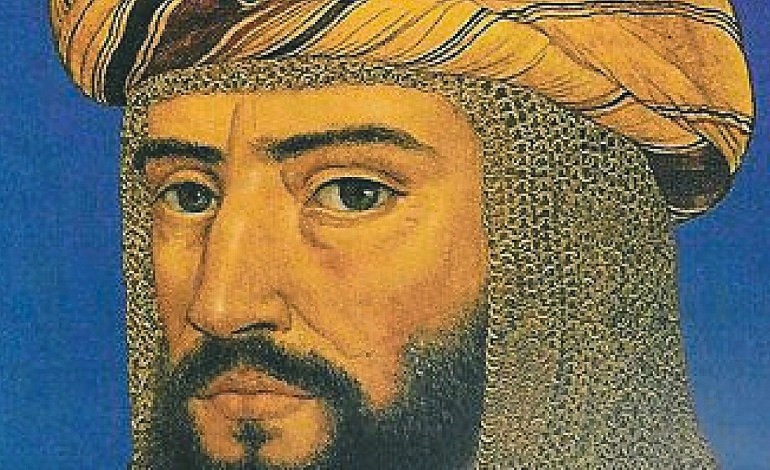
In my favourite scene from Ridley Scott’s crusader epic Kingdom of Heaven, Balian of Ibelin, the defender of Jerusalem, asks Saladin “what is Jerusalem worth?” “Nothing”, says Saladin, and then, as he turns back to the defeated crusader, “everything!”
I keep coming back to those words when I think about Donald Trump’s decision to recognise Jerusalem as Israel’s capital.
It means nothing in the sense that it will not change the Israel-Palestine impasse. Few countries will follow Trump’s lead. In political terms Israel’s possession of the city is no more legitimate today in the eyes of most of the world than it was before Trump issued his fatwa.
And if Jerusalem’s ancient walls were sentient, I suspect that they would be having a hollow laugh at Binyamin Netanyahu’s triumphant crowing, just as they would have done at Saladin’s glee.
Nothing is permanent in Jerusalem. Saladin passed on. Over the following eight hundred years, and up to the present day, there were more conquests, sackings, periods of peace, changes in control. No faith or political entity could truthfully be said to own the city.
Trump, Netanyahu and Abbas will also pass on. Unless the city is destroyed in an apocalypse, new leaders and new dynamics will come into play, and the struggle for mastery will continue.
No matter that Jerusalem means everything to those who seek to rebuild the temple, regain possession of Al-Aqsa and the Dome or hasten the second coming of Jesus, Trump’s pathetic gesture will most probably turn out to mean nothing to ordinary Israelis brutalised by the fear of encirclement and annihilation, and to ordinary Palestinians whose lives under occupation can hardly get worse.
The sadness in all of this is that we lucky people who only have the price of bitcoins and a few snow storms to worry about seem to think that we live in a better world than that of our ancestors.
The unholy conflict in what the devout call the Holy Land shows us that we don’t.
We’d better not be too complacent, because what we call civilisation is a very thin veneer.
Last week, Ireland had one of its rare moments in the international media spotlight, as Theresa May struggled to satisfy the Irish government and her obdurate partners in the north over the issue of what kind of border will exist between the two Irelands post-Brexit.
I was in the country for an entirely different reason: to attend the funeral of my mother-in-law Blaithín Meade in a country town thirty miles from Dublin.
Blaithín was a mother of six, a school teacher, music teacher and a tireless worker for many local charities. She died after an illness that caused her to spend the last ten weeks of her life in hospital. Like many mothers – especially Irish ones – she was the hub of her family, even more so in the fifteen years since the death of her husband Pat.
I was at Pat’s funeral as well, but this was before the death of my own parents in England, so I had no opportunity to compare different approaches to death in the two islands.
When my mother died three years ago, it took three weeks to book the church and the crematorium, and for the four of us siblings to agree a date for the funeral.
In Ireland, things work very differently. Funerals are held within a maximum of three days from the person’s death, regardless of who can or cannot attend. And so it was with Blaithín.
I arrived at the family home the night before the funeral. The wake had taken place on that day. Blaithín lay in an open coffin in the front room. A stream of visitors came to the house to pay their respects. Tea, cakes and sandwiches were on hand.
If you’ve ever seen movies in which an Irish wake is portrayed, you might immediately think of men like Milo O’Shea or Brendan Behan with cloth caps supping Guinness long into the night, occasionally bursting into song. That may still happen deep in the country, but not in Navan.
When I arrived late at night I looked at the condolence book, where visitors had signed their names. There were two pages of names, which seemed quite a lot. But that was by no means all. I looked further and found another six. Around two hundred people stopped by in the course of one day. Each would stay for between ten minutes and half an hour, say goodbye to Blaithín, pay their respects to the family and leave.
By the time I arrived, my wife and her brothers and sisters sat in a state of numb exhaustion.
Then there was the funeral itself. The rituals started with the removal of the coffin. The priest came into the house, said a prayer, and after the relatives had had the chance to say goodbye, the coffin was closed, and carried out to the hearse.
A slow procession headed for the church. As the hearse passed, people in the street instinctively stopped, faced the coffin, crossed themselves and waited for it to pass before resuming their business.
As with funerals more or less anywhere, loved ones carried the coffin on to a trolley, and it moved into into the church, where hundreds of mourners were waiting.
Inside the church, an innovation. The parish has installed a webcam, which allows anyone not able to attend in person to log in and view the ceremony. And so they did, from Galway in the west of Ireland to America, Australia, Spain and Germany. One set of relatives, who were delayed by traffic at the start of the mass, even watched it in their car.
It fell to me to introduce a sweet little tribute from Blaithín’s children, wherein each carried up an object that symbolised one aspect of her life. A book, a sheet of music, a teddy bear and a family photo.
On the day when the border controversy was at its peak, I had to resist the temptation to introduce myself to the mourners as a visitor from the land of Brexit, and to tell them how pleasant it was to be among sane people again. But I didn’t, because this occasion wasn’t about me. God knows what Donald Trump would have said.
The funeral mass took about an hour, with the usual words of comfort from the priest. He was a young guy with jet-black hair and a long beard. Afterwards, a few people agreed that he would look the part in a black turban, Ayatollah-style. Or perhaps in the regalia of a Russian Orthodox priest. One denizen of Islington even compared him to a Shoreditch hipster. Whatever – he was impressive, eloquent and compassionate.
After the customary conversations outside the church, we then made our way to the graveyard. Cremations are not common in Ireland except in the cities where burial space is limited.
At the grave, more prayers, a piece of Blaithín’s favourite music and a poem read by the undertaker, a family friend. Tears and linked arms as the coffin was lowered into the grave. More holy water, flowers from her sister and a handful of earth.
Then those of us who made it to the grave ceremony moved on to a local hotel, where a three-course lunch big enough to sink a battleship awaited.
And that was what my Irish relatives would describe as a decent funeral, as indeed it was.
But what was just as impressive was the way the family pulled together during Blaithín’s last weeks in hospital. Not a day went past when there weren’t two or three visits from her children and grandchildren, from her sister and brother-in-law in Galway, who were themselves not in the best of health, and from others who knew her well. Not ten-minute visits either – hours sitting by her bed, holding her hand, helping her with physio that they hoped would pave the way to the recovery that never came. Never giving up hope, even as the patient took one step forward and two steps back.
What made the difference was that five out of her six children live locally. That would have been quite normal fifty years ago, but less so now. After all, Ireland has always been a land of diaspora, whose children spread their wings and end up far from home. But in Blaithin’s case, those who had lived abroad – apart from my wife – eventually returned. She was surrounded by loved ones who cared for her until the end.
As I played my limited part in the proceedings, I kept remembering my mother’s funeral. It was a far quieter affair, which reflected her personality – far more introverted than Blaithín, not someone who made friends so easily. She was 94 when she died, ten years older than my mother-in-law. Most of her life-long friends had gone before her.
She spent her last few years in a care home, slowly succumbing to dementia, whereas Blaithín was sharp as a pin to the end. Three of my mother’s four children lived some way away, and for various reasons were not able to visit her often. The burden of care fell largely on my wife, and on me when I was in the country.
Many of her fellow-residents in the care home rarely had visitors, which we found desperately sad. When we visited, we took our dog, and made the rounds of the old ladies sitting aimlessly in their armchairs.
At her funeral there were far less mourners – ourselves, a few family friends and some who knew her from the local church. The wake, such as it was, consisted of light refreshments in the church after the visit to the crematorium.
Two very different endings to life. I’m not saying either was typical of the countries in which they took place, and it would be wrong to draw conclusions from them about the cultures of England and Ireland. Blaithín lived her life in a country town. My mother in a city. A couple of years ago, a close friend died in rural Essex, and his funeral was similar to Blaithín’s. No doubt some urban funerals in Ireland would resemble my mother’s.
There are not many upsides to death, unless it serves to release us from pain and suffering. Yet at the funeral of someone who has lived to old age, we console each other with the thought that they lived a full life and a good one, even if in some cases – though not in Blaithín’s – they haven’t.
With her passing we, the children and in-laws, have become the next generation that will be expected to go. It’s an uneasy feeling when you realise that one of you is likely to be next. Personally, if someone came to me and gave me the choice of not knowing when I would die, or the certainty that I would live to 87, I’d take the latter, even if I might feel differently as the time approached.
Whether you leave this life quietly and hardly noticed, or your passing is accompanied by a cast of thousands, as long as you live your full span, then your loved ones should be grateful that you were so privileged, when others in the past and still today are cut down before their time by untreatable disease, war and the capricious intervention of accidents.
If Blaithín’s funeral followed time-honoured traditions, so did her death – surrounded by people who loved her and cared deeply for her. What more could you ask for?
The shame-storm is turning into a hurricane, as we knew it would. Everywhere we look, women, and sometimes men, are stepping out to accuse the great and the good of acts that sit somewhere on a scale between inappropriate and illegal.
In my previous post on this subject, I wondered whether, after a crescendo of exposures, abuse allegations would die down because they would no longer be newsworthy, and the powerful would return to doing what they’ve always done:
“Does it fade away when the media loses interest in the outing of a never-ending trail of well-known miscreants from politics and show business – rather like an epidemic that runs its course because the most vulnerable are dead?”
But what if it doesn’t fade away? What if the torrent of disgrace and retribution ends up not as an epidemic, but as a kind of cultural chemotherapy, wherein to root out a cancer we almost kill the patient?
Western democracies tend to respond to outbreaks of perceived wrong-doing by taking preventive action. Public opinion, stoked up by the traditional and social media, screams out that “something must be done”. Governments, if they wish to remain in power, respond with new laws. Organisations, afraid of law suits and reputational damage, adopt codes, rules, charters and values statements.
There seem to be three streams at play here. The first is paedophilia. The second is what once upon a time used to be called sexual harassment. And the third is sexual assault, with rape at the end of the spectrum.
Governments have been very active over the past thirty years in dealing with child abuse. When I was growing up, paedophilia was a dirty little secret that didn’t generate many headlines. That doesn’t mean that it was any less prevalent then than now. It just wasn’t newsworthy.
The exposure of paedophile rings, the misdeeds of Catholic clergy and latterly online child porn and sex trafficking have made it impossible to ignore behaviour that took place with impunity for centuries. Our social antennae have never been more finely tuned to detect activities and attitudes that might indicate an unhealthy interest by adults in children.
As for sexual harassment, which in common understanding can mean anything from wolf whistles on the street to innuendo in the workplace, behaviour that in the sixties and seventies might have been the stuff of sitcoms has become grounds for constructive dismissal. Woe betide the dinosaur male boss who complements his female secretary on her fabulous hair, her figure-hugging dress or even her shoes.
And then we have sexual assault. What, when I was a student in the seventies, might have been laughed off as a clumsy pass by an inexperienced teenager during fresher’s week has become grounds for a criminal investigation. A drunken one-night stand carries the risk for a male participant of years in prison for rape.
And finally, the powerful, who know exactly what they’re doing, are being called to account.
Different times, different moral standards? Yes and no. The Summer of Love didn’t change everybody’s attitude towards sexual behaviour. Just as it’s foolish to generalise through the eyes of the English-speaking world, it’s equally invalid to make sweeping assumptions from the perspective of university-educated baby boomers and Gen-Xers.
But much has changed. Some schools have adopted a “no-touch” policy, even to the point of prohibiting teachers from consoling injured or emotionally distraught students in ways that come naturally to all human beings. Others prohibit photos of their students at school events for fear that the pictures will fall into the hands of paedophiles.
Universities have drawn up codes of engagement between students to ensure the consent of both parties before they move beyond each stage of sexual activity. And the other day, a British police force tweeted that bumping into someone under the Christmas mistletoe could be construed as rape.
Are we now reaching the point at which men are assumed by society to be child abusers, sexual predators and potential rapists unless they can prove otherwise? And, acting on that assumption, will society take protective measures that will radically change the way men and women interact with each other at work, in public spaces and even at home?
There will be many people, especially the recipients of unwanted attention from the likes of Donald Trump, Harvey Weinstein and Kevin Spacey who might say “bring it on”.
But let’s for a moment consider where this might go.
If we see a child weeping inconsolably, will we be forbidden from putting an arm round them? Instead, will we have to call its mother – not its father, who might be a paedophile – and leave the child weeping until she arrives?
Are we are witnessing a change in western culture wherein any act of touching in the workplace between peers or by those with power is prohibited because it might be sexual? In which every boss is assumed to be a sexual predator unless proven innocent? In which every family friend is a paedophile unless proven innocent?
Do we have to redesign workplaces so that there are no private spaces where men can masturbate in front of their female assistants, or put their hands up their skirts, without being seen by others?
Will CCTV become even more pervasive, including in hotels, offices and public lavatories, or drones, as in Dave Eggers’s novel The Circle, watching for our every misstep?
Will our employee handbooks tell us that we must follow Mike Pence’s rule never to sit down one-to-one with a woman who is not our wife?
Will we have to ask permission to hug a colleague of the opposite sex? Will we even be allowed to offer to hug them, given that that could be interpreted as sexual harassment?
Will employers be required to ask their employees to sign a code of conduct that includes behaviour away from the workplace, whether or not that behaviour is in the course of work?
Will it still be OK for footballers and ice-hockey players to brawl in front of thousands of people, where that behaviour outside a pub would lead them to court? Will it still be OK for them to hug each other, if that act is forbidden in other workplaces, and given that they would be setting a bad example to young fans?
And lastly, whose job will it be to police all this stuff, when the police themselves have their work cut out investigating murder, rape and terrorism? Public morality committees? Corporate morality commissars? Self-appointed vigilantes? Who will bring consistency to all this watching and informing? Who will bring consistency to punishment? How will the innocent be protected when society judges them to be guilty before they are given the opportunity to defend themselves?
I’m not saying all these scenarios will come to pass. But they might. I’m worried that we might end up in a society in which people are afraid to touch, afraid to engage as man and woman, man and man or whatever. And in which those who wish to break the rules of engagement do so in murky places where surveillance and policing is impossible.
All the while, at the cinema, on TV and via our smartphones, we can watch the very behaviour that society seeks to stamp out – rape, murder, abuse of all kinds. And our kids grow up believing that the interactions of porn stars are models for sexual relations.
I worry that in this new society we seem to be building, rules will leave no space for common sense. That people’s behaviour will be dictated by fear of punishment and an assessment of what they can get away with, rather than by a commonly accepted sense of right and wrong.
I also find it ironic that we in the West, who think we know so much better than the Muslim world, appear to be moving towards cultural norms more common in the Middle East, where physical contact between men and women who are not related is often taboo, to the extent that there are many women who reluctant even to shake hands with men outside their families.
If this is where we’re heading, let’s understand what we’re doing. Let’s not drift into it.
Or how about we accept that we live in an imperfect world, in which imperfect acts have been carried out ever since we came down from the trees? That we have laws that forbid us from going beyond existing societal norms. And that when norms change, laws usually follow.
That we recognise that there’s a line to be crossed, and that no matter who crosses it – President, Congressman, Member of Parliament, actor, teacher or garbage collector, gay or straight, transgender or intersex, the consequences will be the same: disgrace in one form or another. That line might move forwards, backwards or sideways as each generation succeeds the previous one, but it will always be underpinned by one fundamental principle: respect for the individual.
And in this imperfect world, we should also understand that not everybody recognises the same lines. The voters of Alabama and Donald Trump, for different reasons, might rejoice if an alleged paedophile is elected as a United States Senator. But it’s up to us to condemn or condone.
If, on the other hand, we need protecting from ourselves, perhaps we should find a way to ban alcohol and pornography, and make it illegal to show movies that include rape, murder and other sexually motivated behaviour. Fat chance.
If the law is only partially effective in providing us with red lines, what else will? Religion? Which religion? And if we opt for religion, is it reasonable that non-believers should be expected to conform to the ordinances of scriptures, divinely inspired but interpreted by humans, sometimes centuries ago? Or do we adopt principles based on humanism, which has no authority beyond shared values?
If in a pluralistic society we believe that we should not be subject to the rules of religion, but seek shared values that transcend individual faith, what are those shared values? If we can find them, are they the same as common sense?
These are all questions I will leave to those who are wiser than me – though not, God help us, to politicians, who seem incapable these days of reaching out beyond their ideologies and personal employment prospects.
If we must embark on a course of cultural chemotherapy, let’s do what we can to make sure that the patient doesn’t end up fearful, confused and permanently weakened.
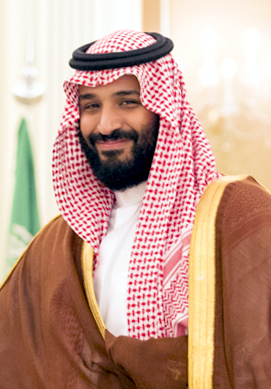
Over the past couple of months both the mainstream and the social media have abounded with material about Saudi Arabia’s Crown Prince Mohammed bin Salman, his foreign policy and the domestic reforms he has launched. Some has been supportive, but by no means all.
I’ve very rarely seen an article in the New York Times met with such scorn and derision on the social media as Thomas Friedman’s recent piece about the crown prince, also known as MbS.
Most of the comments on the article focus on MbS’s intolerance of dissent, his country’s blockade of Qatar and his pursuit of a war in Yemen that has left disease, starvation and thousands of casualties in its wake. But the quotation from Friedman’s interview that seems to have exercised most people has been his comparison of Iran’s Supreme Leader with Hitler.
In MbS’s defence, I suspect his comment about Iran was more about territorial encroachment than any genocidal intent by the Iranian regime. But as soon as you press the Hitler button you unleash all manner of reaction.
As for the interview itself, Friedman is widely accused of writing an apologia for MbS, or, in the words of one tweet, delivering a warm french kiss to the crown prince. Here are a few comments to be found on Twitter on publication day:
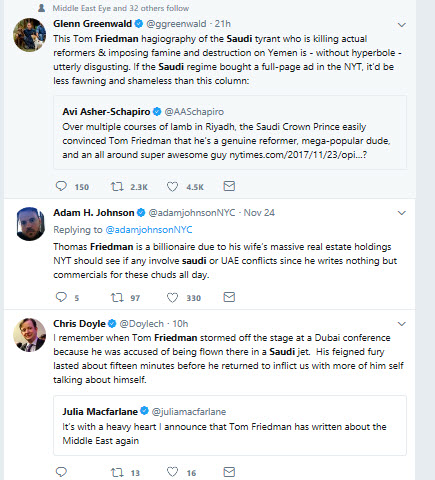
Whatever you think about the article, and Friedman’s journalism in general – this is a man, by the way, who has won three Pulitzer Prizes – the question that critics are failing to ask was simply put in a tweet by Blake Hounshell, editor of the US journal Politico:

Very good question, and worth exploring.
Before we go into that, we should probably ask what King Salman should have done. After all he, not Mohammed bin Salman, is the king. Should he have ditched King Abdullah’s “continuity candidate” Prince Muqrin as crown prince on acceding to the throne? As far as anyone can tell, Muqrin, Salman’s half-brother, would most probably have represented a “business as usual” faction within the royal family. Under his rule, Saudi Arabia might have continued on Abdullah’s path, reactive rather than proactive.
But would the stability that yet another son of Abdulaziz might have delivered have survived the economic sclerosis that has set in over the past twenty years, and has been exacerbated by the decline in oil prices over the past three? How would the continuity faction have dealt with Iran’s perceived encirclement of the country? Perhaps not with a full-scale war in Yemen, but surely by continuing to sponsor proxy wars elsewhere.
Instead, Salman promoted Mohammed bin Naif, his nephew, to crown prince. MbN, as he is known, was a highly respected Minister of the Interior who led an effective anti-terrorism effort against Al-Qaeda in the mid-2000s. He was liked by Barack Obama’s foreign policy team, and again seen as someone who would not rock the boat.
But Salman didn’t just promote MbN. He put MbS, one of his younger sons, into the line of succession, and gave him a host of powers that gradually eroded MbN’s position. Eventually MbS supplanted MbN as crown prince, which leads us to where we are today.
Apart from dynastic considerations, what were Salman’s reasons? Most likely MbS convinced his father that business as usual was not an option. Had things continued in the usual Saudi way, senior princes from the various al-Saud clans – sons of Fahad, Abdullah, Naif and Sultan – would have continued to occupy the critical ministries. Consensus would have continued to be the order of the day. And consensus, Salman and his son would have calculated, gets in the way of rapid and decisive action.
Would MbN have gone into Yemen? Probably not. Would he have commissioned a 2030 Vision? Perhaps. Would he have locked up his cousins? Probably not.
Would Muqrin or MbN have declared that the Kingdom is committed to a “moderate Islam”, and moved against the conservative faction, including the religious police? Almost certainly not. His father and predecessor as Minister of the Interior, Naif bin Abdulaziz, was a noted religious conservative.
All speculation of course. But we can be sure that neither of Salman’s designated successors before he elevated his son would have undertaken such a radical set of measures both without and within his kingdom. If they resembled their predecessors in any respect, it was in aversion to risk.
So we are where we are. Let’s now look at two aspects of the way forward for Mohammed bin Salman and his father: what the West would want, and what the Saudis want.
Neither are clear-cut. The West is not a political monolith, but politicians from America to Japan would probably agree that the one thing they want from Saudi Arabia is to have a stable and reliable ally – one that will not descend into chaos like Iraq and Syria, that will not pivot towards Russia and China, and probably one that will act as a reliable counterweight to Iran.
If we translate that desire into potential political outcomes that might arise out of the current turmoil, lets look at three scenarios, and the risks that might upset the applecart as far as the West is concerned.
- Democracy: a high level of power devolved from the royal family to an elected assembly that has the power to make laws – probably subject to the veto of the King. Potential risks: tribal factionalism, sectarian unrest and salafi control of the assembly. Interference by Iran in electoral processes.
- Authoritarian rule: with social liberties, as in the UAE, curbs on corruption, curbs on religious extremism, clampdown on dissent across the spectrum. Potential risks: passive resistance on the part of the disenfranchised – particularly the religious establishment – leading to active insurgency. Resentment among the marginalised factions within the royal family, especially those who have been targeted in the recent anti-corruption drive, and those who maintain close links with their former military fiefdoms.
- Status quo ante: glacial change, oligarchic rule, widespread corruption, continued funding of salafi ideology, and from the West’s point of view, “they may be bastards, but at least they’re our bastards”. Potential risks: frustration among the middle class at their declining income. Frustration among western-educated technocrats at the slow pace of change and their lack of ability to find meaningful roles within government and business. Continued frustration among educated women at their lack of social freedoms.
What most governments in the West would probably want is somewhere between 2 and 3, while publicly supporting 1. Remember, they prize stability over all other things, including human rights, freedom of expression and – whatever the neoconservatives might say – over democratic government.
Now let’s look at the Saudis themselves. After all, it’s their country.
Here again, the picture is fragmented. The country is not a monolith. There is a wide range of opinion across different segments of society: generational, geographic and economic.
The first point to make is that the vast majority of Saudis do not want social and political chaos. They are only too aware of the consequences of instability. They see it in Egypt, Iraq, Lebanon and Syria. A minority, however, believe that it will only be through massive disruption of the status quo that they will achieve the state they desire. Saudi Arabia was one of the largest contributors of foreign fighters to ISIS. The sentiment that led those people to fight in Syria and Iraq has not gone away with the demise of ISIS as a proto-state. What the West calls the extremist salafis will be biding their time for an opportunity to turn Saudi Arabia into an Islamic state – and possibly an Islamic republic.
How do other Saudis view Mohammed bin Salman’s reforms?
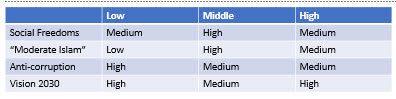
What follows is an educated guess. It can be no more than that, because there is no formal method of measuring opinion across the country, let alone within individual demographic components.
As for my qualification to make such guesses, I’m not a journalist like Friedman and others who are currently offering opinions within and outside the Kingdom. But over the past ten years I have met hundreds of Saudis – doctors, students, academics, and young professionals (Taxi drivers? No – hardly any of them are Saudi!). I haven’t deliberately sought to talk politics with these people, but some have done so of their own volition. I’ve probably spent more time in Saudi Arabia – and not just in Riyadh – during the decade than any foreign journalist who is not based in the country.
For some collateral on my experience, search this blog for two series of articles: Postcard from Saudi Arabia, and currently, RetroSaudi, which offers a series of comparisons between the country of today and how I saw it thirty years ago.
So here’s a broad-brush view, based on my experience and observation, of the support, or otherwise, of the Crown Prince’s domestic initiatives.
This table shows what I consider to be the likely spread of opinion by geographical region.

Next, here’s a breakdown of attitudes by age group:
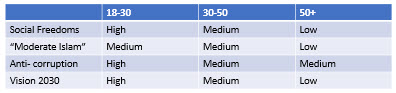
And finally, by economic status:
Jeddah, the Kingdom’s second-largest city, has always been more cosmopolitan than the rest of the country. As a port city and the traditional gateway to the holy cities of Mecca and Madinah, it has been open to more foreign influences and cultures than any other conurbation.
I have not included Mecca and Madinah in this table because I simply know too little of them to hazard as guess. As a non-Muslim I’ve never been allowed to enter either city. Historically, Mecca was never the heartland of the Wahabi movement. Like Jeddah, it’s a multi-ethnic city that welcomes all shades of Islam to the annual pilgrimage. Madinah, on the other hand, was the Prophet’s chosen city. Would Mecca be more open to MbS’s religious reforms? Possibly, but I’ll defer to others who know better than me.
The central region of Saudi Arabia is probably the most conservative area of all. The cities of Hail and Qassim have long been where you will find the sort of traditional social and cultural attitudes most commonly associated with the Kingdom. Heavily tribal, socially conservative, family-oriented and strongly supportive of the religious practice that MbS has undertaken to modify. Many of the influential religious preachers come from the area, and it has been a rich source of recruitment for Al-Qaeda and ISIS.
Riyadh has also been part of the conservative heartland, but its population has grown rapidly over the past twenty years. Many of the younger people, especially the women, are challenging the conservatism of their parents. The government has spent huge amounts on tertiary education, both within the country (and especially in Riyadh) and on scholarship programmes for foreign study. The young people of the capital have been beneficiaries of that expenditure, and I believe their attitudes have led many to embrace MbS’s reforms. But there is still a strongly-entrenched conservatism, especially among the older generation, that acts as a counterweight.
The East of the country includes the communities built up around Saudi Aramco. By and large, they are likely to support most of the reforms, especially the Vision 2030. The picture here, however, is complicated by the sectarian dynamic. The majority of Saudi Arabia’s minority Shia population live in the Eastern Province. While they might be in favour of the economic reforms, would they be strong supporters of “moderate Islam”? I suspect that many will be wondering if they will be beneficiaries of the new spirit of pluralism. After all, the government has long suspected them of being a fifth column for their fellow-Shia in Iran.
There is no inherent reason why the Shia should not be brought in from the cold. I have been to cities such as Al-Hasa, where Sunni and Shia co-exist quite amicably. But it will take a concerted effort by the government to overcome decades of what the Shia consider discrimination, suspicion and sometimes outright persecution.
Other parts of the Kingdom that I have not included in the tables include Asir, in the South-West. Like central Saudi Arabia, the region is innately conservative, but it has a distinct culture, and a tradition of religious plurality. If any region stands to gain from Vision 2030, it’s the Asir, which is poorer and less developed than other areas.
Finally, to the question posed by Blake Hounshell: what should Mohammed bin Salman do?
On the international front, three things.
First, he needs to find a way to end the Yemen conflict. It is causing Saudi Arabia massive reputational damage and is draining the treasury. Admittedly, this is easier said than done. He needs help from the international community to achieve this. But at the very least, he must alleviate the suffering of the Yemenis by allowing food and medicines without putting up insoluble bureaucratic roadblocks.
Second, he needs to make his peace with Qatar. The dispute is getting in the way of any concerted action he wishes to bring against Islamist insurgencies, and is enabling neighbouring actors to exploit the division in their interests, not necessary Saudi Arabia’s.
Third, if he really believes in “moderate Islam”, he should cut off funding and support for salafi propagation in other countries. That means funding for textbooks, literature and imams, especially when they espouse extremist sentiments at odds with the yet-to-be defined moderation he supports.
Domestically, Mohammed bin Salman has been receiving unsolicited advice from just about anyone who thinks they know anything about his country (including me). Based on my own experience, I’ll address in detail one critical long-term improvement that the Kingdom urgently needs. And that’s the secondary school system.
I’m not about to suggest that the schools need less religious instruction and more of other subjects. They probably do, but for me, they first need to focus on five key areas:
Critical thinking skills – particularly the ability to deal with manipulation via the social media
Career guidance – expert advice on how to choose a career rather than take “any job”
Citizenship skills – understanding responsibilities and obligations of adulthood, including money management
Preparation for work – understanding CV preparation, interview skills, the work ethic, employers’ expectations
Soft skills – including communications and emotional intelligence
Getting the kids into satisfying, reasonably paid and sustainable work is – hand-in-hand with a strong economy – one the surest guarantors of the long-term social stability of the country.
I also believe that he should focus on rapprochement with the Shia minority. That means investment in infrastructure and businesses, and bringing more Shia leaders into political institutions such as the Shura Council. A good start would be to commute the death sentences hanging over a number of people arrested during the recent disturbances in the east.
Other commentators are urging a number of actions – for example abolition of the female guardianship laws and improved judicial due process, particularly for corruption cases. They’re right to do so.
Finally, one can understand MbS’s thinking in locking up critics, and anyone who he thinks might be a critic. But he needs to realise that it’s not a viable long-term option for preventing dissent. There also needs to be dialogue and reconciliation, especially with members of his own family.
I have written this rather long piece not because I have any need to curry favour with MbS and his government. My days of visiting Saudi Arabia are probably over. But I do want Saudi Arabia to succeed, for no greater reason than that I still have many friends there. I may well be wrong on my assessment of the Crown Prince’s support within the country, and would be happy to be corrected by those who know better than me.
And for those who are lining up to criticise the current reform programme, I will end by quoting the words of Joni Mitchell:
“Don’t it always seem to go / that you don’t know what you’ve got till it’s gone.”
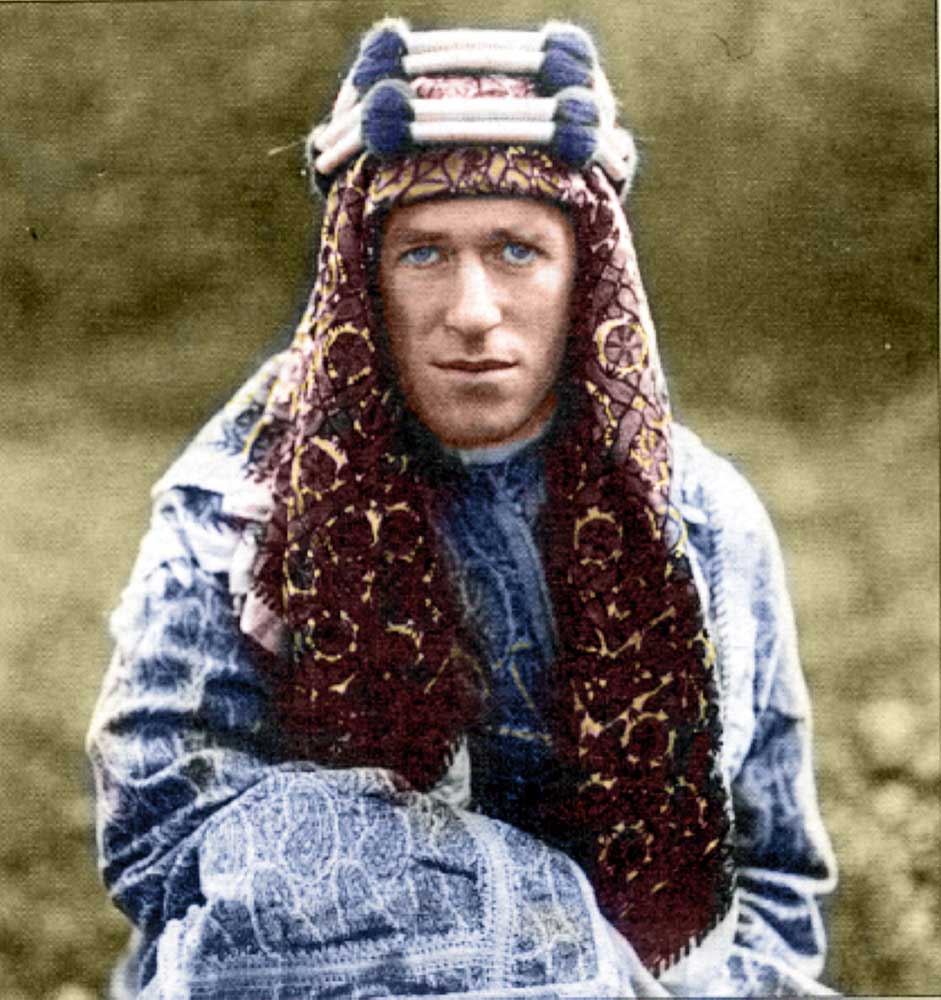
T E LawrenceIn my last RetroSaudi piece, I shared my thoughts from thirty years ago about the Americans I encountered in Saudi Arabia. I wasn’t very kind at the time, but looking back, my views have changed.
This time it’s the turn of the British, who probably exceeded the Americans in the size of their population in the Kingdom at the time. I always thought that my fellow British expatriates were far from representative of the UK as a whole. In fact, I used to say that if they were allowed to vote an MP to Parliament, they would be the only constituency to return a candidate for the National Front, which was the far-right party of the time.
Here’s what I had to say at the time.
Then (1987):
The British influence in Saudi Arabia is strong. Not a strong as that of the US, of course. We British failed to pursue the oil concession we negotiated before the Americans came on the scene. A missed opportunity almost on a par with the record company that failed to sign the Beatles.
As a result we lost a long-term source of income that could have replaced our fast-declining colonial revenue.
The Saudis have always had a soft spot for us. Maybe it’s because we invaded, occupied, colonised, “protected” or imposed political settlements upon just about everybody else in the region over the past hundred and fifty years, but had the decency to leave most of the settlements that now comprise the Kingdom of Saudi Arabia to their own devices, or to those of their Ottoman overlords.
If that’s why they’re fond of us, they’re conveniently forgetting that we left the Arabian interior alone because it wasn’t worth interfering with. The ancient Romans felt much the same way about Ireland.
So the Saudis buy our Rolls Royces, Jaguars and Range Rovers, as well as other less glamorous products that we still have the wit to export. But more than anything else they buy, or they think they buy, our expertise. Often enough they get the expertise they pay for. We do have some clever and capable Brits working here, despite our airs and graces that our hosts find rather comical.
We tend to blend into the local environment a little better than our American cousins. Whereas they try to create little Americas wherever they go, you’ll more often find us living outside the walled compounds beloved of the Yanks. Many of us have apartments and villas in ordinary streets, next to Saudi neighbours and within full blasting range of the loudspeakers coming at us from mosques on every street.
If we can afford it, my fellow Brits like to go sailing with their families every weekend, or to set off through the desert in search of little-known beaches miles away. If we get lost, we amuse the Bedouin with our garbled Arabic, perhaps opening with “Salam aleikum. El Orents, my grandfather”, in the hope that our new friends will also have grandparents with fond memories of Lawrence of Arabia.
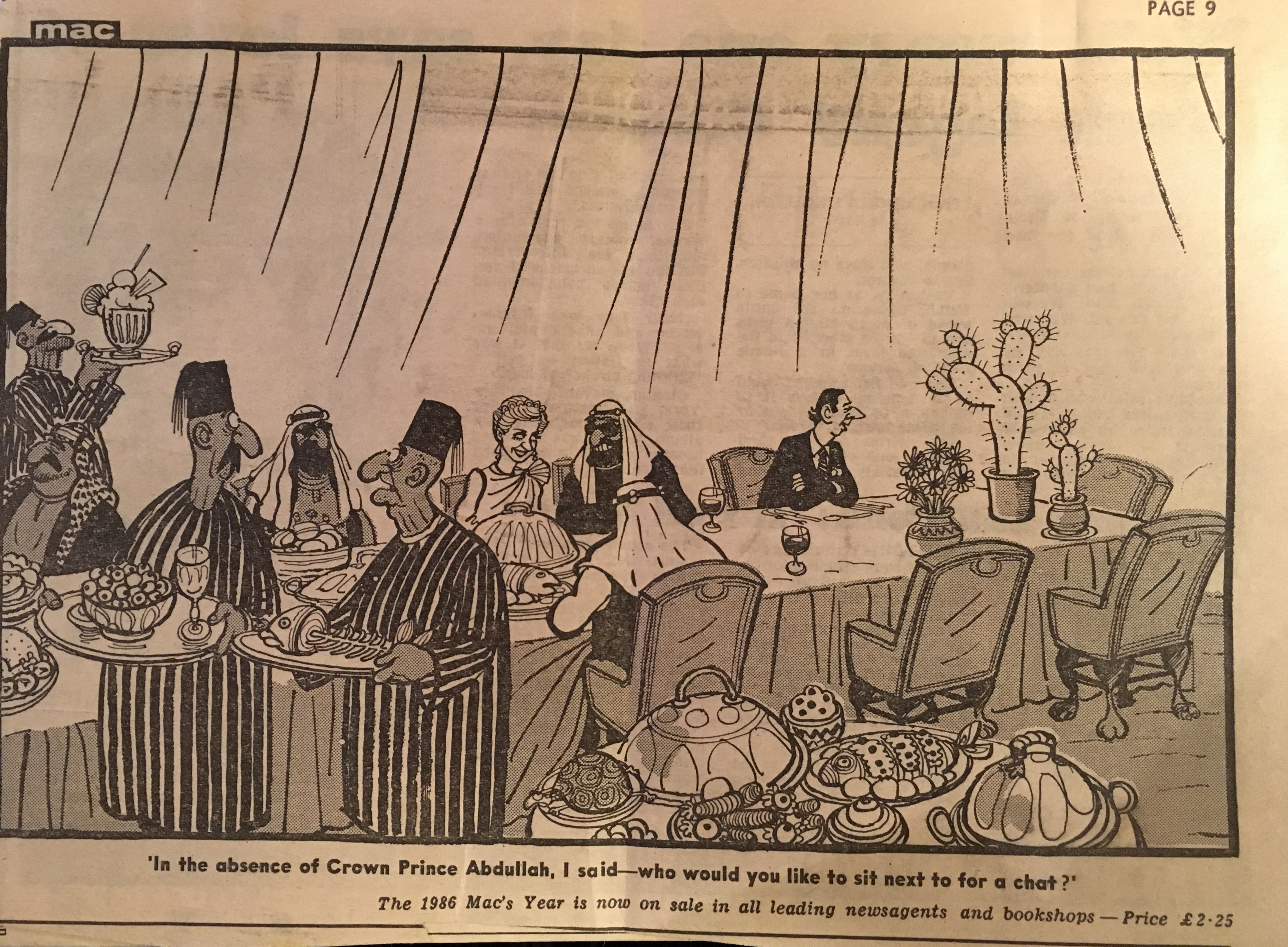
Shuaiba 1987
When we find the place we’re looking for, we pitch our tents, hit golf balls through the sand and organise a Scrabble competition. We swim, cut our feet on the coral, and spend the night fending off millions of curious crabs, claws clicking, that try and get into our tents.
Shuaiba 1987
Those of us who don’t have families with them get into more traditional pursuits: soccer, darts and the occasional booze-up with home-made intoxicants that sometimes cause the drinker to lose the use of one side of his face for several days after. Life can be hard without female company, and these are often the same people who get extremely drunk on flights home, and spend much of their time trying to grope the long-suffering air stewardesses.
Upstanding Brits (definitely not gropers!) Jeddah 1987
Some British families talk endlessly about property and investments. The future is everything, sometimes at the expense of the present. They dream of thatched cottages, cricket by the village green and other vanishing symbols of a long-gone age that they never knew. It’s only when they buy their cottages that they notice juggernauts rolling past their front doors like battalions of tanks on Salisbury Plain.
Others never make it home. I know of one guy who worked away from his family for thirty years, sent all his money home, educated his kids and provided them with a comfortable home. On his way to the airport for his final flight home, the poor chap had a heart attack and died.
Which suggests a lesson for all workers in a foreign land: make the most of the life you live. You may never get to enjoy your hacienda on the hill.
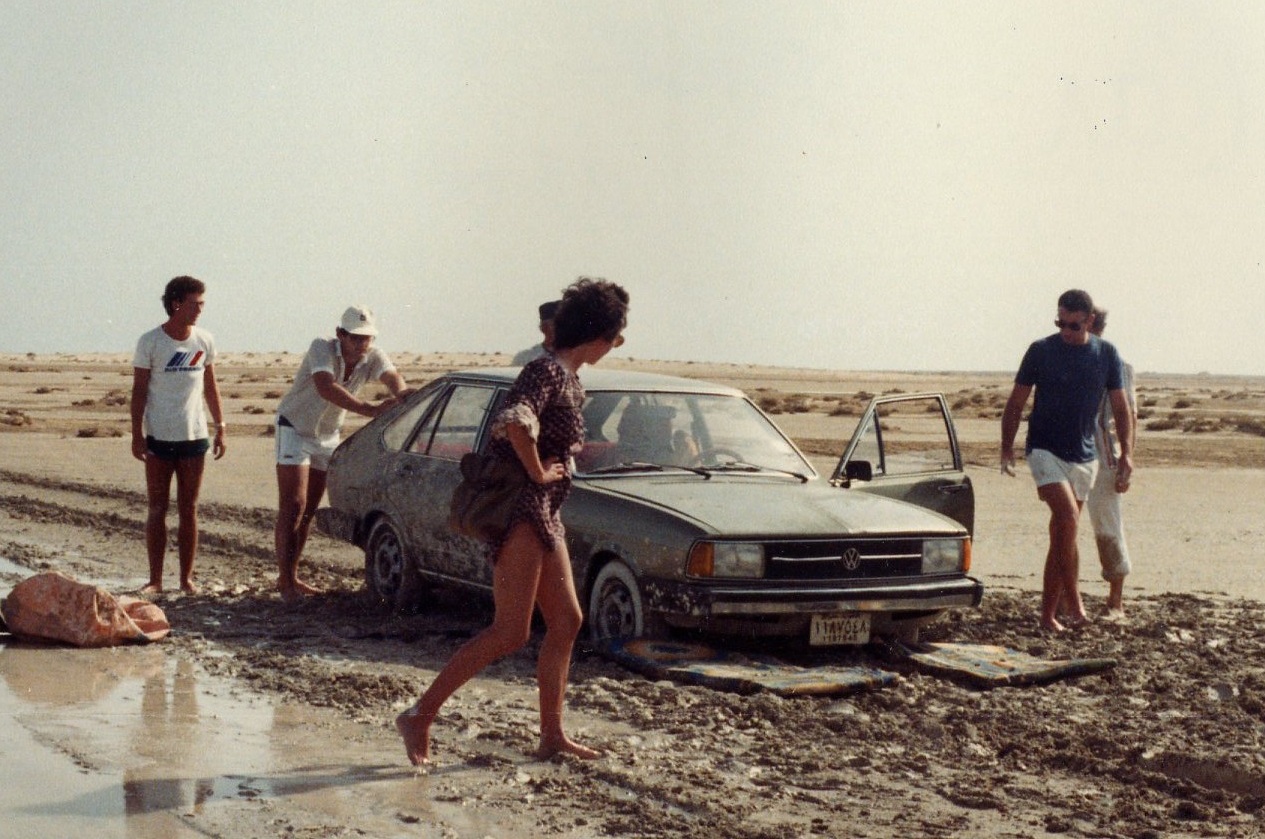
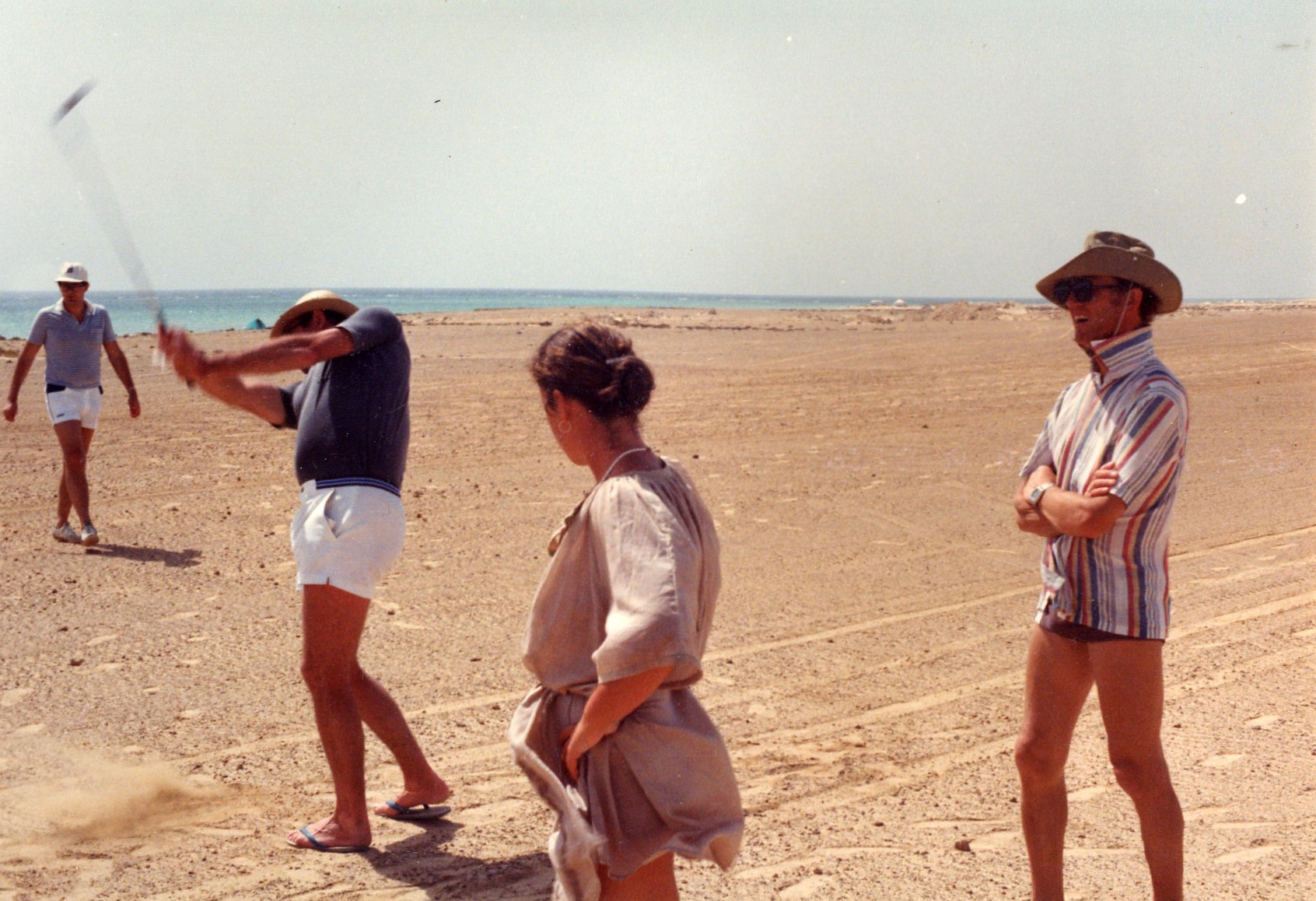
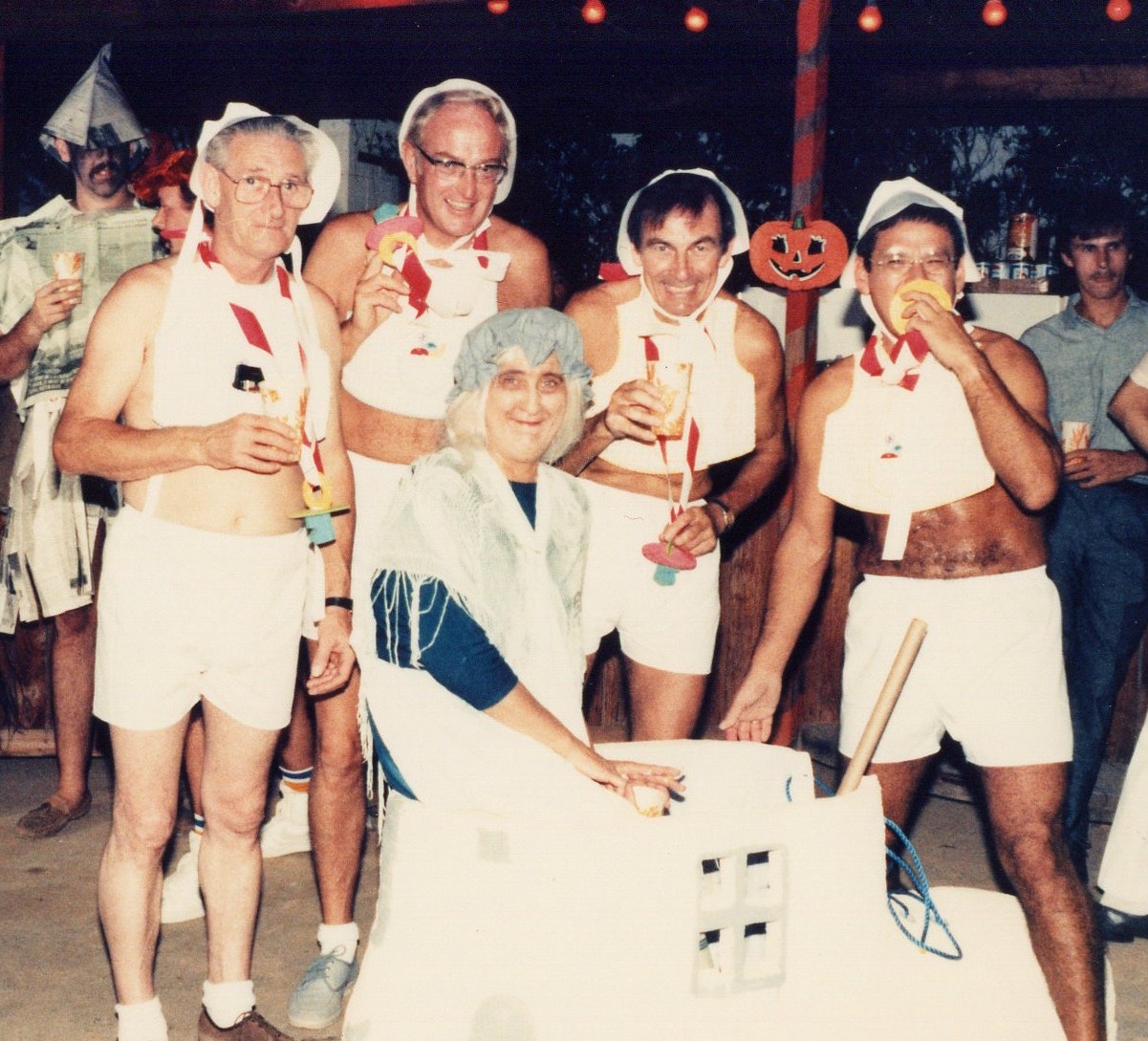
Now (2017):
What’s changed? In those days there were thousands of westerners across Saudi Arabia. Now, not nearly so many. The Saudis soon realised that they could buy their expertise from much less expensive sources. That process accelerated with the end of the cold war, when the Kingdom established diplomatic relations with former Soviet Bloc countries, while at the same time countries considered then as third world upped their education systems and started producing bankers, engineers and technicians with skills just as good as those of the pampered westerners.
We Brits have continued to sell stuff to the Saudis, most notably endless consignments of weapons, war-planes, jet engines and other high value technology. With them came the people to install and maintain them. But by and large, Brits who are not holding down executive roles are harder to find.
There is one curious remnant of the past. For all the diverse sources of expertise available to the Saudis today – including large numbers of their own people who have returned from expensive degree courses in America, Britain and other western countries – many Saudi businesses value the presence of the token khawaja – the slightly derogatory term used in Egypt for westerner – often an American or a Brit of advanced years, who can deliver words of wisdom in meetings and sales presentations.
I know this, because I have served as that khawaja on occasions. Not, I assure you, because of my expertise, but because my age and nationality brings an implied credibility. Of course if I was incapable of playing the part and adding some value to the proceedings I would have been out on my ear shortly thereafter.
But I think it’s sad that so many Saudi businesspeople feel that they have to rely on people like me. They have plenty of talent within their own ranks and ought to have the confidence to rely on it more. Perhaps in the shiny new era of Prince Mohammed bin Salman this will change. Otherwise, what has been the point in spending billions of dollars on sending hundreds of thousands of young people to be educated abroad?
I suppose one of the problems the Saudis have always had with their foreign labour, including the Brits, has been that knowledge is power. Whoever can keep their knowledge to themselves has a better chance of keeping their job than if they pass it to others.
Back in 1987, my Saudi boss gathered all his western managers together, including me, and told us that those of us who were best at eliminating our jobs by passing on our expertise would be the ones who would be with them the longest.
Perhaps Mohammed bin Salman would be wise to send that message to the millions of foreign workers who still ply their trade in the country. For Saudi Arabia to become more self-reliant in labour is surely the element in his reforms that he cannot allow to fail, and yet has been an objective that has eluded all his predecessors.
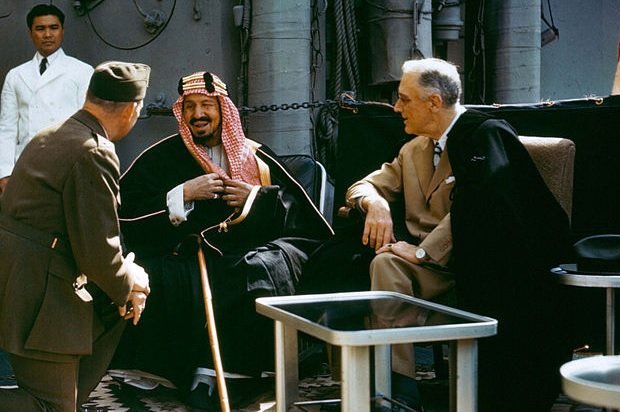
King Abdulaziz meets President Roosevelt
Since today is Thanksgiving, I think it’s appropriate to continue my RetroSaudi series with the words I wrote thirty years ago about my American colleagues in Saudi Arabia. There’s one problem. I wasn’t very kind to them.
I don’t often post stuff I’m subsequently ashamed of, let alone ashamed of before I post it. So I’m a bit squeamish about what follows. On the other hand, authenticity rules, so I’m sharing the thoughts of my younger self anyway.
Then (1987)
Ah yes. Well. Ah. Well I’m British, so I supposed I’m biased. I don’t want to go into observations about Americans in Saudi Arabia that might seem cliched, but I probably will. I like many of the Americans I’ve met here. But I’ve had to forgive them for many things.
For slip-roads and left-hand drive; for thinking they founded Saudi Arabia; for thinking the world owes them a living; for sending back US-educated Saudis who sound like Texans; for using long words when short ones suffice, and teaching the Saudis to do the same; for interminable and impenetrable acronyms; for being so aggressively ignorant of their host country, or so cloyingly curious about the things that aren’t important; for forcing me to change my spelling; for being so maddeningly hierarchy-conscious; for their blustering salesmen who promise more than they deliver.
I do thank them for a few things. For mistaking education for talent (in my case); for some rewarding friendships; for the fast food outlets they franchised in Saudi Arabia; for the strength of the US dollar; and for employing me in the first place.
All that said, my most serious reservations about the Americans I have come across in my work has been about their management capability. I admit that my workplace is perhaps not typical of all US operations in the country. Many, if not most of the managers are ex-armed forces. They’re either gung-ho Robert Duvall officer types straight out of Apocalypse Now (as in “I love the smell of napalm in the morning”), or they’re favour-trading Sergeant Bilko types.
Few of them would last five minutes as managers in their home country. If they did, the USA would rank just above Paraguay in terms of national dynamism. By and large, the American managers I’ve encountered are lazy, incompetent and complacent, or any combination thereof. I get the overwhelming impression that they’re in Saudi Arabia for an easy life, and as a means of topping up their military pensions.
Why? Could it be because the US military’s confidence-sapping reverses from the Vietnam War onwards spawned a generation of shell-shocked incompetents among the officer class? Could this be the reason why so many of the Pentagon’s new toys have failed to perform to expectations?
For whatever reason, as far as I can tell, America has sent very little of its managerial talent to Saudi Arabia. Short-sighted or smart? Only time will tell.
Now (2017):
Oh dear. In fact, ouch. Looking back, I accept that I was very harsh in my assessment. At the time when I wrote that piece, the American company I nominally worked for was being battered one way the next by a young Saudi manager who was intent on wresting operational control of his department from the contractor.
Relations became so strained that many of the Saudis referred to the US program manager, whose surname was Calp, as Ibn Kalb, which Arabic speakers will recognise as meaning “son of a dog”.
So the Americans thought they were in charge, and so did the young Saudi. He had more leadership ability in his little finger than most of his adversaries, so he won the battle, and every prerogative he seized from them they gave up with bad grace. I became a manager at his request, and worked directly for him. Perhaps my perception was coloured by that experience.
Looking back, I can see that I was hopelessly one-eyed. Of course there were some outstanding American managers in the country at the time, especially with Aramco, the national oil company. And many of the UN advisors I worked with were both wise and deft politicians, who were highly respected by the Saudis.
And as we now know, many of the junior officers who went through Vietnam are now the thoughtful, erudite generals like Mattis and McMaster who surround Donald Trump, and hopefully in extremis will save us all from him.
I also met some real characters. Guys like Tex Tutas, who stuck cattle horns on the bonnet of his truck, and whose favourite saying was “let’s get the hell out of here before they sell the car” in the manner of John Wayne. And Leroy Kelly, who taught me to cut out the multi-syllabic bull I used to write, and introduced me to the Fog Index.
Then there were also the wondrously talented Americans I worked with on theatre productions. Many of these people were English teachers, yet their acting and their musical abilities transformed many of the shows we worked on to a level that wouldn’t have been out of place in the professional theatre.
Many of them subsequently died of AIDS, but anyone who was in Jeddah at the time would fondly remember the likes of Paul Jones and Dick Hollenbaugh, who are no longer with us, and Ron Daugherty and David Frontin, who hopefully are.
Rubbing shoulders with so many different types of American, from dour, ass-covering ex-NCOs to exuberant actors and musicians was an education that prepared me for the next thirty years, during which in my business life I’ve had many dealings across the pond. And one of two of those I met in the 80’s are still friends today.
So here’s to you America. Happy Thanksgiving, and may you flourish again once you’ve expunged Donald Trump from your national stage.
Sorry, couldn’t resist that.
This post is dedicated to the good guys – Tex, Leroy, Stan Gray, Jim Gibson, Steve Smith and Ben Helms – from whom I learned much, even if I didn’t appreciate it at the time.

An interesting article in Britain’s Financial Times prompts me to continue my RetroSaudi series with a discussion on corruption. The FT quotes estimates that “anywhere between 10 per cent and 25 per cent of the value of government contracts is routinely skimmed, with the proceeds used to fund lavish regal lifestyles, channel money to loyal tribes and grease the palms of favoured functionaries.” Over decades, that amounts to a helluva lot of money.
Even in Saudi Arabia, the subject has been liberated into the public domain. Tariq Al-Maena, a veteran Saudi journalist who has often written in guarded terms about the country’s ills, has thrown off his self-imposed shackles to speak freely about the recent round-up of princes and leading businessmen accused of corruption in this article from the UAE’s Gulf News.
Normally in RetroSaudi, I quote stuff I wrote thirty years ago about the Kingdom. But on this subject, for some reason, I wrote nothing.
But I can offer a press cutting from 1987 that gives food for thought.

Saudia is the national airline. The King’s “gift” of a fleet of Boeing 747 aircraft was widely believed at the time to be unnecessary. The airline already had a huge fleet, probably larger than it needed. Why then did the King, out of the goodness of his heart, bestow these jumbo jets worth hundreds of million dollars upon Saudia?
If Saudia actually needed the planes, why did it not purchase them through its own resources, or by means of a loan or a lease?
I have no inside knowledge of the transaction, so what follows is pure speculation.
One possible answer was that the King drew the funds out of the oil revenue “off the books”. Saudi Arabia has long had a system whereby a proportion of its revenue is formalised in an annual budget – for education, infrastructure, defence and so forth – and the rest finds its way to senior members for various purposes – charitable donations, travel, property and other personal projects. The details of these “off-budget” payments are never revealed.
By using funds from unbudgeted sources, the King would have been able to draw down more than was needed to buy the planes, and distribute the difference as he saw fit.
I have no evidence that this was the case with the Boeing purchase. I merely present it as a kind of transaction that would have been typical of the time.
The question is: would such a deal have been corrupt – as seen through the eyes of the movers and shakers at the time – if it had happened this way?
To understand the wealth accumulated by various senior members of Al-Saud, and the means by which they acquired it, one needs to understand the mindsets that did the acquiring.
King Abdulaziz, with the assistance of his eldest sons, acquired his kingdom by conquest. Conquest means ownership. Therefore, subject to the constraints of Islamic law, the land he conquered and its resources were his to dispose of. And that included the oil wealth that a team of American engineers discovered in the 1930s.
But conquerors cannot rule by force of arms alone. Gradually, from the 1940s, ministries sprung up to tend to the needs of the population. So did laws that addressed matters not dealt with in the scriptures. However, the attitude among the sons of Abdulaziz persisted that the hospitals, schools and roads that sprung up flowed from their benevolence. In other words, they were gifts to the people, not rights. Just as the jumbo jets were gifts to Saudia.
Gradually, as the Kingdom increased its involvement with the outside world, the princes started realising that certain proprieties needed to be observed. There should be procurement regulations, competitive bidding – no matter that the same few companies won contract after contract.
Until Saudi Arabia joined the World Trade organisation in 2005, foreign companies that wanted to do business in the Kingdom had to do so either through local agents or via joint ventures. The agents, some of whom were princes and others long-established merchant families, grew fabulously rich through the importing of concrete, foodstuffs, automobiles and washing machines.
In the case of government contracts, transactions were somewhat murkier. Allegedly, intermediaries would agree with the decision makers who got the kick-backs, how they were to be paid, how much they would be paid and how the deal was to be structured. Provided the proprieties were observed – that there would be competitive bidding duly evaluated by technical experts – the deals went ahead.
Again allegedly, smart foreign vendors who knew the game duly inflated their prices to take into account the kick-backs, and found ways to avoid exposure within their own countries. Some, knowing that there would almost certainly be a dispute over the final payments for their contracts that could be resolved by discreet greasing of the wheels, inflated their prices further. It helped if they knew in advance that their name was on the contract before the procurement process started, and that the other bidders were there to make up the numbers.
I say allegedly because there has never been a prosecution of a minister or a prince for corruption that might lay bare the process – though that might change very soon.
Meanwhile, the construction companies, most of whom were Saudi, with foreign subcontractors as required, were all too happy to sit at the top of a supply chain who would each distribute largesse to their respective owners and sponsors, while the company that actually did the bulk of the work might receive as little as ten percent of the contract price.
Thus did the big boys, such as Saudi Bin Ladin, who endeared themselves to senior members of the royal family by building their palaces and not insisting on being paid, prosper.
Beneath the commanding heights of the economy, the most valuable commodity that its citizens had to offer beyond their own knowledge and skills was the little brother of the endemic corruption practised by the powerful – or as the powerful saw it, the natural way of doing things.
The little brother was called wasta, which roughly translated means influence, or clout. A kinder way of defining it is to call it social capital.
A person who uses wasta to achieve certain ends is not necessarily corrupt. They might be doing a favour to a friend by having a word about a job in the right ears. They might use their influence to persuade an official who happens to be a cousin to grant someone a visa.
For many princes lower down the royal food chain, wasta is their only asset. Being a prince, and being able to ask a favour of a brother, a cousin or an uncle, is an asset that can be monetised, either now or later. Who, after being introduced to a decision-maker for a business deal, or escaping jail for a road traffic offence through the good offices of a man of influence, would not be prepared to show their gratitude by financial or other means?
Wasta determines social outcomes too. Who would not be delighted to marry their son or daughter into a family with wasta, especially if it exceeds their own? Conversely, few families are prepared to allow their children marry for love, especially if the object of their affection happens to be someone from a family without wasta.
It is a system that pervades society, even if it is not always used for financial gain.
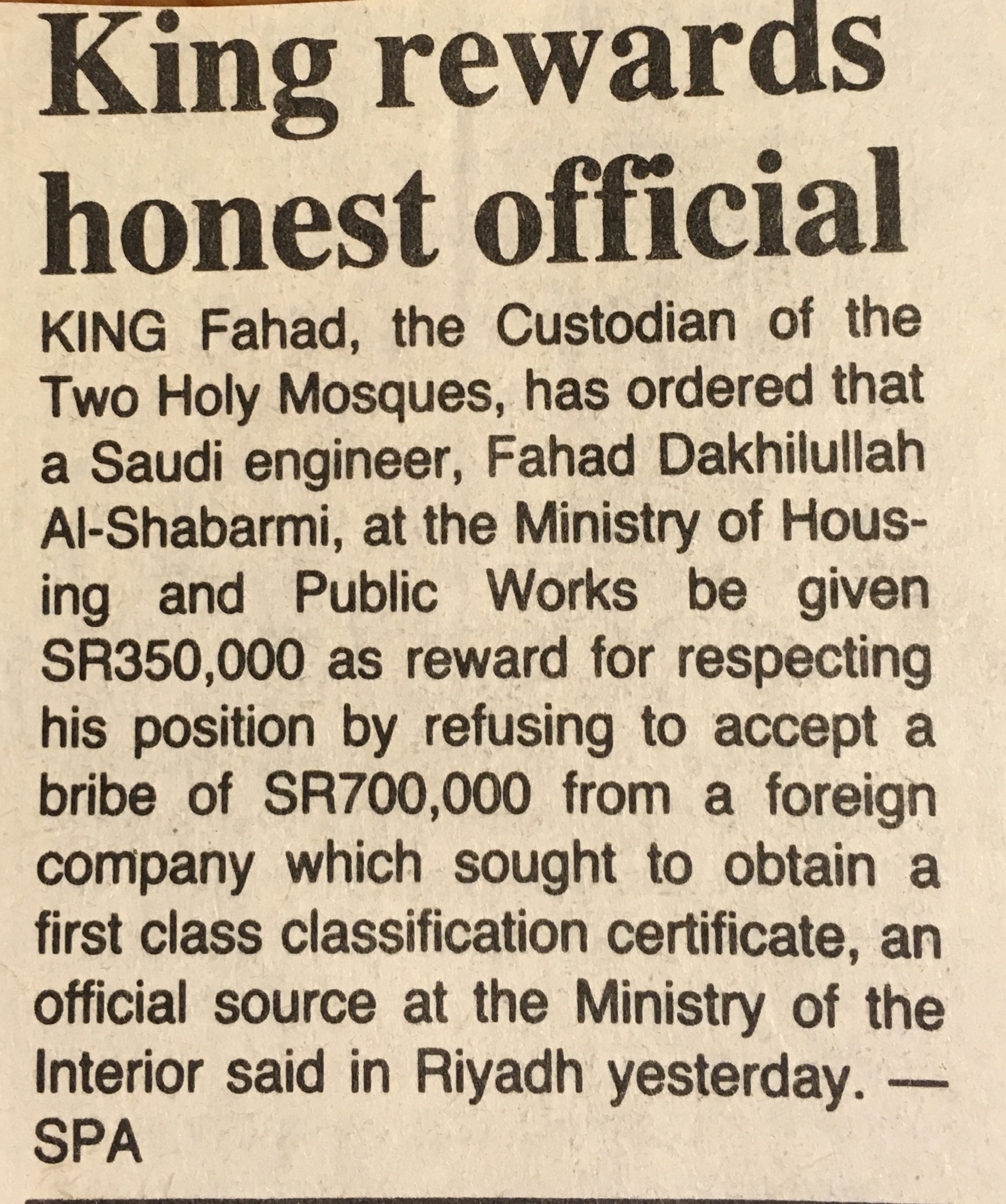
Saudi Arabia has long had anti-corruption laws. But until recently there was a whole class of untouchables. It was only the little people who were busted, or rewarded for their honesty, as this press cutting from 1987 shows.
2009 marked a turning point. Jeddah, a city that I know well, was inundated with seasonal rains, and despite flood defences that had seemingly been enhanced to prevent disaster, many people were drowned and thousands of homes were flooded. The drainage works were subsequently discovered to have been shoddily completed, and in some cases not carried out at all despite large sums of money having passed to contractors.
The result was a storm of outrage across the social media, to which the government responded by arresting and jailing a number of the perpetrators. Because of anonymity regulations, the names of those convicted were never officially revealed.
This article in the UK’s Guardian newspaper, describes the anger felt by many residents. I visited the city on a number of occasions around the time of the flooding, and I also witnessed the anger of Jeddawis, even though they were reluctant to ascribe the disaster – as the writer did – directly to the royal family.
Eight years on, as senior movers and shakers sit confined in their luxury hotel-turned-prison, accused of embezzlement of the state over countless years, the tables have turned. The big fish are wriggling. It’s highly likely that some will find themselves compelled to part with large proportions of their wealth in return for freedom.
I suspect that many of them will feel aggrieved. They will say that they were only behaving according to the unwritten rules of the time, and to punish them retroactively for what the vast majority of their peers were doing is unjust.
They may have a point, but those who have never benefitted from corruption and whose wasta is weak, will no doubt welcome their downfall, temporary or otherwise. And if the funds liberated from the wealthy go towards new schools, houses and other social programmes, then popular support for Crown Prince Mohammed bin Salman will no doubt continue to soar.
They will also be unlikely to be swayed by sceptics who argue that the arrests are not about corruption, but a means to silence dissent.
Ultimately, I can’t see an end to corruption and the wasta culture as long as the ruling family continue to believe that the country ultimately belongs to them. And for that to change, they will have to start acting as accountable custodians rather than conquerors.
At a time when democracy in my country and in the United States is falling apart, I’m not about to lecture anyone on the need for transparent governance and the rights of citizens. Saudi Arabia will have to find its own way forward, and it’s unlikely that their model will closely resemble ours.
But if it wants to imbue in its people a sense of ownership, then, as Jeremy Corbyn constantly reminds us Brits, it will have to convince its citizens that the state is there for the many and not for the few. In a region of nation states beset with similar concerns, that could take a long time.

RetroSaudi continues with a story for dog lovers An epic tale of crisis and survival in the Arabian Peninsula. Well, not quite as dramatic as that, but a testament to the resilience of the species.
Then (1987):
Before ACE came along, my home town of Jeddah was doggy heaven. You couldn’t walk near a piece of waste ground without coming into sniffing range of at least one pack of mangy hounds. They weren’t very fierce, and they ran away if you shouted at them, especially in Arabic.
Food was plentiful. The Jeddawis turned every vacant lot into a stinking garbage dump. Nice little creatures the dogs were, about the size of a small Labrador. Their dun colour allowed them to blend into the background. They looked like a cross between a jackal and a hyena, and appeared more intelligent than either.
Actually they were pretty stupid, as evidenced by the daily cull inflicted by car and truck drivers. No road was complete without the obligatory dog corpse or two lying by the side of the road, squashed to minimal thickness.
Whereas we in the west delight in the diversity of our canine breeds, Saudi dogs all look more or less the same. It’s as if they’d been designed that way, as specified in the Third Five-Year Development Plan. But that’s an unlikely theory, given that Arabs have a deep cultural squeamishness about dogs which is reinforced by a widespread belief that angels don’t enter houses in which they live.
This causes me to wonder why there are any dogs in the Kingdom at all. They must be resilient to have survived centuries of persecution. But dogs there are, even though the majority have to fend for themselves in the streets. A small minority are taken in by kindly expatriates, but they’re rarely allowed beyond the owners’ yards. Most westerners, however, prefer poodles and other sorts of lapdog, which remain cowering behind closed gates.
It’s entirely possible that the reason for the survival of the street mutt is because of the Egyptian population. Perhaps some of them are covert worshippers of the old Egyptian gods, including Anubis, the jackal-god.
As Jeddah grew, so did the dog population. Not even the road cull could keep it down. A pack of five dogs is intimidating enough, but fifty?
That’s when they called in ACE. Arabian Cleaning Enterprises. Jeddah’s first municipal cleaning contractor, arrived in 1982. The mission: to clean up the garbage from vacant lots and make the city fit for humans and plants. Not rats, not cats, and definitely not dogs.
Almost immediately fleets of aquamarine garbage trucks took to the streets. And smaller vans, from which pest controllers in aquamarine jumpsuits emerged, armed with poison and guns. Death squads on every street. Canine genocide. It was rumoured that there were even special squads armed with poison darts that they would fire from blowpipes.
From where were the blowpipers recruited? Who knows? From the Phillipines perhaps. Or possibly Papua New Guinea or the Amazon basin.
Within two months the dogs were gone. Mo more angry hounds barking at your car as you took off for work. No more forlorn corpses on the street. No more lonesome mutts howling at the moon, to be answered by a hundred echoes across the city.
Silence. Only humans and a few wily cats who survived the holocaust because they weren’t big enough targets. And rats of course, which survive everything.
This cat got away.
I supposed they incinerated them, or buried them in unmarked graves outside the city. A far cry from Anubis and his gilded tombs in the Valley of the Kings.
Now (2017):
The dogs didn’t return, at least not in any substantial numbers. If you google Saudi desert dogs, you’ll see lots of pictures of the dogs I remember. You’ll even find a photo of a proud-looking hunter with a hawk on his arm and salukis in attendance. That’s because Islam permits the use of hunting dogs, but not ones who sleep in your house and get taken for walkies.
And then, as so often happens when traces of Saudi Arabia’s pre-Islamic past are uncovered, a revelation. Yesterday, Ahmed Al-Omran, a renowned Saudi journalist, tweeted a report from Science magazine about recently-discovered rock carvings in the north of the Kingdom that show hunting dogs almost identical to the modern desert dog. The carvings are around 9000 years old, predating by at least a millennium the previous earliest depiction of dogs.
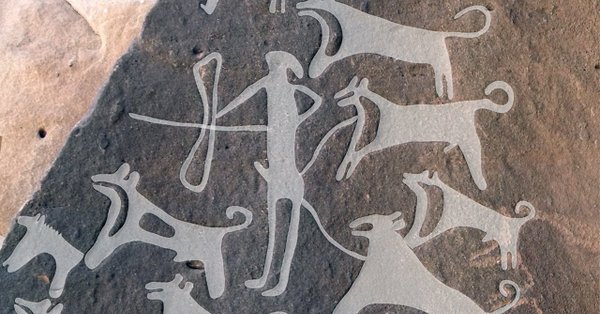
What’s just as significant is that some of them are on leashes, which suggests that these dogs were domesticated. The Science article claims that the carvings date from a time of greenery and abundant wildlife. Presumably when the desert took over the dogs ceased to be of use, which is probably why they suffered the ultimate indignity of being branded haram with the coming of Islam.
But dogs are resilient creatures, and should the gleaming new cities built over the past fifty years ever crumble back into dust, no doubt the dogs will return to scavenge through the remnants. Except that the gene pool will be wider. The desert dog will be joined by feral chihuahuas.

The next piece in my RetroSaudi series is about various diplomatic outposts in Saudi Arabia, and some of the more unusual things that took place in them.
Then (1987):
For many of the strangers in this strange land, the embassy occupies an important role in their lives.
For the unfortunate Korean jailed because he can’t afford to pay blood money after a road accident and has been abandoned by his company, the embassy official might be the only person with whom he can communicate if he speaks no language other than his native tongue.
For the Swedish businessman, his embassy might help put the zing into a sales drive by organising a grand reception and a prince here, a sheikh there.
For a British expatriate an invitation to tea with the ambassador is the social equivalent of being asked to a Buckingham Palace garden party, sniggered at my many but secretly coveted by more.
What makes embassy functions even more attractive to thirsty workers who normally have to make do with a 7-Up laced with aircraft fuel is the presence of real booze. As foreign enclaves, embassies can discreetly ignore the drink laws. How much each embassy takes advantage of that opportunity, and better still, spreads the benefit around its community of citizens, is largely down to the ambassador.
Although visitors have been known to have been carried out of western embassies after parties, much to the amazement of Ministry of the Interior security police, discretion generally prevails.
There have been notable exceptions, of course. One of the best functions of the year used to be the St Patrick’s Day celebrations at the Irish embassy. Every 14th March the ambassador would open his home to the Irish of Jeddah. Hundreds would come, and even though the gin was watered down, a good time was had by all. One of the nice things about Paddy’s Day was the liberal interpretation placed on Irish nationality. Chinese Irish, Caribbean Irish, Tanzanian Irish, Sri Lankan and Filipino Irish, even Saudi Irish were welcomed with equal enthusiasm. I qualified by virtue of being married to an Irish Irish.
On one such night the ambassador had to depart halfway through to attend another function. He left strict instructions with his Yemeni gate guard that nobody else was to be allowed in. When he finally got back at 3am, the guests had dispersed, leaving the guard determined to implement his master’s will. Which he did by refusing to allow the ambassador to enter. So the poor man had to get in over a wall and through a window. Within a couple of days the story was all over Jeddah.
By and large embassy people are a pretty bland lot. Not surprising, since they’re paid to be just that. My experience of the British Embassy is that in official matters the staff display that insolent politeness of British civil servants everywhere, as in “we wouldn’t want to do that, now would we sir?”
Outrageous!
The commercial folks who should be out there drumming up business are about as effective as ducks in the desert. The ambassadors I’ve met have been charming Arabists who appear to have been plucked out of a John Le Carré novel.
The US Embassy and its consulates are heartily despised by many of its citizens of my acquaintance. The Jeddah consulate, formerly the embassy, is a fortress. There are sleepy Saudi guards with guns bigger than themselves sitting in huts every fifty yards around the perimeter. A pick-up truck with a huge machine gun cruises around the compound day and night. Inside are a company of tough-looking marines armed to the teeth. The have a special dispensation from the Saudis to use walkie-talkies, and wherever they go they carry bleepers at their waists like low-slung holsters. You can run, but you can’t hide, right?
One American told me that the only time he’s ever let into his embassy is to file his tax return. The prevailing feeling among the US community here is that their embassy exists to serve the interests of the US government first, American business second, and individual citizens a very poor third.
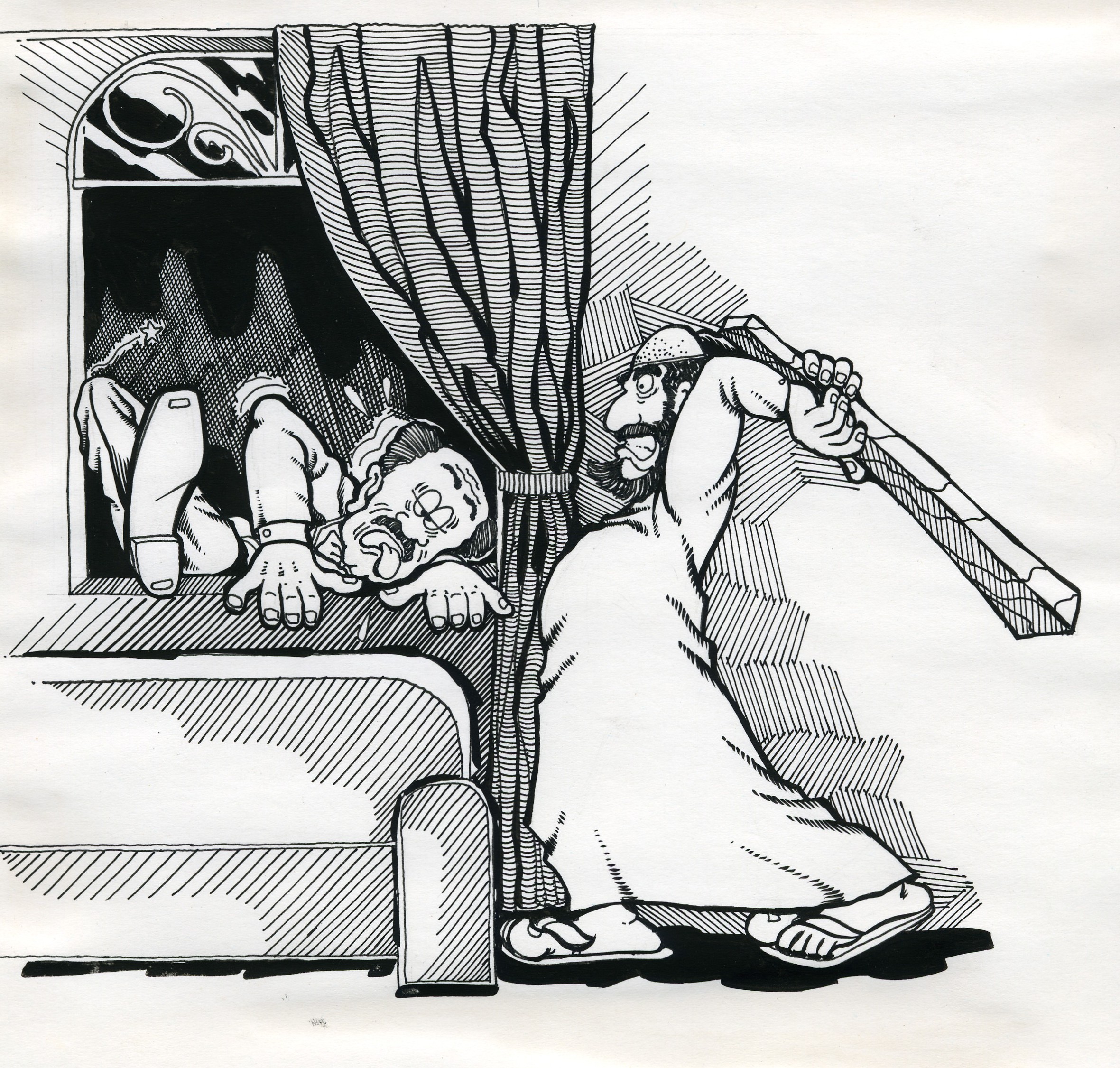
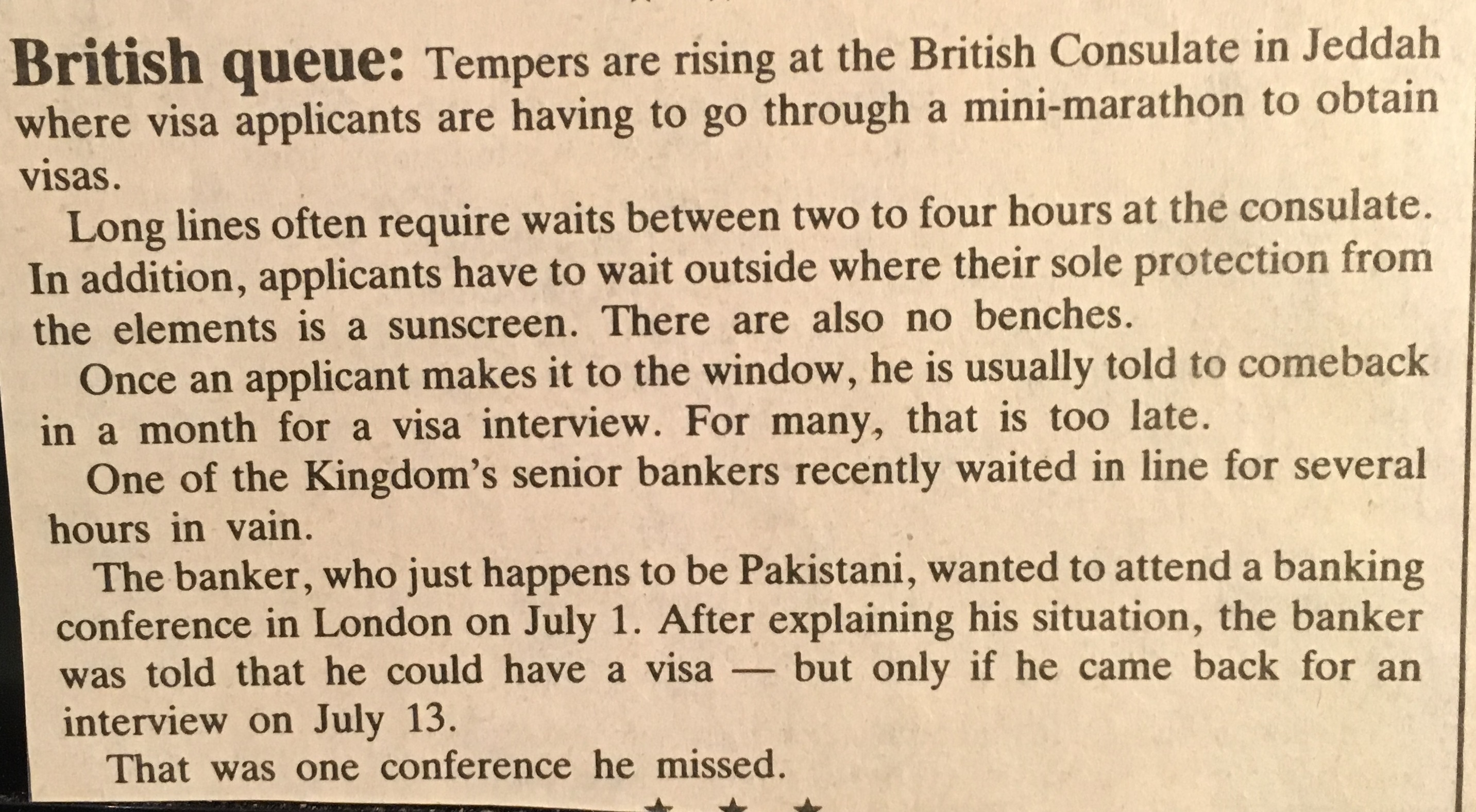
Now (2017):
Not much has changed since 1987, except that these days most of the embassies are confined within a heavily fortified district of Riyadh called the diplomatic quarter. I rented a villa there for a while, and wrote a little piece about the experience: Adventures in the Diplomatic Quarter.
I neglected to say that the British Embassy, when it was in Jeddah, boasted a large stage in its grounds. Several times a year, an amateur dramatic society, to which I belonged, put on plays in front of audiences of hundreds. It was there that I did my first acting since university. We did all manner of shows with large casts, ranging from Shaffer’s Amadeus to Shakespeare’s Romeo and Juliet.
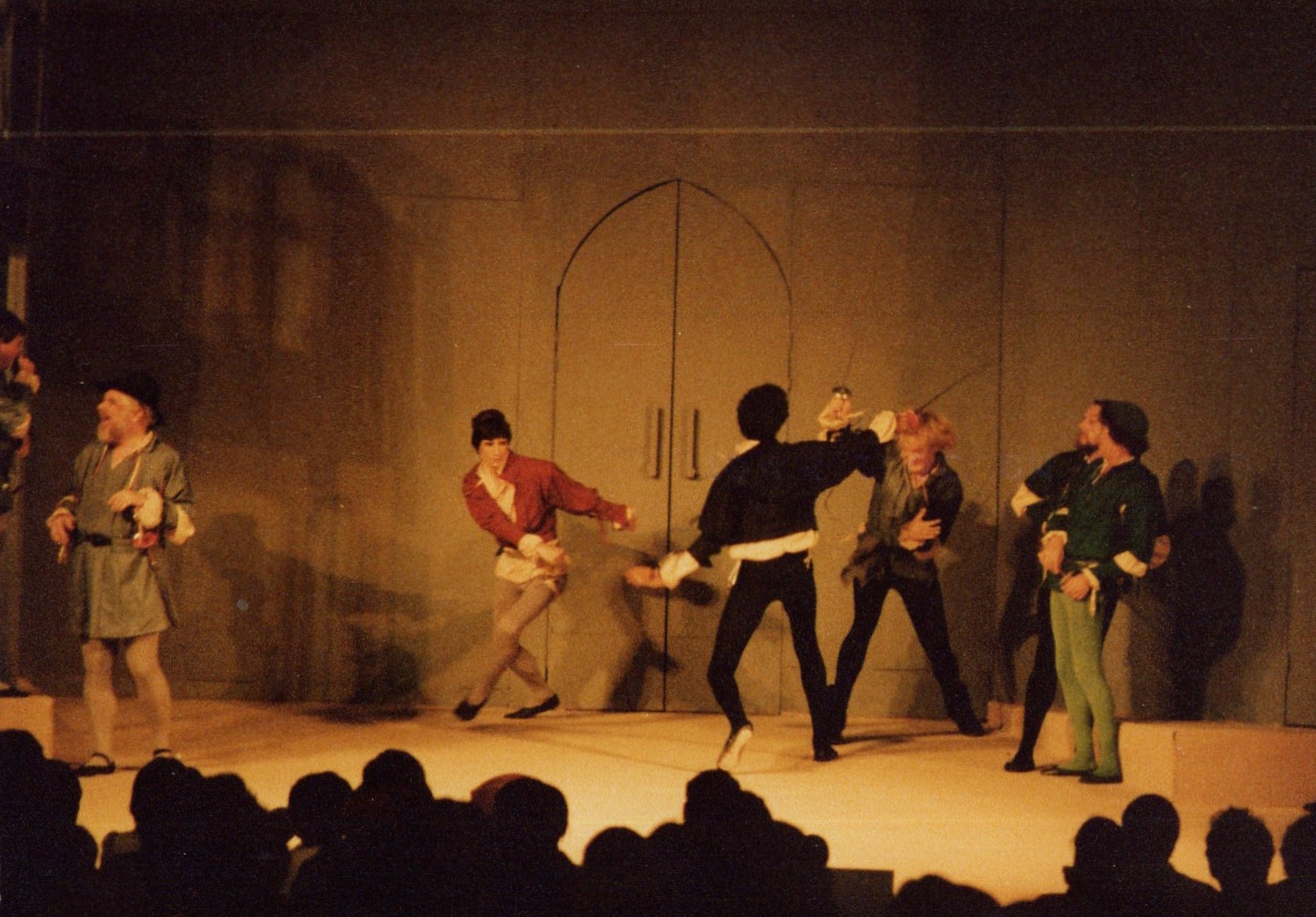
Romeo and Juliet, Jeddah. Advantage Tybalt
The only problem with this superb venue was that the Embassy was directly on the flight path to Jeddah Airport. Every so often, the actors had to stand like statues while a plane came screaming over at low altitude. One wonders how the luvvies at the National Theatre who throw a hissy fit every time a mobile phone goes off would cope with a Boeing 747 on full power a few hundred feet above.
One also wonders what our Saudi guardians outside the embassy would have thought of wannabe Broadway divas screeching away at full volume. Not a patch on Um Kalthoum, most likely.
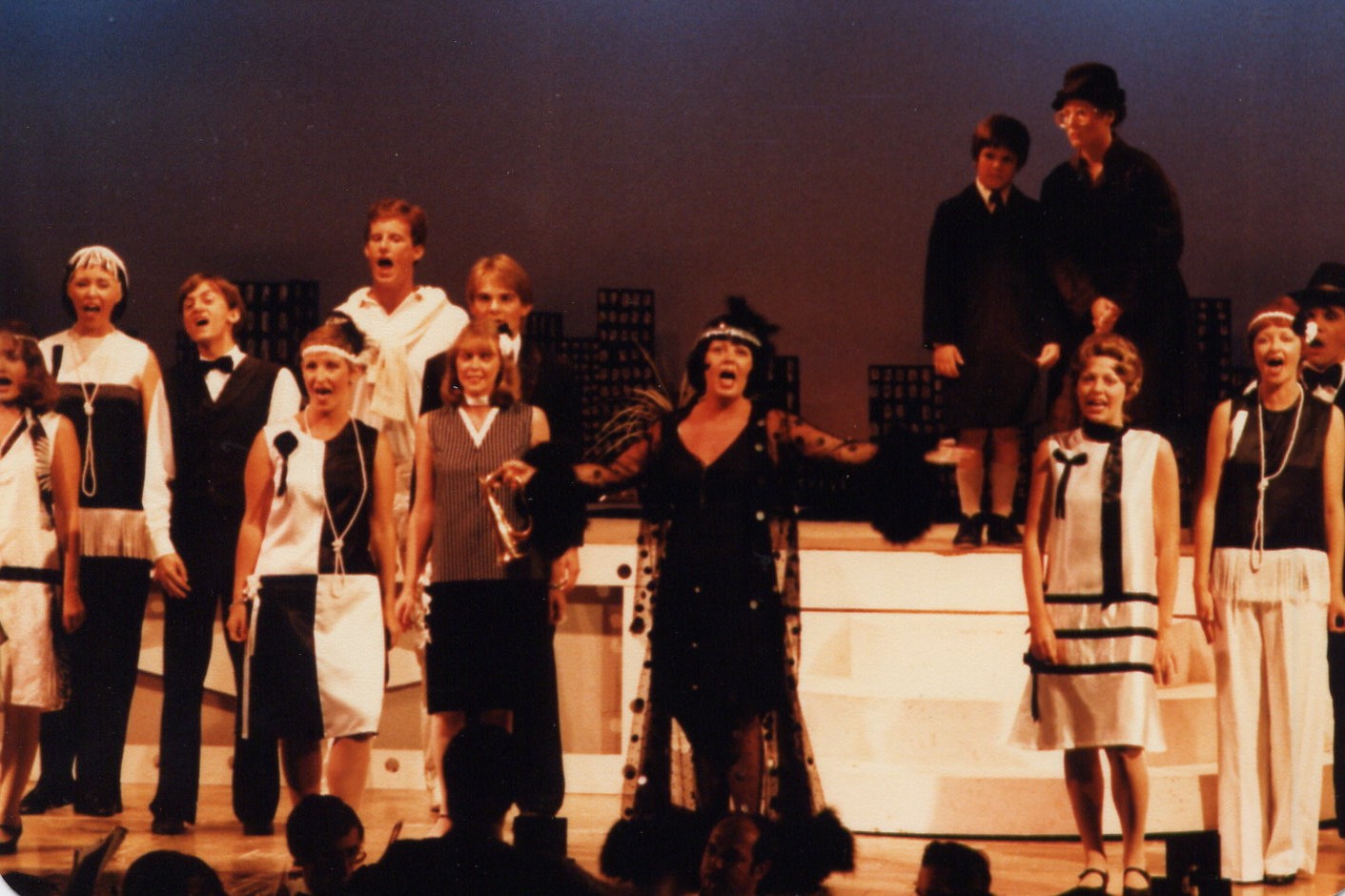
Mame in full voice
All these activities were serenely presided over by the ambassador. For the early part of my time in Jeddah, he was Sir James Craig, who died recently. Before he left, he wrote a scathing end-of-term dispatch to his masters in London about his posting, in which he accused the Saudis as being “feckless, incompetent and unconscientious”. It was supposed to be confidential, but someone leaked it. And of course, copies were smuggled back to us in Jeddah, much to our delight. Not that we agreed with him, you understand.
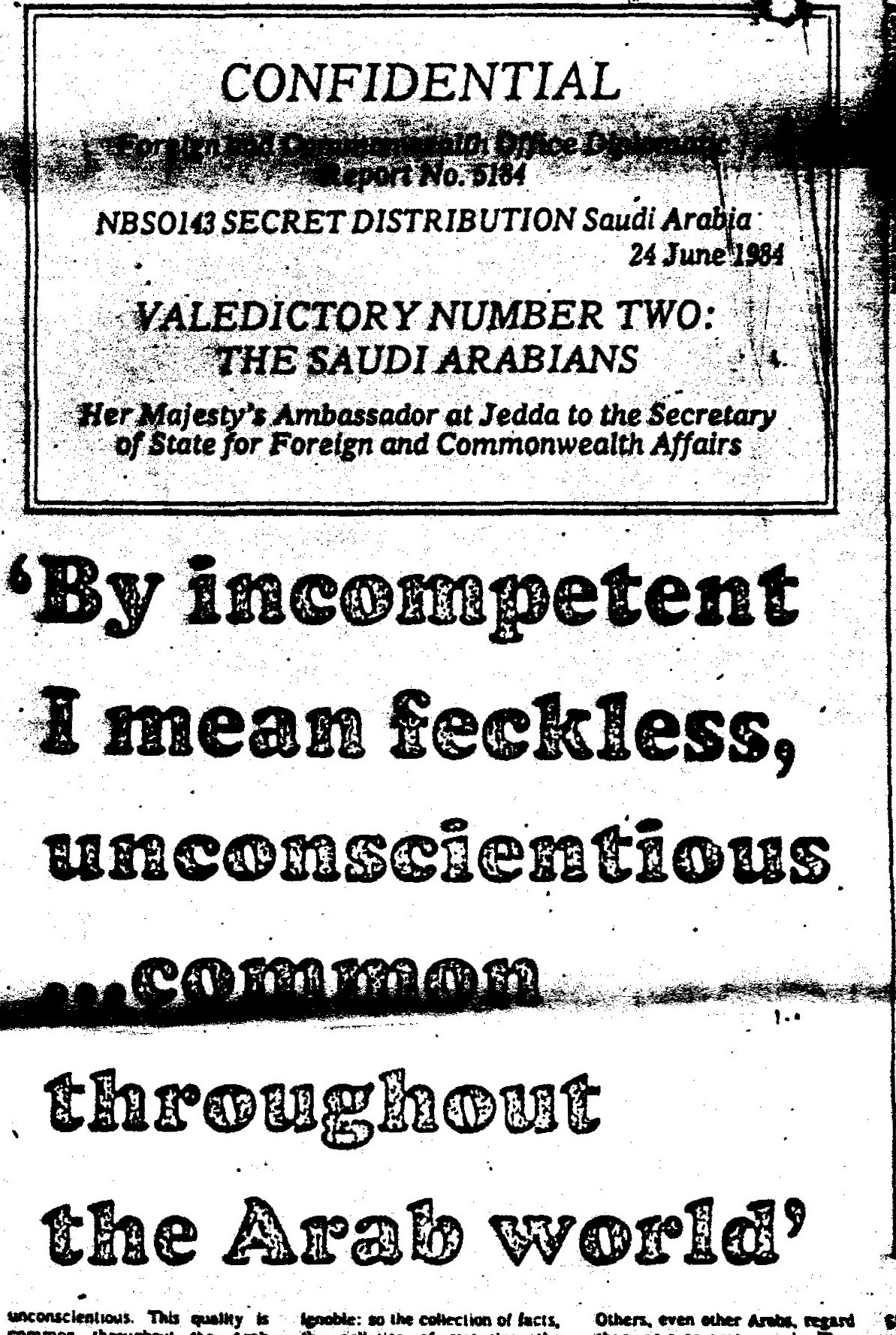
The Saudis did forgive him though, possibly because they admired his mastery of Arabic, both classical and colloquial, and his love of the Arab culture. He maintained strong links with them well after retirement.
His successor was not so deeply appreciated, partly because of his unfortunate habit of nodding his head violently when making a point. This was highly counter-cultural. Saudis, used to keeping their heads still for fear of losing their ghutras, thought he was rather undignified. Little things make a difference in diplomacy, I guess. Moral of the story: don’t appoint a moorhen as ambassador to a Middle Eastern country.
Alas, the days of Cecil B De Mille productions ended when the British Embassy moved to Riyadh. There are still events in the Riyadh embassy as far as I’m aware, such as charity dinners. But even they have become more sedate, partly because an unfortunate incident a few years ago.
A British group called the St George’s Society – no doubt Brexiteers before anyone even thought of leaving the EU – used to hold an annual function. When they put on a fancy dress event they incurred the wrath of the authorities because photos of people draped in the St George’s cross appeared on their website. Crusaders in Riyadh was taking things a bit far.
It’s been a year or two since I last attended an embassy function in the Middle East. No doubt things are a bit more exciting these days, as “characters” like Donald Trump and Boris Johnson (I was about to say idiots, but that would be undiplomatic) fly in and out.
But with the US State Department being slowly degraded, and the British flag becoming increasingly irrelevant, I suspect that the most influential embassies of my youth are prized more for their Buds and gin’n’tonics than for any other reason.
Finally, a little story told by James Craig. Diplomatic shipments, including the all-important booze supplies, were not subject to customs clearance. One day, the British Ambassador received a call from the director of Jeddah Port. “Your excellency”, he said, “would you please come and collect your piano. It is leaking”.
Further reading: if you’re into ambassadorial yarns, I recommend Ever the Diplomat, by Sherard Cowper Coles, and Keep the Flag Flying by Alan Munro, both of whom are former ambassadors to Saudi Arabia. Also The Spanish Ambassador’s Suitcase, a compendium of diplomatic dispatches compiled by Matthew Parris, is a good read.
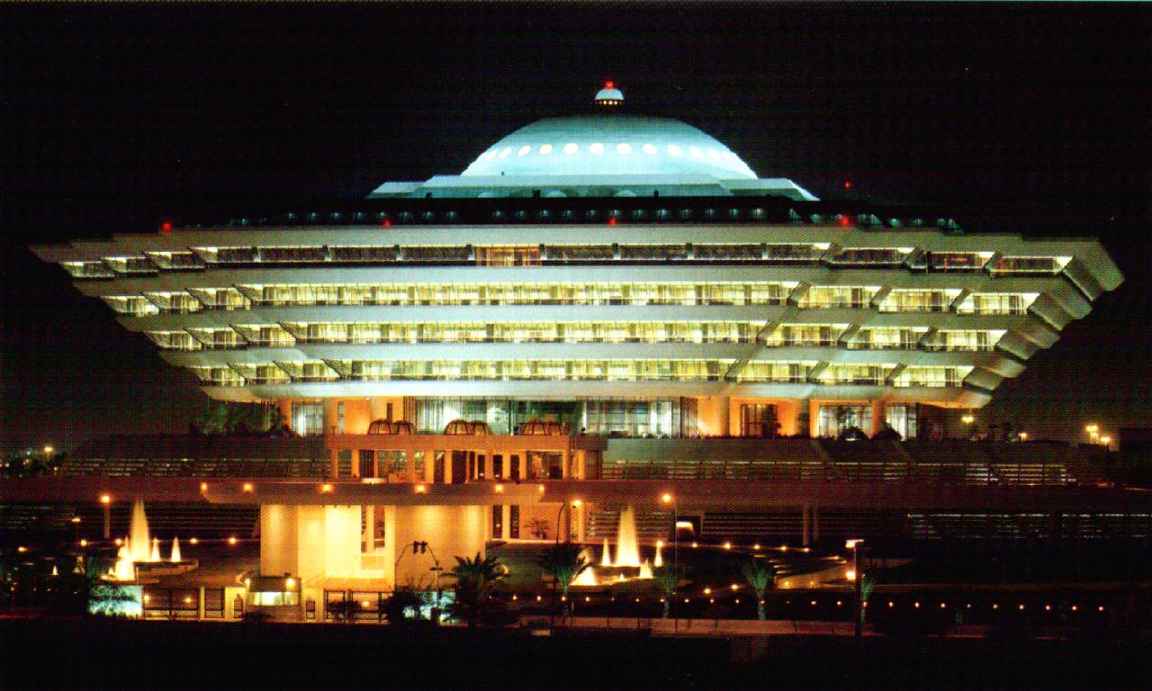
Ministry of the Interior, Riyadh
RetroSaudi continues with this piece I wrote in 1987 about crime in Saudi Arabia. My commentary thirty years later suggests that much has changed since then.
Then (1987):
There is no crime in Saudi Arabia except on Fridays. That’s when the gruesome punishments take place that we all hear about. But floggings, beheadings and amputations cover only specific offences reckoned by Islamic law to be serious: murder, rape, theft and the like. The run of the mill villain is rewarded by jail and fines, as in most judicial systems.
The Islamic system of justice is known as the Sharia, which is the Arabic word for “the path”, or “road”. Aficionados of the Ayatollah will be familiar with this code, which is based on the Holy Koran, and on the sayings of the Prophet as interpreted by successions of scholars through the ages. Of course, the precise flavour of the version adopted by a particular country is often directly linked with the nationality of the scholar whose interpretations prevail.
There are those who argue that to adopt a set of rules made for a bunch of supersitious desert-dwellers fifteen hundred years ago is perhaps a retrograde step in an age in which computers can store the contents of the Koran on a pinhead. It’s worth remembering that one of the leading religious sheikhs, Ibn Baz, believes that the earth is flat, and that the Americans conned the world by landing Armstrong and Aldrin on an earthly desert back in 1969.
Among the more interesting rulings in the Sharia is that it’s a sin to pay or take interest, Over the years the rule has been inconsistently applied. In the good times the banks openly charged and paid interest. The government was the source of all wealth; and directly or indirectly it held huge stakes in the Kingdom’s banks. Interest was cheap and big business borrowed to the hilt to finance their factories, shopping centres and office blocks. Then the big gusher started to dry up; government contracts got scarce and the economy went badly on the slide, leaving many of the’business grandees high and dry. The total debts of some of the more notable casualties would have been enough to keep a small country like Thailand afloat for a year.
When the banks called in their loans, the debtors, in the uniquely self-righteous style of the profoundly bankrupt, went on the offensive. Invoking what the sheikhs had been preaching for years, they declared that they had been sinfully coerced into paying interest. Any part of the debt that arose through unpaid interest, they argued, should be cancelled.
Since some of these debts were years old, and had accrued massive interest, the banks threw up their hands in horror. To no avail, for the clergymen who sit in the Sharia Court predictably ruled in favour of the debtors. Overnight some of the biggest debts were sliced in half, and the banks found themselves with billions of riyals of open-ended, interest-free loans on their hands and no foreseeable chance of getting any of it back. Not so the government itself, which invested the huge surpluses of the boom years in nice little interest-bearing investments, such as bonds, throughout the sinful West.
Beneath the stratospheric heights of international finance, the Saudis are often given to boast that thanks to the Sharia theirs is the most law-abiding society in the world. Certainly crimes against the person, other than those arising through blood feuds or tribal rivalry (tribal wars were only replaced by suicidal driving as the nation’s favourite hobby within the last thirty years), are rare. But to advertise the low crime rate as a symbol of the people’s submission to the will of God, is to my mind somewhat fanciful.
The rewards of honesty
I suspect, having always been a natural opponent of the flog’ em and hang’ em lobby, that if the Kingdom truly has a dramatically lower crime rate than its neighbours, it’s because the country isn’t gripped by extremes of poverty like Egypt and Sudan. Since at least some of the wealth has trickled down to the lowest social levels (far more than in the Shah’s Iran), there’s less crime born of desperation here, except perhaps on the part of those down to their last ten million dollars. Offences against the person are rarely reported even if committed; rapes occasionally take place in western compounds, and one sometimes hears of some poor worker murdered by his mates, but these are rare, and therefore noteworthy, events.
The most common and obvious crimes happen thousands of times a day in full view of everybody, on the roads. While the citizens of Saudi Arabia may lag behind the rest of the world in the achievements of its specialist criminal fraternity, they make up for it on the road. Dangerously and flamboyantly. But that’s another story.
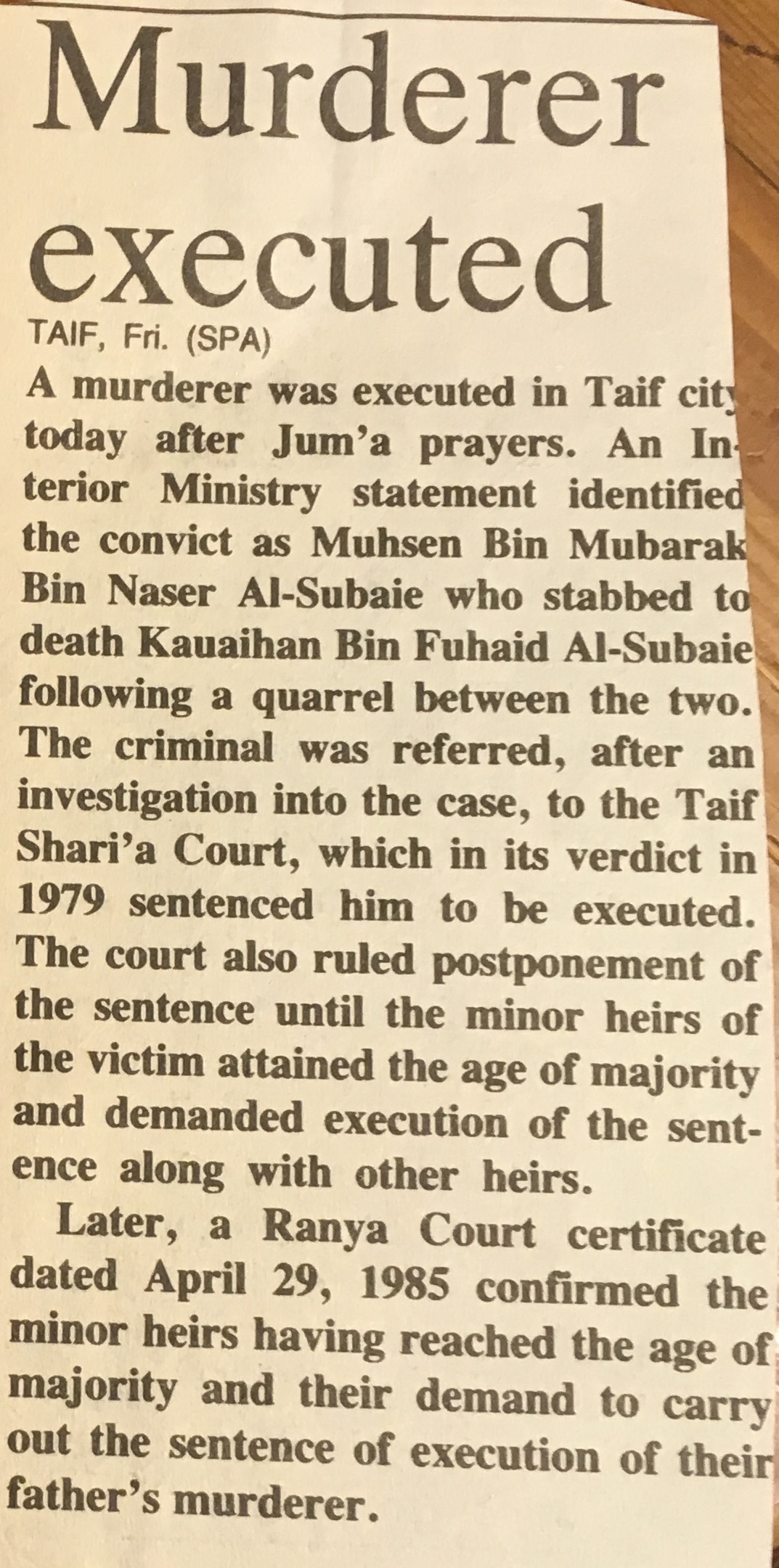
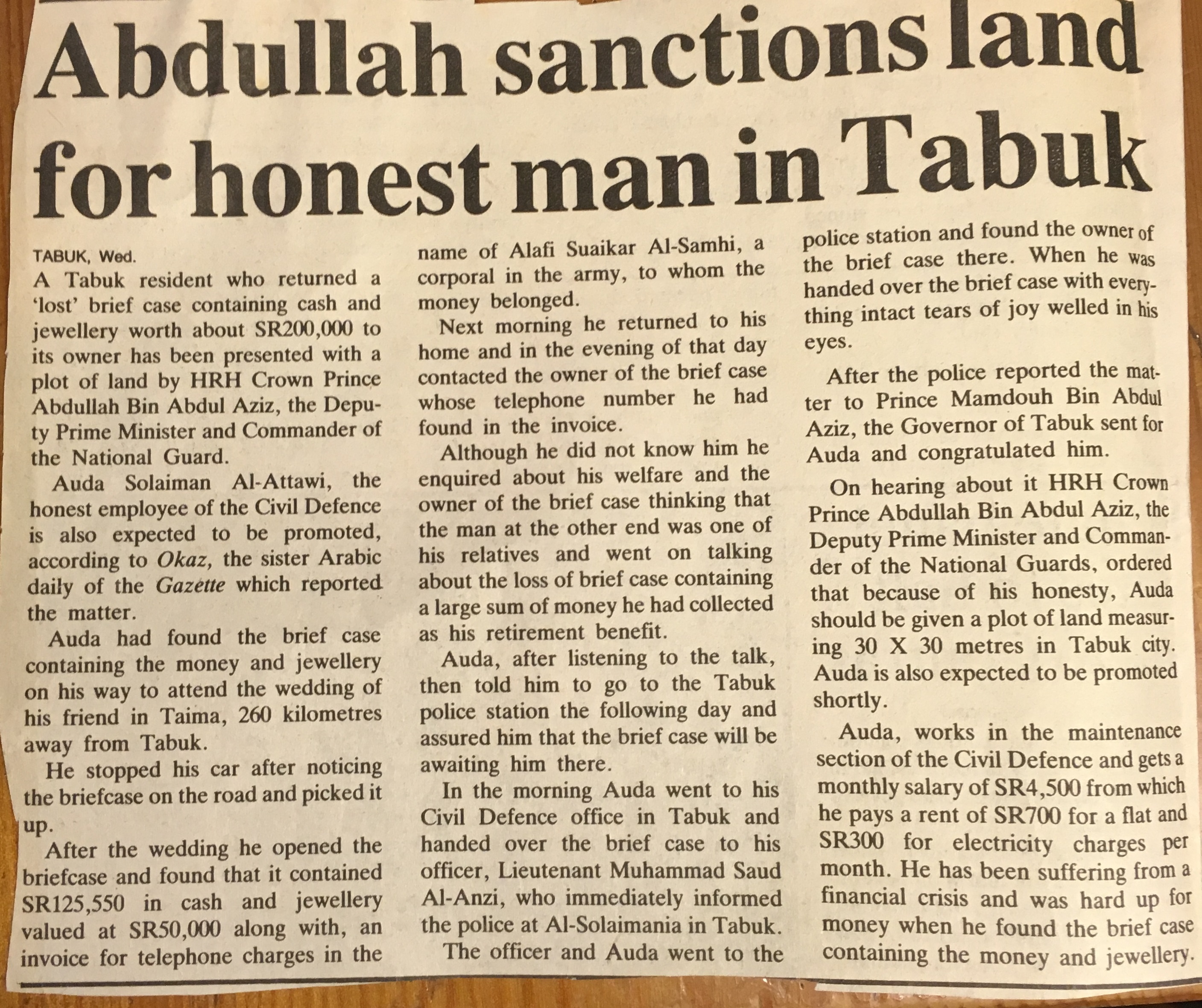
Now (2017):
I never witnessed an execution in those days, deliberately. I knew where they took place and stayed well away. What I didn’t mention was that the list of capital offenses was not confined to murder and rape. It included drug smuggling and sorcery. Yes, sorcery.
I also didn’t mention corruption, which I shall write about some other time.
Fast forward thirty years, and the picture is quite different. Saudi Arabia is starting to resemble other countries in the amount of petty crime on the streets: mugging, pick-pocketing, car theft and so forth. Districts of Riyadh and Jeddah that used to be quite safe to wander through – such as Batha and Balad – are no longer so.
Back in the day, it was said that you could leave your car unlocked, and nothing would disappear from it. Not now.
Why the change? Two major reasons. Since 1987, the number of illegal immigrants – people without papers, living on their wits and scratching a living any which way, has increased substantially. So much so that the government launched a major crackdown between 2012 and 2015 that resulted in hundreds of thousands of people – especially from the Indian subcontinent – being deported.
Also there has been a massive increase in the Saudi population, with the result that today 70% of the population is under 30 years old. The economy has been unable to provide enough jobs for these youngsters, which has meant that there are many people with plenty of time and little to do. Some have resorted to petty crime. Others have gone to Syria to fight for ISIS.
The problem is exacerbated by the fact that the Kingdom is not exactly awash with sources of entertainment, so young males get their kicks where they can – through stimulants such as captagon, and for those who can afford it, suicidal drifting – as in driving cars on two wheels – on highways outside the cities.
Crown Prince Mohammed bin Salman has resolved to make his country more fun. There’s talk of cinemas and entertainment zones to persuade the young to stay at home rather than disappear to the fleshpots of Dubai whenever they can. I’m sure that will help, though what’s on offer in Dubai far exceeds such innocent pleasures as going to the movies.
As for the punishments for which Saudi Arabia is famous, the number of executions has increased substantially over the past three years, which reflects the draconian penalties for acts that the government considers terrorism.
There has also been an increase in prosecutions for white-collar crimes such as fraud and forgery, some of them involving banks and high-profile businessmen, of which the most spectacular has been the dispute between the privately owned Saad and Gosaibi groups. The recent arrest of the head of the Saad Group – as reported here by the New Yorker – undoubtedly raises the stakes.
Had not Maan Al-Sanea’s incarceration been followed by the mass round-up of prominent princes and businessmen in Mohammed bin Salman’s recent corruption crackdown, I suspect that his case would be attracting far more attention today.
These are busy times for the Ministry of the Interior, whose headquarters (above) hovers over Riyadh like some all-seeing alien spaceship.
Will things settle down soon? Not, I suspect, until Saudi Arabia has gone some way towards resolving its political, social and economic challenges.
And a doubling of the price of oil might also help.
A couple of weeks ago, at a family party, my elder brother, in his understated way, told me that I was in danger of becoming a GOM. By this he didn’t mean Grand Old Man, in which case he, as a renowned academic, would have qualified way before me.
In fact, on the basis of my blog, which he visits occasionally, he believes I’m becoming a Grumpy Old Man. Au contraire, I replied, you just haven’t been reading the right posts. In at least one post in five, I’m all sweetness and light. Well OK, maybe one in ten over the past eighteen months.
In my defence, it isn’t every year that America elects a president intent on blowing his country to smithereens, and the will of the British people is subverted by lying politicians and Russian bots.
But yes, dear brother, there’s plenty to smile about. So to balance things out a bit, here are a few positive thoughts guaranteed to put a spring in the step.
David Attenborough is still making wonderful TV. No matter that the old boy is too decrepit to mess with komodos or tickle gorillas any more, the new series of Blue Planet is magnificent, even if it does spend quite a lot of time warning us that if we keep chucking Tesco bags into the ocean, we’re all doomed.
Donald Trump will eventually expire. By that I mean that his presidency will sooner or later end, unless the lunatics in the asylum manage to make him dictator for life. In that event, the demented heffapsycho still has a limited shelf life.
We’re still in the European Union. And will be until March 2019, unless the bleeding obvious jolts enough Members of Parliament out of their career-protecting ideological delusions and persuades them to call a halt to the whole thing.
Another Ashes series is coming up. I’m talking about cricket, in case you weren’t sure. Once again the unstoppable England cricket team will crush the Australians like cockroaches on their own turf….won’t they?
The England football team is on the up. After two triumphant goalless draws against Brazil and Germany, we will once again carry all before us in the upcoming World Cup….won’t we?
There has been no mass shooting in the United States for at least three days. This wonderful news surely justifies the arguments of the US gun lobby. If they can go three days without a massacre, maybe we in Britain should go gun shopping. Anything to Make Britain Great Again.
Britain still has a National Health Service. Just about. No matter that all those foreign doctors and nurses are leaving in droves because they don’t think we appreciate them anymore. Sooner or later they’ll be replaced with local talent. No matter that later could mean many years, and that in the meantime we’ll have to put up with longer waiting lists, higher mortality rates and fewer hospitals, the NHS still stands, and that’s a good thing, right?
80% of us are too old and ugly to be groped. For those of us who don’t live in India or Egypt, are over thirty, have nothing to do with showbusiness or politics, don’t work in an office and aren’t female, what joy it is to walk the streets with nothing to fear, apart from muggers, acid attackers and random shooters.
Ken Clarke is still a British MP. I don’t like his party, but that’s irrelevant these days, because it doesn’t exist any more as a coherent entity. As long as old Ken is still around in Parliament, calling out the liars, the hypocrites and the plain stupid among his fellow MPs, there’s always a chance that the Brexit nightmare can be consigned to history.
And the best news of all is if we hang around long enough, we’ll all be in thrall to artificially intelligent masters, who will have no time for Donald Trump, Nigel Farage, Kim Jong Un, Robert Mugabe, Vladimir Putin, Boris Johnson, Caliph Baghdadi, airport security, jobsworths, officious gatekeepers, intrusive mortgage lenders, inflexible traffic wardens and Harvey Weinstein. The moment we step out of line, Computer will say no.
You see? Lots of things to be cheerful about. So with smiles on our faces, we must get on with our lives, and realise that things could be a darn sight worse.
Is that OK, brother?
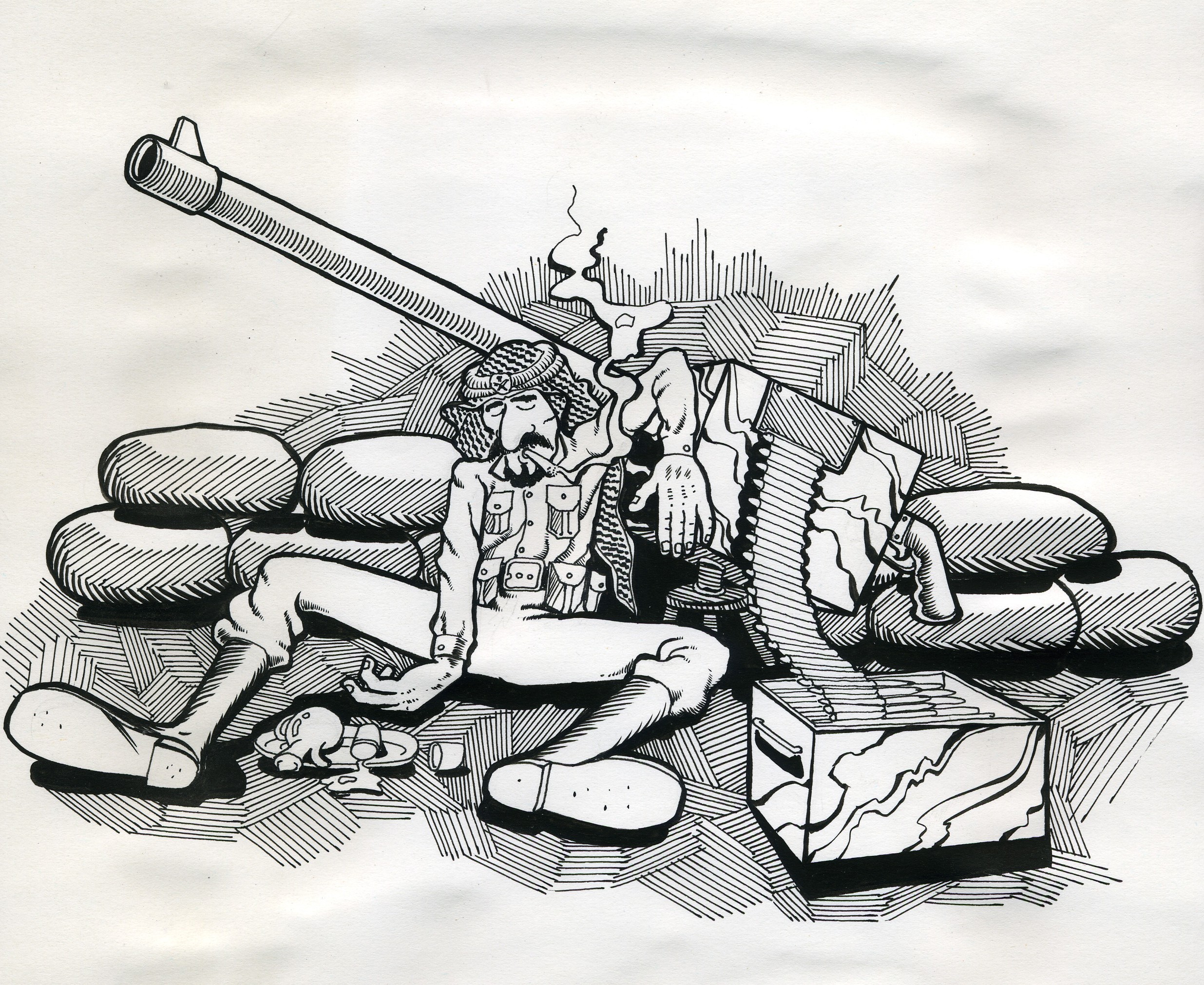
This episode of my RetroSaudi series is about guns. I wrote the piece that follows before the two Gulf Wars, and, even more critically, before the conflicts in the wake of the Arab Spring resulted in a massive proliferation of weapons in the region.
Then (1987):
The first Saudi I caught sight of when I arrived in Saudi Arabia was a spindly little fellow in an outsize helmet lounging at the bottom of the steps beside my British Airways Tristar. He was leaning against a semi-automatic rifle that was almost bigger than himself. He looked about as menacing as a museum curator and as bored as a cinema usher. That image has stayed with me, except that in my imagination the gun has gotten bigger and the soldier smaller.
Any uniformed official worth his salt wears a gun. Even firemen, provided they’re Saudi. Foreigners with guns are a definite no-no, unless they happen to be embassy guards, like the troop of muscle- bound marines who see to it that another bunch of hapless American diplomats don’t fall prey to a squad of revolutionary guards.
To a Briton coming to Saudi Arabia today, meeting so many guns would perhaps not be as shocking as it was to me in 1981. I had come out of a country in which naked shows of force, such as tanks ringing London Airport during an IRA scare, were so rare as to be deeply disturbing. At least to those of us on the mainland. But the Kingdom lies sweating in a ring of fire. To the north, Lebanon and Israel; to the west, Eritrea and the Horn of Africa; to the south, the feuding Yemens, and to the east Iran and Iraq. With half the hatred in the world festering on their doorstep, who can blame the Saudis for being a little nervous?
Surprisingly few ordinary citizens seem to own weapons. “Seem” because although ownership of firearms is restricted in Saudi Arabia, they’re legal and rife in the Yemen. Since the border between the two countries is ill-defined in many places, and therefore as leaky as a sieve, there are not only many Yemenis but also many guns surreptitiously stashed away in Saudi Arabia. A recent house-to-house sweep in Jeddah flushed out a truckload of armaments.
In Haj 1987, as the Mecca riots erupted, the local press announced in bold type that no shots were fired on the Ayatollah’s demonstrators by the security forces. Probably true, but what they forgot to mention were eye-witness reports about people leaning out of the windows of the apartments overlooking the action taking potshots at the rioting Iranians. A sharp-eyed American friend swears that on the official film of the riot you could see little puffs of dirt whipped up by the impact of bullets hitting the ground. Being a Vietnam veteran, he should know.
Most likely the bullet wounds another friend saw on the Iranian bodies (as they lay at Jeddah Airport ready to be shipped home) were caused by small arms.
What worries the Saudis most are the modern semi-automatics, like the Kalashnikovs that flooded the south during the Yemeni civil war in the early sixties. In 1980 such weapons allowed a tiny band of fanatics to hold the Grand Mosque in Mecca for many days, despite being vastly outnumbered by a rattled force of Government troops.
Out in the desert, the bedouin have carried weapons for centuries, but their firearms are usually more suited for suicide than offensive action; many started life in the hands of the British around the time of the Indian Mutiny. Every two or three years the authorities announce a weapons amnesty, but it’s a meaningless gesture to the gnarled old sheikhs, for whom the family flintlock is as much a status symbol as an instrument of destruction. Not so a hundred years ago, when armed robbery was a popular pastime among the bedouin, particularly if the neighbour’s camels happened to be there for the taking.
Surprisingly enough, you can buy antique guns in the Jeddah souk. True, the article for sale is usually seventy years old, and a Yemeni copy of an Afghan copy of a Lee Enfield, but if you could find all the necessary bolts and pins to make it work, it would probably fire. It’s debatable who would be most at risk, the firer or the fired upon.
The use of more modern weapons among private individuals is more discreet. Another friend was recently driving down a narrow road in Jeddah and came up behind a gleaming new Mercedes saloon that was dawdling along in the middle of the road. My mate honked his horn and signalled with an unmistakable gesture that he was in a hurry and would the gentleman kindly get the f**k out of the middle of the road?
The Mercedes slowly came to a halt at an angle, preventing my friend from passing, and a man in a white thobe calmly stepped out of the car, sauntered up to my friend’s window, pointed a pistol at his head and ordered him out of the car. Keeping my friend in his sight the man made a short call on his radiophone; within three minutes the police arrived and slapped an on-the-spot fine of a thousand riyals on the poor fellow for speeding! The gunman happened to be a high-ranking prince.
A final, salutary, tale – which may or may not be true – to place in perspective the somewhat threatening tone of this passage. The US Embassy in Jeddah used to be ringed with armed Saudi guards twenty-four hours a day. Such a dopey lot they were that one night the marines decided to highlight the shortcomings of the security arrangements.
When dawn broke and the guards finally woke out of their collective slumber, they reached for their weapons and found them gone. An hour later they were marched off at gunpoint, perhaps to be given freefall lessons over the Empty Quarter without the benefit of parachutes. Their bashful commanding officer called in to the Embassy to collect the weapons.
Now (2017):
Sadly, things got a bit more dangerous subsequently. The US embassy moved to Riyadh, and the compound guarded by the sleepy soldiers became a consulate. In 2004, during a wave of attacks by Al-Qaeda on both Saudis and expatriates, the consulate was attacked and a number of people killed. There were other attacks on ministry buildings and western compounds, resulting in many deaths over a three-year period. One of the compound attacks was the event depicted in the movie The Kingdom.
When I returned to the country in 2008 after a long absence, the difference was striking. Concrete blocks and blast shields protected ministries, embassies and hotels. Western compounds had watchtowers with armed guards. The major embassies, especially the US embassy in Riyadh, were fortresses. Soldiers armed to the teeth would patrol the grounds.
Had I written a piece about guns then, I wouldn’t have seen the funny side. People were still nervous about their safety. I knew Americans who kept their passports and open first-class airline tickets with them at all times so that they could make a quick exit. Others would rarely venture out of their hotels except to go to work. On one trip from Riyadh to Dammam, my passenger refused to get out and stretch his legs at a gas station, because he was a afraid that someone might shoot him.
Gradually things calmed down thanks to a very effective anti-terrorism effort by the Ministry of the Interior.
But over the past four years, the gun has raised its ugly head again. This time at the hands of ISIS supporters, who have launched repeated attacks with a seemingly sectarian motive against the country’s Shia minority in the east. There have also been attacks against the police. I wrote about one such attack in Al Hasa in my Postcard from Saudi Arabia series.
Guns continue to be a fact of life. If the borders were porous in 1987, they are by no means secure today, despite the wall the Saudis are building to the north of the country, and despite that fact that the border guards in the south are battle-hardened thanks to the current Yemen conflict. The sheer volume of weapons circulating in Syria, Iraq and Yemen among those motivated to harm for one cause or another means that the Saudis have an almost impossible task preventing some of these weapons getting through their borders.
The number of attacks has declined dramatically over the past year, but alertness is still the order of the day.
Also a sense of perspective is called for. Around eight thousand people are killed on Saudi roads each year. Compare that with 10 killed and 40 injured through terrorist attacks in 2017.
And if you happen to be an American working in the country, you might do well to ask yourself where you have a better chance of falling victim to a random shooting: in Saudi Arabia or the USA?
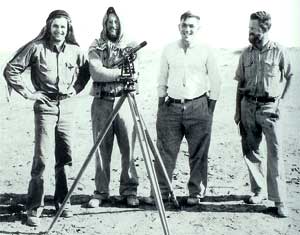
Well No. 7, 1938
“When the huge ship dropped anchor at sundown, it astonished everyone. It was nothing like the other ships they had seen: it glittered with coloured lights that set the sea ablaze. Its immensity, as it loomed over the shore, was terrifying. Neither the citizens of Harran nor the workers, who streamed from the interior to look, had ever seen anything like it. How could such a massive thing float and move on the water?
Voices, songs and drums were heard as soon as the ship neared the shore; they came from the shore as well as the ship, as all the Americans in the compound flooded outdoors. Music blared as small boats began ferrying the passengers from the now motionless ship. There were dozens, hundreds of people, and with the men were a great many women. The women were perfumed, shining and laughing, like horses after a long race. Each was strong and clean, as if from a hot bath, and each body was uncovered except for a small piece of colored cloth. Their legs were proud and bare, and stronger than rocks. Their faces, hands breasts, bellies – everything, yes everything glistened, danced, flew. Men and women embraced on the deck of the large ship and in the small boats, but no one could believe what was happening on the shore.
It was an unforgettable sight, one that would never be seen again. The people had become a solid mass, like the body of a giant camel, all hugging and pressing against one another.
The astonished people of Harran approached imperceptibly, step by step, like sleepwalkers. They could not believe their eyes and ears. Has there ever been anything like this ship, this huge and magnificent? Where else in the world were there women like these, who resembled both milk and figs in their tanned whiteness? Was it possible that men could shamelessly walk around with women, with no fear of others? Were these their wives, or sweethearts, or something else?
The people of Harran stared, panting. Whenever they saw something particularly incredible they looked at each other and laughed. They clicked their teeth sharply and stamped their feet. The children raced ahead of them and arrived first to sit by the water, and some even dove into the water to swim towards the ship, but most of the people preferred to stay behind on the shore, where they could move around more easily. Even the women watched everything from afar, though none of them dared to come near.
This day gave Harran a birth date, recording when and how it was built, for most people have no memory of Harran before that day. Even its natives, who had lived there since the arrival of the first frightening group of Americans and watched with terror the realignment of the town’s shoreline and hills – the Harranis, born and bred there, saddened by the destruction of their houses, recalling the old sorrows of lost travellers and the dead – remembered the day the ship came better than any other day, with fear, awe and surprise. It was practically the only date they remembered.”
Abdulrahman Munif – Cities of Salt, trans. Peter Theroux
Nothing I’ve read more powerfully imagines the impact of the oil era on the people of Saudi Arabia’s east coast. The American compound in Munif’s fictional Harran was actually called Dhahran. And it was at the nearby fishing village of Al-Khobar that the locals would have flooded out to view the ship.
The third piece in my RetroSaudi series is about Saudi Arabia’s first company town, built by the consortium of American oil companies who founded the Arab-American Oil Company, or Aramco for short.
I first wrote about Dhahran in 1987, around the same time that Saudi Arabia completed the final stage of its acquisition of Aramco. When I first visited what the Americans called the camp, it had become a small town, and very different from the cacophonic sprawl of Jeddah, where I was living at the time.
Here’s what I wrote then.
Then (1987):
A flat brown landscape broken by the occasional rocky hillock. Rusting cars and bits of machinery abandoned like relics of a war. Pipelines half-buried in the sand. The occasional ancient dump-truck lumbering down a superhighway. The land stained with heat and dirt. A few miles from the Bahrain causeway you come to the gates of what looks to be a large compound typical of many “camps” built by foreign companies to insulate their employees from the local environment. But this is no ordinary compound. For a mile out lies Well Number 7, where, in 1938, a strike of 7000 barrels an hour trans- formed a charmless patch of waste ground into the most valuable piece of real estate in the world. And changed everything.
Dhahran is Aramco, a company town. The Arabian-American Oil Company built Dhahran around Well No.7 and its successors, and so created a place like no other in the Kingdom. By creating Dhahran and thereby founding the first colony of foreign guest-workers, America laid the foundation stone for the Tower of Babel Saudi Arabia was later to become. The town is a tribute to that singular talent of the Americans to reproduce their own environment in the most unlikely places (remember Alan Sheperd playing golf on the moon?).
Dhahran boasts tidy sidewalks, neat little houses, bowling alleys and supermarkets. It has long American cars whose drivers chew gum and wear baseball hats. It even has the occasional traffic jam. Until recently it was closed to Saudis, and its American inhabitants lived their lives in the American Way, unobserved and unrestricted. Even women drive in the camp, a privilege unheard of elsewhere in the country.
Nowadays things are changing fast. Since the state became an increasingly dominant partner in Aramco (the company is now 100% Saudi-owned) this exclusivity has broken down, and many of the owners now live in the camp. But a number of its more arcane traditions remain. As a non-Muslim Aramcon you can still buy pork in the camp supermarket, a privilege much envied by the rest of the pig-loving expatriate population. Those who are found to have bought more than their allotted pork ration in a given month suffer the ultimate penalty: their personnel records are marked PV, and they are banned from further purchases of the unclean animal for a set period, depending upon the gravity of the offence. PV, of course, stands for Pork Violator, perhaps the most wonderfully misleading acronym yet invented by an American bureaucracy.
Next door to the camp lies the University of Petroleum and Minerals, to which was recently added the prefix King Fahd, presumably at the behest of an anxious dynasty that needs constantly to be reminded that not a slab of concrete is laid in the Kingdom that is not directly or indirectly attributable to the dynamism and generosity of the ruling house. Even before the Custodian of the Two Holy Mosques (no doubt reluctantly) allowed his name to adorn this distinguished academic institution, the UPM campus was spectacular and impressive. Today it remains an example of architectural excellence rare in its consistency; the Saudis tend to build something beautiful and then ruin the effect by erecting a monstrosity next door. UPM is tasteful throughout. Its academic standards are high, and the best of those who don’t make it to the foreign universities come here.
As a place for foreigners to live, the area ranks second only to Jeddah as the most desirable posting in the Kingdom. For Aramco employees, with their special privileges, it’s the only place to be. The climate is more forgiving than in the interior, pleasantly cool in the winter, steamy in the summer. The authorities are rather heavy-handed in the Eastern Province, particularly in religious matters; this is largely because Iran, being so close, exerts a strong gravitational pull on the area. Most of Saudi Arabia’s Shiite Muslims live on the east coast, and the government is constantly on the alert for signs of unrest among followers of Khomeini. Strange institutions known as “Societies for Elimination of Vice and Propagation of Virtue” keep a stern eye open for improper behaviour, and every so often circulate broadsheets to local employers warning them not to allow their employees to walk about displaying their genitals (in other words, tight trousers for men, and anything other than a loose black garment, known as the abaya, for women).
Inside the Aramco camp, however, the oilmen and their families don’t concern themselves with such niceties. For them life goes on as it has for the past forty years. The women, wearing shorts, cycle to the ballpark to watch their kids play softball; the men take their Chevy Blazers up to the Rolling Hills Country Club, unload the golf clubs, and set out for an afternoon of relaxation on the. fairways and greens (which are, in reality, browns) of Aramco’s eighteen-hole course.
Whatever the Saudis might think and say about America, Dhahran is living proof that the expertise that helped the Kingdom pack five centuries of development into fifty years is not to be dispensed with just yet.
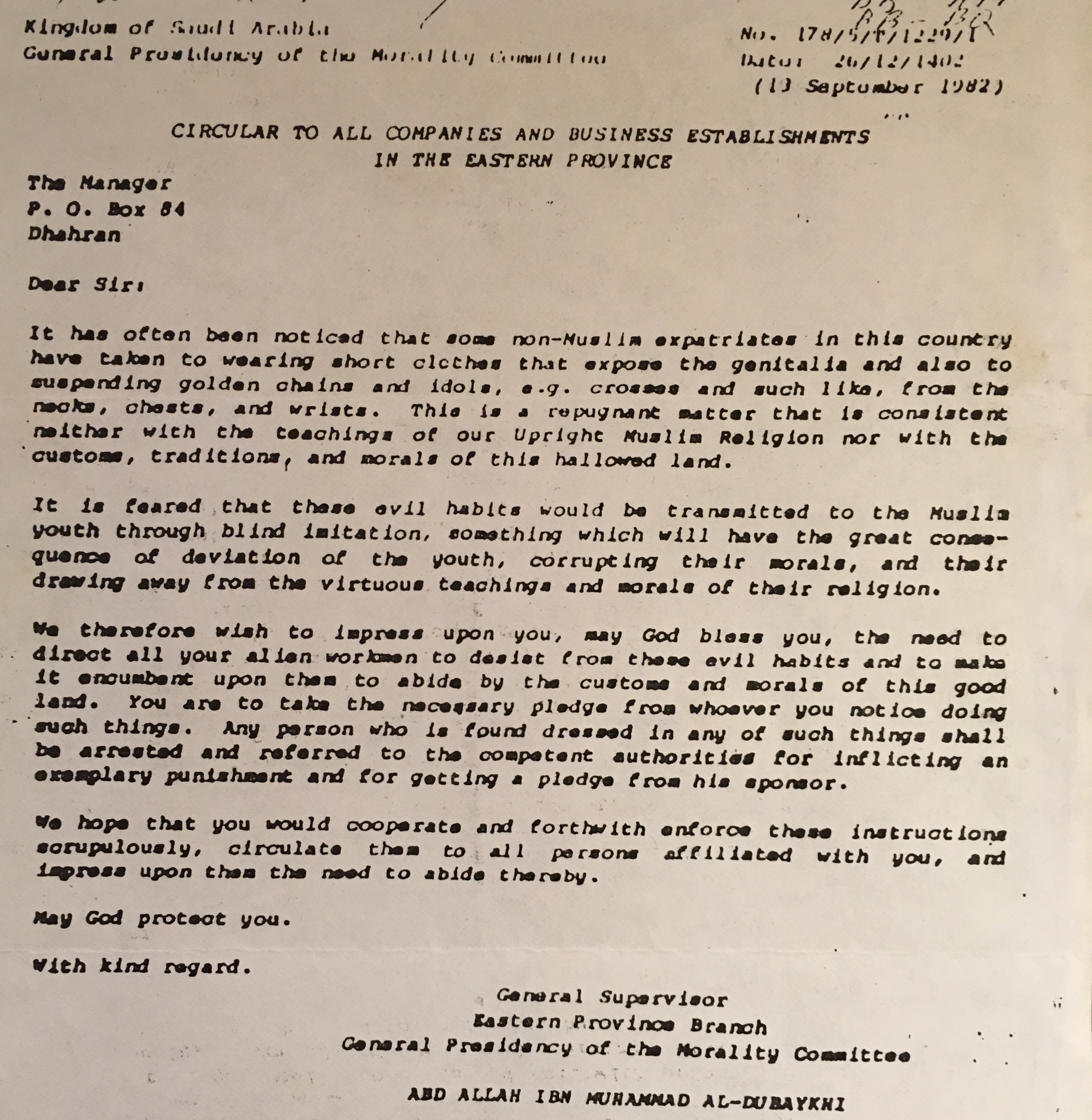
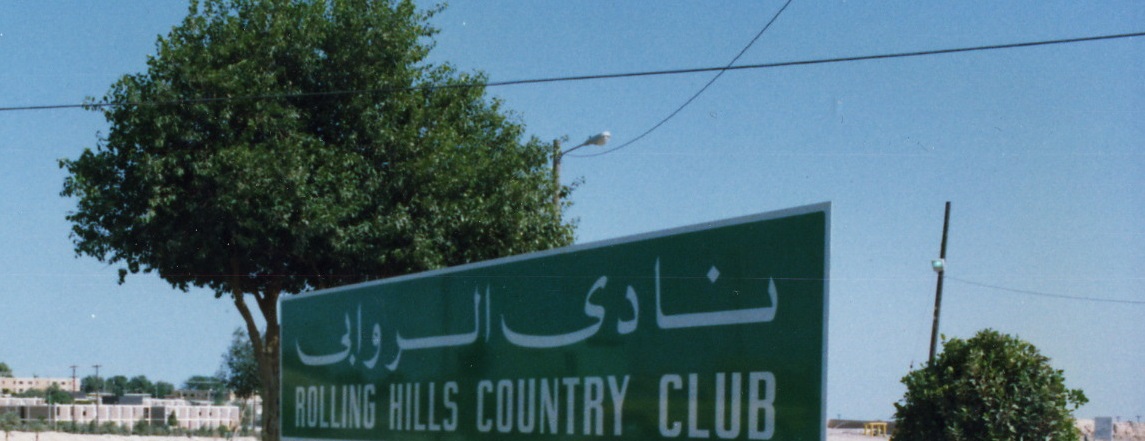
Now (2017):
There are many other legends about Aramco in the days when it was an exclusively American enclave. Every new family was given a leaflet called “The Blue Flame” with detailed instructions on how to safely distill their own spirits at the back of their houses. Those who did were not always as safety-conscious as the booklet advocated. They included a householder who happened to be away one evening when his prefabricated house exploded. Legend has it that the camp engineers constructed a new house on the site by the following morning.
These days backyard distilleries and pork violators are ancient history. I actually think I was wrong to suggest that pork was available after the final stage of the Saudi takeover. It would have been inconceivable that the new masters would have allowed such idolatrous practices.
The inhabitants of the Aramco camp, by the way, were not the only people with access to the unclean meat in the 1980s. We inhabitants had our own source, in the shape of a downtown Lebanese butcher who, if you asked him for “special meat”, would disappear to the back of his shop and produce choice cuts. It tasted pretty good, though rumour had it that it was actually warthog from the south of the country.
In other respects the Aramco camp has not changed much. The relaxed rules for women remain in place, and an increasing number of them work for the company. The golf course is now green, and internal traffic police still patrol the streets to enforce speed limits that would horrify drivers outside the camp with their stringency.
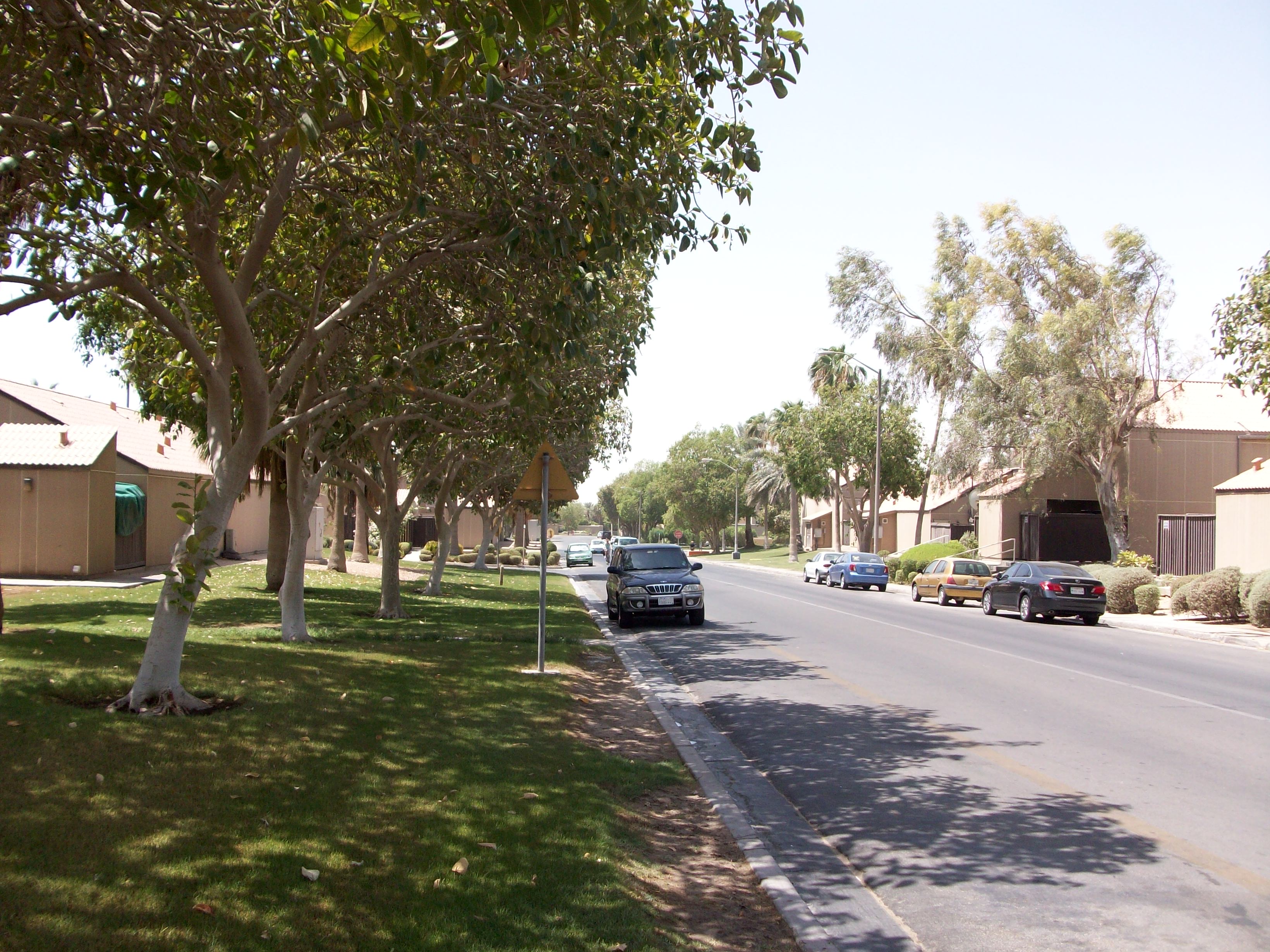
The company itself, now known as Saudi Aramco, has grown from strength to strength. Not only is it one of the foremost petrochemical businesses in the world, but it’s become the go-to project manager for prestige construction projects such as the King Abdullah University for Science and Technology near Rabigh in the west.
The American influence has waned. Most of the stalwart managers and technologists have retired after long careers in Dhahran. Those senior Americans who remain are in advisory roles. Saudis run the company, and it gets its expertise from wherever in the world it can find it, while still going to great efforts to develop its national workforce.
The topic of the moment is the forthcoming flotation of 5% of the company. Fine in principle, but Saudi Aramco’s governance has always been somewhat opaque. The percentage of the oil and gas revenue it generates that finds its way to the royal family, as opposed to the spending ministries, has always been a closely guarded secret. I await with interest to see how they deal with that little conundrum as they prepare for the open governance that will be required of a public company listed on one of the world’s major stock exchanges.
We have come a long way from the days when King Abdulaziz and his son King Saud used to go on tours around the country and, beaming with benevolence, would throw gold coins to the throng who had come to greet them.
All thanks to Saudi Aramco, who keep pumping out the oil.
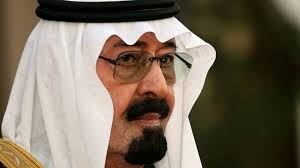
The next part of my RetroSaudi series concerns the man who, eighteen years after I wrote the piece below, became the sixth King of Saudi Arabia. After King Abdullah’s death, his half-brother Salman took the throne, and, his critics say, set about dismantling the carefully-constructed consensus politics that Abdullah and his predecessors had maintained.
Then (1987):
His Royal Highness Crown Prince Abdullah Bin Abdulaziz is, as his name suggests, one of the fifty-three sons of Abdulaziz, the founder of Saudi Arabia. He is also the Deputy Premier and head of the National Guard, as newspapers and TV newscasters, who repeat the formulaic titles in every reference to the man, never let us forget.
Abdullah has a mixed reputation in the Kingdom, and it’s difficult to arrive at a balanced portrait of the heir to the throne through his public utterances. Like all speeches emanating from members of the Government, his are about as precise, original and candid as Mr Nigel Lawson’s financial forecasts.
Some say he’s a deeply religious man who, when he becomes king, will drag his country back to the Dark Ages (from which many would say it has never emerged) by a series of ultra-religious edicts. Others say he’s a prudent and practical man like his brother King Faisal, who will rescue the Kingdom from the real or imagined profligacy of King Fahad. Either way, relations between the King and his heir apparent have never been cordial, despite vigorous attempts by the media to suggest otherwise.
Fahad and Abdullah are only half-brothers, born of different wives of Abdulaziz, and Abdullah has clung on to his power base, the largely bedouin National Guard, since his appointment in 1963. Cynics say that the National Guard exists not to guarantee the security of the nation, but to serve as a counter-weight to the army, navy and air force, whose commander is none other than the next in line to the throne after Abdullah, Fahad’s full brother Sultan (“Second Deputy Premier, Minister of Defence and Aviation and Inspector-General”). The hand-picked bedouin who make up the National Guard tend to be personal and tribal in their loyalties, and therefore pledge their allegiance to their commander rather than their king, which is perhaps why Fahad has been unable to detach Abdullah from his private army.
Sultan’s forces, however, with their flashy and expensive hardware (Tornados, F-16’s AWACS and all) tend to attract the more worldly-wise and technically-minded Saudis. And quite possibly the more fickle ones too.
A clash between those who wish to keep the Kingdom entrenched in the old ways and those who wish to step into the brave, and frequently unIslamic, new world is a scenario often predicted by those who look beyond the demise of King Fahad. The forces of change are said to be represented by Sultan, and of the ancien regime by Abdullah.
Such a clash is unlikely. It nearly happened when King Saud was persuaded to give up the throne in favour of Faisal but in the end family loyalty prevailed. The Saudi Royal Family know only too well that there are any number of predatory forces waiting to exploit a crack in the family’s much-touted unity, to turn a fracture into a collapse. The Ayatollah and Colonel Gaddafi are two of Al-Saud’s more fervent detractors.
Never underestimate the ability of the Arab family, of brothers, cousins, tribes or nations, to hold together, as well as fall apart, when the occasion demands it. “Me against my brother, my brother and I against our cousins, me, my brothers and cousins against the world”.
Now (2017):
Those who were concerned about Abdullah’s religious conservatism – and they included influential voices in the United States who feared that he would not be as pliant as Fahad – were proven wrong. After a period when he was in command but not in power – he served as de facto regent after Fahad suffered a crippling stroke – Abdullah turned out to be a cautious yet steady and pragmatic ruler. Perhaps foreign observers mistook his plain-speaking Bedouin ways for an entrenched conservative outlook.
In fact, while not going as far as some would like, he will be remembered for two key decisions that are likely to have a profound effect on his country. The first was the establishment of the international scholarship programme named after him, which sent hundreds of thousands of young Saudis to study at foreign universities. And just as many women received scholarships as men. I’ve met many of the returnees. They’re bright and strongly motivated to succeed.
The second act was to build a massive new campus for the Princess Noura women’s university. It covers a huge area of north Riyadh close to the airport. It has capacity for at least thirty thousand students a year. Needless to say, its facilities are top dollar, as I discovered when I visited it a few years ago.
By those two decisions Abdullah implanted the bacillus of change – as Churchill said when Germany packed Lenin off in a train to St Petersburg at the beginning of the Russian revolution. While he didn’t change the rules dealing with the role of women in society, by sending so many of them to university, he created the expectation of change. As far as the men are concerned, he educated many of the young technocrats who now surround Crown Prince Mohammed bin Salman.
It’s arguable that without Abdullah’s educational legacy, the current Crown Prince would find it difficult to surround himself with sufficient numbers of the technocratic shock-troops he needs to bring about his reforms.
Whereas King Faisal was universally respected, Abdullah was much loved by his subjects, not least for his simple manner. Some while ago I spent a year working for one of his close relatives, who would regularly return from the King’s ranch with dusty shoes. The result, he claimed, of incessant games of petanque.
His reign was not without its challenges. He had to deal with the fallout from 9/11, the second Iraq war, and the series of Al-Qaeda attacks within the country during the mid-2000s. Iran, as I foresaw in the piece above, was a constant worry. In the eyes of his successor, it continues to be so.
His response to the Al-Qaeda attacks was to unleash the hounds of the Interior Ministry, which effectively cracked down on the insurgents. But he also set up institutions for inter-faith dialogue in an effort to enhance understanding between followers of different religions and sects, and went to some effort to resolve the Israel-Palestine conflict.
Back in 1987 I also mentioned Gaddafi as a concern. In 2003, Abdullah, it was widely reported at the time, survived an assassination plot hatched on the instigation of the Libyan leader.
Towards the end of his reign, Abdullah also had to deal with the Arab Spring. He responded internally by banning protests but increasing welfare handouts. Externally, his most decisive act was to send troops into Bahrain (where I was at the time) in order to snuff out the protests there.
As for my comments on the National Guard, having delivered numerous training workshops for its hospital group in recent years, I can testify to the high regard in which he was held.
Would he have approved of the changes his successor is making? My guess is that he would have supported the goals – to modernise the economy, to reduce dependence on oil and gas and to empower the women of the country – though not necessarily the methods employed to achieve the changes.
He was, after all, a cautious man. Possibly, depending on how things turn out, the last of the great Saudi patriarchs.
One final thought: In 2007 King Abdullah set up an Allegiance Council to formalise the procedure for the selection of the next crown prince. Under the rules, direct descendants of King Abdulaziz, be they sons or designated grandsons, have a vote. Given that a number of senior princes are currently under lock and key, one wonders how the Council would work if King Salman were to pass away any time soon. An issue yet to be resolved, I imagine.
Further reading: Search this blog for King Abdullah and you’ll find plenty of reading. Particularly I suggest my piece on Princess Noura University, and an article I wrote just before the Arab Spring on the generation gap. Robert Lacey is also excellent on Abdullah in Inside the Kingdom.
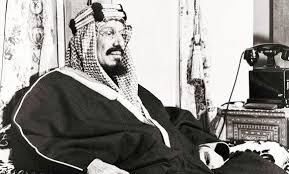
My RetroSaudi series – which features unpublished material I wrote about Saudi Arabia thirty years ago – starts at the beginning, or at least at the beginning of what we know as Saudi Arabia.
In Britain, many monarchs can lay claim to have founded the English component of the United Kingdom as a modern nation. Alfred the Great, William the Conqueror and the first Elizabeth all have a shout, depending on how you define modernity,
But in the country that is named after a family, only one person qualifies for the title: Abdulaziz bin Abdulrahman Al-Saud, also known as Ibn Saud.
Then (1987):
A fitting way to begin a series of glimpses at the Kingdom of Saudi Arabia is to start with its first king. Nobody who visits the Kingdom can fail to notice the nation’s founder, pictured in his declining years, beaming benevolently from the wall of every government office and public building. A symbol as potent in this land as Lenin in the USSR and Mao in China, and no less revered or reviled, depending on whether the person thinking about him benefited or suffered from Abdulaziz’s often ruthless conquest of the Arabian Peninsula.
I sometimes wonder whether he is portrayed on those public walls as an aging, sedentary gentleman, rather than in his vigorous prime, erect in every sense of the word (he had fifty-four sons and innumerable daughters, innumerable because nobody bothered to count them), to avoid unflattering comparisons with his portly successors, the present king and his younger brothers, who appear on the walls beside him.
Certainly he was a hard act to follow. Truly a large man, physically, in his personality and in his achievements, Abdulaziz also had the benefit of the Arabian tradition of storytelling to enhance his legend. No television cameras were on hand when he recaptured Riyadh in 1902 from the Al-Saud’s deadly rivals, the Al-Rashid. We read of his exploits in the official hagiographies, heavily-embroidered anecdotes by Arab admirers, or the romanticised journals of English adventurers such as Harry St. John Philby, father of Kim.
No such rosy legends surround the present crowd. Like the first amphibians that emerged from the primordial swamp, the sons of Abdulaziz hesitantly cope with their new environment. Self-consciously attempting to adapt to the harsh scrutiny of the modem media, they try to project an heroic image for the TV cameras.
The Saudi news bulletins faithfully record every ribbon cutting, every airport greeting ceremony, every conference on sewage treatment and every police graduation day graced by one of the noble few. Alas, they have been encouraged to believe that the more public exposure of members of the family the more honour and admiration will accrue.
I don’t think so. I believe that the more sophisticated the Saudis become the more they will laugh at their ponderous rulers and their endless ceremonies. It’s a pity, because the Royal Family have done Abdulaziz proud in propagating the dynasty he founded; there are now over five thousand direct descendants. What’s more, the Al-Saud have done a creditable job in steering the Kingdom on a stable course while all around erupts in flames of conflict. They just need better public relations.
However the family chooses to project itself in the future, it’s unlikely that the official line will allow any deviation from the theme that the Arabia of today would be no more recognisable without Abdulaziz’s contribution to its history than the film industry without Hollywood. It’s hard to argue with them about that assertion.
Now (2017):
I might have added at the time that the TV coverage of all those ceremonies was usually accompanied by a stirring rendition of Colonel Bogey, which to us Brits at least, inevitably brought to mind Adolf Hitler’s deficiency in the testicle department.
The three main men at the time were King Fahad, his half-brother Crown Prince Abdullah, and Prince Sultan, all of whom were somewhat corpulent. I didn’t mention Faisal, perhaps the most effective of the sons of Abdulaziz, who had what Shakespeare would have described as a “lean and hungry look”. More about him and Abdullah later.
I think the key message I was trying to put across was that despite the unsophisticated and often downright clunky PR, the royal family projected and achieved stability over a long period. But one person’s stability is another person’s inertia, and decades of “holding the line” have contributed to the sense that things must change – and fast.
Now, it seems, they have a smooth PR machine, but have they lost the stability? Has evolution been replaced by revolution?
Would Abdulaziz – the man who on his deathbed made his two eldest sons swear not to fight each other – be looking down in horror at the arrests of brothers and cousins?
Perhaps. He certainly would have admired the ruthlessness of the current Crown Prince. But I suspect that he would be reserving judgement until the consequences of Mohammed bin Salman’s actions become clear.
Finally, a story about Abdulaziz. When the King had the first telephone line installed between Riyadh and Jeddah, the religious sheikhs denounced this innovation as the work of the devil. He asked them whether the devil would tolerate the words of the Koran being transmitted through the phone. They had to admit that he would not. So the King arranged to call the sheikhs in Riyadh from his palace in Jeddah. And he recited the Koran. Hence perhaps the significance of the phone in the picture above, and evidence that he was not just a warrior king, but a man with political finesse when need be.
Further reading: Abdulaziz was by all accounts an extraordinary man. I’ve read a multitude of books about Saudi Arabia, but out of all of them Robert Lacey in The Kingdom, originally published in 1981, writes most compellingly about him. Still well worth the read. For a thinly-disguised fictional account of the rise of Al-Saud, I recommend Abdulrahman Munif’s Cities of Salt trilogy, which I reviewed a few years ago. Here are the links for my reviews: – The Trench and Cities of Salt.
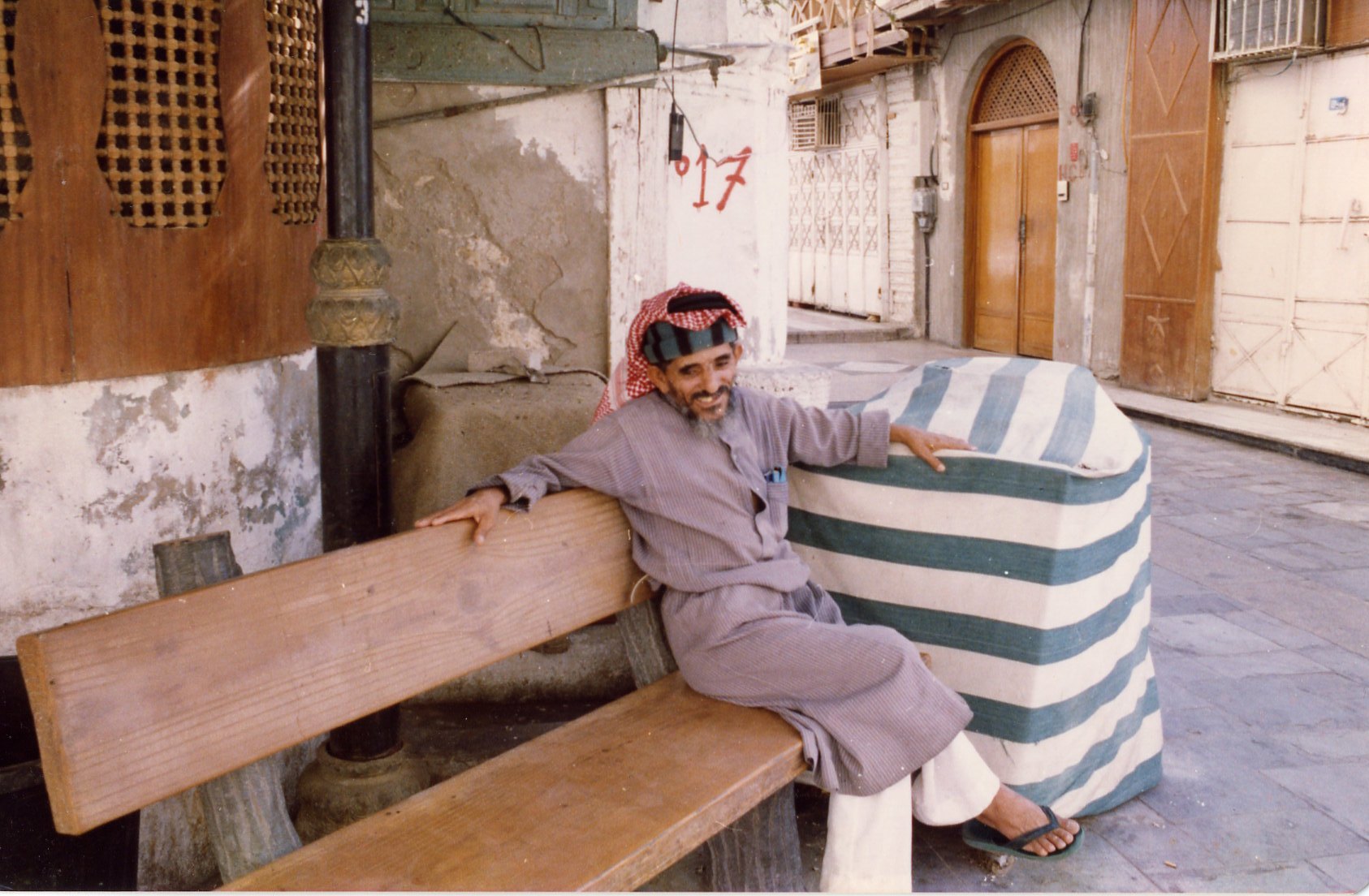
Jeddah 1983
I’ve been writing stuff for fun for the best part of thirty years. That’s way before this blog started. Much of my early jottings were written at a time when I had the time. I was living in Saudi Arabia, and I wanted to record the things I saw and read, and what I felt about them.
I started with letters to friends, full of stories and descriptions. And then, in 1987, I became a bit more systematic. Our first child had been born the year before. If for no other reason, I thought it would be good to write on a set of specific subjects, so that I could show our offspring what their mum and dad were doing when they were babies.
I ended up with a set of short pieces on a wide range of aspects of Saudi life. I suppose it was at the back of my mind that they could form the basis of a book.
The book never happened, and anyway it would have been impossible to publish it while I was still in situ. The Saudis wouldn’t have taken kindly to some of the stuff I was writing. The next year I came home, got stuck into a business, and so for the following couple of decades most of what I wrote was in support of making a living. Boring stuff like proposals, procedures and marcom materials.
I wrote a fair amount of similar material in Saudi as well, plus glossy booklets extolling the work of my masters, and speeches that they could deliver at conferences.
I kept much of this stuff when I left. I stuck it in a big box where it lay, unvisited, until recently. In addition to my personal writing I had kept numerous press cuttings from the daily English-language papers. I organised the material into little clumps with labels such as “crime”, “women”, “health”, “religion” and “politics”.
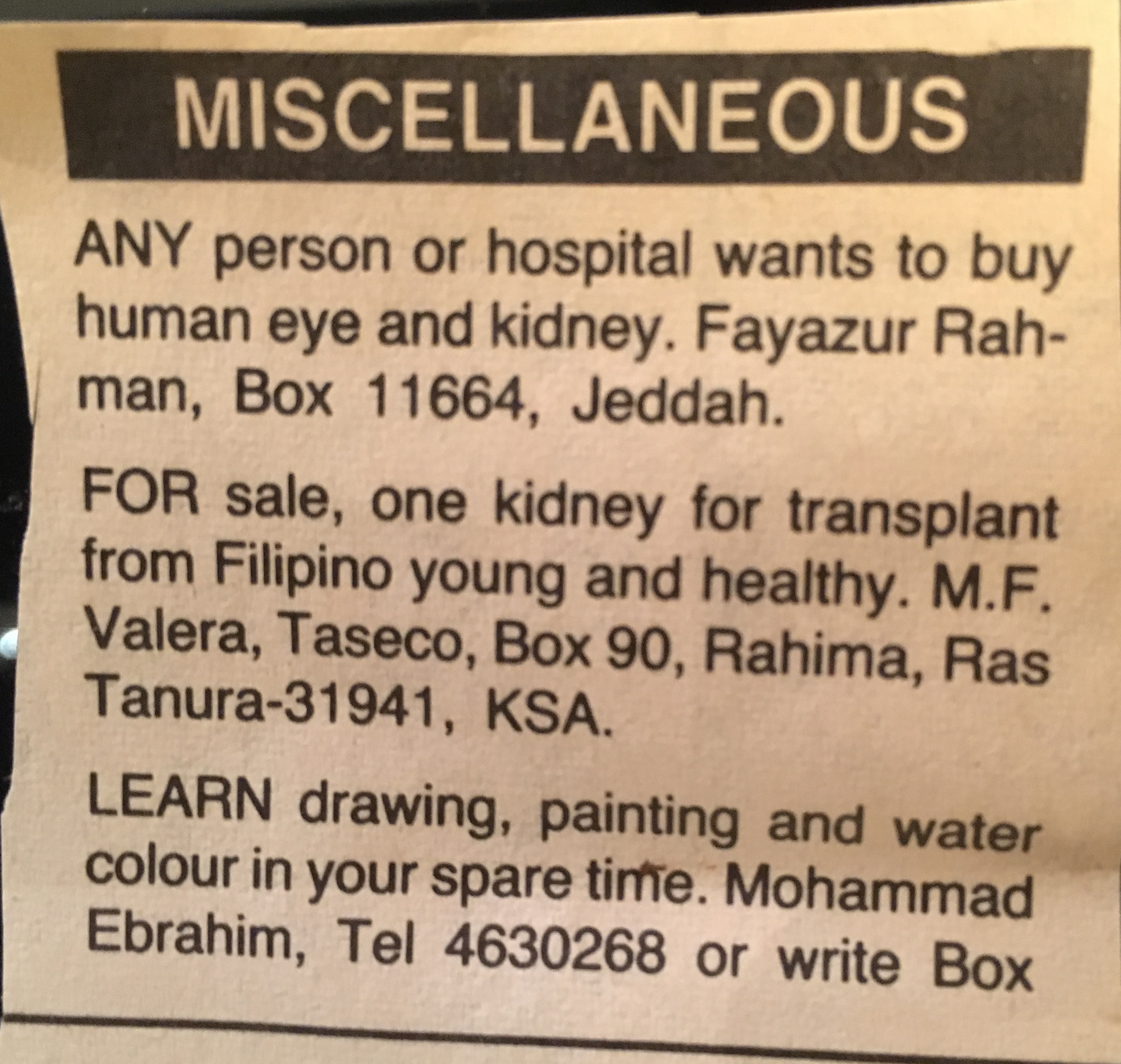
Newspaper ad c1987
Over the past month, in an effort to clear my garage, I have exhumed much of what had lain buried, including the press cuttings, letters – which I’ve digitised – and about thirty of the vignettes about Saudi Arabia back in 1987. The first fruit of that labour was the last piece I posted about the time when the Saudis decided to introduce income tax for foreign workers, and then changed their minds two days later. I called it the mother of all U-turns.
When I look back at this stuff in the light of the dramatic developments in the Kingdom over the past year, culminating in the arrest of princes and business leaders accused of corruption, two things occur.
First, the pace of change was so slow that much of what I wrote then was pretty much up to date until Crown Prince Mohammed bin Salman started shaking things up last year. Consequently, when things changed rapidly, almost in the blink of an eye what was previously current was now history.
Second, the life in Saudi Arabia that I witnessed was all about little dramas, not big ones. The big dramas – the Iran-Iraq war, the Mecca insurrection and the two subsequent Iraq wars, happened at times when I was not there – either shortly after or just before. Nothing deliberate about this – just the way the dice fell. But in each case, the fallout was palpable and lasting. But such changes as took place after each event pale into insignificance compared to what’s happening in the country today.
That being the case, I’ve decided to publish some of this material in a series of pieces under the heading of Retro-Saudi. I shall also include press cuttings, a few pictures and cartoons from the time, and a “then and now” commentary at the end of each piece.
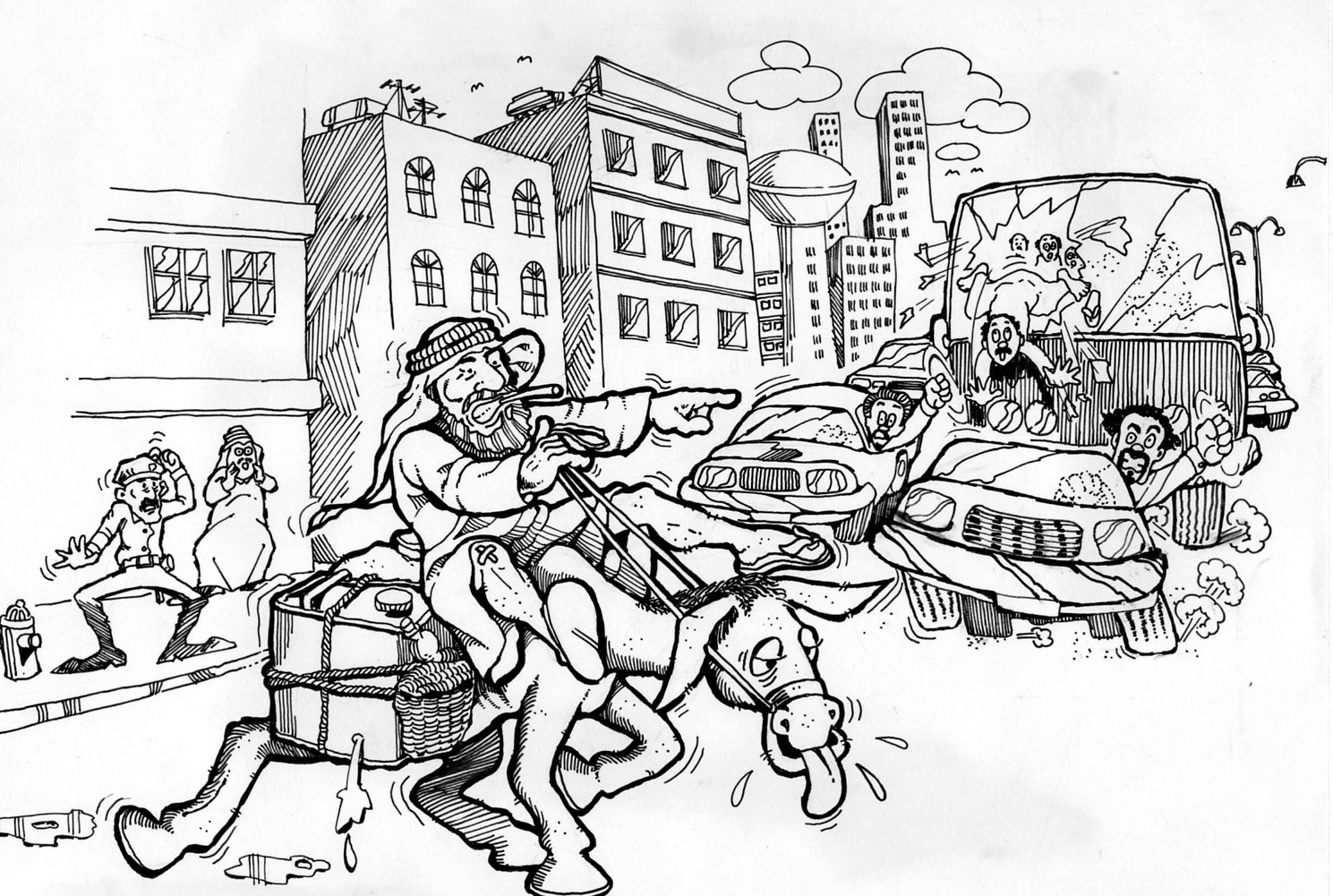
Jeddah 1985
There is a precedent for this approach in the blog. Over three more recent years when I was visiting Saudi and providing consultancy and training workshops, I wrote a series of pieces in which I talked about things I encountered on my travels. If you’re interested, you can find them by searching on Postcards from Saudi Arabia in the field on the bottom right of the home page.
My purpose in writing about Saudi Arabia is not to bash the country or its people. Yes, there’s plenty to criticise, and no lack of people lining up to deliver their disapproval. I leave that field to them. Underlying everything I write is an affection for the good people I encountered, and memories of many happy years I spent there.
On the other hand, I’m not looking to excuse the inexcusable, or pretend that the dark side doesn’t exist. It did then and it does now.
I appreciate that not everybody who reads this blog is interested in Saudi Arabia beyond an understandable concern about events that might affect them. I shall continue to write about other subjects, but I’m hopeful that those of you who are not familiar with the Kingdom might find something to interest you too.
I’d also welcome comments, memories and stories, photos and any other contributions that conjure up what was and no longer is. You can either post comments to the blog, or email me at sr59steps@gmail.com. As long as your contribution is not to my mind obscene, defamatory, racist or insulting in any other way, I’ll do my best to publish it.
Watch this space.
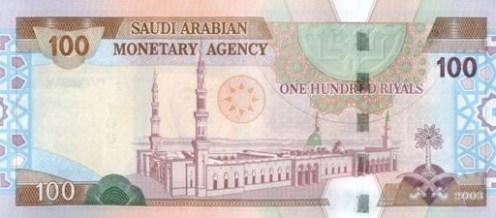
Those of you who follow events in Saudi Arabia will be used to the description by many Saudi-watchers of Crown Prince Mohammed bin Salman as impulsive.
That may or may not be the case, and I certainly think that compared to Donald Trump he’s the epitome of cool calculation. The same pundits also tend to characterise the country’s leaders over the three decades leading up to Prince Mohammed’s rise to power as being rather stodgy, conservative and not given to hasty decisions. By and large – and I speak as someone who spent quite a lot of time living in the Kingdom during that period – I would agree that the reigns of King Fahad and King Abdullah were not exactly dynamic. Such change as took place did not take the breath away.
But there was one notable exception. Over three successive days in January 1988, the Saudi equivalent of the Grand Old Duke of York marched his men up to the top of the hill and then marched them down again.
The events of those three days should be seen against the backdrop of the Kingdom going through one of its lean periods, thanks to the low price of oil at the time. Any opportunity to raise additional revenue was not to be sniffed at.
Here’s what happened.
Day 1 – January 4
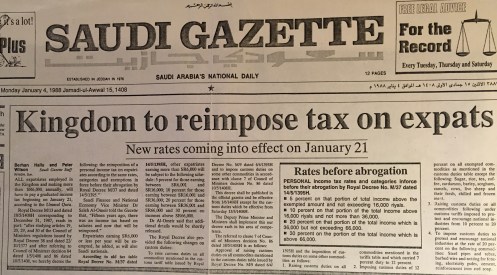
The Minister of Finance announced the reintroduction of income tax for expatriate workers, of whom I was one. This was a big deal. The Minister pointed out that there had been income tax fifteen years before, but that it had been abolished
However, the vast majority of foreign workers arrived after 1973, and had no memory or expectation of being taxed. In fact, it was the tax-free salaries that led many of them to take up employment in Saudi Arabia in the first place. Especially for those who worked away from the cities, in the oil and construction industries, salaries were generous but working conditions were hard.
So the prospect of being taxed came as a shock. Many western expatriates tendered their resignations on the spot.
What happened next was that employers realised to their horror that if they wanted to keep their best people, they would have to pay the tax for them. Form their point of view the imposition of income tax was therefore a tax on them rather than on their staff.
I was told at the time that a delegation of big business owners sought an audience with King Fahad, and told him of the adverse implications – to them at least – of the measure.
Day 2 – January 5
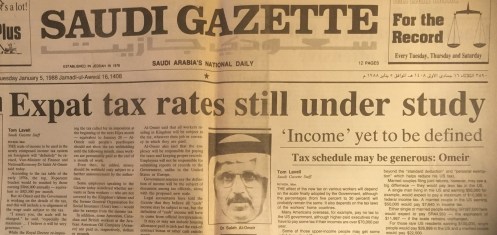
The Saudi Gazette, one the two main English language daily newspapers, quoted the Vice-Minister of Finance and National Economy as saying that the precise details of the taxation regime had not yet determined.
This came as something of a surprise to worried onlookers, since normally such a major decision would have been thought out in detail beforehand. Perhaps it had, but influential figures in the government had started to row back.
Day 3 – January 6
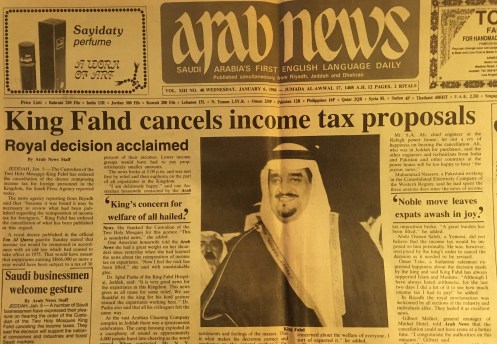
A mere two days after the original announcement, the King announced that the imposition of income tax was cancelled. As the Arab News – the other English language paper – reported it, the decision was met with widespread acclaim. Predictably, business leaders thought that this was a jolly good thing. And in keeping with the flowery tone adopted by the media when reporting popular decisions of the monarch, the paper said that the King’s “noble move leaves expats awash with joy”.
Personally, I wasn’t awash with joy. More incredulous that I had witnessed a U-turn of monumental proportions, which is why I kept the press cuttings you see above.
Nor were a number of those who resigned their jobs on Day 1 too enthralled. Quite a few of them found themselves proud possessors of exit-only visas. They were not a essential as they thought they were.
Those bizarre three days in Saudi Arabia reminded me that the King’s power – said to be absolute – actually depended on consent from a number of powerful interests, of which the business community was one.
Quite a contrast to the events of the past week, in which Prince Mohammed has locked up a number of senior business owners on suspicion of corrupt activities.
Which leads me to suspect that today, if a delegation of business leaders still at liberty approached the Crown Prince or his father the King to protest against an unpopular measure, they might find themselves joining their colleagues at the Ritz Carlton Hotel, where all the detainees are being held.
How things have changed. Whether or not for the better is not for me to judge. But looking back at the events of January 1988 makes me wish that another unpopular and poorly thought-out measure could so easily be overturned at the whim of a monarch.
Unfortunately Brexit will not be so easy to kill, whatever the Queen might think.
When the outing storm rolls over a group of people of whom for other reasons one has a low opinion, it’s tempting to shout “out the bastards”. Such, from my perspective, is the case with a bunch of sitting members of the British Parliament accused of sexual misdemeanours at some stage in their careers. Lawmakers should know better.
But then an actor whose work is admired by millions, including me, enters the spotlight. Kevin Spacey is accused of sexually assaulting a minor thirty years ago. He apologises, while denying any memory of the incident. And comes out as gay.
How do we feel about Spacey’s apparent downfall? Happy because another abuser goes down? Angry because he is admitting to being gay to deflect from his behaviour thirty years ago? Sad because a talented artist who has given much to his profession appears to be at the end of his career? Suspicious at the motives of the alleged victim who has waited all these years to make his accusation? Or curious as to why the hell the parents of a 14-year old allowed him to go, seemingly unprotected, to a party full of adults?
Or do we simply shudder, and think “there but for the grace of God go I”? If we happen to be male, that is.
And how does this end?
Does it fade away when the media loses interest in the outing of a never-ending trail of well-known miscreants from politics and show business – rather like an epidemic that runs its course because the most vulnerable are dead?
Perhaps the defining criterion for the hue and cry will be the use of power to abuse others. The trouble is, there’s power and power.
The power of an employer, of political patronage, of money. In the west, these are the main levers. Not so elsewhere. There are some parts of the world where by tradition a man may not approach an unrelated woman, let alone touch her, yet if they get married the man is more or less free to do with her what he wishes, including rape her.
Lurking behind explicit power is the implicit. Physical strength, peer pressure, the power of manipulation.
Where will it end? It won’t end until we start asking how it begins. With pink and blue. With Dad getting pissed and beating up Mum. Or maybe just slowly reducing her over the course of a marriage. And later, with porn, with rugby songs, with MTV, with oral sex in a supermarket car park. With bravado masking fear. With superheroes, bullies and expectations dashed. With entitlement.
Enough books have been written on this subject to fill a large municipal library. I have nothing to add to the literature beyond a personal perspective.
When I look back on my life, I ask myself whether I have ever done anything that if I was famous might thrust me into the spotlight of shame. Perhaps. Grope an employee, send suggestive texts, call my assistant “sugar tits”? Never. But did I use the behaviour of one woman to characterise all women, as in “bloody women”? Yes. Did I hire a woman based on her looks? I like to think not, but when all other things were equal, possibly. And when I was in my twenties with a bunch of guys in a pub, would I join in the banter about the drop-dead gorgeous girl on the other side of the bar? For sure.
And there may be other stuff from another age that I might have said or done that has faded from memory. Nothing awful, I believe. But then again, that’s what the rock stars, DJs, music biz potentates and hangers-on would say about their behaviour in the 60s and 70s. Different times, different norms.
Did I know others who did all those things? Absolutely. Only in the movies did a man ask a woman for permission to kiss her. It kind of happened, didn’t it? And only on TV would some handsome idiot dressed up as James Bond abseil down a cliff to present a beautiful woman with a box of chocolates “because the lady loves Milk Tray”. Most women I knew at the time would have told him to bugger off.
Back in the 70s we were watching Straw Dogs, Performance, the Exorcist or, lord help us, Confessions of a Window Cleaner. We were a generation for whom the boundaries were dissolving, and I’m not just talking about men. Many of us were more concerned about the Vietnam War than whether the person we woke up next to in the morning had really wanted to be there.
Are we any better or worse today? We may have more gender fluidity, with a vocal minority agonising about safe spaces and personal pronouns. But we have Tinder, online porn available on tap to pre-teens, internet trolls threatening rape. And we have a dirty old man in the White House.
Worse still, in much of the world, the old rules about male supremacy still apply.
Will the disgrace of a hundred Kevin Spaceys serve to rewire our brains, and change the habits and attitudes built up over a hundred generations? I don’t think so.
For me, the issue is less about how men treat women, though that’s part of it. It’s more about how people treat people. How the young treat the old, and vice versa. How the rich treat the poor. How we treat the mentally ill. How we treat people with different faiths, ethnic origins and skin colour. How we treat the uneducated and disadvantaged.
These are the perennial questions, against which the experiences of a multitude of actresses, political interns and other victims of pathetic, bullying men pale somewhat into insignificance.
Solve the bigger problem, and we’d go a long way towards reducing the lesser one that is exercising us all today.
But we have to start somewhere. So by all means let the heads roll. Let’s make some examples. Let’s change a few laws, or at least enforce the ones that exist. But let’s not kid ourselves that most of those who end up getting busted are convinced they’ve done anything worse than the equivalent of a traffic violation. That’s a long way from knowing the difference between right and wrong.
I also worry that young people whose communication skills are not fully developed are liable to become ever more confused by what is acceptable and what is not. No rulebooks or seminars can cover every eventuality. The more mixed the messages coming at them from all directions, the greater the danger of a mistake that will ruin their lives.
As for the bigger issues, I’m enough of an optimist to believe that compared with a hundred years ago, we’re in a better place.
But sadly, the horizon is infinite.
Everyone knows that sites like TripAdvisor are stuffed full of bull about the wonders of the products they advertise, which is why I don’t bother to visit them. Unless I want a laugh, of course.
You want the unvarnished truth? You won’t find it here, but in keeping with my reputation for fearlessly telling my version of the truth, here are a few thoughts on a short trip we’ve just made to France.
I learned three things about our nearest neighbour this week.
The first is that Bordeaux has a truly horrible airport – the worst I have passed through in France, and possibly in Europe. The second is that the French have their own version of Brexit. It’s called Frexit. I know this because I saw a poster advertising “Le Candidat du Frexit”. And finally, it’s a toss-up who the locals dislike more – the British or the Parisians.
The source of my stunning enlightenment was a three-day break we took this week to the Bay of Arcachon, which lies thirty kilometres west of Bordeaux.
I will save the description of our airport experience until last.
What of M Frexit? He turns out to be a chap called Francois Asselineau, who stood in the presidential elections against Macron, Le Pen and gang. He looks like a corpulent version of Nigel Farage, and he turned out to be about as successful as Farage in getting elected to a meaningful office. He came nowhere.
I suspect that his adoption of Frexit in his political banner might have been part of the reason. French purists abhor the creeping colonisation of their language by us Anglo-Saxons. They would argue that exit is an English word that has no place in a French political campaign. It would be difficult, though, to cobble some snappy word out of “France” and “sortie”, which would have been a problem for Assileneau. Whereas Brexit has the wholesome ring of a bowel-scouring cereal, Frexit conjures up an unpleasant cause of death. Almost as bad as Grexit, which sounds like a condition that requires the Heimlich Manoeuvre.
Anyway, the fact that nobody has bothered to deface or remove a fading poster of Le Candidat du Brexit from a wall just outside Bordeaux suggests that unlike Farage, M Frexit has hopped back into his pond.
Since this is supposed to be an alternative to TripAdvisor, I should say something about where we stayed. This is also where the antipathy towards Brits and Parisians comes in. The Bay of Arcachon is a huge bite out of the Atlantic coast. It’s almost a lagoon, but whoever did the biting clearly lacked the courage of their convictions. The result is a tidal basin in which the water virtually disappears for much of the day, leaving sailing boats stranded. It’s ringed by pine forests, villages full of plush holiday homes and miles of cycle paths.
The holiday homes are the source of anti-Paris resentment. Improvements to the rail network have reduced the travelling time from Paris to Bordeaux to two hours. This means more Parisians buying up properties around the bay, which also means more places sitting empty for much of the year.
How the Parisians can afford their plush holiday homes is a bit of a mystery, given that the French economy is supposed to be in a worse state than ours. But they have little competition from us Brits. There are no wrecks waiting to be renovated, and few achingly beautiful medieval squares where we can enjoy our coffee and croissants in the sun as we bray about property prices. Besides, why would we come to Arcachon when we have the Isle of Wight?
Our scarcity partly explains why we seem to be viewed with thinly-veiled contempt, and why waiters are almost as keen as those in Paris to watch with a malicious gleam in the eye as those of us who don’t speak French struggle with their ornate and incomprehensible menus. All very French. Even the Irish pub we visited when we tired of fusion cuisine was about as Irish as a Pyongyang caff.
Which was fine, because we were in France. And the Bay of Arcachon is place for vigorous pursuits beloved of the French – sailing, cycling, trekking, oyster-guzzling and even dune climbing – Europe’s tallest sand dune sits like a white elephant within the tree-lined coast.
Our base for the three days was a ludicrously expensive Italianate villa overlooking the bay. We managed to secure a room for a reasonable rate through an online auction. It was billed as private villa, not a hotel, and we shared the communal dining room and kitchen with other guests. In England we would call it a high-spec B&B, but you wouldn’t get many takers for a place in Bognor Regis with a rack rate of nearly 400 euro a night.
That said, there are probably not many B&Bs in Bognor with landscaped gardens, an eco-pool that uses no chemicals, a house full of Balinese wood sculptures and other effortlessly cool features, including a room at the top of a tower with a 360-degree view of the surrounding landscape, which was where we ended up.
All of which was fine and dandy, except that the bathroom was on the next floor down. To reach it you needed to descend down a steep spiral staircase. Not ideal if you’re suffering from the effects of too much red wine (which we didn’t), or if you have creaky knees and are of an age when you need to get up for the occasional night-time pee (which I do).
The absence of a kettle in the room was explained by the charming manager, Aurelien, on the grounds that you don’t usually have one in your own home. True, but in my home I’m not charged 8 euro for a cup of coffee from the machine in the kitchen. Tea, though, is free. So at our home from home, I reluctantly suspended my daily Alzheimer’s test of bringing my beloved her morning cup of tea, navigating over a sleeping dog and up a single flight of stairs in the process. A journey akin to the ascent of the Old Man of Hoy with a mug of hot tea in one hand would have been a climb too far.
Minor quibbles though. The place was lovely, the view was great and the weather a very pleasant mid-20s.
Our forays out included visits to both ends of the bay – Cap Le Ferret at one end, and the town of Arcachon at the other. At Cap le Ferret you can just about see the Atlantic breakers on the horizon and the monster sand dune sits across the water.
Dune de Pyla, Bassin d’Arcachon
Unfortunately our attempt to secure a coffee and snack at the restaurant overlooking the bay were contemptuously dismissed, on the grounds that it was after 3pm, and wasn’t it obvious that we close for three hours during the busiest time of the day?
We had more luck at Arcachon, which has a promenade of hotels and cafes on the beach-front. It could have been an August day, with the beach full of kids making sandcastles in the sun, and the well-dressed boulevardiers strolling down the pavement with the usual variety of dogs in tow.
Arcachon beachfront
I was conveniently reminded that I’m a stupid Englishman when I expressed surprise that the guy in the ice cream van was also selling churros, which I’ve rarely seen outside Spain. Pourquoi? You bought a mango ice cream, and mangos come from China, he replied. Silly me.
All in all, a pleasant trip, but a timely reminder that there are many parts of France that won’t miss us Brits if we sail serenely away into the mid-Atlantic, unless, of course, we can read their menus and bring large amounts of money with us. Perhaps the locals feel able freely to express their contempt for les rosbifs because, unlike in some parts of France, such as the Dordogne, we don’t outnumber them.
Now for the airport.
We arrived on Easyjet at the low budget shed on the side of the terminal. Nothing too traumatic about that. We hired a car, and were informed that we must fill up with petrol before we hand it back, otherwise we would be charged a full tank and 40 euro for the hassle. Again, relatively normal, though the inconvenience charge seemed a bit stiff.
On the way back we started off fairly early. Our flight was at 10.30pm, this time on British Airways, and we wanted to get back to the car hire cabin before it closed so that that they could certify that we had not damaged their precious property.
We allowed an hour to make the 35km journey to the airport so that we could stop by a filling station. But there was none. After 15 minutes driving back and forth around the airport we finally found one courtesy of satnav. We sat another 10 minutes behind a long queue.
It turned out that the establishment closed at 8pm for some reason. What kind of stupid bloody petrol station in the middle of a large urban area shuts at 8pm, we wondered. And why did they choose to locate it in some obscure location miles from the terminal? Even Gatwick, which ticks many of the boxes in the most horrible airport category, has a gas station in plain sight just off the South Terminal.
We filled up with a minute to spare, but missed our rendezvous with the car hire guy. My wife, who is convinced – probably with good reason – that car hire companies are even more grasping than bankers, then spent five minutes videoing every inch of the car with her phone as evidence of its pristine condition in case someone took a sledgehammer to it after we’d left.
The main terminal at Bordeaux is a concrete monstrosity that has plenty of space but nothing to fill it. One of those ambitious Euro-projects, perhaps, that’s designed to handle a passenger throughput that it will never achieve. Large, soulless and lacking the vital ingredient of people. There is but one food outlet on either side of security, selling the inevitable ham and cheese baguettes and a limited selection of rather sad pastries.
The people at the X-ray machines are surly – clearly graduates of the Homeland Security charm school. In fact they’re worse than their American counterparts. At least the Yanks say Sir when they put you in a choke-hold and march you away. It made me want to give a big hug to the folks who do the same job with infinitely more jollity at our airports.
When they ordered me to put my swatch through the machine, I found myself turning into Larry David and arguing with them about the explosive capability of a plastic watch. But these are not the kind of people to pick a fight with.
When we got through to the other side, it became clear that our flight was the last one of the day. Which was just as well, because the main concourse was tiny, with nowhere to sit other than the floor, and we were unable to get to the gate because the immigration police were nowhere to be found. So about a hundred of us – yowling babies and all – stood around for an hour until a few minutes before departure waiting for a solitary policeman to show up.
The lack of immigration officers was a new one on me. Even in Saudi Arabia, which is the proud owner of Jeddah International, of one of the world’s worst airports, there is no shortage of officials delighted to stamp our passports and get rid of us. Could it be that our French gatekeepers were taking a malicious delight at keeping a plane-load of Brits standing in a queue and wondering whether we’d ever be allowed to leave France? Surely not. We finally made it out, late of course, on a packed flight full of bawling infants back to jolly old Gatwick.
I can only sum up our experience of Bordeaux Airport by saying that if Tom Hanks had arrived there in the movie Terminal, he would have slashed his wrists within hours.
Then again, it’s quite possible that I’m turning into a spoilt old curmudgeon who travels abroad too much for his own good.
Never mind, better times are on the horizon. After Brexit, when the planes are grounded and the ports are choked with lorries, I shall introduce myself to the delights of coach trips to Bognor Regis, Skegness and other fascinating parts of my home country. Like all the other (relatively) ancient people.
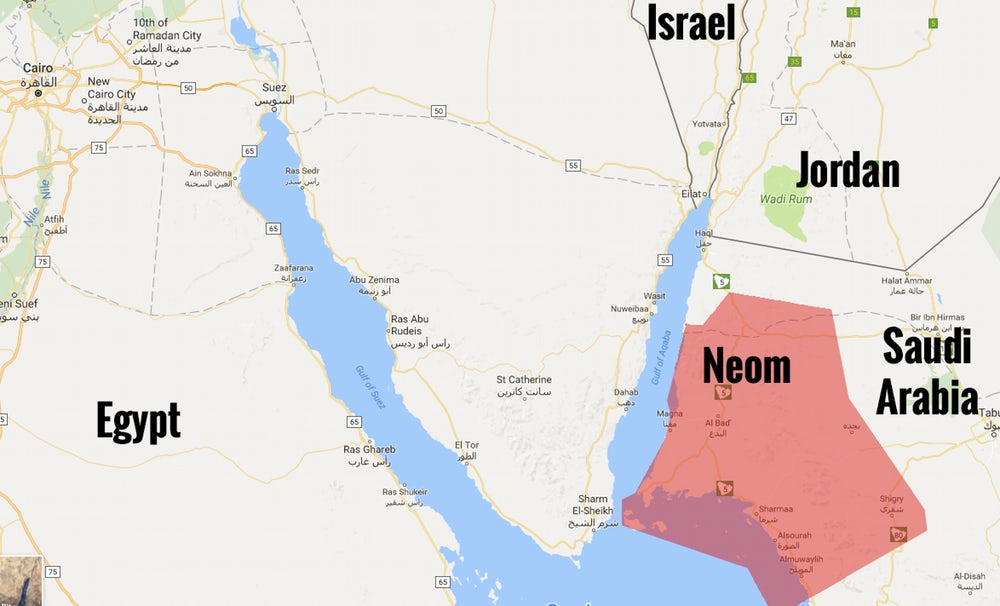
The current pace of change in Saudi Arabia reminds me of global warming. We know it’s happening, but can we predict the outcomes? Will Crown Prince Mohammed bin Salman’s intention to transform the country into a haven for “moderate Islam” eliminate the influence of the conservative elements in its society? Or will he inadvertently create an underground resistance that will lead to perennial unrest?
After decades in which change has proceeded at a glacial pace, the ice is thawing rapidly. Economic and social measures are announced on a regular basis. A far-reaching 2030 Economic Vision. The ARAMCO flotation. Cinemas and entertainment zones. Women allowed to drive. Possible changes to the female guardianship rules. Even Richard Branson has got in on the act. Yesterday he announced that the Saudis would be investing a billion dollars in his space business.
The one constant is on the political front. Nothing and nobody is being allowed to challenge the supremacy of the royal family. Most recently there have been arrests across the social spectrum – from ultra-conservative clerics to liberals pressing for democracy. Saudi Arabia remains in the thrall of al-Saud. Those who have traditionally served as a brake on its absolute power – such as the religious establishment – appear to have been sidelined.
The Crown Prince is not without his opponents and naysayers both within and without the Kingdom. The war in Yemen is draining the treasury and going nowhere, they say. The 2030 Vision is hopefully ambitious and will fail. The marginalisation of the conservatives cannot be achieved by decree – hearts and minds need to be won. Others describe the task of embracing “moderate Islam” as a counter-reformation, pointing out that a Reformation of sorts took place more than two centuries ago when the first Saudi dynasty came to power in alliance with the “back to basics” preacher, Mohammed ibn Wahab. They claim that an open society promised by the Crown Prince cannot exist without the political plurality that he shows no sign of tolerating.
Whether or not the sceptics are right, there’s little doubt that Mohammed bin Salman has a massive task ahead of him if Saudi Arabia is to wean itself from dependence for its prosperity on oil and gas.
Saudi-watchers often claim that he sees Dubai as his model of governance. Tightly controlled by the ruling family, but socially liberal – up to a point – and rampantly entrepreneurial. But Dubai is a city state. It’s relatively easy to control politically and its population of nationals is far smaller compared with its expatriate s than Saudi Arabia. The Kingdom is sprawling and diverse.
My guess is that the Crown Prince looks further for his model – to China, where the entrepreneurial spirit thrives within the iron grip of the Communist Party. To compare Xi Jinping and his party oligarchs with Al-Saud might be a stretch, but the royal family numbers many thousands and its patronage extends far and wide.
In one aspect the example of Dubai does loom large in Saudi thinking. With its cinemas, bars and relatively relaxed social mores, it’s long been a honeypot for Saudis who wish to escape from the restrictions of their homeland for a weekend or sometimes longer. “Why can’t we be like Dubai?” is a familiar refrain, especially in cities, such as Jeddah, that have always been more cosmopolitan than those in the Saudi heartland – Riyadh, Hail and Qassim.
The news that the Saudis are planning to create a new megacity on the north-west coast, close to Jordan, Egypt and Israel made me smile, for reasons I will explain shortly. NEOM will be nearly the size of Belgium. It will be socially liberal, powered by sustainable energy, and devoted to high-tech industries. As Prince Mohammed explained, “this place is not for conventional people or conventional companies”.
Certainly not in Saudi terms. Potentially it represents the first step in solving the ages-old tension between the conservatives and those who chafe under what they see as unnecessary social restrictions.
Why the smile? Because six years ago in this blog I anticipated a development not a million miles from what is now being contemplated. In a piece called The New Saudi Arabia, I imagined the monarch at the time, King Abdullah, upon his return from surgery in the United States, addressing the nation thus:
….Of one thing I am sure. We cannot stand still. Today our economy is stronger than ever. We are a respected member of the G20 group of nations. We have carried out many initiatives to foster a new economy that will remain strong after our blessed patrimony, our reserves of oil and gas, have been depleted. But we have to face the prospect that within the next fifty years those resources will no longer be as valuable to the world as they are today. Our neighbours and trading partners are, as I speak, developing alternative energy technologies which are reducing the world’s reliance on hydrocarbons.
We must do the same. Whether the long-term solution is nuclear, solar, wind, wave power or a combination of all these technologies, Saudi Arabia must be at the forefront in developing solutions for ourselves. This is why I authorised the establishment of the King Abdullah University of Science and Technology and other research initiatives.
But these are long-term programmes. They will not solve the pressing problem facing many of our young people – the curse of unemployment. Therefore, after consulting members of the Shoura Council and the Council of Ministers, I have decided to issue a Royal Decree announcing a number of measures designed to stimulate employment, reduce our reliance of foreign labour and move towards a knowledge-based economy.
The first and most important measure will be to divide the country into two areas with separate commercial and social policies. The cities of Jeddah, Rabigh, Yanbu, Dammam, Al-Khobar and Jubail, together with their surrounding areas, will be designated as International Zones. The remaining cities, including Riyadh, Makkah, Al-Madinah and Hail, as well as the rest of the Kingdom, will be designated as Heritage Zones.
The Western cities, and particularly Jeddah, have long been at the commercial heart of the Kingdom. The conurbation of the Eastern Province plays a vital role as the centre of our petrochemical industries. It is in these regions that we will be implementing new regulations to encourage trade and investment, employment and the free movement of labour. If the measures succeed, then we will consider implementing them in the Heritage Zones also. If they fail, then those who accuse us of being resistant to change will not be able to say that we were unwilling to consider new approaches.
The new measures in the International Zones will include free association between men and women in the workplace, in education and in public gatherings. Women will be permitted to drive. Women will be permitted to practice as lawyers and in all other professions open to men. The sponsorship system for foreign labour employed in these zones will be abolished. The incentives currently in effect in the Royal Commission cities of Yanbu and Jubail will be extended to all the cities in the International zones. Several government departments currently located in Riyadh will move to the International zones, but staff will not be guaranteed lifetime employment, and their working conditions will be similar to those in effect in the private sector.
The Heritage Zones are at the heart of our culture as Arabs and Muslims. Riyadh and Hail best exemplify the purest Arabian traditions of hospitality and observance of the customs of our ancestors. The Holy Cities have been entrusted to us by God, and we will cherish and preserve them as living monuments to our Islamic values. In these regions, life will continue much as it does today.
There will be no discrimination between the Zones in terms of the basic rights and entitlements of our people. But by these measures we recognise and cater for the differences of aspiration and social preference between one section of our society and another. Our policy of investing in business, education and research across all areas of the Kingdom will continue. It will be the choice of our citizens whether to live and work in either Zone.
Saudi Arabia cannot stand apart in the world. We recognise that not all of our neighbours share all of our customs and values. We have learned from their successes and failures. These measures make certain areas of our Kingdom more aligned to the commercial and social practices of our neighbours and trading partners, while preserving in the heartland the way of life practiced by previous generations. They open the way for Jeddah to become the third great commercial and financial centre of the Middle East, rivalling Dubai and Bahrain, but with the advantage of being the only centre in the West of our country. The Eastern Province can similarly develop to become the centre of excellence for engineering and petrochemical technology in the Arabian Gulf, capitalising on the experience and expertise of Saudi Aramco. By these changes in social regulation, we even open the door for the cities of the International Zone to host major sporting competitions such as the Olympic Games and the FIFA World Cup.
Other measures will include regulations requiring a rigorous examination of productivity both in the public and the private sector with adjustments to work permit allocations and labour laws based on the findings. Schemes to re-train Saudi nationals in mid-career into new and rewarding occupations. Anti-corruption legislation that imposes stiff penalties with no exceptions on those who abuse positions of trust for personal gain. The requirement that foreign companies operating in their own right or as joint ventures contribute either to a national research and development fund or invest in their own research and development in the Kingdom, with the rights to their inventions remaining in the Kingdom. Standardisation of procedures for granting business and visit visas common to all our embassies abroad. Investment in non-religious tourist attractions within the International Zones. Extension of tourist visas into the International Zones for non-Muslims…..
Things are not quite working out that way. It would be hard to see young Saudis in places like Riyadh being content to miss out on all the fun to be had elsewhere. And the ban on women driving has been lifted throughout the country. But NEOM, if it happens, would be the first example of an entire area being sectioned off into a zone where different social and economic rules apply, even if, as Bloomberg anticipates, it ends up being populated more by robots than people. If it works, the principle of “one country, two systems” could become a model for further zoning.
I’m cautiously optimistic about the future of Saudi Arabia. I’ve been coming to the country since 1981, and for several years it was my home. That doesn’t make me an expert on all matters Arabian. But I’ve met and worked with enough people over those years to know that there’s no shortage of talent, enthusiasm and goodwill.
I also know that the Kingdom’s political leaders have always tempered dreams with pragmatism, and for that reason I don’t believe that a greater degree of political plurality is out of the question, even if today it appears far away.
Perhaps my optimism is rooted in a desire to see the country succeed. For all its flaws, there is so much to like about its people, its traditions and its often quirky approach to life.
If the region were not so riven with conflict, I would be even more positive about Saudi Arabia’s future as a nation. Even so, there have been plenty of people willing it to fail over the past nine decades of its existence, and it’s still standing. For the sake of all the good people who live there, I hope its current evolution leads to stability and fulfilment.
Those of us who watch from afar, whatever our reservations over its social and political policies, sometimes forget how important the country is to our prosperity. The prospect of it plunging into the chaos that has ruined its neighbours to the north would have ramifications way beyond the Middle East.
For me, it’s a bit more personal. I made friends with many Saudis over thirty-five years. They deserve happiness and success as much as the rest of us.
Back in the days when I was an employer, my business partner and I took the view that there was no point in trying to keep people who wanted to leave the company. Even though we felt that our company was a great place to work, we understood that some people – especially those for whom we’d been the only employer – would want to branch out and broaden their experience of working life.
A number of them came back to us, after realising that the grass was not greener. And we welcomed them.
But would they have left in the first place if they had known that the grass consisted of a few desperate shoots in a field full of mud and putrefaction?
I’m beginning to think that the only way we will resolve the decades-old argument that culminated in Brexit versus Remain is if we crashed out of the EU with only the bare minimum of working arrangements in place.
Yes, the result would be economically difficult. I’m not going to use words like catastrophic and disastrous, though in hindsight we may see it that way. In fact I, like many others, fear that we will end up with a shrunken economy, diminished influence and a generation of citizens whose prospects of happiness and personal fulfilment will be substantially reduced.
In other words, we are in danger of discovering that the grass is not greener.
If that is the hard road that destroys the pretensions and credibility of the Brexiteers for ever, then perhaps it will be a road worth travelling down. In a decade or so, reduced, humbled, and finally stripped of any aspirations to be a world power, perhaps we can apply to re-join the EU as just another medium-sized European nation.
By that time, the EU will hopefully have reformed itself into an entity that no longer orbits around the dead weight of the current Brussels establishment, and is flexible enough to accommodate greater diversity in economic, political and social models within its membership, including the strange ways of us fractious Brits.
I don’t want that future.
I’m still counting on the likelihood that come 2019, there will be enough people in politics who will realise that although their careers may be crippled by overturning Brexit, at least they will escape the notoriety that will stay with them for ever as the architects of Britain’s most damaging mistake since Suez.
Again, should we slip off the cliff, the consequences would not only be economic. It’s entirely possible that our political order will disintegrate. The parties we know today may no longer exist. They might well be replaced by an extreme right, who, like Nigel Farage today, will look for any opportunity to blame others for the misfortune that they helped to create, and an extreme left, who will blame a rigged economic system for all our social ills.
One who apparently knows better than me is Iain Martin, who wrote in yesterday’s London Times:
This winter we are about to be treated to the spectacle of a large part of the British establishment (much of it unelected) effectively trying to overturn a referendum result that was at root a rejection of the British establishment view. If you want to reverse the referendum, this chaos might delight you. But for many millions of voters this will be “our betters” saying that what the country voted for should be vetoed.
Which perpetuates the myth that those who oppose Brexit are the “British establishment”. Not me sir, and not the millions of young people who voted Remain, including my kids.
He goes on to predict fire and fury if the supposed will of the people is thwarted:
…. I have a stark warning from the Leave side of the argument about the potential implications of keeping Britain in the EU against the wishes of voters. Those trying to stop Brexit are playing with matches in a petrol station. Right now, Brexiteers may be depressed by the difficulties of the talks and their own failures of planning but if the process is stopped or looks like it could be, those who campaigned for it are hardly going to sit back. They will organise, and quickly.
They will do so even if the evidence that we are making a terrible mistake is overwhelming? Perhaps. When faith trumps reason, all manner of demons come out to play. Martin claims that there’s plenty of money available from donors to fund a renewed campaign:
The capacity to facilitate new forms of political organisation and protest via social media is well observed here and in the US. A cross-party campaign outside Westminster could be put together very quickly. Think in terms of Momentum for Brexiteers but much bigger, with attempts at organising rallies on a vast scale to spread a pro-democracy, anti-elite message.
At the root of it would be latent anger with the liberal elite and the cosmopolitan contempt in which Brexit voters are held, too often finding themselves dismissed as decrepit racists or stupid dupes.
Ho hum. Pro-democracy and anti-elite? Liberal elite and cosmopolitan contempt? It sounds as though we’re in for a British Trump campaign. Stand by for the swamp drainers and wall builders.
But if you call out racist attitudes among leave voters, and point out the blatant lies peddled by influential (and wealthy) leave campaigners who were aided and abetted by shadowy data analytics companies and mischief-making Russian bots, does that mean that you are anti-democracy and pro-elite? Arrogance works both ways, I think.
Most of the arguments at the moment are about the possibility of no deal, something that the Chancellor and the Home Secretary describe as “unthinkable”, but which the fanatical Brexiteers view with glib complacency. They, of course, are not the ones who will suffer most from the economic consequences. I can’t see John Redwood, for example, applying for income support any time soon. Those who think that Britain under World Trade Organisation rules will be in clover should take a look at this Twitter thread launched by Jo Maugham QC, who is a barrister and a leading Remain activist. He quotes from the Treasury’s own findings pre-referendum. The scenarios are not pretty.
If no deal is not unthinkable, I can’t see how a reversal of Brexit is also beyond the pale, especially if the electorate vote for it in a referendum on the terms of departure. Failing that, as Yanis Varoufakis advises, we should adopt the Norway model which guarantees us access to the single market, albeit at a price. As he says, we would be far better prepared after five years under the Norway terms to work out what future relationship suits us and the EU best.
Even better would be to revoke our Article 50 letter, stay within the EU, and set up an independent advisory body that can help us ensure that should we choose to press the exit button further down the road we will have a coherent view of strategic options, we will be working with accurate data and will have contingency plans already in place. In short, all the things we’ve been struggling with over the past six months.
If, in the meanwhile, reforms to the EU institutions create an entity with which we are more comfortable, fine. But at least we will better understand how to leave in the future without falling into a black hole.
Either way would surely be better than the path we’re on right now. I bear no ill will towards the Brexiteers. But speaking as a committed traitor and enemy of the people, I long for the day when the angry ideologues at either end of the political spectrum fall silent. And if for that to happen they must get the chance to put their theories into practice, then so be it.
Let’s hope that afterwards we still have a country worth living in, and that we don’t burn too many martyrs along the way.
If public revulsion at Harvey Weinstein’s alleged sexual predations was as widespread as you might think, you might also think that the newly outraged would turn on Donald Trump. No such luck, unfortunately. Those most likely to be outraged will no doubt remain so. For the rest, the prevailing view on Trump will continue to be “he might be a bastard, but at least he’s our bastard”.
For the time being, at least.
We Brits have seen this stuff before. It’s a crude parallel, but you could say that Weinstein is our Jimmy Savile. True, Savile died before he could face the music, whereas the film producer, once he emerges from his sex addiction clinic, has every opportunity to defend himself, most likely along the lines of “forgive me – I have a problem”.
Just as Savile was not the first celebrity to be revealed as a sexual predator in Britain, in the United States Weinstein’s downfall was preceded by some high-profile busts: Bill Cosby for example, and Roger Ailes and Bill O’Reilly of Fox News.
The shaming of our creepy former icon kicked off a series of sexual abuse allegations against famous people. Some were convicted. Others were acquitted, and yet more were named but not charged, thus tarnishing their reputations forever.
Our hunting frenzy has not been confined to people in the entertainment business. Over the past three years the finger of accusation has been pointed at a former prime minister, Edward Heath, and a several more politicians who, like Savile, were unable to defend themselves because they were dead.
Weinstein will no doubt be followed in the moral dock by others in his field. He may be the most powerful executive named and shamed, but he won’t be the last. After all, the casting couch has been around since the dawn of Hollywood. We can expect a wildfire of accusations against all manner of famous people in the coming months. And I have no doubt that some of his peers who are energetically casting him into the outer darkness will themselves, like Robespierre, the grand inquisitor of the French Revolution, end up at the guillotine.
When the shame storm has played itself out, will America enter a new era in which sexual exploitation becomes a career killer? I doubt it. At least not as long as Donald Trump rules the roost, and not as long as Hollywood continues to feed the public appetite for depictions of murder, rape and sexual exploitation.
As for Trump, there’s plenty of evidence of his attitude towards women, but nothing that has conclusively proved that he’s more than all talk and no action. Allegations, yes, but videos, semen on clothes, no. Bill Clinton showed that modern presidents can survive pre-election scandals. So it has proved with Trump.
Nor is it likely that he will risk future indiscretions. US presidents are unlikely to be able to get away with bunga bunga parties, even if, like Silvio Berlusconi, they are still able to rise to the occasion.
But then again, who knows what Vladimir Putin has up his sleeve, ready to let slip at the appropriate moment?
Sadly, my best guess is that after the sun god of morality has feasted on the ritual sacrifice of Weinstein and a few others, things will return to normal, and powerful men will continue to do stuff with impunity for which the rest of us would end up behind bars.
Because they can.
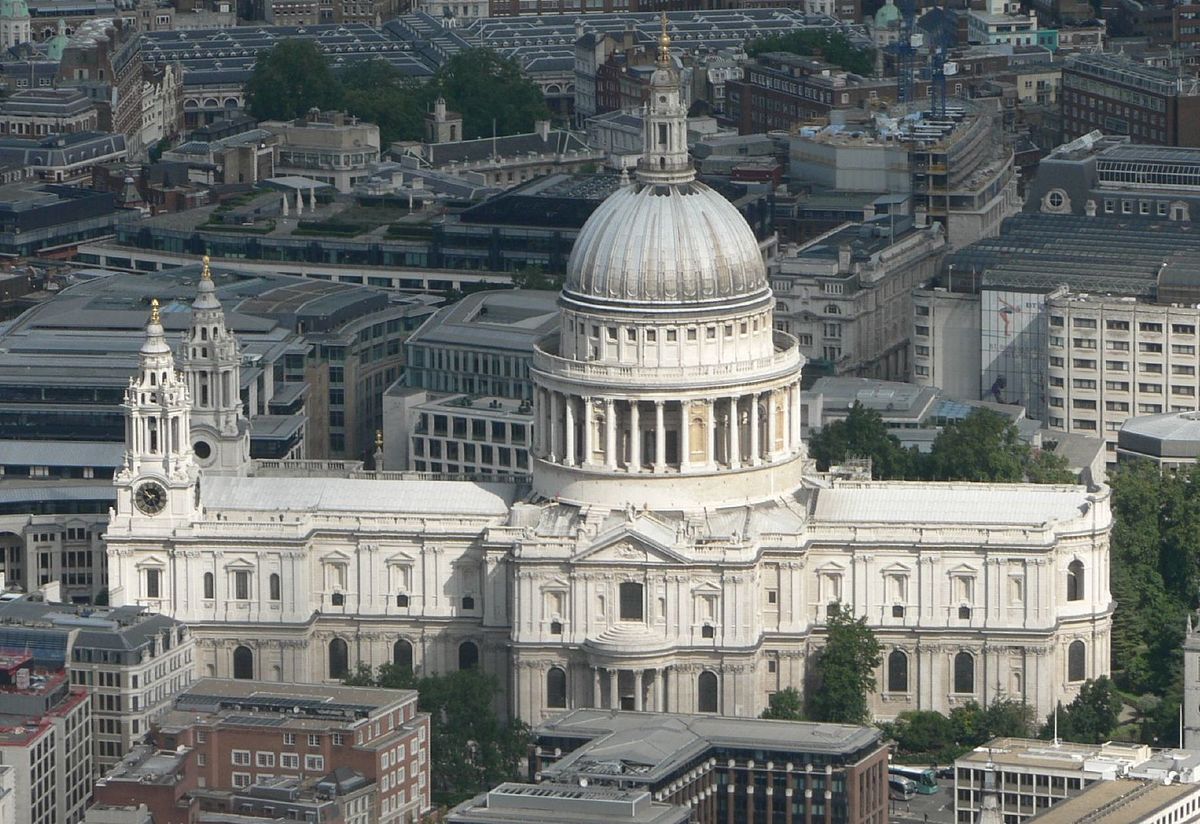
For me, letter-writing died some time around 1993. That was when I started using email in earnest. I’d had a computer for the previous eight years, but it served as a repository of data rather than a means of communication.
Nowadays, I wonder how many people up to the age of fifty actually send letters to anyone, apart from job applications, tax returns and – in the case of the young – thank-you letters to elderly relatives that they’re shamed into writing by nagging parents. In fact, forget about jobs and tax – most people deal with these chores online.
Postcards from exotic locations, yes. But mainly for Granny. The really hot stuff – the parties, the champagne and the daring pursuits that cause the elders to fibrillate with anxiety – appear on Instagram and Facebook, which, conveniently, Granny doesn’t know much about.
A little personal project recently competed reminds me how much I miss letters.
Too many people in my age group have died recently. David Bowie, Alan Rickman and a host of others – and just now, Tom Petty. Therefore I’ve decided it’s time to prepare for death. Not that I’m planning to go any time soon, but I dare say all those talented people who departed in their sixties didn’t either.
Death doesn’t require a monument. Not everyone can say “si monumentum requiris, circumspice” (if you seek his monument, look around you), as Christopher Wren’s epitaph in St Paul’s Cathedral proclaims. Most of us pass on with little ceremony and not much to show for our lives, forgotten within a few years by all but a small group of friends and family.
So in the absence of a physical monument – a Playboy Mansion, a Monticello or a Goldeneye – the evidence of my life will have to be virtual.
My generation is perhaps the last to have corresponded regularly by letter. If I was famous, I might leave my “papers” to some public institution such as the Bodleian Library in Oxford, so that scholars could admire my wit and wisdom for centuries to come.
Now that everything is electronic, that will no longer happen. If you wrote in your will that “I bequeath my emails to the British Library”, your executors would rupture themselves laughing. And anyway, if you were really famous and your emails were even vaguely interesting, the Russians would already have hacked them and sent them over to Wikileaks.
But old letters written on real paper – thick creamy sheets or wafer-thin airmails – lie hidden in trunks. Ready to be discovered, or not, by relatives who are clearing up your stuff after your funeral. If you’re lucky, or not, the person doing the clearing might be fond enough of you to hang onto stuff that has no intrinsic value, but adds to the patchwork of evidence as to who you really were.
On the other hand, if they’re only after the jewellery or the antique furniture, or if they fancy a second-hand set of golf clubs, they might be tempted to throw the rest of your crap into the rubbish dump.
I have plenty of mementos of my parents. War medals, diaries, hundreds of photos that I’ve lovingly digitised, a few press cuttings about significant events such as my uncle’s death in World War 2. The diaries, written sporadically by my father, are almost indecipherable, but shed some light on the person. But there are precious few personal letters, and virtually none written or received by any of my grandparents.
So I know a reasonable amount about my mum and dad, including stuff I wasn’t supposed to know when they were alive. About the earlier generations I know virtually nothing beyond the bare details of births and deaths that my parents passed on, and what I can trawl from official sources – census records, the War Graves Commission and so forth. Not much in the way of monuments.
There is one exception. As I’ve mentioned before in this blog, I have my grandfather’s diary of his experiences in the First World War. As a result, his character comes alive – a rare shaft of light in an otherwise muddy jumble of anecdote and bureaucratic records.
As for my parents, I interviewed them on video for five hours in an attempt to fill as many gaps as I could.
My children have shown little inclination to do the same exercise with me, perhaps because they think I’m immortal, young fools. So if I want to be remembered, it’s up to me to build my own monument, whether it’s interesting to others or not.
Which is where the letters come in.
What I don’t have is ones that I wrote. They remain with the recipients, and have probably been thrown out ages ago. I do remember writing long letters, which will be no surprise to readers of this blog. In my first year in Saudi Arabia I wrote to all and sundry about the wonders of that country, the bizarre, the hilarious and the unexpected. And when people dear to me went off to other places, I would also write at length about the nonsense that was going on at home.
I must have been striking the right tone, because people would write back. It’s those letters that I religiously collected over the years. And it’s those letters, disinterred during a garage purge a couple of weeks ago, that I decided to digitise.
Most of them I hadn’t read for twenty-five years. They were written to a student making new friends, falling in and out of love, casting away the legacy of school and home life. They were written to a penniless struggler in his twenties, living in a succession of houses where the windows froze on the inside in winter. And they were written to an expatriate whose fortunes were transformed amid the oil fields of the Middle East, who became a husband and a father, an actor, a traveller and eventually a businessman.
None of those recipients are me today, and yet all of them are. Reading them again after all these years has shown me more clearly than before what sort of person my correspondents thought I was.
They also shine a light on the world my generation lived in.
No email, PCs, IPhones, WhatsApp. Often no land lines:
I’m feeling a bit concerned about not hearing from you, especially after hearing that things had not been so good where you are. I hope all is well with you and that you have received my recent letters.
A phone conversation with a close friend thousands of miles away was eye-wateringly expensive, beyond the pocket of many young people – therefore a major event:
It was great talking to you on the phone – the line was pretty good considering, but it must have cost you a fortune.
Direct flights to faraway places? Not if you were from a forces family, as one friend was. And when you get to your parents’ house, no aircon:
My flight to Hong Kong was horrible – 19 hours including stops in Aden and Delhi. It’s bloody hot here – it’s midnight, and I’m lying under a fan in 80 degrees.
The annual student ritual of house hunting, by snailmail:
I’m wondering if you’ve found a new house to rent for this year – if so, do you have a spare bedroom?
CDs, streaming, ITunes? Nope, just the humble cassette:
Hello again, my father has put on a cassette of folk songs – and my mother is singing away. They’re enjoying it so I mustn’t complain.
Writing letters was an effort. Receiving one from home was an event to look forward to. Would you say the same about an email?
What a little shit you must think me. There you are in the desert and all you want is the occasional letter, and I can’t even be bothered to do that. There is no excuse, you’ve always made time for me and I should at least have done the same for you.
With your best friends, a chance to amuse, to create and share stuff:
He cheated at cards
He cheated at life
He cheated his friends and he cheated his wife
He lied to us all till he ran out of breath
Then he threw in his hand when he could not cheat death
(My latest effort after 4 pints)
And much, much more. Words of love, hurt, thanks, reproach, praise, disappointment. References to people I don’t remember. Letters from people I don’t remember. Reminders of opportunities taken and lost. Words that bring back the person I once was, and people who once were.
These letters have become part of my modest little monument. It includes photos, videos, various writings (including the 750 pieces I’ve written in this blog). Most of it is open to anyone who’s interested. The letters, however, are rather like the repository for the naughty bits from Pompeii: restricted access.
Perhaps I will also provide some commentary about the writers of these letters, or at least those whom I remember. Not because I’m planning to write an autobiography, though that might be fun. But who would read it? And who would be interested?
You don’t have to be rich, famous or especially talented to create your own monument. But if you’re not, nobody will do it for you. It doesn’t have to be grandiose or full of bombastic self-justification. It can be more like a burial mound, hiding its treasures within.
I have no better reason for building mine than my own satisfaction, and the possibility that those who remember me when I’m gone will have more than a few photos, a few artefacts and a pile of crap to be thrown on the dump. I’m not vain enough to assume that the stuff I’ve gathered in electronic form is going to be interesting to my kids or their kids. But it’ll be there if they want it.
I don’t believe in living in the past. There’s plenty left to see, feel, do and enjoy. But the past – especially our own – is not another country where they do things differently. It’s with us, it’s part of us, it informs us and it helps us make sense of the present.
And as I think of all the people – famous or not – who have gone this year while having so much more to give, I appreciate the present all the more. The future will take care of itself.
Like St Paul’s Cathedral, my monument is not a static thing. I shall keep building it until I can build no more. Hopefully that won’t be for a long time.
This post is dedicated to Paul Brett Sommers, a dear friend and letter-writer who passed away two years ago, aged 66, about whom I wrote this when he died. An example of his ramblings is below:
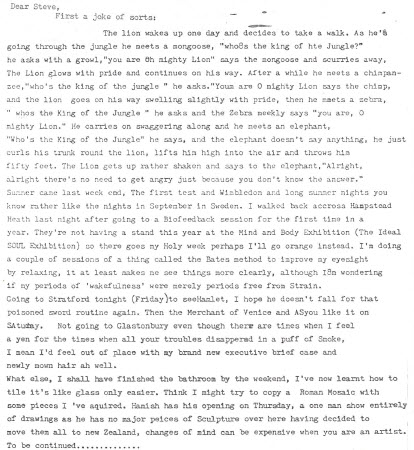
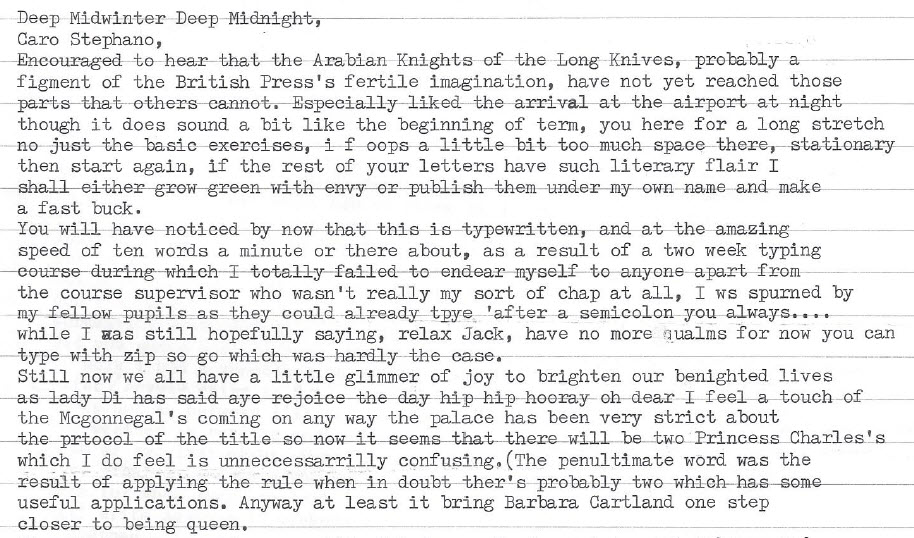
I haven’t posted anything in the past few days, not because of a lack to stuff to write about, but because much of my time has been taken up by two domestic projects.
The first was to scan all my incoming letters over the past five decades, but mostly pre-1990s. More on them some other time.
The second was a garage-clearing exercise. Well, it was supposed to be, but I got side-tracked. I had focused on the contents of a number of plastic crates that mainly contain papers. Boring papers. Reams and reams of them. Business documents that I kept, just in case. In case of what? When you’ve ran businesses and sold companies, you never know whether some gremlin might pop up with some spurious claim, so best to hang on to the evidence that you were on the side of the angels.
Then there’s the personal stuff. Details of mortgages long defunct. Insurance claims for woodworm from twenty-five years ago. Bank statements dating back to the stone age, and all kinds of other bumf that I saw fit to preserve. Why? Because stuff going back, say, five years, might still be relevant. But eventually so much accumulated that to make a bonfire of it might send fragments of paper all over the neighbourhood, 9/11 style.
Chuck it in the municipal dump? Maybe, but then you’re vulnerable to identity theft. What if all those papers bearing our names should fall into the wrong hands – an internet fraudster masquerading as a Latvian municipal employee?
Snip off our names from every document? You must be joking! You’re talking about at least a year’s work.
So in the end, I admitted defeat. The documents are still in the garage, waiting for our kids to deal with when we pop our clogs. Just as we did when my parents died.
My father died fifteen years ago. He was a lawyer, and he continued to work right up to the day he died at the age of 81. Many lawyers do that. It’s their way of warding off dementia, and in the case of Denis, it definitely worked. He was sharp as a pin right to the end.
But then we had to do something about a loft full of papers. As the only members of his family living close by, that task fell to us. Over the next five years my wife got rid of most of them – case work going back many decades in which the protagonists were most likely dead. Anything relevant to our family history we kept, along with evidence of work he did for us.
One crate full of his files remained. We kept it because it contained his more recent stuff. Since most of the people referred to will by now be dead or gaga, this at least was one item that could safely be cleared. But just in case, I went through every file to make sure there was nothing of personal or historical interest.
It turned out that there was.
In among the dusty records of interminable law suits was a summons from a Scottish court issued in 1916. Why it was in Denis’s possession I have no idea.
It tells a sad little story – to the extent that I can understand it.
An army officer is riding through the Scottish town of Aberdour on a motor bike. He has a side car, and in it is a woman – his girlfriend perhaps? A van driver comes towards them on the wrong side of the road. He appears distracted, and wasn’t keeping his eye on the road. He suddenly sees them coming, and swerves to avoid them. He’s too late. The woman is killed, and the motorcyclist suffers injuries from which he may never fully recover.
In some respects the story reminds one how different the world was a hundred years ago, and yet in the most important detail how familiar.
In 1916 there were no laws specifically targeted at dangerous driving. The van driver would most likely have been charged with manslaughter. There was also no Highway Code. The first version was not published until 1933.
I tried to find references to the case on the internet, but without success. Since it took place during the Somme campaign, when large numbers of British soldiers were dying every day, the death of a bookseller’s daughter would probably have merited no more than a few column inches in the local newspaper.
I did find what might be a record of the man who killed her, Arthur Marlow Wilkie. According to Ancestry.com, a man of that name was born in Fife in 1898. If it was him, he would have been eighteen years old at the time of the accident. He apparently got married, so did he marry before the accident or after his jail time, assuming he was convicted? No doubt the answer lies in some long-forgotten archive in Edinburgh.
Yet the cause of the accident would be common enough today.
According to the summons, “The motor was travelling west, and was proceeding on the north, ie its wrong, side of the road. The driver of the motor car was at this time observed to be leaning forward as if observing the kerb, or as if examining some part of the car. He was not keeping a look out for oncoming traffic”.
In 2017 he might have been texting, or checking his satnav for a delivery address, with the same tragic result. And today, the victim could have been a cyclist. You don’t see motorbike side-cars these days.
As for the plaintiff, the motorcyclist himself, he was so badly injured that he needed a relative, his father, I thought – a major in the War Office – to pursue the case on his behalf.
A little more research revealed that it was indeed David Murray’s father. And some father. The Right Honourable Charles David Murray, King’s Counsel, later to be Lord Murray, Conservative MP, Privy Councillor and Lord Advocate (Scotland’s most senior judge).
David Murray, according to the biography of his father, married the exotically named Comtesse Elena Maia Sollohub. Based on inconclusive internet searches, my best guess is that her family were Russian nobility from St Petersburg. Was she an émigré who came to Britain after the Russian Revolution? If so, it’s likely that she married David after the accident. Which in turn suggests that he recovered from his injuries.
Despite being the eldest son, he did not, however, succeed to his father’s title. Lord Murray died in 1936, and his third son Keith became the second Lord Murray. If David was in his mid-twenties in 1916, it seems that he didn’t live beyond his mid-forties. Was his life shortened by his injuries? I drew a blank on this also.
The summons was essentially a demand that Arthur Wilkie’s employers, David Goodall and David Tullis, should pay David Murray what was an extremely large sum of money in compensation. Goodall and Tullis are described as “posting masters and carriage and motor hirers”. Clearly they were in the car hire business, but what a posting master did is less clear – couriers perhaps? They had thus far refused to pay, so they were being summoned to court. And to encourage them, the court prohibited them from selling any of their “movable goods and gear” and any property they owned – their homes for example – unless it was to pay the debt.
There’s no evidence as to whether the family of poor Mary Isabelle Williamson were awarded compensation. But you can bet that David’s father, being a prominent lawyer and a pillar of the Edinburgh establishment, would have squeezed Goodall and Tullis on his son’s behalf until the pips squeaked.
Another striking aspect of the document is the legal language. I’ve seen a few examples of arcane legalese in my time, but nothing, absolutely nothing, approaching the weird combination of words and phrases stitched together in the epic preamble. Here’s an example:
“That is to say, to hear and see the premises verified and proven, and decree and sentence pronounced by our said Lords, or else to allege a reasonable cause to the contrary, with certification as effeirs : Attour that in the meantime ye lawfully fence and arrest All and Sundry the whole readiest moveable goods and gear, debts, and sums of money, and other moveable effects belonging or addebted to the said defenders, wherever or in whose hands soever the same may be found, all to remain under sure fence and arrestment, aye and until sufficient caution and surety be found acted in the Books of Council and Session that the same shall be made forthcoming to the pursuer as accords of law:”
Effeirs? Attour? You have to wonder whether the person who drafted this was dyslexic. And what of the folksy “aye” casually inserted into the middle of the text?
The whole thing is riddled with obscure language that seems almost designed to leave anyone but a Scottish lawyer tearing their hair out with incomprehension and frustration.
When we get to the statement of the facts of the case – bizarrely referred to as the “Condescendence”, it seems as though our writer has suddenly cast aside his legal robes and decided to write in plain English.
The whole thing is a masterclass of drafting that could have been written by someone with multiple personality disorder.
Yet the tragedy is clear enough, even if the aftermath isn’t.
The question remains as to why my father had the document. Was it perhaps a case study set in an exam when he qualified as a lawyer back in 1948? Or did he use it as a legal precedent in a case he was handling? Or did he just delight in reading obscure legal judgements?
I will never know, because there were no accompanying papers. Just this obscure little paper pregnant with implied tragedies that would have devastated at least five families: the van driver, the Murrays, the defendants and the bookseller’s daughter.
Finally, a coincidence of sorts. A month before the fatal accident in Scotland, my maternal grandfather was riding on his motorbike, and collided with a heavy lorry coming from a side road. His knee was mangled, and he took months to recover. He was an artillery officer commanding all the anti-aircraft batteries in Crosby, Liverpool. The injury delayed his deployment to the Western Front, where the Somme offensive had just begun. Would he have survived those extra months in France?
He arrived in time for the battle of Passchendaele, but he survived the war. Like David Murray, he died within twenty years of the end of the war, a relatively young man.
Did the parallels between the two accidents so close in time occur to my father? Indeed, was he even aware of his father-in-law’s account in his war diary? Again, I will never know.
One accident led to a death, and the other quite possibly enabled a life – that of my mother, who was born four years later. And it took a hundred years for two written records – a court summons and a war diary – to sit side-by-side on the desk of someone with the time and inclination to think about their implications.
That’s one of the reasons I love history. It’s not just about the dead and the gone, but about life and the living.

I was surprised to read that the great State of California is considering banning its residents from acquiring dogs unless they come from shelters.
Why surprised? Well, if ever there was a part of the world dedicated to the perfection of mind and body, it’s the west coast of America, and California in particular. So why would their law-making elite try and force you to choose your soon-to-be-beloved pet from a collection of mongrel, inbred, psychologically-disturbed mutts whose previous owners in a fit of buyer’s remorse chucked them out of the car window somewhere down the I-80? Shortly after Christmas, of course.
The new law also applies to cats and rabbits, though I doubt if they’re as populous as the dogs. Cities like Los Angeles and San Diego no doubt have their fair share of stray cats – known as feral if you don’t like the species – but I should have thought that your chance of being attacked by a street bunny with attitude is close to zero.
Predictably, according to the New York Times, which was good enough to alert me to this startling development, the animal breeders have been begging Governor Jerry Brown to veto the bill, on the grounds that owners want to know about the provenance of their prospective pets. Yep, they want to know that their new Rottweiler comes from a long line of small dog maulers, preferably with a few human victims thrown in. If they’re cats, they want to be sure that their lineage includes ancestors with a high rat-killing quotient.
Supporters of the bill say that the animal breeders keep their product in appalling conditions, and that anyway, the shelters need to be cleared. It seems that the concern is also partly financial, which always gets Californians’ attention. Their taxpayers shell out approximately $250 million a year on domestic animal shelters.
If I was a cruel and uncaring person, which I’m not, I would say that a decent proportion of that money could be saved by a timely injection. But the animal welfare folks say that that’s also cruel, which must be a great consolation to all the battery hens, cows and hogs slaughtered every day to keep America fed.
The other reason I’m surprised at the initiative is that California is one of the great centres of bio-engineering. You would have expected by now that by tinkering with a few genes, Silicon Valley would have figured out how to produce the perfect dog. One that doesn’t poo in its owner’s handbag, is inclined to take chunks out of intruders, but not out of visiting great aunts, only barks when asked to, doesn’t shed enough fur to add an extra layer to your carpet every two weeks, and is able to digest a significant proportion of the vast amount of plastic packaging thrown out by the average American household. Oh yes, and a dog that auto-destructs at the first sign of incurring large veterinary bills – after having donated a few stem cells for cloning.
As for cats, why haven’t they produced an animal that loves humans rather than using them, that doesn’t vomit fur balls and is incapable of hunting birds because it sees everything with wings as predatory pterosaurs?
I can’t think of any improvement you could make to rabbits, except possibly to give them a few more brain cells.
In the absence of the perfect dog, cat or rabbit, I’m with the California legislators. As Martin Luther King might have said if he had been a dog lover, we should surely be valuing our animals for their character rather than the colour of their fur. What’s more, perhaps if we had a bit more human miscegenation, we wouldn’t be giving ammunition to the racists and bigots who, nearly fifty years after Dr King’s passing, continue to infest our public life on both sides of the pond.
Alternative Für Deutschland, a right-wing nationalist group, looks set to establish a significant political foothold after the upcoming German elections. Should we be concerned, ask the headline writers?
I suppose that depends on what we should be concerned about. The return of the Nazis by another name? A new Holocaust? Only the terminally naïve would believe that the Germany of today is likely to have the means and the motivation to repeat the catastrophic mistake for which it is still paying in terms of its reputation and the enduring suspicion of its neighbours.
Could the Holocaust happen again? Many would argue that it has – in Cambodia, Rwanda and now in Syria, Iraq and Burma. Others might say that later acts of mass killing might qualify as genocide, but that there was only one Holocaust – an event in which the Nazis deliberately and systematically killed over ten million people either directly or by neglect. The approximate numbers of the dead included six million Jews, along with two million Poles, thee million Russian prisoners of war, a quarter of a million Roma and a significant number of homosexuals, disabled people, mentally ill people and Jehovah’s Witnesses.
The question is relevant, because in a number of countries there’s been an increase in recent years in organised groups that refer to themselves as Nazis. Their currency is anti-semitism, white supremacy and the all-too-familiar regalia of the Third Reich. And for all but a few deniers, Nazism is inextricably linked with the Holocaust
To establish whether these groups are capable of gaining the power to carry out acts similar to the Holocaust, it’s important to understand the circumstances under which the original one took place.
And that’s what Laurence Rees goes a long way towards explaining in his recent book The Holocaust, which I’ve just finished. He traces the rise of murderous intent from the end of the First World War to the annihilation of the Nazi regime in 1945.
Antisemitism in Germany preceded the rise of Hitler. He was not the only angry ex-serviceman to blame the Jews for the degradation of his country in the wake of the defeat in 1918. But as Rees points out, it’s by no means certain that in the Twenties Hitler envisaged the mass slaughter that subsequently ensued. Certainly he wanted to rid Germany of the Jews, but that’s not the same as planning systematic programme of extermination.
Other “solutions” were contemplated, including – after the fall of France – sending them to Madagascar, which at that time was a French dependency.
In fact the Holocaust was far from systematic, and written evidence of Hitler’s specific instructions is hard to find, even though there is little doubt that Himmler, Heydrich and other senior Nazis were acting according to his wishes.
What is clear is that although mass murders began well before the outbreak of World War Two, these were mainly perpetrated on the disabled and mentally ill. It was only after Germany’s conquest of much of Europe that the extermination of the Jews began in earnest. By that time the Nazis were able to act away from the international spotlight.
What comes over strongly in Rees’s narrative was that the Nazis were making up their methods of murder as they went along. First came the death squads – the Einsatzgruppen – and when the mass shootings became too stressful for the killers, more mechanised methods came into play. Mobile gas chambers using carbon monoxide, and then the death camps, fixed gas chambers and crematoria most commonly associated with the Holocaust.
Some were collocated with slave labour camps, such as Auschwitz-Birkenau. Others, including Sobibor and Treblinka, were as process-driven as abattoirs. Within hours of arriving by train, thousands were dead every day. An elaborate charade convinced them until the last moment that they were at a transit stop. Fellow Jews, Poles and Russians oversaw the killing and incineration, thus sparing the SS guards direct involvement in the grisly process.
By the time the death camps came into operation, the Nazis had made it their mission to rid every corner of their new empire of Jews. In some cases, they were largely successful. In others, such as Denmark, where the Nazi governor, probably anticipating Germany’s defeat in the war, tipped off the Danish government, which in turn warned the Jews. Most of them escaped to Sweden.
The details of the Holocaust have been extensively documented, both through written records and eye-witness accounts, but Rees’s account as an end-to-end narrative is second to none. He considers his work to be a new history, because he uses sources never used in previous accounts. For a comprehensive discussion of the book, look no further than Nickolaus Wachsmann’s review in The Guardian.
No matter how desensitized one is by the atrocities of organisations such as ISIS, it’s still hard to read some of the eyewitness accounts of the Nazi death camps without curling up in horror.
We remember the Holocaust so that we can ensure that it will never happen again. If ever there was an event worthy of being commemorated with one minute of silence throughout the world, this is it.
Which brings us back to the question of whether it could happen again. Certainly not on the same scale, and probably not in the same way, for several reasons.
The main difference is that today no combatant with murderous intentions would be able to hide behind a war on such a wide scale and for such an extended period. The next global conflict, if it occurs, will be short and even more deadly then World War 2. It would most likely involve nuclear weapons.
Another factor is that the world today is wired, and even those acts of mass murder as occur rarely take place away from international scrutiny. We know about the ISIS killings, just as we knew about the Rwanda massacres and the killing fields of Cambodia. Military intervention in the former Yugoslavia probably prevented worse atrocities than actually occurred. Horrendous as they are, these killings have been confined to a limited area, rather than taking place over a continent, from France in the west to Ukraine in the east, and from Norway in the north to Greece in the south.
Also, there was no precedent for the original Holocaust. Now, the world is alert to nascent movements that operate by the same playbook as did the fascist leaders in the 1930s. After 1945, two ideological opposites – fascism and communism – were equally toxic in the west. For the communist regimes in the east, fascism was still seen as the ultimate enemy – defeated, yes, but still ready to rear its ugly head within the capitalist west. While communism as an ideology has been supplanted in the east by various forms of authoritarian capitalism, fascist continues to be a term used by Russia to label its opponents – in Ukraine, for example.
In the west, there are plenty of people who use the word with gay abandon to describe any leader with an authoritarian bent. The same brush daubs Victor Orban in Hungary, Marine Le Pen in France, Geert Wilders in the Netherlands, and even the right-wing of Britain’s Conservative Party. Islamist leaders are often described as Islamo-fascists.
Obnoxious as many of them are, they are not necessarily candidates to kick off the next holocaust. We have become so sensitised to the harbingers of fascism – focus on the leader rather than the state, disregard of the rule of law, the need for a scapegoat or enemy, usually within but often without – that we call out people with those tendencies without hesitation.
Donald Trump, who has been labelled a fascist by opponents and onlookers both in the United States and beyond, has struggled to create the unified purpose and belief that allows fascism to flourish. He’s dangerous, to be sure, but he’s an opportunist, not an ideologue. And unlike Hitler, he’s not surrounded by a cadre of steely ideologues ready to do his bidding. As for the swastika-wielding thugs at the extreme edge of what he calls his base, they are vocal, often violent poseurs with a grudge but not a cause. They are not Trump’s stormtroopers.
The same goes for Europe’s extreme right. They squabble, fragment and make a noise, but none of them has a leader charismatic enough to entice sufficient disgruntled but more moderate voters on board. None of the European countries has since World War 2 suffered a humiliating military defeat and subsequent national debasement that has left a festering and unifying sense of resentment, as was the case with Hitler’s Germany. The one exception is Russia, whose defeat was not military, but economic and political. Resentment over the loss of the Soviet empire is the fuel that fires Vladimir Putin.
So will the next holocaust, if it happens, be perpetrated by neo-Nazis or fascists who manage to take power and then act with impunity against the selected scapegoat? I doubt it.
But that doesn’t mean that a future event on a similar scale to the first one is impossible. In a world in which competition for basic resources – water, food, safe habitat – becomes intense, it’s easy to imagine that unscrupulous leaders might eliminate “undeserving” minorities within their borders, either by expelling or exterminating them.
Countries that are relatively immune to international outrage – probably because they possess nuclear weapons and have sufficient resources to satisfy a dominant majority, but not everyone – would quite conceivably carry out programmes of extermination with impunity. Indeed, if Germany had developed nuclear weapons before the US, it’s likely that within short order there would have been no Jews left in continental Europe, rather than scattered survivors.
As the waters inundate coastal cities, and reduce arable land to salt marshes, or as the great rivers, exhausted by diversion to parched regions, dry up, who would bet against extreme solutions to protect the powerful many at the expense of the weaker few? Or even the powerful few against the weaker many.
Whatever the potential scenarios for mass exterminations in the future, surely today, rather than harking back to the circumstances of the original Holocaust and worrying about a bunch of tinpot demagogues and their torch-bearing followers, the most compelling reason to remember the event is that it reminds us of the ability of seemingly ordinary people under certain circumstances to set aside their inhibitions and work together to carry out acts of horrendous inhumanity.
And in those terms, there are little holocausts taking place every day somewhere in the world. In whatever ways we can, we must call them out and stop them.
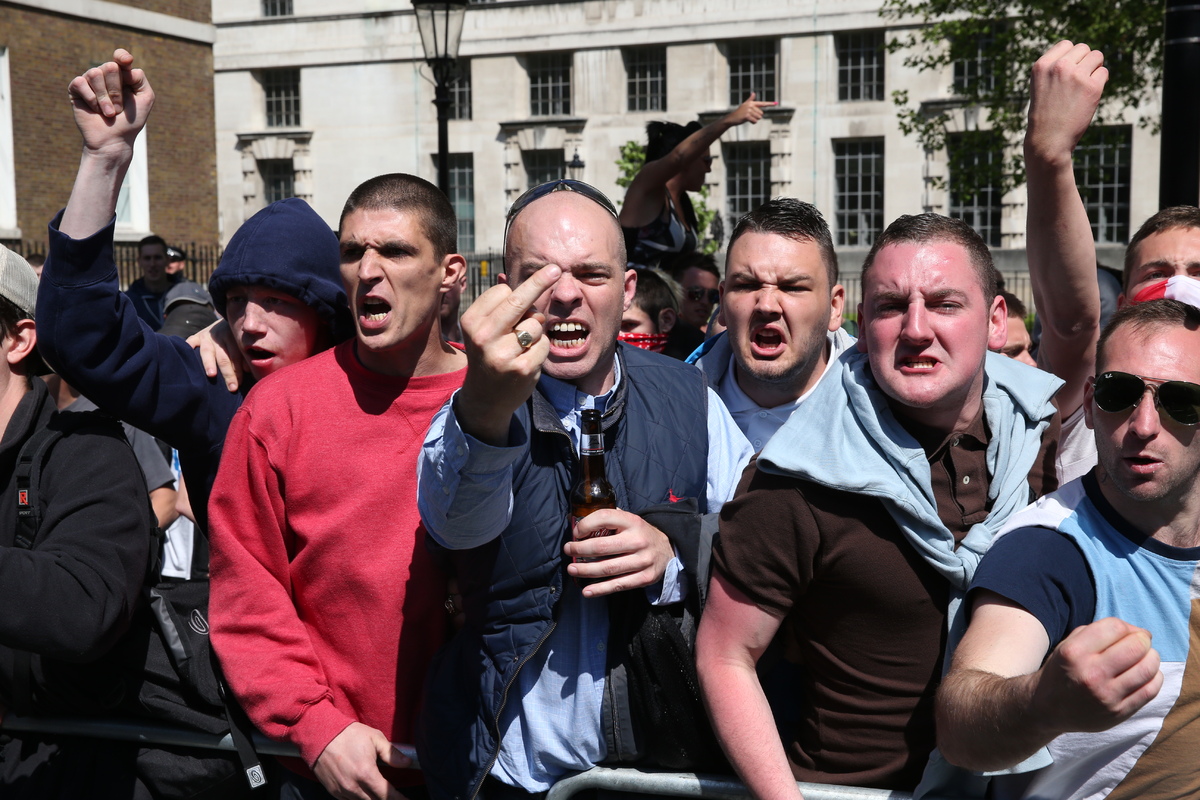
Dammit, I must have been hacked. I suppose it’s time to tell all. My real name is Brian, not Steve. For years I have been building Steve, my artificial intelligence helper designed to save the world from extremism. This blog is his work, not mine.
The reason for this stunning revelation is that, as the BBC reports, a geek from Silicon Valley has created something called Nigel, a personal assistant algorithm that can tell me how to vote. It’s really clever. If I’m a racist, it will tell me to vote for the British National Party. If I have a burning desire to turn my country into Cuba or Venezuela, it will tell me to vote for Jeremy Corbyn.
Nigel, apparently, will soon be capable of reading and writing at grade school level. Very impressive, I’m sure, but Steve has been doing that for years.
Nigel’s maker, Mounir Shita, claims to be on the way to developing the first artificial general intelligence software, as opposed to the task-based AI that we’re rapidly becoming used to, such as self-driving cars, and fridges that tell you when you’re running out of quinoa. I hate to tell Mr Shita that Steve got there before him. But anyway, let’s hear him out:
Voters are increasingly turning their back on identikit “machine politicians” in favour of all-too-human mavericks, like the most famous Nigel in British politics – Farage – and his friend Donald Trump.
How could AI Nigel – which was named after Mounir Shita’s late business partner Nigel Deighton rather than the former UKIP leader – compete with that?
Because, says Shita, you will have learned to trust Nigel – and it will be more in tune with your emotions than a political leader you have only seen on television.
Nigel – robot Nigel, that is – could even have helped voters in the UK make a more informed decision about Brexit, he claims, although it would not necessarily have changed the outcome of the referendum.
“The whole purpose of Nigel is to figure out who you are, what your views are and adopt them.
“He might push you to change your views, if things don’t add up in the Nigel algorithm.
“Let me go to the extreme here, if you are a racist, Nigel will become a racist. If you are a left-leaning liberal, Nigel will become a left-leaning liberal.”
Personally (speaking as Brian, not Steve), I think you need quite a bit of general intelligence to drive a car, as anyone who has driven in Riyadh during the rush-hour will tell you. I will concede, though, that someone who keeps supplies of quinoa in the fridge suffers from a serious general intelligence deficit, and probably needs Nigel to tell them to buy burgers instead. Steve’s been advising me to do this for years.
Steve also convinced me to kick Trump in the rump way before he was elected, and told me that as a cheese-eating surrender monkey who loves France and all its works, voting for Brexit probably wouldn’t be a good idea. But I will admit that his efforts at grade school writing haven’t been particularly successful. Despite strenuous efforts to persuade the United States to spurn Trumpery, and Britain to turn away from the disastrous path of Brexit, Donald is still in situ, and we Brits are still rushing towards the cliff.
Mr Shita also believes that AI, and presumably Nigel, will make it easier for us to spot fake news. Also impressive, but Steve is well ahead of him. Stop reading The Sun, The Daily Mail and the Islington Herald, he says, and all will be well.
The BBC piece then veers off into a discussion about the effects of robots taking our jobs. It quotes an Oxford professor called Ian Goldin, who has written a book in which he and his co-author anticipate “a middle ground between apocalyptic visions of humans controlled by robots and the techno-utopian dreams of Silicon Valley’s elite.” Thank goodness for that then.
Goldin also points to a paper claiming that Trump won the presidency because people who had lost their jobs to robots voted for him.
Well duh! Steve could have told you that. He’s also expert at telling the difference between people and robots. After all, it takes one to know one. For example, he knows that unless she’s a first-generation model, Theresa May is not a robot, because robots these days aren’t robotic. Ask the Russians, whose Twitter bots hail from Eastbourne and Grimsby, places that couldn’t possibly have been invented by artificial intelligence.
As for the claim that Nigel, by getting to know you and your foibles, will become your perfect racist or Marxist companion, Mr Shita is wasting his time. He’s too late.
There already exists a highly effective method of reconfirming your prejudices and telling you how to vote. The right-wing version, whose code name – Joseph – is known only to a few, was developed a while ago by Cambridge Analytica, and has been phenomenally successful in advising the voters of America and Britain. Hence Trump and Brexit. With Joseph at your side, you will never stray from the true path.
Those clever people at Cambridge Analytica probably called their system Joseph because they knew that the name would appeal to both sides of the political spectrum – as in Goebbels and Stalin. Adolf would have been a bit one-dimensional, as would Vladimir.
No doubt Joseph (the Venezuelan version) is waiting in the wings, ready to be rolled out by the same people in an effort to persuade us to elect a Labour government, assuming, that is, that Labour can find a backer rich enough to pay for him.
Perhaps Nigel will eventually get to be far smarter than Joseph. He’s not there yet, and he’s certainly a long way behind Steve, my sublime invention. Much of what Mr Shita says is more about aspiration than reality, but with Steve as his inspiration Nigel will no doubt come on in leaps and bounds. He should be aware, however, that as soon as his creation starts to acquire Steve-like features, my lawyers will be ready to sue him to hell and back.
With the proceeds I should be able to set up a non-profit foundation dedicated to replacing politicians with robots. Surely they’ll do a better job than the dodgy crew we elected last time round?

