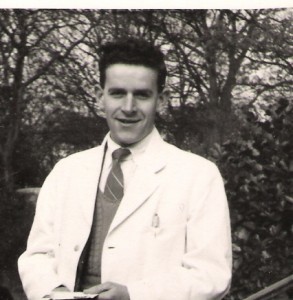
The example of a modest man reminded me a couple of days ago of one of the most valuable skills a person can possess – the ability to listen.
His name was Aiden Meade. He was my wife’s uncle and godfather. He died late last week, and we joined his family and hundreds of friends and former patients at his funeral in Dublin.
Aiden was a physician. As his son Brian – who now runs the family practice his father founded – pointed out in his eulogy, Aiden achieved much in his life. He was not just an ordinary doctor. He chaired a number of professional bodies and started what became a nationwide scheme for assisting doctors suffering from physical and mental illness. I have a personal reason for being grateful to him, since he inspired my wife to go into medicine.
But impressive as Aiden’s achievements were, one thing Brian said particularly struck a chord. And that was the many lives he saved by his expertise in diagnosis. Not by bundling his patients off for tests for a number of potential ailments, but by picking up cues from what they were telling him. In other words, by listening – really listening.
Anyone who has ever tended to a sick child will know how quickly that child can go from slightly ill to very ill. Meningitis, for example, can kill within hours. So lives depend not only on the accuracy of diagnosis, but on speed – in other words, on the ability of the primary healthcare nurses and physicians.
These days, doctors are formally trained in communications skills. In Aiden’s day those skills were passed on by example and by mentoring. I’m not sure we’re much further on from then. And it’s not necessarily through any shortcomings on the part of the doctors.
In the United Kingdom, according to the BBC, general practitioner appointments last an average of twelve minutes, although theoretically doctors have the flexibility to give longer consultations as the situation demands.
But my experience of GP consultations is that one often gets the feeling that there is a time constraint to the visit. Which there is. If every patient appointment took half an hour, surgeries would be full of frustrated people still waiting to be seen long after their appointment times.
So the doctor’s job is to cut to the chase, and do the best they can in the time allowed. All the more important that the doctor’s antennae are finely tuned to pick up verbal and non-verbal cues that might lead to a fast diagnosis. Hence the importance of listening skills.
I suspect that another reason why Aiden Meade was so loved by his patients was that he had the knack of making people feel that he was their friend. That was a gift that our local GP, Alan Stedman, who is now retired, also had. Aiden and Alan practiced their medicine at a time when home visits were frequent, and if your doctor has been to your home and seen you in their surgery, it’s easy to see how a deeper relationship will build up over twenty or thirty years.
But again, such a relationship only exists if the doctor remembers stuff about you beyond your ailments and your blood results. And that takes listening skills.
Nowadays home visits are rare, and are often carried out by a locum. And when you have to wait for days or even weeks for a GP appointment, you will usually take an appointment with the first doctor available. And that person may not be “your doctor”. So consultations tend to be relatively impersonal, with the doctor relying on medical records and what he or she hears during the visit, rather than being able to draw on a much richer store of knowledge.
No doubt there are still GP practices where the doctors stay put for decades, and where the patient population is relatively stable. Where I live, doctors seem to come and go, and population turnover is quite high. In other parts, such as rural areas, I would imagine that the old doctor-patient familiarity still flourishes.
The ability to listen in medicine has other benefits, especially for the doctors. In the United States, where malpractice litigation is an industry in itself, studies have shown that doctors that spend the most time with their patients are the least likely to be sued when something goes wrong. Why? Because of the strength of the personal relationship.
I once heard a story in Saudi Arabia that dramatically illustrates this. I visit the country on a regular basis to do workshops on soft skills. One of my clients is a major hospital group. During a communications workshop a surgeon told me what happened when a young girl had an operation that left her permanently disabled.
The head of the surgical team invited the parents to meet with his team and hear an explanation of what went wrong. Before giving the explanation, the surgeon invited the father to speak about his daughter. The father rose to his feet, and for the next twenty minutes walked around the room. Through his tears he spoke about her character, her hopes and fears, and the ambitions her parents had for her, which were now unlikely to be fulfilled. All the while the medical team listened in silence. They made no attempt to interrupt.
Eventually, when he sensed that the father had said what he wanted to say, the surgeon gently ushered him back to his seat. When he offered to explain how the operation had gone wrong, the father raised his hands and said “no, I don’t need to know. It is God’s will. Thank you for letting me speak”.
That story can be understood in a cultural context of respect for doctors and of a fatalism born of the father’s faith. But it’s by no means typical. In Saudi Arabia, medical malpractice claims are on the rise, just as they are in many other parts of the world. But in this case, as the teller relates it, the critical factor was that the father wanted to be heard, and was heard. And that was enough for him.
Listening is a priceless skill, and an essential aspect of being human. At this time of the year, when people get together to celebrate Christmas or just to take advantage of a welcome few days of holiday, it’s often easier to broadcast rather than to receive.
It’s not just patients that need to be listened to. Negotiations, diplomatic initiatives and political solutions never succeed unless the parties involved listen to each other. Families won’t resolve their differences without parents, children and siblings being prepared to suspend their opinions and prejudices and listen to each other with fresh ears.
The example of a modest and open-minded family doctor loved and respected by all who knew him serves as a reminder of how much his listening skills are needed today – in Syria, Iraq, Paris, Beirut and in troubled cities throughout the world.
Not a bad note on which to wish Aiden’s grieving family, all my friends of whatever faith and all of you who visit this blog my heartfelt season’s greetings.
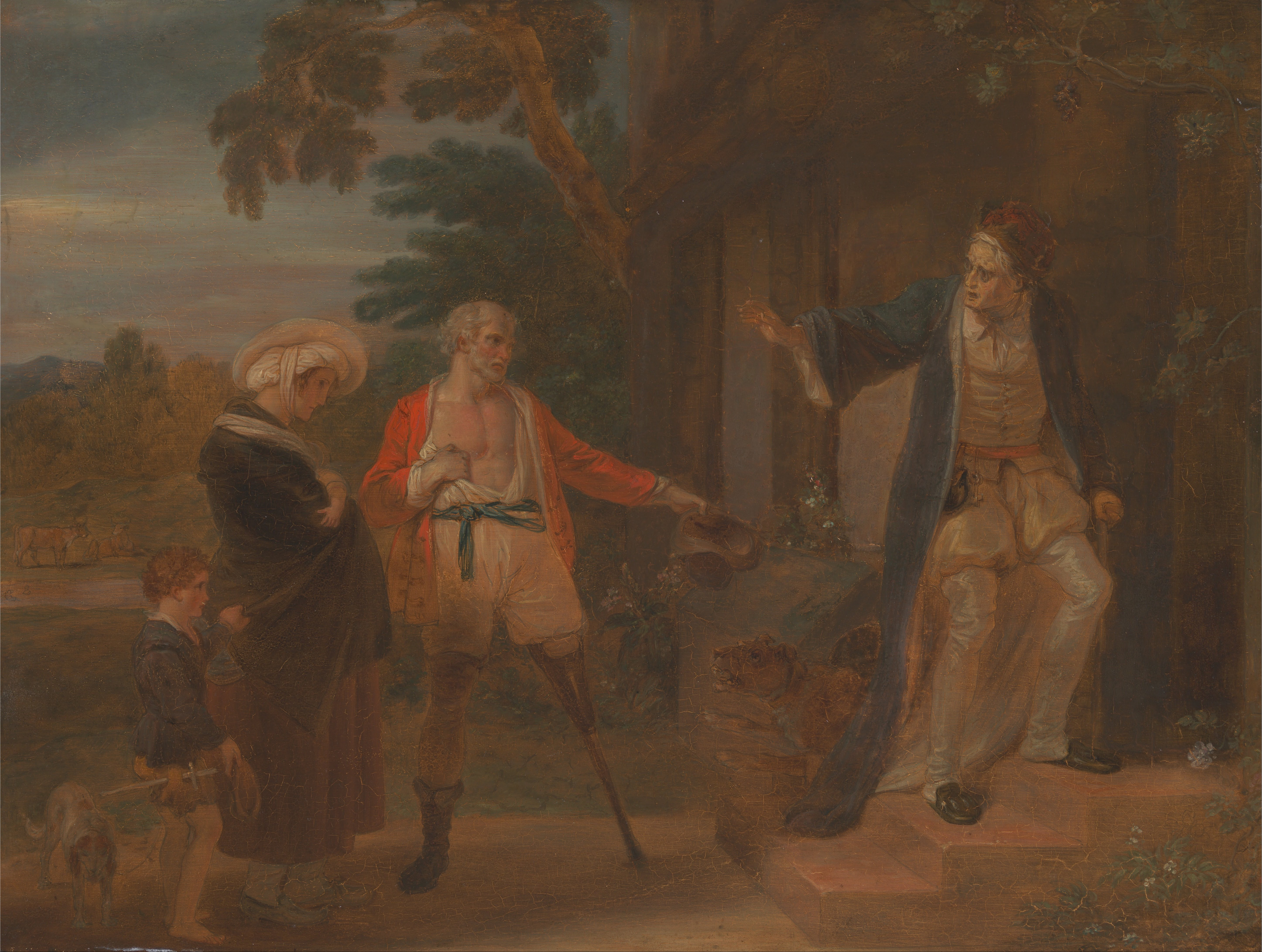
The Seven Ages of Man: The Pantaloon (Robert Smirke)
A couple of days ago I posted about the first of two aspects of ageing from the perspective of a guy in his sixties. In that piece I wrote about the World Without – how, when age starts getting a grip on you, you react to the external world, and how it reacts back.
This is about the World Within – stuff that goes on in your head that has its own momentum without much reference to the World Without. The reference is more to the person you were and are not now. Or, As L P Hartley wrote in the opening line of The Go-Between:
“The past is a foreign country: they do things differently there”.
You laugh at your mistakes. Well I do anyway. It comes from realising that the world doesn’t come to an end when we screw up. Perhaps that’s because the older we get the less chance we have to bring the world to an end.
I prefer to think that the older we get the less inclined we are to create havoc. But the sight of Leonid Brezhnev in his dotage, stumbling around like a zombie with an acolyte bearing the nuclear suitcase never more than a few yards, makes you wonder.
But being able to take your fallibilities on the chin without your self-esteem shattering, and not looking back with endless remorse, is a kind of wisdom that many people increasingly acquire the older they get, and sadly that some people never acquire. And it’s a gift, because it’s a form of wisdom that would serve us all well when our mistakes have real consequences.
You don’t plan too far ahead. Now that the years to come are less than those that have gone, I find I no longer have ambitions. I have projects. They may be in support of a longer-term goal but they’re self-contained, each with their own harvest of satisfaction. The fire still burns, but it’s tempered by realism. Perhaps that’s part of the process of aging. Your world slowly shrinks. Things still matter, but if you’re lucky the important things matter and the rest don’t.
I have something I call the CBA bin. CBA stands for Couldn’t Be Arsed. Sometimes things end up there because I’m lazy, but also things that might have seemed important once, but are now profoundly unimportant. Like shaving every day, or watching the news on TV. The important things are keeping in touch with people (something I’ve been pretty bad at in the past), learning about stuff you know little about, and deepening your knowledge of things you do know something about.
When he hit sixty, my father learned German from scratch. He also bought himself a 500cc motorbike so that he could get around London more easily. Learning a new language at any age uses plenty of brain cells, perhaps an indication as to why he remained sharp as a pin up to the day he died twenty years later. It also widened his cultural horizons (which were pretty wide already) and once resulted in him having a conversation in fluent German in a chance meeting with Albert Speer, Hitler’s architect, something that gave him great pleasure.
The motorbike experiment didn’t work out so well. He gave it up after five years and a couple of unscheduled skyward launches. But the point is that he did it at an age when many people start thinking about bus passes.
You are not so easily shocked. I can remember Vietnam, IRA bomb attacks, Cambodia, Srebrenica, Lebanon, Rwanda, 9/11, Madrid, 7/7 and any number of other atrocities and conflicts that have taken place over the past fifty years. I can still be shocked, but I find myself comparing each new event with others that I have lived through.
I also feel an abiding guilt that I can be more shocked when a neighbouring country is attacked than when I read about yet another car bombing in Beirut, or a suicide bombing at a wedding in Iraq, or a mosque in Saudi Arabia. Are these not people too?
I may have lost my capacity to be shocked, but I actually think it’s more important not to lose your ability to be compassionate.
You look for signs of Alzheimer’s. Or rather your partner does. Forgotten a name, a face? Come to a juddering halt mid-sentence because you can’t remember a word or an expression? Ha! Alzheimer’s!
What was once seen as an innocent stumble is now the harbinger of a sinister fate. Years, perhaps even months away from dribbling, incontinent mental oblivion. Doomed to years of care in a home for the demented, much to the annoyance of your loved ones who see their inheritance eaten away by the cost of care.
We laugh about it. My self-test is the daily ritual of bringing tea in bed to my wife in the morning. Can I vault over the dog at the bottom of the stairs and make it to the bedroom with mugs in both hands and not spill a drop? And do the mugs contain what they’re supposed to contain? So far so good, but I’m watching just the same.
You still get angry. No, not raging against the dying of the light. For me, it’s anger at more often than anger with – at behaviour rather than with people.
I get angry at all kinds of things. A judge sentencing a girl who pretended to be a man in order to have sex with a woman to eight years in jail. Religious bigotry, in fact bigotry of any kind. Donald Trump’s lunacy. Cruelty to children, and not just paedophilia. Bad manners. Poor customer service. Blame culture. ideologies that induce people to kill other people.
And especially I get angry when people who have lots more to give die young.
Everybody of your own age looks older than you. Funny thing, ageing. When I look at people from my generation I look through youthful eyes. I think gosh, he looks old. And when I look at myself in the mirror I screen out the features that might lead others to come to the same conclusion about me.
But then when I look at a recent photo of myself, I think gosh, he looks old.
You cling to routine. Actually I fight it. Sometimes I watch people being disgorged from commuter trains at my local station, while I’m waiting to go into London to a concert or a play. They look grey and exhausted.
I gave up doing a nine-to-five job a long time ago. The mere act of getting up in the morning, putting a suit on and getting ready to go to an office to do the same thing every day is now so alien that I wonder how I managed it for so many years. I haven’t stopped working, sometimes from home, sometimes abroad. Each day is different. Lucky me.
Routine is OK when you’re young, because you can always dream of escape – to the next job, and maybe the next partner. But when you get so used to something that you can’t think of doing it any other way and don’t have the energy to try, that’s when you feel old.
And when routine provides you with a structure that you rely upon to get through the day, that’s when you are old.
You stop looking forward to things. Except your demise, possibly. I think of my mother in the last couple of years of her life. Dementia had taken hold. She couldn’t even look forward to family visits because she would forget. Each day was the same as the last. When something different happened, it would quickly be forgotten.
So those of us lucky enough to remember what diaries are for look forward to holidays, work trips, get-togethers. We wait for Christmas, to see our partners or kids again, for dinner, for a new movie, for a museum exhibition. For the days to get long again. For the next general election when the government gets its backside kicked. Sometimes we even wait for dawn. All these things bring a measure of excitement.
Waiting with positive anticipation makes you feel young. Sadly, disappointment with the way things turn out makes you feel old again. But that’s OK as long as there’s always something new on the horizon.
You stop interacting with people. The older I get the less inclined I am to put up with large gatherings. Parties, for example. One of the reasons could be noise-induced hearing loss. Years of listening to loud music have very likely taken their toll. I don’t consider myself to be deaf, yet I find that understanding what people are saying when there are twenty other people around me braying like donkeys is getting harder.
Or perhaps it’s a sense that words are a finite resource, and best exchanged without distraction. The interaction I treasure is with small groups or individuals. Everyone has something interesting to say if you listen hard enough. You just have to ask the right questions. And these days I prefer watching, listening and learning to sounding off. I save that for this blog.
You know what’s going to kill you. Or at least you think you do. It’ll be stuff that gives you great pleasure. The occasional cigarette, red meat, full fat cheese, cream on your porridge, fruit cake, Full English Breakfasts. And you know that one or more of them will kill you because you read all the medical stuff that tells you so. Though you take comfort in the knowledge that doctors and researchers can’t seem to make their minds up about anything. So maybe some things aren’t as lethal as others. And maybe your genes have some magic protection mechanism that others lack.
But it’ll happen sooner or later, and you can be sure that the doctors and your loved ones will blame one or other of your sensual predilections for your untimely demise. Just about every natural cause of death except motor neurone disease can be blamed on stuff you like.
Yet I for one keep right on indulging and enjoying the stuff that will kill me. The only thing that will stop me will be if someone can convince me that I will enjoy other things just as much if give up the lethal stuff.
Sorry, but fifty years of well-intentioned persuading have so far failed to convince me of the ecstasy that lies in a lettuce, lentils and mung beans as substitutes for camembert, lamb chops and baked potatoes saturated with butter.
So am I frightened of ageing?
Not really. Stuff happens, as Donald Rumsfeld said, and so does ageing. I feel pretty good about my age. As far as I’m concerned, the fashionable adage that sixty is the new forty is a load of old rubbish. Sixty is sixty. There are some young sixty-year-olds and some extremely old ones. The way you turn out depends partly on you, and partly on the cards life deals you.
Rather than grieve over what you’ve lost, isn’t it better to recognize and value the stuff you hold on to? A sense of wonder at something you experience or witness for the first time. A reaction that reminds you that there’s still a strain of adolescence deep within you. Getting pleasure out of things you did when you were a child. And still laughing at things that cracked you up fifty years ago.
And shouldn’t you also be treasuring the stuff you’ve gained? A sense of perspective, perhaps. Satisfaction at things achieved. The ability to laugh at stuff that once would have made you cry. The time and the opportunity to stumble on things and learn because you’re no longer constrained by the tunnel vision of ambition.
Whatever else might come and go with the passage of time, being able to laugh, to empathise and to care about the people who live in the World Without are surely the things that stop the World Within from becoming a grim and ugly place. Or simply a void.
This post is dedicated to Dorothea Royston, Paul Brett Sommers and Dr Aiden Meade, who died this year, but kept laughing until the end.

The Seven Ages of Man – Justice (Robert Smirke)
What does it mean to feel old? Do you feel old because your joints start creaking and bits don’t work as well as they used to? Do you feel old when you hit 30, 40, 60 or 70? Is feeling old a state of mind, body or both?
There are times when I wake up in the morning feeling very ancient. It’s nothing to do with hangovers – I don’t drink. Some days it might be a lack of sleep. Other days I might be recovering from long-haul travel. But there are also mornings when I leap out of bed full of the joys of spring (which this year seems to have come in December). Off for a nice run through the neighbourhood. Not.
That feeling of being old can hit you at any age. I know someone who is 29, and dreading becoming 30. No matter how much I tell her that decades are artificial milestones of no significance, she doesn’t listen to me. Her reality tells her otherwise.
How often do we feel old because we invent our own criteria for age, or because our culture does so for us?
So this – and the post to follow – is about ageing from the perspective of an English male in his early sixties living in a town close to London. In lots of ways I have it good. As a baby boomer in the UK the cards are stacked in my favour. I’m shamelessly bribed by my government with benefits that are more generous than those in most European countries. My health is reasonably good. I get to travel a lot, both for work and on holidays. Nobody is forcing me to retire – I work when I want to and not when I don’t. And I’ve been married to the same person for over thirty years, which is more to her credit than mine.
But one of the things that happens when you’re lucky enough still to be around after three score years is that you think about the future in a different way, because you’re running out of time.
You see people you know dropping off their perches. Not just your parents, but the occasional friend who’s close to you in age. And little by little, changes in your behaviour and attitude to the world creep up on you, imperceptible unless you take the trouble to think about then. Occasionally, or often if you’re so inclined, you look back on your life thus far as if from high on the side of a mountain, with your memories and experiences nestling in the valley below. Easy to see but not to reach.
There are so many ways to look at age, and most of them are not positive. Physical and mental decline are the obvious aspects. Regrets about things you did and didn’t do, and perhaps festering bitterness about what the world has done to you. And a feeling that it’s too late to start over.
I won’t say that those clouds haven’t occasionally blotted out my sun, but never for long. I feel pretty good to be the age I am. I’ve learned plenty and I’m still learning. What’s more I’m able to share what I’ve learned with other people in the work I do.
I look at ageing in two ways. The world within and the world without. The world within is stuff that goes on without reference to other people. The world without is how you react to it and how it reacts back.
This post is about the world without. When I talk about “you”, I’m not assuming that everybody of my age would agree with what I’m saying. Which is a good thing, because if we sixtysomethings have a saving grace, it’s that most of us are less gullible and probably more diverse in our opinions than we were when younger. You don’t find too many sixty-year-old jihadis and stormtroopers. The downside is that we do get more irrational bees in out bonnets, and after years of experience, many of us are masters of the dark art of manipulation.
Most advertising is not aimed at you. There are two aspects to this. As most of us know, the more we do online, the more advertisers know about us, or at least have the information to make intelligent guesses about where we might like to go, or what we might want to buy. So I don’t find personally-targeted ads too intrusive or objectionable.
But ads on TV or in the newspapers aimed at “my age group” or my perceived economic profile miss the mark. Big time. I am not a bloody silver surfer. I have no desire to spend six months of every year gazing out at yet another ocean view from the balcony of a cruise ship. I don’t want to join a wine club, or have facials. I have no need for a stair lift or a bath with a seat. And I have no intention of buying a retirement home. Those kind of ads are as far from my perception of my own needs as offering a pension plan to a ten-year-old.
On the other hand, I find it quite flattering when I’m offered Viagra, and the opportunity to have meaningful online conversations with women half my age. Not sure Mrs Royston does though.
Most entertainment is not aimed at you. These days I increasingly find that so much on offer – especially movies and TV series – insults even my fast-diminishing intelligence. This is stuff that I might have watched twenty years ago when I was of an age that spanned the generation gap. I could appreciate drama aimed at twenty- and thirtysomethings, yet I could also appreciate stuff that my elderly parents would have enjoyed. Nowadays boy-meets-girl and has relationship problems, ultraviolent street drama, or endless reality shows, bore the arse off me. Bake-off? Yes indeed, bake off somewhere else.
The fact is that precious little TV content, or movies for that matter, are designed to appeal to people who can’t stand to watch physical or mental cruelty (having witnessed enough in real life), destruction, rites of passage and all the stuff that appeals to people because it offers a mirror to their own neuroses and fears. And crime. So much bloody crime. This stuff is not produced for my generation, and God help the people who consume it so voraciously – or vicariously.
Having said that, I do enjoy Games of Thrones. Can’t think why – must be something to do with the wildlife.
You’re the only person you know who hates Kindles. I bought one once. I travel a lot, so I thought it would be a good alternative to bringing heavy books wherever I go. Didn’t work. Sorry trees, but Kindles, Nooks and IPads will never match the joy of having a paper book in the hand – being able to go anywhere you want with the flip of a page. Of having a library, where you can scan the titles and pull something out to lend a friend.
It’s funny really, because I have a library of CDs I never browse. They’re all on my laptop and IPad. Perhaps the difference is that to look at the CD titles, you need to be a few inches away from them. But books broadcast themselves from yards away. They seduce, they shout, they reproach you for not revisiting them.
With ebooks, less is definitely not more. It’s less.
You don’t get smartphone apps. It’s not really a matter of not being able to use them. More that you can’t see the point. Facebook, Twitter – OK. But Snapchat? Instagram? Why would you want to spend all your leisure hours posting inane photos of yourself, your friends, a cat with three ears and a wonky donkey?
Is the world around you so boring that you have to sit around on holiday at an exotic location chatting with your distant friends or posting pictures of your exotic lunch or an unexotic glass of champagne?
And what of places you won’t visit, books you won’t read, movies you won’t see, unless a hundred people have reviewed them? Have we lost the ability to think for ourselves?
Tinder? Well I can see the point if you’re a sexual athlete looking for practice, but until someone invents a similar app for oldies looking for a game of scrabble, forget it.
Let’s face it, for my generation a phone’s a phone. We get texting, even if the act of tapping the screen reminds others of an elephant playing hopscotch. But the rest? Just an antidote for boredom and a conversation killer. A narcissist’s paradise.
You don’t worry about switching off your phone. I know people who would feel that they had lost a limb if their mobile phones weren’t talking to them at all times. I remember what life was like without them, and it doesn’t bother me in the slightest if I leave mine at home, or even if I lose the damn thing.
If the next deal, the next party or the next romance depends on your being welded to your phone, good for you. But for me, the world can wait. Not being available makes you the master of your own time.
You pretend to be excited by anniversaries. The more birthdays I reach the less I look forward to them. And when I celebrate them it’s more for the benefit of the people celebrating with me than for me.
I suppose one should celebrate the achievement of making it through to another year. But I haven’t yet got to the stage of people saying – within earshot – isn’t he marvellous, he still does the garden (which I don’t, by the way), he still has his memory and he can go to the loo unaided. I have all that condescending rot to look forward to.
But right now I work, I play, I eat without the aid of a straw, and I don’t need a bunch of people congratulating me for the miracle of another year’s survival.
Wedding anniversaries? Ah well, that’s sacred ground, isn’t it?
You read obituaries. More and more. And when someone dies at an age younger than mine, which happens more and more often for obvious reasons, I read their obituary with the feeling of there but for the grace of God. Or rather, there’s another bugger gone, I think, and for all his achievements what would he have given just to have been still upright like me?
I do find many obituaries inspiring, especially when the subjects manage to do great things in their seventies and eighties. The idea of retirement, linked to a specific age and defined by the state, is a curse. It’s almost as if society expects you to flick a switch and suddenly transform yourself from a wage-earner into an inert drone struggling to find something useful to do.
It was never that way before the welfare state and it doesn’t have to be so now.
You suffer fools less gladly, especially the self-satisfied. I don’t argue the toss with people who strike me as idiots. I just walk away from them. The older I get, the more I encounter people of the same age or older who are pompous, opinionated and deeply satisfied by their achievements thus far. Yes, I know they’re not really idiots, but there are many people who have spent so much of their lives running things that they’ve lost the capacity to listen to others.
I put most politicians who have been in power for more than ten years in that category. Also businessmen (and yes, it’s almost always the men) who’ve made their piles and are sitting complacently on top of them. Those whose company I most enjoy are people who are curious, humble and driven to learn. Those whom I most admire keep learning until the end of their lives no matter how long they live.
Having said that, there is one fool I suffer gladly. And that’s myself.
You realise that senior means junior. I laugh sourly at the corruption of the word “senior”. When I was at school, older boys were referred to as senior, and in the workplace seniority implied knowledge, privilege and power. Then suddenly as you get into your fifties and sixties, people start substituting the word senior for old – as in senior citizens.
Seniority stops being about status and power. It’s about being worn out, on the scrapheap, a burden on society, unproductive. A whole section of society is only of interest when the time comes for politicians to seek their votes. At which point they are shamelessly bribed, and, when the election is over, forgotten for another five years.
Senior citizens, thanks to their relative passivity and ultimately their geriatric apathy, are actually the opposite of senior – patronised, manipulated and exploited for whatever wealth they have managed to accumulate and can be persuaded to part with.
Whoever invented the phrase senior citizen is probably dead or, as Shakespeare said, “Sans teeth, sans eyes, sans taste, sans everything”. Serves them right.
You accept compliments with grace. Even the ones I know are blatantly insincere, as in “Steve, you’re looking well. Have you lost weight?” The inner troll wants to reply “no I haven’t, you smarmy toad, and you know it. And by the way you’re looking as wasted as ever.” But no, I reply in kind, because I know this is a game.
And when people pay me real compliments, I don’t curl up in embarrassment or brush the remark away in false modesty. I try to smile, look the other person in the eye and say thank you without feeling the need to reciprocate. The sincere compliment is a gift. It reminds you that you should be doing the same, not for effect but when you feel a person deserves it.
But then I suppose that benevolent lies are the prime lubricant of successful social interaction, and God help us if we all told the truth.
Having said that, I’ve met a few people in their eighties – mostly women – who say exactly what they think, regardless of the consequences, because they know that there will be no consequences other than those around them buttoning their lips and thinking what cantankerous old bats they are. A prime example of the species is Maggie Smith’s Dowager Countess of Grantham in Downton Abbey.
I have that pleasure yet to come. I look forward to being the cause of much accidental hilarity.
So, for what it’s worth, that’s a little look into my external world. Next up, we’ll look at the murky world within.
It’s time to admit an unpalatable truth about myself. I am a voyeur.
Admittedly not the sort who hides in bushes and looks through other people’s windows to catch them doing what comes naturally, but I’m a voyeur just the same.
I’ve come to this conclusion after asking myself why, with so many excellent TV series available to watch, there are three that sit pretty near the top of my menu: The Bridge, Homeland and Elementary.
And it’s simple. When I try and remember the plotlines from the previous episodes, many of the details escape me. But I never have a problem describing the exact stage we have reached in the mental disintegration of the leading characters.
Murder schmurder, there are only so many ways to kill someone, though The Bridge does manage to push out the envelope. The real horror is the sight of the good guys steadily becoming more demented than the bad guys.
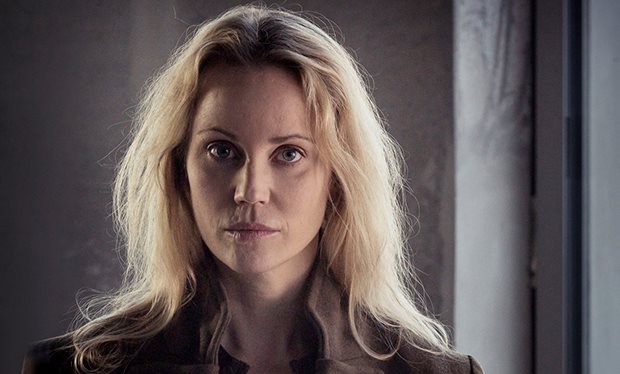
Poor SagaNorinMalmoCountyPolice, as she introduces herself in all circumstances, including to potential sex partners at a singles hook-up evening. The writers have really thrown the kitchen sink at her in Series Three.
They’ve taken out Hans, her boss, who shielded her from criticism of her Asperger-like problems with empathy and communications, and replaced him with a uniformed poison dwarf who makes her reluctance to give Saga the same slack as Hans did abundantly clear.
They’ve introduced her mother, who, as some mothers do, manages to stick the needle into all the vulnerable parts of Saga’s personality. And then, when her mother dies, she ends up under suspicion of murdering her, as if six increasingly bizarre serial killings aren’t enough to be getting on with.
Saga’s eyes bulge and her lips quiver as she struggles to hold herself together. The whole thing is utterly compelling. You want to weep for the poor woman as she’s pitched into excruciating encounters with “normal people”. Such as when the poison dwarf suggests that she needs some communications training, to which Saga replies that it wouldn’t work, because she’s – long pause – different. And when, at the singles evening, the first thing she says after introducing herself to a guy is to ask him if he’d like to have sex. Pathos and humour are a deadly combination.
On top of all her other troubles, she lost her previous partner at the end of Series Two after she shopped him for murdering the serial killer. And now she’s got Henrik, who has his own cross to bear. His wife and children disappeared a few years ago. Perhaps under the influence of the pills he pops, he has regular conversations with their ghosts around his house. But at least he slots in as the one person who sticks up for Saga. Like Martin, his predecessor, he has the communications skills Saga lacks, and he appreciates her brilliance as a detective even if the poison dwarf doesn’t. He even becomes her occasional sex partner, though lover would not be an appropriate description of the relationship.
As I write this we’re two episodes away from the end of the series. How much more Saga can take before imploding for good remains to be seen.
Most likely, as with Carrie in Homeland, the script writers will patch her up and send her back into battle for the next series.
Carrie, the bipolar CIA agent, has had more implosions than the average po-faced spy has had hot dinners. Again, the focus is as much on her troubles as on the labyrinthine plots constructed around her. She also has a mentor, Saul, who, though around her behaves as a sympathetic father figure, is a dab hand with the political stiletto. In the current series Saul is also no longer there for her, since she’s finally left the agency and is freelancing for a German industrialist. Yet you know he will come through in the end.
With Carrie, the main concern is that one day a bad fairy will wave a magic wand, and her stock expression of swivel-eyed outrage will become permanently etched on her tortured face. As with Saga, it’s mainly in the eyes, though the Swede comes over as more of a full-body eccentric than Carrie – stiff, with a jerky walk, she recoils from physical contact, something Carrie could never be accused of.
So at the centre of The Bridge and Homeland are interesting and of course damaged (though political correctness dictates that you call them otherwise) women.
In Elementary, in which Sherlock Holmes is transplanted into modern New York, we get the male of the species. Like Saga, Sherlock is surely “on the spectrum”. And like the Swedish detective, his personality is reflected in his rather odd body language. He walks as though half of his vertebrae are permanently fused.
In the current series he also suffers from vengeful script writing. As a former heroin addict he teeters on the brink of a return to his old ways. He actually falls off the wagon in one episode, after beating half to death the guy who tempts him. Only the ministrations of the female Watson save him from a permanent return to the muddy waters.
Ever since the dawn of Hollywood it’s been the case that the heroes and heroines have been spiced up with intriguing dark sides. In the old days the demons would be failed romances, drinking problems or post-traumatic stress. Nowadays scriptwriters compete to come up with the most interesting personality disorders. A reflection of an age in which every little eccentricity can be explained by the American Diagnostic and Statistical Manual of Mental Disorders (DSM).
So these days, part of the entertainment value in all these series lies in a game of Spot the Psychosis. If it’s not bipolarity or Asperger’s, it’s attention deficit disorder, obsessive/compulsive disorder or any one of hundreds of mental ailments listed in the manual. And when we’ve diagnosed the good guys, we can turn our attention to the bad ones. Basically, we’re all expected to be armchair psychologists. How long will it be before the DSM sits proudly on our bookcases alongside the Oxford English Dictionary?
Loopy killers have always been at the centre of a recognised cinematic genre. But since Hannibal Lecter dissected Clarice Starling’s personality in The Silence of the Lambs, the good guys have increasingly become loopy too. In one sense this is good news, because as I mentioned before it’s no longer socially acceptable to write a person off as loopy. The classic terms have become adjectives, as in “he’s rather OCD, isn’t he?”
We increasingly recognise that many so-called disorders bestow talents beyond those of us who are not, as Saga says, “different”. Which is why organisations like GCHQ, Britain’s electronic communications agency, try hard to recruit people who are skilled at pattern recognition and decryption, but, ironically, may not have a high level of communications skills. Even psychopaths can be of benefit to society, as Jon Ronson points out in his book The Psychopath Test. Always provided they’re not murderous ones.
The downside is that since we can blame just about every quirk and hang-up on a personality disorder, nothing is our fault any more. We are absolved of responsibility for our flaws. We are victims of our genes and our upbringing. We are all survivors of one sort or another. Which is heaven for therapists and authors of self-help tomes.
Despite the GCHQ’s proclivity for brilliant “oddballs”, insiders have commented that in real life Carrie Mathison would never be able to hold down a responsible job in the CIA. And within Britain’s police forces and possibly America’s too, where outliers are suffocated by cultures of conformity, the likes of Saga would be unlikely to prosper.
Listen to interviews with real-life detectives, and few of them stand out as anything other than boringly normal people, even if the odd nutter might be lurking in the back office. Which is a shame really, because perhaps with a few more Sagas and Sherlocks in the ranks, the clear-up rate might significantly improve.
One problem is that highly talented but quirky individuals are often high maintenance. For every Saga there needs to be a Hans to keep her on the straight and narrow. For every Holmes, a Watson. And for our austerity-obsessed masters, that is a luxury that’s hard to afford.
But never mind. In our hearts we’re all Sagas, Carries and Sherlocks now. We’re being conditioned to ask not whether a person, including ourselves, is sad or bad, but why. And The Bridge, Homeland and Elementary (with an honourable mention in this category for True Detective, in which Matthew McConaughey’s character is gloriously deranged) are no doubt inspiring a new generation of spooks, detectives and criminologists for whom procedure is no substitute for insight, rules don’t stifle initiative and being different is not a barrier to employment.
And so long as we don’t end up with a host of Guantanamos and regular extra-judicial killings as the new normal, that should be fine by all of us.
Has there ever been a war more widely written about, and from so many perspectives, as the Syrian conflict? The extra dimension, of course, is the online media. Social media conversations, opinion from online versions of the mainstream media that one would never have encountered even ten years ago, new magazines started by journalists who began their careers in newspapers. And of course people like me.
Many moons ago I played the role of the Emperor Joseph in Amadeus, Peter Shaffer’s magnificent play about the rivalry between Mozart and his infinitely less talented rival, Salieri. The Emperor, on being invited to give his reaction to the first performance of Mozart’s The Marriage of Figaro, observes that there are “too many notes”. “My dear fellow,” he adds, “there are in fact only so many notes the ear can hear in the course of an evening.”
The Emperor’s words come to mind when I struggle through the umpteenth tweet of the day about Syria and ISIS, or the latest analyst’s opinion. It’s not a matter of understanding, but of making sense. Too much information, too little sense. Too many notes. Consider these words, starting with a random Facebook post:
“The thing is the elite don’t want isis, or whatever they’re called this week to be defeated. The idea is to prolong the (war) in order to cash in on the arms needed and then send in their own contractors to rebuild the devastation they’ve caused, thereby making even more profit. War makes money so why would the powers that be want to stop it? Look at Iraq! I rest my case.” (Facebook post)
“Perhaps in this time of confusion, and especially regarding the horror which unfolded in Paris, we should look to history to help instruct the present. As the idiom goes, insanity is doing the same thing over and over again and expecting different results.” (Megan Hanna, writing in Middle East Eye.)
“It is not widely known that US, British, French and Israeli oil companies have had a range of overlapping interests in exploiting Syria’s unconventional oil and gas resources, which are believed to be considerable.” (Nafeez Ahmed, writing in Middle East Eye)
“No one wants to admit it, particularly not in the middle of a presidential campaign, but the hard truth is that America faces two bad choices on ISIS. Either it can adopt the high-risk, high-reward strategies necessary to wipe out ISIS, even though these strategies could fail or even backfire, perhaps catastrophically. Or the US can choose the safer path, managing and minimizing ISIS’s threats without solving the problem completely, knowing this means that some number of attacks will probably continue.
Both choices are terrible. But they’re the only choices that exist.” (Max Fisher, writing in Vox)
“What we have to do – and this is really key – is we have to engage the local people. As soon as the people have hope for a political solution, the Islamic State will just collapse.
“There will be a very easy way to make Isis lose ground at a high speed. The international community must decide all regions held by the Syrian opposition are no-fly zones.
“No-fly zones for everybody. Not the coalition, not the Russians, not the regime, nobody. Providing security for people [there] would be devastating for Isis. That’s what the international community should focus on.” (Nicolas Henin, interviewed by The Independent)
Just a tiny sample of the millions of words being written about Syria and ISIS every day.
No wonder the vast majority of us who watch events unfolding in the Middle East, and read about murder, mayhem and plots in their own countries are deeply confused by what’s happening. No wonder many don’t even try to understand. And no wonder they comfort themselves with the panaceas offered by the likes of Donald Trump and Marine Le Pen.
The quotations are examples of the most common streams of thought about the Syrian tragedy: conspiracy – it’s all about the oil, it’s all about capitalism, it’s all about the neocons; history repeating itself endlessly – we’re not learning from previous mistakes; non-intervention – back off and let the oppressed free themselves.
Each argument makes sense to the person making the statement according to the principles of the ladder of inference – which effectively means that I interpret events and situations according to my personal experience and view of the world. All of them have some validity, yet none of them stand up on their own.
Let’s look at each of them a little closer, starting with the military-industrial motive.
Yes, of course the companies that make bombs and bullets do very nicely out of supplying the combatants in Syria, and Iraq, and Yemen too. Yet are they the masters or the servants of the politicians? If they were the masters, then the US, the UK, Russia and all the other countries with flourishing arms industries would already have boots all over Iraq and Syria. Probably Iran too.
And yes, Syria is a useful test bed for the latest generation of munitions and delivery systems. But you only test things once you develop them, and once developed they become commodities. The real dollars lie in developing new systems in response to perceived future threats. And in terms of military technology, the conflict in Syria is relatively familiar ground.
The US in particular, and consequently its military contractors, will be far more exercised about the potential threat posed by a resurgent Russia and by China, with its increasingly assertive quest to dominate the waters of the South China Sea.
In other words, the military-industrial complex has bigger fish to fry. And why would any construction contractor risk life and limb rebuilding Syria when there are so many infrastructure projects in the West awaiting the say-so of the politicians?
As for the oil motive, why is it surprising that the world’s major oil and gas companies are looking at Syria’s potential? Are they not doing the same in just about every region in the world? Their interest in Syria is hardly a hidden agenda then.
And what of the history argument? Again, it’s easy to say that we keep making the mistakes of the past. But the problem is that history is subjective. Just as for every verse in the Quran that inspires the violence of ISIS there’s another that condemns it, one can trawl the ocean of history to find examples of repeated mistakes, yet there are as many precedents that justify more or less any course of action you take (apart from invading Afghanistan possibly).
The classic in the case of the current conflict is “we went into Iraq in 2003, and look what it did for us”, versus “what would have happened if we hadn’t resisted Hitler?” to argue for against and for a ground war against ISIS.
Yet each situation was utterly different in terms of politics, economics and material conditions as to render comparisons virtually meaningless. And what of the aftermaths? De-Nazification worked. De-Ba’athification didn’t. The Marshall Plan worked in rebuilding Western Europe. The efforts of western contractors to re-build Iraq didn’t.
The killer of historical precedent is that context is king.
And finally we have the case for a no-fly zone.
Nicolas Henin, the French journalist who was imprisoned by ISIS for nine months along with other Western hostages, argues that “Strikes on Isis are a trap… The winner of this war will not be the party that has the newest, the most expensive or the most sophisticated weaponry, but the party that manages to win over the people on its side.”
I’m not sure whether Henin is arguing that a no-fly zone would prevent ISIS from making more territorial gains, or that it would cause the group to implode within the area it currently occupies. If it’s the former, then he has a point, but only if the fiendishly difficult task of reaching a political settlement between the various opposition groups and the Syrian government (with or without Assad) can be achieved.
But to suggest that any of the forces thus aligned against ISIS could bring it to its knees without air support is surely naïve. Even more naïve is the suggestion that under clear skies the cowed population of the caliphate would bring about the implosion of ISIS of their own accord.
There is of course a humanitarian argument against the bombing of Raqqa, Ramadi and other centres of population. Even the smartest bombs fail to find their intended targets. But ISIS depends for its legitimacy on its existence in the eyes of its followers as a state. No state, no caliphate. Without bombing, it will be free to consolidate its grip on the territories it now controls.
So the longer it is allowed to maintain even the most rudimentary characteristics of statehood, the longer it will serve as the inspiration for its affiliates in Libya, Yemen, Afghanistan, Nigeria, Mali and more.
And as the ISIS presence in those countries grows stronger and spreads across more territory, the task of eradicating the caliphate will cause exponentially more human casualties – whether from the air or on the ground – than would be caused by destroying it on its “home ground” as soon as possible. Not only that, but the greater chance of its followers, armed with money and logistical support, carrying out more Paris-style attacks, thus fuelling extreme anti-Muslim sentiment among the most vulnerable Western nations.
Therein lies the weakness of any containment strategy. With or without a no-fly policy, it’s not enough to keep ISIS at bay.
Leaving aside the humanitarian dimension, there’s another reason why containment is not the answer, and that’s the potential economic impact. Current estimates suggest that the Paris attacks have shaved a quarter of the country’s GDP growth for the last three months of 2015. What would a similar attack on Washington or New York do to the US economy?
Just as my late mother’s favourite phrase when faced with some seemingly intractable family conundrum was a plaintive “I don’t know what the answer is”, I can’t pretend that I have any easy solutions when all these people so much smarter than me can’t come up with them.
But I do know this. Big pictures, grand strategies and solutions of elegant simplicity advanced by politicians, pundits and generals will always find opponents willing to demolish them. To find a way forward there will inevitably be an element of suck it and see. And the appetite for continuing struggle will need to be sated before the guns in the Middle East fall silent.
To draw upon one of those inadequate historical parallels, it was not until 1917, three years into the world’s most destructive conflict thus far, that the generals in the First World War finally hit on the concept of integrating air power, artillery, infantry and tanks as an effective way to break the impasse of trench warfare. And even then, it took another year before an exhausted Germany finally threw in the towel.
If this conflict is to end without a massive and horrible conflagration, the decisive qualities will need to be the same on every front – political, diplomatic and military.
And those qualities are resilience and creativity. That should be clear enough for the Emperor Joseph.

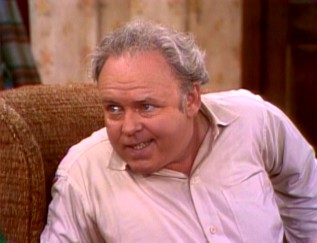
It’s as if some joker gave Alf Garnett a couple of billion pounds and encouraged him to start a political party. Or, if you’re in America, a bunch of Republicans got Archie Bunker to hit the hustings.
If thirty percent of Republicans weren’t telling the pollsters that they supported Donald Trump, you would think that he was the star of a reality show in which they dragged the most bigoted, narcissistic bore out of some downtown dive of a New York bar and stuck him on a podium. Along with a bunch of distinctly odd but slightly less extreme individuals.
Some rich guys put their money into space exploration. Others invest in the fight against malaria. Donald Trump spends his millions on the creepiest exercise in self-indulgent exhibitionism since Nero built his palace across the smouldering ruins of first-century Rome.
America has come a long way since Barry Goldwater, who stood against Lyndon Johnson in the 1964 presidential elections, lost all but one state to Johnson. Goldwater, who scared the life out of liberal America with his nuke-rattling rhetoric, would today be regarded as one of the more moderate candidates out of the bunch standing today.
There are parallels. Goldwater stood for president two years after the Cuban missile crisis. His paranoia was mainly directed towards the Soviets. For Trump the convenient enemy is those guys who took down the twin towers and their successors in Syria and Iraq and a neighbourhood near you.
The thing that worries me about the profoundly angry Donald Trump is that he seems to be the spokesman for a whole bunch of equally angry people. The trouble is that there’s anger and anger.
There’s anger about external situations. About unfairness, injustice, about the poor, about the underprivileged, the dispossessed and about a whole range of things wrong with the world. You could call that righteous anger. And that’s been the stuff of politics since politics began.
Then there’s the dark anger from within. The bullying, impulsive, red-misted anger that comes from a damaged childhood, from personal grudges, from emotional instability. The anger of a Hitler or a Saddam, as opposed to the anger of a Mandela.
I’m not comparing Donald Trump to any of those individuals. But I do see in his utterances and his body language anger from what appears to be a very dark heart. Or at least a wounded one. And the thought of this guy with his finger anywhere near a nuclear button is frightening indeed.
His latest pronouncement about banning Muslims from entry to the US will probably be sufficient to convince those who hold the levers of power within the Republican Party to do whatever they can to stop him from winning the nomination, if they hadn’t determined so already.
Should the unthinkable happen, and he not only gets nominated but wins the presidency, there would surely be enough rational people in the command structure of government to prevent him doing something truly disastrous. After all they will remember the unnerving sight of a drunken and semi-coherent Richard Nixon at the end of his presidency.
As for Muslim Americans, worried and hurt though they may be because of Trump’s rabble-rousing, they might actually benefit from a backlash, as people go out of their way to show that they don’t share his views.
For Trump, the problem is that he must be running out of targets. He’s done the Chinese, the Latinos and the immigrants. He’s cast his scorn over us Brits, whom he accuses of surrendering whole districts of our cities to the Islamists.
What’s left? Let’s see now. Well, there’s the homeless, there’s transsexuals, and hey, there must be a few reds still lurking under the bed. Beyond that, perhaps he needs to summon the ghosts of Alf and Archie to join his advisory team. No doubt they’d come up with some creative answers.
Once lit, the fire needs stoking. He’s going to need a lot of fuel to keep it burning for the next twelve months.
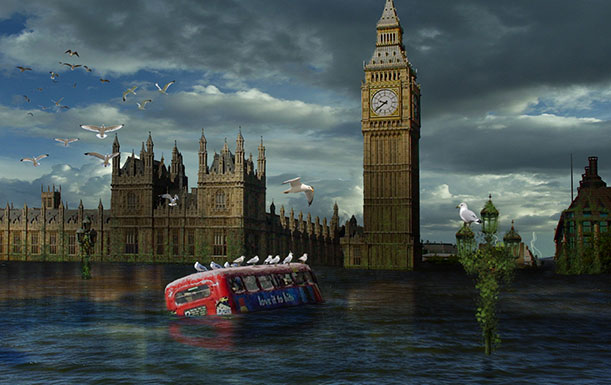
End of the world – Ron Miller
I read an entertaining article in the London Times today about preppers. In case you’re not aware what a prepper is, it’s somebody who’s watched too many disaster movies, and is convinced that one of them before long will turn out to be real.
So they go out and purchase assault rifles, tents, water, non-perishable food, antibiotics, Swiss penknives, gas bottles, cooking stoves, bandages, blankets, lots of spare underwear and a year’s supply of condoms.
I’m kidding about the condoms, though no doubt there are plenty of preppers out there who expect to have their evil way with other preppers, provided they haven’t shot them when they get too close.
Apparently our preppers, as opposed to the hardened survivalists in the United States, don’t believe that the time will come when they will have to defend their mountain redoubts against hordes of feds who will come after them on behalf some post-apocalyptic socialist government. There are also not so many who believe in the end of days.
Our preppers have more mundane concerns. They’re worried about the breakdown of law and order when ebola finally gets here. Or having to leave their homes in the event of a catastrophic flood – a tsunami unleashed when that tottering Canary Island finally slips into the sea. There are even preppers who want the end of the world as we know it to come, so that they can have the satisfaction of being able to tell all the soft, decadent, unprepared “I told you so”.
And decadent we most certainly are, according to the preppers. Our parents and grandparents learned to survive the consequences of one of Hitler’s bombs falling on their houses. In a time of rationing they learned to mend and make do, and concoct nutritious and vaguely edible meals through years of rationing.
My generation, the baby boomers, lived through nothing like this. Yes, we did learn to cross the street when we saw an untended package in case it was an IRA bomb, and we did endure the three-day-week when the miners went on strike. But no street lamps and devouring our curries by candlelight was more an entertaining distraction than a state of emergency.
So I fully confess to being one of those soft, decadent, lamentably-prepared suckers who will be the first to go under when the balloon – of whatever description – goes up. And I don’t propose to change my ways now.
The thought of sharing the blasted heaths of England with a bunch of AK47-toting lunatics as they let loose with their crossbows at itinerant squirrels would be too much to bear.
And anyway, I am prepared, to the extent I’m prepared to be. I have an axe (blunt) for chopping wood. I have enough empty water bottles to be able to fill up in a hurry. As for food, I could do with losing a bit of weight anyway, so I should be OK for a few days. My house is well above any flood plain, so no worries about being swept away, unless the Canaries tsunami reaches the British home counties.
Should the worst happen, and the apocalypse turns out not to be temporary, I would rather curl up and expire beneath an oak tree on an abandoned golf course. I imagine the scene as if it was a movie. I hand my last packet of chocolate fingers to my wife, and tell her to go, save herself. She, not wishing to become the slave of a group of marauding preppers, says she won’t leave me. So we settle down, and have a last meal of the red spotted toadstools that we’ve foraged from under the nearest rhododendron bush, with the choccie bics as dessert. We then quietly slip into the eternal sleep, leaving our bodies to the packs of abandoned Labradors.
After all, who in their right mind would tolerate a world without email, smart phones, camembert, Turkish coffee, Strictly Come Dancing and her Majesty the Queen? A world without the 4×4, dishwashers, hair straighteners, pinot grigio and Premier League Football? Without therapists, estate agents, call centres, traffic wardens and baristas?
And who would want to stumble around waiting for the fallout to crumble our bones, or the black death to strike us down?
Besides, should the disaster turn out only to be a mild apocalypse, and things return to normal, as they usually do in the disaster movies, who wants to listen to some smug bastard talking about how he hung out in the woods for weeks eating baked beans and termites?
Far better to be able to tell harrowing tales of survival against the odds, of emerging skeletal from the ruins of a mansion in Virginia Water, of existing on half a tin of foie gras a week, of removing one’s own appendix or getting into a fight to the death with a rabid Jack Russell.
So to hell with the camouflage jacket, the combat knife and the powdered milk. I’ll take my chances with the Bradley Fighting Vehicle in the garage, my stash of landmines, semtex and hand grenades, and stay put. And when Shiva decides to strike, I hope he waits until the current series of The Bridge is over.
I wasn’t a boy scout in my youth, and Mad Max I ain’t now.
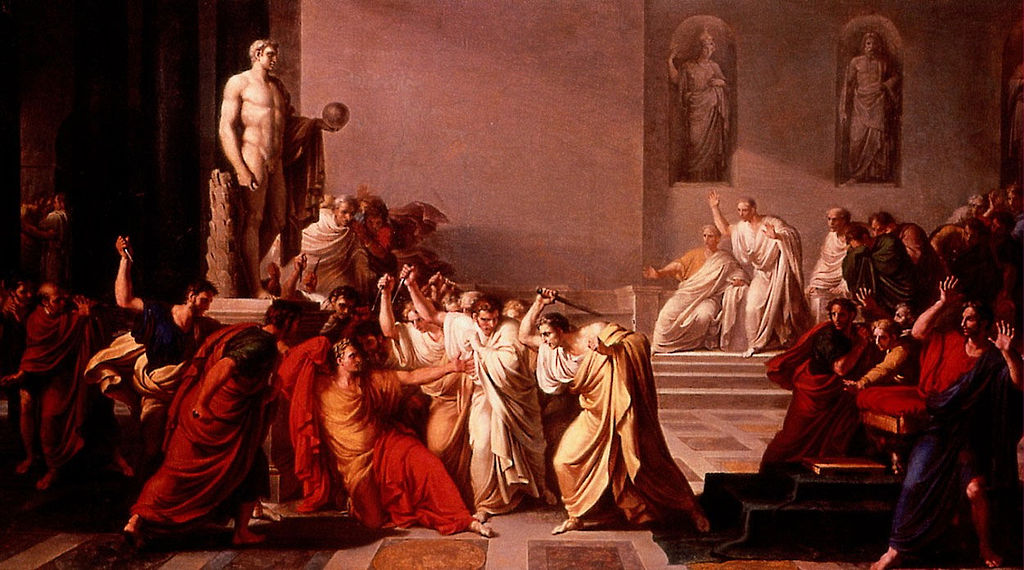
Assassination of Julius Caesar
With exquisite irony, thus spoke Mark Antony in Shakespeare’s Julius Caesar as he whipped up the rabble into a frenzy against the dictator’s assassins.
The phrase keeps coming to me as I watch members of his own party praise Jeremy Corbyn for his sincerity and integrity in his stand against air strikes on ISIS in Syria. Even more so when David Cameron does the same.
For different reasons of course. His own colleagues hoping to bury him, and Cameron hoping to keep the opposition divided and impotent for the longest possible time. As with Caesar, such tributes usually come after death. In the case of Corbyn, some would say that he’s joined the ranks of the politically undead.
Should he fail to bring his parliamentary party round to his point of view over Syria, no doubt there will be other opportunities to praise, then bury him. The Oldham by-election is just round the corner, for example.
One thing’s for sure. The would-be assassins in his own party will need to have nerves of steel. Will the disaffected right wing of the party risk the wrath of the all-powerful Len McClusky, leader of Unite, Labour’s biggest trade union backer? Are they prepared to risk targeted deselection campaigns by Corbyn’s supporters?
Depends on their principles, I suppose. Also there will be a number of them thinking that if they can get rid of him now, they will be in a better position to defend their back yards with a new leader in place and four years to prepare for the next election.
Otherwise, they might calculate, better to suffer a quick political death and have those years to prepare for a career outside Parliament than to soldier on through endless bickering, plotting and lip-buttoning.
One thing’s for sure, there will be blood on the Senate floor. Whose blood remains to be seen.
Or, to quote John Lennon:
There’s room at the top they are telling you still
But first you must learn how to smile as you kill
If you want to be like the folks on the hill
Working Class Hero. Copyright Lennon Music
If I was a member of the British Parliament I would reluctantly vote for military action against ISIS in Syria.
I chose my words carefully. We should not be confined to air strikes. If our contribution is to be meaningful, we need to keep our options open for other forms of military action, such as the use of ground troops. I’m not suggesting that the British Army is capable of driving ISIS out of Syria and Iraq on its own, or that we should send thousands of soldiers on to the battlefield. Only that ISIS rules out no options in its holy war, and neither should we, excepting only the use of weapons of mass destruction.
To require parliamentary approval for each minute step in the war against ISIS is a nonsense. Large scale action on the ground should of course only be launched with the consent of Parliament. And right now, such a venture would be unlikely to gain approval under any circumstances.
But our military should be free to react to changing circumstances by using different kinds of force, be that naval action, the use of special forces or whatever else is deemed necessary. It shouldn’t be beyond the wit of our generals, civil servants and politicians to devise a formula that stops short of a full ground war, yet gives our armed forces the power to vary their tactics according to the needs of the moment.
In Parliament yesterday, David Cameron set out the argument for air strikes in Syria. His main points were:
- Air strikes would help the chances of the international coalition
- Strikes would contribute to a transition plan for Syria
- The action would be legal
- Numerous countries in the region support air strikes
- There are 70,000 fighters ready to attack ISIS on the ground
- The military objective of the strikes is to stop the threat to the UK and to the existence of Iraq
- We would make a difference because our precision-guided missiles are more precise than anyone else’s
So do his arguments stand up?
It depends how we define the national interest. Certainly it’s in Britain’s best interests that the mix of diplomatic, military and political initiatives results in a peaceful Syria and the destruction of ISIS. And yes, the two do go hand in hand, because without the settlement there is always the danger that Son of ISIS will emerge and will continue to inspire terror attacks in the homelands of the coalition members, including our own.
Where the argument breaks down, however, is in the assumption that the diverse groups operating in Syria can be welded into a coherent whole that is not only capable of operating within an effective military command structure, but also are prepared to support whatever political settlements are put in place.
This is by no means guaranteed. We in Britain have the assurance of our Joint Intelligence Committee that there are 70,000 members of the Free Syrian Army ready to roll over ISIS with the help of coalition air support. But two questions arise. Does the FSA actually exist in any shape or form other than as an alliance of independent groups, many of which have less than “moderate” agendas? And second, would 70,000 be enough? To hold the ground maybe, but certainly not to roll ISIS back, if some military experts are to be believed.
Then there’s the argument that regional powers, including Turkey, Egypt, Saudi Arabia and Jordan support the strikes. All well and good, but each Arab state has its own agenda. Jordan is directly threatened by ISIS, and also houses hundreds of thousands of Syrian refugees. Saudi Arabia sees Iran as the primary bogeyman, and it’s hands are full in Yemen. Egypt is consumed by its internal political unrest, not to mention the ISIS-affiliated insurgency in Sinai.
Support is one thing, but direct action is another. Since ISIS’s burning of the Jordanian pilot, the coalition’s allies in the region seem highly squeamish about getting their hands dirty – Turkey being the obvious exception. Looking further down the line, if we assume that foreign boots on the ground would be needed to supplement the fabled 70,000, how likely is it that those boots would come from Egypt, Saudi Arabia and Jordan?
As for the assurance that the UK’s intervention is legal, apparently the advice Mr Cameron has received is based on Article 51 of the UN Charter. Now the legal eagles are far smarter than the rest of us, so surely we can trust the advice they have given to the Prime Minister, can’t we?
Well one would think so. But hang on. Let’s look at the actual source of the argument, Article 51:
“Nothing in the present Charter shall impair the inherent right of individual or collective self-defence if an armed attack occurs against a Member of the United Nations, until the Security Council has taken measures necessary to maintain international peace and security. Measures taken by Members in the exercise of this right of self-defence shall be immediately reported to the Security Council and shall not in any way affect the authority and responsibility of the Security Council under the present Charter to take at any time such action as it deems necessary in order to maintain or restore international peace and security.”
So has ISIS carried out an armed attack on the UK? Does the beheading of two UK citizens constitute such an attack? Does a thwarted conspiracy to attack qualify as an actual attack? Are such conspiracies the result of direct orders from the Islamic State? Does rhetoric encouraging sympathisers to attack us qualify as an actual attack? Er, not sure really.
Another problem with Article 51 is that it was written in an era when states attacked other states. It’s certainly not designed to provide cover for asymmetric warfare, where the aggression is as likely to be home-grown as originating from abroad. It also doesn’t allow for cyber-attacks, which may not be “armed attacks” as defined in the Charter, but can be just as deadly. Clear as mud then.
As for the big picture, Peter Oborne, the respected former columnist comes up with a provocative article in Middle East Eye, entitled Cameron doesn’t know what he’s doing so he shouldn’t go to war.
One of Oborne’s arguments seems to be that Tony Blair successfully made the case for war in 2003, and he was wrong. Cameron is not good at foreign affairs, but has made an equally strong case this time. Ergo, Cameron’s wrong too. The Joint Intelligence Committee provided lousy data to Blair about Saddam’s weapons of mass destruction. Ergo, the estimates of the 70,000 in Syria champing at the bit must be wrong also. Not necessarily on both counts. Does he think that nobody in government is incapable of learning from the mistakes of the past?
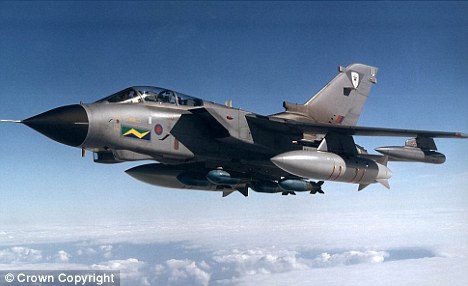
He also questions the benefit of launching a couple of Tornadoes at a time into skies over Syria that are already crowded with the bombers of several nations queuing up to drop their munitions on ISIS. Fair point. Even if our munitions are superior, we do have the option sharing the technology with our allies without launching them ourselves.
And finally he says:
“There is one other point that most observers have overlooked. What about civilian casualties? The British prime minister claims that British bombing technology is more accurate than the Americans.
The United States claims that only half a dozen civilians have died since it launched its campaign of airstrikes against IS across Syria and Iraq 15 months ago. Airwars, which compile lists of civilian deaths, asserts that the true figure is at least 680 and possibly as high as 975.
There would be a dark irony if Britain (and France) killed innocent people in our quest to hurt IS. Cameron’s strategy, as set out today, is to bomb and hope for the best. We should not go ahead until we have a better idea of what we are doing.”
Frankly, I should have thought that his last point was stating the obvious. Of course there are casualties. Where there are bombs there will always be casualties. Over 300,000 have died already in Syria, but for once the vast majority have not perished by Western hands. We should be aware, though, that by joining the swarm of bombers, the UK, no matter that its Brimstone missiles can take out one person leaving the guy next to him unscathed, it will share the responsibility for the deeds of the whole coalition, not just those of the two Tornado pilots.
But have any of the coalition members yet come up with a better idea than to bomb and hope for the best? Not from where I’m sitting. So is it fair to accuse Cameron of not knowing what he’s doing? Sure. But no more and no less than any of the others.
The one observation of Oborne’s I do buy into is this: the main reason for joining the bombing campaign is that it would be a gesture of solidarity.
We can do little to affect the military outcome, but the least we can do is to avoid losing friends among those who are putting the lives of their soldiers and airmen on the line. Because who knows, we might need their help in the future.
That’s an argument anyway. It didn’t help us with our little adventure in Suez, but our American friends were pretty helpful during the Falklands War. But that was then and this is now. I doubt if Barack Obama would lift a finger to support us if it wasn’t in America’s interest to do so. In one sense we have a more special relationship with our old adversaries, the French, because we’re able to cover for each other’s deficiencies. With the French it’s not so much a coalition of the willing, more an entente of the cash-strapped.
I accept that most of the arguments for not getting involved have some validity. Syria is a rat’s nest. The interests of the leading actors are almost impossible to reconcile. The military outcome is uncertain. The legality of the strikes is a grey area.
But we are already involved. ISIS respects no boundaries between Iraq and Syria, and nor should we. No military action can ever guarantee the desired results. And there are no modern precedents for a struggle against a ruthless non-state entity like ISIS, therefore resolving this conflict is entirely new territory.
So for all the emotional reasons – that we are morally bound to try and put an end to the suffering in Syria and Iraq, and that it’s a matter of national self-interest that we show solidarity with our allies – I would vote yes to the strikes.
But let’s not kid ourselves. This is a game of trial and error. It’s dangerous. People will die, including, perhaps, our own, and perhaps in horrible ways.
We may not fully know what we’re doing, but neither do the Americans, the Russians, the French and the Turks. Is that a reason for us to do nothing? As long as we act with good intentions and with the best information to hand, I don’t think so.
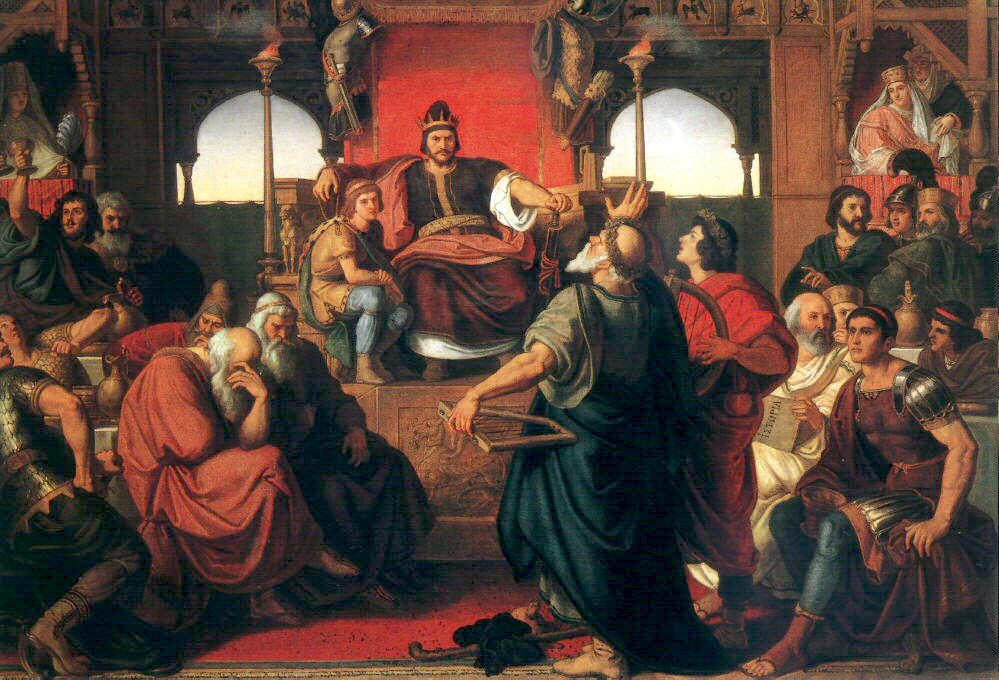
The Feast of Attila, by Mór Than
So the grizzly turned out to be a pussycat.
George Osborne, the UK’s finance minister, spent months softening us Brits up for the biggest round of cuts in public spending since the Great Depression in pursuit of his sacred book-balancing project.
Opponents of the cuts we were led to expect regaled us with doomsday scenarios that left us slashing our wrists in anxiety.
Tax credit cuts would make the impoverished even poorer. Reductions in police budgets would make life easier for terrorists as they cooked up their chemicals and stitched together their suicide vests in unpatrolled neighbourhoods. Defence cuts would make us a laughing-stock among our better-equipped allies.
Muggers and burglars would be free to ply their trades in the knowledge that nobody in a dark blue uniform would be seen on the streets for months, and the chance of one of them attending a crime scene would be less than that of being dive-bombed by a flying pig.
Little old ladies would quake in their sitting rooms waiting for the intruder to appear at the window, or the Russians to come marching down the street. Young families would bristle in outrage because they wouldn’t be able to eat. Or, worse still, that they could no longer afford their Sky TV subscriptions.
It turns out that we’ve been played.
When Mr Osborne revealed the details of his spending plans yesterday, the tax credit cuts were nowhere to be seen. Police budgets were left as they were. And whoopee, more spending on health, defence and housing. All this because apparently we’re £27 billion better off than we thought we were. Well that’s nice. Presumably Santa knocked on the minister’s door just as he was about to tell us that we would be having nut rissoles for Christmas.
And so a grateful nation sighs in relief, and gets ready to spend the equivalent of several times the GDP of Burundi on new IPhones for the kids.
All of this reminds me of an episode from when our children were growing up.
At 14, one of our beloved daughters had the attitude of Attila the Hun and the dress sense of Alaric the Goth. When she wasn’t in Attila mode she could be utterly charming. And she used that combination of nice and horrible to great effect.
One day she approached me with a problem. Daddy, my clothes are crap. I need at least six new tops, two pairs of jeans, a coat and three pairs of shoes. She chose me, of course, as the line of least resistance. I, being a moral coward, referred her case to the real authority in the family.
Mrs Royston politely pointed out that she had several thousand pounds worth of clothes strewn over the floor of her bedroom in layers according to their age. Rather like the seven layers of ancient Troy. Perhaps if she looked after the stuff she had, not all of it would turn out to be crap. Well actually, she wasn’t very polite, and this is a sanitised version of her language.
At this point our daughter went into full Attila mode. With Hunnish fury she made our lives a misery for the next five days, shooting her arrows of contempt at every opportunity and spreading a poisonous atmosphere as only a hormonal 14-year-old can.
We withstood the siege, sighing with relief every morning as she stomped off to school, no doubt to compare notes with her mates on the cruelty of parents, only for the hostilities to renew when she got home in the evening.
On day six she changed tactics. Attila was but a horrible memory as she sidled up to me in Daddy’s-little-girl mode. She’d had a think about what she’d needed, she said, and it turned out that perhaps she could do without the clothes for the time being. But please, please, please could she have a new pair of party shoes?
At which point the united front collapsed, and I took an executive decision. Yes. The prospect of another week of emotional battery was too much to bear, and Daddy’s little girl danced off with a smirk on her face and several crisp bank notes in her hand.
An object lesson in how to conjure something out of nothing. So yes, be it by accident or design, we were played.
Which goes to show that in politics you don’t need a dozen advisers to achieve your objectives. You just need to watch your children going about their business. And if you don’t have kids, hire some as advisers.
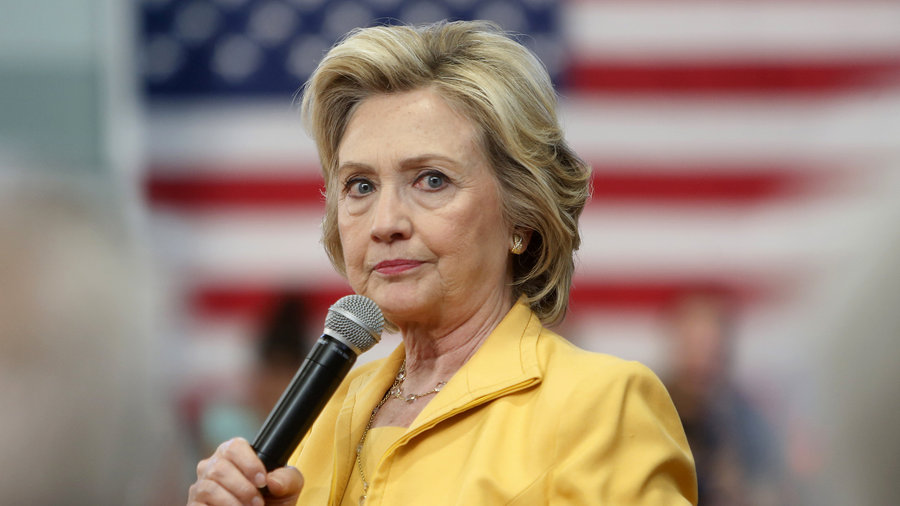
Good for Hillary Clinton for pushing back against the knee-jerkers in the US who are using the Paris massacre as a reason not to give sanctuary to refugees from Syria and Iraq. For her and those who agree with her, it’s a moral issue.
Indeed it is. But there’s another reason why these people shouldn’t be left to rot. But first some questions.
In the wake of the Paris atrocity, do we really believe that we are incapable of detecting fake Syrian passports now that their use has been identified as a security risk? With the billions that we are pouring into all manner of security measures are we likely in the future to be so lax that we fail to scrutinise more closely the backgrounds of the refugees seeking the right to remain within our borders? Do we not face a far greater threat from home-grown terrorists than from those who seek to infiltrate from Syria?
I would answer no to the first question, no for the second and yes to the third.
Now for the other reason. If we let the refugees settle within the EU, if we treat them in a humane and supportive manner and if we give them the opportunity to build new lives for themselves, why should they turn against their hosts? Surely the last thing they will want will be to recreate the battleground from which they have fled. They will no more tolerate the warmongers and fanatics in their midst than we do.
If states in continental Europe have by accident or design marginalised their ethnic minorities, thus producing “breeding grounds for terrorists”, then that is a separate issue that they must address. That’s something that we in the UK must do also, to prevent the like of Bradford, Bolton and Tower Hamlets from becoming more like the Paris banlieues than they already are. When the newcomers arrive, it will be hard to prevent Little Syrias and Iraqs from springing up in our economically deprived areas, because people with common backgrounds, initially at least, tend to stick together. So we must work harder to make those areas less deprived, and help those within them to spread out beyond their ethno-centric communities.
If that means greater investment in housing, education and social amenities in those areas, then so be it. To hell with the orthodoxy of deficit reduction. Priorities have changed. Nobody will thank the current government for sticking to its deficit target if our fiscally-neutral nation is a perilous place in which individual freedoms as well as public services have been cut to the bone.
Much as the right-wing factions across the EU are trying to exploit the Paris tragedy to pursue their anti-immigrant agendas, they cannot turn back the clock. There are multi-ethnic societies in virtually every country in the Union, and that’s not going to change. Integrating them is the problem we need to fix. At least that’s within our power to achieve, whereas helping the countries from which the refugees are fleeing to find political and economic solutions is fiendishly difficult and not within the power of any individual nation.
If fear is preventing us from welcoming the new arrivals, then it needs to be dissipated by a combination of practical measures – again within our control – and moral argument. What better way to set a new tone among our established ethnic minorities than to welcome the refugees (as many Germans have), make use of their skills, and do our best to integrate those who wish to make our countries their permanent home?
There are lessons to be learned from Paris. We will not stop further attacks, but we can get better at preventing more of them. And we can, given time, effort and money, fix the underlying causes behind the attacks.
Letting a million refugees rot in camps, or sending them back to the hell-holes from which they escaped, will do nothing to cure the malaise in our towns and suburbs. Welcoming them and giving them the opportunity to start new lives might be just what we need to begin rebuilding coherence in our European societies, because it will force us to pay full attention to a defining issue for our generation which for decades we have struggled to address effectively.
I admit to a bias. I’ve spent many years living and working in the Arab world among industrious, smart and principled people, including Syrians and Iraqis. They are resourceful and adaptable. Liberate them from a sense that they must defend their cultures and beliefs, and they will have much to offer us. Those cultures are evolving. No matter how much ISIS would desire otherwise, the differences between Middle East and West are becoming less, not more. I have no fear of the other.
And I for one refuse to accept that our continent, which seventy years ago rebuilt itself from the ashes of conflict, can’t emerge from this crisis without building walls, herding people into ghettos or indulging in bouts of ethnic cleansing. As in America, our domestic Donald Trumps are doing us a favour by reminding us of the consequences if we don’t put social coherence at the top of our national agendas.
Jonah Lomu, whose death was announced yesterday, turned rugby into a different kind of war.
In my muddy recollection of the way things were, Rugby Union before Jonah was the sport I briefly played at school and watched occasionally thereafter. A game full of regulated violence played by guys who were tough as nails, had a strong team ethic and liked a few beers after the game. A game played by men who did it for fun, not money. They were fit, but not to the extent that you would easily be able to recognise their favourite pastime if you met them in a bank, an estate agency or a solicitor’s office. They were salesmen, miners, sheep farmers and accountants.
Many of them – particularly in England – were products of private schools, in which rugby was the winter game of choice. But many more were from countries in which the sport trumped soccer as the national game – Wales and New Zealand for example, where background and social class were less important than the ability to sprint past six opponents determined to bring you crashing down on to the muddy turf. A code of courage, camaraderie, endurance, and refusal to admit to physical pain. A showcase of gentlemanly virtues, of the stiff upper lip. A sport of soldiers, of empire.
Jonah’s arrival changed everything, just as tanks transformed the battlefield of the twentieth century. A six-foot-four Polynesian battering ram, running with the ball not just past, but through, opponents half his size, sending them flying in his wake.
Suddenly – at least looking back it seemed sudden – rugby was no longer the game of my youth. Bulked-up forwards and mountainous backs turned it into a contest of attrition. Just as the First World War was described by those who survived it as long periods of boredom punctuated by moments of indescribable terror, rugby at the highest level became a game full of long periods in which players custom-built to resist the likes of Jonah fought out a relentless stalemate up and down the pitch, to be broken now and again by lightning offensives that mostly came to nothing.
The rules seemed to be more complicated. Commentators started to talk about phases, to describe each time an attack came to a juddering halt as defenders swarmed to stop attackers. Line-outs became a matter of who could lift their team-mates high enough to catch the ball. Penalty kickers could mount the ball under a plastic plinth so that they could lift it goal-wards more easily. And miked-up referees shared their decisions, and their reprimands of offending players, with millions of TV viewers. Rugby became a technical game full of gizmos and gimmicks, not just a matter of blood and guts.
The game of empire had become a professional sport, and suddenly, thanks to the Rugby World Cup, we became aware of other places beyond the traditional playing fields where the game was flourishing – Uruguay, Canada, Georgia, Russia and Japan.
Jonah didn’t bring about these changes. They happened gradually over a couple of decades. But for me, watching from afar with decreasing interest, he symbolised the pivot point. It seems so long ago when rugby’s long age of innocence ended. Yet he was only 40 when he died.
The World Cup semi-final of 1995, in which Jonah pulverised England and transformed the game, was the last truly exciting rugby match I ever saw. It all seemed to go downhill from there. But was he worth watching? You bet he was.
If you ask any sports fan under the age of fifty to name one superstar in a sport they don’t regularly follow, they might come up with Messi, Federer, Woods, Magic Johnson, Mohammed Ali and Usain Bolt. Ask them to name a rugby player, and the chances are that they’ll give you Jonah Lomu.
Goes to show once again that it’s not how long you live that makes you immortal, but what you achieve, even in a few short years. I hope that’s a comfort for Jonah’s loved ones as they grieve for a man who died too young.
Rouget de Lisle, composer of the Marseillaise, sings it for the first time
I have few words to say about Paris beyond what has already been said, except that it is one of my favourite cities, and that France is a country I love deeply.
Many commentators far smarter than me have written enough wise and moving words about the dead and the wounded, and about the perpetrators and their motivation.
But if there’s just one though I keep coming back to whenever I read about the tragedy in Syria, Iraq, Beirut and Paris, it’s this: at what stage do past events cease to be opportunities to find culprits and turn into history? At what stage do we move from blaming to understanding?
After the last guilty man or woman dies, would be one answer. Which is why we continue to pursue Nazi war criminals, arrest a soldier on suspicion of murder committed in Northern Ireland thirty years ago and agitate for those who got us into the Iraq war in 2003 to go on trial for war crimes. Which is also why some of the relatives of Mohammed Emwazi’s victims would rather he had lived to face trial for the crimes of which he was accused.
To an extent the line is artificial. Blame is the brother of hatred, and hatred runs deep. Christians still blame Jews for the death of Jesus. Shiites still rail at the Caliph Yazid ibn Muawiya for the killing of Imam Hussain. And in Northern Ireland, more than three hundred years after the Battle of the Boyne, King Billy is still a symbol of oppression among the Catholic minority of the Six Counties. Crusades and a hundred other events etched into the memories of those who live around the battlegrounds continue to feed ancestral grudges today.
As for the origins of ISIS, you will find far more people who take to Twitter and point the finger of blame at a list of states and individuals than those who say enough – that was then, this is now; we have to deal with the present and the future rather than endlessly ruminate on the causes.
Worse still is the tendency to draw lessons from dubious historical parallels. Because of the adverse consequences of our invasions of Iraq and Afghanistan, some of us say that we shouldn’t be contemplating action on the ground against ISIS. Just as those who urged us not to resist Hitler’s empire-building did so because they didn’t wish to see a repeat of World War I.
Those who most energetically point the finger often seem to be the ones reluctant to propose a way forward. For many Western voices it seems to be enough to use blame to confirm a world view. It’s all the fault of American or British imperialism, globalisation, capitalism, the banks, the super-rich, the military-industrial complex, Microsoft, Google, Amazon, Monsanto and so on. And in the Middle East, the same people who blame America for all their ills, are the one who happily chat on their IPhones, drive their Ford pick-ups and watch Hollywood movies. Far easier to blame than take responsibility.
Jeremy Corbyn, the recently-elected leader of the Labour party, has never been kindly disposed towards America, its actions and motives during his political career. He is saying that we should try and achieve peace in what’s left of Syria before turning our attention on ISIS. That’s all very well, but with fifty factions vying for influence, with the international players that have a stake in the future of Syria all looking for different outcomes, a settlement will, to put it mildly, require a miraculous alignment of interests. Until that miracle comes to pass, how will Corbyn’s position resonate with the voters if ISIS manages to mount a Paris-style attack in the UK?
For what it’s worth, I agree with those who say that in the short term boots on the ground will be required to eliminate ISIS. In terms of capability the most effective boots would most likely be Western. But if the result is further casualties and further bitterness against the West, the destruction of Baghdadi’s gang will ultimately be futile. One insurgency will simply be replaced by another. And “victory” in Syria and Iraq will not make the radicalised citizens of France, Britain and Belgium go away. They will switch their allegiance to the next group.
So what’s the solution? There are plenty of opinions, but the problem is that nobody really knows, because the recipe of circumstances and interests that produced ISIS can’t easily be mapped onto similar events from the past. In this case, experience is no guide to the future. And this is also why those who try to deconstruct the situation are far more comfortable finding scapegoats than coming up with a coherent way forward.
For sure, defeating ISIS in Syria, Iraq and other areas where their tentacles are spreading would buy time to create some form of lasting settlement in the region, just as the suppression of Al-Qaeda in Iraq during the Anbar Awakening provided an opportunity for Iraq to organise itself into a non-sectarian state – something that it lamentably failed to do under Nouri al-Maliki.
It would also deprive its followers in the West of a focal point for their efforts. The terror threat would not go away, but groups operating in Western countries would have to become relatively autonomous. Whether that would make them easier to track down is debatable, but if Iraq and Syria no longer served as a training ground for jihadis, the effectiveness of the home-grown groups would probably decline.
In terms of tactics, it’s pretty obvious to this observer with no military training that bombs can certainly degrade. But recent experience shows that they can’t, as Barack Obama suggested, destroy ISIS. And if a coalition of Middle Eastern forces can’t be assembled to provide the boots on the ground that can take the territory without further exacerbating sectarian divides (and that’s a big ask, hence the widespread opinion among Arab commentators that only “moderate” Sunnis can defeat the Sunni extremists), then increased use of special forces might tip the balance.
It’s almost impossible to function as a “state” – which ISIS aspires to do – if you have no control of your airspace, if your leaders are continually in hiding from the bombs and drones. Even more difficult if your institutions can be targeted at will and without notice by helicopters disgorging highly-trained special forces. Just as ISIS thrives at home and abroad on surprise attacks, the same tactics used against it would surely have a telling effect. These days Western opinion tends to be less squeamish about special forces rather than the use of conventional ground troops. The big question is whether there are sufficient intelligence sources on the ground to ensure that the raiders hit the right targets without causing mass casualties among the innocents. The killing of Mohammed Emwazi suggests that those sources do exist. In sufficient numbers? That remains to be seen.
The British prime minister David Cameron tells us that the UK government plans to recruit a large number of additional security services operatives. I suppose the announcement is designed to make us all feel a little safer. But in reality the effect of hiring a couple of thousand extra staff will make little difference for at least a couple of years. After all, these people need to be recruited and then trained.
Of equal significance – again in the longer term – are the government’s plans to invest a further £1.9 billion in cybersecurity, and a similar amount to be spent on equipping the British special forces. Although Cameron announced that the SAS will have a role in defending the country against Paris-style attacks, the money will surely enhance their ability to operate abroad.
Whether or not special forces play an increasing part in the conflict, in the absence of a political solution that leads to an effective military response to ISIS, the benighted lands of Syria and Iraq will continue to be the stage for trial and error on all sides.
Back at home, we in the UK, France, Belgium and all other countries potentially under attack will need to treasure our common values, societies, institutions and way of life, and reflect on what life would be like without them rather than focus only on their imperfections. And if we can’t help those amongst us who hate them to change their minds, then the consequences will be unpredictable, and probably dire.
I for one don’t want to live in an Islamic State under the black flag. But neither do I want to live in a police state. Ultimately, we have to make sure that we don’t have to choose between the two.

Two days after the Metrojet crash in Sinai, I took a flight from Jeddah to London on British Airways. At the airport I and the other passengers were subjected to the third degree. Body search, hand baggage gone through with a fine tooth comb. Two laptops, one IPad and two phones switched on and off to prove that they were really what they appeared to be.
It was a good job that the flight was half empty, because otherwise we would have been standing in the line for many hours. When we finally boarded the aircraft, I asked the steward whether we would be flying over Sinai. “Yes sir”, he said. “But don’t worry, we’ll be well beyond the reach of any surface-to-air missile.”
I didn’t want to get into a discussion about the range of the BUK missile that shot down MH17 over Ukraine, so left it at that and took my seat. And actually, I wasn’t asking the question he so reassuringly answered. I just wanted to know whether I should be more prepared than normal to meet my maker within the following hour or two.
After all there are many factors that bring down aircraft. Bombs and missiles are relative rarities. There are also lots of targets, and not so many people willing to go for them. So it’s really a matter of calculating the odds and taking a view. And since I’m writing this from the comfort of my home in England, the view turned out to be correct.
And so it seems that what brought down the Russian airliner was a bomb, not a missile. Which I guess justifies deploying a couple of guys rifling through hand baggage at an airport in a country where a recent poll revealed widespread sympathy for the aims of the suspected perpetrator of the atrocity, ISIS.
Well yes, sort of. But whenever I encounter this belts and braces approach – note that we had already been through the X-ray scanner – I wonder where the distrust lies: with the people looking at the images from the scanner or with the technology itself? This shouldn’t be taken as a criticism of the Saudis. As will be evident later, they did exactly what they were supposed to by international convention in response a perceived high security risk.
Nevertheless, I have been through enough scanners to know that the attention of the operators can wander. In my experience this happens more often in Middle East airports, something that travellers at Sharm el-Sheikh have reported. But I suspect that’s only because I use more airports in the region than, say, in continental Europe or Africa.
So if one of the security vulnerabilities is down to the scanner operators, what’s to be done? More frequent breaks? Better training? More supervision? Probably all of these things. Yet none of those measures would prevent an operator sympathetic to the cause of would-be bombers from turning a blind eye to something sinister passing through the machine. More thorough – and regular – background screening might just reveal the sympathies of the operator, but what if that person was under duress? A threat to their family in the event of non-cooperation for example. No screening system is likely to pick up on that.
That’s where a technology fix could help. An audible alarm incapable of being overridden by the operator that is set off if the machine sees something suspicious. A similar alarm sounds if you go through the metal detector with a coin in your pocket. In the case of the X-ray scanner an alarm system would mean that the bomber would need two accomplices, not one, to get something through, a far less likely event unless the entire security system was hopelessly compromised.
If such an alarm triggered more bag checks at the scanner, then surely the argument for double checking would be weakened. The last thing travellers and the airline industry needs is for repeated searching of hand baggage to be mandatory on every flight.
Checking hand baggage is only part of the problem. Extra checks may serve to reassure and annoy passengers in equal measures, but then there’s the question of baggage stowed in the hold, and the possibility that a baggage handler might smuggle a bomb on to the plane. Checks on stowed bags take place out of sight of the passenger, so unless they also go through the scanner in the presence of the owner, the traveller usually forgets about them until they arrive at the baggage hall at the other end. The Israelis use barometric chambers to detect devices designed to detonate during flight at lower air pressures. No doubt there will be people pushing for blast-proof baggage containers to be introduced, at least in areas seen to be most at risk. And of course more body searches and screening of staff.
What’s pretty sure is that there will be consequences as the result of the Sinai crash. Governments are already making noises about tightened security. Almost certainly those measures will include improved technology – for those airports that can afford it – and new processes. Equally likely will be that waiting times at airports will increase.
From the passengers’ point of view, frustration will increase. Right now, in most airports around the world (Israel being a notable exception), the same security measures theoretically apply to each passenger regardless of age, nationality, ethnic origin and other factors that might feed into an assessment of the risk that person potentially poses to airport and flight safety. In practice? Who knows?
There has long been an argument for pre-screening measures based on risk assessment. Without the resources of intelligence agencies such as the NSA and GCHQ, looking into a person’s background before they arrive at the airport will always be an inexact science – a matter of risk percentage. But if pre-screening makes life easier for a large number of passengers who, according to objective measures, are highly unlikely to feature on any no-fly list, then for the vast majority of passengers the pain will be alleviated.
The question is: who does the screening and what measures will they use? At the moment, it depends on the country. If you fly to the USA, those from countries that qualify for the visa waiver have to apply for the ESTA (Electronic System for Travel Authorisation). You are never going to know what criteria the US uses to determine whether an ESTA can be granted, but my experience after 9/11 leads me to hope that the system is more sophisticated today.
At that time my passport was full of stamps from Middle East countries, and I found myself being targeted for “special measures” every time I arrived at and left the country. Was there a connection? I’ll never know, but in all other respects as a married middle-aged Englishman with no political or religious affiliations I would surely have ranked pretty low down the list of potential terrorists. I even co-owned a business in the US, for goodness sake!
And then there was the Saudi friend once told me that shortly after 9/11, he was interrogated by the FBI and put under surveillance, seemingly because he shared a name with one of the 19 attackers. He and about a million other people in the Kingdom! Not very smart, you might think.
There is one issue that doesn’t seem to have received much airtime of late. Why is it so difficult to find information from official sources about the safety and security of the airports we must use to travel from one place to another? Why, for example, did it only emerge after the Sinai crash that a couple of months a British airliner full of passengers had to dodge a missile that flew 300 metres past it on approach to Sharm El-Sheikh? The British government explained that “we investigated the reported incident at the time and concluded that it was not a targeted attack and was likely to be connected to routine exercises being conducted by the Egyptian military in the area at the time.” Well that’s OK then. Nothing to do with ISIS, just some trigger-happy army unit letting off missiles for fun. Clearly our masters don’t believe that we need to be told about such incidents. An entirely routine potentially catastrophic near-miss. Happens all the time, does it?
So where can we go to find out whether en route to our place in the sun we are at risk of having to engage in a pas-de-deux with an incoming projectile? Or indeed whether the airport we’re heading towards has security staff who prefer to send messages on WhatsApp rather than keep their eyes on what’s passing across their scanner screens? If our governments won’t tell us, who will?
Now in no sense am I a safety expert, but from a motive of self-preservation, I do take a keen interest in the subject. In the dim and distant past I actually worked in civil aviation for a number of years. That experience led me to a very obvious place to see if I could find an authoritative source of information on airports. Take a look at this interesting document produced by the International Civil Aviation Organisation (ICAO). It’s called a “Manual on Threat Assessment and Risk Management Methodology (Reference Guide for States)”.
The publisher, ICAO, is a UN-affiliated body. According to its website, ICAO “works with the (Chicago) Convention’s 191 Member States and industry groups to reach consensus on international civil aviation Standards and Recommended Practices (SARPs) and policies in support of a safe, efficient, secure, economically sustainable and environmentally responsible civil aviation sector.” One of its key functions is that it “audits States’ civil aviation oversight capabilities in the areas of safety and security.”
The organisation runs a campaign called No Country Left Behind (NCLB) that aims to ensure that members rich or poor are able to implement the standards to a uniform level. One of those standards, of course, relates to safety and security. Hence the The Threat Assessment and Risk Management manual, which shows that at an international level there is a coherent and sensible approach to ensuring the safety of airports. The website goes on to say that “The NCLB effort also promotes ICAO’s efforts to resolve Significant Safety Concerns (SSCs) brought to light through ICAO’s safety oversight audits as well as other safety, security and emissions-related objectives.”
In other words, when there are safety issues, it attempts to resolve them, and carries out audits to ensure compliance.
But are all the member states following the guidelines? Based on a couple of hours browsing the ICAO website I wasn’t any the wiser on that question.
Wading through the acres of acronym-strewn information on the site, in layman’s terms the following is apparent:
- All member states are supposed to adhere to the guidelines in the Threat Assessment and Risk Methodology
- ICAO audits member nations in order to identify and help members resolve Significant Safety Concerns.
- The audit can include on-site inspections.
- Most member nations have agreed to make public information on Significant Safety Concerns
Unfortunately I was unable to find information on Significant Safety Concerns relating to individual countries on the website, but no doubt it exists somewhere. The closest I got to what I was looking for was this annual safety report on European member nations. Though it provided plenty of country ratings, none related to individual airports. Which leads me to the next question: why is there no publicly available worldwide ranking of airports based on an objective assessment of the safety risk of travelling to, from and through them?
My reason for asking that question is that it would be extremely helpful if we the customers – the flying passengers – were able to make our assessment of the risk of using one airport or another. It would also be useful if we were able to be sure that such rankings are based on frequent, impartial, hands-on inspections that are beyond the ability of airport owners and operators to manipulate and obstruct for their own reasons. In other words, no possibility of cover-ups of issues of which the passenger should be aware. In addition to current risks, it would be useful if those rankings were based on historical safety and security track records, and objective measures of political stability.
Difficult to do? Too sensitive for the member states? Too dependent on secret squirrels? Don’t care. It’s about time passengers had the opportunity to make their own minds up about whether they’re prepared to travel to an airport with low safety and security standards, and for the information that they use to make that decision to be objective, credible and easily accessible.
Individual states have too much riding on the outcomes from safety incidents to be left to make their own risk assessments without some element of external mediation. Look at poor Egypt, faced with the loss of 70% of its tourist industry according to one observer. Is it likely to face its problems fair and square and fix them, with international assistance if need be? One would like to think so. Would it be more likely to do so if it was unable to varnish the risks? Highly likely.
That external mediation is what ICAO is supposed to deliver. It may be doing so, but not in a manner easily accessible to this layman.
It’s also a factor that the safety of a particular airport is not the only consideration. The airport is merely the point of arrival or departure. What happens in the air is equally important. So travellers should become aware of the routes being taken to the destination, which was why I asked whether the flight from Jeddah was crossing Sinai.
The bottom line is that as passengers we should not blindly accept what we’re told about the safety of a particular airport, aircraft, airline or air route. We owe it to ourselves to arm ourselves with as much information as we can that might have a bearing on our decision about how we travel and where we travel. Just as it’s relatively easy to find out where malaria and dengue fever are prevalent, and in which country there is a significant risk of terrorism, it should also be easy to access information about aviation safety. We should be able to do that without having to spend many hours on the web dredging up dodgy information or watching endless episodes of Air Crash Investigation.
I personally believe that ICAO and individual member states could do much more to reassure us (or otherwise) that we’re going to a safe place. No-notice security spot-checks, mystery customer programmes and even a place where passengers can easily report incidents and poor practice that they notice while going through an airport or flying would, if publicly accessible, go a long way towards repairing the damage caused to confidence in air travel by high-profile security failures.
The counter-argument will be that if information on security weaknesses was made available to the public, would-be terrorists would gleefully leap in to exploit the open doors. Well yes, they probably would, but don’t you think that airports and countries named and shamed would have a very good incentive to act pretty quickly to resolve the issues?
Air safety has improved significantly over the past decade, which is why crashes when they occur are all the more shocking and extensively reported. But there’s no such thing as perfection, as the Sinai incident showed. More, much more, can surely be done. Yes, I know there are thousands of airports used by over a hundred thousand flights on any given day worldwide, so to apply more rigorous inspection, new procedures, enhanced technologies and more thorough training consistently across all airports will cost money.
But since many national economies, including that of Egypt, depend on air travel, in the future we will have to balance the risk of not investing further in safety and security against the risk of collapsing economies and ultimately failed states, with all the knock-on consequences.
I grieve for Egypt, and for Tunisia, whose tourism industry has been so badly damaged by the attacks in Tunis and Sousse. Also for the families who were snuffed out over Sinai. It’s time for some smart solutions to keep our travel safe, not just more of the same – yet more layers of inspection for the benighted passenger to endure.
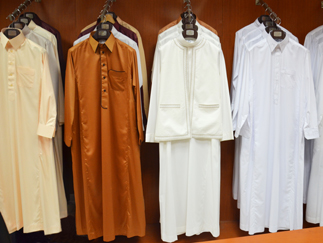
Saudi Arabia is a country of contrasts and contradictions. I suppose you could say that most countries are, but because the Kingdom is such a difficult place to visit unless you’re a pilgrim, a politician or a businessperson, the foreign narrative of an austere, humourless people inhabiting a land largely devoid of water and vegetation tends to dominate the perceptions of those who have never spent time there.
It’s a one-dimensional view that’s far from reality. If you visit the southern Asir region, for example, you will find magical, verdant terrain. Mountains, valleys and lakes, and architecture unlike any to be found in any other part. In some areas, the men even wear flowers in their hair – something that would surprise the superannuated hippies of San Francisco. Cool in the winter, and a good 20c below summer temperatures in other Saudi regions, the Asir is a popular summer destination for Saudis who want to escape the heat and perhaps revisit their tribal homeland.
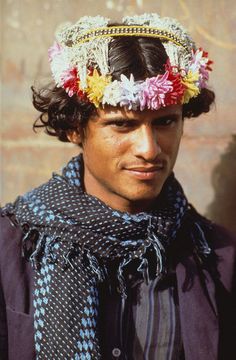
In addition to the men with their flowery hair, you will find baboons everywhere, their colourful backsides adding a splash of colour to the slate-grey mountains that tower above the meadows and forests.
The Asir is also a fairly conservative region, as witness a report in the Arab News about young Saudis scorning the traditional thobe and ghutra in favour of western attire:
“Many young Saudi men are adopting Western-style fashion trends including clothing and haircuts, which are not in line with Saudi customs and traditions, according to several experts.
They are also increasingly using English words mixed with Arabic that they have picked up from Western television programs and movies, they said. The clothing now worn includes accessories such as bags, short pants, and items with “weird” pictures.
Khaled Al-Jelban, a family and community medicine consultant at King Khalid University, was critical of the way young men dress these days. He said he has seen some brag about their clothing and acting in a manner that does not fit in with Saudi culture.
“Some of them are even decorating their Arabic clothes, which goes against the traditions passed down from our fathers and grandfathers,” he told Arab News recently. This was a “dangerous phenomenon,” he said.
In addition, he said that some young people were trying to sound sophisticated by using a lot of English words, probably as a result of them spending too many holidays abroad, rather than in the Kingdom, and watching too many Western-produced movies without parental supervision.”
I’m not sure what “too many” actually means in this context, but you get the message. As for weird pictures, what Mr Al-Jelban is referring to is anybody’s guess. Mickey Mouse perhaps.
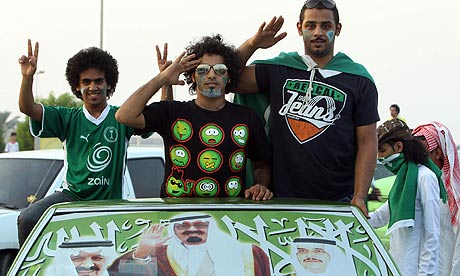
Given that these concerns have been widespread for at least the past twenty years, I’m not sure if this piece isn’t something of a filler – the kind of semi-rant that gets dragged out of the drawer whenever there isn’t much “real news” to report, though God knows, there’s enough going on in the neighbourhood to fill the Arab News twice over. Or perhaps it’s a subtle promo for internal tourism, as in “to hell with Orlando, London and Paris, bring your kids to the Asir, where they can climb mountains and commune with baboons”…. in thobes.
Anyway, the piece set me thinking about the male Saudi national dress. There’s actually not much you can do to enhance the thobe, other than raise it towards your knees. The overtly devout have cornered the market in the short thobe just above the ankle, in emulation of the Prophet’s reported dress style. Mini-thobes above the knees? I don’t think so – not so many Saudis have the legs for that, though the Yemenis often sport a midi variant (useful for fishing). Thobes bearing images of Jabba the Hutt perhaps, but that would upset the scholars, who look down on the use of human (and presumably alien) images.
There is a market, however, for subtle variations. Saudis tend to wear collars fastened with a neat little stud, whereas their neighbours in the Emirates go collarless. The inside of the collar also offers sartorial opportunities, such as the Burberry tartan trim you see sometimes on female abayas. Speaking of tartan, I’m surprised that in a region where tribal membership still matters and where there have been skilled weavers for thousands of years, the Arab tribes didn’t evolve a tartan tradition like the Scots. Useful for distinguishing the raiders from the raided, I would have thought.
In the winter, there are numerous opportunities for colour variations. Dark brown, grey and blue tend to be the favoured hues. I dare say a shocking pink thobe would send the elders of the Asir spluttering into their gahwa (Arabic coffee) in shock, and anyway pink is a girl’s colour isn’t it? That’s one western preference that’s firmly ingrained in Saudi society.
So the problem – at least from a young male’s point of view – is that there isn’t much room for the thobe to evolve. And the same goes for the traditional headdress, the ghutra. It doesn’t lend itself to much variation, though the Omanis and Yemenis wrap it round their heads turban-style. So you either go traditional or you go western. And another allure of going western is that you can show off those snazzy haircuts much loved by footballers and sniffed at by the elders.
The other drawback with thobes is that that they don’t really lend themselves too easily to modern sport – a problem not faced by ancestors whose main concern was keeping cool, rounding up the odd goat and scaling date palms. Even traditional dancing is thobe-friendly – very stately, no sudden movements, which is probably just as well given that many of the dances involve swords. Imagine trying to do the balletic moves practised by Indian and Pakistani border guards wearing a long white robe.
So how does a young Saudi man stand out from the crowd? Not easily, and I guess that’s the point. After all, this is a society in which conformity with social norms is expected and admired. They’re expected to be good sons, good Muslims, respectful of their parents and of authority generally. Deviations from those norms are seen as a problem, as the Arab News article makes clear:
“Saud Al-Dahain, a social sciences professor at King Saud University, said young people are rebelling by adopting these fashion styles. “It’s a cry for attention from young people who don’t want to be marginalized,” he said.
He said that the best way to deal with this situation was to provide counseling and advice for these young people. He said that society needs to deal with these young people in a wise manner.”
Personally I’m all in favour of this approach. Young people who want haircuts like Sergio Aguero and like to wear trousers suspended halfway down their boxer shorts definitely need help. But then again perhaps the fact that I’d need a stick-on Aguero rub, and my every step wearing trousers at half-mast would send them plunging down to my ankles might have something to do with my shamefully illiberal attitude.
But the spirit of conformity is where some of the contradictions come into play. This is the home of the sacred sites of Islam where pilgrims, regardless of status, wealth or origin, don the simplest of garments – white towelling robes – when fulfilling the obligation of the Haj. You might think that the simple thobe is equally a symbol of an egalitarian ethos. In theory, it is, though not in practice.
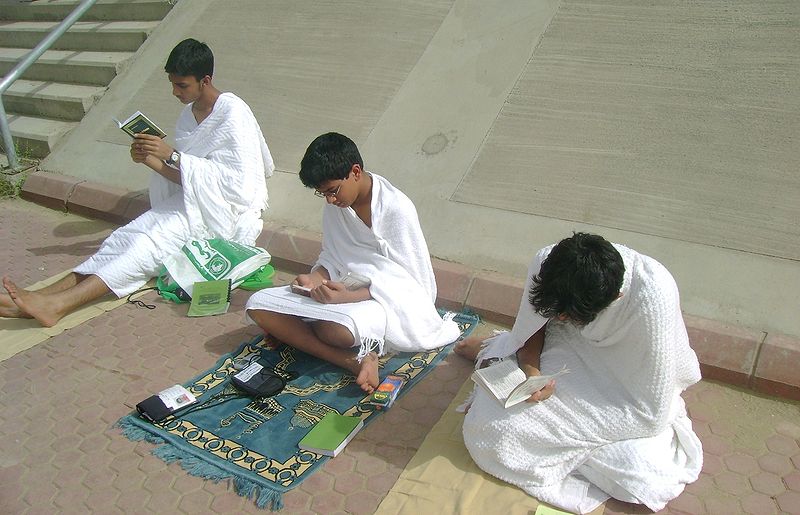
Saudi Arabia has about twenty million citizens and nine million expatriates. In terms of the working population, expatriates outnumber nationals. Foreign workers – from the Philippines, South Asia, North Africa and the Arab countries – tend not to wear the thobe. Through a mixture of disinclination and subtle discouragement by the locals, they stick to Western dress, or, if they’re working outdoors, uniforms.
This means that in most workplaces, Saudis are instantly recognisable. A cry for attention from people who don’t want to be marginalised? Far from it. Foreigners who work in the country develop an instinct for paying deference to, or at least recognising, anyone in a thobe. It’s an unconscious reflex that helps you distinguish between the masters and the servants, the owners and the guests. The bisht, a gossamer-thin, gold-trimmed robe worn on formal occasions and seen here, serves to accentuate the distinction further.
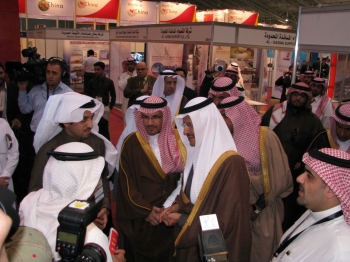
Take away the national dress, and the relationship dynamic changes in subtle ways. Some of my work is with medical staff, who might be wearing white coats and even scrubs. Though I find it pretty easy to tell the Saudis from the non-Saudis through their names, there’s less of a sense of exceptionalism within these groups than there would be if half the people were wearing national dress. And the Saudis I meet in these groups seem to be quite happy to be wearing their medical garb. It wouldn’t be fair to say that they’re relieved not to have to be seen to be different, but I do sense a spirit of teamwork less evident in other dress-delineated workplaces.
The same goes for factories, where I sometimes work with middle managers who show up wearing neat uniforms with the company logo on their shirts. Again, the barriers seem to break down. When you look at faces, especially in a multi-ethnic city like Jeddah, almost anyone could be a Saudi. If everyone’s dressed in the same way, you’re then reliant on language and accent to distinguish, say, between a Saudi and an Egyptian.
This is less the case in cities with a less cosmopolitan flavour, like Riyadh, where ethnic antecedents and tribal bloodlines are important social markers. Sometimes you notice the Najdis from central Arabia looking down their noses at the ethnically diverse people of the Hijaz, the region that encompasses Jeddah, Makkah and Madinah and draws its genetic mix from centuries of pilgrimage. People from Riyadh even try to distinguish themselves by the distinctive style in which they wear the ghutra. So within the country there are signals of origin for each region, some far too subtle for me to recognise.
The Arabian Peninsula is one of the few regions left in the world where a national is instantly recognisable because of the way he dresses. The thobe, like the Pakistani shalwar kameez and the short skirt favoured by the Yemenis, is a genuinely traditional garment. It has survived the transition from a utilitarian garment suited to the hot and dusty plains to an elegant urban attire. You will very rarely see a Saudi wearing one that is anything other than immaculately laundered – at a massive cost in cleaning bills.
So the thobe is a symbol of exceptionalism, and perhaps for that reason its use isn’t likely to decline any time soon. But it’s also a symbol of tradition in the way that manufactured national dress styles aren’t. For example, you can’t describe the (entirely sensible in my opinion) Iranian aversion for neckties as anything other than a contrived mark of rejection of western style, even though non-clerical leaders manage to sport very smart and expensive suits. Same goes for the Mao suit, which has largely fallen out of fashion everywhere except in North Korea.
The elders of the mountainous South shouldn’t fret so much about their young men abandoning traditional Saudi dress. Every generation needs its own way of differentiating itself. Better to do so by wearing shorts and tee shirts with Guns’n’Roses motifs than by trekking up North and playing with real guns in Syria. And anyway, once the fun’s over and they have to start earning a living, they’ll be happily wearing their thobes to the office and mosque just like their dads and granddads.
As for me, I’ve always been a little envious of wearers of the thobe. It’s so effortlessly dignified, especially on those whose girth, like mine, has expanded over the years. Large people, of whom there are many in the Kingdom, cruise like battleships rather than waddle like penguins. That expanse of white cloth covers bodily terrain that even a well-tailored western suit doesn’t manage to disguise.
If we lived in a world less sensitive to cultural appropriation, and I had to choose between and a thobe and a suit, I’d take the former any day. Not great for golf on a soggy November morning, though.
As for female attire in Saudi Arabia, well, that’s another conversation….
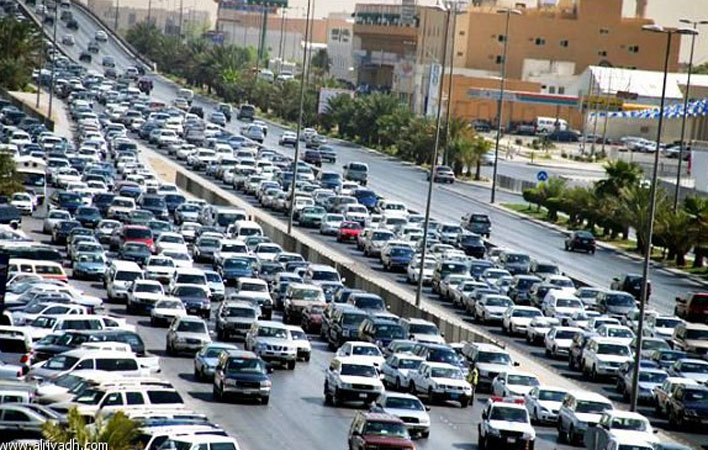
It’s late October, and I’m on one of my regular business trips to Saudi Arabia. It’s a lovely time of year to be here. The blistering dry heat of the summer has given way to days in the low 30s, and nights in the low 20s. If you’re a Saudi, it’s perfect weather for heading out to the desert for a bit of camping, midnight barbecues, endless cups of coffee and tea, and chatting and laughing through the night. Take a night flight into Riyadh at this time of the year and you’ll see fires dotted around areas otherwise devoid of lighting.
This autumn, spirits seem a bit subdued. There’s a war in Yemen that’s draining the national treasury. ISIS sympathisers within the country are increasingly making their presence felt with suicide bomb attacks and random shootings. And the sustained drop in oil revenues is beginning to spark cuts in public spending, particularly in the construction sector – projects put on hold or cut back in scope.
The Kingdom itself is a key player in a region plagued with swirling political instability – jostling with Iran, Russia and the US for influence over outcomes from the multiple conflicts in Syria and Iraq.
You don’t need to be inside Saudi Arabia to be aware of all this stuff. And since I’m here on business,one of the issues that’s fair game to discuss is the economic outlook and the implications of current and potential spending cuts. On more controversial matters I speak when I’m spoken to, and you have to know people pretty well before they will open up in any depth about politics, internal security, war and sectarianism. Not that these issues aren’t discussed in the local media, but truly controversial views tend to be coded.
But everyone talks about the traffic.
If you weren’t aware of the various problems facing the country, you would be forgiven for thinking that in Riyadh it was business as usual. And the most obvious manifestation of that business is breakneck construction everywhere you look. No project is more massive than the Riyadh Metro, about which I wrote a few months ago. The difference is that since then things have started to happen – big time. The city has always been beset by diversions and U-turns, but never on the current scale. Crazy drivers abound, as this article from the English-language Arab News, Residents protest against traffic chaos in Riyadh, plainly points out.
Rush-hour traffic is snarled up as never before. The municipality helpfully launched an app to let drivers know where the real nasties are. Not much use, friends tell me, because they already know through bitter experience. Some journeys to work take an extra half hour or more. That’s in addition to the normal queues of traffic arriving in the city centre via the main arteries. Yet most of the people I’ve spoken to this time are remarkably phlegmatic. It will all be worthwhile when the work is finished, even though at best that that happy moment will be at least three years away.
Do they think the metro will be a good thing? Yes, it will be, they say. So will you use it, I ask? Er, probably not, seems to be the consensus. I suspect the expectation is that the city’s millions of expatriates will use the metro, freeing the citizens to make full use of their asphalt birthright. It will take more than a $20 billion project to wean the average Saudi off his love affair with the car.
Meanwhile, for the next three years at least the drivers of the capital will have to put up with torturous journeys to work, something I experienced in spades over the past week. Though most of my trips to the place where I was running workshops took a mere hour, I had two days travelling to a factory about 70 kilometres outside the city, which took even longer. Those journeys will stay in the memory for a long time. Apart from the delightful people whom I met during the workshop, I have my driver to thank for that.
Abdullah (not his real name) didn’t speak much English, but between us, with our limited grasp of each other’s native tongue, we communicated well enough.
On the first morning he was supposed to be at the hotel at 6.45am. The journey was supposed to take at least an hour and a quarter, and I needed to be there by 8am so that I could get set up for the event in good time. From previous mornings I had come to realise that this was a notional time agreed upon to satisfy my curious Western obsession for arriving on time. 6.45 was never going to happen, but I showed up in the hotel reception on time, ready to be surprised.
I was not surprised. Abdullah finally showed up just after 7.30 coughing, spluttering and looking like death warmed up. There was a box of antibiotics in his car, so I figured all was not well with him. I made sympathetic noises, while at the same time offering a silent prayer that what he had would not be bestowed upon me. It was to be the first of many silent prayers.
I got in the car and we set off, snaking this way and that between the concrete blocks seemingly erected to deny drivers the pleasure of driving in a straight line for more than a hundred yards, even on the approaches to the highways. As we got started, Abdullah muttered “we will be late, but no problem, everyone else will be late too”, as if that made it alright. Which I suppose it did in a curious kind of way. My philosophy for dealing with the vagaries of a culture very different to my own is, if I find myself in a situation beyond my control, to go with the flow, always provided that the flow doesn’t threaten to send me over a cliff.
Abdullah was always going to be beyond my control. The problem was that his solution to our likely lateness was to drive like a lunatic. Which was how I found myself in a car with a particular type of Saudi driver. The driver whose technique I have witnessed many times when behind the wheel of my own car. The guy who calculates to the inch the space between a car on the outside lane and the concrete barrier, and then goes for it. The guy who spends the entire journey talking on his phone to his wife, his friends and colleagues. Who when he has no call to make or receive is watching YouTube videos out of the corner of his eye. Who, when he passes a traffic policeman, hitches his seatbelt over his body, and then lets it snap back to the side of the car when the danger of being caught unbelted recedes.
I had been warned about Abdullah. Someone else who had experienced the joys of riding with him described all these habits, and added that on occasions I could expect him to be driving with his knees controlling the wheel.
All this came to pass, except, I’m relieved to report, the bit about the knees.
You might ask why my instinct for self-preservation didn’t cause me to protest, and to let him know that actually it wasn’t so important for us to arrive on time, and that I’d rather arrive late than end up in a morgue. I could say that my ingrained British politeness stopped me from questioning the tactics of my new best friend. But the truth is that I found it all quite exhilarating. I’m not a great fan of sky-diving or bungee-jumping, but Abdullah’s driving offered the next best thing – an extreme sport without my having to haul my considerable bulk into a parachute or get strapped onto the end of an elastic band.
So there it was – the authentic Riyadh driver experience, not once, but four times over two days. In that time, I had little glimpses of his life. When he wasn’t overtaking at 140kph while talking to his wife, I got to see pictures of his delightful kids on his phone. After the first long conversation with his wife, he explained that she needed money. “Wives”, he said, “always wanting money!” When she called again later, I could hear the frustration in his voice. Clearly being the breadwinner was no easy ride.
At this stage, I must point out that I have ridden with many Saudis, and the vast majority have been responsible and temperate drivers. My friend Abdullah was one of maybe 5% of his countrymen who see the road as an opportunity to multi-task in the same way as they might in the office. The fact that he was hurtling down the road at high speed was no reason to focus on one thing at a time. And actually, he was a very skilled driver. Lewis Hamilton would have been proud of his breath-taking manoeuvres, though I’m not sure Lewis would take hairpin bends at Monte Carlo while watching YouTube videos. Also, to be fair to Abdullah, he was pretty much within the speed limit most of the time, except when he did one of his turbo-charged overtakes six inches from the concrete barrier. Another plus was that he didn’t treat me to a demonstration of drifting, which is a popular though highly illegal pastime in the city. He was far too sensible for that.
Anyway, I survived, and it was comforting to note that his car didn’t appear to bear the scars of his daily battles with water trucks, taxis and boy racers.
But I did wonder about the effect on the workers of Riyadh of their extended journeys to work. Driving through heavy traffic is tedious and often stressful, especially when you don’t know where the blockages will come next. Saudi Arabia doesn’t do flimsy plastic cones, by the way. They would soon be crushed to the thickness of a dinner plate. The obstacle of choice is concrete blocks solid enough to stop a steam roller, for the good reason that anything less would be insufficient to deter the ubiquitous SUVs that rule the road – and the pavements when the occasion demands.
So for several more years the hard-working people of Saudi Arabia’s capital will be arriving at their offices, shops and factories in varying states of frazzle before they even hit their desks. What will be cost of lost productivity thereby? The Metro is due to be finished by 2018, but there’s a big question mark against that date in the light of the government’s economy measures. I wouldn’t be surprised to see the project’s end date slip for at least another couple of years, which would mean five more years of torturous journeys. What’s more, the Kingdom has seen a huge baby boom over the past twenty years. Every male teenager from a middle income family and upwards expects to get his own car as soon as he can drive, so each year more cars clog the streets. What’s more, in the current frenzy of building, city planners seem to have forgotten the joys of trees and green spaces, something that prompted this article – Our streets are barren – in the the other English daily, the Saudi Gazette.
Sooner or later, regardless of when the Metro gets finished, Riyadh is going to have to get to grips with the problems that have beset cities like London and Los Angeles, where congestion has long been a nightmare and a thick yellow haze can be seen from the commanding heights. Already the traffic cameras are in place, a welcome innovation for some, but an irrelevance to others who happily shell out the fines in return for the freedom to burn up the road. How will Saudi drivers – long used to exclusive and unfettered use of their four-wheeled castles – take to congestion charges, car-pooling lanes and other tactics beloved of western cities? Not well, I suspect, especially when the government is making noises about reducing subsidies on petrol, water and electricity.
You might think that, as in London and many of the cities of Europe, bicycles would be part of the answer, even if their use was confined to the winter, when the heat is less intense. I don’t think so. If there is a city less cycle-friendly than Riyadh, I can’t think of it. There’s simply no room on the road, and even the sidewalks would be fraught with danger. In the major thoroughfares the steps, potholes and barriers obstructing the pavements would force you to spend more time walking than cycling. As for motorbikes, the Harleys and Hondas you see occasionally are strictly for recreation. Look out over the relatively empty streets of the centre on the weekend, and you might see (or hear) a dozen or so bikers rearing up on their back wheels, leaving clouds of dust and testosterone in their wake. But biking to work? Never.
Something has to give. When I stepped out of my hotel each morning, the smell of the fumes was noticeable even to someone like me whose nose is far from acute. Riyadh is not yet in the same league as Lagos, Manila and Cairo for traffic problems, but it’s getting there. The main arteries are getting increasingly blocked, and pollution is getting worse.
Before long, my friend Abdullah will have to travel many kilometres beyond the city limits before he can open up the throttle. Even so, I suspect it will be a while until he decides to let the train take the strain.
Metro or no Metro, until someone invents teleporting, it seems that the automobile will still be the transport of choice for those can afford to own one, even if most could reach their destinations faster on the back of a camel.
So that’s what Britain’s GCHQ have been up to – sending in the Smurfs to control our phones.
So far, according to Edward Snowden, we have Dreamy Smurf that switches on our phones, Nosey Smurf that listens to our conversations, Tracker Smurf that reveals our location and Paranoid Smurf that disguises the fact that it controls your phone.
What’s next? It’s time GCHQ cooperated with other government departments than just the security services. Let’s have a think about what else it might be able to discover on our phones. How about these ground-breaking applications:
Greedy Smurf: listens to your order in a restaurant and informs your GP if the fat content is more than 20%.
Stasi Smurf: hears you cursing the police, the Queen or the Conservative Party and puts you on the terrorist watch list.
Teresa Smurf: listens to you ranting about immigration and puts you on the Conservative Party mailing list.
Wonga Smurf: listens to your conversations with your dodgy accountant about sneaky tax evasion tactics and sends them to the Inland Revenue
Madison Smurf: catches you cheating on your spouse and informs the spouse.
Smutty Smurf: catches you making ribald remarks about colleagues of the opposite sex and outs you on Twitter
Jezza Smurf: listens to you making admiring noises about Jeremy Corbyn and informs the police.
Drunken Smurf: tracks your erratic driving and informs the police.
Dirty Smurf (under-18s only): listens for groans and moans coming from your laptop and informs your parents.
Donald Smurf: catches you bad-mouthing America and informs the NSA.
Euro Smurf: catches you bad-mouthing the EU and puts you on Nigel Lawson’s anti-EU mailing list.
Come to think of it, GCHQ really needs to licence this technology so that all and sundry can listen in to our calls and read our texts.
Two benefits: first, we would eliminate the deficit in short order thanks to the massive royalty revenue stream from companies wanting to sell us stuff and benign foreign governments just dying to listen in on their citizens. Second, we would stop using our smart phones for anything other than emergencies and start talking to each other again – after sticking blutac on all its orifices.
Are you listening guys?
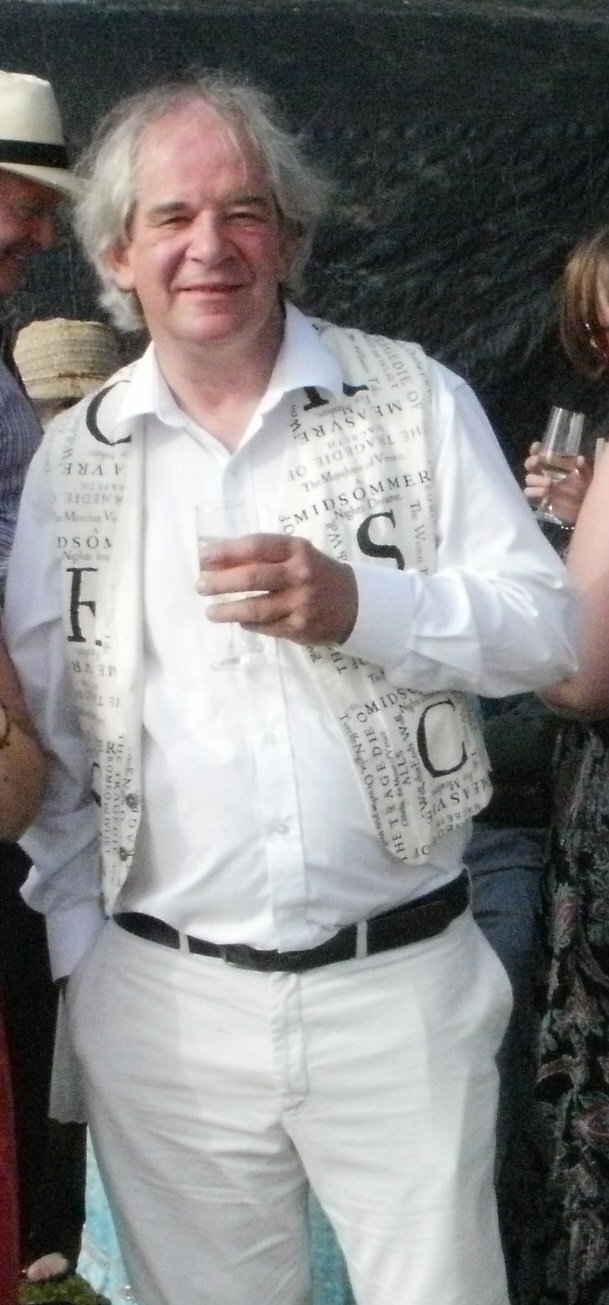
Norfolk 2013
The things I write about in this blog are often covered by other people. All I have to offer is my voice, my perspective, and sometimes there’s nothing to add.
Does the world really need another opinion on Jeremy Corbyn, ISIS, Syria, refugees, Donald Trump, the vanity and greed of business leaders, the megalomania of sports administrators, the Brits, the Saudis, the Iranians, the authors, musicians and all the other movers, shakers, creators and destroyers? Probably not, but I stick my oar in anyway.
But then something hits you. Something you must write about because it’s personal, and nobody else can say what you can, even if what you write has little direct relevance to more than a few people
Now is one of those moments.
This is a farewell to Paul Sommers, who died earlier this week. Ordinary people don’t usually get to be written about in the mainstream media unless they do something extraordinary that catches attention. When they die, they might merit a mention in the local press, but those opportunities are disappearing as fast as the newspapers themselves. But this is one of the reasons why a blog is a wondrous thing.
Like many people, Paul was ordinary in the sense that he never had his ten minutes of fame, but extraordinary to his family and many friends.
I’ve known him for forty-five years. He was the best man at my wedding. We first met at Birmingham University. Well, actually, he was no longer a student. He dropped out after his first year, largely, he would have you believe, because his energies were chiefly focused on the student magazine, and because he was one of those who “sat in” in the university Great Hall in protest against – what? You know, I can’t remember. No doubt the answer lies somewhere in the dusty archives of the university, and in the memories of those who took part, many of whom most likely live prosperous and comfortable lives, and chuckle at their youthful indiscretions.
c1988
We shared a girlfriend. No, not at the same time. His relationship with her was deep rooted and long-lasting. Mine was short, serious but ultimately not life-defining. It was that interest in a mutual friend that first brought us together. I knew about him, and he knew about me. We moved in intersecting circles. He was a year ahead of me. We would get together in the student’s union, or in the succession of dingy houses and flats that we lived in through the early seventies.
He would tell me stories about various people in his circle whom I didn’t know well. The luminaries – those who ran arts labs or what were known in those days as “underground magazines”, the hip capitalists (code name in those days for hypocrites), or people who otherwise stood out for their eccentricity and, in a few cases, talent – he would refer to by their surnames. Paul was always sceptical about people he referred to in this way, yet admiring at the same time. They were people who most successfully sought power or attention, and sometimes both. They were the ones with hidden agendas, but he knew what those agendas were.
He could be scathing of people he didn’t respect, but was never truly spiteful or malevolent. In fact around me he was one of the gentlest people I ever knew.
At one stage we shared a house. By that time I was working on night shifts at Cadbury’s and making tentative moves into the music business. Paul was sort of existing. He became a night dweller. He would sleep until late afternoon, and then stay up all night, thinking, talking, thinking. One morning I came downstairs to find that the living room ceiling was dark blue. Or at least that was what immediately struck me, until he explained that he had spent all night painting the night sky.
Was he depressed? Hard to tell. These days depression is a disease of the mind; in those days it was a state of mind. All I know was that he lived a fairly unstructured life at that time, with moments of joy but blank days as well.
Depression or otherwise, he had an active social life. Girlfriends in England and Sweden came and went, yet his thoughts always seemed to return to the one that got away. Even then, he seemed preoccupied with the past, a trait that stayed with him for the rest of his life.
One activity that gave him much joy was co-financing some of my music promotions. He loved music, and he loved being part of the concerts that I promoted at the Birmingham Town Hall and other venues – Supertramp, Curved Air, Paul Kossof, Tangerine Dream and John McLaughlin. This picture is of him in a bar after a Steeleye Span concert, peering across the room. He’s the guy not looking at the camera!
c1975
Speaking of photos, he was into selfies decades before the term was invented. He had a little book with passport photos of himself over several years from the age of eighteen onwards. In each photo, the hair got longer and the eyes wilder. In one or two of them he looked quite – how to put this delicately – scary. I suspect that this was a bit of a pose. We used to laugh at them when he produced the book from time to time.
Years later he would remind me of some of the scrapes we got into. I have no recollection of some of them. Other stories were outrageously embellished for dramatic effect.
After Birmingham, he lived for a while with his parents in their home in Surrey, but at various times he also went to Sweden, and helped our mutual friend Nick in Norfolk with his stained glass business.
He eventually got into a settled relationship, and thirty years ago his daughter Rhiannon arrived. Around this time – I’m uncertain of the exact chronology – he went to work for a company that supplied planning engineers to the burgeoning North Sea oil business. There he discovered the joy of the database. As soon as computers were available for small businesses, recruiters started building databases of contractors and jobseekers. This became Paul’s responsibility. More than that, it was his pride and joy, lovingly tended and updated, as beautiful to him as an ornamental garden, and defended against the idiots who sought to change it.
Proximity to London enabled him to indulge in the passion that meant more to him than any other art form – theatre. Or more specifically, Shakespeare. He would go to the Barbican, and back to the Midlands to Stratford. Anywhere, in fact, where the Bard was on offer. He was also a dedicated Londoner, born in the East End. I used to walk with him through the City and he would provide a running commentary on the meaning of street names and the history of buildings.
Though the relationship with Rhiannon’s mother didn’t last, Paul didn’t walk away from his parental responsibilities. Far from it, and when his former partner had a daughter by someone else, he took that child under his wing as well. This was one of the character traits that ran as a spine through his life – a sense of responsibility and duty towards others, often to the detriment of his own well-being.
In the early nineties, I had started a business with a partner. It was growing fast. We needed someone to look after our database, and Paul was the man. This was also a time when we were getting into web and intranet design. Paul took to the web like a duck to water, and we eventually contracted him out to one of our clients, Credit Suisse.
This took him back to his old stamping ground, the City of London. He spent several happy years there, earning plenty of money and occasionally lapsing into bouts of excess for which banking is notorious. Like the time when he arrived home early one morning in less than an optimal state, only to find he had left his house keys in the office. He ended up sleeping in the potting shed, suited and booted, with only a deflated plastic swimming pool as a blanket. Most of us would have climbed through a window, or broken the back door if necessary. But Paul was always careful with money. We lived only a mile away, and he could have stayed with us, but perhaps he was too proud to do that, or too pre-occupied to think of it.
Towards the end of his spell at Credit Suisse, he met Lucy, who became his partner for the remainder of his life. They had a daughter, Bethan, and eventually moved to a village in Essex. It was a new phase in his life. Lucy had a demanding job in local government, and Paul became a house husband.
House husbands are sometimes looked upon with suspicion – often seen as glorified drones with some responsibility for the children but otherwise with little purpose. Paul was never that. Not only did he spend much of his time nurturing Bethan, but by the time she went to primary school he had thrown himself into village life. Andy, his brother-in law, told me:
“At Great Oakley, he made a tremendous contribution to the life of the school, working as an unpaid assistant and running all kinds of extra-curricular activities…….. He made a tremendous difference to many individual pupils and had a special talent for relating to the more difficult ones. He also made it his job to spread culture and enlightenment among the community as a whole, organising pantos and taking people to WEA meetings on art. In fact, if you take the last ten years of his life, this was Paul’s major preoccupation and a very worthy and altruistic one it was.”
It was strange to think of him as a pillar of a small community, but that was indeed what he became.
Bethan’s arrival didn’t mean that he forgot about Rhiannon, his first daughter. He helped her through university, and when she showed promise as an actress funded a second degree in drama. She’s now a professional actress, and a fine one at that. He supported her with all his heart. Here’s a review of one of her performances from a couple of years ago.
After several years at Great Oakley, Paul’s health took a downturn. He suffered a mild stroke, from which he recovered well, followed by a broken leg that left him unable to walk for the best part of a year. Both cramped his style somewhat, but not enough to get in the way of Bethan’s creative efforts, as can be seen here:
c2008
Yet once he was on his feet he got his life back. Village activities, tending the huge garden at the rectory, finding the time to visit friends and making frequent sallies to Stratford and London to commune with his beloved Shakespeare.
We would see him several times a year. He made all our important anniversary parties, and often came to see my mother, who was by that time in a care home.
The last time my wife and I saw him in reasonable health was in March, when he showed up for my mother’s funeral. He had lost a lot of weight. He claimed that this was at his own volition. But as it turned out, he already had the cancer that killed him. In the following months we tried to see him, but he kept putting us off. It was clear that he was not well. Various text messages alluded to ailments that the doctors couldn’t positively identify. Looking back, we think that he probably didn’t want us to see him in his rapidly deteriorating state.
By mid-September all was revealed. He was dying of pancreatic cancer at the ridiculously young age of 66. We were all distraught, especially my older daughter Tara, to whom Paul was an active and concerned godfather, and our younger daughter Nicola, with whom he also spent much time.
We managed to see him in the hospital, and subsequently in the hospice to which he moved for his final two weeks. He had said that he wanted eight hours with me on his own, but that never happened. By the time we saw him he was not well enough for a sustained conversation. So I will never know what he wanted to say. And besides, it was more important that his family – his wife Lucy, his sister Angela and his daughters – had as much time with him as was available.
What can I say about the character of my departed best friend? Which truth do you want? My truth? His truth? His family’s truth? If you believe that there are multiple truths, it’s easier to accept that there might be multiple universes. Anyway, I’ll stick with what I know.
In all the time I knew Paul, I hardly ever heard him raise his voice in anger. On those odd occasions it would mainly be expressions of exasperation rather than the blood-curdling fury I’m capable of venting.
I suppose in these halcyon days of psychobabble he would be referred to as a beta male. Gentle, kind, sometimes stubborn, sometimes passive-aggressive. Loved by many women, not always in a physical way. Women found him unthreatening. Some loved to mother him. Many wanted to change him. Those with whom he had close relationships would sometimes walk away with exasperation, because under the soft surface was a core that would not be fashioned or manipulated.
Men would also find him unthreatening. There was no overt macho competitiveness that raised the male hackles. As a result he had many friends of both sexes. If he lost friends it was because he disappointed them by not rising to their expectations. Even among the many who loved him, the phrase “you know Paul” was a code for the things that drove us round the bend: procrastination, chronic unreliability, mysterious changes of mind, saying yes and meaning no, obsessiveness over tasks beyond the bounds of reason.
Yet we would forgive him because we loved him. We especially valued his ability to listen, really listen. That’s why he was so good with children, especially his daughters and god-children. He didn’t talk down to them. He had great reserves of patience that were only occasionally exhausted.
That was my truth. There are undoubtedly others. There were dark sides he sometimes talked about but that we never witnessed. He had the habit of maintaining several circles of friends, and doing his utmost to ensure that they rarely intersected. Even when there were people that we both knew, Paul would not make much effort to bring us together. So I would hear about people and get-togethers over decades without being invited to participate. I didn’t have a problem with this – I could have made the effort to reach out to these people without his assistance.
But for this reason, for all our closeness, I got the impression that I only knew part of the man. Did he behave differently in his other circles? Almost certainly. After all, most of us modify our behaviour among groups that don’t mix – at work, at play, in mixed company, among men, among women.
So he seemed to me to be a man with many secrets. Few, if any, knew them all, let alone that most secret of repositories: emotions – love, hate, fear, jealousy and worship. Perhaps he was planning to fill in some of the gaps in the eight hours he asked for as he was nearing death.
So I can only speak of the Paul I know: student activist, writer, stained glass maker, keeper of databases, web designer, nurturer, educator, gardener, set designer, lover of music, devotee of Shakespeare, father, husband, brother, man of mystery and beloved friend.
When he was lying in hospital, knowing he was dying, I asked him to send me a sign. There has been no sign, and anyway if he’s moved on to another place I’m sure he has much to pre-occupy him. Communicating with me would not be high on his agenda.
But wherever he is, this is my way of trying to make him immortal, or at least as immortal as digital information is likely to be. It’s the fulfilment of a promise I made to him before he died. The rich, the famous, the saints and the sinners are not the only ones who deserve to live forever. Everyone at some stage of their life is special to someone. Some pass through their lives unnoticed and unloved. Others disappear along with all who know them in a cataclysmic event. Those that can be remembered should be.
So this is a record, imperfect and incomplete, of a life that is remembered. A record that I hope will survive me and everyone else who knew the man. That’s my parting gift to my dear friend Paul Brett Sommers.

Once upon a time, my long-departed grandmother was an actress in silent movies. She was not very famous, but well enough known to attract the attention of the Inland Revenue, Britain’s tax collectors. They were, according to my father, the bane of her life.
Eventually she retired from acting to become a full-time mother to her children. But the demands from the Revenue kept coming. She decided that enough was enough. So she sent a letter to the tax inspector informing him that Miss Stevenson (or whatever her stage name was) was no longer alive, and would they therefore stop sending these tiresome letters to her address? The letters stopped, and she never heard from the Revenue again.
Twenty-five years ago I took a job with rather an eccentric company in Surrey. I say eccentric because not many company owners even in those days would have a large, flea-bitten dog lying across the entrance to his office. The office was in a wood-beamed house dating back to the 16th Century, and the entrance was at least six inches shorter than me. The challenge of stepping over the dog and remembering to duck left me with dents in my head that can still be felt today.
Even stranger was that he “employed” a bookkeeper who freely admitted that he didn’t exist. By which he meant that he was totally under the radar of officialdom. He paid no tax and no national insurance contributions. He was paid in cash, and there were no transactions he was aware of that would enable anyone to track him down. Some bookkeeper. Some company.
Could anyone get away with being a non-person today? Well yes actually. In the United Kingdom there are probably hundreds of thousands of people who entered the country illegally or overstayed their visas. They have effectively disappeared from official notice. Like the bookkeeper, they operate within the black economy. But should they decide to get into something of which the state disapproves, such as plotting a terrorist act or encouraging people to go to Syria, there’s a fair chance that they would catch the attention of the government agencies tasked with preventing such activities.
Given, post-Snowden, what we know of the capabilities of these agencies – MI5 and MI6 primarily, but with the government communications agency GCHQ providing increasingly close support – it’s pretty clear that if the government wanted to round up a large proportion of the illegal immigrants in the country, it could do so in fairly short order. It chooses not to because it has bigger fish to fry.
Those fish are the subject of Gordon Corera’s Intercept – The Secret History of Computers and Spies.
Corera is the BBC’s Security Correspondent. In his latest book, which could be subtitled “From Bletchley to Snowdonia”, he describes how computers – in the hands of the spies – have gone from single-purpose devices designed to crack German codes during World War II to vast repositories of data to be mined for the purpose of discovering the activities and intentions of individuals, companies and potentially hostile foreign powers.
Before the internet, the intelligence communities used the limited tools at their disposal to monitor their Cold War rivals. Who was spying on them? Was an attack imminent? What were the enemy’s capabilities? The main protagonists, America, Britain and the Soviet Union, relied on increasingly effective cryptology to keep their secrets secret. But codes could be cracked, and as at Bletchley Park, where the first recognisable computer, Colossus, was pivotal to the British war effort, computers increasingly complemented and to an extent replaced the input of human spies.
The internet, and the development of encryption tools that individuals and non-state actors could use to protect their privacy, changed everything. The door was not only open to libertarians, bombers and drug dealers to cover their tracks, but to governments that could use the internet to hack into companies and the institutions of other governments. And, it seems, this is precisely what they did on an industrial scale. Most notably the Chinese, whose People’s Liberation Army employed legions of hackers to suck western companies dry of their intellectual property.
In particular the Chinese wanted know-how related to military and communications technology. They would penetrate servers by exploiting security vulnerabilities, by phishing emails and through access granted by insiders in their pay. Before long intelligence agencies that previously had an offensive role, spying on foreign countries, were forced to go on the defensive in order to prevent potentially destructive attacks on institutions and infrastructure. Companies realised, too late in the case of some, how vulnerable they were, and likewise took action.
After 9/11, attention in the US turned to individuals who might be plotting against the state, be they in the homeland or in hot spots such as Pakistan, Afghanistan and Iraq. The main actors were the CIA and the National Security Agency (NSA). In the United Kingdom the GCHQ joined the so-called War against Terror. For the first time the NSA and GCHQ, whose remit up to then had been confined to targets in foreign countries, found themselves – because of their unique expertise in electronic surveillance – monitoring people in their own countries.
In the main they were looking at metadata – information about who was doing what and going where, rather than what they were actually doing. Who had made calls or sent emails to who, rather than the content of the conversations. The task of finding the needle in the haystack was made easier by technology that enabled them to recognise intersecting patterns of activity. Once they had identified “persons of interest”, they needed warrants that authorised them to listen to calls and read emails related to specific individuals. Use of individual warrants in the UK resulted in a number of high profile arrests, including those of the second, unsuccessful, wave of bombers in July 2005.
Meanwhile we were entering the era of Big Data. Private organisations, such as credit card companies, social media sites and banks, were collecting huge amounts of information about their users. New software tools enabled them to target individual customers based on their social preferences and buying habits. Which is how Amazon, for example, sends you recommendations of products you are likely to buy, and offers of cheap flights to destinations you are contemplating mysteriously arrive on Facebook or in your email account.
To exploit this data governments demanded access for their purposes. The US and the UK passed legislation compelling companies to hand over their data on demand. Access to a much richer set of data – both at home and abroad – enhanced their ability to identify threats to national security. Not without opposition, however. Civil liberties organisations have argued that if governments are able to trawl through these huge and comprehensive repositories of data, for what other purpose might they use the capability – either now or in the future? Not good news for my grandmother had she been alive today, perhaps, or for the bookkeeper who didn’t exist .
Then came Edward Snowden, a contractor with the NSA. The documents he stole from the NSA revealed the full extent of what the intelligence agencies were up to. According to the British and US governments, his revelations seriously affected the counter-terrorism efforts of both countries. The warriors, plotters and planners of jihad very quickly changed their methods of communication to avoid detection.
Corera ends his narrative in the present day with a set of moral and practical dilemmas. Can we justify secure encryption on grounds of civil liberty, when some use it to do bad things? Can we be sure that our governments will use their powers responsibly when others are using cyber capabilities to oppress their citizens? To what extent should national entities govern the internet? Will every country – like China – end up with a Great Firewall, behind which they can control their citizens as they wish (see this article on the BBC website about Thailand’s plans, for example)? And how do we protect our infrastructures in the age of the Internet of Things against cyber-attacks such as the Stuxnet virus that disabled Iran’s nuclear centrifuges?
What is clear, according to Corera, is that the US has exploited home advantage – as the country through which until recently 80% of internet traffic passes (the other 20% passes through the UK), and as the source of the vast majority of technical innovation over the past seventy years. Whether that will remain the case in the future is debatable. China is well aware of its vulnerability on these grounds, hence the Great Firewall and the rise of home-grown technology powerhouses like Huawei.
Whatever the posturing, the US, China and Russia are well aware that a principle of mutually assured destruction applies. Just as today’s great powers can destroy each other and themselves with nuclear weapons, they can also inflict great damage in a cyber war. Yet the economies of each need each other. So an uneasy accommodation recognising that “spies will be spies” will no doubt continue. But no such accommodation exists between governments and insurgent groups, between governments and individuals that seek to bring them down, and between major powers and smaller countries prepared to wage asymmetric war against them.
Personally, I can live with the possibility that my government can find out what they need to about me. I have no secrets likely to be of interest to them. If I did, I would most likely keep them in my head. But then again, I freely express myself in this blog, and I’m acutely aware that if I were a citizen of Egypt or several of its neighbours, were I to say exactly what I thought about my government, my life could be made extremely uncomfortable.
What conditions might lead to the British government doing the same as Egypt? Who knows, but it doesn’t bode well to hear an anonymous former general implying that if a Labour government led by Jeremy Corbyn were to downgrade the capabilities of our armed forces, a coup might be forthcoming. One would hope that the intelligence services would quickly pick up on that possibility. But would they be listening in on the colonels? And what if a future government decided to extend its existing powers of surveillance under its anti-terrorism laws in order to clamp down more effectively on tax evasion? One only has to look at the emergency powers of surveillance introduced under the US Patriot Act in the wake of 9/11, or the UK Regulation of Investigatory Powers legislation enacted in 2000 to see how individual rights to privacy can be chipped away, never to be restored.
I’m not sure how many people will end up reading Intercept, or indeed how many of us actually care about the issues Gordon Corera raises. But we should. It’s an important subject. The book requires some concentrated reading, but it’s a fluent and accessible exploration of one of the major dilemmas of our time.
It took a while, as it usually does these days, but I finally got it. For years I’ve been a LinkedIn user. Not particularly active, but it touches my vanity when people want to connect with me, even though their reasons for wanting to make my acquaintance usually remain obscure, since the act of connecting is almost always the last I hear of them. Except that they lurk forever in that very eclectic group of people LinkedIn refers to as my contacts.
Lately I’ve been receiving emails from the site telling me about ten jobs I might be interested in. Which is rather odd, since at no time since I signed up with LinkedIn have I ever stated or even implied that I was looking for a job. But as the former owner of a recruitment business I’m interested to see how effective the software is at figuring out what jobs might be appropriate for me.
The answer is: not very effective. How I might qualify for the position of Senior Building Surveyor with a property company is an interesting question, for example. Perhaps the software has figured out that I live in a house, which it thinks is qualification enough.
Another opportunity it helpfully pointed me towards is to be the manager of a testing service business for a computer retailer. Years of wrestling with laptops that go into cardiac failure after a couple of years clearly make me a good pick for that one.
A third job in the current batch got a bit warmer. Would I like to be an executive assistant to the founder of a hedge fund? Sounds interesting – a chance to learn the tricks of the trade and run off a couple of years later to start my own hedge fund. The only problem would be that to disguise myself for any length of time as a smart woman in her mid-twenties would be a serious challenge to my acting ability, not to mention the problem of paring down my voluminous. Mrs Doubtfire perhaps, but definitely not Miss Moneypenny.
The other jobs were at the BBC as a “service owner”; with a digital advertising agency as a “male lifestyle media owner”; as a “connected care feature owner” with Jaguar; and as a “Programmatic Sales Manager – Media Owner” with a digital publisher.
And that’s when I finally twigged what was going on. I’d been working on the assumption that LinkedIn, as one of the world’s leading social media companies, had some pretty smart software people on their team. People who use all kinds of sophisticated algorithms to harness their big data on my behalf. Like Facebook and Amazon, for example. Not necessarily very nice people, but certainly smart.
That may be the case in other areas of their business, but not with the engine they use to match people to jobs. The clues I hadn’t picked up on until my eureka moment were the words “owner” and “founder” – words that feature on my LinkedIn profile because I have indeed been an owner and founder of businesses.
So basically these guys are using nothing cleverer than word searches to come up with these ridiculous suggestions of jobs that might suit me. Doubtless on an industrial scale, consuming enough electricity power for each search to power a small town for a year. And wasting enough time on the part of users to last several lifetimes.
The technology employed – as far as I can see – is no different than what my recruitment business used twenty years ago. Databases and word searches. Except that we went a step further and used a system that allowed relevant terms to be specifically coded, so that the search results yielded the skills that we were actually looking for rather than an endless list of random and irrelevant occurrences of search terms.
Thus if I said in my CV that I was a “Jaguar owner” (which I’m not and never have been by the way), the software we used all those years ago would have ignored that, or presented the information way down the search. Not so LinkedIn it seems.
Perhaps I’m wrong. That’s entirely possible, since I’m a mere earthling far from the cutting edge of the technology business. But I would have thought that by now companies like LinkedIn would have figured out by now how to guess people’s career aspirations a little more accurately.
In my case, for example, it should be pretty clear that I’ve been around the block a few times, and that I’d rather climb up Everest without oxygen than contemplate working in the middle ranks of some corporation, even if that company was foolish enough to want to employ me. My profile should be screaming out: PAIN IN THE ASS – UNEMPLOYABLE. The definition of a freelance consultant, perhaps.
I suppose you could argue that LinkedIn is merely a conduit. That it makes no judgement about the suitability of a person for a job. Presumably it leaves that to all the headhunters and networkers who pay premium fees for easy access to the millions on its database.
In which case it’s missing a trick. Why, for example, could it not provide a private space for people to talk at more length about themselves? About their aspirations, their career preferences, their favourite companies, their role models. And if it was concerned about the data security implications of doing that, it could sell access to a profiling engine to headhunting companies that can’t afford such software, so that they could retain the information in their own space.
I shouldn’t really be too hard on LinkedIn. Sadly, recruitment technology doesn’t seem to have advanced much over the past 20 years, except possibly in improving process. The real silver bullet lies not in doing things more efficiently and quickly, but in finding the right people, meaning people who can add value, not just now but in the future. And for that the traditional solutions seem still to apply – database and internet searching, psychometric tests with varying degrees of clunkiness, and of course interviews – none of which can be relied upon to supply the critical ingredient: judgement.
Artificial intelligence barely seems to get a look in. Business games have been around for quite a while, and are starting to be used in assessment centres. HR companies will tell you that their assessment techniques focus on attitude rather than skills, and can predict the success (or otherwise) of a candidate in a particular role. But the trouble is that they rarely get the opportunity to use their science on the other side of the equation: the employer. Predicting whether a person will succeed in a vanilla environment is one thing, but getting a handle on a company with thousands of employees and hundreds of subcultures that change each time an influential employee leaves is quite another. And I’m sorry, but the mission statements and beautifully crafted company values won’t change that – they reflect “like to be”, rather than “actually is”.
Most recruiters take the employer’s word for what it’s like to work for them. Some talk to former employees, who may or may not be biased depending on their reason for leaving. Others use their common sense by picking up indicators of culture from visits. But all of this information is based on the present and the past, not the future. A potential employee might be perfect for today, but what about tomorrow?
Businesses and their cultures are dynamic, not static. Some companies recognise this, and hire consultancies to define the attributes of their ideal employees based on future plans and aspirations, but how many do this on a regular basis? Not many, I suggest. And what about the people whose attitudes and skills match the present and not the future? They either adapt or leave. And if they leave, it can be a colossal waste of investment. I’ve seen that happen time and time again. One warning sign is when a company asks its employees to “apply for their own jobs”. I remember Digital doing that in the late 90s, much to the consternation of its staff. Within a year or two it was gone – gobbled up by Compaq.
All of which suggests that while the gurus warn us that artificial intelligence threatens to make huge numbers of workers redundant over the coming decades, people who hire other people will not lose their jobs any time soon, no matter how dumb they are, because no amount of intelligent software can compensate for dumb recruiters, or for dumb executives who don’t think further than their noses when figuring out who they want to hire. And yes, there are some smart recruiters and employers out there, but I haven’t met one yet that would accept the recommendation of an expert system over their own experience, intellect and gut feeling – in other words, judgement.
So perhaps LinkedIn are quite smart in keeping things simple and leaving expensive mistakes to the employers and employees that use them.
Anyway, my next career move will probably be as a greeter for Asda. I don’t think I’ll need LinkedIn for that.
(Illustrations are by the illustrious Hunt Emerson for a book I wrote on recruitment – among other things – back in 1995)
Enough is enough. The Rugby World Cup is three days old and I’ve already had my fill of pumped-up, grunting men sticking their heads up other men’s backsides, and prissy referees demanding endless video replays of squashed bodies writhing on top of a white ball.
The sight of these size-thirty superheroes is almost as unedifying as that of the size-zero ghosts currently drifting down the catwalks of London, New York and Milan in the name of fashion.
It’s time to alienate many of my friends and probably one or two readers of this blog. Sorry, but rugby is boring and fashion is not sexy. And both cause people to distort their bodies into unhealthy extremes in the name of what? Sport? Beauty? No. They’re are both industries. It’s all about money, isn’t it?
At Friday’s opening ceremony for the World Cup – and by the way, opening ceremonies are an industry in themselves, unnecessary and often cringeworthy – Prince Harry talked about values engendered by the game. What values? Teamwork – yes, I can understand that. Fairness – I can appreciate that referees are at least respected in rugby, whereas soccer players have turned the abuse and cynical manipulation of officials into an art form. But what else? That might is right, that brute force carries the day?
It was entirely apt that the Japanese, who gave sumo to the world, should roll over South Africa in Saturday’s shock of the tournament, because rugby players are increasingly looking like lumbering wrestlers rather than the fleet-footed springboks that gave their name to South Africa’s national team.
I’m profoundly grateful that I have no sons who might have been tempted to risk their necks – literally – playing this brutal game, just as I’m happy that neither of my daughters have felt tempted to starve themselves half to death in order to look good in the “creations” of clothes designers quite happy to employ borderline anorexics to show off their rags, and send them down the catwalks staring vacantly in front of self-important harridans in their premium seats.
Why anyone would encourage their sons to grow thighs the size of the average person’s waist, and their daughters to look like stick insects, is quite beyond me. There are enough twenty-stone hulks waddling in and out of MacDonald’s, and wasted victims of war and food shortages, without our having to create more in the service of commerce.
I admit that my own experience has left me permanently biased. I was put off rugby when at the age of fourteen I spent many afternoons gasping for air at the bottom of piles of evil-smelling, sweaty, pubescent boys. What values were instilled by being half-suffocated against the muddy nether regions of overweight teenagers I completely failed to comprehend, and still do.
Neither was modelling my thing, though I do think my effigy would be an attractive addition to the Chamber of Horrors at Madame Tussauds.
So I suppose that leaves the annual political party conferences as the only remaining seasonal entertainment in Britain over the next few weeks. Gatherings where reasonable, high-minded people spend their time drinking lots, lusting after each other plotting against their leaders when they’re not insulting their equally high-minded opponents. People who want to improve our lives, whether we want them improved or not.
Looking beyond the UK, there’s always the theatre of the grotesque in the US: the Republican presidential debates, starring that paragon of self-effacing modesty, Donald Trump. But I’m afraid I can’t look at the ghastly Donald without getting the feeling that the conspiracy theorists who claim that the world is in the control of a cabal of half-human, half-lizard oligarchs might actually be right.
What’s left? Well I suppose there’s always the Oktoberfest in Germany, where old men in leather shorts and silly hats down vast quantities of beer served by young women dressed as extras in the Sound of Music. Not an option really, since I rarely drink beer, and never the gassy effluent to be had in the dark cellars of Munich.
But all is not lost. I shall be away from my country for most of October, partly for pleasure and the rest for business. When I get home it will be time once again to burn the plotters who tried to blow up Parliament five centuries ago. And this November, courtesy of Jeremy Corbyn, we shall be arguing the merits of wearing red or white poppies to commemorate our war dead.
A reminder that our ancestors had less trivial things to worry about than fashion weeks, rugby tournaments, bake-offs and dancing competitions. As do far too many people today.
Never mind. There’s a perfect antidote to the end-of-summer gloom that embraces us as the days grow shorter and the nights get chilly. Downton Abbey returned this week. Another good reason to escape the country.

I’ve been following the hullabaloo surrounding barrister Charlotte Proudman, who tweeted an exchange between her and a solicitor of advancing years, Alexander Carter-Silk, in which the latter complimented her on her LinkedIn picture. In reply she accused him of sexism, pressed the button on Twitter, and the inevitable pandemonium duly broke loose.
Accusations of being a “feminazi” (a term I hadn’t heard before), trolls trolling, women leaping to her defence, all stoked up by The Guardian, which published her thoughts on the saga in its blog, and a comment piece by Barbara Ellen congratulating the barrister for her brave stand against lecherous seniors, and asserting that Mr Carter-Silk “is not a cheeky chappie – he’s a sexist chancer”. Cue three hundred-or-so comments ranging from considered to rabid, including some that didn’t make the moderator’s cut, presumably because they were too rabid for the eyes of the sensitive Guardian reader.
Before my head hit the keyboard in blissful slumber, it occurred to me that there were two winners in the debate, and neither of them are Ms Proudman and Mr Carter-Silk. The first is LinkedIn, whose users seem to have emphatically endorsed the company’s branding as a site for professionals rather than exhibitionist job-hunters. And the second is Facebook, founded by a guy at Harvard who gleefully launched the site all those years ago to allow his buddies to rate the “hottest” girls in his year. Apparently it’s still a place where you can be gleefully exhibitionist, and “objectify” members of the opposite sex with impunity. In other words it’s OK to be sexist on Facebook, but not on LinkedIn. I suppose a third winner is Twitter, with its eager trolls finding another target, but this is familiar territory for them.
As for the subjects of the brouhaha, it’s hard to say how either will come out of this. But the chances are that Ms Proudman will get through her stormy fifteen minutes of fame and resume her career unscathed. Mr Carter-Silk, as a senior partner in a London law firm, will probably continue to prosper, buoyed up by quietly supportive colleagues. If his career tails off from here it’s unlikely he will starve. Hopefully he has plenty of years left to pursue other interests.
Coming on to the issues that provoked the frenzy, I thought of writing to Charlotte Proudman, but changed my mind because after being bombarded with opinion and abuse from all quarters, the last thing she will want to read is what she might view as patronising words from an ageing windbag. But patronising or otherwise, here’s what I would have said:
Dear Ms Proudman
I write as someone who is close in age to the person you rebuked so eloquently. Though I’m not a lawyer, I’ve dealt with members of your profession – both male and female – throughout my career. I have employed many women. In one company I co-founded, the majority of staff were women, and that included the senior management team. In another in which I have a substantial interest, the majority shareholder is a woman. I appreciate and admire the contribution of the women I’ve worked with, and my professional life would have been the poorer without them.
I have never written an email similar to the one that Mr Carter-Silk sent you. But forgive me if I suggest another way of looking at him – as a dinosaur grazing on the prehistoric plains. Yes, you’re right to point out that he shouldn’t have complimented you on your appearance. He also shouldn’t have explained his message away by suggesting that he was enraptured by the quality of the photo. But based on the evidence, I don’t see a big bad wolf behind that email. Patronising perhaps, but not evil. If he was a sexual predator, he surely would have used more subtle methods.
As a LinkedIn user, you will know that if you accept a connection, you are immediately sent to pages of photos. These are of people the software thinks might also be appropriate connections. Many of those photos are of a similar quality to yours. In those terms, with respect, your picture is nothing special to anyone other than you. While yours is a professional shot, many of the images are awful – passport photos or cropped holiday snaps. But there are just as many images of women of a similar age to you, smiling, smartly dressed, not just headshots. Looking at their pictures I might think “wow, that’s a beautiful woman”. Would I send them an email telling them that? Not in a million years. Firstly because I have no job to offer them or business to discuss. And secondly because I realise that a “glamorous” photo is not an invitation to me and millions of other men to try to seduce them, stalk them or otherwise “objectify” them, as you put it.
But here’s the thing. Do you think those women posted what they thought was the most attractive available images of themselves if they didn’t think they would gain an advantage – in terms of employment prospects or business opportunities – by doing so? To suggest otherwise, I believe, would be naïve.
The advantage might be huge, in the case of a male decision-maker who is influenced by the physical appearance of a salesperson or prospective employee, or marginal, in the case of an employer that uses more objective measures of employability. But given the choice between a smiling, well-dressed woman, and a grim-faced, scruffy individual – man or woman – in a low-resolution shot, the former will usually have an advantage when knocking on the door. After all, even in this age of relative informality at work, Apple’s executives may wear jeans and casual shirts, but they’re still well scrubbed up.
Your rebuke to Alexander Carter-Silk may well, as you hope, cause people like him in your profession to think twice before indulging in inappropriate flattery towards strangers. But have you really struck a blow against sexism in the legal profession or in the wider workplace? I think not.
Slapping down one man will not stop other men from lusting after women in the workplace (or women from lusting after men for that matter), from joking about it with their mates, and, worst of all, from making decisions based on physical appearance rather than competence. Such men will just cover their tracks more effectively. And these days – even in banking – most of them do take more care, for fear of ending up in front your colleagues at the bar. But the gender dynamic will remain. And my experience tells me that many women in the workplace know this and actively exploit the sexism of their male colleagues to their advantage. Perhaps not to the extent of enduring the casting couch, but manipulation is not an exclusively male art.
I’m aware that, as the Guardian puts it, you are a lawyer “who specialises in violence against women and girls” (though if I was the journalist who wrote that piece I wouldn’t have quite put it that way). So I want to be clear that I don’t subscribe to the “appearance is an invitation to rape” school of thought. I’m simply pointing out that appearance is a weapon of influence. Not always, but surely often.
Likewise I don’t believe that posting a controversial tweet is “asking for it”, though if you’re a regular Twitter user you will surely not be surprised that you’ve attracted the attention of the knuckleheads. If you are surprised, I suggest you read Jon Ronson’s book So You’ve Been Publicly Shamed. However, you don’t deserve a torrent of ad hominem abuse for expressing your opinion.
But was that tweet really worth posting? I just think that your public shaming of Mr Carter-Silk doesn’t really advance the cause of equality and the reduction of sexism in the workplace very far. Sexism and misogyny in the workplace, whether overt or overt, aren’t going to go away any time soon. What’s more I would argue that our country has come further than most in creating a level playing field, excepting possibly the Nordic nations. Not there yet, but definitely getting there.
To put the last observation into perspective, I write this as someone who has spent much time in the Middle East, especially Saudi Arabia, a country in which, its critics would argue, misogyny is institutional. I probably don’t need to point out what many Saudis might say about the “objectification” of your physical appearance.
I’m sure you are not wrong in your perception that sexism in the workplace is still pretty widespread, though as I implied earlier, I think you were a little harsh on Mr Carter-Silk in describing him as a “sexist man”. You can describe his behaviour as sexist, but do you know him well enough to use that epithet to describe the person? I also think that you are over-egging his potential power and influence over your career. After all, you work in Mike Mansfield’s chambers, and there are few more influential people in the British legal profession than Mr Mansfield.
More importantly, I do believe that in your chosen specialisation you can make a far deeper impact than that achieved by outing a dinosaur of a solicitor. After all, as you of all people will know, you can be an advocate for millions of women who live under far more oppressive conditions than you or any of your female colleagues have encountered in the legal profession. In your work you will probably have come across Headscarves and Hymens by Mona Eltahawy, Sex and the Citadel by Shireen El Feki, the books of Ayaan Hirsi Ali and other writers arguing for an end to extreme misogyny in some societies. It’s not just women who read these books and take on board the messages they deliver. Men, including me, read them too. After all, misogyny is not just a gender issue. It’s human issue.
I’m sure you’re strong enough to ignore the trolls and get on with your life. You’ve made a mark in a way which you probably didn’t expect. I hope you will now kick on and help to solve the big problems, because God knows there are plenty of them. You’re young enough to make a difference, whereas people like me and Alexander Carter-Silk have only our declining years to look forward to, doubtless entertained from time to time by images on LinkedIn.
Oh, and if I can offer one more suggestion: based on my experience, emails written in anger, beyond providing an initial rush of righteous satisfaction, rarely deliver positive outcomes. Just more anger.
I wish you success in the rest of your career.
Yours with the greatest respect
Steve
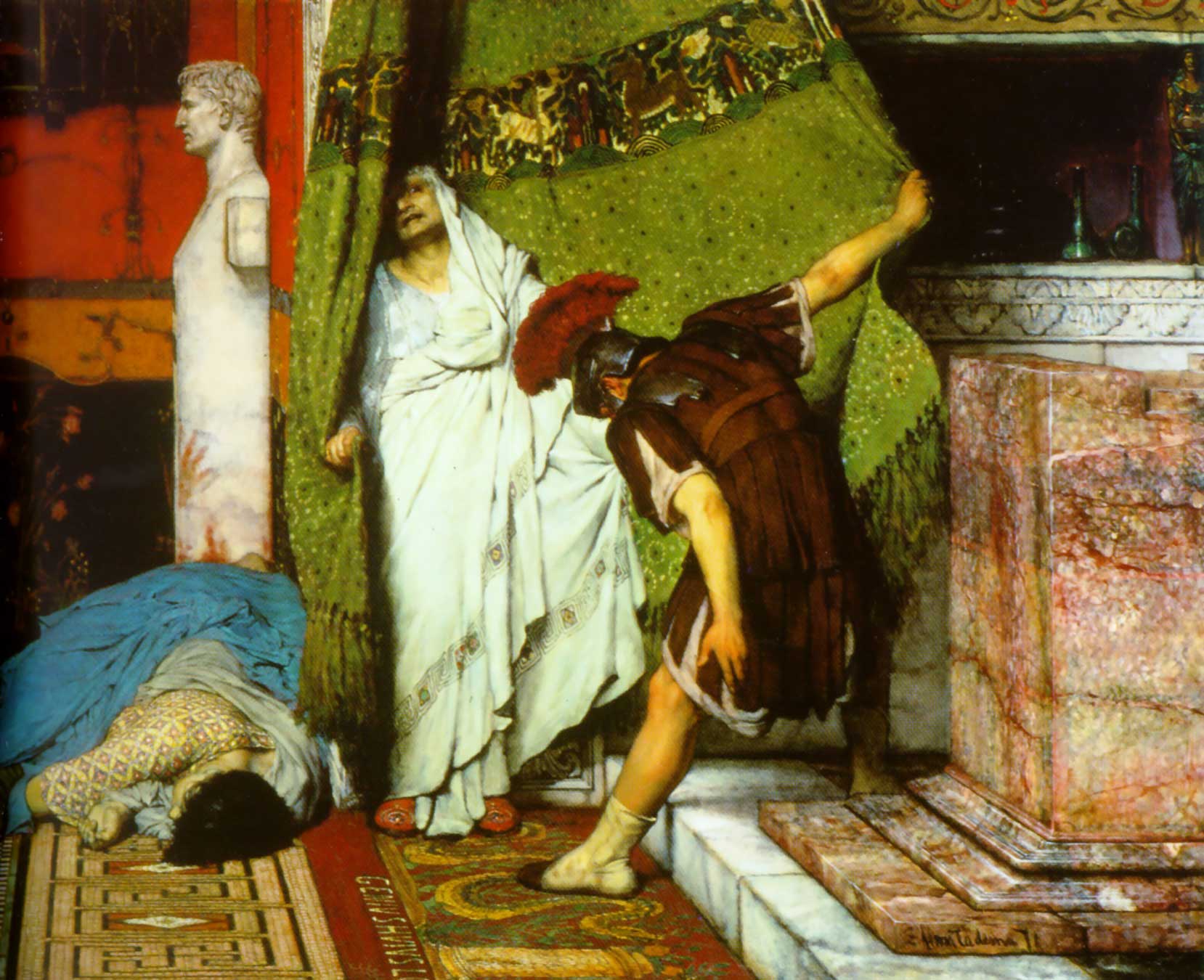
Gratus Proclaims Claudius Emperor
I fear for Jeremy Corbyn. Maybe I shouldn’t. After all he’s made his own bed.
And yet, having read acres of stuff about him – both sympathetic and scathing – since he emerged as a serious contender for the Labour Leadership, I still can’t work out whether he’s the cork blasted out of the champagne bottle, or the golden liquid itself.
If he is the cork, he’s a well-considered, thoughtful piece of tree bark. I accept the logic of many of his embryonic policies (I say embryonic because what they will look like once they’ve been honed by the party grinding machine is anybody’s guess), and I like some of them, even if they may not be in my financial best interest.
His many supporters clearly think he’s the champagne – a heady change from the machine politicians whose every spoken word has been negotiated over by a dozen spin doctors and Whitehall obfuscators. They think he can deliver on turning ideals into action. They love his homespun style, so different from the silken smoothness of his opponents. They think he’s authentic, though I swear I have no idea what it means to be an authentic politician.
Who “they” are remains to be seen. The 0.5% of the electorate that voted for him? A groundswell of people who don’t normally vote but will now rise up and outnumber the privileged majority who rejected his party last time round? A new generation of voters for whom the ideas of the left are fresh and new – a different perspective from that of the old cynics who were around in the Seventies and Eighties and saw the same ideas dispatched to the fringes?
It would only take another major economic crisis, or possibly a political one involving China, Russia or the Middle East, for what one pundit on the BBC last night described as “pre-revolutionary conditions” to arise, and thus for “them” to become a majority. That must frighten the Conservatives, for all the self-satisfied noises they are currently making about Corbyn.
But I wonder if Labour’s new leader is prepared for what he will have to go through over the next few years – assuming he survives in post that long. I wonder if he’s prepared for the stress and the teeth-grinding frustration of having to drag a reluctant parliamentary party along with him. That will probably depend on whether he really is a leader, rather than a catalyst, or a lightning rod for all the idealists, the disaffected, the axe-grinders and the marginalised who see him as some kind of messiah. Will it be a case of “he’s not the messiah, he’s a very naughty boy”?
Those who are unhappy with the status quo are unhappy for many reasons. As I wrote back in July in Jeremy Corbyn and the Atomisation of the Labour Party, Corbyn will find it next to impossible to satisfy all the lobbies, interest groups and political sub-groups that have coalesced under his banner. If his teeth don’t grind down to stumps dealing with the 200-odd Labour members of parliament who didn’t vote for him, he will definitely need dentures by the time his unelected supporters have finished with him. Or possibly a hearing aid.
And that’s before the Conservatives and their friends in the media have had their turn.
Perhaps he’s a man of steel who will not let these competing forces wear him down. Perhaps he will be a Claudius, the Roman Emperor who was discovered hiding behind a curtain when Caligula met his gory end, and hoisted on the shoulders of the Praetorian Guard, to be acclaimed as the new Caesar. He turned out to be less pliable than his soldiers might have anticipated, and was by no means the worst of the Julio-Claudian rulers.
And perhaps because he is now in a position that most likely he never craved for, he will feel that he has nothing to lose by giving it a go, and will not be a broken man if it doesn’t work out. I hope so for his sake. Yet I have an uneasy feeling that though he’s clearly his own man, he will have the devil’s job of dealing with the minders, the ideologues, the union bosses and the political bruisers who will feel that they made him, and that therefore he owes them.
Kerensky or Lenin? Augustus or Claudius? A mild-mannered Trojan Horse? A political Pope Francis? I can think of any number of vaguely appropriate historical analogies to suggest that what you see may not necessarily be what you get.
However things pan out, the next few years in British politics will not be boring.
I’ve just finished reading Justin Marozzi’s stunning book, Baghdad: City of Peace, City of Blood, in which he charts the history of the city from its foundation in AD762 through to the present day. Or almost to the present day, because events in woebegone Iraq come fast and furious.
A number of thoughts occur.
First, if we think that ISIS are being fiendishly imaginative in their methods of torture and execution, we should think again. Compared with the rulers of Baghdad from the Abbasid caliphs onwards, they are amateurs. One paragraph from Marozzi’s description of Saddam Hussain’s torturers should be enough to convince anyone of that. In fact if further evidence of the dark hand of Saddam’s “security” operatives, was needed, one only needs to read this passage:
One man stands by a wall with his head sandwiched between two wooden wedges, to which his ears are nailed. When he can no longer stand, he slumps to the floor and rips his ears off. Teeth are drilled. The corpses of murdered victims are thrown into cells to decompose in the heat of the Baghdad summer. Acid is sprayed on to bodies; snarling fighting dogs – Rottweilers and Dobermanns – are thrust into cells to attack men already weak from torture. Needles are pushed through tongues and under fingernails; feet and hands are immersed in boiling oil; insecticide is sprayed into eyes; arms are tied to an electric heater. Women are raped before husbands; glass bottles are shoved into men’s anuses; a menstruating woman is hung upside down by her feet; wires are plunged into flesh. A blindfolded man stumbles around an empty room as loudspeakers blare a continuous high-pitched cacophony to prevent sleep. One video shows Iraqis bound and kept for weeks in an airless room in which the temperature soars to 50˚C. Parents are forced to watch their frantic children running naked around a cell containing a beehive, desperately trying to escape the squadron of stinging insects. A chainsaw slices through a man’s genitals. One man has his arms broken with iron bars, another has his head crushed between the steel plates of a vice. His skull suddenly collapses with a jolt, and his brain squeezes out like toothpaste. In all the terrible history of death and violence in Baghdad, there had been nothing as perverted as this.
Which shows that whatever happened to Saddam’s weapons of mass destruction, his ability and inclination to destroy lives on a smaller scale was formidable, and causes one to ask where the moral line falls between a small number of mass killings and 30 years of torture and execution.
Second, I wonder if there has been any other city that has seen so many catastrophes over a 1400 year period yet still stands today. Plenty of neighbouring cities – Nimrud, Ctesiphon, Babylon and Palmyra to name but a few – never made the cut, and moulder away in the desert waiting for ISIS to come and deliver the coup de grace. Yet Baghdad has survived countless civil wars, conquests by Mongol, Tatar, Persian, Ottoman, British and American invaders, devastating floods and epidemics of plague, cholera and other diseases that regularly culled the population. At its cultural and political height, the population was over a million. At its lowest point there were as few as 15,000 inhabitants. Today the population stands at over seven million.
Third, I’m surprised that – to my knowledge anyway – there has never been an attempt by academia to identify the factors most likely to cause perennial bloodshed in a city. In Baghdad’s case, was it the city’s location beside the Tigris river? Was it the energy unleashed by a new religion? Was it the ethnic and sectarian mix? Most likely all of these things.
Marozzi’s book tells of much more than bloodshed and disaster. He takes us through the early history of the city, when Baghdad became the epicentre of an explosion of learning and invention not seen again until the European Renaissance, for which it was the main inspiration. The failure of the enlightened Arabs of the 8th-12th centuries to kick on and lay the foundations of the industrial age is one of the great “might have beens” of history. Was it vulnerability to invasion, the triumph of orthodox Sunni thinking at the expense of the rationalists or the scarcity of resources – minerals, metals, arable land – that existed in abundance further east and north? Again, perhaps all of these things.
But those who have grown up to think of the Muslim world in terms of grim-faced videos of suicide bombers, women in veils scuttling in the shadows, book burners and lynch mobs would be surprised by Marozzi’s description of Baghdad under the early caliphs – a place of scholars, inventors, scientists and artists. Where wine, women and song, at least among the elite, coexisted happily with piety and good works. Even today, the city’s literary tradition survives in the bookshops to be found in the back-streets, eagerly patronised by Baghdadis whose love of coffee and conversation is of a different order than that to be found in a high street Starbucks in my own country.
And until recently, it was a city in which large communities of Jews and Christians played their part as merchants, politicians and servants of the rulers. For most of its life it was not an exclusively Muslim city. In 1917, British intelligence sources estimated that the city contained 101,400 Turks and Arabs, 80,000 Jews and 12,000 Christians. Sadly, not so today. Both minorities – the Jews harassed and expelled in 1948, and the Christians subjected to bombs and persecution after the fall of Saddam – are vastly diminished.
Those who seek historical parallels will learn that Baghdad’s dark moments of recent times – the looting that followed the 2003 invasion, the bombardment of the city, and the vicious outbreaks of sectarian violence – have been repeated so often that recent events are entirely unsurprising. This is a city, surpassed only perhaps by Jerusalem and Istanbul, whose earth, bricks and mortar are soaked in blood. And there seems no prospect that the cycle will end when the current agony subsides.
Yet the story of Baghdad is also one of spirit, resilience and renewal, and it’s beautifully told by Justin Marozzi. Here’s a description of life in the court of Harun Al-Rashid, the most famous of the Abbasid caliphs:
Night after night, Harun and his court, joined by scholars, poets, diplomats, generals, musicians, judges, sportsmen and the latest favourites, assembled in the palaces to feast and lay waste to the royal cellars, indulging in the ruby-red wine of Shiraz, bewitched by the graceful young women of the harem who were selected as much for their musical talents as for their beauty. As the poet Muslim ibn Walid wrote in characteristically risqué verse, ‘What is this life but loving, and surrender to the / drunkenness of wine and pretty eyes?’
We hear of royal banquets with platters of gold and silver set with precious stones, heaving with the finest delicacies, ‘egg-apples and stuffed marrows, filled vine-leaves seasoned with lemon, cakes of bruised wheat and minced meat, sliced fillet of mutton cooked in tomatoed rice, a stew of little onions ….. ten roast fowls and a roast sheep, and two great dishes, one of kunafa and the other of a pastry made with sweet cheese and honey; fruits of every kind: melons, cucumbers, limes and fresh dates.
Pondering the lithe bodies swaying gracefully before them, Harun’s guests tucked into the porcelain bowls of halva perfumed with orange juice, and sprinkled with cinnamon and ground nuts. There were crushed raisins infused with essence of rose, lozenge-shaped, sugar-coated baklava, wrinkled figs, bulging grapes, bananas and breadfruit and, hidden among vases of roses, jasmine and tulips, mountains of almond cakes covered in syrup that dripped down chins and produced sticky smiles.
Cup-servers brought the men golden jugs and basins filled with scented water in which to wash their hands, rinsing them in ewers encrusted with rubies and diamonds before giving them scent of aloes in small golden pots. Wine was served in goblets of gold, silver and crystal. Eunuchs refreshed guests with musk and rosewater from jewelled gold sprinklers. While the drinking bouts raged until dawn, the girls sang and strummed the lute, entertaining their guests with the playful scarf dance and the languorous dance of the sabres.
Decadent? Of course, and not, I think, a lifestyle what would be endorsed by my country’s longest-serving monarch, or by the roundheads of Jeremy Corbyn, who looks set to become the leader of Britain’s Labour Party. But this was the Baghdad of the Arabian Nights, a far cry from the court of the kings of Wessex, who in the same era were ensconced in smoky thatched huts eating burnt cakes off wooden platters and quaffing tankards of beer.
Marozzi, who spent much of the past decade as a journalist in post-Saddam Iraq, has written a book that serves two constituencies of opinion equally well: those who believe that the Arab world has a genetic predisposition towards cruelty and violence, and those who treasure the region and its contribution to humanity. I belong to the latter group, yet the bloodshed is hard to ignore at a time when the whole area seems to be in flames.
But whichever way you look at the region, Baghdad, City of Peace, City of Blood is a rich resource for anyone struggling to make sense of the extreme wealth and the heart-rending violence that dominates most of the headlines about the modern Middle East.

There aren’t many stories in this horrible, death-strewn summer that lift my heart. But here’s one of them.
The London Times reports a plan to equip thousands of volunteers throughout the Middle East with 3D cameras. The idea is that they will take photos of every monument and artefact threatened with destruction or theft by ISIS or any other gang of iconoclasts intent on wiping out the pre-Islamic history of the region.
Teams from Oxford and Harvard Universities hope that before 2017 the volunteers will have taken 20 million pictures of objects, using digital cameras that cost as little as £20 ($30) each. What is subsequently destroyed will be able to be recreated using 3D printing.
I think it’s a brilliant idea. The only questionable aspect is whether they can find the volunteers to do the job. I hope they can, and quickly. Palmyra may be lost, but there are many more sites and museums not yet within the clutches of the barbarous ideologues with their sledgehammers and dynamite.
A few months ago, after the destruction of Hatra and Nimrud, I wrote a post called Daesh: the Destroyers of History? No Chance. I pointed out that whatever ISIS manage to destroy, there is much that they cannot reach, either because it still lies underground or because we already have extensive photographic evidence that is available to all of us via the very tool that they use so effectively for their own purposes: the internet.
This plan goes another step towards putting history beyond their reach. And when people use the hackneyed argument that we should be more concerned to protect the living than to preserve the heritage that the dead have left behind, I will always argue that it’s not a matter of choosing one or the other. Both are achievable, and both are important.
For the dead nourish the living, and without a record of what they thought, achieved and built, our ability to make sense of the world would be much diminished. Which of course is what ISIS want; in the world they seek to create, sense is irrelevant. Belief is all.
So the Oxford/Harvard project sends a message to the iconoclasts that no matter how many archaeologists and museum curators they decapitate, and no matter how many objects they destroy, what is remembered can no longer be forgotten.
So esteemed academics, please, please, make it happen, and soon.
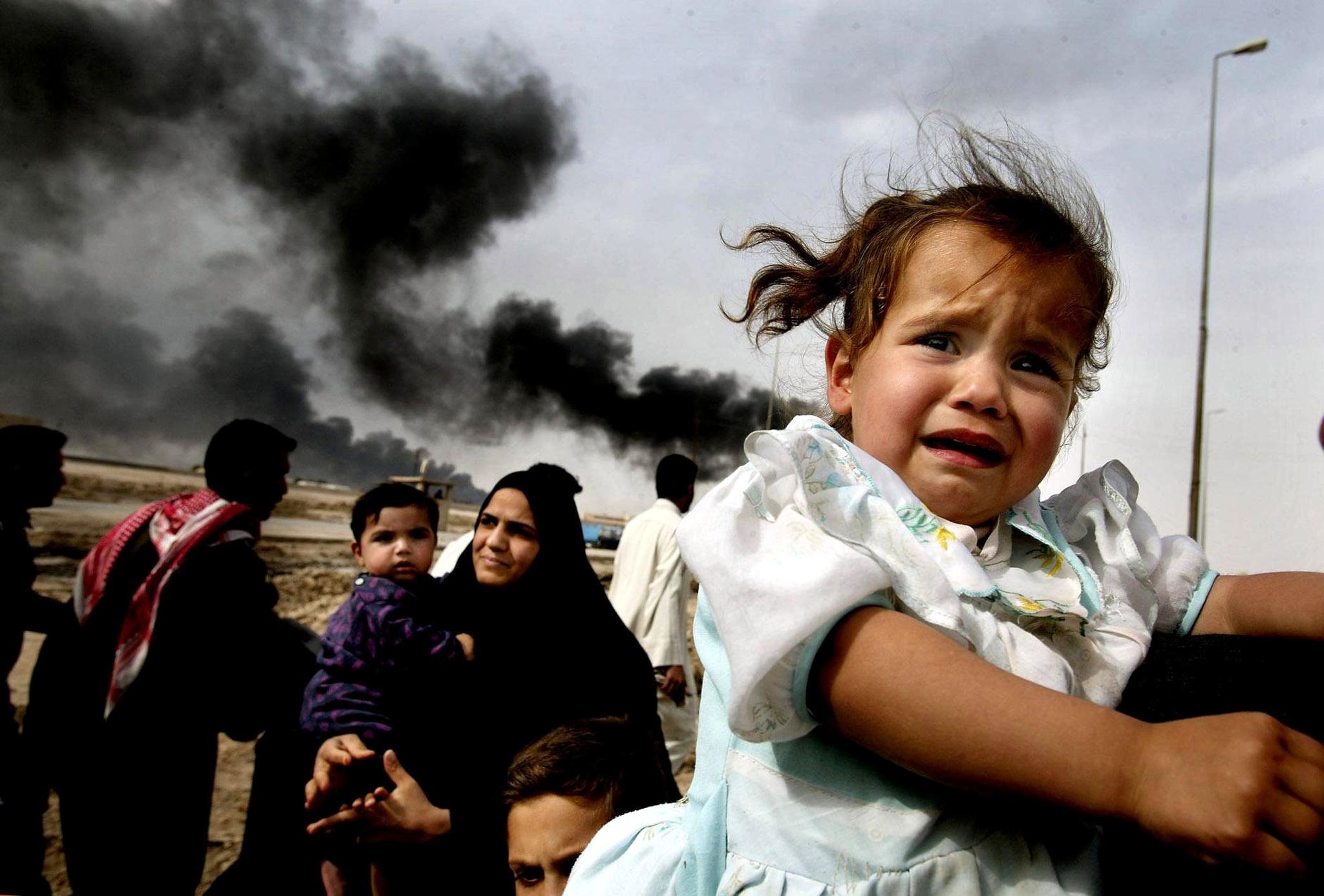
Basra 2003 (Photo: Dan Chung/AFP/Getty Images)
So that’s how we sort the world’s problems out, is it? With apologies?
Jeremy Corbyn may have been quietly working away on the sidelines of the Labour Party for the last thirty years, but he certainly knows how to grandstand. And during his time in the sun, he’s clearly making the headlines while he can.
According to the BBC, he intends to apologise to the people of Iraq on behalf of the Labour Party for the 2003 Iraq War.
Now when I was a child, I was taught to apologise only when I meant it. And meaning it meant that I would endeavour not to repeat the action for which I was apologising. If Jeremy had the same responsible parenting as I received, presumably he is undertaking that his party would never again partake in what he views as an unjust war.
Fair enough. We would all endorse that sentiment, provided we could have a clear definition of just and unjust. But this is where things start to become problematic. And two of the most problematic areas are motivation and retrospection.
Is a war entered into for one reason, possibly malign, but remembered for another, possibly benign, an unjust war? The abolition of slavery was not the cause for which the north went to war with the south in the American Civil War. The principle at stake was the right of the southern states to secede from the Union. Abraham Lincoln issued his Emancipation Proclamation eighteen months after the war started, and the amendment of the US Constitution abolishing slavery did not come into effect until after the war.
Americans might have a more nuanced understanding of the causes of the Civil War, yet outside the US the war is mainly remembered for its most fundamental outcome – the end of slavery.
Britain went to war with Germany in 1939 in response to Germany’s invasion of Poland. Whatever was known before and during the war of Hitler’s genocidal intentions towards the Jews, the Holocaust was not the cause of the war, yet the justice of the struggle has ever after been framed in the context of the Nazi regime’s murderous actions.
Looking at Iraq, does the failure of nations to take military action against one country whose regime oppresses its people and threatens its neighbours – North Korea, for example – invalidate the justice of going to war against another country whose regime is equally malevolent?
And if the war against Iraq had resulted in a stable government free of sectarian bias and dedicated to re-building the country for the benefit of all within its borders, would we now be describing it as a just war, even if the casus belli turned out to be false and potentially in contravention of international law?
Then there is the question of to whom Jeremy Corbyn is proposing to apologise. To the Kurds, whose villages Saddam Hussain gassed? To the Shia, whom the dictator ruthlessly persecuted in the aftermath of the 1991 war? Or to all the other ordinary Iraqis victimised by his regime – with which, incidentally, we had cordial relations for much of the period up to the invasion of Kuwait under both Labour and Conservative governments? Presumably he is not apologising to any of those people, even though many of them are the same folk who suffered in the 2003 war, and most likely would have been delighted with the fall of Saddam.
I’m fine with his apologising for the consequences of the war. We and our American ally made some disastrous mistakes. But it should not be on behalf of his party. It should be as prime minister on behalf of the nation. But should that moment come, he should apologise not just for failing to see through the motives of the Bush administration and ignoring the frailty of the pretext. He should express national contrition for standing by while Saddam murdered his own people and made war on Iran. And while we’re at it he should apologise for other decisions made where good intentions seemingly coincided with the national interest but which had disastrous consequences in the Middle East: the Balfour Declaration, the Sykes-Picot Agreement, the Gulf mandates, the Palestine mandate.
But of course that way madness lies. Personally I would like Mongolia to apologise for the massacres of Genghis Khan and for the destruction of Baghdad. I would like Uzbekistan to apologise for the mountains of skulls Timur left across the plains of Mesopotamia. I would like Turkey to apologise for the Ottoman conquest of Constantinople.
And in my own country, I seek apologies from Italy for the Roman conquest, from Germany for the Saxon invasion, from France and Denmark for the Norman conquest. Except that I am as much a Roman, Saxon and Norman as I am an ancient Briton. Who knows – I might even be a descendent of Genghis Khan or have the genes of Ottoman janissaries in my blood. So to whom am I apologising? Myself?
Yes, I know that this is different. The Iraq war is recent history, and that many of the decision-makers are still alive. Yet to apologise for 2003 is a meaningless gesture unless it is accompanied with a genuine intention to learn from mistakes, and backed by the power to do things differently in the future. And Jeremy Corbyn cannot change the way we do things until he stands at the dispatch box in Parliament as the leader of a Labour government elected on a manifesto that enshrines those intentions.
The six hundred thousand people – one percent of the population – who might elect him leader of his party in September will not give him that mandate. What’s more, if he eventually achieves power, it would be an insult to suggest that the governments in the United Kingdom and the USA that succeeded those in power when we invaded Iraq have learned nothing from that conflict and are doing nothing to avoid future ill-advised wars, even if many, including Corbyn, would disagree with their policies.
The bottom line is that motivations for war are usually muddy and multi-layered. The pursuit of war is always fraught with risk. The short-term consequences might be predictable, but the long-term outcomes are frequently not. And the verdict of history usually depends on who is writing it.
If you dismiss these words on the grounds that I am unqualified to utter them – not a general, a politician, a historian, a lawyer or an academic – I will plead guilty as charged. But I do think I have a nose for unproductive rhetoric, especially when it comes from a person who has never had to face the challenge of doing what he advocates. Apologising to the people of Iraq might make Jeremy and his supporters feel good, but it won’t make a jot of difference to the lives of those who are living with the consequences.
Perhaps Jeremy Corbyn should have a word with Alexis Tsipras about the difficulties of turning rhetoric into results. Failing that, there must be a thousand equally cogent examples of good intentions failing the test of reality in the public libraries that I hope he supports and sustains should he have the opportunity to do so in the future.
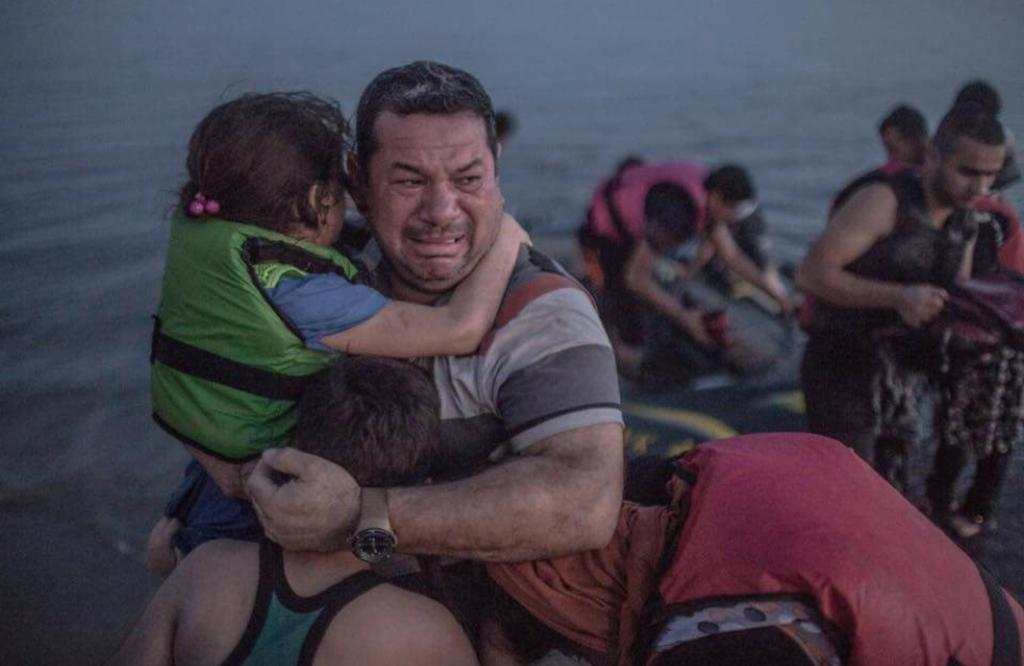
I have never met a migrant who has managed to enter the UK illegally – at least as far as I’m aware. I’ve seen a few on a number of occasions when passing through Calais. So beyond what I read in the media, I can’t say I’m cognisant of the individual motives of these people or the circumstances that are driving them to risk their lives trying to enter the UK and other EU countries.
But I do know that they are being exploited, directly and indirectly. Directly by people smugglers who charge them huge sums for the privilege of boarding an overcrowded boat in conditions that slave traders of previous centuries would regard as common practice. Indirectly by newspapers whose pundits have also never met an illegal migrant, and by politicians using them to incite a wave of paranoia and xenophobia among their prospective electors.
I also know that on the political extremes there are many who find in the flood of desperate people a rich opportunity to blame their selected scapegoat for their plight. It’s because of Blair and Bush. It’s because of the Turks, the Sunni, the Shia, the Saudis, the oil companies, the arms dealers, the neoconservatives, New Labour, the Bilderberg group, the Zionists, the Freemasons, the Safavids, the atheists, the capitalist system. And so on.
Somebody or something is always to blame for something. And the more we blame, the less we think forward and look for solutions. The more we wring our hands and point fingers, because that’s far easier than effective action. And also because we don’t seem to have coherent solutions.
But for what they are worth, here are a few thoughts.
Without laying blame, we need to accept above all that these people are human beings, not marauding swarms. We need to look back to 1945 and ask ourselves whether these people are any less deserving of our assistance than the victims of Hitler and Stalin.
We need to ask themselves what it is about these desperate people that is different from the displaced Jews, Poles, Ukrainians, and yes, Germans, whom we fed, sheltered and protected after the war. Is it race, ethnicity, religion, level of education? Is it because Eritrea’s vicious regime oppresses its citizens in a faraway country of which we know little? Because Syria has become a vicious battleground for factions and religious extremists? Because Afghans like to beat their wives and force them to wear burkas? Because Sudanese cut off the clitorises of their women? Is it because “these people” are seemingly far more alien than the white Europeans who suffered equally in the shattered ruins of their countries?
This is not to say that our post-war record was as white as the skin of the refugees we allowed into the country. We abandoned many Europeans to their fate as boundaries were re-drawn and ethnic revenge flourished under the benign gaze of Josef Stalin. We also stood by as millions were slaughtered after the partition of India and Pakistan.
But should we help the migrants out of a moral obligation formed of guilt over our past actions or inaction, or because we can? Because we are a wealthy nation that has the resources and the humanity to welcome the few thousand in Calais, and perhaps another hundred thousand waiting in other countries? Just because we’re an island at the western edge of Europe, does that mean that we shouldn’t take a significant share of migrants?
We can and we should. And I personally would accept a hike in income tax to support and assimilate them into the workforce, confident in the belief that the vast majority of people seeking entry into the country don’t want to live on benefits, but do want to work hard to create a future for themselves and their families. Damn the consequence for our social cohesion. This is an emergency, for goodness sake.
But that’s not enough. We need to be part of a strategy on the part of the same players who negotiated the nuclear deal with Iran to make a concerted effort to eliminate the reasons why the migrants feel compelled to come to our shores. I’m not just talking about Syria, Iraq and Afghanistan. Libya, Ethiopia, Mali, South Sudan and Somalia too. To resolve the conflicts in each of those countries, let alone ones that subsequently flare up elsewhere, will take time, effort, resources and patience.
And no, I’m not stupid enough to believe that China, Russia, the US and the EU will suddenly set aside considerations of national interest for the sake of a few thousand people about to drown in the Mediterranean. But big problems are often solved step by step, in little increments.
All this is obvious. But here’s a final thought.
If a super-volcano wiped out most of France, leaving a million or so starving people on the margins of the devastation, would we in the United Kingdom not take a goodly proportion of them in, feed them, shelter them and enable them to build new lives here?
Why then do we categorise man-made disasters – the legacies of war, political mismanagement and other human failures – as different from natural ones? Are we not life forms also? And in that respect are the results of our folly not also natural disasters?
If one species achieves dominance over a particular domain – and I’m not talking about humans now – and as a result manages to so devastate the habitat of hundreds of competing species that it drives them to extinction, would we not consider the event as a disaster of the natural world? We think of our species as the only one capable of doing this. Yet in South Georgia, the arrival of rats over 200 hundred years has, according to one report, wiped out 90% of the sea birds that use the islands as a nesting place. A man-made disaster? Yes, because we brought the rats there on our whaling ships. A natural disaster? Surely also true.
So if we thought of the current wave of migrants as the result of a natural disaster caused by the malign genetic disposition – to make war, to oppress, to ignore the fate of those whose lives don’t matter to us – of our species, then surely we would open our hearts, our purses and yes, our land, as generously as we might to the victims of earthquakes, volcanoes, flooding and crop failure in countries close to our shores.
Thirty years ago, when famine devastated Ethiopia, the well-meaning and the wealthy came together to stage Live Aid, and event that raised both awareness of the plight of the starving Ethiopians and money for their relief.
I see no sign of a massive wave of sympathy for those who are flocking to the borders of Europe today. No rock stars ready to perform at Wembley for the boat people. Is this because as a continent we feel threatened, diminished by the European project, keen to hold what we have after the successive financial disasters of the past seven years? Does self-preservation trump generosity? Do we see the migrant crisis as a problem for our governments to sort out, not a disaster that should engage each and every one of us?
I have no smart answers that might transform the lives of those so desperate that they risk everything on a boat that might never arrive. But what is happening in the Mediterranean is a natural disaster, and the sooner we start thinking of it in those terms, the sooner we start following the best instincts of humanity rather than the worst.
It’s our chance to prove that as a species we’re more than just another colony of rats mindlessly eating seabirds out of South Georgia.
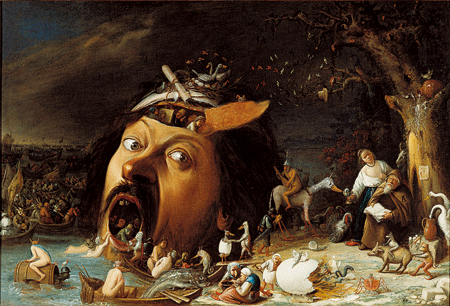
The Temptation of St Anthony – unknown artist
I very rarely have a visceral reaction to a business fad that causes me to describe it as codswallop – or worse. But so it was when I read a piece in Business Insider about how “A Wharton professor discovered a psychological trick that will help you stop procrastinating”.
The theory, it seems, is that if you bundle two activities – one that you don’t enjoy and are forever putting off, and another that you love – you will end up doing the thing that you would otherwise avoid.
Professor Kate Milkman came up with this stunning concept:
“I struggle at the end of a long day to get myself to the gym even though I know that I should go. And at the end of a long day, I also struggle with the desire to watch my favorite TV shows instead of getting work done.
And so I actually realized that those two temptations, those two struggles I faced, could be combined to solve both problems.”
Other examples quoted include listening to audio-books while working out, clearing work emails while getting a pedicure, only watching TV favourites while doing the ironing, and combining a meal at a favourite restaurant with meeting a difficult colleague.
The fancy name for this technique is temptation bundling.
That the Wharton professor is a woman is probably not surprising. When I ran some of these ideas past my wife, she thought they were great. She already irons while watching TV, and would be very happy to do what she does with her IPad while her feet receive some welcome attention. She is, in other words, a dedicated multi-tasker. The good professor can’t teach her anything.
I, on the other hand, have great difficulty walking and chewing gum at the same time. While I was writing this, I was listening to some music. I had to switch it off so that I could concentrate on a serious subject. No great loss, because I wasn’t really listening to it. It just got in the way.
What really sends me into orbit is the idea that for every pleasurable experience we should have to go through pain, and that the pleasure and the pain should be administered at the same time. What kind of rubbish is that? The same kind of rubbish that we dish out to our kids when we tell them that they can watch TV for half an hour after they’ve eaten their broccoli, but with a particularly cruel twist. While they endure the ordeal of chomping through mouthfuls of green mush they can watch Sesame Street. How can anyone enjoy Sesame Street when they’re eating broccoli?
So I’m supposed to refrain from eating in my favourite restaurant until I have the company of my least favourite person. How, pray, am I going to enjoy an exquisite pasta when I have some weasel-faced waster in front of me whose every utterance makes me want to pour the food over his head?
Let’s consider some other temptation bundles that might put us on the path of rectitude. Eating an ice cream while mowing the lawn, perhaps. Sorry, doesn’t work – the ice cream melts into the mower and you get splattered with red and white goo. Having endless skype business calls while on holiday? Done that all too often – the combination degrades the call and the holiday. Answering emails while on a date? I haven’t been on a date with anyone other than my wife since before emails existed, but I can imagine the enthusiastic reaction of the object of my desire.
Enough! To hell with productivity and to hell with procrastination. If something is worth doing, be it pleasure or chore, it’s worth giving it one’s full attention. We half-do too any things in the name of efficiency. Perhaps that’s why we don’t spend enough time considering whether something’s worth doing in the first place.
All of which perhaps explains why I could never be a Wharton professor or an inspirational speaker. I’d end up laughing at the nonsense that came out of my head. And anyway, ironing and watching TV at the same time is way too complicated for a man with my limited powers of concentration.
The only temptation bundles I’m really good at are combining pleasure with other pleasure. Obligations and chores don’t get a look in. Enjoying a good cheese and gazing at my lovely wife. Guzzling ice cream at the cinema. Seafood in a restaurant overlooking an Aegean bay.
That kind of multitasking I’m really good at. Anything else, it’s one task at a time. Self-flagellation while indulging in a pleasurable act has far too many overtones for my taste. So I will continue with the fight against procrastination in my own way: do nothing, have an ice cream and hope that the broccoli goes away.

If you knew that a company used and abused its employees, sold you things it sourced from sweatshops in Bangladesh whose owners lock the staff into their premises so that they can’t escape in a fire, bought its components from countries where combustible materials duly combust in spectacular fashion, and kept its prices competitive through the use of indentured child labour, would you give them your business?
Yes, you probably would. You might shudder at revelations about conditions in China, Bangladesh and Pakistan, and then keep on buying the products you love from the likes of Nike, Primark and Apple, duly satisfied by reassuring statements from their corporate headquarters. Well maybe you wouldn’t, but most people would, because otherwise a host of big-name companies would be out of business by now.
Amazon is an interesting case in point. It’s an online retailer that aims to sell more or less anything – except, presumably, the fruits of the Dark Web – to anyone. Yet it manages to do so without suffering the kind of reputational damage that sticks to the makers of the products it sells. Sort of.
The other day I read Inside Amazon, a long piece in the New York Times about what it’s like to be an Amazon employee. It’s caused a bit of a stir both on the social media and among other news publishers, some of them most probably because they’re envious that they didn’t pick up on the story first.
Depending upon your outlook, you can read the piece and admire the company as visionary, innovative, dedicated to setting the highest standards – the present and the future of online retailing.
Or, as the NYT portrays them, you can see them as a corporate cult, built on the values of the founder, Jeff Bezos. A business that demands 24/7 commitment from its staff, encourages people to inform on colleagues who fail to meet standards for any reason, be it illness, the demands of family life or personal crisis. That culls its staff on regular basis regardless of mitigating circumstances, such that managers feel the need to nominate sacrificial lambs in order to avoid losing other valuable team members. Effectively a business for which people are a commodity, to be hoovered in, sucked dry and disgorged. Disposed of like cows at the end of their milk-producing lives.
This view is vigorously disputed by Bezos and, in this blog post, by Nick Ciubotariu, one of its eloquent employees.
The NYT article is not the first to put Amazon’s treatment of its people under the microscope. And it’s not the first company with a founder whose ego is the size of the planet he seeks to dominate. Steve Jobs, for example, was not exactly a pussycat. Yet people turned up to work for Apple in full knowledge that Jobs had a talent for making people feel smaller than a pinhead. They did so because they loved being part of a company that made cool things. The share options probably helped as well. Amazon employees don’t have all the goodies offered by other technology companies like Google and Microsoft – free meals, pinball machines and so on. They too, I suppose, get their kicks out of being part of a ground-breaking enterprise. They buy into the cultish fervour because some people love belonging to cults, if that is what it is. The dividing line between culture and cult can be very thin. If you believe the NYT, Amazonians are required to be true believers – those that don’t embrace the creed either get out are forced out.
I’m a regular user of Amazon. I buy books mainly. Sometimes music, and occasionally electronics. I buy from them because it’s easy. I like being prompted with suggestions based on what they know of my tastes. I like the fact that I can compile a wish list and turn the items into purchases in my own time. I read book reviews every week. When I see something I like the look of, I put it on the wish list. Sometimes I wait until the book is out on paperback. Other times I don’t want to wait that long.
When the time comes, I go to the list. Five minutes later, the order’s done, and I get an email telling me when the goods will arrive. Within a couple of days, there’s a ring on the doorbell. What’s not to like?
My needs are pretty simple. I have no desire to summon a drone that will hover outside my door within thirty minutes of my placing the order. No gratification needs to be that instant. I’ve resisted Amazon Prime. I don’t need video streaming and I’m profoundly uninterested in Top Gear Mark 2.
Yet every time I buy books from Amazon I feel a pang of guilt. Because ten minutes’ walk away in my local high street there’s a little bookshop that doesn’t get my business. There’s a WH Smith as well, but I don’t care about them. After all, they’re just another corporate that happily gorges on the VAT savings at airports where much of their business resides.
The bookshop is a family business run by people who love books. They have an antiquarian section, and they have most of the stuff I might otherwise buy from Amazon. But they’re about 30% more expensive.
I’m not sentimental about small businesses. They survive by offering things that the big retailers don’t. In the case of bookshops, the attraction is customer intimacy, personal knowledge, and most importantly the ability to put your hands on the product, turn the pages and leave with stuff that you hadn’t the least intention of buying when came into the shop. Yes, I know that Amazon gives you some of this in a geeky, online sort of way, but it’s not the same.
So I do buy stuff from the bookshop as well as from Amazon. Just as I buy electronics and clothes on the high street, and would buy fruit, vegetables and meat from small shops if the superstores had not sucked the life out of local butchers and greengrocers a couple of decades ago. High streets should be more than collections of bars, restaurants, Starbucks outlets, charity shops and hairdressers.
Parochial concerns like mine are unlikely to be a barrier to Amazon’s future success. But its people practices might be. The company described in the NYT article might not be the Amazon of today. Or it might be. Any firm with thirty thousand employees will find it hard to avoid fracturing into sub-cultures, especially when it has large number of workers in different countries. Ask HP, which has long faced the challenge of maintaining the common approach represented by the HP Way across its far-flung empire. After all, the French have a very different way of doing things than Californians. Subcultures develop into informal schisms that threaten the overriding philosophy and purpose of the enterprise. As they do in countries.
Multinationals also have to contend with more assertive tax gatherers in countries like the UK, whose politicians have picked up on corporate structures designed to minimise tax liabilities in lucrative markets. Amazon has not escaped their scrutiny.
Another threat to its global dominance is that for each innovative service variant it launches, there are a dozen smaller, more agile tech companies looking to find ways of stealing – oops, sorry, I meant re-engineering – its inventions and adapting them for their own purposes. Smaller scale, more personalised, for specialist markets perhaps. There’s only so much that copyright lawyers can do to protect their clients’ intellectual property, especially when the predators have the assistance of a state at their disposal. And even more especially when that state is China.
No matter how touchy-feely the Amazon experience might be for its employees, by its size and dominance it has become a big bad wolf – like Microsoft, Google, Apple and Facebook. Used by billions yet resented by many, and mistrusted by even more. Which is why so many people are prepared to believe the New York Times exposé, whether true or not.
One Twitter user I came across a couple of days ago claimed that Amazon is the dystopian organisation described by Dave Eggars in his novel The Circle made real. An interesting comparison, though as far as I know, Bezos has no plans to suborn political establishments and control our behaviour with his drones. More on The Circle, which I reviewed a couple of years ago, in a post called The Circle, the Court and the Illusion of Privacy.
Personally I don’t see Amazon as an evil empire. If it’s that rotten to their employees, it will fall apart in due course, especially if its ability to fly new kites becomes increasingly cramped by its Achilles heel, namely a dubious profitability history. It will lose its best people to the tender embrace of rivals. And anyway, it’s just another company that enthusiastically lives by the capitalist mantra: if I can I will. It has some brilliant people who do brilliant things. So do its rivals. And so do future rivals we’ve never even heard of – yet. It’s a dog that’s having its day, and sooner or later it will be supplanted by other dogs.
So I will continue to use Amazon for my purposes, much as I would also like my local bookshop to stay open, and for all the other millions of small retailers to find a way to coexist with the online giants. But to do that, they will have to evolve, to find ways to offer things that the big retailers can’t, just as Amazon, Google, Apple and Microsoft are continuing to evolve.
And their best hope lies surely in another business mantra: when all other things are equal, people like doing business with people. As opposed to some disembodied Happiness Engineer in Seattle.

I’ve just read an article in Vanity Fair about how eagerly New York’s young professionals are embracing Tinder, and thereby each other.
It seems that in the cities of America the evening entertainment of choice for marketing executives, investment bankers, interns and students is to hang out in bars, meet up with someone they’ve never met before and have sex with them. Not occasionally, but several times a week, and sometimes more than once a night. Each time a different person.
No article on a social phenomenon would be complete without an expert being wheeled out to pontificate on its significance, and sure enough, Nancy Jo Sales, the author of the piece, duly obliges:
As the polar ice caps melt and the earth churns through the Sixth Extinction, another unprecedented phenomenon is taking place, in the realm of sex. Hookup culture, which has been percolating for about a hundred years, has collided with dating apps, which have acted like a wayward meteor on the now dinosaur-like rituals of courtship. “We are in uncharted territory” when it comes to Tinder et al., says Justin Garcia, a research scientist at Indiana University’s Kinsey Institute for Research in Sex, Gender, and Reproduction. “There have been two major transitions” in heterosexual mating “in the last four million years,” he says. “The first was around 10,000 to 15,000 years ago, in the agricultural revolution, when we became less migratory and more settled,” leading to the establishment of marriage as a cultural contract. “And the second major transition is with the rise of the Internet.”
To which my immediate reaction was yeah, yeah. As someone who grew up in the sixties and seventies, who witnessed the so-called sexual revolution and watched while extracts from the poppy, the coca leaf and marijuana plant went from being the recreation choice of a few to challenging alcohol as a mainstream social lubricant, I’d put it another way.
One of the major impacts of the internet on society, whether on sexual relations or any other social activity, is in the way it reduces the time needed for cults, fads and fashions to take root, develop and go mainstream internationally, as opposed to locally. Hence the growth of ISIS, and, dare I say it, the emergence of Jeremy Corbyn in the UK from the far-left margins of the Labour Party to frontrunner in the forthcoming leadership election.
To borrow Malcolm Gladwell’s terminology, it massively accelerates the tipping point.
But to suggest that all around the world, from Hyderabad to Omsk to Alice Springs, it will be “normal” in the near future for people hook up with each other in bars or bazaars and disappear for evenings of no-strings fornication is as much a delusion as the idea that listening to a Grateful Dead album on a scratchy gramophone in a smoke-filled room would usher a new era of world peace.
That said, it’s easy for followers of cults to believe that they’re on the cutting edge of something that will change the world. And exciting too. But the flipside of the internet as an accelerator is how quickly the wildfire cults it facilitates degenerate, and if they don’t fade away, mutate. Facebook is no longer “our thing”, for example. It’s everybody’s thing. Likewise Twitter. And so, eventually, will go dating apps like Tinder. Corporate imperatives – the compulsion to grow revenue and profit on an ever-upwards line – will take care of that.
I find it interesting that the growth of Tinder coincides with the nannying of sexual relations on university campuses. Several of the people interviewed in the Vanity Fair article were female students. So when they go out for their nightly doses of sex with strangers, do they ask the objects of their desire to sign a contract of consent? I very much doubt it. Just a reminder that sexual politics in America are as torturous and fractured as they ever were.
The students and young professionals busy coupling away all over America, Britain and other western societies won’t want to be reminded that that youth is not eternal. Sooner or later they’ll be bored and sated by an endless stream of meaningless encounters, just as most of us oldies got bored with hanging around in the kitchen at parties waiting more in hope than expectation for the next girlfriend, and getting wasted as the next best thing. Most of us moved on when we finally twigged that actually it’s difficult to achieve much the day after if your brain is still enjoying the effects of a night with weed or Newcastle Brown.
And sooner or later, like us, they’ll come to realise that the narcissistic bubble of hedonism in which they do what they do is little more than that. They’ll see that they were just a bunch of kids indulging in an opportunity that was denied to their parents. And if and when they become parents, they’ll reflect on the influence of pornography on their sexual behaviour and expectations, just as we used to reflect on the influence of drugs. They’ll not want their kids to conform to the values imposed on them by those who make and sell porn, just as we worried about our kids permanently altering their brains with the evil stuff that made billionaires in Colombia, China and Chicago.
Hopefully they’ll also understand that they were duped, just as we were duped, and that the only way to help their kids not to be duped is to raise them to think for themselves, not to judge, ban and disapprove. To educate rather than indoctrinate.
When I think about those kids in New York, it’s with no sense of disapproval, and certainly not envy. Each generation – or, in the age of the internet, sub-generation – takes its pleasure, excitement and risks in different ways. And in regard to sex, what is easy to come by is devalued. Relationships are still difficult, though potentially more rewarding. That much has not changed.
So no need for agonising, political and religious point-scoring, or for prohibition. No need for sex tsars. If you feel the need to regulate, ban and punish, there are many parts of the world you can go to where you will meet that need. Syria, for example. And remember that the Tinder generation is but a tiny slice of society, the result of a vertical and horizontal cut that hives off a few million out of billions. It’s not that much of a big deal.
What’s more interesting to me is how the dating apps will mutate so that older generations can get involved. Not for instant sex, you understand, though there may well be plenty of oldies who might find that of interest, judging by the very significant increase in sexually-transmitted diseases among the over-fifties during the last decade.
Just as Facebook has become the application of choice for families and distant friends as much as for preening youngsters, perhaps a variant of Tinder can transform the lives of the ageing lonely. Anyone fancy a game of dominoes? I have a spare ticket to a concert – anyone interested? I’m off to the coast for the day – anyone fancy a lift? I’m sitting at home with an injured knee – anyone fancy a cup of tea?
I should have thought that there are far more internet-enabled lonely people of a certain age out there with money to spend and nobody to spend it with than there twentysomethings who want to hang out in bars waiting for the next hook-up. Surely a commercial opportunity for some bright app developer.
Now there’s a thought – Tinder for Tortoises….
 59steps