This is motivational speaker season in Bahrain.
Before the weather gets insufferably hot – between June and October – a stream of high-profile personalities come here on paid gigs to bestow their wisdom upon us locals. If you’re Bahraini, the government pays most of the cost of the ticket. If not, you’ll have to stump up a price equivalent to that for a headline act in Vegas – anything in the range of $80-$150.
Most of them consider themselves gurus – or at least their publicists and agents do. Their imminent presence is announced by posters on lampposts and on hoardings along the highways. Their faces peer from the posters – looking well-coiffed, wise and benevolent.
Most of them hail from the US – the ultimate fount of business knowledge in the estimation of many in the Gulf countries. A positive piece in the love-hate jigsaw that defines the relationship between America and the Arab world. In recent months we’ve had John Gray, “Author of Men are from Mars, Women are from Venus”, Laura Stack “The Productivity Guru”, Jack Canfield, author of “Chicken Soup for the Soul”, Deepak Chopra, guru of alternative medicine, well-being and much besides. Next month the uber-guru, Tom Peters, will be here, presumably to tell us how to find excellence.
Just as the price of a ticket to a rock concert is determined by the number of albums the act has sold, the gurus justify their fees – usually in the tens of thousands of dollars – by the number of books they’ve shifted. Zillions usually, in just about every language known to man.
The books are usually variations on a theme – the subject of their original hit. There aren’t too many shape-shifters within the motivational community – artists like Bob Dylan and David Bowie who morph from one musical form to another according to their fancy at the time. No, these guys stick to their knitting. They’re great speakers and the audiences love them. I often wonder whether the medicine they prescribe lasts longer than a day or two. But if a guy listening to John Gray decides to take an alternative approach to beating his wife when he gets cross, I reckon that’s worth the cost of a ticket in anyone’s money.
Am I jealous? You bet. How wonderful it would be to swan around the world giving fifty talks a year in exotic parts of the world and ending up with a few million dollars, while your acolytes, otherwise known as “staff”, beaver away at building your brand, helping you sell ever more books and laying the foundations for yet another variation on the theme.
But fair play to them. It takes years of hard work to become a guru. Many of them struggled in the wilderness before hitting the magic formula. Personally I don’t have what it takes to churn out endless tomes that establish my credibility. The speaking bit and the exotic locations I would love, but I fear I would become bored to death going on and on for a lifetime about one subject. Life’s too short, and there’s too much else to discover.
Last night I met a guru of a different stripe. Yet another American, but this guy appears to have missed out on the official largesse, and his visit was not accompanied by the usual promotional fanfare. What’s more, the event was free.
Dr Michael Stankosky was hosting a “conversation” at Bahrain’s Capital Club on knowledge management. That’s a subject I know little about. Fifteen years ago one of the companies I co-owned was providing consultancy on KM. Or trying to. It’s an interesting area of business, and we did some fascinating projects. But whether we were ahead of our time or barking up the wrong tree, we never made much money out of it, and eventually moved to other stuff. The problem was that nobody really understood what KM was.
According to Stankosky, most people still don’t. Is it a way to boost your balance sheet by recognising the intangible assets in your organisation – the knowledge and skills of your people? Is it about creating giant systems for collating information that can then be available to everyone? Is it – as Stankosky believes – about leveraging knowledge assets to ensure the survival and ultimately the prosperity of the organisation? I’m with him on that one, by the way.
I was looking forward to hearing what a professor from George Washington University had to say about the latest thinking on KM. The problem was that I learned more about the good Dr Stankosky than the subject he was supposedly there to discuss.
Now I’m all in favour of using personal experience to illuminate a subject. I do this all the time in my writing, public speaking and in the workshops I facilitate. Stories last longer in the mind than elegant explanation of theory. Yes, you need the theory, but the stories provide the glue that lodges theory in permanent memory.
But over a two-hour session we were treated to a bewildering stream of information about the man himself. Twenty-odd years in the Marine Corps, spells as a software engineer, diplomat, businessman and academic. Oh, and butcher, skier, would-be priest, European racketball champion and God knows what else. That and an endless stream of references to the great and the good with whom he is personal friends.
Perhaps I’m being unfair. There was plenty of talk about knowledge management. It’s just that what stayed in my mind was all the stuff about him. This guru has lived, and likes talking about it.
At the beginning of the session, he also told us that he likes being challenged. When I suggested that culture has something to do with the failure of organisations to capitalise on knowledge, and gave as an example the tendency in Saudi Arabia to deal with failing organisations by establishing parallel structures, he slapped me down. That’s a process issue, not a cultural one, he said, and continued to mutter darkly about culture throughout the rest of the talk. He’s a systems thinker, you see.
When a woman in the gathering asked what I thought was an intelligent question, he did a Michael Winner, and began his answer with “well you see, my dear….” Clearly there was only one guru in the room, and he made sure we didn’t forget it. What’s more, as we learned from him, his gurudom is not confined to KM – it extends to software as well.
For all that, the good doctor was a welcome antithesis to the smooth inclusivity of many of the motivators who bless us with their presence. He was here for another event, and I doubt if he was paid for his time with us. He clearly loves his subject. I can relate to a guy who has done many different things in his life. I have too.
I also enjoy cranky, opinionated people. They test our own opinions. They make us think, and sometimes they make us cross. I would have liked to have had a good argument with him over a beer about a number of things he said, but that session wasn’t the place or the time. He has much of the late Margaret Thatcher about him. Possibly (though I don’t know this for a fact) admired and disagreed with in equal measures, but someone who relishes a bit of intellectual strife and commands great respect from his followers.
I especially enjoyed one comment he made early on: “people don’t go to university to learn – they go to get degrees.” Such a remark could only have been made by someone who has spent much of his life outside the education industry. And for that observation I’ll ignore all the moments when I stopped to think “who the hell does this guy think he is?”
So the gurus keep galloping though Bahrain. Next up, Tom Peters. Now who does he think he is, I wonder?
So Boston, it seems, has had its 9/11. Not on the scale of the New York attacks, of course. But the shock will be almost as deep.
The average American – if there is such a person – will be thinking dark thoughts. “We’ve spent billions on homeland security since 9/11, but these guys still get through. Who can we blame?”
A Saudi is questioned in hospital. It’s easy to shoot up the ladder of inference and assume that this was an Al-Qaeda attack. If it’s a bomb, it must be Al-Qaeda. If they’re talking to a Saudi, it must be him. If it’s a Saudi, it must be Al-Qaeda.
Not so in Norway, when the culprit for the bombing and mass shooting was identified as a foreign terrorist attack by various media outlets, and hours after the stories went out, the identity of a Norwegian far right extremist, Anders Breivik – about whom I wrote after his horrific acts – emerged.
Many of the failed terrorist attacks on American targets seem to have been “inspired” rather than “directed”. Even if the attack turns out to be of foreign origin, one would expect that the FBI have learned some lessons from previous attempts when looking for its origins and the motivation behind it.
My heart goes out to the people killed and injured in Boston yesterday. Just as it does to the people of Baghdad, Kirkuk and Nasariyah, who suffered fatal car bombings yesterday and lost 31 people. We sometimes forget that these events are taking place on a regular basis in other parts of the world. The difference is that in Iraq they are the norm, and in America they are not.
The attacks, if they are of foreign origin, come at a time when American boots are leaving the ground they have trodden on for the past 12 years. Land wars are giving way to drone wars. The Boston attacks will remind America that explosives kill people – a lesson not needed by those who have been on the end of missiles launched by pilots sitting at desks in Nevada. Is that the motive of the attackers? That remains to be seen.
But traumatic as the Boston bombing undoubtedly is, I hope that Barack Obama will find a measured response. Now is not the time for a reinvigorated War on Terror, with all that it implies. Empathy for the victims, yes, but reason should be the order of the day in the White House this morning.
I said my piece about Margaret Thatcher a few hours after she died. I’m not at all surprised by the vitriolic celebration of her death among the Twitterati, the “witch is dead” posts going viral on Facebook, the headlong rush of anyone who’s anyone to comment on her death, and the subsequent gleeful feeding frenzy in the media.
Looking on from afar, I suspect that much of the rest of the world will be somewhat bewildered at the clamour. After all, was she not a strong leader, a stateswoman? Why are her people celebrating her death?
Here, for example, is part of a letter to Bahrain’s Gulf Daily News from Rajendra Aneja:
“The death of Margaret Thatcher – the longest serving British prime minister (1979 to 1990) – this week marks the passing away of one of the most towering leaders of Britain and the world. She was a strong leader with the courage of her convictions. She translated her beliefs into action.
The three most remarkable milestones of her life and career are: First, she transformed Britain from a socialistic pattern of society to a free market economy and mobilised the power of the middle classes in trade and development. Second, she played a pivotal role along with president Ronald Reagan and president Mikhail Gorbachev in ending the cold war.
Finally, she was a women of strong courage and integrity. As a premier she even insisted on paying for her own ironing board, at her official residence.
She was a brave lady and despite attacks on her life, she did not waver from her policies. She narrowly escaped injury in an IRA assassination attempt at a hotel in October 1984. Next day she adhered to her itinerary. She was also far-sighted. She realised China’s growing importance and built bridges with the country.
The daughter of a simple grocer, she was a fierce patriot. Her leadership was always characterised by a strong vision for Britain, clarity in her views and an endeavour to transform society. It is sad that eventually her own party dethroned her.
However her legacy of building a strong and independent Britain inspires Britons even now, 23 years after she relinquished office.
In an age when politicians are doubted and often abhorred, Thatcher is highly respected, even by those who disagreed with her policies and style of management.
Compared to her, many contemporary politicians seem to be men of straw.”
Mr Aneja would be surprised at the level of disrespect shown to her in her own country.
We should not. We lost our inhibitions about funerals when Princess Diana died. Her funeral was accompanied by mass emotional incontinence of a kind not seen in Britain in living memory. Before she died we would have regarded the wailing and gnashing of teeth that accompanied the burials of foreign leaders with a faint air of superiority, or even amusement.
The sight of Ayatollah Khomeini’s body being hoisted on the shoulders of a sea of mourners, and at one point slipping out of its shroud, would have had an observer in Middle England thanking goodness that “we don’t do things that way here”. Yet a decade or so later, we’re weeping in the street and pelting Diana’s cortege with flowers as it makes its way through London en route to the burial ground.
I have a French colleague staying with me at the moment. Last night we were chatting about the relative states of Britain and France today. He believes that France is in a state of slow decline. Whereas thirty years ago the French would have seen Britain as the “sick man of Europe”, many in France now believe that this term applies to their country.
The difference, as he sees it, is that France has not been through a rupture, or shake-up of the kind administered by Thatcher’s government. And it wasn’t only Britain that went through radical change over the past thirty years. Germany also had its ruptures, in the shape of economic reforms by Chancellors Gerhard Schröder and Helmut Kohl, as well as the massive challenge of reunification.
Powerful vested interests and fear of reform in France have prevented the transformative change that shook up the other “great powers” of Europe, with the result – according to my friend – that the country is starting to look more like the economic basket cases of Southern Europe.
Looking back at Thatcher, I wonder if the reaction to her death would have been as extreme if she had died before 2008. To what extent is her legacy a focus for the frustration many Brits feel about the past five years of economic decline? Of the erosion of living standards through austerity measures and a sense that no serious improvement is in sight? Certainly responsibility for the climate of greed in the banking sector is being laid at her door.
Yet if she is looking down on us today with beady eyes, she would probably be asking a number of questions of those who seek to dance on her grave:
“How many of you have benefited from becoming house owners, and have climbed the property ladder?
How many of you profited from shares in British Telecom or the demutualisation of Building Societies?
How many of you have suffered serious losses through industrial action since I faced down the miners?
How many of you have had financial, career and social opportunities that were never available to your parents and grandparents, regardless of whether or not you chose to take them?”
To which the unfaithful would be lining up to provide equally robust answers. No doubt those arguments will flow back and forth between her representatives on earth and those who hope she has gone to hell until all who lived through her time have died off, and the field is left to historians.
There’s a great Arabic word/expression combination I would use today: “Khalas”, accompanied by the motion of hand-washing – meaning enough – it’s finished, it’s over. For better or for worse, the package was delivered years ago. All the malevolent glee, the bitterness and the abusive tweets will not change that.
It’s time for us Brits to put back on our emotional incontinence pads, accept that not everybody saw Margaret Thatcher as the wicked witch, and let those who wish to mourn her do so in peace and with decorum.
And when the funeral is over, time to start focusing again on building a future.
What drives people to spend days, months and sometimes years expressing themselves through writing?
One such person is Tim Mackintosh-Smith, chronicler of Ibn Battutah and my favourite travel writer, who was back in Bahrain last week.
Tim gave what was billed as a masterclass in travel writing. The event was part of the Bahrain Spring of Culture, which I talked about last month. Though entertaining and enlightening, I wouldn’t describe his talk at La Fontaine Centre for the Arts as a masterclass – more a rumination with nuggets of wisdom emerging from a stream of authorial consciousness.
Something he said about the art and business of travel writing set me thinking. It was to the effect that that if you want to be a travel writer, do it for love, not money. Because there is precious little money to be made from writing about your hikes around lesser known parts of the world, unless you happen to own the rights to the Lonely Planet series. And writing about pubs, tourist attractions, exchange rates and hotels is definitely not the business of writers like Tim and others of his ilk, such as William Dalrymple, Wilfred Thesiger, Patrick Leigh Fermor, Sir Richard Burton and of course the great Ibn Battutah.
No less than great novelists, poets and historians, these writers offer us lessons in life – windows into the human condition. Yet today if you try and get published under the category of travel writer, you will struggle. Even if you get a publishing deal with an advance, the sum involved is highly unlikely to fund four years of effort, which is typically the time Tim took to write each of his books on Ibn Battutah.
Fortunately for him, the cost of living in Sana’a, the capital of Yemen, is somewhat less than that in London, Paris or New York. Yet travel costs money, and as he said, there were times when things got very tight during the long gestation periods of his books.
So why would Tim, his fellow writers and writers past dedicate their lives to labouring with so little reward? Tim is an erudite and charming man who could have succeeded in many other walks of life, and probably made a heap of money in the process. I can’t speak for him, and you would probably get different answers from every successful writer on the planet.
He might say “it’s a job, guv”. But I doubt it. It’s not a job, and I doubt he would disagree if I suggested that it was more of a calling. And I suspect that he probably wouldn’t swap the two thousand books he has on his shelves in Sana’a for all the Range Rovers, country houses and five-star hotel visits that might have been within his reach had he chosen a different life.
All speculation of course. Then I got to thinking about why I write. Unlike Tim, I’m not a renowned writer. Yet I usually churn out a few thousand words a week. I look back on some of what I’ve written and think yes, that’s pretty good. Other stuff is not great, but not so bad that I regret having written it. I don’t write in the expectation of striking it rich with some future book, but if somebody wants to offer me a large sum of money for what I might produce in the future, that’s OK.
I write because I love doing it. I have decades of life behind me, and writing forces me to make sense of my experience. It also makes me think about events and issues when otherwise I might pass them by without a further thought. Writing without the need to make money from it, with no deadlines and no compulsion gives me the freedom to choose what I write, when I write and how much I write.
Perhaps it’s an act of self-indulgence rather than self-actualisation. Perhaps when I’m gone the words will dissolve into the vast digital soup and never be thought of or read again. That’s the fate of many writers, whose books find themselves on the shelves of charity shops or in car-boot sales on offer for less than price of a can of Pepsi.
Does that make the effort of writing all those words a waste of time? Words are ripples of thought that wash over the consciousness of others, and change those who read them in ways big and small. From the pens of some writers, words make giant waves that keep rolling over the centuries. In my case, if a few tiny ripples cause a few people to think anew, or think more deeply, I consider that to be a worthy reward for my time.
If there is one word whose meaning has changed for the worse over the past century, it’s “amateur”. A hundred years ago an amateur was someone who loved doing something and didn’t expect to be paid for doing it – as opposed to a professional who did the same thing and earned a living from it. There was no implication that the amateur was any less an expert at the activity than the professional. In cricket, for example a medical doctor called WG Grace set records for the sport he loved that have not been equalled since. And there was no implication, by the way, that professionals loved what they did any less.
These days the term amateur is often used pejoratively. It can mean inexpert, clumsy, not thorough. An amateur’s efforts might be rewarded with faint praise: “not bad for an amateur”. In contrast, professional has come to mean the paragon of excellence: “a really professional job”.
That’s a shame, because neither term any longer carries the suggestion of love.
I’m happy to call myself an amateur in the old-fashioned sense of the word. I do get paid occasionally for stuff I write, both directly and through people liking what I say and wanting to do business with me. But that’s not why I write. And I regard people like Tim Mackintosh-Smith – who has written about subjects that he loves, but whose books about Yemen and Ibn Battutah may never reach an audience large enough to bring him wealth as well as the fame he has deservedly won – as amateurs also.
The same goes for hundreds of thousands of people who have found an outlet for their words over the past decade through their blogs and self-published books. And so it has been for writers down the ages. Ibn Battutah didn’t regard himself as a “professional writer”, yet his words have echoed down the centuries.
There are many people scratching a living from their work who might wearily comment “art for art’s sake, money for God’s sake”. But at the risk of sounding somewhat Olympian, commercial success is not always the same as memorable work. Thousands, maybe millions, of writers are producing stuff that touches others deeply without gaining commercial reward for their efforts. They write for love first, money second. It’s a passion, a compulsion. One of the joys of reading is to be constantly surprised by great writing from unlikely sources. Take Russell Brand’s meditation in the Guardian on how Margaret Thatcher touched his life, for example. It’s a piece that radiates humanity, and couldn’t have been produced by someone who doesn’t love writing.
Another author whose work I admire very much, Tahir Shah, once wrote about story-telling in Morocco. He used an analogy of underground rivers of stories beneath the feet, waiting to be discovered.
In a wider sense, we walk today across digital rivers. We cannot discover all that flows beneath our feet. Yet to be a tributary into those rivers is an opportunity open to anyone with the time, the means and the motivation. And the sweetest water is that which flows from love.
I missed my first earthquake!
I happened to be at home when the Bushehr earthquake rattled the Gulf coast at 3pm local time yesterday. The local media reported severe shaking in large buildings over several parts of Bahrain, including the Salmaniya Medical Centre. Yet I felt nothing, despite being no more than a couple of miles from some of the affected areas. Earthquakes are no laughing matter, yet I feel a sneaking disappointment at not experiencing one at close hand, yet not too close. Perhaps I should be careful about what I wish for.
Whether I felt nothing because there are several districts built on reclaimed land – and I don’t live in one – is an open question. It goes to show that earthquake science is still full of unknowns.
That Bushehr is in the vicinity of three major fault lines is well known, however. So is the fact that Iran’s only working nuclear power station is located in the region. I wrote about the risk of locating a nuclear reactor in an earthquake zone two years ago in the wake of the Fukushima disaster. See Concerns About Bushehr – Too Close for Comfort.
Since earthquakes often come in clusters (witness the recent successive quakes in Christchurch, New Zealand, and the major events following the 2004 Indian Ocean quake and tsunami), perhaps those of us living within a few hundred kilometres of the reactor have reason to feel a little nervous right now. Would it be too much to hope that the Iranians might shut the reactor down, at least for the next few months, as a precautionary measure? Probably.
But fear is one thing, and reality is another. Let’s not forget that people were killed yesterday in Iran, and many more lost their homes. Our sympathy should go to those affected before any other considerations.
I breathed a sigh of relief when Margaret Thatcher resigned as Prime Minister in 1990. She was a divisive politician, and I found myself on the anti-Thatcher side of the divide.
I couldn’t stand the woman, as much for her style as for her policies. I hated her Churchillian posturing over the Falklands crisis, her gloating over the decline of the trade unions, her school-marmish lecturing of our European partners, her bullying of her cabinet colleagues, her stubbornness and inflexibility over the poll tax, and her ridiculous rhetorical constructs, such as “you turn if you want to, this lady’s not for turning”.
Looking back on her life now ended, 22 years since she left office I still feel the same way about her personal style, but differently about many of her policies.
She was right to be concerned about the power of the unions. She was right to re-take the Falklands, despite the loss of life. She was right to privatise the utilities, to try to reform the education system and the National Health Service. She was right to be cautious about closer integration into the European Union. She was right to encourage home ownership and sell off council houses to their tenants.
She was wrong to emasculate local government. She presided over the destruction of our manufacturing base and didn’t have the vision to see that the resulting service-based economy was built on shifting sands. She was wrong to place so much faith in a deregulated financial market. She presided over a growing culture of greed, and a widening of the gap between rich and poor. She did little to alleviate inner city decline until forced to do so.
Many of the problems the UK is facing today she didn’t see coming. But neither did her predecessors. And neither did most of the rest of us.
Her style was to extent a reaction to the misogynistic political culture that prevailed during her early career. She became a caricature of stridency, which was unfortunate, because it enhanced the perception of divisiveness. As a human being she was clearly not the harridan she projected, as testimony from those who knew and worked with her amply demonstrated. Underneath the Iron Lady was a bit of a marshmallow.
Legacies are for historians, but for all her failings, I do believe that the UK has much to thank her for. She didn’t return our country to greatness, and anyway we were never that great in the first place. But she was never less than sincere, honest and passionate.
Something I never thought I would say when as a student I spent inky hours printing anti-Thatcher posters.
I have a message to the exalted Ministers of Bahrain who are being urged by their Crown Prince to use email in their communications with each other: don’t do it!
That’s a joke, of course. I am not encouraging the top echelon of government to disobey the Crown Prince, who is a man for whom I have great respect, especially as he seems to be providing a welcome injection of energy and imagination into government following his recent appointment as Deputy Prime Minister.
So before somebody knocks on my door and accuses me of lèse-majesté, I should change my advice to: “proceed with caution”.
I’m commenting a story that appeared in the Gulf Daily News this morning: A new era…. The paper opened the story with this line:
“Government ministers have been urged to usher in a new era by embracing creative and innovative ideas.”
It then went on to talk about the Crown Prince promoting the use of email within government, particularly as a means of following up on the implementation of government decisions.
Email equates to creativity and innovation? Not according to fellow blogger Dark Red Hat, who believes that it is the productivity scourge of the age. I quote from Kontent is King:
“Email is the most used, abused, productivity-stifling, time-wasting and pernicious invention of the 20th century. It’s the giant hogweed of the workplace. Far from helping us communicate more effectively in our work and social lives, it’s a massive distraction, and an ideal platform for fraudsters, office politicians, axe-grinders, bores, arse-coverers, show-offs and narcissists.
Rather like Facebook, in fact. At least you can turn Facebook off. But you ignore your email at your peril, even though you have to wade through gigabytes of kontent to reach the few messages that are actually relevant to you.
So think of this. Let’s say there are a billion email users in the world today – equal to the number of Facebook users. If each user sends one less email a day for a year, and if that email takes ten minutes to write and ten minutes to read, that would be 333 million hours a year of human time freed up to do other stuff. Every internet user on the planet would save 12 days a year. Time they could use to talk to people, make things, leave work early, read a book, run round the block. Or simply think.
The only trouble is, most people would probably use the extra time on Facebook. Kontent is an addiction we can mitigate but never cure, it seems.”
Politicians are being urged across the world to “get modern”. The most unlikely people are opening Twitter accounts – Pope Emeritus Benedict, for example. But I suspect that the high and mighty are far too busy to spend time trawling Twitter or composing pithy 140 character nuggets of wisdom. Generally, the exalted don’t do pithy – they get their flunkies to do it for them.
And so it is with email. On the odd occasion when I have found myself in the office of an exalted person in the Middle East, I usually see a computer screen, but no keyboard. This is for the simple reason that many such people don’t write and read email – at least not in electronic form. Again, they have a flunkey to act as a gatekeeper. The servant will screen email, draft messages for the master’s approval and pass him printed copies of incoming mail. Not, I hasten to add, the ones trying to sell plastic surgery or hot dates – and I’m not talking about Bahrain’s most delicious food.
So I’m sure the Crown Prince is not proposing that Ministers get close and personal with their laptops and actually start writing emails themselves, though I’m sure that’s what he’s been doing for decades, being a thoroughly modern man. If they did, they would risk exposing themselves to all the rubbish that Dark Red Hat refers to as Kontent, and that could be a serious drain on their productivity. Less time for meetings, speeches, conferences and opening ceremonies.
Seriously, I think I fully understand what the Crown Prince is trying to do. He’s trying to cut through the impenetrably tangled remnants of British-Indian, Ottoman or Egyptian bureaucracies that still plague the governments of most Gulf countries. Less faxes. flunkies, decorous rubber stamps, middle men and paper obfuscation; more action and results.
Unfortunately the Gulf Daily News did him a disservice by referring to email as an example of innovation and creativity. He’s no fuddy-duddy, and he will know well that it will take much more than dragging a few ministers to the keyboard to help government get to the point at which reality matches the rhetoric.
Fortunately, there are plenty of talented and creative people in Bahrain who would deliver innovation if given the chance. People full of what the Prime Minster in the same article described as “ambitious and youthful visions”.
I’m sure that given the chance, the Crown Prince will give them the chance.
The recent case of a man in Saudi Arabia who has reportedly been sentenced to being paralysed has implications beyond the unusual method of punishment.
Commentators in the West, including Amnesty International and the British Foreign and Commonwealth Office (FCO) have expressed outrage at the sentence, which is based on Quranic interpretation of “an eye for an eye”.
The punishment seems to be overshadowing the fact that the offender – who stabbed a friend in the spine, resulting in the victim’s paralysis – committed the crime at the age of 14. According to the FCO, the age of legal responsibility for men in Saudi Arabia is the point at which they reach puberty. Theoretically therefore, had Ali Al Khawahir not reached puberty when he committed the crime, he would not be subject to the punishment. Since puberty is generally arriving earlier than in previous generations (here’s an article from Intelligent Life on the subject), there must be a real prospect that a physically mature 11-year-old could in the future face execution for murder.
The case echoes the recent execution of seven Saudis for robbery. Two of those executed committed the crimes when aged 16.
In the UK, the age of criminal responsibility is 10. If a person commits a crime between that age and 17, they are subject to a different punishment system. As an example, in 1993, two 10-year-old boys were convicted of murdering 2-year-old James Bulger in a horrific fashion. They were released on licence – meaning that they could be returned to detention if they committed any subsequent crime – upon reaching adulthood in 2001. Had they committed the crime when adults, they would have received life sentences, with the strong possibility that the judge would have recommended that they serve at least 25 years in prison before being eligible for parole.
Another famous case in the UK was that of Mary Bell, an 11-year-old who was convicted of manslaughter on the grounds of diminished responsibility after she had killed two young boys. She was also released on licence – in her case at the age of 23.
A further factor in the Saudi case is that the perpetrator has served ten years in jail already. While comparisons between the UK legal system and the Sharia – which is the basis of Saudi law – are likely to be irrelevant in the eyes of a Saudi judge, the chances are that in the UK Mr Al Khawahir would probably be a free man by now. Right now, the only way he can avoid the punishment is to pay the victim “blood money” of $270,000.
As John Burgess pointed out in a recent Crossroads Arabia commentary:
“It is going to be exceeding hard — if not impossible — to make a change in law that directly reinterprets a Quranic injunction and so to make the acceptance of blood money the only response. A law that made sense nearly 1,500 years ago no longer makes sense. The change can be accomplished, but it will take bravery on the part of the government and the clerics.”
My sense is that the more likely development will be that the Saudis will instruct the judges to apply some form of mitigation – formally or informally – in the case of offenders who have not reached a certain age. Maybe not 18, but perhaps 16. In the case of Mr Al Khawahir, they will also be mindful of the damage to their international reputation – in general and specifically among the medical profession, one of whose members will be asked to carry out an act that many would consider contrary to medical ethics – and will quietly find the means to pay the required blood money on his behalf.
There is an additional dimension to this case. Though I am neither a lawyer nor an expert in the Sharia, my understanding is that judges under the Sharia are empowered to apply lenience in cases of ambiguity or uncertainty – shubuhat. In the current case, the judge could have taken the view that the offender did not intend to paralyse or kill his friend. If such a principle was not a factor in judgements, Saudi Arabia would face the prospect of wholesale amputations of limbs, paralyses and executions as the result of daily acts of dangerous driving that result in injury and death.
As John Burgess says, the Saudis can change the law, but resistance to Quranic reinterpretation is likely to be fierce. So whatever the international outcry, do not expect the kind of changes being called for by the Kingdom’s critics, such as abolition of the eye-for-eye principle. Instead, expect quiet persuasion applied towards the judiciary and, as is the Saudi way, small steps towards reforming the legal system.
Those temperate souls in the Bahrain Parliament were at it again yesterday.
The Gulf Daily News – demonstrating what a bastion of unbiased reporting it is – took a break from reporting the daily condemnations by leading ministers of the “thugs and terrorists” who are blamed for the current state of the country. Instead, they chose to sit in on a lively debate in parliament. Since the political composition of the lower house has been somewhat skewed by the resignation in 2011 of the 19 members of the Al-Wefaq political society – the group that has taken much of the blame for the troubles of the past two years – you would expect that the current members would be violently agreeing on most matters placed before them.
Apparently not. According to the GDN, in yesterday’s deliberations, Islamist MP Abdulhaleem Murad said this about remarks by a fellow member:
“Those are the words of infidels and atheists, which reflect the philosophy of the person saying them. The person saying those words has been silent for numerous sessions, but when he spoke the words of infidels came out.
“What nonsense comments have come out of his mouth? We should not stay silent against those silly words. There are no loopholes in religion, with good and evil being clear. Those words only come from a devil with satanic intentions.”
So what were the devilish, satanic, atheistic ideas being thus condemned? You might think that the object of such contempt was proposing something seriously radical, such as the abolition of religious teaching in schools, or the incorporation of the religious holidays of other faiths into the national holiday schedule.
Not so. The recipient of the broadside was suggesting that it was a mistake to establish a government-funded academic institution for exclusively for women. Again according to the GDN:
“Bahrain Bloc MP Ali Al Durazi had criticised the Islamist MPs’ plan, saying males and females should mix and it was up to them to control their desires. “It doesn’t matter if females and males are segregated or are mixed in classrooms, lectures or even at work and in general life,” he said.”Desire is found in everyone’s soul.
“We can’t stop people from fulfilling their desires if they want to do so and it is a choice to control it or let go. The problem is within people themselves, when they lose their senses and shut off their conscience.”
I suppose the idea that people should act according to their consciences is pretty radical. And there are countries nearby where, if he had made those statements, Mr Al Durazi would be in fear for his safety at the very least, and in real danger of being hauled off to jail.
Mr Murad apparently had the last word:
“Acting parliament chairman Abdulla Al Dossary ordered the comments to be removed from the official record, but Mr Murad said they were already recorded in God’s eyes.”
That’s all right then. No one can say they weren’t warned of the coming retribution.
When I read about the exchange, I thought to myself how different were the proceedings to those of my own dear Parliament in the UK. But then I thought of Oliver Cromwell’s words when he shut down the Rump Parliament that had lingered on after the demise of King Charles I, as reported by Thomas Salmon in his Chronological Historian:
“[Cromwell] commanded the Speaker to leave the Chair, and told them they had sat long enough, unless they had done more good, crying out You are no longer a Parliament, I say you are no Parliament. He told Sir Henry Vane he was a Jugler [sic]; Henry Martin and Sir Peter Wentworth, that they were Whoremasters; Thomas Chaloner, he was a Drunkard; and Allen the Goldsmith that he cheated the Publick: Then he bid one of his Soldiers take away that Fool’s Bauble the mace and Thomas Harrison pulled the Speaker of the Chair; and in short Cromwell having turned them all out of the House, lock’d up the Doors and returned to Whitehall.”
Not being a journalist or an academic, I unapologetically thank Wikipedia for that quote.
More recently, we have had our share of ripe insults in the House of Commons. In 2010, the Health Minister was reported as muttering under his breath that the Speaker, John Bercow, was a “stupid, sanctimonious dwarf”. Then there was Denis Healey’s famous remark when, as the UK’s Chancellor of the Exchequer, he likened the criticism of his budget by his opposite number Geoffrey Howe to being “savaged by a dead sheep”.
Even in New Zealand, that great exporter of dead sheep, and not a country with a reputation for rabble-rousing, parliamentarians have got into trouble for little gems such as these:
“Idle vapourings of a mind diseased”
“His brains could revolve inside a peanut shell for a thousand years without touching the sides”
“Energy of a tired snail returning home from a funeral.”
Again my thanks to Wikipedia, this time for the wisdom of the Antipodes.
Yesterday’s contretemps in Bahrain’s parliament is not the first of its kind. A few months ago, for example, another MP almost set off the sprinklers by burning an Israeli flag in the chamber.
Whatever your thoughts about the current situation in Bahrain, you have to have some sympathy for a government pincered between opposite extremes of the sectarian spectrum.
You could even understand if, in their darker moments, there were not ministers who might dearly wish that they could adopt Cromwell’s tactics with the Rump Parliament – minus the insults of course.
It’s coming up to three years since 59steps crept on to the internet. Since then I have posted 335 articles – well over half a million words, most of them mine.
I would be the first to admit that the content on 59steps is an acquired taste – well actually, many acquired tastes! That’s because I write about whatever interests me at the time, and my interests are pretty wide.
If I was writing this blog to make money, I would probably focus on a specific subject area – say, the Middle East – so that visitors would know the kind of content on offer whenever they visit. But that’s not what I do. Long-suffering followers of this blog know by now that not everything I write about will hit their particular spot, unless their interests are a perfect match for mine.
I don’t bother with search engine optimisation techniques, I don’t host advertisements, I don’t set out to appeal to anyone or any interest group. I just write.
I get huge satisfaction from writing. I’ve written throughout my career for one purpose or another, including print publication. But blogging is different, because it’s a two way thing. Whenever someone posts a comment, I reply (well almost always – I don’t respond to gobbledygook and ranting). And every time someone likes a piece or subscribes to the site, I look at their site, if they have one.
I’m not so good at acknowledging every like and sign-up, though I do sometimes post a message when I like what they do. In that case it’s not a courtesy – it’s genuine. But I do genuinely appreciate it whenever someone shows an interest in what I write.
Apart from the pleasure of writing, another joy is the serendipitous connection. A couple of years ago I posted three excerpts from my grandfather’s World War One diaries. He was at the heart of one of the most vicious battles of the war – Passchendaele. More recently I read one of my late father’s books on that very subject, In Flanders Fields, by Leon Wolff. It was written in 1958, and included a foreword by one of the British generals involved in the battle.
What made the book special was that I was able to match the diary with the timeline of the battle. The places my grandfather mentioned suddenly had new meaning. So did the events he described from his limited perspective as commander of an artillery battery. The mole’s eye view suddenly gelled with the big picture.
Then last week something happened that was only possible because of those diary posts. I acquired a new cousin.
A genealogist who was preparing a family tree for a friend in Melbourne, Australia. He posted this comment on one of the diary posts, the Dead of Fromelles:
“Hi Steve, I’ve sent you an email about Harry HICKSON. After reading this page, where you mention your Grandfather Harry HICKSON working with the White Star Line around 1912, I now know that your Grandfather is my friend David’s Great Uncle, as David has related the family info from his side of Harry HICKSON and the White Star Line, including a story about Harry concerning the ill-fated Titanic. Please get in touch so we can then share some family information. I look forward to hearing from you. Cheers for now, Neil”
A couple of emails back and forward established that yes, David and I were second cousins. He came from a branch of my family whose antecedents, from my end at least, were poorly documented. Neil then sent me a family tree that went back to the 18th Century – a whole stack of relatives I never knew existed. And of course I reciprocated with family pictures, updates on Harry’s descendants and a copy of the diaries. The dialogue is ongoing! All because I put some diaries in a blog.
Then there’s the pleasure of reaching people with a vast array of interests across the world. I’m constantly surprised at why they should be interested in the stuff I write. And occasionally another blogger opens up another world for me. A good example is http://thisdaythissong.wordpress.com/. The blogger is somewhere in Catalonia. He or she posts a song every day. In recent years I haven’t listened to a lot of new stuff. But I spent an hour listening to the songs on the site, and was amazed by the quality of the songs and videos on show. What was even more amazing was that I had never heard of any of the artists concerned.
I’ve also made the acquaintance of a number of fine authors whose work I have reviewed – far better writers than me, yet not so high in the literary stratosphere that they are not prepared to swap the odd email.
In recent months other visitors have included a guy who creates stories from paragraphs contributed by visitors, a lady in California promoting a sun screen, an estate agent in Patna, India, a Filipino logistician working in Oman, a poet from Burma, a menswear designer and a search engine specialist from the UK, a cousin-in-law in Sydney, a cartoonist and trainee opera singer from Canada, an Australian/Lebanese chef, a social commentator from India, a conference organiser from Dubai, a foodie social media manager from London, a photographer from Cincinnati, a blogger on Africa, a writer from North Carolina, a consultant from Canberra, a literary website from the UK, a photographer from Canada, a political blogger from Pakistan, an online novelist, an online marketer from Canada, an online fundraiser, a map fanatic from England, a novelist from Calcutta and a whole host of other travellers, obsessives, writers, axe-grinders and yes, ordinary people like me who just like reaching out to the world.
And what fun it is when the world talks back!
Thanks everyone, and keep visiting….
Two years ago I wrote a piece comparing Bahrain to Dubai. Even though Bahrain was going through the worst of its trauma at the time, I still gave my vote to it.
Would I do so again today? I’m not sure. Many of the things that I cited then as reasons why I personally preferred Bahrain are still true today – most notably the country’s “authenticity” as a society in which a far greater proportion of the population are nationals, and the good hearts of the vast majority of Bahrainis.
A friend who left Bahrain for Dubai has other views. In a comment to the original article, he wrote:
“Two years down the line it is sad to say that Bahrain’s advantages seem to be eroding further, with no end in sight. After 12 years of running my own entrepreneurial business in Bahrain, the supply of work and clients in Bahrain simply dried up. Trying to “hang in there” made things harder than they would have been otherwise, and desperate people’s deviousness only made it worse. I’ve relocated to Dubai, started afresh, and can see opportunities here that could equally have happened in Bahrain – but have not, and are unlikely to for the foreseeable future.
I like Bahrain a lot, and miss the ease of doing business (when there’s business to be done), the comfortable, “lived-in” feel of the place and feeling that Gulf Air really cares. But I can’t see myself going back. Dubai has evolved radically into a socio-economic enclave, where the expatriate population is actually a primary driver of the economy. The termite tunnel that was Sh Zayed road has turned into an enormous mound that has spread all along the coast and back to the hinterland.
The old expat way of life has gone in Dubai, but in its place is infrastructure, opportunity, stability and a refuge for the wealth of the failed states of the region.”
It’s interesting that he sees the dominance of the expatriate population in Dubai’s economy as a plus. While I can understand that, you could argue that over-reliance on expatriate labour leaves Dubai like a house built on shifting sands. It would only take another downturn for many of those expatriates to run for the hills. Would the Emirati population be able to take up the slack? Would it want to? I’m not sufficiently informed on Emirati demographics to comment on that.
But business is business, and Bahrain is not a wonderful place for a foreign entrepreneur these days, as my friend points out and as I can also testify. Most of my business these days comes from other Gulf states, so Bahrain at the moments serves mainly as a jumping-off point. This is not the reason I came here – I would much prefer to be doing a healthy proportion of local business. But needs must.
So would I still give the vote to Bahrain today? That’s a tough one. On balance, if business was the only consideration, I would say no. On the other hand, if the country can get through the current turmoil, it could emerge as a stronger society than before. Adversity is sometimes the catalyst for dynamic change – not merely in political terms but in terms of desire to succeed.
If the country comes out on the other side with the sense that nobody owes it a living, then it might emerge from the entitlement culture that plagues many of its neighbours in the region and become a real entrepreneurial force. If it becomes further mired in reliance on subsidies, sweeteners and handouts as the price of restoring peace, it will become ever more reliant on the largesse of its neighbours, and so increasingly under their influence socially and politically. Personally I would hate to see that happen, because it would erode the distinctive character of Bahraini society that attracted me in the first place.
I wrote at some length recently about areas where I feel Bahrain should focus for its mid-term economic development. A couple of nights ago I went to a meeting where the Minister of State for Information was talking about the role of the media in influencing perceptions of the country’s economy. One of the encouraging suggestions that emerged was that there is discussion about establishing a centre to promote film and TV production. A great idea, and just the kind of initiative that can drive exports to the GCC and diversify the economy.
Looking beyond the difficulties of the present, Bahrain still has all to play for.
I don’t often review movies. Books are more my thing. But occasionally I stumble upon a film so awful that I can’t contain myself. The last one that drove me to apoplexy was 300, in which Gerard Butler and his band of CGI-enhanced, muscle-bound Spartans hold off the Persian army of Xerxes, at Thermopylae.
As a classicist by education, it offended me to the core. Here’s an extract from my purple prose at the time:
“The sad thing is that a generation of Americans will grow up thinking that the Persians deployed regiments of Orks against the Spartans, that Xerxes was a seven-foot body-piercing fetishist, and that the Ephors were a bunch of deformed, leprous perverts who lived on top of a cliff and spent their leisure time groping the Oracle.”
The movie didn’t go down too well with the Iranians, who banned it on the grounds that it was a gross distortion of the nation’s glorious history, which it was. Apart from the historical perversion, it was a supremely awful movie, so the Iranians has the additional menefit of saving their money.
Mr Butler seems to like winding up the Axis of Evil. His latest vehicle, Olympus has Fallen, for which he is co-producer as well as leading man, pits him against the yellow peril – or more specifically a renegade band of North Korean terrorists. These guys are made of sterner stuff than the unfortunate orks. The Olympus in question is a metaphorical home of the Gods: the White House. The yellow peril infiltrates a South Korean delegation visiting the White House at a time of tension between the two Koreas (good timing, huh?).
With more hardware than a company of Navy Seals they proceed to lay waste to the White House and kidnap the President (Aaron Eckhart) and most of the senior members of his administration. It’s left to Morgan Freeman, the Speaker of the House, to don the Presidential mantle he last wore in Deep Impact and negotiate with the terrorists.
Meanwhile the redoubtable Gerard Butler, a Secret Service agent sidelined to the Treasury after saving the president in a car accident at the expense of the First Lady’s life, steps forward. Or rather blasts his way into the body-strewn White House to attempt to save the day.
I will not give the rest of the plot away, but you won’t be surprised to know that many bodies later, Butler prevails over the lead peril (Rick Yune) in a cliffhanging finish that that draws on just about hackneyed device in the book. You just know the world is going to be saved from way back, except that it’s not President Freeman who stands before the world and delivers a rousing endorsement of American values (we will rebuild etc, etc), but President Eckhart.
It’s as though the plot was designed by a computer programmed to select bits from just about every best-selling action movie over the past couple of decades and bolt them together into what is effectively a frankenplot. For example, the destruction of the White House (with references to cheering mobs in the Middle East) begs the question of how the terrorists got hold of a US Air Force C-130 and truckloads of explosives when the 9/11 plotters had to make do with box-cutters.
Whether or not the plot was computer-aided, the CGI was laid on thick and badly (according to my daughter, who knows about these things). I can’t say I noticed. I was too busy counting the bodies and marvelling at each successive cliché. Did I hear “let’s do this”? I’m not sure, but it was there in spirit.
Ironically, about the only saving grace – apart from a muscular score from Trevor Morris – was the performance of Butler himself. He’s actually a versatile and charismatic actor in a Bruce Willis kind of way. When Daniel Craig finally declines the Golden Martini, our hero would make a very acceptable James Bond. The rest of the cast were not challenged. Morgan Freeman was grave and statesmanlike. Susan Sarandon as the Secretary of State feisty and defiant. The rest: typecast baddies and goodies.
Unfortunately Bahrain, where I saw the movie, seems to have an insatiable appetite for the action genre. There’s not much else to see beside romantic comedies and Bollywood. The cinema was packed with young Bahrainis and Saudis enjoying the school holidays. There were even one or two babies who seemed have slept through the whole thing – aurally battered into submission, I suppose. This was another similarity to 300, which I saw in Raleigh, North Carolina – babies there too, unbelievably.
Olympus Has Fallen is a seriously awful movie. You have to wonder why in credit-crunched America anyone in their right mind would finance such crap. I guess because crap sells.
Strange times in Hollywood. Endless sequels and prequels. Sexually explicit movies are apparently on the wane because everyone can access porn these days – making love bad, making war very good indeed. Yet here and there, a few out-of-genre gems remind you that there are still some creative spirits lurking among the dross-makers. At least that’s what I hear, because their work rarely comes to Bahrain.
From now onwards I shall be very careful before going to any movie with classical references. If the redoubtable Professor Mary Beard, classical scholar turned fashion anti-heroine, were to try her hand at scripting a movie, that would be a different matter.
I turn into a bit of a pedantic old grump whenever I see the word culture associated with centrally organised series of events and activities. Cities of Culture, Springs of Culture and so on make me want to ask nobody in particular “are you implying that culture hibernates when you’re not promoting? Whose culture are you talking about? And what do you mean by culture anyway?”
I’m being churlish. Here in Bahrain, the “Spring of Culture 2013” is in full swing. And happily for me, it has coincided with a rare visit from one of my daughters, and a less rare visit from my wife. One of the problems of living in Bahrain in these troubled times is that for a visitor, options are limited by the fact that there are many parts of the island that are simply unsafe to visit. And sadly they are the kind of places I would like to take people to in addition to the shiny showpieces. Places where a kind of culture thrives that is very different to the highbrow stuff that takes place in venues like the swanky new National Theatre and the not-so-new Arad Fort. The culture of getting by, of religion, of weddings, births and funerals, of family life, of people working in banks by day and on fishing boats by night, of recreation that doesn’t cost a fortune, like chatting with a friend over coffee.
Nicola, my daughter, had her first experience of a more basic culture when we were driving back from a mall. On the right hand side of the highway what seemed like a fireworks display lit up the sky. Wrong. It was teargas canisters arcing towards a group of protesters on some waste land. A moment later we had to swerve to avoid a lump of burning debris lying in our path.
After a salutary reminder that even the main highways are not immune to the fire, she understood why caution prevails when choosing the timing and location of trips around Bahrain. Yet we did manage one or two memorable outings during her stay.
As an up-and-coming film music composer, she immediately picked up on the recital by Zade Dirani, the Jordanian composer who normally performs with big orchestras and has a huge following in his native country. Dirani’s performance was at the Sheikh Ebrahim bin Mohammed Al Khalifa Centre for Cultural Research. The venue is a converted house attached to an auditorium in an old quarter of Muharraq – the heartland of the ruling Khalifa family’s original domain. As a predominantly Sunni area, it has been relatively untouched by the recent sectarian conflict.
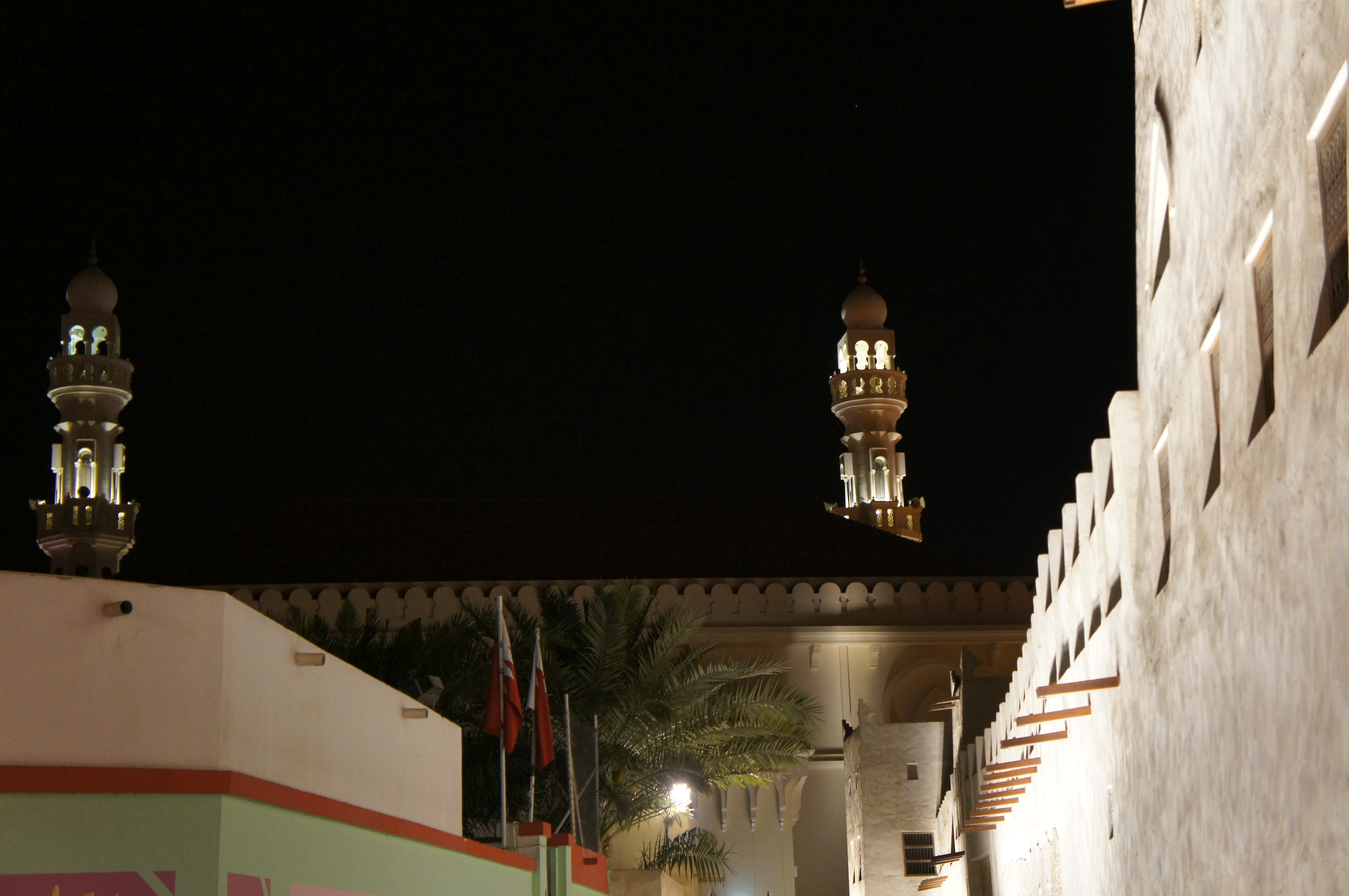
The block where the centre is located has had a face lift in recent years – there are several other houses that have been turned into centres for music, poetry or just elegant coffee shops. Narrow streets, whitewashed walls, old mosques – the kind of place where you would like to take tourists to show them the charm of the old, and where well-heeled locals like to visit to remind themselves of what used to be.
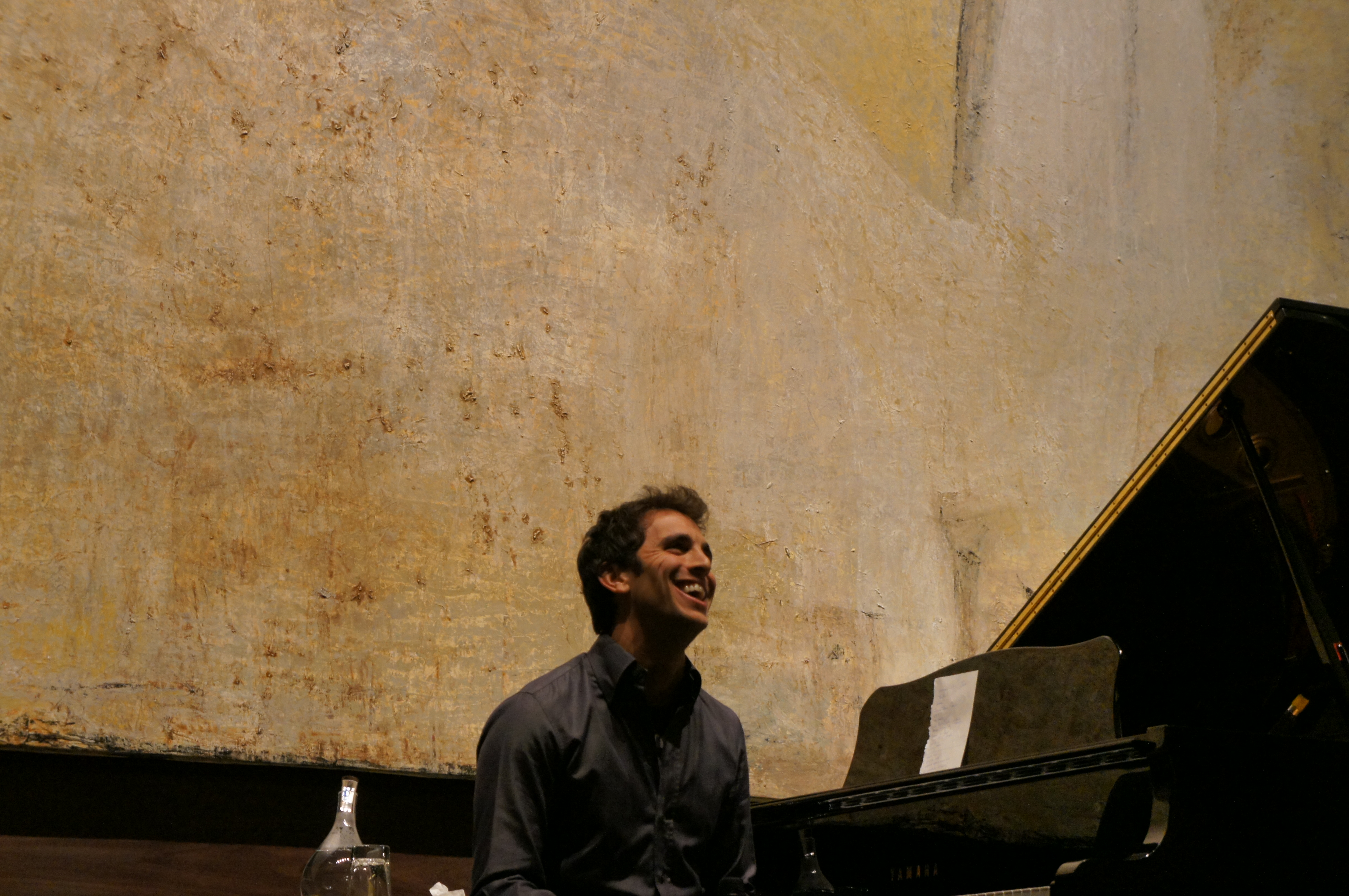
Zade Dirani performed to a packed house – mainly an Arab audience. We were advised to get there early. It was a free concert, so first come first served. And many came, to the extent that the place was packed to the rafters, with people in places that would cause raised eyebrows in Western auditoria. Dirani’s eclectic mix of Western and Arabian influences was delivered with panache and went down a storm, especially among the women in the audience. Not surprising – he’s a charming guy with an infectious grin who bounces around the piano like a cat playing with thread.
Next up was a visit to another landmark that seems to have escaped the troubles – Qal’at Al-Bahrain (Bahrain Fort). It’s an impressive structure that started life as the capital of the pre-Islamic Dilmun civilisation, but owes much of its surviving architecture to the brief Portuguese colonial era and subsequently to embellishments during periods of Persian rule. Thirty years ago you could have wandered around the site picking up shards of pottery, and you would have been left to your own devices. These days, though the fort was empty when we visited – apart from a group who seemed to have escaped from a cruise ship for the day and a lone rider on an Arab stallion practicing dressage nearby – the structure has the well-organised look of a “heritage site”, which indeed it is, having received the UNESCO accolade in 2005.
By the entrance to the fort, there is a small museum that has many artefacts from the site, and a coffee shop where you can sit outside and enjoy the view of the sea and the cluster of surviving date plantations. It’s a pity, though, that someone coyly referred to in the local media as a “VIP” has chosen to build a large residence jutting out to sea smack in the middle of what would otherwise be an idyllic vista. Though I’ve taken visitors to the museum more than once, for some reason this was my first walk through the fort itself. It’s well worth a visit, especially at this time of year when it’s not too hot to wander far.
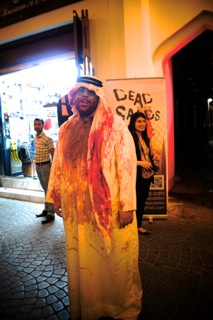
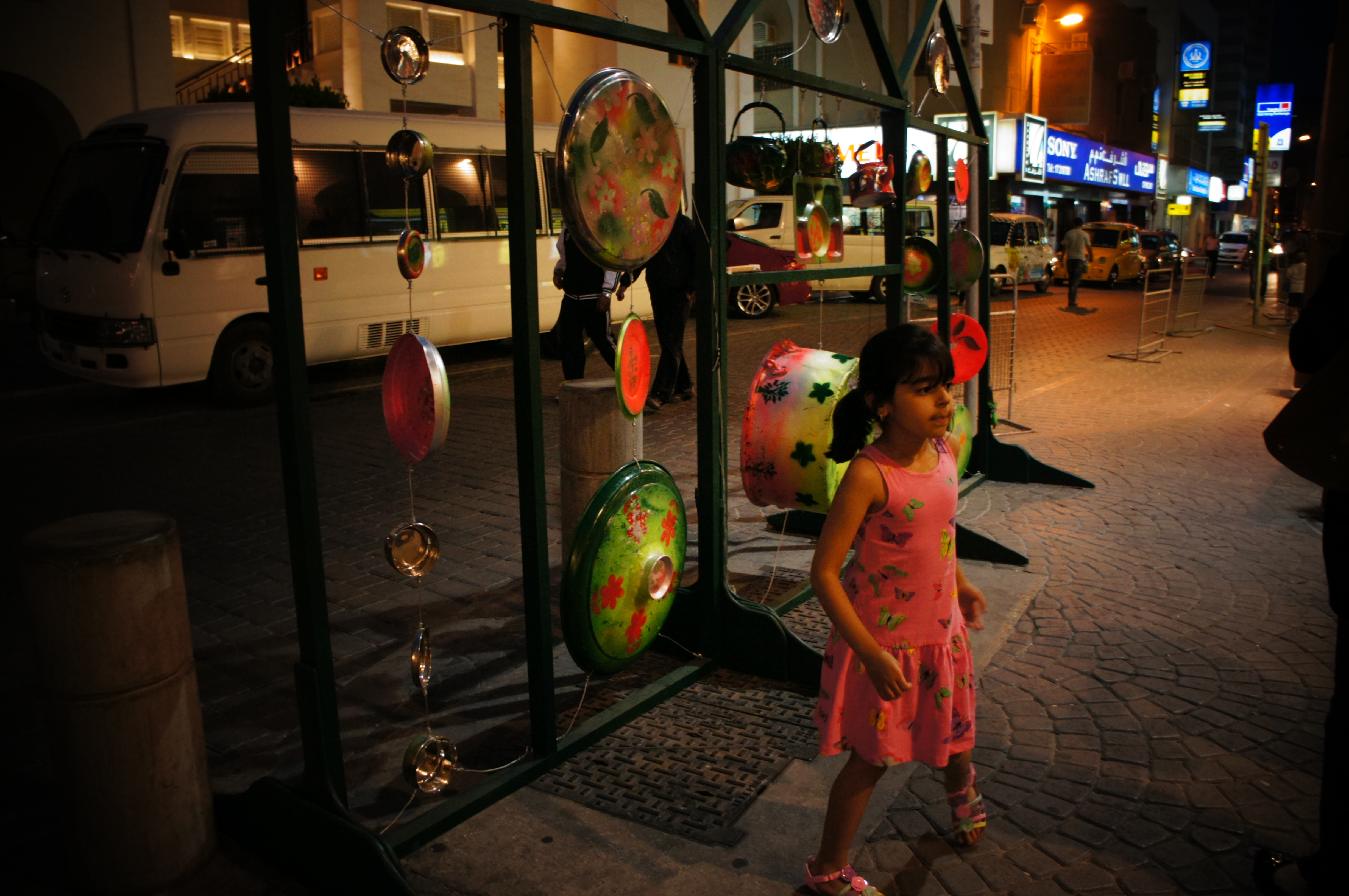
Back in the Spring of Culture, a few days later we took a trip down Bab Bahrain, the gateway to the Manama souk, where there were a number of special exhibits and stalls set up in connection with the event. Giant scrabble boards, percussion arrays built from household objects, Bahraini games packs build by a local school, incense burners, musicians and a blood-spattered zombie being led around on a chain. A nice touch, the latter, except when he started roaring at the visitors, upon which an official came up and began a conversation that began with “Look guys….” We didn’t hang around to hear the rest of the conversation, but I imagine that it could have continued thus: “at this difficult time it doesn’t really send a positive message to all these tourists to have some guy in a blood-stained thobe wandering around, does it?” or something to that effect.
Whether or not the zombie returned to his grave, it was good to see the souk thronging with people again. On recent visits it’s been a very sad place. Shop holders have suffered grievously over the past two years. Some have closed down. Others are barely hanging on. The survivors include my favourite, Roshan’s. There are many shops selling the usual tourist trinkets: coffee pots, wooden camels and ersatz bedouin jewellery. Though it also has some of this stuff, Roshan stands out because of its interesting collection of Afghan artefacts – bracelets, necklaces, seals and message cylinders. Not only that, but a small selection of Umayyad, Abbasid and Fatimid coins, and ancient Greek drachmae from Bactria, the furthest outpost of Alexander the Great’s empire.
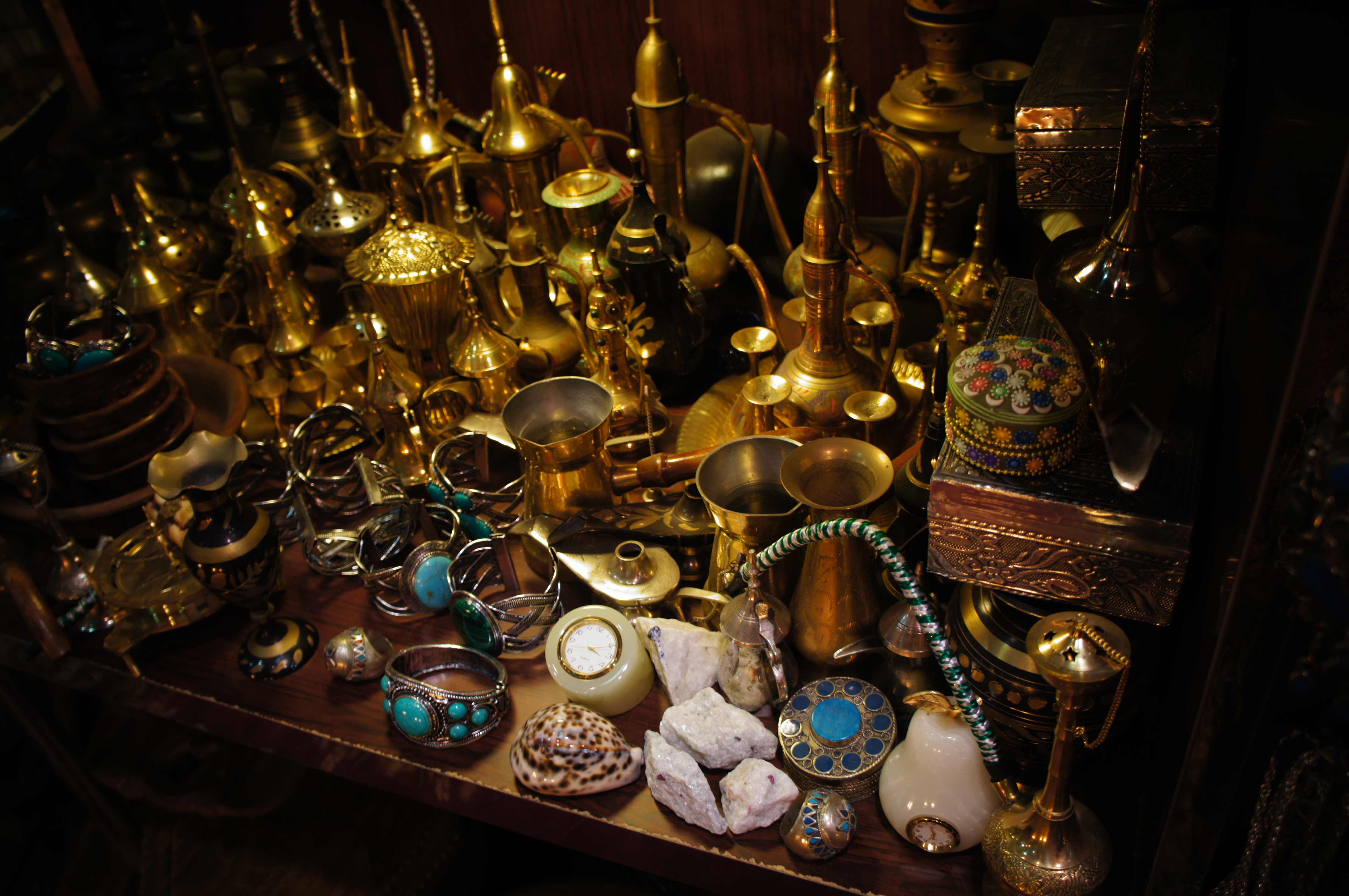
Nicola emerged with a camel whip and a couple of boxes – one made from camel bone and the other from rosewood. The transaction was nicely rounded off by cups of sweet masala tea and a couple of freebie pashminas.
The Bahrain Spring of Culture runs through April. Though many of events are targeted at Arabic-speaking audiences, there are one or two goodies for English speakers – not least a masterclass from my favourite travel writer, Tim Mackintosh-Smith, the renowned Arabist and chronicler of the celebrated medieval traveller, Ibn Battutah.
Whatever my reservations about organised seasons of culture, I congratulate the Ministry of Culture for putting a varied and eclectic programme together, especially as it doesn’t pander mainly to Western tastes. There are performers, artists and speakers from across the Arab world, which is entirely as it should be. And people on the island need to remind themselves that there is another side to Bahrain beyond the seemingly endless grind of unrest.
If you happen to be in the area, it’s worth checking out what’s on during your stay. Next month the legions of Formula I will be arriving for the Bahrain Grand Prix. If you’re a petrolhead with some of your hearing left, a bit of high culture might be a nice counterpoint to squabbling drivers, dodgy tyre compounds and shattered carbon fibre.
By then, Nicola and her Mum will be back in the frozen wastes of England, and I won’t be far behind. Nothing like a break from the Middle Eastern sun…..
PS: Thanks to Nicola Royston for all the pics.
Top flight football in England continues to be at the wild frontier of business – to the extent that it’s a business at all. I’m with Richard Bevan, the chief executive of the English League Managers Association when he says that the number of sackings of soccer managers in the English professional game is “embarrassing”.
Owners of football clubs have always been quirky. Forty years ago many of them would be local worthies who enjoyed the prestige of being associated with a league club, with deep enough pockets to splurge on eye-catching transfers. TV money was modest – no satellite revenue then – and the idea that you might make a buck by selling shirts in China emblazoned with the name of your star player would have had the average chairman choking with laughter over his match-day pork pie.
Fools and their money are easily parted, and there have been a lot of fools in football over the years. They are still there, only they are different types of fools.
Some are greedy, some seem unhinged. Few are football fans. Gone are the quixotic, ego-driven super-fans willing to sink their hard-won fortunes into a local club for the privilege of rubbing shoulders with the great and the good in the boardroom and a few column inches in the daily newspapers in the full knowledge that they would never recoup their investments.
Today’s owners are cold-eyed investors – smart ones and dumb ones. The more successful among them know a bit about sport before they pick their target with a pin on the map. The owners of Liverpool, Arsenal and Manchester United have portfolios of sporting enterprises. They think of clubs as “sports franchises”. They cut their teeth on the North American major leagues of baseball, basketball, football and ice hockey.
Competing with them are the plutocrats with a variety of agendas. Disgraced Thai politicians, Russian oligarchs and operators of Gulf sovereign wealth funds. Some of them are consortia, like the owners of QPR, a club that has seen more ownership changes in recent years than an aging exhibit in a used car auction. And then there’s Venky’s, the Indian chicken producers whose very name must strike the stolid Lancastrians of Blackburn as odd – like a male cousin of those fluffy names favoured by middle-class Indian families for their daughters: Pritti and Pinkie.
Venky’s have managed to get through three managers in this season alone. The last one, Michael Appleton, met his end by letter at the hands of a corporate gofer (Shebby Singh, another name likely to provoke mirth among Blackburn’s far right British National Party adherents) whom he never met during his 67-day tenure. The club’s chief executive hadn’t a clue about the sacking until it happened. It was Appleton’s dismissal that prompted the comment by the League Manager’s Association as reported by the BBC.
Leaving aside for a moment the eccentricities of the owners, what I find interesting about English football is the way it reflects the massive change that globalisation has induced in the national psyche.
When I was growing up, football clubs still had a strong local flavour. Though the burgeoning transfer market produced teams drawn from all parts of the British Isles, more or less every club had a local hero or two – players born and bred in the vicinity. Fans identified with them. They rejoiced in their success. Kids wanted to be like them. That ethos remains in some clubs. Michael Owen, though not a native Liverpudlian, was a Liverpool man from childhood. When he left Anfield to join Newcastle, many of the Liverpool faithful spoke of betrayal.
But these days, fans seem quite content to support their local teams, even when there is not a single English – let alone local – player on the team sheet. They might hurl derision and contempt at the corporate stooges who control their clubs. But they seem as willing to take to their hearts a player from Congo, Japan or Bosnia Montenegro as they would an English lad – provided he does the business on the pitch. The deep affection of Chelsea fans for Gianfranco Zola, and the outpouring of sympathy for the plight of Patrice Muamba, the Bolton player who nearly died on the pitch from a heart attack last year, are cases in point.
Just as football fans have become used to their game becoming an international product – notwithstanding the occasional bout of racist bite-back – so the average Brit on the street accepts as a given that they can go through their lives without ever having to buy a home-grown product. Our software originates largely from America, our cars from anywhere but Britain, even if some are manufactured on home soil. We buy clothes sourced from all parts of the world. We buy white goods from Japan, China and even Turkey these days. And our electronics come predominantly from the Far East, even if they bear the logos of American brands like Apple and HP.
About the only British name you might regularly encounter in a British household is Dyson, and even the eponymous inventor of the rotary vacuum cleaner is now outsourcing much of his manufacturing abroad.
British products, such as remain, have become in many cases retro fashion items – like the Roberts radios in those sturdy padded boxes with handles that used to be popular in the sixties and seventies – now reinvented as digital radios.
After centuries when our economy was fuelled by cheap labour and the import at preferential prices of raw materials from our far-flung empire, we have reverted to our former type – a nation of shop-keepers, or, in modern parlance, of service providers. Also of scientists, researchers and educators. But making things is not what we do any more.
Will we ever return to the factories and foundries that proudly turn out products with “Made in Great Britain” emblazoned on them? Perhaps not until the massive wage differentials between today’s manufacturing economies and ours narrows to the point where goods made and exported from the UK become profitable again. Who knows? It might happen. Labour costs in China and India are rising, whereas the wealth of the average Brit has, by some measures, declined by 9% since the financial crisis begun five years ago. But in the short term, our best hope is to specialise, innovate and hold on to a market lead for as long as possible until competitors manage to trump, clone or steal the technology. Like Dyson – and a host of German manufacturers who are successfully bucking the trend.
Will we ever again see an English leading football club win a championship with an all-English team? Not likely. And I’m not sure anyone in my home country really cares about that, any more than they care about the origin of their cars, jeans, phones and washing machines. I guess we have to be content that in the Premier League we have a market-leading product, even if much of the revenue goes straight into the pockets of foreign players and corporations who will eventually syphon the funds off into tax-efficient offshore locations.
As long as the foreign players keep eating in our restaurants, employing our gardeners, buying our mansions and consuming our fashion, we should be content in the knowledge that a small margin from those transactions seeps into our economy.
Why rational businessmen or plutocrats continue to buy into English football when a run of bad results – through misfortune or incompetence – can cause you lose half of your investment in a year continues to escape me. Perhaps because these days there are enough fools out there with a few hundred million to spare who don’t mind pouring them down a black hole. Which makes you wonder how they came by their millions in the first place. Many of their forays into football look like bouts of temporary insanity from where I stand.
But then I guess it’s more fun than investing in a bank, and no more risky.
The other day I broke one of my major rules in life. In consequence, shortly thereafter, I broke another.
The first rule is: never do business with friends. Actually I have broken that one more than once, to the extent that I have come up with a qualifier: it’s OK to make friends of people with whom you work or do business, but very dangerous to do business with people with whom you are first friends.
The second rule is: never send an email when you’re upset or annoyed. I teach this in just about every workshop I run on communications. By and large I stick to it. Except in this case I was revealed as a hypocrite. The consequences are in danger of proving the rule.
Here’s what happened. One of my business partners in Saudi Arabia needed someone with specific expertise for a short assignment. In the past I have often referred people to him. I don’t get paid for this. I do it in the interests of the relationship and because I enjoy helping people I know to find new opportunities. A long time ago I co-founded a recruiting firm that was pretty successful. I have no desire to go back to that business, but it left me with skills I occasionally use pro bono.
I contacted someone who has been a friend for many years. I will call him Simon, though that is not his real name. The friendship originally arose through Simon becoming the partner and eventually husband of an even older friend of my wife. As is often the case, our wives are the conduit of the relationship. They fix up the get-togethers and we husbands happily fall in with the arrangements.
Simon is well qualified and extremely bright – which are not necessarily the same thing. He has a sardonic sense of humour matched only by Rowan Atkinson. My daughters love him – he has them in stitches of laughter. A few hours in his company are never boring. He is also a natural teacher. He has the gift of explaining things simply.
So when this opportunity came up I sent him an email. He came back to me with a list of questions. He qualified his interest by saying that he was waiting on another assignment that was due to start in April.
We talked on Skype – he is in England and I’m in Bahrain. By the end of the conversation he seemed sufficiently interested to send me his CV, which I forwarded to my partner in Saudi. The partner was enthused, and asked me to send him Simon’s passport details so that he could process a visit visa.
Things went downhill from there. The day after, he sent me an email saying that he “had now had a chance to think about your offer”. He felt that the rate for the job was uncompetitive, and that there would be too much preparation involved. He ended by saying “these are my reservations. We can talk again tomorrow.”
This email came during a busy day. I’m experienced enough to read the implication of Simon’s message, which was that he was not interested, even though he didn’t say so specifically. I was a bit cross, because I was trying to do him a favour, and he implied that I was making him an offer when I thought I’d made it clear that I had nothing to gain from the outcome. Why didn’t he just say no, instead of continuing an unproductive dialogue?
So I sent him rather a direct email in reply, saying:
“My friend, let’s not beat about the bush! You don’t want to do it and that’s fine. I have no interest in this – I was trying to do my partner a favour, and I thought you might find this a bit of an adventure. The money is not negotiable I’m afraid. So no worries, I’ll let him know you can’t do it. Happy to talk tomorrow if you want to discuss further, but I suspect your mind is made up for all the reasons you’ve given. Not a problem!”
A day later he replied: “OK Steve, let’s leave it there”. I signed off in a more conciliatory tone, hoping that a more suitable opportunity would come up soon.
The thing is, I regretted sending that email as soon as pressed the button. I was mildly annoyed, and I had broken my rule never to send an email in that state. What’s more, I wrote it in business mode. I wasn’t thinking of him as a friend, but someone who was in danger of wasting my time with unproductive discussions. If I’d paused for an hour or two, I probably would have ended the dialogue with a simple “thanks, I think this one is not going to happen, so let’s try again in the future”.
The other lesson learned is that one should never cut corners in communications. I was busy. Perhaps I made an assumption about Simon’s intentions that I should have tested more thoroughly in the phone conversation. There’s an interesting concept called the Ladder of Inference that applies in this case.
And now I’m left with the feeling that the exchange has left Simon and me with an altered – perhaps damaged – relationship. I’m sure it can be recovered, but testing the friendship in this way was unnecessary.
Perhaps one of the reasons why not doing business with friends is a principle that holds true much of the time is that most friendships work within a specific framework. Bust the framework, and you find out things about people that you would rather not have known, and perhaps didn’t need to know.
You could argue that deep and lasting friendships only endure through occasional stress testing. You go through things together – good times and bad. You’re there for them, and hopefully they’re there for you, with emotional and practical support. But my experience is that these are relatively rare relationships, especially if you pour much of your energy into your marriage and your kids. Keeping up lifetime friendships with others outside the nuclear family can be tough. Many are called, few are chosen.
This is also why people develop strong bonds with work colleagues. If they are close colleagues, they spend as much time with them as they might with partners and family. Work-related bonds are tested all the time. It’s not so easy to fall out permanently with colleagues unless you leave or they do. In my case, walking away has rarely been an option, since for the past twenty years I’ve been a business owner rather than an employee. So if there are problems, it is in the interest of the business to sort them out and move on.
With some colleagues the bond over time becomes so strong that the relationship gradually turns to friendship. I rarely let this happen while the person is still working with me. But when the business relationship is over, if I admire their personal qualities, I will try and stay in touch – not because they might be useful to me in the future, but because I like and respect them.
And yes, sometime I end up doing business with them again. After all if you have witnessed their trustworthiness, resilience and talents over the years, why not? At that stage you can say that the person is both a friend and a colleague.
There’s a word that has rather fallen out of fashion because of its military and communistic connotations. But taken out of its modern cultural context, the word comrade, and its less culturally specific noun, camaraderie, best describes the shared values, empathy and behaviours that can transcend the barriers of business relationships and personal friendship.
I can only think of one person apart from my wife that I would describe as a true comrade. He knows who he is. As I said, many are called, but few are chosen. There have been others, but they have fallen away over time.
One of my less endearing qualities that has increasingly taken hold over the years is that I’ve become less inclined to suffer fools gladly. Age is supposed to mellow you. Not me. Having reached an age when the top of the hour glass has less sand than the bottom, I’m less prepared for the remaining time to be wasted. I’m not suggesting that everyone who wastes my time is a fool, though I’ve encountered plenty of them in my career. It’s just that I’m a little more ruthless in making judgements about whether a discussion, an opportunity or a relationship is going anywhere.
Here in the Middle East, distinctions between different types of relationships often blur, at least in the perception of non-Arabs. When Arabs refer to a person as a friend, they could be talking about someone who is a work colleague, a business acquaintance or a personal friend. Is that because they are unable to describe the subtleties of different relationships in a second language, and end up with catch-all word? Or does the Arabic language reflect a fundamentally different attitude towards friendship which any foreigner coming to the region needs to understand?
That will be a subject of a future post.
Back in the real world, the unnecessary testing of a friendship reminds me once again that I must practice what I preach.
The Western world kneels at the altar of productivity. From the evidence of a recent conference in which I was a speaker, business people within the Gulf States and Saudi Arabia are pretty keen on it too.
At the 3rd Annual GCC Productivity and Leadership Conference in Bahrain this week, US productivity expert Laura Stack provided some useful ideas on improving productivity by focusing on execution.
It was a message that seemed to go down well with the attendees, as well it might. My experience of business in the Middle East is that there is no shortage of bright ideas. The problems lie in making them happen.
And yet….
In the panel discussion at the end of the conference, I made a suggestion to the effect that if anyone was looking for a good subject for a PhD thesis, they should look at the trade-off between the economic benefits of fully implementing Western concepts of productivity within the region and the potential for negative social consequences.
As Laura rightly pointed out, getting people to work more productively does not automatically mean that you need less people to do the same work. Ideally, it should mean that the people you have will achieve more.
But if you have far more people than are needed to do the work that needs to be done, for an organisation that wants to cut costs or improve profit, staff reductions are a lower-hanging fruit than dreaming up new ways of putting your people to good use. And retraining unproductive staff may quite possibly cost you money before your organisation starts going up the gears.
So is productivity always the golden egg?
To answer that question as far as the Gulf states are concerned, perhaps it’s worth comparing some of the social and cultural mores in this region with those prevailing in the West.
In the West, productivity is king. If we find a better way of doing something, we enthusiastically do it, without much care about the amount of people we need to jettison on the way. Life is cruel. Profit is king. We pay corporate taxes and personal taxes in a variety of ways that have given birth to an army of tax accountants. Tax regimes vary from country to country. But the general idea is that through taxation the state provides us with a cushion to protect us from the consequences of unemployment and social welfare to protect us from the worst consequences of poverty.
In some countries, notably the US, the cushion is relatively limited. The Republicans would like it to be more minimal still because of the crippling debt the country has incurred to support social programs. In others, such as Sweden, taxation is much higher and so is the level of state support of its citizens – high enough to send any self-respecting US Tea Partier running for the hills, muttering darkly about socialism.
But look at any Western nation and you will see variants of the same philosophy – that taxation serves as a method of redistributing wealth to pay for national infrastructure and services, and to prevent its less fortunate citizens from having to sleep rough, starve or succumb from a treatable health problem.
When that system goes out of kilter, you will typically find civil unrest or worse. Marches, demonstrations, strikes and occasionally violence. Whether the semi-bankrupt southern European states such as Greece, Spain, Italy and Portugal will see even worse than sporadic violence – perhaps revolution – remains to be seen. But austerity measures that reduce welfare and pension entitlements typically produce economic pain that translates into social instability.
The argument between Titan, a US tyre maker, and the French government over the company’s decision not to acquire an ailing Goodyear plant is an interesting example of what happens when the drive for productivity comes up against entrenched resistance.
According to Bloomberg, Titan’s Chairman Maurice Taylor broke off negotiations with the French government with the now-famous remark that “I have visited the factory several times. The French workforce gets paid high wages but works only three hours. They get one hour for breaks and lunch, talk for three and work for three. I told the French union workers this to their faces. They told me that’s the French way!”
To Arnaud Montebourg, the Minister for industry, Taylor wrote: “Sir, your letter says you want Titan to start a discussion,” he wrote. “How stupid do you think we are? Titan is the one with the money and the talent to produce tires. What does the crazy union have? It has the French government. The French farmer wants cheap tires. He does not care if the tires come from India or China and these governments are subsidizing them. Your government doesn’t care either. ‘We’re French!”’
An interesting clash of civilisations, Western-style!
What about the Gulf states? In most, taxation is minimal or non-existent. In several, trade unions are outlawed. Private sector businesses are hugely reliant on cheap foreign labour. Because they can get this labour easily, they are reluctant to hire nationals. There are several reasons for this, but primarily the problem is the higher wage demands of the nationals. Saudis, Emiratis and the other Gulf nationals will not accept the minimal standards of living enjoyed by the foreign workers. Also they have families to support, whereas the foreigners support their families in their home countries where the cost of living is much lower.
Meanwhile, the private sector is under increasing pressure from governments to hire more nationals. This is an understandable response to concerns that high levels of youth unemployment will lead to social unrest.
So in the Gulf states the cushion is paid for not by taxation but by (largely) oil and gas revenues. The black stuff pays for healthcare, education, loans to buy property. Many government organisations provide free housing for their staff.
In an environment dominated by fear of social unrest, productivity measures that result in job losses for nationals are not likely to be welcome, even if governments and businesses pay lip-service to the principles of efficiency.
Tales abound of inefficiency and low productivity in government departments throughout the Gulf. I will always remember visiting the office of a senior executive of a state-owned business. In the ante-room sat four nationals basically doing nothing during my lengthy wait to see their boss. It was a phenomenon I have seen frequently ever since. Drinking tea, reading the paper, chatting with their mates. Enough to give Maurice Taylor the heebie-jeebies. In a Western office they would be out on their ears in ten seconds.
But now consider the culture within they work, and the ethos of the society in which they live.
At the risk of coming over as a naïve orientalist, as I see it the dominant ethos in the Middle East is that of the family. Beyond the family, perhaps the tribe or the local community. At the apex of the society is the ruler. He is the head of the national family. On his accession his subjects swear an oath of loyalty that is binding unless his behaviour renders his rule illegitimate. As the father it is his responsibility to protect his people, and to do whatever he can to ensure their welfare. Under him there are numerous other fathers, each with their own tribe, region, community, ministry, company, extended family or nuclear family to look after.
So if you are the head of a large family, what is important? If you have unproductive members – the old, the young or perhaps the lazy or less talented, would you turn them out on to the street to fend for themselves? As long as they obey the rules of the family, of course not. You might try to make them more productive, but not at the expense of family cohesion.
In just about every Gulf state the government is the largest employer of nationals. In Saudi Arabia, as of 2009, 86% of the Saudi workforce worked in the public sector, according to the International Monetary Fund. If productivity measures were to reduce that workforce by ten percent, the effect would be a significant addition to the unemployment figures and potentially a source of considerable hardship and resentment.
The question is: if you are the head of the family, and you can afford to carry the less productive members within your nuclear or extended family, why would you not do so?
Even in the private sector, where family bonds are somewhat weaker – although this is often not the case within the Gulf’s large and powerful family businesses – it would still be understandable if owners felt a certain squeamishness about getting rid of people they could afford to keep on the payroll.
For this reason, whatever noises come from governments and business leaders about the need for increased efficiency and productivity, the headwinds of the family ethos will always work against the more extreme measures we are used to in the West, even if the private sector is beginning to embrace those measures, as witness the growth of outsourcing in the region.
What’s more, there is no doubt that traditional family values are weakening. Young people are questioning the wisdom of their elders as never before, their impertinence fuelled by the political upheavals elsewhere in the Arab world and enabled by the social media.
All the more reason for the elders to fear the cold blast of Western-inspired change.
Western observers are all too happy to criticise the Gulf states for what they perceive to be the dark side of their societies: the treatment of low-cost foreign workers, the role of women, the lack of democratic institutions.
But it’s easy to understand why a Saudi or an Emirati might feel that some double standards apply as we in the West ruthlessly downsize in the interest of productivity and profit. Where staff show up for work one day and leave an hour later with a final paycheck and their personal effects in a cardboard box. Where the unemployed lose their homes while bankers pocket huge bonuses without feeling any sense of responsibility to the less fortunate in their communities.
And why some people in this region might feel that productivity is not the only measure of a successful society.
Just about everywhere in the world, the conventional wisdom is that small and medium enterprises are the engine for economic growth. Encourage them, create the right regulatory conditions for them, and some of the little acorns will grow into mighty oaks.
But does this philosophy pay dividends in the Gulf Cooperation Council (GCC) countries – Saudi Arabia, Kuwait, Bahrain, Qatar, Oman and the United Arab Emirates – where government support in the form of subsidies for start-ups are part of wider strategies to boost the employment of GCC nationals?
In Bahrain at least, perhaps not.
The other night I took part in a discussion organised by the Bahrain Economic Development Board and the Institute of Banking and Finance. One of the panellists was Dr Jameela Al Mahari, who is a lecturer in entrepreneurship at the University of Bahrain.
Dr Jameela believes that the subsidy policy for SMEs in Bahrain does not discriminate between family businesses, which are not necessarily entrepreneurial, and start-ups with genuine entrepreneurial instincts – defined broadly by innovation and paradigm-shifting.
The former, she claims, contribute little to the Bahraini economy because most of the jobs created by their growth are filled by low-cost foreign workers. Although these businesses bring economic benefit to the owners and their families, they create few additional jobs for Bahrainis. And the overall gain for the economy is possibly balanced or even outweighed by the cost of the infrastructure and services needed to accommodate and support the additional foreign workers – housing, health, transportation systems, water and electricity (which are themselves subsidised).
It’s an interesting idea that – as she readily points out – needs to be tested by research and data.
Bahrain, in common with the other GCC states, has a massive youth bulge – according to a statistic quoted in the meeting, 52% of Bahrainis are under the age of 24. Leaving aside the socio-political impact on the economy of the current unrest – which is admittedly hard to do – the fact remains that finding employment for these young people is and will continue to be a high priority for the Government.
So what is the best strategy for achieving this?
The approach over the past fifteen years has been both to encourage start-ups and to attract big-ticket foreign investment that brings with it new jobs for Bahrainis. Given the current instability, Bahrain has a tough job persuading new investors to come to the island. It faces strong competition from the likes of Dubai and Abu Dhabi.
So organic job creation, aided by liberal doses of financial Baby Bio applied by the government, becomes ever more critically important. You might argue that now is possibly the worst time for young (or old Bahrainis) to be thinking of starting new businesses.
However, the situation as I see it is not all doom and gloom. Bahrain has plenty going for it.
For a start, it has a large population of highly educated young people. There are 20 public and private universities catering for just over half a million Bahrainis. The country does not have the resources of Saudi Arabia, which currently has over 120,000 students studying at foreign universities. But it does punch above its weight in producing large numbers of talented and well-qualified young people.
It also sits next to two of the wealthiest of the Gulf States – Qatar and Saudi Arabia. It is a member of an economic zone designed to facilitate freedom of trade and movement.
And finally it is a society that is both technically literate and has a long tradition of linguistic literacy.
So I would question the wisdom of diverting funds towards those businesses that Dr Jameela sees as non-entrepreneurial – hardware stores, restaurants, small construction companies, importers of foreign products. All of these are inward-looking activities, and they are the types of businesses most likely to struggle in times of civil unrest.
It seems to me that Bahrain should focus on exporting expertise and intellectual property to its neighbours in the Gulf. But what kind of expertise? The country has plenty of knowledge of financial services, oil and gas. But so do its neighbours.
Perhaps one of the most promising export opportunities would draw from a combination of cultural and linguistic literacy.
Of all the GCC states, the country has the longest tradition of multi-cultural interaction – rivalled only by Jeddah, the gateway to the Mecca pilgrimage, the Haj. Even today, when reading as a pastime throughout the Middle East has been largely replaced by the attenuated delights of Facebook, Twitter and YouTube, a deep tradition of literature – especially poetry – and song is alive and well on the island. And despite the sectarian undercurrent that also runs deep, the major world faiths and their followers have coexisted for a century in Bahrain in a way that is unique among its neighbours.
If you combine that experience and knowledge of parallel cultures with the massive adoption of computer technology in the region – ranging from social networking and mobile applications to enterprise systems – and you have an opportunity for a GCC country to become pre-eminent in developing software that is designed for the Arab world, yet moves easily between Arab and non-Arab users.
Most software products sold in the GCC are produced by enterprises outside the region – giants like Google, Microsoft, Oracle and so forth. The localisation of those products is often grudging and sometimes ineffective. Arabic interfaces are usually an afterthought – tacked on long after the product design is set in concrete.
Why then does Bahrain – or any of the other GCC states for that matter – not harness its technical resources in designing software products that are built specifically for the 200 million Arabic-speakers in the Middle East and North Africa?
If hybrids of Arabic and English increasingly dominate the Arab parlance in the social media, who is surfing that wave and designing specifically to support the hybrid? Why is it that Arabic characters embedded in English text have to be represented by numerals, for example?
The penetration of Facebook and Twitter in the GCC has mushroomed – a perfect sales medium for Arabic apps and cloud-based enterprise software. Both fixed and mobile broadband use in these countries has become common currency. Where are the Arab developers who are challenging the clunky products imported from the West? Where is the Arabic Weibo?
Can’t be done, I hear my Arab friends say. Bahrain is very different from China. We are consumers, not creators. The big software players are struggling to monetise mobile apps. How can we do so?
I can only say that this was the reason behind Nokia’s decision to focus on the 3G market at the expense of its investment in 4G phones. In its pursuit of short-term profit, it couldn’t see beyond its nose.
And then what of e-books? The platforms now exist for all manner of e-books that go well beyond the flat text you can download to a Kindle. Western publishers are now developing exciting products that use audio, video, great graphics and interactive feature, and seamless interfaces to the web. Why is it that nobody is investing in Arabic e-books that push the boundaries? Books that can be accessed by smartphones and tablets, and that play to the preferences of the local market?
This is another opportunity for Bahrain that could soon slip away. It won’t be long before technology-savvy countries like Dubai and Egypt move to fill the gap.
Then there’s e-business. Very few small businesses in the GCC have woken up to the possibility of selling their products and services through the web. E-consumers in the region are still somewhat cagey about entrusting their credit card information to the web. Many of those that do prefer to pick up their purchases rather than rely on delivery services such as couriers.
But that will change over time. Traditional traders who fail to see the opportunity to boost their businesses with online sales will find it harder to grow, and harder to escape the local constraints that are currently holding back their businesses.
Bahrain does not need to import large numbers of foreign workers to become pre-eminent in these fields. It has abundant local talent that I suspect would welcome the opportunity to get involved with start-ups that push out the boundaries in their own region and create products that don’t have a foreign logo all over them.
I might be completely barking up the wrong tree. But in my opinion this is where Bahrain’s economic investment needs to go. It will produce more dividends in the long run than bringing yet another bank, insurance company or foreign consultancy to the country. And there are enough restaurants, cake makers, builders and shoe shops here already.
A knowledge economy takes generations to build, whatever the rhetoric from just about every GCC government maintains. But you’ve got to start somewhere.
Leveraging literacy and technology would great way for Bahrain to go.
I know little about Yahoo beyond what I read in the media. But the decision by the new CEO Marissa Mayer that remote workers will have to start coming to the office tells me one thing: that the company is a dead man walking.
Here’s why.
One of the reasons quoted in the memo for arbitrarily ending a practice that has effectively become a right through custom is that it perceives home workers to be less productive than office workers. In other words, it doesn’t trust them to be productive.
You do not re-energise a company by forcing people who are allegedly unproductive at home to show up at the office. Not only will they continue to be unproductive, but they are highly likely to be unproductive with a grudge. And their lack of productivity will degrade the effectiveness of others.
It’s true that many people thrive on working physically alongside others. Yet others don’t. They hide in their cubicles and emerge only when it’s time to go home. Is a company the poorer if it lets people whose jobs don’t involve a large measure of team activity work from home?
If the purpose of the move is to induce those who work at home to leave the company, Yahoo will succeed in that aim. There will be enough people who will look for other jobs because they believe that that the company has breached an informal covenant allowing remote working.
But what then? Bring in a bunch of enthusiastic, creative Google types and use them to give Yahoo a kind of corporate bone marrow transplant? Sorry. It won’t work. The wrong cells in the wrong body.
Then there’s the idea that bringing people back to the office will help to create a sense of “one Yahoo”. I’m afraid that’s a typical top-down fantasy dreamed up by people who see themselves as transformational leaders. In terms of typical lifecycles of technology firms, Yahoo is a middle-aged company. If it is like its peers, it will consist of a large workforce that mostly works to live rather than lives to work. It will have as many differences in style and culture as it has leaders, managers, departments and country operations.
“One Yahoo” implies common values, common behaviours and a common sense of purpose. You don’t create those things by calling people Yahoos or IBMers, and giving everyone a company T-shirt. Nor do you do so by providing free food, bagels on Friday and lots of comfy sofas near the water fountain. If people are demotivated, they will simply continue to bitch and moan while stuffing themselves with bagels and lounging on the sofas.
My experience tells me that the life cycle of technology companies looks something like this.
You start with a small band of like-minded people excited by what they are creating. The esprit de corps comes from the perception that being at work is more fun than not being at work. The camaraderie comes from being in love with the business, what it does and what it stands for. A sense of being one of an elite band. Of belonging.
Over time, the business becomes successful. It makes a stack of money – or it looks like it will in the future. But it retains a sense of organised chaos because the infrastructure never catches up with the growth. And since there are a lot of young people who prefer the wild west to the suburban lawn, the key actors stay with it. Except that their motivation subtly changes. Gradually the prospect of becoming fabulously wealthy comes to the forefront. Of course the owners were most likely looking towards the big payday from the start. But by now everyone is looking at their share options and figuring out what they will be worth come the IPO.
Two, maybe three years before the flotation, the suits arrive. Older people. Advisors from Goldman Sachs poring over balance sheets. A Chief Financial Officer. Perhaps even a CEO because the founders haven’t a hope of convincing the market that they know how to run a grown-up company. (The firing of Andrew Mason, CEO and founder of Groupon is a recent case in point). HR people draw up succession plans, competency maps and procedures telling you how to apply for leave, when previously you would just send an email to the boss and disappear. A purchasing team applies its icy grip on the company’s expenditure.
The pioneering few who were there in the early days stay with it. They are upset at being chucked out of their sand pit, but by now the dollar signs are the reason why they get up in the morning.
Come the day of the flotation, everybody’s rich – at least on paper. People start thinking about what they will do with the money. Some of them cash in and leave, perhaps to form their own start-up, or maybe to enjoy the Ferrari and the hillside mansion overlooking the bay. The latecomers look with envy at the pioneers and start dreaming of cashing in on their share options. If the company is lucky or smart, it will still have cadres of creators for whom the joy of creating is the driving force.
But as new people come in, and offices or factories in Taiwan, France, Hungary and Brazil start springing up, the business starts looking like any other multinational. The drivers are now KPIs, market share, profit, share price. And the pioneering spirit of those who live to work is slowly drowned by the ethos of those who work to live, or for whom money is the primary mission.
Among those who remember the early days, talk is of how things used to be, not of how things can and will be.
This, I suspect, is where Yahoo is today. Bagels and sofas will not bring back the old days. Nor will gene therapy that seeks to implant the DNA of Google. Turning online meetings into physical ones won’t improve the quality of the meetings. People will still email their neighbours two yards away suggesting a coffee break. And new employees will soon become as demotivated as the old timers.
For what it’s worth, if I was in Melissa Mayer’s shoes, I would have done two things.
First, I would have looked at the home workers and determined which of them were in the kind of roles best carried out by people working “physically together”. I would have then phased in the change, starting with mandatory attendance two days a week, and ending with full attendance after a year. The others I would have left alone, but as they left the company I would have replaced them with office-based hires.
Second, if I was going to apply a bludgeon, this is what I would have decreed:
- No more than two hours a day in meetings with more than one other person
- No email to be longer than three hundred words
- No internal email string to be longer than three messages – if you have not concluded your business by then, pick up the phone or go and see the person
- No email to be copied to more than three people.
The biggest productivity drain in large corporates is interminable meetings and endless email. Address those issues and you free up time to think and do, as opposed to talking about thinking and thinking about doing.
It seems to me that Yahoo now has two choices.
It can accept that it is what it is – a middle-aged corporation that is a slave to its shareholders who don’t give a fig for what it does or what it stands for. Within that aging body it can still create elite bands of motivation and creativity – much as Lockheed Martin did with its Skunk Works and IBM has always done with its laboratories.
But it would do well to recognise that shock therapy can have unintended consequences, and that change should be brought about with a rapier, not a bludgeon.
The other option – which seems consistent with the current direction, even if it’s unintentional – is to rip the edifice down. Which effectively means downsizing, selling off bits, being acquired, dismembered and “integrated”, or junking product lines and completely re-inventing the purpose of the company. What’s left is a business that – to use HP parlance – is back in the garage. Except that I can’t think of any technology company other than Apple that has succeeded in doing this. The other oft-quoted example of reinvention – Nokia – appears to be on a path from paper mills and wellington boots to mobile phones and ultimately to the junkyard.
I can’t see the first option working if the now-famous memo reflects the mindset of the current leadership. The company’s products and services are relatively ephemeral and easily replicated – unlike IBM and HP, whose evolution has been underpinned by a deep well of intellectual property, knowledge and expertise. If Yahoo shuffles off the stage, any vacuum its departure creates will quickly be filled by Google and Microsoft. Yes, it can acquire as a means of introducing new intellectual property. But would the shareholders view this as throwing good money after bad? And Yahoo does not exactly have a shining reputation for turning its previous acquisitions into gold.
The second option is effectively the death of the company, and that’s where – to my entirely uninformed mind – things are heading.
After which – two or three years on – perhaps Marissa Mayer and her transformational cohorts will move on to work their magic on another sclerotic multinational. Or maybe start a new Google with Yahoo’s IP acquired for a song.
The graveyard is waiting. And who today remembers or cares about Digital, Compaq, EDS, Autonomy, ICL, Motorola and a host of other technology giants, except those who occasionally recall “how it used to be”?
Yesterday I spent an evening at a seminar on personal relationships in Bahrain by Dr John Gray, author of Men are from Mars, Women are from Venus. I also sat in on his morning seminar that covered relationships at work.
John Gray is about my age. Though we come from countries far apart, in many ways we speak the same language. We share many of the reference points that sprang from what was once known as the counterculture of the Sixties and Seventies. So I was fascinated to watch this supremely high achiever in action.
He practices what he preaches. He listens. He is charming. He is relentlessly energetic. He spent around seven hours on stage. During breaks, he signed books and posed for photos. Between the two seminars, he had lunch with delegates and managed a radio interview. From 7.30am through until 10.30pm, he barely had a moment to himself – effectively a fifteen-hour performance.
He is a great speaker. Everything I teach about public speaking, he does par excellence – humour, use of stories, stagecraft, eye contact, gestures, engagement, use of props, pauses and timing.
He also has that very American way of unashamedly talking about his achievements. It’s a style that goes against all my British instincts. Brits from my background are taught from any early age not to boast, to be modest and self-effacing, to downplay our achievements, to let others come up with the superlatives if they will.
That’s not John Gray’s style. He is happy to let you know that he is the world’s foremost expert in relationship counselling, that he has sold 50 million books in 50 languages. But there’s a difference between confidence and arrogance. In the palette of emotions, arrogance has a strong tinge of fear. Gray is not a man who emanates fear. His kind of confidence comes perhaps from the sense that he has nothing to prove – except possibly to himself. Very different from the brittle showmanship of a Mohammad Ali, a Jose Mourino and a host of others who give you the impression that they can’t quite believe in their self-created myths.
What of the audience? It’s an ironic coincidence that Gray was visiting Bahrain at a time when all manner of relationships are under the severest pressure. He tactfully avoided referring to current issues. His statistics for divorce in the country were in reference to the 2008 financial crisis rather than to the strains of the moment.
I sensed that the auditorium was a bubble of alternate normality – an opportunity to think about relationships outside the toxic political and social box that prevails in the country today. Most of those who attended were Bahraini, and the women outnumbered the men. They were warm, enthusiastic and responsive.
For me it was a pleasure to catch up with Bahraini friends and acquaintances. I will repeat what I have said again and again in this blog. The Bahrainis are the saving grace of Bahrain. Strip away the superficialities typical of any Gulf state – the ostentatious buildings, monuments and symbols of nationality. Listen beyond the strident rhetoric of the loud voices in this society. Look beyond the reptilian reactions of the few.
Beneath the surface still lies the well of idealism, kindness, humour and goodness of heart that attracted me to the country in the first place. Not just among the few hundred high-status individuals who were in the audience last night – but among the ordinary people you will encounter on the street, in the souk, the farmer’s market and in the office. Not saints – full of the frailties and flaws you will find in any country – but a people with immense potential for building a civilised society that can be an example to its neighbours in the region.
In the morning session, Gray argued that people who have satisfying, intimate relationships do not feel the need to fight. A message reflecting that iconic watchword for his and my generation from our formative years: “make love, not war”. Simplistic maybe, but not a bad starting point.
John Gray’s theories on the differences between men and women and the practical advice he gives for building relationships based on that understanding are not going to solve Bahrain’s immediate problems. Nor was that what the seminar was about.
But I was still left wishing that within his hectic schedule he could have been invited to spend a few hours with the leaders currently engaged in trying to find a way through the impasse. It couldn’t have hurt. It might have helped.
Yet all in all, a good day in Bahrain.
(Note: these are personal views and don’t represent the opinions of the participants, organisers or of Dr John Gray)
The other day I wrote a rather bitchy piece about LinkedIn. It produced a bit of a reaction here and there, and a noticeable spike in traffic to this blog. Which of course I appreciate. Though my friends know that it’s very dangerous to encourage me.
So since we’ve been talking about my relationship with its suited cousin LinkedIn, what of Facebook?
One of my main problems with Facebook is dogs. Now don’t get me wrong. I’m not a canophobic. We have a large dog whose entry into the family I grudgingly consented to seven years ago. But I do not drool over it as other family members do, and post its picture on Facebook on a regular basis. In fact it drools over me, not because I’m adorable, but because its snout is twelve inches away from my dinner.
OK, it’s a she, like everyone else in my family. Perhaps she quite likes me, and I quite like her. But that’s as far as it goes.
And one dog is enough, thank you very much. For some strange reason I seem to have collected a number of friends on Facebook who delight in posting pictures of dogs – loads of them. A never-ending stream of dogs. And their posts tend to crowd out everyone else’s.
Occasionally I wish they would also post pictures of dog hair tufting up at the back of the sofa and drifting around the house like brushwood. Or those yellow patches on the lawn. Or the owner doing the poop patrol and dragging them away before they can sink their fangs into some Jack Russell’s hindquarters.
Because that is the other reality of dogs. Those smoochy pooches posing on Facebook in all manner of winsome settings – followed by a cascade of adoring likes and aaahs – have a dark side. They poop, they pee, they salivate, they bark. They smell – at least some of them do – like moth-eaten aristocrats or truffle pigs. And they fart at inappropriate moments, such as when you have friends round or you’re in the middle of the final episode of Downton Abbey, prompting wrinkled noses, accusing stares and cries of outrage.
Another thing about Facebook is that I often feel I shouldn’t really be there. As my young, upwardly mobile ex-colleagues cavort in various exciting parts of the world – they don’t bring their dogs with them by the way – I see their pictures of parties in Perth, daiquiris in Dubai and orgies in Omsk, and I feel like a crabby old priest in an Irish dance hall.
Then there’s my daughters. Why they put up with having me as their friend, heaven knows. When I was their age, the last thing I would have wanted was to give my parents a window into my world.
You could argue that as a Dad it’s good to know what your kids are up to. No it’s not. They are adults. It’s not my place to approve or disapprove. And there are times when they tell you things you would rather not know. Such as the time when my older daughter found herself and boyfriend face to face with an angry bull elephant in Kenya. That kind of stuff doesn’t get on Facebook. All the fun stuff does – which makes you wonder what more fun – of the dangerous kind – lies beneath.
What of the old farts of my age, who are not ashamed to display themselves growing old disgracefully? I look at them and think “do I look like that?” Well yes, and probably worse. This is one of the reasons why I put virtual blinkers on when I go to an Eric Clapton concert. All the paunchy, balding guys with shaggy Afghan coats rocking arthritically to the master’s music – they are me. Minus the Afghan, fortunately – that decomposed a long time ago. Focus on the music, Steve, you are not like them! You are still 21!
Nestling among the dogs, the daughters and the decrepit are the erudite. People who post in Latin, or write serious mini-tomes on incredibly elevating subjects. I ask myself what right I have I to be granted this little keyhole into their ethereal minds, to be exposed to great thoughts and insights I could never emulate.
I also have mixed feelings about the gurus whose posts I have signed up to. People like Robert Fisk, one of the few people who can match me in grumpiness. You look at his posts and they have a thousand likes! Well OK, he is after all one of the finest political journalists in the Middle East still standing, so I guess he deserves his likes. But he doesn’t need them, and why can’t I have a few? Whoops, there’s a lapse into the inner Iago. Actually I only said that for effect. Likes – like endorsements on LinkedIn – are a debased currency. Balm for the ego, but they don’t pay the rent.
And finally there are the comments to your friends’ posts by people you don’t know. Witty, fun, yet unreachable. They leave you thinking that there’s an alternative universe out there, full of interesting people you never met, but might have met had you made different choices in your life. Yeah well, in that alternative universe I might have para-glided into a rocky ravine and broken my neck, or drunk myself to death in Marrakesh.
So I guess I’m fine with the dogs, daughters, degenerates and party-goers that populate my Facebook world. In amongst them are people very dear to me – real friends. It’s good to know that they’re still alive, and I enjoy reminding them from time to time that I am undead also. Even if my brief interventions are as rare as white smoke from the roof of the Sistine Chapel.
Would my world be diminished without Facebook? Not as much as Mark Zuckerberg’s for sure.
The Bible says “do unto others as you would have them do unto you”. This principle is known in secular circles as The Law of Reciprocity. It’s also a widely used technique for influencing people. Give somebody something, according to Robert Cialdini, author of Influence: The Psychology of Persuasion, and you can often expect to receive something out of proportion to the value of what you gave.
So I guess this explains why people keep endorsing my formidable skills on LinkedIn. They include some who have no experience whatsoever of my practising the skill for which they are endorsing me. Which makes the whole exercise rather futile, really. I know, they know, and probably most people who use the site know that endorsements are a debased currency.
So why bother? The truth is that they are not really bothering at all. LinkedIn is a software engine. It keeps prompting you to endorse people, connect with people, find new people to connect with and so on ad cybernauseam. As with the like feature beloved of Facebook and other social media apps, all these actions can be taken with the click of a button.
If I try to connect with someone – which I very rarely do by the way – I click the button, and if the person doesn’t respond they get an email a few days later reminding them to respond to me. I didn’t send the follow-up. LinkedIn did.
LinkedIn tries to make me feel guilty if I don’t respond in kind. If I fail to accept a connection, or if I don’t endorse the person who has endorsed me, I’m intended to feel like a heel. It’s a bit like Christmas cards. You get a card from the Smiths, and you think oh dear, we didn’t send them one this year. We’d better rush out and put a card in the post. At least with Christmas cards you need to make an effort, even if it’s writing your name on the card, the other person’s address on the envelope and shoving a stamp in the right place. With LinkedIn, there’s no effort whatsoever – and perhaps, no value either.
I know people who swear by LinkedIn as a way of generating business. One person I know was clearly delighted to be informed by the site that his profile was among the top 1% of viewed profiles in the world. He sent an email to all his contacts telling us about his former wives, his children’s names, his best mates’ names and the magnificent house he’s trying to sell, and even that he has lost 27 kilos in the past year. Not to mention his entire professional life story over 40 years. Personally I would rather walk naked down the high street in my home town with a slop bucket on my head than indulge in that level of disclosure. But then he probably knows much more about self-promotion than I do.
The moral of the tale is that he would never have sent that email without LinkedIn’s timely prompt, guaranteed to massage his ego? And who benefits? Probably LinkedIn as much as him.
So perhaps you’re wondering why I bother to be on the site at all. I sometimes ask myself that. I suppose the answer is that one day I might really need it. Or maybe one day someone might contact me for some really interesting reason. But in the ten years since I first joined, I can’t recall either ever having happened. Perhaps that’s because despite my much-endorsed skill-set I am fundamentally a deeply boring person!
I do get a certain pleasure in finding out what acquaintances and former business associates are doing at any time. But a good 50% of my contacts – including some who claim to have known me or worked with me at various ports of call – I have never met in this life or any other as far as I’m aware. Why do I agree to connect with these strangers? Well, you never know. Maybe, just maybe, they might have a seriously interesting proposition or background. Maybe they might be someone I might want to do business with. But it hasn’t happened thus far.
Yes, I know. I don’t get it, do I?
You get out what you put in, as the Law of Reciprocity dictates. Which is probably why I only have 227 connections instead of the zillions others seem to have.
But here’s the thing: I’m not looking for a job, I’m not looking to employ anyone and I manage to do enough business without having to send emails boasting about my profile.
Yet I do quite like people looking at my profile and asking to connect with me, even if I have no expectation that there will ever be any outcome from that very weak transaction. Occasionally people seek me out who I genuinely have worked with, with the result that we have an enjoyable catch-up. And I quite often get feedback from people who pick up on this blog through the site, which is great.
But I don’t like being manipulated by a software engine, which is partly why I tend to be a bit of a curmudgeonly non-participant.
For what it’s worth, here are my four simple rules of engagement with LinkedIn:
- If I endorse you, it’s because I really mean it, not because I want you to endorse me in return.
- If you contact me with some proposition that clearly demonstrates that you know nothing about me or my profile, I will ignore you.
- If you contact me because you are someone I know, you want to say hello or ask for advice, I will always respond to you. If I can help I will, but I won’t make promises I can’t keep.
- If you contact me because you want to add me to your network, give me a reason I can understand and relate to, and I’ll be happy to press the button.
And that’s it. Hopefully I’ve saved you a few milliseconds of your valuable time with this information.
The social media can be a colossal waste of time – a way to make you busy without really achieving anything. Just as in the Nineties the new time waster was email – which continues to be so when misapplied – social media are the star productivity drain of the Teenies.
I’m sure LinkedIn is a wonderful resource for some people. Otherwise why would the company have a market value of over $17 billion? Unless, of course, fools and their money are easily parted.
Personally, I really don’t understand what the fuss is all about. But then again I’m not worth $17 billion.
And you know what? I’m promoting the site by just talking about it!!!
Sweeney Todd would be cackling in his grave. The Demon Barber of Fleet Street, who transformed his human victims into meat pies for the benefit of 18th century Londoners, would have enjoyed the thought that meat eaters throughout Europe have been unwitting consumers of horse flesh and perhaps even donkey meat in their burgers and lasagne.
Pony Club members will be grief-stricken in the knowledge that they have most likely dined on the cousins of their pets. Muslims will be outraged to discover that they have eaten pork. And I suspect that the current furore will launch a new generation of vegetarians disgusted at the realisation of just what ends up on their cheap ready meals, and how it got to their plates.
I’m afraid I won’t be among them. For I am guilty of having knowingly eaten all manner of meat that might give the tender-hearted the horrors. Rabbit, reindeer, camel and horsemeat “steak haché”. On a visit to South Africa I once patronised a gruesome restaurant called Carnivore, where muscle-bound Boers in shorts prowled around a fiery grill serving ostrich (very tough), antelope (likewise) and zebra (delicious). Bushmeat, as monkey is euphemistically known as in Africa? No. Consuming other primates feels a bit close to cannibalism for my taste. And dog? I just about survived the zebra confession to my family. I suspect that if I owned up to dining on Rover, an abrupt termination of relations would ensue.
But I’ve no doubt that in extremis I would eat almost anything to stay alive.
The current issue, of course, is not what we eat, but knowing what we eat.
OK, so we now know that bits of other animals get into our beef products, and that our burgers consist of all manner of body parts scraped, mangled and chewed into shapeless red globules of protein.
But do we know where everything else we eat comes from, and how it is produced?
When we buy farmed fish, for example, do we know about the chemicals used in fish farms to keep infection at bay. Do we know how those nice tiger prawns from Thailand and China are farmed? And have we any idea of what chemicals are used to keep our supermarket fruit ripe, and what effect all those additives listed on food packaging have on our bodies? Hell no, until some researcher comes along to tell us that we’ve been poisoned by trans-fats, flavouring agents or artificial sweeteners for all these years.
Nothing new here. Three decades ago I started to develop eczema. It still flares up occasionally. My wife swears that it was a reaction to the steaks we used to eat in Jeddah that came from the place of her birth, Ireland. This was at a time when another scandal brewed up over the extent to which cattle were fed antibiotics both in Ireland and the UK.
So this is what it comes down to. You want cheap food, you accept that you will eat bad stuff from time to time. You hope that the food safety regulators in your country have a good handle on what is going into the food chain, but you’re not surprised at the occasional shock horror revelation.
If you don’t like it, grow your own food – or double your budget and buy only produce with an unimpeachable provenance. Not so easy if you live in a city and have limited means.
Medical science is devoted to keeping us healthy and giving us the opportunity to live longer lives. Nature – human nature in this case – conspires to prevent immortality and limit the best efforts of the scientists. Another example of the self-regulating Gaia at work? Possibly.
One way or another, we all have a bit of Dobbin the faithful workhorse inside us, whether by accident or design. We need to get used to it.
To hear the tales of woe emanating from the passengers of the Carnival Triumph cruise liner marooned in the Gulf of Mexico for the past few days, you would think they had just escaped from the Titanic.
Blocked toilets, defecating in bags – OMG! Cold food for three days – disaster!! Sleeping on deck – horror!!! No mobile coverage – unthinkable!!!!
There are times when I miss the old stiff upper lip. If only someone had come off that liner and said “well, it was getting a bit rank down below, but hey, I was at Woodstock, and you wouldn’t have wanted to be less than half a mile away from the trenches we had to use there.” Or maybe “sleeping on deck? Made a change from those boring cabins. And there’s nothing like a bit of adversity for making new friends.” Or even “I’ll put up with all kinds of crap for a refund, $500 and a free cruise…”
But of course that wouldn’t have been very newsworthy, would it?
I suppose it’s been a threadbare week for disasters. Real disasters, like Chernobyl, Sandy and the Japanese tsunami, would have made the plight of the Carnival Triumph a non-story.
It seems to me that humanity today is divided into people who have known life-threatening hardship and those who haven’t. Some have known war, famine and natural disasters. For others, the height of adversity has been a blocked toilet on a cruise ship
I will freely admit that I am from the latter half. I’ve just come back from a ridiculously lazy holiday in Thailand, spent mostly eating, reading and writing. My saving grace was my wife, who insisted that we swim lengths on the pool twice a day, and curbed my instinct for a second croissant at breakfast and a large lunch before an equally large dinner. Had she not done so, I would have looked even more like the human whales flopped around the pool with their iPads and suncream.
I, and the other overweight baby boomers jostling each other over the food counter in Thailand and waddling off the cruise liner, have had a soft life. At least our bodies have, even if our minds have been warped by the stresses and neuroses of the late 20th century and the nervous noughties.
Our parents and grandparents, especially those brought up in the US, the UK and continental Europe, endured an economic depression, followed by a world war that is beyond our imagination no matter how many documentaries we watch and history books we read. Those who suffered the most tend to talk the least about their experiences.
For the other half, the 20th century was one of continual adversity and physical hardship. A couple of years ago I went on a ten-day cruise of the Holy Land and the southern Mediterranean. There were many ethnic groups on board. The majority were westerners very similar to those who could be seen disembarking from the Carnival Triumph. But there was also a large group of South Koreans. Very few of them were overweight. On average they were several inches shorter than the other passengers. Many of them were bent, bow legged and walked with a shuffle rather than a stride. An older generation with hardship, and possibly malnutrition, imprinted on their bodies.
Something tells me that if true adversity returns to the West, we will roll over, moaning about unsanitary defecation, cold food and a shortage of antiseptic wet wipes.
The other half is made of sterner stuff.
If you think of the Muslim world as a monolith of orthodoxy, you should read Tim Mackintosh-Smith’s Landfalls, on the Edge of Islam from Zanzibar to the Alhambra. You will be persuaded otherwise.
Follow current events in Syria, Mali, Egypt. Iraq and Iran, and you could be forgiven for thinking that the Muslim world has turned white and black. The white of the thobe, the salafis and the Muslim Brotherhood. The black of the Al-Qaeda banner and the Iranian basiji.
Mackintosh-Smith’s journey in search of the great mediaeval traveller from Tangier, Ibn Battutah, takes him to the fringes of the Islamic world. To places where local traditions, pre-Islamic culture and cohabiting belief systems have left their stamp on Islam as much as the other way round.
In his previous books on Ibn Battutah, Travels with a Tangerine and Hall of a Thousand Columns, he traced the great man’s footsteps in the Arabian Gulf, the Levant and lands now occupied by Turkey, Iraq, Iran and India.
In Landfalls he goes to Zanzibar, the Maldives, Sri Lanka, China, Mali, Mauretania and Equatorial Guinea, where Islam rubs shoulders with Buddhism, Confucianism, Hinduism and spirit worship. And he ends up on European soil, at Granada, the last outpost of Islamic Spain.
Ibn Battuta was the greatest traveller of his age. In the 14th century he journeyed by sea and land to the edges of the known world of the time. As a self-appointed qadi (Islamic judge) he inveigled his way into the courts of sultans, princes and khans, usually walking away with substantial goodie bags from those illustrious rulers. He took wives and concubines where ever he went, yet was never hesitant to frown at practices that he considered un-Islamic. His account of his travels is full of meetings with mystics with magical powers, of jinn’s, and of the generosities and cruelties of the rulers in whose courts he took shelter.
Mackintosh-Smith’s book is about his attempts to find traces of Ibn Battutah on the various way posts of the shaikh’s journey. His devotion to his subject does not stray into reverence. Ibn Battutah is always human – vain, censorious yet resilient and devout. Within his rules, he is a voluptuary, ever on the lookout for the main chance.
The author’s journey takes him to ruins of an ancient palace and a haunted graveyard in Zanzibar. To the Maldives, where fiery demons still appear to trembling fishermen. To Adam’s Peak in Sri Lanka, a mountain holy to Buddhists, Hindus and Muslims alike. To the mosques in the port cities of China where Ibn Battutah made landfall in a futile mission to the Mongol Kahn on behalf of the Sultan of Delhi. To Saharan Africa, where the trade in salt and gold created a great empire, of which only traces remain. And finally to Granada, the jewel of Al-Andalus, the last outpost of the Islamic empire in Europe.
Mackintosh-Smith is no wandering mystic, though he is full of mystical insight. Wherever he goes, his command of Arabic and deep knowledge of Islam leads people to assume that he is a Muslim and invite him to prayer. His polite refusals to join the rituals call to mind the time-honoured phrase beloved of British tabloid journalists who find themselves at the logical next step in their investigations of salacious stories: “I made an excuse and left”.
By contrast, when asked an awkward question at a Sufi festival, he responds with grace and elegance:
“I went to bid farewell to Abd al Salam Bawa. He was sanguine about the cancellation of the ritual. These things happened, he said: there would be other times, by the will of God. ‘Tell me’, he asked as he released my hand, ‘what is your tariqah?’ My sufi order; at least, that is the common gloss on a word that also means a way or course or line.
A tricky question. For a moment I thought of telling him I was an independent. But it wasn’t strictly true. ‘I follow the tariqah of Ibn Battutah,’ I said, and went out into the night pursued by slightly puzzled blessings.”
Though the theme is IB, as Mackintosh-Smith calls the wandering sage, Landfalls is also a travel book full of earthy stories as well as ethereal reflection. We meet a peppery scholar in Sri Lanka who sounds like a retired English major from the home counties. A smooth-suited Malian who guides the author through his perilous journey through Guinea. An old patriarch in Walata, a dusty Mauretanian town, who refuses to acknowledge his ancestral link with IB because of the traveller’s description of the ancestor’s tolerance of the mixing of the sexes. A converted Sufi in Granada full of contempt for the author’s failure to see the Islamic light. The Lord of the Balafon, keeper of the sacred instrument that IB heard in 1352, and descendent of musician who played it.
And Mr Ding, one of sixty thousand Chinese descendants of a visiting shaikh, Shams al-Din Tuganshah.
“I asked Mr Ding the question that had been on my mind since I’d seen the Arabic script in the entrance to the hall. ‘Would you consider yourself a Muslim?’
Mr Ding smiled and blinked through owl spectacles. ‘No, I myself am not a Muslim. But I understand Islam, because I am head of the Islamic Association here.’ A non-Muslim head of the Islamic Association…. I was beginning to wonder if some vital nuances were being lost in translation. ‘Of course, we do not burn symbolic money here,’ Mr Ding went on; I remember watching visitants at a temple in Guangzhou stoking a furnace with sackfuls of ‘banknotes’, offerings to appease the ancestors. ‘And we do not bring pork into the building’.”
Landfalls is a thoughtful, witty (especially when he is accompanied by his illustrator, Martin Yeoman, who plays the grumpy straight man to perfection) and often ribald account of a world not yet fully penetrated by the black and white orthodoxy of the salafists. Where, as the author says, Islam has formed a “crust on top of earlier beliefs”, and also where sometimes it is only “a buried memory”.
How much longer the great diversity of Muslim belief and practice – which I have also witnessed in less extensive travel – will survive is anybody’s guess. I have a feeling that the influence of orthodoxy will endure no longer than those who promote and fund it. But Western culture is not the only surfer on the waves of globalisation, as ancient Timbuktu has discovered in recent years.
Tim Mackintosh-Smith’s Ibn Battutah trilogy reminds us that Islam is on a journey of thought that did not end in the Prophet’s time or with the House of Wisdom in Baghdad. It is travelling still, even if to some it might seem to be grinding towards universal conformity.
But if that is his message, it is lightly delivered and does not detract from the narrative. His works have given me more pleasure than any other travel books in recent years.
The other day I happened upon an interesting example of the alternative realities being portrayed in the Syrian drama.
On February 3rd, the Saudi English language daily, Saudi Gazette, quoted the Saudi Ambassador to Jordan in a story that emphasises the humanitarian aspect of the imprisonment of Saudis in various Middle East hotspots. Mishal Al-Otaibi reports that:
“More than 2,500 Saudis have been stranded in different parts of Syria following the outbreak of the popular uprising in that country, according to Saudi Ambassador to Jordan Fahd Al-Zaid.
The majority of these people traveled to Syria before the conflict began, he added.
Al-Zaid made the remarks during a meeting organized recently by Abdul Rahman Al-Jurais, the Saudi lawyer who is following up the case of Saudi prisoners in Iraq. The meeting was also attended by the families of some Saudi prisoners.
Al-Zaid said there are at least 124 Saudis currently incarcerated in various prisons in Iraq and Jordan. They have either been convicted of terrorism and drug-related charges or are awaiting trial, Al-Zaid said, adding that the embassy was regularly following up their situation.”
Three days later, Pravda.ru, a Russian news website founded by former journalists from Pravda,the newspaper that has been telling the Russians all the news that’s fit to hear for 100 years, came up with an alarming headline: Saudi Arabia confesses support for terrorists in Syria.
The article states:
“Saudi Arabia’s ambassador in Jordan, Fahad bin Abdul Mohsen al-Zaid, admitted that the Saudis residing in Syria are supporting and collaborating with armed terrorist groups in Syria, orchestrated from abroad, to fight against President Bashar al-Assad.
In this regard, the representative of Saudi authorities in Jordan in an interview with the newspaper Al-Hayat, a leading pan-Arab daily reported Monday that since the beginning of the Syrian crisis, some 2,500 Saudis have entered the Arab country.”
The highlighting of the conflicting statements is mine. The article goes on to say that:
“Saudi Arabia has dispatched to Syria a large number of dangerous criminals, including murderers and prisoners sentenced to death to take part in terrorist activities against the supporters of President Assad and ordinary citizens. There is footage of Sudanese, Yemeni and Saudi criminals beheading the Syrian people and committing other atrocities.”
The end of the article is somewhat garbled. It appears to refer to the western supporters of the Syrian opposition as “maggots”. However the term could be describing the fighters it claims are terrorising the Syrian population. Something appears to have been lost in translation of the piece, which apparently was originally in Spanish.
No prizes for guessing whose side Pravda.ru are on, then. The website has no official affiliation with the Russian government that I’m aware of, but it’s worth noting that if its stories deviated substantially from the official line, in today’s Russia I suspect that someone would be feeling its collar pretty quickly.
I have seen no official reaction in Saudi Arabia to the Russian piece, which suggests that the Saudi Government are maintaining a dignified silence. And it’s almost inconceivable that a senior Saudi official would speak in the terms described. If he did, he would be seriously worried about his job right now.
The claim that the Saudis are releasing criminals to join the jihadists in Syria also seems patently absurd, given the government’s diligent pursuit of Al-Qaeda in the Arabian Peninsula (AQAP) since 2003. It would be the equivalent of releasing a virus that would eventually return to infect those who released it.
The Pravda.ru piece is so consistent with the Syrian government’s line on the causes of the conflict that it would not be surprising if it came directly from one of Bashar Al-Assad’s mouthpieces.
It seems as though in amongst the inconvenient truths about the Syrian conflict there are plenty of convenient lies floating around. Who swallows what will probably make little difference to the ultimate outcome.
Dear Richard
First of all, forgive me for not calling you Your Majesty. There are enough Majesties in the world of the living. You do not deserve comparison with the humdrum rulers living in comfort today. After all, you were the only King of England to fall in battle for a thousand years.
You are Richard the Third. You have been with me ever since as, a ten-year-old schoolboy, I learned the “Kings and Queens” by heart – the dates of every king and queen since your ancestor William I took the throne from Harold in 1066.
You might have thought that a two-year reign was just a footnote in English history. That you would take your place among the more insignificant monarchs, like so many of your undistinguished predecessors.
For your fame, you have to thank the dynasty whose founder cut you down at Bosworth. Would Shakespeare have demonised you so memorably were it not in his interests as a loyal subject of the Tudors to do so?
So you reached us as a villain. A child-killer glorying in the transformation of your winter of discontent. A fighter screaming for a horse before the axes fell. I’ve seen you in the theatre and on film, as have more people than you ever reigned over. You have been caricatured as a malevolent crab, scuttling around the stage with your hunched back and withered arm. A picture of low cunning and devilish deeds to set before the chalk-faced virgin queen William Shakespeare was so eager to please.
Were you so much worse than the ruthless miser who took your place? Than the murderous, spendthrift wife-killer who took his place? Than the whole monastery-pillaging, martyr-burning, intolerant and capricious dynasty that led us towards our destiny as a maritime empire?
What was the alternative future snuffed out in 1485? Would we still be a Catholic nation today, spared the marital upheaval that led to the creation of the Church of England? Would we be a United Kingdom, or would we have meandered along as an insignificant country on the edge of Europe cohabiting peacefully with our neighbours the Scots? Perhaps your death spared us another century of the Wars of the Roses.
Now that you have returned to us, I have so many questions to ask you.
Look at your reconstructed face in the mirror. Were you really the fresh-faced, handsome man the forensic sculptor revealed to the world this week? Did you bear the scars of former battles or the marks of the pox? Was your 32-year-old face lined with the pain of keeping a regal bearing while your twisted spine cruelly contorted your posture?
Did the demands of your office turn your mouth into the cruel set visible in the few portraits that remain of you? Were your eyes cold and piercing, or open and enquiring?
When your body was dragged away from Bosworth Field, did you carry the stubble of a street fighter, or did you go to your death freshly-shaven like a King?
Did you speak English as your first language? Or the French of your Norman predecessors?
What of the Princes in the Tower? Now is the time to confess. If you did kill your nephews, you will surely not be judged more harshly today than your Ottoman contemporaries, who regularly disposed of their close relatives in order to secure their undisputed succession. If not you, then who? Was it your successor, who found a way of disposing of other claimants to the throne, such as Edward, Earl of Warwick?
And why did you make that desperate charge at Henry’s bodyguards, when perhaps you could have escaped to fight another battle?
You owe the discovery of your remains to a woman referred to as “amateur historian” (as if by her characterisation as an amateur we should take her less seriously than all the other amateurs – Herodotus, Suetonius, Bede, Gibbon and Macaulay for example). What was it that chilled her to the bone when she first walked on that car park above your grave?
We will never know whether the Tudors unfairly damned you, or whether you really were the brave but evil man who made good laws. You were a man of your times.
But isn’t it ironic that your reward for lying in an unmarked grave for half a millennium is that millions now look upon your face, whereas all your successors until Queen Victoria – the first monarch to be photographed – moulder in their graves without a faithful likeness other than the portraits painted by those paid to please?
Welcome to a world that in many ways must be beyond your imagination. In some ways, though, it must seem very familiar. If you could look at your fellow monarchs and rulers, you might be surprised to see the crowned heads of Europe reduced to impotent figureheads or indolent exiles. But among the modern Emperors, Tsars, Caliphs and Khans – royal or not – that rule much of the planet, you would not be surprised to see the same instincts for self-preservation that drove you. The brutal exercise of power so prevalent in your time is alive and well today.
And once the clerics agree where you are to be re-buried, hopefully that resting place will be your last.
But be sure that you will forever have a special place in English history as the king who came back from the grave.
Three days ago was the 80th anniversary of Adolf Hitler’s swearing in as Chancellor of Germany.
Today, Hitler and the evil he wreaked is no less potent a reference for those who wish to make a political point than ever.
In the UK, the veteran cartoonist Gerald Scarfe has been censured and censored for a cartoon in the UK’s Sunday Times showing Binyamin Netanyahu building a wall with the corpses of Palestinians as mortar. A Liberal Democrat Member of Parliament caused a furore by comparing the actions of Israel against Palestinians with Nazi persecution. And David Irving, the historian who served jail time in Austria for denying the Holocaust was quoted the other day as saying that “no more than 50,000” people died in the Majdanek concentration camp.
Here in the Middle East, a long-standing school of thought about Nazism that began after the end of the Second World War appears to be alive and well. It holds that Hitler was the friend of the Arabs who failed in not doing a sufficiently thorough job in exterminating World Jewry. As a result, according to one branch of the narrative, schoolchildren in the Gulf states between the fifties and seventies were taught a highly anti-Semitic version of history by generations of Egyptian teachers – members of the Muslim Brotherhood – who were hired in the absence of local educators. One student who fell under the influence of such a teacher was Osama Bin Laden.
In the current ascendancy of the Egyptian Muslim Brotherhood, holocaust denial appears to have successfully survived the Mubarak years. A political blog that I respect and follow regularly, The Arabist, calls attention to a recent statement by Fathi Shihab Eddin, the Chairman of the parliamentary Culture, Tourism and Information Committee. Mr Eddin in his original article claims that the 6 million Jews supposed to have perished in the Holocaust actually ended up in the US! The title of the article – Embarrassing MB Statement about Jews Part 235 – implies that this is the latest of many such rants.
One historical fact few would dispute is that Haj Amin Husseini, the Mufti of Jerusalem – the spiritual leader of the Muslim community in Palestine, was virulently anti -Semitic. He tried to make common cause with Hitler, lived in Berlin for much of World War 2 and worked tirelessly to enlist the support of the Third Reich in his attempts to combat the Zionist movement in what was then the British mandate of Palestine.
I didn’t realise how toxic the whole subject of Hitler still is in the Arab world until I was told in a Gulf country that the subject of Hitler and the Holocaust was not taught in the state school system.
I was somewhat surprised at this assertion. So I did a little research. I discovered that the history of the Second World War, Holocaust and all, was fully covered in the government-approved curriculum for the private schools. Why the curriculum in the state system should be different is still a mystery to me. A few months later, as I was passing through the airport in that country, I noticed in the bookstore, in a prominent position, an English translation of Mein Kampf! Confusing to say the least.
I thought that the days were over when Arab states affected to ignore inconvenient political realities. Thirty years ago, when I first came to the Middle East, Israel was regularly referred to in sections of the Arab media as “the Zionist entity”, for example. Maps of the region would not show Israel, as if through the pretence that it did not exist, the notional enemy would go away.
Yet the rhetoric, the denial and the manipulation of the Nazi-Jewish narrative continues in many quarters. It needs to stop. Individuals like Mr Eddin and other representatives of supposedly responsible nation states should stop making themselves look ridiculous with wild assertions that are easily refuted.
They should also refrain from comparing the behaviour of Israel with that of the Nazis. Doing so is insensitive and hurtful to the human beings whose families suffered in the Holocaust, whether or not even if they support Israel’s policy over Palestine. Also, the comparison is disproportionate, asymmetric and ultimately unnecessary. There are many other historical and well-documented examples of oppression that would equally bear comparison with current events in Palestine.
For their part, supporters of Israel need to accept that to criticise Israel is not necessarily to be anti-Semitic. They also need to recognise that those who speak of Nazism and the personal qualities and achievements that made Nazism possible are not necessarily admirers of fascism any more than those who recognise the leadership qualities of Josef Stalin endorse the atrocities he perpetrated.
Yes, I know I’m making a point that has been repeated again and again in many circles, not least among those who are worried about the disproportionate power of the Jewish lobby in the USA. But it should continue to be repeated until sanity and reason prevail in the relationship between Israel and its neighbours.
The Holocaust is but one contentious historical event. Whether we like it or not, there is no objective standard for the teaching of history. Individual nations – especially the “liberal democracies” of the West – have increasingly confronted their murky pasts in the historical narrative taught in schools. In the US you will learn about the slave trade and the marginalisation of American Indians. The UK’s colonial past is no longer varnished into a glorious era of empire. Germany does not shirk from describing the horrors of the Nazi period. And Australia recognises the injustices done to the aboriginal population.
Yet other countries continue to provide redacted version of their histories – Japan and Argentina, for example. I say redacted because often it is not a matter of distortion of known facts – more about the omission of inconvenient ones, such as the extermination of Argentina’s native population by the European settlers in the 19th century. The Japanese find it excruciatingly hard to come to terms with their activities in Korea and China in the 1930s. And now the Russian state under Putin is slowly rehabilitating Stalin’s reputation.
Here in the Middle East, historical narrative is often written in such a way as to emphasise the legitimacy of the ruling elites, particularly those with a limited provenance. Nothing new in that. The Roman Emperors were happy to boast of their ancient and sometimes divine antecedents. Virgil’s Aeneid traces Augustus’s ancestry back to the goddess Venus through his great- uncle and adoptive father Julius Caesar.
Popular narratives in Israel intermesh the secular with the religious to make a case for the Zionist vision of Greater Israel. No doubt the Islamists of Mali would dearly love to erase that country’s history as a centre of Sufi scholarship, just as the Taliban sought to deny Afghanistan’s Buddhist antecedents by their vandalism at Bamyan.
The more insecure the nation, it seems, the more strident and selective the history.
Fortunately alternative narratives do find a way to survive the efforts of the censors. People in the Middle East will find them every day on satellite TV. Channels with a variety of agendas regularly infuriate the state information controllers with their versions of history and current affairs.
The other day I was deeply moved by a documentary on the BBC World Service about the oral history that was collected in the Warsaw Ghetto before the extermination of its occupants by the Nazis. Sensing what was about to befall their community, a group of activists transcribed thousands of spoken accounts of life before the holocaust and the persecution that led Jews all around Poland to the Ghetto. They buried the documents in three caches, two of which were discovered after the war. As they hoped, the memory of their people was not destroyed.
For all the ethnic and sectarian tensions taking place in troubled areas of the Middle East – in some cases amounting to outright ethnic cleansing and sectarian oppression – the tradition of oral history will survive, no doubt to emerge and challenge the official view espoused by present regimes and their educators. Today there is no need for documents hidden in milk pails in the bombed out gardens of the Warsaw Ghetto. In the age of the Internet, no government or religious establishment can easily shelter behind its authorised narrative. Where there is a will, people will usually find a way to tell a different story.
And then it’s up to you, and not the history makers, to decide between the versions.
I happened upon an e-mailshot the other day from a company claiming that “we build cultures”.
What nonsense! To my mind, you can no more “build” culture than you can create life itself. What’s more, an organisational culture is in the eye of the beholder. It’s no more visible than a Higgs Boson, and no more tangible than a regional weather forecast.
Extreme statements, maybe. I make them because I believe that organisations waste huge amounts of time and money in pursuit of culture change – both in the West and in the Middle East, where I live and work. And I think it’s time to question this endless preoccupation.
The way I would define an organisational culture is as an accumulation of personal behaviours, attitudes and interests. People with shared attitudes and interests make common cause. If they are in a majority, they influence the behaviours of others. And the dominant attitudes are what we think of as “the culture” of that organisation.
Here in the Middle East, I have yet to encounter any organisation whose culture you could encapsulate in a few words without your statement being grossly misleading and probably out of date.
For example, you could describe the culture of a fast-growing company as dynamic. Fine, so long as they continue to burn increasing amounts of debt or capital in order to fund the growth. But look at the same company in a different way, and you could describe them as having authoritarian leadership sitting on top of an organisation with no more stability than a gold-rush town in the Klondike. And should the money run out and they crash and burn, you might then describe their culture as venal and chaotic. Think of Enron.
When I look at large enterprises in the Middle East and their leaders, I can’t help lapsing into metaphor.
Sometimes I imagine a chimera – a hybrid beast made up of bits of many animals. The leader is a jockey riding a giant chimera whose many legs point in different directions. The jockey has no idea which part of the animal to whip in order to move it forward. Bits fall off the beast periodically, and it frequently changes direction because the jockey keeps changing his mind about what constitutes forward.
How would you describe the culture of such a beast? That depends on which bits are intact and which direction it happens to be taking at a particular point in time, I suppose.
Other times I see a giant termite slowly grazing on a large clump of rotten wood. Blissfully ignorant of anything other than the act of gorging. Feasting as the anteater approaches.
Another way of looking at cultures, to the extent that we can define them, is that they are rather like trees. Their growth is dependent on climate and the availability of water and nutrients. They can be made to grow in different directions if they have bits lopped off them periodically. Too many bits, or the wrong bits in the wrong season, and they are fatally weakened. All too often they take years to grow and minutes to destroy.
If I’m sounding rather like Chauncey Gardiner, the simple-minded gardener mistaken for a sage in the classic movie Being There, it’s because his inadvertent philosophy actually rings true.
If we continue down the organic path you could say that organisations and the societies in which they exist are ecosystems of competing organisms interested primarily in their own survival. The only way for the keeper of such an ecosystem to maintain its health is to ensure that the organisms are kept in balance. And for that to happen, the needs of each organism must be satisfied.
So perhaps a successful business or society is one that recognises the wide tapestry of interests, and satisfies those interests that are common to the largest numbers of organisms.
What are the organisms in an average enterprise? Well actually – as in the natural world – they are constantly mutating and adapting to the proximity of other organisms. Take a snapshot in time, and in the Middle East you might find these species:
- The owners: it could be a family, a bunch of individual shareholders or institutions
- The leaders: sometimes the owners, sometimes hired hands
- Social groups, bound by shared family and tribal ties, nationality or religious belief. Sects, cults and even mafias.
- Functional groups – people working in the same departments and perhaps on the same activities.
If we are going to find a set of common interests between these diverse organisms, we should first look at what motivates them – in other words, what are their drivers?
Here’s a very broad view of the drivers for the interest groups in a typical Middle Eastern enterprise:
|
Group |
Primary Drivers |
| Owners | Money, status, power, influence, stability, continuity |
| Owner/Leaders | All the above plus self-actualisation |
| Hired Leaders | All the above plus job security |
| Nationality Groups | Money, belonging, job security, shared values, mutual support |
| Religious Groups | Status, influence, belonging, shared values, mutual support |
| Family/tribal groups | Money, status, influence, belonging, mutual support |
| Functional groups | Belonging, job security, mutual support |
Of course it’s never that simple. You could say that the dominant drivers would be money, stability, belonging and security – whether financial or social. But if those drivers are satisfied, do we have a culture? I would suggest not.
Perhaps it would be better to look at interests the groups don’t have in common. If we were to ask a member of each group to say what they really think, in many organisations we might get these kind of answers:
|
Group |
Hidden Drivers |
| Owners | I am interested in one thing above all others: my personal wealth and that of my family. I want respect, to be a leading member of my community. I want the power and influence to ensure that my wealth is secure for the foreseeable future. I don’t really think too much about my employees, unless they happen to be family members. |
| Owner/Leaders | I want what all owners want (as described above), but I also want to be known for my achievements. I try and look after my staff, not because I care about them, but because without them I can’t achieve my ambitions. As far as I’m concerned, they are interchangeable. I leave the caring to others. |
| Hired Leaders | My number one priority is to satisfy the owners. If I can do that, I will earn lots of money, and I will be well positioned for my next job, where I will earn even more money. I look after my trusted friends and try to get them into my team. That way, I have people around me who watch my back. |
| Nationality Groups | I do what I can to make sure that there are as many of my fellow nationals in the company as possible. That way I feel more at home, and we all watch each other’s backs. However, the most important back is my own, and I will do anything I can to stay in my job. |
| Religious Groups | I will always gravitate towards people who share my faith. Even if I have no power, I can gain influence and esteem among my peers by my values and personal behaviour. |
| Family/tribal groups | Family comes first. My number one priority is to put bread on the table. I work to live, not live to work. I won’t hesitate to help a member of my tribe, just as they won’t hesitate to help me, provided that the interests of my family are not threatened. I have no special loyalty to the company. It is just a means to an end. |
| Functional groups | I feel a sense of loyalty to my team, but usually only in adversity. They are like a family at work. We squabble, but still have a common bond. Often I feel that it’s us against the world. They speak my language and understand the job I do. But I will not hesitate to do what is necessary to advance my personal interests over theirs. |
If these mindsets are typical, they represent a whole spectrum of conflicting interests.
Now you might think that this is a very cynical portrayal of typical corporate mindsets. And yes, it’s is a broad brush, and probably unfair in some cases. There are many honourable exceptions. Leaders who care deeply about the people they lead. Owners with a deep sense of social responsibility. Employees with a deep sense of loyalty to companies as well as to individual leaders.
But equally I have encountered in the Middle East organisations riddled with self-interest, group interest, partiality, prejudice – both racial and social – and deep cynicism.
Typically they are the ones whose leaders hire consultants to “build culture”. They are also the ones who most loudly trumpet their “corporate values”, as if putting a poster on a wall saying that “our values are honesty, respect, innovation, quality and loving our customers” will make it so. The result is that by publicly espousing a set of values that are manifestly a fantasy, their leaders end up being seen as hypocrites. Especially when they don’t live up to the values themselves.
For all that, leaders can make a positive difference. The Middle East is a very leader-oriented society. People tend to be loyal to individual leaders rather than to the organisations they represent.
But this is partly why culture is such an ephemeral thing. Leaders come, they instil an expectation of behaviour and reward those who toe the line. Then they go, and are replaced by new leaders who have very different expectations. The tree that was planted by the outgoing leader is chopped down, and what takes its place is no more than a sapling for many years.
And it’s also why family businesses, that tend to give family members longer tenure than hired hands, are often more successful in enforcing enduring behaviours within their workforces. Moving away from the Middle East for a moment, it’s why those rare football clubs that maintain continuity of management – such as Manchester United under Sir Alex Ferguson and Liverpool under Bill Shankly and Bob Paisley – create what you might call distinctive cultures. But be sure that when Sir Alex retires and his place is taken by someone like Jose Mourino, the Manchester United “culture” will be no more. And likewise, the accession of a new generation of family owners very often leads to the cultural tree crashing down.
So what hope is there of building any set of common interests in organisations that change their leaders every year or three, when each successive leader tries to create an organisation in his or her own image? Every time it happens, the interest groups respond to the vacuum of expectations by pulling together and fighting like hell to preserve their place and privileges in the new organisation. The common interests that in periods of stability work to the benefit of the organisation go out of the window.
This is why – often after an initial “wait and see” period – new leaders tend to hire expensive consultants to try to change the culture. They do this with a series of HR instruments such as psychometrics, competency mapping, appraisals, revamping of incentive schemes, and they bring in new people who best represent their values, which have now become the “company values”. Those already in place are demotivated and often leave, and the people they led are confused and demotivated.
After a while, a new stability sets in, and gradually the sapling grows. But a few years later the cycle begins again. The result is wasted time, wasted talent and short-term thinking.
So is there an alternative to the periodic turmoil that debilitates the corporate tree on an all-too-regular basis?
Well to start with, companies would do well to recognise that what they call culture can’t be changed by a top-down gardener with the occasional dose of nutrients and insecticide, or even by a tree surgeon who lops off whole branches. Unless they are prepared to commit to a consistent way of operating for at least twenty years, they will not change their culture in anything other than superficial ways. And who can bank on twenty years of continuity in these volatile times?
So in my humble opinion they would do better to save themselves the cost of their periodic splurges on consultants, forget about artificially-created culture and values, and focus on common interests.
In the Middle East, you could argue that this is a counter-intuitive view, because here above all other regions people are led by the heart. Yet the heart has many other places to invest beyond an employer. And in a region where – especially in the Gulf States – there is such a strong tradition of entitlement rather than responsibility, the organisation takes second place to all those other concerns that twang the heart strings – such as family, status, security and faith.
I therefore fear that within many if not most organisations in the Middle East, corporate leadership will most likely continue to be a succession of unrepeatable miracles, each bringing in their wake a swathe of collateral damage. And that culture is an irrelevance to which they pay very expensive lip service.
 59steps