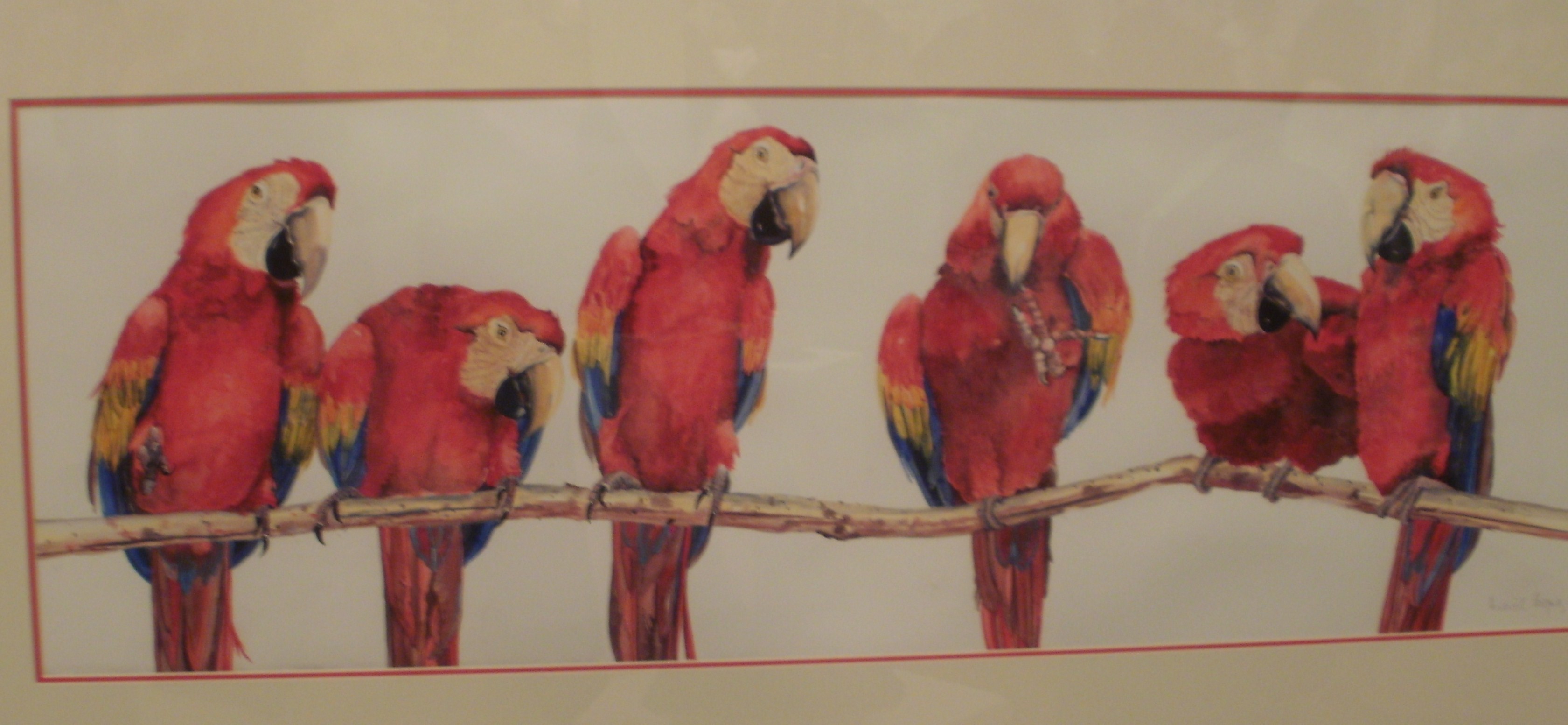
Here’s my column published in today’s Gulf Daily News. It develops one of the themes in my earlier post on corporate communications.
Is it possible to have five hundred friends? Real friends? That was one of the questions posed at the recent Bahrain Corporate Communications Conference. A large part of the conference was devoted to social networking, and how it’s changing attitudes and behaviour.
Mazen Nahawi of News Group International gave a passionate talk about the power of social networks in the Arab world. His view is that they are transforming the way Arabs think and interact, crossing national barriers and creating mindsets that will lead to social change.
Perhaps he’s right, but it’s one thing creating a pan-Arab virtual reality in which people are breaking free of perceived cultural shackles which bind them in their real lives. It’s quite another thing to transform the physical world. The weak links created by social networking do not necessarily transform like-minded thinking into the determination, organization and willingness to take physical risks that lead to change from the grass roots.
Malcolm Gladwell, one of my favourite social commentators, has written an interesting article on this subject in the New Yorker magazine. He tells the story of four black students in North Carolina who staged a sit-in at a whites-only coffee bar during the days of segregation. The protest spread like wildfire, and soon many thousands of civil rights activists were taking similar action across the USA’s southern states.
Gladwell points out that successful activism usually arises out of strong ties – personal identification with the aims of a movement, and personal bonds between the activists. Also, he says, there is usually a strong organizing backbone underpinning and coordinating the activities of the activists. In this case, the civil rights movement was organized by a number of pressure groups, and had a unifying voice in Martin Luther King.
It’s pretty obvious that you wouldn’t be able to organize that level of coordinated protest through Facebook, or even instant messaging. Saying that you “like” someone’s protest page is not the same as agreeing to be at a specific place at a specific time and deciding how the protest is to be conducted. Facebook is supposed to be about openness and transparency, which is the last thing you need if you’re trying to stay one step ahead of those who would seek to thwart you.
A more likely outcome of the social networking boom will be that Arab social networkers will increasingly inhabit parallel worlds – the virtual one in which they bypass some of the social and cultural norms of their daily lives, and the physical world in which they knuckle down under the structures kept in place by establishments that like things just as they are.
To be fair to Nahawi, he wasn’t suggesting that there was a strong political content to Arab social networking. Most people, he says, use Facebook and internet forums to discuss careers, education, love, relationships and personal problems.
But coming back to the point about weak links, is it really possible to have five hundred friends?
For the digital generation, sites like Facebook are redefining the meaning of friend. In the real world, we have lots of alternative words to describe different levels of relationship – family, colleague, acquaintance, team-mate to name but a few. In Facebook, everyone’s a friend.
I personally have great difficulty in investing enough time and energy to maintain relationships with more than five people I consider close friends. Facebook works for me by helping me keep alive all those weaker relationships, some of which I might be able to reinvigorate in times to come. And that’s good enough for me.
One of my big regrets in life is that I’m not a connoisseur of fine art. I envy the likes of Brian Sewell, who lisps his way through his TV and radio commentaries on art with that curious retro accent that went out of fashion thirty years ago. I may not be an aesthete, but I am a fan. I lapped up Kenneth Clarke’s Civilisation TV series in the seventies. I head for galleries whenever I’m in a city like Florence or Venice. When in London, I pay regular visits to the National Portrait Gallery, because I love portraiture – especially some of the renaissance artists like Durer, who so expertly capture the cunning, the mean and the ruthless spirit of the age. And the Florentines, masters of portraying realpolitik.
One of the joys of living in the Middle East is that there is no shortage of art and artists. Elegant calligraphy, Ottoman miniatures and geometric motifs in the Islamic tradition, a thriving community of Arabic cartoonists, and the figurative and abstract works of present-day local and expatriate artists. Not to mention some magnificent architecture, both new and old.
Here in Bahrain, the Bahrain Arts Society provides a platform for Bahrainis and and foreigners alike. A couple of weeks ago they displayed the works of Mohsen Ghareeb and Abdulshaheed Khamdan. Both artists draw on the influences of traditional Islamic art, particularly Arabic calligraphy, to produce striking abstract paintings.
Last week it was the turn of Meriel Cooper Wallace and Michele Karam. Meriel paints mainly in watercolour and in this exhibition portrays the natural world. Michele is a ceramicist who draws heavily on oriental influences. The exhibition was a feast for the eye.
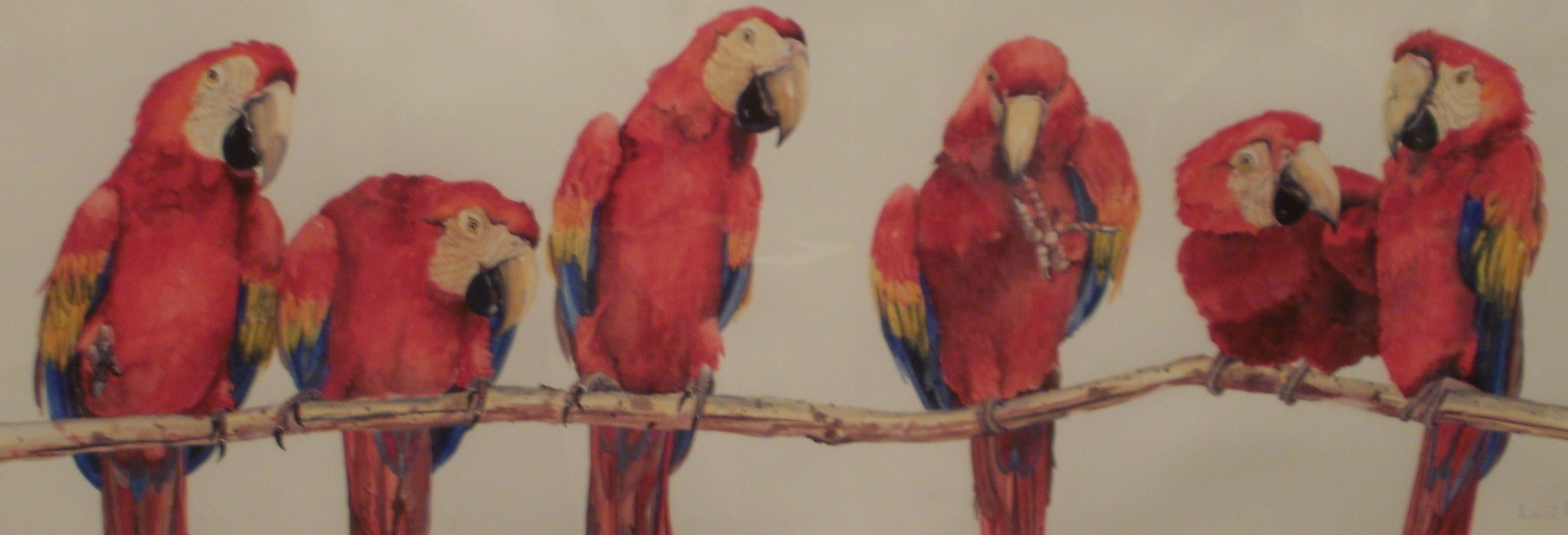

Not being an art critic, I’m unable to wax lyrical on this or that technique. But if you happen to be in Bahrain in the next few days, do visit Meriel’s and Michele’s exhibition at the Society of Arts Gallery in Budayia. I’m sure you won’t be disappointed.
Here’s a brief addendum to my last post about messages from this week’s Corporate Communications Conference in Bahrain.
More than one of the speakers spoke about the importance of corporate values. If you don’t have a set of defined values, they said, how can you expect your employees to communicate – especially in the social media – in the same philosophical language?
I don’t believe in corporate values. For me, only people have values, and very few of us stick to them through thick and thin. If you have a company with leadership that is cohesive and like-minded, then you have a chance – as long as that leadership remains in place – of those values permeating the organization. But as soon as the leadership changes, the values change. If you have strong governance in the form of a board that broadly shares a set of core values, then the construct of company values has a chance of remaining relevant a bit longer.
This is one of the reasons why it’s so damnably difficult to maintain a continuity of management philosophy within an organization. Large companies with HR teams spend huge amounts of money building competencies based on that defined set of corporate values, and they wonder why there is disappointment and disillusionment when newly hired employees find that the reality is far from the construct.
Family businesses – seen by many as corporate dinosaurs – can retain a coherent belief system based on the values of the founders for as long as the original owners stay in control. In the case of family businesses, the values of the father also have a good chance of rubbing off on the sons and daughters. In the Middle East, family patriarchs still influence the values of those who succeed them well beyond retirement, because of the cultural tradition of respect for older generations.
The same often applies to business founded by a small number of partners. After the demise of Bill Hewlett and Dave Packard, HP continued to espouse the values encapsulated in the legendary The HP Way. But in the aftermath of the many acquisitions the company made in the 2000s, as well as a few controversial events affecting the recent leadership, one wonders how many of the new generation of HP employees, many of whom came from acquired companies such as Compaq, EDS and Palm, would agree that the principles of the HP Way reflect today’s reality. I’m not saying they don’t, by the way – just that as a company reinvents itself, it often has a problem staying true to the beliefs of the founders.
In both cases, coherence of philosophy and sense of purpose remain intact because they are derived from the personal philosophies of a small group of powerful leaders with a vested interest in the business – sometimes a single individual. As soon as the hired hands take over, the disconnects and fissures start to emerge, until the organisation starts to reflect the personality of the new leadership.
So my advice to corporate communicators, humbly offered, is to carefully map any gaps between values construct and the reality on the ground before you stake your reputations on high profile communications based on corporate values. Believing in fantasy is easy to do if all around you believe in it too. But then the emperor takes his clothes off…..
Anyone interested in this subject might want to take a look at The Thin Veneer, a longer piece I posted a few months ago.
I’ve just spent three fascinating days in the world of corporate communications, one of many I regularly visit. The occasion was the Bahrain Corporate Communications Conference, with a workshop on social media marketing tagged on to the end.
The speakers were a mixture of PR people and digital media specialists. There were also talks on corporate social responsibility and sustainability. Oh, and the obligatory lawyer to warn us of the dire consequences of intellectual property theft and online defamation.
Many of the speakers had flown in from Dubai, and a couple from the UK, including the headmasterly Sir Paul Judge, the President of the UK Chartered Institute of Marketing.
Most of the delegates and many of the speakers were young enough to be my children. I didn’t really think about this until a delegate from Saudi Arabia discouraged me from accepting a Pepsi at one of the lunches, remarking “old guys like you shouldn’t be drinking stuff like that”. I thanked him for the compliment about my age, and suggested that a good slug of caffeine was precisely what old guys like me needed to stay awake in the afternoon session.
Anyway, such trivia apart, here were some of the standout messages from the conferences, and my take on them:
Mazen Nahawi of News Group International gave a passionate talk about the power of social networks in the Arab world. His view is that social networks are transforming the way Arabs think and interact, crossing national barriers and creating mindsets that will lead to social and political change. I hope he’s right, but a pan-Arab virtual reality in which people are breaking free of the cultural and political shackles which bind them in their real lives is a long way from transforming the physical world. Real change takes much more than the weak links created by social networking. Malcolm Gladwell, one of my favourite social commentators, has written an interesting article on this subject in the New Yorker. See also a rebuttal of Gladwell’s views in the excellent mideastposts.com. In my view, a more likely outcome will be that Arab social networkers will increasingly inhabit parallel worlds – the virtual one in which they bypass the social and cultural norms of the real world, and the physical world in which they knuckle down under the structures imposed by national establishments which like things just as they are.
More than one speaker expressed the view that since the financial crisis, the corporate mantra of increasing shareholder value is no longer considered an appropriate message. These days, they say, it’s all about stakeholder value – the value the corporation is adding to the community, their employees and the environment in addition to shareholders.
Well yes, we do live in a world of corporate hairshirts, of bankers offering ritual apologies for their shortsightedness, and of politicians admitting their mistakes (while doing what they can to lay the blame on their predecessors). But have we entered a new age of corporate responsibility, of warm and cuddly CEOs risking the wrath of the shareholders by casting aside a big slice of their profit margins for the “common good”? I don’t think so. Call me a cynic, but as I see it, greed has not gone away – it’s just hibernating through necessity. As soon as we get through these troubled times and emerge into the next period of stability, the Gekkos of this world will step out again in their summer coats, sleek and rapacious as ever. In fact, many of them have never gone away – they just have good PR.
Sultan Al Bazie, CEO of At Tariq Communications, one of Saudi Arabia’s leading communications consultancies, presented three case studies that highlighted the challenges of government communications in the Kingdom, and used them to show how the government has become more sophisticated and open in its communications with its citizens.
I agree with him on both counts. The unfettered media reaction to last year’s flooding disaster in Jeddah showed how things have changed in Saudi Arabia. And the frank coverage of King Abdullah’s current back ailment has been in stark contrast to the disinformation surrounding King Fahad’s health in his declining years. As always in Saudi Arabia, gradual and cautious.
Craig Hanna of the UK digital gurus eConsultancy, who also delivered the post-conference workshop on Social Media Marketing, told us that organizations planning to adopt a communications strategy around social media should first think carefully about their corporate cultures. Giving your CEO a Facebook page or assigning the task of Tweeting the world to a faceless apparatchik will not necessarily do the trick. Corporate social marketing demands a wholly different mindset from the conventional top-down communications strategy. You need to trust your employees to do and say the right thing (within defined guidelines). You need to recognize that social networking is about people and personalities, and understand that communications must be two-way. Above all, you should be honest and transparent.
He’s absolutely right, which is why the majority of social media initiatives from organizations in the Middle East will fail. Remove the authoritarian, fear-driven culture from your organization, empower your people, allow them to make mistakes and you have a chance. Otherwise forget social media, and concentrate on your usual Stalinist pronunciamenti. Making that culture change in a region so permeated by authoritarian leadership styles is a big ask.
Communications people, like politicians, love rattling out statistics. We got plenty of these. A perennial concern in the communications industry is to justify return on investment in their activities. So they look for more sophisticated and meaningful metrics. In this respect I feel they’re missing the point. You can measure until kingdom come. But what really matters is the success of the organization and the people within it. And that arises from any number of influences: leadership, strategy, people, culture, financial management, not to mention luck.
Most organizations are reactive – they are driven by events. Some lurch from crisis to crisis. Those organizations that have an ethos based on “one for all and all for one”, can survive most crises. In companies I have helped to lead, I always tried to get the message across that there is no such thing as a sales team or a PR function. Everyone is a salesperson for the company, and communications, in thought, deed and example, is everyone’s responsibility.
So I would encourage communications professionals to measure less and achieve more. To stop trying to ascribe specific outcomes to your team or function, and be part of a holistic effort that focuses on the organization’s goals. Successful companies tend not to fire their communications people. That’s not to say that politics, ambition and personal fiefdoms won’t get in the way of the corporate utopia. And if that’s the case, as Craig commeted, consider changing your job.
All in all, a good three days. I have at least a hundred new websites to look at, and two or three interesting ideas to explore. So back to the real world.
I collect coins – ancient mostly, but some from more recent times. So the other day I happened upon a review by Arab News journalist Roger Harrison of a book about the history of the Maria Theresa thaler. The review hit a couple of buttons for me – the history and culture of the Middle East, and of course the history of coins.
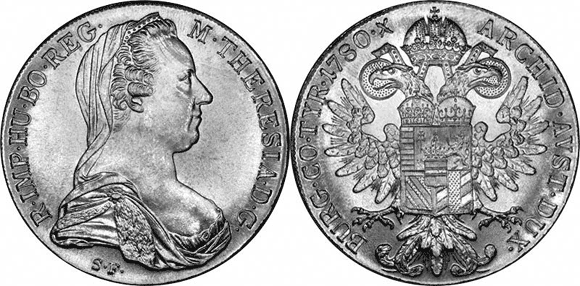
Roger’s review of Thaler Tales (a Silver Legend) by Clara Semple is as good a taster as an author could hope for. He expertly summarizes how the thaler became the common currency of the Middle East because of the reliability of its silver content and its intricate design. How the low-cut dress of the 18th Century Austrian Empress was more to the taste of Levantine merchants, and won out in popularity over the more severe profile of the monarch in widowhood. Also the origin of the word thaler, which subsequently morphed into the dollar, and of the Spanish reale, its big competitor, which eventually gave its name to the riyal, the currency of Saudi Arabia and several other states of the Arabian Peninsula. There can’t be many Saudis or Americans who have any idea about the origin of a word they use a hundred times a day.
The book was published in 2006, so this is not exactly a hot-off-the-press post. But hey, the thaler’s been around for 250 years, so no matter. I’m not sure what has happened to the publisher, Barzan Publishing – the website doesn’t seem to have been updated since 2007. But I hope they’re still in business, because they’ve produced some interesting stuff in a very precise Middle Eastern niche. I referred to another Barzan book about a Victorian adventurer who risked his life in the 19th century visiting Macca and Madinah in an earlier post about the Haj. It’s a gem.
Coins are little pieces of history you can hold in your hand. Anyone living in the Middle East who would like their kids to taste history in an object can easily find a thaler in most of the souks of the region. As for me, if anyone wants to get me a book for Christmas, Thaler Tales would be it.
A fascinating article about Iran in the Saudi-owned political monthly magazine Al-Majalla has opened my eyes to the philosophical basis of the Iranian regime. The author, Mehdi Khalaji, is a senior fellow at the Institute of Near East Studies in Washington. Here’s a key excerpt:
Iran’s attitude toward Muslims is rooted in its approach toward Islam itself. Before 1979, Ayatollah Khomeini had been working diligently to build an intellectual case in support of the rule of the jurist, arguing that the strict implementation of Shari’a was indispensible. Since a jurist is an expert on Islamic law, he is the most qualified to implement its tenets and should thus rule the country. When he came to power, however, he found that modernization had led Iranian culture and society to be intolerant of many Shari’a principles; it became nearly impossible to return to a lifestyle that fit the traditional understanding of Islamic jurisprudence. So, he borrowed the idea of maslaha, or expediency, from Sunni jurisprudence and raison d’état (a French concept that justifies the overriding power of the state) from Western political philosophy, and applied them according to his own rules.
Khomeini argued that in cases where Shari’a conflicts with the realities of modern life, the ruling jurist has the religious authority to overrule Shari’a. In this way, what sets the ruling jurist apart is not found in his ability to implement Shari’a but rather in his unique religious authority to ignore Shari’a in favor of the regime’s own interests should Shari’a be at odds with what would otherwise sustain the government. Based on this novel method of thinking, Khomeini solved many problems his government faced, including women’s suffrage (which he forbade more than a decade before the revolution), women’s right to appear on TV, in films or as public musicians, as well as the forced sales of privately-owned property, the imposition of new tax systems and so on. So, even though there are many other jurists in the Shi’ite world who are more learned and knowledgeable than Iran’s ruling jurists, what makes this class of Shi’as suitable for this job is that they also understand the regime’s interests and can recognize the situations in which Shari’a law should be overridden in favor of national interests.
Overruling Shari’a is not simply an inadvertent issue in the Islamic Republic. Rather, it has become institutionalized. When Khomeini realized that present conditions prevented Shari’a from being implemented fully, he introduced the notion of maslaha. He then established the Expediency Council of the regime to integrate his methodology into the political system. The Guardian Council, created in the original constitution, was tasked with examining parliament’s decisions to ensure that they adhered to both the constitution and Islamic law, while the Expediency Council was to resolve conflicts between parliament and the Guardian Council. For example, if the Guardian Council rejects what has been ratified by parliament, the bill can go to the Expediency Council for deliberation. If the Expediency Council (on behalf of the ruling jurist) believes that parliament’s decision better serves the interests of the regime, it can vote for in favor of the legislation, even if it is against the constitution or Islamic law. At the top of the pyramid is the ruling jurist, who is authorized to overrule the law himself or through the Expediency Council. This is the meaning implied in the “absolute authority of the ruling jurist,” mentioned in the revised version of the constitution.
Ayatollah Khomeini elaborated a theory for government, which is nothing but autocracy in the name of Islam. In this political order, everything depends not on the ruling jurist’s understanding of Islam but rather on his will.
As was tellingly demonstrated during last year’s elections, backed up by the enforcement muscle of the Iranian Revolutionary Guards, the current ruling jurist, Ayatollah Ali Khamenei, can do much as he wants. If President Ahmadinejad steps out of line, Khamenei can swiftly stuff him back into the bottle from which he emerged.
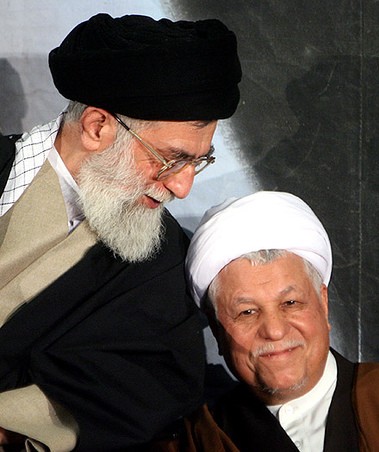
The Expediency Council seems an elegant device. If a policy is unconstitutional, or contradicts the Sharia, but is deemed to be in the national interest, no problem, refer it to the Expediency Council and the Ayatollah’s ruling. What would some of Iran’s neighbours give for their own Expediency Council? So much better than justifying your policies through the edicts of unpredictable clerics or obedient lawyers, or through the application of naked political power backed up by the gun. Such a device would have been very useful to Tony Blair as he struggled to find a legal basis for going to war in 2003. Today, it would be a useful addition to President Obama’s playbook as he attempts to expedite Congress’s consent to the latest arms limitation treaty with Russia.
In the end there are many routes to autocracy. Most of them in the past century have been cloaked in a democratic veneer, at least until the autocrats’ grip on power is strong enough to abandon pretence. And many, like General Than Shwe of Burma, take out the old cloak, give it a dusting, and return it to the wardrobe when it suits them.
Winston Churchill once described democracy as the “least worst” political order. If I was an ordinary citizen of Russia watching Vladimir Putin following his path to autocracy, and bringing much-craved “order” to his chaotic country, would I agree? Perhaps I would not. But it seems to me – ordinary citizen of the UK and definitely not a politician or a political philosopher – that democracy, underpinned by the rule of law, offers a reasonable chance for the underprivileged and marginalised to make their voices heard. The alternative can result in a lava dome of discontent that sooner or later erupts in revolution, civil war or external conflict.
I know what I prefer.
I’ve been pretty busy during the last week working on a book. The Haj holidays have provided a welcome respite from day-to-day concerns.
Here are a few miscellaneous stories of note that I’ve picked up on since my last post, plus a theatre review:
Haj: I wrote recently on the annual Muslim pilgrimage, the Haj. One of the things I mentioned was that the great desire of many Muslims is to pass away during the Haj, because they would be dying in a blessed state. Given that each year up to 4 million people perform the Haj, it’s inevitable that a number of people would get their wish. The Arab News, Saudi Arabia’s English language daily, ran an interesting article on this subject today. I lived in Jeddah before the new (now old) airport opened. In those days the city was flooded with Hajjis (these days, those arriving by air are bussed straight to Mecca from the airport Haj Terminal) and a popular urban myth was that after the Haj, relatives of elderly Hajjis would occasionally push them into the path of oncoming traffic, so that they would die in their blessed state. I don’t believe this, but I suppose it would be logical for relatives to push them rather than for them to jump. In this way the deceased would not be called to account for the sin of suicide, which – many westerners who are used to hearing about suicide bombers would be surprised to know – is strictly haram, or forbidden.
Another facet of the modern Haj is that huge sums of money have been spent on upgrading the facilities for pilgrims. Looking at photos and TV footage of the event, I was left with the impression that many of the holy places have been so overrun by walkways that they resemble concrete bus stations. Saudi efforts to enhance safety features for the multitude are necessary and commendable, but I wonder if people who remember Mecca as it was before the improvements would look back with nostalgia to the wild terrain that now seems to have been tamed. I’m not including the magnificent vista of the Grand Mosque, of course. But the only pictures I saw that radiated the atmosphere of an ancient rite were those of the pilgrims climbing the craggy slopes of Arafat. Anyway, congratulations to all who completed the Haj, and I look forward to receiving first-hand accounts from friends who made the journey of a lifetime.
Russia: Sky News ran an interesting story about continued bullying of conscripts in the Russian Armed Forces. According to Sky, over three thousand conscripts a year die of causes unrelated to fighting. Interviews tell a tale of institutional brutality, often alcohol-fuelled, that would never be tolerated in the Western military. The deaths of three recruits at the Deepcut Barracks a few years ago in the UK were enough to cause a major furore. In Russia, though, the emphasis seems to be on re-arming the military rather than on caring for military personnel. A tradition that has survived from the days of Stalin, who was quite happy to sacrifice millions of poorly-armed soldiers against the Wehrmacht in World War II, and the High Command in the first World War, who were equally happy to send their troops to the slaughter against better-armed German forces, thus triggering the Russian Revolution. Poor bloody infantry.
Speaking of infantry, I spent an interesting evening the other day with three Chelsea Pensioners who had been invited to Bahrain for the Remembrance ceremonies and various fund-raising events. The image of the Chelsea Pensioners is of benign old soldiers in red uniforms who show up at various events throughout the UK and radiate bonhomie. Old soldiers they are, and the ones I met are feisty into the bargain – just because you’re old, you don’t stop being a soldier. These days World War II veterans are too old to travel on trips like this one. But these guys, whose service encompassed the Korean War and the Malayan insurgency, had interesting stories to tell. One of them described a moment in the Malayan jungle when a ragged man came into view. They were about to shoot him when he dropped his weapon and raised his arms. The man turned out to be a Japanese soldier who had spent several years hiding out in the jungle – unaware that the war had ended – waiting for instructions for the Emperor. Apparently he was in a terrible physical state, but like many others who went to ground after the war, he finally made it home.
Here in Bahrain, the plight of housemaids from countries such as Sri Lanka and Indonesia continues to make the news. A piece in today’s Gulf Daily News reports that more than three hundred house maids from Sri Lanka have left Bahrain in the last six months complaining of physical abuse, sexual harassment and no-payment of wages. Being a fan of Bahrain and Bahrainis, I’m very disappointed to hear this. In Saudi the latest in a seemingly endless stream of abuse cases concerns an Indonesian maid who was allegedly murdered by her employer in Abha. Meanwhile, another maid who was convicted of murdering a child in her care is due to be executed shortly. I’m not a supporter of the death penalty, but I hope that the couple in Abha, if convicted, are treated with similar rigour, though hopefully not execution. Treatment of maids by many otherwise law-abiding people in the Middle East is a scandal. Period.
Last but not least, this week the British Club hosted “Shakespeare for Dummies” – a one-man show by Daniel Foley. A good show it was too, perfectly pitched for us Bahraini Brits. I’d never heard of Foley before, but since found out that he runs a small theatre company called Performance Exchange. The company, according to the website, specialises in “touring thought-provoking theatre to some of the more remote destinations around the world.” I’m not sure that Bahrain qualifies as remote – perhaps he was stopping off en route to Ulan Bator.
Anyway, the man is a walking Shakespeare encyclopedia, and spent the evening firing questions at the audience about the bard, most of which we shamefully failed to answer correctly. There was a substantial dose of audience participation (including one of my dining companions in the role of Hamlet’s father’s ghost, who closely resembled an animated Easter Island statue covered by a dust sheet), and hilarious impressions of Burgage, Irving and even Brando playing Hamlet. The maestro talked about how the Japanese perform Shakespeare, the origins of the Scottish Play hoodoo, how Elizabethans actually spoke, and performing the Scottish Play in Japanese, Chinese and English (all in one performance). We also learned the basics of stage fighting – using fists, sabres and broadswords, plus a simulated kick to the groin of a rather nervous member of the audience.
Daniel Foley showed us that there are fine actors who don’t spend most of their careers in the National Theatre or the West End, or earning a mint in CSI, the Wire or Spooks. As far as I’m concerned, it’s the likes of Foley who deserve the gongs for talking theatre beyond the realm of the obvious. The only thing missing for me was the promised impression of Olivier. Better still, I would have loved to see him playing Winston Churchill playing Laurence Olivier playing Richard III. Now that would have been a treat. “Now. Ish the wintah of our dishconTENT made glorioush SHUMMAH. By thish shon of Yawk” and so on….
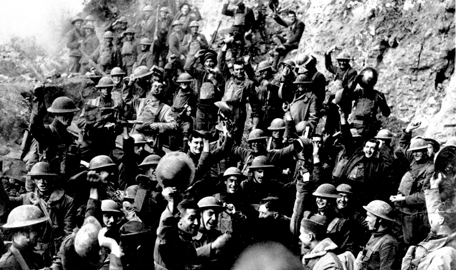
The First World War ended 92 years ago today. Back in August, I published some long excerpts from the war diaries of my grandfather, Harry Hickson.
Here’s his entry for Armistice Day 1918 and the days leading up to it. It seems that his war ended quietly, and he greeted it with his usual understated enthusiasm. Harry also had a talent for oxymoron, with his unfortunate medical condition almost carrying as much weight in his narrative as the momentous events he describes! Though the juxtaposition is almost comic, his medical problem was probably a symptom of the stress that he and millions of others suffered as the war dragged on to the bitter end. But at least he survived.
November 9th
A fine sunny day for a change. The Major and Jones went off to Wassigny with the Battery Sergeant Major to get billets. I got the caterpillars down and the guns ready to leave hen marched the battery to Wassigny. The billets are quite comfortable, but it is a very cold night, I feel frozen!!!
Memo: We hear rumours that the Kaiser has abdicated, and the Crown Prince will not take the throne. Also that internal affairs in Germany are in a desperate state, all very good news indeed. The Bosche are given till Monday to decide whether they accept our armistice conditions. I have been having some awful boils lately.
November 10th
A fine morning with a sharp frost, a lovely sunny day. I saw the Doctor this morning, and he lanced my boils and bound them up. I had a bad quarter of an hour! I feel sure my system was all out of order when I had all those headaches in Boheim. After lunch the Major and I walked over to our old position. Miller came in to tea, and I afterwards visited my old battery 185. I am in a cosy room now.
November 11th
11 November 1918
Monday. A lovely day. I saw the Doctor again this morning and he dressed my boils. We hear that the Armistice comes into force at 11 AM today, we can hardly believe it, it sounds too good to be true. After lunch our fellows played 185 at footer and the latter won 3-1, then we went on to 185 and played bridge. Later on we celebrated the Armistice – and only had rum to do it with! I simply can’t imagine no more shelling and bombing, and the feeling of safety is wonderful.
My good friend Mohamed Abdulla Isa, author and public speaker extraordiaire, has just started his own blog. You can visit it at mohamedisa.wordpress.com. He’s currently on the Haj, and his first two posts capture the spirituality of the pilgrimage in a way that would be understood by pilgrims of all faiths.
Those who see Islam as a negative and malevolent force in the world should read his blog and learn otherwise. Though I don’t share his faith, I do believe that Mohamed and his fellow pilgrims – and the experience they are going through as I write this – are a force for good, and I wish them all a memorable and successful Haj.
This is the original version of an article that appears in today’s version of Bahrain’s Gulf Daily News. I sent a copy in advance to my business partner in the US to prepare him for my coming out as a closet Manchester United fan. He is a life-long Liverpool man, so this news introduced an unpredictable dimension to our business relationship. His terse response was “we need to talk!!!”
This week, Pele, the greatest footballer who ever lived, celebrates his 70th birthday. Though all his fans will wish him well, there’s not much else for them to celebrate today.
Football is in a death spiral. Not the game played by millions, week in, week out, in parks, schools and any old open space in all corners of the world. But the game we watch on TV, or in super-stadia like Old Trafford, the Bernbeau and San Siro, is slowly rotting from the head downwards.
FIFA, the world governing body, is run by a pompous emperor who struts the world stage like the statesman he believes himself to be. Powerful lobbies in rich countries seek his imperial nod to support their bids for the next World Cup. The press reports his every word, and we have to listen to his ridiculous pronouncements about the future of the game.
Not for nothing has the sports page been on the back of every newspaper for as long as I can remember. Any reader interested in sport will go from front to back before venturing inside. Sport means that much to us.
Two senior FIFA officials are under investigation for corruption, and another two regional representatives on the committee that will vote for the next World Cup host have been filmed allegedly offering their vote for cash. Lots of it.
In the UK, wealthy owners have been buying up clubs for a variety of reasons over the past decade. Hard headed businessmen looking for a lucrative “franchise”. Quixotic zillionaires seeking a vanity project that might one day pay off financially but in the meanwhile serves as a handy outlet for ego gratification and self promotion. Smaller clubs are bankrupting themselves to keep up.
People who have no regard for game, its traditions and those who pay ever-increasing sums of money to support the teams they love, shuffle clubs around on a gigantic Monopoly board. There are no fans any more. Only customers.
Then there are the players. Football has always had its share of Wayne Rooneys. Talented guys from humble origins who come into great wealth, corrupted and diminished by hangers-on, or exploited by ruthless agents who think of their man as a meal ticket or “a franchise”. George Best, Diego Maradona, Paul Gascoigne to name a few. Others come from poverty to become shining examples of values we can all subscribe to. Pele, for example, and George Weah, who has devoted much of his fortune to rebuilding his beloved Liberia.
At its best, football offers us much to admire and seek to emulate. Strength in adversity, teamwork, selflessness, discipline and the joy of collective achievement. At its worst, it shows us that it’s OK to lie, manipulate, injure and abuse people, to go for the fast buck. The photo of Wayne Rooney mouthing a curse at the camera at the end of a desperate England performance in the last World Cup epitomizes the dark side.
I used to love football. For years I supported Aston Villa. I was born within two miles of the ground. Apart from a glorious season or two in the 80s in which they won the championship and then the European Cup, following Villa has been a bit like looking out of the same window for 30 years. You hope for something new to show up, but somehow the scene never changes. But in my heart, I’ve always been a Manchester United fan. The drama, the brilliance and the beauty of the game, exemplified in one club.
I still care about the game, but I’m losing hope. For me, the best cure would be amputation. Painful as it would be for armies of long suffering fans, I’d like to see the houses come crashing down. I would like to see the owners of the richest clubs losing their shirts. I would like to see FIFA losing its “franchise”. Then, perhaps, the millions who play, watch and support the game will be reunited. Football will become, once more, “only a game”. Their game, and Pele’s too.
As the late lamented John Lennon sang: “you might think that I’m a dreamer, but I’m not the only one”….
Here in the Middle East, and all around the Muslim world, the Haj season will soon be upon us. The Haj is the annual pilgrimage to Mecca. It’s one of the Five Pillars of Islam, along with the declaration of faith, daily prayers, charitable donations and the month of fasting.
Every Muslim is expected to perform the Haj at least once in a lifetime. Many who live in the Middle East do so more than once. For non-Muslims like me, it’s an event that goes on around us, but that we can never witness. Only Muslims are allowed into the two most holy cities of Islam – Mecca and Madinah.
Mecca is the epicenter of Islam. It was the Prophet Mohammed’s birthplace, a holy city and place of pilgrimage long before the birth of Islam. Tradition has it that the Prophet Abraham (Ibrahim to Muslims) established the shrine known as the Kaaba two thousand years before the Christian Era.
A few months ago I wrote about the Holy Month of Ramadan, the month of fasting. In contrast to Ramadan, which is a season of communal contemplation followed by the celebration of Eid-al-Fitr, the rituals of the Haj take place over a few days, as millions of pilgrims arrive in Mecca and visit the holy places in a prescribed order. The rituals of the Haj all reinforce the beliefs and behaviors of the faithful. Wikipedia provides an easily understood summary of the various rituals and their significance.
It’s an event of staggering complexity. Imagine a temporary city of four million souls springing up every year on the dusty plains around a city whose normal population is a third of that number. Getting them there, keeping them safe, fed, healthy and sheltered, especially in the blistering heat of the summer, is a year-round preoccupation both for the city and for the government of Saudi Arabia.
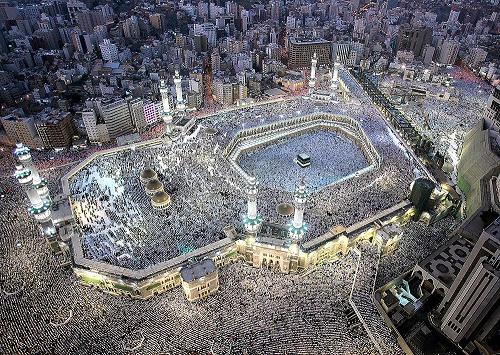
There is no airport near Mecca, so the multitude travels by bus and car to the city, and, until now, by foot thereafter. This year a new railway linking the holy places will ease some of the strain caused by the vast movement of people from one location to another. Many of the pilgrims are old and infirm. And some die from the effort. Muslims believe that those who pass away immediately after the completion of the Haj, because they are cleansed of their sins, will go straight to heaven.
It’s also inevitable that accidents happen. Every few years there are reports of deaths by crush injuries. The dust and pollution caused by the thousands of motor vehicles taking pilgrims to and from the holy places play havoc with the respiratory system. Returning pilgrims can take weeks to recover from coughs and chest infections picked up on the journey. It was a minor miracle that last year’s Haj passed off without a mass outbreak of swine flu.
Yet compared with even fifty years ago the Haj, though arduous enough, is an infinitely less perilous and physically debilitating experience than it was for pilgrims during most of the Islamic era. The Saudi government has invested billions of dollars in roads, walkways, tented cities, water supplies, health services and safety facilities, not to mention a massive development of the Grand Mosque that encloses the Kaaba.
In olden times pilgrims would take months to reach Mecca. Many would travel by foot from far-flung corners of the Islamic world such as Morocco, China and central Asia. Those who could afford it would come by ship to Jeddah, and make the rest of the journey by donkey or camel. They would travel though hostile regions, often in caravans for protection. Even the final leg of the journey once inside the Arabian peninsula was fraught with danger from marauding tribes who would think nothing of robbing the “guests of God”.
One of the best accounts of the Haj in the pre-modern era was written by John Keane, an Anglo-Irish adventurer who made the pilgrimage in the company of an Indian prince in 1877. Keane was one of a tiny band of Europeans who visited Mecca in the 19th Century – Sir Richard Burton, who translated Layla Alf Layla (1001 Arabian Nights) was another. He took a considerable risk by masquerading as a Muslim retainer of the prince and entering the holy cities. In fact, as he recounts in his book, Six Months in the Hijaz – Journeys to Makkah and Madinah, he almost lost his life in the process. Here’s his description of the Bedouin he encountered on the journey:
“All the bodies we came on were decapitated; showing that it was quite true that the Bedawi who follow in the wake of a pilgrim caravan cut off the heads and hands of all the stragglers they fall in with, both dying and dead… From what I have hitherto said about the Bedawi, his character will, I suspect, have impressed the reader unfavourably; but there really is much of the desert man to admire: his hospitality, and genuineness as a scoundrel, and above all his untiring energy and hardihood – qualities in which he differs so much from all other Easterns”
Of course, he describes what he experiences through the eyes of a Victorian Englishman, so many of his observations, if written today, would be damned as wickedly politically incorrect. But his account is a lively and detailed portrayal of a world little known to Westerners of the time, and not much better understood today.
My own encounters with the Haj are much less dramatic. When I arrived in Jeddah in the 1980’s the new airport, complete with a massive open-air terminal built specially for the Haj, had just opened. Every year Jeddah was flooded with pilgrims, dressed in their simple white robes. The build-up would, and still does, take many weeks. Flights into Jeddah would reach Heathrow frequencies for the final week before the festival, putting great strain on airlines, air traffic controllers and ground staff alike. Many pilgrims arrive in Mecca well in advance of the festival, and extend their once-in-a-lifetime trip by moving on to Madinah, where the Prophet is buried.
Although Ramadan is seen by many as an increasingly commercialized season, the pilgrimage has always been an economic lifeline, especially for the people of the Hejaz, the western region of Saudi Arabia. Before the discovery of oil, it was the main source of income for the region. In addition to the annual festival, pilgrims come to Mecca at all times of the year to perform the umrah, the ritual circumambulation of the Kaaba. Revenue from religious festivals sustained the local populations in a region with few natural resources.
I have met many people who have performed the Haj. All that I have spoken to tell me that it is an unforgettable spiritual experience. They describe a sense of being at the centre of the world, and the exhilaration of being among a vast multitude with a common belief and purpose, regardless of sect, race, school of thought and political persuasion. Above all, of being at peace, both with themselves and with God.
If that spirit could extend to the daily lives of people of all religious persuasions, the world would surely be a different place.
As the French return gleefully to the barricades in protest against the raising of the retirement age to 62, a stream of invective falls upon the hapless President Sarkozy. A discussion on the BBC World Service this morning on the French crisis revealed an interesting opinion poll. According to the poll, 60% of the population support the strikes, yet 60% also accept that pension reform, including raising the retirement age, is inevitable. So the BBC commentator suggested that the apparent contradiction was down to a perception in France that the manner in which the legislation is being rammed through by Sarkozy is as much the cause of the strikes as the proposed changes themselves.
Political invective is a grand tradition in France (as of course it is in England). The fiery speeches of Danton, Marat and Robespierre inspired the French Revolution. In more recent times General De Gaulle was an equally fine orator.
A few months ago a French friend of mine happened upon this fine piece of modern day pamphleteering, written under the name of Fils de Danton (Son of Danton). Those of a sensitive disposition should pass quickly across the somewhat earthy language. In his polemic, the writer compares the President with the celebrated 19th century music hall artist, Joseph Pujol, also known as Le Petomane. Pujol was celebrated for his ability to deliver sound impressions through his backside, thanks to a unique physical malformation.
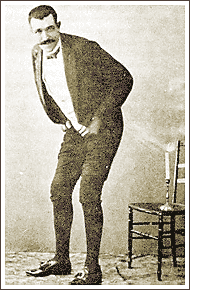
Joseph Pujol, AKA Le Petomane
Here’s the piece:
As France celebrated General De Gaulle’s historic call to the French on June 18th, 1940, I could not help wondering how the current President of France would go down in history. The comparison with the great man is not to his advantage, to say the least.
First of all, he is as small, in every respect, as the General was big. Then, his vision of France, its role and influence in the world, is as thin as cigarette paper, apart from taking along the usual bunches of French business leaders on his trips to various regions of the world. And worst of all, his language and attitude as President would make the General turn in his grave. It is worth reflecting on his constant, determined and outstandingly effective degrading and vulgarizing of the presidential function, which in my view will cost him the next election. How would I best describe him at this point? As an anal impressionist, a petomane of modern times whose act, unlike that of the real petomane in days gone by, Joseph Pujol, the celebrated 19th Century impressionist who could fart the Marseillaise, is anything but odourless. In fact, it is shockingly unpleasant, like a bad smell on a warm summer day. And it has done considerable harm to the image of France, internally and externally.
Both seeking to be seen as using the language he assumes is that of the people, and also riding on his boundless, inflated ego, this man, who so desperately and successfully climbed the social ladder, has been using insults and vulgar language on a regular basis. Let me give you a few examples. To a farmer at a show who would not shake hands with him, he said outright “ Just f**k off, you a******e”. Prior to that, when he was minister of the Interior, this petomane of vulgar politics claimed that he would “clean up” suburban areas of “the filth” that lived in there. How lovely. How presidential. How effective in terms of conveying messages that would contribute to addressing and solving the problem. To most people, even to the majority of citizens who well recognize that something must be done to tackle crime issues in some suburban areas, he made only one impression: he is a man of utter contempt. That impression was of course further reinforced by his statement at the show. Then, the anal impressionist turned president organized a few talk shows at which he appeared surrounded by so-called representatives of various French social classes, pretending to listen to their problems and proposing solutions. He convinced no one. In fact, he appeared to behave in a way contrary to his own nature, remaining exceedingly calm when seriously challenged by a trade-unionist. He did not struggle with his answers, but he struggled with his nature. It showed, and he did not turn perception round. In fact, he came across as being even more insulting.
A lot could be said about the man, though, about his determination, his determined progress, his political astuteness, and his outstanding presidential campaign three years ago. One could also forgive him for not having been able to quicken the pace of badly needed reforms, and for having been unlucky to be the man in charge when the global financial crisis erupted, a crisis that he handled better than many of his counterparts, not without using it to his advantage and behaving, yet again, as an anal impressionist on the world scene through a series of more than awkward contradictory statements. None of these considerations will save him. The President forged his own image to his own disadvantage. An image of a man who made the grade, which he said he would use for the common good, but an image systematically defiled and destroyed with his brutal, vulgar, and contemptuous statements. Would we have heard the British Prime minister, the German Chancellor, the Chinese President or the President of the USA come up with the statements mentioned above? Definitely not. Not to mention General De Gaulle, his so-called mentor, with whom he compares in no way whatsoever.
The President most certainly went down the path of losing the next election every time he made those statements, as he was forging an image of an uncaring, vulgar man, just as Marie-Antoinette, Queen of France when the French revolution broke out, did when she said: “if they do not have bread, let them eat brioche”. I do persist. The President is an anal impressionist whose act will soon end. If that happens, he is rumoured to have said privately, he will go away and make money. I am sure that he will. Unless he can’t help it and becomes a boardroom petomane this time round, a temptation that he might not resist. Congratulations, Mr President. Your anal impressions, including your latest political, shameful planting and manipulation of the so-called niqab issue, have further divided the country, significantly helped the French National Front to rise again, insulted the majority of the population, and worst of all further destroyed the credibility of the presidential role at a time when so many needed hope and respect. Do not fear any competitors for your impressions. You brought it to a fine art indeed, and you will be remembered in history for that. And in the meantime, like many, I shall flush the toilet and will never vote again. I have now seen enough anal impressionism from you and your counterparts in the other parties, who will no doubt learn a lot from you.
Ouch! To the barricades, mes braves, it would seem….
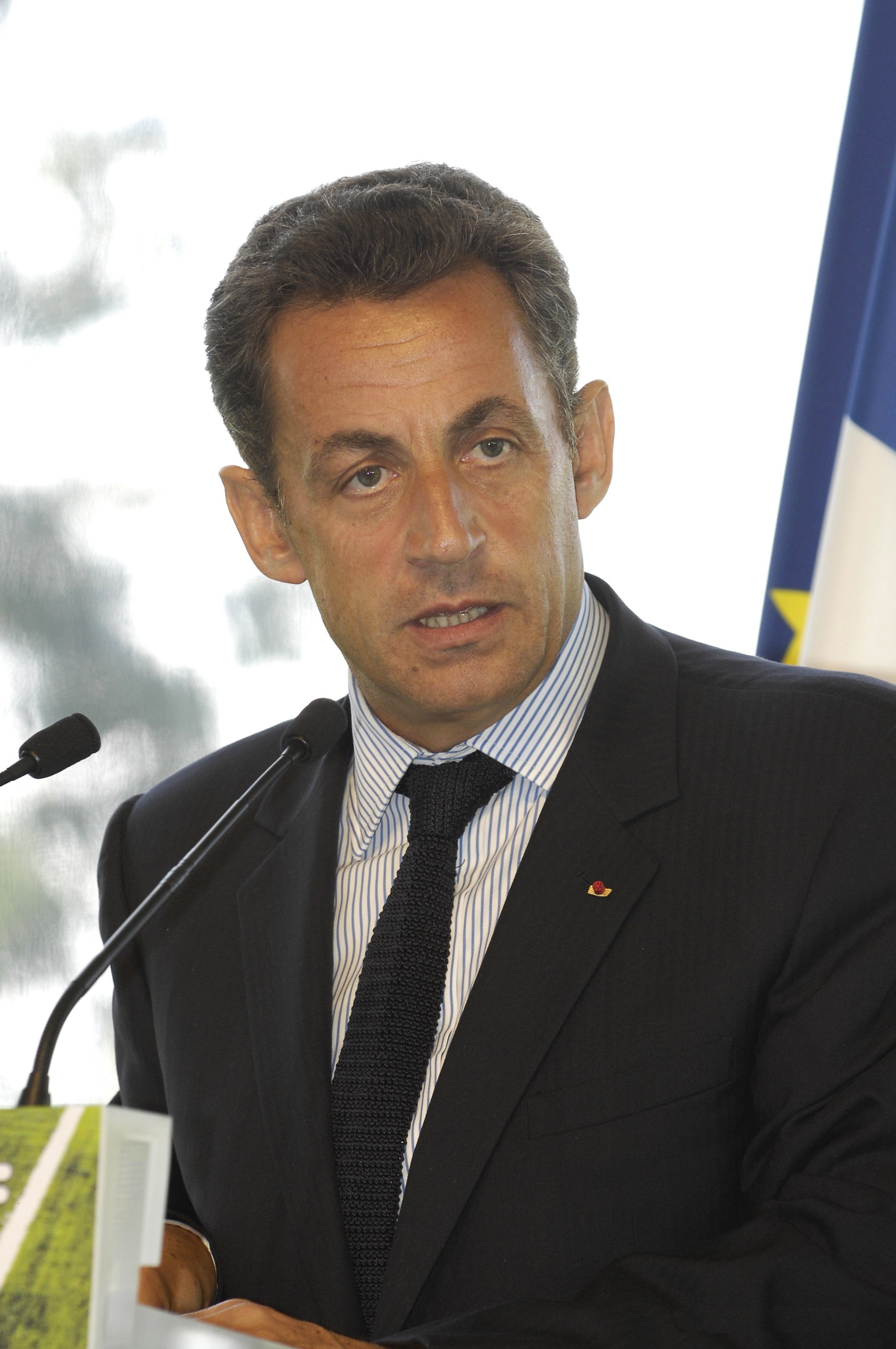
The beginning of the end?
I have no opinion on President Sarkozy one way or another, except to note that leaving aside the current brouhahah, he provided additional fuel for Fils De Danton by the Government’s decision to expel a large number of Roma immigrants in apparent defiance of EU law.
Though the writer denies any resemblence between Sarkozy and the great General, a few British and American politicians over the years might have recognized a familar stubbornness in the present incumbent that drove them up the wall when dealing with De Gaulle. Churchill, for example, once referred to him as the “Monster of Hampstead” when he was in exile in London during World War II. I vividly remember visiting France in 1968, when the barricades last went up, hastening the retirement of the General. His unpopularity at that time was comparable with that of Sarkozy today.
If Fils De Danton‘s views are shared by the majority of French men and women today, the President will soon be joining Tony Blair on the lecture circuit. However, if Sarkozy’s reforms fail, where will that leave France? Waiting for an even bigger “rupture” further down the line, I suspect.
Saturday PM: It’s election day here in Bahrain. I took a drive around the island. Even more posters of candidates than ever. Groups of people sitting by the road handing out leaflets to passers by. This evening, much honking of horns, banging of drums and general exuberence. No evidence of trouble – all seemed good humoured. The Gulf Daily News published a strong editorial urging the Bahrainis to come out and vote, and backing the advocates of moderation over sectarian and Islamist groups.
Lets hope the people take note. This is a nation full of goodwill, good intentions and benign ambitions for the future. It has its problems and imperfections, as all countries do. Bahrain is a great place to live, but I say this as a Westerner in a relatively privileged position. Let’s hope the politicians focus on making it so for all the people on this island.
Sunday am: The world media (at least those I scanned in the past 20 minutes) reports a peaceful election. The BBC website was perhaps the most informative source of the current political alignments, but interesting that the picture editor couldn’t resist using a picture of a set of election posters in which four of the five candidates appeared to be Shiite clergymen, thus giving the casual observer a potentially false impression of the range of candidates. Most that I’ve seen have been wearing western attire or the traditional thobe and gutra. This is not the first time that I’ve seen Bahrain stereotyped by use of pictures. A couple of months ago, the monthly UK political magazine Standpoint published a piece about women’s empowerment in which the caption for a picture of two women wearing the niqab claimed that 85% of Bahraini women wear veils. Disingenuous, unless you consider that the hijab (which covers the hair) is a veil, which I don’t. Fairly low on the Goebbels Scale, I suppose, but as Dr G knew well, pictures form opinions as effectively as words….
Bad news for Saudi Arabia’s Dr House wannabes. A Facebook campaign in the Kingdom is calling for the establishment of single sex hospitals. In the women’s hospitals, no men would be allowed to work on the premises.
According to an article in Saudi Arabia’s Arab News, the campaign has gained the support of at least 20 doctors and consultants. The statement on the Facebook page says:
“Mixing of men and women in hospitals and other places leads to much corruption and vices such as exchanging looks, breaking the barriers between men and women and the creation of unethical relationships, which is forbidden in Islam”
Oh boy. Perhaps they’ve been looking with horror at all those western medical soaps, saturated as they are with “exchanged looks” between hunky consultants and adoring nurses. As for unethical relationships, half of Hollywood would be out of work if the doctors of ER, Scrubs and Grey’s Anatomy confined their attention to the insides of their unfortunate patients.

Not in my back yard....
Actually, medical soaps are quite popular in the Middle East. There’s even an Arabic-dubbed version of House. Arabic-speaking fans of the series tell me that the dubbed version doesn’t quite capture the sardonic tone of Dr Greg’s omnidirectional misanthropy. What’s more, if you seek out an Arabic soap on your satellite TV in Saudi, you’ll have no problem finding plenty of “exchanged looks”, in that delightfully over-the-top style beloved of Egyptian actors and actresses.
Joking apart, there are practical implications. Would these doctors extend the segregation to emergency medicine? Would this mean separate ER’s for men and women? If only one ambulance is able to get to a road traffic accident in time, would they pick up an injured man before a woman? And if the ambulance picked up a man and a woman, who would be dropped off first at the single sex ER? And would men be allowed to visit their spouses without every other patient in the ward being screened off up to protect them from those dangerous glances?
The lady who wrote the Facebook statement appears to have a wider agenda. She calls for an end to gender mixing in schools and university, and appeals to the government to reverse the rising tide of desegregation. That’s a refrain you will hear regularly across the Saudi media. equally balanced by views to the contrary.
She also states that in Britain there is an increasing trend towards separation of men and women patients. Well yes, she’s right in saying that there’s a strong lobby in favor of segregated wards in the UK. But that’s a long way from having separate hospitals. Any attempt to bring that about would lead to the rapid collapse of the British National Health Service for a variety of reasons.
I find it sad that doctors themselves are targeting the health services in their campaign. Long ago my wife spent several years working in Saudi, first as an emergency room head nurse and then running a military clinic. She would tell you that Saudi doctors and nurses of both sexes worked happily alongside each other in a highly professional manner. It was true that cultural concerns inhibited the recruitment of a large number of female Saudi nurses, but that constraint didn’t seem to apply to women doctors. But my wife’s experience was that Saudis and expatriates of both sexes worked as dedicated teams in the interests of their patients, with little time for “exchanging looks”. And absolutely no time for anything other than patient care with the constant stream of traffic accident victims – a problem still with us today.
Clearly a lot of water has flowed under the bridge since the 1980s. But hey, isn’t it great that Saudis are free to express their opinions on Facebook – at both ends of the social spectrum?
The ever-surprising Mohamed Abdulla Isa, despite surely having had enough of Fred’s and my company at Tabreez the other night, showed us yet another face of Bahrain this morning. This time we rendezvous’d for breakfast at a little Bahraini restaurant called Maseela. It’s near the entrance to the Manama souk, and consists of a number of tables in the alley outside, as well as an indoor family area.
For those not familar with Bahrain, I should explain that the Bahrain weekend is on Friday and Saturday. So this morning was the equivalent of Saturday in the West. Since I arrived in Bahrain I’ve got into the habit of going to the excellent Friday Brunch at the British Club – in terms of the volume of food, a serious assault that usually requires me to take to my bed for the afternoon to recover.
So Maseela was a welcome change. A traditional Bahraini breakfast consists of a number of small dishes – scrambled egg with tomatoes, chicken liver with potatoes, a runny lentil dish and a spicy mince stew. All eaten with the inevitable flat bread straight from the oven that was blazing away on the other side of the alley.
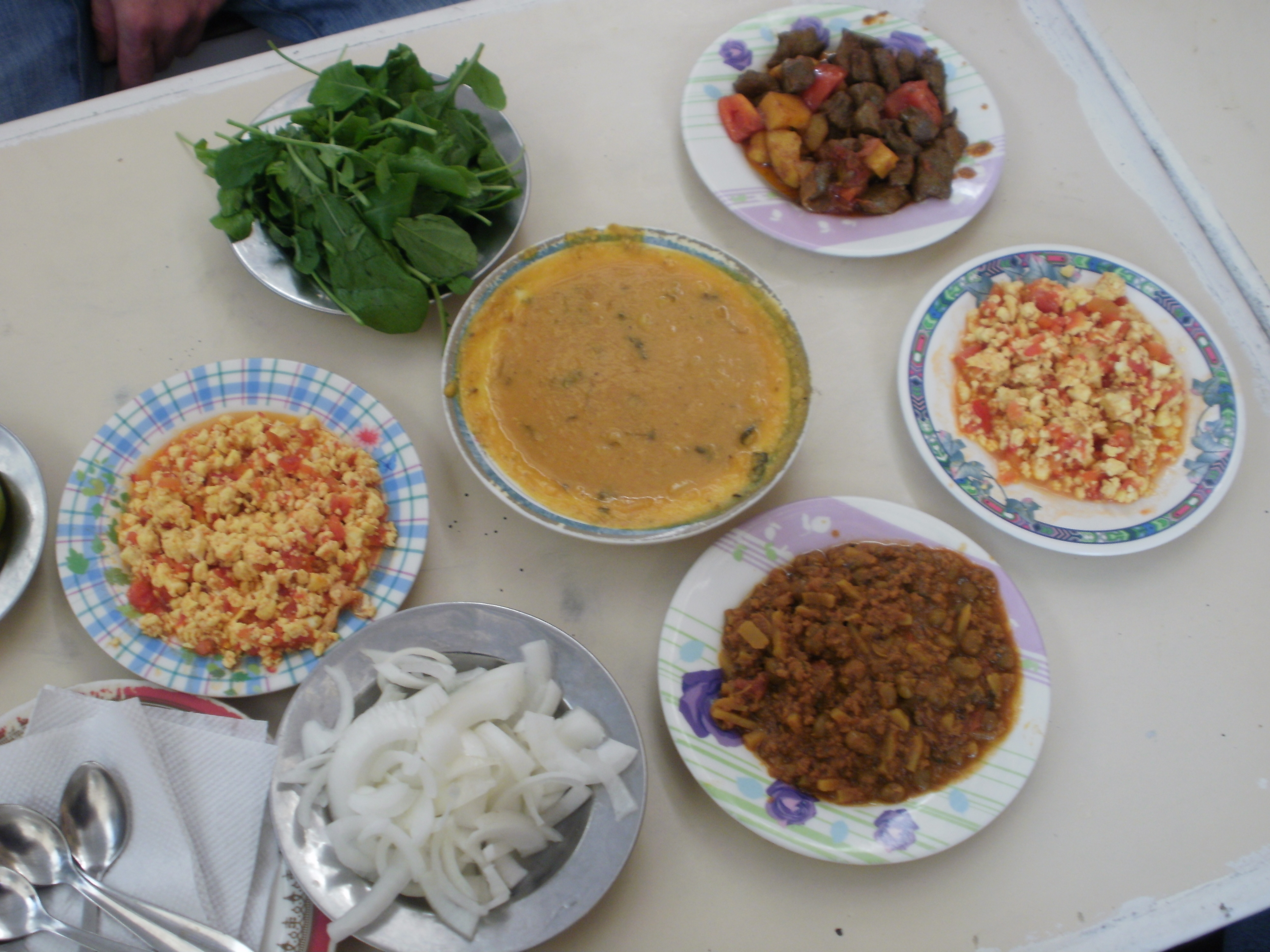
The reataurant was thronged with families and groups of men meeting for a chat – a truly social occasion. Mohamed is a man with many friends, and every so often an acquaintance would stop by to say hello. Fred, Mohamed and I were joined by another Fred, who was over for the weekend from Saudi Arabia.
We then set off for a wander round the souk. Fred One was looking to add to his new collection of Afghan seals – beautiful latticed silver objects about two inches across with a stone seal mould (agate, jade and lapis lazuli) as the centerpiece. The seal images are carvings of horses or other animals, or Arabic inscriptions. The same shop sells Islamic coins, which is an interest of mine, and a host of other good stuff.
Having made the necessary purchases, we followed Mohamed to another eating place deeper in the souk. This is a tiny shop which has been open for 50 years. Inside there’s room for about five people standing up. Most people eat from there outside in the street. We sampled the food – a plate of potato fritters served with a very tasty chickpea sauce. Apparently the man who owns the shop has built a sizeable propoerty portfolio, all from the takings of a tiny outlet in a backstreet. A prime example of patience over the instant gratification urge of today’s business ethos.
What was originally planned as a breakfast get-together was turning into a full morning’s outing. Mohamed’s pleasure in showing us his Bahrain was matched by ours at experiencing it. We went on to a shop that sells herbal water – remedies for indigestion, headaches, diabetes and a host of other complaints. The herbs are all locally grown, and the produce is known throughout the Gulf. One of the lesser-known local industries – a throwback to the days when the country had an abundance of spring water and large fields of date palms. Much of that water is gone now, sucked away by the increasing population and the industrial plants that have sprung up on the island over the past thirty years. But the herbal business remains.
Then on to Bahrain Fort, an ancient structure that dates from the Dilmun civilisation around four thousand years ago. There’s a new museum at the Fort, which boasts Sumerian tablets, Dilmun seals and Persian figurines, tetradrachms from the time of Alexander the Great (who visited the island – then called Tylos- on the way back from Afghanistan), Parthian pottery and artifacts from the days when the Portuguese established a bridgehead into the region. Next to the Museum is a cafe looking out over the sea that’s growing in popularity – a great place to visit as the sun goes down over the Gulf.
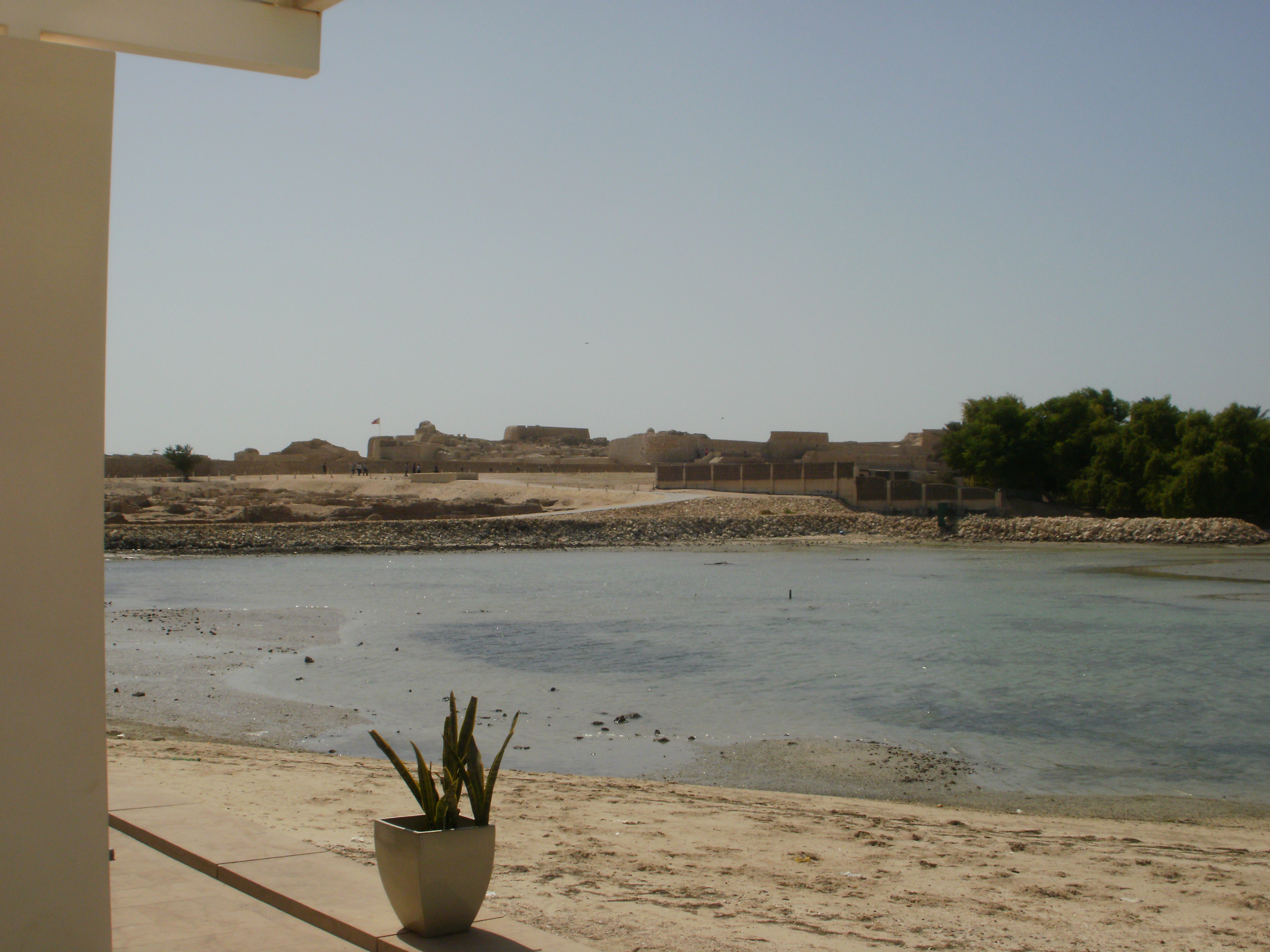
We rounded off the tour with a visit to a couple of a couple of old houses – now derelict – which reminded us that before the days of tower blocks and apartments, most people on the island lived a life of simplicity.
A great three hours exploring parts of Bahrain that I’m ashamed I’ve not taken the time to visit before. All through the generosity of a man who clearly loves his place of birth, and is more than willing to share its delights. Many thanks, Mohamed.
Bahrain is a country of many restaurants. Time Out lists over a hundred of them, typically in places beloved of expatriates, such as the malls, hotels and areas heavily populated with Westerners – Adliya, Saar and Juffair for example. Go to one of the swish restaurants in Adliya, and you’re unlikely to come away without spending BD20-25 per head ($50-$65), and sometimes much more.
Make friends with someone who knows the island well, and you can find wonders unknown to readers of Time Out. My friend Mohamed, financial executive, public speaker extraordinaire and one of the most interesting and likeable people I’ve met in Bahrain, has a local’s knowledge of eating out.
A couple of weeks ago we got together for dinner, and I mentioned that a colleague from France was coming over for a visit, and that he was a serious lover of fish. So I contacted Mohamed when Fred arrived, and he suggested we meet at Tabreez, a fish restaurant near Adhari Park on the outskirts of Manama. I’ve never reviewed a restaurant before, so forgive the unrestrained superlatives which a gnarled old gourment like Michael Winner might choke on with mirth. But there’s a reason.
Tabreez is not mentioned in the restaurant guides. That’s because it serves a Bahraini clientele, and is also very popular with Saudis who come across the causeway for the weekend. The interior looks a bit like a British transport caff, and there’s also an outdoor area with a few tables scattered about. At this time of year, Bahrain starts cooling down from the stifling heat of the summer, so eating outside is starting to be a pleasure again. So we took a table in the courtyard. But first we had to choose our fish. Now Fred considers himself an expert on fish. I only know that if the fish stares at you from the ice with rheumy eyes like a 90-year-old with cataracts, it’s best avoided. So Fred inspected the eyes, the scales and the general look of the fish, and pronounced them good.
Mohamed suggested two fish I’d never heard of. One, known locally as yanam, was about 18 inches long with a wide body. The other, maid, was much smaller – a bit like an overgrown sardine. Both, he said, were caught locally and Bahraini favorites. For good measure he suggested we get some very fat prawns.
We took our table, which the waiter covered with two plastic sheets Arabian-style. We started with hors d’oeuvres, hummous, tabouleh and the most delicious flat bread which they baked on the premises. Then the fish arrived. The prawns were barbecued with a delicious yogurt and herb sauce. Then came a plate of maid, grilled with little embellishment – very delicate white flesh – delicious. Finally, the yanaan. Cooked as you would a sole, but with a thick crust of spicy vegetables – chunks of flesh coming easily off the bone, similar to sea bass.
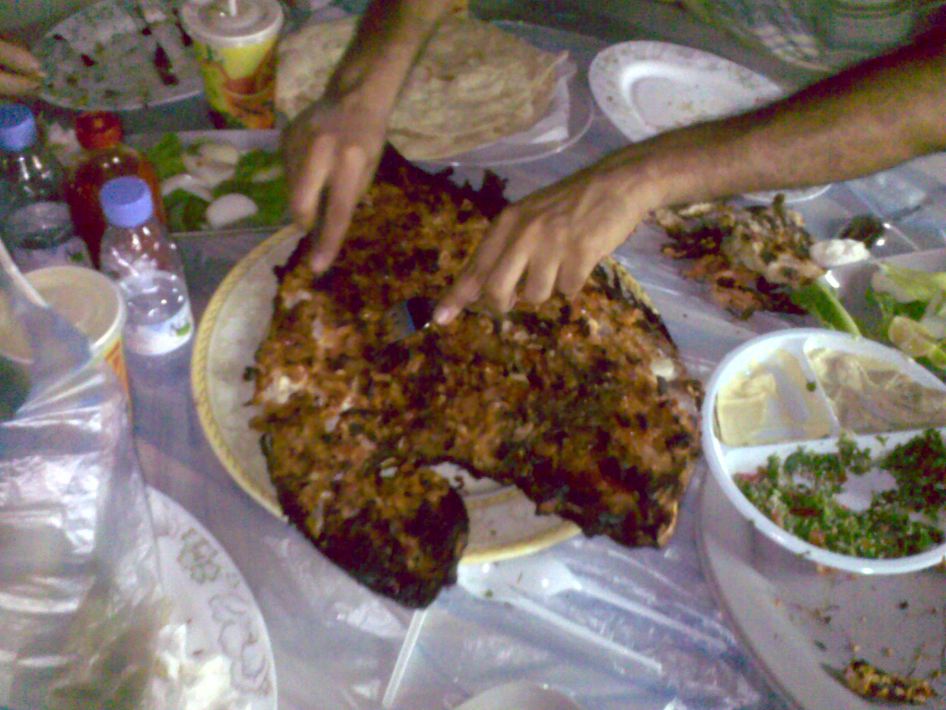
Fred, who, being a Breton who caught his first seabass from the rocky shores of Britanny at the age of eight, is not easly impressed. With his typically lyrical turn of phrase, he commented “it was as if the enjoyment would never stop – a moment out of time”.
After three hours of great conversation and equally great eating, we walked out of Tabreez with a bill that came to a third of what we would have paid in the swish restaurants of downtown Manama. But not before we were shown the bakery in action, and presented with a couple of pieces of bread straight from the furnace – a typically Bahraini touch.
With all the pain and anxiety around us, it’s nice occasionally to taste the joy of small things.
Another article in the Arab News about Saudi students abroad. In this one, Rima Muktar reports that many students are having to take part-time jobs to supplement their income while studying:
High living costs force scholarship students to take on part-time jobs
With high rents and increasing costs of living, Saudi students on scholarships abroad are forced to take on part-time jobs to survive.
Instead of spending her time between lecture halls and the university library, Maha Ibraheem, a finance student in the United States, spends her time babysitting for her American neighbors.
“I get paid around $10 an hour for babysitting. I do it because I need the money. The scholarship I receive is not much and is spent on rent, and buying groceries and other supplies,” she said.
“It’s really hard doing this as a full time student and someone expected to get A’s in all my classes,” she added.
Rent in the US can be high, and so many Saudi students are forced to look for supplementary income to cover costs.
“I live in a two-bedroom apartment that costs around $2,000 a month. In light of what I get from the Ministry of Higher Education, I have hardly anything left to spend on food and clothes,” said Ahmed Hijazi, a marketing student in the United States.
“My wife and I both work in a coffee shop and we do shifts to cover each other when one of us has to study for an upcoming exam. But what are we supposed to do when the economy is like this?” he added.
According to US law, foreign students are not permitted to work and do not qualify for social security numbers. As a result, students are forced to look for illegal jobs.
“I’ve tried hard to find a job with decent pay but couldn’t find anything that pays more than $500 a month. I’m now working as a waiter in an Italian restaurant near my house,” said Khalid Zaki, an MBA student in the US.
“The owner of the restaurant did not give me a hard time when I came looking for a job. He took me on knowing that I’m a student and that I need money,” he added.
Amro Jalal, an MBA student in England, gives lessons on reading the Qur’an to local Muslims. “I give private Arabic classes to British Muslims at my house; I’m actually making good money out of it. I think it’s a smart and quick way to make money,” he said.
“I don’t need to waste time running from university to school … I receive around £1,700 a month and my expenditures are way above that, especially since I don’t cook at home and live off pizza everyday,” he said.
“In spite of all this, I still need to ask my parents to send me money every month so I can pay for my car,” he added.
According to Tariq Hassan, a finance student in the United States, there are many Saudi students working to earn extra cash.
“I work as a part-time receptionist at a motel, doing the night shifts. My income is low but the motel offers me free access to the laundry room and the cafeteria when I’m hungry,” he said.
“I will never list this job on my CV when I come back to the Kingdom because it wouldn’t help me at all. I’m just doing it to make some extra cash,” he added.
Arab News tried to call the Saudi Arabian Cultural Mission in Washington but no one was available for comment.
It’s interesting that this story is considered newsworthy in the Kingdom, since working part-time to support studies is normal practice all over the Western world for all but the very wealthy. Even well-off parents often encourage their kids to work so that they learn that university is not a long free lunch.
Apart from the guy who earns £1700 ($2750) a month giving Arabic and Quranic tuition and still can’t make ends meet (my student daughter would think she was rich as Croesus with that income every month…), the most telling comment was from the guy who said that he would never include his part-time work for a motel in his CV when he gets home.
I have a good idea that his comment was driven by a sense that relatively menial work experience would not stand him in good stead with future employers. But perhaps he (and his future employers) should consider that working as a waiter has given him valuable customer service, communications, multitasking and time management experience. Anyone who has worked as a waiter, serving demanding customers with strange accents who are usually in a hurry, will tell you that the job develops those skills and more – especially as your personality and efficiency can bring you extra income in the form of tips. Tariq will also have met people whom he would never normally encounter in student life – another big plus.
Sometimes it helps to think laterally about work experience. For a couple of summers in my student years, I spent two weeks shovelling grease and metal shards from the production lanes of the old British Leyland car production line in Birmingham. While I never put that in my CV, I did learn quite a lot about the car industry and the conditions in which people in the industry worked. It also gave me a different perspective on the disputes that dogged the industry in the pre-Thatcher 70s.
There’s learning to be had from every job, however dirty, tedious and remote from what we think is our deserved place in society. Perhaps that Saudi student should reflect that his learning from the motel experience could be real asset to his future employers.
Yesterday a colleague and I spent a day at The Education Project. This was an annual conference sponsored by Bahrain’s Economic Development Board. It brings together school principals, university professors, educational thinkers and government officials from around the world to discuss issues in education.
As you would expect from the company that runs the annual Davos gathering of the great and the good, the conference organization was top notch. The stand-out session for me was a series of short presentations about innovative projects in South Africa, the US, China and Brazil. In the China presentation, which involves teaching critical thinking, the speaker made the interesting comment that 300 million people in China are currently learning English – more than in the USA.
The plenary sessions ranged from baffling to uplifting. A chap from Cisco described the Global Leaders in Education Project (with the attractive acronym of GELP), which seemed to me to be an opportunity for educationalists to travel to interesting places to discuss other people’s problems. Fine, but there weren’t any specific outcomes he was able to share. On the other hand, four students from the Crown Prince’s elite Scholarship Program were brave enough to sit on the podium and discuss their thoughts on education with admirable eloquence.
From the conference I was able to gather that everybody – from politicians to educationalists – was violently agreeing that education needs to change. That we need to move from the attitude that education is all about certificates. That we need to give people the skills to succeed in the workplace as people rather than as repositories of knowledge. That learning should be life-long. That teachers should care. That parents must play a role in educating their kids rather than leaving the job to teachers.
And yet….
As I sat among hundreds of well-paid education professionals who had flown in to Bahrain from all points of the globe, I was left with an uneasy feeling that these people represented an educational paradigm that has been in existence for a hundred years, but is not fully fit for purpose in the 21st Century. The linear process of primary, secondary and tertiary education does not serve people in India living in villages without electricity. It doesn’t serve manual laborers in China or illiterate women in Afghanistan. In communities where education is about learning how to plough, to build shelter, to survive from one day to the next, the pinnacle of the education system, the university degree, is about as relevant to the vast majority of the population as the black monolith that appeared among the hominids in Stanley Kubrik’s movie 2001. As Malcolm Gladwell suggests in his book Outliers, those who escape do so through a happy combination of luck, ability and circumstance. The rest spend their lives in poverty and deprivation.
I don’t have answers that will address the problem of the educational have-nots any more than I have bright ideas to eradicate poverty, disease and conflict. I also see no chance that the rigid structure of education – primary, secondary and tertiary, academic and occupational learning – is likely to change any time soon. There are too many vested interests that will work to prevent it.
But I also keep thinking about technological leapfrogging. Countries which can’t afford a traditional land-based telecommunications infrastructure, but go straight to mobile telephony, and from there to the internet. Is it possible that these countries can develop systems of education that also run parallel to the conventional structures? Systems that deliver education to the many rather than to the few without having to build hundreds of schools and universities and hire thousands of teachers?
Perhaps we should be rethinking the purpose of education, and looking to create an alternative construct that focuses on basic human needs – food, shelter, security, community – and builds from there. If you don’t understand crop rotation, how will algebra help you? If you don’t understand basic hygiene, does it really matter whether you can read or not? For most of our history, know-how was passed on via hands-on instruction, through learning by doing, not through the use of textbooks and the internet.
As for the existing system, why is the lack of critical thinking skills such a hot issue? Kids should be taught to think for themselves from the time they learn to walk. Why does the education system not recognize the basic abilities required to function in the workplace – communication (as opposed to language) skills, leadership, negotiation, personal finance, self-organisation, real-life problem solving (as opposed to algebraic solutions) – as credits in a system that is supposed to produce citizens ready to play their part in society? Why do secondary and tertiary institutions not recognize work experience, social projects and tangible, demonstrable outcomes arising from extra-curricular activities as credits in the educational system? Why is there no facility for gifted kids to attend tertiary-level programs at neighboring universities? At the same time why can’t they remain in the secondary system for study areas where they are in the mainstream of ability, and among peers at the same stage of emotional development?
I’m sure you will find people in the existing system who will tell you that “we already do this”. But I don’t see the evidence or the outcomes on a widespread basis. If it were so, there wouldn’t be thousands of training and education companies who make their living by shoring up the failures of conventional academia.
As I said, I don’t have the answers, but I’m absolutely certain that in a hundred years from now the global education landscape will be a very different place, or our descendants will be in deep trouble. And I’ve only mentioned the internet once.
I’d like to think that we will fix the system, and perhaps this will happen at the grass roots through the dedication of people like Taddy Blacher in South Africa and his Maharishi Institute, and through iconoclasts like Roger Schank in the US. While there’s life there’s hope.
The death of Linda Norgrove in Afghanistan comes as I near the end of Megan Stack’s book Every Man in This Village is a Liar. Stack is a journalist with the Los Angeles Times who was posted first to Afgahnistan and subsequently to the Middle East. In the book she recounts her experiences in Afgahnistan after the US invasion, Iraq after the US invasion there, Lebanon during Hariri’s assassination and during the Israeli hostilities against Hezbollah, with stories about Saudi Arabia and Egypt’s elections thrown in for good measure.
As a litany of the brutality of war and its consequences Every Man in this Village is hard to touch. Stack excels in depicting the atmosphere of viciousness and fear as insurgency takes hold in post-Saddam Iraq, and as death rains down on Lebanon from Israeli bombs at the height of the 2005 Hezbollah conflict.
Well worth reading – not that it will deter any future combatants from wreaking similar destruction on innocent people.
Here’s a column I wrote for the Gulf Daily News, which appears in today’s edition. Every year, thousands of students, both nationals and expatriates, head out of the Middle East to foreign academic institutions, both in the West and in the East. For kids who have been brought up in tight family groups, this can be a difficult and disorienting experience. Reactions to their new-found freedom range from wild exuberence to retreat and rejection. Those in the middle of the spectrum ususally do fine.
One area of my business involves equipping students to deal with the transition from school to university, so it’s a subject close to my heart. Middle Eastern countries spend billions of dollars on foreign education. A lack of planning and psychological preparation can lead to much of that money being wasted through drop-outs and, in some cases, mental breakdown.
Then there’s the issue of the expectation of the students when they come back with their degrees from prestigious universities. Some find that their degrees are less valued by local employers than they hoped. They expect to walk into high-salaried jobs from the off, and are disappointed because nobody told them that there’s a difference between what they learn at university and what they need to know to become effective in the workplace. I touched on this in a recent piece.
Here’s the GDN column, which deals mainly with the parting for students and their parents, something we’ve been through a couple of times:
We first said goodbye when we dropped her off at primary school. Crisp new uniform, two sizes too big because she was so tiny she wouldn’t fit the smallest available. Lunchbox almost bigger than she was. Bright eyes, ready for school. A tear in Mum’s eye – there goes our youngest.
Six years on, and off to big school. Things are getting serious now – exams to think about, careers, decisions, Mum and Dad not sure what to advise. Let’s wait and see how the exams go. Suddenly she’s eighteen, she’s got the grades, she knows what she wants to study. Results day is chaos, but thank God she has her place!
Come September last year, our youngest set off to University for the first day of the rest of her life, following in the footsteps of her sister who took wing four years earlier. This was the big goodbye. Of course we didn’t stop worrying about how she was doing. Was she safe? Was she happy? How was the course going? Had she run out of money? But from a distance.
Around this time, such little dramas are playing out in families across the world. For parents everywhere, especially those whose kids are leaving home for the first time to study in universities thousands of miles away, there will be a sense of an end of an era. They are no longer under our control. They are becoming adults. They’re on their own for the first time. Just as worrying, so are we. After so many years of the school routine – drop-offs, pick-ups, extracurricular activities and family holidays – our babies are gone.
It’s tough for parents to see their children fly the nest. Typically, mothers find it hardest, especially if they’ve given up their careers to care for their young ones, supported them in their education and picked them up when they fall over. We start re-appraising our lives, thinking about what will fill the gap, but still worrying about those who have gone away. This is often the time when we also start worrying about our own parents, who are moving into old age and increasingly depending on us for help and support. So nests are rarely empty – one set of birds are replaced by another.
For the young ones, the path is also not easy. University can be a life-changing experience. We meet new people, we change our views on life. Sometimes we change our career aspirations and find ourselves on the wrong course. If we move away from home, we have to deal with different cultures, different ways of thinking and studying. Sometimes we get lonely and confused. Maybe we embrace the new culture, and become American, Australian or British in our outlook and behavior. Then when we come home in our new incarnation, we’re upset when our parents can’t accept us as we are now. And our parents are upset when we question their lifestyles, customs and behavior.
As I was driving to the airport for my flight back to Bahrain the other day, my wife and I spotted a people carrier in front to us packed with belongings – bags of clothes, a new printer, cardboard boxes, Mum and Dad in the front, daughter in the back. Off to University for the first time. We’ve been there twice, so we can spot them a mile off.
Every family deals with the transition to adulthood in their own way. Leaving home is the final frontier. A new relationship awaits – sometimes difficult, often full of pride and joy. It’s a time to be thankful – as parents that our children have successfully made it this far, and as young adults that we have opportunities denied to many others. Good luck to one and all!
Another story in Saudi Arabia’s Arab News has caused much comment among the paper’s readers. The article is about a man who married a 12-year-old girl and consummated the marriage shortly thereafter. The tradition in the Kingdom is that there is no age limit for a girl to be married, but that the husband must wait for his wife to reach puberty. Here’s the article:
NAJRAN: A marriage official (mazoun) in the southern city of Najran has told a local Arabic daily that he had married a minor girl who is barely 12 years old and consummated their marriage after only two and a half months.
The mazoun, who has not been identified, told Al-Watan on Friday that his father in-law advised him not to touch her for a year, but his mother insisted otherwise.
He claimed that his mother, who was angry that he was treating his young wife like a sister, told him that there was no girl too young for marriage.
The mazoun told the newspaper that he brought his wife to his home and lived for two months together like a brother and sister.
“When my mother insisted I consummate my marriage, I had to summon up the courage for two weeks before I was able to have sex with her,” he said. He said when he first saw her, he was shocked by her fragility and added that he spent a long time trying to understand how to treat her. “We used to be together without any sexual contact. She slept in the bedroom while I slept in the guest room. All the time I used to tell her the story of Adam and Eve. She often said to me that she did not know why her parents gave her away to me,” he said.
The mazoun said his young wife has completed her sixth grade at elementary school and is now a better housewife than many university graduates.
Commenting on minor marriages, an official source at the Human Rights Commission (HRC) said the commission was making an effort to end this trend.
“If the marriage contract has not been signed, the commission will try to talk to the parties concerned, but if it is already signed, then it will question the mazoun who issued it,” he said.
The official attributed the occurrence of minor marriages to a host of economic and social factors and said the commission was committed to tackling it.
This story is the latest in many similar occurences of what the paper calls “minor marriages”, and goes to the heart of the debate in the Muslim world between those who take the example of the Prophet Mohammed in the 6th Century as the absolute and timeless determinant of how to behave, and those who say that Muslims should take into account the world we live in now in determining morality and social norms. In this case, those who believe that the mazoun’s behavior was perfectly acceptable quote the example of the Prophet when he married Aisha, his second wife, who was 12 at the time.
Few Muslims would dispute that the words of the Quran are timeless. But many would say that the sayings of the Prophet and stories about him encapsulated in Islam’s second holy book, the Hadith, reflect the age and norms of the Prophet’s time, and cannot serve as the absolute and only guide for today. Hence among Muslims fierce debates rage about other social issues that keep coming up in the West as examples of Muslim “backwardness”, such as burqas, polygamy and execution by stoning.
Those unfamiliar with the Islamic world might find the reader comments quite illuminating. All but one of the posts seem to be from believers. Those, like the Rev Jones in Florida, who think that Muslims are a monolithic bloc of like-minded people might be surprised to find that there’s as huge a divergence of opinion on religious and social issues in Saudi Arabia and other Muslim countries as there are in their own countries about how people should behave.
I find it sad that the gross generalizations to be found in some areas of the Western media have led to broad brush opinion about what Muslims believe. More than once I have had conversations with young Saudis in which they were eager to assure me that they were not terrorists, and nor were the vast majority of the people of Saudi Arabia. It’s a shame that a 16-year-old feels that he needs to say this because he is afraid that this is the prevailing opinion in the Western world.
Yes, there are traditions in some parts of the Muslim world that most Westerners will find abhorrent. But Glenn Beck, Geert Wilders and their supporters don’t tell us that there is a host of Muslims who also find them abhorrent.
I’m back in Bahrain after a lengthy visit to the UK and a very short visit to Jeddah. It’s been a pretty intensive few weeks, culminating in a 16-hour-a-day dash to complete a major bid to a Bahrain government department. We made the deadline with 15 minutes to spare – it was amazing to see how many other bidders were in the same boat. Lastminute.panic still rules in the Middle East!
Here in Bahrain we are in the middle of election fever. On October 23 the people will be electing a new parliament and municipal councils across the island. Wherever you drive there are huge hoardings, in Arabic of course, of the various candidates. Some in western suits, some in traditional dress. Some look grim and determined, others chirpy and cheerful. Unlike those discreet little lamppost posters in the UK, these are monster hoardings, with the candidates accosting you at every turning in the road.
The past couple of months has been a difficult time for Bahrain, with political disturbances which have been well reported in the local media, culminating in the arrest of a number of alleged terrorist plotters, and rioters who specialize in burning tyres on roads. Whether the unrest has been orchestrated to coincide with the elections I leave to better informed commentators.
But the striking difference between these elections and those we’re used to in the West is the relative absence of women candidates.
Bahrain leads the way in the Middle East in its policies of encouraging women to play a part in the Kingdom’s business and social life. Since I arrived in Bahrain a year ago, I have had the pleasure of meeting a number of bright, talented and enthusiastic women who make what seems to me to be a great contribution to the country. There are female business leaders, ministers and ambassadors. So why are only 6% of the candidates for election to parliament female? And why, out of 188 candidates for the municipal elections, are there only 3 women – less than 2%?
The other day I asked a male Bahraini friend the same question, and got an interesting answer. The issue, he says is multi-layered. First, the political and religious societies are reluctant to nominate women. So women who want to stand generally have to do so as independent candidates. The cost of running an election is high – according to my friend, the average cost of a campaign seems to be around BD20,000 – lots of posters to pay for. That’s a lot of money for anyone without substantial means. Also, my friend said, the Supreme Council for Women helped have helped a number of female candidates to stand in previous elections, but without great success. But the biggest issue, he says, is fear of failure. Why would you stand for election if you believe that you have no chance of success?
One of my female Bahraini acquaintances, who works in another GCC country, puts it this way:
If I was in Bahrain I would not stand for election. People in Bahrain will always put you in a corner and decide that you are either with the government, or with this party or the other. And if you try to be different, they will say that you have an ulterior motive. Also women do not like to be criticized, and the Bahrainis are hard to please, so no matter what you do you will always be judged differently.
Women in general in Bahrain are very busy, very rarely that you see a family with a house maid, so the woman works, and once she is at home, she does her second job, while the husband watches football or read the newspaper. So if she stands for election, that is going to be a third job.
Also maybe their husbands or fathers will not allow them – we still have these types by the way. We (women) are not completely free to do what we think is right, and elections are not considered a duty on women, despite the fact that we are equal in education and work.
I would prefer be in the Shoura house (the upper house) rather than the parliament, as the former is by appointment.
A little unkind to the hard-working men of Bahrain, perhaps, but her comments are not far in other respects from those of my male friend. However, I’m not about to dip my toes into the whirlpool of political debate in a country in which I’m a guest. But I’m a male feminist when it comes to women in work and politics. I have run companies staffed and managed by a majority of women. One of our most successful managers joined us from school at the age of 16 with virtually no qualifications. Within fifteen years she was a head of department, and is now in a very senior role with one of the world’s leading recruitment firms.
In the UK, 22% of Members of Parliament are women – not great, but better than 20 years ago. The new cabinet in Switzerland contains a majority of women. In Afghanistan, despite Taliban intimidation, 406 women stood in the recent parliamentary elections, and 64 of the 249 seats were reserved for them. And on the world stage, Margaret Thatcher (who to this day, even in her dotage, scares the life out of me) and Hillary Clinton have shown that women in politics can be as tough and incisive as any man. Should I have mentioned Sarah Palin in this context? I don’t think so…
But let’s also remember that it’s only ninety years or so since women in the UK got the vote, and until fairly recently, female representation in parliament was relatively sparse. Bahrain is to be congratulated for initiatives to bring women into politics – for example, through the appointment of representatives on the Shoura Council. But when it comes to elections, the prevailing opinion still seems to be that politics is a man’s work.
As my male friend points out, cultural barriers inhibiting the advancement of women will take time to break down. He believes that things will change as more women achieve prominent roles in business and government. Muslim friends cite the example of the Prophet Mohammed’s first wife, Khadijah, who was a successful businesswoman in her own right, when they make the case for the promotion of women in business.
I’m not the first to say this, but it bears repeating: women represent a reservoir of talent that is yet to be fully tapped in many countries in the Middle East. In this respect Bahrain is ahead of the field. Meanwhile I suggest that the country needs more role models like Sheikha Haya bint Rashid Al Khalifa, who was the President of the UN General Assembly in 2006, and Lateefa Al Gaoud, Bahrain’s first female MP, to show the way to the talented women of Bahrain.
Anyway, on October 23, the people of Bahrain will speak. Let’s hope that Mrs Al Gaoud does not remain in splendid isolation.
Thousands of young Saudi graduates are coming home to a problem faced by their peers around the world: we have the qualifications – now where’s the job?
The Arab News, Saudi Arabia’s leading English-language daily, ran a story today about the expectations of Saudi students returning from degree programs in the West to find that their expectations of going straight into well paid jobs are often not being met. Rima Al-Mukhtar writes:
Saudi graduates from universities abroad say they are jobless, while those who are working claim that their jobs do not fetch decent salaries.
According to Ahmed Jan, a finance graduate from the United States, his colleague, who graduated from a university in Jeddah and has the same job in the same financial company, makes more money than him.
“I graduated last year from the University of London with a bachelor’s degree in law. Ever since I came back I stared hunting for a job in more than one company,” said Mohsen Radwan.
“When one of them hired me they made me a very lousy offer. Even though I interned at a superior legal office in London, that did not give me the boost to earn more money here in the Kingdom.”
Obtaining a master’s degree did not help Wafaa Nomani land a job at a university.
“I studied phonology in Canada and graduated with an excellent GPA. I applied at more than one university thinking that with a master’s degree in such a rare major, colleges would fight over me,” she said.
“I guess I was wrong because I did not get any reply from four colleges and now I’m working in a private school teaching general English.”
For more, go to the full article Foreign degree won’t fetch big pay.
This is a problem that has implications for Saudi Arabia and others in the Middle East who invest huge sums in giving their youth what they think is a head start in their careers. More on those implications later.
This is a bit of a curio. I’ve been so busy of late that I haven’t found the time to write any new stuff. Then I came upon the piece below, which I wrote back in 1998, in the days when blog was a misspelling of an English surname. The background is that a partner and I ran a business called Kudos, that started in an unsalubrious area of Woking, in the UK. It grew to be an international business in seven countries, but Ken and I saw no reason not to stay in the original office, though we ended up taking the whole block.
Across the road was a pub which we frequented for a decade. This piece, which I wrote for the company intranet, describes the history of the pub during our time in Woking. I’ve removed some surnames to spare the embarassment of a few protagonists. We first went there in the depths of the recession of 1991. It was a place where we partied, where we saw a total eclipse of the sun and watched airplanes crashing into the World Trade Center. For hundreds of Kudos employees who came though our doors during those years, The Crown and Anchor was part of life. I can’t say I’d ever visit it again, but I’ll never forget it. They don’t make pubs like the Crown and Anchor anymore.
For eight long weeks, there has been a gap in the working lives of many of us in Westminster Court. We don’t talk to each other any more (except for the smokers on the pavement – persecuted minorities always talk to each other). The garage has done record business – same bloody sandwiches. People have disappeared at lunch to obscure Woking eating places. The glue that has bound us together for the past seven years – the staff canteen, aka the Crown and Anchor, has been closed for refurbishment. And have we missed it! Well I have, even if those of a more refined disposition have always steered a wide berth.
On Thursday June 4th the Crown and Anchor triumphantly reopened, just in time for the World Cup. The place has been transformed. Green and gold on the outside, pastel comfort on the inside, plus a Thai restaurant in the old saloon bar where the pool table and knife fights used to be.
So we crowded in to the opening evening to sup the free booze and sample the Thai cuisine, and lo! department spoke unto department. We were whole again.
For those who don’t remember the old days, I thought I’d look back on the old Crown and Anchor, the backdrop for so many defining moments in our history. As the Woolpack is to Emmerdale, The Bull to the Archers, the Rovers to Coronation Street and the Coach and Horses to Jeffery Bernard, so is the Crown and Anchor to Kudos.
Our affair with the Crown and Anchor started in June 1991, when we moved from our pokey offices in Guildford to the top floor of 9 Westminster Court. We were the first into the new office complex. There was a choice of two pubs in the vicinity. The C&A, no food and dubious beer, ran by a surly landlord and patronised by many of the criminal fraternity of Old Woking. The Queen’s Head, no food and dubious beer, ran by a surly landlord and patronised by nobody. The C&A became our regular simply because it was over the road.
The appearance of the C&A changed little over the subsequent seven years. Red and gold flock wallpaper, probably left over from a sixties curry house. Ceilings originally painted cream but now a nicotine-stained deep yellow. The exterior peeling and scuffed, last decorated in 1960. Carpets ingrained with beer, fag-ash, blood and chips. The doors showing signs of numerous break-ins. The “beer-garden” with rickety benches and lawn pocked by mole-hills. The seats foam-covered with maroon plastic in various stages of disrepair, the worst held together with electrical tape.
In short it was a pub in depression, ideal for a business growing up in a recession.
Four months later things looked up. The landlord, so unmemorable that none of us remember his name, departed to be replaced by the very memorable Mike and June Kelly. Mike was, and still is I hope, Irish. When he was very young his dad moved from County Carlow to Didcot in Oxfordshire, where he found a job with British Rail. I never found out much of Mike’s post-Didcot history, but he ended up in the pub trade, and must have done OK because he had a holiday home in Nerja, in Southern Spain, to which he and June retreated with relief on a regular basis. Both he and June had grown-up children by their first marriages. June’s daughters lived locally and often helped out in the pub.
They made an immediate impact. Mike took the trouble to find out our names, in the way that the best landlords do, and made us feel welcome and wanted. He made no changes to the decor, nor do I believe did he ever seriously intend to. Yes, he would mutter about his plans to give the place a going over, but in the same breath he would complain about not being able to afford it. But he did make an effort to attract the punters, with discos, live music, Sunday lunches and even a notorious stag evening, of which more later.
But what made the difference was Mike’s sense of humour, his willingness to put himself out, especially for us, and, most important of all, the food. The chef was the long suffering June. Mike and June came from a long tradition of transport caff food. They knew how to cook for those who worked off their food. Their breakfasts, as those Kudossers who lodged with them will recall, were mountainous – every form of cholesterol known to humanity. Their lunches, the fry’n’chips variety, beloved of many including me, were titanic. Their chilli con carne defeated the UK boss of ICIM, ICL’s Indian software house, a native of Kerala, whom we once entertained there. And yet there was more to June than building the bums of builders. Gradually other dishes appeared on the menu. Dishes designed to appeal to us effete office workers, like Spanish casseroles and spicy fried chicken, always with three or four types of fresh vegetable. Whenever I went on one of my frequent diets June would come up with joys like fresh grilled tuna. I always thought that she had missed a vocation.
If you didn’t fancy June’s cooking you also had the delights of the whelk stall, which was a converted caravan in the car park. The whelk stall seemed to be a chalice passed from one regular to the next. One moment you were drinking with them, the next they were selling cockles and whelks outside.
The scars to prove it
As Kudos grew, so did our patronage of the C&A. If we needed a working lunch, Mike would bring over the pop and sausage rolls. Large tabs started to accumulate, and the pub quickly became known as the staff canteen. We held our second Christmas party in the room upstairs, dank and low-ceilinged. It was notable for the way in which the dignified business folk of Kudos degenerated into food-throwing lunatics, instigated by one or two people whom you would not expect to behave like rock drummers on tour. Pay me lots and I’ll tell who.
The most memorable event of the first bash was around chuck-out time (or chuck-up depending on whether or not you ate the seafood platter), when one of the regulars, a hard-looking chap of five-foot nothing, forgot which bar he had come from and joined the disco. He took against one of our number who was at least a foot taller, clapped his hands on our man’s shoulders, rose with the grace of Billy Bremner on angel dust, and nutted him on the bridge of the nose.
By and large this was an exception – the violence was mainly implied rather than actual, but perhaps this was because most of us early evening drinkers took off before the night got long. Tracey, who for a spell worked the odd weekend behind the bar, remembers ducking to avoid a large glass ashtray frisbeed across the bar as the parting shot from a punter whom Mike had just barred. The asthray shattered a mirror and lodged some glass in the poor lady’s derriere, which made her reluctant to sit down for the rest of the evening. One way to keep the staff on the go I suppose. The guy that did it disappeared for a while; something to do with Her Majesty.
The pub was also the venue for our fifth anniversary, at which much beer was consumed. Ken, being a modest person, had made up his mind that there would be no speeches. But as always his enthusiasm eventually got the better of him and he stood on a table to say his piece. Being somewhat the worse for wear he steadied himself by putting his hand on the ceiling. Thirty-five years of grime rubbed off and an executive paw print was clearly visible ever after.
The one event we weren’t invited to was the famous stag evening. A rather flash insurance salesman organised a stag night for his mates at which there were to be two strippers. Mike blocked the main bar off, leaving only the saloon open to the public. As the evening went on, the beer went down, and everyone, including the strippers got very drunk. Rumour (aka Ken, who definitely wasn’t there) has it that the strippers got so carried away with the occasion that they offered what may politely be called “additional services” for a knock down (or knock up, depending on which way you look at it) price. Allegedly twenty guests bought in. What seems indisputable is that if the law had walked in at that point there would have been no more C&A, and local history would have changed course. Mike, being a good Catholic, was deeply embarrassed the morning after. June didn’t speak to him for a fortnight.
Over the years, the way in which Kudos and the C&A interacted grew more diverse. Whenever there was an office move, we would recruit large regulars to do the lifting. Anyone we wanted to put up for the night (except customers…) we would book into the pub for B&B, from whence they would emerge with the builders and reps for one of June’s gargantuan fried breakfasts. Ask Mark about these. The C&A became our window on Old Woking, the place you could go to get the latest on the criminal fraternity, or to buy a used car (from Steve with the foot-long eighties-vintage mobile phone – he spent more time in the pub than in his “office”), or to find out who in Westminster Court had recently gone bust. We (or rather Tracey) even helped organise a fun day in the back garden and adjoining fields to raise funds in memory of a local girl who died of meningitis. Whatever the shortcomings of the place, you could forgive everything because of the inextinguishable good humour of Mike and June. (That good humour did not always extend to relations between them. Mike lived in fear of his spouse’s wrath, which was mighty.)
Around 1995 came a notable newcomer. A black and white cat the size of a small Labrador waddled in one day and never left. Mike claimed that Mickey was abandoned when the people in the next house moved away. To look at him you would think that Mickey’s owners had intended to use him for foie gras du chat. Walking was clearly a pain, so he hardly ever attempted it. He spent most of his time stretched on his side. A major brawl erupting around him would merit only the slightest twitch of acknowledgement. The only time anyone ever saw him “fast” on his feet was when he caught a mouse among the molehills in the back lawn. The effort clearly exhausted him because he didn’t then have the energy to kill it. Mickey was a sumo cat. He exuded an air of somnolent menace. Even visiting dogs circled warily around him. Yet oddly enough, despite his extraordinary size, no one I know ever saw him eat. Perhaps Mike fed him on moles.
Every year was to be Mike’s last, but we never took his threats to retire to Nerja seriously until the middle of ’97, when he started to get visibly stressed by things that would previously have washed over him – busy meal times for example. The place became even more dilapidated, and some very young drinkers began to appear in the saloon bar. By the end of the year it was clear that the time had come. He was selling up and on his way. Torturous negotiations followed and by February there was a new landlord imminent, with plans for Thai restaurants, minstrel galleries, a change of name even (allegedly “the Fat Cat” after Mickey). Two weeks later Mike and June were gone and Mark and John were in charge. The Kellys refused a party. Their leaving was celebrated by a quiet drink or six, the exchange of addresses and promises to keep in touch. Since then nothing has been seen or heard of them. Sad affairs, lifetime friendships.
In March the pub closed for refurbishment. Delays, discovery of damp rot, and changes to plans turned the estimated four weeks to eight, but finally, last week, all was ready. And we were whole again. The beer was declared drinkable, the food good (albeit more expensive), the decor much improved and the new TV magnificent. The whole job cost a hundred grand.
As for Mickey, like Humphrey the Downing Street cat when Labour got in, he’s been “retired” to a home for obese cats. But his effigy is there for all to admire in the form of a fine stained-glass portrait above the bar.
We all have our memories of the old Crown and Anchor. Ken has a piece of the flock wallpaper. Others have scars in unlikely places. For me those days are summed up by a cautionary message to be found on the machine in the loo that dispensed banana-flavoured condoms – “use for fun only”.
I first picked up on Pastor Jones and his bigoted rantings back in July. I’m not surprised at the resultant furore, though I suspect that the Pastor himself is surprised. Living in his bubble of righteousness in Gainesville, Florida with his 50-strong flock (now apprently reduced to 30), the Pastor has triggered a firestorm byend his worst nightmare. I can only think that the guy is not only bigoted but also stupid. And now I suspect that he is seriously frightened. If you could have chosen an anniversary on which to burn the Quran, you couldn’t have done better than go for September 11, the date when America’s vulnerability to terrorist attack was most painfully illustrated. Did Pastor Jones not consider that he was stirring up a hornet’s nest that would have a strong chance of stinging him?
So now we have the usual rent-a-mobs in Afghanistan and Pakistan urging “Death to America”, and even Arab newpapers such as the Arab News in Saudi Arabia, normally a beacon for moderation, referring to the Pastor’s plan as satanic. It’s a telling reflection of the reality that if you pick the right subject and choose the right media (such as Facebook) for your cause, you will gain instant fame and set alight the world in a way that never would have been possible before the coming of the internet.
Unfortunately for the Pastor, I suspect that he will be living in fear for the rest of his life – perhaps he had never heard of Salman Rushdie – and the defection of his flock suggests that the apostates of the Church of the Dove want no part of sleeping every night with a pistol under the pillow.
Just as Benjamin Franklin in 1752 became a human lightning conductor, so Terry Jones has made himself the target of every militant Islamist wishing to inflict divinely sanctioned punishment on a perceived enemy of Islam. And sadly, his dwindling flock is unlikely to be able to protect him from that threat. His bubble has burst. God help him.
William Hague, the British Foreign Secretary, is probably not a golfer. And I most definitively am not a politician. But it seems that we both have recent experience of sharing a hotel room with a male of our acquaintance.
I’m sure that Mr Hague’s nocturnal preferences while on the recent UK election campaign trail were as practically motivated as mine, but at least I don’t feel I have to explain myself. Room-sharing is the tradition on all-male golf tours, and I’ve just come back from five days in Northern France hacking my way around the golf courses of St Omer, Le Touquet and Hardelot with nineteen other members of the SHAGGS golf society on the annual golf tour.
Room sharing with a bunch of middle aged golfers is something of an art, but much depends on who you get as your room mate. If you’re allocated a room with a known snorer, it’s sensible to equip yourself with earplugs, and make sure you go to bed at least an hour before the other guy. At least then you get an hour’s sleep before the commotion starts, and with any luck you sleep through it. All the better if you fortify yourself with a strong alcoholic anesthetic.
As I’m not much of a drinker, this tends not to work with me. On my first tour in 2002, we went to a number of rain-swept courses in Belgium. In those days it was a quite a physical challenge – seven rounds in four days, and after the first day’s golf I was pretty tired. There were knowing smirks when the room allocations were announced. It seems that an initiation rite for tour rookies was to be paired up with a notorious snorer known to fellow tourists as The Walrus. Now I’ve never heard a walrus snoring, but I thought I had a pretty good idea of what was in store.
I was wrong. I headed for bed good and early, and had been asleep for about an hour, when I woke up to a sound I can only describe as a cross between a growling pit bull and a pavement cutter. The Walrus was in full flow. Fellow tourists had advised me to keep a seven-iron by the bed, ready to poke him with it at moments of crisis. But this guy’s snoring didn’t come and go. It was a continuous, high-volume, low-frequency, deafening, roar.
After an hour, I’d had enough. Brain scrambled, dead tired and fearing four days of torture-grade sleep deprivation, I went down to the lobby and begged for a room, any room, at any price, on my own for the rest of the trip. Duly ensconced in heavenly silence, after another hour I woke up with cramp in both thighs and spent twenty minutes in a cold sweat, screaming in pain, until the agony abated.
After that introduction, the tour went swimmingly. Literally. Drenched at the Winge course, balls with my initials deposited in every lake and bush across Belgium’s finest courses. But at least I got a decent night’s sleep for the rest of the tour.
Spot the Walrus
Fast forward to France 2010, and the Walrus, after an absence of a few years, had returned. This time I was not the lucky partner, and anyway in the interim he’s had an operation that eased the problem and probably saved him from an Anti-Social Behaviour Order, the UK’s favourite weapon against noisy neighbours, teenage drinkers and others whose activities are considered by society to be unacceptable.
But snoring continues to be a major topic of conversation. One of our veterans, a delightful guy much loved by all who tour with him, tends to erupt into an industrial snore whenever he, shall we say, has had a few. His roommate recorded the snore for posterity on his mobile phone, and played the clip the following day to the admiration of all. He ended up moving his mattress into the bathroom by the third night.
Nocturnal incidents notwithstanding, the SHAGGS tour – the name, by the way, stands for Staines Hockey and Guests Golf Society – is a delight. It’s been an annual event for nineteen years, thanks to its organizer, inspiration and guru Mike Waite, who has recorded every score and every round played by members both on tour and at our host golf course for a quarter of a century.
When you have a bunch of people who go through shared experiences for that length of time, you get a taste of how life was before the internet and even the printing press. Stories told and embroidered with each telling on evenings in bars. Not quite the same as hunters gathered around fires in caves, but the oral tradition which began in the stone age lives on. Outrageous shots, clubs broken in fury (I’ve contributed a few of them), epic nights and even more epic hangovers. SHAGGS has its heroes, its disasters and its traditions.
As we all get older – backs creaking, knees giving out – the schedule’s less demanding these days. But it’s still a joy to tee off on a sunny morning in France, Spain or the Czech Republic and dream of walking away with the ultimate accolade – King Shagger – at the end of five days of sweat, laughter and the occasional humiliation and ridicule.
And it’s also a delight to play a sport with such a strong ethos of fairness and honesty. More than can be said of modern cricket, whose batsmen don’t walk when they know they’re out, or soccer, where players dive for penalties, or even rugby, where players bite on blood capsules to bring about a tactical substitution. There are cheats in golf, but once exposed they are shunned and despised.
So if William Hague fancies the camaraderie of room-sharing without attracting the attention of the news hounds, he should take up golf. No doubt Mike is working on next year’s tour as I write this. And I have a whole lot of new balls to replace the thirty five I lost in France.
Here’s a piece I wrote for the Bahrain Gulf Daily News. Old hat for hardened social networkers perhaps, but a reminder to everyone else that living in a world where everyone’s a paparazzo has consequences:
“The other day I saw an interesting piece of research from the UK claiming that the era of Facebook faux pas was over.
If you’re not sure what I’m referring to, there’s been quite a lot of press over the past few years about job applicants finding that they’ve been rejected because they’ve been less than discreet on their Facebook page. Nasty comments about their current colleagues or bosses and, horror of horrors, pictures of what we’ll call exuberant behavior plastered all over their “walls”.
In common with the rest of the world, Facebook is hugely popular among the young and not-so-young of Bahrain and the rest of the Middle East. I’m pretty sure that Bahrainis are far more discreet about the pictures they show and the things they say on Facebook than the party generation in the West, so perhaps they’ve not fallen foul of the corporate police who scour the social networking sites looking for dirt on promising candidates.
But apparently job applicants have now got wise. Before they apply for a new job, they delete incriminating photos from their walls so that they appear squeaky clean in the eyes of the potential employer.
I find that rather sad. Do the banks, accountancy firms and lawyers really want to employ only po-faced citizens in suits? Don’t they want to see a bit of joie de vivre, even if that joie sometimes appears to go a bit far? Perhaps they should remember that two of the UK’s leading politicians appeared in their Oxford days in a group photo for the Bullingdon Club. Looking like young peacocks, Prime Minister David Cameron and London Mayor Boris Johnson were pictured with a dozen more young toffs similarly attired. Presumably the photos were taken before a club night on the tiles, because the Bullingdon was notorious for its debauchery.
Much as his opponents tried to use the picture to portray Cameron as an upper class twit, I suspect it did him far less harm than the revelation that the last Conservative Prime Minister, John Major, grew up in the company of thousands of garden gnomes (his father sold them for a living).
One of the stories that came up in the survey was of a girl who narrowly avoided losing out on a job with an accountancy firm by promising to remove a picture of herself at a fancy dress party wearing a beard.
Another concern voiced in the survey was that because Facebook so frequently changes its privacy settings, the dodgy pasts of some users might surface without warning, like mammoths in the Siberian permafrost. There must be thousands of bearded ladies out there quaking at the thought.
As oldies like me start Facebook pages, should we only show the dignified and professional side of our lives for fear that one of our bosses will see us in our Y-fronts and take a jaundiced view of our future career progression?
I agree that lies, unkind remarks, posts in support of deranged killers and groups encouraging people to insult the religion of others are indeed beyond the pale. But when it comes to running the rule over the potential leaders of the future, the corporate watchdogs should perhaps be looking for some spice, some evidence of character, instead of gleefully unearthing youthful peccadilloes.
After all, like David Cameron, I’m sure Attila the Hun, Alexander the Great and Winston Churchill had their adolescent moments…..”
Here in Bahrain, there’s a natural concern about the proximity of the Bushehr nuclear power plant in Iran. The other day, the Gulf Daily News ran a piece about Bahrain drawing up contingency plans for dealing with the consequences of an accident at the plant, which is less than 200km across the water.
If there is any issue more subject to fear, paranoia and misinformation than Iran and its nuclear program, I struggle to find it. Is Bushehr a hazard for Bahrain and its neighbours? If there was a nuclear accident, yes, it could be catastrophic for the Guld states. The Bahrainis are sensible to make contingency plans, and the government is right to reassure us that plans are in place. Would the Israelis be foolish enough to bomb Bushehr and risk a Chernobyl-style meltdown that could pollute the whole region? I don’t think so. Of course there’s a risk of a nuclear accident, but one that the British, French, Japanese and Americans have lived with for half a century. One would hope and expect that the chances of an accident in a new plant would be lower than in aging facilities throughout the West.
And what of the wider issue of an Iranian nuclear weapons program? Many commentators see the events in Iran as disturbing a status quo. But in reality there is no such thing as a status quo in politics. There is either slow change or fast change. Just as tectonic plates grind away against each other for hundreds of years, producing the occasional unremarkable tremor and slowly building in pressure, and then suddenly the pressure resolves itself with a major earthquake.
In politics, the earthquakes are man-made. They can happen with great violence or with peaceful change. The partition of India in 1948 is an example of the former. The collapse of the Iron Curtain in the 1990’s shows that radical change need not be violent. Where the geological analogy stops is in our ability to control the outcome. We cannot predict when a geological earthquake will occur, and whether it will produce a tsunami that kills a quarter of a million people, or will be relatively harmless. Our ability to predict a political earthquake is still not perfect, but we can still see it coming. What we find difficult to predict with any accuracy is the outcome.
And when we can’t predict an outcome, the result is fear. The Chinese are afraid that the collapse of North Korea will remove a buffer between it and the West, so they prop up the regime even though they know that it’s causing millions to suffer. The Israelis are afraid that a nuclear-armed Iran threatens its existence, so it launches a preemptive strike because they believe that this is their least worst option. Other countries know that they need to change the social order, but fear that the consequences of rapid change could be armed insurrection and possibly civil war, so they try to introduce change gradually in a way they believe they can control. In Iran, Ahmadinejad is able to maintain what the West considers to be an extreme position because he can play on the “fear of the other” within the population.
Sometimes a person of exceptional qualities emerges who allays the fear and takes their country with them on a leap of faith. Nelson Mandela is one such person. Even men like Mandela do not bring about peaceful change unless there are enough people willing to follow where they lead. Khomeini would not have brought about the Islamic revolution in Iran if the conditions had not allowed him to do so. Gorbachev, more a pragmatist than a visionary, surfed the wave of decline and discontent in the Soviet Union and proved to be the human catalyst that led to the fall of the Berlin Wall.
Step forward, our Mandela of the Middle East. We need some goodwill around here.
Bahrain’s English-language daily, the Gulf Daily News, ran a story last week about a judge in Tabuk, a town in the north-west of Saudi Arabia, who is looking for a hospital prepared to sever the spine of a man convicted of paralyzing his brother. The injured brother, apparently, is insisting on and eye-for-eye punishment being inflicted on his sibling, as opposed to blood money, which the Sharia also permits. The same story was covered on the BBC website.
Horrifying as the Tabuk story appears, it’s worth noting that the Kingdom’s premier hospital, the King Faisal Specialist Hospital, has refused to contemplate such a procedure. Even if the judge in this case were to find a hospital prepared to do it – and I find it hard to believe that he would succeed – there would be many hurdles to cross before such a punishment was actually carried out. Saudi Arabia is not unaware of its image abroad, as I pointed in the previous post. It will not happen.
The other point to note is that, in common with the Lebanon, Saudi Arabia is not a monolithic state in which opinion is universally suppressed, and everybody thinks the same way. As I mentioned in an article about last year’s Jeddah floods, in the past few years the Saudi media has opened up considerably, and there’s plenty of opinion, particularly on the internet, about the story.
Saudi Arabia is home to many different cultures, from the Shi’ite community in the East, to the relatively cosmopoloitan people of the Hejaz in the West and back to the cultural island in Dhahran that is Aramco. While Riyadh, at the heart of the country, is staunchly conservative, many of the towns and villages in country’s heartland are even more so.
But Saudi Arabia is changing, even if the pace of the change is not to everybody’s liking and not uniform throughout the country.
The other day, a friend lent me a copy of Standpoint, a relatively new British monthly magazine which I’d not seen before. It had launched in 2008 while I was in Riyadh, and obviously escaped my notice. The magazine has an impressive array of contributors, including Michael Burleigh, Lionel Shriver, Andrew Roberts, Nick Cohen and Clive James.
When I opened its pages, two articles immediately grabbed my attention, largely because on the front page a large caption read: “Clive James and Nick Cohen denounce the apologists for murder and misogyny”. The edition is actually a year old, but both writers produced articles no less compelling to a reader today.
I then took a look at Standpoint’s website, and found another piece by Nick Cohen in a later edition of the magazine, which referenced an American article criticizing Barack Obama for not raising the subject of women’s rights with King Abdullah of Saudi Arabia during the King’s visit to Washington. The thrust of the piece was that the Jewish lobby in Washington is matched by an equally powerful Saudi lobby.
Clive James speaks eloquently against honour killings. He states that the murder of daughters who have been raped are far more prevalent in the Middle East and South Asia than in the West. He also points out that feminists have become reluctant to condemn such practices because they are afraid of accusations of racism.
Nick Cohen’s piece is in a similar vein. He believes that at the root of the reluctance of Western liberal opinion, particularly among feminists, to condemn attitudes about women and physical acts against them lies in physical fear of violent retribution. So, in his words “people do not own up to cowardice. They prefer to dress it up in fine clothes and call it respect for difference or celebration of diversity.”
Both pieces show an interesting perspective on Western attitudes about multiculturalism, and the authors turn their guns as much on people they see as apologists for the practices they deplore, as on the practices themselves.
Cohen also wrote a more recent piece about political lobbies, which quotes at length a piece by a journalist whom he refers to as “the admirably hard-headed David Keyes” on a US website called The Beast. Barack Obama is criticized for not raising the issue of human rights – and particularly women’s rights – with King Abdullah of Saudi Arabia on the King’s recent visit to the US. I think that the criticism is unfair for a couple of reasons.
I’m sure there’s a diplomat or two who can tell me otherwise, but it seems to me that lecturing other heads of state about issues such as human rights rarely achieves anything other than antagonizing person you’re lecturing. This is especially the case when there is an interdependent relationship. Any follow-on action in the event of a rebuff is likely to hurt the US as much as Saudi Arabia. We’re not talking about right and wrong here – this is realpolitik. Previous US presidents have made attempts to discuss human rights with their peers from China and the former Soviet Union, and have got nowhere. Where pressure on such issues can succeed is when the second party’s relationship with the US is based on dependence rather than interdependence. That certainly is not the case with Saudi Arabia.
There is also a big difference between pressure applied “for the gallery”, and quiet diplomatic moves that don’t end up publicly humiliating a visiting head of state. King Abdullah will be well aware of public opinion in the West about some aspects of Saudi society, and is more likely to be amenable to a quiet word than to a piece of grandstanding on Obama’s part that is designed to reinforce the President’s standing with the liberal element of the American electorate. Obama’s isolated stance on the Manhattan mosque issue is a perfect example of pleasing one group while alienating another.
One more piece in Standpoint worth looking at is the article about Faisal Rauf, the Imam who is at the centre of the Manhattan controversy. He’s been vilified by some of the right-wing media in the US. The article is an interesting and sympathetic view of Rauf, who’s just visited Bahrain.
Sadly, the US is so polarised these days that it’s almost impossible to express an opinion on a sensitive issue without facing the challenge: “are you with us or against us?” And if you listen to the loudest cries in the Muslim world you will hear the same refrain.
 59steps