On a similar theme to a previous post on swine flu, here’s an article I wrote for today’s edition of the Gulf Daily News.
Ironically, the GDN reported on the same day that two swine flu patients are currently in a serious condition in Bahrain. Let’s hope the virus is not staging a second coming, as its ancester did in the 1918-1920 outbreak.
I was doing a bit of tidying up over the weekend, and came across this little gem of a poster. It dates from the 80s, and was published by the Patients and Public Relations Department of the King Fahad Armed Forces Hospital in Jeddah…..
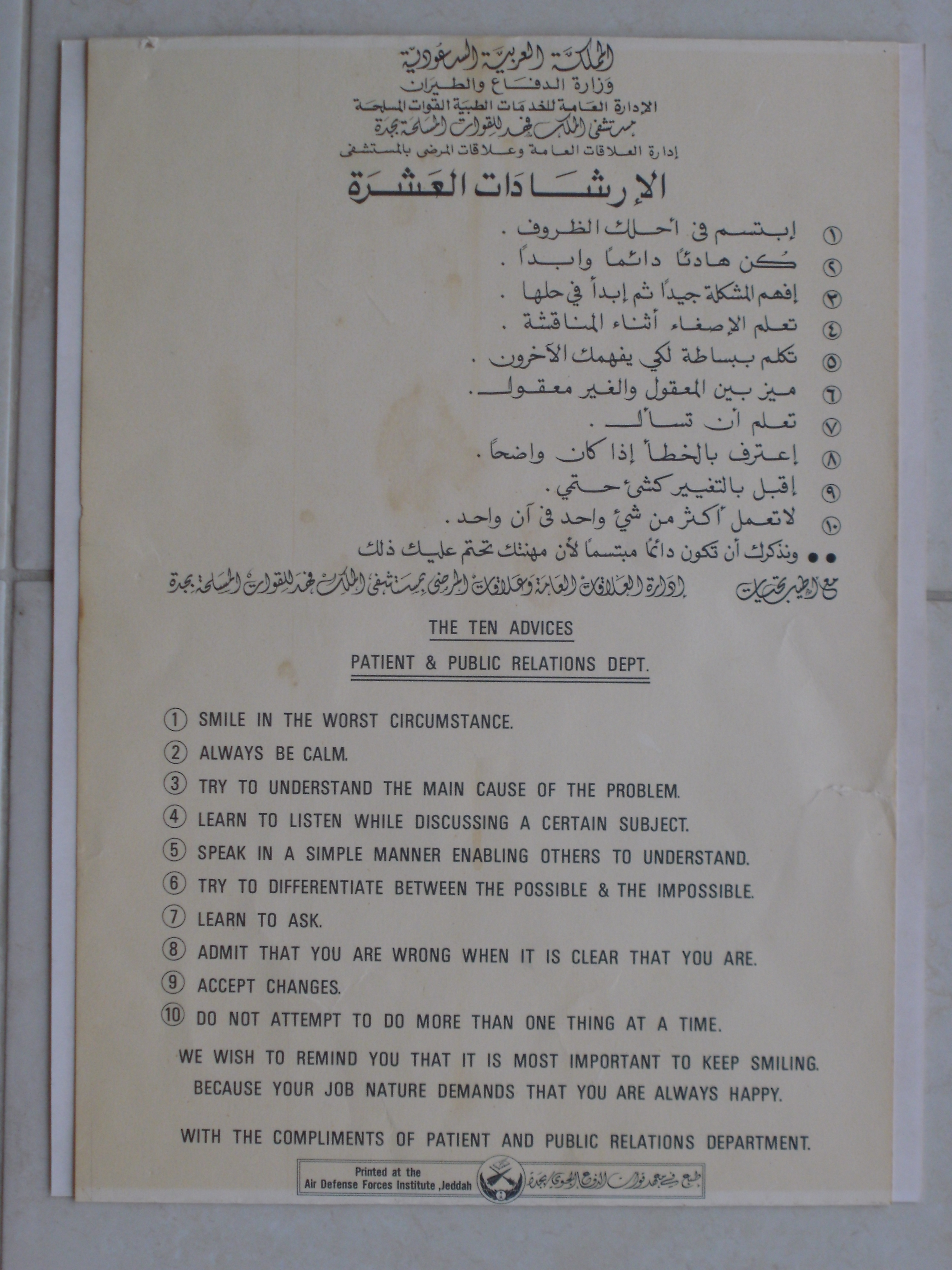
I occasionally go on about customer service in the Middle East, and when I revisited this piece of wisdom, I thought about how many millions of training dollars would be saved if people followed these basic exhortations.
My favourite of them all is the last one – “your job nature demands that you are always happy.” HR departments, stick that phrase in every job spec!!!
Last Saturday Germans were celebrating the fact that their economy grew faster in the second quarter of 2010 than at any time since 1990, and twice as fast as any other country in the Euro-zone. Shortly afterwards the BBC reported that “German investor confidence has fallen sharply this month on fears that the strong economic growth recorded in the second quarter will not last”.
The other day, a Newsweek survey showed that Finland is “the best country in the world”. No we’re not, said one Finnish commentator in the Guardian. What about suicides, alcoholism, depression and our long dark winters?
This glass-half-empty stuff can get contagious. I’m sure I could find a few Spaniards who would tell you that “it’s great that we won the World Cup, but bad news because the chances are zero that we’ll win it again next time.”
Coming from a country that in recent years has won very little, doesn’t come top of silly surveys and certainly doesn’t have an economy to boast about, it’s comforting to know that our neighbours are equally adept at souring triumph with pessimism.
At least we British do humour pretty well. Our German friends who fear the dreaded double-dip recession should check out this clip from the British comedy duo Bird and Fortune about the original sub-prime crisis. Happy days!
Looking at today’s edition of the Gulf Daily News, I noticed a job advertisement posted by the British Embassy in Bahrain. They are looking for a Corporate Services Manager. Clearly the Embassy is enthusiastically adopting the latest thinking coming from London about boosting the Foreign and Commonwealth Office’s role as the promoter of Britain’s business interests abroad. Hiring a “Corporate Services Manager” implies that the person will be providing services to a corporation. Is that how embassies see themselves these days?
All power to them. It’s much sexier than Admin and Finance Manager or, to use older FCO-type parlance, Executive Officer, Administration and Finance.
Which reminds me of my days in Saudi Arabia working for a US company. Americans are great at making people feel good about the job they’re doing by creative title-making. So whereas in Britain we have storemen, the American equivalent would be inventory management specialist. A dustman would be a waste management specialist, and so on. In today’s warm and cuddly corporate environment, US companies have invented ever more creative titles, such as Microsoft’s “evangelist”. The esteemed hosts of this blog, WordPress, have a team of “happiness engineers” waiting presumably to convert me from a state of unhappiness. Also known as technical support.
Which leads me to fantasise about the rebranding of other occupations. Can we expect in the future to go to church and hear a sermon from a pastoral care executive? Will Catholic missionaries refer to themselves as theological consultants? And will the next Archbishop of Canterbury be enthroned as Chief Salvation Officer?
Then there’s the medical profession. Cardiac engineers? Mind management professionals (mental nurses)? Other suggestions for job titles better reflecting our new corporate reality are welcome.
Of course, job titles can occasionally become a touch self-referential. In one GCC country I noticed a parking space reserved for a “Manager, Management Management”. If only I had a digital camera at the time.
O brave new world that has such people in it!
Two interesting stories today in Saudi Arabia’s Arab News, one of my favourite English-language newspapers in the region.
The first is about the prevention of two Saudi scholars from issuing fatwas on radio shows. Last week, King Abdullah issued a decree that fatwas could only be issued the officially-sanctioned Council of Senior Islamic Scholars. Curtailing the activities of the sheikhs in question seems to be in line with that decision.
Most casual observers in the West know the word “fatwa” because of Ayatollah Khomeni’s famous decree calling on the faithful to kill Salman Rushdie because his publication of Satanic Verses, which the Ayatollah and many others perceived as blasphemous. My reason for mentioning this story is that the understanding of fatwas in the non-Muslim world is highly coloured by memories of the Rushdie fatwa.
In fact, fatwas are opinions issued by experts based on their knowledge of the Quran and the Hadith (the sayings of the Prophet). They are issued to provide guidance on everyday social issues relating to how a Muslim is to behave and live his or her life. Very few fatwas deal with momentous issues such as jihad (another word that has been seriously misconstrued in the West) and terrorism.
The vast majority of religous authorities consider fatwas to be non-binding. It is for the individual to decide whether to follow the guidance offered. The problem that the King seems to be addressing is that there has been a proliferation of fatwas issued on relatively trivial subjects via TV, radio and over the web. Many of them are conflicting, because the texts of Quran and Hadith do not provide specific guidance on all the minutiae of everyday life, so people seek guidance from the scholars, who might provide different interpretations of the scriptures on the same issue. And aspects of modern life, such as the web, global communications and air travel were not factors when the Prophet received the Quran and his followers assembled the Hadith.
So King Abdullah seems to be trying to rein in the stream of opinions which can cause confusion to people looking for clarity. Saudi Arabia is not alone in facing this problem. Just about every Muslim country which bases its legal system on the Sharia has to contend with the same issues. Each has its own rules for the issuance of fatwas. Wikepedia has an informative entry on fatwas, which of course comes with the usual health warning on its veracity.
The second story is about the supermarket giant Panda. It seems that they are planning to employ Saudi women at their checkout stations. Here in Bahrain the majority of cashiers in the supermarkets are Bahraini women. They are cheerful, efficient and modestly dressed. Across the causeway in Saudi Arabia, Panda’s plans have caused a furore. As the article points out, there are many people who oppose the plan for a range of social and religious reasons. Social, because they think it’s bad that women should take jobs that men can do. Religious, because they believe that the proximity of unrelated men and women is forbidden in Islam. Which relates back to the fatwa issue.
Among those in favour of the move is a commentator who raises the question of where all the women who are graduating in increasing numbers are to work, an issue I raised in a recent post. I’m not sure that a woman who graduates from Harvard Law School is going to be satisfied with a check-out job, but his point is well made.
The Arab News story is a good illustration of divisions of opinion on social issues such as the role of women in society. It also implies an underlying anxiety about unemployment levels. Panda, like every other organisation in Saudi Arabia, has strict Saudisation quotas to meet. It employs a large number of non-Saudis, and replacing foreign check-out staff with Saudi women seems like a good way of increasing the proportion of Saudis in its workforce. It’s not surprising to see them making this move, as its erstwhile parent company, Savola, has an active corporate social responsibity program, which funds schemes to get the disabled into work, and supports the Madinah Institute for Learning and Entrepreneurship, a recent program designed to address a perceived lack of homegrown education for entrepreneurs.
So the article shows that progress is in the eye of the beholder, and what the liberal end of the spectrum in Saudi Arabia views as progress always takes time to embed itself in the Kingdom’s delicately-balanced society.
Saudi Arabia this week announced that it considers swine flu no longer to be a threat to public health in the Kingdom. That’s good news, as is the World Health Organization’s announcement that it the pandemic is over.
I was living in Riyadh when the virus first started gathering pace. At that time few people locally seemed too concerned, and I was able to get supplies of Tamiflu over the counter at one of the pharmacies near my office. My main concern was to protect my family, since at that time the virus seemed to be affecting the young, and those with “pre-existing medical conditions”. I encouraged colleagues to do the same.
As things turned out, the virus did spread rapidly, just as its distant relative did in 1918-1920, when it carried off millions of people around the world. The 1918 outbreak was exacerbated by the circumstances of the time. The First World War was still raging. There were millions of young men still in uniform, living in sub-optimal conditions. The virus targeted the young and the relatively healthy, and it ripped through the army camps before it spread to the cities of the world, perhaps carried by returning soldiers.
In 2009, the conditions for the spread of the virus seemed even more suitable. Air travel, which was not a factor in 1918, greatly increased the chances that the Mexican outbreak would quickly spread. And remember that in Mexico, the initial concern was sparked by the large number of fatalities. So it seemed that we were in for a pandemic that could cripple fragile economies and put young people around the world at risk. In Saudi Arabia, the advent of the Haj, which annually brings millions to Mecca for the pilgrimage, seemed the perfect opportunity for the virus to cause mayhem and death. The Saudis had to contend with the nightmare scenario of people in their thousands falling ill in the Holy Places, and stretching its healthcare facilities to the limit and possibly beyond.
In the end, the worst didn’t happen. The Haj took place largely unblemished by infection, though the virus did cause considerable disruption in the region. Residents of the GCC will remember the delays in the opening of the schools for the autumn term, and the heat sensors set up at airports to detect passengers arriving with high temperatures and other possible symptoms of swine flu. But fortunately it turned out to be much milder than anticipated.
In many countries there were mass vaccinations, but not before large numbers of people, including one of my daughters, came down with the flu. But as things turned out, less people died through swine flu in proportion to the population than did in earlier flu pandemics, such as those in 1957 and 1968.
What lessons should we learn from swine flu? Should we blame the experts whose predictions scared the life out of us? Should we congratulate the WHO and government health authorities for their swift action in taking preventive measures and communicating effectively with the public? To the first question, no, because nobody knew how the virus would develop – flu viruses are notorious for mutating rapidly, so mild could easily have turned to virulent in short order. To the second question, yes. Governments learned lessons from the SARS epidemic, and by and large took effective measures this time round.
Apart from the fact that the virus did not have the effect that many feared, we should be pleased for more than one reason. We have effectively had a dress rehearsal for the next pandemic, which may not even be of a flu virus. What we have learned from swine flu will help us prepare better for an outbreak that turns out every bit as bad as predicted. Also, the pandemic resulted in breakthroughs in the development of vaccines that offer the hope of a single vaccination that will protect us from all future variants of flu. The result could be hundreds of thousands of lives saved in the future.
These comments come with a big health warning. I’m not a doctor, nor am I an epidemiologist. But it seems to me as an interested observer that the world is a safer place thanks to swine flu.
The obvious danger is that next time a pandemic occurs, we will remember the relatively mild outcome of the swine flu episode, and not take future warnings seriously. As I write this, there is growing publicity about a nasty little enzyme called NDM-1 that attaches itself to common bacteria and renders them resistant to all antibiotics. See http://www.bbc.co.uk/news/health-10930031.
Mother Nature often finds a way of defeating man’s best endeavors.
My father died seven years ago this month. He was 81. Though I loved him and miss him still, I’m not one to get sentimental about people who’ve gone. There’s no grave to lay flowers on – he was cremated. He should really have gone on much longer. In his last years he developed angina, and then leukemia, which prevented an operation to fix his heart problems. Throught his life, he stayed very fit, and looked years younger. When I took him to the cardiac specialist for the last time, it was summer, and he was wearing shorts. “Nice legs”, she said, and they were.
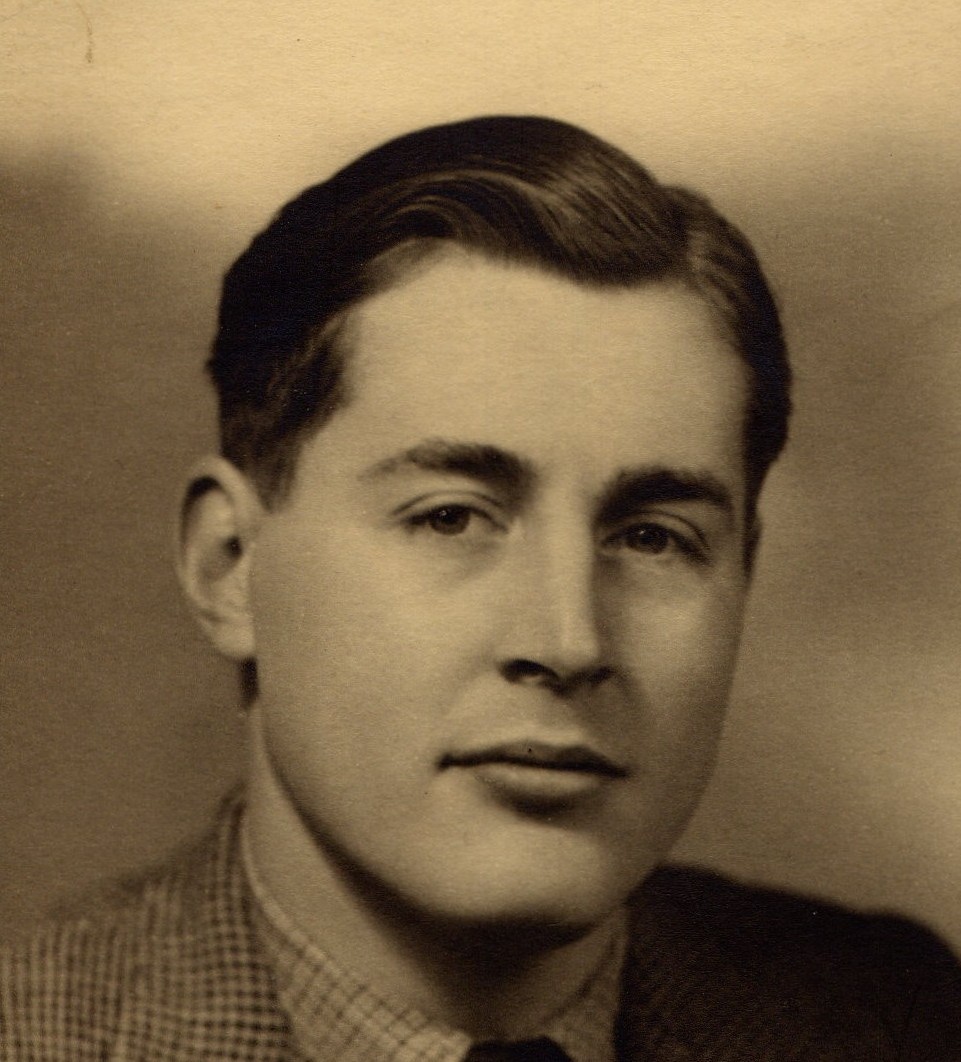
A couple of years before he died, I found myself with more time on my hands than before. My partner and I had sold one of our businesses, so I had an opportunity to ease back on work. When you get to your fifties you realise that you’ve reached a cusp – more time gone than there is to come. Not that that bothered me. In fact, you start measuring time more by quality than by hours in the day. But because you have plenty of it, you start thinking more of the past as well as present and the future. After all, you own your past, so why not make good use of it?
So I embarked on a series of projects to preserve my past as well as that of my family. No, not an autobiography. My life isn’t significant enough to warrant what would be a vanity project. Three hundred pages of justification, embroidery and minutiae. I’d die of boredom after the first fifty pages.
My first project was to digitise all the family photos. I borrowed all the photos I could find from my parents and set to work. By the time I’d finished, I’d worn out two scanners and had a photo folder with well over ten thousand pictures, from daguerreotypes made in the mid-1800s to family snaps of my own growing family. All categorised and easily accessible. I put the photos from my generation backwards on to a DVD, and sent them to each of my siblings. That way, everyone had everything that would mean something to them. If my kids and their kids are interested, it will be there for them as well.
The next project was to capture some oral history. I’d bought a near-broadcast standard digital video, and decided to interview my parents. I wrote a hundred questions which I sent to them in advance. Over five sessions, I sat them in their garden and asked them questions. What was life like in the 20s? What do you remember of your parents? How did you feel before the war? Did you support Churchill or the appeasers? Describe a typical day at the age of ten. What were you doing on VE day? They sat talking in the garden in the English summer, pausing occasionally to let an aircraft pass over – they lived in Barnes, on the flight path to Heathrow.
My mother said little. She always felt overshadowed by my father’s confidence and fluency. He was a lawyer, you see, and never at a loss for words. That didn’t stop the odd scornful interjection when his narrative flew too high. The interaction between the two of them said as much as my father’s words. He was in his element, and in the end I went away with five hours of stories, reflections and opinions. Again, I burned a DVD and sent one to my siblings. My mother never wanted to see the tapes, and these days they wouldn’t mean much to her.
Then my father died, and another project began. This one was much longer. It started with the occasional visit to the parental loft, and a root around papers, books and mementoes. Things picked up speed this summer when my mother’s health declined. We decided decided it was time to clear the house of personal stuff in preparation for the time when she would go into nursing care. My mother didn’t much mind what we did. Since my father died, her world slowly shrank from visits to the supermarket, church twice a week and the occasional visit to us for Sunday lunch, to hours spent in the sitting room with soaps, library books and radio, punctuated with visits to hospital, help from kindly neighbours and the heroic support of my wife, who shopped for her and visited her once or twice a week.
This summer, my brother and I decided to deal with the books and papers. To the day he died, our father continued to work. He took on work for no pay for neighbours. He also had an international network with whom he embarked on endless schemes to make huge amounts of money, much of which he would give to a children’s charity he had set up specially for the day the boat came in. It never did. The result was over a hundred legal folders stuffed with contracts, faxes, letters, prospectuses and other weighty stuff.
Interesting as the papers were as a testament to his immense energy and output, the real interest for Patrick and me was the books. He’d got rid of half of them ten years ago to raise some cash. A book dealer came and took hundreds away. Those that remained still showed the breadth and depth of his interests. We separated them into categories. History, psychology, philosophy, poetry, plays, politics, economics, travel, maths, science, religion, spirituality, art, architecture, language, health and healing.
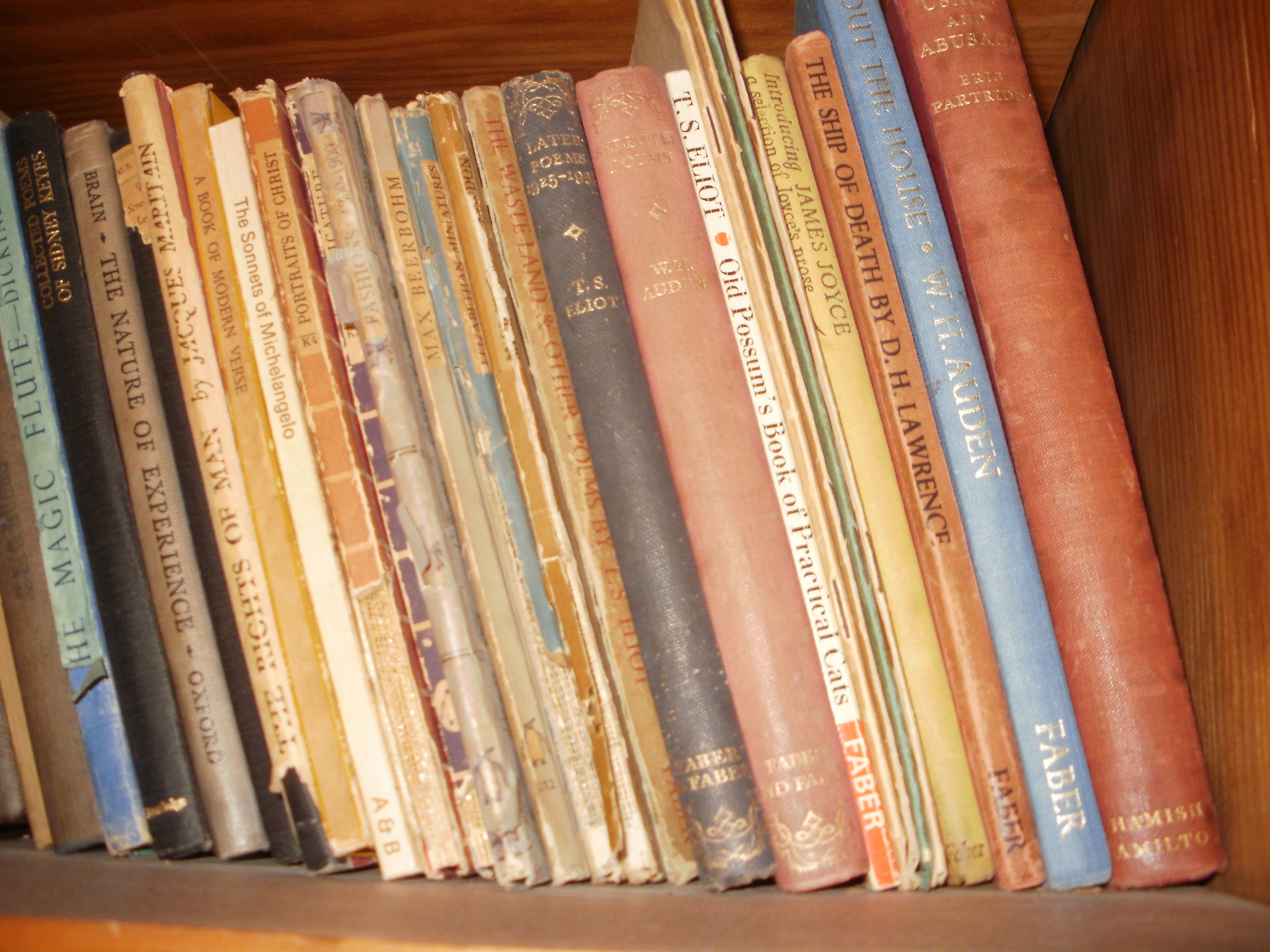
He was always a prolific reader – over his reading life he must have got through one or two books a week, if not more. It’s no wonder that my mother would occasionally weigh into him for one reason or another. With his work and his books, she was entitled to think that she never got the time she was due. Yet for all her complaining, she more than once referred to him as her rock. Especially after he died.
I used to regularly plunder his library while he was alive. I promised to return them, but never did. He had so many books he never noticed. Patrick and I used to joke about some of his books with particularly obscure titles as “typical Dad books”. Tomes like “Giordano Bruno and the Hermetic Tradition”, “The Holographic Paradigm and Other Paradoxes”, “Wholeness and the Duplicate Order”, and “Wilhelm II – Aus Meinem Leben 1859-1888”. He learned German at 60, you see, around the same time as he took up motorcycling, and bought himself a Honda 500 bike, complete with regulation leathers.
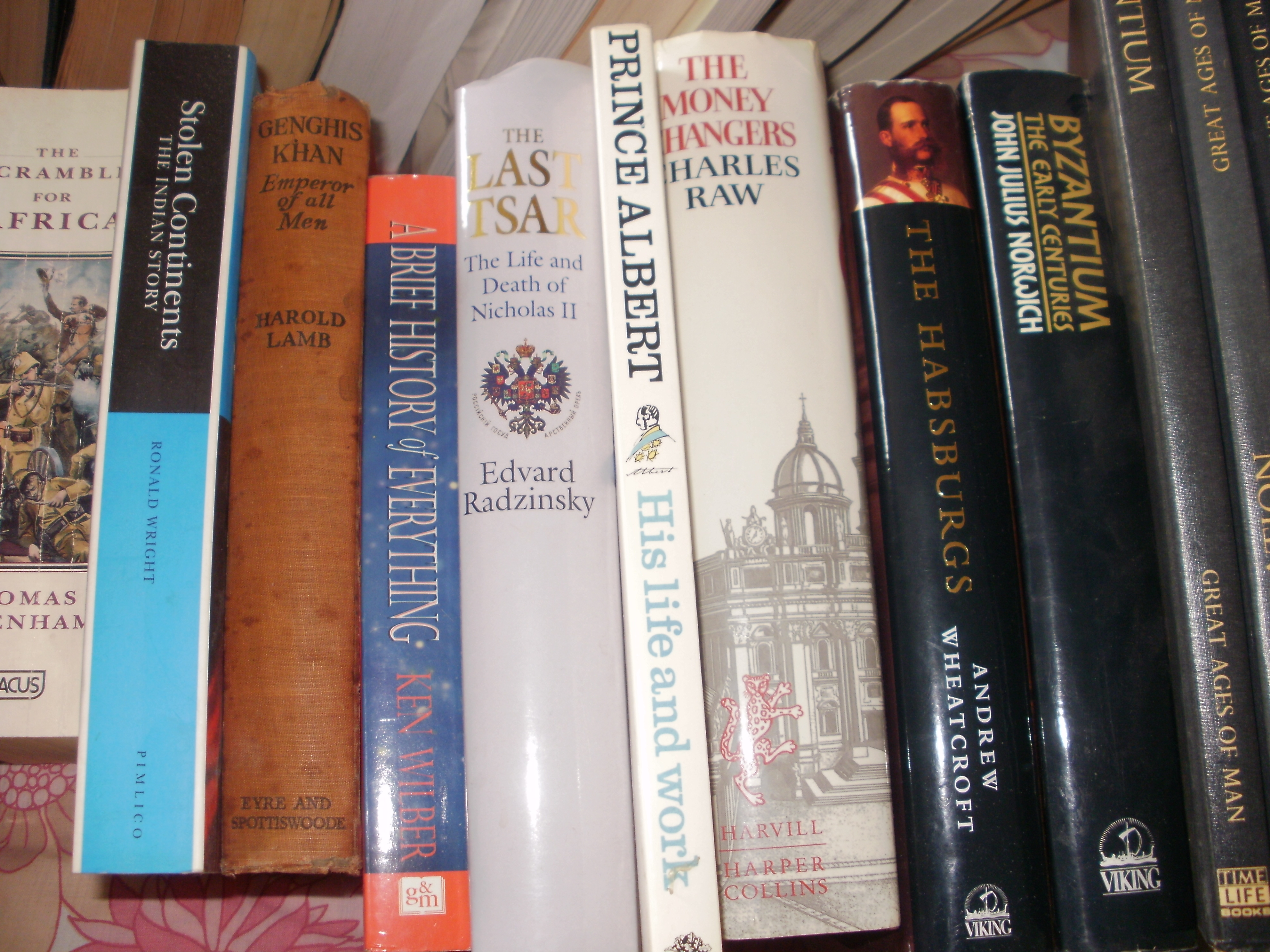
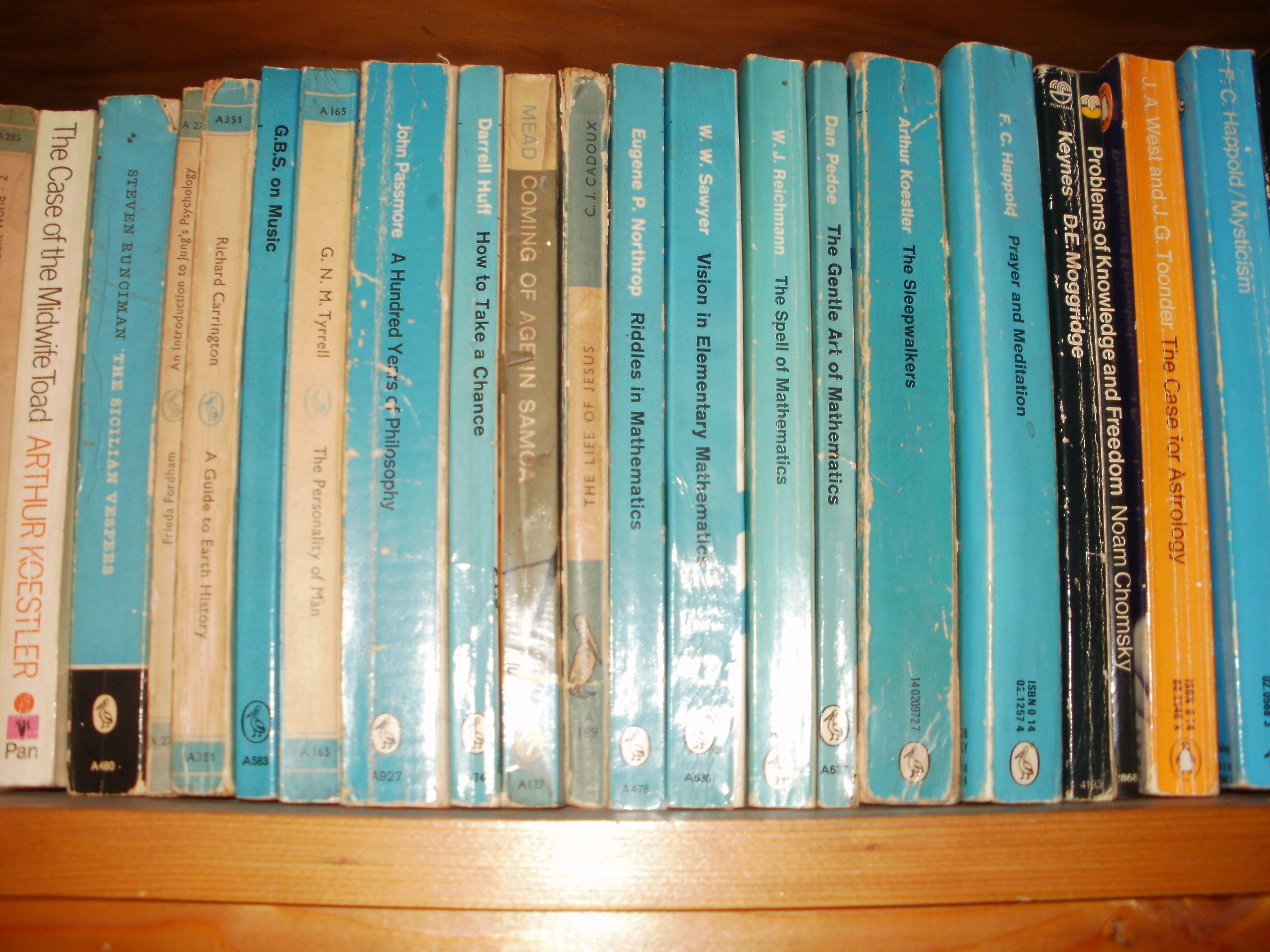
But what to do with the books? Patrick and I decided that we would make them available to members of the family to take what they wanted, and sell the rest to a second-hand bookseller, perhaps, in Hay-on Wye, which over the past twenty years has become the secondhand book souk to the nation. Rather than load them into a set of boxes and cart them around the shops, I volunteered to photograph all the spines, and create a little database of the titles, subjects authors and publishers.
Today I finished the job. When I look at the compendium of his books, it occurs to me that, more than all the pictures, videos, conversations and memories, these books are rather like the beams in a timber-framed house. They provide the shape into which everything else fits. Books by Huxley, Koestler and Jung remind me of conversations we would have about the mind. “Books like Human Personality and its Survival of Bodily Death” remind me of his rock solid conviction that there was an afterlife. Travel books remind me of family holidays. And his language books reminded me of his description of a chance meeting with Albert Speer, Hitler’s architect, shortly before Speer’s death.
He was a man who loved conversation. Who had a talent for finding the passion of others, drawing it out and being a fascinated audience. He had circles of friends, not always intersecting, but representing different aspects of his life. They all came together to his funeral. His swimming pool circle who described how he held forth in the jacuzzi. An Egyptian filmmaker who said what a wonderful person he was. Neighbors, business associates, and the ghosts of those long gone.
Denis had a long life, with many ups and downs, setbacks and thwarted ambitions. He was no saint. But when I would look at him buried in a book, I saw someone contented with the moment. And there were many moments.
I said earlier that I’m not sentimental about him, but one thing saddens me. He often talked about writing about things that were important to him, but never made the time. A man who met thousands of people and spoke millions of words in his lifetime wrote little but legal documents and a few diaries that give only the slightest hint of his inner thoughts. All that knowledge that he poured into himself, and so little output beyond the dry, banal words that he wrote on behalf of others. Perhaps there was a core that he shared with nobody, and he felt all else to be superfcial. And perhaps we have words enough already.
So we have his books to remember him by, like the artifacts of Tutankhamun – things that inform us about him, but don’t reveal a heart that will be forever private.
Maybe that’s the way with all of us.
Pakistan is not a happy nation. Devastated by earthquake in 2005, now overwhelmed by flooding. Ill-served by successive governments. Divided within itself, vilified by the West for its alleged double dealing over Afghanistan. Its sons and daughters have emigrated by the hundreds of thousands to the Middle East and the UK, where their remittances prop up an ailing economy.
In the Middle East, those with education hold down a huge number of white and blue collar jobs, and the uneducated work on the roads and construction sites for as little as $200 a month. They come here to make a better life from themselves and for their families back home. Consider the implication. If $200 a month represents a better option than staying at home, what does that say about home? What’s more, many get into debt to come here, and are the first to be left waiting for their wages if things go bad for their employers.
In the UK, the word “Paki” has become the standard weapon of insult used by the bigoted, ignorant underclass for anyone with a brown skin, be they Indian, Sri Lankan or even Arab. And not just insult. “Paki-bashing” was a favourite occupation of young white racists from the 70s onwards. And we wonder why the victims turn in on themselves, stay with the customs of their parents’ homeland, or turn to violence themselves?
I’ve never been to Pakistan, and I don’t plan to any time soon, despite the undoubted beauty of many parts of the country, and the energy and vitality of its people. I’m not a habitual seeker of dangerous places, and Pakistan for me seems too violent, too full of hate.
Yet in my time in the UK and the Middle East I’ve encountered and worked with hundreds of Pakistanis – taxi drivers from Peshawar, librarians from Islamabad, clerks from Lahore and Karachi. In the UK, bankers, doctors, corner shop owners, even golfers. And not a single one of those I have met could I imagine rioting in the streets, burning effigies, bombing mosques and rampaging through Indian railway stations. But I guess that what I was talking about in The Thin Veneer – that we’re all a crisis away from inhumanity and inhumane behavior.
Two of the guys who look after my apartment block are from Pakistan. They’re always smiling and friendly. When I show up with a car-load of shopping, without any prompting they come out to the car and help me carry my stuff to the apartment. Three days ago, I learned that both of them have lost their houses in the flood. Thankfully their families are OK, but while you and I would melt with worry, and probably take the next plane home to deal with the crisis, they don’t have that option. Yet I come down in the morning to the same smiling faces, showing not a trace of the concern they must feel.
The people of Pakistan have been dealt a bad hand. They’re not bad people, and I don’t believe in divine punishment. Like the rest of us, they’re human beings who want only shelter, food and a decent life for their families and loved ones. Millions in the country don’t have anything right now. So I urge anyone who reads this to think seriously about making a donation to one of the relief funds set up to ease the plight of those caught up in the floods.
Here are some places where you can donate:
There are many other funds, so take your choice. Just do it.
The Holy Month of Ramadan started today.
Writing about Ramadan in the Middle East is rather like writing about Christmas in the West. A subject with so many facets that it’s the equivalent of writing an article about the meaning of life.
But if you’ve never been in a Muslim country, and you know little more than that Ramadan involves fasting from dawn to dusk, there’s much more to discover. Why bother? Because understanding Ramadan takes you a long way towards understanding Islam and the traditions of the Muslim world. Far further than stories of the Taliban murdering a team of Western medics, or the sight of women in the street dressed in black from head to toe.
So this is a personal view of a non-Muslim who has lived through many Ramadans among Muslims celebrating their holy month.
Let’s start by looking at the Christmas analogy. It’s true that both seasons involve goodwill, charity, family gatherings, feasting and present-giving. But there the similarity ends. Christmas in the West is a one-day festival with an indeterminate (and some say interminable) lead in. It’s marked by indulgence, excessive eating, drinking and partying. It involves no personal sacrifice, except on the part of mothers and fathers who go into serious debt in their attempt to give their children a “good Christmas”. Only a small proportion of those who consider themselves Christians perform an act of worship on Christmas Day, or any other day for that matter.
Observing Ramadan, on the other hand, is an obligation on all Muslims. Fasting is one of the Five Pillars of Islam (the others are daily prayers, the declaration of faith, the giving of alms and the pilgrimage to Mecca). It involves serious personal endurance.
Consider the implications of fasting from dawn to dusk for 30 days. No food, no, drink, no smoking, no brushing of teeth. In short, nothing to enter the mouth or any other part of the body. And the vast majority of the hundreds of millions of Muslims around the world, rich and poor, do this every year. For example, as I sit in an air-conditioned room writing this, I can see manual laborers in the street working away in 40 degrees of heat with no food or drink to sustain them.
There are, of course, exemptions derived from the Quran and religious tradition. Pregnant women, children, and the sick do not have to fast. Nor under certain circumstances, do travelers, although they have to fast at other times to complete the obligation. There are also rules which apply to people living in areas where the summer sun doesn’t fully set, such as Finland, Alaska and Antarctica. Fasting for 23 hours a day simply isn’t practical, and contrary to some perceptions in the West, Islam is a practical religion.
Such is the power of the obligation that in many parts of the world, including where I live, it is enshrined in the law. Nobody, Muslim or non-Muslim, is permitted to drink, smoke or eat in public during fasting hours. The penalties for breaking the law can range from admonition to jail.
So this is no festive season with a bit of religion thrown in. Nor is it the equivalent of giving up chocolate for Lent. It’s a drastic, annual, change of behavior by a significant percentage of the world’s population. For many Christians, their religion is a way of living, and the teachings of Jesus inform, without enforcing, social norms, morals and behavior in the West. But Islam is a way of life, and Ramadan exemplifies that life. Obligation. No compromise, right and wrong, adherence both to form and substance.
Yet beneath the seeming harshness of the obligation lies the meaning of Ramadan for Muslims. A time of contemplation, of spiritual cleansing, of consideration for others, of self-discipline, of shared experience. It’s a positive time which leaves participants with a real sense of achievement and wellbeing.
Of course not everyone enters into the spirit even if they adhere to the form. Just as in the West the inevitable reaction of horror follows the appearance of Christmas advertising many months before the season begins, many Muslims complain of the creeping commercialization of Ramadan. Just as we do, many Muslims max out their credit cards during the season and spend the aftermath worrying about how they will make ends meet. And many overindulge during the night time hours, with some actually gaining weight over the month.
Some also mitigate the fasting hours by sleeping. Visit the more traditional offices in parts of the Gulf during Ramadan, and it’s not uncommon to see sleeping bodies littering prayer areas, offices and communal areas. But even among the weak-willed, there’s no mistaking the desire and intention to meet the obligation of their faith.
For non-Muslims living through Ramadan, only those who wrap themselves in their own bubble of reality can fail to be affected and often uplifted by the experience. I enjoy the month immensely. Social activities go on late into the night. Shops stay open until the early hours. There are special Ramadan foods, including the sweet, sticky variety which I adore. Above all, there’s a spirit of animation and excitement in the night time hours not to be felt at any other time of the year.
Daytimes are quiet. Working hours for those who are fasting are shorter. Meetings late in the afternoon are best avoided. Try as they might, even the most diligent start flagging. I remember one meeting with a very senior executive. At his request, it was at 5pm. As the meeting went on, I could see his eyes drooping as he fought to stay awake. Though there was a good chance that I would have bored him to sleep anyway, I learned my lesson.
For those experiencing the season for the first time, there can be memorable moments. When I first came to Jeddah in the 80’s, I woke up on the first morning of Ramadan to a loud explosion. When I crawled from my refuge under the bed and looked out of the window, I could see a field gun on a bit of waste ground outside my apartment, which was fired every morning at dawn to remind the faithful that the hours of fasting had begun. Then there’s the craziness on the roads as people rush to get home or the mosque at dusk for prayers and the breaking of the fast. And for half an hour following nightfall, the experience of driving on deserted roads normally packed with crawling rush-hour traffic.
For non-Muslims Ramadan is a chance to listen, observe, understand and enjoy. It’s unforgettable.
For my Muslim friends everywhere, Ramadan Kareem!
This is another Career Advantage article. More about the straightjackets of ageism, rigid recruitment practice and over-reliance on paper qualifications….
“The other day, I was having dinner with a friend. He’s a former soldier who did his officer training at a prestigious military college. When he left the Army he went into IT. At the age of fifty, he’s still working in the same field here in the Middle East. He’s concerned that as he gets older, it’s becoming increasingly difficult for him to pass through the recruiter’s gate, first because of his age, and more importantly because he doesn’t have a university degree. This is despite a military education that gave him knowledge and skills superior to that achieved by the vast majority of graduates in his area of specialization.
We talked about people who get “Life Experience” degrees you can pick up for $500 via the internet. We agreed that these people are probably wasting their money, because nowadays days recruiters (and I was one in an earlier life) can spot a dubious degree from a mile off.
As we talked, I reflected on the role of “qualifications” in determining the level of success an individual will have in his or her career.
What I have to say from here onwards may not be what the millions who have put their hearts and souls into achieving the all-important degree certificate will want to hear. So at the risk of alienating half the planet (or at least the tiny fraction of that hemisphere who happen upon this blog), here are a few thoughts about qualifications, and how attitudes towards them have led to the failure to recognize a huge pool of untapped human capability.
For centuries, university degrees fell into two categories. The first category included those qualifications which proved that, at a given point in time, you had the minimum knowledge and mental ability to carry out some kind of occupational task. Medicine, law and divinity came first, followed later by disciplines such as science, engineering, accountancy and teaching.
In the second category were the so-called liberal arts – philosophy, divinity, history and languages. Until the early 20th Century, these would be degrees favored by people who didn’t want to go into one of the so-called “professions” – law, medicine and so on. In some cases they were the favored option of the wealthy, who might be expected to go into politics or manage the family estates and business. In other cases they were the choice of those who had a passion for the subject and wanted to share their knowledge through teaching or academic research. In the days of Isaac Newton, science was also considered a liberal art, and only later became the gateway for careers as physicists, chemists and biologists as the industrial revolution gathered pace.
Then came disciplines that straddled the divide. Subjects that provided the student with many potential career options: management, sociology, psychology, archaeology, anthropology, and then a host of new entrants to the university curricula, such as media studies, sports science and hotel management. The list goes on, becoming ever more exotic as we reach the present day.
The assumed common denominator for all degrees is that graduates, at the time that they graduate, have proved that they have achieved a benchmark in their knowledge and their capacity to think in ways approved by the institutions that taught them.
It’s a logical and rational system that has stood the test of time.
But in my opinion, as academia has become a business, and as hundreds of millions of young people aspire to a life beyond the reach of their parents and grandparents, the degree has become the one-eyed king in the land of the blind.
Nowhere is this more true than in the Middle East. Here, employers (though not all, I hasten to say) are often too lazy to look beyond a person’s qualifications. So they will judge a person of twenty years of experience and wisdom on the basis of knowledge they acquired two decades ago, much of which they probably forgot within a couple of years of graduating. Teachers ram home the importance of qualifications, and often they talk about certificates, as though the piece of paper is more important than the learning. Which, in practice, it is, because employers frequently place more importance on the piece of paper than on the evidence of experience and competence gained since graduation. So the certificate becomes an end in itself, not a milestone in a life long journey of learning.
In a culture where being a manager wins more respect than being a specialist, specialist degrees often provide the stepping-stone for career advancement into areas for which they do not prepare the student. Clever engineers become mediocre managers or worse, because being a manager pays better.
The certificate obsession in the Middle East is only an extreme example of the attitude towards qualifications the world over. That attitude is often overcome by brilliant individuals such as Richard Branson and Alan Sugar in the UK, who have few formal qualifications, and yet have created huge business empires and gained wide respect for their abilities. But often as not, they are the exceptions rather than the rule.
I suggest that there are hundreds of thousands of Richard Bransons and Alan Sugars working away in jobs way below their capabilities because, like them, they do not have the pieces of paper so prized by employers. They may not have the determination of Branson and Sugar, but the capability is there, untapped.
In the 1990s a Houston petroleum engineer in his seventies called George P Mitchell found a way of unlocking vast gas reserves trapped in shale. Others ignored these resources because they considered extraction to be too difficult and expensive. Thanks to his pioneering work, he became a billionaire, and the US has reversed decades of decline in gas reserves to become the leading gas producer today. At the age of 92, Mitchell is still working today – a living testament to lifelong learning and the staying power of the elderly.
Just as that gas was waiting for a brilliant engineer to extract it, the capabilities of many capable people remain today to be discovered and used to their full potential. People who, for a number of reasons, such as poverty, accidents of fate or simply being in the wrong place at the wrong time, missed out on the formal education that employers demand.
Employers who find a way to extract that talent by looking beyond the straightjacket of formulaic recruitment techniques and rigid attitudes towards qualifications will discover a new seam of intelligent, motivated and capable human resources.
HR professionals will point to assessment centers as a good way of tapping that talent. But if the only way to walk through the assessment door is to have a pass marked “degree”, and that pass is the only way to progress to roles matched to capability, employers will continue to miss out on the hidden treasure that is available to them.
Archimedes, Galen, Ibn Al Haytham, Al Kwarizmi and Leonardo Da Vinci did not have pieces of paper attesting to their knowledge, yet their discoveries and perceptions changed the world.
Degrees are good things, but they are not the only markers of capability. As long as I’m in business, I shall encourage employers to look beyond them and tap the human equivalent of shale gas.
As for my friend who, incidentally, introduced me to the best seafood in Bahrain – this is for him.
Steve Royston
June 2010”
For more stuff on the Middle East, see www.careeradvantage-uk.com.
Her’s another Career Advantage post. It’s about the tendency in the Middle East to find someone to blame when things go wrong as a first reaction, rather than to fix things and then examine how things went wrong. Not exclusive to the Middle East, of course, but in an authoritarian work culture, fear and willingness to blame others for mistakes tend to be pervasive.
Many thanks to Tahir Shah for his permission to reproduce the story. Here’s the piece:
“Last week I was having dinner with a friend from one of the GCC countries. As is usually the case with this particular friend, we spent a couple of hours solving the problems of the world, and the Middle East in particular. We talked about the huge potential within the people of the GCC, and the obstacles to realizing that potential. The usual subjects came up: the education system, the employment of women, the gap between planning and implementation.
Then my friend came up with this observation: “The number one problem that is holding back our people is the fear of being punished for making a mistake”. How right he is, and not just in the GCC!
It happens that I’m currently re-reading Tahir Shah’s wonderful book about the storytellers of Morocco, “In Arabian Nights”. Anyone coming to the Middle East who wants to understand the culture of the region beyond the superficial etiquette should include Tahir’s book on their reading list.
One of the stories he tells is “The Tale of Melon City”:
“Once upon a time the ruler of a distant land decided to build a magnificent triumphal arch, so that he could ride under it endlessly with great pomp and ceremony. He gave instructions for the arch’s design, and its construction began. The masons toiled day and night until the great arch was at last ready.
The king had a fabulous procession assembled of courtiers and royal guards, all dressed in their finest costumes. He took his position at the head and the procession moved off. But as the king went through the great arch, his royal crown was knocked off.
Infuriated, he ordered the master builder to be hanged at once. A gallows was constructed in the main square, and the chief builder was led towards it. But as he climbed the steps of the scaffold, he called out that the fault was not with him, but with the men who had heaved the blocks into place. They, in turn, put the blame on the masons who had cut the blocks of stone. The king had the masons brought to the palace. He ordered them to explain themselves on pain of death. The masons insisted that the fault lay at the hands of the architect whose plans they had followed.
The architect was summoned. He revealed to the court that he was not to blame, for he had only followed the plans drawn out by the order of the king. Unsure who to execute, the king summoned the wisest of his advisors, who was very old indeed. The situation was explained to him. Just before he was about to give his solution, he expired.
The chief judge was called. He decreed that the arch itself should be hanged. But because the upper portion had touched the royal hand, it was exempted. So a hangman’s noose was brought to the lower portion, for it to be punished on behalf of the entire arch. The executioner tried to attach his noose to the arch, but realized it was far too short. The judge called the ropemaker, but he stated that it was the fault of the scaffold, for being too short.
Presiding over the confusion, the king saw the impatience of the crowd. ‘They want to hang someone,’ he said weakly. ‘We must find someone who will fit the gallows.’
Every man, woman and child in the kingdom was measured by a panel of experts. Even the king’s height was measured. By a strange coincidence, the monarch himself was found to be the perfect height for the scaffold. Victim procured, the crowd calmed down. The king was led up the steps, had the noose slipped round his neck and was hanged.
According to the kingdom’s custom, the next stranger who ventured through the city gates could decide who would be the next monarch. The courtiers ran to the city gate and waited for a stranger to arrive. They waited and waited. Then they saw a man in the distance. He was riding a donkey backwards. As soon as the animal stepped through the great city gate, the prime minister ran up and asked him to choose the next king. The man, who was a travelling idiot, said ‘A melon.’ He said this because he always said ‘A melon’ to anything that was asked of him. For he liked to eat melons very much.
And so it came about that a melon was crowned the king.
These events happened long, long ago. A melon is still the king of the country and, when strangers ask why a melon is a ruler, they say it’s because of tradition, that the king prefers to be a melon and that they as humble servants have no power to change his mind.”
I leave you to draw your own conclusions from the story. But in my time in the Middle East, I have seen people petrified in fear of their bosses, and afraid to take even the most simple and inconsequential decisions. And a culture in which mistakes are not tolerated is one in which innovation cannot flourish, because true innovators take risks and make mistakes.
Of course, there are mistakes and mistakes, and different forms of punishment. Among those in lowly and middle ranking positions within the great bureaucracies of the region, the fear is of loss of job and livelihood. If you are from Egypt or India, for example, the economic consequences of losing your job and having to return home are massive. If you can get a job at all in your home country, it’s unlikely that you will equal the standard of living you enjoy in, say, Saudi Arabia or the UAE. So you do everything you can to resist change that will threaten your job security, and the tools of that passive resistance are to keep your head down, cling to the status quo and tell those higher in the hierarchy what they want to hear.
If you are among the elite, there are different drivers. You may not risk unemployment, especially if you are the owner of a business or among the governing class. But you do risk loss of respect or personal humiliation of something goes wrong. And many people would prefer to lose money than face. So you do your best to cover up mistakes by denying that they ever happened and reinventing history. What you learn from the experience is not how to get things right next time, but never to put yourself in the same position again.
In case you might think I’m unfairly singling out the Middle East as a prime upholder of blame culture, I would point out that the concept of “never explain, never apologize” first reared its ugly head through the words of John Wayne in the 1948 movie Tie A Yellow Ribbon, in which he counsels a junior officer facing an Indian attack: “Never apologize, son. It’s a sign of weakness.”
And in my own life, I’ll always remember one of my daughters at an early age playing in the kitchen. From another room, I heard the sound of breaking crockery, and rushed in to investigate. I found my daughter standing in the wreckage of a shattered mug. She turned round and said “you made me do it, Daddy!”
In these fraught times, perhaps we could all benefit from prizing two great tenets of Islam – humility and forgiveness.
Steve Royston
June 2010″
Originally published in www.careeradvantage-uk.com.
Here’s another piece from Career Advantage. It’s about women’s education in Saudi Arabia. I was in Riyadh this week, and the subject of what to do with the thousands of graduates returning from scholarships abroad came up in conversation more than once. Part of the problem with the Gulf in general is that many graduates expect jobs to be waiting for them in their fields of study. There was a recent story in the Bahrain press about four physical education graduates staging a sit-in in a goverment office because they took the view that they had their qualifications, and that the government should now find them jobs. Graduates from the West tend to take the more practical view that while they’re waiting to find a job in their chosen field, there’s no shame in taking up temporary jobs in MacDonalds, Starbucks et al. That mindset does not seem to have reached every graduate in the Gulf.
For women in Saudi Arabia, that route is a little more difficult, as temporary jobs for women are hard to come by, and the classic burger flipping option simply isn’t available because of social and religious norms forbidding physical proximity between men and women who are not related.
Here’s the piece:
“Driving into Riyadh the other day from King Khaled International Airport I saw an amazing sight. Not amazing to the casual observer who does the trip every day. But I normally visit the city by road, and it had been a couple of months since I’d last flown in.
On the right hand side of the highway that takes you into central Riyadh, there is now a massive construction site that must span several square miles. The steel frames of huge buildings, new roads, landscaping, a regiment of cranes, earthmoving equipment and hundreds of construction workers crawling all over the site.
In a land of soaring ambition and money to match, gargantuan construction projects are nothing new, especially in the capital. What was amazing to me was that this site had seemingly risen from nothing in the space of a couple of months.
Rising from the desert is the world’s largest university, Princess Noura bint Abdulrahman University. It’s been designed to accommodate 40,000 women. It will have its own 700-bed hospital, a monorail to get you between buildings, mosques, leisure centres, kindergartens and accommodation complexes. It will teach medicine, pharmacy, management, computer sciences and various languages, as well as translation, interpretation and domestic science. The project will cost approximately $12 billion – for British readers, that’s the equivalent of ten Wembley Stadia!
In the Middle East one becomes used to superlatives – the biggest, the highest, the most advanced. Usually they refer to ostentatious projects like the Burj Dubai, the world’s largest tower block (for now…). But superlatives applied to education are usually significant, and in Saudi Arabia, when applied to women’s education, they are even more significant.
This is a country where, according to recent research, 32% of women in employable age are in jobs, where there is substantial unemployment among the under-30s, and where there are in excess of 9 million foreign workers. So in this context, the development of Princess Noura University is a big statement of intent on the part of the government. It’s the latest step in an even bigger programme of women’s education. Last year Effat University for Women opened in Jeddah. The King Abdullah Scholarship Fund has for several years been sending thousands of women to study in western universities. It’s also a telling indication of the attitude of senior royals towards these projects that Princess Noura was the favourite sister of Saudi Arabia’s founder, King Abdulaziz, and Effat was the beloved wife of the late King Faisal, and a pioneer in women’s education in the Kingdom.
Set these facts against western perceptions of the Middle East fuelled by the media, politicians and the acts of radical Islamism – terrorism, burqas, and society’s attitude towards women – and you have an interesting contrast. Saudi Arabia is still a country with a wide spectrum of opinion on the role of women in society. On the conservative end of the scale, for example, there has been great resistance, particularly among the clergy, to the plans to allow men and women to work alongside each other at the showpiece King Abdullah University of Science and Technology, which opened recently near Jeddah. Although these views probably reflect those of a minority of the population, nonetheless large sections of the community hold a deep and sincere conviction that the role of women should be confined to motherhood and family.
Such views can’t simply be swept aside by a reforming government. Saudi Arabia has succeeded in keeping its political equilibrium in the eighty-odd years since the Kingdom’s foundation by consensus and evolution rather than revolutionary change. King Abdullah is known as a reforming monarch. He is much loved and respected, and yet there are limits to what he can achieve without alienating elements within the Kingdom’s stakeholders: the royal family, the tribes, the business community and the highly influential body of clergy, the ulema.
So it seems to me that by the massive investment in women’s education, the King and his advisors are creating a groundswell. When these women graduate, and find themselves unable to get jobs suited to their newly acquired knowledge and skills (remember the current employment rate for women), will they apply irresistible force by pressuring their fathers, husbands and brothers to support reforms which will level the playing field for women in the workplace? Will employers, who hire millions of non-Saudis while struggling to meet mandatory quotas of Saudi employees, ignore the tens of thousands of bright, motivated and highly skilled women looking to enter the workplace?
As a classicist, I’m reminded of Lysistrata, the comedy written by Aristophanes two and a half thousand years ago. The women of Athens, fed up with the constant wars being fought by their men, calls upon all the women of Greece to withhold conjugal rights from their men until they stop fighting each other. After many comic attempts by the men to get the women to change their minds, Lysistrata succeeds, peace breaks out throughout Greece and marital harmony resumes!
I’m not suggesting that the women of Saudi Arabia would adopt such tactics, but perhaps an irresistible force is building to change the minds of those who think of women, as the preacher John Knox did in 16th century Scotland, as the “monstrous regiment”.
Steve Royston
May 2010″
Originally published in www.careeradvantage-uk.com.
This is another piece I wrote for Career Advantage at the time when the Gulf oil spill crisis was at it’s height. It was interesting that Jane Lubchenco, the Administrator of the National Oceanic and Atmosphere Administration, in her press conference yesterday, referred only to the Federal clean-up effort, as though BP had nothing to do with it. Likewise President Obama in his speech to the AFL/CIO. BP would probably take the view that it would have been appropriate if the Federal Government, having “kicked the company’s ass” over the past three months, had the grace to acknowledge their efforts.
But hey, that politics, and there’s a mid-term election coming up…. Here’s the original piece:
“A few months ago, I wrote a piece for this website (Career Advantage) called Saudi Arabia’s Katrina (http://www.careeradvantage-uk.com/uncategorized/saudi-arabia%e2%80%99s-katrina.) It was about the aftermath of the floods which took many lives in Jeddah in November 2009. I compared the event to the original Katrina because of the game-changing consequences of the flood: public outrage at the incompetence and alleged corruption of city planners; formal and social media coverage of the event without suppression by the government; the arrest of a number of public officials.
Since then has come the announcement that there will be a criminal prosecution of forty-odd individuals in connection with the event. This is not the first time that the Saudi government has prosecuted officials for corruption. But Saudis I have spoken to say that hitherto those who have been prosecuted before have been minnows. They are immensely encouraged that this time big fish are being called to account.
In Saudi Arabia, as in New Orleans, the cry went up, “what are our leaders doing?”. The perceived poor response by the federal government to the devastation of Hurricane Katrina inevitably led to severe criticism of President Bush. Many reckoned that it marked the end of Bush’s presidential honeymoon period.
In contrast, the Saudi government, and particularly King Abdullah, earned praise and respect for trying to address the root causes of the Jeddah disaster.
Now we seem to have come a full circle back to the Gulf of Mexico, where another disaster has sparked a frenzy of finger-pointing. The current oil spill is unlike the New Orleans and Jeddah disasters in that it’s being played out in slow motion. As I watch the oil spewing out from the ocean floor, I feel sick to the stomach, as much because of the seeming powerlessness of the scientists and engineers to stop the flow as from the knowledge that every day the human and environmental catastrophe gets worse. Like millions of others, I say to myself “for God’s sake stop this!”
So once again, the media frenzy focuses on the President. What’s the Federal Government doing? Why doesn’t Obama move the White House to the Gulf until the crisis is over? Why doesn’t he seem to care? Why no tears, no embracing of the families of those killed on the drilling rig? With mid-term elections coming up, Obama is aware of these perceptions. He talks about his anger. He visits the Gulf twice in the last couple of weeks, and is seen on the beaches. His officials talk about criminal prosecutions. He suspends further drilling in the Gulf. He says that the buck stops with him, and that the government will restore the Gulf and support those whose lives have been blighted.
The crisis is not yet over, but for what they are worth, here are some observations from someone who looks out every day on the Arabian Gulf, a sea which was devastated by the deliberate oil spills following the first Gulf War, and which could be struck again by some similar catastrophe in the future.
Firstly, the Western media craves emotion from its leaders. “The people want to see that Obama cares”. Well, emotion is a double-edged sword. Manage it well, and it can work to your advantage. Manage it badly and it will lead you to the dark side. Do Americans want a president who shoots from the hip in a state of genuine anger? Perhaps we should think back to 1962, and ask what the consequences might have been of an angry reaction by Kennedy to the presence of Russian nuclear missiles in Cuba.
Obama is a cool character who seems to have his emotions well under control. His style is to try and take a rational approach when dealing with problems. For that approach he has won much praise, even if results have not always matched up to promises. So perhaps his failure has been his inability to <strong>simulate</strong> anger to the satisfaction of the drama-thirsty media and the consumers it feeds with a daily diet of tears and disaster, both real life and make-believe. That failure doesn’t make him a bad president, and I’d rather have him around than some of the capricious demagogues around the world who stir up the anger of others against scapegoats and minorities, while posing as “men of the people” from their heavily guarded fortresses.
Second, the oil spill is a telling reminder that technology can’t fix everything. Of course, we all know this. We can’t stop hurricanes, earthquakes and volcanoes, even though we might in the future get better at predicting them earlier, and we can certainly mitigate their effects by keeping people from harm’s way and improving construction techniques. But the spill is a man-made disaster, which is why we all feel so frustrated that we can’t fix it. So yes, let’s be angry that BP had no failsafe method of dealing with the spill, but let’s also not forget that new technology brings with it risk.
When Airbus developed the A320, the first fly-by-wire commercial aircraft – controlled entirely by computer rather than direct mechanical links between pilot, engines, flaps and rudders – it was said that by the time they tested the flight management software by the standards of the day, the aircraft would have been obsolete. The software testing would have taken so many years that the whole A320 would have become commercially unviable.
In 1988, within months of the first flight of the A320, one of the new aircraft on a demonstration flight crashed in a wood in France during an air show. The official cause of the accident was determined as pilot error, but pilots disputed the verdict, saying that the performance of the aircraft was “anomalous”. At the time, many raised questions about the role of the software in the accident. Since then the aircraft has had an excellent safety record.
As long as there is a commercial imperative to bring new technology to the market, things will go wrong. There’s no better example, albeit non-lethal, than Microsoft’s habit of releasing software and fixing the bugs as it goes along. Tragically for the people of the Gulf of Mexico, deep-sea drilling is leading-edge technology developed in response to the relentless consumption of hydrocarbons. Could it be argued that in order for the oil industry to develop pre-fixes for every conceivable failure of the technology, the pace of exploration would slow down? And would the consequent shortages in supply cause even greater damage to the lives of people around the world because of the economic damage caused by massive increases in the price of oil?
This brings me to my final point. For all the outrage, finger-pointing and pontificating in the wake of the Gulf oil spill, let’s not forget one thing. The US economy has for the past seventy years increasingly relied on cheap oil. That supply initially came from within its own borders, and subsequently much of it came from the Middle East. The American way of life has been built on cheap gasoline to fuel its cars and trucks, and affordable power derived also from non-renewable resources such as oil, gas and coal. Development of nuclear power has slowed down since the accidents at Three Mile Island and Chernobyl (examples once again of the risks of new technology). Only in the past decade has renewable energy come to the forefront of thinking in the US as evidence of man’s contribution to climate change has become clearer. Even now, development of alternative energy technology has been in response to the perceived depletion of oil and gas resources and its threat to an energy-intensive way of life, rather than to notions of saving the planet for future generations.
Since the oil embargo of 1973, America has sought to decrease its reliance on the Middle East for oil, despite the steady deletion of its own resources. So deep sea drilling has become increasingly important in maintaining the good life which America’s citizens have come to see as their right. It could therefore be argued that America is supping with the devil, and is the author of its own misfortunes. And the same goes for all countries who take risks with technology in their national interest.
Once the sound and fury has abated, one would hope that Americans as a nation will look beyond their entirely understandable emotions of grief and outrage, and reflect on the bargain they have struck as the root cause of the current predicament. Perhaps they should also reflect on whether calmness and unflappability, or the destructive power of anger, are qualities they most value in the man with his finger on the nuclear button.
Steve Royston
June 2010
This is a post that originally appeared in the Career Advantage website. I’m reposting a few of my Career Advantage articles here. Plenty of other stuff at www.careeradvantage-uk.com/blog. Since the article was originally published, the UK govenment has announced that it’s scrapping the mandatory retirement age of 65, which means that you can carry on working with full employment rights beyond that age. The original piece referred to the age at which you can draw the state pension.
“One of the consequences of the belt-tightening going on around Europe at the moment is that governments are revisiting the retirement age for their citizens. The French are raising the retirement age to sixty two over the next eight years – the barricades are up already as the heroes of the 1968 insurrection brandish their walking sticks in the streets. In the United Kingdom, the new government has just announced that the retirement age for men will rise from sixty-five to sixty-six by 2015.
It’s a nifty way of taking out several billion pounds from the national deficit. Ian Duncan-Smith, the Work and Pensions Minister, pointed out that the current retirement age was set in place when we could all expect to live until the age of seventy-five. Now the average male life expectancy has risen to eighty-five, and higher for women. So the good minister sees no reason why we couldn’t work on until we’re seventy.
All well and good, except that from the 1980s onwards, the over-50s have been increasingly marginalized in the workplace. Not so much in the public sector, where you’re usually allowed to potter on to sixty-five, and then retire on the generous final-salary pension still enjoyed by state employees. But in the private sector, the culling has been ruthless. The received wisdom was that the over-50s were too expensive, a risk because of the disruption caused as they fell prey to chronic illness, and, in the view of the younger masters of corporate destiny, beyond their most creative, productive and motivated days. An exception was usually made in the case of the masters themselves, who cheerfully carried on in office through to their sixties.
I ran a recruitment business in the 90s. It was sad to see the stream of CVs coming in from creative, productive and motivated over-50s who found themselves unable to find a permanent job after redundancy. Many of them found contract or temporary jobs for which they were not temperamentally suited. Others gave up, or turned into independent financial advisors, living on their wits or other peoples’ investments.
In contrast, one of our most successful recruiters was a lady called Gilly. She came into the business in her early 50s and was one of the most effective members of our team until she retired well past the legal age. She had twice the energy of some of her more laid-back colleagues, was spiky, hard working, and had a great sense of humour. She was just one of a number of people I can think of who were effective well past their allocated sell-by dates. My father was one of them. He was a lawyer, and he kept working until he fell off his perch at eighty-one.
The Middle East has a similar culture among white collar workers. But there are differences. Many Saudis and Bahrainis have more than one job – perhaps a main job, but small businesses on the side, or family businesses that can keep them occupied beyond retirement. Also, one of the impressive aspects of the Arab culture is respect for age, particularly among families. If you go to a gathering of GCC nationals in a business or a social context, you are expected to shake hands first with the person oldest person in the gathering. If you get it wrong and go to someone who appears to be the oldest but isn’t, you won’t get thrown out, because expatriate faux pas are usually treated with polite tolerance. In fact you might be paying a back-handed compliment to the young-looking elder!
For a Westerner looking to work in the Middle East, particularly in Saudi Arabia, it’s quite difficult to get a job once you’re past the age of sixty, but if you start in your fifties and find yourself liked and trusted, you will often be able to work well into your sixties and beyond. Join one of the British Business groups in the GCC, and you will find a disproportionate number of members who in the Europe or the USA would be considered in their dotage. In the Middle East, respect for age and the wisdom it theoretically brings with it is a big advantage. I worked for most of my thirties in Saudi Arabia, and returned to the Middle East after a twenty-year gap. I’m not sure I’m much wiser now than I was then, but it certainly helps to be in your fifties, whether you are doing business with people of a similar age (because they treat you as a peer) or younger (because they have an innate respect for your age). A caveat here: if you’re a fool, they’ll figure you out whatever age you are!
So if you’re in your fifties, and have recently been sent to the corporate elephant’s graveyard in your home country, consider the Middle East. You will need to be open-minded, have a solid professional track record and still have a few dreams to realize.
The alternative might be greeting people at Asda, helping people to find things at the DIY store, or perhaps voluntary work. All of which I would consider if it was necessary, but not just yet….
Steve Royston
June 2010”
I’ve started writing what I hope will be a regular column in the Gulf Daily News, which is Bahrain’s English-language daily newspaper.
This one is a piece about Professor Roger Schank, a US academic who has views on education very similar to my own, except that he’s far more erudite, coherent and thought-through than I am. His website is at www.rogerschank.com.
The article is at http://www.gulf-daily-news.com/ArchiveNewsDetails.aspx?date=08/01/2010&storyid=283648.
If you can’t be bothered to follow the link, here it is:
“This is the season of exam results. Next month, thousands of students in the UK and Bahrain will be anxiously awaiting their A-Level results. For many, those results will determine which University they will be going to, or whether they will be going to a University at all.
Three or four years later, the same students will be pictured by proud parents as they walk up to the podium to collect their degree certificates. Brimming with knowledge, they are ready to start their careers.
Professor Roger Schank thinks they’ve wasted their time – at least a large part of it.
I came across the thoughts of Professor Schank a few days ago. A young Saudi engineer of my acquaintance sent me a link to the Professor’s website. My friend graduated from one of the best universities in the UK with a First Class honours degree in mechanical engineering. He’s deeply frustrated because he feels that his degree has failed to equip him for the workplace. He has learned to think, he says, but not to do. He graduated a year ago, and already he’s forgotten much of what he knew. And what he still knows is not necessarily relevant to what he has to do now.
Roger Schank is an expert in artificial intelligence and cognitive science. During his a 35-year career as a professor at Yale, Stanford and North West Universities in the US, Roger came to realize that the model at the heart of most of the world’s education systems is fatally flawed. Now he’s dedicated the rest of his career to fixing it.
Schank’s view is that in the current system, large numbers of students passively receive the wisdom of a single teacher or lecturer and cram their heads with conscious knowledge. The student’s ability to take in and understand that knowledge is measured by regular testing. The test, of course, determines the next stage of the education process, all the way up to the degree. He argues that the vast majority of what we learn in school and university is of no use to us whatsoever. He uses algebra as an example. Most of what we’ve learned we will have forgotten within a couple of years. What’s missing in the system is that we don’t learn how to do the things that will be most useful to us. Not only in our working lives, but as parents and as members of society.
As he says on his website “in 35 years as a professor I never once assigned a research essay or gave a multiple choice test. I did, however ask students to think and write about things that had no right answer. And I asked them to build things. I actually expected them to think.”
So Schank has helped to found a number of institutions in the US and Europe which apply a different model of learning. Learning by doing. No more classes, but simulations of real life challenges which the student tackles either individually or in groups. The teacher is no longer the focus of the system. He or she acts as the mentor, the coach or the facilitator.
Professor Schank accepts that he is unlikely to be able to change the curriculum-based schools system, because it’s too entrenched. So he’s trying to bypass it with alternative programs. He’s also helped to launch a number of graduate and postgraduate programs at institutes such as La Salle University in Barcelona.
His ideas make a lot of sense to me. In my career I’ve seen and employed graduates with great degrees who have proved incapable of dealing with real life problems because they haven’t been taught that way.
As we welcome thousands of new graduates into the workplace, and as so many of those proud possessors of the all-important certificate come to the shocking realization, like my friend, that they know plenty but can do little, perhaps we should pay more attention to the visionary Professor Schank. His website, incidentally, is at www.rogerschank.com.”
Thanks to the GDN for publishing the piece, and to Professor Schank for inspiring it.
Tahir Shah in his blog (on my blog roll) flags up a story about a Florida “church” which is holding an “International Burn a Quran Day”. The church’s leader, Pastor Terry Jones, thinks that this enlightened event will help convert Muslims to Christianity. The pastor is also the author of a book called “Islam is of the Devil”.
I’m not going proliferate this bigotry by providing a link to the site reporting the story, but if you really want to find it, go to Tahir’s blog.
Tahir is right to be shocked, but not to be surprised. My instant reaction to the story was to think “the world’s gone crazy”. But of course it hasn’t gone crazy. It is, was and ever shall be crazy. It’s just that the web shows us craziness every day and in every country if we go out and look for it.
I guess we should be thankful that individuals, communities, tribes and governments find it harder to do their twisted, nasty, cruel thing without the world finding out about it.
The Florida story is also a reminder that Islamist extremists do not have a monopoly on bigotry. America, great country though it is, has always had a dark side. The Ku Klux Klan Lynch mobs, anti-abortion activists and radical libertarians have never been afraid to kill for their causes. Elsewhere, Protestants and Catholics in Northern Ireland, Muslims and Hindus in India, Tamils and Sinhalese in Sri Lanka, Hutus and Tutsis in Rwanda, Sunnis and Shia in Iraq. The cavalcade of hatred and slaughter that seems to define humanity
Sad, sad, sad.
This is the third set of extracts from the diaries of my grandfather, Harry Hickson. It’s Autumn 1917. The bloody and muddy Battle Of Passchendaele continues, although Harry and his colleagues still find time for a little recreation. He describes visits to local towns to buy lingerie for my grandmother, and days bombarding the Germans followed by evenings of bridge.
In these extracts you can see how the aerial war became an increasing threat to those on the Western Front. The Allies used aircraft and balloons for observation and to plan shoots. In Harry’s area, German bombers seem to have operated with little resistance from Allied air forces.
At the end of the section Harry is appointed the Corps Gas Officer – not a job I would have relished, but at least it took him out of the line for a while. Notice that they were still using carrier pigeons for sending signals….
October 11th
Got up at 8am and went to the right section at 9.30 for an aeroplane shoot, which was fairly successful. We did a shoot on Meuniers Houses in the afternoon. The Huns retaliated with 5.9’s about lunchtime, then had another go at us about 5pm, when several fell very close. We start our shoots now with a salvo of 4 or 6 guns on the chance of catching them unawares, I hope they won’t do the same to us! Turned in at 9.30pm.
October 14th (Sunday)
Inspected the men and their gas helmets etc. before breakfast. About lunchtime 17 Gothas came over in perfect formation, and dropped bombs on a camp near us. Followed by a fleet of 9 fighters half and hour later, they seemed to do as they pleased and met with no opposition whatever. Another fleet of 9 Gothas bombed on our left just before tea, and we had another lot over at night. They have had a busy day! We have done no firing all day. One of our kite balloons was brought down by a Bosche.
October 18th
Amos, Dew and Lunt went to White Mill as Forward Observation Officers. I shot on some pill boxes. Hendry came up to relieve me and I left after lunch. 15 Gothas came over and bombed the locality and put the wind up me rather badly! I called in to see 309 on my way down and arrived at Foch Farm for tea. After tea I had a lovely hot bath, the first for 10 days!!!, and a change of clothes and felt decidedly better. I got into slacks for a change after continual rubber boots. I got to bed early and had some nice hot rum. Comfortable night.
October 24th
Up early to work out barrages etc, a very busy day. Started firing at 8am and continued all day. Several Gothas came over and bombed us when I was on the guns. I ordered all the men to get under the gun carriages as being the best protection I could see at the moment, but two of the men were killed on the railway, the bombs fell very close to us, and also shook our dug out badly. We fired in the evening, and continued harassing fire all night on cross roads etc. I worked out more barrages etc until nearly 1am, and then got to bed, but had a very disturbed night again.
October 26th
I was up again at 3.30am to work out our zero shoots. Zero hour for another show was at 5.40am. It was a wet miserable morning but cleared during the day. I had to put No 3 gun out of action as she tilted dangerously – we were firing all day. Hendry and Mawby relieved Dew and I after lunch and it rained all the way to Foch Farm. I found 3 anti-aircraft officers there – Captain Carr, Biddulph and Oak-Rhind – who had been shelled out of their position near Kitcheners Wood. I changed into slacks and felt comfortable. Played bridge and afterwards had a very comfy night.
November 3rd
UP at 8.30am. The major and I went to look for a new position, and then tried to go to Group H.Q, but the Huns were shelling so heavily with 8″ and we couldn’t get there so returned to Hindenburg Farm. We got to Group after lunch and saw the Colonel, afterwards went as far as the Steenbeek to look for a position. The country was very desolate and the Huns were putting over gas. We saw about a dozen dead horses lying about and stench was very bad. We returned to Group for tea and back at Hindenburg about 5.30pm
November 7th
W started the barrage at 5.30 this morning. The Huns replied and at 6.30am they put up a dump of 174 Siege Battery consisting of 539 shells, 300 cartridges and 600 furzes. There was an awful explosion which shook our dug out and gave us all “wind up”. We thought it was one of their 17″ arrived, we have had several over lately and they make a tremendous hole! I started a ‘plane’ shoot on Papa Farm at 1pm but it rained heavily and we finished up by making it a blind shoot. Hendry relieved me at 4pm and I returned to Foch Farm. Mitchell (our Transport Officer) and McQuaker came to dinner and we played cards afterwards. The Major and Mitchell, Dew and McQuaker had a rough and tumble and we had to put Dew to bed, rather tight!! We got to bed at 1am, but the Huns bombed close to us during the night and caused terrible havoc. 375 Siege Battery were moving their guns and the Huns evidently saw the sparks from the exhaust of the tractors and bombed them. They killed Capt Bannerman A.S.C and killed and seriously injured 30 men of 375 S.B., a ghastly business.
November 9th
Up at 9.30 this morning and had a lazy lay in slacks, slept in the afternoon. 7 Hun planes came over and bombed in the morning, they seemed so close that we fired at them with rifles and revolvers! Early bed and comfy night.
November 10th
Another stunt this morning, zero hour was 6.50am. I got up at 8.15 and took the first parade, after lunch I went to “Siege Park” (where our tractors, lorries etc were kept) to a footie match between our boys and theirs, we won 2-1, quite a good match. We organised a smoking concert after tea, then had dinner with Captain Comfort, Mitchell and McQuaker, a topping meal of 7 courses – goodness knows how they managed it! We played roulette and cards after dinner and got back to Foch Farm at 3.30am.
November 15th
I was up at 5.30am to carry out the barrage. The Major and Gay went up to Hϋbner OP to shoot on Papa Farm and Cameron Houses. 10 Gothas came over and bombed us about 11am, two of the bombs fell near me when I was on No 2 gun, badly got wind up again! The Major and Gay returned for tea, a lovely day. Hun planes came over again in the afternoon, they seem to have the absolute mastery of the air and come over just when they like. Our planes can do nothing. Comfortable night, played cards.
November 22nd
Justice came along with their car this morning and we went to Poperinghe and on to Hazebrouck for lunch. A very nice lunch and then we carried on to Aire. Bought lingerie in the square and some syphons. We went to ‘Alice’s’ for tea and started back about 6pm for Cassel. We had dinner at Yvonne’s Place (Hotel Lion Blanc) and very nice ‘fizz’. Justice played the piano very nicely. We left at 9.30 and when we got back found Hendry just off to Blighty on leave. We drank his health and then went up on to Hindenburg Farm. I felt awfully tired, but had to work out shoots till 2am. The Huns strafed us during the night.
November 29th
A lovely day. Evans and Lunt went off to Aire, I spent the day in slacks at Foch Farm. Wrote letters. The Huns strafed all day, in the vicinity and also fired a lot of shrapnel at our balloons. The Major, Comfort and Mitchell arrived at about 2.30am and pulled Evans and Bellfield out of bed and we had rather a rough house till 3.30am!!
December 8th
Mitchell turned up to breakfast and we got the old No 4 gun away. This afternoon we turned up the flooring boards of our dug out and killed 17 mice! We smoked and gassed them with cordite first. They must thought it a very Hunnish trick!!! A comfy night after that.
December 12th
This morning I saw two Hun planes brought down, one of them in flames. The pilot of the latter plane jumped out when the plane was still about 1000ft up! Poor beggar, he must have been roasting slowly and went mad or else he had a remarkably strong nerve and decided that that was an easier death. I hear he made a big hole in the ground with the force of impact and was like a piece of pulp. I went to Poperinghe with a lorry load of men and had a topping bath and nice lunch in the club. After lunch I went to the station and loaded up our old No 3 gun. I was back at Foch Farm for tea and read till 10pm.
December 14th
I went to Bailleul today in the car and took Mawby and Evans, we spent a very enjoyable day. A nice lunch with some topping ‘fizz’ at the club. We returned at 6.30pm and I heard rumours of my appointment as Corps Gas Officer. I rang up the Adjutant and he told me to report to the Staff Captain at Headquarters at 10.30am tomorrow. No one seems to know anything about the job as it is a new one. Presumably I shall be responsible for anti-gas measures in all the batteries in the Corps, it should be interesting work, lecturing etc.
December 15th
I was up at 7.30am and started to pack up after breakfast. Left Foch Farm in the Sunbeam at 10am and went to H.Q Heavy Artillery and reported to the Staff Captain there. He told me I should be under the Corps Chemical Advisor and was to go to the 7th Heavy Artillery Group H.Q and live there with them. I hunted them up and found they were living in dug outs cut into the canal bank. I saw the O.C Colonel Eady, an awfully nice man, Williams the Adjutant, Duncan the Doctor and Fairburn the Orderly Officer and Pigeon Signals. Quite a nice crowd. I was promptly dubbed “stinks”, which strikes me as being rather appropriate!! I got my kit down after lunch and after some trouble I was allocated No 107 dug out on the Canal Bank. It was very cold with no store, and only a canvas door, very different from our comfy little dugout at Foch Farm. We yarned till 1am and then I had quite a comfy night.
We were talking, a friend and I, about ethics. He’s a young professional from one of the Gulf states. Idealistic, enthusiastic, with a strong moral code clearly derived from his family and his religion, yet a person who wears his morality lightly, laced with a fine sense of humor.
He was asking me whether I thought it was ethical for his company to break a contract with a supplier because they had received an offer from another supplier for goods at 20% of the price delivered by the current contractor. A tough one, said I. He felt that it would be wrong for his company to deal with the would-be supplier until their contract with the existing one expired. A deal is a deal – it’s about ethics, he said.
And of course he was right. But, as he pointed out, the people who were considering taking up the offer and junking their supplier were motivated by the good of the company. Would the fact that the company was prepared to break a contract and damage its reputation of fairness to suppliers ultimately be counterproductive? Probably not. This particular company has such economic power that it can effectively do what it wants without adverse consequences, particularly when it’s dealing with an entity with less power, such as an individual or a smaller supplier.
I shared a few tales from my own business life. Of the telecommunications manufacturer with whom my company had a long-term outsourcing deal worth many millions of dollars. In the early 2000s, during the dotcom collapse, they came to us and informed us – not asked, you will note – that with immediate effect our prices would be reduced by 5%. But we have a contract, we protested. And if you want to continue to have a contract, they replied, this is the way it will be. We complied of course, because the eventual loss of revenue resulting from their cancelling the contract would have left a catastrophic hole.
I told him of another extremely large customer which on numerous occasions would implement an unspoken moratorium on payments. Months would go by without any attempt to settle invoices which they were contractually obliged to pay within 45 days. Our increasingly angry protests were met with lame excuses. We knew they were lying. They knew we knew they were lying. Each time it happened, we felt a sense of weary outrage. We also felt sorry for employees who were being forced to tell untruths. Eventually they would pay up, having met their objective of conserving cash for few months. Effectively we had become their bankers, at a cost to ourselves of many thousands of dollars in interest.
Being young and relatively inexperienced, he was shocked, especially as these things had happened in Europe and the US, not in his home country. Why had they behaved this way? Because they could, I said.
When I read the dreary stuff many companies publish about their values, I laugh. Companies don’t have values. People do. And if companies are led by people with values that do not include fairness and honesty, most people within those companies, whatever their personal values, take their cue from their leaders and act accordingly. If the CEO of Trafigura had believed that it was wrong for his company to dump toxic waste in the Ivory Coast and poison thousands of people, you can be sure that they wouldn’t have done it. They just thought they would get away with it.
Even companies whose leaders espouse the best of values abandon them in extremis. Digital was a company that in the good times was respected as one of the best employers in the world. “Deccies” were proud to work for the company. As the hard times came, the company became embroiled in a miasma of back-biting, individual self-preservation and mistrust, before being acquired by Compaq, who were eventually swallwed up by HP.
It’s easy to go along with behavior which you know in your heart is wrong, especially if your personal wellbeing depends on it. Very few people have the courage to stand up and blow the whistle. Change does not come about because of a spontaneous uprising of people who simultaneously stand up and protest. It usually happens because one or two people are brave enough to risk everything to bring it about. The rest of us join in when we feel we have sufficient strength in numbers to guarantee the preservation of our jobs, families and way of life. Most of us just go with the flow, or worse still subordinate our values by actively taking part in the wrongdoing.
When Robert Maxwell’s UK publishing empire came crashing down, and it was revealed that he had plundered the Daily Mirror pension fund to keep the business afloat, many of his employees and associates rushed to condemn Maxwell as a cheating monster. Did they protest while they were taking his shilling, even though they knew that his business ethics were deeply flawed, to say the least?
It’s easy to take the moral high ground when we have nothing to lose by doing so. Daniel Goldhagen in his book “Hitler’s Willing Executioners” presented compelling evidence that the holocaust was not a crime perpetrated by a small group of Nazi fanatics. It was, he claimed, an event in which huge numbers of Germans enthusiastically participated. The victors in the Second World War were able to take that high ground (despite one of them, Stalin, being responsible for many more deaths in his own country than Hitler and his cronies managed in the countries they occupied) and execute the leading perpetrators at Nuremburg. The rest were left to live their lives. As People of the Book would have it, they would await their punishment from God.
Yet I suspect that if Britain had been defeated and occupied by Hitler, we would have been just as willing to participate in the holocaust as the the citizens of the counties defeated by the Nazis. Just as many in Rwanda, including Catholic priests, abandoned their values and participated in the slaughter there. Not to mention the Bosnian Serbs, the Cambodians, and, as I write this, the people of North Korea, Darfur and the Congo.
Billions of words have been written in the past century by people far wiser and more learned than me, chronicling, analyzing and explaining our ability as a species to descend into darkness. Perhaps another thousand or so from me serves no useful purpose and brings no new insight.
But it seems to me that the larger a company, and the larger a political movement, even the voices of well-intentioned leaders are drowned by the amorality of the organization as a whole. Did Ghandi and Jinnah condone the slaughter of millions of Muslims and Hindus in the aftermath of the partition of India in 1948? Of course not. Yet they were powerless to stop it.
Organizations whose leaders take no stance on moral issues are more likely perpetrate acts of questionable morality. It’s interesting to note that the two companies I referred to above with whom I had dealings both have values statements. Neither of them says a word about respecting their suppliers. I doubt if Union Carbide, the perpetrators of Bhopal, had much to say about its responsibilities to the communities in which it operated.
So my advice to my young friend would be this. Don’t be surprised when your company behaves in a way that doesn’t live up to your own moral standards. Companies are not moral entities. They are slaves to their shareholders, and it’s rare for a shareholder to stand up and say “not in my name.” If you believe strongly enough in your principles, try to bring about positive change through your personal behavior, and when you are in a position to influence others through your own leadership, stick to your principles and other will follow you. If they don’t, then you have a decision to make.
And I would ask him to consider that what most of us think of as morality and humanity is a thin veneer that can easily crack. After all, we’re only human.
This post fulfils a promise I made to my elder daughter when I was in the UK a couple of weeks ago.
My wife and I were invited to dinner with some old friends in Richmond. They also invited my elder daughter and her boyfriend. My daughter, although she’s reached the advanced age of 24, has not yet fully overcome the sense of embarrassment about her parents which tends to surface among kids around 10, and slowly peters out after the teen years.
In most respects she seems to have accepted my quirks and eccentricities by now. But as for dress sense, well that’s another matter. A few hours before we left for Richmond, said daughter sent me the following text: “Dad please don’t wear a short sleeved shirt they are so hideous. Look forward to seeing you tonight.” At the same time she gave detailed instructions to her mother as to what I WAS to wear: long trousers (not shorts, despite the fact that it was one of the hottest days of the year in London), and a long-sleeved shirt with the sleeves rolled halfway up my forearms.
My first reaction was to text back “How dare you tell me how to dress!” with all the outrage of a parent affronted by the impertinence of his offspring. But I relented, preferring a quiet life and a pleasant evening to the black looks I would get when I turned up dressed in my usual shorts and tee shirt.
Come the evening, I show up looking as elegant in my offspring’s terms as I can manage, duly dressed as commanded. Our hosts are dressed down, as I would have expected. The husband is wearing a nice tee shirt and shorts, as you would expect on a hot evening.
Daughter shows up, and boyfriend shortly after. After changing out of his cycling stuff, her boyfriend appears exactly as daughter demanded I should. I’m sure he was not also under orders – this would have been his natural attire for such an evening.
I took my beloved to one side, and said “you will notice that I’ve dressed as you asked rather than as I would have wished. However, there is a price to be paid. I shall be exposing your coercion in my blog.” Fair enough, she said.
Not that I wish to embarrass her, but simply to point out that although she has excellent dress sense herself, there were times in her teens when she would go out dressed in a way that would have led other parents to come out with the traditional line, “you’re NOT going out dressed like that!” But being a fairly liberal chap, and remembering the ridiculous stuff I used to wear once I’d escaped from the clutches of my parents, I refrained from passing comment, except the occasional “very nice dear” as she sloped out in full Gothic regalia rounded off by a magnificent studded dog collar.
What I hadn’t anticipated when I joined the older generation was that I would be subject to dress censoring, not only from my wife (who hates it when I wear tee shirts with no collars because she says she can’t tell my neck from my head), but also from my daughters. So much for liberal parenting. Perhaps if I’d taken the line of the stern paterfamilias, they would have stopped short of provoking my ire by daring to comment on the way I dress.
So the generations have flipped over. The oldies dress like slobs and the young wouldn’t be seen dead with them. You see it at airports. Guys my age with pot bellies bulging through over-tight tee shirts, baggy shorts with more pockets than they know what to put things into, complemented with casual shoes and totally inappropriate socks. Oh dear, am I talking about myself here?
Well at least I dress fairly formally at airports in the forlorn hope of getting an upgrade. And I don’t wear one of those M&S squashable Panama hats beloved of the oldies in linen jackets who dress ready die in Venice when they’re actually off on a package tour to the Canaries.
I will continue to do my best not to embarrass my family, but I’d also encourage my daughters to look forward to reaching an age when they don’t feel the need to impress anybody, as I have.
I do draw the line at speedos these days, though.
In this extract of my grandfather Harry Hickson’s diaries, he describes his experiences in the Battle of Poelcapelle. This was one of a series of battles now known as the Passchendaele offensive, in which British and French troops attempted to break through the German lines and force them to abandon the Channel Ports. The Passchendaele offensive, fought on reclaimed marshland between July and November 1917, resulted in the Allies gaining 5 miles of territory near Ypres at the cost of 150,000 combat deaths. Five months later the Germans recaptured the ground with no resistance.
Harry’s experiences speak for themselves. Where he uses acronyms I have expanded them in parenthesis.
September 20th
Our big push came off this morning – the Battle of Polecapelle. Zero hour was 5.40am. Our guns had been continually firing from 3am. Yesterday the prisoners started to come down from about 9am. I got a button as a souvenir from a huge Bosche who came down in charge of a wee Argyll and Sutherland Highlander! They seemed to be the best of pals!!! We were very bucked up with the news of the push; things are going well. I slept in the afternoon, then wrote several letters. Very comfortable night.
September 21st
I got up at 8 o’clock this morning, it was a glorious day and I spent a very lazy morning as we are out of range now. I wrote several letters while I had the chance, we shall be busy again soon. The Major and Amos went in the car to Poperinghe. We had a pretty bad strafe from some of the Bosche long range guns in the evening. We played cards in the evening and then had quite a comfortable night.
September 22nd
Nothing exciting happened, a very quiet day.
September 23rd
We have had a very busy day getting the right section ready to move to a new position further forward at Hindenberg farm, just beyond the Pilchem Ridge. The Major and Hendry went forward early and we had the guns ready to move in the afternoon. It entails a lot of hard work getting 9.2″ guns on their carriages in 3 pieces ready for transport. At 8.15pm after dinner the Major and I started off with the guns and caterpillars etc.
After a lot of delay owing to bad roads, we got them to the position about 10pm and started to mount them. About 11pm the Huns started strafing the Rilckern Road and ridge, but none fell near us until about 2am, when they started a furious barrage of 8″, 5.9″ and all kinds of gas shells. It all came on so suddenly that we had hardly time to get on our gas masks. Shells seemed to be falling all round me and one gas shell exploded with a dull thud not more than a yard from me – saw the cloud of gas issue from it. We all tried to clear out as quickly as we could, but it was pitch dark, we did not know the country at all, never having seen it in daylight, and we all got right into thick barbed wire and shell holes. We could hardly see in the gas masks in any case.
It was perfectly awful, the most terrible time I have ever had. We could hear men shouting out all round us, but could do nothing for them. I had a few men with me and we eventually reached a dugout (I could see a light faintly glimmering, that was how I found it) and we stayed there till 5am. Gas shells and H.E.(High Explosives) were falling all around, but luckily the dugout was not hit and we sat there in gas masks feeling very wet and miserable. I got back to the position about 5 o’clock but could only find a few of the men. We collected some and carried on with the mounting till Hendry arrived with a fresh party to relieve us about 7.30am. We finished mounting No.1 gun by 8.30am. What an awful night.
September 24th
We arrived back at Foch Farm at 9am and after breakfast got into bed and slept till lunch. I had lunch in pyjamas, followed by a hot bath and felt much better. It was a very misty morning, but turned into a glorious day. After my bath I lazed in the sun in vest and breeches. It was lovely and hot, then wrote some letters. We played cards after dinner. Then I slept very soundly. They tell me the Bosche strafed very badly during the night but I did not hear it.
September 25th
A glorious day, got up at 8am nothing exciting happened in the morning. In the afternoon went up to the Hindenburg Farm with Hendry, and returned to tea. After tea we were told we must register our forward section and we rushed back the H.F but found the visibility too bad. We returned for dinner and played cards afterwards, then left a third time for H.F and tried to get the guns in the zero line as we heard that another stunt would probably come off in the early morning, but we could not find our datum mark – a crab apple tree – so we left them on the centre traverse and got to bed about midnight, but could not sleep.
September 26th
I was up again on the guns at 3.30am, to start shooting at 3.50am. Zero hour was at 5.50am and we were firing till 6.15am, when our ammunition was expended. I got back to bed from 6.30 to 9am. Spent the morning on the guns, and was told at noon to go to a forward O.P. (Observation Post) to shoot on some enemy concrete dug outs.
I had an awful job to get there as Bosche were putting up very heavy barrages. I got as far as Maison D’Hibon (the headquarters of the Oxford and Bucks Light Infantry) with my two signallers, but it was impossible then to go further forward on account of heavy shelling and I was advised by the Colonel to stay there for a time. As soon as I could I went forward, but found the O.P. I was bound for had been blown in. I went to another concrete mebus on the right and was rather alarmed to hear someone talking in German! It proved to be a wounded German soldier who said he had been there seven days. He was nearly starved and begged me to finish him as his leg was shot away and he couldn’t move. He was terrified of being left alone again. I gave him all I had, which was a little chocolate and some water, and he was very grateful, but there was a terrible scene when I was leaving him. He cried bitterly.
I found there was no hope of doing any shooting. It was impossible to keep a telephone line through. We got into an awful barrage on the return journey and had a narrow escape from two shells. The sights and smells of dead men – both ours and German – were appalling; I saw one poor Scotsman with his hands up as though he had been praying and kneeling in the bottom of a shell hole with his head on one side, he had evidently been killed in that position. We had a fairly comfortable journey after passing Masion d’Hibon, where I called to tell the Colonel about the German. He said if he sent a stretcher party they could only be shelled, he couldn’t risk his men, especially as the Hun would most probably die. Poor devil, he had my sympathy. I wonder what became of him. I was awfully tired when I got back and went to bed early, my bed had been wired during the day.
September 27th
I got up at 8am after a very good night’s sleep. In the morning Hendry and I sat on the top of our dug out and registered our guns on Polecappelle Church which we could see clearly with our glasses, it was very successful. We had a quiet afternoon and evening and we occupied our time in cleaning and white washing our dug out! After dinner we played cards till 9.30pm, then had a comfortable night, but the Huns strafed nearly all night and shook our dugout.
September 28th
I got up at 8am and went across to the position after breakfast. I came back to our dug out to visualize a target on the left of Polecappelle Church, which a place was also to observe for us. After only two rounds the Huns started to shell the battery (11am) and they continued till 4.5pm, putting over approximately 250 rounds. One shell hit the earth box of No.2 gun and put up some cartridges, it was a lucky escape for the gun. They shelled us again with 8″ from 6 to 7pm. Then we had a fairly comfortable night, but they sent over some gas about 3am.
September 29th
Got up at 8am and went over to position after breakfast. Built a new Section Commander’s dugout. The Colonel came up to look at the position. Huns started shelling us with 5.9’s about noon and continued till 4pm. We tried to do an aeroplane shoot near Polecappelle Church, but there were too many hostile planes about. They seemed to have command of the air in this section. We did a blind shoot on it after dark, and we also selected a new position for the left section. Comfortable night.
September 30th
A quiet night. Made the new gun emplacements for the left section on the opposite side of the road. Two new officers – Miller and Bellfield – came up and joined us. We are very glad to have them. Hendry went off in the car to St Omer about 8pm. The guns of the left section came up and we started to get them in position in bright moonlight. Bosche planes came over bombing and must have spotted us and wirelessed back about 9pm. Ten minutes later shrapnel, 4.2s and all kinds of gas shells came in quick succession. We managed to escape to some dug outs on the right and about 11pm we got back to Hindenburg Farm. Another awful experience, but not quite so bad as the last. This seems to be an unlucky position. Turned in about midnight.
October 1st
I got up about 5.30am and carried on with the left section of guns. The Huns started shelling again with H.E. (High Explosives) very heavily and we had to leave the guns again. We went back as soon as the shelling eased up and we had nearly finished at 8am when they started again and we retired from the position for breakfast. We managed to get them ready for firing after breakfast. We tried to register them about 5pm, but the visibility was too bad. We were relieved at 6pm by the Major and other officers and we came back to Foch Farm. Played cards after dinner. Comfortable night, but the Huns strafed us badly and wounded 3 of our men, worst luck.
October 3rd
2nd Lieutenant Dew and myself went up to the Vieille Maisons near the front line to shoot on a concrete mebus near Delta House. The visibility was very bad until about 2.30pm when it was good for half an hour. However, we could not establish communication with the battery on account of the heavy shelling, we mended 20 breaks in the telephone wires. Then the Huns spotted us and strafed us with shrapnel and 4.2s. We were in touch with the battery from 3.30pm to 4, but unluckily there was no visibility. The line went again and we returned to Hindenburg Farm about 6pm. I had a cup of tea there and then came on to Foch Farm, very tired with the long hard tramp and a very disappointing day. I turned in at 9.30pm and had a good night’s rest.
October 4th
I got up at 8am and took a party of men into Poperinghe by lorry for a bath etc. I had a fine bath myself, then a topping lunch in the club. Returned for tea via Ypres and had a good look at the place. What a ghastly mess the Huns have made of it. Wrote several letters and played cards after dinner, turned in at 10pm. Another of our stunts came off this morning. Zero hour was 6am. Reports this evening seem very favourable, our boys have captured all their objectives including Polecappelle, permanently this time I hope.
October 5th
I got up at 8am and had a very quiet lazy day and wrote several letters. Hendry went up in a balloon to shoot on Nobles Farm and got 7 OKs. Today I saw a horrible sight, two of our planes collided in the air and came down in bits. It has been a miserable day, rain and hail. Comfortable night.
October 6th
Got up at 8.30am, very wet day. Major and Hendry went off to Pop (Poperinghe) in the car, we whitewashed the Foch Farm dug out. Nothing exciting happened. Time was altered to normal again at midnight.
October 7th
A fine morning, ordered car to go to Bailleul and went to the canal bank to meet it, but it did not turn up and we returned to Foch Farm. Car eventually arrived at noon (new time). It was pouring with rain all the way, a miserable journey. We arrived at Bailleul about 1.30pm, and had a very nice lunch at the Officers Club. We afterwards did some shopping and started back at 5.45pm and arrived at Foch Farm at 7.30pm, a fine night but very dark and tricky on the roads. Hendry went out to dinner with Capt Dowell, an old friend in a neighbouring battery, and a crowd of them came back here about 2am, feeling very merry! They pulled Mawby out of bed, and we had rather a disturbed night.
Yesterday I spent some time in one of Bahrain’s shopping malls chatting with a friend over a coffee. We sat at one of the numerous cafes watching the shoppers pass by. Friday night in Bahrain is prime time for the malls. Every weekend, thousands of Saudis cross the causeway to shop, go to the movies and enjoy other aspects of life in Bahrain not readily available at home. They mingle with Bahrainis, Asians, other Arabs and Westerners into a throng of families, young kids, single men and women, giggling teenage girls, boys trying to look cool. Some excited and animated. Others with carefully composed expressions of boredom. Much like people in malls across the world.
As we sit facing the main concourse, people of all sizes and shapes wander by. Men in shorts, like me. Others in thobes (the traditional white garment favoured by Saudis and Bahrainis), or jeans and flashy tee shirts with the names of American universities, or football shirts – Barcelona, Italy, Liverpool.
Accompanying the men, or wandering around in groups, are the women. Some wear abayas (the traditional black cloaks worn from shoulder to ground) with the hijab, the scarf that covers the hair but not the face. Others wear the full face veil, commonly known in these parts as the niqab. Many wear no abayas, no hijabs and no niqabs, yet are pretty obviously of Middle Eastern origin. Amongst them are the Western and Asian women who dress as they would in any mall in Sydney, London or Los Angeles. There is no sense of unease, or of overt disapproval by one group of another. Things are as they are.
Anyone who has visited Riyadh, reckoned as the most sartorially conservative capital in the Muslim word, would tell you that you would witness a similar scene in one of its lavish malls, but with two differences. All the women would be wearing abayas, and none of the men would be likely to be wearing shorts. Admittedly, most of the Muslim women would be wearing the hijab, but by no means all. And yes, a large number of women wear the niqab. If you speak to people who have been in Riyadh for some time, they will tell you that over the past five years, the number of women wearing a full face veil has actually decreased, but not hugely so.
The issue of covering up is a subject of debate within Saudi Arabia as well as the West. But in the Kingdom, on the evidence of blogs and media reports, there are many women, particularly those educated in the West, who seem to be concerned less about their dress code than about other issues that fundamentally affect their lives: education, the right to work in any field, the availability of work, their ability to function in society in their own right without the protection of a male member of their family, their ability to travel without a male “guardian”. Those opinions are more easily accessible to a Westerner because they are often expressed in English language blogs and newspapers. Friends tell me that in the Arabic media you will see an equal body of opinion from women quite happy with the status quo.
In the West, women have the right to work in any sector they chose. Discrimination in the workplace on grounds of gender is outlawed, and the ability of women to function as independent members of society without the approval or consent of males is guaranteed by law in most Western societies.
Why, then, Western politicians and pundits ask, do Muslim women in the West, who benefit from laws that give them status equal to that of men, insist on covering up in London, Paris and Rome? Is it because they are being forced to do so by their families? Is it because they believe that their religion requires them to do so? Is it because they are conforming to cultural norms while accepting that there is no religious compulsion to do so? Or is it because they chose to use the face veil to identify their faith in a society in which they believe the majority disapproves of them or feels threatened by them, as a gesture of defiance and solidarity with other Muslims?
The answer is probably all of the above, though I wouldn’t hazard a guess at the percentages of each category.
I’m not entering the debate on face veils to argue about whether it is right or wrong for people to wear them, but to offer a little context.
Arab women have been wearing face veils in London for as long as people from the Middle East have been visiting the city. Stroll through Earls Court or Knightsbridge 40 years ago and you would find them. In those days women thus clad were seen as an exotic addition to the cosmopolitan flavor of London’s premier shopping district. Shops welcomed their business, heads would turn, the odd finger would point, but in no way were women wearing face veils seen as threatening, and less still as an insult to the British way of life.
The whole issue of face veils in the West has only arisen as a political and social issue during the past ten years or so. The rise of so-called Islamism, culminating in 9/11 and the London tube bombings, has had the effect of politicizing the use of face veils as never before. In Britain, sartorial trends perceived by some as threatening have been commonplace over the last century. Some followers of such trends actually have been threatening – blackshirts in the Thirties, teddy boys in the Fifities, mods, rockers, skinheads and Hell’s Angels in the Sixties and Seventies, and more recently hoodies, have all to a greater or lesser degree carried out acts of violence on rival gangs or members of the general public. Did we ban them from dressing as they did because we felt threatened by them?
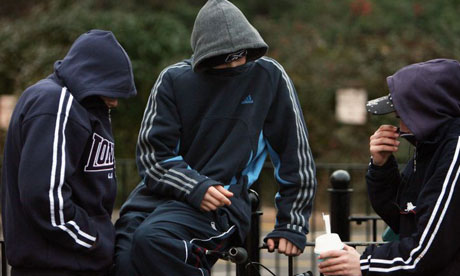
In 1940, we banned the British Union of Fascists, also known as the Blackshirts, because we were in a state of war with Germany, whose government had policies similar to those of the BUF. But since then, we have tended to tolerate wearers of “tribal” clothing unless they break the law. People have been banned from the occasional pub, but have never been subject to a law forbidding them to wear felt collars, bovver boots, leather jackets or hoods that obscured their faces from the increasingly pervasive CCTV cameras.
Let’s also remember that various forms of head and face covering are not unknown among women in Christian society. Consider the mantillas used by Catholic women at worship in southern Europe. Think of nuns. And take a look at this picture of Queen Elizabeth the Queen Mother at the funeral of her husband King George VI.
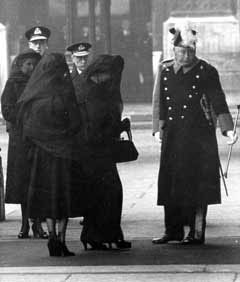
Dress trends come and go. Is it possible that this will be the way with face veils? When the first wave of Muslim immigrants arrived in Great Britain in the Fifties and Sixties, they may not have blended in to society as successfully as some other immigrants did. But many tried hard to fit in to the extent that doing so did not compromise their faith and adherence to the customs of their homelands. The next generation, born in the UK, struggled to reconcile themselves between the culture of their parents and that of the mainstream within which they grew up (see My Beautiful Launderette).
Among the third generation, growing up in the Nineties and during the current decade, some believe themselves to be threatened not only because of their race – a condition well known to the previous two generations – but also because of their faith. Asian Muslims in Blackburn, Luton and Leeds have retreated into communities of the like-minded to protect themselves from the attitudes of organizations such as the British National Party, and from a perception shared by many beyond the BNP that being a Muslim means that you are a potential terrorist. Witness the British bus driver who the other day refused to allow a woman wearing a niqab to board his bus because he considered that she was threatening to his passengers.
It seems to me that if we ban face veils in the UK we will only increase the sense of isolation and apartness among Muslim minorities. We will add fuel to the arguments of those who preach that Britain is a country of governed by unbelievers who oppress Muslims, and are therefore deserving of the consequences of violent jihad.
Perhaps if we work to lift the feeling of oppression and threat among Muslims, use of the face veil among the next generation will decline as a natural consequence of the new generation pushing back against the norms of the previous one. Or perhaps we will come to accept that the wearers of veils do so for their own valid reasons, and that we who are not Muslims have nothing to fear from them, as was always the case with veiled visitors to London before the era of Al Qaeda.
If face veils become a more common sight on British streets than they are today – and consider that we’re talking about a tiny minority of Moslem women, let alone women in general – so what? As many women in Saudi Arabia would tell you about their own country, we have issues far more important than face veils. In the UK, there’s poverty, trans-generational unemployment, gun and knife crime, obesity, drug and alcohol abuse. Beyond the borders of the UK, should we not be more worried about resolving the Israel-Palestine conflict, about preventing nuclear proliferation, about the effects of climate change, about the exploitation of children in Asian factories, about HIV and malaria, and about the looming crisis of water shortage among poor countries in Africa and the Middle East?
Should we not feel more threatened by these issues than by the fact that a 25-year-old solicitor from Leicester chooses to cover her face in public?
A few years ago, when my children were young, like all kids, they went through phases of behavior. Not sleeping, acting up, bickering, becoming surly and offensive teenagers. Each phase caused their parents pain and soul-searching. We used to think that the current phase we were suffering through was forever, until it was replaced by another, challenging in a different way. There were delightful times and tough times. But we all got through them, and today we have two adult children who each have their own challenges, but of whom we’re inordinately proud.
The lesson I learn both as a parent and as someone who has lived through Suez, Cuba, Vietnam, the fall of the Berlin Wall, conflict in the Middle East, the Troubles in Ireland, the creation of the internet, the rise of China, the financial collapse of 2008 and many more world-changing events, is that nothing is permanent. Things get better for some, worse for others.
In twenty years time I confidently predict that nobody will be worrying about face veils. Not because they will have gone away, which I doubt. But because we will either be more comfortable with ourselves and those who believe and dress differently from ourselves – as are the people of Bahrain – or because our obsession about face veils will seem trivial compared with the life-and-death issues facing all of us, regardless of nationality or faith.
Hopefully it will be the former rather than the latter. If we set about fixing the really important problems facing us today, symbols which are a focus for our anxieties will lose their potency, and in Britain at least we will learn again to live and let live.
In my last post I mentioned that I would be publishing extracts of the First World War diaries of my grandfather, Harry Hickson. Here’s the first episode. The diaries have never been previously published.
It’s August 1917. Harry is an officer in the British Royal Artillery. He’s just arrived in France. The “Dolly” he refers to is my grandmother. They were married earlier that year.
Note how, being English, he is able to report, amidst the horrific events he describes, that it was a “lovely day”!
August 4th
Today is the 3rd anniversary of the outbreak of war. I wonder how much longer it will last. We little thought it would last as long as this. We passed Abbeville and Boulogne early this morning and arrived at Calais at 10.30am. We only stayed there about half an hour and then proceeded via St. Omer to Hazebrouck. We stayed there about an hour as I believe the Bosche were shelling Poperinghe, and eventually arrived at Hopoutre, a suburb of Poperinghe, at 4.30pm. Just as we got there the Bosche put over a shell, which landed about 100 yards away, it gave me quite a start. The first I had ever experienced that was really fired at me, so to speak. Then came the parting of ways, for the battery was to split into two sectors, much to my regret. We detrained at Hopoutre and lorries were waiting for us there. Flint took the Right Section of 401 S.B to 306 Siege Battery and I took the Left Section to 309 (H.A.C) Siege Battery. We travelled through Pop to Trois Tours Wood where the headquarters of the battery were. There I met Major Edmondson who is in command and some of the officers. My first impressions are good. The battery is manned by H.A.C officers and men, all good stout fellows I’m sure, and the Major seems particularly nice. We are in the XVIII Corps of the 2nd army under Lieutenant General Sir Ivor Maxel. The Brig General Heavy Artillery is Brig Gen Brake R.A. We are in the 65th Heavy Artillery Group under Lt Col Webb R.G.A. I slept in my first dug out under a bank in Trois Tours Wood and had a very comfortable night.
August 5th
This morning I went with Major Edmondson and a party of 401 up the line to a new forward position at Turco Farm, to get ready for the guns coming, by the way the guns are 6″ howitzers and very good ones with the quick release gear for loading. The Bosche were strafing rather badly and I got the wind up, but no one was hit. I saw my first dead men today, two poor fellows evidently killed in the big advance. They had an uncanny fascination for me which I can’t account for, I had to keep looking at them. We returned to the dug out to sleep and I watched the bombardment at night. It was quite a thrilling sight.
August 6th
This morning I went on duty to an intermediate battery position just in rear of the railway near Orielen and stayed there all day. The Bosche put over a few nasty ones during the day, and Sergeant Saunders was hit in the leg. I slept in a tin shed near the guns and did not feel very safe!!
August 7th
Today I took part in several shoots and stayed on duty in the battery till 6pm, when I returned to Trois Tours and had a bath and change of clothes, both of which were very welcome. Major Chamberlain was hit in the arm but not very badly, Major Stewart left 309 S.B and was sent to No. 18 Siege Battery with 12″ guns. That is the big fellow which fires at night close to here and keeps us awake. However, I had a very comfortable night’s sleep.
August 8th
I had a really slack morning writing letters etc, and after lunch went over to the battery position near the railway. I had a very busy afternoon with shoots etc. Bdr West and Gunner Hatton were wounded, but not badly I’m glad to say. A very heavy thunderstorm came on after tea and upset things completely. I slept on the floor of a dug out and had a very hard restless night, hardly any sleep at all. I think I was rather scared really, I haven’t got used to this fighting and facing death constantly properly yet.
August 9th
This morning I did a very good shoot with aeroplane co-operation. Then we prepared to move the battery position. I returned to Trois Tours at 8pm and had a very comfortable night with no strafing. I was feeling awfully tired and done up.
August 10th
I have had a very busy day at the battery. One section went forward to the new Boront Farm position. I slept at the battery position near the railway.
August 11th
Today I went up to the new position at Boront Farm and was very busy building dug-outs etc ready to occupy it. A violent thunderstorm came on after tea, but we had a cheery dinner in the new dug-out. The other section with a supply of ammunition was expected up and I went to look for them about 11pm as they had not turned up, but they did not appear and I lay down on the floor of the dug-out. I woke up about 1am to find I was lying in about 3″ of water and felt very cold and wet!! I shifted quarters to another dug-out and finished the night quite comfortably. The guns and ammunition were bogged on the way up.
August 12th (Sunday)
It was a lovely morning, sunny and bright. We did a very successful aeroplane shoot and got and O.K on the 13th round and several more OKs and Y’s during the shoot. We had lunch in the open as it was so lovely, and in the middle of it the Bosche strafed us badly with high explosive shells and shrapnel. The first shell landed only about 20 yards from us all (officers) and killed one man and wounded several. It was a horrible experience. One man’s stomach was ripped right open, an awful sight. I had my first letter from Dolly today, it helped to cheer me up a little, the awfulness of war seemed very realistic today, I am sure more of our wounded men will die they looked ghostly as we carried them away. The Huns strafed all afternoon.
August 13th
We had a fairly quiet day today. I saw a very exciting aeroplane fight, a Bosche plane forced one of our RE8 planes almost to the tree tops when another RE8 came along and shot the Bosche down and he crashed. They were quite close and we gave a big cheer. The Huns shelled us badly at night with gas shells and we had to wear our respirators. Another long letter from Dolly.
August 14th
Another wet day, but we have done a bit of shooting – 576 rounds. This afternoon 306 and 184 Siege Batteries were badly strafed. I hope Flint nor any of my old men weren’t hit. We were bombarding Polecapelle from 8.30 to 9.30 tonight, a terrific din. The Huns had a go at us tonight. Splinters were hitting our dug out and we retired to some trenches on our flank from 1.15am to 2.30am when things quietened down a little. Three men were killed, they belonged to the K.O.L.I.
August 15th
It was a lovely day today with just occasional showers. We continued our bombardment scheme as per yesterday. I came back to Trois Tours (which we have still retained) at 6pm for 24 hours rest. I feel I need it too. After writing several letters I had some hot rum and went to bed at 9.30pm. The Huns were strafing No.18 S.B’s position close by, but I had a topping nights sleep, in spite of our heavy bombardment nearly all night. The attack was carried on this morning, zero hour was 4.45am.
August 16th
I woke at 8 o’clock this morning and had a cup of tea, then went to sleep again till 9.30 and had breakfast in bed!! What a luxury! I saw batches of Hun prisoners came into the cages and spoke to some of them. I returned to the battery position about 5 o’clock and carried on with shoots till 8.30pm. The Bosches gave us another bad strafing and we retired to a trench and dug ourselves in for the night. We slept on duckboards, and very hard they were, but fairly comfortable and fairly safe but the darned Huns sent a lot of gas over and we had to wear our helmets again.
August 17th
It was a lovely sunny day again and we did no shooting till 2.30pm. The Huns put a few over at tea time and killed Gunner Jogden, a very fine fellow. They also put over more gas about 9.30pm. I slept in the dug out and had quite a comfortable night.
August 18th
It was another lovely day and we did no firing till 11.30am. I wrote several letters. This evening I left the battery at 5 o’clock and came back to Trois Tours. Some Canadian officers came in and had a yarn and we got the gramophone going. I had some hot rum and got to bed about 10.30pm, the rum helps me to sleep. A Hun plane dropped bombs quiet close during the night and the wood was shelled about 1.30am.
August 19th (Sunday)
I woke at 8 o’clock this morning as usual and had a cup of tea then slept again till 10, and had a bath and breakfast. It was a lovely day and I sat outside and censored letters. Returned to duty at the battery at 4pm, and had quite a comfortable night in the dug out.
August 20th
Another lovely day, this morning I did another successful aeroplane shoot with 5zs 4ys and 2MOKs. Tonight I moved the right section of guns up to the new position at Turco Farm and got them in position for firing. I don’t like the position very much, it seems rather exposed. Slept in a small dug out near the guns.
August 21st
The Bosche gave us a terrible strafing this morning from 9am to 12.30. They did what they call and area shoot and we were in the middle of it! They use all the calibres from field guns up to 8″ and we estimate they put over at least 1200 rounds, it was an awful experience. We were lucky enough to escape with only two men wounded. The afternoon and evening were fairly quiet and the men built dug outs. I went down to the Burnt Farm position for dinner and returned afterwards and slept in the small Battery anchorage dug-out. The Huns strafed badly with H.E shells during the night, and put over great quantities of gas shells from 12.30am onwards. We had to wear our respirators from 12.45-2.15am and at intervals up to 4am when it was fairly clear.
August 22nd
Another big bombardment started at 4.45 this morning. We found Sergeant Welham was badly gassed last night and he was taken to the dressing station at Essex Farm. We have lost a good man in the Sergeant. We got an officers dug out made in the ruins of Turco Farm and some billets for the men. I returned to the Burnt Farm position at 11pm for a good sleep but the Huns strafed badly during the night and I couldn’t sleep.
August 23rd
Gunner Stewart was killed at 5 o’clock this morning during the strafing at Burnt Farm, and we buried him at Bard Cottage Cemetery at 3 o’clock this afternoon. It seems awful that a strong healthy man should be alive and well in the morning and under the sod in the afternoon. Such is war. We cleared up shells, furzes etc at the old position, and the Huns strafed us again, one shell fell near the orderly room and wounded three men. They put a lot over during the night too, they were very persistent!
August 24th
I got up at 5am and went up to an Observation Post (O.P) in an old Hun dug out on Pilcham Ridge, and had a very interesting day. I passed a grave with this inscription, “Here lies the body of an unknown Highlander”. I saw the ruins of Zangemarck church in the valley and also Zounebeke and Polecapelle churches in the distance, all in the occupation of the Huns. I returned to the Turco farm position at 7.30 pm, and had a fairly comfortable night in our new dugout in the ruins.
August 25th
I have had a fairly easy day on the guns, the Huns strafed us again but not badly, I was orderly officer at 6 pm and did a “night lines” shoot from 9 to 10.30pm, then a bombardment shoot from 11pm to 1 am, when the Huns strafed us again, in retaliation I suppose. The bombardment was a lovely sight at night.
August 26th
I was wakened again at 5.30 this morning to do an aeroplane shoot, which was quite successful. Spent the rest of the day making dug outs etc. I returned to Trois Tours at 6 pm, and paid the men who were there, we keep a certain number back there all the time for a spell and clean up. After dinner I got the gramophone going and went to bed at 10 pm, feeling very tired. Some shells fell quite close during the night and it rained very heavily too.
August 27th
I woke at 9.30 this morning and had breakfast in pyjamas, then had a bath and general clean up till lunch. I wrote a letter of condolence to Stewart’s mother, he was one of my original men in 4015.B. I returned to the Turco Farm position at 4 pm in pouring rain and got wet through, especially at the knees. I found the battery had a “stunt” on, and after tea went on the guns and got very wet. The major lent me dry socks and I slept in my wet clothes! I hadn’t any to change to.
August 28th
I spent the morning wading in mud on the battery position, it was most uncomfortable, and occasionally we could see some poor fellow’s boots sticking out of the mud and the know the rest of him was only just covered. We cleared up empty cartridge cases etc. Did a blind shoot in the afternoon, very windy and showery. I was Orderly Officer at night and did a shoot about 10 pm. Slept in a small dug out with P. H. Edmondson the major’s brother, and had a very cosy night. It was a lovely moonlight night too.
August 29th
We spent the morning getting the gun trails settled on the platforms, very showery. Did a blind shoot in the afternoon and afterwards drained the position. Comfortable night in dug out.
August 30th
The Huns started strafing us at 8 o’clock this morning with 11″ and 8″ shells, big fellows, which made a great shindy. We cleared off to a flank and let them go ahead, so had no casualties and no guns were hit. They continued till tea time and put over from 300 to 400 rounds, and the road was very badly cut up. We did a shoot in the evening and I had a comfortable night.
August 31st
We did three counter battery “stunts” during the day, I hope we relieved some of our batteries of the Bosche attentions. The Huns later on retaliated with more of their 8″ stuff, which isn’t a bit pleasant. I was Orderly Officer and ammunition arrived for us about midnight, and also had to turn out for “night lines” shoot at 4.30am. Then I had to report at 7 am so had very little sleep.
September 1st
I have spent all day getting the position and ammunition squared up after the strafing we have had, it was very showery again. We did a 200 rounds shoot in the evening. The Huns strafed again during the night and nearly hit Nos 1 & 3 guns, they evidently spotted our battery. I turned out at 3.15 am to do a shoot for P.H. who had to go to an O.P.
September 2nd
A lovely day but slight showers. We did a 200 rounds shoot this afternoon at battery fire 1 second. Then tried a shoot with P.H. in the O.P., but the light was too bad. I came back to Trois Tours at 7 pm. feeling very tired, and had a very comfortable night. Several Hun planes dropped bombs in the vicinity.
September 3rd
I got up at 9.30 this morning and had breakfast in pyjamas, it was a glorious day. Had a bath and good clean up in the morning. I left Trois Tours at 3.45 pm and when I got near the position I found the Major and all the men in trenches to the south west of the position as the Huns were having a terrific “area strafe”. We went back to the mess about 6 pm and the Huns were still shelling the ridge about 100 yards in front of us with 8″ stuff. We went across to the battery and found that about 200 fuses and 600 cartridges had gone up, and they also had a direct hit on No 4 bunker. We cleared up the debris and camouflage and then had tea. The Huns started again near the battery at 8 pm with 8″ and then about 10 o’clock sent over a lot of gas, which did not disturb us very much. Very comfy night in the little dug out.
September 4th
A lovely day, nothing exciting happened. We tried to do two aeroplane shoots, but no luck owing to bad visibility. I got into pyjamas for a change, but heard at midnight I had to man the O.P. next day. Comfortable night.
September 5th
I was up at 6 o’clock this morning and went to the O.P. with two signallers. I had a very busy day there but rather monotonous. Returned at 9.30pm, and had dinner, then slept on the ground in the mess as Forsyth was O.O, and had quite a comfortable night.
September 6th
I spent most of the morning getting No. 3 gun down to the road to go to workshops. Did a very successful shoot in the afternoon with 2 OKs (one a direct hit on No. 4 gun pit) 3 Y’s and 3 Zs. I have had a wretched pain in my stomach all day, I don’t know what has caused it. I turned out to do a shoot at 8.30 pm and felt very rotten. I slept in the little dug out but did not have a very comfortable night as the Bosche put more gas over.
September 7th
I felt very seedy this morning and went down to Group H.Q. to see the doctor, who thought the water was the cause of the trouble or that I was slightly gassed. I should think probably the latter. I then saw Gunner Patten off to G.H.Q. for duty. Had a slack afternoon waiting for an aeroplane shoot, which did not materialise, so did a blind shoot at 5 pm. The Huns started strafing again at 8 pm and got a direct hit on one of the men’s dug outs. Gunners Heathcote and Upsdale were killed, Read and Terry badly wounded. It was an awful business sorting them out from among the debris in the dark and hearing their moans. Slept in the little dug out, but very uneasy night.
September 8th
Very misty morning and slight rain. Felt a little better, but my stomach is still out of order, spent the day getting the position squared up, and building furze and cartridge recesses. Read died of his wounds today, a most unlucky shell for us.
September 9th
I had another wretched day with stomach trouble. Spent the day on the position, still carrying on, we dug out a “dud” the Bosche put under No 4 gun position. We also rebuilt our dug out, and it is now much more comfortable. I was Orderly Officer at 6 pm. The Huns strafed us again very badly during the night, and the whole battery had to clear out at 2.30 am. Our men are getting a bit “windy” and no wonder! Luckily we had no casualties, but one shell hit the ration bivouac and upset our food! It was a lovely day.
September 10th
Another bright day, nothing of note happened. Spent the morning on the position clearing up etc. Felt a little better. Fairly comfortable night, although we were shelled again, and the Bosche also gave us another taste of gas.
September 11th
A glorious morning, lovely bright sun. Spent the morning censoring letters and doing an unsuccessful aeroplane shoot. I saw the doctor again and he advised a 24 hour rest at Trois Tours. The Huns shelled us again at 3.30pm and got a direct hit on another dug out, which luckily was empty, the second shell nearly hit our dug out and we cleared to a flank in double quick time! This constant shelling is getting rather too much. It upsets one’s nerves. We were lucky that second shell just missed us, or the battery would have needed a new compliment of officers! We waited for another shoot till 6pm and as that didn’t come off I left for Trois Tours, called at Camp H.Q en route for medicine and arrived at T.T at 7.30pm. I had a light meal and after writing to Dolly I had some hot whisky and went to bed. At 11pm I received news that the battery was to go out of the line for a short rest – we badly need it. The Huns dropped bombs very near and also shelled during the night, but I slept very soundly.
September 12th
I got up at 9.30am and had a bath and general clean up, then wrote several letters. My stomach still feels very rotten. The Major arrived for lunch and Knox (Captain), P.H and Forsyth later. I left Trois Tours with the men at 2.45pm, and met the motor buses on the Vlamerstinghe road about 3.45pm. The Major, Knox and myself went in the Sunbeam car and left the buses on the Poperinghe road and went on to Cassel for tea at the Hotel du Sauvage, it was a lovely trip and already the war seems a long way off. After tea we motored through Noordpeene to Lederszeele (where we had a puncture) and on to Millaine, our rest camp, where we arrived about 6pm. We found no one in camp and we bagged a nice hut for ourselves and tents for the men. The others arrived about 8.30pm and we all soon settled down. Very comfy night.
A couple of days ago the first new World War One cemetery for 80 years was dedicated in Fromelles in northern France. It contains the remains of 250 Australian and British soldiers who were among the 7500 killed in the allied offensive at Fromelles, a feint intended to divert German troops from the upcoming Somme offensive in July 1916. The Germans saw through the ruse. The resulting slaughter was as meaningless as any in that monstrous conflict.
The story came at a time when I was helping to clear my parents’ house in advance of its sale. I was keen to make sure that no family memorabilia were accidentally thrown away. In the process I discovered many photographs and documents that I hadn’t seen before. I was particularly looking for mementos of my maternal grandfather. He was an officer in the White Star Line (owners of the Titanic) at the time the war broke out. Rather than join the Navy, he chose to serve in the Royal Artillery.
One of our most treasured pieces of family history is my grandfather’s war diary. Although he transferred from the White Star Line to the Army early in 1915, for various reasons he didn’t arrive at the Western Front until August 1916. His diaries cover the entire period of the War. As in many diaries of the time, he describes life on the ground rather than the grand sweep of historic events.
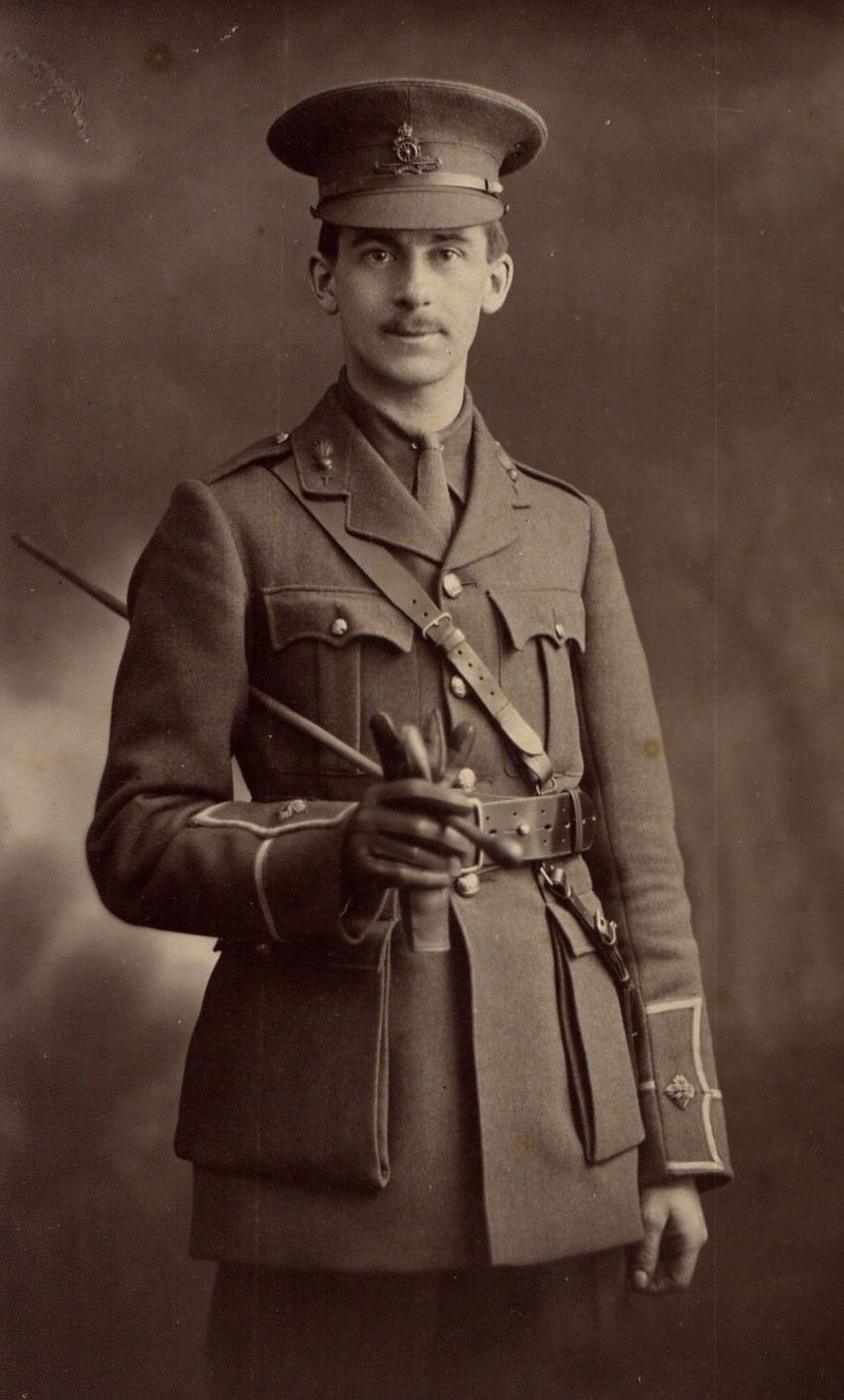
Lt Harry Hickson, 1915
I never met my grandfather. He died of stomach cancer in 1933 in his mid-forties. The received wisdom within the family was that his life as an engineer in the White Star liners – much of which will have been spend among the engines – was responsible for the cancer. Reading the diaries, I’m not sure. He suffered from frequent illness. He was caught up in gas attacks several times – part of his job involved training his regiment to protect themselves from gas.
The diaries graphically bear out other descriptions of life on the Western Front. Long periods of boredom punctuated by short episodes of sheer terror. He was not afraid to admit his fear.
Harry Hickson comes over as a profoundly decent man caught up in a world over which he had little control. Like so many others, he survived by luck rather than courage, and knew it. He didn’t live long enough to see his only son killed in the Second World War, but he saw enough horror to last his lifetime.
Among the items I found at my parents’ house was Harry’s war medals. As a collector of ancient coins, I’m moved by artifacts that have been touched and used by many before me. War medals are different. Kept in a box and brought out for the occasional ceremony, they will have served as a reminder to one brave man of his part in a profound human experience shared by too many in the past century and now in the current one. To hold them is to connect personally to someone with whom I share genes but not a common memory.
I have never been in a war. As much as any of the war movies I’ve seen, Harry Hickson’s diaries in their modest way provide me with an insight into an experience many are still going through today.
In the next post, and possibly more thereafter, I’m publishing extracts from Harry’s diary. It’s a small tribute to the dead of Fromelles and all who have suffered in war since then.
Looking at the pictures of the recent spy swap between Russia and the US caused me to think about what motivates a spy these days.
During the sixty-odd years of the Cold War, the motivation of those who passed the secrets of the West to the Soviet Union was largely ideological. Burgess, MacLean, Philby and Blunt in the UK, and the Rosenbergs in the US, acted out of a sense of commitment to a social ideal represented by Soviet Russia. Soviet missions in the West did their work though planting agents in deep cover, and through judicious use of honey traps and financial inducements.
Those who spied for the West seem to have done so for similar reasons, except that when they betrayed Soviet Russia for reasons other than blackmail, their motivation was anti-ideological rather than ideological. They were against communism rather than for capitalism. Many had been to the West and compared the luxury they found with the privations of their homeland. They defected for the same reason that brought economic migrants to the US and the wealthier parts of Europe for centuries: the desire for a “better life”.
Of course this is a massive generalization, and no doubt you could find in the archives of the KGB, CIA and MI6 learned tomes analyzing down to the last detail the motivation of every traitor who crossed the border since 1945. But I suspect that the general theory holds true.
But where do today’s spies come from? What is the Russian ideology that they might hold dear? It seems to me that since the collapse of communism there is no driving political and social ideology in Russia. The only unifying force is patriotism, which is still strong enough to enable politicians like Vladimir Putin to reestablish many of the government controls that were a way of life under the Soviet system. And, ironically, strong enough to allow George W Bush rein in personal liberties in the Land of the Free after 9/11 through the Patriot Act.
Looking at the backgrounds of the recently repatriated spies, it seems that altruism and love for country played little or no part in their willingness to spy for Russia. The deal seems to have been this. “Espionage is a career, not a vocation. In return for a pleasant lifestyle in the West and a guarantee of a state pension, carry out intelligence gathering under assumed identities. If you’re caught, we’ll do our best to swap with the spies we’re holding, and bring you home.” So Anna Chapman, the daughter of a former KGB official, swans around the world, sets up a dotcom with the aid of the Russian government, blissfully unaware that she and her colleagues have been watched over by the FBI for the past eight years. Others, including two couples whose children were born in the West, lived unexceptional lives, and carried out unspecified but apparently ineffective espionage.
In the halcyon days of the Cold War spy scandals, state secrets were perceived to be critical to the balance of power. The West and Soviet Russia saw each other as enemies in waiting, and Russia’s success in getting hold of America’s nuclear secrets in the Forties and Fifties sparked a protracted arms race, with massive consequences for both sides. In contrast, today’s East-West espionage seems a tame and inconsequential activity. The spies themselves seem to have been rootless citizens of the world familiar through experience with the Western world, far more comfortable with LinkedIn than the Lubianka.
The other night I had dinner with a friend who holds a senior position with one of the UK clearing banks. He told me about an intern from South America who was working in his team. He mentioned him as an example of a generation of rootless young professionals who feel that they owe no loyalty to any one country. Their sole focus is personal advancement. Their aim is to make as much money as possible in the country which offers the best prospect of doing so. He wondered if this guy represented a transnational elite who in the future will flit from country to country with no responsibility to anyone but themselves – the individual equivalent of the multinational corporation. The rest of us will slowly descend to helot status, tied to our countries, our declining economies and our increasingly authoritarian political systems.
You could argue that people like Roman Abramovich, Lakshmi Mittal and others of their ilk already form that elite. But they are few. As people like my friend’s intern join them, perhaps they will become many – and travelers like Anna Chapman nee Kushchenko will represent the transnational ruling class – or appear to do so.
I don’t actually believe that we will become bonded laborers any time soon, though you could say that many people in developing countries have been reduced to that status by globalization. Even in the poorest countries there is a route out of poverty, and money usually serves to ease the weight of social and political control. But I do believe that the wealthy and well connected, regardless of nationality, are fast becoming an elite which is largely immune from close political control, albeit one that still accepts new members. And just as football clubs promoted to the top leagues find it hard to become permanent fixtures, so people who join the economic elite find it hard to stay there. Political and economic volatility see to that, as Mikhail Khodorkovsky, the Russian oligarch crushed (as he claims) by the Russian state, would testify.
It’s also untrue to think of the world as ideology-free. In 2010, the West wakes in the middle of the night on a cold sweat not about international Marxist Leninism, but about Islamism, another transnational ideology far harder to confront than the monolithic and very physical threat of Soviet Russia, in that it has no borders, no state apparatus and an ephemeral organization. Yet the same secrets that the former protagonists worked so hard to protect – nuclear technology and delivery systems – are still the target of every would-be nuclear state, and many believe that it’s only a matter of time before an Al-Qaeda inspired group acquires a nuke in a backpack.
Which is why Anna Chapman and her colleagues are a sideshow. The real challenge for Russia and America is preventing technology that has already leaked beyond their borders from blowing up in their faces.
Meanwhile the transnational elite get more rootless and ruthless, and the rest of us find our privacy and liberties steadily eroded in the name of the War on Terror.
I’ve just got back from a brief trip to Paris, where I stayed with a colleague and his partner. Marie is the French equivalent of a health visitor. When Fred and I arrived at their place after our meeting, Marie mentioned that on her first visit of that day, she found her patient, a sixty-year-old man, slumped in his chair, blue in the face and obviously dead. It seemed that he had died of a heart attack. Marie had only seen him for the first time the day before. He had no friends, no family, and died alone.
What had he achieved in his life? Many things, perhaps, but none of them were apparent at the time of his death.
I’m not generally prone to morbid contemplation, but Marie’s story set me thinking about what people achieve in life, and what those achievements mean to them and those around them. I particularly thought about business leaders.
If you run a business, you have to keep your shareholders, your partners, your customers, your employees, your backers and your banks onside. You have to be the one who is constantly pushing out the envelope, looking further than everyone else, thinking the big picture.
The outside world sees you as the boss – the person with the ultimate power. But the reality is that you don’t have that power. You’re beholden to many interest groups within and without your company. Having the ultimate power over hundreds or thousands of employees does not mean that you control your own destiny or theirs.
And what’s your typical day? Thinking great thoughts? Turning your company from good to great? Not in the world I know. Your typical day consists of dealing with hundreds of emails, most of which have been copied to you because the sender is looking to influence you, sell to you, undermine you, and rarely to inform you. You read reports that are three times as long as they need to be, and use your comprehension skills to strip the out the bull and ignore the grinding axes. You’re constantly travelling for meetings with stakeholders, and donning the mask of confidence and decisiveness for the outside world. Many of the people you deal with you have little respect for, and trust only as far as you can throw them.
You make decisions that not only result in million-dollar spending, but launch hundreds of meetings among your staff that cost many times the value of the dollars you spend, and thousands of emails, more words than are written in the bible. Words that one day can be exhumed by a regulator, a court or a congressional hearing to prove your incompetence or criminality.
You watch your back, flatter your stakeholders, trust nobody except for a tiny band of confidants and hope for the best. Meanwhile, your spouse is complaining that he or she never sees you. Your daughter is taking drugs. Your son has dropped out of University. You’ve developed a hernia through overexertion in the gym. The only movies you see are in your hotel room. You never read books except ones about business. You spend most of your holidays glued to your Blackberry, or worse, chained to your laptop. You give interviews with the business press about your balanced lifestyle, the hobbies you never pursue and the country house you never enjoy.
If you’re lucky you end up being kicked upstairs to enjoy a lifestyle of non-executive directorships, country clubs and discreet affairs. It’s your turn to kick the CEO. If you’re unlucky, you get kicked out and spend the rest of your years trying to fill the void. Suddenly all that money is no comfort when you’re left with no purpose, no interests, no reason for being. If you’re even unluckier, you keel over while still in harness, either into the grave or a life of incapacity.
And what have you achieved? Increased shareholder value? Kept the company alive for a few more years? Only a handful of leaders can say that they have transformed their companies or changed the world – people like Bill Gates, Steven Jobs and maybe Mark Zuckerberg. Most other leaders have been cogs in the wheel, dependent for their self-esteem on the intravenous drip of power and wealth. Some have made a big difference – led their businesses in different directions, perhaps transformed them, but not in a way that anyone outside business would notice. Just another paper manufacturer has become just another mobile phone manufacturer. So what? There are others.
For all the glamour and prestige attached to the role, most CEOs spend most of their time just getting by. Going to meetings, dealing with email, waiting for the next crisis to hit them, the next fire to put out. Struggling to implement someone else’s objectives, someone else’s agenda, while being acutely aware that just around the corner there’s a tsunami, an earthquake or a tornado waiting to flatten them. Knowing that it’s important to have a convincing strategy, but even more important to have convincing excuses for having failed to implement it.
Who would be Tony Hayward today? Three years ago he rises to the top job in a world class company, BP. Suddenly his whole world is blown apart by a leaking oil well. Derision is poured upon him by institutions, self-serving politicians, the wounded and the damaged. The poor guy works for sixty days on the trot trying to cap the well, and when he takes a day off to go sailing, he’s accused of being uncaring. BP will never be the same again. Most likely, he will never be the same again. He’ll go down in history as the man who ruined the Gulf of Mexico. O fortuna, velut luna.
When I was twelve, I wanted to be the Prime Minister of my country. Reality quickly set in, as it does for most of us, and I spent my twenties having a lot of fun. In my thirties, as I rose through the ranks, I watched companies, for all their strategies, visions, missions and values, just getting by. In my forties, a partner and I started a business that was under our terms of reference highly successful. When we got to the point that we were just getting by, we sold them.
I’ve enjoyed running companies. I managed to avoid some of the downside because I never ran a public company – I was answerable only to a limited number of shareholders. But I’ve seen others go through it. Today I run a couple of smaller companies, and I’m even happier, because I have more time to think, to enquire and to discover. Hopefully I have time left to focus even more on trying to make a difference.
A by-product of having more time is that when I read the newspapers, I can focus on what interests me as well as sections like the business pages that I feel I must read. One of the delights of The Times, which is my regular paper, is the obituaries. They tell stories of extraordinary lives. Of people who have made a much greater impact on their limited worlds than Microsoft or Apple have made on the multitude. I find the diversity of their lives inspiring. They may not all have been as happy or successful as they would have wished. But to themselves and to others, their lives had meaning. They didn’t just get by.
If someone starting a career in business were to seek my advice, I would offer them five thoughts. First, feel lucky, because there are billions around the world who struggle to get from one day to the next. Second, be aware that you are going into a world where you will spend most of your time getting by, because that’s the nature of business. Third, never be content with just getting by, even if all around you seem resigned to it. Fourth, if you’re lucky, you will encounter a few moments of joy and triumph, or equally despair and pain, which shatter the equilibrium. And finally, imagine that someday someone might write the story of your life, and make sure you can look back with pride on at least some of the things you’ve achieved.
What do I personally learn from the lives of the nurses, musicians, war heroes, civil servants, explorers and, yes, CEOs and even politicians, whose lives are celebrated in the obituaries column? It’s not that I wish I could have lived a life like theirs. But if I can look back on my life and say that for at least some of my time, like them, I didn’t just get by, I’ll drop off my perch with a smile on my face.
I hope the guy in Paris had some great moments, however anonymous his death.
I belong to a number of groups on Linked In. I subscribe to one or two websites that provide wisdom on various topics such as innovation and intellectual capital. I get a huge number of emails from these sources. They all come to what I call my toxic email account.
Why don’t I block them all and purify the account? Or better still, change the address, and let the emails keep flying into the void?
Because occasionally, very occasionally, in amongst the river of crud that flows my way, I pick up the odd nugget of wisdom, a little bit of intelligence, or a post that is pricelessly, laughably banal.
Here’s one in the latter category from a self-styled Thought Leader on one of the Linked In groups:
“There is no need for me to have any fatidic skill to tell you the business world is a very different place to that of five years ago.
* The GFC has reminded us that risk and uncertainty are increasing.
* Innovation, advancements and development have generated accelerating change – social, economic and technological.
* Competition is increasing locally, and globally – China, India, South America.
* Complexity is increasing while the need for simplicity has never been so great.
* Interdependency is increasing.
* Ethics and public opinion are increasingly influencing corporate decision-making as societal issues increasingly become political issues. Assisted by the media having access to practically anything, anytime, anywhere, anyhow.
To build an organisation that can survive and thrive into the future in this uncertain world will require exceptional leadership, a compelling vision, an inspiring mission, personal and organisational alignment, clear and concise goals, measurable objectives and superior human performance.
What are you doing now to prepare for this?”
Oh my goodness. First thing I had to do was look up fatidic on Google. OK, it means prophetic. I feel like an idiot already that I didn’t know this. But he’s a Thought Leader – thinks on a different plane. Or maybe on an intergalactic starship. By the time I got to his sixth bullet point I was in a state of extreme anxiety. Hell, I didn’t know any of this!
Then I read his rousing penultimate paragraph, and said to myself “YES, that’s what we have to do!”
What am I doing now to prepare for this (whatever “this” might be)?
Well actually, I’m going to have some breakfast.
More on thought leadership later….
The blog scene in the Middle East is fascinating. It provides great insight into social attitudes among the younger Saudis, Emiratis and Bahrainis. Admittedly most of those who blog in English tend to be socially liberal, in that they are very impatient with conservative attitudes in countries like Saudi Arabia. But that doesn’t lead them to reject all aspects of their culture. All of them take their religion seriously, and consider themselves good muslims.
A friend in Saudi Arabia – who is collaborating with me and a colleague on a book aimed at helping GCC students to adapt and prosper when they go to study at a Western university – sent me a blog posting talking about men from the Gulf who go abroad, chase after western women and break their hearts when they go home and revert to the conservative lifestyles they left behind.
http://majda-says.blogspot.com/2009/02/khaleeji-runaways-who-treat-their.html
He sent it to me because relating to the opposite sex is one of the hot topics of concern among Middle Eastern students when they go abroad. Many of the men have no experience of a woman of the same age, apart from siblings, because mixing between unmarried men and women is frowned upon, and strictly forbidden in Saudi Arabia.
My friend was interested in my feedback. I responded to him in this way:
“Wow. That’s a full range of attitudes is it not? None of the guys would admit to being like those the lady was talking about, but I suspect there’s some truth in what she’s saying. But it’s always dangerous to generalize, and also dangerous to believe that if guys behave that way, that’s “how they are”. People experiment when they’re young. I did, most of my friends did.
What some people don’t realize is that western guys go equally crazy. I went to an all-boy boarding school. I doubt if I saw much more of single women than the average Saudi guy who goes abroad to study. Same with many girls, who are educated by religious orders (ie nuns). “Loving” and leaving people is not good in any society, but khaleejis are not unique in this.
As I keep saying, if you look for them you’ll find more similarities than differences!”
Some of the Arabic blogs are less benign, I’m afraid, and I hate to think how some of them would have reacted to the piece. But the open way in which the blogger and the people who commented debated the issue shows that it’s dangerous to stereotype the people of the Gulf.
Not much to say about England’s World Cup demise beyond what has been said already all over the English media, except for this.
The Sunday Times yesterday reported that following the dismal draw against Algeria, gloom descended on Chancellor George Osborne’s speech-writing team preparing for the emergency budget statement. I quote:
“We realized then that we would be delivering the budget at a time when England were still to qualify for the knockout stage of the tournament” said an aide. “There would be no feelgood factor to propel us. We would need a darned good speech.”
For goodness sake, do they think the electorate is that stupid? That we would all wake up the following morning bleary eyed but euphoric, thinking “that’s OK, George. 20% VAT? No problem, we’re into the next round!”?
If anyone believes that the world is as it was in 1966, when the World Cup victory was credited with winning the election for Labour, and when millions of happy workers raised their productivity in the steel mills, coal mines and car factories, then they are hopelessly naïve. For starters, there are virtually no coal mines, steel mills and car factories left. Do they think that the denizens of our service economy would have their collective foot on the gas and sold more derivatives, houses and mobile phone contracts? Would the unemployed have worked harder at being unemployed?
Not likely. Those who could afford it would have been in Wetherspoons and wine bars getting wasted until 2am. The economy would have lost a good thirty percent of its productive capacity for the months of June and July. Now at least the hangover will be painful but short.
The mentality of the government spin doctors is the same as it was nine years ago, when one of the Labour “communications” team remarked in an email that eventually came to light that 9/11 “was a good day to bury bad news on the economy”.
I’d love to know what they were planning to bury on the day we won the World Cup. They probably thought that it would have been a good day to announce the abolition of the National Health Service and old-age pensions. So this is what our sons and daughters learn on those super media studies courses at University…..
I was also amused to see the photo of David Cameron watching the England-Germany match with Angela Merkel at the G8 Summit. As self-conscious a couple as ever you would see. If the tabloids weren’t hard at work pouring derision over our unfortunate footballers, you could have counted on their coming up with some creative dialogue between the two.
I understand that Angela apologized to David for the goal that wasn’t. Apologized? Why apologize, unless the apology went something like: “I’m so sorry David. We had arranged for that to happen in the last minute of extra time with the score at 3-2 to Germany. What goes around comes around, mein freund.”? No doubt his reply would have been “that’s alright Angela, your team has only caused a Europe-wide sovereign debt meltdown and cost me the next election.”
Cheer up David, we’ve just beaten the Aussies at cricket. Surely you can get away with burying the abolition of the Prison Service?
I tend to dream in words rather than pictures (which is probably why I hate those complicated diagrams beloved of management consultants and bureaucrats).
This morning the following words were fresh off the dream press when I woke up:
“You are so rare! It is deleted from the blood of a monkfish.”
It would be interesting to see what entrants in a short story competition would come up with if they had to use that line as the start or the end of their story…..
 59steps